
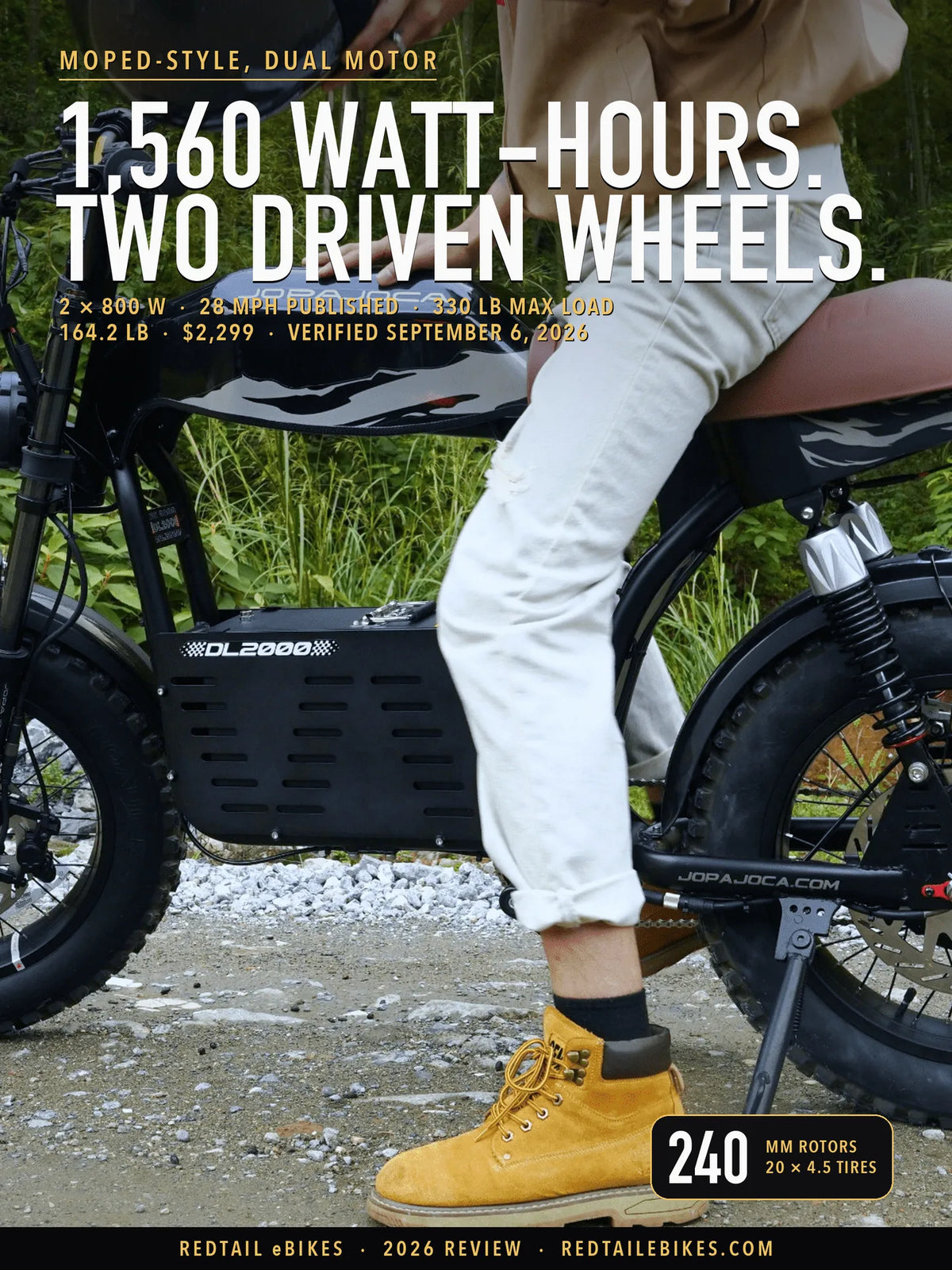
52V dual 800 W hubs · 2 × 65 N·m · 1,560 Wh · 28 mph published · 240 mm hydraulics · 100 mm fork · 330 lb max load · 164.2 lb · $2,299 · verified September 6, 2026
Quick Answer — The Eahora DL2000 is a $2,299 dual-motor moped-style e-bike: two 800 W hubs, 1,560 Wh, 28 mph published, 164.2 lb, a 330 lb max load and a fixed 34.3-inch bench. It is built for a rider with ground of their own to use it on, or a plated-vehicle plan for the road.
Every figure on this page comes from Eahora's own documents, opened and archived on 6 September 2026, and the maker publishes the same numbers on three separate surfaces. Two things to settle before ordering: which vehicle class your state puts a 1,600 W machine in, and whether a fixed 34.3-inch bench fits you.
Order the DL2000 with free shipping to the lower 48, browse the Eahora range, or read on.
Takeaway
- Two driven wheels and 1,560 watt-hours at $2,299. Both hubs drive, the display lets you pick front, rear or both, and the pack is among the largest in this price band on our shelf.
- The maker's own numbers agree with each other. Product page, detail page and comparison grid publish the same speed, power, battery, weight and load. That consistency is not universal in this category, and it made this page straightforward to verify.
- 240 mm rotors and a motor cutoff on both levers. That is a bigger rotor than several machines above this price, and the right braking architecture for a bike with two driven wheels.
- Check the model name before you compare prices. A separate, higher-powered DL2000 sells on Amazon at 2 × 2,000 W and $4,383. Same name, different machine, nearly double the money. What a 2,000 W figure actually describes, and the four different machines it is attached to, is the opening of our 2000W e-bike guide.

What's on this page
- Who the DL2000 is for
- How we verified this review
- Eahora DL2000 specifications
- The model name is shared with a faster machine
- Two motors, and what the torque figure means
- 28 mph published, and the numbers the internet gives instead
- Where 1,600 watts puts you: the 51-jurisdiction screen
- Range: 1,560 watt-hours and what it buys
- Brakes: 240 millimetres, and the maker's own answer
- Suspension, tires and 164 pounds
- Fit: a fixed bench at 34.3 inches
- The Mercer fit test
- Living with it: rain, racks and the throttle
- Has it been recalled?
- Battery standards, and what this page can tell you
- What owners say
- Against our own shelf
- Warranty, returns and what changes when we sell it
- Ordering, shipping and support
- The honest ledger
- Who should buy it
- Before you buy: the checklist
- Limitations of this review
- The source register
- Frequently asked questions
- The bottom line
Who the DL2000 is for
Start with the shape, because the shape is what sells this bike. The DL2000 is a moped: a long padded bench, a steel frame, 20 × 4.5 tires and a riding position you sit in, not one you sit on. Eahora took the look from the Douglas Dragonfly and calls the model "Dragonfly Light 2000W" in its own copy.
Underneath that shape is a genuine traction package. Two 800 W hubs drive both wheels, the display lets you run either one alone or both together, and 4.5-inch tires at thirty psi put a lot of rubber on loose ground. At $2,299 with 1,560 watt-hours, the value case is strong.
The deciding number is published and it is 1,600 watts nominal, which places the machine on the motor-vehicle side of the ledger. So the first question is not how good the bike is. The first question is where you plan to ride it.
Two riders should read on. The first has land — private property, an OHV area, a track — and wants the most bench, battery and traction that $2,299 buys. The second lives somewhere a moped or motor-driven cycle plate is obtainable and is happy to get one.
The differentiator, in one line: at $2,299 the DL2000 carries 1,560 watt-hours and two driven wheels on a steel moped frame, and the Romeo II at the same money carries twice the battery and one driven wheel. That trade is the whole decision, and the comparison section works it through.

Eahora's own frame of the DL2000. The bench runs the length of the top tube, the pack sits in the frame triangle, and both hubs are driven.
How we verified this Eahora DL2000 review
Verification basis: spec-verified. We sell this bike; every figure on this page is its maker's published specification, confirmed at the maker's page and recomputed. Every sentence describes what a document says, what arithmetic on those documents yields, or what a photograph shows.
What we opened. Eahora's rendered product page and its product feed; the maker's DL2000 detail page; its model-comparison grid; its warranty page; the two Amazon listings that carry this model name; and Eahora's own published owner-review module. All were retrieved and archived on 6 September 2026. Our own listing was read through the store's administration interface the same day.
What we computed. Watt-hours per mile under the maker's own range band; hours-to-full from amp-hours and charger amps; the rider allowance left after the bike's own weight under two readings of the load rating; and the electricity cost of a full charge at the published national residential rate.
What we screened. The published 1,600 W and 28 mph against the e-bike definition of all 50 states and the District of Columbia, using the same statutory table every review on this site runs. The federal model for those definitions is 15 U.S.C. § 2085(b). One row per jurisdiction, each with its section and its reason, is saved.
Reading the comparison grid by its own keys. Eahora's model-comparison page is a layout grid rather than a table, and read in document order the model names arrive first and the values after, so the first speed cell appears to belong to whichever model is named first. Every cell on that page carries the model's own handle, and the figures quoted here were taken by that handle. It matters: the first speed cell on the page reads 45–50 MPH and belongs to the Romeo Ultra II. The cell belonging to the DL2000 reads 28 MPH.
The recall instrument was proved before its answer was believed. The federal recall service returns nothing for this brand on four separate fields. Before printing that, the same service was queried in the same session for a brand with a recall on the record, and it returned recall 24075 on two of those fields. A zero from a working instrument is a finding. A zero from an untested one is not.
Where the questions came from. Every question this page answers was observed being asked: 1,230 phrasings harvested from Google's suggestion endpoints on 6 September 2026, six questions Eahora publishes on its own DL2000 page because buyers asked them, and a six-prompt AI-answer panel run the same day. One question is marked in our ledger as an editorial addition, and it is the one about the Amazon listing.
Corrections: support@redtailebikes.com. A verified error is fixed on the page and logged in the limitations.
Eahora DL2000 specifications
Every row is Eahora's published figure for this model, read on 6 September 2026 from the maker's own specification block and cross-checked against the model-comparison grid entry keyed to this bike. The two agreed on every row.
| Specification | Eahora's published figure |
|---|---|
| Price | $2,299 at our store, against a $2,599 reference price |
| Motor | 2 × 800 W, peak 2,000 W; brushless, IPX6 |
| Torque | 2 × 65 N·m maximum — 130 N·m combined |
| Top speed | 28 mph, for both pedal-assist and throttle |
| Battery | 52V 30Ah lithium-ion, 1,560 Wh |
| Battery lifespan | ≥ 1,000 charge cycles to 80% of capacity |
| Range | 40–50 miles without pedal-assist |
| Charger | 58.8V 4.5A quick charger, 5.5–6.5 hours |
| Brakes | Hydraulic disc with motor cutoff, 240 mm rotors, 2-piston calipers, semi-metallic pads |
| Front fork | Adjustable hydraulic suspension, 100 mm travel |
| Rear shock | FASTACE coil suspension |
| Tires | 20" × 4.5" fat tires with tube, 28–33 psi |
| Drivetrain | Single speed; 44T chainring, 24T rear |
| Frame | High-carbon steel, 20" × 17" |
| Bike weight | 164.2 lb with the battery installed; the battery alone is 28.9 lb |
| Max load | ≤ 330 lb, "to ensure the performance and safety" |
| Rider height | 5'7" – 6'4", or inseam ≥ 28.7" |
| Seat height | 34.3 inches, on a fixed bench |
| Handlebar height | 44.5 inches |
| Throttle | Full twist |
| Display | Color LCD, cruise control, 6 km/h walk mode, five riding modes |
| Motor control | Front only, rear only, or dual drive |
| Lighting | 2,500 lumen (25 W) LED headlight with built-in horn; brake-signal tail light |
| Waterproofing | IP65 on the electrical components, per the maker's own answer |
Two 800 W hubs · 1,560 Wh · 28 mph published · 330 lb max load. In stock today with free shipping in the contiguous US. Warranty claims on a bike bought here come to us.
See the Eahora DL2000 — $2,299
The driven rear hub and its 240 mm rotor. The front wheel carries the second motor and a rotor of the same size.
The model name is shared with a faster machine
Search this model name and the first results are not this bike.
Two Amazon listings and an eBay listing carry "eAhora DL2000" in the title at 4000W and 44MPH. One of them, the "2025 Version", publishes 2 × 2,000 W motors, four-piston hydraulic brakes and a price of $4,383; the other carries the same model name at the same power figure. That machine shares this one's battery size, tire size, frame material and 330 lb load rating, and it is a different, higher-powered product.
The bike reviewed here is the one Eahora publishes at eahoraebike.com: 2 × 800 W, peak 2,000 W, 28 mph, $2,299 from us. The gap between the two is 2,084 dollars and 16 miles an hour.
Why this comes before anything else on the page. Three of the six AI-search prompts we ran returned the 4000W/44MPH figures as the answer to a question about this model, and one of them stated "up to 2000W per motor, with peak speeds of 44 MPH" in a sentence about street legality. If you have been comparing the DL2000 against something else on a 44 mph number, you have been comparing the higher-powered machine.
The bare model designation is worse than ambiguous, and the harvest behind this page shows it. In the same suggestion harvest, "dl 2000" returns a winch, a camera and a battery line from three unrelated categories. The brand-qualified term is the only one that reaches this bike, which is why this page uses it everywhere.
Two motors, and what the torque figure means
Eahora publishes a maximum torque of 2 × 65 N·m. Read it the way the maker writes every other paired figure on the page and it means 65 N·m at each hub, 130 N·m across both.
An AI-search answer we ran on 6 September stated "up to 130N·m torque for each" motor, then carried that figure into a comparison against another bike. The difference matters: 260 N·m would be a different class of machine, and the number is the one a reader would use to judge a hill.
What two hubs buy you. Traction, first. The display offers front-only, rear-only and dual drive, so the second motor is a surface tool: it is there for loose ground, wet leaves, gravel and snow, where one driven wheel spins and two do not. Second, redundancy — a hub failure leaves you a working bike rather than a 164-pound push.
What it does not buy is range. Two motors drawing from one 1,560 Wh pack is the same energy divided differently. Eahora publishes a single range band for the machine, so the practical approach is the one the display already gives you: run front-only or rear-only on pavement when distance is the day's problem, and switch to dual when the surface stops cooperating.

The color display carries the drive selector — front, rear or both — along with cruise control and a 6 km/h walk mode. The throttle is a full twist, which Eahora confirms in its own published answer.
28 mph published, and the numbers the internet gives instead
Eahora publishes 28 mph, for both pedal-assist and throttle, and it publishes that figure in three places: the product page, the "explore more" detail page, and the model-comparison grid cell keyed to this bike. Three surfaces, one number, checked on the same day. More internal consistency than most e-bike listings manage, and worth saying plainly.
The internet gives three other numbers.
| Where the figure appears | What it says | What it actually is |
|---|---|---|
| Eahora US, three surfaces | 28 mph | The published figure for this machine |
| Amazon and eBay listings | 44 mph | The higher-powered SKU: 2 × 2,000 W at $4,383 |
| An AI-search answer, 6 Sep 2026 | "37-42 MPH … the official comparison page" | The Romeo Ultra II's row, read off the wrong column |
| The same answer, headline | 44 mph | The Amazon SKU again |
The last row shows how a wrong number gets made. Eahora's comparison page is built as a layout grid and not as a table. Flatten it to text and the model names come first, then a run of values, so the first speed cell looks like it belongs to the first model named.
Read by the handle attached to each cell, the top three rows are Romeo Ultra II at 45–50 MPH, Romeo Pro II at 41–46 MPH, and DL2000 at 28 MPH.
What 28 mph means in practice. It is the highest assisted speed any US e-bike class permits, and this machine reaches it on a 164-pound frame with 4.5-inch tires, which is to say it gets there with authority and not at the edge of its ability. Where you may use it is a separate question, and the screen below answers it state by state.

The maker's own riding photograph. Note the posture the frame produces: feet forward on the pegs area, upright back, hands wide — a moped position rather than a bicycle one.
Where 1,600 watts puts you: the 51-jurisdiction screen
We screened Eahora's published 1,600 W nominal and 28 mph against the e-bike definition of every state, plus the District of Columbia, reading each statute's own wording. This section is about what the statutes say, and the answer is the same for any machine publishing these figures.
| Verdict | Count | What it means |
|---|---|---|
| Meets the e-bike definition | 0 | No jurisdiction's definition covers both published figures |
| Outside the e-bike definition | 49 | At least one published figure sits outside; the saved screen names which |
| No statutory definition | 2 | Alaska and Kentucky publish none for these figures to sit inside |
The federal model those definitions follow is 15 U.S.C. § 2085(b), which defines a low-speed electric bicycle as having a motor of "less than 750 watts". Sixteen hundred watts is a different category of vehicle, and the line is the statute's rather than anybody's opinion.
Hawaii shows the structure clearly, because both thresholds sit in one section. HRS § 291C-1 defines a bicycle to include "A low-speed electric bicycle, as defined under title 15 United States Code section 2085", adopting the federal ceiling wholesale, and defines a moped by a maximum power output of "two horsepower (one thousand four hundred ninety-two watts)" or less. A 1,600 W machine sits above both, so in Hawaii it is a motorcycle-class vehicle. The publisher of record for that section refused every direct request on the day, so the text was read from the archive capture linked above.
So what is it, practically? In most states a machine at this rating falls into a motor-driven cycle, motorbike or moped category, each with its own registration, licensing, insurance and helmet rules, and a few states have no category that fits it. Your own state answers that, and our 50-state e-bike law guide has the section for yours. Riders buy this class of machine and use it legally every day — on private land, on OHV routes, and on the road with a plate. The point of this section is to get you to the right one of those before you order.
One note on certification claims you may meet online. An AI-search answer we ran today said all Eahora models are DOT certified and carry a VIN, citing a FAQ on the company's separate scooter storefront, which sells a different category of vehicle. The DL2000's own page makes no DOT claim, so plan your state's paperwork on the vehicle class rather than on that answer. "Eahora dot" is a real search term in our harvest, so the question is being asked.
Settle the ground before you settle the color. With private land, an OHV area or a plated-vehicle plan, the DL2000's numbers stop being a question and start being the point. If your riding is a public bike path, the machine written for that is a 750 W one, and the Eunorau FLASH LITE ST is the moped-shaped bike we sell at that rating.
Settled where you will ride it? The DL2000 is $2,299 with free shipping to the contiguous states, and the product page carries today's price, today's stock and the cart. If a 750 W machine is the better fit for your roads, the FLASH LITE ST is $1,899.
Check today's price and stock
The front of the machine: a 2,500 lumen headlight with a built-in horn, a hydraulic fork with 100 mm of travel, and the driven front hub inside a 20 × 4.5 tire.
Range: 1,560 watt-hours and what it buys
Eahora publishes 40 to 50 miles without pedal-assist on a 1,560 Wh pack. Divide the one by the other and the machine tells you what it consumes.
| Reading | Watt-hours per mile |
|---|---|
| At the top of the band, 50 miles | 31.2 Wh/mi |
| At the midpoint, 45 miles | 34.7 Wh/mi |
| At the bottom, 40 miles | 39.0 Wh/mi |
For a 164-pound machine on 4.5-inch tires those readings are conservative, and they are more conservative than the range claims attached to lighter bikes carrying the same battery. A maker publishing 40–50 miles from 1,560 Wh is quoting a figure a rider can plan around.
Charging. The shipped unit is a 58.8V 4.5A quick charger and the maker publishes 5.5 to 6.5 hours to full. Thirty amp-hours at four and a half amps is six hours and forty minutes of pure arithmetic, so the published band lines up with a pack that is rarely run to empty.
What a full charge costs. 1.56 kilowatt-hours at the US average residential price of 18.34 cents per kilowatt-hour is about 29 cents, before charger losses. In California, at 34.74 cents, it is about 54 cents. Forty to fifty miles for the price of a stick of gum is the part of this machine nobody argues with.
Plan your day around 40 miles, not 50. The maker publishes a 40 to 50 mile band without pedal assist, and the bottom of a published band is the number a rider should budget with. At 39 watt-hours per mile the pack still covers a full day of short, loose riding, and the 6 km/h walk mode is what gets 164 pounds home if you misjudge it.
Battery life. Eahora publishes ≥1,000 charge cycles to 80% of original capacity. At one full cycle a week that is roughly nineteen years of calendar time and, more usefully, about 40,000 to 50,000 miles of the published range band before the pack is down to four fifths of what it started with.
Brakes: 240 millimetres, and the maker's own answer
Buyers asked about the calipers, and Eahora published both the question and its answer on its own product page:
"The brakes only have 2 pistons, why not 4 pistons? For a dual-motor bike, can it play a good braking effect?"
The maker's published answer, in its own words: "Although it only has 2 pistons, its disc is 240mm, and its brake tube diameter is larger than other brands of brake tubes, which means that the liquid pressure is strong when braking, and it can play a good braking effect."
That answer is engineering, and it holds up. Braking torque is the product of clamping force and rotor radius, and a 240 mm rotor is large for a 20-inch wheel — considerably larger than the 180 mm rotors on several bikes we sell, and larger than the 203 mm rear rotor on a machine costing over two thousand dollars more. A two-piston caliper on a big rotor fed by a wide-bore line can out-brake a four-piston caliper on a small one, and the maker has chosen the rotor as the place to spend.
The other half of the system is the one that matters most on a two-motor machine: both levers carry a motor cutoff, so pulling either kills power to both hubs before the pads have done any work. On a bike with two driven wheels that is the right architecture.
What to do with this as a buyer. Bed the pads in properly over the first few rides, keep an eye on the reservoir — Eahora fits a visual brake-fluid window specifically so you can — and remember that semi-metallic pads want a few hard stops from speed before they are at their best.
Suspension, tires and 164 pounds
This is a full-suspension machine: an adjustable hydraulic fork with 100 mm of travel at the front and a FASTACE coil shock at the rear, under 20 × 4.5 tires run at 28–33 psi.
Two of those three do most of the work. Fat tires at thirty psi are a suspension system in their own right, and a 4.5-inch casing is wider than the 4.0 on most moped-style bikes we sell. The 100 mm fork is a comfort fork tuned for pavement joints, kerb edges and gravel.

The front wheel. The sidewall reads 20×4.5 and 116-406, and the hub in the middle of it is the front motor — on this machine the front wheel is driven too.
The weight is the specification you will feel first. At 164.2 pounds the DL2000 is the third-heaviest machine in our review corpus, and that number settles three practical things before you have ridden anywhere:
- It lives on the ground floor, or wherever you can roll it to. Nobody is carrying 164.2 pounds up a staircase.
- A hitch rack has to be rated for it, and most trunk racks are not. Check the rack's per-bike rating against 164 pounds before you buy one.
- If the pack runs down, you are pushing 164 pounds home. The 6 km/h walk mode exists for exactly this and it is the feature to remember.
The battery accounts for 28.9 of those pounds and comes out, which makes carrying the pack indoors to charge a realistic habit and drops the bike itself to about 135 pounds for moving around a garage.

Rear coil shock and a 4.5-inch tire at 28 to 33 psi. The published fork travel is 100 mm at the front; the tires carry the rest.
Fit: a fixed bench at 34.3 inches
Eahora publishes a recommended rider height of 5'7" to 6'4" and an inseam floor of 28.7 inches, and the reason the inseam appears at all is the seat.
The bench is fixed at 34.3 inches, in the motorcycle idiom the frame is drawn in — the maker's geometry block records no seatpost and no seat tube, which is what a moped bench means. Handlebars are at 44.5 inches.
That reorganises the fit question. On a bicycle, height is a starting point and the seatpost handles the rest. Here the saddle height is a fixed property of the machine.
So what matters is whether you can get a foot down confidently at a stop, from a bench 34.3 inches off the ground, on a bike that weighs 164 pounds. Riders inside the published range generally can, and riders below it want a different frame.

The maker's own dimensioned drawing. The rider guide printed beside it reads 5.5 to 6.3 feet, slightly wider at the bottom than the 5'7" floor in the specification block, so the specification block is the figure this page uses.
The load rating is worth reading carefully. Eahora publishes "Max Load: ≤ 330 lbs to ensure the performance and safety". Most makers in this category mean rider plus cargo, and few of them spell it out. Two readings:
| Reading | What you get |
|---|---|
| 330 lb is rider plus cargo | 330 lb for you and what you carry |
| 330 lb is the total on the wheels | 165.8 lb for you and what you carry, after the bike |
Load to the lower figure if you are near the line. A load rating is a structural statement about a frame, a fork and two wheels, and the conservative reading costs you nothing.
The Mercer fit test
The Mercers are our editorial cast, the fixed measuring stick we hold every bike against; meet them here. Each verdict below reads only Eahora's published numbers and the age law where the rider is a minor. Nobody here has ridden this bike.
| Member | Verdict | The number behind it |
|---|---|---|
| Frank Kowalski, 63, 5'10" | Inside the height range; the bench and the weight are his questions | 5'10" sits mid-range in 5'7"–6'4". The bench is fixed at 34.3 in, and at 164.2 lb this is a bike he holds up at every stop. The NEW-TRIKE 2.0 removes that question entirely. |
| Ruth Kowalski, 61, 5'5" | Below the maker's published floor | 5'5" is two inches under Eahora's 5'7" minimum, on a fixed bench. The FLASH LITE ST publishes a range starting at 4'8" and a 17.5-inch standover. |
| Jack Mercer, 48, 6'1" | Fits, and the surface case is his | 6'1" is comfortably inside the range. Two driven wheels on 20 × 4.5 tires is a traction package, and he has the ground to use it — with the class question settled first. |
| Dana Mercer, 45, 5'7" | Fits at the floor of the range; try the foot-down first | 5'7" is exactly Eahora's published minimum, against a fixed 34.3-inch bench and 164.2 lb of bike. That is the combination to check in person. |
| Maya Torres, 32, 5'6" | Below the floor, and a different use case | An inch under the published minimum. Her riding is a city commute on public infrastructure, which is the 750 W conversation rather than this one. |
| Cole Mercer, 16, 5'11" | Fits the frame; his state's licensing decides the rest | 5'11" is inside the range. At 1,600 W the machine sits in a motor-vehicle class, so the rules that apply are his state's licensing rules — which at sixteen are restrictive nearly everywhere. |
| Ivy Mercer, 12 | No | Ivy is 12. A 164-pound machine publishing 28 mph sits in a vehicle class she cannot be licensed for anywhere in the United States. |
The sharpest contrast in this family is Jack and Maya. The same published numbers that make the DL2000 the right machine for Jack's private ground put Maya on a different bike, and neither verdict is about how good this one is.
Living with it: rain, racks and the throttle
Three things buyers asked Eahora directly, and Eahora answered on its own page.
Riding in the rain. The maker's published answer: "While all electric components are designed to be waterproof with an IP65 rating, we don't recommend riding in heavy rain for optimal safety and performance." IP65 is dust-tight and rated against low-pressure water jets from any direction, which is a solid rating at this price.
Racks and baskets. The maker's published answer is direct: "Sorry that the DL2000 has no optional rear rack and rear basket for the time being." On this frame the bench is the cargo area — it is a two-person seat, and the 330 lb rating is sized for that use.
The throttle. "It is equipped with full twist throttle." Motorcycle-style, right hand. Worth knowing if you have only ridden thumb-throttle e-bikes: a full twist grip is more sensitive off the line, and this machine has two motors behind it.

The right grip. The collar inboard of the grip is the twist throttle, and the small window above the lever is the brake-fluid reservoir the maker fits so the level can be read without tools.
One more, from the display: five riding modes, cruise control and a 6 km/h walk mode. On a 164-pound bike the walk mode is not a novelty. It is how you get the machine up a ramp or across a lawn without a second person.
$2,299, in stock, 25 units as of 6 September 2026. Free shipping to the contiguous states, and we handle the warranty claim rather than handing you a form.
Order the DL2000 with free US shippingHas it been recalled?
No Consumer Product Safety Commission recall names Eahora, on any of four query fields, as of 6 September 2026.
A zero is only worth printing when the instrument was proved on the same day, so this is what was run:
| Query | Result |
|---|---|
Recall service, ProductName=Eahora
|
0 records |
Recall service, RecallTitle=Eahora
|
0 records |
Recall service, RecallDescription=Eahora
|
0 records |
Recall service, Manufacturer=Eahora
|
0 records |
Control, RecallTitle=Aventon
|
1 record — recall 24075, a 2024 recall by another maker, used here only to prove the query worked |
Control, RecallDescription=Aventon
|
1 record — the same recall |
Control, ProductName=bicycle
|
385 records |
| Product safety warning listing, all 360 rows | 0 name Eahora; 7 rows are e-bike related |
The first field we tried, ProductName=Eahora, returned nothing — and so did the same field for a brand that carries a recall on the public record. That field does not index brand names, so its zero says nothing at all. The fields that do index them were then run for both, and only then was the answer believed.
The warnings listing is the separate half of the Commission's record, and it was read in full: 360 rows, all of them, none naming this brand.
Battery standards, and what this page can tell you
This is the section every e-bike buyer should read once, on any bike, from any maker.
Two standards are worth knowing by name. UL 2849 covers the complete electrical system — battery, charger and drive tested together. UL 2271 covers the battery pack on its own. They are different tests, and a page that names one has not told you about the other.
What Eahora publishes for this model is an IP65 rating on the electrical components, a battery lifespan of ≥1,000 charge cycles to 80% of capacity, and a 240 mm hydraulic brake system with motor cutoff. Those are useful, checkable durability figures.
If a named standard is a condition for you — and in a growing number of cities it is a condition of storing or charging a battery inside a building — buy from the part of our range where we have opened the certificate ourselves. The Freesky Wild Cat Ultra A-340 at $1,399 publishes UL 2849 certificate U14 128702 0008 and UL 2271 certificate U10 128702 0003, and we read both. If your building or your insurer asks for a certificate number, that is the review to start from.
Whatever you buy, charge on a hard surface away from exits, use the charger that came with the bike, and do not leave a pack charging unattended overnight. The UL 2849 scope is the thing a certificate number would let you check. That advice is the same for every machine on this site.
What owners say
Eahora publishes two owner reviews of this model, both five stars, with "100% of reviewers would recommend this product to a friend" attached. Two is a small sample and it is reported here as one.
Beyond that the public record is thin, which is what you would expect of a model that launched in late 2024 and sells in modest numbers. It is also where an AI-search answer went wrong in a way worth knowing about.
Asked about DL2000 owner problems, an engine returned a confident list — head tube nuts, battery rattle, warranty emails — sourced to a long-running Electric Bike Review forum thread about Eahora products generally. We read every page of that thread: seven pages, roughly 126 posts, all fetched successfully. The string "DL2000" does not appear in it once. Whatever those posts describe, none of them describes this machine.
| Route | Verdict | What was found |
|---|---|---|
| Electric Bike Review thread on Eahora products, all 7 pages | Read in full | 0 mentions of this model in ~126 posts |
| Eahora's own owner-review module on the model page | Read | 2 reviews, both 5 stars |
| The Amazon listings carrying this model name | Read, then excluded | Their reviewed machine is the $4,383 SKU |
| Trustpilot for the maker's storefront | Brand-level only | Not model-specific; not used for a model claim |
Four routes, four read. If you are weighing this bike on owner reports, the honest position is that the model is too new to have a large public record either way, and the two that exist are positive. We will revisit this section as one accumulates.
Against our own shelf
The DL2000 sits at $2,299, where one other machine we have reviewed sits, and a third is $100 above it. The three answer different questions.
| Bike | Price | The number it wins on | Read it when |
|---|---|---|---|
| Eahora DL2000 | $2,299 | Two driven wheels and a 4.5-inch tire | Traction is your problem and you have the ground |
| Eahora Romeo II | $2,299 | 3,120 Wh, twice this pack | Distance is your problem and one driven wheel is enough |
| Eahora Juliet Pro II | $2,399 | A 24.2-inch standover under 4,200 Wh | You need to step through the frame |
Against the Romeo II, the trade is easy to state: the Romeo II carries twice the battery for the same money, and the DL2000 drives both wheels. Long and paved, take the Romeo II. Short and loose, take this one.
Against the Juliet Pro II, $100 more buys a step-through frame and 4,200 watt-hours, which is the answer if the fixed bench is the sticking point.
And if the riding is public roads and bike paths, the machine for that job is a 750 W one. The Eunorau FLASH LITE ST is the moped-shaped bike we sell at that rating, at $1,899.
Warranty, returns and what changes when we sell it
Eahora's warranty page is the governing document, and its terms are the maker's rather than ours.
What changes when the bike comes from us. The maker's terms still govern the machine, and we add free shipping to the contiguous states. A US address for support. And when a warranty claim arises, we file it — you send us the problem and we deal with the manufacturer, so you never start a support thread from scratch yourself.
That is the point worth weighing against a marketplace listing. The Amazon SKU discussed above is nearly double this price, and a marketplace warranty claim is a claim you make on your own.
Ordering, shipping and support
The DL2000 is in stock at $2,299, against a $2,599 reference price, with 25 units showing on 6 September 2026. It ships free to the lower 48.
The color published for this model is orange. Assembly is partial — moped-style bikes of this weight arrive largely built, with the front wheel, handlebar and pedals to fit — and the maker supplies a manual and an installation video.
Support runs through support@redtailebikes.com. If something on this page turns out to be wrong, that address is where the correction comes from, and the limitations records it.
The honest ledger
What this bike is good at
- Two driven wheels on 4.5-inch tires, with a display that lets you pick front, rear or both. Traction is the thing this machine is built to sell, and it sells it.
- 1,560 watt-hours at $2,299, with a published range band of 40–50 miles that works out to 31 to 39 watt-hours per mile — a figure a rider can plan around.
- 240 mm rotors with a motor cutoff on both levers, which is the right braking architecture for a two-motor machine and a bigger rotor than several bikes above this price.
- A removable 28.9 lb battery, so the pack charges indoors and the bike moves at about 135 pounds.
- ≥1,000 charge cycles to 80%, published, which is a real durability figure rather than a slogan.
- Zero CPSC recall records, from an instrument validated the same day on two fields against a brand that carries one.
- Three of the maker's own surfaces publish the same numbers, which made this page straightforward to verify and is not universal in this category.
- The maker answers its hardest buyer question on its own page, in engineering terms, about the brake calipers.
Who it is wrong for, and where to go instead
- Riders under 5'7", or anyone who needs to adjust the saddle. The bench is fixed at 34.3 inches. The FLASH LITE ST publishes a range from 4'8".
- Anyone whose riding is public bike paths and bike lanes. At 1,600 W the class is a motor-vehicle class in 49 of 51 jurisdictions. The 750 W machines are the ones written for that use.
- Riders who need distance over grip. The Romeo II is the same money with twice the pack, and it is in the range here.
- Anyone who has to carry the bike, or park it upstairs. 164.2 pounds decides that, and no accessory changes it.
- Riders who want a rear rack from the factory. The bench is the cargo area on this frame; the Eunorau MAX-CARGO 2.0 is the machine built around a platform.
- Anyone whose building or insurer asks for a certificate number. Buy from the part of our range where we have read the certificate: the Wild Cat Ultra A-340, $1,399 here.
- Anyone comparing on a 44 mph figure. That is the $4,383 Amazon machine, and this one is the $2,299 machine.
Who should buy it
Buy it if you have private land, an OHV area or a plated-vehicle plan; you are between 5'7" and 6'4" and comfortable with a fixed 34.3-inch bench; your riding is short and loose more often than long and paved; and 164 pounds of machine fits your storage and your rack.
Buy something else if any of these describes you:
- You ride public roads and bike paths. The Eunorau FLASH LITE ST is the moped-shaped bike at 750 W and 20 mph, $1,899.
- Distance is the problem and traction is not. The Eahora Romeo II is the same $2,299 with 3,120 watt-hours.
- You need to step through the frame, or you are under 5'7". The Eahora Juliet Pro II publishes a 24.2-inch standover, at $2,399.
- A named certification is a condition where you live or store the bike. The Freesky Wild Cat Ultra A-340 at $1,399 is the machine whose UL 2849 and UL 2271 certificates we opened.
Two 800 W hubs, 1,560 Wh, 330 lb rated, in stock today. Free shipping to the lower 48, and we file the warranty claim if one ever comes up. Comparing across the range first? The Romeo II carries twice the pack at the same price, and the Juliet Pro II is the step-through.
Order the Eahora DL2000 — $2,299New: our Eahora brand profile answers the brand-level questions this page does not — who owns the trademark, where the bikes ship from, the federal safety record, the warranty terms, and all 23 models we stock screened against the 750-watt line.
Before you buy: the checklist
- ☐ Read your state's row in our e-bike law guide, and settle which vehicle class a 1,600 W machine is in where you live.
- ☐ Measure your inseam against 28.7 inches and your height against the published 5'7" floor.
- ☐ Sit on something 34.3 inches tall and put a foot down. That is the bench height.
- ☐ Check your rack's per-bike rating against 164.2 lb, or plan to ride from where the bike lives.
- ☐ Decide where the 28.9 lb battery charges, because carrying it inside is the habit that makes this bike easy to own.
- ☐ Total your riding weight plus gear against 164.2 lb and see whether the sum clears 330. If it is close, load to the lower reading.
- ☐ Confirm you are buying this machine, at 2 × 800 W and 28 mph, and not the $4,383 listing at 2 × 2,000 W that carries the same name.
Limitations of this review
- Author interest. Redtail eBikes sells this bike. This review is written by the seller, and the methodology above is the control on that interest.
- Every figure on this page is the manufacturer's own, verified at its page and recomputed. Nothing describes how the machine feels.
- The load rating's basis is not something we could resolve from the page, so whether 330 lb includes the bike's own 164.2 lb is left open. Both readings are printed above and the conservative one is recommended.
- We located no braking measurement for this machine, from the maker or from an independent tester, so the brakes section reports the hardware and the maker's own engineering explanation rather than a stopping distance.
- We located no certificate number for a named battery or system standard for this model. That is a statement about what our search reached, and the standards section says what the maker does publish.
- The owner record is two reviews on the maker's own page. Four routes were searched and no independent model-specific report was located either way. The model is new and the record is small.
- The AI-search panel ran one instrument of three. ChatGPT, Perplexity and Google AI Overviews were not reachable from this session. The panel is labelled as the single accessible instrument it is.
- Hawaii's statute was read from a February 2025 archive capture because the publisher refused every direct request on the day. The section quoted is the definitional one and its text is stable, but the retrieval is an archived one.
- Search-volume figures are absent by choice. No keyword export inside our 30-day freshness window covers these terms, so no volume claim appears anywhere on this page.
- Expiry. This page is re-derived when Eahora changes a published figure, when a certificate or recall record appears, or when an independent owner record accumulates.
The source register
| Tier | What it means | Used here for |
|---|---|---|
| T1 | Government or standards body, primary | The federal definition, the state statutes, the recall and warnings records, the electricity price |
| T2 | Manufacturer's own published document | Every specification, the maker's published answers, the warranty terms |
| T3 | Identified third party, retrieved and read | The AI-search panel output, the marketplace listings, the owner forum thread |
| T4 | Aggregator or retailer restatement | Recorded where it appears in an engine's source list; not relied on for a claim |
| T5 | Unattributed content | Never cited |
Twenty-two distinct sources were consulted for this page and every one was retrieved and read. One, Hawaii's statute, was read from an archive capture after the publisher refused direct requests; that substitution is recorded in the limitations and in the citation ledger.
Frequently asked questions
Is the Eahora DL2000 worth it?
For a rider with private ground or a plated-vehicle plan, yes: $2,299 buys 1,560 watt-hours, two driven wheels, full suspension and a 330 lb load rating, and the maker's own figures are conservative and consistent across three of its own surfaces. For a rider whose use is public bike paths, the 750 W machines are the ones written for that job.
How fast does the Eahora DL2000 go?
Eahora publishes 28 mph, for both pedal-assist and throttle, in three places on its US site. Listings that say 44 mph describe a different, higher-powered machine that shares the model name and costs $4,383.
How fast does a 2000W ebike go?
It depends on gearing, weight and the controller, which is why the question has no single answer — but this machine is the useful worked example. Its peak rating is 2,000 W, its nominal rating is 1,600 W, and its published top speed is 28 mph on a 164-pound frame with 4.5-inch tires.
Is a 2000W ebike legal?
Not within the e-bike definition, in any US state. The federal definition in 15 U.S.C. § 2085(b) sets the line at less than 750 watts, and state three-class statutes carry the same ceiling or one close to it. Our 50-state guide sets it out per state.
A machine at 1,600 W belongs to whatever vehicle class your state puts it in, and machines in that class are ridden legally every day on private land, on OHV routes and on the road with a plate.
Is the Eahora DL2000 street legal?
Not as an e-bike. Whether it can be ridden on a public road where you live depends on whether your state has a moped or motor-driven cycle category its published figures fit, and what that category asks for — registration, a license, insurance, a helmet. Your state's section is in our 50-state guide.
Is the Eahora DL2000 DOT certified? Does it have a VIN?
The model's own page makes no DOT claim and lists no VIN, so plan your state's paperwork on the vehicle class instead. An AI-search answer we ran on 6 September 2026 said all Eahora models are DOT certified with a VIN, citing a FAQ on the company's separate scooter storefront — a different property selling a different category of vehicle.
Are dual motor ebikes worth it?
For traction, yes; for range, no. A second driven wheel is what keeps you moving on gravel, sand, wet leaves and snow, and it gives you a working bike if one hub fails. It draws from the same battery, so it buys grip rather than distance. This machine lets you choose: the display offers front-only, rear-only and dual drive.
Are dual motor ebikes legal?
The motor rating is what the statutes measure, and on a two-motor bike most states read the combined figure. Two 800 W hubs is 1,600 W. A dual-motor bike sits inside an e-bike definition only when the pair sums to something the statute covers, which in practice means two motors of 375 W or less.
How much torque does the DL2000 have?
Eahora publishes a maximum of 2 × 65 N·m — 65 N·m at each hub, 130 N·m combined. An AI-search answer we ran reported 130 N·m for each motor, which doubles the machine's advertised torque.
What is the DL2000's range?
Eahora publishes 40 to 50 miles without pedal-assist from a 1,560 Wh pack, which works out to 31 to 39 watt-hours per mile — a conservative figure for a 164-pound machine on fat tires.
How long does the Eahora DL2000 take to charge?
The shipped charger is a 58.8V 4.5A unit and the maker publishes 5.5 to 6.5 hours. Thirty amp-hours at 4.5 amps is six hours and forty minutes of arithmetic, so the published band assumes a pack that is not fully empty.
How much does it cost to charge the DL2000?
About 29 cents for a full 1,560 Wh charge at the US average residential price of 18.34 cents per kilowatt-hour, before charger losses. About 54 cents in California.
How much does the Eahora DL2000 weigh?
164.2 pounds with the battery installed. The battery alone is 28.9 pounds and removes, which leaves about 135 pounds of bike to move around a garage.
Can a shorter rider fit the DL2000?
Eahora publishes a floor of 5'7" and an inseam minimum of 28.7 inches, on a bench fixed at 34.3 inches. A rider below that floor wants a different frame; the FLASH LITE ST publishes a range starting at 4'8".
Can you add a rear rack or basket to the DL2000?
Not at present — the maker's published answer says no optional rear rack or basket is available for this model. The two-person bench is the cargo area, and the 330 lb rating is sized for it.
Can you ride the DL2000 in the rain?
The maker rates the electrical components IP65 — dust-tight and rated against water jets from any direction — and states that it does not recommend riding in heavy rain.
Why does the DL2000 have two-piston brakes?
Eahora answers this on its own page: the rotors are 240 mm and the brake line bore is wider than usual, so clamping pressure is high and the large rotor supplies the leverage. A 240 mm rotor is big for a 20-inch wheel, and rotor size is where braking torque actually comes from.
Is the Amazon DL2000 the same bike?
No. The Amazon listings under this model name are a 2 × 2,000 W machine with four-piston brakes at $4,383. The bike on Eahora's own site and on ours is 2 × 800 W at $2,299.
Has the Eahora DL2000 been recalled?
No CPSC recall names Eahora on any of four query fields as of 6 September 2026, and none of the 360 rows of the Commission's product safety warning listing names the brand. The instrument was validated the same day against a brand that carries a recall on the record.
Is Eahora a good brand?
On the evidence of the six Eahora bikes we have reviewed, it is a maker that publishes detailed specifications, keeps them consistent across its own surfaces, builds market-specific configurations instead of shipping one worldwide, and answers hard buyer questions on its own product pages in engineering terms. Its range is built around high-power moped-style machines, so the vehicle-class question comes up on every model. All six reviews are indexed on the reviews hub.
The bottom line
The Eahora DL2000 is a well-documented machine with one question attached to it, and the question is about your ground rather than about the bike.
At $2,299 the numbers are good and they are consistent: 1,560 watt-hours, two driven wheels, full suspension, 240 mm rotors, a conservative range claim and a maker that answers its hardest question on its own page. What you are buying is traction and bench, on a frame that weighs 164 pounds and seats you at a fixed 34.3 inches.
Where you can use it is the part to settle first. At 1,600 watts this is a motor-vehicle class machine in 49 of 51 jurisdictions, which is the ordinary position for everything in this segment.
Riders use these bikes legally every day on private land, on OHV routes and on the road with a plate. If the honest answer for you is a public bike path, the FLASH LITE ST is $400 less and it is the machine written for that.
Order the Eahora DL2000 · compare our moped-style e-bikes · read every review we have published
Primary sources
- Eahora. DL2000 product page and specification block. Retrieved 2026-09-06. https://www.eahoraebike.com/products/eahora-dl2000 · archived https://web.archive.org/web/20260906070718/https://www.eahoraebike.com/products/eahora-dl2000
- Eahora. DL2000 product record (JSON feed). Retrieved 2026-09-06. https://www.eahoraebike.com/products/eahora-dl2000.json
- Eahora. "EXPLORE MORE ABOUT DL2000", technical specifications. Retrieved 2026-09-06. https://www.eahoraebike.com/pages/explore-more-about-dl2000
-
Eahora. Model comparison grid, cell set keyed to
eahora-dl2000. Retrieved 2026-09-06. https://www.eahoraebike.com/pages/comparison-of-bicycle-models - Eahora. Warranty terms. Retrieved 2026-09-06. https://www.eahoraebike.com/pages/warranty
- United States Code. 15 U.S.C. § 2085(b), definition of a low-speed electric bicycle. https://www.law.cornell.edu/uscode/text/15/2085
- Hawaii Revised Statutes. HRS § 291C-1, definitions of "bicycle" and "moped". Publisher of record https://www.capitol.hawaii.gov/hrscurrent/Vol05_Ch0261-0319/HRS0291C/HRS_0291C-0001.htm, which returned HTTP 403 to every direct request on the day; read 2026-09-06 from the 2025-02-07 archive capture https://web.archive.org/web/20250207022733/https://www.capitol.hawaii.gov/hrscurrent/Vol05_Ch0261-0319/HRS0291C/HRS_0291C-0001.htm
- U.S. Consumer Product Safety Commission. Recall REST service, queried 2026-09-06 on ProductName, RecallTitle, RecallDescription and Manufacturer for "Eahora" (zero rows each), with RecallTitle and RecallDescription for "Aventon" as same-session controls (one row each). https://www.saferproducts.gov/RestWebServices/Recall?format=json&RecallTitle=Eahora
- U.S. Consumer Product Safety Commission. Recall 24075, a January 2024 folding e-bicycle recall by another manufacturer, used here solely as the same-session control that proved the recall query was working. https://www.cpsc.gov/Recalls/2024/Ride-Aventon-Recalls-Sinch2-Folding-E-Bicycles-Due-to-Crash-and-Injury-Hazards
- U.S. Consumer Product Safety Commission. Product safety warning listing, all 360 rows read 2026-09-06. https://www.cpsc.gov/s3fs-public/recall-data/product_safety_warning_listing.csv
- U.S. Energy Information Administration. Electric Power Monthly, Table 5.6.A, average residential price of electricity, June 2026: U.S. total 18.34 ¢/kWh, California 34.74 ¢/kWh. https://www.eia.gov/electricity/monthly/epm_table_grapher.php?t=epmt_5_6_a
- UL Standards & Engagement. UL 2849, electrical systems for e-bikes. https://www.shopulstandards.com/ProductDetail.aspx?productId=UL2849
- UL Standards & Engagement. UL 2271, batteries for use in light electric vehicle applications. https://www.shopulstandards.com/ProductDetail.aspx?productId=UL2271
- Amazon.com. "eAhora DL2000 (2025 Version) … Peak 4000W/1700W 44MPH/36MPH Dual/Single Motor", listing price $4,383. Retrieved 2026-09-06. https://www.amazon.com/dp/B0FB3JX2N7
- Amazon.com. "eAhora DL2000 4000W 44MPH Electric Motorcycle for Adults". Retrieved 2026-09-06. https://www.amazon.com/dp/B0DLNFDQXC
- Electric Bike Review forums. "Known Issues & Problems with Eahora Products + Help, Solutions & Fixes", thread 31293, all seven pages read 2026-09-06. https://forums.electricbikereview.com/threads/known-issues-problems-with-eahora-products-help-solutions-fixes.31293/


Share:
Eunorau FLASH LITE 2.0 Review 2026: 750W, One Gear
Costco eBikes (2026): 7 Listings, 10 Matches