

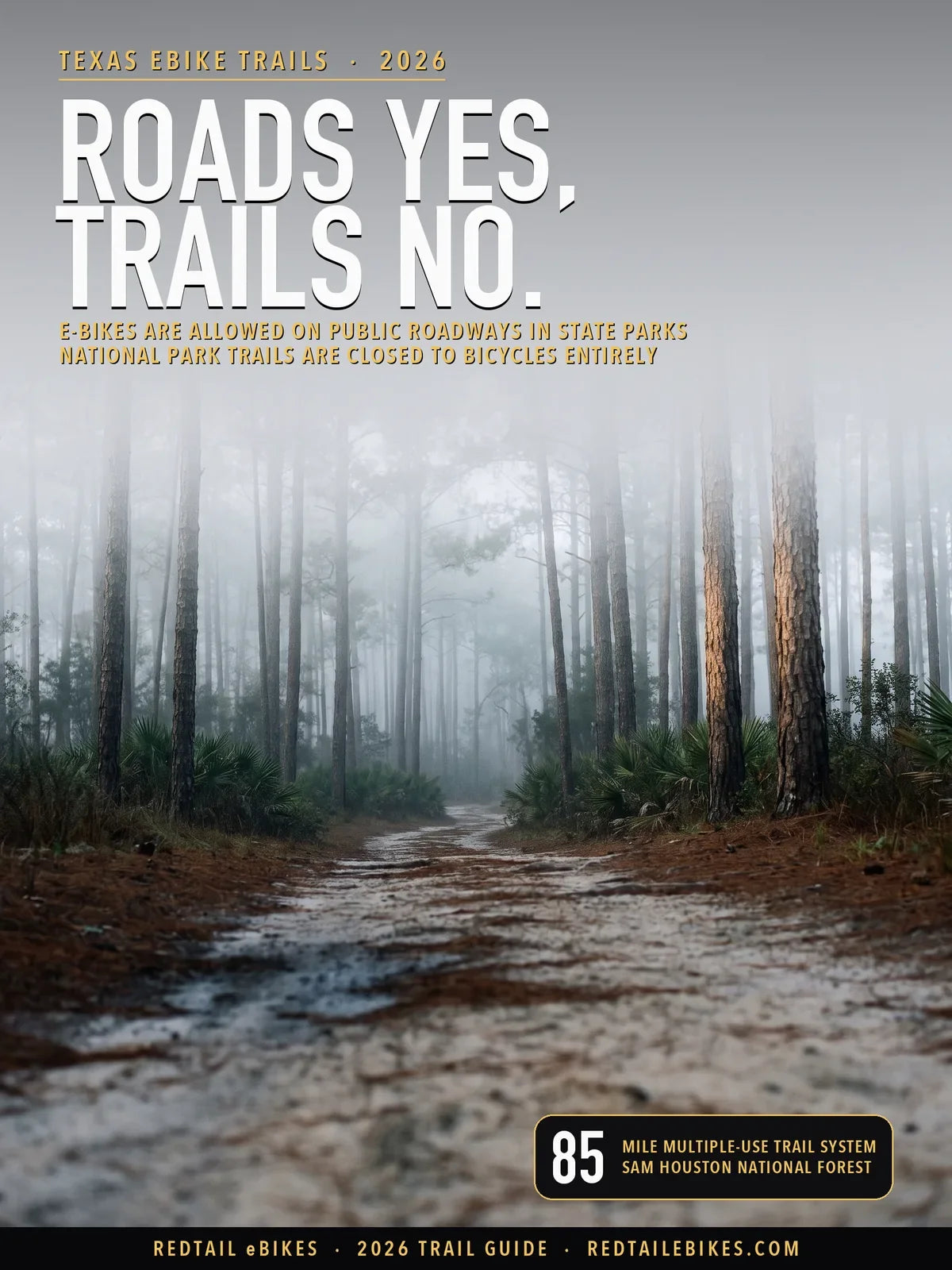
Quick Answer: Texas has very little legal off-road e-bike riding on public land. Texas Parks and Wildlife Department policy is blunt — e-bikes are allowed on public roadways in state parks but not on park trails, and that applies to Class 1, 2 and 3 alike.
National park trails are closed to bicycles entirely. The one real exception is the 85-mile Multiple-Use Trail System in Sam Houston National Forest, the only trail open to motorized use in any Texas national forest. Almost everything else worth riding is a paved city greenway. Verified against agency sources 13 August 2026.
If you've read that Texas is e-bike friendly, that's true on the road and mostly false on the dirt. The state's public-land agencies have converged on the same answer — roads yes, trails no — and one legislative attempt to change it died in 2025.
This page maps who controls what, what each one allows by class, and the handful of places where the answer is actually yes.
In this guide
- What's on this page
- The short version: roads yes, trails almost never
- What Texas law says
- The land managers, and what each allows
- Named Texas eBike trails you can legally ride
- Charging and range in Texas
- Where riders get caught out
- The honest ledger
- The bottom line
- Frequently asked questions
- How we verified this
What's on this page
- The short version
- What Texas law says
- The land managers
- Named Texas eBike trails you can legally ride
- Charging and range
- Where riders get caught out
- The honest ledger
- The bottom line
- FAQ
The short version: roads yes, trails almost never
Texas separates roads from trails more sharply than most states. On pavement and on park roads, an e-bike is treated much like a bicycle. The moment you leave the road for a trail on public land, the answer is usually no — and unusually, the class of your bike rarely changes it.
That is the opposite of somewhere like California, where access turns heavily on whether you're riding a Class 1, 2 or 3. In Texas, the more useful question is simply: is this a road or a trail?
For how the same question resolves elsewhere, see our California e-bike trails guide and the national e-bike trails overview. For where you can ride on the street rather than on a trail, see our Texas e-bike laws guide, including which Texas cities require a permit.
What Texas law says
Texas Transportation Code Chapter 664 defines an electric bicycle as a bicycle with fully operable pedals, an electric motor of fewer than 750 watts, and a top assisted speed of 28 mph or less. It uses the standard three classes:
| Class | Assist type | Top assisted speed |
|---|---|---|
| Class 1 | Pedal-assist only | 20 mph |
| Class 2 | Throttle or pedal-assist | 20 mph |
| Class 3 | Pedal-assist only | 28 mph |
A person must be at least 15 to operate a Class 3 e-bike in Texas. That's a year younger than California's threshold and a detail riders crossing state lines get wrong.
State law is not what closes the trails, though. The closures come from the agencies that manage the land, and they apply their own rules on top. For the statutory picture across states, see our electric bike laws guide.
The land managers, and what each allows
1. Texas state parks — roads only, every class

Texas Parks and Wildlife Department's published position is one sentence:
Texas Parks and Wildlife states it in one line on its biking page: "E-bikes are allowed on public roadways but not on park trails."
There is no Class 1 carve-out. There is no Superintendent's Order mechanism opening individual trails the way California State Parks uses. Across the state park system, park roads and parking areas are open and trails are not.
This nearly changed in 2025. Companion bills in the 89th Legislature — CSHB 4089 and CSSB 1865 — would have allowed low-speed electric bicycles in state parks where regular bicycles are permitted. Neither passed; SB 1865 died in committee on 2 June 2025. Advocates expect it back next session, so this is a rule worth re-checking rather than assuming.
2. National forests — one trail in the entire state

The Forest Service treats e-bikes as motor vehicles under 36 C.F.R. § 212.1, so they are confined to routes designated for motorized use. In Texas that produces a very short list.
Sam Houston National Forest's Multiple-Use Trail System is the exception, and it is a good one. The forest publishes "85 miles of multiple-use trails designated and developed for hiking, biking, horses, and registered Off-Highway Vehicles (OHVs)" and adds, in its own words, that "the multiple-use trail in the Sam Houston is the only trail open to OHVs in the National Forests in Texas."
Practical details before you go: - Vehicles must be no wider than 50 inches - Exhaust limit of 96 decibels (aimed at OHVs, not at you) - Fees apply: $5 per person per day at trailhead self-pay stations, or a $25 annual pass
And the state's other big trail system does not help you. The LBJ Multiuse Trail system runs to nearly 75 miles and the Forest Service describes it as used by "hikers, mountain bikers, and horseback riders" — non-motorized, which under § 212.1 is exactly the category an e-bike is excluded from. It is a fine ride on an analogue mountain bike and closed to the one you came here to read about.
Angelina National Forest has no designated motorized trails open. Davy Crockett and Sabine publish no forest-specific e-bike designation. The Motor Vehicle Use Map for the district is the authority, and it is worth checking rather than guessing.
Bottom line Sam Houston's 85-mile Multiple-Use Trail System is the only trail open to OHVs in any Texas national forest, and every e-bike class can ride it for $5 a day or $25 a year. Angelina, Davy Crockett and Sabine have no equivalent — check the Motor Vehicle Use Map first. Riders who spend real time on natural-surface miles like these are usually looking at a mountain e-bike built for the terrain.
3. Bureau of Land Management — barely a factor
Unlike the western states, Texas has very little BLM-managed land, so this tier that matters enormously in California or Nevada is close to irrelevant here. If you're planning around federal land in Texas, you're planning around the Forest Service and the Park Service.
4. National parks — ride the roads, and in Big Bend that's a lot
Superintendents may allow e-bikes where traditional bicycles are allowed. In Texas, bicycles are consistently allowed on roads and consistently barred from trails.
Big Bend National Park is the standout, and it isn't close:
The park's own biking page puts it plainly: "Bicycling (including e-bikes) is allowed on any road within Big Bend National Park, but is not allowed off-road or on any trail."
That gives you over 100 miles of paved road plus 160 miles of backcountry dirt road — the best off-pavement e-bike riding on public land in Texas, and it's legally road riding rather than trail riding. The park notes paved roads are narrow with few shoulders, and backcountry roads range from smooth to rough and rocky.
Guadalupe Mountains National Park allows e-bikes wherever traditional bicycles are allowed, which means named park roads including Pine Canyon Drive, McKittrick Canyon Road, Salt Basin Dunes Access Road, Dog Canyon Road, Frijole Ranch Road and Williams Ranch Road when open. Its compendium is explicit that "all trails are closed to bicycle use" and that administrative roads are closed too.
One rule there catches people out. Guadalupe's compendium states that except where public motor vehicle use is allowed, using the electric motor to move an e-bike without pedaling is prohibited. Your Class 2 is fine — using its throttle may not be.
Bottom line Big Bend allows e-bikes on any road but no trail, and that still adds up to over 100 miles of pavement plus 160 miles of backcountry dirt — the best off-pavement riding on public land in Texas. Guadalupe permits e-bikes on its named roads only, and using a throttle without pedaling can be illegal there even though the bike itself is legal. A fat-tire e-bike is built for the rough, rocky stretches of Big Bend's backcountry roads.
5. City and county networks — where the riding actually is

Because the state and federal tiers are so restrictive, Texas's usable e-bike riding is overwhelmingly urban and paved. The big metro networks are genuinely extensive: Houston's bayou greenways, San Antonio's Howard W. Peak Greenway Trails at 80+ miles, Fort Worth's Trinity Trails at 100+ miles, and Dallas's Katy Trail.
These are managed by cities, counties, water districts and trail non-profits, each setting its own rules, and most publish far less detail than the state and federal agencies do. Treat posted signage at the trailhead as the authority, and see the caution about Austin below.
6. Rail-trails — short but reliable
Texas has nothing on the scale of the long midwestern rail-trails, but the Dallas Katy Trail — 3.5 miles through Uptown — is the best-known. A 15 mph limit is posted along it. Worth understanding: a Class 3 ridden at its 28 mph assist ceiling breaks the trail's speed rule, not state law. The trail rule is the one that gets enforced.
Named Texas eBike trails you can legally ride
The confirmed list on public land is short, which is the honest headline:
- Sam Houston National Forest Multiple-Use Trail System — 85 miles, natural surface, all classes, fee required. The only motorized-designated forest trail in Texas.
- Big Bend National Park roads — 100+ paved miles and 160 miles of backcountry dirt road, all classes, no trails.
- Guadalupe Mountains National Park roads — the six named roads above, throttle use restricted.
- State park roads — every unit, all classes, pavement only.
Beyond that you're on metro paved networks — Houston's Buffalo Bayou and Brays Bayou greenways, San Antonio's Howard W. Peak system, Fort Worth's Trinity Trails, the Dallas Katy Trail. We've recorded what each reportedly allows in our research file, but those rules come from secondary sources rather than the managing agencies, so confirm at the trailhead before you rely on them.
For Dallas, our Dallas e-bike guide reads the City’s own trail inventory, which records the Katy Trail as 3.55 miles of concrete and the White Rock Lake loop as 9.46 miles of asphalt.
Sam Houston's natural surface and Big Bend's backcountry roads are the two places in Texas where trail-capable geometry actually matters. Find a mountain e-bike built for terrain like it.
Shop mountain e-bikesCharging and range in Texas
There is no public e-bike charging network in Texas, just as there isn't in California. Searching for e-bike charging stations returns electric-car networks, which won't help you.
Plan on one battery, out and back. Texas distances make that a real constraint:
- Sam Houston's 85-mile system is far beyond a single charge — ride a loop, not the network.
- Big Bend is remote, hot, and has long gaps between services. Its 160 miles of dirt road is a multi-day proposition rather than a day ride.
- Metro greenways are the easy case: most Houston, San Antonio and Fort Worth rides sit comfortably inside one charge.
Heat is the Texas-specific factor. Battery range and rider endurance both fall in summer conditions, and in Big Bend or Guadalupe a flat battery is a genuine safety problem rather than an inconvenience. Carry water for the walk out. Our electric bike buying guide covers how manufacturer range claims translate to real miles.
Bottom line Texas has no public e-bike charging network, so plan every ride on one battery. Sam Houston's 85 miles and Big Bend's 160 miles of dirt both exceed a single charge — ride a loop, not the whole system. Metro greenways in Houston, San Antonio and Fort Worth are the easy case, comfortably inside one charge even in summer heat.
Where riders get caught out
The Austin trail rules you'll read online are probably out of date. This is the biggest trap in Texas. Austin Code § 8-1-31 prohibits motor-driven devices in public recreation areas — city parks, trails, greenbelts, the Boardwalk. A pilot program created by Council Resolution 20181213-107 exempted six trails at a 10 mph limit, including the Ann and Roy Butler Hike-and-Bike Trail and the Boardwalk.
That pilot ran in 2019 and reported ending in January 2020. We could not find any source confirming it was made permanent, and the city's own pilot page now returns a 404. Guides across the internet still state the Butler Trail rule as current fact, citing a program that expired. We're not repeating it. Contact Austin Parks and Recreation before riding an e-bike on Austin parkland.
Assuming your class buys you access. In California, Class 1 opens doors. In Texas state parks it opens none — the trail closure applies to all three classes equally.
Assuming a national park trail is open because it's remote. Big Bend has 160 miles of legal dirt road and zero legal trail. The distinction is the whole game.
Using a throttle in Guadalupe Mountains. Legal bike, potentially illegal way of riding it.
Forgetting the Sam Houston fee. $5 per person per day, or $25 for the year.
Assuming the 2025 bill passed. It didn't. But it may return, so a rule verified today is worth re-checking next season.
The honest ledger
Green flags for Texas riding
- Metro paved networks are large and genuinely good: 100+ miles in Fort Worth, 80+ in San Antonio, Houston's bayou system.
- Big Bend offers 260 miles of legal road riding, including 160 miles of backcountry dirt with real remoteness.
- Sam Houston gives Texas a genuine 85-mile natural-surface option open to every class.
- State law is permissive and simple: no license, no registration, three standard classes.
- Class 3 riders face fewer class-specific bans than in California, because Texas closures tend not to distinguish class at all.
Red flags
- State park trails are closed to every class, with no per-park exception mechanism.
- National park trails are closed to bicycles statewide.
- Off-road options on public land are essentially one forest trail system and one park's dirt roads.
- City rules are thinly published and, in Austin's case, genuinely unclear.
- The 2025 bill that would have opened state park trails died in committee.
- No public charging infrastructure, in a state where distances and heat both punish a flat battery.
Fort Worth, San Antonio and Houston have built genuinely large paved networks, and most of that riding fits easily inside one charge. Find a commuter e-bike suited to daily miles on pavement.
Shop commuter e-bikesThe bottom line
If you want to ride dirt legally in Texas, there are two answers: Sam Houston National Forest and Big Bend's backcountry roads. Everything else on public land is pavement.
If you're a metro rider, Texas is better than its trail rules suggest. Fort Worth, San Antonio and Houston have built serious paved networks, and a Class 1 or Class 2 bike will use them happily.
If you're planning around state parks, plan on roads. Not a single Texas state park trail is open to e-bikes, whatever you're riding — and no superintendent can open one the way they can in California.
Whichever you're doing, check the managing agency before you load the bike. In Texas that habit matters most in the cities, where the rules are least clearly published. If you're still choosing a bike, our best eBike brands comparison covers which brands build genuine trail-capable Class 1 machines.
For the bike itself, the San Antonio buying guide grades every street block in that city and reads the greenway, park and state-natural-area rules block by block. The Austin buying guide does the same for Austin on 1-meter lidar, and reads the City's 10 mph park-path rule and the Barton Creek Greenbelt closure block by block, with a three-wheel answer for riders who have not been on a bicycle in years.
Frequently asked questions
Are e-bikes allowed on Texas state park trails?
No. Texas Parks and Wildlife Department policy states that e-bikes are allowed on public roadways but not on park trails, and that applies to Class 1, Class 2 and Class 3 alike. Park roads and parking areas are open; trails are not.
Where can I legally ride an e-bike off-road in Texas?
Two main places. The Sam Houston National Forest Multiple-Use Trail System — 85 miles open to hiking, biking, horses and registered OHVs, the only motorized-designated trail in any Texas national forest — and Big Bend National Park's 160 miles of backcountry dirt roads, which are legally roads rather than trails.
Can I ride an e-bike in Big Bend National Park?
Yes, on any road in the park. The park states that bicycling including e-bikes is allowed on any road but not off-road or on any trail. That covers over 100 miles of paved road and 160 miles of backcountry dirt road.
How old do you have to be to ride a Class 3 e-bike in Texas?
At least 15. That is set in Texas Transportation Code Chapter 664, and it is a year younger than California's minimum of 16.
Can I ride an e-bike on Austin trails?
We can't give you a reliable answer, and you should be sceptical of guides that do. Austin Code § 8-1-31 bans motor-driven devices in public recreation areas by default. A 2019 pilot exempted six trails at 10 mph, but that pilot reportedly ended in January 2020 and we found no source confirming it became permanent. Contact Austin Parks and Recreation before riding.
Did Texas change its state park e-bike rules in 2025?
No. CSHB 4089 and CSSB 1865 would have allowed low-speed electric bicycles in state parks where regular bicycles are permitted, but neither passed — SB 1865 died in committee on 2 June 2025. Advocates expect the issue to return in a future session.
Do I need a permit to ride Sam Houston National Forest trails?
Yes, there's a fee: $5 per person per day at trailhead self-pay stations, or a $25 annual pass through the ranger district office or recreation.gov.
How we verified this
Every access rule here came from the managing agency's own published material, retrieved 13 August 2026: the Texas Parks and Wildlife Department biking-in-state-parks page, the US Forest Service page for the Sam Houston Multiple-Use Trail System, the National Park Service biking page for Big Bend, and the Guadalupe Mountains National Park Superintendent's Compendium.
Texas Transportation Code Chapter 664 supplied the class definitions and the Class 3 age rule. The status of CSHB 4089 and CSSB 1865 comes from BikeTexas's legislative tracking.
Where we could not confirm a rule against an authoritative source — the current status of Austin's trail pilot, the per-unit rules at Padre Island, Big Thicket, Amistad, Lake Meredith and San Antonio Missions, and the city network rules in Houston, Dallas, San Antonio and Fort Worth — we have said so rather than publish a guess.
This is not legal advice, and it is not a substitute for the posted rules at the trailhead. Agencies change these policies without notice, and a Texas legislative session could change the state park rule outright. Verify with the managing agency before you ride.
Found something out of date? Tell us and we'll correct it: corrections@redtailebikes.com
Written by Milad Ghobadibeygvand, BScN (Western University, 2014), Redtail eBikes. Verified 13 August 2026.
Nothing here is a substitute for the sign at the trailhead. If Texas dirt is mostly closed to you and the paved network is where you will actually ride, Redtail ships commuter and city e-bikes and cargo e-bikes free anywhere in the US, with US-based support and warranty behind them.
Limitations
- Three agency quotes carry this page, and all three were re-read at source on August 27, 2026. They are exact. What the page previously lacked was any way for a reader to check that: it had no external citations at all. Every quote now links to the page it came from.
- A trail open to mountain bikes can still be closed to an e-bike, and this page had not said so. The Forest Service's LBJ Multiuse system runs to nearly 75 miles and is described by the agency as used by "hikers, mountain bikers, and horseback riders" — non-motorized. Under 36 C.F.R. § 212.1 an e-bike is a motor vehicle, so it is excluded. A rider finding LBJ on a trail app would reasonably assume otherwise.
- TPWD's page was unreachable directly on the day of verification. It returned HTTP 503 and was read through a text proxy instead. The sentence quoted is verbatim, but a 503 is a reason to re-check rather than a clean retrieval, and it is recorded as such in the ledger.
- Coverage of city and county networks is a sample. Austin, Houston, Dallas and San Antonio are described. Texas has more than 1,200 incorporated municipalities, and the ones not named here were not checked.
- Fees and permits change independently of policy. The Sam Houston day and annual figures were current at verification. A fee schedule is the fastest-moving fact on this page.
- Nothing here was ridden. Every mile, fee and rule is quoted from the managing agency. We have not surveyed a trail, and a posted closure at the trailhead beats anything published, including this.
- The publisher sells electric bikes. Redtail eBikes is an online retailer. The honest conclusion of this page is that Texas offers very little legal off-road e-bike riding, which is not a conclusion that helps sell a trail bike, and it is stated anyway.
This page expires when any of these change: TPWD revises its state-park e-bike position; a national forest amends its Motor Vehicle Use Map or its fee schedule; the National Park Service changes a park's bicycling rule; a named city network changes its trail policy; or the Legislature amends Transportation Code chapter 664.
Source register
| Source | Tier | What it supports | Retrieved |
|---|---|---|---|
| Texas Legislative Council — Transp. Code ch. 664 | T1 | The e-bike definition, the three classes and the Class 3 minimum age | 2026-08-27 |
| Texas Parks and Wildlife Department — Biking in State Parks | T1 | Roads yes, park trails no, for every class | 2026-08-27 |
| National Park Service, Big Bend — Bicycling | T1 | Any road in the park, no off-road and no trail, e-bikes named explicitly | 2026-08-27 |
| USDA Forest Service — Sam Houston Multiple-Use Trails | T1 | The 85 miles, and that it is the only trail open to OHVs in the Texas national forests | 2026-08-27 |
| USDA Forest Service — Recreation Opportunity: Biking | T1 | The LBJ Multiuse system and its non-motorized user list | 2026-08-27 |
| US GPO (eCFR) — 36 C.F.R. § 212.1 | T1 | That an e-bike is a motor vehicle on Forest Service land | 2026-08-27 |
tpwd.texas.gov returned HTTP 503 to a direct request and was read through a text proxy. No T4 source is relied on for any statement of rule, and no T5 source appears anywhere on this page.
References
- Texas Legislative Council, Tex. Transp. Code ch. 664 — Electric Bicycles — statutes.capitol.texas.gov. Retrieved August 27, 2026.
- Texas Parks and Wildlife Department, Biking in State Parks — tpwd.texas.gov. Retrieved August 27, 2026.
- National Park Service, Bicycling — Big Bend National Park — nps.gov. Retrieved August 27, 2026.
- USDA Forest Service, Sam Houston Multiple-Use Trails — fs.usda.gov. Retrieved August 27, 2026.
- USDA Forest Service, Recreation Opportunity: Biking, National Forests and Grasslands in Texas — fs.usda.gov. Last updated July 16, 2025. Retrieved August 27, 2026.
- US Government Publishing Office, 36 C.F.R. § 212.1 — ecfr.gov. Retrieved August 27, 2026.
Share:
California eBike Trails (2026): Where to Ride
Texas eBike Laws (2026): 60 City Ordinances Checked