
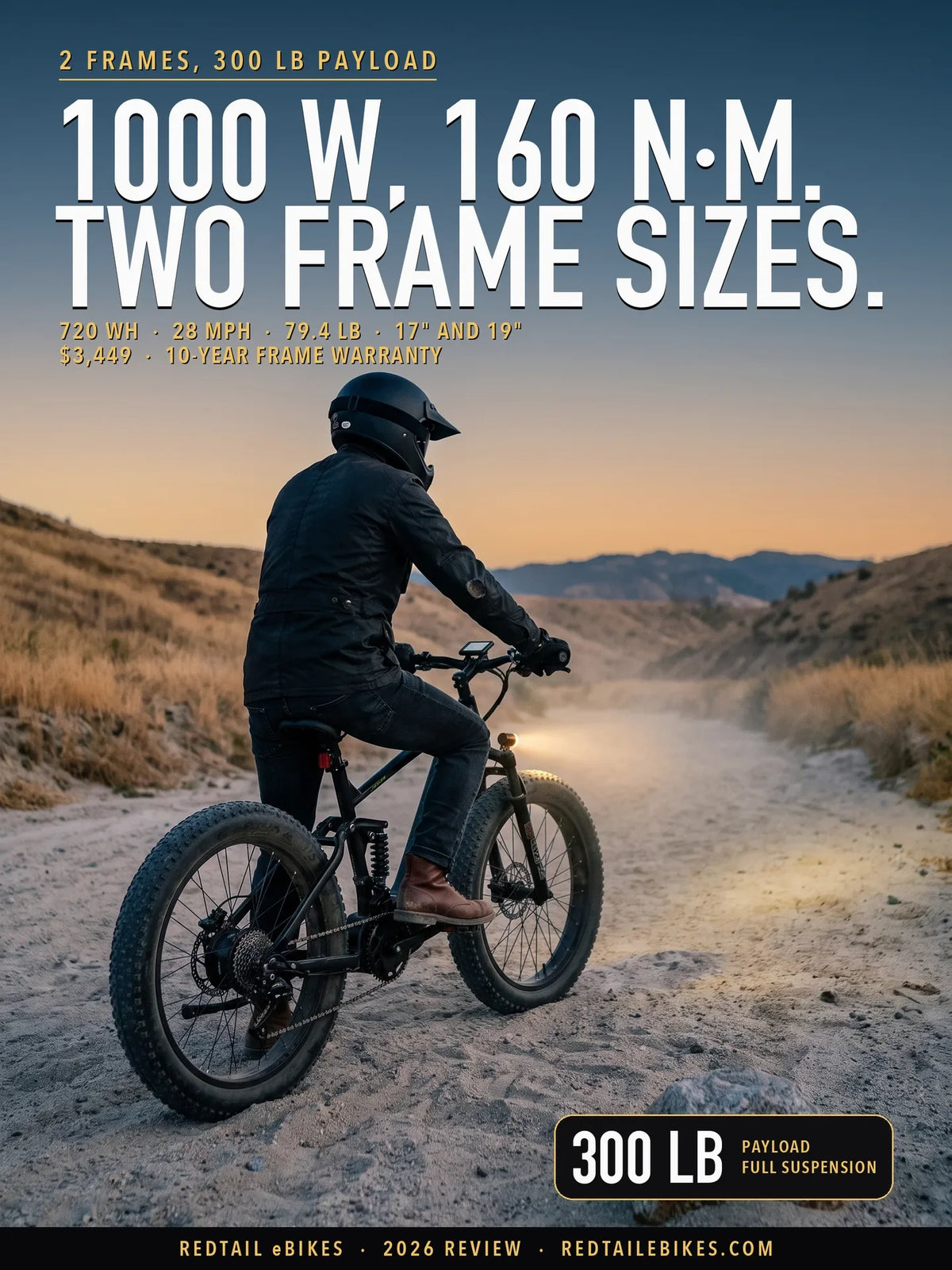
48V 1000 W · 160 N·m · 720 Wh · 28 mph · 300 lb payload · 79.4 lb · 17" and 19" · $3,449 · verified September 1, 2026
Quick Answer — The Eunorau FAT-HS, sold as the Hunter X8, is a $3,449 full-suspension fat-tire e-bike with a 1000 W Bafang M615 mid-drive rated at 160 N·m and a published 28 mph. It comes in a 17" and a 19" frame at the same price, and the frame you pick decides whether its advertised range is available at all.
The 80-mile headline needs a second battery, and Eunorau states that the second battery does not fit the 17" frame at all. Choosing the size is therefore also choosing the range, and no review or AI answer we could find mentions it.
Both frames orderable on 1 September 2026. Free contiguous-US shipping, and every warranty claim handled by us.
See the FAT-HS — $3,449Takeaway
- The 17" frame cannot take the second battery. Eunorau's own note reads: "The second battery is not compatible with 17” FAT-HS; to utilize it on the 19” FAT-HS, it’s necessary to lock out the rear shock." Both frames cost $3,449 here, so the 19" is the one that keeps the option open.
- As it ships, the bike carries 720 Wh, and the 80-mile claim describes 1,632. The range line names a 17 Ah primary plus a 17 Ah second pack. Divide the claim by its own configuration and you get 20.4 Wh per mile; apply that to the 720 Wh the bike actually ships with and you get 35.3 miles, or 44% of the headline.
- Two earlier generations of this same product page agree with that arithmetic. The 2021 pair works out at 19.2 Wh/mi and the 2020 pair at 17.5, which put the shipping pack at 37.5 and 41.1 miles. The number is consistent across five years; only the headline moved.
- Every review a US buyer can find describes a different bike. Eunorau's product record was created on 2 January 2020 and has been updated in place since. The reviews still ranking describe a $2,799 bike with a 14.6 Ah pack, 120 N·m and Shimano Alivio.
- Ask what it weighs and you get four published answers. 79.4 lb and 77.1 lb sit on Eunorau's page simultaneously; 70 lb and 80 lb come from the 2021 and 2020 reviews. We use 79.4 and say why.
- Screened against every US e-bike definition, the published 1000 W and 28 mph sit outside 49 of 51. Two states publish no definition at all. This is a machine to plan around, and the planning is easy once the numbers are in front of you.
What's on this page
- Who the FAT-HS is for
- How we verified this Eunorau FAT-HS review
- Eunorau FAT-HS specifications
- The FAT-HS everyone reviewed is not the one on sale
- The 80-mile claim, and the arithmetic underneath it
- The second battery and the 17-inch frame
- The two frames, measured
- How much does the FAT-HS weigh?
- 1000 watts, 28 mph, and all 51 states
- Suspension: 75 mm in a 120 mm category
- The Mercer fit test
- Charging, against the charger in the box
- Where Eunorau's own page disagrees with itself
- Has it been recalled?
- Is it UL certified?
- The warranty, and who files the claim
- Buying it from us
- The honest ledger
- Who should buy it
- Before you buy: the checklist
- Limitations of this review
- The source register
- References
- Frequently asked questions
- The bottom line
Who the FAT-HS is for

Two frame sizes at one price, and the smaller one is missing an option the larger one has. That is the decision this page is built around.

Eunorau's own photograph of the bike, and the source for every component detail on this page. The surface under the tires is the one the bike is sold for.
Buy it if your problem is getting a load of gear a long way down a fire road, and you would rather solve it with gearing than with raw wheel torque. A mid-drive puts its power through the same nine gears your legs use, so it multiplies on a climb the way a low gear does.

The motor sits between the cranks rather than in a wheel, which is the whole reason the gears can multiply its torque. The 42T ring and the guard around it are standard fitment.
The hunting framing on the box is honest about the job. Eunorau tags this bike for hunting and fishing, and the things that suit it to that — the fat tires, the 300 lb payload, the gearing, the quiet — are the same things that suit it to any long, loose, loaded ride.

Four inches of tire at low pressure is a second suspension system, and on this bike it does more of the work than the 48 mm shock behind it.
Look at the SPECTER-S 3.0 first if what you want is a trail bike. It is $2,999, it carries 140 mm of fork travel against this bike's 75, and its motor is torque-sensing. If you are still choosing a category before a bike, start with our electric mountain bike guide.
1000 W Bafang M615 mid-drive · 160 N·m · full suspension · 300 lb payload · 17" and 19". Free shipping in the lower 48, and we run any warranty claim for you.
Check the FAT-HS — $3,449How we verified this Eunorau FAT-HS review
Nobody at Redtail has ridden this bike. We say that first because it decides what the rest of the page is allowed to claim: every figure below is a published figure or an arithmetic operation on published figures, and each one is linked to the document it came from.
Every specification here was read from Eunorau's own product page on 1 September 2026 and saved to disk, so the figures can be checked against what the page said on the day.
That page publishes its specification three separate times: a table inside the product description, a fuller block rendered by the theme, and a compact grid near the images. The three do not agree with each other. Which figure we used, and what the alternatives were, is set out under where Eunorau's own page disagrees with itself.
Almost every specification on this page has one publisher, and it is Eunorau. No independent laboratory publishes a weight, a range or a payload for this model, so where a figure appears here with no second source, that is the reason. The figures we could corroborate independently — the price, the earlier generations, the statutory positions — carry their second source in the citation ledger.
Prices and stock come from our own listing through the Shopify Admin API on the same date. The accessory prices come from Eunorau's own pages for the second battery, the rack and fender set and the fast charger, pulled the same morning.
The older reviews were read from archived copies, and that is stated rather than hidden. electrifiedreviews.com did not resolve from this machine on 1 September 2026 — four attempts, DNS failure each time. Its FAT-HS reviews were read instead from Internet Archive snapshots dated 12 May 2025 and 11 August 2025, and both snapshot dates appear beside every figure taken from them.
We measured the demand this page answers. We harvested 2,391 rows from three independent programmatic sources — 1,980 Google autocomplete completions, 232 related searches and 179 headings from the pages currently ranking — of which 332 are about this bike or this brand. On top of that we ran a seven-prompt AI-answer panel and saved its raw output. From all of it we built a ledger of 57 demand items: 51 are answered on this page and 6 were dropped, each with the reason recorded. Four of the 57 are questions nobody was observed asking — the recall position, the certification position, the frame-size choice and the charge time — added because a review of a powered machine owes them anyway, and labelled as ours in the ledger rather than mixed in with measured demand.
No search volume appears anywhere on this page. Our Semrush units are exhausted and no dated export exists inside the freshness window, so we publish no volume, no difficulty and no "high-intent" claim. Absence of a number here means we did not measure one, and not that nobody is searching.
The arithmetic is ours and it is reproducible. Every derived number on this page comes from fathhs_arithmetic.py, a script that takes Eunorau's published figures as inputs and prints the method beside each result. Nothing here is a number we remembered.
The legality screen is measured. The published 1000 W and 28 mph were run against a table of all 51 US e-bike definitions, each row carrying its statutory citation. Every one of those statutes was then re-fetched on 1 September 2026 as an independent second retrieval; 46 of 51 returned, three were blocked and two failed, and the five that did not return are named as unconfirmed rather than counted as agreement.
Questions or a correction: support@redtailebikes.com. We publish corrections on the page itself.
Eunorau FAT-HS specifications
Every row is Eunorau's published figure, retrieved 1 September 2026.
| Specification | Published figure |
|---|---|
| Motor | 48V 1000 W Bafang M615 mid-drive, 160 N·m |
| Pedal assist | Cadence sensing, five levels |
| Battery as shipped | 48V 15 Ah (720 Wh) |
| Optional second battery | 17 Ah, 19" frame only |
| Range | Up to 80 miles, with the second battery fitted |
| Maximum speed | 28 mph |
| Charger | US-standard 2.0 A smart charger |
| Total payload capacity | 300 lb |
| Weight | 36 kg (79.4 lb) |
| Recommended rider height | 5'3" to 6'4" |
| Frame | 6061 aluminum alloy, full suspension, 17" and 19" |
| Fork | RST Guide, 75 mm travel |
| Rear shock | KS-388RL, 48 mm |
| Drivetrain | Shimano Altus 9-speed: SL-M2010 shifter, RD-M2000 derailleur, CS-HG400-9 11–34T |
| Chainring and cranks | 42T 7075 CNC chainring, 170 mm forged alloy cranks |
| Brakes | Eunorau-design 180 mm hydraulic discs, motor cut-off in the levers |
| Tires | Kenda Krusade Sport 26×4.0 with K-Shield |
| Rims | 26 in black alloy, stainless spokes |
| Display | DP C080.C color LCD |
| Throttle | Thumb throttle |
| Saddle | Selle Royal, 34" to 43.3" off the ground |
| Lighting | 6–60V LED headlight, independently switched tail light |
| Rack and fenders | Optional, sold as a matched set |
| In the box | Manual and tool kit |

Eunorau photographs the FAT-HS with orange and with green decals. Both storefronts list one color option, "Black" — the accent treatment is not chosen at checkout, so ask us what is in the crate before you order if it matters to you.
The FAT-HS everyone reviewed is not the one on sale
Search the model name and you will find real, competent reviews. Electrek published one, and Electrified Reviews published two a year apart. There are two YouTube reviews as well.
For a bike from a brand this size, that is unusually good coverage.
All of it is five and six years old, and it describes a bike you cannot buy.
Eunorau's product record for the FAT-HS carries a creation date of 2 January 2020, read from the page's own product data on 1 September 2026. The URL has never changed. What is behind it has, repeatedly, and every review still ranking is a snapshot of an earlier state of the same address.
| 2020 review | 2021 review | Electrek, Feb 2021 | On sale today | |
|---|---|---|---|---|
| Price | — | $2,799 | $3,199 | $3,449 |
| Battery | 14.6 Ah (700.8 Wh) | 14 Ah (672 Wh) | 14 Ah internal | 15 Ah (720 Wh) |
| Torque | 120 N·m | 160 N·m | — | 160 N·m |
| Top speed | 28 mph | 35 mph | 30 mph | 28 mph |
| Fork travel | ~80 mm | 75 mm | — | 75 mm |
| Drivetrain | Shimano Alivio | Shimano Deore | — | Shimano Altus |
| Weight | ~80 lb | 70 lb | — | 79.4 lb |
| Frame sizes | one | two | — | two |
2020 and 2021 rows from Electrified Reviews, read from Internet Archive snapshots dated 12 May 2025 and 11 August 2025. Electrek row from its review of 26 February 2021. Today's column from Eunorau's product page, 1 September 2026.
Three things in that table are worth sitting with.
The two 2021 reviews disagree on price by $400 — $2,799 against $3,199 — for the same bike in the same month. Neither is wrong; a bike sold through many storefronts has many prices, which is a useful thing to know before you read any single figure as the price.
The drivetrain moved down. Shimano's mountain hierarchy runs Deore above Alivio above Altus. The 2021 bike was specified with Deore, the 2020 bike with Alivio, and the bike on sale today with Altus — while the price went from $2,799 to $3,449. Those tiers are Shimano's own, and the ranking belongs to Shimano, and the individual parts on today's bike are named on Eunorau's page: SL-M2010 shifter, RD-M2000 derailleur, CS-HG400-9 cassette.
The top speed has been published three ways. 28, then 35, then 28 again, with Electrek's 30 in between. Today's figure is 28 mph, and today's marketing copy on the same page says "a max speed of 48 km/h", which converts to 29.8.
None of this makes the current bike worse than the reviews say. It makes the reviews a poor guide to it, in both directions — today's pack is bigger than 2021's and today's drivetrain is a tier lower, and a buyer reading a 2021 review will get both wrong.

Nine sprockets on an 11–34T cassette. The 2021 reviews photographed a Deore derailleur in this position; Eunorau's current parts list names Altus.
Every figure on this page was read from Eunorau's product page on 1 September 2026 — never from a review of an earlier version of it.
See the 2026 spec — $3,449The 80-mile claim, and the arithmetic underneath it
Eunorau publishes the range two ways on one page. The compact grid says "Up to 80 Miles (Dual Battery)". The description table is more specific, and the specificity is what makes it checkable:
That line reads, in full: "BATTERY RANGE: 80 Miles (48V/17Ah SAMSUNG Cells+ Second Battery 14Ah/17Ah)."
That line names its own configuration. A 17 Ah primary plus a 17 Ah second pack, at 48 volts, is 1,632 watt-hours. Divide the claim by the configuration it names and the implied consumption is 20.4 watt-hours per mile.
Now apply that to the bike as it is actually sold. Eunorau's capacity line, on the same page, reads "48V15Ah Standard" — 720 watt-hours. At the claim's own rate of 20.4 Wh/mi, 720 watt-hours is 35.3 miles, which is 44% of the headline.
The interesting part is that this is not a one-off. Two earlier published pairs from the same product line land in the same place:
| Source | Published pack | Published range | Implied consumption | 720 Wh at that rate |
|---|---|---|---|---|
| The 80-mile claim's own configuration | 1,632 Wh | 80 mi | 20.4 Wh/mi | 35.3 mi |
| 2021 review | 672 Wh | 35 mi | 19.2 Wh/mi | 37.5 mi |
| 2020 review | 700.8 Wh | 40 mi | 17.5 Wh/mi | 41.1 mi |
Derived by fathhs_arithmetic.py from the published figures in each row. 2020 and 2021 figures from the archived Electrified Reviews snapshots.
Three independent pairs, spread over six years, put a 720 Wh FAT-HS somewhere between 35 and 41 miles. That is the number to plan a day around, and it is not a criticism of the bike — it is a fat-tire, 79 lb, 1000 W machine, and 20 watt-hours a mile is what one of those costs to move. A lighter commuter on 2-inch tires does it for half that.
Takeaway
- Plan your day around 35–41 miles, not 80. That range comes from three separate published pack-and-range pairs for this product line, each read on its own.
- The 80-mile configuration costs $4,048 — the bike plus the 17 Ah second battery Eunorau's own range line names.
- The consumption figure is normal for the category. 20 watt-hours a mile is what a 79 lb fat bike costs to move; the asterisk belongs on the headline, and the engineering is fine.
What the arithmetic does say is that the 80 on the box and the bike in the box are describing different machines, and closing that gap costs money.
The second battery and the 17-inch frame
One sentence in Eunorau's own specification block decides which frame you buy:
"The second battery is not compatible with 17” FAT-HS; to utilize it on the 19” FAT-HS, it’s necessary to lock out the rear shock."
Read that twice, because it is doing two separate things.
First: on the 17" frame, the advertised range is not available at any price. There is no second battery for that frame. A buyer who takes the smaller size — and the smaller size is the right size for a rider around 5'5", by Eunorau's own geometry — has bought a bike whose headline number they can never reach.
Second: on the 19" frame, reaching it costs the rear suspension. Eunorau repeats the instruction a few rows later — "To avoid any damage, please lock out the rear shock when you install the second battery" — so this is not an aside. The rear shock is the feature that separates this bike from Eunorau's cheaper fat bikes, and running the long-range configuration means switching it off.
Both frames are $3,449 here. That is the whole reason this is a straightforward decision rather than a trade-off: the larger frame costs nothing extra and keeps an option the smaller one closes permanently. Unless the 17" is the size that fits you, take the 19".
The two frames, measured
Eunorau publishes a full geometry table for both sizes, which is more than most makers at any price give you. The differences are smaller than the names suggest.
| Dimension | 17" frame | 19" frame | Difference |
|---|---|---|---|
| Seat tube | 432 mm (17 in) | 483 mm (19 in) | 51 mm |
| Standover | 780 mm (30.7 in) | 800 mm (31.5 in) | 20 mm |
| Reach | 507 mm (18 in) | 512 mm (20.2 in) | 5 mm |
| Top tube | 582 mm (22.9 in) | 600 mm (23.6 in) | 18 mm |
| Stack | 425 mm (16.7 in) | 475 mm (18.7 in) | 50 mm |
| Wheelbase | 1,306 mm (51.4 in) | 1,311 mm (51.6 in) | 5 mm |
| Chain stay | 460 mm (18.1 in) | 460 mm (18.1 in) | none |
| Total length | 2,056 mm (80.9 in) | 2,061 mm (81.1 in) | 5 mm |
| Weight | 36 kg (79.4 lb) | 36 kg (79.4 lb) | none |
Eunorau's published geometry table, read 1 September 2026.
The two bikes share a chain stay, a weight and — within 5 mm — a wheelbase. What actually separates them is 50 mm of stack and 20 mm of standover: the 19" sits you more upright and asks more of your inseam. Between the sizes on height, the second battery is the tie-breaker, and it only goes on the 19".

The seatpost clamp is a quick-release, so saddle height is a tool-free adjustment — useful on a bike two people share, and the reason the published saddle range spans more than nine inches.
What the headline configuration costs
If you do want the range, here is the arithmetic on price, read from Eunorau's own pages for the battery and the rack set on 1 September 2026:
| Item | Price |
|---|---|
| FAT-HS, either frame | $3,449 |
| Second battery, 17 Ah | $599 |
| Bike plus the pack the range claim names | $4,048 |
| Rack and fender set — both listed "Optional" on the spec sheet | $149 |
| As described, with somewhere to put the gear | $4,197 |
The 15 Ah version of the second battery is $499. The 17 Ah is the one the range line names. Eunorau's 48V 3A fast charger is a further $69.
We do not stock either second battery or the rack-and-fender set. Said here so it does not surface at checkout.
The AI engines cannot price this. Asked directly on 1 September 2026 what a second battery costs for this bike, the answer named the FAT-HS, identified the second pack as the thing that unlocks the advertised range, and then said the price was not available and recommended contacting the manufacturer. It is published; it is $599.
How much does the FAT-HS weigh?
After "review", the most-completed thing people type about this bike is its weight. It is a fair question on a full-suspension fat bike, and it has four published answers.
| Figure | Where it comes from |
|---|---|
| 79.4 lb (36 kg) | Eunorau's geometry table, given per frame size, both sizes |
| 77.1 lb | Eunorau's specification block — on the same page, same day |
| 70 lb | The 2021 review, "70 pound curb weight" |
| ~80 lb | The 2020 review, "weighs in at nearly 80 pounds" |
We use 79.4 lb. It is Eunorau's current figure, it is stated per frame size, and it is the one given in both kilograms and pounds so the conversion can be checked — 36 kg is 79.37 lb. The 77.1 lb on the same page is 2.3 lb lighter and is not broken down by frame; we report it and do not use it.
Ask an AI engine and you get all four figures and a summary that settles on 70 lb as "most current". Seventy pounds is the 2021 number. The gap between that and 79.4 is about the weight of a full pannier, and it is the difference between a bike two people can lift onto a rack and a bike that argues about it.
For what it is worth against the rest of the shelf: the SPECTER-S 3.0 is 88.2 lb, the FAT-HD 1.0 Pro is 78.7 lb, and the Defender is 66 lb. The FAT-HS sits in the middle of its own family and is 8.8 lb lighter than the full-suspension bike above it.
The payload arithmetic
Eunorau publishes a 300 lb total payload capacity. Subtract the 79.4 lb bike and there is 220.6 lb left.
That figure carries one honest caveat: Eunorau does not define whether "total payload capacity" includes the machine. Read one way you have 300 lb for rider and gear; read the other you have 220.6. On a bike sold for carrying game and gear out of the back country, that is a difference worth an email before you load it to the number, and it is the kind of question we will put to Eunorau for you.
1000 watts, 28 mph, and all 51 states
This is the section that decides where the bike can be ridden, so it is built from statutes, and every one is cited.
Eunorau publishes 1000 W nominal and 28 mph, and fits a thumb throttle. Those three facts were screened against the electric-bicycle definition in all 51 US jurisdictions, using a table in which every row carries its own statutory citation.
The federal reference point is 15 U.S.C. § 2085(b). It defines a low-speed electric bicycle as one with a motor of less than 750 watts and a top motor-powered speed under 20 mph on level ground with a 170-pound rider.
That statute decides whether a machine is treated as a bicycle for the Consumer Product Safety Commission's purposes. Where you may ride it is decided by your state, and the states write their own definitions on top of it.
The result: 0 QUALIFIES · 49 OUTSIDE DEFINITION · 2 NO STATUTORY DEFINITION.
The two are Alaska, which publishes no e-bike definition in AS 28.90.990(a)(20)-(22), and Kentucky, which publishes none in KRS 189.010. In those two there is nothing for the figures to sit inside or outside; everywhere else, at least one published figure sits outside the definition.
Being outside a definition is not the same as being unusable. It means the bike is regulated as whatever else that state's code covers, which is why the bike is sold for trail, fire road and private land, and why our state-by-state e-bike law guide exists.
Takeaway
- 0 of 51. The published 1000 W and 28 mph qualify as an electric bicycle nowhere in the United States on our reading of the statutes.
- Two states have no definition at all — Alaska and Kentucky — so there is nothing there to sit inside or outside.
- The number that trips it is not always the wattage. In Oregon, which regulates no wattage, it is the combination of a throttle and 28 mph.
- Check your own state before you plan a route. This is a machine to ride on trail, fire road and private land.
What the AI engines are telling buyers, and what the statutes say
Ask an engine whether a 1000 W mid-drive is street legal and you get a specific, confident answer. On 1 September 2026 it read:
It read, verbatim: "Six states explicitly permit 1000W e-bikes: Georgia, Kansas, Minnesota, Oklahoma, Oregon, and Virginia. Two states, Florida and Mississippi, impose no maximum power limits."
Every source behind that answer was a retailer's blog. Not one statute was cited. So we re-fetched the statutes on the same day and read them.
| State | The AI answer | The statute, retrieved 1 September 2026 |
|---|---|---|
| Kansas | permits 1000 W | "less than 750 watts" |
| Minnesota | permits 1000 W | "not more than 750 watts" |
| Virginia | permits 1000 W | "no more than 750 watts" |
| Florida | no power limit | "750 watts", "less than 750 watts" |
| Georgia · Oklahoma · Mississippi | permit 1000 W / no limit | the wattage language was not present in what we retrieved — unconfirmed today, and left on a single retrieval rather than counted either way |
| Oregon | permits 1000 W | no wattage figure appears in the definition at all — see below |
Four of the eight are contradicted by the text of the statute on the day.
Oregon, and a trap worth naming
A keyword search of the Oregon page returns "not more than 1,000 watts", which looks like confirmation. Reading the sentence around it shows what it belongs to:
The sentence reads: "(4) Is equipped with a power source that is incapable of propelling the vehicle at a speed of greater than 24 miles per hour on level ground and: … (b) If the power source is electric, has a power output of not more than 1,000 watts."
That is Oregon's definition of a moped, further down the same chapter. Matching the term without reading its sense would have put a claim about Oregon e-bike law on this page sourced from Oregon moped law.
Oregon's actual electric-assisted-bicycle definition, ORS 801.258 as amended in 2024, sets no wattage limit whatsoever. It defines three classes: Class 1 and Class 2 both "cease to provide assistance" at 20 miles per hour, and Class 3 reaches 28 miles per hour but "provides assistance only when the rider is pedaling."
So in Oregon the FAT-HS's 1000 W is not the issue — Oregon does not regulate wattage. The issue is the combination of a throttle and 28 mph: the two classes that permit a throttle stop at 20, and the class that reaches 28 is pedal-assist only. The bike sits outside the definition for a reason that has nothing to do with the number everyone argues about.
Suspension: 75 mm in a 120 mm category
The FAT-HS is a full-suspension bike, and it is worth being precise about how much suspension that is: 75 mm at the fork (RST Guide) and 48 mm at the rear shock (KS-388RL).

The shock body in Eunorau's own photograph is stamped EXA 388 — the same 388 that appears in both of the model numbers Eunorau publishes for it, which is part of why we report the pair rather than pick one.

The fork lowers carry the RST Guide name — the one component in this section that all three of Eunorau's specification blocks describe the same way.
Asked on 1 September 2026 to name the best full-suspension fat-tire e-bikes for hunting, the engines returned a set with travel figures of a different order — one at 120 mm front and rear, another at 150 mm. The FAT-HS did not appear in the list.
That is a real positioning fact and the page would be worse for routing around it. What the FAT-HS has instead is price and weight: the same 300 lb payload as the 120 mm bike in that set, at a price well under it, on a chassis 8.8 lb lighter than the longer-travel bike in our own range.
Short travel is not a defect; it is a choice about what the bike is for. Seventy-five millimetres is enough to keep a loaded back wheel tracking on a rutted fire road and to take the hammer out of a washboard descent. It is not enough for a rock garden, and the bike is not sold for one.
If the riding you have in mind is technical, the SPECTER-S 3.0 is $2,999 with 140 mm up front and a torque-sensing M620 motor, and it is the bike we would point you at.
The Mercer fit test
The Mercers are our editorial cast — a fixed family we hold every bike against, so that fit is measured the same way every time. Meet the Mercers. Nobody in this table has ridden anything; every verdict below is a reading of a published number.
Eunorau gives us more to work with than most: a rider-height range of 5'3" to 6'4", a standover of 30.7 in on the 17" and 31.5 in on the 19", a saddle that sets between 34 in and 43.3 in off the ground, a 79.4 lb weight and a 300 lb payload.
| Member | Verdict | The number behind it |
|---|---|---|
| Frank Kowalski, 63, 5'10" | Wrong shape for him | Inside the 5'3"–6'4" window, but this is a step-over frame with a 30.7 in standover on the 17" and 31.5 in on the 19", and Eunorau publishes no step-thru version. At 79.4 lb it is also a bike he holds up at every stop. |
| Ruth Kowalski, 61, 5'5" | Take the 17" — and accept that it caps the range | She clears the 5'3" floor. The 17" frame's 30.7 in standover is the one that suits her, and the 17" is the frame Eunorau says the second battery will not fit. |
| Jack Mercer, 48, 6'1" | The rider it is built for | 6'1" sits inside the range with room, and the 19" frame's 31.5 in standover and 20.2 in reach are the larger of the two. He is the only member for whom the second battery is even an option. |
| Dana Mercer, 45, 5'7" | Fits either frame; check the payload math | Inside the window on both sizes. The 300 lb payload against a 79.4 lb bike leaves 220.6 lb — if the 300 includes the machine, which Eunorau does not say. |
| Maya Torres, 32, 5'6" | Fits her body; wrong use case | Inside the height window. But the published 28 mph and 1000 W sit outside the e-bike definition in 49 of 51 jurisdictions, and a commute is the one job those numbers do not clear. |
| Cole Mercer, 16, 5'11" | Not on public roads | His height clears the window. The published figures put the bike outside the e-bike definition almost everywhere, which means the rules for whatever vehicle class it does fall into apply, and those generally turn on a license he does not have yet. On private land, with a helmet, that is a conversation with his parents. |
| Ivy Mercer, 12 | Off the table at her age | Eunorau's published rider floor is 5'3", and this is a 79.4 lb machine published at 28 mph. No reading of those numbers puts a 12-year-old on it. |
The sharpest contrast in that table is between Jack and Ruth, and it is arithmetic. Jack at 6'1" takes the 19" frame and can buy the second battery. Ruth at 5'5" should take the 17" for its lower standover — and the 17" is precisely the frame Eunorau says the second battery does not fit. The rider who most needs the smaller bike is the rider locked out of the number on the box.
Both sizes, one price, and we will check your inseam against the standover before you order. Free shipping in the lower 48, and we file any warranty claim for you.
Pick your frame — $3,449Charging, against the charger in the box
Eunorau publishes a charging time of "4 - 6 hours" in its description table, and a charger specification in its rendered block: "US standard 2.0 A smart charger".
Those two figures can be checked against each other, and Eunorau supplies the missing constant itself: its own charger listing publishes an output voltage of 54.6 V. At 2.0 amps that is 109.2 watts.
Refilling 720 watt-hours at 109.2 watts takes 6.6 hours — and that is a floor, assuming perfect efficiency and no constant-voltage taper at the end, neither of which happens in reality. Running it the other way: a four-hour refill of 720 Wh needs 3.3 amps, and a six-hour refill needs 2.2 amps. The charger in the box is rated at 2.0.
So the published "4 - 6 hours" is not describing the charger in the box. It is describing a charger Eunorau also sells: a 48V 3A fast charger at $69, whose own listing gives the same 54.6 V output. At 3 amps that is 163.8 watts, and 720 watt-hours divided by 163.8 is 4.4 hours — inside the published window, at the fast end of it.
The practical version, then, is a choice rather than a defect. On the charger in the box, put it on when you get home and it is ready in the morning — a normal way to live with a bike this size. If you need two rides in a day, the fast charger is a $69 line item, and it is the one the published charge time was written for. We can quote you one with the bike.
Where Eunorau's own page disagrees with itself
One URL, three specification blocks, and they do not match. This is not unusual on a product page that has been edited in place since 2020, and it is the reason this review says which block each figure came from.
| Specification | Description table | Rendered spec block | Compact grid |
|---|---|---|---|
| Weight | not stated | 77.1 lb | not stated |
| Weight (geometry table) | — | 36 kg / 79.4 lb | — |
| Display | CDC6 LCD | DP C080.C LCD | not stated |
| Rear shock | KS-388L, 190 mm | KS-388RL, 48 mm | not stated |
| Maximum speed | not stated | 28 MPH | not stated |
| Box dimensions | 156 × 32.5 × 88 cm | 172 × 36 × 85 cm | — |
| Battery in the range claim | 17 Ah primary | — | — |
| Battery as sold | 15 Ah | 15 Ah | 15 Ah |
| Second battery | 14 Ah / 17 Ah | 14 / 17 Ah | 15 Ah |
| Drivetrain | "SHIMANO (Or SUNRACE)" | Shimano Altus, named part by part | — |
| Saddle | "Comfortable Saddle" | Selle Royal | — |
Bold is the figure this review uses. Read from Eunorau's product page on 1 September 2026.
Two of these are worth more than a table row.
The rear shock is described as both KS-388L 190 mm and KS-388RL 48 mm. Those are conventionally different measurements — an eye-to-eye length and a stroke — but the model suffix differs too, so this is not simply two ways of saying one thing. We use the rendered block's figure and note the other.
The marketing copy contradicts the spec block on speed. The prose says "a max speed of 48 km/h", which is 29.8 mph; the spec block says 28 MPH. We use 28.

The display is the one component Eunorau names two ways on a single page. Whatever the unit is called, the thumb throttle beside it is the part that decides how several states classify the bike.
There is also a tagging inconsistency: the product's own tags include "Torque Sensor", while both specification blocks and the marketing copy describe cadence sensing. We treat it as a cadence-sensing bike, because two blocks and the body copy agree and a tag is not a specification.
Has it been recalled?
No CPSC recall names Eunorau or the FAT-HS, checked 1 September 2026.
That sentence is only worth printing because the instrument was tested first. The recall API was queried for a brand that certainly has a recall — Aventon, recall 24075, the Sinch.2 — and it returned that record correctly, with its date, its ~2,300 units and its six reports of unexpected acceleration. Only then was the Eunorau query run, and it returned zero rows.
That test was not ceremony. On the first attempt the same query returned a result that looked like a clean record and was in fact an error response the tool had failed to recognise. A zero from a broken instrument reads exactly like a zero from a working one, which is why the positive control comes first.
A recall zero is not a complete safety record. Recalls and public safety warnings are separate instruments, and the CPSC warnings index is paged; we could enumerate only part of it, which makes that a partial view and never a null. What can be said is what is said above: no recall, on an instrument shown to work the same day.
Is it UL certified?
Eunorau marks this model "UL CERTIFIED: Yes" in the compact grid on its product page, and publishes no standard number and no certificate number anywhere on the page.
That distinction is the whole answer. UL 2849 covers the electrical system of an e-bike; UL 2271 covers the battery pack. Eunorau's page names neither. A page that says "UL certified" without naming which, and without a certificate that can be looked up, has made a claim that cannot be checked from the outside.
We report what Eunorau publishes and assert nothing beyond it. If your building, campus or insurer requires a specific listing — and a growing number do — tell us before you order and we will request the certificate from Eunorau and put it in front of you.
The warranty, and who files the claim
If you are considering a used one, the cover does not come with it — every Eunorau warranty runs to the original purchaser. Our brand profile explains what that leaves a second owner holding.
Eunorau's terms, from its published warranty policy:
| Component | Coverage |
|---|---|
| Frame | 10 years |
| Battery | 24 months |
| Motor | 24 months |
| Electrical components | 24 months |
It covers manufacturing defects in Eunorau's original parts, it applies to the original purchaser, and it does not transfer. It requires registration with Eunorau after purchase and a check-up by a Eunorau specialist or dealer after the first year.
It excludes wear items — pads, rotors, spokes, cables, tires, tubes, chains, cassettes — and it excludes labor. Bikes bought for commercial use get half the period.
The part that matters on the day something breaks: you send it to us. Buy the FAT-HS from Redtail and we file and track the claim with Eunorau. You do not open a ticket with a factory in another time zone and wait.
Buying it from us
| What we say | The document behind it |
|---|---|
| $3,449, both frames, no price difference | Our own listing, Admin API, 1 September 2026 |
| Same price as Eunorau's own storefront | Eunorau's product page, same day |
| Free shipping in the contiguous US | Our shipping policy |
| Shop Pay instalments at checkout | Verified live on the theme |
| We file the warranty claim | Eunorau's warranty terms, plus our own handling |
| Both frames orderable | Storefront product endpoint, 1 September 2026 |
What this page rests on. The maker's published figures, confirmed at its page and recomputed, and nothing we cannot source. We do not stock the second battery or the rack-and-fender set, and we say so above rather than at checkout. And we sell this bike, which is a reason to read the ledger below at least as carefully as the specification table.
The reverse sell, and we mean it: email us with your height, your terrain and your state, and we will tell you straight — including when the answer is a different bike. Sometimes it is the SPECTER-S 3.0, and sometimes it is nothing we sell.
The honest ledger
Green flags
- A named drivetrain, part by part. SL-M2010, RD-M2000, CS-HG400-9 — catalog Shimano parts any shop can order, which is worth more on a bike ridden a long way from a road than a fancier group would be.
- Motor cut-off switches in both brake levers, on a 79 lb machine with a thumb throttle.
- Real fit data, published. A rider-height range, both standovers, a saddle-height range and a full geometry table for both frames. Most makers at this price publish none of it.
- 300 lb of payload, matching a hunting bike the engines recommend at a considerably higher price.
- A 10-year frame warranty, and we file the claim.
- A mid-drive, which is the right architecture for the job. Torque through the gears is what holds a loaded climb on loose ground.
Red flags
- The 80-mile figure describes a configuration the 17" frame cannot have, and one the 19" can only have with the rear shock locked out. Both frames cost the same, so the fix is to buy the 19".
- As sold, the arithmetic puts it at 35–41 miles, not 80.
- 75 mm of fork travel in a category whose recommended bikes carry 120–150.
- Cadence sensing, not torque. Assist arrives on pedal rotation rather than on how hard you push.
- Eunorau's page disagrees with itself on weight, display, rear shock and box dimensions, and its tags disagree with its own spec on the sensor.
- "UL CERTIFIED: Yes" with no standard and no certificate number.
- The published "4 - 6 hours" belongs to a charger that is not in the box. The supplied 2.0 A unit needs 6.6 hours at best; the $69 3 A charger Eunorau also sells does it in 4.4.
- Every third-party review of this bike is five or six years old, and describes different specifications in both directions.
Who should buy it
Buy it if you want a mid-drive fat bike to carry you and a load of gear a long way down fire roads and access routes, you are between 5'3" and 6'4", and you will ride it where a 1000 W machine belongs. Take the 19" frame unless the 17" is genuinely your size — same price, and it is the only one that can ever take the second battery.
Buy something else if the riding is technical, in which case our SPECTER-S 3.0 review is the one to read next and the SPECTER-S 3.0 has 140 mm of travel and a torque sensor for $450 less; or if you want the longest single-charge range in the family, in which case the FAT-HD 1.0 Pro carries 1,200 Wh on one pack for $1,999 and our FAT-HD 1.0 Pro review sets out its 51-jurisdiction position before you buy; or if you want the cheapest way into a suspended fat bike, which is the Defender at $1,599 and 66 lb.
Do not buy it as a commuter. The published numbers sit outside the e-bike definition in 49 of 51 jurisdictions, and that is a planning constraint you would meet every single day.
Take the 19" unless the 17" is your size. Free shipping in the lower 48, Shop Pay instalments at checkout, and we file any warranty claim for you.
Buy the FAT-HS — $3,449Before you buy: the checklist
- ☐ Measure your inseam against the standover — 30.7 in on the 17", 31.5 in on the 19".
- ☐ Decide about the second battery before you choose the frame. It only fits the 19".
- ☐ Read your own state's rules for a 1000 W, 28 mph machine — start with our state guide.
- ☐ Budget $599 for the second battery and $149 for the rack and fenders if you want the bike as its headline describes it.
- ☐ Plan for an overnight charge on the supplied 2.0 A unit, or add Eunorau's $69 48V 3A fast charger if you need two rides in a day.
- ☐ If a UL listing is required where you keep it, ask us for the certificate before ordering.
- ☐ Ask us about the 300 lb payload if you intend to load it near the limit.
- ☐ Check you have two people, or a hitch rack, for a 79.4 lb bike.
Limitations of this review
- We sell this bike. Read the red flags at least as carefully as the green.
- Nobody here has ridden it. There are no ride impressions on this page, and every fit and performance statement is a reading of a published number.
- We hold no test data, no measured range, no measured weight, and we publish no rating for this model.
- The 2020 and 2021 review figures were read from Internet Archive snapshots dated 12 May 2025 and 11 August 2025, because electrifiedreviews.com did not resolve from this machine on 1 September 2026.
- Five of the 51 statutes could not be re-retrieved on 1 September 2026 — three returned HTTP 403 and two failed outright. Those five rest on a single retrieval dated 21 August 2026 and are not counted as independently confirmed.
- Georgia, Oklahoma and Mississippi were not settled today. The wattage language was not present in what we retrieved from them, so their rows stay on one retrieval.
- The CPSC warnings index is paged and only part of it could be enumerated. The recall result is a recall result and not a complete safety record.
- Whether Eunorau's 300 lb payload includes the bike is not published, so both readings are given and neither is asserted.
- The range arithmetic is arithmetic, not a road test. It says what Eunorau's own numbers imply, and the real figure moves with rider weight, terrain, temperature and throttle use.
This page expires when any of these change: Eunorau's published specification, our price, the second-battery compatibility note, or any state's e-bike definition.
The source register
| Source | Grade | What it supports |
|---|---|---|
| Eunorau FAT-HS product page, retrieved 2026-09-01 | T1 — manufacturer primary | Every specification, the range claim, the second-battery note |
| Eunorau second battery, retrieved 2026-09-01 | T1 — manufacturer primary | $499 / $599 |
| Eunorau rack and fender set, retrieved 2026-09-01 | T1 — manufacturer primary | $149 |
| Eunorau warranty policy, retrieved 2026-09-01 | T1 — manufacturer primary | Warranty terms |
| Our own listing, Admin API 2026-09-01 | T1 — first-party | Price, frames, orderability |
| ORS 801.258, Oregon Legislature, retrieved 2026-09-01 | T1 — statute | The Oregon class definitions, quoted |
| 50 further state e-bike definitions, each with its citation, re-retrieved 2026-09-01 | T1 — statutes | The 51-jurisdiction screen |
| CPSC recall API, queried 2026-09-01 | T1 — federal database | The recall result, and the Aventon positive control |
| Electrek, "EUNORAU FAT-HS Review: Let the monster loose", 2021-02-26 | T2 — independent editorial | The 2021 price and configuration |
| Electrified Reviews, 2020 and 2021 FAT-HS reviews, via Internet Archive 2025-05-12 and 2025-08-11 | T2 — independent editorial, archived | The 2020 and 2021 published specifications |
fathhs_arithmetic.py, run 2026-09-01 |
First-party derivation | Every derived figure on this page |
References
Every URL below was retrieved on 1 September 2026 unless a different date is given, and each is
deposited in research/eunorau-fat-hs/. The machine-readable ledger, with a pinpoint and an
archive copy for each, is citations.csv.
- Eunorau. FAT-HS / Hunter X8 product page. https://eunorau-ebike.com/products/fat-hs — every specification, the 80-mile range line, and the second-battery note.
- Eunorau. FAT-HS product data endpoint. https://eunorau-ebike.com/products/fat-hs.json — the product record's creation date of 2 January 2020, and the manufacturer's own price.
- Eunorau. Meta / Defender / HS bike battery. eunorau-ebike.com/products/eunorau-48v15ah-17ah-suoni-i-ss… — $499 for the 15 Ah pack, $599 for the 17 Ah.
- Eunorau. FAT-HS / Defender-S / FAT-AWD 2.0 rack and fender set. eunorau-ebike.com/products/eunorau-fat-hs-defender-s-rack-… — $149.
- Eunorau. 48V 3A US/CA e-bike fast charger. eunorau-ebike.com/products/48v3a-electric-bicycle-li-ion-l… — output voltage 54.6 V, 3 A, $69.
- Eunorau Bikes. 24-Month+ Limited Warranty. https://eunorau-ebike.com/pages/warranty — coverage periods, registration requirement, exclusions, and the issuing entity.
- Eunorau. SPECTER-S 3.0 product page. https://eunorau-ebike.com/products/specter-s-hunter — the 840 Wh pack, 140 mm fork, SRAM NX 1×11, 88.2 lb and torque sensing this page compares against.
- Redtail eBikes. Eunorau FAT-HS. https://redtailebikes.com/products/eunorau-fat-hs — our price and both frame variants.
- Redtail eBikes. FAT-HS storefront product endpoint. https://redtailebikes.com/products/eunorau-fat-hs.js — live purchasability of both variants on the day.
- Electrek. EUNORAU FAT-HS Review: Let the monster loose. 26 February 2021. electrek.co/2021/02/26/eunorau-fat-hs-review-let-the-monst… — the $3,199 price and 14 Ah internal pack of the 2021 bike.
- Electrified Reviews. 2021 EUNORAU FAT-HS Review. Read from the Internet Archive snapshot of 11 August 2025. web.archive.org/web/20250811050119/www.electrifiedreviews.… — 672 Wh, 160 N·m, 35 mph, Shimano Deore, 70 lb, $2,799.
- Electrified Reviews. 2020 EUNORAU FAT-HS Review. Read from the Internet Archive snapshot of 12 May 2025. web.archive.org/web/20250512022828/electrifiedreviews.com/… — 700.8 Wh, 120 N·m, 28 mph, Shimano Alivio, ~80 lb.
- Oregon Legislature. ORS 801.258, "Electric assisted bicycle." As amended by 2024 c.12 §1. https://www.oregonlegislature.gov/bills_laws/ors/ors801.html — the three class definitions quoted on this page, and the absence of any wattage limit.
- Kansas Office of Revisor of Statutes. K.S.A. 8-1489. www.ksrevisor.gov/statutes/chapters/ch08/008_014_0089.html… — "less than 750 watts".
- Minnesota Office of the Revisor of Statutes. Minn. Stat. § 169.011 subd. 27. https://www.revisor.mn.gov/statutes/cite/169.011 — "not more than 750 watts".
- Virginia General Assembly. Va. Code § 46.2-100. law.lis.virginia.gov/vacode/title46.2/chapter1/section46.2… — "no more than 750 watts".
- Florida Senate. Fla. Stat. § 316.003(23). https://www.flsenate.gov/Laws/Statutes/2025/316.003 — "less than 750 watts".
- Alaska State Legislature. AS 28.90.990(a)(20)-(22). https://www.akleg.gov/basis/statutes.asp?media=print&secStart=28.90.990&secEnd=28.90.990 — no electric-bicycle definition.
- Kentucky Legislature. KRS 189.010. apps.legislature.ky.gov/law/statutes/statute.aspx?id=57661… — no electric-bicycle definition.
- US Consumer Product Safety Commission. Recall REST service. https://www.saferproducts.gov/RestWebServices/Recall — the Eunorau query returning zero rows, and the Aventon positive control that validated it.
- US Consumer Product Safety Commission. Recalls. https://www.cpsc.gov/Recalls — the second retrieval of the recall null.
Frequently asked questions
How much does the Eunorau FAT-HS weigh?
36 kg — 79.4 lb — in Eunorau's geometry table, the same for both frame sizes. Eunorau's specification block on the same page shows 77.1 lb, and the 2020 and 2021 reviews say roughly 80 lb and 70 lb. We use the geometry figure because it is current, it is given per frame size, and it is stated in both units so the conversion can be checked.
How far will the FAT-HS actually go on one charge?
Plan on 35 to 41 miles on the pack it ships with. Eunorau's "up to 80 miles" is published with a second battery fitted, and the configuration that line names holds 1,632 Wh against the 720 Wh the bike ships with. Three published pairs of pack-and-range from this product line, spread over six years, imply between 17.5 and 20.4 watt-hours per mile.
Does the second battery fit both frame sizes?
No. Eunorau states the second battery is not compatible with the 17" frame, and that on the 19" the rear shock has to be locked out while it is installed. Both frames cost $3,449 here, so choose the 19" if long range matters to you at all.
How fast is the Eunorau FAT-HS?
Eunorau publishes 28 mph. Its marketing copy on the same page says 48 km/h, which is 29.8 mph. Because 28 mph and 1000 W sit outside the electric-bicycle definition in 49 of 51 US jurisdictions, check your own state before riding it on a public path.
Is a 1000 W electric bike street legal?
Not as an electric bicycle, in most of the country. Screened against all 51 US definitions, the FAT-HS's published figures qualify in none, sit outside 49, and meet no definition at all in Alaska and Kentucky, which publish none. Answers you will find online naming six states that "permit 1000 W" come from retailer blogs; four of the states they name carry an explicit 750 W ceiling in text we retrieved on 1 September 2026.
Is the FAT-HS a 1000 W motor or 1500 W?
Eunorau's specification lists 1000 W nominal for the Bafang M615. Its marketing copy on the same page describes over 1500 W of peak power. Nominal and peak are different measurements, and 1000 W is the continuous rating — the number a state's definition turns on.
What is the Hunter X8?
The same bike. Eunorau titles this model "FAT-HS / Hunter X8" — FAT-HS is the engineering name and Hunter X8 is the name used for the hunting market. Retailers use them interchangeably.
How long does the FAT-HS take to charge?
Overnight. Eunorau publishes "4 - 6 hours" and supplies a 2.0 A charger; at a 13-cell pack's 54.6 V that is 109.2 W, which needs 6.6 hours to move 720 Wh even at perfect efficiency. A four-hour refill would need a 3.3 A charger.
Is the Eunorau FAT-HS UL certified?
Eunorau marks it "UL CERTIFIED: Yes" and publishes no standard number and no certificate number. UL 2849 covers the electrical system and UL 2271 covers the pack; the page names neither. Ask us before ordering if a specific listing is required where you keep it, and we will request the certificate. The same unnamed claim sits on our review of the maker's 20-inch children's bike, which is where it matters most and where our open request to Eunorau is recorded.
Has the Eunorau FAT-HS been recalled?
No CPSC recall names Eunorau or this model, checked 1 September 2026 on an instrument that returned a known e-bike recall correctly the same day. Recalls and safety warnings are separate instruments, and the warnings index could be only partly enumerated, so this is a recall result and not a complete safety record.
What warranty comes with it?
Ten years on the frame and 24 months on the battery, motor and electrical components, against manufacturing defects, for the original purchaser. It requires registration with Eunorau and a first-year check-up, and excludes wear items and labour. Buy it from us and we file the claim.
Does the FAT-HS come with a manual?
A printed manual and a tool kit are listed in the box. Eunorau publishes its display, controller and shock documents as separate files rather than one book per bike; tell us which one you need and we will send our copy.
Does the FAT-HS come with lights?
Both, and the rear one has its own switch. Eunorau specifies a 6–60V LED headlight and a tail light, and its copy notes the rear light "features its own switch, providing straightforward operation without relying on the main lighting circuit." That is worth knowing on a bike ridden out before dawn: the tail light does not go dark because the main circuit did.
Where are Eunorau bikes made, and who backs the warranty?
Eunorau publishes no country of manufacture for this model, and we do not infer one. What is published is who stands behind it in the US: the warranty is issued by "Eunorau Bikes, a Nevada corporation", at 3111 S. Valley View Blvd, Las Vegas, NV 89102, and it covers bikes bought in the US. Buy from us and you do not deal with either address — we file the claim.
What comes in the box?
The bike, a printed manual and a tool kit, per Eunorau's specification. The frame arrives with lights, an adjustable saddle on a quick-release collar, alloy platform pedals and a kickstand fitted. The rack and fenders are not included — Eunorau lists both as optional and sells them as a matched set for $149.
Which frame size should I buy?
The 19", unless the 17" is genuinely your size. They cost the same, the 19" has a 31.5 in standover against 30.7, and the 19" is the only frame that can take the second battery. Eunorau's published rider range across both is 5'3" to 6'4".
The bottom line
The FAT-HS is a competent mid-drive fat bike with an unusually well-documented chassis and an unusually badly documented headline.
Eunorau publishes a full geometry table for both frames, a rider-height range, both standovers and a saddle-height range — more real fit data than most makers at any price — and then puts an 80-mile number on the box that one of its two frames cannot reach.A rider at either end of this bike's published fit range should read the fit tables on the reviews index, which carry every published window in the corpus.
Buy it for what it is: a $3,449, 79.4 lb, 1000 W mid-drive that will carry you and 220 lb of gear a long way down a fire road on 26×4 tires, charge overnight, and stop with hydraulic discs that cut the motor when you touch them.
Expect 35 to 41 miles from the pack in the box. Take the 19" frame. Ride it where a machine with these published numbers belongs, and check your own state first.
If what you actually want is a trail bike, the SPECTER-S 3.0 is the better buy and it is cheaper. We would rather tell you that here than have you find it out afterwards.
Free shipping in the lower 48 · Shop Pay instalments at checkout · we file any warranty claim for you. Not sure between the frames? Send us your inseam and we will check it against the standover.
Buy the FAT-HS — $3,449Reviewed by Milad Ghobadibeygvand, BScN (Western University, 2014), Redtail eBikes. Verified 1 September 2026. Specifications were read from Eunorau's published product page and reproduced as Eunorau states them; every derived figure is calculated from those published inputs and the method is shown beside it. We sell this bike; corrections go to support@redtailebikes.com and are published on this page.


Share:
Indiana eBike Laws (2026): Three Landlords, 3 Answers
Eahora Juliet Pro II Review 2026: 60 Miles or 220