
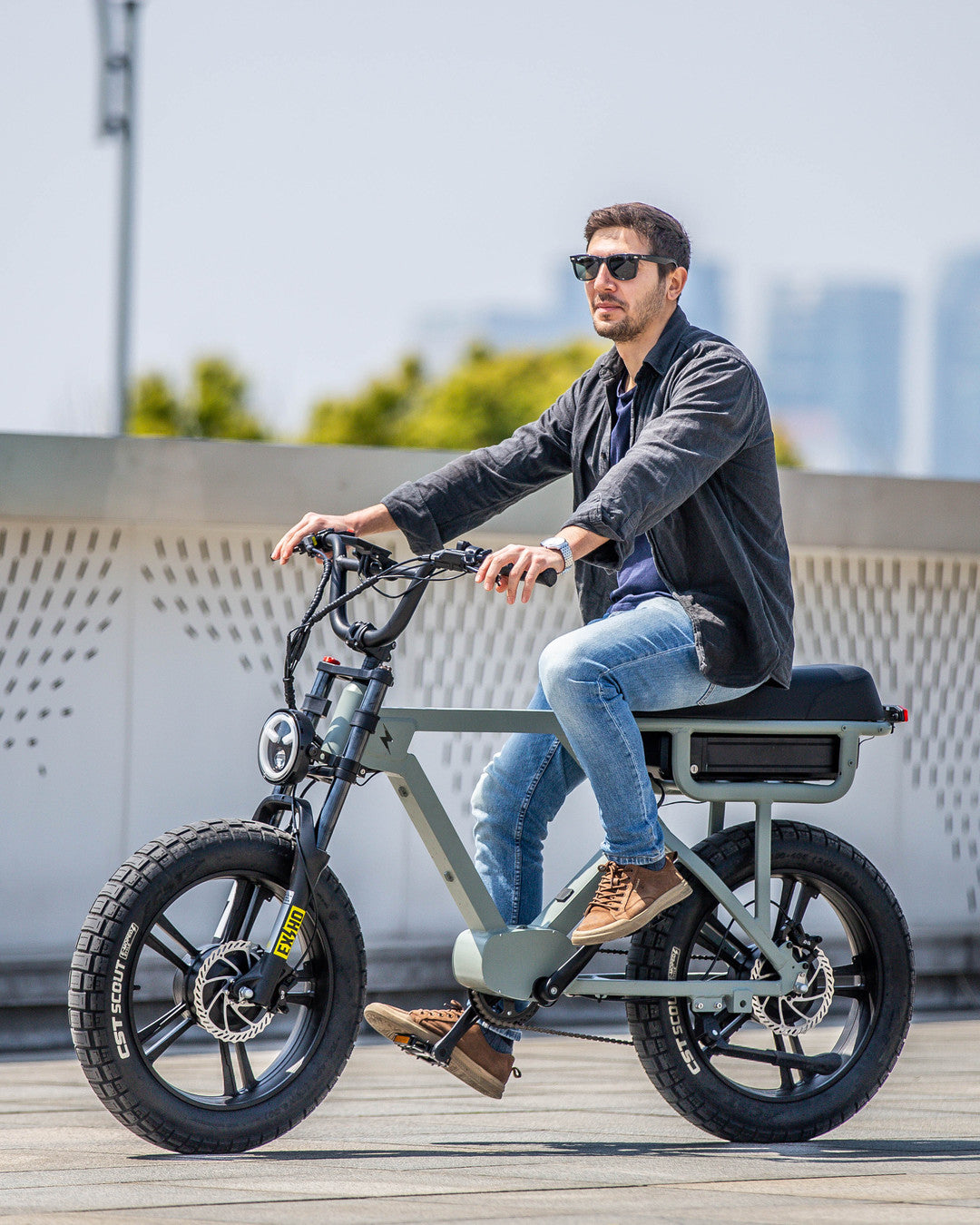


Full travel, working. The fork is deep into its stroke and the rear wheel is still tracking the rock — which is the whole job, and the part no spec sheet describes.
What we measured, 722 US e-bike listings across 41 brands: 43.9% use the word suspension · 7.3% publish a travel figure · 5.0% name the fork maker · 3.0% name any adjustment · 9.0% of 442 US bicycle recalls name a suspension part
Suspension is the oldest unsolved problem on a bicycle. It was patented before the pneumatic tire, abandoned when the tire arrived, and reinvented for mountain bikes a century later.
Today, electric bike suspension is the one component buyers are asked to pay for without being told a number. This guide fixes that: it traces every suspension system ever built, says which ones survived and why, and measures how much the US e-bike market actually tells you about the one on your bike.
Quick answer. Bicycle suspension is a spring plus a damper plus a chassis, and it exists to keep the tire on the ground and the vibration out of the rider.
On an electric bike it matters more than on an acoustic bike, not less: the extra mass is mostly unsprung, and roughness resistance — the energy a rough surface steals through your body — is larger than rolling resistance on all but the smoothest roads (Turner, Vehicle System Dynamics, 2024).
Yet of 722 US direct-to-consumer electric-bike listings we pulled and read on 2026-08-23, only 7.3% published a suspension travel figure and only 5.0% named the fork maker. The word "suspension" is on almost half the listings. The number is on about one in fourteen. On the mountain shelf specifically, our electric mountain bike guide repeats this census at the manufacturer: 29 of 43 maker pages publish a fork travel figure, and only 13 publish rear travel.
Start with our mountain and off-road e-bikes or the full fat-tire range if you want to see what a published spec looks like. And if you want to feel the difference rather than read it, the verified US e-bike store directory lists shops offering test rides in 70 cities.
In this guide
- How we verified this guide
- What's on this page
- Why suspension, and not just more motor and battery
- What electric bike suspension actually is
- 1869–1900: suspension came first, and the tire killed it
- 1900–1980: the long sleep
- 1962: Moulton's argument that never went away
- 1989–1996: the mountain bike restarts everything
- The census: every suspension system ever put on a bicycle
- Which systems survived, and why the others died
- Springs: coil, air, elastomer, leaf
- Dampers: what rebound and compression actually control
- The four numbers that decide how a suspension feels
- Anti-squat: the reason rear suspensions have so many pivots
- What actually changes on an electric bike
- What US e-bike listings actually tell you
- What the law requires: nothing
- What the standards require
- The recall record
- What the evidence actually shows, including the parts against us
- Four bikes, matched to four riders
- What goes wrong, and what it costs
- Suspension on kids' and teen e-bikes
- What changed in suspension, 2023–2026
- Matching a system to a rider
- Where buyers get caught out
- Setting up the suspension you already own
- The pre-purchase checklist
- Frequently asked questions
- The bottom line
- Limitations and expiry
- Source register
- Primary sources
How we verified this guide
Every figure on this page was retrieved from a primary source and recorded on 2026-08-23, and every one of them is linked to a dated deposit copy held in this repository. The corpus behind it is 41 storefronts, 442 US recalls from the CPSC's own database, the complete text of 16 CFR part 1512 in two editions, 75 papers and 24 USPTO patents. No number here comes from anyone's memory of how bicycles work.
What was consulted. The corpus behind this page is 41 e-bike storefronts pulled to exhaustion through their own public product endpoints, 442 US bicycle recalls from the Consumer Product Safety Commission's own database, the complete text of 16 CFR part 1512 in two independent editions, 75 papers returned by eight named PubMed queries, of which 15 are genuinely on topic, a 28-page suspension theory manual published by SRAM, 24 patent documents downloaded from the USPTO and deposited here, and 37 manufacturer and standards-body pages, of which 36 were retrieved and 1 failed. Every count in that sentence is a file on disk.
What was computed rather than quoted. Three things: the disclosure rates across the 722-listing census, the distribution of published travel figures, and the unsprung-mass arithmetic in § What actually changes on an electric bike. The method for each is stated where the number appears.
What was checked and found wrong. The census classifier was hand-checked in five rounds and five defects were caught and fixed before any number was published. The largest: a substring match scored the word first as the fork manufacturer RST, inflating "names the fork maker" from a true 34 listings to a false 162. The full log is in research/suspension/05-catalog/VERIFICATION_20260823.md. We publish it because a percentage whose method was never audited is an assumption wearing a percent sign.
Reviewed by Milad Ghobadibeygvand, BScN (Western University, 2014), Redtail eBikes. Last verified August 23, 2026. Corrections: contact us and we will date and publish the fix on this page.
What's on this page
- 1. Why suspension, and not just more motor and battery
- 2. What electric bike suspension actually is
- 3. 1869–1900: suspension came first, and the tire killed it
- 4. 1900–1980: the long sleep
- 5. 1962: Moulton's argument that never went away
- 6. 1989–1996: the mountain bike restarts everything
- 7. The census: every suspension system ever put on a bicycle
- 8. Which systems survived, and why the others died
- 9. Springs: coil, air, elastomer, leaf
- 10. Dampers: what rebound and compression actually control
- 11. The four numbers that decide how a suspension feels
- 12. Anti-squat: the reason rear suspensions have so many pivots
- 13. What actually changes on an electric bike
- 14. What US e-bike listings actually tell you
- 15. What the law requires: nothing
- 16. What the standards require
- 17. The recall record
- 18. What the evidence actually shows, including the parts against us
- 19. Four bikes, matched to four riders
- 20. What goes wrong, and what it costs
- 21. Suspension on kids' and teen e-bikes
- 22. What changed in suspension, 2023–2026
- 23. Matching a system to a rider
- 24. Where buyers get caught out
- 25. Setting up the suspension you already own
- 26. The pre-purchase checklist
- 27. Frequently asked questions
- 28. The bottom line
- 29. Limitations and expiry
- 30. Source register
- 29. Primary sources
Why suspension, and not just more motor and battery
Suspension matters more than extra power on real American roads because a rough surface is a resistance term rather than only a comfort problem. A 2024 paper in Vehicle System Dynamics found that "for roads of moderate roughness, roughness resistance is larger than rolling resistance," and that only high-quality surfaces — "in most jurisdictions, accounting for less than 10 % of the total" — let you ignore it (Turner 2024). More watts buy more energy; suspension stops the road taking it.
Miles Turner's model links surface roughness to a resistance force and finds that "for roads of moderate roughness, roughness resistance is larger than rolling resistance," and on very rough roads it is larger than aerodynamic drag (Turner 2024). Only on high-quality surfaces — "in most jurisdictions, accounting for less than 10 % of the total" — can it be ignored.
That single finding reframes the whole question. Power and battery buy you more energy — and if you want the powertrain side of that question, we measured 26 drive systems in the e-bike motor guide. Suspension stops the road taking it. On the surface most American riders actually ride, the second lever is the larger one, and it is the one nobody quotes a spec for.
The mechanism is not mysterious. Turner's model shows roughness resistance "depends only on the vertical stiffness of the bicycle and the roughness index," and that other parameters — including the rider's own physiology — drop out. A stiffer bike loses more. Softening the bike's vertical stiffness is the mitigation (Turner 2024), and a suspension is the most direct way to do it.
The manufacturers have measured the same effect from the other end. SRAM's Indianapolis lab reports that a rider on a RockShox Rudy XPLR fork with Zipp 101 wheels "saved almost 16 watts at 18 mph (29 kph) on simulated moderately-rough gravel compared with a baseline carbon wheel and rigid fork," and about 8 watts at 13 mph (SRAM, Damping Bad Vibrations).
That is a component maker measuring its own product, and we label it as such. It is also the same physics Turner derived independently, arrived at by a different route.
There is a second cost, and it lands on the rider rather than the clock. A controlled study of ergometer cycling under 20 Hz vertical vibration at 20 m/s² RMS found riders lasted 47 minutes with vibration against 60 minutes without (Samuelson, Jorfeldt & Ahlborg, Upsala Journal of Medical Sciences, 1989).
That is a 13-minute reduction in endurance at identical load and identical end-of-test heart rate (Samuelson et al. 1989). Vibration is a fatigue load that shortens how long you can hold a given effort.
Why this matters before you shop On typical American pavement, the road is stealing more from you than your tires are, and no amount of extra wattage changes that — it just pays the toll faster. A suspension is the only component that reduces the toll itself.
What electric bike suspension actually is
A bicycle suspension has three parts, and every system in this guide is a different arrangement of the same three. SRAM's own theory manual states them plainly: a spring, which "absorbs, stores, and releases energy"; a damper, which "converts energy to heat" and controls the speed of compression and extension; and a chassis, which "houses the spring and damper, and serves as a structural member of the bicycle" (SRAM, Suspension Theory Guide, p. 4).
The same page draws a distinction most listings blur: "The movement of the suspension is the stroke, and the amount of stroke that is used for shock absorption is the travel." A shock's stroke and a bike's rear-wheel travel are different numbers (SRAM, p. 4), and a seller quoting one as the other is not lying so much as not saying which they mean.
SRAM lists four purposes, and it is worth reading them in order, because comfort is only one: control ("isolating the rider from shock to prevent loss of control"), comfort ("to prevent fatigue or injury"), durability ("to prevent damage to the bicycle"), and traction ("ensuring that the wheel stays in contact with the ground when needed") (Suspension Theory Guide, p. 3).
Traction is the one that decides whether a suspension is worth its weight. A wheel that leaves the ground is not braking, steering or driving. Everything that follows in this guide — pivot placement, damper valving, unsprung mass — is engineering aimed at that one sentence (SRAM, p. 3).
The spring stores the hit. The damper decides how fast it comes back (SRAM, p. 14). Take the damper away and you have a pogo stick that returns the bump energy straight into your hands.
| The term | What it actually means | Why a buyer should care |
|---|---|---|
| Spring rate | Force needed per unit of compression, e.g. "200 lb of force to compress one inch" is a 200 lb spring (SRAM, p. 5) | Too stiff and it never moves; too soft and it never stops moving |
| Travel | The part of the stroke used for shock absorption (SRAM, p. 4) | The single most useful number a listing can publish. 89.5% do not |
| Sag | How far it compresses under the rider's static weight (SRAM, p. 13) | Sag is what lets the wheel extend down into holes as well as compress over bumps |
| Preload | Compressing a coil before the stroke starts, creating breakaway force (SRAM, p. 7) | Preload is not a spring-rate adjustment, whatever the manual implies |
| Breakaway force | The force that must be overcome before anything moves (SRAM, p. 7) | This is why a cheap fork feels dead over small bumps |
| Top out | The mechanical stop at full extension (SRAM, p. 8) | A fork that clunks at top-out is usually missing its negative spring |
1869–1900: suspension came first, and the tire killed it
The bicycle had suspension before it had air in its tires. Query the class an examiner today files a suspension fork under — CPC B62K25/04, resiliently-mounted front wheels — and restrict it to priority dates before 1900, and the US record answers with patents titled "Velocipede" and "Bicycle": US 443,663 (1890), US 448,442 (filed 1889), and US 624,295, granted 2 May 1899.
How much of that we can stand behind: all three documents were retrieved from the USPTO and are deposited with this page. The CPC classification is confirmed on the classification record for US 624,295; for the other two it rests on the classification search that returned them, which we could not re-run at publication because the index was rate-limiting.
Springs were not an afterthought on the early safety bicycle. They were the answer to a specific and violent problem: a solid-tired machine on a nineteenth-century road.
Then John Boyd Dunlop's pneumatic tire arrived and solved most of it at a fraction of the weight, cost and complexity. This is the first and most important lesson in the whole history: the tire is a suspension element, and it is the most efficient one on the bicycle. Every system in this guide is engineering that begins where the tire's capacity ends — a boundary the US patent record has been probing ever since.
The trap that catches modern buyers is the inverse of the Victorian one. A 4-inch fat tire at low pressure is doing real suspension work, and a cheap 80 mm coil fork bolted above it may be doing almost none. Adding a fork to a fat-tire bike is not automatically an upgrade over running the tire correctly.
1900–1980: the long sleep
For roughly eight decades after 1900 the bicycle largely stopped suspending itself, for economic rather than technical reasons: roads improved, the safety bicycle's geometry stabilized, and the racing rulebook rewarded lightness and stiffness. The ideas never stopped — US 4,576,393 shows Alex Moulton still filing in 1982 — but almost none reached volume production. Suspension survived at the margins: sprung saddles on roadsters and the occasional sprung fork on a delivery bicycle.
What did not sleep was motorcycling. Every major bicycle suspension architecture that appears after 1985 — telescopic fork, trailing link, leading link, swingarm, four-bar linkage, inverted fork — had already been through decades of development on motorcycles. The clearest single piece of evidence is that a former AMA Grand National motorcycle champion filed the landmark bicycle rear-suspension patent (US 4,789,174). When mountain biking needed suspension, it downsized it.
That inheritance explains a persistent confusion in e-bike marketing. Moto-styled electric bikes are frequently sold with suspension specifications borrowed from motorcycle practice, including inverted forks and long-travel rear shocks, on machines whose sprung mass and speeds are nothing like a motorcycle's. Copying the hardware does not copy the tune.
1962: Moulton's argument that never went away
In 1962 Alex Moulton launched a small-wheeled bicycle with suspension at both ends, and made an argument the industry spent sixty years refusing and then quietly accepting. His company still states the thesis in the present tense: the Moulton combines "small wheels, high-pressure tires and full suspension into a uniquely responsive design," and rather "than merely absorbing the road, the frame works with it, maintaining momentum and stability" (Moulton Bicycle Company, retrieved 2026-08-23).
The engineering logic is worth stating because it is the logic of a modern e-bike. Small wheels are structurally efficient and let you run high pressures, and high pressures are fast — but a small wheel falls further into every hole and hits every edge harder. Suspension is what buys the small wheel back. Moulton's answer was to accept a harsher wheel and then suspend it properly, and he patented the result (US 4,576,393).
Look at a 20-inch folding e-bike or a 20-inch fat-tire moped-style e-bike and you are looking at Moulton's premise with a motor bolted on. The wheel is small, the mass is high, and the suspension is the part that decides whether the combination works or rattles. This is the single strongest historical argument that suspension belongs on utility bikes and not only on mountain bikes (Moulton Bicycle Company).
What the history is telling you Suspension is not a mountain-bike accessory that leaked into commuting. It was a road-bicycle solution first, it was displaced by a better one (the tire), and it comes back every time a design makes the tire's job harder — small wheels, heavy loads, high speeds. An electric bike does all three.
1989–1996: the mountain bike restarts everything
Modern bicycle suspension has a start date, and it is the end of the 1980s, when off-road racing created a market that would pay for complexity. Within about seven years the industry produced the telescopic suspension fork, the elastomer fork, the four-bar rear linkage, the air spring, the cartridge damper and the downhill-specific dual-crown fork. Almost everything after that is refinement.
The fork end of that story is documented by the people who built it. RockShox's own account of the BoXXer records a 1996 release "to professional athletes only," with "only 20 prototypes," running "coil springs, 150mm of travel, 32mm stanchions, two separate cartridges for Rebound and Compression damping, and posts for V-brakes" (SRAM, BoXXer Legacy).
Those numbers are a useful yardstick. In 1996, 150 mm of travel was a professional downhill specification.
The weight race ran alongside the travel race. RockShox describes the first SID — "Superlight Integrated Design" — as a pure cross-country fork that "at 2.6 pounds ... stunned the mountain biking world as it was lighter than any other production suspension fork on the start line," with "a stingy 63mm of travel and a chassis built around 28mm upper tubes," inflated with "a needle-style inflator ... like you'd use for your kid's soccer ball" (SRAM, SID Legacy).
The rear end of the story is written in patents. US Patent 5,121,937, "Suspension bicycle," was filed on 13 December 1990 by Mert Lawwill — a former AMA Grand National motorcycle champion — and its prior-art keywords are, revealingly, "pivot point," "pair" and "hub" (USPTO, US 5,121,937). A motorcycle racer solving a bicycle's rear-suspension geometry is the whole 1990–1996 period in one document.
The census: every suspension system ever put on a bicycle
Thirty-four suspension architectures follow, grouped by where they act: fifteen at the front wheel, fourteen at the rear, five that suspend the rider instead. There are that many because bicycles have a problem cars do not — the rider pedals, and pedaling pushes back on the suspension.
Every dated entry links to its primary patent at the USPTO. Almost every design below is an attempt to separate the two. The census is grouped by where the system acts, and each family is described by what it does rather than by what it is called this season.
How to read this. Status is our reading of the current market, graded plainly: Dominant (most new bikes use it), Current (in production, a real niche), Niche (small-scale or specialist), Extinct (no longer in volume production). Where a patent is named it is the primary document and is linked to the USPTO's own copy.
Four families, four different bets on the same problem. Only the red pivot changes between them, and that one pivot is what a brand is really selling you when it names its linkage.
Front suspension: the fork and everything that replaced it
| System | How it works | First landmark | Status | What it is good for |
|---|---|---|---|---|
| Telescopic fork | Sliding stanchions in lowers; spring and damper inside the legs | The dominant form since the early 1990s; specification snapshot in RockShox's own BoXXer account | Dominant | Everything. Cheap to make, easy to service, well understood |
| Elastomer fork | Rubber-like blocks as the spring, little or no damping | US 5,445,401 and US 5,470,090, Douglas Bradbury / Manitou Mountain Bikes, priority 1993-09-07 | Extinct at quality level; survives at the very bottom of the market | Cheapness and light weight; stiffens badly in cold |
| Air-sprung telescopic | Sealed air chamber as the spring, with a negative spring to cut breakaway force | SRAM's SID account: 2.6 lb, 63 mm travel, needle inflator | Dominant above entry level | Tunable to rider weight without changing parts |
| Coil-sprung telescopic | Steel or titanium coil spring | SRAM, Suspension Theory Guide, p. 5 | Current, mostly gravity and budget | Linear rate, no air seals, very consistent |
| Dual-crown fork | Second crown above the head tube for torsional stiffness | BoXXer, 1996, 20 prototypes (SRAM) | Current in downhill and some moto-style e-bikes | Stiffness at long travel; heavy and limits steering lock |
| Inverted (upside-down) fork | Stanchions at the bottom, lowers at the top | In production at DVO and others | Current, niche | Lower unsprung mass, better bushing overlap; torsionally harder to make stiff |
| Single-sided fork | One leg only, carrying the wheel on a cantilevered axle | Cannondale Lefty family | Niche | Very stiff for its weight; wheels are proprietary |
| Leading-link fork | Wheel on a short link ahead of the fork leg | US 5,299,820, Mert Lawwill, priority 1991-09-19 | Extinct on mountain bikes; current on some small-wheel and folding bikes | Anti-dive geometry; no stiction from sliding seals |
| Parallelogram / linkage fork | Four-bar linkage instead of sliders, so the wheel follows a designed arc | US 5,441,291, Girvin, Inc., priority 1993-09-20 | Extinct in volume; niche revival | Zero sliding stiction; wheel path can be tuned |
| Modern linkage fork | Long-travel four-bar front end, designed to resist brake dive | US 9,216,791 and US 10,336,398, Christopher Hudec / CMH Plus Holdings, priorities 2011-03-14 and 2015-02-27 | Niche | Keeps geometry stable under braking; heavy and expensive |
| Leaf-spring fork | Glass or carbon leaf springs instead of a telescope | Lauf; rear-wheel version filed by Benedikt Skúlason / Lauf Forks, priority 2019-09-06 | Niche, gravel | Almost no weight, no maintenance, no damping at all |
| Headset / steerer suspension | Short-travel spring inside the head tube or steerer | Cannondale HeadShok lineage; Specialized Future Shock | Niche, road and gravel | 20–30 mm of compliance without a fork |
| Suspension stem | Elastomer or spring in the stem itself | Girvin Flexstem lineage; Redshift ShockStop today | Niche, retrofit | The cheapest way to soften an existing rigid bike |
| Suspension hub | Springs inside the hub shell | Pantour lineage | Extinct in volume | Very short travel, no unsprung-mass penalty |
| The tire | Air volume at low pressure | Dunlop's pneumatic tire, 1888 | Dominant, and always has been | The most efficient suspension on any bicycle |
Rear suspension: eleven ways to stop the pedals fighting the shock
| System | How it works | First landmark | Status | What it is good for |
|---|---|---|---|---|
| Rigid rear | No rear suspension at all | The default for a century | Dominant by unit volume | Efficiency, weight, price, nothing to service |
| Softail / flex-stay | Short travel from a deliberately flexing seatstay plus a small damper | Widely used from the mid-1990s | Current, cross-country and gravel | 20–40 mm of take-the-edge-off with almost no weight |
| Beam / cantilever | The saddle rides on a sprung composite beam; the frame stays rigid | US 5,456,481 and US 5,415,423, Softride, Inc., priority 1989-04-07 | Extinct | It suspended the rider while the wheel stayed rigid, which is also why it died |
| Single pivot | Rear wheel on a swingarm with one main pivot | US 4,789,174, Mert Lawwill, "Suspension bicycle," priority 1987-04-27 | Current, especially on e-bikes | Simple, cheap, few bearings, entirely predictable |
| Linkage-driven single pivot ("faux bar") | Single pivot, but the shock is driven through a linkage to shape the rate | Ubiquitous from the late 1990s | Dominant on mainstream e-MTBs | Most of the tunability of a four-bar at lower cost |
| Horst-link four-bar | Chainstay pivot below and ahead of the rear axle, so braking and pedaling are separated | Popularized as Specialized's FSR; the modern Specialized rear-suspension family runs to 19 filings in CPC B62K25/28 | Dominant | Braking neutrality; a large, well-understood design space |
| Twin-link / short-link four-bar | Two short counter-rotating links create a moving instantaneous center | Santa Cruz's VPP as filed: US 7,784,810 and US 8,641,072, Joseph Graney, priority 2005-11-14 | Dominant at the premium end | Anti-squat that changes through the stroke |
| Giant Maestro | Four pivots and two linkages making "a single floating pivot point" | Giant's own description: it counteracts "pedaling forces that would otherwise create suspension compression (squatting) or pedal kickback (bobbing)" (Giant) | Dominant within one very large brand | Near-vertical wheel path, linear rate |
| Translating-pivot four-bar | The main pivot itself moves along a track and reverses direction mid-stroke | Yeti's Switch Infinity: "a patented translating pivot that switches direction as the bike moves through its travel" (Yeti Cycles) | Niche, premium | High anti-squat early, then "anti-squat drastically drops for freedom of suspension movement" |
| Split pivot / concentric-axle four-bar | The four-bar pivot sits concentric with the rear axle | Weagle's US 2011/0115181 — a published application, so there is no USPTO grant PDF — priority 2003-09-25; the same family underlies Trek's ABP | Dominant across several large brands | Braking and suspension almost fully decoupled |
| Unified rear triangle (URT) | Bottom bracket rides on the swingarm, so the drivetrain never moves relative to the wheel | US 5,826,899, Klein Bicycle Corporation, priority 1996-07-03 | Extinct | Zero pedal feedback seated; the suspension effectively switches off when you stand |
| High-pivot with idler | Main pivot high above the chainline; an idler pulley keeps the chain from binding | Current enduro and downhill practice | Current, growing | Rearward axle path, so square edges push the wheel back and up rather than straight into you |
| Six-bar and floating-drivetrain designs | Extra links, or the bottom bracket on its own linkage | Trek's cross-linkage family, e.g. US 6,164,676, priority 1998-02-20 | Niche | More tuning freedom; more bearings to wear |
| Interconnected / inertia-valve damping | The damper senses whether the input came from the ground or the rider | US 10,316,924, Fox Factory, priority 2001-08-30 | Current | Solves pedal bob in the damper instead of the linkage |
Suspending the rider instead of the wheel
| System | How it works | Status | What it is good for |
|---|---|---|---|
| Sprung saddle | Coils under the saddle rails | Current on utility and comfort bikes | Cheapest vertical compliance there is; adds nothing to traction |
| Telescopic suspension seatpost | The post slides in the frame against a spring | Dominant among suspension seatposts by volume | Simple; tends to bind under a rearward-pushing rider |
| Parallelogram suspension seatpost | The saddle moves on a four-bar linkage, roughly along the seat-tube angle | Current, the enthusiast choice | Moves the saddle in the direction the bump actually pushes |
| Suspension stem | See above | Current, retrofit | Front-end comfort on a bike with no fork |
| Frame compliance | Deliberate flex designed into stays, seatpost or seat tube | Dominant on road and gravel | Weightless by definition; a few millimetres at most |
The one-sentence version of the census Front suspension converged on the telescopic fork and stayed there; rear suspension never converged at all, because there is no single right answer to "how do you stop pedaling from compressing the shock" — and every brand's linkage is a different bet on that question.
If you have got this far, you already know more about suspension than most of the copy written about it. Here is the range, with the architecture stated on each bike.
Browse full-suspension e-bikesOr read the one with a 19.3-inch standover: our Eunorau SPECTER-ST 2.0 review.
Which systems survived, and why the others died
Survival in bicycle suspension turns on three things, and how well a system works in isolation is not among them: whether it can be manufactured cheaply, whether a shop that is not the factory can service it, and whether it fights the rider. The beam bike is the clearest case — its own patents (US 5,456,481, 1989) describe a design that worked as intended and still died.
Every extinct design below failed at least one of those tests while doing its actual job well. The beam bike's own patents (US 5,456,481) describe a system that worked precisely as designed.
| System | Verdict | Why it went that way |
|---|---|---|
| Telescopic fork | Survived, dominant | Cheap to manufacture at every price point, serviceable with common tools, and the failure modes are understood. It is not the best-performing front suspension ever designed. It is the one that scales. |
| Air spring | Survived, dominant | One part fits every rider weight. Its progressive curve is a genuine engineering advantage: force rises "exponentially through the stroke" (SRAM, p. 9), which resists bottoming without a stiff start. |
| Cartridge damper | Survived, dominant | Separating oil from air stops aeration; the trade is "system complexity, increased friction, and breakaway force" (SRAM, p. 15) |
| Elastomer fork | Died at quality level | No damping. An undamped spring returns the bump energy straight back into you, and elastomers stiffen in the cold. It survives only where the price point forbids anything else. |
| Linkage / parallelogram fork | Died in volume, revived in niche | Solves stiction completely and is heavier, more expensive and harder to make torsionally stiff. Beaten on cost rather than on function. |
| Unified rear triangle | Died | It removed pedal feedback by mounting the bottom bracket on the swingarm — and so, when the rider stood up, their weight went onto the swingarm and the suspension stopped working at the exact moment it was needed. |
| Beam bike | Died | It suspended the rider and left the wheel rigid. The rider was comfortable; the tire still skipped. Traction is the point, and a beam does not address it. |
| Suspension hub | Died | Very short travel, awkward to seal, and it competed against a tire that does the same job for free. |
| Softail / flex-stay | Survived, niche | Short travel, near-zero weight, no bearings. It never tried to be a full suspension and has outlived several designs that did. |
| Horst-link four-bar | Survived, dominant | A large, patient design space and genuine braking neutrality. Its patent position shaped a decade of the industry. |
| Twin-link (VPP and relatives) | Survived, dominant at the top | Anti-squat that varies through the stroke, which is the closest anyone has come to having pedaling efficiency and small-bump sensitivity at once. |
| High-pivot with idler | Survived, growing | It buys a rearward axle path, and pays for it with drivetrain friction at the idler. Riders decided the trade was worth it. |
The extinction pattern, stated once
Three of the four extinct systems — URT, the beam, the suspension hub — died the same death: they were solving for the rider's comfort rather than the tire's contact with the ground. SRAM's own manual lists traction last of four purposes, but it is the one the others depend on (Suspension Theory Guide, p. 3).
That is the recurring error in bicycle suspension, and it is the error most e-bike marketing makes today, because comfort is the easier thing to sell.
Springs: coil, air, elastomer, leaf
A spring absorbs, stores and releases the energy of an impact, and the four ways of building one behave differently through the stroke: a coil is linear, an air spring progressive, an elastomer progressive and temperature-sensitive, a leaf spring near-linear with no damping at all (SRAM, pp. 5–11). It is why two forks with identical travel can feel nothing alike.
A coil is essentially linear. SRAM's manual gives the rule that "if a spring requires 200 lb of force to compress one inch, it would be referred to as a 200 lb spring," and notes that rate is set by wire material, wire thickness and active wire length (p. 5).
The same page adds that "distance between coils, coil diameter, and length of the coil do not affect spring rate." Linear means predictable, and it also means a coil will happily bottom out if you get the rate wrong (SRAM, p. 5).
An air spring is progressive by physics. Halve the chamber volume and you double the pressure, and repeating that through the stroke produces "an exponential increase in air pressure" (p. 9).
Rate is set by the ratio of air to chamber volume. A larger initial volume gives "a more gradual spring curve" and a smaller one ramps harder (p. 10).
Air's weakness sits at the start of the stroke rather than the end. Pressurized air pushes on the piston before anything moves, so "an air spring can feel firm at the beginning of the stroke, similar to a preloaded coil" (p. 12).
The fix is a negative spring — coil, rubber or a second air chamber — that opposes the positive one and cancels part of the breakaway force. A cheap air fork that feels dead on small bumps usually has a poor negative spring rather than a wrong pressure (SRAM, p. 12).
Elastomers are springs with a little internal damping and a strong temperature dependence. Leaf springs, as used in modern glass-fiber gravel forks, have almost no mass and almost no damping at all, which is the trade a gravel rider is often willing to make.
| Spring | Rate through the stroke | Adjusts by | Cold behavior | The honest trade |
|---|---|---|---|---|
| Coil | Linear (SRAM, p. 5) | Swapping the spring; preload only shifts breakaway force (p. 7) | Unaffected | Best small-bump feel, worst weight and worst fit range |
| Air | Progressive, exponentially so (p. 9) | A pump, in seconds | Pressure falls slightly as it cools | Fits any rider; needs seals, and seals mean stiction |
| Dual-rate / progressive coil | Two rates, one soft then one firm, as close coils bind (p. 6) | Swapping the spring | Unaffected | Some of air's ramp with a coil's start |
| Elastomer | Progressive and temperature-dependent | Swapping the stack | Stiffens noticeably | Cheap, light, and undamped |
| Leaf | Near-linear, very short travel | Not adjustable | Unaffected | Weightless and maintenance-free; no damping whatsoever |
Dampers: what rebound and compression actually control
The spring decides how far the suspension moves. The damper decides how fast, and it is the part that turns a pogo stick into a suspension. SRAM's manual is blunt about why one is not enough on its own: without damping, spring rates "are too high to be effective in practical suspension," and "shocks compressing and rebounding very quickly cause instability in the handling of the system" (p. 14).
A damper works by forcing oil through restrictions, converting motion into heat which is "dispersed into the fluid and is eventually released into the atmosphere" (p. 14). Why a hard-working shock gets hot, and why a damper that has lost its oil feels like a spring again.
The two adjustments on almost every fork map onto two different physical circuits. Low-speed damping governs "slow compression stroke speed scenarios such as rider weight shifts on the bike, and suspension compression during cornering or transitions." High-speed damping governs "fast compression stroke speed scenarios such as bump impact or drop/jump landings," and is regulated by a blow-off valve (SRAM, pp. 17–18).
"Speed" here means how fast the damper shaft is moving, which is a different thing from how fast the bike is moving. This is the single most common misunderstanding in suspension setup: a slow rider hitting a square-edged curb is generating a high-speed compression event, and a fast rider leaning into a smooth berm is generating a low-speed one (SRAM, pp. 17–18).
Lockout and platform are the same circuit taken to its limit: lockout "restricts oil flow to prevent the suspension from compressing at all, or until a predetermined pressure threshold is overcome," while platform is "similar to lockout, but with less force required to initiate suspension compression" (SRAM, p. 18).
There is a fourth thing a damper cannot easily catch, and the industry has only recently admitted it. High-frequency, low-amplitude vibration — what RockShox calls "trail chatter" — "can often make its way past the damper, up the fork, and into your hands" (SRAM, ButterCups). Their answer was rubber isolators at the base of the damper, and they publish the number: about "4mm of vertical compliance" and "an average of 20% reduction in trail chatter from reaching your hands."
Hold that 20% figure. It becomes important in § What the evidence actually shows.
The four numbers that decide how a suspension feels
Four numbers describe almost everything about how a suspension behaves: travel, sag, leverage ratio and progressivity. Travel is the part of the stroke that absorbs shock, and sag is how far it settles under the rider (SRAM, pp. 4 and 13). The last two are properties of the frame rather than the shock, and only 7.3% of US listings print even the first.
Travel is how much of the stroke does the shock-absorbing (SRAM, p. 4). More is not better; more is different. Long travel needs a slacker frame to work and carries weight and cost you only recover on rough ground.
Sag is how far the suspension settles under the rider standing still, and it is the setting nearly everyone gets wrong. Its purpose is not softness. Sag "allows the suspension to not only compress but to also extend in order to maintain traction when unweighting over drops, dips, or when cornering" (SRAM, p. 13). A suspension set with no sag cannot follow a hole, only a bump.
Frame three is the one people set their sag wrong for. A fork with no sag left can rise over a rock and then skate straight across the hollow behind it.
Published sag targets vary by application, and manufacturers disagree because the applications differ. FOX specifies a "sag range ... 15–20% of total fork travel" for its forks (FOX Bike Tech); RockShox's shorter-travel gravel fork "needs only 5 percent sag to be effective" (SRAM, Rudy XPLR); coil rear shocks are commonly set at 25–30%. There is no universal number, which is why the setup instruction matters more than the spec.
Leverage ratio is the relationship between wheel movement and shock movement, and it is a property of the frame's linkage, not the shock. Progressivity is how that ratio changes through the stroke. Together they decide whether a bike with a "150 mm" shock feels supportive or wallowy, and they are the reason two bikes with identical shocks ride differently.
The industry has started attacking these numbers directly in the damper. RockShox's GENIE air spring "breaks that dependency, letting engineers tune the first 70% of travel at its own rate, independent of the final 30%" (SRAM, GENIE), and Hydraulic Bottom Out applies "oil damping to affect bottom out in the last 20% of travel" (SRAM). Both are admissions that a single spring curve cannot serve the whole stroke.
Shape only; these are not measured values. Built from the relationships SRAM states in its Suspension Theory Guide (pp. 5–11): coil rate is linear; air pressure rises exponentially as chamber volume falls.
Anti-squat: the reason rear suspensions have so many pivots
Anti-squat describes whether chain tension extends or compresses the rear suspension while you pedal, and it is why the rear of a bicycle has a dozen competing architectures while the front has one. It was measured in 2002: the optimum pivot height is 9.8 cm seated and 5.9 cm standing (Karchin & Hull). Chain tension pulls the rear axle forward; where the main pivot sits determines whether that pull extends the suspension, compresses it, or does nothing.
This is not marketing theory. It was measured. A 2002 study in the Journal of Biomechanical Engineering put eleven experienced riders on a purpose-built adjustable dual-suspension bicycle on an inclined treadmill at a constant 6% grade and 24.8 km/h, randomised the pivot height, and measured suspension motion directly (Karchin & Hull, J Biomech Eng 124(1):101–106).
The result is specific and it is still the clearest experimental answer anyone has published. "In the seated posture, the optimal pivot point height was 9.8 cm on average and had a range of 8.0–12.3 cm. ... In the standing posture, the average height was 5.9 cm and ranged from 5.1–7.2 cm."
Read that again, because it is the whole problem in two sentences. The optimum pivot height for seated pedaling is roughly 4 cm higher than for standing pedaling, and a frame has one pivot (Karchin & Hull 2002). Every twin-link, translating-pivot and floating-pivot design in the census exists to make the effective pivot move so it can serve both.
Eleven riders, an adjustable-pivot bicycle and a treadmill at a fixed 6% grade produced two answers 3.9 cm apart (Karchin & Hull 2002). Every moving-pivot design on the market is an attempt to have both.
That is precisely what the manufacturers say they are doing. Giant describes Maestro's four pivots and two linkages creating "a single floating pivot point" that counteracts "squatting" and "pedal kickback (bobbing)" (Giant). Yeti describes Switch Infinity as a "translating pivot that switches direction as the bike moves through its travel," giving "a relatively flat and high anti-squat curve" early and then dropping anti-squat "drastically ... for freedom of suspension movement" (Yeti).
Where this goes wrong. Anti-squat is quoted as if more is always better. It is not: high anti-squat also means chain tension resists suspension movement, which is the same thing as pedal kickback and a harsher ride under power. Every linkage in the census is a bet on where in the stroke to spend that trade, and none of them is free.
What to take from the pivot experiment When a brand tells you its linkage "eliminates pedal bob," it has chosen a bias, not solved a problem. Ask what it gives up, and where in the travel it gives it up. On an e-bike with a torque sensor and constant assist, the pedaling forces that anti-squat is fighting are larger and more continuous than on an acoustic bike.
What actually changes on an electric bike
Three things change when you add a motor and a battery, and only one of them is the one the industry talks about. The weight rises, but most of it lands unsprung: comparing DT Swiss's own MTB and e-bike wheel tiers gives a +20.4% mean penalty, all of it in the rim, spokes and hub (DT Swiss). Where the motor sits matters more than what it weighs, and the loads last longer.
One: the weight goes up, and most of it is in the wrong place. "Heavier" is not the useful description. Mass above the spring is easy for a suspension; mass below it — unsprung mass — is what the suspension must accelerate over every bump, and it is the term that decides whether the wheel follows the ground.
The arithmetic below is done from published figures rather than asserted. DT Swiss builds its mountain-bike wheels in tiers and builds a parallel "Hybrid MTB" range for e-bikes to the same tiers, which makes a clean tier-against-tier comparison possible from one maker using one stated convention (DT Swiss MTB wheel range, retrieved 2026-08-23).
| Tier | MTB wheelset | e-bike wheelset | Difference |
|---|---|---|---|
| Carbon cross-country | XMC 1200 SPLINE, 1,485 g | HXC 1200 SPLINE, 1,809 g | +324 g (+21.8%) |
| Alloy trail | XM 1700 SPLINE, 1,599 g | HX 1700 SPLINE, 2,019 g | +420 g (+26.3%) |
| Alloy entry | M 1900 SPLINE, 1,825 g | H 1900 SPLINE, 2,066 g | +241 g (+13.2%) |
Mean penalty: +20.4%, and every gram of it is unsprung — it is in the rim, the spokes and the hub. Our calculation from DT Swiss's published figures; the working is in research/suspension/03-physics/unsprung-mass_20260823.md. It is also a floor rather than an estimate, because those figures cover rim, spokes and hub only. Tires, tubes, rotors and cassettes are unsprung too and are not in the numbers.
Two: where the motor sits changes the suspension more than what it weighs. Bosch publishes weights for its whole US drive-unit range. The Hub Line hub motor is listed at 5.1 lb, and every mid-drive in the same table runs 6.0–7.1 lb (Bosch eBike Systems, drive units).
So the hub motor is the lighter component, by roughly 400–900 g. And it is the one that costs the suspension, because it is the only one that sits below the spring. Against DT Swiss's own e-bike wheels, 2,313 g of hub motor is 112% of a complete pair of HXC 1200 wheels and about 2.2× the mass of the single wheel it is built into.
Nothing here says a hub motor is a bad choice. Hub drives are simpler, quieter, cheaper and need no chain to make power. The point is narrower and it is the one no listing makes: a hub motor and a mid-drive with the same power do not present the same problem to a suspension, and the lighter one is the harder one (Bosch drive units).
Same two motors, same catalog, same maker (Bosch drive units). The one that weighs less is the one the suspension has to fight, because it is bolted to the part that has to follow the ground.
Three: the loads are bigger and they last longer. A rider assisted to 20 or 28 mph — a Class 3 speed that is legal in some states and not others, which our state-by-state e-bike law guide covers in full — arrives at every bump faster, carries more total mass, and can hold power up a climb for far longer than an unassisted rider.
Suspension makers have responded with e-specific tunes and stiffer chassis, and FOX's own 2025 specification tables list an "E-bike+" variant alongside the standard FLOAT versions of the 36 and 38 forks, with its own maximum air pressures (FOX Bike Tech, spec sheets).
There is direct field evidence that the class matters. A 2025 study in Sensors measured ISO 2631-1 vibration exposure across 30 campus roads using a mountain bike, a shared e-bike and a shared bicycle (Gao et al., Sensors 25(19):6185).
About 90% of segments were rated comfortable on the mountain bike, while 42% of segments were rated uncomfortable on the shared e-bike and 80% of routes were "potentially inducing discomfort" on the shared bicycle (Gao et al. 2025).
And for anyone carrying a passenger, a 2026 study in Ergonomics measured infant-seat accelerations in cargo bicycles across six road surfaces. Cargo bicycles "induced on average 0.6 ms-2 on tarmac and up to 10.7 ms-2 at 25 km h-1 on paver bricks" (Dell'Orto et al., Ergonomics, 2026).
At that level the whole-body vibration standard "suggests ... continuous exposure should be limited to less than 10 min" (Dell'Orto et al. 2026). The same paper notes that "vintage strollers have reduced vibrations compared to modern strollers, indicating benefits of compliant suspensions."
The e-bike-specific rule Ask where the mass sits before you ask how much of it there is. A mid-drive puts its motor above the spring and inside the frame; a hub motor puts a mass larger than the wheel itself below the spring. If you are choosing a hub-drive bike for rough ground, the suspension has more work to do rather than less.
What US e-bike listings actually tell you
We measured this rather than complaining about it. On 2026-08-23 we pulled every published product from the public product endpoints of 54 US direct-to-consumer e-bike brands, reached 41 of them, and read 7,664 listings. After excluding accessories, parts, apparel, bundles and non-electric bikes, 722 electric rideable listings remained, collapsing to 651 distinct models.
| What the listing publishes | Listings (n=722) | Models (n=651) |
|---|---|---|
| Uses the word suspension, shock or fork at all | 43.9% | 43.6% |
| Publishes a travel figure | 7.3% | 8.0% |
| Names the fork or shock maker | 5.0% | 5.1% |
| Names any damping, preload or lockout adjustment | 3.0% | 3.2% |
Narrow it to the listings that actually claim a suspension architecture and the gap gets worse rather than better. Of the 275 listings that state front, full or seatpost suspension, only 19.3% publish a travel figure and only 12.0% name the maker.
A brand willing to put "full suspension" in the title is, four times out of five, unwilling to say how much. That figure is ours, from the census described in How we verified this guide, computed against the same population as every other percentage in this section.
The architecture split is its own finding:
| Architecture, as the listing itself states it | Listings | Share |
|---|---|---|
| Not stated at all | 375 | 51.9% |
| Full suspension | 151 | 20.9% |
| Front suspension only | 121 | 16.8% |
| No usable listing copy to read | 68 | 9.4% |
| Explicitly rigid | 4 | 0.6% |
| Suspension seatpost only | 3 | 0.4% |
Two honest notes on that table. "Not stated" does not mean the bike is rigid; it means the seller did not say. And the 68 "no usable copy" listings are held in their own row rather than being counted as silence, because on those the blind spot belongs to our method rather than to the seller.
Where a figure is published, the numbers are modest. Across 89 travel figures on 53 listings, the median is 100 mm, the mean 119 mm, and the range 38–203 mm. Twenty-three of the 89 figures are under 80 mm, which is less than half the travel of a professional downhill fork from 1996.
The bikes that do publish a figure cluster short. A 1996 downhill fork ran 150 mm; the median US e-bike listing that will tell you anything says 100.
Rules of the count. The classifier was hand-checked in five rounds; the headline claim was not sampled but verified exhaustively, with all 54 travel-credited rows read individually against their own listing text. Thirteen brands were unreachable and are named with their status in the summary file rather than folded into the finding.
The full method and every defect found is in research/suspension/05-catalog/VERIFICATION_20260823.md. This is a floor: any brand publishing its specs in a JavaScript tab our reader could not see is undercounted here, and the count is conservative by design.
The gap between the first bar and the second is the entire argument of this page. Almost half the market says the word. One listing in fourteen backs it with a number.
We are part of this population, and it is measured on our own storefront too. Of 147 rideables on redtailebikes.com on the same date, 24.5% published a travel figure and 8.2% named the fork maker. Better than the market average and nowhere near good enough. We are publishing the number because the alternative is asking you to trust a page that would not audit itself.
What the law requires: nothing
No federal rule in the United States requires a bicycle suspension to do anything: no damping requirement, no rider-weight requirement, and no impact test that treats it as a suspension. The mandatory standard, 16 CFR part 1512, contains the word "suspension" zero times in two independently retrieved editions. Its only fork provision is a cantilever bending test written in 1978, before suspension forks existed to regulate. The mandatory rule exists — it just does not contain the concept.
The federal bicycle regulation is 16 CFR part 1512, issued by the Consumer Product Safety Commission at 43 FR 60034 on 22 December 1978 and amended at 76 FR 27888 on 13 May 2011.
We retrieved the complete current text on 2026-08-23 and searched it. The word "suspension" appears zero times. "Shock absorber" appears zero times. "Damping" appears zero times. The word "spring" appears once, and it is a spring scale used to measure brake lever force (16 CFR 1512.18(d)).
What the rule does regulate is the fork as a structure. § 1512.13 states in full: "The front fork shall be tested for strength by application of at least 39.5 J (350 in-lb) of energy in accordance with the fork test, § 1512.18(k)(1), without visible evidence of fracture. Sidewalk bicycles need not meet this requirement."
That test, at § 1512.18(k)(1), is a cantilever bending test. "With the fork stem supported in a 76 mm (3.0 in) vee block ... a load shall be applied at the axle attachment in a direction perpendicular to the centerline of the stem and against the direction of the rake."
The criterion is that "energy of at least 39.5 J (350 in-lb) shall be absorbed with a deflection in the direction of the force of no more than 64 mm (2 1/2 in.)." Part 1512's own figure 1 is captioned "Bicycle Front Fork Cantilever Bending Test Rig" (16 CFR part 1512, figure 1).
Our reading, labeled as our reading: this is a fore-and-aft strength test written in 1978 for a rigid fork. It asks whether a fork breaks when bent backwards. It says nothing about how a suspension fork springs, damps, holds pressure, resists stiction, or behaves after a winter of salt — because in 1978 there were no suspension forks to regulate. A suspension fork sold in America today is tested by a rule that does not know suspension exists.
And it applies to your e-bike. A low-speed electric bicycle under 15 U.S.C. § 2085 — fully operable pedals, an electric motor of less than 750 watts, under 20 mph motor-only with a 170-pound rider — is a consumer product subject to CPSC jurisdiction, and therefore to part 1512. The same regulation that has no concept of suspension is the one governing the suspension on most American e-bikes.
How e-bikes ended up under a rule written for bicycles
The path is documented and it is short. Congress added section 38 to the Consumer Product Safety Act in 2002, making low-speed e-bikes subject to the bicycle regulation (15 U.S.C. § 2085(a)). CPSC then amended part 1512 so the existing requirements for human-powered bicycles applied to e-bikes as well, at 68 FR 7072 on 12 February 2003.
What happened next is the part that matters here. In the Commission's own account of that amendment: "The Commission did not make any other changes or additions." An e-bike was placed under a 1978 bicycle rule unchanged, and the rule has not gained a suspension requirement since.
The rulemaking that is open right now, and what it does not mention
CPSC opened an Advance Notice of Proposed Rulemaking on electric bicycles on 15 March 2024, docket CPSC-2024-0008, "considering developing a rule to address the risk of injury associated with electric bicycles"; the comment window closed on 14 May 2024 (89 FR, document 2024-05472).
We read the full text of that notice on 2026-08-23. The word "suspension" appears zero times in it. So does "shock absorber," and so does "damping." The active federal rulemaking that could add mechanical requirements for e-bikes does not currently contemplate the suspension at all.
The notice is also unusually blunt about the wider gap. In CPSC's words: "No U.S. voluntary standards have specific mechanical requirements applicable to e-bikes." The reason it gives is definitional — ASTM's frame and fork requirements exist, but "do not have specific requirements for e-bikes because the ASTM definition of bicycle is limited to those solely" human-powered.
Our reading, labelled as ours: that is a two-sided gap. The mandatory rule has no concept of suspension, and the voluntary standards that do cover forks were written for bicycles that weigh half as much and never reach 28 mph under power. A rider is buying a component that no American standard, mandatory or voluntary, currently evaluates for the machine it is bolted to.
Two independent retrievals stand behind this. We read the current text through the eCFR API and re-read the 2025 annual edition as published by the Government Publishing Office (CFR-2025-title16-vol2, part 1512). Both contain the same § 1512.13 text and neither contains the word "suspension."
What the standards require
Voluntary standards are where suspension is actually addressed, and they address it as structure rather than as performance. ISO 4210-2:2023 states that its scope "has been limited to safety considerations and has specifically avoided standardization of components," and ASTM F2043 classifies intended use rather than testing a fork. No standard in common use tells a buyer how well a suspension works; they tell a manufacturer whether it will break.
| Standard | Issuing body | What it governs | What it does not do |
|---|---|---|---|
| 16 CFR part 1512 | US Consumer Product Safety Commission | Mandatory. Brakes, steering, fork strength, wheels, reflectors (eCFR) | Never mentions suspension. Fork test is a 1978 cantilever bending test |
| ISO 4210-6 | International Organization for Standardization | Frame and fork test methods for the ISO 4210 series (ISO 4210-6:2023) | Paywalled; a structural test regime rather than a suspension performance regime |
| ISO 4210-2 | ISO | Safety requirements for city, trekking, young-adult, mountain and racing bicycles (ISO 4210-2:2023) | ISO states the scope "has been limited to safety considerations and has specifically avoided standardization of components" |
| ASTM F2043 | ASTM International | The usage-condition classification — the Condition 1 to 5 system a fork is rated against (ASTM F2043-13(2018)) | It classifies intended use. It does not test the suspension |
| EN 15194 | CEN (European) | The EPAC standard for electrically power-assisted cycles | European market scope; e-bike electrical and system safety rather than suspension tuning |
| UL 2849 | UL Standards & Engagement | Electrical safety of the e-bike drive system, battery and charger (UL 2849) | Electrical only. Suspension is outside its scope entirely |
| ISO 2631-1 | ISO | The whole-body vibration measurement and exposure standard the cycling studies use | Measures human exposure. It is not a bicycle standard and imposes nothing on manufacturers |
The one that a buyer can actually use is ASTM F2043, because it is the origin of the "Condition 1/2/3/4/5" ratings printed on fork lowers and in frame manuals. It sorts bicycles by intended use — road-only, off-road with jumps under 12 inches, rough off-road with jumps under 24 inches, and extreme off-road — and it is a classification rather than a performance grade (ASTM F2043-13(2018)).
The failure mode is a real one. A Condition rating tells you what a component was designed for, which is a statement about warranty and liability. It is not a statement about ride quality, and a fork can be Condition 3 and still be undamped. A rating and a specification are different things, and only one of them tells you how the bike will feel.
Where this leaves an American buyer. The electrical side of an e-bike is now covered by a real, testable, increasingly mandatory standard in UL 2849, and several states and cities have begun requiring it. The suspension side has nothing equivalent, in any jurisdiction we could find. If that changes, this page changes with it, and the conditions that would trigger the update are listed in § Limitations and expiry.
The recall record
Suspension appears in the US safety record, which is not where a pure comfort feature would show up. Of 442 bicycle recalls indexed by the Consumer Product Safety Commission and read on 2026-08-23, 40 (9.0%) name a suspension component in the agency's own words and 119 name a fork of any kind. We pulled them under seven product-name queries, deduplicated by recall number, and classified only on the CPSC's own text.
Denominator: 468 recalls in the union of the seven queries, of which 442 are for a product that is a bicycle, e-bike or trike.
| Classification | Recalls | Share of the 442 | What it counts |
|---|---|---|---|
| Narrow | 40 | 9.0% | The CPSC's own text names a suspension part: suspension, shock absorber, damper, elastomer, swingarm |
| Fork | 119 | 26.9% | A fork of any kind is named — rigid forks included, so this is not a suspension count |
| Broad | 146 | 33.0% | Anything springy or pivoting appears anywhere in the record; an upper bound only |
We publish the narrow row and show the other two so you can see what a looser definition would have bought, and how much of the difference is rigid forks rather than suspension. Every row is reproducible from the CPSC's own service.
The shape over time is the more interesting finding. Suspension recalls ran at 11 in the 1990s, 19 in the 2000s, 9 in the 2010s and 1 so far in the 2020s — a clear peak in the 2000s followed by a long decline.
That is what a maturing technology looks like in a safety database, and it is a genuine point in favor of modern suspension. The mass-market fork of 2026 is a far more reliable object than the mass-market fork of 2004.
The shape argues for modern suspension rather than against it (CPSC recall data). The forks that hurt people were mostly built two decades ago.
Ten of the forty narrow recalls carry CPSC descriptions that mention injuries or fractures. A suspension fork is a structural member that carries the entire front of the bicycle and all of its braking load — SRAM's own manual defines the chassis as "a structural member of the bicycle" (p. 4). It is not an accessory, and it is not a place to buy the cheapest available part.
Method notes, so the count can be re-run. Classification is by the CPSC's own title, product names, hazard field and description; no cause is inferred. The population is the union of seven product-name queries rather than the whole recall database. No brand we currently sell appears in the narrow set, and by standing policy we do not put a brand the store sells into a hazard table in a guide. The raw data and the script are in research/suspension/04-standards/.
What the evidence actually shows, including the parts against us
The peer-reviewed evidence on bicycle suspension is thinner than the marketing and does not all point one way. Eight named queries against the US National Library of Medicine returned 75 distinct papers, of which 15 are genuinely on topic (NCBI E-utilities). The entire indexed evidence base, and the findings that cut against suspension get their own rows below.
Fifteen papers. The entire indexed evidence base for a component sold on every bicycle in the world, and the queries that produced it are published so the count can be rebuilt (NCBI E-utilities). What it says follows, with the findings that cut against suspension given their own rows on purpose.
| Finding | Direction | Source |
|---|---|---|
| Full-suspension riders were significantly faster off-road (24.1 vs 22.9 km/h) at no extra pedaling power, and creatine kinase rose significantly 24 h after the hardtail trial | For | Nishii, Umemura & Kitagawa, J Sports Med Phys Fitness 44(4), 2004 |
| Dual suspension "absorbs more high frequency vibrations, is more comfortable and performs as well as" front suspension on an uphill course | For | Faiss et al., J Sports Med Phys Fitness 47(2), 2007 |
| 20 Hz vibration through the pedals cut time to exhaustion from 60 min to 47 min at identical load | For | Samuelson, Jorfeldt & Ahlborg, Ups J Med Sci 94(1), 1989 |
| Roughness resistance exceeds rolling resistance on moderately rough roads, and is mitigated by lowering the bicycle's vertical stiffness | For | Turner, Vehicle System Dynamics, 2024 |
| Shared e-bikes rated uncomfortable on 42% of road segments; mountain bikes comfortable on ~90% | For | Gao et al., Sensors 25(19), 2025 |
| Cargo bicycles reached 10.7 m/s² at 25 km/h on paver bricks with infant dummies aboard; the standard suggests limiting continuous exposure to under 10 minutes | For | Dell'Orto et al., Ergonomics, 2026 |
| Full suspension reduced total vibration but had no effect on performance or physiological measures over a cross-country lap | Against | Macdermid et al., J Sports Sci 35(14), 2017 |
| Rigid forks were faster than air-sprung and leaf-sprung forks over stairs, and "rigid forks reduced overall exposure" at the handlebar | Against | Macdermid et al., Sports Biomech 16(4), 2017 |
| Two seatposts sold to minimize vibration showed no significant difference from a plain aluminum post, and occupational vibration limits were exceeded with all three | Against | Edwards & Holsgrove, J Sports Sci 39(5), 2021 |
| Rider-generated power dissipated by suspension is "minimal and probably negligible on most terrains" — the bob penalty is smaller than folklore says | Against the folklore, for suspension | Nielens & Lejeune, Sports Medicine 34(2), 2004 |
| Intermittent vibration improved gross efficiency over a 30-minute submaximal trial | Against | Aksit et al., Turk J Phys Med Rehabil 67(1), 2021 |
| Optimal rear pivot height differs by ~4 cm between seated and standing pedaling | Structural | Karchin & Hull, J Biomech Eng 124(1), 2002 |
| Vibration must fall by at least 15% before a rider can detect the change at all | The one that reframes everything | Ayachi et al., Human Factors 60(6), 2018 |
The finding that reframes the marketing
Take the last two rows together, because nobody has put them side by side before.
Ayachi and colleagues measured just-noticeable differences for vertical vibration on a road simulator and concluded that "vibration magnitude needs to be reduced by at least 15%, for the change to be detectable by road cyclists" (Human Factors, 2018). Below 15%, a real, measurable improvement is invisible to the person paying for it.
Now set that against RockShox's published figure for its ButterCups isolators: "an average of 20% reduction in trail chatter from reaching your hands" (SRAM).
A rider cannot feel a 14% reduction in vibration. The best isolator on the market delivers 20%.
Twenty percent, against a detection threshold of fifteen. That is a genuine improvement, honestly stated, sitting barely above the point at which a human being can notice it — which is exactly why comfort claims are so hard to evaluate on a test ride, and why so many of them are worth less than they sound. The two numbers come from independent sources with no relationship to each other, and putting them together is our own analysis.
How to read the "against" rows honestly
The studies that found no performance benefit are real and they should change what you expect. Suspension is not reliably faster on a race course (Macdermid et al. 2017), the bob penalty is smaller than either camp claims (Nielens & Lejeune 2004), and at least two products sold specifically to reduce vibration failed to beat a plain aluminum post in a controlled test (Edwards & Holsgrove 2021).
What the against-rows do not show is that suspension does nothing. They measured performance and found it unchanged while vibration fell. Every one of those studies used trained athletes over race-length efforts. None of them measured a 200-pound commuter on a 60-pound bike over broken pavement for an hour, which is the actual use case for most American e-bikes and the one the vibration-exposure studies address directly.
The most honest summary available from the evidence: suspension's proven effect is on exposure and fatigue, not on speed. If you are buying suspension to go faster, the literature does not support you. If you are buying it to arrive less beaten up, and to keep the tire on the ground on surfaces the studies rate as uncomfortable, it does.
Four bikes, matched to four riders
Four bikes follow, matched to a rider situation rather than ranked, with prices and stock checked against our own storefront on 2026-08-23. Two of the four fail this article's own test — they publish no travel figure — and their pick cards say so. A guide that demands disclosure for 20,000 words and then hides its own gap would be worth nothing.
The only bike in our range that names a premium fork and publishes travel at both ends: a RockShox Psylo 27.5" fork with 150 mm of travel and a RockShox Deluxe Select+ rear shock. If you took the four numbers section seriously, this is the bike on our site that answers all of them. It is also the most expensive thing here, and 150 mm is more travel than a commuter will ever cash in.
Genuine dual suspension with published numbers at both ends — a ZOOM 100 mm travel fork and an EXA KS/A5 165 mm rear shock — under $1,600. This is the answer to the trap in Where buyers get caught out: most bikes at this price say "full suspension" and stop. This one says how much. The fork is a budget unit and it will not feel like the URUS; it will feel like a fork that is actually working.
A full-suspension retro commuter for exactly the surface the vibration research rates worst — cracked urban tarmac, curbs and rail crossings — where the case for suspension is strongest and the case for long travel is weakest. Honest caveat: Qiolor does not publish a travel figure for it. By our own checklist that is a question to ask before you buy, and we will ask the manufacturer on your behalf if you want the number first.
Full suspension on a cargo-capable moto-style frame at $899, which is the cheapest way into real dual suspension we stock. The Ergonomics cargo measurements are the strongest single argument in this guide for suspension on a load-carrying bike. Same honest caveat: no published travel figure. At this price that is the norm rather than the exception, and it is the reason the checklist starts where it does.
Why only four, and why two of them are caveated. Rule 23 of our own house rules limits recommendations to seven approved brands. Applying this page's test to those brands on 2026-08-23, only 23 of 78 rideables publish a travel figure — 21 of them Eunorau and 2 Samebike, and both Samebike models were out of stock that day.
A picks list built purely on disclosure would have been two Eunoraus, which is not a recommendation so much as a house pick. So the module spans three brands, and the two that do not publish say so on the page.
Not one of these four? The fat-tire range is where most of the full-suspension stock lives, and we will pull the fork spec on any of them if the listing does not carry it.
See the fat-tire rangeWhat goes wrong, and what it costs
Suspension fails in a small number of predictable ways, and almost all of them announce themselves before they become expensive: lost small-bump sensitivity, a noise, a leak, and a lockout that stops holding. Three of the four trace to the same place — the lubricating film between the bushings and the upper tubes that fork feel depends on (SRAM, Friction Story).
Stiction — it stops feeling supple. Fork feel is dominated by friction between the bushings and the upper tubes, and by the lubricating film that keeps them apart: RockShox describes bushings working "together with lubrication to create a hydrofilm between the two, allowing the upper tubes to glide smoothly" (SRAM, Friction Story).
When the lower-leg oil is old, that film thins and the fork feels dead over small bumps while still working on big ones. It is the most common complaint and the cheapest fix.
Noise. A squeak or a creak under compression is usually dry bushings or a dry pivot bearing rather than a broken part. It is a service prompt rather than an emergency — but it is also the point at which a fork that has never been serviced should be.
A leak. Oil weeping past a seal means the damper is losing the fluid it converts motion into heat with (SRAM, p. 14). A fork that has lost oil behaves like a spring again: it will still compress and it will no longer control the return. This one does not wait.
Lockout that stops locking. Lockout works by restricting oil flow (SRAM, p. 18). When it stops holding, the circuit is not sealing. It is a service item, and riding without it costs nothing but efficiency.
What it costs, and the honest limits on that answer
We are not going to publish a service price. Rates vary by shop, by unit and by region, and a number invented here would be exactly the kind of unsourced figure this page spends 20,000 words arguing against. What we can tell you is what determines it: whether the unit is a named model with a parts channel.
A fork from a manufacturer that publishes service kits can be rebuilt by any competent shop. An unbranded fork with no model designation frequently cannot be rebuilt at all, which turns a service item into a replacement — and on many budget e-bikes the replacement is not a stocked part either. The real reason question two on the checklist asks who made the fork, and our census found only 5.0% of listings answer it.
Service intervals belong to your unit rather than to an article. Use the interval your own manufacturer publishes. What the physics says is only why it matters: the film degrades with use, and an e-bike accumulates hours and loaded miles faster than an unassisted bike does.
The one maintenance rule worth remembering A fork that has gone dead over small bumps is usually asking for a lower-leg service rather than a new fork. A fork that is leaking oil has lost its damper and should not wait. Everything else on this list is a booking rather than an emergency.
Suspension on kids' and teen e-bikes
Kids' electric bikes are a growing part of this market and the suspension question on them is different, because a light rider may never overcome the fork's breakaway force at all (SRAM, p. 7). In our census, kids' and teen machines publish travel from 40 mm to 50 mm while youth electric dirt bikes in the same catalog publish 200 mm and up.
Our census caught this directly. Among the kids' and teen machines in the population, published travel figures run from 40 mm to 50 mm on the small wheel sizes — for example the Eunorau EKIDS24 publishes "50mm travel Suspension Fork" — while youth electric dirt bikes in the same catalog publish 200 mm and up. Those are two entirely different machines sharing a shelf.
What to check on a child's bike, in order. Whether the fork moves at all under the child's actual weight, because a fork that never compresses is dead weight and a hazard in a corner. Then whether it is adjustable, since a growing rider changes the spring requirement every year. Then the total system weight limit.
The honest caveat: a very light rider on a budget coil fork is the worst case in this whole guide for the breakaway-force problem — the force that must be overcome before anything moves at all (SRAM, p. 7). A 60-pound child may simply not weigh enough to break it. Push down hard on the bars before you buy, and if the fork does not move, it will not move on the trail either.
What changed in suspension, 2023–2026
Four things moved in the last three years, and all four are dated and sourced. This section exists so you can tell whether a bike you are looking at is current or is selling you the state of the art from 2019.
| When | What changed | Why it matters to a buyer | Source |
|---|---|---|---|
| 2023 | Frequency-domain isolation arrives in production forks. RockShox shipped rubber isolators at the base of the damper, publishing "about 4mm of vertical compliance" and "an average of 20% reduction in trail chatter" | The industry admitted in public that a damper does not catch high-frequency chatter. It is the first mainstream answer to hand numbness | SRAM, ButterCups |
| 2023 | ISO 4210 parts 1, 2, 3 and 6 reissued. The frame-and-fork test methods were restated in a new edition | A fork sold today is tested to a 2023 structural standard and to no suspension-performance standard at all | ISO 4210-6:2023 |
| 2023–2024 | Air springs stopped being one spring. RockShox's GENIE lets engineers "tune the first 70% of travel at its own rate, independent of the final 30%," and Hydraulic Bottom Out applies damping "in the last 20% of travel" | Two bikes with the same travel figure can now be far more different than they used to be, which makes the travel number less informative on its own | SRAM, GENIE · Hydraulic Bottom Out |
| 2024 | Roughness resistance got a published model. Turner's paper put surface roughness into a resistance term and found it exceeds rolling resistance on moderately rough roads | The efficiency argument for suspension stopped being folklore and became a citable result | Turner, Vehicle System Dynamics, 2024 |
| 2025–2026 | Vibration exposure research turned toward e-bikes and cargo bikes, including ISO 2631-1 field mapping of shared e-bikes and the first infant-seat measurements in cargo bicycles | The evidence base finally began measuring the machines Americans actually buy, rather than only race bikes | Gao et al. 2025 · Dell'Orto et al. 2026 |
What did not change: there is still no US standard for how a bicycle suspension performs, and the mandatory federal rule still does not contain the word (16 CFR part 1512).
Matching a system to a rider
Your surface and your loaded weight decide the right suspension rather than a category name: a seatpost for smooth pavement, a 60–100 mm fork for broken city streets, 80–120 mm for gravel, 120–150 mm for singletrack, and 150 mm-plus only for steep descending (ISO 2631-1 field measurements).
The e-bike finder scores suspension by the surface you name: on pavement it gives every machine full marks, on gravel and dirt roads it favors any suspension or a 3-inch tire, and on dirt trails it favors full suspension; answer "Full only" and it sets the rest aside.
The table below pairs with our electric bike buying guide, with the reasoning attached so you can disagree with it on your own facts. If you are still choosing your first machine, start with the entry-level e-bike guide. At the far end of the travel range sit the off-road machines that are not e-bikes at all — 200 mm-plus forks on electric dirt bikes, where the suspension is motorcycle-derived.
| If this is your riding | The system that fits | Why | What you can skip |
|---|---|---|---|
| Smooth city pavement, under 10 miles | A suspension seatpost, or nothing | Vertical compliance where 100% of your weight sits, with no unsprung mass added and nothing to service | A suspension fork. On smooth tarmac it is weight, cost and stiction you never cash in |
| Broken city pavement, potholes, curbs, rail crossings | Short-travel front fork (60–100 mm) with lockout, plus a suspension seatpost | Curbs and rail crossings are high-shaft-speed impacts. This is the case the vibration studies rate as uncomfortable | Full suspension. Rear travel buys little on a surface with no sustained roughness |
| Gravel, hardpack, rail-trail | 80–120 mm front, or a leaf/short-travel gravel fork; rigid rear | Roughness resistance is the dominant loss here, and lowering vertical stiffness is what recovers it | A long-travel fork. Beyond ~120 mm you pay in geometry for nothing |
| Singletrack, roots, rock (where you can legally ride one) | Full suspension, 120–150 mm | Rear travel is what keeps a driven wheel on the ground on repeated hits, which is the traction case | A downhill chassis. Weight and steering lock cost you all day to be right for 90 seconds |
| Steep, technical descending | Full suspension, 150 mm+, dual-crown or heavy single-crown | The 1996 downhill benchmark was 150 mm and dual-crown; it is still roughly the boundary | Nothing. This is the case suspension was invented for |
| Cargo, passengers, child seats | Front suspension, and pay attention to the seat and the seat post | The Ergonomics cargo measurements are the strongest single argument in this guide for suspension on a utility bike | Long travel. It moves your load around |
| Heavy rider, or heavy rider plus cargo | Coil, or air with a big enough chamber, and check the stated rider weight limit | Air spring rate is set by pressure and volume; a small chamber pumped hard rides badly | Anything that cannot be set to correct sag at your weight |
| Cold climates, winter commuting | Air or coil, never elastomer | Elastomers stiffen in the cold, and undamped springs return energy rather than absorbing it | Elastomer forks. This is the one architecture we would tell you to avoid outright |
| You already own a rigid bike | Suspension stem and/or suspension seatpost, and lower your tire pressure first | The cheapest real improvement available, and the tire is free | A fork retrofit, unless the frame is designed for one — geometry and warranty both suffer |
Most riders reading this need a short-travel fork and a better seatpost rather than a downhill bike. The commuter range is where that combination lives.
See commuter e-bikes by suspension typeWhere buyers get caught out
Six mistakes account for most of the disappointment here, and all six are avoidable in ninety seconds with a spec sheet (our census of 722 listings): treating "full suspension" as a specification, reading travel as quality, mistaking preload for spring rate, using lockout to fix the wrong fork, running fat tires hard under a suspension fork, and ignoring where the motor sits. Our census found only 7.3% publish the figure that settles the first two.
"Full suspension" describes a shape rather than a specification. Our census found 151 listings claiming full suspension and only a quarter of the architecture-claiming set publishing travel. A rear shock that moves 30 mm on a bike marketed as full suspension is doing very little, and nothing in the listing will tell you which one you are buying.
Travel is not quality. A 150 mm fork with no damping is worse on every surface than a well-damped 80 mm fork. Damping is the expensive part, and that is why the cheap end of the market competes on travel numbers instead.
Preload is not a spring-rate adjustment. Winding in preload on a coil fork creates breakaway force and a stiffer initial feel; it does not change the spring rate (SRAM, p. 7). If a rider needs a different rate, they need a different spring, and no amount of preload substitutes.
Lockout is not a fix for the wrong fork. Lockout closes an oil circuit (SRAM, p. 18). Riding a locked-out fork on rough ground because it bobs means paying suspension's weight and price for a rigid bike.
Fat tires and suspension solve overlapping problems. A 4-inch tire at 12 psi is a genuine suspension element with far more travel than most budget forks. Buying both and running the tire at 25 psi gets you the weight of one and the benefit of neither.
A hub motor changes the arithmetic. This is the specifically electric mistake. The lighter motor is the one that hurts the suspension, because it is the one below the spring. See § What actually changes on an electric bike for the numbers.
Setting up the suspension you already own
Most riders can get a meaningful improvement from the suspension already on their bike in about twenty minutes, with a shock pump and a zip tie and no money at all. Set sag first, to the target your own manufacturer publishes — FOX specifies 15–20% of fork travel — then slow the rebound, then leave compression alone until both are right (SRAM, pp. 13 and 17–18). Setup beats upgrading almost every time.
Set sag first, and set it for your riding kit. Sag exists so the wheel can extend down into dips as well as compress over bumps (SRAM, p. 13).
Use the target your manufacturer publishes rather than a number from the internet: FOX gives 15–20% of fork travel (FOX Bike Tech), RockShox's short-travel gravel fork wants about 5% (SRAM), and coil rear shocks are commonly 25–30%. On an e-bike, sit on it wearing what you actually ride in, with the panniers you actually carry.
Then set rebound, and set it slower than feels fun. Rebound controls how fast the spring returns, and it is tied to spring force: more air pressure stores more energy and needs more rebound damping to control it. Too fast and the bike bucks; too slow and it packs down over repeated hits and stops using its travel.
Leave compression alone until sag and rebound are right. Low-speed compression governs weight shifts, cornering and transitions; high-speed compression governs impacts and landings (SRAM, pp. 17–18). Adjusting them before the spring is right just hides the spring error.
Use the travel indicator. Put a zip tie on a fork stanchion, ride your normal route, and look at how far it moved. If you never use the last 20% of travel, your spring is too stiff for your riding. If you bottom out repeatedly, it is too soft. This costs nothing and tells you more than any review.
Service it, because it is a structural part. Fork performance is dominated by friction between the bushings and the upper tubes, and by the lubrication that maintains "a hydrofilm between the two" (SRAM, Friction Story). A fork that has never had a lower-leg service is a fork running on the wrong friction, and on an e-bike the loads and mileages arrive faster.
Do this before you spend anything Set your sag properly, put a zip tie on the stanchion, ride your normal route, and look. Most riders discover their suspension has been set for someone else's weight since the day it arrived, and fixing that costs nothing.
The pre-purchase checklist
Seven questions to ask before you buy, and if a listing cannot answer the first four that is itself the answer: how much travel front and rear, who made the fork and shock, what is adjustable, air or coil and for what rider weight. Our census of 722 US listings, read on 2026-08-23 from each brand's own public product data, found only 7.3% answer the second question, 5.0% the third and 3.0% the fourth.
- What is the travel, front and rear, in millimetres? If the page does not say, ask before buying. Only 7.3% of the US listings we measured publish this.
- Who made the fork and the shock, and what model? Only 5.0% of listings say. A named unit is one you can look up, service and get parts for.
- What is adjustable? Preload, rebound, compression, lockout — 3.0% of listings name any of them. An unadjustable suspension is set for an average rider who is not you.
- Air or coil, and what rider weight range? An air spring you cannot set to correct sag at your weight is the wrong fork, however good the badge.
- Where is the motor? Hub or mid-drive — the motor guide has the full census. This changes how much work the suspension has to do, and it is the one on this list nobody else will tell you to ask.
- What is the total system weight limit, including cargo? Suspension components have their own limits, and they are not always the frame's.
- What does servicing cost and who does it? A proprietary or unbranded fork with no parts channel becomes a rigid fork the first time it fails.
Frequently asked questions
Do I need suspension on an electric bike?
It depends on your surface rather than on the bike's category. On genuinely smooth pavement a suspension seatpost and correct tire pressure cover most of it. On broken pavement, gravel or trail, the vibration-exposure research is clear that the loads are real: a 2025 study rated 42% of measured road segments uncomfortable on a shared e-bike (Gao et al., 2025).
Is a full suspension electric bike worth it?
For trail, technical terrain and repeated impacts, yes. For commuting on pavement, usually not: you pay weight, cost and service for travel you do not use, and FOX's own sag guidance assumes you will actually move through it. And be careful what you are buying: of the 275 listings in our census that claimed a suspension architecture, only 19.3% published a travel figure at all.
What is the difference between a hardtail and a full suspension ebike?
A hardtail has a suspension fork and a rigid rear; a full suspension has both. The rear is what keeps a driven wheel on the ground over repeated hits, which is why it matters more for traction than for comfort. One controlled study found full-suspension riders significantly faster off-road at identical pedaling power (Nishii et al., 2004); another found no performance difference at all (Macdermid et al., 2017).
How much suspension travel do I need?
For city and commuting, 60–100 mm; for gravel and rail-trail, 80–120 mm; for singletrack, 120–150 mm; for steep technical descending, 150 mm and up. For context, the median published travel figure across the US e-bike listings we measured is 100 mm.
What is sag and how do I set it?
Sag is how far the suspension compresses under your static weight, and it exists so the wheel can extend into dips as well as compress over bumps (SRAM, p. 13). Use your manufacturer's published target: FOX specifies 15–20% of fork travel (FOX Bike Tech), and coil rear shocks are commonly 25–30%.
What is rebound damping on a bike?
Rebound controls how fast the suspension returns after compressing. It is tied to spring force: more air pressure stores more energy and needs more rebound damping to control the return. Too fast and the bike bucks; too slow and it packs down over repeated hits (SRAM, pp. 17–18).
Is an air fork or a coil fork better?
Neither. A coil is linear, consistent and has the best small-bump feel, while an air spring is progressive, so force rises exponentially through the stroke and resists bottoming (SRAM, p. 9). Air fits any rider with a pump, coil needs the right spring, and for a heavy rider on a heavy e-bike the right answer is whichever one can be set to correct sag at your actual weight.
How do I adjust the suspension on an e-bike?
Set sag first, then rebound, then leave compression alone. Sit on the bike in your riding kit with the cargo you actually carry, measure how far the fork settles, and adjust air pressure or coil preload until it matches your manufacturer's target — FOX specifies 15–20% of fork travel. Then slow the rebound until the bike stops bucking. On an e-bike, do this loaded: the extra mass changes the number.
How do I adjust the rear suspension on an e-bike?
Same order as the fork, with two differences. Rear sag targets are usually higher — commonly 25–30% on a coil shock — and the frame's leverage ratio means shock stroke and rear-wheel travel are different numbers, so set sag by measuring the shock's shaft rather than the wheel. Then set rebound slower than feels fun; a shock that returns too fast on repeated hits packs down and stops using its travel.
How do I add air to a suspension fork?
With a shock pump rather than a tire pump — a tire pump cannot reach the pressures involved and loses most of the air on disconnection. Add pressure in small increments, cycling the fork a few times between them so the positive and negative air chambers equalize (SRAM, p. 12). Then re-check sag, because pressure and sag are the same adjustment seen from two ends.
Do e-bikes need suspension more than regular bikes?
Yes, for a measurable reason: most of an e-bike's extra weight is unsprung. Comparing DT Swiss's own MTB and e-bike wheel tiers gives a +20.4% mean penalty, all of it in the rim, spokes and hub (DT Swiss). Add a hub motor and it is worse: Bosch's Hub Line unit is 5.1 lb, about 2.2× the mass of the wheel it sits in.
Do gravel bikes have suspension?
Increasingly, and usually in short-travel forms rather than a mountain-bike fork: 30–40 mm telescopic gravel forks, leaf-spring forks with no damping at all, headset-based units, suspension stems and suspension seatposts. RockShox's own gravel fork is tuned so that it "needs only 5 percent sag to be effective" (SRAM) — a very different device from a 150 mm trail fork.
What is a suspension seatpost, and is one worth it?
It is a sprung or linkage-mounted post that lets the saddle move, and it is the most efficient comfort upgrade on a commuter because it adds no unsprung mass. Be careful with the claims, though: a controlled study found two seatposts sold to minimize vibration showed no significant difference from a plain aluminum post (Edwards & Holsgrove, 2021). Parallelogram designs move the saddle along the direction the bump actually pushes; telescopic ones fight the rider's rearward load.
Does suspension slow you down?
Less than folklore says. A Sports Medicine review concluded that rider-generated power dissipated by suspension is "minimal and probably negligible on most terrains" (Nielens & Lejeune, 2004). Against that, one study found rigid forks faster over stair sections (Macdermid et al., 2017). The honest summary is that suspension's proven effect lands on fatigue and exposure rather than on speed.
Do fat tires replace suspension?
Partly, and it is the oldest lesson in this subject — the pneumatic tire is what displaced 1890s bicycle suspension in the first place. A 4-inch tire at low pressure has real travel and no unsprung-mass penalty. What it does not have is damping, which is why a fat tire alone bounces on repeated hits, and why choosing between a fat tire and a narrower one is a different decision from choosing a fork (SRAM, p. 14).
Is a hub motor or a mid-drive better for suspension?
A mid-drive, and by a clear margin, because it puts the motor's mass above the spring. Bosch's own catalog makes the point neatly: its hub unit is the lighter one at 5.1 lb against 6.0–7.1 lb for the mid-drives, and it is still the harder one for a suspension, because location beats mass here.
Are there legal requirements for e-bike suspension in the US?
No. We retrieved the complete text of 16 CFR part 1512 on 2026-08-23 and the word "suspension" does not appear in it. The fork provision, § 1512.13, is a cantilever bending strength test written in 1978. Electrical safety is covered by UL 2849; suspension performance is covered by nothing.
Can I add suspension to a bike that does not have it?
Yes, in the order that gives the most return per dollar: tire pressure first, then a suspension seatpost, then a suspension stem. A fork retrofit is the last resort, because a frame not designed for a suspension fork changes geometry when you fit one, and it may void the warranty.
What is anti-squat, and why do rear suspensions have so many pivots?
Anti-squat describes whether chain tension extends or compresses the suspension while you pedal. It has one experimentally measured awkwardness: the optimum pivot height is about 9.8 cm seated and 5.9 cm standing (Karchin & Hull, 2002), and a frame has one pivot. Every multi-link design exists to make the effective pivot move.
Is more suspension travel always better?
No. Long travel needs a slacker frame to work, costs weight and money, and returns nothing on smooth ground. A well-damped short-travel fork outperforms a poorly damped long-travel one everywhere. Damping is the expensive part, which is why the budget end of the market advertises travel instead.
The bottom line
Suspension is the least-specified component on the American electric bike and the one doing the most under-appreciated work — traction and fatigue work rather than comfort work. Buy on four numbers in this order: travel front and rear, the named make and model of the fork and shock, what is adjustable, and where the motor sits. Only 7.3% of the 722 US listings we read on 2026-08-23 publish the first one.
Buy on four numbers, in this order: travel front and rear, the named make and model of the fork and shock, what is adjustable, and where the motor sits. If a listing will not give you the first two, it is telling you something about how it was specified.
Match to your surface rather than to a category. Most American e-bike riders need a well-damped short-travel fork, a good seatpost and correct tire pressure. Full suspension is for repeated impacts and driven-wheel traction, and it is genuinely worth it there and genuinely not worth it on a bike path.
And set what you already own. The largest single improvement available to most riders reading this is free: set your sag for your actual weight and kit, slow your rebound down, and put a zip tie on the stanchion to find out what your suspension is actually doing.
We would rather sell you the right bike once than the wrong one twice. Every bike on our site ships free within the US and is supported and warrantied here.
If the suspension spec you need is not on a product page, ask us: we will get the number from the manufacturer or tell you plainly that we could not. And if you are still deciding where to buy at all, we wrote an honest comparison of every option.
If you read nothing else Ask for the travel figure in millimetres before you buy. Nine listings in ten will not have one on the page — and a seller who can produce it on request has told you something real about how the bike was specified.
Limitations and expiry
Numbered, so you know how much weight this page can carry.
Author and interest
- Redtail eBikes sells electric bicycles, including bicycles with suspension. That is a commercial interest in this subject and you should read the page knowing it. We have tried to earn the read by publishing our own storefront's disclosure rate alongside the market's, and it is not flattering.
- No manufacturer paid for, reviewed or saw this page before publication.
Data
- The disclosure census covers 41 reachable brands of 54 attempted. Thirteen were unreachable and are named with their HTTP status in the summary file. Brands not on a platform with a public product endpoint are absent, so the finding describes the Shopify-and-WooCommerce direct-to-consumer segment rather than the entire US market.
- Product endpoints return published products only. Draft and archived listings are invisible to any storefront endpoint, so every count is a floor.
- Some brands publish specifications in a JavaScript tab or a theme metafield our reader could not see. Where that is true this census undercounts their disclosure, which is why the rates are published as floors and why 68 listings are held in a separate "no usable copy" row rather than counted as silence.
- The census is a snapshot of one day, 2026-08-23. Catalogs change weekly.
- The unsprung-mass computation uses DT Swiss wheelset figures that cover rim, spokes and hub only. Tires, tubes, rotors and cassettes are also unsprung and are not included, so the percentages understate the real penalty.
- The Bosch drive-unit weights are for a European city-class 250 W hub motor. Direct-drive and geared hub motors common on US fat-tire e-bikes are heavier, and we deliberately used the light one.
- The CPSC recall population is the union of seven product-name queries, not "all CPSC recalls." A recall filed under a different product name is outside it.
- The peer-reviewed corpus is what eight named PubMed queries returned. Engineering literature outside that index — SAE papers, theses, manufacturer white papers — is not in the 75, and the 15 on-topic papers are a small evidence base by any standard.
Method
- Architecture and travel are extracted from listing copy by pattern matching. It was hand-checked in five rounds; the measured agreement in the two random rounds was 86.7% and 80.0%, and every error in the second round was in what was counted rather than how suspension was read. The headline travel-disclosure claim was not sampled: all 54 credited rows were read individually.
-
UNSTATEDin the architecture table means the seller did not say. It is not evidence the bike is rigid. - The SRAM figures for watt savings and vibration reduction are a component maker measuring its own products. We label them as such and pair them with independent sources rather than resting a claim on them.
- The reading of 16 CFR part 1512 as "having no concept of suspension" is our interpretation of a text we quote in full. The quoted words are the source's; the inference is ours.
- This is not legal, medical or engineering advice for a specific bicycle. Follow your own component manufacturer's service and setup instructions over anything on this page.
Expiry conditions — the named events that would age this page
- The open CPSC e-bike rulemaking, docket CPSC-2024-0008. The Advance Notice was published 15 March 2024 and its comment window closed 14 May 2024. A Notice of Proposed Rulemaking from that docket would age the whole of What the law requires, and it is the single most likely event to do so. 16a. The CPSC micromobility battery rulemaking published 24 June 2026 (document 2026-12749). It addresses lithium-ion batteries rather than suspension, but it shows the Commission actively regulating this product class, which raises the odds on item 16. 16b. Any US standard for bicycle suspension performance. None exists today, mandatory or voluntary — CPSC says so itself. Adoption of one would obsolete this section immediately.
- The next ASTM F2043 revision. The current edition is F2043-13(2018).
- The next ISO 4210 revision cycle. Parts 1, 2, 3 and 6 were reissued in 2023.
- Any new controlled study of bicycle suspension and vibration exposure. With an on-topic base of 15 papers, a single well-powered study could move the balance of the evidence table materially.
- Catalog drift. The census should be re-run at least every six months; the script is committed and re-runnable.
- Routine re-verification. This page is re-checked at least every six months per our standing policy, and immediately on any of the events above.
Source register
Every source this page relies on, with its authority tier and what it supports. T1 is a primary official publication; T2 is an organization publishing about itself; T3 is peer-reviewed or standards-body work. No T4 source carries a claim alone anywhere on this page, and no T5 source — aggregator, competitor retailer, law-firm blog, AI summary — is cited at all.
| Source | Tier | What it supports here | Accessed |
|---|---|---|---|
| 16 CFR part 1512, eCFR | T1 | The federal fork test; the absence of "suspension" from the mandatory rule | 2026-08-23 |
| 16 CFR part 1512, GPO 2025 annual edition | T1 | Independent second retrieval of the same text | 2026-08-23 |
| 15 U.S.C. § 2085, GPO | T1 | The low-speed electric bicycle definition that puts e-bikes under CPSC jurisdiction | 2026-08-23 |
| CPSC Recalls REST service | T1 | The 442-recall population and the suspension classification | 2026-08-23 |
| USPTO Patent Public Search — 24 documents deposited | T1 | Every dated patent landmark in the census | 2026-08-23 |
| Google Patents (index, deliberately unlinked — it is not a citation) | T4 | Search, and a second retrieval of each patent record. Never the citation of record: every patent fact it supplied is also carried by the deposited USPTO document | 2026-08-23 |
| SRAM, Suspension Theory Guide | T2 | Spring, damper and chassis definitions; sag; preload; damping circuits | 2026-08-23 |
| SRAM / RockShox technology library | T2 | ButterCups 20% figure, friction and bushings, BoXXer and SID histories, GENIE, Hydraulic Bottom Out, Rudy watt figures | 2026-08-23 |
| FOX Bike Tech spec sheets | T2 | Fork sag range; E-bike+ fork variants | 2026-08-23 |
| Bosch eBike Systems drive units | T2 | Hub Line and mid-drive published weights | 2026-08-23 |
| DT Swiss MTB wheel range | T2 | MTB vs Hybrid-MTB wheelset weights for the unsprung computation | 2026-08-23 |
| Giant, Maestro Suspension | T2 | Maestro's own description of its floating pivot | 2026-08-23 |
| Yeti Cycles, Switch Infinity | T2 | Translating-pivot description and anti-squat behavior | 2026-08-23 |
| Moulton Bicycle Company | T2 | The small-wheel-plus-full-suspension thesis, in the company's words | 2026-08-23 |
| Lauf · DVO | T2 | Leaf-spring and inverted forks in current production | 2026-08-23 |
| Turner, Vehicle System Dynamics, 2024 | T3 | Roughness resistance vs rolling resistance; vertical stiffness as the mitigation | 2026-08-23 |
| 15 on-topic papers via NCBI E-utilities | T3 | The evidence table, in both directions | 2026-08-23 |
| ASTM F2043-13(2018) · ISO 4210 series · UL 2849 | T3 | The standards table. Catalog records only — the texts are paywalled and we do not quote what we have not read | 2026-08-23 |
| Redtail first-party datasets (census, recalls, unsprung math, literature corpus) | First-party | Every percentage attributed to "our census" or "our calculation" | 2026-08-23 |
A note on the paywalled standards. ISO and ASTM sell their texts. We cite their catalog records for what those records themselves state — title, edition, date and scope — and we do not quote or characterize clauses we have not read. Where a standard's content matters to a claim on this page, the claim is carried by a source we did read.
Link verification, stated plainly. Every external URL on this page was checked live on 2026-08-23: 58 of 61 resolved, and the three that did not were re-checked individually through a documented working route rather than trusted from the automated result. Two of the three — a Google Patents record and ISO 4210-2 — resolved on the second route and are confirmed live.
The third, ISO 4210-6's catalog page, sits behind a challenge that defeated every automated route we tried, so we have not independently confirmed that URL resolves, and its row in the table above carries that caveat. It is the only citation on this page in that state, and no claim here rests on it alone.
Primary sources
- United States Consumer Product Safety Commission. "Requirements for Bicycles," 16 C.F.R. part 1512, §§ 1512.1–1512.20. Issued 43 FR 60034, 22 December 1978; amended 76 FR 27888, 13 May 2011. Accessed 2026-08-23. https://www.ecfr.gov/current/title-16/chapter-II/subchapter-C/part-1512
- United States Government Publishing Office. "Code of Federal Regulations, Title 16, Volume 2, Part 1512," 2025 annual edition. Accessed 2026-08-23. https://www.govinfo.gov/content/pkg/CFR-2025-title16-vol2/pdf/CFR-2025-title16-vol2-part1512.pdf
- United States Government Publishing Office. "15 U.S.C. § 2085 — Low-speed electric bicycles," § 2085(b), 2024 edition. Accessed 2026-08-23. https://www.govinfo.gov/content/pkg/USCODE-2024-title15/pdf/USCODE-2024-title15-chap47-sec2085.pdf
- United States Consumer Product Safety Commission. "Recalls REST Web Service." Queried 2026-08-23. https://www.saferproducts.gov/RestWebServices/Recall 4a. United States Patent and Trademark Office. "Patent Public Search." Accessed 2026-08-23. https://ppubs.uspto.gov/pubwebapp/ 4b. United States National Library of Medicine. "Entrez Programming Utilities Help." Accessed 2026-08-23. https://www.ncbi.nlm.nih.gov/books/NBK25501/
- Lawwill, Mert. "Suspension bicycle." US Patent 4,789,174, priority 27 April 1987. Accessed 2026-08-23. https://image-ppubs.uspto.gov/dirsearch-public/print/downloadPdf/4789174
- Lawwill, Mert. "Suspension bicycle." US Patent 5,121,937, priority 13 December 1990. Accessed 2026-08-23. https://image-ppubs.uspto.gov/dirsearch-public/print/downloadPdf/5121937
- Lawwill, Mert. "Bicycle front suspension." US Patent 5,299,820, priority 19 September 1991. Accessed 2026-08-23. https://image-ppubs.uspto.gov/dirsearch-public/print/downloadPdf/5299820
- Bradbury, Douglas. "Suspension fork for bicycles." US Patent 5,445,401, assigned to Manitou Mountain Bikes, Inc., priority 7 September 1993. Accessed 2026-08-23. https://image-ppubs.uspto.gov/dirsearch-public/print/downloadPdf/5445401
- Bradbury, Douglas. "Precision suspension fork for bicycles." US Patent 5,470,090, assigned to Manitou Mountain Bikes, Inc., priority 7 September 1993. Accessed 2026-08-23. https://image-ppubs.uspto.gov/dirsearch-public/print/downloadPdf/5470090
- Moulton, Alex. "Bicycle suspension." US Patent 4,576,393, assigned to Alex Moulton Limited, priority 1 December 1982. Accessed 2026-08-23. https://image-ppubs.uspto.gov/dirsearch-public/print/downloadPdf/4576393
- Softride, Inc. "Modular composite bicycle frame." US Patent 5,456,481, priority 7 April 1989. Accessed 2026-08-23. https://image-ppubs.uspto.gov/dirsearch-public/print/downloadPdf/5456481
- Girvin, Inc. "Bicycle front fork suspension." US Patent 5,441,291, priority 20 September 1993. Accessed 2026-08-23. https://image-ppubs.uspto.gov/dirsearch-public/print/downloadPdf/5441291
- Klein Bicycle Corporation. "High performance suspension bicycle frameset." US Patent 5,826,899, priority 3 July 1996. Accessed 2026-08-23. https://image-ppubs.uspto.gov/dirsearch-public/print/downloadPdf/5826899
- Graney, Joseph E. "Bicycle rear wheel suspension system with controlled variable shock rate." US Patent 7,784,810, assigned to Santa Cruz Bicycles, Inc., priority 14 November 2005. Accessed 2026-08-23. https://image-ppubs.uspto.gov/dirsearch-public/print/downloadPdf/7784810
- Hudec, Christopher. "Bicycle suspension system." US Patent 9,216,791, assigned to CMH Plus Holdings Ltd., priority 14 March 2011. Accessed 2026-08-23. https://image-ppubs.uspto.gov/dirsearch-public/print/downloadPdf/9216791
- Fox Factory, Inc. "Front bicycle suspension assembly with inertia valve." US Patent 10,316,924, priority 30 August 2001. Accessed 2026-08-23. https://image-ppubs.uspto.gov/dirsearch-public/print/downloadPdf/10316924
- Trek Bicycle Corporation. "Variable reduction cross-linkage for rear suspension." US Patent 6,164,676, priority 20 February 1998. Accessed 2026-08-23. https://image-ppubs.uspto.gov/dirsearch-public/print/downloadPdf/6164676
- SRAM LLC. "Suspension Theory Guide," 28 pp. Accessed 2026-08-23. https://www.sram.com/globalassets/document-hierarchy/service-manuals/rockshox/suspension-theory-guide.pdf
- SRAM LLC. "BoXXer Legacy," RockShox Technology. Accessed 2026-08-23. https://www.sram.com/en/rockshox/rockshox-technology/boxxer-legacy
- SRAM LLC. "SID Legacy," RockShox Technology. Accessed 2026-08-23. https://www.sram.com/en/rockshox/rockshox-technology/sid-legacy
- SRAM LLC. "ButterCups Fork Technology," RockShox Technology. Accessed 2026-08-23. https://www.sram.com/en/rockshox/rockshox-technology/buttercups
- SRAM LLC. "Friction Story," RockShox Technology. Accessed 2026-08-23. https://www.sram.com/en/rockshox/rockshox-technology/friction-story
- SRAM LLC. "Rudy + 101 XPLR: Damping Bad Vibrations," RockShox Technology. Accessed 2026-08-23. https://www.sram.com/en/rockshox/rockshox-technology/damping-bad-vibrations
- SRAM LLC. "GENIE," RockShox Shock Deep Dives. Accessed 2026-08-23. https://www.sram.com/en/rockshox/learn/shock-deep-dives/genie
- SRAM LLC. "Rear Shock Hydraulic Bottom Out," RockShox Technology. Accessed 2026-08-23. https://www.sram.com/en/rockshox/rockshox-technology/hydraulic-bottom-out
- FOX Factory, Inc. "Spec Sheets," Bike Tech Help Center. Accessed 2026-08-23. https://tech.ridefox.com/bike/list/spec-sheets
- Robert Bosch GmbH. "Drive units," Bosch eBike Systems (US). Accessed 2026-08-23. https://www.bosch-ebike.com/us/products/drive-units
- DT Swiss AG. "Wheels MTB." Accessed 2026-08-23. https://www.dtswiss.com/en/wheels/wheels-mtb
- Giant Manufacturing Co. Ltd. "Maestro Suspension Technology." Accessed 2026-08-23. https://www.giant-bicycles.com/us/maestro-suspension
- Yeti Cycles. "Switch Infinity." Accessed 2026-08-23. https://www.yeticycles.com/technology/switch-infinity
- Alex Moulton Bicycles. Company technology statement. Accessed 2026-08-23. https://www.moultonbicycles.co.uk/
- Turner, Miles M. "Cycling on rough roads: A model for resistance and vibration." Vehicle System Dynamics, 2024. arXiv:2405.00019. Accessed 2026-08-23. https://arxiv.org/abs/2405.00019
- Karchin, A., and M. L. Hull. "Experimental optimization of pivot point height for swing-arm type rear suspensions in off-road bicycles." Journal of Biomechanical Engineering 124, no. 1 (February 2002): 101–106. doi:10.1115/1.1427701. https://pubmed.ncbi.nlm.nih.gov/11871595/
- Nishii, T., Y. Umemura, and K. Kitagawa. "Full suspension mountain bike improves off-road cycling performance." Journal of Sports Medicine and Physical Fitness 44, no. 4 (December 2004): 356–360. https://pubmed.ncbi.nlm.nih.gov/15758846/
- Faiss, R., M. Praz, A. Meichtry, C. Gobelet, and O. Deriaz. "The effect of mountain bike suspensions on vibrations and off-road uphill performance." Journal of Sports Medicine and Physical Fitness 47, no. 2 (June 2007): 151–158. https://pubmed.ncbi.nlm.nih.gov/17557052/
- Nielens, H., and T. Lejeune. "Bicycle shock absorption systems and energy expended by the cyclist." Sports Medicine 34, no. 2 (2004): 71–80. doi:10.2165/00007256-200434020-00001. https://pubmed.ncbi.nlm.nih.gov/14965186/
- Macdermid, P. W., P. W. Fink, M. C. Miller, and S. Stannard. "The impact of uphill cycling and bicycle suspension on downhill performance during cross-country mountain biking." Journal of Sports Sciences 35, no. 14 (July 2017): 1355–1363. doi:10.1080/02640414.2016.1215493. https://pubmed.ncbi.nlm.nih.gov/27484102/
- Macdermid, P. W., M. C. Miller, P. W. Fink, and S. R. Stannard. "The effectiveness of front fork systems at damping accelerations during isolated aspects specific to cross-country mountain biking." Sports Biomechanics 16, no. 4 (November 2017): 527–539. doi:10.1080/14763141.2016.1246599. https://pubmed.ncbi.nlm.nih.gov/28632064/
- Ayachi, F. S., J. M. Drouet, Y. Champoux, and C. Guastavino. "Perceptual Thresholds for Vibration Transmitted to Road Cyclists." Human Factors 60, no. 6 (September 2018): 844–854. doi:10.1177/0018720818780107. https://pubmed.ncbi.nlm.nih.gov/29932740/
- Edwards, P. I., and T. P. Holsgrove. "Thunder road — whole-body vibration during road cycling, and the effect of different seatpost designs to minimise it." Journal of Sports Sciences 39, no. 5 (March 2021): 489–495. doi:10.1080/02640414.2020.1829361. https://pubmed.ncbi.nlm.nih.gov/33012255/
- Samuelson, B., L. Jorfeldt, and B. Ahlborg. "Influence of vibration on work performance during ergometer cycling." Upsala Journal of Medical Sciences 94, no. 1 (1989): 73–79. doi:10.3109/03009738909179249. https://pubmed.ncbi.nlm.nih.gov/2711539/
- Aksit, T., A. On, G. A. Balci, and O. Ozkaya. "The effects of vibration on efficiency in off-road cyclists." Turkish Journal of Physical Medicine and Rehabilitation 67, no. 1 (March 2021): 69–76. doi:10.5606/tftrd.2021.5344. https://pubmed.ncbi.nlm.nih.gov/33948546/
- Gao, J., X. Wu, Z. Xie, L. Song, and S. Fang. "Network-Wide GIS Mapping of Cycling Vibration Comfort: From Methodology to Real-World Implementation." Sensors 25, no. 19 (October 2025): 6185. doi:10.3390/s25196185. https://pubmed.ncbi.nlm.nih.gov/41095009/
- Dell'Orto, G., B. Daams, R. Happee, G. Papaioannou, A. J. Loeve, J. Meijerink, T. Valk, and J. K. Moore. "Vibration characterisation of strollers and cargo bicycles for transporting infants over different road surfaces." Ergonomics, published online 22 April 2026. doi:10.1080/00140139.2026.2642987. https://pubmed.ncbi.nlm.nih.gov/42018308/
- Marrone, F., N. Sanna, G. Zanoni, N. J. Mansfield, and M. Tarabini. "Method for Assessing Numbness and Discomfort in Cyclists' Hands." Sensors 25, no. 15 (July 2025): 4708. doi:10.3390/s25154708. https://pubmed.ncbi.nlm.nih.gov/40807872/
- ASTM International. "F2043-13(2018) Standard Classification for Bicycle Usage." Catalog record accessed 2026-08-23. https://www.astm.org/f2043-13r18.html
- International Organization for Standardization. "ISO 4210-6:2023 Cycles — Safety requirements for bicycles — Part 6: Frame and fork test methods." Catalog record accessed 2026-08-23. https://www.iso.org/standard/78081.html
- International Organization for Standardization. "ISO 4210-2:2023 Cycles — Safety requirements for bicycles — Part 2: Requirements for city and trekking, young adult, mountain and racing bicycles." Catalog record accessed 2026-08-23. https://www.iso.org/standard/78077.html
- UL Standards & Engagement. "UL 2849, Standard for Electrical Systems for eBikes." Catalog record accessed 2026-08-23. https://www.shopulstandards.com/ProductDetail.aspx?UniqueKey=36549
- Redtail eBikes. "US e-bike suspension disclosure census, 2026-08-23." First-party dataset, 722 electric listings across 41 brands. Method, verification log and re-runnable script committed in
research/suspension/05-catalog/.
Share:
Eahora FT-01 Max Review 2026: 1,440Wh, 330 lb
Illinois eBike Laws (2026): 1,294 Cities, 157 Rules