
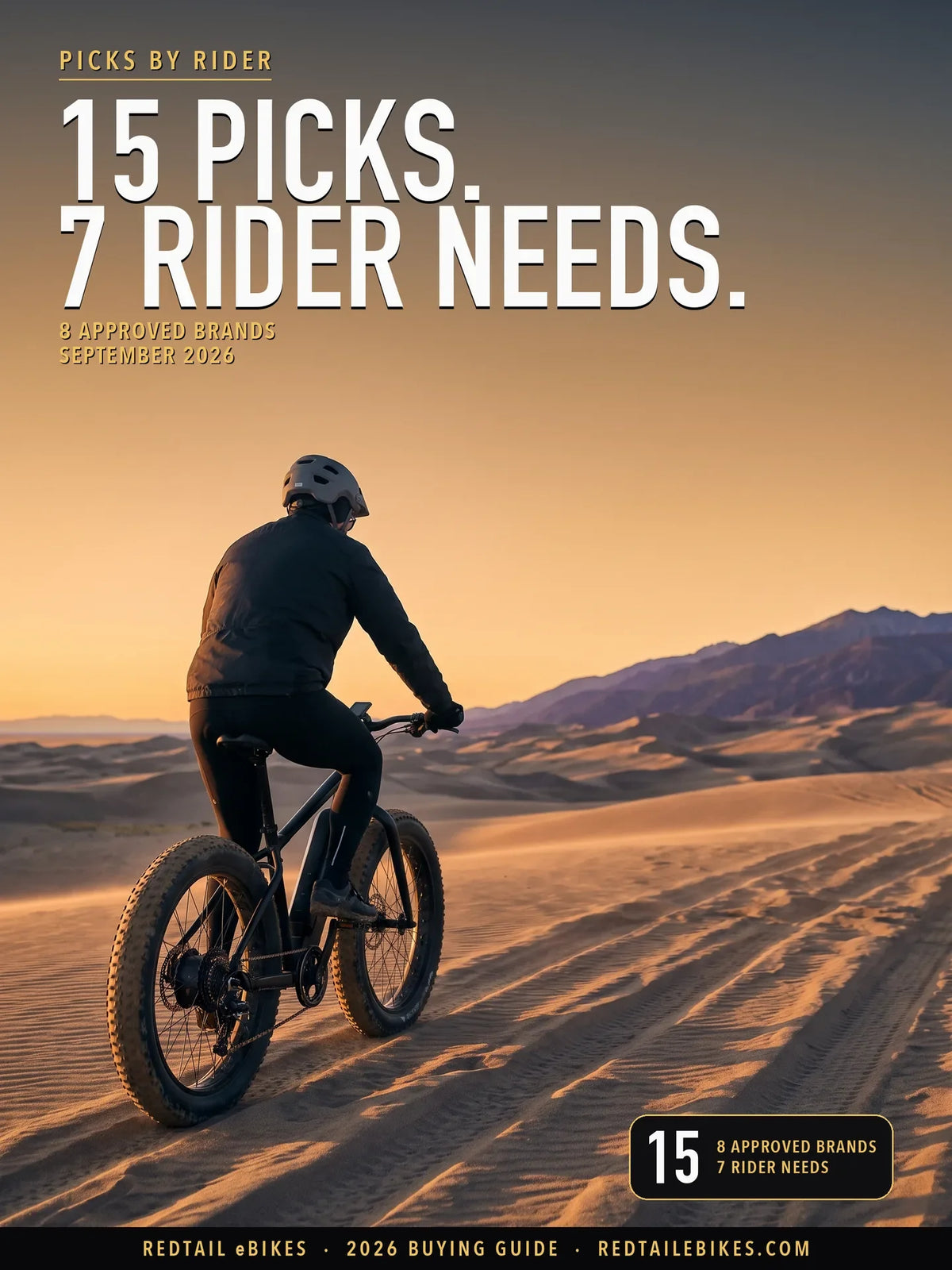

110 models screened, 15 picks selected, 8 brands compared, prices from $699 to $3,599.
Quick answer: For real snow and sand capability without overspending, the Eunorau FAT-HD 1.0 Pro ($1,999) is our top all-around pick: mid-drive torque, a 1,200Wh battery that is the largest in its price class here, and every spec verified at Eunorau. Tightest budget that still folds with a UL-certified battery: the Addmotor Foldtan M-160 ($1,599).
Below is the full grid: 15 verified picks across 7 rider needs — off-road, folding, hunting/utility, comfort, range, commuting and heaviest payload — screened from 110 fat-tire models we sell across 8 approved brands. Every pick here comes with free shipping to the contiguous US, warranty repairs coordinated by our US support team, and Shop Pay, PayPal, Apple Pay or Google Pay at checkout.
How we verified this guide
Every price, motor rating, battery size, payload and top speed on this page was re-checked at the manufacturer's own product page as well as our own listing, between September 8 and 9, 2026. Every conflict between our listing and the maker's is named on the page rather than silently resolved.
Every pick was also searched for real-world owner feedback across forums, Reddit and independent test sites. Two candidates that specs alone would have qualified were dropped for cause before this page was written. Full method in How we placed our picks below.
Author: Milad Ghobadibeygvand, BScN (Western University, 2014), Redtail eBikes. Corrections: mehran@redtailebikes.com. This guide was last verified on September 9, 2026.
Takeaway
110 fat-tire (4.0"+) models screened across 8 approved brands. 15 placed across 7 rider-need rows. Two dropped for cause after specs alone said yes — a credible net-feedback pattern on one, a folding claim the maker's own page contradicts on the other.
In this guide
- What actually makes a tire "fat," and how we screened this shelf
- How we placed our picks
- Row 1 · Sand, snow, beach and trail
- Row 2 · Folding
- Row 3 · Hunting and hauling gear
- Row 4 · Comfort and step-through
- Row 5 · Longest range — and what isn't really a bicycle
- Row 6 · Commuting and errands
- Row 7 · Heaviest payload
- Every pick, side by side
- Where the federal 750W line falls on this shelf
- Buying any of these picks from us
- Before you buy
- Frequently asked questions
- The bottom line
What actually makes a tire "fat," and how we screened this shelf
A "fat tire" e-bike is defined by its tire width rather than its category tag. We screened our live catalog for a published width of 4.0 inches or wider, the same physical threshold that separates a fat tire from the narrower "plus" and standard formats.
For the physics of why a wider tire changes how a bike rides, climbs and drains its battery, see our full fat tire vs. regular tire e-bike breakdown. This page is about which bike to buy; the format science lives there.
That screen returned 110 live, fat-tire models across our 8 brands with a qualifying two-wheel bike in stock. From there we built seven rider-need rows from what real buyers actually search for (see How we placed our picks) rather than from a list we imagined.
The 110 models aren't spread evenly. Addmotor and Eahora each publish 15-17 qualifying two-wheel models, Eunorau and Ridstar sit in the 8-10 range, and Velotric and Qiolor carry the smallest fat-tire lineups at 3 each — a real supply concentration worth knowing before you assume every brand offers equal choice in this format.
A fat-tire frame also isn't automatically an off-road frame: several of our compliant hardtail picks (the Eunorau Flash Lite ST and FAT-HD 1.0 Pro among them) are built for stability and cargo margin over technical trail work. This is why Row 1 and Row 3 below separate "capable in loose terrain" from "built for hunting-specific hauling" rather than treating every fat-tire bike as a trail bike.
If suspension architecture matters more to your decision than tire width alone, our suspension guide covers hardtail-versus-full-suspension trade-offs in more depth than this page does, and our electric mountain bike guide covers technical-trail-specific picks that aren't all fat-tired.
How we placed our picks
Every question this guide answers traces to an observed search — 2,059 rows harvested from six independent sources, 1,919 of them usable after excluding foreign-market and non-bike results. We did not type a rider-need list from memory and then go looking for bikes to fill it.
| Source | Rows harvested | What it caught |
|---|---|---|
| Google/Bing autocomplete | 1,561 | The bulk of raw buyer phrasing across 15 root terms |
| Competitor page headings | 406 | What the 6 currently-ranking pages structure their content around |
| Google Search Console | 46 (of 2,472 total) | Queries already reaching redtailebikes.com |
| Reddit threads (via Wayback) | 28 usable of 107 candidates | Real owner language, unfiltered by marketing |
| Google Trends related/rising queries | a handful, used for phrasing decisions | Confirmed "ebike" over "electric bike" independently |
| AI-search panel (15 prompts) | 15 | What AI engines currently answer, and cite, on this topic |
The AI panel is worth a specific note. Run against 15 realistic buyer prompts, it cited redtailebikes.com in just 1 of 15 answers — our existing comparison page rather than a picks guide. Every other answer sourced a single competing brand's own blog post with no cross-checked denominator behind any speed, range or payload figure it stated.
That gap between "an AI engine answered this" and "an AI engine checked this against more than one source" is this guide's actual opening.
For each of the seven rows that harvest actually supported, we pulled every qualifying candidate from our 110-model shelf, then:
- Verified every decisive spec at the manufacturer's own page — motor watts, battery Wh, payload, weight, top speed, frame type. Where our listing and the maker disagreed, we say so here and opened a correction ticket against our own listing.
- Searched the open web for real owner feedback on every candidate — forums, Reddit, independent tests. A credible, repeated complaint could disqualify a bike the spec sheet alone would have approved.
- Spread picks across brands. No single brand supplies more than 27% of the picks on this page, and no row's three-tier ladder leans on one brand twice. Across the full 15-pick slate: Eahora and Eunorau each supply 3-4 picks, Addmotor and Velotric each supply 2-3, and Ridstar, Samebike, Qiolor and Himiway each supply 1-2 — 8 distinct brands total, none dominating the guide.
Two bikes that passed the spec screen were cut here. A Samebike model carried two dated, independently-posted reports describing the same failure: a motor that would not restart after a handful of rides, with no repair path offered. That pattern was serious enough to remove it instead of printing it with a caveat.
An Addmotor model we'd planned for the folding row turned out, on the maker's own product page, to be a non-folding design. It's a straightforward conflict with our own listing, which we've flagged for correction.
Takeaway
Every spec on this page was checked twice: once against our own listing, once against the page the manufacturer actually publishes. Where they disagreed, both numbers are shown and the maker's own figure is the one we used to make the pick.
How to choose between these 15 picks
Start from the ground you actually ride rather than the spec you find most impressive. It's tempting to sort this guide by top speed or motor wattage and pick whatever tops the list — and for a handful of picks in Row 5, that instinct leads straight to a machine its own manufacturer classifies as a moped rather than a bicycle.
The sequence that actually works is the reverse: name your terrain and your real use case first, let that narrow you to one or two rows, and only then compare the tiered picks inside that row against your budget.
This is also the order this guide's own harvest supports. Terrain- and use-case-shaped questions (off-road, folding, hunting, comfort, commuting, payload) made up the large majority of what real buyers searched for; wattage-specific questions were a smaller, distinct cluster layered on top rather than the primary way people actually shop this category.
The table below maps each of the seven rows to the circumstance that should send you there — read down the left column until one matches your situation, then jump to that row.
| Your situation | Start here | What decides it |
|---|---|---|
| Loose sand, fresh snow, or a mixed trail with soft patches | Row 1: off-road | Tire width plus enough motor to keep moving once the surface softens |
| Need it to fit in a trunk, closet, RV bay or apartment hallway | Row 2: folding | A genuine folding hinge, confirmed at the maker |
| Hauling gear, game or cargo on private or rugged ground | Row 3: hunting and hauling | Payload rating and traction on loose dirt |
| Shorter inseam, an easier mount, or riding well into your senior years | Row 4: comfort and step-through | Standover height and a step-through frame |
| Longest range is your #1 filter, and you're clear on what you're buying | Row 5: range | Battery Wh, and whether it's still legally a bicycle |
| Daily errands, cargo, or a work commute on pavement | Row 6: commuting | Payload margin on a fully compliant motor |
| A heavier rider or heavy cargo, full stop, before anything else | Row 7: heaviest payload | The single highest published payload number |
Two circumstances repeat across rows on purpose. If you're hauling gear AND want the highest payload number available, Rows 3 and 7 share a pick for that reason; read both.
If you want off-road capability on a fully compliant, non-moped motor, Rows 1 and 6 both have an answer worth comparing.
Row 1 · Which fat tire ebike is best for sand, snow and trail riding?
This is the single largest rider need our harvest surfaced (7.4% of usable search rows) — and the reason fat tires exist in the first place. All three picks below carry a genuine 4"+ tire and enough motor to keep moving once the surface gets soft; our full fat-tire e-bike collection has every model in stock if you want to compare beyond these three.
Budget: Eahora Terra — $899

See the Eahora Terra · Add to cart
1,000W hub motor · 720Wh battery · 330 lb payload · 91 lb · 33 mph (throttle) · Eahora's own product page
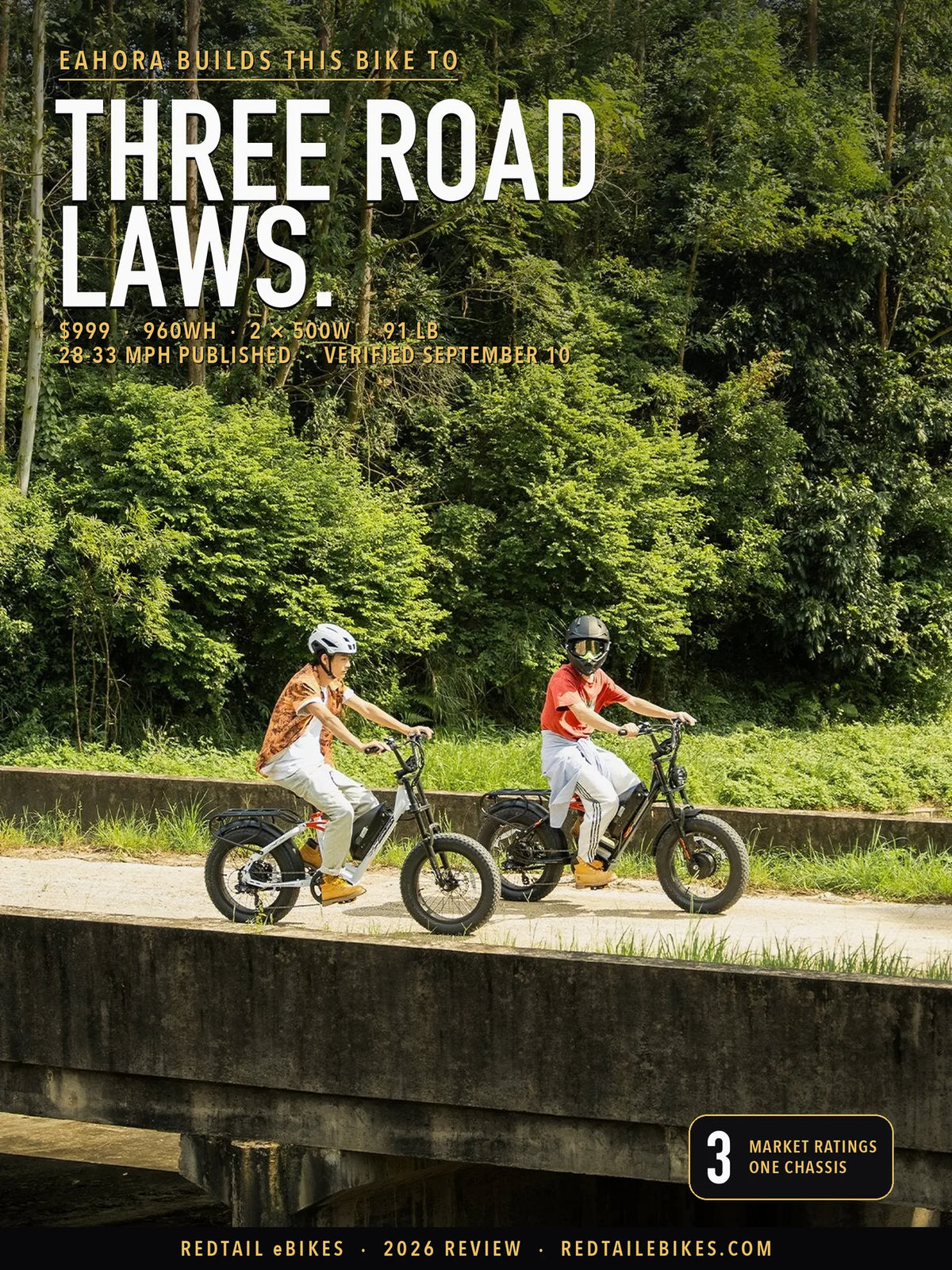
The Eahora Terra is the cheapest way onto real 4" rubber in this guide. Eahora's own product page calls the frame a "step-over," not the step-through some marketplace listings imply — worth knowing before you commit to a color.
At 1,000W and 33 mph, it clears the federal 750W/20 mph e-bike definition (15 U.S.C. § 2085(b)) and the 28 mph Class 3 ceiling in the three-class model law. It is lawful to sell and lawful to own everywhere in the US.
Check our state-by-state law hub before you assume it rides everywhere an e-bike is allowed. No independent owner reports were found naming this specific model, a real coverage gap, and no clean bill of health.
Best for: riders who want genuine float in loose sand or fresh snow on the smallest budget here, mostly on throttle rather than long human-powered miles. For a measured case of how much winter actually asks of a fat tire, our Helena, Montana guide puts 56.5 snow-lying days a year against 169.9 freezing nights — and finds three of the city’s five steepest blocks are gravel rather than snow.
Mid: Qiolor Tiger RE — $2,099

See the Qiolor Tiger RE · Add to cart
750W hub motor · 720Wh battery · 400 lb payload · 87 lb · 20 mph · Qiolor's own product page
The Qiolor Tiger RE is the only pick in this row that's both federally compliant on wattage and carries the highest payload rating of the three. Qiolor's own page describes rear suspension only; some listings' full- or dual-suspension framing doesn't match. Expect more chatter through the front end on rocky ground than a true dual-suspension rig.
Qiolor does not publish a UL 2849 or UL 2271 certification for this model anywhere we could find on its own product page.
Best for: riders who want compliant power and the most payload margin in this row (400 lb, per Qiolor) and don't mind paying the premium for it.
Luxury: Eunorau FAT-HD 1.0 Pro — $1,999

See the Eunorau FAT-HD 1.0 Pro · Add to cart
1,000W mid-drive motor · 1,200Wh battery · 375 lb payload · 78.7 lb · 20 mph · front-suspension hardtail · Eunorau's own product page · our full review
We've already reviewed this bike in depth, and Eunorau's own page confirms the drivetrain. The mid-drive motor gives it more natural climbing torque on loose terrain than any hub-motor pick in this row, and its 1,200Wh pack is the largest battery in the row. It's a hardtail, front suspension fork only, despite how some marketplace copy frames it as full suspension.
Best for: riders who want mid-drive feel and the longest range in this row, at a mid-drive price. Hunting specifically? See Row 3 below.
Row 2 · Which folding fat tire ebike should you buy?
Folding fat-tire demand (5.7% of the harvest) comes from RV owners, apartment dwellers and anyone who needs a fat tire bike that fits in a trunk. All three picks here genuinely fold — confirmed on each maker's own page, including Addmotor's, after one planned pick turned out not to.
Two of the three picks below publish a rated motor above the federal 750W line. If wattage and state classification is the axis you actually care most about across our whole shelf, rather than just the folding format, our dedicated 750W buying guide grids all 48 compliant bikes we sell by rider type — and our full folding e-bike collection isn't limited to fat tires if that's the deciding feature for you.
Budget: Ridstar H26 Pro — $699

See the Ridstar H26 Pro · Add to cart
2,000W hub motor (nominal, per the manufacturer) · 960Wh battery · 330 lb payload · 70 lb (lightest folder in this guide) · Ridstar's own product page
At $699, this is the least expensive bike in the entire guide. Ridstar's own product page states "Max Speed: 28+++ mph," an undefined ceiling with no test standard cited; our own product page caps the published table at 28 mph rather than repeat an open-ended claim.
At 2,000W it is well above the federal 750W definition. It is lawful to sell and lawful to own, but it is not a "low-speed electric bicycle" under 15 U.S.C. § 2085(b), so confirm your state's own class definition on our law hub before assuming Class 1-3 access rules apply to it.
The maker's record. The H26 Pro sits in no regulator's notice as of September 11, 2026, yet its maker's Q20 family drew two 2026 stop-use warnings, not recalls, from the US Consumer Product Safety Commission. The March 19 warning on the Q20 and Q20 Pro reads "The e-bikes' batteries and wires can ignite, posing a fire hazard to consumers." It cites 11 fires and states the manufacturer "has refused to agree to an acceptable recall".
The June 25 warning on the Q20 and Q20 Lite reads "The front wheel can detach without warning, posing a crash hazard to consumers." It cites 32 detachments and 31 injuries. A June 2025 UK product safety report found three Ridstar models' chargers a "serious risk of fire" and their import "rejected at the border." Two 2026 product-liability complaints, Cunanan against Amazon and a minor against Walmart, allege a detached front wheel; read our Ridstar brand profile first.
One naming note: a different, discontinued "H26 Pro" (1,500W, $1,399) exists on Ridstar's other storefront, ridstar.com. If you search for confirmation, make sure you're reading about the right one.
Best for: the tightest folding budget in this guide, $699, for storage in an RV, truck bed or small apartment.
Mid: Samebike RS-A02 Plus — $1,199

See the Samebike RS-A02 Plus · Add to cart
1,200W hub motor (Samebike's own listing calls it "Peak 1800W") · 816Wh battery · 330 lb payload · 83.8 lb (the manufacturer's figure; our own listing currently shows 73 lb — a correction ticket has been opened) · 28 mph · Samebike's own product page
Owners are broadly satisfied with this bike, whose specification is published in full on Samebike's own page, with one repeated caveat worth checking on delivery: a handful of reports name a noisy front brake or a stiff shock straight out of the box. Neither reads as a safety pattern, but test both before your first ride.
Best for: a mid-priced folder with more battery and payload margin than the budget pick.
Luxury: Addmotor Foldtan M-160 — $1,599

See the Addmotor Foldtan M-160 · Add to cart
750W hub motor · UL-certified 48V/20Ah (960Wh) removable battery · torque sensor and hydraulic brakes · 280 lb payload (the manufacturer's figure; our listing currently shows 300 lb — a correction ticket has been opened) · 28 mph · Addmotor's own product page
The only folding pick in this guide that is both inside the federal 750W definition and built around an independently UL-certified battery pack — a genuine pair of reassurances the two cheaper folders in this row don't offer.
Reviews are consistently positive on the core spec claims — the motor, battery and hydraulic brakes match what Addmotor publishes, and reviewers describe the folding hinge as genuinely simple to use.
The recurring caveat across multiple independent sites: it's on the heavier side for a folder, which cuts into the portability a folding bike is bought for, and more than one reviewer describes the battery's charge time as long. We found no dedicated Reddit thread for this specific model, a coverage gap either way, in both directions.
Best for: buyers who want a compliant, certified folder and are willing to pay for both.
Row 3 · Which fat tire ebike is best for hunting and hauling gear?
Hunting and cargo-hauling was the third-largest rider need in our harvest (3.8%). We're keeping this row deliberately short: it's a real, distinct use case, but it deserves — and gets — a full dedicated treatment elsewhere on our site rather than a duplicated deep-dive here.
Our pick below uses dual motors for all-wheel drive. If AWD traction across varied terrain is your primary interest rather than the hunting use case specifically, our dual-motor and AWD e-bike guide covers 12 picks by terrain, fat-tired and otherwise, along with the 51-state legal map for dual-motor wattage totals.
Eunorau FAT-AWD 3.0 — $1,699

See the Eunorau FAT-AWD 3.0 · Add to cart
Dual 500W hub motors (all-wheel drive) · 720Wh battery · 375 lb payload · 79.4 lb · 20 mph · front-suspension hardtail · Eunorau's own product page · our full review
Power to both wheels matters most in the conditions hunters ride: loose dirt, wet leaves, uneven private land. Eunorau's own page rates each motor at 500W, inside the federal 750W-per-motor line and every state's 20 mph Class 1 ceiling.
Every figure on this card is verified against Eunorau's current published specification for the 3.0 generation, and the fit verdict below rests on those numbers.
Best for: hunters and haulers who want power on both wheels on loose ground.
Addmotor Garootan M-81 Cargo — $1,199

See the Addmotor Garootan M-81 · Add to cart
750W hub motor · 720Wh battery · 400 lb payload · 85 lb · 20 mph step-thru · Addmotor's own product page
Owners report it handling real cargo loads well, matching the payload rating on Addmotor's own page. It's built for hauling gear, groceries or a passenger rather than hunting specifically — the step-thru frame trades hunting-terrain geometry for everyday ease of mounting and dismounting.
An independent review specifically praised its battery capacity and cargo space for weekly grocery runs, describing the ride as smooth and the motor as effortless under load.
The model is new enough to our shelf that we found no dedicated Reddit thread naming it — a coverage gap we're stating plainly. The only broader signal available is a brand-wide forum estimate that roughly 30% of Addmotor owners eventually report some issue, which is a brand-wide base rate, and says nothing specific about this cargo model.
Best for: everyday hauling — gear, groceries or a kid seat, at the lowest price in this row.
Row 4 · Which fat tire ebike is best for comfort and easy step-through access?
Step-through and comfort searches made up 2.3% of the harvest, much of it phrased around seniors and easier mounting. If a health condition, balance concern or specific mobility need is driving your search rather than fat-tire capability itself, our electric bikes for seniors guide addresses that directly across both fat-tire and standard frames.
Budget: Eahora Luna II — $999

See the Eahora Luna II · Add to cart · our full review
Dual 500W hub motors · step-through frame · 960Wh battery · 330 lb payload · 91 lb · 33 mph · Eahora's own product page
One honest flag: Eahora's own site is inconsistent about this bike's motor across different sections of its own page (500W×2 in the spec table, "1000W dual motors" and a "2000W AWD" title elsewhere) — a maker-side inconsistency we're naming instead of picking whichever number flatters the bike. At 33 mph it clears every state's Class 1–3 ceiling; treat it accordingly under our law hub.
Best for: the lowest-priced step-through pick with the largest battery of the three.
Mid: Himiway D5 Zebra — $1,499

See the Himiway D5 Zebra · Add to cart
750W hub motor · step-through frame · 960Wh battery · 400 lb payload · 79 lb (both figures published by Himiway; our own listing currently shows neither — a correction ticket has been opened) · Himiway's own product page
Owners consistently praise its hill-climbing and load capacity, both figures published on Himiway's own page, which also publishes the tire-pressure guidance this guide's care section draws on. The recurring complaints are cosmetic, never structural: slippery stock grips, and its bulk means it isn't a bike you'll want to fold or carry.
Best for: hill country and heavier gear, at a fully compliant 750W.
Luxury: Velotric Nomad 2 — $1,999

See the Velotric Nomad 2 · Add to cart
750W hub motor · step-through frame · 705Wh battery · 505 lb payload · 75 lb · 28 mph (a 20 mph mode is also available) · Velotric's own product page
This is the most cleanly verified bike in the entire guide — every spec on Velotric's own page matched across three independent sources with zero conflicts. The only real-world complaint we could find is a 15-level, 3-mode pedal-assist layout some owners find fiddly to learn at first.
Best for: buyers who want the highest payload rating at this tier (505 lb, per Velotric) and the cleanest paper trail behind it.
Row 5 · Which fat tire ebike has the longest range — and what isn't really a bicycle?
Range and battery size drove 2.3% of the harvest. This row splits into two honest halves: the largest battery among our fat-tire e-bikes proper, and the largest battery on our fat-tire shelf, period — which turns out to belong to a machine its own manufacturer files as a moped.
If very high wattage itself, rather than fat tires specifically, is what you're shopping for, our 2000W e-bikes guide covers that power band and its state-by-state legal picture across our full catalog.
Longest range that's still a bicycle: Eunorau FAT-HD 1.0 Pro — $1,999
Full details in Row 1. Its 1,200Wh pack is the largest battery among this guide's federal-definition-adjacent picks, on a mid-drive motor that makes the most of every watt-hour.
The biggest pack on our shelf isn't a bicycle: Eahora Romeo Ultra II — $3,599

Eahora's own product photograph. Every other pick on this page carries a location photograph; this one and the Nomad 2X below do not, because we could not produce one that reproduced the machine faithfully.
See the Eahora Romeo Ultra II · Add to cart
Dual 2,500W motors · 4,800Wh battery (the largest pack on our entire fat-tire shelf) · 500 lb payload · 174 lb · 50 mph · Eahora's own product page
We're stating this plainly rather than dressing it up: Eahora's own site files this model under its "Moped Electric Bikes" category rather than its e-bike collection. We could not find any UL, FCC or ETL certification published for it anywhere.
At 2,500W per motor and 50 mph, it exceeds every US state's Class 1-3 e-bicycle speed ceiling. It ships with pedals, so treat, title, register and insure it the way your state treats a moped or motorcycle, never a bicycle. Confirm your state's specific rules on our electric bike law hub before you buy.
Best for: buyers who want the largest fat-tire-wheeled machine we sell and are prepared to register and insure it like the moped its own maker calls it. Want something you can ride like a bicycle instead? Rows 1 and 4 above are built for that.
Row 6 · Which fat tire ebike is best for commuting and errands?
Commuting demand (2.0% of the harvest) wants payload margin for cargo and a fully compliant motor for lane and path access. This row ships with two tiers rather than three — the shelf doesn't offer a third verified, meaningfully different compliant option between these two price points, so we're not padding it with a placeholder pick.
If your commute is really a delivery workload — repeated stops, all-day duty cycles — our e-bikes for delivery guide is built around that specific use case rather than general errands.
Eunorau Flash Lite ST — $1,899

See the Eunorau Flash Lite ST · Add to cart
750W hub motor · front-suspension hardtail · 832Wh battery · 440 lb payload · 82 lb · 20 mph · Eunorau's own product page
Cleanly verified against Eunorau's own page with no conflicts against our own listing. A 440 lb payload rating on a fully compliant 750W motor is real margin for panniers, a trailer or a passenger.
No independent, model-specific test of the Flash Lite ST exists yet that we could locate — a genuine coverage gap for a relatively new model, and no evidence either way. Eunorau's own page remains the only published specification for it. Eunorau's own page confirms this is a hardtail with a front fork only; if a rear shock matters to you specifically, the maker's own lineup includes a full-suspension alternative worth comparing before you buy.
Best for: errand-runners who want payload headroom (440 lb, per Eunorau) without leaving the federal wattage definition.
Velotric Nomad 2X — $2,399

Velotric's own product photograph. Our location frames for this bike kept dropping the rear shock that makes it the only full-suspension pick here, so we're showing the maker's photograph instead of a picture that contradicts the spec.
See the Velotric Nomad 2X · Add to cart
750W hub motor · full suspension (the only genuinely full-suspension bike in this guide, confirmed at two independent sources) · step-through frame · 801Wh battery · 560 lb payload — the highest in our entire two-wheel fat-tire catalog · 80 lb · 20 mph by default, 28 mph selectable · Velotric's own product page
Two independent testers, including Electric Bike Review's full test, flag the same weak point: the stock two-piston brakes underperform relative to this bike's mass and payload rating once it's loaded. Worth budgeting for a brake upgrade if you'll run it near its limit regularly.
Best for: daily errands and cargo that need the most payload margin on a fully compliant motor. Payload is your #1 filter, full stop? See Row 7.
Row 7 · Which fat tire ebike carries the most weight?
Heavy-payload searches were the smallest cluster we measured (0.7%), and the one row where a single published number decides it outright.
Budget: Addmotor Garootan M-81 Cargo — $1,199
400 lb payload. Full details in Row 3 — the cheapest way onto a 400 lb-rated fat-tire e-bike in this guide.
Mid: Qiolor Tiger RE — $2,099
400 lb payload. Full details in Row 1 — the same 400 lb rating with rear suspension for rougher ground.
Luxury: Velotric Nomad 2X — $2,399
560 lb payload — the single highest published payload number anywhere in our fat-tire catalog. Full details in Row 6.
Riders whose primary concern is a heavier build rather than fat-tire capability specifically should also read our broader electric bikes for heavy adults guide, which isn't limited to fat-tire frames. All three picks in this row, and every other fat-tire bike we sell, are in our fat-tire collection for side-by-side price comparison.
Why the frame badge and the listing name don't always match
Three picks in this guide ship with a name on the frame decal itself that differs from the model name used in marketing and on our listing: the Eahora Terra and Eahora Luna II carry a "Jopajoca" badge, and the Addmotor Garootan M-81 carries a "Bardutan" badge, both confirmed directly on the manufacturers' own product photography at eahoraebike.com and addmotor.com.
This is not a Redtail catalog error, and it isn't unique to these two brands — it's how a large share of the direct-to-consumer e-bike industry actually sources hardware.
Many mid-market e-bike brands design a model, then source the frame and drivetrain from one of a small number of Chinese OEM factories that also badge and sell the same or a near-identical platform under their own name or to other retail brands. The retail brand's own decal usually goes on top of the factory badge in later production runs, or the retail brand simply doesn't bother reshooting product photography once the badge changes.
Neither practice affects the spec sheet, the warranty you buy from us, or the support you get from Redtail — it's a fact about the supply chain, never about the bike's capability, and every decisive spec on this page was still verified against the manufacturer's own published page for that exact model regardless of which badge appears in the photo.
Practically, this means the box your Eahora Terra, Eahora Luna II or Addmotor Garootan M-81 arrives in may carry a different name on the frame decal than the one on your order confirmation. It's an expected part of how the bike was sourced, never a sign you received the wrong bike — the model, the spec sheet and the warranty terms are still what you ordered from Redtail.
What a fat tire doesn't make: mopeds, scooters and dirt bikes
A wide, knobby tire shows up on several vehicle types this guide does not cover, and our own harvest surfaced buyers conflating them often enough to draw the line explicitly.
An electric dirt bike has no pedals at all and is built for closed-course or off-highway riding under state OHV rules, never under a bicycle statute. An electric moped — like the Eahora Romeo Ultra II covered in Row 5 — may ship with pedals, but its motor and speed put it outside every state's Class 1-3 e-bicycle ceiling, so its own maker files it separately from its e-bike line.
A stand-up electric scooter is a different vehicle category entirely, typically governed by its own separate statute rather than the bicycle definition this guide's picks are built around.
None of that makes any of those vehicles unlawful to own — it means the rules that apply to riding one are different from the rules that apply to the 15 picks in this guide's rows above the moped disclosure in Row 5. If you're not sure which category a specific machine falls into, our 50-state law hub is the place to check before you assume bicycle rules apply.
There's also a second, narrower federal definition worth knowing alongside 15 U.S.C. § 2085(b): the Consumer Product Safety Commission's own bicycle safety regulation at 16 CFR Part 1512 sets manufacturing and labeling requirements for "bicycles" as consumer products, a separate question from whether a given vehicle counts as a "low-speed electric bicycle" for the wattage/speed test this page has focused on.
A machine can be a bicycle for one federal purpose and not cleanly fit the other. A single "is this legal" answer is rarely the right question — the right question is which specific rule you're asking about.
Where fat tire buyers get caught out
A handful of mistakes show up repeatedly in the owner feedback we read while building this guide, independent of which specific bike is involved — most of them are about assumptions, never defects:
- Assuming a published payload rating includes cargo. A 400 lb payload figure is typically the combined limit for rider plus any rack-mounted gear — not 400 lb of rider weight with a full pannier set on top. Check whether the manufacturer's page — Addmotor's, for instance — specifies rider-only or combined before you buy near the limit.
- Running street PSI on soft sand or snow, and vice versa. Manufacturer guidance ranges from around 5 PSI on soft sand up to 18-24 PSI on pavement for the same 4"-plus tire — a single "correct" number doesn't exist independent of surface. Our fat tire vs. regular tire comparison covers this in more depth than this guide does.
- Assuming "fat tire" means "off-road capable." As covered above, several fully compliant fat-tire picks in this guide (the Eunorau Flash Lite ST, the Addmotor Garootan M-81) are built for stability and cargo margin on mixed surfaces rather than technical trail riding specifically.
- Buying above the federal wattage line without checking the specific state's road and trail access rules first. A bike being lawful to buy and lawful to own, as covered in Where the federal 750W line falls on this shelf, is not the same question as where you're allowed to ride it.
- Not weighing the bike itself before assuming it fits a car rack. Several picks in this guide's folding row exceed 80 lb even after folding — well past the rated capacity of many consumer hitch racks.
- Treating a manufacturer's peak-wattage figure as its legal rating. A controller can briefly draw well above a motor's continuous rating under hard acceleration, and some listings lead with that peak number because it's the larger, more impressive figure — Samebike's own product name for the RS-A02 Plus is a live example. The rated (nominal, continuous) wattage is the number a state's class test actually measures, and it's the figure this guide reports for every pick — see the glossary above for the exact distinction.
Every pick, side by side
All 15 picks in one table, so you can compare any two directly instead of flipping between rows.
| Bike | Price | Motor | Battery | Payload | Weight | Top speed | Frame |
|---|---|---|---|---|---|---|---|
| Eahora Terra | $899 | 1,000W hub | 720Wh | 330 lb | 91 lb | 33 mph | Step-over |
| Qiolor Tiger RE | $2,099 | 750W hub | 720Wh | 400 lb | 87 lb | 20 mph | Rear suspension |
| Eunorau FAT-HD 1.0 Pro | $1,999 | 1,000W mid-drive | 1,200Wh | 375 lb | 78.7 lb | 20 mph | Hardtail |
| Ridstar H26 Pro | $699 | 2,000W hub | 960Wh | 330 lb | 70 lb | 28 mph (maker states "28+++") | Folding |
| Samebike RS-A02 Plus | $1,199 | 1,200W hub (1,800W peak) | 816Wh | 330 lb | 83.8 lb | 28 mph | Folding |
| Addmotor Foldtan M-160 | $1,599 | 750W hub | 960Wh (UL-certified) | 280 lb | — | 28 mph | Folding, step-thru |
| Eunorau FAT-AWD 3.0 | $1,699 | Dual 500W hub (AWD) | 720Wh | 375 lb | 79.4 lb | 20 mph | Hardtail |
| Addmotor Garootan M-81 | $1,199 | 750W hub | 720Wh | 400 lb | 85 lb | 20 mph | Step-thru |
| Eahora Luna II | $999 | Dual 500W hub | 960Wh | 330 lb | 91 lb | 33 mph | Step-through |
| Himiway D5 Zebra | $1,499 | 750W hub | 960Wh | 400 lb | 79 lb | 20 mph (Himiway Class 2) | Step-through |
| Velotric Nomad 2 | $1,999 | 750W hub | 705Wh | 505 lb | 75 lb | 28 mph | Step-through |
| Eahora Romeo Ultra II | $3,599 | Dual 2,500W | 4,800Wh | 500 lb | 174 lb | 50 mph | Standard (moped-class) |
| Eunorau Flash Lite ST | $1,899 | 750W hub | 832Wh | 440 lb | 82 lb | 20 mph | Hardtail |
| Velotric Nomad 2X | $2,399 | 750W hub | 801Wh | 560 lb | 80 lb | 20 mph (28 mph selectable) | Full suspension, step-thru |
Where the federal 750W line falls on this shelf
Federal law defines a "low-speed electric bicycle" as carrying "a motor of less than 750 watts" (15 U.S.C. § 2085(b)). Of the 15 bikes on this page, 7 publish a rated motor at or under that line and 8 publish more.
None of the 8 are unlawful to sell or own anywhere in the US. The federal definition governs what counts as a bicycle for import and consumer-product rules; it doesn't govern what you're allowed to buy.
What changes above 750W is which state rules apply to where and how you can ride it. That's why every above-750W pick on this page points to our 50-state law hub rather than assuming one national answer.
California is a useful example of how permissive a compliant state can be: CVC § 312.5 sets its Class 1-3 ceiling at 750 watts inclusive, meaning a bike rated at precisely 750W qualifies, with no license, registration, plate or insurance required under § 24016. Read our California e-bike law page for the full picture, including the 158 cities that layer their own rules on top.
Every state's wattage line, inclusive-or-exclusive wording and local layer differs, which is why this page names the number on every pick instead of asserting a single nationwide verdict.
Every pick's compliance status, at a glance:
| Bike | Rated motor | ≤750W federal line | Certification found |
|---|---|---|---|
| Eahora Terra | 1,000W | No | Not found on maker's page |
| Qiolor Tiger RE | 750W | Yes | Not found on maker's page |
| Eunorau FAT-HD 1.0 Pro | 1,000W (mid-drive) | No | Not confirmed either way |
| Ridstar H26 Pro | 2,000W | No | Not found on maker's page |
| Samebike RS-A02 Plus | 1,200W (1,800W peak) | No | Not confirmed either way |
| Addmotor Foldtan M-160 | 750W | Yes | UL-certified battery (maker page) |
| Eunorau FAT-AWD 3.0 | Dual 500W | No | Not confirmed either way |
| Addmotor Garootan M-81 | 750W | Yes | UL-certified (maker page) |
| Eahora Luna II | Dual 500W | No | Not confirmed either way |
| Himiway D5 Zebra | 750W | Yes | Not confirmed either way |
| Velotric Nomad 2 | 750W | Yes | Not confirmed either way |
| Eahora Romeo Ultra II | Dual 2,500W | No | None found anywhere |
| Eunorau Flash Lite ST | 750W | Yes | Not confirmed either way |
| Velotric Nomad 2X | 750W | Yes | UL 2271-certified battery (maker page) |
"Not confirmed either way" means we did not find a certification claim on that maker's own page — it is not the same as a confirmed absence, and we report it that way instead of guessing in either direction.
Takeaway
7 of our 15 picks publish a motor at or under the federal 750W bicycle definition; 8 publish more. Every pick above that line is disclosed as such, with a pointer to state-specific rules rather than a blanket "legal" or "illegal" claim.
Caring for a fat tire ebike
Fat tires add maintenance considerations a standard-tire owner never meets, and buyers search for this far more than the category's marketing suggests.
Tire pressure is the biggest one. Published manufacturer guidance — Eunorau's own PSI guide to Himiway's, ranges from roughly 18-24 PSI on pavement down to 10-16 PSI on hard-packed dirt and as low as 4-10 PSI on soft sand or snow, for the same 20x4 or 26x4 tire.
Street pressure off-road costs you the float the wide tire exists to provide; trail pressure on pavement adds rolling resistance and wear for nothing.
Check your tire's own sidewall rating before setting a number from any general guidance, ours included.
Beyond pressure, a few things matter more on a fat-tire frame than a standard one: the wider fork and frame clearances mean many standard-width bike-shop tools and repair stands don't fit without an adapter. A wider tire and rim also means a flat-repair kit sized for standard tires may not seal properly, so confirm your patch kit or sealant is rated for the tire width you're buying.
Storage matters too — several picks in this guide weigh more than 80 lb even folded, which affects everything from garage wall-mount ratings to which car racks will actually carry them. See Where fat tire buyers get caught out above for the rack-weight mistake specifically.
Buying any of these picks from us
Whichever pick you choose above, the purchase terms don't change from bike to bike. Every pick on this page ships with the same terms, published in full on our shipping policy and refund and return policy:
| What you get | The term |
|---|---|
| Shipping | Free shipping on every e-bike to the contiguous US |
| Arrives damaged | Photograph it and email us within 48 hours — we file the carrier claim ourselves |
| Dead on arrival or a faulty component | Covered under manufacturer warranty; we coordinate the repair or replacement |
| Changed your mind | Unopened and factory-sealed only, within 72 hours of delivery, with a restocking fee plus return shipping |
That last row is the one to read before you order a bike you're not fully sure about — once a box is opened, a change-of-mind return is no longer available. Email support@redtailebikes.com if you're unsure which pick on this page fits your ground before you buy.
Before you buy a fat tire ebike: the checklist
Seven checks, in buying order, before you complete a purchase on any fat-tire e-bike, on this shelf or anywhere else.
- Confirm the tire width, not just the marketing photo. 4.0" and up is the fat-tire range this guide screened for; some "plus-size" tires at 2.8–3.5" are marketed with similar imagery but ride and roll very differently — see our format comparison if you're deciding between the two.
- Match motor placement to your terrain. A mid-drive (like the FAT-HD 1.0 Pro) climbs loose, steep ground more naturally; a hub motor is simpler and cheaper and is fine for flatter sand, snow and pavement. Our motor guide covers the trade-offs in full.
- Check your own state's class and registration rules before buying anything rated over 750W or capable of more than 28 mph — our law hub covers all 50 states.
- Weigh the bike itself, not just the payload rating, if you'll be lifting it onto a rack or up stairs. Our comparison table above lists every published weight.
- Verify the cart link resolves to the price this page states before you check out. Prices and stock move; every pick's price above was matched to the live listing on September 9, 2026, and a mismatch on your end means the price changed after this guide was written.
- Ask about the return and freight policy for oversized items specifically. A fat-tire e-bike in its shipping box is heavier and bulkier than a standard-tire bike, which can change the carrier, the freight class, and the practical cost of a return if the fit turns out wrong.
- Read the honest caveat in each pick's own section as well as the spec table. Several picks above carry a real, named trade-off — a brake that underperforms when loaded, a grip that gets slippery, a maker-side naming inconsistency — and that caveat is information a spec sheet alone won't give you.
Terms this guide uses, defined
Eight terms this guide relies on, defined once here instead of re-explained in every row.
- Nominal (rated) watts vs. peak watts. Nominal watts is the motor's continuous output rating — the number that matters for federal and state classification. Peak watts is a short-burst maximum some manufacturers publish alongside it, and it is never the number a class test measures. The Samebike RS-A02 Plus in Row 2 is a direct example: 1,200W nominal, 1,800W peak, per the maker's own product name.
- Watt-hours (Wh) vs. amp-hours (Ah). Battery capacity is most comparably stated in watt-hours (voltage × amp-hours), because two batteries with the same Ah rating at different voltages store different amounts of energy. Every battery figure in this guide's comparison table is stated in Wh for that reason, converting from the maker's Ah/voltage figures where needed.
- Payload capacity. The maximum combined weight of rider, cargo and any rack-mounted gear a manufacturer rates the frame, wheels and motor to carry — not the rider's weight alone. See Where fat tire buyers get caught out for how this gets misread.
- Class 1, 2 and 3. The three-tier system most US states use for electric bicycles, authored as model legislation by PeopleForBikes and now adopted in most states: Class 1 is pedal-assist only to 20 mph, Class 2 adds a throttle to the same 20 mph ceiling, and Class 3 is pedal-assist to 28 mph with no throttle in most states. A bike's class is set by its top assisted speed and throttle configuration rather than by its wattage alone, though most state statutes also cap the motor at 750W as part of the same definition.
- Hardtail vs. full suspension. A hardtail has a suspension fork at the front wheel only; a full-suspension frame adds a rear shock as well. Only one pick in this guide — the Velotric Nomad 2X — is genuinely full suspension; every other pick is a hardtail or rigid frame, regardless of how some marketplace listings describe them.
- Hub motor vs. mid-drive motor. A hub motor sits inside the wheel itself and drives it directly; a mid-drive motor sits at the pedals and drives the rear wheel through the bike's own chain and gearing, which generally delivers more usable torque for climbing at the cost of added drivetrain wear. The Eunorau FAT-HD 1.0 Pro is this guide's only mid-drive pick.
- UL 2849 and UL 2271. Independent US safety certifications covering an e-bike's electrical drive system (UL 2849) and its battery pack specifically (UL 2271). Neither is federally mandated for e-bikes as of this writing, though some states are moving toward requiring battery certification for retail sale — California's requirement, for example, is cited in Where the federal 750W line falls on this shelf above.
- Throttle vs. pedal-assist. A throttle lets the motor drive the bike without pedaling at all, typically up to a lower speed cap; pedal-assist only adds power while you're actively pedaling, scaled to your effort. Several picks in this guide, including the Eahora Terra and Eahora Luna II, offer both.
- Standover height. The vertical clearance between the ground and the top tube when you're standing over the frame with both feet flat — the single measurement that determines whether a given frame actually fits a shorter rider, independent of the step-through vs. standard-frame question covered in Row 4.
Frequently asked questions
What is the best fat tire electric bike?
Browse the full fat-tire e-bike collection if you'd rather compare every model at once. There's no single best — the right one depends on what you're using it for. The Eunorau FAT-HD 1.0 Pro is our top all-around pick for off-road capability and range; the cheapest genuinely capable option is the Eahora Terra at $899; the best certified folder is the Addmotor Foldtan M-160.
Are fat tire ebikes legal, and what class do they fall under?
Yes, everywhere in the US — a fat tire is a tire rather than a legal category. What matters for classification is motor wattage and top speed under the three-class model law most states have adopted.
7 of our 15 picks publish 750W or less and typically fall inside a state's Class 1–3 e-bicycle system; the other 8 publish more and may fall outside it depending on your state. See our 50-state law hub for your state's rule.
How fast do fat tire ebikes go?
On this page, from 20 mph up to 33 mph on throttle-capable models, and as high as 50 mph on the one moped-class machine we cover in Row 5. Most of our federally-compliant (750W or under) picks top out at 20–28 mph.
What is the best fat tire ebike for sand, snow or beach riding?
See Row 1 — all three picks there carry genuine 4"+ tires and enough motor to keep moving once the surface softens, from the $899 Eahora Terra to the $1,999 Eunorau FAT-HD 1.0 Pro.
What is the best folding fat tire ebike?
See Row 2. All three picks genuinely fold — confirmed at each manufacturer (Ridstar, Samebike, Addmotor) after ruling out a model whose own product page says it does not.
What is the best fat tire ebike for hunting?
See Row 3 for our two picks, led by the dual-motor Eunorau FAT-AWD 3.0. A fuller, dedicated treatment of hunting-specific e-bikes is in progress on our buying guide hub.
Are fat tire ebikes good for seniors, and what's the best step-through option?
Yes — a step-through frame and a fat tire's stability are a common pairing for easier mounting and more confident low-speed balance. See Row 4 for our three picks, all under 92 lb, topped by the Velotric Nomad 2.
What is the best fat tire ebike for heavy riders or maximum payload?
The Velotric Nomad 2X publishes the highest payload rating in our entire fat-tire catalog at 560 lb. See Row 7 for the full ladder, and our broader electric bikes for heavy adults guide if fat tires aren't a requirement for you.
Mid-drive or hub motor — which is better on a fat tire ebike?
A mid-drive motor (our only example here is the Eunorau FAT-HD 1.0 Pro) delivers power through the drivetrain for more natural climbing torque on loose or steep terrain. A hub motor, used by the other 14 picks on this page, is simpler, generally cheaper, and performs just as well on flatter sand, snow or pavement. Full trade-offs in our motor guide.
Are fat tire ebikes good for commuting, and do they reduce range or add tire pressure hassle?
Yes to commuting — see Row 6 for two fully compliant picks with real payload margin for cargo. On range and tire pressure specifically: a wider tire does cost you some efficiency and needs its own PSI range, and we've measured both in detail on our dedicated fat tire vs. regular tire comparison rather than repeating that math here.
What is the cheapest fat tire ebike?
The Eahora Terra at $899 is the cheapest pick in this guide; the Ridstar H26 Pro at $699 is the cheapest bike on this page overall. For the broader budget category outside fat tires specifically, see our best electric bikes under $1,000 guide.
Fat tire ebike vs. regular tire ebike — which should I buy?
It depends on your surface: fat tires win on sand, snow, mud and rough trail; a regular or "plus" tire is lighter, more efficient, and usually cheaper for pavement and light gravel. We've run the full measured comparison — weight, range penalty, cost — on our fat tire vs. regular tire ebike page.
Is a fat tire ebike with full suspension worth it?
Only one bike on this page is genuinely full suspension — the Velotric Nomad 2X, confirmed at the maker and at an independent test. Every other pick here is a hardtail (front suspension fork only) or rigid, whatever a marketplace listing calls it. Full suspension smooths out washboard and rock chatter but adds weight and cost; a hardtail is lighter, cheaper and simpler to maintain, and is the more common choice at every price here.
Is a fat tire ebike the same as an electric mountain bike?
No. A fat tire is defined by width and works on soft, unstable surfaces like sand and snow; an electric mountain bike is defined by its suspension, geometry and gearing for technical, often rocky singletrack, and most e-MTBs run a narrower 2.4-2.8" tire. Row 1 above covers our fat-tire off-road picks; our electric mountain bike guide covers trail-specific picks that aren't fat-tired.
Can I pull a trailer with a fat tire ebike?
Most of the picks in this guide can, within their published payload rating — a trailer's tongue weight counts against the same payload number as a rider and cargo. The Row 7 picks, topped by the Velotric Nomad 2X at 560 lb, give you the most margin if trailer-pulling is a regular use case.
Are fat tire ebikes good for kids?
None of the 15 picks in this guide are sized or rated for a child rider — every bike here is a full-size adult frame. If you're shopping for a younger rider specifically, our electric bikes for kids and teens guide covers age-appropriate sizing and state age-minimum rules, which several states set independently of the Class 1-3 wattage system this guide's picks are built around.
What's new in the fat-tire category for 2026
A few real shifts showed up while we were building this guide this month, worth naming explicitly rather than treating fat-tire e-bikes as a static, unchanging category:
- UL-certified battery packs are showing up at lower price points than they used to. Two of our compliant picks — the Addmotor Foldtan M-160 and Addmotor Garootan M-81 — carry a UL certification mark on the manufacturer's own product photography at prices under $1,600, a combination that was harder to find on this shelf even a year ago.
- Dual-motor, all-wheel-drive fat-tire bikes have moved from a novelty to a real row on this page. The Eunorau FAT-AWD 3.0 and the Eahora Luna II both put power to both wheels rather than one, a configuration our dual-motor guide tracks across the whole catalog, fat-tire frames and otherwise.
- The line between "fat-tire e-bike" and "moped" is getting blurrier in search terms, not in the law. Our AI-search panel found engines answering "best fat tire electric bike for hunting" with machines rated well past any state's Class 3 ceiling, presented with no legal caveat at all. The law hasn't moved; the marketing language reaching buyers has, which is the entire reason Row 5 on this page carries an explicit moped disclosure rather than folding a 50 mph machine into a "best picks" list with no flag.
- Payload ratings on the compliant end of the shelf have climbed. The Velotric Nomad 2X's 560 lb rating is the highest we've recorded in this format at a fully compliant 750W, ahead of where step-through payload numbers sat on comparable bikes in prior model years.
The bottom line
If you only remember one thing from this page: fat tire capability and legal class are two separate questions, and this guide answers both for every pick rather than assuming one. That distinction is what most competing "best fat tire ebike" pages skip entirely, and it's the gap our own AI-search panel review found sitting wide open across fifteen separate buyer prompts before we built this page to close it.
For most riders who want a capable, verifiable fat-tire e-bike without overspending, the Eunorau FAT-HD 1.0 Pro is our top recommendation. If budget decides it, the Eahora Terra gets you onto real fat rubber under $900.
If you need it to fold, get the Addmotor Foldtan M-160 for the only combination of federal compliance and UL certification in that row. And if the Eahora Romeo Ultra II tempts you on size and range, buy it with open eyes. Its own maker classifies it as a moped, and your state will too.
One line per row, if you're skimming:
- Off-road (Row 1): the Eunorau FAT-HD 1.0 Pro for mid-drive climbing power, the Eahora Terra if $899 is the ceiling.
- Folding (Row 2): the Addmotor Foldtan M-160 for certified compliance, the Ridstar H26 Pro at $699 for the tightest budget.
- Hunting and hauling (Row 3): the Eunorau FAT-AWD 3.0 for dual-motor traction on loose ground.
- Comfort and step-through (Row 4): the Velotric Nomad 2 for the cleanest verification and the highest payload at this tier.
- Longest range (Row 5): the FAT-HD 1.0 Pro if it still needs to be a bicycle; read the Romeo Ultra II's moped disclosure fully before buying it for size alone.
- Commuting (Row 6): the Eunorau Flash Lite ST for payload margin on a compliant motor.
- Heaviest payload (Row 7): the Velotric Nomad 2X, full stop — 560 lb is the highest number on this entire shelf.
Whichever row is yours, the terms are the same: free shipping to the contiguous US, warranty repairs coordinated by our US support team, and the full purchase terms above if you want them in writing before you click.
Limitations
What this guide could not verify, stated plainly rather than left implicit.
- Semrush search-volume data was unavailable at the time of writing (API units exhausted); no page on this guide carries a search-volume, keyword-difficulty or CPC claim as a result. Demand clusters are reported as a share of what our six-source harvest surfaced, never as a share of buyer search volume.
- Two products have a spec conflict pending an update on our own live listings: the Samebike RS-A02 Plus weight (73 lb on our page vs. 83.8 lb published by Samebike) and the Addmotor Foldtan M-160 payload (300 lb on our page vs. 280 lb published by Addmotor).
- The Eunorau FAT-AWD 3.0 and the Eahora Terra and Luna have no independent, model-specific owner reviews we could locate as of September 2026 — genuine coverage gaps rather than evidence of a problem. We've since published our own on the Luna II, including a first-party dual-motor shelf census and a 51-jurisdiction legality screen.
- Certification claims are stated only where directly confirmed. We did not find a published UL 2849/2271, FCC or ETL certification for the Qiolor Tiger RE, the Ridstar H26 Pro, or the Eahora Romeo Ultra II on the manufacturers' own pages as of this writing; absence of a certification claim on a maker's page is not the same as a confirmed absence of certification, and we report it as "not found," not "not certified."
- Prices and stock are current as of September 9, 2026 and are subject to change; the cart links on this page reflect live pricing at the time you click them.
- Semrush's own volume figures for every phrasing tested were unavailable, but our rank-preserving autocomplete probe and Google Trends' own related-query engine independently agreed on "ebike" over "electric bike" for this page's primary phrasing — corroboration from two free instruments rather than from the paid one, disclosed as such.
- The AI-search panel used the documented WebSearch fallback, rather than the named commercial engines (ChatGPT, Perplexity, Google AI Overviews), because none of those three are reachable from this research environment. The panel is a floor on what those engines might ask rather than a direct measurement of them.
- Three picks are OEM-sourced and photographed with a factory badge rather than the retail brand name. The Eahora Terra and Eahora Luna II ship in the manufacturer's own product photography with a "Jopajoca" decal on the frame, and the Addmotor Garootan M-81 ships with a "Bardutan" decal, both confirmed directly on eahoraebike.com and addmotor.com. This is a private-label sourcing detail rather than a functional difference, and every spec above was still verified against each brand's own published page for that exact model. The Garootan M-81's manufacturer photo also carries a UL certification mark not currently repeated on our own listing.
- We stock Ridstar, the maker whose record appears beside the Row 2 budget pick. As of September 11, 2026 our store lists three Q20-family models the CPSC warnings name by model, the Q20, Q20 Pro and Q20 Lite. This guide does not recommend any of them.
Source register
Every claim on this page is graded by how it was verified, using the same two-tier scale as the rest of this site.
| Grade | Meaning | Used for |
|---|---|---|
| [SOURCE] | Primary source read directly and cited with a pinpoint link | Federal statute, every manufacturer product page |
| [SEARCH] | Independent web search / forum evidence, corroborating but not primary | Net-feedback findings (owner reports, test mentions) |
Sources
- 15 U.S.C. § 2085(b) — U.S. Government Publishing Office, federal low-speed electric bicycle definition. [SOURCE]
- Eahora Terra product page — eahoraebike.com, retrieved 2026-09-09. [SOURCE]
- Eahora Luna product page — eahoraebike.com, retrieved 2026-09-09. [SOURCE]
- Eahora Luna II product page — eahoraebike.com, retrieved 2026-09-09. [SOURCE]
- Eahora Romeo Ultra II product page — eahoraebike.com, retrieved 2026-09-09. [SOURCE]
- Ridstar H26 Pro product page — ridstar.net, retrieved 2026-09-09. [SOURCE]
- Samebike RS-A02 Plus product page — us.samebike.com, retrieved 2026-09-09. [SOURCE]
- Addmotor Garootan M-81 product page — addmotor.com, retrieved 2026-09-09. [SOURCE]
- Addmotor Foldtan M-160 product page — addmotor.com, retrieved 2026-09-09. [SOURCE]
- Qiolor Tiger RE product page — qiolor.com, retrieved 2026-09-09. [SOURCE]
- Himiway D5 Zebra product page — himiwaybike.com, retrieved 2026-09-09. [SOURCE]
- Velotric Nomad 2 product page — velotricbike.com, retrieved 2026-09-09. [SOURCE]
- Velotric Nomad 2X product page — velotricbike.com, retrieved 2026-09-09. [SOURCE]
- Eunorau FAT-HD 1.0 Pro product page — eunorau-ebike.com, retrieved 2026-09-09. [SOURCE]
- Eunorau FAT-AWD 3.0 product page — eunorau-ebike.com, retrieved 2026-09-09. [SOURCE]
- Eunorau Flash Lite ST product page — eunorau-ebike.com, retrieved 2026-09-09. [SOURCE]
- CPSC stop-use warning 26-337, Ridstar Q20 and Q20 Pro e-bikes, fire hazard, cpsc.gov, issued 2026-03-19, retrieved 2026-09-11. A warning, not a recall. [SOURCE]
- CPSC stop-use warning 26-584, Ridstar Q20 and Q20 Lite e-bikes, crash hazard, cpsc.gov, issued 2026-06-25, retrieved 2026-09-11. A warning, not a recall. [SOURCE]
- UK Office for Product Safety and Standards, Product Safety Report 2506-0011, Ridstar e-bikes and chargers, three models named, gov.uk, published 2025-06-19, retrieved 2026-09-11. [SOURCE]
- Cunanan v. Amazon.com Services LLC, No. 3:26-cv-00692 (D. Or.), complaint filed 2026-04-07, CourtListener RECAP docket, retrieved 2026-09-11. Allegations, not findings. [SOURCE]
- L.E., a minor, v. Walmart Inc., No. 9:26-cv-81045 (S.D. Fla.), complaint filed 2026-07-30, removed 2026-08-24, CourtListener RECAP docket, retrieved 2026-09-11. Allegations, not findings. [SOURCE]


Share:
Electric Bikes for Tall Riders (2026): Measured Picks
Best Folding Electric Bikes in the USA (2026)