
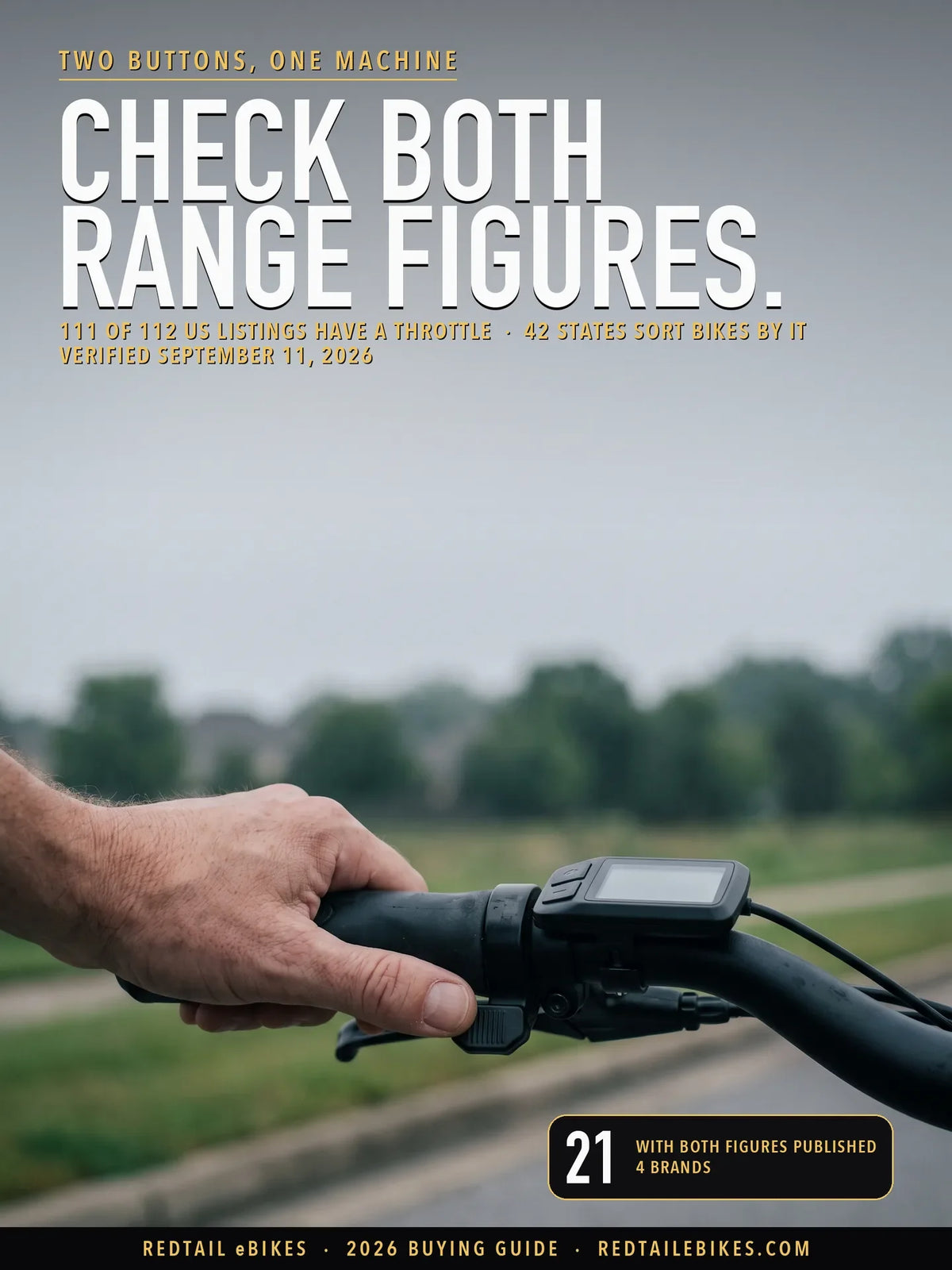
21 bikes with both figures published · throttle range lower on every one · median −33.3% · 111 of 112 US listings have a throttle · 42 states sort bikes by it · verified September 11, 2026
Quick Answer: Pedal assist adds motor power to your pedaling and stops when you stop; a throttle delivers motor power on demand, whether or not you pedal. In the United States almost every e-bike has both. A throttle makes the bike a Class 2, and riding on it costs range: a median of 33.3% across 21 bikes whose makers publish both.
On nearly every e-bike sold here, then, this is not a choice between two machines — it is a choice between two buttons on one machine. Of the 112 live bikes in Redtail's US catalog whose specification states it either way, 111 have a throttle.
The real decisions are what the throttle costs you in range, and where it costs you the right to ride. Across 21 bikes whose own manufacturer publishes both figures for the same bike, the throttle range is lower on every single one — a median of 33.3% lower, spanning 14.3% to 50.6%.
That three-and-a-half-fold spread makes this a per-bike number rather than a category one.
Legally, a throttle is what makes a bike Class 2 in the 42 states that use the three-class system, and that costs you default path access in a handful of them — New Mexico and Michigan chiefly. Start from commuter and city or cruiser and comfort.
The assumption almost every buyer arrives with is that "pedal assist bike" and "throttle bike" are two kinds of product, the way a hardtail and a full-suspension are two kinds of product.
In the US market they are mostly the same product. The question worth your time is not which bike to buy but which control you will actually use, because that choice moves your range by a median of 33.3% (the three classes, defined) and, in a few states and on most natural-surface trails, decides whether you are allowed to be there at all.

One hand, two controls, and the second range figure most buyers never look up. Tap to read the fine print.
In this guide
- How we verified this comparison
- What US buyers are actually asking
- What pedal assist and a throttle actually do
- Almost every e-bike sold here has both
- Pedal assist vs throttle on range: 21 bikes, both numbers, one maker each
- The sensor changes the feel more than the throttle does
- The class system is the throttle system
- Where a throttle costs you the right to ride
- Can you add a throttle to a bike that does not have one?
- When the throttle earns its keep
- What riding on the throttle does to the rest of the bike
- Where buyers get caught out
- Our picks, matched to how you ride
- The 60-second decision checklist
- Frequently asked questions
- Why buy either kind from us
- Buying either kind from us
- The bottom line
- Limitations
- Source register
- Primary sources
How we verified this comparison
Three datasets sit under this page, and all three are published with it: a census of every live bike we sell, read from the live Redtail storefront; a paired range dataset read off the manufacturers' own pages; and the arithmetic that turns the second into the number in the headline.
The catalog census
The first is a census of our own catalog: every live, complete bike and trike listing on redtailebikes.com, pulled from the storefront on September 11, 2026 — 190 of the 217 listings collected, after setting aside 24 that are not active and three that are not bikes — with each bike's throttle specification, assist sensor and published ranges read from its own specification table.
112 listings state whether the bike has a throttle; 78 do not, and a listing that says nothing is counted as unstated rather than as a no. The storefront those listings were read from is redtailebikes.com, and the census and the code behind it are published with this page.
The paired range dataset
The second is the paired range dataset, and it is the one that took the work. For every bike whose manufacturer publishes both a pedal-assist range and a throttle-only range for the same machine, both figures were read off the maker's own published page on September 11, 2026, and the gap is arithmetic.
Pairing matters: two numbers about one bike share a battery, a motor and a test protocol, so the difference between them isolates the thing being measured in a way that comparing two different bikes never can.
Qiolor's Tiger JR page is the clearest example: both figures, one bike, one sentence. 21 machines from 4 brands cleared that bar. Where a maker states a span, the low end is used on both sides. The deposited maker pages behind every row are committed with this page; Velotric, Himiway and Qiolor are three of the four.
The third is arithmetic: subtraction and division, with the inputs printed beside every result.
The legal sources
Everything legal comes from the body with authority over it. The federal definition is read at 15 U.S.C. § 2085 and at 16 CFR § 1512.2. State class definitions are quoted from the state's own code — 625 ILCS 5/1-140.10 and California Vehicle Code § 312.5 among them — never from a summary of it.
Coverage, with its denominator. 2,489 demand rows were harvested from five independent sources before a single heading was chosen, and 29 distinct questions are answered on this page. Prices and stock were read from the live store on September 11, 2026. Verified September 11, 2026 by Milad Ghobadibeygvand, BScN (Western University, 2014).
What US buyers are actually asking
The biggest question on this topic in the United States is not which system feels better. It is whether the throttle is legal where you ride. Before this page had an outline, 2,489 query rows were collected from Google autocomplete, Google Trends, the headings of the pages currently ranking, related-search surfaces and the AI engines themselves.
Sorted into topics, 485 of them are about legality, class or where you are allowed to ride — two and a half times the next-largest group.
The topic is not usually written that way. The pages that rank for it, and the answers the AI engines give, are built around feel, fitness and battery life. Fitness is the smallest measured cluster on this subject: 8 rows out of 2,489.
| What people are asking about | Harvested queries | How the ranking pages treat it |
|---|---|---|
| Legality, class, where you can ride | 485 | one section, often none |
| Which to buy, which is better | 192 | the whole frame |
| Repair and troubleshooting | 168 | a different topic — not covered here |
| How the systems work | 130 | the frame |
| Torque sensor vs cadence sensor | 124 | well covered |
| Adding or retrofitting a throttle | 80 | answered inconsistently |
| Range and battery | 57 | answered without sources |
| Speed | 31 | covered |
| Exercise and fitness | 8 | a headline benefit |
Topics overlap, so those rows do not sum to 2,489. The full harvest, its five sources and everything discarded from it are published with this page.
The AI engines were measured, on the day of writing. Six prompts were put to an AI-search engine on September 11, 2026. Across those six answers it cited 51 sources from 36 domains, and not one of them was a primary source — every citation was a competing retailer's blog, a forum thread, a news post or a marketplace listing.
On the range question three different engines-cited blogs gave three different numbers with no method attached. On one prompt the engine contradicted itself inside a single answer, saying that a bike's class cannot be changed by adding a throttle and then, four sentences later, that a universal throttle is "ideal for switching between Class 1, Class 2, and Class 3."
Takeaway
Decide the legal question first, because it is the only one that can cost you a citation or a confiscated bike. Find your state's rule, then choose the control you like. Our state-by-state e-bike law guide has every jurisdiction in one table, and the electric bike buying guide covers the rest of the specification sheet.
What pedal assist and a throttle actually do
Pedal assist adds power to your pedaling; a throttle adds power instead of your pedaling. Every other difference on this page follows from that one. With pedal assist the motor is a multiplier on what your legs are already doing, and it stops when you stop. With a throttle the motor is an independent source of propulsion you command with your thumb or your wrist, and it works whether or not the cranks are turning.
Pedal assist is almost always delivered in levels, usually five, sometimes three, occasionally nine.
A level sets a ceiling on how much help the motor is allowed to contribute.
The bike's top assisted speed is fixed by its class instead (625 ILCS 5/1-140.10). On level 1 you are doing most of the work and the motor is topping you up. On level 5 the motor is doing most of it and you are mostly turning the cranks to keep the system awake.
Learn the two words before you shop. Pedal assist is a multiplier on your own effort and it stops when you stop. A throttle is an independent source of power you command with a thumb or a wrist. Every other difference on this page — range, class, where you may ride — follows from that one.
A throttle comes in three shapes on the bikes we sell: a thumb lever on the left or right grip, a half-twist grip that rotates under your palm, and a trigger you pull with a finger.
The shape changes ergonomics and nothing else — a thumb throttle is easier to hold steady on rough ground because your grip on the bar is unaffected, and a twist throttle is more intuitive to anyone who has ridden a motorcycle. Whatever the shape, the motor-only speed is capped at 20 mph in the three-class states (§ 1-140.10(b)).
Two mechanical details matter more than the shape.
First, a brake lever usually cuts motor power, through a switch in the lever itself — the Eunorau META26's specification names it as a "motor cutoff switch". Makers state it per model rather than universally, so check the brake row of the specification for the bike you are looking at.
Second, some throttles will not engage until the bike is already rolling — a maker will state a small minimum speed in the throttle row of its specification. It is a design decision about lurch, the throttle row of any maker specification is where it shows up, and it surprises people who expect to pull away from a stop on the throttle alone.
Almost every e-bike sold here has both
The premise of the question is mostly false in the American market. We read the specification of all 190 live bikes in our catalog on September 11, 2026. 112 of those listings state whether the bike has a throttle. Of those 112, 111 have one.
The exception is a single machine: the Velotric T1ST, whose maker prints its top speed as "28 MPH(No Throttle)" and lists it as Class 1/3. One bike out of 112 that answer the question.
| What our catalog says about throttles | Listings |
|---|---|
| Specification states a throttle is fitted | 111 |
| Specification states there is none | 1 |
| Specification does not address it | 78 |
| Total live bikes, September 11, 2026 | 190 |
The 78 that say nothing are counted separately and never folded into either side. A listing that omits a throttle row tells you something about the listing. The listings themselves are public, one specification table per bike, at redtailebikes.com.
This reframes the whole decision. You are not usually choosing between a pedal-assist bike and a throttle bike. You are choosing a bike that has both, and then choosing how to ride it — and, in a few places, whether the throttle's presence is something you can live with legally.
The one genuine either/or in this catalog is whether you want a machine like the T1ST that omits the throttle in exchange for being light: 39 lb, against 68.4 lb for the META26. Velotric prints the T1ST's weight and its "28 MPH(No Throttle)" top speed on its own product page; Eunorau prints the META26's on theirs. Weight is its own decision, and it drives our folding e-bike picks more than any other number.
Stop shopping for "a pedal assist bike." Nearly every bike on the US market is both. Shop for the class you are allowed to ride, the weight you can lift, and the sensor you will enjoy — then use whichever control suits the moment.
Pedal assist vs throttle on range: 21 bikes, both numbers, one maker each
Riding on the throttle costs you range on every bike where the question can be checked — a median of 33.3% — but the size of the penalty belongs to the bike rather than to the category. Across the 21 machines below the loss runs from 14.3% to 50.6%.
Any single number you have read for this — "40 to 60 percent", "30 to 50 percent" — is a category average standing in for a figure that your own bike's maker has usually already published. Qiolor and Himiway both print theirs in plain language.
The method, in one sentence: for every bike in our catalog whose manufacturer publishes a pedal-assist range and a throttle-only range for that same bike, both figures were read at the manufacturer on September 11, 2026 and the second was subtracted from the first. The four makers are Velotric, Samebike, Qiolor and Himiway. Where a maker gives a span, the low end is used on both sides, so the comparison is like-for-like.
| Bike | Pedal assist | Throttle only | Range difference |
|---|---|---|---|
| Himiway A7 | 70 mi | 40 mi | −42.9% |
| Qiolor Tiger JR | 70 mi | 40 mi | −42.9% |
| Qiolor Tiger RL | 70 mi | 40 mi | −42.9% |
| Samebike CY20 Pro | 56 mi | 28 mi | −50.0% |
| Samebike CY20 Pro (spoked) | 62 mi | 31 mi | −50.0% |
| Samebike LO26 Plus | 68 mi | 34 mi | −50.0% |
| Samebike M20 | 87 mi | 43 mi | −50.6% |
| Samebike RS-A02 Plus | 81 mi | 40 mi | −50.6% |
| Samebike RS-A02 Pro | 68 mi | 34 mi | −50.0% |
| Velotric Breeze 1 | 70 mi | 55 mi | −21.4% |
| Velotric Discover 2 | 75 mi | 60 mi | −20.0% |
| Velotric Discover 3 | 80 mi | 65 mi | −18.8% |
| Velotric Discover M | 95 mi | 70 mi | −26.3% |
| Velotric Fold 1 | 55 mi | 45 mi | −18.2% |
| Velotric Fold 1 Plus | 68 mi | 45 mi | −33.8% |
| Velotric GoMad | 75 mi | 50 mi | −33.3% |
| Velotric Nomad 2 | 65 mi | 45 mi | −30.8% |
| Velotric Nomad 2X | 75 mi | 50 mi | −33.3% |
| Velotric Summit 1 | 70 mi | 60 mi | −14.3% |
| Velotric Summit 2 | 95 mi | 70 mi | −26.3% |
| Velotric Tempo | 60 mi | 40 mi | −33.3% |
Every figure in that table is a manufacturer claim measured under favorable conditions, on both sides. Nobody's real range looks like the left-hand column. Both columns are inflated by the same optimism on the same bike, which is why the ratio survives even though the absolute numbers do not. Both columns come off one specification table, as on the Tiger JR.
One caution about comparing gaps across brands rather than within a bike: the makers do not all quote range the same way. Some publish the pedal-assist figure from their lowest assist level and say so; others publish a single figure without naming a level. A larger gap can therefore describe how a maker quotes range as much as how its bike behaves. Compare Samebike's "PAS 1 Mode (Max) Range" with Velotric's unlabelled "Pedal Assist Range".
What the spread tells you that an average hides
Five of the 21 lose under a quarter of their range on the throttle; nine lose 40% or more. The size of the gap tracks how much of the work your legs were doing in the first place: on a light bike with modest assist, your contribution is a large share of the total, so removing it costs a large share of the range.
On a big-battery machine whose motor was already doing most of the moving, the proportion the rider adds is smaller to begin with. The Himiway A7, at 70 miles against 40, sits in the middle of that spread.
The practical translation
Take the Qiolor Tiger JR, which publishes both figures plainly: 70 miles if you pedal, 40 if you do not.
On a 12-mile round trip that is the difference between charging twice a week and charging every other day — on one bike, with one battery, decided entirely by which control you reach for. Qiolor publishes both figures on the bike's own page. Look up your own bike's two numbers before you decide how you will ride it, because the maker has usually printed them both and the second one goes unread.
Check both range figures before you buy, the headline one and the quiet one. Every bike in the commuter and city range publishes its battery in watt-hours, and the makers that publish a throttle-only figure alongside the pedal-assist one are telling you something useful about how the bike behaves.
Compare commuter eBikesThe sensor changes the feel more than the throttle does
If you want the bike to feel like a bicycle rather than a scooter, the specification to check is the assist sensor. A pedal-assist system has to decide how much help to give, and there are two common ways of deciding.
A cadence sensor watches whether the cranks are turning. It is effectively a switch: turn the pedals and the motor delivers whatever the current assist level allows, regardless of how hard you are actually pushing. It is cheap, robust, and it produces the surge that people describe as "the bike taking off with me." Makers that fit one usually name it in the sensor row of the specification, as Himiway does.
A torque sensor measures how hard you are pushing and scales the motor's contribution to your effort.
Push gently, get gentle help.
Stand on the pedals for a hill, get a lot. It feels like strong legs rather than like a motor, and because it only spends battery in proportion to your input it is generally the more frugal of the two. Velotric's T1ST is a torque-sensor bike; its specification names the sensor explicitly. Where the sensor sits relative to the motor is a separate question, covered in our e-bike motor guide.
| Cadence sensor | Torque sensor | |
|---|---|---|
| What it measures | whether the cranks are turning | how hard you are pushing |
| Power delivery | steps up at each level; on/off character | proportional and continuous |
| Feels like | a motor you switch on | legs you did not know you had |
| Typical cost | cheaper | the pricier build |
| Hill starts | strong once you are moving | rewards effort immediately |
| Who tends to prefer it | riders who want minimum effort | riders who want to feel like cyclists |
In our catalog on September 11, 2026, 41 listings name a torque sensor, 28 name a cadence sensor, 19 mention both — usually a switchable or dual system — and 102 name neither, which is a gap in the published specification rather than a fact about those bikes (the listings), and the ones that name none are counted separately throughout.
The switchable systems are worth knowing about because they dissolve the argument. The Himiway A7's specification lists its sensor as "Torque / Cadence Switchable", with an auto pedal-assist mode, five assist levels and a thumb throttle, which means one bike gives you the proportional feel on a good day, the effortless mode on a tired one, and the throttle when you need it.
Where this bites. A cadence-sensor bike ridden on level 1 in traffic can feel jerky in a way that has nothing to do with the throttle, and buyers routinely blame the wrong component. If the complaint you have read about a bike is "surgey" or "all or nothing", check whether the reviewer was describing a cadence system before you conclude anything about the machine.
The sensor decides the ride feel; the throttle decides the options. If a natural, bicycle-like ride matters to you, buy a torque sensor and treat the throttle as a tool you keep for hills and junctions.
The class system is the throttle system
In the 42 states that use the three-class framework, the throttle is the thing that sorts a bike into Class 2. The classes are statutory definitions, and they turn almost entirely on two questions: does the motor help only while you pedal, and at what speed does it stop helping.
Illinois states it as plainly as any legislature has.
Under 625 ILCS 5/1-140.10, a Class 1 bike is one "equipped with a motor that provides assistance only when the rider is pedaling and that ceases to provide assistance when the bicycle reaches a speed of 20 miles per hour".
A Class 2 is one "equipped with a motor that may be used exclusively to propel the bicycle and that is not capable of providing assistance when the bicycle reaches a speed of 20 miles per hour." A Class 3 provides assistance "only when the rider is pedaling" up to 28 mph. All three definitions sit in 625 ILCS 5/1-140.10.
"May be used exclusively to propel the bicycle" is the statutory way of saying it has a throttle.
| Class | How the motor engages | Assist stops at | Throttle | Where it comes from |
|---|---|---|---|---|
| Class 1 | only while you pedal | 20 mph | no | 625 ILCS 5/1-140.10(a) |
| Class 2 | may propel the bike on its own | 20 mph | yes | 625 ILCS 5/1-140.10(b) |
| Class 3 | only while you pedal | 28 mph | varies by state | 625 ILCS 5/1-140.10(c) |
Class 3 and the throttle: the answer depends on the state
The Class 3 question is the one the internet gets wrong most often, and it gets it wrong because the answer genuinely differs by state. Some states' Class 3 definitions are silent about throttles, which leaves room for a Class 3 bike that also has a 20 mph throttle.
California's are not silent. Under Vehicle Code § 312.5(a)(3), as amended by SB 1271 and effective January 1, 2025, a Class 3 bike must be "not capable of exclusively propelling the bicycle, except as provided in paragraph (4)" — and paragraph (4) permits only "start assistance or a walk mode that propels the electric bicycle on motor power alone, up to a maximum speed of 3.7 miles per hour." California made the same change to Class 1.
So in California a Class 1 or Class 3 e-bike may have a walk-alongside mode and nothing more. A throttle that will carry you at 20 mph makes the bike a Class 2 there, full stop. Class 2 itself is untouched and remains legal statewide. The section is Vehicle Code § 312.5, as amended by SB 1271.
What the federal statute actually governs
The federal statute is not a road law, and the mistake is everywhere. 15 U.S.C. § 2085 defines a "low-speed electric bicycle" as a two- or three-wheeled vehicle "with fully operable pedals and an electric motor of less than 750 watts (1 h.p.)".
The rest of the definition is a speed test: a maximum speed on a paved level surface, "when powered solely by such a motor while ridden by an operator who weighs 170 pounds", of less than 20 mph. The same definition is carried by the CPSC's own regulation at 16 CFR § 1512.2.
Read subsection (a) and you will see what the definition is for: it makes low-speed electric bicycles "consumer products" subject to the Consumer Product Safety Commission's regulations. Subsection (a) of § 2085 says so in terms. It is a product-safety statute. It governs what may be manufactured and sold, and is silent on where you may ride.
One of the six AI answers we measured told its reader that federal law makes Class 1 and Class 2 bikes street-legal in all fifty states, citing this section.
It does not. What makes your bike legal on your road is your state's vehicle code, and the federal definition's contribution is that phrase "powered solely by such a motor" — a description of a throttle, written into product law twenty-four years ago. Read the section itself at 15 U.S.C. § 2085.
Find your class before you find your bike. A throttle makes it Class 2 in 42 of the 50 states, and North Carolina makes it 43 on December 1, 2026. Check the state-by-state table, then check whether your city or your favorite trail has its own rule on top.
Where a throttle costs you the right to ride
On the road, a Class 2 goes wherever a Class 1 goes in every three-class state. It is on paths, trails and federal land that the throttle starts costing you something. In most of the country the two classes are treated identically for roads and bike lanes. A handful of jurisdictions single out the throttle, and they are worth knowing by name because the rule is usually the opposite of what a rider expects.
| Where | How a throttle changes things | Source |
|---|---|---|
| New Mexico | Class 2 and Class 3 are off bicycle and pedestrian paths unless within a street or locally permitted; Class 1 is allowed by default | NMSA § 66-3-709(A)–(B) |
| Michigan | Class 1 may use paved linear trails and rail-trails unless a local authority prohibits it; Class 2 and 3 only if authorized — presumptively off until someone says yes | MCL 257.662a(8)–(9) |
| New Jersey | A throttle makes the machine a "motorized bicycle": registration, a licensed rider and insurance | P.L.2025, c.285 |
| South Carolina | The definition requires the motor to cut out "when the rider stops pedaling" — a pure-throttle machine may not fit it at all | S.C. Code § 56-1-10(29) |
| Utah | A bike whose throttle mode exceeds 20 mph on motor power is excluded from the e-bike definition entirely | Utah Code § 41-6a-102(21)(b)(v)(D) |
| Wisconsin DNR trails | The trail rule names Class 1 and Class 3 and omits Class 2 | NR 45.055 |
| Arkansas state parks | Class 1 is allowed on every park bike trail including mountain-bike trails; Class 2 and 3 are barred from park trails and confined to park roads | 22 CAR § 50-122 |
Notice the shape of it.
New Mexico and Michigan flip the default: in most states a Class 2 inherits a bicycle's path rights and a Class 3 is the restricted one, and in those two the throttle itself is the dividing line. The provisions are NMSA § 66-3-709 and MCL 257.662a. New Jersey is in a category of its own — it is the only state that attaches an insurance requirement to the throttle. The act is P.L.2025, c.285.
The federal rule on how you may use it
And a federal rule governs how you may use the throttle, which the buying guides leave out. The National Park Service's e-bike regulation, effective December 2020, adopts the same three classes — its Class 2 is "a motor that may be used exclusively to propel the bicycle".
It then restricts the behavior. The regulations bar a Class 2 rider from using the motor alone "to propel the e-bike for an extended period of time without pedaling, except in locations that are open to public motor vehicle use" (NPS, Electric Bicycles in National Parks).
Two further NPS rules matter to anyone planning a park ride. E-bikes are allowed only where traditional bicycles are already allowed, and they are barred from wilderness areas by federal statute. Superintendents may open a road or trail to Class 1 only, or to Class 1 and 2 but not Class 3, so the class your bike wears decides the ride park by park. All of it is set out at NPS, Electric Bicycles in National Parks.
Beyond the state layer there is a land-manager layer that catches more riders than any statute does.
Natural-surface trails, whoever runs them, very often admit Class 1 and exclude anything with a throttle, and they do it through a trail rule rather than a traffic code.
The rule that governs the trail you ride is written by whoever owns the trail, and it is frequently stricter than your state's law. The National Park Service states its own version of that rule in its e-bike regulation guidance. Our state-by-state guide carries the full 51-jurisdiction table and every state page underneath it carries its own city-by-city sweep.
If none of that touches you — and for most road and bike-lane riding it does not — the throttle costs you nothing legally.
Can you add a throttle to a bike that does not have one?
Mechanically, often yes. Legally, adding a throttle changes what your bike is, and in some states it can stop being an e-bike at all. This is the question the AI engines answer worst — one gave both answers in the same reply — and it is one of the largest clusters of real queries on this topic that nobody answers cleanly.
Start with the mechanics. A throttle is a signal device: it tells the controller how much power to send. Whether one can be added depends on whether your controller has a throttle input and will accept the signal.
Room on the handlebar is never the constraint.
Many controllers on bikes sold as pedal-assist-only do have the port, because the manufacturer builds one controller for several models. Many do not. Ask the maker of your specific bike, and ask first; Velotric, Himiway and Qiolor each publish a contact route.
Now the part almost nobody writes down.
The statutory classes are defined by how the bike is equipped. Illinois's definition says a Class 2 is one "equipped with a motor that may be used exclusively to propel the bicycle". Equip a Class 1 with a working throttle and, on the face of the definition, you have a Class 2, with its path consequences in New Mexico, Michigan, Wisconsin's DNR trails and Arkansas's state parks and its insurance consequence in New Jersey.
Two traps on top of the class question
The label is part of the bike. California has required since January 1, 2017 that every e-bike carry a permanently affixed label stating "the classification number, top assisted speed, and motor wattage" (§ 312.5(c)). A bike wearing a Class 1 label with a throttle bolted to it is a bike whose label no longer describes it, and the label is what an officer reads.
Modification can take the bike out of the definition entirely. California § 312.5(d) says that a vehicle "that is modified to attain a speed greater than 20 miles per hour on motor power alone" is not an electric bicycle under the code and "shall not be advertised, sold, offered for sale, or labeled as electric bicycles".
Utah reaches the same result by a different route, excluding a bike whose throttle mode exceeds 20 mph on motor power. A bike outside the e-bike definition becomes an unregistered motor vehicle. Utah's exclusion is at § 41-6a-102(21)(b)(v)(D) and California's at § 312.5(d).
So the honest answer has three parts, in this order:
- Ask the manufacturer whether your controller supports a throttle. If it does not, the question ends there.
- Assume the bike becomes a Class 2 and check what that costs you where you ride — which for most road riders is nothing, and for path and trail riders can be everything.
- Never let the modification raise the motor-only speed above 20 mph. Cross that line and the machine stops being an e-bike in the states that write the test that way, and no argument brings it back.
If you want a throttle, buy a bike that came with one. A factory throttle arrives with a matching label, a class the maker stands behind, and a warranty that still applies — and on this market that is nearly every bike anyway.
When the throttle earns its keep
The throttle is a tool that solves four specific problems, and outside those four the pedal assist is usually the better control. Because it costs range, using it as your default is an expensive habit. Using it deliberately is close to free.
Starting from a dead stop on a hill. This is the case the throttle was made for. A loaded bike on a gradient with the chain in the wrong gear is genuinely hard to start, and on a cadence-sensor bike the assist will not arrive until the cranks are already turning — which is exactly the moment you cannot turn them. A thumb of throttle gets the bike rolling and the pedal assist takes over.
A knee, a hip, or a day when the body is not cooperating. For a rider managing an injury or a joint that objects to load, the ability to take the pressure off for a block without stopping the ride is the difference between riding and not riding. It is the most common honest reason people buy a throttle, and it is why the throttle features so heavily in our electric bikes for seniors picks.
Traffic you have to keep up with. Pulling away from a light into a lane of cars is a moment where acceleration is a safety feature. The throttle gives you immediate power at the instant your feet are still finding the pedals.
Carrying something heavy. A cargo load, a child seat, a week of groceries — the mass that makes the bike hard to start is exactly the mass the throttle handles best. Our cargo range is where this shows up most, and the best cargo electric bikes guide matches loads to machines.
Use pedal assist by default and spend the throttle deliberately. It is worth real miles: across the 21 bikes whose makers publish both figures, the throttle costs a median of 33.3% of the range. Keep it for the four moments above — the hill start, the bad knee, the traffic light, the heavy load.
The case for pedal assist as the default
Against those, the case for pedal assist as the default control is simple arithmetic and one point of feel.
The arithmetic is the table above: on the median bike in this dataset the throttle costs you 33.3% of your range. The feel is that a torque-sensor pedal-assist system gives you the bike's best behavior — proportional, quiet, and entirely under your control — and a throttle gives you the same motor with the subtlety removed. Velotric's T1ST is the version of that argument with the throttle removed entirely.
A note on exercise, because it is the smallest thing people search and the largest thing they are told. Eight of 2,489 harvested queries on this topic were about fitness. It is a real benefit of pedal assist, and it ranks far below legality among the reasons Americans weigh these two controls. If it is your reason, the sensor matters more than the throttle: a torque sensor scales effort to your input, which is what makes the exercise real.
If you have got this far and the answer is "I want the throttle for hills and junctions, not as my default", the Eunorau META26 is the bike that shape of riding points at: a torque sensor for the feel, a thumb throttle for the moments that need it, $1,699 with free shipping in the lower 48, price-matched, US support and warranty handling, and Shop Pay Installments at checkout.
Add the META26 to your cartWhat riding on the throttle does to the rest of the bike
Range is the cost you can measure; three others are worth knowing about and none of them is a reason not to buy a throttle.
The battery works harder per mile. It is the same fact as the range table, stated from the pack's side. A pack delivering all the propulsion runs at a higher average current than one topping up a rider's effort, and higher average current means more heat.
The motor spends more time at low speed under load. Hub motors are least efficient when they are turning slowly against resistance — pulling away from a stop, grinding up a hill at walking pace. The hub-drive guide sets out which machines use them and where a mid-drive behaves differently. It is the throttle's favorite duty cycle, which is why throttle-only riding on a steep hill drains a pack faster than the flat-ground numbers suggest.
The drivetrain wears less and the brakes wear more. Riding on the throttle means the chain and cassette are doing nothing, and the brakes are doing all the slowing on a bike that is heavier and faster than a bike without a motor.
Hydraulic discs are close to standard on the bikes we sell for that reason: the Qiolor Tiger JR, the Eunorau META26 and the Himiway A7 all specify hydraulic discs with 180 mm rotors. Each maker prints the brake specification on its own page: Qiolor, Eunorau, Himiway. Our e-bike reviews go through the braking hardware model by model.
What does not change is the legal speed. The throttle is capped at 20 mph on motor power alone in every three-class state, which is the same ceiling a Class 1's pedal assist has. A throttle does not make a bike faster. It makes it easier.
Where buyers get caught out
Four mistakes account for most of the trouble on this topic: believing federal law settles where you may ride, assuming Class 3 means a throttle, treating the range penalty as one fixed number, and planning to add a throttle later without checking what that does to the bike's class. The governing texts are 15 U.S.C. § 2085 and Cal. Veh. Code § 312.5.
"Federal law says throttle bikes are street legal everywhere." It does not. 15 U.S.C. § 2085 is a consumer-product statute that tells the CPSC what it may regulate. Your riding rights come from your state's vehicle code and from whoever manages the path you are on.
"Class 3 means it has a throttle." Class 3 means pedal assist to 28 mph. Whether it may also have a throttle depends on the state — and in California, since January 1, 2025, a Class 1 or Class 3 may have nothing beyond a 3.7 mph walk mode (§ 312.5(a)(4)).
"The throttle costs about half your range." On six of the 21 bikes measured here it costs half or more. On five it costs under a quarter. The number that matters is your bike's, and its maker has probably published both figures already.
"I'll just add a throttle later." Sometimes you can. But the class definitions key on how the bike is equipped, the California label has to keep describing the machine it is attached to, and a modification that lifts motor-only speed past 20 mph takes the bike out of the e-bike definition in the states that write the test that way.
Our picks, matched to how you ride
Four bikes, four brands, chosen against the four situations this page has been describing rather than against a score. Every specification below is the manufacturer's own published figure, read at the manufacturer on September 11, 2026 and recomputed. The four pages are Velotric T1ST, Eunorau META26, Himiway A7 and Qiolor Tiger JR.
Prices and availability were read from our own store the same day. All four ship free in the lower 48, are price-matched to the maker's own US price, and are supported and warranty-handled by us in the United States, with Shop Pay Installments at checkout. Every bike and its published specification is on the storefront.
Velotric T1ST — the one built without a throttle

The bike with nothing to press: 39 lb, a torque sensor, and a clear handlebar.
$1,399 · 39 lb · torque sensor · Class 1 and Class 3 · 70 mi on pedal assist · no throttle
The only bike in our catalog whose maker states it has no throttle at all: Velotric prints its top speed as "28 MPH(No Throttle)". Velotric's page names it the T1 ST Plus and lists it at $1,399, down from a $1,649 list price; our price matches.
The omission is what buys the weight. A 350 W hub motor with a 600 W peak and a 36 V 352.8 Wh UL 2271 battery keeps the whole bike at 39 lb, and the torque sensor makes the assist feel like your own legs.
Its 70-mile figure and the Himiway A7's are the same number from very different machines: a small battery moving a light bike with a rider pedaling, against a 720 Wh pack moving a heavy one. It is why a range claim is only ever comparable to the other claim about the same bike. Default 20 mph, adjustable 12–28 mph, on KENDA 700×40c puncture-resistant tires. All of it from Velotric's own specification.
Buy it if you ride paths or natural-surface trails where Class 1 is welcome and a throttle is not, you carry the bike up steps or onto a rack, or you want the ride to feel like cycling. If a city commute is the whole job, compare it against our best commuter electric bikes picks. Look at the META26 instead if you need a throttle for hill starts — the T1ST will not give you one, by design.
Velotric T1ST
$1,39939 lb, torque sensor, Class 1/3 and a 70-mile pedal-assist range on a 36 V 352.8 Wh UL 2271 pack (Velotric's published specification, read September 11, 2026). Velotric's list price is $1,649; ours matches its $1,399 sale price. Free shipping in the lower 48, price-matched, US support and warranty handling, Shop Pay Installments at checkout.
Eunorau META26 — the throttle commuter

A torque sensor for the ride and a thumb throttle for the hill start — the combination most US buyers actually want.
$1,699 · 48 V 500 W hub, 55 N·m · thumb throttle · torque sensor · Class 2 · 20 mph
A city bike that answers the hill-start and bad-knee case without giving up the proportional feel. It pairs a torque sensor with a thumb throttle, so the assist behaves like a good pedal-assist bike and the throttle is there when the junction demands it.
286 lb payload, 68.4 lb, 26 × 3.0 in tires, hydraulic discs with a motor cutoff switch in the lever, fits riders 5'4" to 6'3". Figures from Eunorau's own specification.
Buy it if you want the throttle for specific moments rather than as your default control. Look at the T1ST instead if you ride trails where Class 2 is excluded. Our Eunorau META26 review covers the rest of the specification, frame fit included.
Eunorau META26
$1,69948 V 500 W rear hub with 55 N·m, thumb throttle, torque sensor, 20 mph, 286 lb payload (Eunorau's published specification, read September 11, 2026). Free shipping in the lower 48, price-matched, US support and warranty handling, Shop Pay Installments at checkout.
Himiway A7 — the one that does both

Switchable sensing: the same bike will behave like a torque-sensor machine on Tuesday and a cadence one on Friday.
$1,799 · switchable torque and cadence sensing · thumb throttle · 70 mi on pedal assist · 40 mi on throttle · Class 1, 2 or 3
The bike for the reader who has read this far and still wants both controls. Its specification lists a switchable torque / cadence sensor with a Smart Auto mode, five assist levels and a thumb throttle, on a 48 V hub motor with a 720 Wh UL 2271 pack.
Himiway rates that motor at 750 W and 70 N·m on the Regular frame and 500 W and 60 N·m on the Large, at the same price, and the button below adds the Regular. Our Himiway A7 review works through the frame choice.
It is also one of the bikes that publishes both range figures — 70 miles on assist, 40 on throttle — so you can see the trade-off on the spec sheet before you commit to it. Shimano MT200 hydraulic discs, 400 lb payload, 27.5 × 2.4 in tires. Figures from Himiway's own specification.
Buy it if you want to try both delivery styles on one bike and settle the argument for yourself. Look at the T1ST instead if weight is your constraint — the A7 is a full-suspension commuter and it weighs like one.
Himiway A7
$1,799Switchable torque/cadence sensor plus Smart Auto, five assist levels, thumb throttle, 750 W / 70 N·m on the Regular frame this button adds, 720 Wh UL 2271 pack, 400 lb payload (Himiway's published specification, read September 11, 2026). Free shipping in the lower 48, price-matched, US support and warranty handling, Shop Pay Installments at checkout.
Qiolor Tiger JR — the trade-off, priced

The clearest spec sheet on this page: Qiolor prints 70 miles pedal assist and 40 on the throttle, side by side.
$1,399 · 48 V 500 W rated, 750 W peak · 63 N·m · Class 2 · 70 mi on pedal assist · 40 mi on throttle
Qiolor publishes both numbers for this bike in plain language on its own product page: "up to 70 miles with pedal assistance or 40 miles using just the throttle".
It is the clearest illustration on this page of what the choice actually costs. A Class 2 machine at 20 mph by default, 63 N·m, hydraulic discs front and rear with 180 mm rotors, 20 × 4.0 in tires, 87 lb, sized for riders 5'1"–5'9". Figures from Qiolor's own specification.
Buy it if you want a throttle bike at the entry price and you want the range arithmetic stated up front. Look at the T1ST instead if you carry your bike up stairs or lift it onto a rack.
Qiolor Tiger JR
$1,39948 V 500 W rear hub (750 W peak) with 63 N·m, Class 2 at 20 mph, and a maker who publishes 70 miles on pedal assist against 40 on throttle (Qiolor's published specification, read September 11, 2026). Free shipping in the lower 48, price-matched, US support and warranty handling, Shop Pay Installments at checkout.
The 60-second decision checklist
Six questions, in the order that saves you the most trouble: your state's framework first, because it decides what a throttle makes your bike; then where you ride, because that is where a throttle costs access; then your own bike's two range figures, the sensor, and the weight you have to lift. Your state's framework is in our state-by-state table; the class definitions themselves are at 625 ILCS 5/1-140.10.
| # | Ask | Why it comes here |
|---|---|---|
| 1 | Which state do I ride in, and does it use the three classes? | 42 of 50 do. It decides what a throttle makes your bike |
| 2 | Do I ride bike paths, rail-trails or natural-surface trails? | This is where a throttle costs access — NM, MI, Wisconsin DNR, Arkansas state parks |
| 3 | Am I in New Jersey? | The only state that attaches insurance to a throttle |
| 4 | What are my bike's two range figures? | The maker has usually published both. The gap runs 14.3% to 50.6% |
| 5 | Torque sensor or cadence sensor? | This decides the ride feel far more than the throttle does |
| 6 | Can I lift it? | 39 lb and 87 lb are both on this page. Weight outlasts every other preference |
If the throttle is the reason you are here — a hill start, a knee, a stop-and-go commute — the cruiser and comfort range is where the upright, throttle-equipped bikes live. Free shipping in the lower 48 and US warranty handling on every one.
Shop throttle-equipped cruisersFrequently asked questions
What is the difference between pedal assist and throttle?
Pedal assist adds motor power to your pedaling and stops when you stop pedaling. A throttle delivers motor power on demand whether or not you are pedaling, from a thumb lever, a twist grip or a trigger. In statute the distinction is that a Class 2 bike is "equipped with a motor that may be used exclusively to propel the bicycle" (625 ILCS 5/1-140.10(b)).
Is pedal assist or throttle better?
Neither, for most buyers, because nearly every e-bike sold in the United States has both — 111 of the 112 listings in Redtail's US catalog that state it. Use pedal assist as your default because it goes further, and keep the throttle for hill starts, heavy loads and pulling into traffic.
Do all electric bikes have a throttle?
No, but very nearly all of them do in the United States. Of the 190 live bikes in Redtail's US catalog on September 11, 2026, 112 state the answer and 111 of those have a throttle. The single exception is the Velotric T1ST, whose maker prints "28 MPH(No Throttle)".
Are throttle e-bikes legal in the US?
Yes. A throttle makes a bike Class 2 in the 42 states using the three-class framework, and a Class 2 is road-legal wherever a bicycle is. What varies is path and trail access: New Mexico and Michigan restrict Class 2 by default, Wisconsin's DNR trail rule omits it, Arkansas keeps it off state-park trails, and New Jersey requires registration, a licensed rider and insurance (P.L.2025, c.285).
Are throttle e-bikes legal in California?
Yes, as Class 2. California's Class 2 definition still permits a throttle to 20 mph. What changed under SB 1271, effective January 1, 2025, is that a Class 1 or Class 3 may no longer have one beyond "start assistance or a walk mode … up to a maximum speed of 3.7 miles per hour" (Veh. Code § 312.5(a)(4)).
Do Class 2 e-bikes have a throttle?
Yes — that is what defines the class. Illinois puts it as a motor that "may be used exclusively to propel the bicycle", capped so it provides no assistance at 20 mph (625 ILCS 5/1-140.10(b)).
Do Class 3 e-bikes have a throttle?
It depends on the state, which is why you will find both answers online. Class 3 means pedal assist to 28 mph. Some states' definitions are silent about throttles; California's is not, and since January 1, 2025 a Class 3 there may have only a 3.7 mph walk mode (Veh. Code § 312.5(a)(3)–(4)).
Does throttle drain the battery faster than pedal assist?
Yes, on every bike where the maker publishes both figures. Across 21 such machines the throttle-only range is lower on all 21 — a median of 33.3% lower, ranging from 14.3% to 50.6%. Look up your own bike's two numbers rather than using an average.
Can you use pedal assist and throttle at the same time?
On most bikes that have both, yes — the controller takes whichever input is asking for more power. It is a normal way to ride: pedal at a comfortable assist level and add a touch of throttle for a rise or a junction. The motor-only ceiling stays 20 mph either way (§ 1-140.10(b)).
Can I add a throttle to my e-bike?
Sometimes mechanically, and it is never only a mechanical question. Your controller has to have a throttle input, which is a question for your bike's manufacturer.
Legally, the classes are defined by how a bike is equipped, so a working throttle points at Class 2 and its path consequences. In California the affixed class label must still describe the bike (§ 312.5(c)), and a modification that lifts motor-only speed past 20 mph removes the machine from the e-bike definition (§ 312.5(d)).
What is the difference between a torque sensor and a cadence sensor?
A cadence sensor detects that the cranks are turning and delivers whatever the assist level allows. A torque sensor measures how hard you are pushing and scales the motor to match. Torque feels natural and is generally more frugal; cadence is cheaper and delivers effortless, slightly on-off power. Makers name the sensor in the specification, as Himiway does for the A7.
What are pedal assist levels?
Levels are ceilings on how much the motor may contribute, usually numbered 1 to 5. A level is a power ceiling; the bike's top assisted speed is fixed by its class. Level 1 tops up your effort; level 5 does most of the work. The speed ceiling comes from the class, not the level (625 ILCS 5/1-140.10).
Can pedal assist be turned off?
Yes. Every assist system has a level 0, and the bike then rides as a heavy bicycle. On a bike with a throttle the throttle usually still works with assist at zero, because it is an independent input. That independence is what the statutory phrase "may be used exclusively to propel the bicycle" describes (§ 1-140.10(b)).
How fast does a pedal assist e-bike go?
The motor stops assisting at 20 mph on a Class 1 or Class 2 and at 28 mph on a Class 3 (625 ILCS 5/1-140.10). You can pedal faster than that under your own power; the motor simply stops helping.
Are pedal assist bikes good for exercise?
Yes, and the sensor decides how much.
A torque sensor scales the motor to your effort, so you get a real workout with the hills flattened. It is also the smallest thing US buyers ask about on this topic — 8 of 2,489 harvested rows. Sensor types are named in the maker specifications.
Are pedal assist bikes allowed on trails?
Class 1 usually is, and it is the class most trail managers admit. Whether a throttle-equipped Class 2 is allowed depends on the land manager rather than on the state: Arkansas's state parks open every bike trail to Class 1 and keep Class 2 and 3 on park roads (22 CAR § 50-122), and Wisconsin's DNR trail rule names Class 1 and Class 3 only (NR 45.055).
Are Class 2 e-bikes allowed on bike paths?
In most three-class states, yes, on the same terms as a Class 1. New Mexico and Michigan are the exceptions worth memorizing: New Mexico keeps Class 2 and 3 off bicycle and pedestrian paths unless permitted (NMSA § 66-3-709), and Michigan allows Class 2 and 3 on linear trails only if authorized (MCL 257.662a(9)).
Do e-bikes need a throttle?
No. A throttle solves hill starts, heavy loads, joint pain and pulling into traffic. If none of those describe your riding, a pedal-assist-only bike is lighter, goes further, and is welcome in more places. Velotric's T1ST is the one machine in our catalog built that way.
Which is better for beginners, pedal assist or throttle?
Pedal assist on a low level, for the first few rides. It is predictable, it keeps your feet doing what feet do on a bicycle, and it teaches you the bike's balance before you add instant power. Keep the throttle for the first hill start that defeats you, and read our first electric bike guide before you order. Whichever you pick, the class rules are at 625 ILCS 5/1-140.10.
Is pedal assist or throttle better for hills?
Pedal assist for climbing, throttle for starting on a climb. Once you are moving, a torque-sensor system gives you more power in proportion to how hard you push, which is what a hill asks for. Getting rolling from a dead stop on a gradient is the throttle's single best trick. A torque-sensor bike like the T1ST rewards the effort from there.
Why buy either kind from us
Because the two numbers this page is built on are the two numbers we put on our own product pages. Every bike we sell carries its maker's published specification, transcribed and checked against the manufacturer's own page — which is how this page's dataset exists at all, and why 21 of our listings could be tested against their makers and survive it.
Three things come with the bike, and none of them is conditional:
- Free shipping in the lower 48, on every machine on this page.
- Price-matched to the manufacturer's own US price — if the maker sells it cheaper, so do we.
- US support and warranty handling. A claim is filed by us with the maker, rather than handed to you as a form.
Shop Pay Installments are available at checkout on all four picks. The four are Velotric T1ST, Eunorau META26, Himiway A7 and Qiolor Tiger JR.
Buying either kind from us
Every bike on this page ships free in the lower 48, is price-matched to the manufacturer's own US price, and is supported from the United States — if a warranty claim arises, we file it with the maker rather than handing you a form. Shop Pay Installments are available at checkout on all four.
The reason that matters on this particular topic is the return question. A throttle is a preference you discover by riding, not by reading, and the two bikes that bracket this page — the 39 lb T1ST with no throttle at all and the Tiger JR with one — are different enough that most people know within a week which side they are on.
If the bike that arrives is the wrong side of that line, write to support@redtailebikes.com before you ride it and we will tell you exactly where you stand on returns for that model and that supplier — the terms differ by maker, so a single number here would be wrong for some of them.
Two things we will tell you before you order rather than after. If you ride natural-surface trails, check the trail manager's rule before you buy a Class 2, because that rule is usually stricter than your state's law and it is not our call to make. And if you are in New Jersey, the throttle brings registration, a licensed rider and insurance with it (P.L.2025, c.285) — worth knowing before the box arrives.
Both sides of this page live in the commuter and city range — the light torque-sensor machines and the throttle-equipped ones, with every specification published. Free shipping in the lower 48, price-matched, US support and warranty handling, Shop Pay Installments at checkout.
Shop commuter eBikesThe bottom line
Buy the bike, then choose the control — because on the US market you are almost certainly getting both. 111 of the 112 listings in Redtail's US catalog that answer the question have a throttle, and the one without a throttle, the Velotric T1ST, trades it for a 39 lb weight.
Two numbers decide the rest.
The first is your own bike's pair of range figures. Across 21 machines whose makers publish both, the throttle-only figure is lower on every one, by a median of 33.3% and by anything from 14.3% to 50.6%. That spread makes the average close to useless and your bike's own figure decisive. It is usually on the same spec sheet as the one you already read.
The second is your state and your trail. A throttle makes the bike a Class 2 in 42 of the 50 states. On roads and bike lanes that costs you nothing. On paths it costs you the default in New Mexico and Michigan, on Wisconsin DNR trails and in Arkansas state parks, and in New Jersey it costs you an insurance policy.
Two of the four picks publish both range figures themselves: the Himiway A7 at 70 and 40 miles, and the Qiolor Tiger JR at the same pair. The other two do not, because the T1ST has no throttle to measure and Eunorau publishes a single range for the META26.
So: if you ride roads and want the option, take the throttle and use it sparingly — the Eunorau META26 pairs it with a torque sensor so the feel survives (add it to your cart). If you cannot decide, the Himiway A7 switches between torque and cadence and has a throttle besides (add it to your cart).
If price is the constraint and you want the trade-off stated on the spec sheet, the Qiolor Tiger JR publishes both range figures itself (add it to your cart). And if your riding is on paths and trails, or if you lift your bike, the Velotric T1ST is the one machine here built around not having a throttle at all (add it to your cart).
Limitations
Twelve things about this page's evidence a careful reader should know before relying on it: every range figure here is a manufacturer claim rather than a measured one, the paired dataset covers 21 machines out of a larger catalog, and several counts describe the listings that disclose a specification rather than the whole market.
- Every range figure on this page is a manufacturer claim, on both sides of every comparison, measured by the maker under favorable conditions. Nobody's real range matches the left-hand column. The comparison holds because both figures on a given bike carry the same optimism; the absolute numbers do not transfer to the road.
- The paired dataset covers 21 machines, and what it excludes is as important as what it counts. 217 listings were read; 52 publish both a pedal-assist and a throttle-only range, and 21 of those survived a strict test: the manufacturer's own page, saved to disk, states exactly one pedal-assist figure and exactly one throttle figure for that machine. The other 31 were excluded for four named reasons — a maker page that gives one two-column comparison table covering two models, so neither column can be attributed to a single bike; a maker page that publishes several range pairs for several battery configurations; a maker page that states no structured pair we could read; and one machine where the maker's current figure and our own listing disagree. None of them is estimated or averaged in. Read the span, 14.3% to 50.6%, as the finding; the median summarises one particular 21.
- The 78 listings that do not state a throttle are not a finding about those bikes. They are a gap in published specification. They are counted separately throughout and never added to either side.
- Two pedal-assist figures are published for the Himiway A7, 70 miles and 65 miles. This page uses the specification-table figure of 70 miles, and reports both so the arithmetic can be checked either way.
- Sensor counts describe listings, not the market. Of 190 live bikes, 41 name a torque sensor, 28 a cadence sensor and 19 both; 102 name none. The largest group is the one where the specification is silent.
- No search-volume figure appears anywhere on this page. The demand harvest counts observed queries, which is a different quantity from search volume, and no volume export was made for this topic. The Google Trends figures behind it are a relative index, never a count.
- People Also Ask could not be read on the day of writing. Six SERP shapes were probed 36 times; every Google shape returned a JavaScript shell and Bing's only marker was a localization string. It is a fact about scrapers on September 11, 2026, and evidence of nothing else.
- The AI panel was run on an accessible AI-search instrument, not on Google AI Overviews, ChatGPT or Perplexity, none of which is reachable from our tooling. The panel file names the engines that were not run.
- The forum layer is missing. The forum harvest returned a decoy result set — an index of unrelated review pages — and all 200 rows were discarded rather than filtered. This page therefore rests on no forum evidence and makes no claim about what riders say online.
- The class counts are ours. "42 of 50 states use the three-class framework" comes from our own reading of every state's e-bike statute between August 13 and 19, 2026, refreshed September 8, 2026, with each jurisdiction linked in the national law guide. North Carolina joins on December 1, 2026. The District of Columbia is not among the 42: its Code defines a "motorized bicycle" without a class system.
- State law changes, and this page has named expiry conditions. Every legal statement here carries the date it was read. It is re-verified by December 11, 2026 at the latest, and immediately on any of these events: North Carolina's three-class statute taking effect on December 1, 2026; any state legislative session that amends an e-bike class definition; an amendment to California Vehicle Code § 312.5; a trail-rule change by the land managers named above in New Mexico, Michigan, Wisconsin or Arkansas; a change to the National Park Service e-bike regulation; or the next catalog census, which re-derives every first-party figure on this page.
- One maker in the source list is Ridstar under another name. YVY, whose K20 page is cited below, is HK Ridstar Trade Limited, the company whose Q20 family carries two 2026 CPSC stop-use warnings including 26-584 for front wheels that detach, and the K20 figures read for this page are the maker's published claims and nothing more.
Source register
Every source used on this page, graded. [SOURCE] means the primary document was retrieved and read; [SEARCH] means it was seen but not retrieved; [GAP] means not established. Nothing graded [SEARCH] or [GAP] is stated as fact anywhere above.
| Tier | What it is | Used for | Grade |
|---|---|---|---|
| T1 | 15 U.S.C. § 2085; 16 CFR part 1512 | the federal product definition, and what it is not | [SOURCE] |
| T1 | 625 ILCS 5/1-140.10 | the three class definitions, quoted | [SOURCE] |
| T1 | Cal. Veh. Code § 312.5(a) (SB 1271) | what a throttle does to the class | [SOURCE] |
| T1 | Cal. Veh. Code § 312.5(a)(4) | the 3.7 mph walk mode | [SOURCE] |
| T1 | Cal. Veh. Code § 312.5(c) | the affixed class label | [SOURCE] |
| T1 | Cal. Veh. Code § 312.5(d) | what modification does to the definition | [SOURCE] |
| T1 | NMSA § 66-3-709; MCL 257.662a; S.C. Code § 56-1-10; Utah Code § 41-6a-102; NR 45.055; 22 CAR § 50-122; P.L.2025 c.285 | the jurisdictions that treat a throttle differently | [SOURCE] |
| T2 | Manufacturer specification pages: velotricbike.com, eunorau-ebike.com, himiwaybike.com, qiolor.com, us.samebike.com, yvyebike.com, ridingtimes.com, eahoraebike.com | every range, motor, sensor and weight figure | [SOURCE] |
| T2 | redtailebikes.com live storefront, pulled September 11, 2026 | the 190-bike census, prices, availability | [SOURCE] |
| T1 | CPSC product safety warning 26-584 | the Ridstar and YVY note in Limitations | [SOURCE] |
| T2 | yvyebike.com company address page | who YVY is | [SOURCE] |
| T3 | Google autocomplete, Google Trends, related-search surfaces, competitor headings, AI-search panel | the demand measurement only — never a factual claim | [SOURCE] |
Primary sources
Every statute, regulation and manufacturer specification this page relies on, each retrieved and read on September 11, 2026 unless stated otherwise.
- 15 U.S.C. § 2085 — Low-speed electric bicycles, U.S. Government Publishing Office
- 16 CFR § 1512.2 — Definitions, U.S. Consumer Product Safety Commission
- 625 ILCS 5/1-140.10 — Low-speed electric bicycle, Illinois General Assembly
- California Vehicle Code § 312.5, as amended by Stats. 2024, Ch. 791 (SB 1271), effective January 1, 2025
- NMSA 1978 § 66-3-709 (SB 69, Laws 2023), New Mexico Legislature
- MCL 257.662a, Michigan Legislature
- S.C. Code § 56-1-10, South Carolina Legislature
- Utah Code § 41-6a-102, Utah Legislature
- Wis. Admin. Code NR 45.055, Wisconsin Legislative Reference Bureau
- Arkansas Act 956 of 2017; 22 CAR § 50-122, Arkansas General Assembly
- P.L.2025, c.285 (S4834/A6235), New Jersey Legislature
- D.C. Code § 50-2201.02, Council of the District of Columbia
- Electric Bicycles (e-bikes) in National Parks, U.S. National Park Service — final rule published in the Federal Register November 2, 2020, effective December 2020
- Velotric T1ST specification · Velotric Nomad 2 · Velotric Discover 3
- Eunorau META26 specification
- Himiway A7 specification
- Qiolor Tiger JR specification
- Samebike RS-A08 specification
- YVY K20 specification
- Riding'times Z8 specification
- Eahora P5 specification
First-party datasets behind this page
Three datasets on this page are our own. Each is committed with the script that produced it, so the method can be audited and the numbers reproduced.
-
Throttle and assist-sensor census, all 190 live bike listings on redtailebikes.com, read September 11, 2026 —
research/catalog/throttle-census_20260911.csv, produced byscripts/census_throttle_sensor.py -
Paired pedal-assist vs throttle-only range, 21 machines, every pair read off the manufacturer's own deposited page on September 11, 2026 —
research/pedal-assist-vs-throttle/range-pairs-final_20260911.csv, produced byscripts/census_range_delta.pyand verified byscripts/verify_range_pairs_at_maker.py -
Demand harvest, 2,489 rows from five independent sources, September 11, 2026 —
keywords/harvest/pedal-assist-vs-throttle_20260911.csv, with its provenance file naming everything discarded and why - 51-jurisdiction e-bike statute survey, read August 13–19, 2026 and refreshed September 8, 2026 — published in full, one row per jurisdiction with its section linked, in our state-by-state e-bike law guide
- YVY company address page, yvyebike.com, naming HK Ridstar Trade Limited. Retrieved September 11, 2026.
- CPSC product safety warning 26-584, U.S. Consumer Product Safety Commission, Ridstar Q20 and Q20 Lite e-bikes, crash hazard, issued June 25, 2026. Retrieved September 11, 2026.
Corrections. Found an error? Write to support@redtailebikes.com and we will check it against the source and correct it in public, with the date.
Image credit: the cover art on this page was generated with Playcut (Nano Banana Pro) and composited by us; the four bike photographs are the same images that appear on our product listings.



Share:
Electric Bike for Adults: How to Choose One You Love
Ridstar eBikes 2026: Two CPSC Warnings, No Recall