
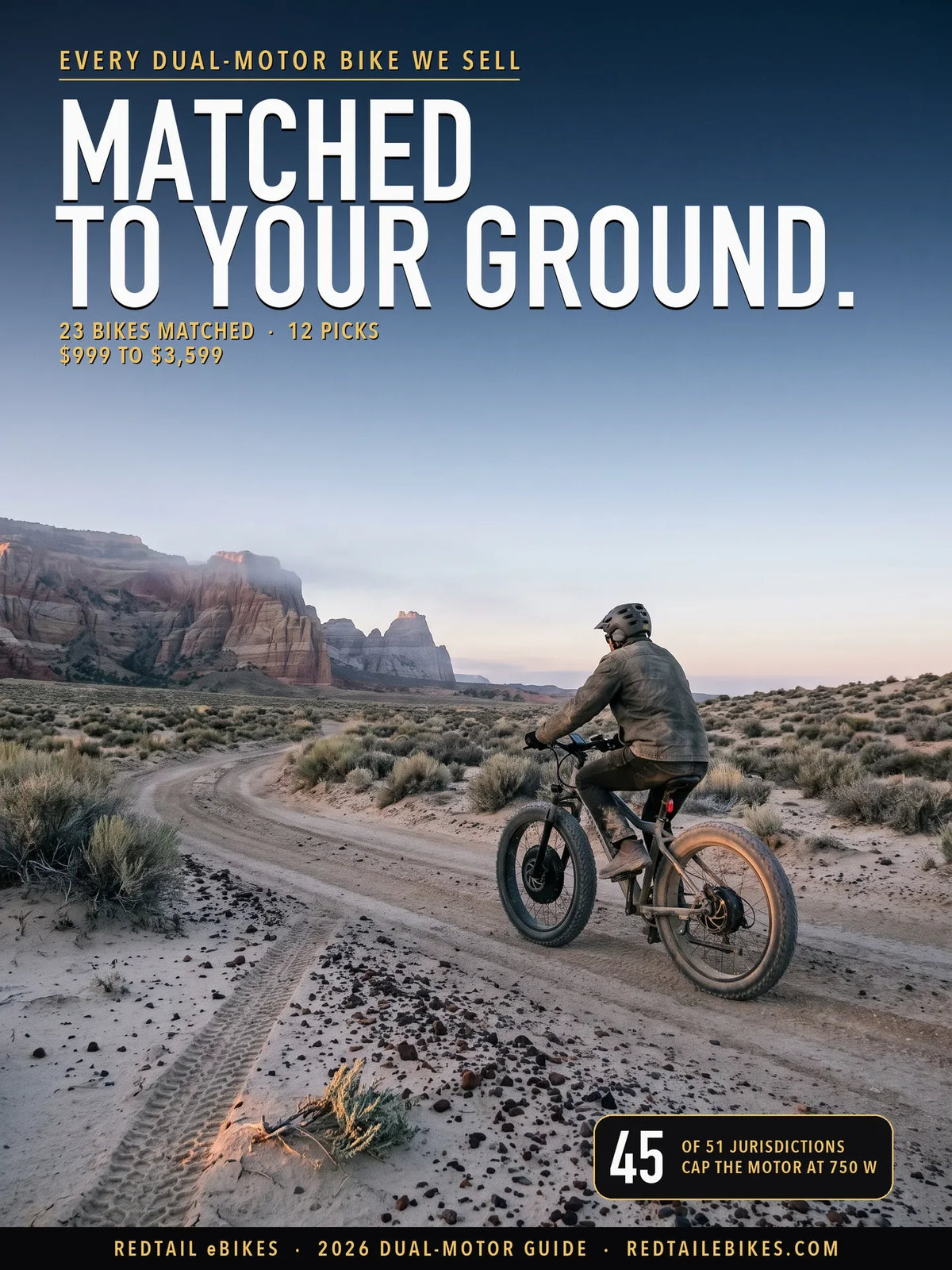
23 bikes matched · 12 picks · 51 jurisdictions read · 45 of them cap the motor at 750 W · $999 to $3,599 · every decisive spec read off the manufacturer's own US page on September 6, 2026
Quick answer. The best dual motor electric bike is the one matched to your ground, because a second driven wheel buys traction rather than speed, and it costs you range. Buy one if your ground is loose, steep or unimproved, and buy where you can legally ride it, because almost every dual-motor bike sold in America sits outside the e-bike definition in the state you live in.
So the answer splits four ways by the ground you actually ride:
- Ranch, farm and back-country — the Freesky Ranger Air M-540, $1,299. Step-through frame, a 400 lb rated load, and two driven wheels for $1,300.
- Steep, sustained climbing — the Freesky Eurostar Turbo M-410, $1,299. The only machine here whose maker publishes UL 2849 for the whole system as well as UL 2271 for the battery.
- Sand, snow, mud and gravel — the Eunorau FAT-AWD 2.0, $1,699. Two 500 W motors, a torque sensor, and a 20 mph factory limit.
- Distance between charges — the Freesky Cheetah MT-380, $1,849. A 48V 60Ah pack, the largest watt-hour figure under two thousand dollars on this shelf.

The San Rafael Swell in Utah, where the ground is the argument for a second motor and the law happens to agree.
Last verified September 6, 2026. Every motor rating, top speed, battery figure and load rating below was read off the manufacturer's own US product page on that date, and every statutory rule was read in the code section itself. Where a maker publishes nothing, this guide says so and scores it zero rather than filling the gap.
By Milad Ghobadibeygvand, BScN (Western University, 2014), Redtail eBikes. Corrections: support@redtailebikes.com.
In this guide
- What a second motor actually buys you, and what it takes away
- Are dual motor e-bikes worth it? · Do they drain the battery faster?
- Where in America two driven wheels earn their keep
- Are dual motor electric bikes legal in the United States? — all 51 jurisdictions, in one table
- Where you can actually ride one
- How we matched rider, ride and bike
- Picks: ranch and back-country · steep climbing · sand, snow and mud · long range
- Every dual-motor bike we sell — all 23, measured
- Who should not buy one · where buyers get caught out
- How to read a dual-motor spec sheet · the pre-purchase checklist
- The honest ledger · Limitations · How we verified this · FAQ · Sources
What a second motor actually buys you, and what it takes away
A dual-motor e-bike puts a hub motor in the front wheel as well as the rear, so both wheels pull at once. What that changes is grip. When a single driven wheel breaks traction on sand, wet leaves or a loose climb, the bike stops going forward; when two wheels are driving, the one still gripping keeps pulling. Everything else about the machine follows from that one fact, including the bill.
The cost is range, and the number does not have to be argued about. Freesky publishes it on the Ranger Plus M-540 product page: the same 48V 30Ah pack gives "60–120 miles on a single motor or 40–60 miles with dual motors per charge."
That is the maker's own arithmetic on its own bike. Roughly a third to a half of the range goes the moment the front motor is switched in.
Independent testing puts a harder edge on it. In BikeRide's testing of the Eunorau FAT-AWD 2.0, a tester covered 18 miles on one battery while using maximum power up climbs and riding on sand, against the maker's rating of up to 80 miles on two batteries.
Both figures are true. They describe different days.
| What people say two motors do | What the published record shows |
|---|---|
| "Twice the power" | Two motors split the job. Freesky's own comparison table shows a single 4,500 W peak motor alongside dual 2,000 W + 2,000 W builds in the same range |
| "Much faster" | Speed comes from volts and controller rather than wheel count. Freesky's fastest dual pair is 45 mph on the Warrior Ultra M-530; Eunorau's dual 500 W FAT-AWD is factory-limited to 20 mph |
| "Better on hills" | True on loose hills. On grippy pavement a single rear hub of the same total wattage climbs the same |
| "You always run both" | You rarely do. Eahora fits a motor switch on the display so the Romeo II can run one motor or two, and owners report using rear-only for everyday riding |
| "It is heavier" | Yes, and measurably. Freesky publishes 95 lb for the Ranger Air M-540 and 122 lb for the Cheetah MT-380 |
| "The range hit is small" | The maker says otherwise. Freesky's 60–120 against 40–60 miles is the only first-party figure we located, and it is not small |
| "It is a legal e-bike" | Almost never. See the 51-jurisdiction table below |
The trap: reading two motors as twice the bike
The number that sells a dual-motor bike is usually the sum, printed large. Ridstar advertises the Q30 Pro as 4000W and describes it in its own copy as "dual front and rear motors, each with a power of 2000W." Freesky prints 2500W + 2500W rather than 5000W, which is the more honest presentation of the same hardware.
Neither figure tells you how fast the bike goes or how far. What it tells you is how much current the pair can draw from one pack, and the pack is the tank. Buy the watt-hours, then buy the motors.
Takeaway
Two driven wheels are a traction purchase, not a power purchase. If your problem is that the back wheel spins, a second motor solves it. If your problem is that the bike feels slow on pavement, a second motor will not, and it will cost you a third of your range getting there.
Are dual motor e-bikes worth it?
Worth it depends on ground, and two long-term owners on the Electric Bike Review forum answered it better than any spec sheet. One, after five weeks running two MAC 10T motors, wrote:
"Were I rural, on a farm, and some elevations to climb, I'd do it again. As a street bike IMO it overkill."
The other, with about 7,000 miles on a dual-hub build, was blunter about where it stops paying: "I would never do a dual hub again but they were a blast as fast, pedaled pavement commuters. The reason is hubs are great on flat land and I live in hills now."
On deep sand after a rainstorm, the same rider said the bike simply got through, and that "it would never happen on a single-motor bike regardless of how much power you pump into the back wheel."
The whole decision sits in those two answers. Loose ground and unimproved surfaces, yes. Flat pavement, no. Between those, look at how many days a year your route actually turns to dirt, and be honest about the answer.
Do dual motor e-bikes drain the battery faster?
Yes, and the size of the hit is published on one bike in this category. Freesky's Ranger Plus M-540 carries a 48V 30Ah pack and its maker states 60–120 miles on one motor against 40–60 miles on two. Read the ends against each other and running both motors costs between a third and a half of the distance.
The mechanism is not mysterious, and it is not really about motor count. Two motors let you ask for more current, and on the ground where you bought them you will. A rider who runs one motor on the flat and switches the second in for the climb pays the penalty only where it buys something, which is why a motor cut-off switch matters more on this kind of bike than any other spec except the pack.
Three of the machines here publish that switch. Eahora fits it to the display on the Romeo II and the Romeo Ultra II, and Eunorau's FAT-AWD platform lets the rider select front, rear or both. Freesky wires the front and rear on the Ranger Plus to be "independently controlled via the handlebar."
Takeaway
Plan every dual-motor purchase from the watt-hours, not the wattage. Multiply the pack's volts by its amp-hours: a 48V 30Ah pack holds 1,440 Wh, a 52V 70Ah pack holds 3,640 Wh, and that number is the only part of the spec sheet that behaves like a fuel tank.
If range, not traction, is actually what you're after, a second battery does that job without the current draw a second motor adds. Our dual-battery guide covers the 8 bikes on our shelf that ship standard with two packs, including the Samebike M20-III and Ridstar Q30 Pro above, which do both at once.
Where in America two driven wheels earn their keep

Soft sand is the surface where one driven wheel digs and two pull the bike out.
Terrain decides whether this purchase pays, and state lines do not. Five kinds of American ground reward a second driven wheel, and one punishes it.
Coastal and lakeshore sand. Soft sand is the surface where a single rear wheel digs and a front wheel that is also pulling drags the bike out. Eunorau names the case in its own FAQ copy for the FAT-AWD platform: the front and rear motors "provide all-wheel-drive traction for better acceleration, hill climbing, and control on sand, snow, and moderate off-road trails." Gulf and Atlantic beach access roads, Michigan's dune country and the Outer Banks all read the same way to a bike.
The snow belt and shoulder-season slush. Lake-effect country and mountain valleys spend months on packed snow and refrozen ruts, which is loose ground with a lower friction budget. The physics are identical to sand: the wheel that still has grip keeps the bike moving.
Appalachian and Rocky Mountain grades. A grade only needs two motors when it is also loose. On a paved switchback a single hub of the same total wattage climbs the same; on a gravel forest road at the same angle, a spinning rear wheel ends the climb. That distinction is why the forum owner quoted above moved to hills and gave up on dual hubs for pavement while another kept them for the farm.
Desert washes and jeep roads. The Southwest's unimproved routes mix deep sand, gravel and rock ledges in the same mile, and traction changes under the wheel faster than a rider can react. This is the terrain the picks in ranch and back-country are chosen for.
Working ground: farms, ranches and hunting access. The strongest measured demand in this whole category is hunting. Of 1,426 distinct queries harvested for this page, 28 name hunting, ranch or rural use directly, more than any other use except price. These riders carry weight, cross fields and two-track, and are usually on land they own or have permission to be on, which resolves the legal problem in the same sentence.
And the ground that punishes it: paved city commuting. On dry pavement a second motor adds 20 to 30 pounds, a second thing to maintain, and a range penalty for grip you already had. If your route is asphalt, the honest recommendation is a single-motor bike from our commuter and city collection, and the e-bike motor guide is a better place to spend your reading time than this page.
| If your ground is | The failure a single motor hits | What to buy here |
|---|---|---|
| Soft sand, beach access, dunes | Rear wheel digs in and the bike stops | Sand, snow and mud picks, fat tire, torque sensor |
| Packed snow, slush, refrozen ruts | Wheel spin on any incline | Same, plus hydraulic brakes and a low factory speed limit |
| Loose gravel forest road, steep | Traction ends the climb before power does | Steep climbing picks |
| Desert wash, jeep road, two-track | Grip changes mid-corner | Ranch and back-country picks |
| Fields, farm tracks, hunting access | Load plus loose ground together | Ranch picks, and read the payload rating first |
| Long distance between charges | Running out rather than slipping | Long-range picks |
| Dry pavement, bike lanes, city | None. A single motor is the right bike | Commuter e-bikes |
Are dual motor electric bikes legal in the United States?
This is the question the rest of the internet answers badly, so we answered it from the statutes.
Federal law defines the category in one sentence, and the sentence is written in the singular. 15 U.S.C. § 2085(b) says a "low-speed electric bicycle" means "a two- or three-wheeled vehicle with fully operable pedals and an electric motor of less than 750 watts (1 h.p.), whose maximum speed on a paved level surface, when powered solely by such a motor while ridden by an operator who weighs 170 pounds, is less than 20 mph."
Read the second half slowly. The speed test is "when powered solely by such a motor" — one motor, named in the singular twice. A machine with two driven wheels has no "such a motor" to be powered solely by. The federal definition was written in 2002 for a bicycle with one hub, and nothing in it contemplates a second.
So we went and checked whether any state had caught up.
We read the e-bike definition in all 51 US jurisdictions. Forty-nine of them define an e-bike; all 49 do it in the singular, with the phrase "an electric motor" or its equivalent. Not one addresses a second motor, a combined figure, or an aggregate output. Forty-five of the 51 cap that single motor at 750 W or less. Rhode Island sets the only higher numeric ceiling in the country, 2 SAE horsepower, about 1,490 W. Montana, Oregon and the District of Columbia have no wattage limb at all and test speed instead. Alaska and Kentucky have no e-bike definition to fail.
| The wattage limb of the e-bike definition | Jurisdictions | Which |
|---|---|---|
| Caps a single motor at 750 W or less | 45 | Every state not named below |
| Sets a higher numeric ceiling | 1 | Rhode Island, 2 SAE hp (about 1,490 W) |
| Has no wattage limb, tests speed instead | 3 | Montana, Oregon, District of Columbia |
| Has no e-bike definition at all | 2 | Alaska, Kentucky |
| Addresses more than one motor anywhere in the definition | 0 | none |
Denominator: 51 jurisdictions, being the 50 states and the District of Columbia. Each definition was read in its own code section or enacted act; the per-jurisdiction citations are in the table below and the screen that produced the counts is committed with this page.
What that silence means, and what it does not
The difference between what the sources say and what we think matters to a reader deciding what to buy, so the two are separated below.
What the statutes say, and this part is not in doubt: the ceiling is written against an electric motor, and a bike carrying two 500 W motors has no single motor above 750 W.
What we think it means, labelled as our reading rather than as law: the argument that two 500 W motors are two compliant motors has never been tested in any decision we located, and it is not the reading a roadside officer is likely to apply. The number that gets read in practice is the one on the frame, the listing and the box, and on this shelf that number is 1,000 W, 2,000 W or 4,000 W.
What we could not establish: we found no state statute, no state agency guidance and no published decision addressing how the wattage limb applies to a bike with two motors. The gap is in the law rather than in our searching, and it is why this page tells you to buy for the ground and ride on land where the question does not arise.
Two claims circulating on AI answer engines are worth correcting against the record above.
The first is that "40+ states" classify anything over 750 W as a moped. The real figure for the wattage ceiling is 45 of 51, every one of them written against the single motor the federal definition names, and the consequence varies by state rather than being uniformly "moped."
The second is that only nine named states permit higher-powered machines as off-road recreational vehicles. Off-highway vehicle access is set by each state's OHV statute and by the land manager rather than by the e-bike definition, and the nine-state list matches no enumeration we could find in any statute.
All 51 jurisdictions, with the section that decides it
| Jurisdiction | Wattage ceiling in the e-bike definition | Motors the definition contemplates | A dual-motor bike over 750 W | The section |
|---|---|---|---|---|
| Alabama | 750 W or less | one motor | Over the ceiling | Ala. Code § 32-1-1.1(16); § 32-5A-267; § 32-12-20 |
| Alaska | no e-bike definition | one motor | No definition to fail | AS 28.90.990(a)(20)-(22) |
| Arizona | 750 W or less | one motor | Over the ceiling | A.R.S. § 28-101(28); § 28-819 |
| Arkansas | 750 W or less | one motor | Over the ceiling | Ark. Code §§ 27-51-1701 to 27-51-1706; § 27-20-101; 22 CAR § 50-122 |
| California | 750 W or less | one motor | Over the ceiling | Cal. Veh. Code §§ 312.5, 21207.5, 21212, 21213, 24016 |
| Colorado | 750 W or less | one motor | Over the ceiling | C.R.S. § 42-1-102(28.5); § 42-4-1412; HB25-1197 |
| Connecticut | 750 W or less | one motor | Over the ceiling | C.G.S. § 14-1(13)-(15), (31); § 14-286; § 14-286d; § 14-289k |
| Delaware | 750 W or less | one motor | Over the ceiling | 21 Del. C. § 101(18); § 4198P |
| District of Columbia | no wattage limb | one motor | No wattage test | D.C. Code § 50-2201.02(11), (11A), (14A) |
| Florida | 750 W or less | one motor | Over the ceiling | Fla. Stat. §§ 316.003(23), 316.2065, 316.20655 |
| Georgia | 750 W or less | one motor | Over the ceiling | O.C.G.A. § 40-1-1(15.3); §§ 40-6-300 to 40-6-303; § 40-6-351; § 40-6-352 (HB 454, 2019, Act 56) |
| Hawaii | 750 W or less | one motor | Over the ceiling | Act 259 (2026), HB 2021 CD1 §§ 1, 5, 9, 12, 13, 14, 22; HRS § 291C-1; § 291C-143.5; § 291C-145; § 291C-150; § 249-14(b) |
| Idaho | 750 W or less | one motor | Over the ceiling | Idaho Code § 49-106(1); § 49-725 |
| Illinois | 750 W or less | one motor | Over the ceiling | 625 ILCS 5/1-140.10; 5/11-1517 |
| Indiana | 750 W or less | one motor | Over the ceiling | IC 9-13-2-49.2; 9-13-2-26.6 to 26.8; 9-21-11-13.1 |
| Iowa | 750 W or less | one motor | Over the ceiling | Iowa Code § 321.1(36A); § 321.235B |
| Kansas | 750 W or less | one motor | Over the ceiling | K.S.A. 8-1489; 8-1592b |
| Kentucky | no e-bike definition | one motor | No definition to fail | KRS 189.010; 601 KAR 14:020 |
| Louisiana | 750 W or less | one motor | Over the ceiling | La. R.S. 32:1(4), (38), (40), (95); 32:204 (Act 152 of 2020, HB 514) |
| Maine | 750 W or less | one motor | Over the ceiling | 29-A M.R.S. § 101(22-B); § 2063(14) |
| Maryland | 750 W or less | one motor | Over the ceiling | Md. Code, Transp. § 11-117.1; § 11-104; § 21-1205.1; § 21-1205.2; § 21-1207.1 |
| Massachusetts | 750 W or less | one motor | Over the ceiling | M.G.L. c.90 § 1; c.85 § 11B¾; c.90 § 1B |
| Michigan | 750 W or less | one motor | Over the ceiling | MCL 257.13e; 257.662a |
| Minnesota | 750 W or less | one motor | Over the ceiling | Minn. Stat. § 169.011 subds. 15a-15c, 27, 45a; § 169.222 |
| Mississippi | 750 W or less | one motor | Over the ceiling | Miss. Code Ann. § 63-3-103; § 63-3-1315 (HB 1195, 2021) |
| Missouri | 750 W or less | one motor | Over the ceiling | RSMo § 301.010(15); § 307.194 |
| Montana | no wattage limb | one motor | No wattage test | MCA § 61-8-102(2), (7) |
| Nebraska | 750 W or less | one motor | Over the ceiling | LB 138 (2023) §§ 37-41, 44; Neb. Rev. Stat. § 60-611; § 60-6,314 |
| Nevada | 750 W or less | one motor | Over the ceiling | NRS 484B.017; 484B.760; 484B.763; 484B.777 |
| New Hampshire | 750 W or less | one motor | Over the ceiling | RSA 259:27-a; 259:6; 265:144-a |
| New Jersey | 750 W or less | one motor | Over the ceiling | P.L.2025, c.285 (S4834/A6235); N.J.S.A. 39:4-10.1; 39:4-14.3q |
| New Mexico | 750 W or less | one motor | Over the ceiling | NMSA 1978 § 66-1-4.5; § 66-3-708; § 66-3-709; § 32A-24-2 (SB 69, Laws 2023) |
| New York | 750 W or less | one motor | Over the ceiling | N.Y. VTL §§ 102-c, 1238(5-c), 1242 |
| North Carolina | 750 W or less | one motor | Over the ceiling | G.S. 20-4.01(7a), (23), (49); S.L. 2026-46 § 19 (H.B. 1094) → new G.S. 20-171.3, 160A-300.2, 153A-245.1 |
| North Dakota | 750 W or less | one motor | Over the ceiling | N.D.C.C. § 39-01-01(3), (19), (48)-(50); § 39-06-14.1 |
| Ohio | 750 W or less | one motor | Over the ceiling | R.C. 4511.01(A), (B), (G), (H), (SSS)-(VVV); 4511.522 |
| Oklahoma | 750 W or less | one motor | Over the ceiling | 47 O.S. § 1-104; § 11-1209(E)(2) |
| Oregon | no wattage limb | one motor | No wattage test | ORS 801.258; 807.020(15); 814.405; 814.410(1)(e); 814.485 |
| Pennsylvania | 750 W or less | one motor | Over the ceiling | 75 Pa.C.S. § 102; § 3510; § 3514 |
| Rhode Island | 2 SAE hp (about 1,490 W) | one motor | Higher ceiling | R.I. Gen. Laws § 31-1-3(g); § 31-19-3; §§ 31-19.7-1 to 31-19.7-3 |
| South Carolina | 750 W or less | one motor | Over the ceiling | S.C. Code § 56-1-10(26), (29) |
| South Dakota | 750 W or less | one motor | Over the ceiling | SDCL 32-20B-9 to 32-20B-15 |
| Tennessee | 750 W or less | one motor | Over the ceiling | T.C.A. §§ 55-8-301 to 55-8-307; Public Chapter 651 (2026), SB 1782 |
| Texas | fewer than 750 W | one motor | Over the ceiling | Tex. Transp. Code ch. 664; § 551.106 |
| Utah | 750 W or less | one motor | Over the ceiling | Utah Code § 41-6a-102(11)-(13), (21), (66); § 41-6a-1115.5 |
| Vermont | 750 W or less | one motor | Over the ceiling | 23 V.S.A. § 4(45), (46); § 1136a |
| Virginia | 750 W or less | one motor | Over the ceiling | Va. Code § 46.2-100; § 46.2-904.1; § 46.2-908.1 |
| Washington | 750 W or less | one motor | Over the ceiling | RCW 46.04.169; 46.20.500; 46.61.710; ESSB 6110 (2026) |
| West Virginia | 750 W or less | one motor | Over the ceiling | W. Va. Code § 17C-1-70; § 17C-11-8 (Enr. Com. Sub. for HB 2062, 2023) |
| Wisconsin | 750 W or less | one motor | Over the ceiling | Wis. Stat. § 340.01(15ph); § 346.806 |
| Wyoming | 750 W or less | one motor | Over the ceiling | W.S. 31-1-101(a)(xxxiv); 31-5-707 |
| Where a jurisdiction is linked, our full guide to that state's e-bike law covers age, helmet, path access and enforcement in detail. |
Where you can actually ride one
The definition question decides what the machine is. A separate set of rules decides where you may take it, and on federal land those rules were written in terms of class rather than wattage.
On National Park Service land, 36 CFR 4.30(i)(2) states that "The use of an electric bicycle is prohibited in locations not designated by the Superintendent under paragraph (i)(1) of this section." Permission is granted by designation and is not inherited from a bicycle.
On Bureau of Land Management land, 43 CFR 8340.0-5(a)(5) lifts an e-bike out of the "off-road vehicle" definition only where three conditions hold together, one of which is that the authorized officer has expressly determined e-bikes should be treated like non-motorized bicycles on that unit. A machine that fails the e-bike definition in the first place never reaches that test, and is simply an off-road vehicle there.
On National Forest land the deciding rule never says "electric." 36 CFR 212.1 defines a motor vehicle as "Any vehicle which is self-propelled" apart from rail vehicles and mobility devices, and 36 CFR 261.13 makes it "prohibited to possess or operate a motor vehicle on National Forest System lands" except as shown on that unit's motor vehicle use map.
The practical effect for a dual-motor bike is simple. It belongs on the motorized routes, where the Forest Service says more than 60,000 miles are open.
That leaves four places a dual-motor bike is uncontroversially at home, and they are the four places most of these bikes get bought for:
- Private land you own or have permission on. No definitional question arises.
- Designated OHV areas and motorized trails, subject to that state's OHV registration and helmet rules rather than its e-bike statute.
- Farm, ranch and hunting access, which is usually case 1 with a job attached.
- Roads where the state has a moped or motor-driven cycle category the machine actually fits, with whatever license, registration and insurance that category carries.
Takeaway
Before you buy, answer one question in writing: whose land am I riding this on? If the answer is "public bike paths and city streets," this is the wrong category and a single-motor Class 2 bike is the right one. If the answer is private land, an OHV area or a motorized forest route, buy the traction and stop worrying about the wattage.
Not sure a dual-motor bike is the right shape for your riding at all? Start with the complete electric bike buying guide, then browse every e-bike we stock.
Browse the fat-tire rangeHow we matched rider, ride and bike
We started from the ground and the rider, then went looking for the machine, rather than starting with inventory and finding a reason for it.
Four areas of recommendation came out of measured demand rather than taste. We harvested 1,426 distinct queries for this topic from Google and Bing autocomplete, Google's related-search set, and the headings of the fifteen pages currently occupying this surface.
Hunting, ranch and rural use led on 28 distinct queries; range and battery on 26; hills and climbing on 26; loose ground, dirt and all-terrain on 25. Two-up riding and cargo drew six, which is why payload is a column in the tables here rather than an area of its own.
Every pick then had to clear four tests in order.
- The ground. Does the fit argument for this bike stop being true if you move it to another slot? If not, it is filler and it was cut.
- The manufacturer's own page. Every decisive figure was read on the maker's US product page on September 6, 2026, and the page was deposited. Where our own listing and the maker disagreed, the maker won and our listing was ticketed for correction. That happened twice and both are named in Limitations.
- Real-world feedback. No pick was finalised on specs alone. Owner reports, forum threads, independent test write-ups and federal safety notices were searched per model and recorded. Feedback removed picks that specs had qualified.
- Purchasability. Live price, a buyable variant and a working cart link on the day of writing.
Three tiers in every area, because a reader arrives with a use case and a budget at the same time. The tiers are relative to the area, so a budget climbing bike and a budget long-range bike are different numbers and the page says so.
Three different brands in every area, and no brand supplying more than a third of the picks. The rule is a supply-chain one as much as an editorial one, and it is why the twelve picks below come from four makers rather than from whichever one has the deepest shelf.
What the feedback pass changed
It removed two brands from this guide.
Ridstar and YVY are one company, and no bike from either is recommended here. The Consumer Product Safety Commission has issued two stop-use warnings on the Q20 family. Its March 19, 2026 notice names the Q20 and Q20 Pro: "The e-bikes' batteries and wires can ignite, posing a fire hazard to consumers." It records "11 reports of fire, including one burn injury, five reports of smoke inhalation, and two reports of property damage totaling over $40,000."
Its June 25, 2026 notice names the Q20 and Q20 Lite: "The front wheel can detach without warning, posing a crash hazard to consumers," with "32 reports of the front wheel detaching, including 31 reports of injuries such as concussions, broken bones, cuts, scrapes, and bruises." No recall exists behind either notice. The manufacturer "has refused to agree to an acceptable recall" and, by June, "has been unresponsive to CPSC's requests for information about these products or a recall."
YVY is a trading name of HK Ridstar Trade Limited, which is why the two brands are one here. In the United Kingdom, the Office for Product Safety and Standards published Product Safety Report 2506-0011 on June 19, 2025, listing the risk level as serious and the risk type as fire for Ridstar Q20-Plus, Q20-Mini and E26 Pro bikes and their chargers; the corrective measure reads "The import has been rejected at the border."
Two product-liability suits are on file. Cunanan against Amazon, Oregon federal court No. 3:26-cv-00692, filed April 7, 2026, alleges a Q20's front wheel came off and caused "numerous facial fractures." A minor's suit against Walmart, Florida federal court No. 9:26-cv-81045, alleges a Ridstar bike's front wheel "unexpectedly detached during normal operation." Neither is decided, neither names the manufacturer as a defendant, and the Ridstar brand profile holds both complaints.
Whatever you are shopping in this category, check the CPSC's safety notices for your exact model number before you buy from anyone, us included. Do it for every brand. It takes two minutes.
Best dual-motor e-bikes for hunting, ranch and back-country

Working ground: unimproved, loaded, and a long way from an outlet.
The rider. You cross ground nobody grades: fields, two-track, creek crossings, fence lines. You carry weight, sometimes a lot of it, and you are usually a long way from an outlet. You are on land you own or have permission to be on, which is why the wattage question that dominates this category does not touch you.
What decides it. Rated payload first, stored watt-hours second, tire width third. Speed is close to irrelevant.
Budget: Freesky Ranger Air M-540, $1,299

The step-through frame is the detail that matters with a pack on your back and 95 lb under you.
Two 2,000 W peak motors, a 48V 25Ah pack, a 400 lb rated maximum load and a step-through frame, which is the detail that matters when you are swinging a leg over with a pack on your back. Freesky publishes 34 MPH and 95 lb for it, and a UL 2271 certified battery.
Who it is wrong for. Anyone who has to lift it. Ninety-five pounds is a two-person job on a tailgate, and independent reviewers of this platform describe the weight as noticeable in tight spaces and walking the bike up steps. If storage means stairs, read the sand and snow picks instead, where the lightest machine on this page sits.
Add the Freesky Ranger Air M-540 to your cart · full specification and photos
Price matched to Freesky's own US store, free shipping in the lower 48, and the warranty claim is ours to file.
Mid: Eunorau FAT-AWD 3.0, $1,699

Two 500 W hub motors and a 20 mph factory limit: the machine here you can also ride to the property.
Front and rear 500 W hub motors with a maximum 110 N·m, a 375 lb total payload, 26 × 4.0 tires and a factory top speed of 20 MPH. Eunorau publishes UL certification and a class row reading "Class 2 Speed limited Unlockable", and rates it at up to 80 miles with the optional second battery.
This is the machine on this page that can also be ridden to the property. At 20 mph and 500 W a side it is the closest thing here to a bike that a state statute was written for, and the second battery is the difference between a morning and a day.
Who it is wrong for. Riders who want speed. Twenty miles an hour is the point of this bike, and unlocking it is the buyer's decision and the buyer's legal problem. If you want the same traction with real pace, the climbing picks run to 45 mph.
Add the Eunorau FAT-AWD 3.0 to your cart · full specification and photos
Matched to Eunorau's US price, shipped free in the lower 48, with Shop Pay instalments at checkout.
Luxury: Eahora Romeo Ultra II 2026, $3,599

Four thousand eight hundred watt-hours and a 500 lb rating, which is why it replaces a quad for half its jobs.
Dual 2,500 W motors, a 60V 80Ah pack holding 4,800 watt-hours, a 500 lb maximum load and a motors switch on the four-inch display so one motor can run alone. Eahora publishes 28+ mph, with 50 mph in brackets, which is the plainest signal on the page that this is not a road bike in the legal sense.
Nothing else we sell combines that pack with that load rating. For a working property where the bike replaces a quad for half its jobs, the 4,800 Wh is the argument, and our full Romeo Ultra II review has the rest of the numbers.
Who it is wrong for. Anyone who wants to ride on a road. At a maker-published bracketed 50 mph this machine fails the e-bike definition in all 49 jurisdictions that have one. If you need a machine a statute was written for, the Eunorau FAT-AWD 3.0 above is factory-limited to 20 mph and costs less than half.
Add the Eahora Romeo Ultra II 2026 to your cart · full specification and photos
Eahora's own US price, free shipping in the lower 48, and thirty days to change your mind.
Best dual-motor e-bikes for steep, sustained climbing
The rider. Your climbs are long, loose and repeated. The problem is not getting up one hill; it is getting up the fourth one without the bike protecting itself.
What decides it. Torque per motor, brake hardware for the way back down, and heat. A dual-motor bike climbing a long grade is two motors and one controller working at their limit, and thermal derating is the failure mode this ground produces.
Budget: Freesky Eurostar Turbo M-410, $1,299

The certificate is the reason this one leads the climbing area: UL 2849 for the system as well as the battery.
Two 2,000 W peak motors at 105 N·m each, a 48V 25Ah pack, a 400 lb rated load and 99 lb on the scale. Freesky publishes 34 MPH for it.
The reason it leads the area at the lowest price is paperwork. It is the one machine on this page whose maker publishes UL 2849 certification by TÜV SÜD for the system as well as UL 2271 for the battery. On a bike that will spend its life asking two motors and a controller to run hot, a system-level certificate is the most useful line on the spec sheet.
Who it is wrong for. Riders who need range more than certification: 25Ah is the smallest pack in this area. The long-range picks start at more than double it.
Add the Freesky Eurostar Turbo M-410 to your cart · full specification and photos
Freesky's US price, free delivery in the lower 48, and a warranty we handle here rather than overseas.
Mid: Samebike M20-III, $1,499

Two 48V 18Ah packs, because on a long day of grades the battery runs out before the motors do.
Samebike publishes 2,000 W of motor power and 160+ N·m across the pair, two 48V 18Ah packs for 48V 36Ah in total, and a 180 kg (396 lb) payload. Two batteries on a climbing bike is the right architecture, because the pack is what runs out first on a long day of grades.
Who it is wrong for. Anyone who needs a US speed or certification figure before buying. Samebike's page for this model is metric and publishes neither an mph figure nor a UL certificate, so under our scoring both score zero rather than being filled in from a sibling model. If a published certificate is your bar, the Eurostar Turbo M-410 above is the pick, and it is $200 less.
Add the Samebike M20-III to your cart · full specification and photos
Samebike's own price, free shipping in the lower 48, and Shop Pay if you would rather split it.
Luxury: Eahora Juliet Pro II, $2,399

A low standover on a heavy machine is what lets you get a foot down on a loose pitch.
Dual 2,200 W motors, a 60V 70Ah pack holding 4,200 watt-hours, a 400 lb maximum load and a 20-inch step-through frame with a low standover. Eahora's own product page carries the figures, and our Juliet Pro II review works through them one at a time.
The step-through shape is not a comfort feature on a climbing bike. It is what lets a rider get a foot down instantly on a loose pitch without swinging a leg over a 20-inch step-through machine on a slope.
Who it is wrong for. Riders who want to pedal. Testers report ghost pedalling at 20 mph, which is the polite way of saying the pedals stop contributing before the bike stops accelerating. Treat this as a throttle-and-assist machine. If pedalling into the assist matters to you, the Eunorau FAT-AWD 2.0 below runs a torque sensor and is the better fit.
Add the Eahora Juliet Pro II to your cart · full specification and photos
Matched to Eahora's US price, free shipping, and support that answers in US hours.
Best dual-motor e-bikes for sand, snow, mud and gravel
The rider. Your surface changes under the wheel. Beach access roads, lake-effect snow, spring mud, washboard gravel. You are not chasing speed; you are trying not to stop.
What decides it. Tire width and pressure range, how finely the power arrives, and brakes that work wet. A torque sensor matters more here than anywhere else, because loose ground punishes a throttle that arrives all at once.
Budget: Eahora Luna II, $999

Two 500 W motors is the mildest pairing on this shelf, and on loose ground that is the point.
The cheapest way into two driven wheels anywhere on this shelf. Two 500 W motors, a 960 Wh (48V 20Ah) pack, 20-inch fat tires, four-bar-link rear suspension and a 330 lb maximum load. Eahora publishes 28 to 33 mph for both pedal assist and throttle and a real range band of 45 to 62 miles with assist, 38 to 46 without.
At a thousand dollars this is the machine that answers "is it worth it" without a large bet. Two 500 W motors are the mildest dual pairing we sell, which on loose ground is a feature.
Who it is wrong for. Heavy riders and anyone carrying gear. A 330 lb ceiling is the lowest in this guide, and on a bike weighing 91 lb the rider's share of that number is smaller than it looks. Read the ranch picks for 375 lb and up.
Add the Eahora Luna II to your cart · full specification and photos · our full review
Eahora's own price, shipped free, and thirty days from the day it arrives.
Mid: Eunorau FAT-AWD 2.0, $1,699

The torque sensor reads how hard you are pedalling, which on wet sand is the difference between drive and spin.
The best-matched machine on this page for the ground it is chosen for, and the only pick here whose maker publishes a torque sensor. Front 48V/500 W plus rear 500 W with a maximum 110 N·m, and 26 × 4.0 KENDA Krusade Sport tires, 180 mm hydraulic discs with a motor cut-off in the levers, a 375 lb payload and a 20 MPH factory limit.
Weight is 81.5 lb in the step-over frame and 79.4 lb in the step-through, the lightest numbers in this guide.
A torque sensor reads how hard you are pedalling rather than whether you are pedalling, so power arrives in proportion to effort. On wet leaves or soft sand that is the difference between drive and spin. Independent testing reports excellent traction on sand, easy climbing of steep inclines in dual-motor mode, and a rider-selectable front, rear or both.
Who it is wrong for. Riders who need a firm fork. The same testing found the non-adjustable RST fork too soft, and recorded 18 miles from one battery at maximum power on climbs and sand, against the maker's up-to-80-mile figure on two batteries. If you ride loaded and fast in soft going, budget for the second pack on day one, or step up to the Freesky Ranger Plus below, whose maker publishes the range for each drive mode.
Add the Eunorau FAT-AWD 2.0 to your cart · full specification and photos
Eunorau's US price, free shipping in the lower 48, and Shop Pay instalments at checkout.
Luxury: Freesky Ranger Plus M-540, $1,849

Each motor is switched from the handlebar, so you can ride one to the sand and both in it.
Two 2,500 W peak motors, independently controlled from the handlebar, a 48V 30Ah Samsung or LG pack, a 400 lb rated load, a step-through frame and 95 lb. Freesky publishes 40 MPH and UL 2271 certification by TÜV.
It earns the top slot in this area on a single sentence its maker prints and nobody else does: "Enjoy 60–120 miles on a single motor or 40–60 miles with dual motors per charge." Independent handlebar control plus a published range figure for each mode is the most useful pair of facts in this whole category, because it lets you ride one motor to the sand and both motors in it.
Who it is wrong for. Anyone who wanted a road bike. At 40 mph this fails every US e-bike definition, and Freesky publishes peak wattage rather than a rated figure across its whole range, so the wattage limb of the statutory test cannot be answered for it at all. Private land and motorized routes, or take the Eunorau FAT-AWD 2.0 above instead.
Add the Freesky Ranger Plus M-540 to your cart · full specification and photos
Freesky's US price, free delivery, and the warranty claim filed by us.
Best long-range dual-motor e-bikes
The rider. Distance is the problem rather than grip. You want the traction of a second motor without the range penalty deciding how far you get, which means buying enough tank to absorb it.
What decides it. Watt-hours, and nothing else comes close. Multiply volts by amp-hours and compare the answers.
Budget: Freesky Cheetah MT-380, $1,849

Two thousand eight hundred and eighty watt-hours, and 122 lb of bike to carry them.
A 48V 60Ah pack, 2,880 watt-hours, which is the largest battery on this page under two thousand dollars. Two 2,000 W peak motors, a 400 lb rated load, 40 MPH and a UL 2271 certified battery. At 122 lb it is the heaviest machine in this guide, which is what a pack that size costs in mass.
Who it is wrong for. Anyone with stairs, a bike rack or a hatchback. This is a bike that lives at ground level; the Eunorau FAT-AWD 2.0 is 40 lb lighter and still carries two driven wheels.
Add the Freesky Cheetah MT-380 to your cart · full specification and photos
Matched to Freesky's own store, shipped free in the lower 48, thirty days to decide.
Mid: Eunorau FLASH AWD 1.0, $2,099

The extended saddle and a 440 lb rating make this the two-up machine on the page.
The most flexible battery architecture we sell. Dual 52V 750 W hub motors with 92 N·m each, and a pack that starts at 52V 16Ah and takes an optional second and third battery, for a maker-published 65 miles, 135 miles or 220 miles on one, two or three packs. Payload is 440 lb, the highest published figure in this guide, and Eunorau publishes UL certification and a 20 MPH maximum speed.
The extended saddle and the 440 lb rating make it the two-up machine here, and our FLASH AWD 1.0 review covers how that plays out in practice.
Who it is wrong for. Riders who want the class row and the speed row to agree. Eunorau's badge reads "Class 3 Speed limited Unlockable" while the specification row reads 20 MPH, and those are two different pictures of the same bike. Buy it as a 20 mph machine and treat the unlock as your decision. If you would rather both rows agreed, the Eunorau FAT-AWD 2.0 publishes Class 2 and 20 MPH together.
Add the Eunorau FLASH AWD 1.0 to your cart · full specification and photos
Eunorau's price, free shipping, and a warranty handled in the US rather than by email overseas.
Luxury: Eahora Romeo II, $2,299

A motors switch on the display is how 3,120 watt-hours get spent one motor at a time.
Two 1,250 W motors at 100 N·m each, a 52V 60Ah pack holding 3,120 watt-hours, and a motors switch on the display. Eahora publishes 28+ mph with 40 mph in brackets and a 330 lb maximum load, and our Romeo II review has the full sheet.
The switch is the reason it belongs in this area rather than a bigger pack alone would be. Owners of this platform report running the rear motor for everyday distance and bringing the front in when they need it, which is precisely how you spend 3,120 watt-hours well.
Who it is wrong for. Riders carrying weight. At 330 lb the load rating is the lowest of the three here, and the FLASH AWD 1.0 above carries 110 lb more for less money.
Add the Eahora Romeo II to your cart · full specification and photos
Eahora's own US price, free delivery in the lower 48, Shop Pay at checkout.
Every pick above is in stock and price-matched to the manufacturer's own store, ships free in the US, and carries a warranty we file for you. Compare them side by side in our full fat-tire range or every e-bike we stock.
Compare every e-bike we stockThe best dual motor electric bike for each kind of ground: twelve picks at a glance
| Area | Tier | Bike | Price | The spec that decided it |
|---|---|---|---|---|
| Ranch and back-country | Budget | Freesky Ranger Air M-540 | $1,299 | 400 lb rated load on a step-through frame |
| Ranch and back-country | Mid | Eunorau FAT-AWD 3.0 | $1,699 | 375 lb payload at a 20 mph factory limit |
| Ranch and back-country | Luxury | Eahora Romeo Ultra II 2026 | $3,599 | 4,800 Wh with a 500 lb load rating |
| Steep climbing | Budget | Freesky Eurostar Turbo M-410 | $1,299 | UL 2849 for the system as well as the battery |
| Steep climbing | Mid | Samebike M20-III | $1,499 | 160+ N·m across the pair, on two packs |
| Steep climbing | Luxury | Eahora Juliet Pro II | $2,399 | Dual 2,200 W and a low step-through standover |
| Sand, snow and mud | Budget | Eahora Luna II | $999 | The mildest dual pairing we sell, 2 × 500 W |
| Sand, snow and mud | Mid | Eunorau FAT-AWD 2.0 | $1,699 | The only pick here with a published torque sensor |
| Sand, snow and mud | Luxury | Freesky Ranger Plus M-540 | $1,849 | Independently switchable motors, and a published range for each mode |
| Long range | Budget | Freesky Cheetah MT-380 | $1,849 | 2,880 Wh, the biggest pack under $2,000 |
| Long range | Mid | Eunorau FLASH AWD 1.0 | $2,099 | Three-battery architecture, 440 lb payload |
| Long range | Luxury | Eahora Romeo II | $2,299 | 3,120 Wh with a motor cut-off switch |
Four brands across twelve picks, three different brands inside every area, and no brand supplying more than a third. Eahora builds nine of the twenty-three dual-motor machines we stock, more than any other maker; the picks spread across four makers instead.
Every dual-motor bike we sell, all 23 measured
This is the whole shelf rather than a shortlist. Every machine in our catalog whose maker describes two driven wheels is here, in stock or not, picked or not. Bold rows are the twelve picks above.
Figures are the manufacturer's own strings, read on the maker's US product page on September 6, 2026. "Not published" means the maker does not state it on that page. It is never a number we inferred and never a claim that the bike lacks the thing.
| Bike | Price | Motors, as the maker states them | Top speed | Battery | Max load | Stock |
|---|---|---|---|---|---|---|
| Eahora Luna II | $999 | Dual 500W (2 x 500 Watt) | 28 - 33 mph for both pedal-assist and throttle | 960 Wh | up to 330 lb | in stock |
| Eahora Terra II | $1,099 | Dual 750W High-Torque DC | 28 - 33 mph for both pedal-assist and throttle | 960 Wh | up to 330 lb | out of stock |
| Eahora Juliet III | $1,999 | 2 x 1,000W, or peak 2 x 1,500W (dual hub, brushless, IPX6) | 31 - 33 mph for both pedal-assist and throttle | 3,120 Wh | up to 330 lb | out of stock |
| Eahora Romeo II | $2,299 | 2 x 1,250 Watt, 2 x 100 N-m max (dual hub, brushless, IPX6) | 28+ Mph (40mph) | 3,120 Wh | up to 330 lb | in stock |
| Eahora DL2000 | $2,299 | Dual 800W High-Torque DC | not published | 1,560 Wh | up to 330 lb | in stock |
| Eahora Juliet Pro II | $2,399 | Dual 2200W High-Torque DC | not published | 4,200 Wh | up to 400 lb | in stock |
| Eahora Romeo Pro II | $2,599 | 2 x 2,000 Watt, 2 x 120 N-m max (dual hub, brushless, IPX6) | 28+ Mph (46mph) for both pedal-assist and throttle | 3,640 Wh | up to 500 lb | in stock |
| Eahora Romeo Pro III | $3,499 | 2 x 2,800 Watt Peak, 2 x 100 N-m max | 28+ Mph (48-50mph) | 4,800 Wh | up to 500 lb | out of stock |
| Eahora Romeo Ultra II 2026 | $3,599 | Dual 2500W High-Torque DC | 28+ Mph (50mph) | 4,800 Wh | up to 500 lb | in stock |
| Eunorau FAT-AWD 2.0 | $1,699 | Front 48V/500W + Rear 500W hub, MAX 110 N.m | 20MPH | 720 Wh | 375 lbs | in stock |
| Eunorau FAT-AWD 3.0 | $1,699 | Front 48V/500W + Rear 500W hub, MAX 110 N.m | 20MPH | 720 Wh | 375 lbs | in stock |
| Eunorau FLASH AWD 1.0 | $2,099 | Dual 52V 750W hub with dual 92N.m (badge: AWD 1500W) | 20 MPH | 832 Wh | 440 lbs | in stock |
| Freesky Eurostar Turbo M-410 | $1,299 | 2000W + 2000W Brushless Peak Motor, 105 N-m each | 34 MPH | 1,200 Wh | ,400 LBS | in stock |
| Freesky Ranger Air M-540 | $1,299 | 2000W + 2000W Brushless Peak Motor | 34 MPH | 1,200 Wh | 400 LBS | in stock |
| Freesky Cheetah MT-380 | $1,849 | 2000W + 2000W Peak Motor | 40 MPH | 2,880 Wh | 400 LBS | in stock |
| Freesky Ranger Plus M-540 | $1,849 | 2500W + 2500W Brushless Peak Motor | 40 MPH | 1,440 Wh | 400 LBS | in stock |
| Freesky Warrior Pro M-530 | $1,749 | 2000W + 2000W Peak Motor | 40 MPH | 1,440 Wh | 400 LBS | in stock |
| Freesky Warrior Ultra M-530 | $1,999 | 3000W + 3000W Peak Motor | 45 MPH | 1,800 Wh | 400 LBS | in stock |
| Ridstar E26 Pro | $719 | 2000W (1000W x 2) | 28 MPH | 1,104 Wh | not published | out of stock |
| Ridstar Q30 Pro | $1,269 | dual front and rear motors, each with a power of 2000W | not published | 1,040 Wh | not published | in stock |
| Ridstar Q20 Pro | $1,369 | 2000W (1000W x 2) | 34 MPH | 2,080 Wh | not published | in stock |
| Samebike M20-III | $1,499 | 2000W of motor power, 80Nm instant torque (badge: 160+Nm/2) | not published | 1,728 Wh | 180 KG (396 lb) | in stock |
| YVY K20 Pro | $1,399 | not published by the maker | 28+++ mph (maker FAQ) | 1,040 Wh | 330 lbs | in stock |
| Denominator: 193 active bikes in our catalog were swept for dual-motor evidence by two independent instruments, one reading our own listing bodies and one reading 1,167 products across fourteen manufacturer catalogs. Twenty-three machines carry it. Four are out of stock as of September 6, 2026 and are listed because a shelf with the sold-out models hidden is not a denominator. |
Every dual-motor bike we sell, matched to a rider, a use and a place
The table above is the specification. This one is the answer to the question people actually arrive with: which of these is mine? All twenty-three are here, picked or not, in stock or not, and each row is decided by a figure the maker publishes rather than by a category label.
| Bike | Price | The ride it is for | The place it belongs | The rider it fits |
|---|---|---|---|---|
| Eahora Luna II | $999 | Short loops on soft ground: beach access track, snowed-in park road, a sandy driveway | Coastal and lakeshore towns; anywhere the ground turns loose within a mile of home | The rider testing whether two motors matter at all, on the smallest bet available. Its 330 lb ceiling and 91 lb weight suit a solo rider without cargo |
| Eahora Terra II | $1,099 | The same short loose loops as the Luna II with more pull for a heavier rider or a steeper driveway | Same coastal and snow-belt use | The rider who wanted the Luna II and needs 750 W a side instead of 500. Out of stock as of September 6, 2026 |
| Ridstar E26 Pro | $719 | Mixed commuting and light trail on a full 26-inch wheel, folded into a car boot at the trailhead | Suburban edges where pavement runs out into gravel | The rider who needs a folding frame and a 26-inch wheel together. Out of stock as of September 6, 2026 |
| Ridstar Q30 Pro | $1,269 | Long unpaved days where charge rather than grip sets the limit: two 52V 20Ah packs behind two 2,000 W motors | Private land and OHV routes | The distance rider on rough ground who wants two full packs at the lowest price on this shelf |
| Ridstar Q20 Pro | $1,369 | Long unpaved days on 2,080 watt-hours behind two 1,000 W motors, published at 34 mph | Private land and OHV routes | Named as the "Q20 Pro" in the Consumer Product Safety Commission's March 19, 2026 fire warning, which "urges consumers to remove the battery from the e-bike immediately." Not recommended and not linked on this page for that reason |
| YVY K20 Pro | $1,399 | All-day riding on two 52V 20Ah packs, 2,080 watt-hours, with a maker-published 330 lb capacity | Private land and motorized routes | The rider who wants the largest pack under $1,500 and accepts that YVY publishes no motor wattage at all, which under our scoring is a zero rather than a gap to fill. Sold by HK Ridstar Trade Limited, the company behind Ridstar, at $1,399 against the Q20 Pro's $1,369 on this shelf. No safety notice names the K20 Pro, and neither storefront publishes whether it shares the Q20 Pro's parts |
| Freesky Eurostar Turbo M-410 | $1,299 | Repeated loose climbs where heat rather than power ends the day | Mountain and foothill country, on motorized routes | The rider who wants a certificate covering the whole electrical system as well as the battery. The one machine here whose maker publishes UL 2849 as well as UL 2271 |
| Freesky Ranger Air M-540 | $1,299 | Working days on unimproved ground with a load on the rack | Farms, ranches, hunting access, desert two-track | The rider mounting a heavy bike with a pack on. Step-through frame, 400 lb rated load, 95 lb |
| Samebike M20-III | $1,499 | Long grades under load, on two 48V 18Ah packs | Hill country on private or motorized routes | The climbing rider who wants 160+ N·m across the pair and two batteries. Samebike publishes no mph figure and no certificate for it, and both score zero here |
| Eunorau FAT-AWD 2.0 | $1,699 | Wet, sandy and snowy going where power has to arrive gently | Beaches, snow belt, spring mud, washboard gravel | The rider who pedals. The only pick here with a published torque sensor, and the lightest machine in this guide at 79.4 lb in the step-through |
| Eunorau FAT-AWD 3.0 | $1,699 | Working ground you also have to ride to, at a 20 mph factory limit | Rural property, plus the road between it and home | The rider who wants one bike for the field and the ride out to it. 375 lb payload, UL certified, 26 × 4.0 tires |
| Freesky Cheetah MT-380 | $1,849 | Distance between charges: 48V 60Ah, 2,880 watt-hours | Long private-land and OHV days | The rider whose problem is running out rather than slipping, and who has ground-level storage. At 122 lb it is the heaviest machine here |
| Freesky Ranger Plus M-540 | $1,849 | One bike ridden two ways: one motor to the sand, both motors in it | Coastal, snow and loose-ground riding on motorized routes | The rider who wants independent handlebar control of each motor, and a published range figure for each mode |
| Freesky Warrior Pro M-530 | $1,749 | Fast off-road work on a 48V 30Ah pack at a published 40 mph | Private land and OHV areas only | The rider who wants the Warrior chassis and 400 lb of load rating without stepping up to 60 volts |
| Freesky Warrior Ultra M-530 | $1,999 | The hardest pulling on this shelf: 3,000 W a side on 60 volts, published at 45 mph | Private land and OHV areas only | The rider whose ground is steep, loose and long, and who has somewhere lawful to use 45 mph |
| Eahora Juliet III | $1,999 | All-wheel-drive on a step-through frame without moped weight | Mixed loose ground, on private routes | The rider who wants 3,120 watt-hours and a low standover in one bike. Out of stock as of September 6, 2026 |
| Eunorau FLASH AWD 1.0 | $2,099 | Two-up riding and long days, on one, two or three batteries | Private property and motorized routes, at a 20 mph factory limit | The rider carrying a passenger. 440 lb payload is the highest published figure in this guide, on an extended saddle |
| Eahora Romeo II | $2,299 | Long-distance riding with a motors switch, so one motor carries the flat miles | Private land, with the range to get well into it | The rider who wants 3,120 watt-hours and the ability to spend them one motor at a time |
| Eahora DL2000 | $2,299 | Moped-shaped riding on the mildest big-frame pairing we sell, 800 W a side | Private property and motorized routes | The rider who wants the moped chassis and seating position without 2,000 W a side. 1,560 watt-hours, 330 lb rating |
| Eahora Juliet Pro II | $2,399 | Sustained climbing under load on 4,200 watt-hours | Steep country, private and motorized ground | The rider who needs a low step-through standover on a slope. Treat it as a throttle-and-assist machine rather than a pedaller's bike |
| Eahora Romeo Pro II | $2,599 | Carrying the most weight on this shelf: a published 500 lb rating on 3,640 watt-hours | Private land and motorized routes | The heaviest rider, or a rider plus a passenger plus gear. Run the rear motor alone for distance and switch both in when it is needed |
| Eahora Romeo Ultra II 2026 | $3,599 | The longest working day available here: 4,800 watt-hours and a 500 lb rating | Working property where the bike replaces a quad for half its jobs | The rider who needs range and load together and has somewhere lawful for a machine published at 28+ mph with 50 mph in brackets |
| Eahora Romeo Pro III | $3,499 | The same 500 lb, 4,800 Wh brief as the Ultra II with 2,800 W peak a side | Private land and OHV routes | The rider comparing the two big Romeos. Out of stock as of September 6, 2026 |
Nineteen of the twenty-three are buyable as of September 6, 2026. Four are out of stock and are listed anyway, because a shelf with the sold-out machines hidden is not a denominator.
Why one brand supplies so many of these rows
The screen for this page is the category itself: a machine qualifies if its maker describes two driven wheels. Applied to our whole catalog, that test returns nine Eahora machines, six from Freesky, three from Ridstar, three from Eunorau, one from Samebike and one from YVY. The table above is skewed by what the shelf holds rather than by any judgement of ours, and saying so is more useful than quietly trimming it to look balanced.
The twelve picks are a different matter and are spread on purpose: four makers, three distinct brands inside every area of recommendation, and no maker holding more than a third. Where the fit argument and the shelf disagreed, the fit argument won.
Four more machines we link, and who each one is for
These four are not tiered picks, and they are linked because they are the right answer for a rider the four areas above do not describe.
Eahora DL2000, $2,299

Eight hundred watts a side is the gentlest way into a full-size moped frame.
Dual 800 W, 1,560 watt-hours, a 330 lb rating. The mildest big-frame pairing we sell, for the rider who wants the moped chassis and the upright seating position without 2,000 W a side or the weight that comes with it. Read the DL2000 review for the full sheet.
Who it is wrong for. Anyone carrying weight or covering distance. The pack is the smallest of the big Eahoras and the load rating is the lowest; the Romeo Pro II below carries 170 lb more.
Add the Eahora DL2000 to your cart · full specification and photos
Eahora's US price, free shipping, and support you can reach in US hours.
Eahora Romeo Pro II, $2,599

Five hundred pounds is the highest published load rating on this shelf.
Two 2,000 W motors at 120 N·m each, 3,640 watt-hours, a 500 lb rating, air suspension at both ends and 240 mm discs. This is the machine for the heaviest rider on the page, or for a rider plus a passenger plus gear. Eahora publishes 28+ mph with 46 mph in brackets, so it belongs on private land. Our Romeo Pro II review goes through it in detail.
Who it is wrong for. Riders who want to pedal into the assist, and anyone whose ground is flat and paved: the Eunorau FAT-AWD 2.0 runs a torque sensor, and the commuter range is the right shelf for pavement. On this bike, run the rear motor alone for everyday distance and bring the front in when you need it.
Add the Eahora Romeo Pro II to your cart · full specification and photos
Eahora's own price, shipped free in the lower 48, warranty claims filed here.
Freesky Warrior Pro M-530, $1,749

A 400 lb rated load on a 97 lb chassis, published at 40 mph.
Two 2,000 W peak motors, a 48V 30Ah pack, a 400 lb rated load. The Warrior chassis at 48 volts, for the rider who wants the frame and the load rating without stepping up to the 60-volt machine beside it. Private land and OHV areas only.
Who it is wrong for. Anyone who needs range more than pace. The Cheetah MT-380 carries twice the amp-hours for less money.
Add the Freesky Warrior Pro M-530 to your cart · full specification and photos
Freesky's US price, free shipping, and thirty days once it is on your driveway.
Freesky Warrior Ultra M-530, $1,999

Three thousand watts a side on 60 volts, the hardest-pulling pair we sell.
3,000 W + 3,000 W peak on a 60V 30Ah pack, published at 45 mph, same 400 lb rating and same 97 lb chassis as the Pro above. For ground that is steep, loose and long, where the limit is how much torque you can put down rather than how fast you want to go. Our Warrior Ultra M-530 review has the numbers.
Who it is wrong for. Everyone without somewhere lawful to use it. Forty-five miles an hour is seventeen past the Class 3 ceiling, and Freesky publishes peak wattage rather than a rated figure, so the statutory wattage test cannot be answered for it at all.
Add the Freesky Warrior Ultra M-530 to your cart · full specification and photos
Freesky's own US price, free delivery in the lower 48, and Shop Pay instalments.
Why buy the machine here rather than from the maker. The price on this page is matched to the manufacturer's own US price, so buying through us costs nothing extra. Shipping is free in the lower 48. The warranty claim is ours to file rather than yours to chase overseas, support answers in US hours, and Shop Pay splits it into instalments at checkout. If the bike is wrong when it arrives, you have thirty days.
Shop every dual-motor bike we sellHow to read a dual-motor spec sheet
| What the sheet says | What it means for your ride |
|---|---|
| "4000W" with no other detail | Usually two 2,000 W motors added together. Ask which, because a single 4,000 W motor and a 2,000 W pair behave differently |
| "Peak" wattage | The most the motor can draw briefly. Freesky publishes peak on every model and a rated figure on none, so the statutory wattage test cannot be answered for those bikes at all |
| "2 × 500 W" | Two motors, each under the federal 750 W figure, 1,000 W together. No US statute says which of those two numbers is the one that counts |
| Torque in N·m, per motor | The number that moves a loaded bike from a standstill. Two × 105 N·m is a genuinely different machine from two × 50 N·m |
| Volts × amp-hours | Multiply them. That is your watt-hours, and watt-hours are the fuel tank |
| "Class 2 speed limited, unlockable" | It ships legal-shaped and can be changed by the rider. What you do after that is your decision and your liability |
| "UL 2271" | The battery is certified |
| "UL 2849" | The whole electrical system is certified. This is the stronger statement and far fewer bikes carry it |
| A motors switch on the display | You can run one motor and save a third of your range. On this kind of bike it is worth more than 500 W of extra peak |
| Payload or "max load" | Rider plus cargo plus accessories together. Buy 50 lb of margin |
How two motors change the way the bike handles
Almost every guide to this category talks about traction and stops. The part nobody prepares a buyer for is that a driven front wheel changes how the bike behaves in your hands, on machines that run from 79 to 122 lb, and the changes take a few rides to get used to.
The front wheel pulls into the turn. On a rear-drive bike, opening the throttle mid-corner pushes the bike straight and widens your line. With the front wheel driving too, the bike tightens instead, and it does so more the harder you ask. Riders coming off a rear-hub bike consistently describe the first few corners as the bike steering itself. It settles quickly, but take the first ride somewhere with room.
Loose surfaces feel calmer and hide the limit better. Two driven wheels do not make a bike grip forever; they raise the point at which it stops gripping and make the approach to that point much less obvious. A rear-drive bike warns you by spinning up. An all-wheel-drive bike stays composed until both wheels let go at once, which is later and less friendly. Ride to the surface rather than to the feel.
Braking is where the weight arrives. These machines are 79 to 122 pounds before a rider, and none of that mass gets lighter downhill. The extra front hub sits at the worst possible place for steering inertia and for unsprung weight, so the fork works harder over stutter bumps and the front tire skips more on braking bumps. This is the real argument for hydraulic discs and larger rotors on a bike like this, and it is why brake hardware appears in every pick above.
Walking it is a different job. A front hub motor drags noticeably when you push the bike with the power off, and on a soft shoulder or a steep push-up it is a genuine effort. If your riding involves walking sections, this matters more than any spec on the sheet.
And the maintenance moves forward. A second motor means a second connector, a second set of wires routed through a fork that turns, and a front wheel that is much heavier to remove for a flat. Nothing here is difficult. All of it is unfamiliar to someone whose last bike had one motor.
Working out your own range before you buy
The arithmetic is short enough to do in a shop, and it beats every advertised number on this page.
Step one, find the tank. Multiply the pack's volts by its amp-hours. A 48V 25Ah pack is 1,200 watt-hours. A 52V 60Ah pack is 3,120. A 60V 80Ah pack is 4,800.
Step two, pick a consumption figure. No maker on this shelf publishes watt-hours per mile, so this is a planning number rather than a measurement: assume 15 to 25 Wh per mile on one motor on firm ground, and 25 to 40 Wh per mile with both motors working in soft going. The high end is where independent testing landed at 18 miles on a 720 Wh pack, which works out near 40 Wh per mile.
Step three, divide, then take 70 percent. Cold weather, headwind, rider weight and tire pressure all come out of the same account, and the last 20 percent of a pack is not range you want to plan a route on.
A worked example on the Freesky Ranger Air M-540: 48 volts times 25 amp-hours is 1,200 watt-hours. At 30 Wh per mile in dual-motor mode that is 40 miles, and 70 percent of 40 is 28 miles of route you can plan with confidence. Freesky's own comparison of the sibling Ranger Plus, 40 to 60 miles on two motors from a 30Ah pack, sits in the same territory once the same discount is applied.
Do that sum for every bike on your shortlist before you compare anything else. It is the only number on a dual-motor spec sheet that behaves the same way on every brand.
What changed for this category, 2024 to 2026
| When | What changed | Why it matters to a buyer |
|---|---|---|
| 1 May 2024 | Utah's rewritten e-bike section took effect, adding a "programmable" e-bike category to its three-class framework | A machine whose class can be changed by the rider is now named in statute in at least one state |
| 2024 | Oregon's amended definition carries no wattage cap at all, testing class and speed instead | One of only three jurisdictions where a wattage figure is not the deciding limb |
| 19 January 2026 | New Jersey replaced Class 1/2/3 with three statutory categories, one of which expressly names machines over 750 W and over 28 mph | The first US framework that gives a higher-powered machine its own named category rather than leaving it undefined |
| 11 June 2026 | Washington's ESSB 6110 tightened the state's e-bike definition | A machine that qualified in Washington before that date may not now |
| 15 July 2026 | Hawaii moved from the federal definition to a three-class framework under Act 259 | A state that previously borrowed the federal test now has its own |
| 1 December 2026 | North Carolina moves from a single tier to three classes under S.L. 2026-46 § 19 | Scheduled and not yet in force; re-check the table above after that date |
Not one of those changes addresses motor count. Every framework that moved, moved on class and speed, and the singular "an electric motor" survived each rewrite.
Where buyers get caught out
Buying the sum instead of the tank. A 4,000 W badge on a 1,040 Wh pack is a bike that goes hard and stops early. The watt-hour figure is the one that decides your day.
Assuming a motor switch exists. It is the single most useful feature in this category and most of these machines do not publish one. Three of our twelve picks do.
Reading "unlockable" as permission. Several of these bikes ship limited to 20 mph with a documented way to remove the limit. Removing it is legal to do and changes what the machine is on a public road, in every jurisdiction with a definition.
Treating peak wattage as the rated figure. The statutory tests are written against a rated, continuous figure. Where a maker publishes peak only, the honest answer is that the test cannot be run, and a page that back-fills a rated number from a peak one is inventing evidence.
Believing a range figure that was measured on one motor. Freesky is unusual in publishing both. When a dual-motor bike quotes one range band, assume it was the friendlier mode.
Forgetting the weight until delivery day. These bikes run 79 to 122 lb. Ninety-five pounds is a loading-ramp decision, a bike-rack decision and sometimes a doorway decision.
The pre-purchase checklist
- Name the ground. Write down the surface that made you look at two motors. If you cannot name one, buy a single-motor bike.
- Name the land. Private, OHV, motorized forest route, or public road. If it is a public road, check your state's definition in the table above before anything else.
- Compute the watt-hours. Volts times amp-hours. Compare that number across your shortlist before you compare wattage.
- Check the payload against your loaded weight, including gear, and leave 50 lb.
- Look for a motor cut-off switch. It is worth a third of your range.
- Check what is certified, battery only or the whole system, and treat an unstated certification as absent rather than assuming it.
- Weigh the bike against your storage. Stairs, racks and tailgates all have limits.
- Check the current model number against the CPSC safety notices before you buy from anyone.
What to buy with it, and what you can skip
The accessory list for a dual-motor bike is short, and one item on it is not optional.
Buy the second battery first. On every machine here that accepts one, the second pack is the single purchase that changes what the bike can do, because the range penalty of two motors is paid out of the same tank. Eunorau's FAT-AWD platform goes from a single 48V 15Ah pack to up to 80 miles with two, and the FLASH AWD takes a third. Packs and chargers live in e-bike parts.
Buy a ramp or a hitch rack rated for the weight. These bikes run 79 to 122 lb. A rack rated for a 60 lb commuter will not carry one, and a tailgate lift is a two-person job at the top of that range. Carriers and hardware are in accessories.
Buy tire pressure gauges you trust, and use them. Almost all the traction advantage of a four-inch tire lives in the bottom five psi of its range, and a gauge meant for road pressures cannot read it accurately.
You can skip the wattage upgrades. On this category the controller and the pack set the ceiling, and there is no bolt-on that changes either safely.
Shopping by category, if this is not the shelf you needed
- Two driven wheels, fat tires — fat-tire e-bikes
- Moped and cruiser shapes — cruiser and moped e-bikes
- Trail and mountain — mountain e-bikes
- Daily paved commuting — commuter and city e-bikes
- Carrying loads or children — cargo e-bikes
- Stability over speed — electric trikes
- Storage-limited homes — folding e-bikes
- Younger riders — kids' e-bikes
- Whatever is discounted this week — on sale
- Everything at once — every e-bike we stock
Who should not buy a dual-motor e-bike
Most people reading this page, honestly.
If your riding is paved, a second motor is a range penalty and 20 extra pounds in exchange for traction you already have. Our commuter and city collection is the right shelf, and the e-bike motor guide explains why a torque-sensing mid-drive beats any hub arrangement on tarmac.
If you ride mixed pavement and light trail and want to stay inside the law everywhere, buy a Class 2 or Class 3 single-motor fat bike from the fat-tire range and read 750 W e-bikes, which covers the strongest machines that still clear the federal figure.
If you want a moped and know it, the moped and cruiser collection and our electric mopeds guide are a more honest place to shop than a page arguing about traction.
If you need a bike for real singletrack, class is what gets you on the trail and no dual-motor machine here publishes Class 1. Read the electric mountain bike guide instead.
And if the appeal is speed rather than grip, say so and shop it directly. Electric dirt bikes is the guide for that, and it is honest about where those machines belong.
The honest ledger
What two driven wheels genuinely deliver
- Traction on surfaces where a single driven wheel simply stops working, corroborated by independent testing on sand and by long-term owners on deep, wet ground.
- Redundancy. Two motors means a limp home if one fails, which on a property a mile from the house is worth something.
- Load capability. Every 400 lb and 500 lb rating in our catalog sits on a dual-motor frame.
- Thermal headroom on paper, because two motors sharing a job each run cooler than one doing all of it.
- A motor switch, where fitted, that lets one bike be two: an efficient single-drive machine and an all-wheel-drive one.
What it costs, stated plainly
- A third to a half of your range, on the maker's own published figures for the one bike where both modes are printed.
- 20 to 40 lb of extra weight, and these machines already start at 79 lb.
- Legal status. Every machine on this page sits outside the e-bike definition in most of the country, and four of the twelve picks have a maker-published top speed at or above 40 mph.
- A wattage figure that cannot be tested. Where a maker publishes peak only, the statutory rated-wattage question has no answer, and this page will not invent one.
- A second thing to maintain, including a front hub that changes how the bike steers and how the fork is loaded. That makes the service question worth settling first, and the verified US e-bike store directory covers who is open and what they will work on.
- Against our own interest: for most American riders, on most American routes, the correct purchase is a single-motor bike and this guide has told you so twice.
Limitations
- Every figure here is verified against the manufacturer's published specification and recomputed, with the retrieval date attached, and watt-hours are computed from each maker's own voltage and amp-hour figures. Where a number comes from a named third party, the page says whose it is.
- Two of our own product listings disagreed with the manufacturer and the manufacturer won the page. Our Eahora Romeo Pro II listing records a 50 mph top speed where Eahora's own page publishes 46 mph; our Ridstar Q30 Pro listing records one 52V 20Ah pack where the maker describes two. Both listings are ticketed for correction.
- The first pass at the manufacturer pages was served the wrong market. Nine of twenty-three fetches returned a non-US market page or a 404, which is why every deposit in this build is verified by its canonical URL before a figure is taken from it. The figures on this page come from the re-fetched US pages.
- The wattage question for a two-motor bike is genuinely unsettled. We found no statute, no state agency guidance and no published decision addressing it in any of the 51 jurisdictions. Our reading is labelled as ours in the legality section.
- The state matrix behind the 51-jurisdiction table was built between August 14 and August 19, 2026, with two jurisdictions re-read on September 6, 2026. Statutes change; the expiry conditions below say when to distrust this.
- No search-volume figure appears anywhere on this page. The paid keyword instrument was not run for this topic, so the demand counts here are counts of harvested queries and never volume claims.
-
One forum thread could not be read. The
ebikesforum.comdual-motor recommendations thread returned HTTP 403 directly, a bot interstitial through a reader proxy, and no Wayback snapshot. Three routes were tried. Its absence is a gap in our evidence, not evidence of anything. -
Model-specific owner feedback was not located for four of the twelve picks despite searching for each by name. Those are recorded as nothing found rather than as a clean record, and the picks rest on published specification and certification.
-
The bike photographs are the manufacturers' own product images, pulled from each machine's own US product page on September 6, 2026, rather than photographs we took or generated. Two attempts to generate a lifestyle frame for a specific model produced a machine that was not that model, so this page runs the maker's picture instead. Freesky publishes the same product photography for both M-530 machines, so the Warrior Pro and Warrior Ultra rows carry two different angles of that shared set.
- The cover photograph is generated, and it shows no specific model. It is a composed plate of the San Rafael Swell, made to carry the cover type, and the bike in it is a generic fat-tire machine with no wordmark rather than any bike sold here.
- Three Ridstar models the Commission has named are listed on our own store. The Q20, the Q20 Pro and the Q20 Lite were each buyable on redtailebikes.com on September 11, 2026, and five YVY bikes from the same company sat beside them. This page links no Q20-family listing and quotes the notices in full above; the Ridstar brand profile sets out the whole record.
Expiry conditions. Re-check this page when any of these happen: a state legislature amends its e-bike definition to address motor count, which none has done; the CPSC issues a new warning or recall touching any machine listed here; a manufacturer changes a published motor, speed or battery figure; or a picked model goes out of stock. In the ordinary course, this page is re-verified every six months, and the next scheduled re-verification is March 6, 2027.
How we verified this
The catalog sweep. All 193 active bikes in our catalog were swept for dual-motor evidence by two independent instruments, both committed with this page. The first read our own listing bodies; the second read 1,167 products across fourteen manufacturer catalogs. The first missed a machine the second caught, which is why both exist and why the patterns were widened and re-run. Every match was then confirmed by reading the sentence it sat in, and 28 matches were rejected as comparison-table or FAQ mentions of other bikes.
The manufacturer pages. Twenty-three US product pages were retrieved and deposited on September 6, 2026, each verified by its own canonical URL. Nine of the first-pass fetches were rejected and re-run: five were served from a non-US storefront, two of those were not product pages at all, and two were 404 pages large enough to pass a naive size check.
The statutes. The e-bike definition in all 51 jurisdictions was read in its own code section or enacted act, against a matrix built from primary legislative sources and 206 archived statutory deposits covering 45 jurisdictions. The District of Columbia and Minnesota were re-read on September 6, 2026 to resolve two classifications the matrix left open. The federal definition was read in the United States Code itself.
The demand. 1,426 distinct queries were harvested from Google and Bing autocomplete, Google's related-search set, and the H2 and H3 headings of fifteen ranking pages, plus an AI-answer panel run across seven prompts and saved verbatim. Every question-shaped heading and every FAQ question on this page maps to a harvested row.
The feedback. Every pick was searched by name for owner reports, forum threads and independent testing. Two forum threads were read in full, one directly and one recorded as unreadable after three routes. The CPSC warnings database was searched and two live warnings were read at the source.
Seventeen of the 81 sources behind this page are recorded as sole-publisher citations. A state legislature is the only publisher of its own code, so for those definitions there is no genuinely independent second source to corroborate against, and the ledger says so rather than dressing a second route from the same publisher as independence.
Corpus denominator: 23 manufacturer pages, 51 statutory definitions, 3 federal regulations plus the United States Code, 2 CPSC warnings, 4 independent test or aggregate-review sources and 1 owner forum thread were retrieved and read for this page. One source, named in Limitations, could not be retrieved.
Frequently asked questions
Is a dual motor ebike worth it for most riders?
Only if your ground is loose, steep or unimproved. On sand, snow, mud, gravel and unpaved climbs a second driven wheel keeps the bike moving where a single one spins, and that capability is not available any other way. On pavement it costs a third of your range and 20 to 40 lb for nothing you needed.
Are dual motor e-bikes legal?
Usually not as e-bikes. Forty-five of 51 US jurisdictions cap the e-bike definition at a single motor of 750 W or less, following the federal figure, and every dual-motor machine we sell exceeds that when the motors are added.
All 49 definitions that exist are written in the singular and none addresses a second motor, so the machines sit outside the category rather than inside a worse one. Ride them on private land, designated OHV areas and motorized routes.
How fast can a dual motor electric bike go?
On this shelf, from a maker-published 20 mph to 50 mph. Eunorau's FAT-AWD platform is factory-limited to 20 mph; Freesky's Warrior Ultra M-530 is published at 45 mph; Eahora prints 28+ mph with 50 mph in brackets on the Romeo Ultra II. Speed comes from voltage and the controller rather than from having two motors.
How much does a dual motor system affect battery range?
Yes. Freesky publishes the only first-party comparison we located, on the Ranger Plus M-540: 60 to 120 miles on one motor against 40 to 60 miles on two, from the same 48V 30Ah pack. Independent testing of a dual 500 W bike recorded 18 miles on one battery at full power on climbs and sand.
Can you use just one motor on a dual motor e-bike?
On some of them, and it is the feature to look for. Eahora fits a motors switch to the display on the Romeo II and the Romeo Ultra II, Eunorau's FAT-AWD lets you select front, rear or both, and Freesky wires the Ranger Plus front and rear for independent handlebar control. Most dual-motor bikes publish no such switch.
Are dual motor e-bikes better for hills?
On loose hills, decisively. On grippy pavement, a single hub of the same total wattage climbs the same grade at the same speed. The advantage appears when the rear wheel would otherwise break traction, which on a gravel forest road happens well before the motor runs out of power.
What is the real-world range of a dual motor electric bike?
Between roughly 18 and 120 miles, and the spread is the honest answer. The low figure is independent testing at maximum power on climbs and sand; the high figure is a maker's single-motor, pedal-assisted best case. Compute your watt-hours, assume 25 to 40 Wh per mile in dual-motor mode on loose ground, and treat every advertised number as the friendliest possible day.
Are dual motor e-bikes heavier?
Substantially. The machines on this page run from 79.4 lb for the Eunorau FAT-AWD in its step-through frame to 122 lb for the Freesky Cheetah MT-380. Plan for the ramp and the rack before you plan for the ride.
Do dual motor e-bikes need fat tires?
Not by necessity, but every one we sell has them, and the reason is consistent. The surfaces that justify a second motor are the same surfaces that justify a four-inch tire, so the two features arrive together. A dual-motor bike on narrow tires would solve half the traction problem.
What is the best AWD e-bike for hunting?
For most hunters, the Eunorau FAT-AWD 3.0 at $1,699: a 375 lb payload, 26 × 4.0 tires, a 20 mph factory limit that keeps it quiet and controllable, and up to 80 miles with the second battery. If you carry more than that, the Eahora Romeo Ultra II 2026 is rated to 500 lb on 4,800 watt-hours.
Our hunting e-bike guide answers the fuller question: fourteen picks matched to five kinds of ground, the federal land layer and all 50 states' wildlife-agency rules.
How much does a good dual motor electric bike cost?
On this shelf, $999 to $3,599, and the useful range for most buyers is $1,300 to $1,900. Below a thousand dollars you get two mild 500 W motors and a small pack; above two thousand you are buying watt-hours and load rating rather than more traction.
Can you ride an e-bike in the snow?
Yes, and packed snow is one of the few surfaces where two driven wheels change the outcome rather than the feel. Fat tires at low pressure, hydraulic brakes and a low factory speed limit matter more than power. Rinse the salt off, and expect a cold pack to give up range.
Are AWD electric bikes suitable for daily commuting?
Rarely, and we would talk you out of it. A dual-motor bike on a paved commute carries a weight and range penalty for traction the route never demands, and in most states it cannot legally use the bike lane. A single-motor Class 2 or Class 3 bike is the better commuter and costs less.
What maintenance is required for dual motor AWD electric bikes?
Everything a single-motor bike needs, plus a front hub. That means a second motor connector to inspect, a front wheel that is heavier and harder on the fork, and brake pads that wear faster because there is more mass to stop. Owners of these platforms report the front motor's connector as the first thing to check when the front drive stops working.
How does a dual motor e-bike work?
Two hub motors, one in each wheel, are driven from the same battery and controller set. Both pull at once when the throttle or assist is engaged, splitting the torque between two contact patches instead of one. Where a switch is fitted, the rider can shut one motor off and run the bike as a conventional single-drive machine.
Are dual motor e-bikes faster than single motor?
Not inherently. A 4,500 W single motor in Freesky's own range is published faster than either of its 4,000 W dual pairs, because a dual system splits its power budget across two hubs and carries the weight of both. Two motors accelerate harder from a standstill on loose ground, which is a different quality from top speed.
The bottom line
Buy a dual-motor e-bike for one reason: your ground is loose and a single driven wheel stops working on it. Sand, snow, mud, gravel, unimproved climbs, working land. The problem is real, it has no other solution at this price, and the machines on this page solve it well.
Then buy it for where you can ride it. Almost every dual-motor bike sold in America sits outside the e-bike definition in the state you live in, because 45 of 51 jurisdictions cap that definition at a single motor of 750 W.
Not one of the 49 definitions that exist has anything to say about a second motor. The fact belongs to the statute rather than to the bikes, and it points at one answer: private land, OHV areas and motorized routes, where these machines are excellent and nobody is arguing.
If you want one bike to do both, the Eunorau FAT-AWD 2.0 at $1,699 is the closest thing here: two 500 W motors, a torque sensor, a 20 mph factory limit and a UL certificate. If you want the most capability for the money, the Freesky Ranger Air M-540 at $1,299 puts two driven wheels and a 400 lb load rating under you for the price of a mid-range single-motor bike.
And if, having read this far, your honest answer to "name the ground" is pavement, then the most useful thing this guide can do is send you to the commuter range with your money intact.
You have thirty days to decide once it arrives. Shipping is free in the US, the warranty claim is ours to file rather than yours to chase, and if you would rather talk it through before ordering, email support@redtailebikes.com and a person who has read this page will answer you.
Source register
Every source behind this page, graded. A tier-4 source never carries a load-bearing claim on its own, and no tier-5 source is cited anywhere.
| Source | Tier | What it supports here | Accessed |
|---|---|---|---|
| United States Code, 15 U.S.C. § 2085(b) | T1 — primary official | The federal low-speed electric bicycle definition, quoted verbatim | 2026-09-06 |
| The e-bike definition in all 51 US jurisdictions, in each jurisdiction's own code or enacted act | T1 — primary official | The wattage ceiling and the singular-motor finding, per jurisdiction | 2026-08-14 to 2026-09-06 |
| 36 CFR 4.30, 36 CFR 212.1, 36 CFR 261.13, 43 CFR 8340.0-5 | T1 — primary official | Federal land access rules for e-bikes and motor vehicles | 2026-09-06 |
| US Consumer Product Safety Commission warnings 26-337 and 26-584 | T1 — primary official | The two Ridstar Q20-family stop-use warnings, quoted in the feedback section and the fit table | 2026-09-11 |
| UK Office for Product Safety and Standards, Product Safety Report 2506-0011 | T1 — primary official | The UK fire-risk finding and border rejection on Ridstar Q20-Plus, Q20-Mini, E26 Pro and chargers | 2026-09-11 |
| US District Court complaints, D. Or. No. 3:26-cv-00692 and S.D. Fla. No. 9:26-cv-81045, via the CourtListener RECAP archive | T1 — primary official | Two product-liability suits, cited as allegations only | 2026-09-11 |
| USDA Forest Service e-bike guidance | T1 — primary official | Mileage of motorized routes open to e-bikes | 2026-09-06 |
| Manufacturer US product pages: Eahora, Eunorau, Freesky, Ridstar, Samebike, YVY | T2 — primary institutional | Every motor, speed, battery, payload, weight and certification figure | 2026-09-06 |
| YVY company-address page, yvyebike.com | T2 — primary institutional | YVY's published business name, HK Ridstar Trade Limited | 2026-09-11 |
| Redtail eBikes live catalog, Shopify Admin GraphQL | T2 — primary institutional | Price, stock and the 193-bike denominator | 2026-09-06 |
| BikeRide independent testing | T4 — secondary journalistic | The 18-mile loaded-range observation, corroborated against the maker's own range band | 2026-09-06 |
| Electric Bike Review owner forum | T4 — secondary journalistic | Owner testimony, quoted as testimony and never as a statistic | 2026-09-06 |
| Aggregator sites, retailer blogs, AI answer summaries | T5 — excluded | Cited nowhere, for anything | — |
Sources
Every entry was retrieved and read on the date shown. The 51 statutory definitions are listed in the jurisdiction table with a direct link in each row and are enumerated again below.
- United States. "15 U.S.C. § 2085 — Low-speed electric bicycles." Pinpoint: subsection (b), definition. Enacted Pub. L. 107-319, December 4, 2002. Accessed 2026-09-06. https://uscode.house.gov/view.xhtml?req=granuleid:USC-prelim-title15-section2085&num=0&edition=prelim
- US National Park Service. "36 CFR 4.30 — Bicycles." Pinpoint: § 4.30(i)(2). Accessed 2026-09-06. https://www.ecfr.gov/current/title-36/chapter-I/part-4/section-4.30
- US Bureau of Land Management. "43 CFR 8340.0-5 — Definitions." Pinpoint: § 8340.0-5(a)(5). Accessed 2026-09-06. https://www.ecfr.gov/current/title-43/part-8340/section-8340.0-5
- US Forest Service. "36 CFR 212.1 — Definitions." Pinpoint: definition of "motor vehicle." Accessed 2026-09-06. https://www.ecfr.gov/current/title-36/part-212/subpart-A/section-212.1
- US Forest Service. "36 CFR 261.13 — Motor vehicle use." Pinpoint: § 261.13. Accessed 2026-09-06. https://www.ecfr.gov/current/title-36/chapter-II/part-261/subpart-A/section-261.13
- USDA Forest Service. "E-Bikes." Undated. Accessed 2026-09-06. https://www.fs.usda.gov/visit/e-bikes
- US Consumer Product Safety Commission. "Recalls." Accessed 2026-09-06. https://www.cpsc.gov/Recalls
- Freesky. "Ranger Plus M-540." Pinpoint: battery and range rows; motor row. Accessed 2026-09-06. https://www.freeskycycle.com/products/ranger-plus-m-540
- Freesky. "Ranger Air M-540." Pinpoint: specification block. Accessed 2026-09-06. https://www.freeskycycle.com/products/ranger-air-m-540
- Freesky. "Eurostar Turbo M-410." Pinpoint: specification block and certification rows. Accessed 2026-09-06. https://www.freeskycycle.com/products/eurostar-turbo-m-410
- Freesky. "Cheetah MT-380." Pinpoint: specification block. Accessed 2026-09-06. https://www.freeskycycle.com/products/cheetah-380
- Freesky. "Warrior Ultra M-530." Pinpoint: motor and top-speed rows. Accessed 2026-09-06. https://www.freeskycycle.com/products/warrior-ultra-m-530
- Freesky. "Warrior Pro M-530." Pinpoint: motor comparison row. Accessed 2026-09-06. https://www.freeskycycle.com/products/warrior-pro-m-530
- Eahora. "Eahora Luna II." Pinpoint: motor power, top speed, battery capacity and max load rows. Accessed 2026-09-06. https://www.eahoraebike.com/products/eahora-luna-ii
- Eahora. "Eahora Romeo II." Pinpoint: motor power, motor type and battery capacity rows. Accessed 2026-09-06. https://www.eahoraebike.com/products/eahora-romeo-ii
- Eahora. "Eahora Juliet Pro II." Pinpoint: motor power, battery capacity and max load rows. Accessed 2026-09-06. https://www.eahoraebike.com/products/eahora-juliet-pro-ii
- Eahora. "Eahora Romeo Ultra II 2026." Pinpoint: motor power, top speed, battery capacity and max load rows. Accessed 2026-09-06. https://www.eahoraebike.com/products/eahora-romeo-ultra-ii-2026
- Eunorau. "FAT-AWD 2.0 All Wheel Drive Fat Tire Ebike." Pinpoint: specification block, class row and FAQ. Accessed 2026-09-06. https://eunorau-ebike.com/products/fat-awd-2
- Eunorau. "FAT-AWD 3.0." Pinpoint: specification block and class row. Accessed 2026-09-06. https://eunorau-ebike.com/products/fat-awd-3-0
- Eunorau. "Flash AWD 1.0." Pinpoint: motor, range, payload and maximum speed rows. Accessed 2026-09-06. https://eunorau-ebike.com/products/flash-awd-1-0
- Samebike. "M20-III Street Retro Electric Bicycle." Pinpoint: motor power, torque, battery and payload statements. Accessed 2026-09-06. https://samebike.com/products/m20-iii-retro-motorcycle
- Ridstar. "Ridstar Q30Pro 4000W Fat Tire Ebike." Pinpoint: product description, motor and battery sentences. Accessed 2026-09-06. https://ridstar.net/products/ridstar%C2%AE-q30pro-4000w-fat-tire-ebike-1
- BikeRide. "14 Reasons to/NOT to Buy EUNORAU FAT-AWD 2.0." Undated. Accessed 2026-09-06. https://www.bikeride.com/eunorau-fat-awd-2-0/
- Electric Bike Review forums. "Dual Powered E-Bikes…Worth it?" Thread 57209. Accessed 2026-09-06. https://forums.electricbikereview.com/threads/dual-powered-e-bikes-worth-it.57209/
The 51 statutory definitions
- Alabama Legislature. "Alabama: the electric bicycle definition." Pinpoint: Ala. Code § 32-1-1.1(16); § 32-5A-267; § 32-12-20. Date last amended: as stated at the source. Accessed 2026-08-19. https://alison.legislature.state.al.us/code-of-alabama?section=32-5A-267
- Alaska State Legislature. "Alaska: the electric bicycle definition." Pinpoint: AS 28.90.990(a)(20)-(22). Date last amended: as stated at the source. Accessed 2026-08-19. https://www.akleg.gov/basis/statutes.asp?media=print&secStart=28.90.990&secEnd=28.90.990
- Arizona State Legislature. "Arizona: the electric bicycle definition." Pinpoint: A.R.S. § 28-101(28); § 28-819. Date last amended: as stated at the source. Accessed 2026-08-19. https://www.azleg.gov/ars/28/00819.htm
- Arkansas General Assembly. "Arkansas: the electric bicycle definition." Pinpoint: Ark. Code §§ 27-51-1701 to 27-51-1706; § 27-20-101; 22 CAR § 50-122. Date last amended: as stated at the source. Accessed 2026-08-19. https://www.arkleg.state.ar.us/Home/FTPDocument?path=%2FACTS%2F2017R%2FPublic%2FACT956.pdf
- California Legislature. "California: the electric bicycle definition." Pinpoint: Cal. Veh. Code §§ 312.5, 21207.5, 21212, 21213, 24016. Date last amended: as stated at the source. Accessed 2026-08-19. https://leginfo.legislature.ca.gov/faces/codes_displaySection.xhtml?lawCode=VEH§ionNum=312.5
- Colorado General Assembly. "Colorado: the electric bicycle definition." Pinpoint: C.R.S. § 42-1-102(28.5); § 42-4-1412; HB25-1197. Date last amended: as stated at the source. Accessed 2026-08-19. https://leg.colorado.gov/bills/hb25-1197
- Connecticut General Assembly. "Connecticut: the electric bicycle definition." Pinpoint: C.G.S. § 14-1(13)-(15), (31); § 14-286; § 14-286d; § 14-289k. Date last amended: as stated at the source. Accessed 2026-08-19. https://www.cga.ct.gov/current/pub/chap_248.htm#sec_14-289k
- Delaware General Assembly. "Delaware: the electric bicycle definition." Pinpoint: 21 Del. C. § 101(18); § 4198P. Date last amended: as stated at the source. Accessed 2026-08-19. https://delcode.delaware.gov/title21/c041/sc12/index.html
- Council of the District of Columbia. "District of Columbia: the electric bicycle definition." Pinpoint: D.C. Code § 50-2201.02(11), (11A), (14A). Date last amended: as stated at the source. Accessed 2026-08-19. https://code.dccouncil.gov/us/dc/council/code/sections/50-2201.02
- Florida Legislature. "Florida: the electric bicycle definition." Pinpoint: Fla. Stat. §§ 316.003(23), 316.2065, 316.20655. Date last amended: as stated at the source. Accessed 2026-08-19. https://www.flsenate.gov/Laws/Statutes/2025/316.20655
- Georgia General Assembly. "Georgia: the electric bicycle definition." Pinpoint: O.C.G.A. § 40-1-1(15.3); §§ 40-6-300 to 40-6-303; § 40-6-351; § 40-6-352 (HB 454, 2019, Act 56). Date last amended: as stated at the source. Accessed 2026-08-19. https://www.legis.ga.gov/legislation/55353
- Hawaii State Legislature. "Hawaii: the electric bicycle definition." Pinpoint: Act 259 (2026), HB 2021 CD1 §§ 1, 5, 9, 12, 13, 14, 22; HRS § 291C-1; § 291C-143.5; § 291C-145; § 291C-150; § 249-14(b). Date last amended: as stated at the source. Accessed 2026-08-29. https://www.capitol.hawaii.gov/sessions/session2026/bills/HB2021_CD1_.HTM
- Idaho Legislature. "Idaho: the electric bicycle definition." Pinpoint: Idaho Code § 49-106(1); § 49-725. Date last amended: as stated at the source. Accessed 2026-08-19. https://legislature.idaho.gov/statutesrules/idstat/Title49/T49CH7/SECT49-725/
- Illinois General Assembly. "Illinois: the electric bicycle definition." Pinpoint: 625 ILCS 5/1-140.10; 5/11-1517. Date last amended: as stated at the source. Accessed 2026-08-19. https://www.ilga.gov/legislation/ilcs/fulltext.asp?DocName=062500050K11-1517
- Indiana General Assembly. "Indiana: the electric bicycle definition." Pinpoint: IC 9-13-2-49.2; 9-13-2-26.6 to 26.8; 9-21-11-13.1. Date last amended: as stated at the source. Accessed 2026-08-19. https://www.in.gov/ipac/files/Title-9-Indiana-Code-2022.pdf
- Iowa Legislature. "Iowa: the electric bicycle definition." Pinpoint: Iowa Code § 321.1(36A); § 321.235B. Date last amended: as stated at the source. Accessed 2026-08-19. https://www.legis.iowa.gov/docs/code/321.235B.pdf
- Kansas Office of Revisor of Statutes. "Kansas: the electric bicycle definition." Pinpoint: K.S.A. 8-1489; 8-1592b. Date last amended: as stated at the source. Accessed 2026-08-19. https://www.ksrevisor.gov/statutes/chapters/ch08/008_015_0092b.html
- Kentucky General Assembly. "Kentucky: the electric bicycle definition." Pinpoint: KRS 189.010; 601 KAR 14:020. Date last amended: as stated at the source. Accessed 2026-08-19. https://apps.legislature.ky.gov/law/statutes/statute.aspx?id=57661
- Louisiana State Legislature. "Louisiana: the electric bicycle definition." Pinpoint: La. R.S. 32:1(4), (38), (40), (95); 32:204 (Act 152 of 2020, HB 514). Date last amended: as stated at the source. Accessed 2026-08-19. https://www.legis.la.gov/Legis/ViewDocument.aspx?d=1183350
- Maine Legislature. "Maine: the electric bicycle definition." Pinpoint: 29-A M.R.S. § 101(22-B); § 2063(14). Date last amended: as stated at the source. Accessed 2026-08-19. https://legislature.maine.gov/statutes/29-A/title29-Asec2063.html
- Maryland General Assembly. "Maryland: the electric bicycle definition." Pinpoint: Md. Code, Transp. § 11-117.1; § 11-104; § 21-1205.1; § 21-1205.2; § 21-1207.1. Date last amended: as stated at the source. Accessed 2026-08-19. https://mgaleg.maryland.gov/mgawebsite/Laws/StatuteText?article=gtr§ion=21-1205.2&enactments=false
- Massachusetts General Court. "Massachusetts: the electric bicycle definition." Pinpoint: M.G.L. c.90 § 1; c.85 § 11B¾; c.90 § 1B. Date last amended: as stated at the source. Accessed 2026-08-19. https://malegislature.gov/Laws/GeneralLaws/PartI/TitleXIV/Chapter85/Section11B3~4
- Michigan Legislature. "Michigan: the electric bicycle definition." Pinpoint: MCL 257.13e; 257.662a. Date last amended: as stated at the source. Accessed 2026-08-19. https://www.legislature.mi.gov/Laws/MCL?objectName=mcl-257-662a
- Minnesota Office of the Revisor of Statutes. "Minnesota: the electric bicycle definition." Pinpoint: Minn. Stat. § 169.011 subds. 15a-15c, 27, 45a; § 169.222. Date last amended: as stated at the source. Accessed 2026-08-19. https://www.revisor.mn.gov/statutes/cite/169.011
- Mississippi Legislature. "Mississippi: the electric bicycle definition." Pinpoint: Miss. Code Ann. § 63-3-103; § 63-3-1315 (HB 1195, 2021). Date last amended: as stated at the source. Accessed 2026-08-19. https://billstatus.ls.state.ms.us/documents/2021/html/HB/1100-1199/HB1195SG.htm
- Missouri Revisor of Statutes. "Missouri: the electric bicycle definition." Pinpoint: RSMo § 301.010(15); § 307.194. Date last amended: as stated at the source. Accessed 2026-08-19. https://revisor.mo.gov/main/OneSection.aspx?section=307.194
- Montana Legislature. "Montana: the electric bicycle definition." Pinpoint: MCA § 61-8-102(2), (7). Date last amended: as stated at the source. Accessed 2026-08-19. https://archive.legmt.gov/bills/mca/title_0610/chapter_0080/part_0010/section_0020/0610-0080-0010-0020.html
- Nebraska Legislature. "Nebraska: the electric bicycle definition." Pinpoint: LB 138 (2023) §§ 37-41, 44; Neb. Rev. Stat. § 60-611; § 60-6,314. Date last amended: as stated at the source. Accessed 2026-08-19. https://nebraskalegislature.gov/FloorDocs/108/PDF/Slip/LB138.pdf
- Nevada Legislature. "Nevada: the electric bicycle definition." Pinpoint: NRS 484B.017; 484B.760; 484B.763; 484B.777. Date last amended: as stated at the source. Accessed 2026-08-19. https://www.leg.state.nv.us/nrs/nrs-484B.html#NRS484BSec017
- New Hampshire General Court. "New Hampshire: the electric bicycle definition." Pinpoint: RSA 259:27-a; 259:6; 265:144-a. Date last amended: as stated at the source. Accessed 2026-08-19. https://www.gencourt.state.nh.us/rsa/html/XXI/265/265-144-a.htm
- New Jersey Legislature. "New Jersey: the electric bicycle definition." Pinpoint: P.L.2025, c.285 (S4834/A6235); N.J.S.A. 39:4-10.1; 39:4-14.3q. Date last amended: as stated at the source. Accessed 2026-08-19. https://pub.njleg.gov/Bills/2024/PL25/285_.HTM
- New Mexico Legislature. "New Mexico: the electric bicycle definition." Pinpoint: NMSA 1978 § 66-1-4.5; § 66-3-708; § 66-3-709; § 32A-24-2 (SB 69, Laws 2023). Date last amended: as stated at the source. Accessed 2026-08-19. https://www.nmlegis.gov/Sessions/23%20Regular/final/SB0069.pdf
- New York State Senate. "New York: the electric bicycle definition." Pinpoint: N.Y. VTL §§ 102-c, 1238(5-c), 1242. Date last amended: as stated at the source. Accessed 2026-08-19. https://www.nysenate.gov/legislation/laws/VAT/102-C
- North Carolina General Assembly. "North Carolina: the electric bicycle definition." Pinpoint: G.S. 20-4.01(7a), (23), (49); S.L. 2026-46 § 19 (H.B. 1094) → new G.S. 20-171.3, 160A-300.2, 153A-245.1. Date last amended: as stated at the source. Accessed 2026-08-19. https://www.ncleg.gov/EnactedLegislation/SessionLaws/PDF/2025-2026/SL2026-46.pdf
- North Dakota Legislative Branch. "North Dakota: the electric bicycle definition." Pinpoint: N.D.C.C. § 39-01-01(3), (19), (48)-(50); § 39-06-14.1. Date last amended: as stated at the source. Accessed 2026-08-19. https://ndlegis.gov/cencode/t39c01.pdf
- Ohio Laws and Administrative Rules. "Ohio: the electric bicycle definition." Pinpoint: R.C. 4511.01(A), (B), (G), (H), (SSS)-(VVV); 4511.522. Date last amended: as stated at the source. Accessed 2026-08-19. https://codes.ohio.gov/ohio-revised-code/section-4511.522
- Oklahoma State Senate. "Oklahoma: the electric bicycle definition." Pinpoint: 47 O.S. § 1-104; § 11-1209(E)(2). Date last amended: as stated at the source. Accessed 2026-08-19. https://oksenate.gov/sites/default/files/2019-12/os47.pdf
- Oregon Legislative Assembly. "Oregon: the electric bicycle definition." Pinpoint: ORS 801.258; 807.020(15); 814.405; 814.410(1)(e); 814.485. Date last amended: as stated at the source. Accessed 2026-08-19. https://www.oregonlegislature.gov/bills_laws/ors/ors801.html
- Pennsylvania General Assembly. "Pennsylvania: the electric bicycle definition." Pinpoint: 75 Pa.C.S. § 102; § 3510; § 3514. Date last amended: as stated at the source. Accessed 2026-08-19. https://www.palegis.us/statutes/consolidated/view-statute?txtType=HTM&ttl=75&div=0&chapter=35§ion=3514
- Rhode Island General Assembly. "Rhode Island: the electric bicycle definition." Pinpoint: R.I. Gen. Laws § 31-1-3(g); § 31-19-3; §§ 31-19.7-1 to 31-19.7-3. Date last amended: as stated at the source. Accessed 2026-08-19. https://webserver.rilegislature.gov/Statutes/TITLE31/31-19.7/31-19.7-3.htm
- South Carolina Legislature. "South Carolina: the electric bicycle definition." Pinpoint: S.C. Code § 56-1-10(26), (29). Date last amended: as stated at the source. Accessed 2026-08-19. https://www.scstatehouse.gov/code/t56c001.php
- South Dakota Legislature. "South Dakota: the electric bicycle definition." Pinpoint: SDCL 32-20B-9 to 32-20B-15. Date last amended: as stated at the source. Accessed 2026-08-19. https://sdlegislature.gov/Statutes/32-20B
- Tennessee Secretary of State. "Tennessee: the electric bicycle definition." Pinpoint: T.C.A. §§ 55-8-301 to 55-8-307; Public Chapter 651 (2026), SB 1782. Date last amended: as stated at the source. Accessed 2026-08-19. https://publications.tnsosfiles.com/acts/114/pub/pc0651.pdf
- Texas Legislature. "Texas: the electric bicycle definition." Pinpoint: Tex. Transp. Code ch. 664; § 551.106. Date last amended: as stated at the source. Accessed 2026-08-19. https://statutes.capitol.texas.gov/Docs/TN/htm/TN.664.htm
- Utah State Legislature. "Utah: the electric bicycle definition." Pinpoint: Utah Code § 41-6a-102(11)-(13), (21), (66); § 41-6a-1115.5. Date last amended: as stated at the source. Accessed 2026-08-19. https://le.utah.gov/xcode/Title41/Chapter6A/41-6a-S1115.5.html
- Vermont General Assembly. "Vermont: the electric bicycle definition." Pinpoint: 23 V.S.A. § 4(45), (46); § 1136a. Date last amended: as stated at the source. Accessed 2026-08-19. https://legislature.vermont.gov/statutes/section/23/001/00004
- Virginia Law Library. "Virginia: the electric bicycle definition." Pinpoint: Va. Code § 46.2-100; § 46.2-904.1; § 46.2-908.1. Date last amended: as stated at the source. Accessed 2026-08-19. https://law.lis.virginia.gov/vacode/title46.2/chapter8/section46.2-904.1/
- Washington State Legislature. "Washington: the electric bicycle definition." Pinpoint: RCW 46.04.169; 46.20.500; 46.61.710; ESSB 6110 (2026). Date last amended: as stated at the source. Accessed 2026-08-19. https://app.leg.wa.gov/rcw/default.aspx?cite=46.61.710
- West Virginia Legislature. "West Virginia: the electric bicycle definition." Pinpoint: W. Va. Code § 17C-1-70; § 17C-11-8 (Enr. Com. Sub. for HB 2062, 2023). Date last amended: as stated at the source. Accessed 2026-08-19. https://www.wvlegislature.gov/Bill_Text_HTML/2023_SESSIONS/RS/bills/hb2062%20sub%20enr.pdf
- Wisconsin Legislature. "Wisconsin: the electric bicycle definition." Pinpoint: Wis. Stat. § 340.01(15ph); § 346.806. Date last amended: as stated at the source. Accessed 2026-08-19. https://docs.legis.wisconsin.gov/document/statutes/346.806
- Wyoming Legislature. "Wyoming: the electric bicycle definition." Pinpoint: W.S. 31-1-101(a)(xxxiv); 31-5-707. Date last amended: as stated at the source. Accessed 2026-08-19. https://wyoleg.gov/statutes/compress/title31.pdf
- US Consumer Product Safety Commission. "Warning 26-337: Ridstar Q20 and Q20 Pro e-bikes, fire hazard." Pinpoint: hazard, incident-count, consumer-action and manufacturer-position statements. Issued March 19, 2026. Accessed 2026-09-11. https://www.cpsc.gov/Warnings/2026/CPSC-Warns-Consumers-to-Immediately-Stop-Using-Ridstar-E-Bikes-Due-to-Fire-Hazard-Risk-of-Serious-Injury-or-Death
- US Consumer Product Safety Commission. "Warning 26-584: Ridstar Q20 and Q20 Lite e-bikes, crash hazard." Pinpoint: hazard, incident-count and manufacturer-position statements. Issued June 25, 2026. Accessed 2026-09-11. https://www.cpsc.gov/Warnings/2026/CPSC-Warns-Consumers-to-Stop-Using-Ridstar-E-Bikes-Immediately-Due-to-Crash-Hazard-Risk-of-Serious-Injury-or-Death
- YVY (HK Ridstar Trade Limited). "Company address." Pinpoint: Name of Business line. Undated. Accessed 2026-09-11. https://yvyebike.com/pages/company-address
- UK Office for Product Safety and Standards. "Product Safety Report: Ridstar E-Bikes Q20-Plus, Q20-Mini, E26 Pro and Chargers (2506-0011)." Pinpoint: risk level, risk type, risk description and corrective measure. Published June 19, 2025. Accessed 2026-09-11. https://www.gov.uk/product-safety-alerts-reports-recalls/product-safety-report-ridstar-e-bikes-and-chargers-2506-0011
- US District Court for the District of Oregon. "Cunanan v. Amazon.com Services LLC, No. 3:26-cv-00692, Complaint." Pinpoint: product identification and injury allegations. Filed April 7, 2026. Accessed 2026-09-11 via CourtListener RECAP. https://www.courtlistener.com/docket/73159439/cunanan-v-amazoncom-services-llc/
- US District Court for the Southern District of Florida. "L.E., a minor, v. Walmart Inc., No. 9:26-cv-81045, Complaint." Pinpoint: product identification and failure allegations. Filed in Palm Beach County July 30, 2026; removed August 24, 2026. Accessed 2026-09-11 via CourtListener RECAP. https://www.courtlistener.com/docket/74691512/le-v-walmart-inc/


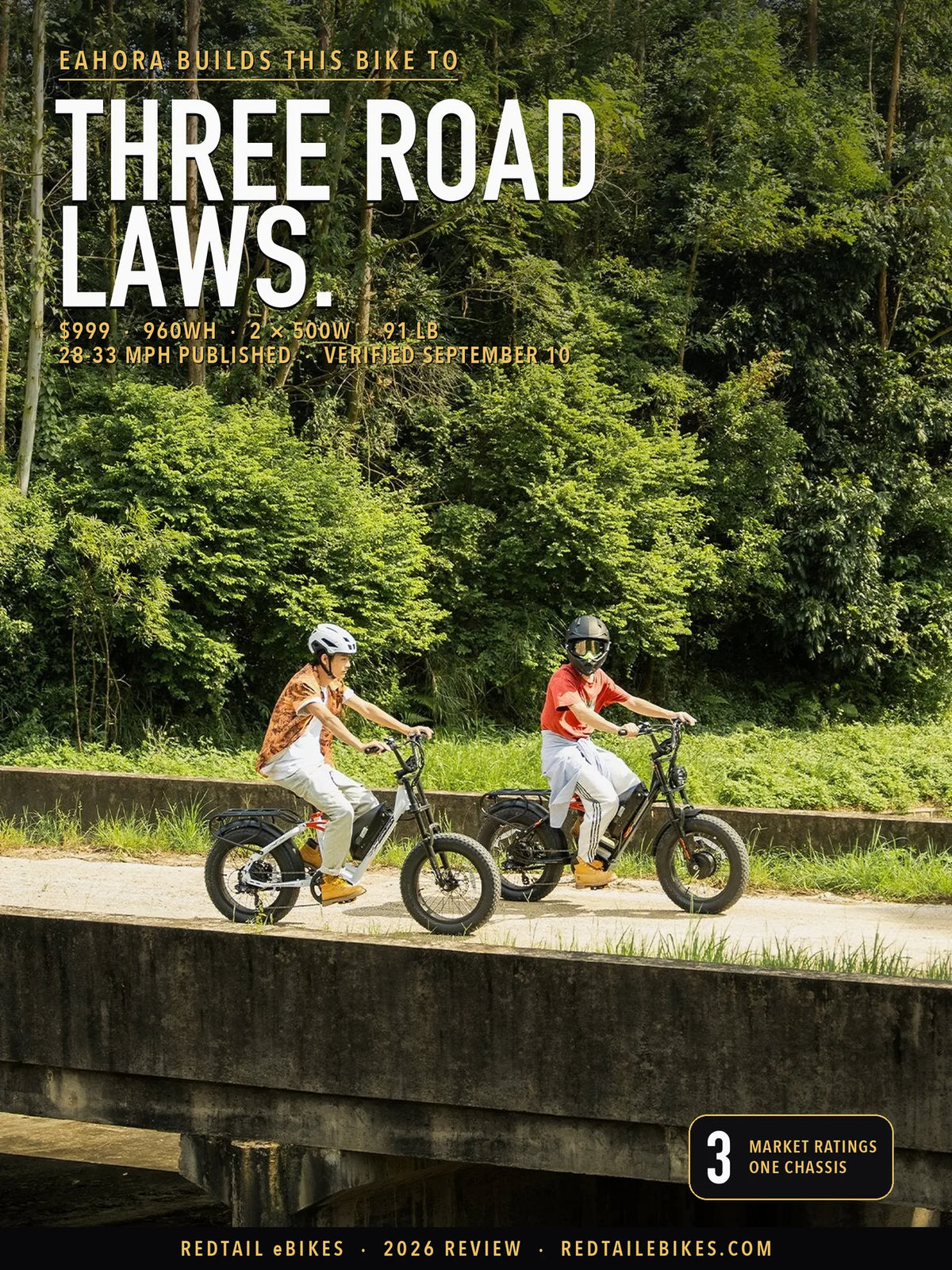
Share:
Your First Entry-Level E-Bike (2026): 10 Decisions
Best Dual Battery Electric Bikes: 8 Picks