


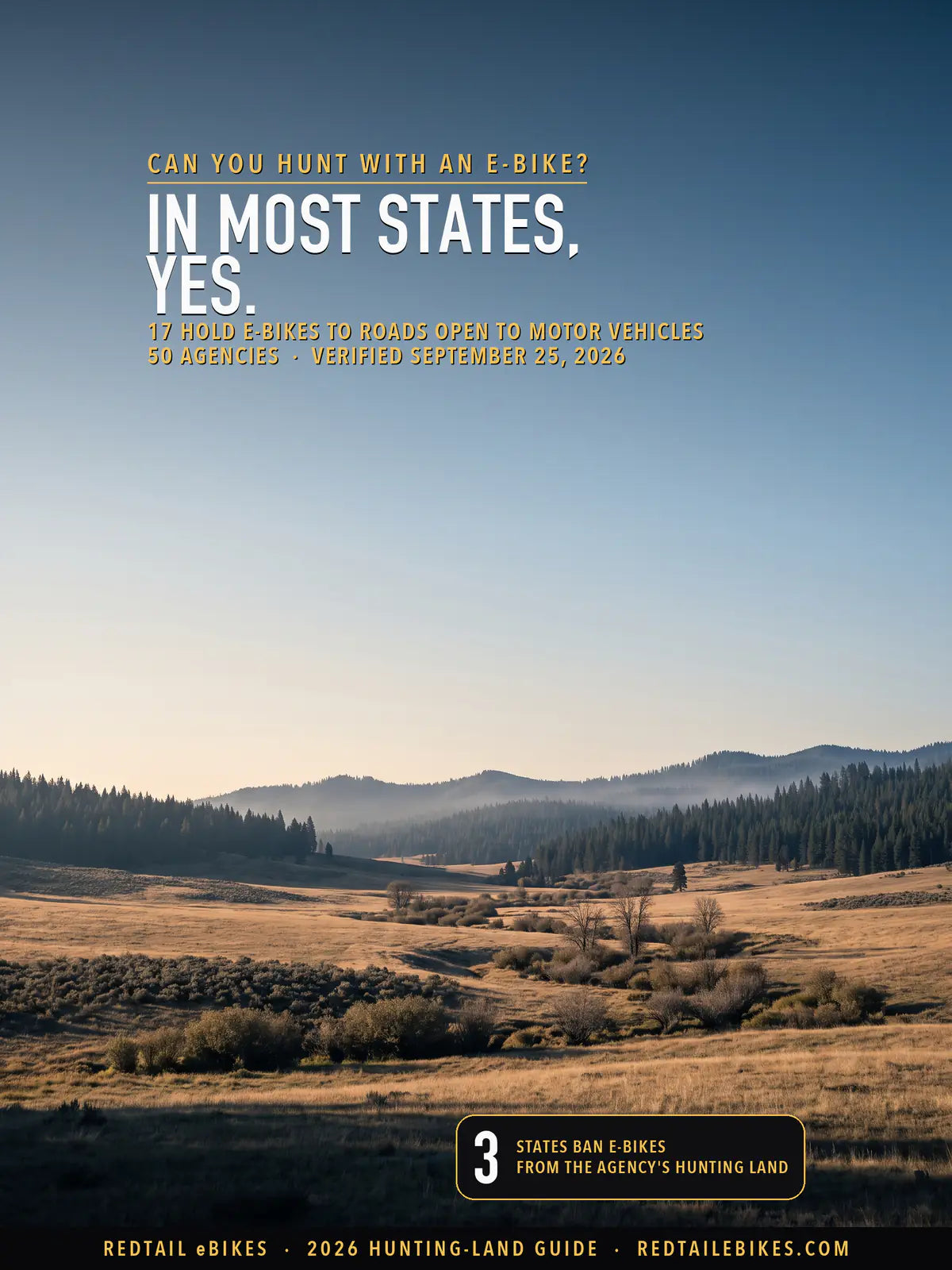

Quick Answer
Can you hunt with an e-bike? In most states, yes, on the roads and trails the state wildlife agency opens to it. Of 50 agencies, 17 hold e-bikes to roads open to motor vehicles, 12 treat classes differently, 6 ride them as bicycles and 9 publish rules that point two ways; California, North Carolina and Pennsylvania ban them.
The other three states work differently: Alaska closes named areas to any motorized vehicle used for hunting, Minnesota publishes guidance but no rule, and Montana splits by agency. Before you ride, find your state's row in the table below, then check the class of your bike against it.
Buying a bike for the hunt? The three picks below, the TIGER JR, the CY20 Pro and the META275 1.0, are rated at 500 W and ship set to 20 mph, the speed Class 1 and Class 2 definitions are written around. Every e-bike we sell ships free across the contiguous US.
See the three picksIn this guide
- How we verified this guide
- What states allow e-bikes for hunting?
- The 50-state hunting-land table
- Which e-bike class can you hunt with?
- Where e-bikes are banned on hunting land
- Where the rule points two ways
- Hauling game and hunting from the bike
- Riding with a disability
- What happens if you get caught
- Which state is strictest?
- What the AI answers get wrong
- Federal land inside your state
- A pre-hunt checklist
- Which rule applies to you
- What changed in 2026
- Three e-bikes built around the 20 mph line
- The bottom line
- Frequently asked questions
- State by state: every rule, quoted
How we verified this guide
Every rule on this page is the hunting-land agency's own regulation or published statement, read at its official publisher on September 25, 2026 and quoted as written. Behind the table sit 353 evidence rows across the 50 states, and each quotation was matched against a saved copy of its source before it was used.
Penalties come from the statute each rule answers to. Where that statute could not be confirmed at its official publisher, the page says so and prints no figure. Every provision was last verified September 25, 2026, by Milad Ghobadibeygvand, BScN (Western University, 2014). Corrections: support@redtailebikes.com.
What states allow e-bikes for hunting?
Forty-seven states let an e-bike onto at least some of the land their wildlife agency manages for hunting, and three do not. What changes from state to state is where your bike may go once you are there, and whether its class matters. The agencies' rules fall into eight families:
| Rule family | States | What the rule does |
|---|---|---|
| Roads only (17) | Arizona, Colorado, Hawaii, Idaho, Kentucky, Louisiana, Michigan, Mississippi, Nebraska, New Mexico, New York, North Dakota, Ohio, Oregon, South Dakota, Washington, Wyoming | Holds every e-bike to the roads, and sometimes named trails, open to motor vehicles |
| Class split (12) | Alabama, Arkansas, Florida, Indiana, Maryland, Rhode Island, South Carolina, Tennessee, Utah, Virginia, West Virginia, Wisconsin | Opens more ground to one class, almost always Class 1, than to the others |
| Unsettled (9) | Connecticut, Iowa, Kansas, Maine, Massachusetts, Nevada, Oklahoma, Texas, Vermont | The land rule and the state's e-bike law point different ways; the table gives the course that holds under both |
| Bicycle rules (6) | Delaware, Georgia, Illinois, Missouri, New Hampshire, New Jersey | The e-bike rides where an ordinary bicycle may |
| Banned (3) | California, North Carolina, Pennsylvania | Off the agency's hunting land unless posted open or permitted |
| Area closures (1) | Alaska | No statewide rule; named controlled use areas close to any motorized vehicle used for hunting |
| Guidance only (1) | Minnesota | The agency's published guidance, not its rule, sets the e-bike line |
| Two agencies (1) | Montana | Fish, Wildlife & Parks and the trust-land agency (DNRC) draw the line differently |

Roads only is the most common rule: seventeen agencies hold every e-bike to the routes open to motor vehicles.
Thirty-five of the fifty hunting-land agencies name e-bikes in their own rule or published statement. In seven more, Connecticut, Massachusetts, New Hampshire, Ohio, Oklahoma, Vermont and West Virginia, the agency's rule does not name e-bikes, and the state's e-bike statute is what decides whether one counts as a bicycle or a motor vehicle.
Admitted is not the same as anywhere. Forty-seven states let an e-bike onto some of their hunting land, and the most common rule, in seventeen of them, holds it to routes a motor vehicle may use. Your state's row says where it may go once it is there.
The 50-state hunting-land table
Find your state, read its family, then read the cell for your bike's class. Each state name links to our full guide to that state's e-bike law, and the last column links the rule itself. Every row is written out in full, with the rule quoted, in State by state at the end of this page.
| State | Rule | Class 1 | Class 2 | Class 3 | Disability access | Penalty | Source |
|---|---|---|---|---|---|---|---|
| Alabama | Class split | Allowed under 750 W, only to hunt, fish, trap or camp, on roads open to vehicles | Not named: barred on 19 WMAs, open roads on 15 | Not named: barred on 19 WMAs, open roads on 15 | Written ADA request for a mobility device | Class C misdemeanor: $100 to $500, up to 3 months | Ala. Admin. Code r. 220-2-.55(1)(t), (u), (s) |
| Alaska | Area closures | Treat as motorized inside a controlled use area | Treat as motorized inside a controlled use area | Treat as motorized inside a controlled use area | Exemption request with a physician's statement | Class A misdemeanor: up to $25,000 and 1 year | 5 AAC 92.540 (Sourdough Controlled Use Area and others) |
| Arizona | Roads only | Designated roads or areas only (big game retrieval excepted) | Designated roads or areas only (big game retrieval excepted) | Designated roads or areas only (big game retrieval excepted) | CHAMP permit (wait for game in a vehicle off road) | Class 2 misdemeanor: up to $750 and 4 months | A.A.C. R12-4-802(A)(2) |
| Arkansas | Class split | Where bicycles may go on AGFC-owned WMAs | Open access roads and parking only | Open access roads and parking only | Mobility Impaired Access card (OHVs on set areas) | Class 1 offense: $100 to $1,000, up to 30 days | AGFC Code 20.19(A) and Exception L |
| California | Banned | Banned on CDFW lands unless posted open | Banned on CDFW lands unless posted open | Banned on CDFW lands unless posted open | Mobility-impaired license to hunt from a vehicle (does not open closed land) | Infraction ($100 to $1,000) or misdemeanor (up to $1,000 and 6 months) | 14 CCR § 550(c)(4) |
| Colorado | Roads only | Established roads open to vehicles, camping and parking areas | Established roads open to vehicles, camping and parking areas | Established roads open to vehicles, camping and parking areas | Area rules only (for example an OHV permit on the Woodard Unit) | Misdemeanor: $100 fine | 2 CCR 406-9, #900(C)(4) (Chapter W-9) |
| Connecticut | Unsettled | Unsettled: ride only where DEEP designates vehicle use | Unsettled: ride only where DEEP designates vehicle use | Off every bicycle trail statewide | Call the Wildlife Division about ATV access | Infraction: $35 to $90 fine, payable by mail | Regs. Conn. State Agencies § 26-16-3a(b), (g) |
| Delaware | Bicycle rules | Roads or trails the area map designates | Roads or trails the area map designates | Roads or trails the area map designates | Wheelchair hunting days; unridden electric carts for gear | Class D environmental violation: $50 to $100, $100 to $500 on a repeat | 7 DE Admin. Code 3900 § 8.4 |
| Florida | Class split | Where bicycles may go, unless an area rule bars it | Named or numbered roads only | Named or numbered roads only | Alternative Mobility Permit (ATV, UTV, golf cart) | Level One infraction: $50, $250 on a repeat | Fla. Admin. Code r. 68A-15.004(9)(d) |
| Georgia | Bicycle rules | Open roads, designated trails, closed roads for hunter access (750 W or less) | Open roads, designated trails, closed roads for hunter access (750 W or less) | Open roads, designated trails, closed roads for hunter access (750 W or less) | Handicap-access roads; OPDMD special use permit | Criminal trespass | Ga. Comp. R. & Regs. r. 391-4-2-.62(1)(c), (2), (8) |
| Hawaii | Roads only | Roads opened for vehicles only | Roads opened for vehicles only | Roads opened for vehicles only | No vehicle-access exception in the hunting rules | Petty misdemeanor: $100 to $1,000 or up to 30 days; at least $500, then $1,000, on repeats | Haw. Admin. R. § 13-123-22(4)(C) |
| Idaho | Roads only | Designated roads and trails; in Motorized Hunting Rule units, roads a car can pass | Designated roads and trails; in Motorized Hunting Rule units, roads a car can pass | Designated roads and trails; in Motorized Hunting Rule units, roads a car can pass | Disabled Motor Vehicle Hunting Permit | Misdemeanor: $25 to $1,000, up to 6 months | IDAPA 13.01.03.100.01.e |
| Illinois | Bicycle rules | Vehicle roads, parking lots, posted bike trails; 20 mph | Vehicle roads, parking lots, posted bike trails; 20 mph | Vehicle roads, parking lots, posted bike trails; 20 mph | None in the land-use rule | Class B misdemeanor: $75 to $1,500, up to 6 months | 17 Ill. Adm. Code 110.165(a) |
| Indiana | Class split | Roads, paved trails, designated mountain bike trails | Roads and paved or hard-surface trails | Roads only | DNR permit for mobility devices | Not confirmed | 312 IAC 8-2-8(d), (j), as quoted in NRC Agenda Item 4 (March 2025) |
| Iowa | Unsettled | Unsettled: stay on constructed and designated roads and lots | Unsettled: stay on constructed and designated roads and lots | Unsettled: stay on constructed and designated roads and lots | Mobility devices allowed; others need the area manager's approval | $35 scheduled fine | Iowa Admin. Code 571—51.8(1), 51.1 |
| Kansas | Unsettled | Unsettled: department roads and parking; ask the area manager first | Unsettled: department roads and parking; ask the area manager first | Unsettled: department roads and parking; ask the area manager first | Annual disability vehicle permit | Class C misdemeanor: up to $500 and 1 month; at least $250, $300, then $400 on repeats | K.A.R. 115-8-13(a), (f)(1)-(2) |
| Kentucky | Roads only | Maintained public roads and parking only | Maintained public roads and parking only | Maintained public roads and parking only | Wheelchairs are outside the limit | $50 to $500 | 301 KAR 3:010, Section 4(1) |
| Louisiana | Roads only | Designated roads and ATV/UTV trails; deer and hog retrieval | Designated roads and ATV/UTV trails; deer and hog retrieval | Designated roads and ATV/UTV trails; deer and hog retrieval | Physically Challenged Hunters ATV permit | Class two violation: $100 to $500; up to $1,000 on repeats | La. Admin. Code tit. 76, § XIX.111(A)(9)(q), (o) |
| Maine | Unsettled | Unsettled: open roads and designated trails | Unsettled: open roads and designated trails | Unsettled: open roads and designated trails | None in the rule; ask for an authorization | Civil violation: $100 to $500; a crime after 3 civil violations in 5 years | 09-137 C.M.R. ch. 5, § 5.01(B)(1) |
| Maryland | Class split | Roads, parking lots, ORV trails and designated trails | Roads, parking lots and ORV trails | Roads, parking lots and ORV trails | Adaptive e-bikes share Class 1 trail access | Misdemeanor: up to $500, up to $1,000 and 1 year on a repeat | COMAR 08.01.10.03A-B |
| Massachusetts | Unsettled | Unsettled: keep to roads and trails open to public vehicles | Unsettled: keep to roads and trails open to public vehicles | Not a class Massachusetts law recognizes | None disability-specific; ask the district about a Director's permit | $200 to $500, up to 30 days | 321 CMR 3.01(1)(h) |
| Michigan | Roads only | Roads where bicycles may ride; no trails on game areas | Roads where bicycles may ride; no trails on game areas | Roads where bicycles may ride; no trails on game areas | Class 2 mobility permit does not open game-area trails | Civil infraction: up to $500 | Michigan DNR, E-bikes on DNR-managed lands |
| Minnesota | Guidance only | Public roads; walking speed on closed roads and trails; no sanctuaries | Public roads; walking speed on closed roads and trails; no sanctuaries | Public roads; walking speed on closed roads and trails; no sanctuaries | Special permit for a power-driven mobility device | Misdemeanor: up to $1,000, 90 days, or both | DNR guidance (Minnesota Conservation Volunteer, July-August 2024) |
| Mississippi | Roads only | Area rules: retrieval only on 20 of 54 areas, designated roads or trails on 18 | Area rules: retrieval only on 20 of 54 areas, designated roads or trails on 18 | Area rules: retrieval only on 20 of 54 areas, designated roads or trails on 18 | ATV, UTV or mobility device on open WMA portions | Not confirmed | 40 Miss. Admin. Code Pt. 2, R. 1.1 (Roads/Vehicles) and area rules R. 1.2-1.47 (2026-27) |
| Missouri | Bicycle rules | Multi-use trails and roads open to vehicles (750 W or less) | Multi-use trails and roads open to vehicles (750 W or less) | Multi-use trails and roads open to vehicles (750 W or less) | None in the area rules | Class A misdemeanor (up to $2,000 and 1 year) or class B (up to $1,000 and 6 months) | 3 CSR 10-11.130(1)-(2) |
| Montana | Two agencies | FWP land: authorized routes; DNRC land: open roads | FWP land: authorized routes; DNRC land: open roads | FWP land: authorized routes; DNRC land: open roads | None in FWP's public-use rules | Misdemeanor: up to $500 or 6 months | Admin. R. Mont. 12.12.115(1)(b) |
| Nebraska | Roads only | Roads, parking areas and designated vehicle trails | Roads, parking areas and designated vehicle trails | Roads, parking areas and designated vehicle trails | None in the WMA rule | Class III misdemeanor: up to $500, 3 months, or both | Nebraska Game and Parks, Wildlife Management Areas (restating 166 Neb. Admin. Code ch. 18, § 001.07A) |
| Nevada | Unsettled | Unsettled: designated interior roads and trails | Unsettled: designated interior roads and trails | Unsettled: designated interior roads and trails | None in the rule | Misdemeanor: $50 to $500, up to 6 months | Nev. Admin. Code § 504.115(2) |
| New Hampshire | Bicycle rules | Management access roads only unless posted | Management access roads only unless posted | Management access roads only unless posted | Special use permit (OHRV) for walking disabilities | Violation: up to $1,000 | N.H. Admin. R. Fis 902.02(9) |
| New Jersey | Bicycle rules | Roads year-round; trails in set windows or while hunting (750 W or less) | Roads year-round; trails in set windows or while hunting (750 W or less) | Roads year-round; trails in set windows or while hunting (750 W or less) | None on the WMA regulations page | $50 to $1,500 | NJ Fish & Wildlife, WMA regulations page (N.J.A.C. 7:25-2) |
| New Mexico | Roads only | Established roads only | Established roads only | Established roads only | None in the rule | Not confirmed | 19.34.4.7, 19.34.4.8 NMAC |
| New York | Roads only | No off-road riding unless posted or permitted in writing | No off-road riding unless posted or permitted in writing | No off-road riding unless posted or permitted in writing | Regional Manager's written permission | Violation: up to $250 and 15 days | 6 NYCRR § 51.4(b) |
| North Carolina | Banned | Not permitted on game lands (designated national-forest areas excepted) | Not permitted on game lands (designated national-forest areas excepted) | Not permitted on game lands (designated national-forest areas excepted) | Disabled Access Permit | $25 fine | 15A NCAC 10D .0102(k), (h) |
| North Dakota | Roads only | Constructed roads, established trails and parking | Constructed roads, established trails and parking | Constructed roads, established trails and parking | None in the rule | Noncriminal offense: $100 | N.D. Admin. Code § 30-04-02-03 |
| Ohio | Roads only | Designated roads, driveways and parking only | Designated roads, driveways and parking only | Designated roads, driveways and parking only | All-purpose vehicle permit; wheelchairs exempt | 4th-degree misdemeanor: up to $250 and 30 days | Ohio Adm.Code 1501:31-9-01(D)(1)-(2) |
| Oklahoma | Unsettled | Unsettled: roads open to public or hunter use; ask first | Unsettled: roads open to public or hunter use; ask first | Unsettled: roads open to public or hunter use; ask first | Nonambulatory permit (ORV or ATV) | Misdemeanor: $10 to $100, up to 30 days | Okla. Admin. Code 800:30-1-5(a) |
| Oregon | Roads only | Open roads and parking; none on the Lower Deschutes | Open roads and parking; none on the Lower Deschutes | Open roads and parking; none on the Lower Deschutes | Permit to hunt from a parked vehicle | Class D violation (up to $250) or Class A misdemeanor (up to $6,250 and 364 days) | OAR 635-008-0050(5) |
| Pennsylvania | Banned | Not allowed on state game lands; state forests allow | Not allowed on state game lands; state forests allow | Not allowed on state game lands; state forests allow | Disabled Person Access Permit | Summary offense: $100 to $200 | 58 Pa. Code § 135.2(3) |
| Rhode Island | Class split | Parks bike paths; management areas: ask DEM | Barred on DEM land except Parks roadways | Barred on DEM land except Parks roadways | Electric mobility devices allowed | Up to $100 | 250-RICR-100-00-7 § 7.9(E)(3) |
| South Carolina | Class split | Bicycle routes: open roads, roadbeds, bike trails | Motorized: open maintained roads and parking | Motorized: open maintained roads and parking | Drawn mobility-impaired hunts | Misdemeanor: $25 to $200 or 30 days | S.C. Code Regs. 123-203(D)(1) |
| South Dakota | Roads only | Designated roads and parking | Designated roads and parking | Designated roads and parking | Disabled Hunter Permit | Class 2 misdemeanor: up to $500 and 30 days | SD GFP, General Hunting Laws, 'Motor Vehicle Restrictions' |
| Tennessee | Class split | As a bicycle | As a bicycle | As an OHV: roads open to vehicles, designated trails | Wheelchair hunts, zones and blinds | Not confirmed | TWRA, Wildlife Management Areas, 'Electric Bicycles' |
| Texas | Unsettled | Designated roads (TPWD); the definition points the other way | Designated roads (TPWD); the definition points the other way | Designated roads (TPWD); the definition points the other way | Disabled hunters exempt; ATV routes | Not confirmed | TPWD, Public Hunting in Texas 2026-27, 'Prohibited Acts' |
| Utah | Class split | Where bicycles may go | Marked roads only | Marked roads only | Certificate to hunt from a vehicle | Infraction (rule, up to $750) or class B misdemeanor (statute, up to $1,000 and 6 months) | Utah Admin. Code R657-28-4(2)(e) |
| Vermont | Unsettled | Designated corridors only; ask first | Designated corridors only; ask first | Designated corridors only; ask first | ADA special use permit | Up to $1,000 | 10 V.S.A. App. § 15, 5.1(d) |
| Virginia | Class split | Where bicycles may go (designated roads) | Where bicycles may go (designated roads) | Prohibited | Wheelchairs and power-driven mobility devices (ADA) | Class 3 misdemeanor: up to $500 | 4VAC15-20-100 |
| Washington | Roads only | Roads and trails open to motorized use | Roads and trails open to motorized use | Roads and trails open to motorized use | Motorized wheelchairs are outside the rule | Infraction: up to $500 | WDFW and DNR, Public Process on E-bike Use: FAQ (June 23, 2022) |
| West Virginia | Class split | Bicycle routes: public roads, posted routes | Bicycle routes: public roads, posted routes | Off bike paths and trails unless in a roadway | None in the WMA rule | Misdemeanor: $20 to $300 or 10 to 100 days | W. Va. Code R. § 58-43-7.1 |
| Wisconsin | Class split | Listed and posted bike trails under 15 mph | Not in the trail allowance | Listed and posted bike trails under 15 mph | Permit to use a motorized vehicle | Not confirmed | Wis. Admin. Code NR 45.05(3)(em)1. |
| Wyoming | Roads only | Designated or established roads | Designated or established roads | Designated or established roads | None in Chapter 23 | Not confirmed | WGFC Chapter 23 § 3(n) |
Read September 25, 2026. "Not named" means the rule does not mention that class, and the cell gives the course the rule's own wording supports. A penalty marked "Not confirmed" is one whose statute was not confirmed at its official publisher.
Which e-bike class can you hunt with?
A Class 1 opens the most hunting land to you, and in most states your bike's class makes no difference at all. The three classes come from state vehicle codes.
Arizona's is typical: an electric bicycle has "fully operable pedals and an electric motor of less than seven hundred fifty watts," and a Class 1 "provides assistance only when the rider is pedaling and ... ceases to provide assistance when the bicycle or tricycle reaches the speed of twenty miles per hour" (A.R.S. § 28-101(29)).
A Class 2 has a motor that "may be used exclusively to propel the bicycle or tricycle and that is not capable of providing assistance when the bicycle or tricycle reaches the speed of twenty miles per hour", which in practice means a throttle. A Class 3 is pedal-assist only, to twenty-eight miles per hour (A.R.S. § 28-101(29)(b)-(c)).
When the machine is not an e-bike at all
The classes cover only what fits the state's definition, and Arizona's, quoted above, requires working pedals and a motor under 750 W (A.R.S. § 28-101(29)). An electric dirt bike built without pedals, or a bike whose motor is over the state's limit, falls outside it, and a hunting-land rule's e-bike wording does not reach it.
South Carolina's rule shows what that means on the ground. It lifts only defined e-bikes out of its motor-vehicle limit: they "are not considered motorized vehicles and shall be considered bicycles" (S.C. Code Regs. 123-203(D)(1)). Anything else with a motor stays on open maintained roads and parking areas unless a posted notice or the Department allows more.
If your bike has a throttle, 41 of the 50 agencies treat it on hunting land exactly as they treat a Class 1. The other nine give it less ground:
| State | Class 1 | Class 2 |
|---|---|---|
| Alabama | Allowed under 750 W, only to hunt, fish, trap or camp, on roads open to vehicles | Not named: barred on 19 WMAs, open roads on 15 |
| Arkansas | Where bicycles may go on AGFC-owned WMAs | Open access roads and parking only |
| Florida | Where bicycles may go, unless an area rule bars it | Named or numbered roads only |
| Indiana | Roads, paved trails, designated mountain bike trails | Roads and paved or hard-surface trails |
| Maryland | Roads, parking lots, ORV trails and designated trails | Roads, parking lots and ORV trails |
| Rhode Island | Parks bike paths; management areas: ask DEM | Barred on DEM land except Parks roadways |
| South Carolina | Bicycle routes: open roads, roadbeds, bike trails | Motorized: open maintained roads and parking |
| Utah | Where bicycles may go | Marked roads only |
| Wisconsin | Listed and posted bike trails under 15 mph | Not in the trail allowance |

In these nine, the throttle is what costs ground; a pedal-only Class 1 keeps the wider access.
A Class 3 gets different treatment from a Class 1 in 13 states: eight of the nine above (all but Wisconsin, which lets a Class 3 onto the same trails as a Class 1), plus Connecticut (off every bicycle trail), Massachusetts (not a class its law recognizes), Tennessee (ridden as an off-highway vehicle), Virginia (prohibited) and West Virginia (off bike paths and trails unless on a roadway).
If you hunt in any of those thirteen, the class on your bike's label decides how far past the parking lot it can take you.
On a throttle bike, read the class line. Nine states give a Class 2 less ground than a Class 1, and thirteen treat a Class 3 differently. In the other 36, the class on the label changes nothing on hunting land.
Where e-bikes are banned on hunting land
Three state agencies keep e-bikes off their hunting land entirely, unless a sign or a permit says otherwise. If you hunt in California, North Carolina or Pennsylvania, each rule is quoted below.
California. The Department of Fish and Wildlife's rule is flat: "Electric bicycles and motorized transportation devices (including but not limited to motorized bicycles, scooters, and carts) are prohibited on all department lands except where posted as allowed" (14 CCR § 550(c)(4)). That covers wildlife areas and ecological reserves, so look for the posted sign before you unload.
North Carolina. On game lands "It is unlawful to operate motorized land vehicles not licensed for highway use on game lands except for designated areas on National Forests" (15A NCAC 10D .0102(k)), and the same rule names e-bikes among the off-road vehicles that are not permitted.
A hunter who qualifies under G.S. 113-296 can hold a Disabled Access Permit covering ATVs and other passenger vehicles on Commission roads and designated trails (15A NCAC 10D .0102(l)).
Pennsylvania. State game lands are closed to "vehicle or conveyance propelled by motorized power" unless the person in charge of the lands or the Director gives permission (58 Pa. Code § 135.2(3)). The one carve-out is for devices the Game Commission authorizes for people with mobility disabilities, through its Disabled Person Access Permit (58 Pa. Code §§ 135.48-135.55).
In all three, a ban on the wildlife agency's land says nothing about the other public land you may hunt in the state. National forest ground follows federal rules, under which every e-bike is a motor vehicle (36 CFR § 212.1), set out in our guide to e-bikes on public land.
Where the rule points two ways
In nine states the land rule and the state's e-bike law disagree about what an e-bike is. Iowa is the plainest case: the Commission's rule keeps motor vehicles to constructed and designated roads and parking lots, but defines a motor vehicle as "any self-propelled vehicle having at least three wheels and registered as a motor vehicle" (Iowa Admin. Code r. 571—51.1), which a two-wheeled, unregistered e-bike is not.
When a rule can be read two ways, ride as if the stricter reading holds. It costs you some ground, and it keeps you inside both readings. The course that holds under both readings, state by state:
| State | Ride this way until the agency says otherwise |
|---|---|
| Connecticut | Only where DEEP designates vehicle use; a Class 3 is off every bicycle trail statewide |
| Iowa | Constructed and designated roads and parking lots |
| Kansas | Department roads and parking areas; ask the area manager first |
| Maine | Open roads and designated trails |
| Massachusetts | Roads and trails open to public vehicles |
| Nevada | Designated interior roads and trails |
| Oklahoma | Roads open to public or hunter use; ask first |
| Texas | Designated roads, as TPWD's public hunting rules require |
| Vermont | Designated corridors only; ask first |
Texas shows why the stricter reading is the safe one. TPWD's 2026-27 public hunting rules make it a prohibited act to not "confine motor vehicle use to designated roads, including electric bicycles (e-bikes)" (TPWD, Public Hunting in Texas 2026-27), while the Transportation Code says a motor vehicle "does not include an electric bicycle" (Tex. Transp. Code § 541.201(11)).
On a public hunting unit, ride by the first, because it is the rule that names e-bikes.
Hauling game and hunting from the bike
A handful of states write hunting itself into the e-bike rule, and those lines decide what you can do after the shot. Read your state's rule for three things: whether the bike may carry game out, whether it may take you somewhere only to hunt, and whether you may shoot from it.
Carrying game out
Arizona holds e-bikes to designated roads or areas "except for big game retrieval" (A.A.C. R12-4-802(A)(2)), and the retrieval rule it points to reads: "A person may use a vehicle on or off a road to pick up lawfully taken big game" (A.A.C. R12-4-110(H)).
Louisiana lets "Hunters ... retrieve their own downed deer and hogs with the aid of an ATV or electric bicycle," except on nine named WMAs, among them Sherburne, Atchafalaya Delta and Pass-a-Loutre (LAC 76:XIX.111(A)(9)(o)). Where your state allows it, compare e-bike game carts and trailers by rated load before the season.
Riding only to hunt
Alabama admits a Class 1 under 750 W only "for the express purpose of hunting, fishing, trapping, camping, or related activities," on roads its WMA maps show open (Ala. Admin. Code r. 220-2-.55(1)(t)).
On 18 of Mississippi's 54 areas the rule reads like this: "ORVs/ATVs/Electric Bicycles are allowed on designated roads or trails for hunting and fishing access only" (40 Miss. Admin. Code Pt. 2). Twenty allow the bike only to retrieve a harvested deer or hog, and 37 open marked foot trails to riders 65 and older; our Mississippi guide lists every area.
Where the hunting season itself closes ground
In Alaska's controlled use areas "the area is closed to the use of any motorized vehicle for hunting, including the transportation of hunters, their hunting gear, or parts of game" (5 AAC 92.540).
Idaho counts any vehicle "propelled by ... electricity" as motorized (Idaho Code § 36-202(y)), and in units under its Motorized Hunting Rule, from August 30 through November 14, "hunters may only use motorized vehicles on established roadways that are open to motorized traffic and capable of travel by full-sized automobiles" (IDAPA 13.01.08.411.01).
Carts you do not ride
Delaware allows "motorized electric carts, wagons, or wheelbarrows" to haul gear or game on Division lands, "provided they are not ridden or used to transport any person" (7 Del. Admin. Code 3900 § 8.1.1).
Hunting from a vehicle is a separate rule again. Across the fifty rules on this page it appears only in disability permits, such as Utah's certificate to take wildlife from a vehicle (Utah Admin. Code R657-12-4). Those permits are set out next.
Riding with a disability
If you hunt with a mobility disability, thirty-five of the fifty hunting-land agencies publish some route for you, but most of those routes are written for ATVs and power-driven mobility devices, not e-bikes.
Maryland's is the only one of the fifty rules that names an adaptive e-bike: its Department lands rule says an electric bicycle "includes an adaptive bicycle equipped with an electric assist motor" (COMAR 08.01.10.02B(6)(b)), and "A person may use a bicycle, adaptive bicycle, or Class 1 electric bicycle only on designated trails on Department lands" (COMAR 08.01.10.03).
The 35 routes fall into five kinds:
| Kind of route | States | What it opens |
|---|---|---|
| Permit to use an ATV, off-highway vehicle or motor vehicle (15) | Arkansas, Colorado (by area), Florida, Georgia, Idaho, Kansas, Louisiana, Mississippi, New Hampshire, North Carolina, Ohio, Oklahoma, Pennsylvania, Texas, Wisconsin | A vehicle on roads or areas the permit names; ask whether your e-bike counts |
| Mobility devices under the ADA (10) | Alabama, Indiana, Iowa, Kentucky, Maryland, Minnesota, Rhode Island, Vermont, Virginia, Washington | Wheelchairs and other power-driven mobility devices, by request or by rule |
| Hunting or waiting from a vehicle (4) | Arizona, Oregon, South Dakota, Utah | The right to hunt from a parked vehicle, not new ground to ride |
| Special hunts and exemptions (4) | Alaska, Delaware, South Carolina, Tennessee | Wheelchair days, drawn hunts, zones and blinds, or a case-by-case exemption |
| Ask the agency (2) | Connecticut, New York | A call to the Wildlife Division, or a Regional Manager's written permission |

Of the 35 routes, only Maryland's names an e-bike; the fifteen vehicle permits are written for ATVs and motor vehicles.
In the other fifteen the land rule carries no disability route, or carries one that does not open closed land: California's license lets a hunter hunt from a motor vehicle without opening closed ground (14 CCR § 251(b)), and Michigan's mobility permit does not open game-area trails. Each state's route, with its own rule linked, is in State by state.
If you hunt with a disability, apply before the season and ask the agency in writing whether your e-bike qualifies as the device the permit names. A permit for an ATV is not a permit for a bike unless the agency says so.
What happens if you get caught
If you ride an e-bike where a hunting-land rule bars it, you can be charged with a crime. Of the 43 states whose penalty we confirmed at its official source, 23 make the violation a misdemeanor or allow it to be charged as one, and Georgia treats it as criminal trespass (O.C.G.A. § 27-1-33).
The fine you face runs from Oklahoma's $10 minimum to Alaska's $25,000 maximum. These are the states where a first offense can cost $1,000 or more, the four where it costs least, and Oklahoma, whose $10 is the lowest floor:
| State | What a first offense can cost | Source |
|---|---|---|
| Alaska | Class A misdemeanor: up to $25,000 and 1 year | AS 16.05.925(a) |
| Oregon | Class A misdemeanor if done intentionally, knowingly, recklessly or with criminal negligence: up to $6,250 and 364 days. Otherwise, if no wildlife is taken, a Class D violation, up to $250 | ORS 496.992; ORS 161.085(6), 161.635(1)(a) |
| Missouri | Class A misdemeanor, up to $2,000 and 1 year, or class B, up to $1,000 and 6 months | RSMo 252.230; RSMo 558.002 |
| Illinois | Class B misdemeanor: $75 to $1,500, up to 6 months | 20 ILCS 835/6; 730 ILCS 5/5-4.5-60 |
| New Jersey | $50 to $1,500 | NJ Fish & Wildlife, WMA regulations |
| Arkansas | Class 1 offense: $100 to $1,000, up to 30 days | AGFC Code 20.19 |
| California | Infraction, $100 to $1,000, or misdemeanor, up to $1,000 and 6 months | Fish & Game Code § 12000(b)(16); § 12002(a) |
| Hawaii | Petty misdemeanor: $100 to $1,000, up to 30 days, or both | HRS § 183D-5; § 706-640 |
| Idaho | Misdemeanor: $25 to $1,000, up to 6 months | Idaho Code § 36-1402 |
| Minnesota | Misdemeanor: up to $1,000, 90 days, or both | Minn. Stat. § 97A.301; § 609.02, subd. 3 |
| New Hampshire | Violation: up to $1,000 | RSA 206:19-a |
| Utah | Infraction under the Wildlife Board rule, up to $750; class B misdemeanor under the statute, up to $1,000 and 6 months | Utah Code 23A-5-301(1); 76-3-301(1)(d)-(e) |
| Vermont | Up to $1,000 | 10 V.S.A. § 4515 |
| Connecticut | Infraction: $35 to $90, payable by mail | C.G.S. § 26-61(e); § 51-164m(c) |
| Florida | Level One infraction: $50, $250 on a repeat | Fla. Stat. § 379.401 |
| Iowa | $35 scheduled fine | Iowa Code §§ 481A.6, 805.8B(3)(c) |
| North Carolina | $25 fine | N.C.G.S. 113-135.1 |
| Oklahoma | Misdemeanor: $10 to $100, up to 30 days | 29 O.S. § 8-104 |

Oregon's $6,250 applies when the rider acted intentionally, knowingly, recklessly or with criminal negligence; otherwise, with no wildlife taken, the ride is a violation fined up to $250.
Forty-two of the 43 confirmed penalties set a top fine for a first offense; Georgia's rule treats a violation as criminal trespass.
Delaware, Florida, Hawaii, Kansas, Louisiana, Maine and Maryland raise the price of a repeat: in Kansas a second wildlife conviction carries a fine of at least $250, and in Maine a WMA violation after three civil fish and wildlife violations in five years is a crime (K.S.A. 32-1031(a); 12 M.R.S. § 12702(2)).
A low fine does not mean you avoid a record. Oklahoma's $10-to-$100 range is still a misdemeanor: "It shall be a misdemeanor to violate any Commission rule or regulation" (29 O.S. § 8-104). North Carolina's $25 fine applies when the offense "is solely a violation of rules of the Wildlife Resources Commission" (N.C.G.S. 113-135.1(a)); using the vehicle to take wildlife falls under the general penalty instead.
Seven states' penalties are marked not confirmed in the table: Indiana, Mississippi, New Mexico, Tennessee, Texas, Wisconsin and Wyoming. In each, the statute that would attach a fine to the land rule could not be confirmed at its official publisher, so the page prints no figure rather than a guess.
Plan for a record, not just a fine. In 23 of the 43 states whose penalty we confirmed, riding where the rule bars e-bikes is or can be charged as a misdemeanor, and at least seven charge more for a repeat.
Which state is strictest?
By what the rule allows, California, North Carolina and Pennsylvania are the strictest: in all three you need a sign or a permit before you ride onto the agency's hunting land. By what a violation can cost, Alaska is: breaking a Board of Game regulation is "a class A misdemeanor" (AS 16.05.925(a)), with a fine of up to $25,000 and up to a year in jail.
Idaho leaves no room for a class split. Its definition of a motorized vehicle covers anything "propelled by means of steam, petroleum products, electricity, or any other mechanical power" (Idaho Code § 36-202(y)), so every class of e-bike is held to the routes open to motorized vehicles.
What the AI answers get wrong
We asked seven answer engines "what states allow ebikes for hunting" on September 23, 2026, and read every state they named against that state's own rule. Five claims would have put you on the wrong side of the rule:
| What the answer said | Engine | What the state's rule says |
|---|---|---|
| "In states like Colorado, Florida, Idaho, and Wisconsin, e-bikes are widely accepted for hunting." | Brave | Colorado and Idaho hold every e-bike to roads open to motor vehicles; Florida and Wisconsin give a Class 2 less ground than a Class 1 (Colorado, Idaho, Florida, Wisconsin) |
| "Idaho allows Class 1 e-bikes on trails open to bicycles in most hunting units" | Brave | Idaho counts any vehicle "propelled by ... electricity" as motorized, and on Fish and Game lands motorized vehicles stay "on designated roads and trails" (IDAPA 13.01.03.100.01.e) |
| "Colorado: One of the most permissive; Class 1 allowed on most SWAs that permit bicycles" | Bing Copilot | On State Wildlife Areas no one may operate "any form of vehicle, or bicycle (motorized or non-motorized) except on established roads open to public motor vehicle use" or in designated camping or parking areas (2 CCR 406-9, #900(C)(4)) |
| "Texas, Arizona, Wyoming, Montana and Idaho are often cited as relatively permissive" | ChatGPT | All five hold e-bikes to roads or authorized routes on the wildlife agency's land; Wyoming's Commission defines a motor vehicle to include an "electric bike" (WGFC Chapter 23 § 3(n)) |
| "California: Roads accessible to motor vehicles, but off-road use generally restricted unless specifically designated" | Bing Copilot | California prohibits e-bikes "on all department lands except where posted as allowed" (14 CCR § 550(c)(4)) |
In the Colorado answers the source of the error is visible. Colorado Parks and Wildlife lets Class 1 and 2 e-bikes onto trails open to non-motorized biking in state parks, but on State Wildlife Areas it limits every e-bike to designated roads and designated camping or parking areas (CPW, biking). An answer that reads the park line into hunting land will put you on a trail the wildlife rule closes.
Federal land inside your state
The table covers the land your state's wildlife agency manages. National forests, BLM land, national wildlife refuges and national parks follow federal rules, whatever state they sit in. The Forest Service counts every e-bike as a motor vehicle (36 CFR § 212.1), so on a national forest an e-bike rides the routes the Motor Vehicle Use Map opens to it.
Our guide to e-bikes on public land walks through each federal agency, including the national forest big-game retrieval allowance. If your hunt crosses from a state wildlife area onto a national forest, the rule changes at the boundary, so read both.
A pre-hunt checklist
Before you ride onto state hunting land, work through these eight checks. Each one points to the part of this page that answers it for your state and your bike.
- Name the land manager. A state wildlife area, a national forest and a private lease each follow a different rule, and the table covers only the first.
- Find your state's row. Read its family, then the cell for your bike's class.
- Read the class on your bike's label. In 13 states it changes where you may ride.
- Get the area map for the land you hunt. Many rules point to it: Alabama's roads are those the WMA map shows open, and Delaware's are those the current area map designates.
- Check the season. Idaho's Motorized Hunting Rule limits you to established roads a full-sized car can travel from August 30 through November 14 in designated units, and Alaska's controlled use areas close by season.
- Apply early for a disability permit, and ask in writing whether your e-bike is a device the permit covers.
- Keep your bike's speed where it ships. Class 1 and Class 2 are written around 20 mph.
- Carry the rule on your phone. A saved copy of the rule and the map settles a roadside question faster than your memory does.
Which rule applies to you
Match your situation to a row below. The rule that governs your ride depends on who manages the land, your state's rule family and your bike's class.
| Your situation | What applies | Where to read |
|---|---|---|
| You hunt a state wildlife area in California, North Carolina or Pennsylvania | No e-bike unless a sign or a permit opens the land | Banned |
| Your state is one of the 17 roads-only states | Any class, on the roads, and any named trails, open to motor vehicles | The table |
| Your state splits by class | Your class's cell; a Class 1 opens the most | Class |
| Your state rides e-bikes as bicycles | Wherever an ordinary bicycle may go on that land | The table |
| Your state's rule points two ways | The stricter reading, and a call to the area office | Two ways |
| You hunt a national forest or BLM land | Federal rules, whatever the state | Federal land |
| You need the bike to carry game out | Your state's retrieval rule, if it has one | Hauling game |
| You hunt with a mobility disability | Your state's permit or request route | Disability |
What changed in 2026
Fifteen of the fifty rules carry an amendment or edition dated 2026, and Iowa's next amendment takes effect in 2027. A date below is when the rule's current version took effect; the e-bike line you ride under now is in the state's row. Maryland's is a new chapter written for e-bikes (COMAR 08.01.10).
| Date | State | What took effect |
|---|---|---|
| January 1, 2026 | Ohio | Rule 1501:31-9-01, the wildlife-area vehicle rule, in its current form |
| January 1, 2026 | Virginia | The latest amendment of 4VAC15-20-100, which prohibits Class 3 e-bikes on Department land |
| January 1, 2026 | Delaware | The Wildlife regulation's latest register entry, 29 DE Reg. 621 |
| January 3, 2026 | Nebraska | 166 NAC 18, the WMA chapter, in its current form |
| April 2026 | Mississippi | The 2026-27 WMA rule compilation |
| May 25, 2026 | Maryland | A new e-bike chapter for Department lands, COMAR 08.01.10: Class 1 and adaptive e-bikes on designated trails |
| June 2026 | Louisiana | The latest amendment of the WMA rule, LAC 76:XIX.111 |
| July 1, 2026 | Idaho | The latest amendment of the Motorized Hunting Rule's use restriction |
| July 1, 2026 | Wisconsin | An amendment to NR 45.05(3)(e), the DNR lands vehicle rule |
| July 11 or 12, 2026 | Oklahoma | The latest amendment of OAC 800:30-1-5 (its history note says July 11, the state's rules viewer July 12) |
| July 31, 2026 | Florida | The latest version of 68A-15.004 |
| July 31, 2026 | Missouri | The current chapter of the conservation area rules, by its update stamp |
| August 1, 2026 | North Carolina | The latest amendment of the game-land rule, 15A NCAC 10D .0102 |
| August 22, 2026 | Utah | The latest change to R657-28, which counts Class 2 and 3 e-bikes as motorized vehicles |
| September 1, 2026 | Colorado | Chapter W-9, the State Wildlife Area rule, in its current form |
| February 1, 2027 | Iowa | ARC 0557D, a trail-camera ban; the motor-vehicle definition is unchanged |

Eight of the fifteen took effect on or after July 1, so a rule you read last season may already be out of date.
Oklahoma is the one state whose official sources give two effective dates for the same amendment: the rule's history note says July 11, 2026, and the state's rules viewer July 12. This page prints both until the two agree.
Three e-bikes built around the 20 mph line
A hunting-land rule reads three things about your bike: its rated motor, its class and its top assisted speed. Each pick below is rated at 500 W and ships set to 20 mph, the speed the Class 1 and Class 2 definitions are written around (A.R.S. § 28-101(29)), and each has a throttle.
In 41 states the throttle changes nothing on hunting land. In the nine that give a Class 2 less ground, read your row in the class table before you choose the TIGER JR, the CY20 Pro or the META275 1.0.
All three ship set to 20 mph. Eunorau describes the META275 1.0's limit as "Speed limited Unlockable", and Qiolor says of the TIGER JR that "The default maximum speed is set to 20 MPH, which can be adjusted according to user preferences."
A Class 2 is defined as a bike "not capable of providing assistance" past twenty miles per hour (A.R.S. § 28-101(29)(b)), so on any land that sorts bikes by class, keep your setting where it ships.
Qiolor TIGER JR
$899The fat-tire pick for gravel roads and two-track, at $899, Qiolor's own anniversary-sale price (Qiolor lists it at $1,399).
Qiolor publishes a 500 W rear hub with a 750 W peak and 63 N·m, a removable 48V battery listed at 13 or 15 Ah, CHAOYANG 20 × 4.0 fat tires, hydraulic disc brakes, a suspension fork, an 87 lb weight and a 400 lb maximum load, and calls it a Class II e-bike built to an IP5 rating "suitable for riding through creeks, mud, and snow".
Buy it if you are between 5'1" and 5'9", Qiolor's published rider range, and your hunting ground is gravel, sand or rutted two-track, where the wide tire earns its weight. Read the META275 1.0 instead if you are taller, or if the bike has to be lifted into a truck bed often.
Free shipping, and Shop Pay can split the $899 into four interest-free payments of $224.75, subject to approval. Specifications read at Qiolor's own TIGER JR page on September 25, 2026.
Samebike CY20 Pro
$599The folding pick that rides in the cab, at $599, Samebike's own US price (Samebike lists it at $899).
Samebike's specification table lists a 500 W motor with an 800 W peak, a removable 36V 13Ah battery, 20 × 3.0 tires, a Shimano 7-speed, mechanical disc brakes, a detachable throttle, a 32 km/h (19.9 mph) top speed, 31 kg (68 lb) and a 150 kg (330 lb) payload, and it folds to 88 × 49 × 85 cm.
Buy it if the bike rides to the trailhead inside the truck or the car, and your hunting land is graded roads. Samebike prints no class for it; its throttle and its 32 km/h top speed are the two figures a Class 2 definition reads. Read the TIGER JR instead for loose sand and deep ruts, where a 4-inch tire does what a 3-inch one cannot.
Free shipping, and Shop Pay can split the $599 into four interest-free payments of $149.75, subject to approval. Specifications read at Samebike's own CY20 Pro page on September 25, 2026.
Eunorau META275 1.0
$1,699The long-approach pick with gears and a torque sensor, at $1,699, Eunorau's own price (Eunorau lists it at $1,799).
Eunorau publishes a 48V 500W rear hub with 65 N·m, a torque sensor, a Shimano 9-speed, hydraulic disc brakes with a motor cutoff, a thumb throttle, a 48V 13Ah battery with a second pack as an option, 27.5-inch wheels, 68.3 lb, a 286 lb payload, a 20 mph maximum speed and a UL certification, and labels it Class 2.
Buy it if your approach is miles of forest road rather than a few hundred yards of two-track, and you are between 5'6" and 6'1", Eunorau's published rider range. Our META275 1.0 review works through the whole bike. Read the TIGER JR instead if you are under 5'6", or if your ground is soft enough to want a fat tire.
Free shipping, and Shop Pay can split the $1,699 into 12 monthly payments of $153.35 at 15% APR, subject to approval. Specifications read at Eunorau's own META275 1.0 page on September 25, 2026.
Why buy from us. Every e-bike we sell ships free across the contiguous US, warranty claims come to us and we coordinate the repair or replacement with the maker, and you can split the price with Shop Pay at checkout, subject to approval. For more machines built for rough ground, see our guide to the best hunting e-bikes.
The bottom line
Most states let you hunt with an e-bike, and almost none let you ride it anywhere you like. Forty-seven of the fifty wildlife agencies admit e-bikes to at least some hunting land, and the most common line, in 17 states, is the one your truck follows: roads open to motor vehicles.
Three questions settle it for any hunt: who manages the land, what that agency's rule says about e-bikes, and what class your bike is. Answer them from your state's row, carry the rule and the map, and keep the bike at the speed it ships with.
If you are buying for the hunt, choose the tire for your ground and the class for your state:
Gravel, sand and two-track: the Qiolor TIGER JR, 20 × 4.0 fat tires and a 400 lb maximum load, at $899 in Qiolor's anniversary sale. Free shipping, and Shop Pay at checkout.
Buy the TIGER JR — $899Long forest-road approaches: the Eunorau META275 1.0, a torque sensor and nine gears, at $1,699, Eunorau's own price. Free shipping, and Shop Pay at checkout.
Buy the META275 1.0 — $1,699Frequently asked questions
What states allow e-bikes for hunting?
Forty-seven of the fifty state wildlife agencies allow e-bikes on at least some of their hunting land, most often on roads open to motor vehicles. California, North Carolina and Pennsylvania ban them from the agency's hunting land unless a sign or a permit opens it (14 CCR § 550(c)(4); 15A NCAC 10D .0102(k); 58 Pa. Code § 135.2(3)).
Are e-bikes legal for hunting?
Yes, in 47 states, on the routes the state wildlife agency opens to them. The rule is set by the agency that manages the land, so the same bike can be legal on a road through one state's wildlife area and banned from another's. National forests follow federal rules instead, under which every e-bike is a motor vehicle (36 CFR § 212.1).
Can you use e-bikes on public hunting land?
On state hunting land, where the agency's rule opens it: in 17 states that means roads open to motor vehicles, in 6 wherever a bicycle may go, and in 12 it depends on the bike's class. On a national forest, the Forest Service counts every e-bike as a motor vehicle (36 CFR § 212.1), so it rides the routes the Motor Vehicle Use Map opens to it.
Which state has the strictest e-bike laws?
For hunting land, California, North Carolina and Pennsylvania, which keep e-bikes off the wildlife agency's land unless a sign or a permit opens it. By penalty, Alaska: breaking a Board of Game regulation is a class A misdemeanor, with a fine of up to $25,000 and up to a year in jail (AS 16.05.925(a)).
What happens if you get caught on an electric bike?
On state hunting land, a fine, and in 23 of the 43 states whose penalty we confirmed, a violation that is or can be charged as a misdemeanor. The fines run from Oklahoma's $10-to-$100 misdemeanor (29 O.S. § 8-104) to Alaska's class A misdemeanor, up to $25,000 and a year in jail.
What e-bikes are Class 1?
A Class 1 e-bike's motor "provides assistance only when the rider is pedaling and ... ceases to provide assistance when the bicycle or tricycle reaches the speed of twenty miles per hour," with a motor under 750 W (A.R.S. § 28-101(29)(a)). Its motor never moves the bike without pedaling.
Where are Class 2 e-bikes allowed?
On hunting land, wherever a Class 1 is allowed in 41 of the 50 states. In Alabama, Arkansas, Florida, Indiana, Maryland, Rhode Island, South Carolina, Utah and Wisconsin a Class 2 gets less ground: Utah, for one, counts "class II and III electric bicycles" as motorized vehicles, used only where a declaration, management plan or posting allows (Utah Admin. Code R657-28-4(2)(e)).
Where are Class 3 e-bikes allowed?
On hunting land, a Class 3 is treated differently from a Class 1 in 13 states, usually with less ground. Virginia prohibits it outright: "Class three electric power-assisted bicycles as defined in § 46.2-100 are prohibited" (4VAC15-20-100), and Tennessee regulates it as an off-highway vehicle on its WMAs (TWRA).
Are e-bikes legal for hunting in Montana?
Yes, on authorized routes, and the rule depends on which agency owns the land. On Fish, Wildlife & Parks wildlife management areas no vehicle may leave authorized routes, and FWP's definition treats an e-bike as non-motorized (Admin. R. Mont. 12.12.115(1)(b)). On DNRC state trust land, DNRC calls an e-bike a motorized vehicle and holds it to public roads and roads signed open.
Can you use e-bikes for hunting in Illinois?
Yes, as a bicycle. On IDNR-owned, -leased or -managed property, hunting sites included, a low-speed electric bicycle may ride only on roads designated for vehicles, parking lots and posted bicycle trails, at no more than 20 mph on roads and trails (17 Ill. Adm. Code 110.165(a)).
Are e-bikes legal for hunting in Tennessee?
Yes, and the class decides how. TWRA says that on its WMAs "Class 1 and Class 2 ebikes are regulated the same as traditional bicycles," while "Class 3 ebikes are regulated as off-highway vehicles (OHVs) and require a high-impact conservation permit to operate on WMAs" (TWRA, Wildlife Management Areas).
Are e-bikes allowed on Pennsylvania state game lands?
No. The Game Commission's regulation makes it unlawful, without permission, to "Travel on lands by means of vehicle or conveyance propelled by motorized power" (58 Pa. Code § 135.2(3)). The exception is for devices authorized for people with mobility disabilities, through the Disabled Person Access Permit.
What are the registration and motor power limits for hunting e-bikes by state?
Power comes from each state's e-bike definition, usually a motor under 750 W: Arizona's is "less than seven hundred fifty watts" (A.R.S. § 28-101(29)). Registration shows up as a way to keep vehicles out: North Carolina bars vehicles "not licensed for highway use" on game lands, and Kansas bars unregistered motorized vehicles from department lands (K.A.R. 115-8-13).
Class 1 vs Class 3 e-bikes: which is better for hunting?
A Class 1. A Class 3 is treated differently from a Class 1 in 13 states: Virginia prohibits it on Department land, Connecticut keeps it off every bicycle trail, and Tennessee regulates it as an off-highway vehicle.
State by state: every rule, quoted
Each state's hunting-land rule in its own words, with the class split, the route for a hunter with a disability, the penalty and the date of the rule's current version. Every rule was read on September 25, 2026, at the publisher linked in its entry.
Alabama
Class split. Class 1 e-bikes under 750 W may be ridden only to hunt, fish, trap or camp, and only on roads the WMA map shows open to motor vehicles; no motor-driven vehicle, e-bikes included, may pass a locked gate, barricade or closure sign.
The rule reads: "Notwithstanding the forgoing, Class 1 pedal-assisted e-bikes equipped with an electric motor less than 750 watts are allowed when utilized for the express purpose of hunting, fishing, trapping, camping, or related activities; and when operated only on regularly used roads depicted on WMA map to be open for motorized vehicle traffic" (Ala. Admin. Code r. 220-2-.55(1)(t), (u), (s)).
- By class: Class 1: named and allowed for hunting on open WMA roads. Class 2 and 3: not named; as unlicensed motor-driven vehicles they are barred on the 19 areas listed in (t) (only Class 1 is excepted there) and held to the same hunting-on-open-roads use on the 15 areas listed in (u).
- Riding with a disability: A hunter with a mobility disability may ask in writing to use a motorized vehicle or other power-driven mobility device on the areas; the request is judged under the ADA and 28 C.F.R. § 35.137 (r. 220-2-.55(1)(s)).
- Penalty: Breaking a WMA rule is a Class C misdemeanor: a fine of at least $100 (§ 9-11-307) and up to $500 (§ 13A-5-12), and up to three months in jail (§ 13A-5-7) (Ala. Code §§ 9-11-307, 13A-5-12(a)(3), 13A-5-7(a)(3)).
- Current: The rule's own history shows it was published June 30, 2025 and took effect August 14, 2025.
- The rest of the state's e-bike law: our Alabama e-bike law guide
Alaska
Area closures. Alaska sets no statewide e-bike rule for hunting land. Its controlled use areas close 'any motorized vehicle' to hunting use, including hauling hunters, gear or game, in named areas and seasons.
The rule reads: "the area is closed to the use of any motorized vehicle for hunting, including the transportation of hunters, their hunting gear, or parts of game" (5 AAC 92.540 (Sourdough Controlled Use Area and others)).
- By class: No classes: Alaska statute defines no electric bicycle. The Board of Game defines a motorized vehicle as a motor-driven land, water or air conveyance; no ADF&G page read says whether a pedal-assist e-bike is one, so treat it as motorized inside a controlled use area and ask ADF&G (5 AAC 92.990(a)(48); AS 28.90.990).
- Riding with a disability: A hunter with a disability may apply, with a physician's statement, for a written exemption from a methods-and-means requirement in chapter 92; the rule does not say whether a controlled-use-area vehicle closure qualifies (5 AAC 92.104(a)-(b)).
- Penalty: Breaking a Board of Game regulation is a class A misdemeanor (AS 16.05.925(a)), with a fine of up to $25,000 (AS 12.55.035) and up to one year in jail (AS 12.55.135), unless a listed exception applies (AS 16.05.925(a); AS 12.55.035(b)(5); AS 12.55.135(a)).
- Current: 5 AAC 92.540 was read in the Legislature's print view, which prints no amendment history, so no amendment date is given.
Arizona
Roads only. On Game and Fish wildlife areas, e-bikes ride only designated roads or areas, the same line as motor vehicles, except to retrieve lawfully taken big game; several areas ban both outright except for that retrieval, and some close their crop fields.
The rule reads: "Motorized vehicle and electric bicycle travel permitted on designated roads or areas only, except for big game retrieval as permitted under R12-4-110(H)." (A.A.C. R12-4-802(A)(2)).
- By class: No class split: the rule treats every electric bicycle alike (it uses the term 14 times and never splits by class); Arizona's vehicle code defines all three classes under 750 W (R12-4-802; A.R.S. § 28-101).
- Riding with a disability: A hunter with a severe permanent disability can hold a Challenged Hunter Access/Mobility Permit (CHAMP), which among other things allows using off-road locations in a motor vehicle as a place to wait for game; it does not mention e-bikes (A.A.C. R12-4-217(E)(3) (CHAMP)).
- Penalty: Breaking a Game and Fish Commission rule is a class 2 misdemeanor unless another penalty applies: up to $750 (§ 13-802) and up to four months in jail (§ 13-707) (A.R.S. §§ 17-309(B), 13-707(A)(2), 13-802(B)).
- Current: The Secretary of State's copy is supplement 26-2, current through June 30, 2026.
- The rest of the state's e-bike law: our Arizona e-bike law guide
Arkansas
Class split. On a WMA every e-bike is a motorized vehicle held to open access roads and parking areas, except that a Class 1 may use trails and areas where regular bicycles are allowed; off a WMA, on other Commission property, Code 19.21 gives no Class 1 exception.
The rule reads: "It is unlawful on a WMA to operate any motorized vehicle including an electric or motorized bicycle: off any open access road and parking area; behind any gated, cabled or earthen barrier; where no road exists; on any trail, levee, or dam" (AGFC Code 20.19(A) and Exception L).
- By class: Class 1: where regular bicycles are allowed on the WMA. Class 2 and 3: motorized vehicles, open access roads and parking areas only. The Commission's 2020 release said the Class 1 rule reaches only the 61 WMAs it owns; on WMAs owned by others, the owner's rules decide.
- Riding with a disability: Holders of an AGFC Mobility Impaired Access (MIA) card may drive OHVs on designated mobility-impaired access areas at named WMAs (Moro Big Pine, Jack Mountain), and a special mobility-impaired deer hunt runs at Freddie Black Choctaw Island; none of this mentions e-bikes (AGFC Code 20.19, Exceptions B, H and J).
- Penalty: A 20.19 violation is a Class 1 offense: a fine of $100 to $1,000 and up to 30 days in jail (AGFC Code 20.19 (PENALTY: Class 1); Code 01.00-I).
- Current: The AGFC Code Book is stamped as of July 1, 2025.
- The rest of the state's e-bike law: our Arkansas e-bike law guide
California
Banned. Every e-bike is prohibited on all CDFW lands, wildlife areas and ecological reserves included, except where a sign says it is allowed.
The rule reads: "Electric bicycles and motorized transportation devices (including but not limited to motorized bicycles, scooters, and carts) are prohibited on all department lands except where posted as allowed." (14 CCR § 550(c)(4)).
- By class: No class split: all electric bicycles are prohibited unless posted; the Department may open particular areas by posting.
- Riding with a disability: A hunter with a permanent mobility disability can get a Mobility Impaired Disabled Persons Motor Vehicle Hunting License (form FG1460) to hunt from a motor vehicle under its conditions; it does not open closed land and does not mention e-bikes. § 550 itself carries no disability provision (14 CCR § 251(b)).
- Penalty: Breaking § 550 is charged either as an infraction with a $100 to $1,000 fine or as a misdemeanor (up to $1,000 and six months under § 12002); CDFW can also eject a visitor for up to a year and revoke passes (§ 550(c)(5)) (Fish & Game Code § 12000(b)(16); § 12002(a); 14 CCR § 550(c)(5)).
- Current: The e-bike line, § 550(c)(4), took effect July 1, 2024 and has not changed since; the official database is current through Register 2026, No. 37 (September 11, 2026).
- The rest of the state's e-bike law: our California e-bike law guide
Colorado
Roads only. On State Wildlife Areas no vehicle or bicycle, motorized or not, may leave established roads open to public motor vehicles or designated camping and parking areas; CPW's own page says e-bikes follow the motor-vehicle line and are not allowed anywhere else on an SWA or on State Trust Lands it manages for access.
The rule reads: "To operate any form of vehicle, or bicycle (motorized or non-motorized) except on established roads open to public motor vehicle use or within designated camping or parking areas." (2 CCR 406-9, #900(C)(4) (Chapter W-9)).
- By class: No class split on wildlife areas: CPW says every e-bike is limited to designated roads and designated camping or parking areas where motor vehicles are allowed (in state parks, by contrast, Class 1 and 2 may use trails open to non-motorized biking). Some SWAs allow 'bicycles' on named trails; the rule does not say whether that reaches e-bikes, and CPW's page says it does not (CPW biking page (agency statement)).
- Riding with a disability: No statewide e-bike disability rule in Chapter W-9; individual areas carry their own, e.g. mobility-impaired hunters with a permit may use an OHV for hunting and game retrieval on the Woodard Unit (2 CCR 406-9, area rule for the Woodard Unit).
- Penalty: Using Parks and Wildlife property in violation of any Commission rule is a misdemeanor with a $100 fine (C.R.S. § 33-6-129(2) (2026)).
- Current: Chapter W-9's current version took effect September 1, 2026 (adopted July 16, 2026; Colorado Register, August 10, 2026).
- The rest of the state's e-bike law: our Colorado e-bike law guide
Connecticut
Unsettled. Unsettled, published both ways: DEEP's WMA rule bars 'all other motorized vehicles' unless the Department designates the area, and allows bicycles except where posted against. It never says which an e-bike is; the vehicle code excludes electric bicycles from 'motor vehicle', but the rule's word is 'motorized'.
Advice that holds either way: ride only where DEEP has designated vehicle use, and ask the district office before riding a WMA trail.
The rule reads: "All-terrain vehicles, motorcycles, snowmobiles, and all other motorized vehicles shall be prohibited on any wildlife management area unless so designated by the Department." (Regs. Conn. State Agencies § 26-16-3a(b), (g)).
- By class: The WMA rule has no class split. Statewide, a Class 3 may not ride any bicycle trail, path or multiuse trail; Class 1 and 2 follow the WMA reading above (C.G.S. § 14-289k(c)).
- Riding with a disability: Disabled hunters who need ATV access on state land are told to call the Wildlife Division; the guide names no e-bike provision (DEEP 2026 Hunting and Trapping Guide, Hunting Opportunities for Persons with Disabilities).
- Penalty: Breaking a WMA use regulation (adopted under § 26-16) is an infraction, payable by mail. Infraction fines come from the Chief Court Administrator's schedule, which may set none below $35 or above $90; an infraction with no scheduled fine carries $35 (C.G.S. § 26-61(e); § 51-164n; § 51-164m(a), (c)(1), (e)).
- Current: The wildlife-area rule was last amended February 4, 2020.
- The rest of the state's e-bike law: our Connecticut e-bike law guide
Delaware
Bicycle rules. On the Division of Fish and Wildlife's 20 wildlife areas, DNREC treats e-bikes as bicycles: ride only on roads or trails the current area map designates. Motorized vehicles are held to established roads and must be highway-licensed unless the Division issues a permit. On the three state forests, the Forest Service bans e-bikes outright.
The rule reads: "It shall be unlawful to ride horses or bicycles on, or allow horses to use, any lands or waters administered by the Division, except on roads or trails that have been designated by the Division for such purposes on current wildlife area maps." (7 DE Admin. Code 3900 § 8.4; § 8.1).
- By class: No class split: every e-bike rides only the roads and trails the area map designates.
- Riding with a disability: No vehicle-access provision for disabled hunters in the land rules; the Wildlife regulation sets special deer and turkey days for non-ambulatory hunters using a wheelchair, and allows motorized electric carts to haul gear or game if nobody rides them (3900 § 8.1.1 (carts); wheelchair seasons).
- Penalty: Breaking a Division land rule is a class D environmental violation: a fine of $50 to $100 plus costs, $100 to $500 for a repeat within five years; a first offense stays off employment background records (7 Del. C. § 103(d); § 1304(g)).
- Current: The Wildlife regulation's latest register entry is 29 DE Reg. 621 (January 1, 2026).
- The rest of the state's e-bike law: our Delaware e-bike law guide
Florida
Class split. On FWC wildlife management areas, e-bikes may use only named or numbered roads, except that a Class 1 may go wherever the bicycle rules allow unless an area rule says otherwise.
The rule reads: "Electric bicycles may be operated only on named or numbered roads. Unless otherwise prohibited by specific area rule, Class 1 electric bicycles (as defined in Section 316.003, F.S.) are exempt from this restriction and may be used pursuant to regulations relating to bicycles." (Fla. Admin. Code r. 68A-15.004(9)(d)).
- By class: Class 1: bicycle rules (trails where bicycles may go), unless an area rule prohibits it. Class 2 and 3: named or numbered roads only.
- Riding with a disability: The Alternative Mobility Permit lets people who cannot walk, or cannot walk unassisted, drive or be carried by an ATV, ROV/UTV or golf cart on selected WMAs under regional conditions; it names no e-bike (FWC Alternative Mobility Permit (AMP)).
- Penalty: Breaking an FWC vehicle rule on a WMA is a Level One violation, a noncriminal infraction: a $50 civil penalty, or $250 for the same violation within 36 months (Fla. Stat. § 379.401(1)(a), (b), (d)).
- Current: The latest adopted version of 68A-15.004 took effect July 31, 2026.
- The rest of the state's e-bike law: our Florida e-bike law guide
Georgia
Bicycle rules. On DNR wildlife management areas an e-bike that meets Georgia's electric assisted bicycle definition counts as a bicycle: open roads, designated trails and areas, and closed roads for hunter access. On WMAs on national forest land, only non-motorized bicycles leave the roads.
The rule reads: "Horses, bicycles and all motor vehicles, including off-road vehicles, are restricted to open roads. Provided, however, that horses and bicycles may use designated trails or designated areas; bicycles may be used on closed roads for hunter access" (Ga. Comp. R. & Regs. r. 391-4-2-.62(1)(c), (2), (8)).
- By class: No class split: any e-bike within the state definition (motor output not more than 750 W, Class 1, 2 or 3) rides as a bicycle; a bike over 750 W is not an electric assisted bicycle and is held to open roads like other motor vehicles.
- Riding with a disability: Vehicles and ATVs with handicap plates or placards may use closed roads the Department designates for handicapped hunter access, and a Department-issued OPDMD Special Use Permit opens other closed roads and locations named in the permit (r. 391-4-2-.62(3)).
- Penalty: Breaking the WMA rules is treated as criminal trespass under O.C.G.A. § 27-1-33, the section Georgia's own enacted law captions as covering noncompliance on wildlife management areas 'and acts constituting criminal trespass' (O.C.G.A. § 27-1-33 (caption and (a) as amended by SB 72, 2019)).
- Current: The WMA vehicle rule was last amended effective June 27, 2021.
- The rest of the state's e-bike law: our Georgia e-bike law guide
Hawaii
Roads only. In Hawaii's public hunting areas, no motorized vehicle may leave the roads designated, built, maintained and opened for vehicles. DLNR's own rules define a motorized vehicle as one that depends on a motor, gas or electric, so an e-bike is held to those roads.
The rule reads: "No person shall operate any motorized vehicle (including, but not limited to motorcycles and all-terrain vehicles) in any hunting area, except on roads that are designated for their use which have been constructed, maintained, and opened for vehicular use." (Haw. Admin. R. § 13-123-22(4)(C)).
- By class: No class split: every e-bike depends on an electric motor, so on hunting land it rides only the roads opened for vehicles.
- Riding with a disability: DLNR issues disabled-hunter permits (crossbows; carrying a loaded firearm in, or shooting from, a vehicle or other carrier); the hunting rules give no vehicle-access exception to the road-only limit (Haw. Admin. R. §§ 13-123-2, 13-123-22(4)(D)).
- Penalty: Breaking a hunting rule is a petty misdemeanor. A first conviction brings a mandatory fine of $100 to $1,000, up to 30 days in jail, or both; a repeat within five years raises the minimum fine to $500, then $1,000. Administrative penalties can also apply (HRS § 183D-5(a); Haw. Admin. R. § 13-123-25; cap at HRS § 706-640(1)(e)).
- Current: The public-hunting-area vehicle rule was last amended May 9, 2015.
- The rest of the state's e-bike law: our Hawaii e-bike law guide
Idaho
Roads only. Idaho counts an e-bike as a motorized vehicle, because Title 36 defines one as any vehicle propelled by electricity. On Fish and Game lands, motorized vehicles stay on designated roads and trails.
During the Motorized Hunting Rule season (August 30 to November 14 in designated units), hunters may use them only on established roads open to motor traffic and passable by full-sized automobiles.
The rule reads: "Operate any motorized vehicle, including over-snow use, except on designated roads and trails." (IDAPA 13.01.03.100.01.e; IDAPA 13.01.08.411.01; Idaho Code § 36-202(y)).
- By class: No class split: every e-bike is propelled by electricity and so is a motorized vehicle under both rules (Idaho Code § 36-202(y)).
- Riding with a disability: Holders of a Disabled Motor Vehicle Hunting Permit are exempt from the Motorized Hunting Rule and may use a motorized vehicle as the landowner or manager allows (IDAPA 13.01.08.411.02.a).
- Penalty: Neither vehicle rule is on the infraction list, so a violation is a misdemeanor: a fine of $25 to $1,000 and/or up to six months in jail (Idaho Code §§ 36-1401(b), 36-1402).
- Current: The Motorized Hunting Rule's use restriction carries a July 1, 2026 amendment date; the Fish and Game lands vehicle line dates from March 31, 2022.
- The rest of the state's e-bike law: our Idaho e-bike law guide
Illinois
Bicycle rules. On all IDNR-owned, -leased or -managed property, hunting sites included, a low-speed electric bicycle is ridden like a bicycle: only on roads designated for vehicles, parking lots and posted bicycle trails, at no more than 20 mph on roads and trails and 10 mph in parking areas unless posted.
The rule reads: "It shall be unlawful for any person to ride a bicycle or low-speed electric bicycle as defined by Section 1-140.10 of the Illinois Vehicle Code [625 ILCS 5] on Department-owned, -leased or -managed property or facilities" (17 Ill. Adm. Code 110.165(a)).
- By class: No class split on IDNR land: any low-speed electric bicycle under the Vehicle Code definition follows the bicycle rule.
- Riding with a disability: Part 110, the land-use rule, carries no disability access provision for vehicles; its only disability text is a fee exemption for disabled veterans. IDNR's separate disabled-hunter permits were not read for this row (17 Ill. Adm. Code Part 110).
- Penalty: Violating a Department rule adopted under the State Parks Act is a Class B misdemeanor for each offense: up to 6 months in jail and a fine of $75 to $1,500. On any Department site a violator can also be arrested or removed (20 ILCS 835/6(7); 17 Ill. Adm. Code 110.180; caps at 730 ILCS 5/5-4.5-60(a), (e)).
- Current: § 110.165 was last amended effective September 24, 2021 (45 Ill. Reg. 12553).
- The rest of the state's e-bike law: our Illinois e-bike law guide
Indiana
Class split. On DNR properties, fish and wildlife areas included, nobody may bike except on a trail designated for it; the rule adds that a Class 1 may use designated mountain bike trails, and DNR's published guidance opens roads, paved and hard-surface trails to Class 1 and 2.
In 2025 DNR declined a hunter's petition to open its properties to bikes and e-bikes off the trails for hauling game.
The rule reads: "(j) A person may operate a Class 1 electric bicycle on a trail designated by the department as a mountain bike trail." (312 IAC 8-2-8(d), (j), as quoted in NRC Agenda Item 4 (March 2025)).
- By class: Class 1: designated mountain bike trails, campgrounds, and natural-surface trails where mountain bikes are allowed. Class 1 and 2: paved multiuse and hard-surface trails and public roads inside DNR properties. Class 3: not named, so roads only under the vehicle code.
- Riding with a disability: DNR runs a permit process that lets people with physical disabilities reach areas with mobility devices, including motorized conveyances to hunt and fish where that would otherwise not be possible (NRC Agenda Item 4 (March 2025), DNR response).
- Penalty: Not confirmed. No penalty figure is printed here until the statute that attaches one is confirmed at its official source.
- Current: DNR's e-bike page still carries the natural-surface Class 1 line; the rule's allowance dates from LSA #23-538, and DNR restated its guidance to the Natural Resources Commission in March 2025.
- The rest of the state's e-bike law: our Indiana e-bike law guide
Iowa
Unsettled. Published both ways: the Commission's rule holds motor vehicles to constructed and designated roads and parking lots on game management areas, but its definition of motor vehicle needs three wheels and registration, which a two-wheeled, registration-exempt e-bike lacks; DNR's 2026-27 booklet counts e-bikes up to 750 W as motor vehicles.
Advice that holds either way: stay on the constructed and designated roads and parking lots.
The rule reads: ""Motor vehicle" means any self-propelled vehicle having at least three wheels and registered as a motor vehicle under Iowa Code chapter 321, 321G, or 321I." (Iowa Admin. Code 571—51.8(1), 51.1; DNR 2026-27 regulations booklet).
- By class: No class split on either side: the rule's definition leaves out every two-wheeled e-bike; the booklet takes in every e-bike up to 750 W.
- Riding with a disability: A person whose impairment substantially limits walking may use a manual or power-driven wheelchair or scooter built for mobility disability on game management areas; any other power-driven device (the booklet names ATVs and golf carts) needs the area manager's approval first (DNR 2026-27 booklet; 571—51.1 ('Person with a physical disability')).
- Penalty: Breaking a game management area regulation is unlawful under § 481A.6, and the scheduled fine is $35 (Iowa Code §§ 481A.6, 805.8B(3)(c)).
- Current: The motor-vehicle definition carries ARC 9226C (effective June 18, 2025); the one later amendment, ARC 0557D (effective February 1, 2027), adds a trail-camera ban and leaves the definition unchanged.
- The rest of the state's e-bike law: our Iowa e-bike law guide
Kansas
Unsettled. Unsettled, published both ways: KDWP's land rule counts 'electric or gasoline-powered two-wheeled vehicles' as motorized vehicles, held to department roads and parking areas, and bars unregistered motorized vehicles from department lands altogether; the wildlife-and-parks statute says an electric-assisted bicycle is not a 'motor vehicle'.
Advice that holds either way: ask the area manager before riding onto a wildlife area, and never leave the roads and parking areas.
The rule reads: "Motorized vehicles shall be operated only on department roads and parking areas, except as otherwise established by this regulation or posted notice or as approved by the secretary." (K.A.R. 115-8-13(a), (f)(1)-(2); K.S.A. 32-701(j)).
- By class: No class split on wildlife areas. In state parks, KDWP lets e-bikes that stop assisting at 20 mph (Class 1 and 2) use trails approved for bicycles.
- Riding with a disability: A person with a disability (disabled placard, plate or ID) may request an annual permit to use a motorized vehicle on named department lands and roads to reach recreation otherwise out of reach (K.A.R. 115-8-13(g)).
- Penalty: Breaking a wildlife-and-parks rule is a class C nonperson misdemeanor: up to one month in jail and a fine of up to $500. A second wildlife conviction carries a fine of at least $250, a third at least $300, and a fourth or later at least $400 plus seven days in jail. KDWP may also remove the person and equipment (K.S.A. 32-1031(a); K.A.R. 115-8-19(b); caps at K.S.A. 21-6602(a)(3), 21-6611(b)(3)).
- Current: The land-vehicle rule was last amended November 28, 2016; the e-bike pass rule (115-8-13a) took effect October 18, 2019.
- The rest of the state's e-bike law: our Kansas e-bike law guide
Kentucky
Roads only. On a Kentucky WMA every mechanized vehicle, which the rule defines to include motor vehicles and bicycles alike, stays on maintained roads open to public use and in designated parking areas, unless the department specifically authorizes otherwise; an e-bike is a mechanized vehicle on either reading.
The rule reads: "Use a mechanized vehicle except: (a) On a maintained road open to public use; or (b) In a designated parking area" (301 KAR 3:010, Section 4(1); Section 1(8)-(9)).
- By class: No class split: a bicycle and a motor vehicle are both mechanized vehicles, so every e-bike is held to maintained roads and parking areas.
- Riding with a disability: Wheelchairs are outside the mechanized-vehicle limit; the rule carries no other disability access provision (301 KAR 3:010, Section 1(8)).
- Penalty: A WMA regulation with no fine of its own carries a fine of $50 to $500; the court may also take the offender's license for the rest of the license year (KRS 150.990(2)(b)) (KRS 150.990(3)).
- Current: The WMA public-use rule was last amended effective September 18, 2025.
- The rest of the state's e-bike law: our Kentucky e-bike law guide
Checked your state? The three picks above are rated at 500 W and ship set to 20 mph. Every e-bike we sell ships free across the contiguous US, with Shop Pay at checkout.
See the three picksLouisiana
Roads only. On LDWF wildlife management areas e-bikes are restricted to designated roads and ATV/UTV trails; hunters may use one to retrieve their own downed deer or hog under set conditions (no firearm or bow aboard, one helper, retrieval only), except on nine named WMAs.
The rule reads: "Electric bicycles are restricted to designated roads and ATV/UTV trails." (La. Admin. Code tit. 76, § XIX.111(A)(9)(q), (o)).
- By class: No class split: every electric bicycle is held to designated roads and ATV/UTV trails.
- Riding with a disability: The Physically Challenged Hunters Permit program issues an ATV permit for specially designated ATV trails on WMAs (with a helper's ATV), and the statute opens disability-only trails to hunters over 60; e-bikes are not named (LAC 76:XIX.105; La. R.S. 56:109(A)).
- Penalty: Breaking a WMA rule is a class two violation: a first-offense fine of $100 to $350 (class 2-A) or $250 to $500 (class 2-B); the statute does not say which tier applies. Repeat offenses cost more, up to $750 (2-A) or $1,000 (2-B) from the third, with forfeiture of anything seized and possible revocation of the license involved (La. R.S. 56:109(F); 56:32).
- Current: § XIX.111 was last amended in June 2026 (LR 52:998).
- The rest of the state's e-bike law: our Louisiana e-bike law guide
Maine
Unsettled. On state-owned WMAs, motor vehicles may run only on roads not posted closed, on trails designated for them, or where specifically authorized. The rule does not define motor vehicle or mention e-bikes; Maine's traffic code treats an e-bike under 750 W as a bicycle, so whether the WMA rule reaches one is unsettled.
Advice that holds either way: stay on open roads and designated trails.
The rule reads: "The operation of any motor vehicle, excluding motorboats, within the boundaries of any state-owned Wildlife Management Area, Boat Launch Facility or Shooting Range is prohibited except as provided below." (09-137 C.M.R. ch. 5, § 5.01(B)(1)).
- By class: No class split: the rule does not name e-bikes or classes.
- Riding with a disability: The WMA rule carries no disability access provision; ask the Department about an authorization under § 5.01(B)(1)(c) (09-137 C.M.R. ch. 5).
- Penalty: Breaking a WMA rule is a civil violation with a fine of $100 to $500. After three or more civil violations under the state's fish and wildlife laws in the previous five years, the next WMA violation is a Class E crime (12 M.R.S. § 12702(1)-(2)).
- Current: Chapter 5's vehicle section was last amended in 2016 (filing 2016-206); other sections changed through May 21, 2023.
- The rest of the state's e-bike law: our Maine e-bike law guide
Maryland
Class split. On all DNR lands, wildlife management areas included, any bicycle or e-bike may use public roads, parking lots and ORV trails; on trails, only a bicycle, adaptive bicycle or Class 1 e-bike, and only where the trail is designated; Wildlands are closed to all bicycles.
The rule reads: "A person may use a bicycle, adaptive bicycle, or Class 1 electric bicycle only on designated trails on Department lands." (COMAR 08.01.10.03A-B; .02B).
- By class: Class 1, 2 and 3: public roads, parking lots and ORV trails. Designated trails: Class 1 only.
- Riding with a disability: An adaptive bicycle with an electric-assist motor counts as an electric bicycle, and adaptive bicycles are named alongside Class 1 e-bikes for designated trails (COMAR 08.01.10.02B(6)(b); .03B).
- Penalty: Breaking a Department rule adopted under Title 5 is a misdemeanor: a fine up to $500; for a repeat within two years, up to $1,000 and/or up to a year in jail (Md. Code, Nat. Res. § 5-1301(a)-(c)).
- Current: The e-bike chapter for Department lands, COMAR 08.01.10, took effect May 25, 2026 (53:10 Md. R. 454).
- The rest of the state's e-bike law: our Maryland e-bike law guide
Massachusetts
Unsettled. The WMA regulation keeps motor vehicles, snow vehicles and recreational vehicles to roads or trails maintained by a government agency and designated for public vehicle traffic, unless the Director issues a permit.
Massachusetts law says Class 1 and Class 2 e-bikes (750 W or less) are not motor vehicles, so the regulation's words do not clearly reach one; MassWildlife's own rules page, though, says no one may drive or possess 'any vehicle' off roads or trails maintained for public vehicular traffic.
Either way the safe course is the same: keep an e-bike on those roads and trails.
The rule reads: "(h) No person, except under permit from the Director or his authorized agent, and except governmental employees in the performance of their duties, shall drive, operate, or possess within the bounds of any wildlife management area any motor vehicle, snow vehicle, or recreational vehicle, except on roads or trails maintained by a governmental agency and designated for the express purpose of permitting public vehicular traffic." (321 CMR 3.01(1)(h)).
- By class: No class split in the WMA rule; the statute recognises only Class 1 and 2, and every e-bike is a vehicle under the WMA rule's plain words (321 CMR 3.01(1)).
- Riding with a disability: The vehicle limit yields to a MassWildlife permit; no disability-specific provision was read on the WMA rules page, so a hunter with a disability should ask the district office about a permit (321 CMR 3.01(1) ('unless under permit')).
- Penalty: The WMA rule was adopted under c. 131 § 6, which § 90(a) does not list, so the catch-all applies: a fine of $200 to $500, up to 30 days in jail, or both (M.G.L. c. 131 § 90(b); the rule's authority line is in 321 CMR 3.01(1)).
- Current: 321 CMR 3.01(1) was last revised January 6, 2023.
- The rest of the state's e-bike law: our Massachusetts e-bike law guide
Michigan
Roads only. The DNR's Class 1 trail approval covers state parks, recreation areas and state forests but expressly excludes state game and wildlife areas, so on hunting land an e-bike stays on roads, where Class 1, 2 and 3 may ride wherever a regular bicycle can.
The rule reads: "The only exceptions are state game and wildlife areas, congressionally authorized trails such as the North Country Trail and the High Country, Shingle Mill and Pickerel Lake pathways in Pigeon River Country." (Michigan DNR, E-bikes on DNR-managed lands).
- By class: Game and wildlife areas: no e-bike on trails; Class 1, 2 and 3 on roads open to bicycles. Elsewhere on DNR trails: Class 1, and Class 2 with a mobility permit; Class 3 on no state-managed trail.
- Riding with a disability: A free DNR permit for mobility issues lets a rider use a Class 2 where Class 1 may go; because game and wildlife areas are excluded from the Class 1 approval, the permit does not open their trails (Michigan DNR, Class 2 mobility permit).
- Penalty: Breaking a DNR land-use rule or order is a state civil infraction with a civil fine of up to $500 (MCL 324.504(14)).
- Current: The DNR's e-bike page carries the game-area exception word for word as it stood on August 25, 2026.
- The rest of the state's e-bike law: our Michigan e-bike law guide
Minnesota
Guidance only. DNR guidance, not a rule: on WMAs e-bikes may use public roads not posted closed to motor vehicles; on roads posted closed and on developed non-motorized trails, only at walking speed; never in sanctuaries. The WMA rule itself does not name e-bikes, and DNR said in 2024 it was working to clarify e-bike use.
The rule reads: "E-bikes may be used on public roads unless they are posted closed to motor vehicle travel. On roads that are posted closed to motor vehicle use or on developed nonmotorized trails, e-bikes may be used at walking speeds. E-bikes are not permitted in areas marked as sanctuaries." (DNR guidance (Minnesota Conservation Volunteer, July-August 2024); DNR WMA page; Minn. R. 6230.0250).
- By class: No class split in the WMA guidance: every e-bike follows the roads, walking-speed and sanctuary lines.
- Riding with a disability: The commissioner may issue a free special permit letting a person with a disability use an other power-driven mobility device (28 C.F.R. § 35.104), a category an e-bike can fall within, in wildlife management areas (Minn. Stat. § 97A.137, subd. 3).
- Penalty: Breaking a WMA rule under the game and fish laws is a misdemeanor unless another penalty is prescribed: up to 90 days in jail, a fine of up to $1,000, or both (Minn. Stat. § 97A.301, subd. 1(6); cap at § 609.02, subd. 3).
- Current: The WMA rule was last published July 25, 2024; the DNR's WMA page still refers to 'some e-bikes' without naming which.
- The rest of the state's e-bike law: our Minnesota e-bike law guide
Mississippi
Roads only. No motorized vehicle may leave the road or use a closed road on any WMA; the area rules then set e-bikes alongside ORVs and ATVs: 20 of the 54 areas allow them only to retrieve a harvested deer or hog, 18 on designated roads or trails for access, 13 under Forest Service rules and 3 not at all, and 37 of the 54 open marked foot trails to riders 65 and older (every area, in our Mississippi guide).
The rule reads: "No motorized, regardless of size or type, vehicles allowed off-road or on any roads blocked or posted as closed." (40 Miss. Admin. Code Pt. 2, R. 1.1 (Roads/Vehicles) and area rules R. 1.2-1.47 (2026-27)).
- By class: No class split: the rules name 'electric bicycles' as one group with ORVs and ATVs.
- Riding with a disability: Eligible hunters with disabilities may get special privileges, including access to any open portion of a WMA by ATV/UTV or other power-driven mobility device, on credible assurance of the disability (40 Miss. Admin. Code Pt. 2, R. 1.1 (Handicapped Hunter Access)).
- Penalty: Not confirmed: the 2026-27 WMA rule compilation prints no penalty. No penalty figure is printed here until the statute that attaches one is confirmed at its official source.
- Current: The 2026-27 rule compilation is current; Rule 1.1 says it was updated in April 2026.
Missouri
Bicycle rules. Missouri's Wildlife Code counts an electric bicycle (up to 750 W, Class 1, 2 or 3) as a bicycle, so on conservation areas it rides where bicycles may: designated multi-use trails, roads open to vehicles, and service roads marked in the online atlas, except on listed areas and, on some areas, during firearms deer and spring turkey seasons.
A bike over 750 W is a vehicle, held to gravel and paved roads and parking areas.
The rule reads: "Bicycles are permitted only on designated multi-use trails and on roads open to vehicular traffic, unless otherwise posted." (3 CSR 10-11.130(1)-(2); 3 CSR 10-20.805(7), (25)).
- By class: Class 1, 2 and 3 up to 750 W all ride as bicycles; there is no class split on department areas (3 CSR 10-20.805(25)).
- Riding with a disability: The department-area rules carry no disability vehicle-access provision; their disability text concerns reserving ADA-accessible waterfowl blinds (3 CSR 10-11).
- Penalty: Breaking a Conservation Commission rule is a misdemeanor: class A (up to one year and $2,000) or class B (up to six months and $1,000), depending on which statutes the rule relates to; the statute's split does not say which applies to an area-use rule, so both tiers are printed (RSMo 252.230; caps at 558.002.1(2)-(3) and 558.011.1(6)-(7)).
- Current: The Secretary of State's current chapter carries a July 31, 2026 update stamp.
- The rest of the state's e-bike law: our Missouri e-bike law guide
Montana
Two agencies. On FWP wildlife management areas (and state parks and fishing access sites), no vehicle, motorized or not, may leave authorized routes; FWP's definition treats an e-bike as non-motorized. On DNRC state trust land, which is also open to hunting, DNRC calls an e-bike a motorized vehicle and holds it to public roads and roads signed open.
The rule reads: "operating a motorized or non-motorized vehicle off of authorized routes" (Admin. R. Mont. 12.12.115(1)(b); 12.12.102(15), (20)).
- By class: No class split on either agency's land; Montana's statute sets no motor-power figure for an e-bike, so the line is the agency's definition, not a class (ARM 12.12.102(15); DNRC page).
- Riding with a disability: FWP's public-use-site rules carry no disability vehicle provision; federal ADA rules on other power-driven mobility devices still apply to a state agency (Admin. R. Mont. 12.12.101-12.12.118).
- Penalty: Breaking a public-use-site rule adopted under § 23-1-106 is a misdemeanor: a fine of up to $500 or up to six months in jail (MCA 23-1-106(2)).
- Current: The public-use-site vehicle rule took effect January 13, 2024; DNRC's trust-land rules were replaced November 8, 2025, and a DNRC rule review naming e-bikes ran through September 25, 2026.
- The rest of the state's e-bike law: our Montana e-bike law guide
Nebraska
Roads only. On state WMAs no carriage or motorized vehicle may leave roadways, parking areas or trails designated for vehicles, and Game and Parks defines a motorized vehicle to include anything propelled by an electrical engine, so an e-bike is held to those places.
The rule reads: "It shall be unlawful for any person to operate a carriage or motorized vehicle on other than roadways, parking areas, or trails specifically designated for vehicle use" (166 Neb. Admin. Code ch. 18, § 001.07A, 001.07B1).
- By class: No class split on WMAs: every e-bike is a motorized vehicle under the definition.
- Riding with a disability: The WMA property rule carries no disability vehicle provision; federal ADA rules on other power-driven mobility devices still apply to the agency (166 NAC 18).
- Penalty: Breaking a state WMA public-use regulation is a Class III misdemeanor: up to three months in jail, a $500 fine, or both (Neb. Rev. Stat. § 37-336(3); cap at § 28-106(1)).
- Current: The chapter's official record carries an effective date of January 3, 2026.
- The rest of the state's e-bike law: our Nebraska e-bike law guide
Nevada
Unsettled. Unsettled, published both ways: on NDOW wildlife management areas no motor vehicle may leave the interior roads and trails designated for vehicles, but Nevada's vehicle code says an electric bicycle is not a motor vehicle, so the general rule may not reach an e-bike; NDOW has written e-bikes expressly into at least one area rule (Pole Canyon Cooperative WMA).
Advice that holds either way: stay on designated roads and trails.
The rule reads: "it is prohibited, within a wildlife management area, to operate a motor vehicle: (a) Off an interior road or trail that is designated for vehicular travel" (Nev. Admin. Code § 504.115(2); NRS 482.075).
- By class: No class split in either rule (NAC 504.115; NRS 482.075).
- Riding with a disability: Neither the WMA vehicle rule nor the Pole Canyon rule carries a disability provision; the exception is for authorized personnel only (NAC 504.115; R128-23).
- Penalty: Breaking a Wildlife Commission regulation is a misdemeanor: a fine of $50 to $500, up to six months in county jail, or both (NRS 501.385(1)(d), (2)).
- Current: NAC 504.115 was last amended effective March 1, 2003 (R054-02); the Pole Canyon rule is R128-23, in NDOW's April 2024 adopted file.
- The rest of the state's e-bike law: our Nevada e-bike law guide
New Hampshire
Bicycle rules. On Fish and Game Department lands, wildlife management areas included, bicycles may use management access roads only unless posted otherwise, and New Hampshire law defines a bicycle to include an electric bicycle, so an e-bike is held to those roads.
The rule reads: "Horses and bicycles shall be permitted on management access roads only, unless otherwise posted." (N.H. Admin. R. Fis 902.02(9); RSA 259:6).
- By class: No class split: every electric bicycle is a bicycle under the rule's cross-referenced definition.
- Riding with a disability: The Department issues special use permits for an OHRV or snowmobile to people with documented permanent walking disabilities, limited to named areas; e-bikes are not named (N.H. Admin. R. Fis 902 (special use permits)).
- Penalty: Breaking a Fish and Game rule is 'a violation' (a non-criminal offense) for an individual: a fine of up to $1,000 (RSA 206:19-a; fine cap RSA 651:2, IV(a)).
- Current: Fis 900 was read on the General Court's official rules page.
- The rest of the state's e-bike law: our New Hampshire e-bike law guide
New Jersey
Bicycle rules. Fish and Wildlife permits e-bikes up to 750 W under its bicycle rules: all roads open to motor vehicles year-round; existing trails and secondary woods roads only from March 1 to April 15, June 1 to September 15 and on Sundays (Assunpink has its own window); and year-round when you are legally hunting or fishing.
No bikes on the Highlands Trail through Berkshire Valley and Wildcat Ridge.
The rule reads: "Ebikes with motors up to 750 watts are permitted." (NJ Fish & Wildlife, WMA regulations page (N.J.A.C. 7:25-2); Mountain Bicycle Policy).
- By class: No class split: the page sets a 750 W motor line, not a class line; a bike over 750 W falls outside the permission.
- Riding with a disability: The WMA page carries no disability vehicle provision (WMA regulations page).
- Penalty: NJ Fish and Wildlife says its WMA regulations carry penalties of $50 to $1,500 (NJ Fish & Wildlife, Wildlife Management Area Regulations page).
- Current: The Division's WMA regulations page carries the rule quoted here.
- The rest of the state's e-bike law: our New Jersey e-bike law guide
New Mexico
Roads only. On all lands the Department of Game and Fish owns or controls, wildlife management areas included, no motorized vehicle may leave established roads, and the rule's definition (any motor-powered device used for conveyance) covers an e-bike.
The rule reads: "It shall be unlawful for any person or persons to operate any motorized vehicle off of established roads on lands owned or controlled by the department of game and fish." (19.34.4.7, 19.34.4.8 NMAC).
- By class: No class split: every e-bike is motor-powered.
- Riding with a disability: The department-lands vehicle rule carries no disability provision (19.34.4 NMAC).
- Penalty: Not confirmed: whether a land-use vehicle rule falls under the misdemeanor for hunting rules is not settled by the text. No penalty figure is printed here until the statute that attaches one is confirmed at its official source.
- Current: 19.34.4 NMAC was last amended January 13, 1996 and recompiled December 31, 2001.
- The rest of the state's e-bike law: our New Mexico e-bike law guide
New York
Roads only. On DEC wildlife management areas and other Part 51 lands, New York names e-bikes as motorized vehicles and bars riding one off-road unless a posted notice or the Regional Manager's written permission allows it; roads posted against bicycles or motorized vehicles are closed to them too.
The rule reads: "No person shall operate a motorcycle, motor scooter, moped, e-bike, snowmobile or any other motorized vehicle off-road except as specifically permitted by posted notice or as otherwise permitted in writing by the Regional Manager." (6 NYCRR § 51.4(b); § 51.1 (definitions)).
- By class: No class split: the definition lists e-bikes among motorized vehicles, and the bicycle definition is muscle-powered only.
- Riding with a disability: Part 51 carries no disability access provision; DEC's separate motorized access program for people with disabilities was not read for this row, and written permission from the Regional Manager is the route the rule itself names (6 NYCRR Part 51).
- Penalty: Breaking a DEC regulation is a 'violation': up to 15 days in jail, a fine of up to $250, or both, plus a civil penalty ($200 base) under the ECL schedule (ECL § 71-0923(1); § 71-0919(1)(b)-(c); civil schedule § 71-0925(1)).
- Current: Part 51 in its current form took effect January 1, 2022.
- The rest of the state's e-bike law: our New York e-bike law guide
North Carolina
Banned. North Carolina's game-land rule makes it unlawful to operate any motorized land vehicle not licensed for highway use on game lands (except designated areas on national forests), and names e-bikes among the off-road vehicles that are not permitted.
Read together, an e-bike, which carries no highway plate, is kept off game lands outside designated national-forest areas; confirm with the Wildlife Resources Commission before riding.
The rule reads: "It is unlawful to operate motorized land vehicles not licensed for highway use on game lands except for designated areas on National Forests." (15A NCAC 10D .0102(k), (h)).
- By class: No class split: the rule names 'ebikes' as one group.
- Riding with a disability: Hunters who meet G.S. 113-296 can get a Disabled Access Permit that allows electric wheelchairs, ATVs and other passenger vehicles on Commission roads and designated trails, including ungated roads otherwise closed, on game lands listed online (15A NCAC 10D .0102(k)-(l); G.S. 113-296).
- Penalty: Riding an e-bike where the game-land rule bars it is, on its own, punishable by a $25 fine. Using a conveyance to take wildlife is excepted and falls under the general penalty: a Class 3 misdemeanor (fine up to $200) for a first conviction (N.C.G.S. 113-135.1(a), (b)(3); 113-135(a); 15A-1340.23(b)).
- Current: The game-land rule was last amended effective August 1, 2026.
- The rest of the state's e-bike law: our North Carolina e-bike law guide
North Dakota
Roads only. On North Dakota wildlife management areas all motorized vehicles are restricted to the constructed roads, established trails and parking areas normally used by passenger cars. The rule does not name e-bikes or define 'motorized vehicle'; an e-bike has a motor, so keep it to those roads, trails and lots.
The rule reads: "On all other wildlife management areas, the use of all motorized vehicles is restricted to those constructed roads, established trails, and parking areas normally used by passenger cars." (N.D. Admin. Code § 30-04-02-03).
- By class: No class split: the rule speaks only of 'all motorized vehicles'.
- Riding with a disability: The WMA public-use chapter carries no disability vehicle provision (ch. 30-04-02).
- Penalty: Breaking the WMA motor-vehicle rule is a noncriminal offense with a $100 fee (N.D. Admin. Code § 30-04-02-03 (the section's own penalty sentence)).
- Current: The motor-vehicle section was last amended effective April 1, 2006.
Riding sand, mud or two-track? Our fat tire e-bikes list each bike's rated motor and class, so you can check it against your state's row.
Shop fat tire e-bikesOhio
Roads only. On any area run by the Ohio Division of Wildlife, every vehicle, human-powered ones included, may be ridden or parked only on designated roads, driveways and parking areas, unless the wildlife chief gives written permission. Ohio's traffic code counts an e-bike as a vehicle, so the same limit applies.
The one named exception is bicycles on the North Turkeyfoot wildlife area trail that is part of the North Country National Scenic Trail.
The rule reads: "It shall be unlawful for any person to operate or park a vehicle, including any aerial drone or vehicle propelled by human power, or permit such vehicles to be operated or parked on any area under agreement with, and administered by, or under control of the division of wildlife, except:
- (1) On designated roads, driveways and parking areas provided for such purpose.
-
(2) For any person who has first obtained written permission from the chief of the division of wildlife for such purposes." (Ohio Adm.Code 1501:31-9-01(D)(1)-(2)).
-
By class: No class split on wildlife areas: the rule covers every vehicle. Ohio defines Class 1, 2 and 3 e-bikes in its traffic code (motor under 750 W; 20, 20 and 28 mph) and counts all three as vehicles and bicycles, not motor vehicles (Ohio Rev. Code 4511.01(A); classes at 4511.01(SSS)-(VVV)).
- Riding with a disability: A mobility-impaired person can get an all-purpose vehicle permit from the wildlife chief to ride in designated areas (within 100 yards of a posted access lane); a person in a wheelchair is exempt; and 14 named wildlife areas have Physically Handicapped Access Areas (Ohio Adm.Code 1501:31-9-01(D)(3)-(4), (V)).
- Penalty: Breaking a Division of Wildlife rule is a fourth-degree misdemeanor: up to 30 days in jail and a fine of up to $250 (Ohio Rev. Code 1531.99(A); 2929.24(A)(4); 2929.28(A)(2)(a)(iv)).
- Current: Rule 1501:31-9-01 has been in effect since January 1, 2026; its next five-year review is due January 1, 2031.
- The rest of the state's e-bike law: our Ohio e-bike law guide
Oklahoma
Unsettled. Oklahoma's rule for Department of Wildlife lands keeps all motorized vehicles on roads designated open for public or hunter use, lets road-registered vehicles use roads open to the public, and bans ATVs, OHVs, UTVs and off-road motorcycles from department roads except county-maintained ones. It never names bicycles or e-bikes.
State law says an e-bike is not a motor vehicle and needs no registration, while the department's own summary says only road-registered vehicles may be used or parked on its lands.
Whether an e-bike is a 'motorized vehicle' limited to open roads, a bicycle the rule does not address, or an unregistered vehicle the summary excludes is unsettled. On OLAP walk-in areas the department's page bars all vehicles, bicycles included.
The rule reads: "(a) Except as otherwise provided, all motorized vehicles are required to stay on roads designated as open for public or hunter use." (Okla. Admin. Code 800:30-1-5(a)).
- By class: No class split in the wildlife rule. Oklahoma law defines Class 1, 2 and 3 e-bikes (motor output up to 750 W; 20, 20 and 28 mph), says an e-bike is not a motor vehicle, and exempts it from registration (47 O.S. § 11-1209(B); classes at § 1-104(B); not a motor vehicle at § 1-134(B)(5)).
- Riding with a disability: A hunter who cannot walk (amputation, paralysis, or a wheelchair as primary mobility) can get a nonambulatory permit to ride an ORV/ATV from parking or camp to designated nonambulatory areas and to use roads designated open to permittees (Okla. Admin. Code 800:30-1-18(a)-(b)).
- Penalty: Breaking a Wildlife Commission rule is a misdemeanor: a fine of $10 to $100, up to 30 days in county jail, or both (29 O.S. § 8-104; OAC 800:30-5-3).
- Current: OAC 800:30-1-5 carries two effective dates in official sources: its history note reads "Amended at 43 Ok Reg, Number 20, effective 7-11-26", and the state's rules viewer shows July 12, 2026 for the same section.
- The rest of the state's e-bike law: our Oklahoma e-bike law guide
Oregon
Roads only. On Oregon Department of Fish and Wildlife land, motor vehicles are allowed only on parking areas, open roads and areas posted open to them, with no cross-country or off-road travel.
ODFW's 2026 hunting regulations say 'all classes of E-bikes are considered motorized vehicles', so treat an e-bike as a motor vehicle there: open roads and parking areas only. The Lower Deschutes Wildlife Area allows access by foot, boat or non-motorized bicycle only, and on Sauvie Island even plain bicycles stay on roads open to vehicles.
Oregon's Vehicle Code calls an e-bike a bicycle, but only 'for purposes of the Oregon Vehicle Code'; the wildlife-area rules are wildlife law.
The rule reads: "(5) Motor vehicles are prohibited except on parking areas, open roads, areas posted as open to motor vehicles, or as provided for in the following rules. No cross-country travel or off road motor vehicle use is allowed, except for administrative use." (OAR 635-008-0050(5)).
- By class: No class split on ODFW land: ODFW's regulations treat 'all classes' of e-bikes as motorized vehicles. Oregon defines Class 1, 2 and 3 e-bikes by assistance and speed (20, 20 and 28 mph) and sets no wattage limit (ORS 801.258(4); classes at (1)-(3)).
- Riding with a disability: Oregon's Disabilities Hunting and Fishing Permit lets the holder hunt from a parked motor-propelled vehicle (never on a public road) and have a companion finish wounded game; on public land it applies only where off-road travel is permitted. It is not a road-access permit for wildlife areas (ODFW 2026 Oregon Hunting Regulations, Disabilities Hunting & Fishing Permit).
- Penalty: Breaking a wildlife rule is a Class A misdemeanor if done with a culpable mental state (up to 364 days and $6,250). Without one, and if no wildlife is taken, it is a Class D violation with a fine of up to $250 (ORS 496.992(1)-(2); 153.018(2)(d); 161.615(1); 161.635(1)(a)).
- Current: OAR 635-008-0050 was last amended effective May 19, 2023; ODFW's wildlife-area regulations page was last updated March 31, 2026.
- The rest of the state's e-bike law: our Oregon e-bike law guide
Pennsylvania
Banned. On state game lands the Game Commission's answer is no: e-bikes are not allowed. Its regulation makes it unlawful, without permission, to travel on Commission lands by any vehicle or conveyance propelled by motorized power; the only carve-out is devices authorized for people with mobility disabilities.
Pennsylvania's 2.2 million acres of state forests, also open to hunting, are run by DCNR, which allows e-bikes that meet the state definition wherever regular bikes may go, plus DCNR motorized trails and public-use roads, pedaling only (no throttle) on non-motorized trails.
The rule reads: "it is unlawful, except with the permission of the person in charge of the lands, or the written permission of the Director to: ... (3) Travel on lands by means of vehicle or conveyance propelled by motorized power. This provision is not intended to restrict travel by certain devices used for persons with mobility disabilities as specifically authorized under Subchapter C (relating to State game lands)." (58 Pa. Code § 135.2(3)).
- By class: Pennsylvania does not use the three-class system. Its 'pedalcycle with electric assist' weighs no more than 100 pounds, has a motor rated at no more than 750 W, working pedals, and a top motor-only speed of 20 mph. Game lands bar every motorized conveyance, so no class qualifies there; DCNR's state-forest rule uses the same 100 lb / 750 W / 20 mph test (75 Pa.C.S. § 102 ('Pedalcycle with electric assist')).
- Riding with a disability: The Game Commission's Disabled Person Access Permit lets hunters with mobility disabilities use mobility devices and motor vehicles on designated routes on state game lands; wheelchairs may go anywhere foot travel is allowed (58 Pa. Code §§ 135.48-135.55; permit under ch. 147, subch. AA).
- Penalty: Breaking a state game lands regulation is a summary offense of the fifth degree: a fine of $100 to $200 (34 Pa.C.S. § 721(b); fine at § 925(b)(9)).
- Current: 58 Pa. Code § 135.2 was last amended effective March 16, 2024 (54 Pa.B. 1316); the Pennsylvania Code reflects changes through July 4, 2026 (56 Pa.B. 4026).
- The rest of the state's e-bike law: our Pennsylvania e-bike law guide
Rhode Island
Class split. Rhode Island DEM's rule, which covers its Fish & Wildlife management areas, bars Class 2 and Class 3 e-bikes on every DEM property except roadways inside Parks & Recreation properties, unless DEM gives written permission.
Class 1 e-bikes are expressly allowed only on Parks & Recreation bike trails and paths (state law also guarantees Class 1 on state bike trails and paths). For a management area the rule neither grants nor bars a Class 1; bicycles there are limited to trails and roads designated for them.
Ride only a Class 1, only on designated roads and trails, and ask DEM for written permission first.
The rule reads: "3. Class 2 and 3 Electric Bicycles, as defined in R.I. Gen. Laws § 31-19.7-2 are prohibited on all properties, bicycle trails, or paths under the jurisdiction of the Department except on roadways located within properties under the jurisdiction of the Division of Parks and Recreation, unless written permission to the contrary is provided." (250-RICR-100-00-7 § 7.9(E)(3)).
- By class: Class split: Class 1 allowed on Parks & Recreation bike paths; Class 2 and 3 barred on all DEM property except Parks roadways. Rhode Island defines three classes: pedal-assist to 20 mph, throttle to 20 mph, pedal-assist to 28 mph (R.I. Gen. Laws § 31-19.7-1).
- Riding with a disability: People with a disability may use electric mobility devices (EPAMDs, motorized wheelchairs or similar devices), as capable, on DEM properties (250-RICR-100-00-7 § 7.9(F)(2)).
- Penalty: A fine of up to $100 for each violation (250-RICR-100-00-7 § 7.21(A)).
- Current: The Part 7 amendment took effect May 12, 2025; the e-bike statute took effect July 1, 2024 (P.L. 2024, ch. 172 and 173).
- The rest of the state's e-bike law: our Rhode Island e-bike law guide
South Carolina
Class split. On every South Carolina WMA, heritage preserve and other DNR-owned land, motorized vehicles may use only open maintained roads and parking areas.
SCDNR's rule says that e-bikes meeting the state's electric-assist bicycle definition (under 20 mph on the motor, no more than 750 W, working pedals, motor cuts out when the rider stops pedaling or brakes) are not motorized vehicles and count as bicycles.
Bicycles may use roads open to motor vehicles, established roadbeds and designated bicycle trails unless posted. An e-bike outside that definition is a motorized vehicle: open roads and parking only. Some properties bar bicycles entirely (for example Capers Island).
The rule reads: "(1) Motorized vehicles, all terrain vehicles, and off road vehicles may be operated only on open maintained roads and parking areas except as otherwise established by posted notice or as approved by the Department."
It continues: "For purposes of this Section and subsequent sections, ‘‘Electric-assist bicycles’’ and ‘‘bicycles with helper motors’’ (Class 1 e-bikes) as defined in S.C. Code Section 56–1–10(29) are not considered motorized vehicles and shall be considered bicycles." (S.C. Code Regs. 123-203(D)(1)).
- By class: Class split by definition: only an e-bike meeting S.C. Code § 56-1-10(29) (the rule's 'Class 1') counts as a bicycle; others are motorized vehicles. The statute's test: two or three wheels, fully operable pedals, a motor of no more than 750 W, a top motor-powered speed under 20 mph, and a motor that stops when the rider brakes or stops pedaling (S.C. Code § 56-1-10(29)).
- Riding with a disability: SCDNR holds drawn special hunts and special hunt areas for mobility-impaired hunters on listed WMAs. Chapter 123 contains no general vehicle-access permit for disabled hunters (8 mentions of mobility impairment, disability, handicap or wheelchair in the chapter, all special-hunt listings) (S.C. Code Regs. 123-40 (area listings)).
- Penalty: Breaking the rules for WMAs and other DNR land is a misdemeanor: a fine of $25 to $200, up to 30 days in jail, or both (S.C. Code § 50-11-2200(E) (conduct list at (C)(8): 'operation of motorized and nonmotorized vehicles')).
- Current: Reg. 123-203 was last amended effective May 26, 2023 (SCSR 47-5).
- The rest of the state's e-bike law: our South Carolina e-bike law guide
South Dakota
Roads only. South Dakota Game, Fish and Parks says no one may operate motor-propelled vehicles, e-bikes included, on land it owns, leases or controls (game production areas among them) except on designated roads and parking areas.
Federal Waterfowl Production Areas allow designated parking areas only; National Grasslands and Forest Service land, designated roads and trails; Walk-In Areas, no driving except designated trails and parking.
GFP's own plate rule requires a valid license plate on any motor vehicle on department roads and parking areas and names no e-bike exception, so even the designated-road allowance is not certain in the rule text. Treat an e-bike as a motor vehicle there and confirm road use with GFP.
The rule reads: "Motor Vehicle Restrictions No person may operate motor-propelled vehicles (including e-bikes) on: Lands owned, leased, or controlled by GFP except on designated roads and parking areas; and waters that are open to motorized boats (see boating restrictions). Federal Waterfowl Production Areas, except on designated parking areas. National Grasslands except on designated roads and trails." (SD GFP, General Hunting Laws, 'Motor Vehicle Restrictions').
- By class: No class split on GFP land: the agency's restriction names e-bikes as one group. South Dakota law defines Class I, II and III e-bikes (motor 750 W or less; 20, 20 and 28 mph), but only 'for purposes of this chapter' (the bicycle chapter) (SDCL 32-20B-9).
- Riding with a disability: A GFP Disabled Hunter Permit lets the holder shoot from a motor vehicle, and a holder who uses a mobility device may reach School and Public Lands by power mobility device to hunt, fish or trap (SD GFP, General Hunting Laws (School and Public Lands; motor vehicles)).
- Penalty: Breaking a GFP Commission rule is a Class 2 misdemeanor: up to 30 days in county jail, a $500 fine, or both (SDCL 41-2-18; penalty at SDCL 22-6-2(2)).
- Current: ARSD 41:03:02:01 was last amended effective December 2, 2019 (46 SDR 74).
Tennessee
Class split. TWRA's rule for its WMAs splits e-bikes by class. Class 1 and Class 2 e-bikes are regulated the same as traditional bicycles and are not subject to motor vehicle or off-highway vehicle rules.
Class 3 e-bikes are regulated as off-highway vehicles, which are restricted to roads open to other motorized traffic and designated trails, and TWRA says they need a high-impact conservation permit. The permit rule itself exempts anyone holding a hunting license with the WMA permit.
The rule reads: "On Tennessee WMAs, Class 1 and Class 2 ebikes are regulated the same as traditional bicycles and are not subject to motor vehicle or off-highway vehicle regulations. Class 3 ebikes are regulated as off-highway vehicles (OHVs) and require a high-impact conservation permit to operate on WMAs." (TWRA, Wildlife Management Areas, 'Electric Bicycles').
- By class: Class split: Class 1 and 2 ride as bicycles; Class 3 is an off-highway vehicle. TWRA describes Tennessee's e-bike as a two- or three-wheel bike with working pedals and a motor under 750 W, in three classes (20, 20 and 28 mph).
- Riding with a disability: TWRA runs wheelchair-bound hunts, zones and blinds for hunters totally and permanently confined to a wheelchair (physician-certified), with accessible blinds on seven named WMAs (TWRA, Wildlife Management Areas, 'Wheelchair-bound Hunts, Zones, or Blinds').
- Penalty: Not confirmed. No penalty figure is printed here until the statute that attaches one is confirmed at its official source.
- Current: The permit rule (1660-01-14-.15) was last amended effective July 1, 2015; the chapter file is the April 2024 revision.
- The rest of the state's e-bike law: our Tennessee e-bike law guide
Texas
Unsettled. TPWD's 2026-27 public hunting rules list it as a prohibited act to not confine motor vehicle use to designated roads, 'including electric bicycles (e-bikes)'; parking is allowed on or right beside designated roads, with exceptions for hunters with disabilities and their helpers.
There is a conflict: TPWD defines 'motor vehicle' by Transportation Code chapter 541, and that chapter says the term 'does not include an electric bicycle'. The advice that holds either way: keep an e-bike on designated roads on public hunting lands.
The rule reads: "does not confine motor vehicle use to designated roads, including electric bicycles (e-bikes), except parking is permitted on the shoulder of or immediately adjacent to designated roads, and as provided for persons with disabilities or for a person directly assisting persons with disabilities on designated roads or trails" (TPWD, Public Hunting in Texas 2026-27, 'Prohibited Acts').
- By class: No class split in TPWD's rule: it names e-bikes as one group. Texas defines Class 1, 2 and 3 e-bikes; an e-bike has working pedals, a motor under 750 W and a top assisted speed of 28 mph or less (Tex. Transp. Code § 664.001(4); classes at (1)-(3)).
- Riding with a disability: Hunters with disabilities (and a person directly assisting them) are exempt from the designated-roads limit where the rules provide, and may use ATVs, OHVs and off-road vehicles on designated ATV/OHV/ORV roads and trails (TPWD, Public Hunting in Texas 2026-27, 'Prohibited Acts').
- Penalty: Not confirmed: the public hunting land chapter (Parks and Wildlife Code §§ 81.401-81.405) has no penalty section of its own. No penalty figure is printed here until the statute that attaches one is confirmed at its official source.
- Current: TPWD's 2026-27 public hunting rules are current; Texas's e-bike definitions date from HB 2188 (2019).
- The rest of the state's e-bike law: our Texas e-bike law guide
Utah
Class split. On Utah Division of Wildlife Resources land (wildlife management areas included), motorized vehicles, which the rule defines to include Class 2 and Class 3 e-bikes, may be used only where a declaration, management plan or posting allows; DWR's WMA page says marked roads.
Class 1 e-bikes are not in the definition, so they ride as bicycles wherever bicycles are allowed.
The rule reads: "(e) use motorized vehicles, as defined in Section R657-28-2, including cars, trucks, motorhomes, OHV, and class II and III electric bicycles, except as authorized by declaration, management plan, or posting." (Utah Admin. Code R657-28-4(2)(e)).
- By class: Class split: Class 2 and 3 e-bikes are motorized vehicles on division land; Class 1 is not in the definition and rides as a bicycle.
- Riding with a disability: Hunters who are paraplegic, permanently confined to a wheelchair or crutches, or have lost a lower limb can get a certificate of registration to hunt from a vehicle; holders must still follow the motorized-vehicle rules (Utah Admin. Code R657-12-4(1), (4)).
- Penalty: Breaking the statute is a class B misdemeanor (up to six months and $1,000); breaking the Wildlife Board rule is an infraction (fine up to $750) (Utah Code 23A-5-301(1); caps at 76-3-204(2) and 76-3-301(1)(d)-(e)).
- Current: R657-28 last changed August 22, 2026.
- The rest of the state's e-bike law: our Utah e-bike law guide
Vermont
Unsettled. On Vermont Fish & Wildlife lands, cycles and motorized vehicles alike are limited to designated corridors shown on the WMA maps; motorized vehicles also need roads designated for them; and operating any wheeled motorized vehicle not registered for highway use is prohibited. The rule never names e-bikes.
Vermont's natural-resources agency told the Legislature in 2026 that e-bikes count as bicycles, not motorized vehicles, under Vermont law; read literally, the unregistered-vehicle ban could still reach an e-bike. Either way an e-bike stays on designated corridors; ask the department before riding one.
The rule reads: "(d) Horseback riding, dog sledding, non-motorized cycle riding, or use of motorized vehicles except on designated corridors;" (10 V.S.A. App. § 15, 5.1(d); also 5.1(a)-(b)).
- By class: No class split in the F&W rule. Vermont defines Class 1, 2 and 3 e-bikes with a motor under 750 W (20, 20 and 28 mph) (23 V.S.A. § 4(46)(A)).
- Riding with a disability: A special use permit can allow an otherwise barred motorized vehicle to accommodate a person with a qualified disability under the Americans with Disabilities Act (VT Fish & Wildlife, Authorized and Prohibited Activities (restating 10 V.S.A. App. § 15, 5.1(a) and 6.0)).
- Penalty: Breaking a Fish & Wildlife Board rule with no other penalty carries a fine of up to $1,000 (10 V.S.A. § 4515).
- Current: The rule's history note ends "eff. Dec. 28, 2012"; the department's page restates the same prohibited-activities text.
- The rest of the state's e-bike law: our Vermont e-bike law guide
Virginia
Class split. On Virginia Department of Wildlife Resources land, motorized vehicles may travel only on roads open to vehicle traffic. Class 1 and Class 2 e-bikes may go where traditional bicycles are allowed, which on WMAs means only roads designated for horseback and bicycle riding, with no cross-country riding. Class 3 e-bikes are prohibited.
The rule reads: "Nothing in this section shall be construed to prohibit the use of Class one or Class two electric power-assisted bicycles as defined in § 46.2-100 of the Code of Virginia where traditional bicycles are allowed. Class three electric power-assisted bicycles as defined in § 46.2-100 are prohibited." (4VAC15-20-100).
- By class: Class split: Class 1 and 2 ride as bicycles; Class 3 is prohibited. DWR describes Class 1 and 2 as up to three wheels, operable pedals, a motor of no more than 750 W and 20 mph, and Class 3 as capable of 28 mph.
- Riding with a disability: The department may allow wheelchairs and other power-driven mobility devices for people with mobility disabilities under the ADA; the WMA leaflet opens trails to manual and power wheelchairs and personal mobility scooters (4VAC15-20-100).
- Penalty: Breaking a DWR regulation is a Class 3 misdemeanor unless another penalty applies: a fine of up to $500 (Va. Code § 29.1-505; fine at § 18.2-11(c)).
- Current: 4VAC15-20-100 was last amended effective January 1, 2026 (Virginia Register, Volume 42, Issue 8).
- The rest of the state's e-bike law: our Virginia e-bike law guide
Washington
Roads only. On WDFW wildlife areas, e-bikes are allowed on roads and trails open to motorized vehicles, according to WDFW's public e-bike FAQ (June 2022); WDFW's own land rules count anything 'propelled by electric power' as a motorized vehicle, which fits that position.
On DNR-managed land, e-bikes of all three classes are only allowed on forest roads and trails open to motorized use.
The rule reads: "WDFW allows the use of e-bikes on roads and trails open to motorized vehicles." (WDFW and DNR, Public Process on E-bike Use: FAQ (June 23, 2022)).
- By class: No class split on WDFW land: the allowance covers e-bikes as one group. Washington's e-bike has two or three wheels, working pedals and a motor of no more than 750 W, in three classes (20, 20 and 28 mph) (WDFW, Electric-assisted bicycles on WDFW-managed lands).
- Riding with a disability: WDFW's land rules exclude motorized wheelchairs used by people with disabilities from the definition of motorized vehicle (WAC 220-500-020(17)).
- Penalty: Breaking a WDFW land rule is a civil infraction; infraction penalties may not exceed $500 per offense unless a statute says otherwise (WAC 220-500-180; cap at RCW 7.84.100(1)).
- Current: WDFW's e-bike allowance dates from June 23, 2022, and its current e-bike page announces nothing newer; the WAC 220-500 sections were recodified effective March 18, 2017.
- The rest of the state's e-bike law: our Washington e-bike law guide
West Virginia
Class split. On West Virginia wildlife management areas, bicycles may be ridden only on roads normally open to public travel and on routes posted for them; ATVs, motorbikes and snowmobiles are barred except where signs permit them on designated roads and trails.
The WMA rule never names e-bikes, but state law gives Class 1 and Class 2 e-bikes the same rights as ordinary bicycles on roads and trails where bicycles are allowed, and bars Class 3 from bike paths and trails unless the managing agency permits it.
The rule reads: "7.1. The use of mountain bikes or bicycles are permitted only on roads normally open to public travel and designated routes as posted on the area." (W. Va. Code R. § 58-43-7.1).
- By class: Class split by statute: Class 1 and 2 have bicycle rights where bicycles are allowed; Class 3 is kept off bike paths and trails unless inside a roadway or the agency permits it (W. Va. Code § 17C-11-8(h)(2)).
- Riding with a disability: The WMA rule sets no disability vehicle-access provision; state e-bike law says its bicycle-equal treatment of Class 1 and 2 is meant to open public lands to people with disabilities, health issues or age limits.
- Penalty: Breaking a Natural Resources rule with no set penalty is a misdemeanor: a fine of $20 to $300, 10 to 100 days in jail, or both (W. Va. Code § 20-7-9).
- Current: 58 CSR 43 took effect May 9, 1995 and is listed as the active rule; § 17C-11-8 was last amended by HB 2062 (2023).
Wisconsin
Class split. On Wisconsin DNR lands (state wildlife areas included), no vehicle may be driven unless posted notice allows it, and bicycles may use only public highways and areas or trails posted for bicycles.
Class 1 and Class 3 e-bikes may use listed state trails and posted trails that are open to bicycles, below 15 mph while the motor is engaged; the DNR can post trails closed to e-bikes. Class 2 (throttle) e-bikes are not in that allowance.
The rule reads: "Class 1 and class 3 electric bicycles as defined in s. 340.01 (15ph) , Stats., may be operated at speeds of less than 15 miles per hour while the motor is engaged on trails listed in s. NR 51.73 (1) and subject to this chapter that are otherwise open to bicycles" (Wis. Admin. Code NR 45.05(3)(em)1.).
- By class: Class split: Class 1 and Class 3 are allowed on listed state trails and posted bicycle trails under 15 mph; Class 2 is not named in the allowance.
- Riding with a disability: The DNR may issue a permit letting a person whose physical disability affects mobility use a motorized vehicle to get around on department lands, with up to two helpers (Wis. Admin. Code NR 45.05(3)(d)1.).
- Penalty: Not confirmed. No penalty figure is printed here until the statute that attaches one is confirmed at its official source.
- Current: NR 45.05(3)(e) was amended effective July 1, 2026 (CR 25-088), and (3)(em) was rewritten effective August 1, 2024 (CR 23-060).
- The rest of the state's e-bike law: our Wisconsin e-bike law guide
Wyoming
Roads only. On land and water the Wyoming Game and Fish Commission owns or administers (wildlife habitat management areas and Access Yes lands included), no one may drive a motor vehicle except on designated or established roads, and the Commission's current rule defines 'motor vehicle' to include an electric bike.
WGFD tells visitors that all motorized vehicles, including e-bikes, must stay on established and marked roads. (Wyoming's traffic code excludes electric bicycles from its own motor-vehicle definition; the Commission's rule names them anyway, and it governs its lands.)
The rule reads: "(n) “Motor vehicle” means any motor vehicle as defined in Wyoming Statute Title 31-1-101 (a)(xv) including but not limited to a motor home, motorcycle, passenger car, truck, electric bike, off-road recreational vehicle and multipurpose vehicle." (WGFC Chapter 23 § 3(n); rule at § 5(a)(iii)).
- By class: No class split in the Commission rule: 'electric bike' is named as one group. Wyoming law defines three classes with a motor under 750 W (W.S. 31-1-101(a)(xxxiv)).
- Riding with a disability: Chapter 23 contains no disability vehicle-access provision.
- Penalty: Not confirmed: Chapter 23 treats a failure to follow its restrictions as a violation of the regulation and names no penalty. No penalty figure is printed here until the statute that attaches one is confirmed at its official source.
- Current: The current Chapter 23 was signed March 12, 2024.
How we verified this guide, in detail
What this page covers. Land that each state's fish and wildlife agency manages for hunting: wildlife management areas, game lands, public hunting units and the agency's other property. State parks and state forests run by a different agency, federal land, tribal land and private land are outside it; federal land is in our guide to e-bikes on public land, and each state's general e-bike law is in its own guide.
The rules. For each state the governing rule was read at its official publisher on September 25, 2026: the administrative code or register for regulations, the legislature's own site for statutes, and the agency's own page where the agency's published statement is the only e-bike line.
Each fact on the page traces to one of 353 evidence rows, and each quotation was matched word for word against a saved copy of its source before it was entered.
The class and disability columns. Where a rule names a class, the table quotes it. Where it does not, the cell says "Not named" and gives the course the rule's own wording supports; those readings are marked as derived in the evidence file. A disability route is counted when the rule, or the agency's published statement, names one; a route that exists but does not open closed land is not counted.
The penalties. Each penalty is read from the statute the rule points to, with its fine and jail figures from the state's sentencing sections where the rule's statute sets a class of offense. Seven states' penalty statutes could not be confirmed at their official publisher, and those rows print no figure.
The AI answers. Seven answer engines were asked the page's four main questions on September 23, 2026, in a real browser with no account; every state they named was read against its row.
The picks. Each maker's product page was read on September 25, 2026, for the specifications printed on the cards, and our own store for price, stock and the cart links; Shop Pay figures come from the plan table our checkout serves (read September 18, 2026).
Rules checked? Each of the three picks is rated at 500 W and ships set to 20 mph, and every one ships free across the contiguous US.
See the three picksThe source register
Every source this page cites, grouped by state, with its tier: T1 for a statute or regulation read at its official publisher, T2 for an agency's or maker's own published page. Each was read on September 25, 2026 (the one federal regulation on September 24), and the numbered references below give the full record.
First-party datasets behind this page:
-
research/state-laws/national/hunting-land-ledger_20260925.csv: the canonical 50-state ledger that generates this page's table and the compact table on our best hunting e-bikes guide -
research/hunting-ebike-laws/evidence_20260925.csv: 353 evidence rows, each with its quote, pinpoint, link and saved copy -
research/hunting-ebike-laws/stats_20260925.json: every count on this page, computed from the ledger -
research/hunting-ebike-laws/ai-panel_20260925.md: the answer engines' verbatim answers -
research/hunting-ebike-laws/maker-read_20260925.csv: the three maker pages behind the picks -
keywords/harvest/hunting-ebike-laws_20260925.csv: the 79 questions this page answers, with where each was observed -
research/hunting-ebike-laws/penalty-figures-verify_20260925.csv: every dollar figure and jail term in the penalty column, read in the statute that sets it
Limitations
Twelve limits apply to what this page states; each names the gap in the record and the event that would close it.
- The table covers the state wildlife agency's land only. A state park, a state forest or a county park in the same state can follow a different rule. Expires only if a state merges those agencies' rules.
- Seven penalties are not confirmed: Indiana, Mississippi, New Mexico, Tennessee, Texas, Wisconsin and Wyoming. In each, the statute that would attach a penalty to the land rule could not be confirmed at its official publisher. Expires when each statute is read there.
- Cells marked "Not named" are readings of rules that do not mention that class. An agency could read its own rule differently. Expires on an agency statement or an amendment naming the class.
- Nine states' rules point two ways, and the table gives the course that holds under both. Expires as each agency clarifies or amends.
- Oklahoma's amendment carries two effective dates in official sources, July 11 and July 12, 2026, and the page prints both. Expires when the state's sources agree.
- Many states set e-bike lines area by area, through maps, postings and area rules, and the table gives the statewide rule. Expires for each area when its own rule is read.
- Rules change by amendment. Every rule here was current on September 25, 2026; Iowa's next amendment takes effect February 1, 2027, and a Montana trust-land rule review naming e-bikes ran through September 25, 2026. Expires on the next amendment of any rule quoted here.
- The AI answers were retrieved from a connection outside the United States; three of the engines offer no logged-out region setting. Expires on a panel run from a US connection.
- The picks' specifications and prices were read on September 25, 2026, and the TIGER JR's price is Qiolor's anniversary-sale price. Expires when a maker changes its page or Qiolor's sale ends.
- Georgia's rule treats a violation as criminal trespass, and the fine for that offense sits in the Official Code of Georgia, which is published through LexisNexis's public-access site; no fine is printed for Georgia. Expires when that section is read at its publisher.
- Connecticut's fine is printed as the statutory range for infractions, $35 to $90; the court's schedule sets the exact figure for this infraction. Expires when the Judicial Branch's infractions schedule is read.
- The repeat-offense figures are those each state's penalty statute sets beside its first-offense figure; a state's general sentencing law can add more for a repeat. Expires when each state's sentencing code is read for repeat terms.
References
Every source below was read on September 25, 2026 (the eCFR section on September 24, 2026) at the publisher of record named in its entry; a saved copy of each is kept with the evidence file.
- California Office of Administrative Law (Barclays Official California Code of Regulations). 14 CCR § 550 (California), 14 CCR § 550(c)(4) (This database is current through 9/11/26 Register 2026, No. 37.). https://govt.westlaw.com/calregs/Document/I7800E6C028A311EF9244C896CBDA1E2C?viewType=FullText&originationContext=documenttoc&transitionType=CategoryPageItem&contextData=(sc.Default) Accessed September 25, 2026.
- North Carolina Office of Administrative Hearings. 15A NCAC 10D .0102 (North Carolina), 15A NCAC 10D .0102(k), (h) (Amended Eff. August 1, 2026). http://reports.oah.state.nc.us/ncac/title%2015a%20-%20environmental%20quality/chapter%2010%20-%20wildlife%20resources%20and%20water%20safety/subchapter%20d/15a%20ncac%2010d%20.0102.pdf Accessed September 25, 2026.
- Legislative Reference Bureau of Pennsylvania. 58 Pa. Code § 135.2 (Pennsylvania), 58 Pa. Code § 135.2(3) (amended March 15, 2024, effective March 16, 2024, 54 Pa.B. 1316). https://www.pacodeandbulletin.gov/Display/pacode?file=/secure/pacode/data/058/chapter135/s135.2.html Accessed September 25, 2026.
- Alaska State Legislature. 5 AAC 92.540 (Alaska), 5 AAC 92.540 (Sourdough Controlled Use Area and others) (current version, as read). https://www.akleg.gov/basis/aac.asp?media=print&secStart=5.92.540&secEnd=5.92.540 Accessed September 25, 2026.
- Minnesota Department of Natural Resources. DNR guidance (Minnesota), DNR guidance (Minnesota Conservation Volunteer, July-August 2024); DNR WMA page; Minn. R. 6230.0250 (current version, as read). https://www.dnr.state.mn.us/mcvmagazine/issues/2024/jul-aug/bikes.html Accessed September 25, 2026.
- Montana Secretary of State. Admin. R. Mont. 12.12.115 (Montana), Admin. R. Mont. 12.12.115(1)(b); 12.12.102(15), (20) (NEW, 2024 MAR p. 45, Eff. 1/13/24.). https://rules.mt.gov/viewer/policy-library/aec52c46-128e-4279-9068-8af5d5432d74/policies/8709f887-2558-49ae-a724-ea95874c8dd8 Accessed September 25, 2026.
- Alabama Department of Conservation and Natural Resources. Ala. Admin. Code r. 220-2-.55 (Alabama), Ala. Admin. Code r. 220-2-.55(1)(t), (u), (s) (Amended: Published June 30, 2025; effective August 14, 2025.). https://www.outdooralabama.com/sites/default/files/WMAs/Rules-Regulations/Alabama%20Wildlife%20Management%20Areas%20Regulation%20220-2-.55.pdf Accessed September 25, 2026.
- Arizona Secretary of State. A.A.C. R12-4-802 (Arizona), A.A.C. R12-4-802(A)(2) (Supp. 26-2 June 30, 2026). https://apps.azsos.gov/public_services/Title_12/12-04.pdf Accessed September 25, 2026.
- Arkansas Game and Fish Commission. AGFC Code 20.19 (Arkansas), AGFC Code 20.19(A) and Exception L (As of July 1, 2025). https://agfc-omnibus.s3.amazonaws.com/eregs/regulation_pdfs/small/agfc_regulations_codebook_small.pdf Accessed September 25, 2026.
- Colorado Secretary of State. 2 CCR 406-9, #900 (Colorado), 2 CCR 406-9, #900(C)(4) (Chapter W-9) (current version, as read). https://www.sos.state.co.us/CCR/GenerateRulePdf.do?ruleVersionId=12660&fileName=2%20CCR%20406-9 Accessed September 25, 2026.
- Connecticut Secretary of the State, eRegulations System. Regs. Conn. State Agencies § 26-16-3a (Connecticut), Regs. Conn. State Agencies § 26-16-3a(b), (g) (Amended February 4, 2020). https://eregulations.ct.gov/eRegsPortal/Browse/RCSA/Title_26Subtitle_26-16Section_26-16-3a/ Accessed September 25, 2026.
- Delaware Registrar of Regulations. 7 DE Admin. Code 3900 § 8.4 (Delaware), 7 DE Admin. Code 3900 § 8.4; § 8.1 (29 DE Reg. 621 (01/01/26)). https://regulations.delaware.gov/AdminCode/title7/3900 Accessed September 25, 2026.
- Florida Department of State. Fla. Admin. Code r. 68A-15.004 (Florida), Fla. Admin. Code r. 68A-15.004(9)(d) (current version, as read). https://www.flrules.org/gateway/readFile.asp?sid=0&tid=31102000&type=1&file=68A-15.004.doc Accessed September 25, 2026.
- Georgia Secretary of State. Ga. Comp. R. & Regs. r. 391-4-2-.62 (Georgia), Ga. Comp. R. & Regs. r. 391-4-2-.62(1)(c), (2), (8) (Amended: F. June 7, 2021; eff. June 27, 2021.). https://rules.sos.ga.gov/GAC/391-4-2-.62 Accessed September 25, 2026.
- Hawaii Department of Land and Natural Resources. Haw. Admin. R. § 13-123-22 (Hawaii), Haw. Admin. R. § 13-123-22(4)(C) (am and comp 05/09/15). https://dlnr.hawaii.gov/dofaw/files/2013/09/HAR-123-Game-Mammals.pdf Accessed September 25, 2026.
- Idaho Office of the Administrative Rules Coordinator. IDAPA 13.01.03.100.01.e (Idaho), IDAPA 13.01.03.100.01.e; IDAPA 13.01.08.411.01; Idaho Code § 36-202(y) (current version, as read). https://adminrules.idaho.gov/rules/current/13/130103.pdf Accessed September 25, 2026.
- Illinois General Assembly. 17 Ill. Adm. Code 110.165 (Illinois), 17 Ill. Adm. Code 110.165(a) (Amended at 45 Ill. Reg. 12553, effective September 24, 2021). https://www.ilga.gov/agencies/JCAR/EntirePart?titlepart=01700110 Accessed September 25, 2026.
- Indiana Department of Natural Resources. 312 IAC 8-2-8 (Indiana), 312 IAC 8-2-8(d), (j), as quoted in NRC Agenda Item 4 (March 2025) (current version, as read). https://www.in.gov/nrc/files/item_4_nrc_March_2025.pdf Accessed September 25, 2026.
- Iowa Legislature. Iowa Admin. Code 571—51.8 (Iowa), Iowa Admin. Code 571—51.8(1), 51.1; DNR 2026-27 regulations booklet (ARC 9226C, IAB 5/14/25, effective 6/18/25; ARC 0557D, IAB 9/2/26, effective 2/1/27). https://www.legis.iowa.gov/docs/iac/chapter/571.51.pdf Accessed September 25, 2026.
- Kansas Secretary of State. K.A.R. 115-8-13 (Kansas), K.A.R. 115-8-13(a), (f)(1)-(2); K.S.A. 32-701(j) (amended Nov. 28, 2016). https://rules.ks.gov/browse/collections/0ae1e448-f5a1-4e09-9d6d-a488ac7c284a/policies/4457b69a-ef8f-4a02-a791-4b781ffbb538 Accessed September 25, 2026.
- Kentucky Legislative Research Commission. 301 KAR 3:010, Section 4 (Kentucky), 301 KAR 3:010, Section 4(1); Section 1(8)-(9) (eff. 9-18-2025). https://apps.legislature.ky.gov/law/kar/titles/301/003/010/ Accessed September 25, 2026.
- Louisiana Office of the State Register. La. Admin. Code tit. 76, § XIX.111 (Louisiana), La. Admin. Code tit. 76, § XIX.111(A)(9)(q), (o) (LR 52:998 (June 2026)). https://www.doa.la.gov/media/ln5kb5vu/76.docx Accessed September 25, 2026.
- Maine Secretary of State. 09-137 C.M.R. ch. 5, § 5.01 (Maine), 09-137 C.M.R. ch. 5, § 5.01(B)(1) (December 3, 2016 - Sections 5.01, 5.03, filing 2016-206). https://www.maine.gov/sos/sites/maine.gov.sos/files/inline-files/137c005%20-%20JUL%202025.docx Accessed September 25, 2026.
- Maryland Division of State Documents (COMAR). COMAR 08.01.10.03A-B (Maryland), COMAR 08.01.10.03A-B; .02B (current version, as read). https://regs.maryland.gov/us/md/exec/comar/08.01.10.03 Accessed September 25, 2026.
- Commonwealth of Massachusetts. 321 CMR 3.01 (Massachusetts), 321 CMR 3.01(1)(h) (Regulatory Authority: M.G.L. c. 131, § 6. Last Revised: 1-6-23). https://www.mass.gov/regulations/321-CMR-300-hunting Accessed September 25, 2026.
- Michigan Department of Natural Resources. Michigan DNR, E-bikes on DNR-managed lands (Michigan), Michigan DNR, E-bikes on DNR-managed lands (E-bikes on DNR-managed lands). https://www.michigan.gov/dnr/things-to-do/hike-and-bike/ebikes Accessed September 25, 2026.
- Mississippi Department of Wildlife, Fisheries, and Parks. 40 Miss. Admin. Code Pt. 2, R. 1.1 (Mississippi), 40 Miss. Admin. Code Pt. 2, R. 1.1 (Roads/Vehicles) and area rules R. 1.2-1.47 (2026-27) (History: Updated April 2026.). https://www.mdwfp.com/sites/default/files/2026-06/40%20Miss.%20Admin.%20Code%2C%20Part%202%2C%20Rule%201.1%20Basic%20Regulations%20for%20All%20Wildlife%20Management%20Areas%20FINAL.pdf Accessed September 25, 2026.
- Missouri Secretary of State. 3 CSR 10-11.130 (Missouri), 3 CSR 10-11.130(1)-(2); 3 CSR 10-20.805(7), (25) (Denny Hoskins Secretary of State (7/31/26)). https://www.sos.mo.gov/cmsimages/adrules/csr/current/3csr/3c10-11.pdf Accessed September 25, 2026.
- Nebraska Game and Parks Commission. Nebraska Game and Parks, Wildlife Management Areas page (Nebraska), Nebraska Game and Parks, Wildlife Management Areas page (restating 166 NAC 18 § 001.07) (current version, as read). https://outdoornebraska.gov/conservation/land-management/wildlife-management-areas/ Accessed September 25, 2026.
- Nevada Legislature. Nev. Admin. Code § 504.115 (Nevada), Nev. Admin. Code § 504.115(2); NRS 482.075 ((NAC A by Bd. of Wildlife Comm’rs by R054-02, 11-19-2002, eff. 3-1-2003) NAC 504.120). https://www.leg.state.nv.us/NAC/NAC-504.html Accessed September 25, 2026.
- New Hampshire General Court. N.H. Admin. R. Fis 902.02 (New Hampshire), N.H. Admin. R. Fis 902.02(9); RSA 259:6 (RULES FOR LANDS AND WATERS UNDER DEPARTMENT CONTROL). http://gencourt.state.nh.us/rules/state_agencies/fis900.html Accessed September 25, 2026.
- New Jersey DEP, Division of Fish and Wildlife. NJ Fish & Wildlife, WMA regulations page (New Jersey), NJ Fish & Wildlife, WMA regulations page (N.J.A.C. 7:25-2); Mountain Bicycle Policy (Mountain Biking). https://dep.nj.gov/njfw/wildlife/wildlife-management-area-regulations/ Accessed September 25, 2026.
- New Mexico State Records Center and Archives. 19.34.4.7, 19.34.4.8 NMAC (New Mexico), 19.34.4.7, 19.34.4.8 NMAC ([8/16/72, 1/13/96; Recompiled 12/31/01]). https://www.srca.nm.gov/parts/title19/19.034.0004.html Accessed September 25, 2026.
- New York State Department of Environmental Conservation. 6 NYCRR § 51.4 (New York), 6 NYCRR § 51.4(b); § 51.1 (definitions) (6 NYCRR Part 51: Public Use of Wildlife Management Areas (Effective 1/1/2022)). https://extapps.dec.ny.gov/docs/wildlife_pdf/p51expressterms.pdf Accessed September 25, 2026.
- North Dakota Legislative Branch. N.D. Admin. Code § 30-04-02-03 (North Dakota), N.D. Admin. Code § 30-04-02-03 (History: Amended effective April 1, 1986; April 1, 2006.). https://ndlegis.gov/information/acdata/pdf/30-04-02.pdf Accessed September 25, 2026.
- Ohio Legislative Service Commission. Ohio Adm.Code 1501:31-9-01 (Ohio), Ohio Adm.Code 1501:31-9-01(D)(1)-(2) (Effective: January 1, 2026). https://codes.ohio.gov/ohio-administrative-code/rule-1501:31-9-01 Accessed September 25, 2026.
- Oklahoma Secretary of State, Office of Administrative Rules. Okla. Admin. Code 800:30-1-5 (Oklahoma), Okla. Admin. Code 800:30-1-5(a) (current version, as read). https://rules.ok.gov/code Accessed September 25, 2026.
- Oregon Secretary of State. OAR 635-008-0050 (Oregon), OAR 635-008-0050(5) (History: DFW 43-2023, amend filed 05/19/2023, effective 05/19/2023). https://secure.sos.state.or.us/oard/displayDivisionRules.action?selectedDivision=2901 Accessed September 25, 2026.
- Rhode Island Department of State. 250-RICR-100-00-7 § 7.9 (Rhode Island), 250-RICR-100-00-7 § 7.9(E)(3) (Type of Filing Amendment Regulation Status Active Effective 05/12/2025). https://rules.sos.ri.gov/regulations/part/250-100-00-7 Accessed September 25, 2026.
- South Carolina Legislature. S.C. Code Regs. 123-203 (South Carolina), S.C. Code Regs. 123-203(D)(1) (SCSR 47–5 Doc. No. 5166, eff May 26, 2023. 123–204.). https://www.scstatehouse.gov/coderegs/Chapter%20123.pdf Accessed September 25, 2026.
- South Dakota Game, Fish and Parks. SD GFP, General Hunting Laws, 'Motor Vehicle Restrictions' (South Dakota), SD GFP, General Hunting Laws, 'Motor Vehicle Restrictions' (current version, as read). https://gfp.sd.gov/general-hunting-laws/ Accessed September 25, 2026.
- Tennessee Wildlife Resources Agency. TWRA, Wildlife Management Areas, 'Electric Bicycles' (Tennessee), TWRA, Wildlife Management Areas, 'Electric Bicycles' (current version, as read). https://www.tn.gov/twra/wildlife-management-areas.html Accessed September 25, 2026.
- Texas Parks and Wildlife Department. TPWD, Public Hunting in Texas 2026-27, 'Prohibited Acts' (Texas), TPWD, Public Hunting in Texas 2026-27, 'Prohibited Acts' (What You Need to Know Public Hunting in Texas 2026-27). https://tpwd.texas.gov/huntwild/hunt/public/annual_public_hunting/need-to-know/ Accessed September 25, 2026.
- Utah Office of Administrative Rules. Utah Admin. Code R657-28-4 (Utah), Utah Admin. Code R657-28-4(2)(e) (Date of Last Change: August 22, 2026). https://adminrules.utah.gov/api/public/getfile/uac-html/f451109d-552d-434f-bf7b-d44ae1ff5e86.html/R657-28.html Accessed September 25, 2026.
- Vermont General Assembly. 10 V.S.A. App. § 15, 5.1 (Vermont), 10 V.S.A. App. § 15, 5.1(d); also 5.1(a)-(b) ((Added 1998, Fish and Wildlife Commissioner’s Reg. No. 1024, eff. Sept. 8, 1998; 2013, Fish and Wildlife Commissioner’s Reg. eff. Dec. 28, 2012.)). https://legislature.vermont.gov/statutes/section/10APPENDIX/001/00015 Accessed September 25, 2026.
- Virginia Legislative Information System. 4VAC15-20-100 (Virginia), 4VAC15-20-100 (Volume 37, Issue 22 , eff. July 1, 2021; Volume 42, Issue 8 , eff. January 1, 2026.). https://law.lis.virginia.gov/admincode/title4/agency15/chapter20/section100/ Accessed September 25, 2026.
- Washington Department of Fish and Wildlife. WDFW and DNR, Public Process on E-bike Use: FAQ (Washington), WDFW and DNR, Public Process on E-bike Use: FAQ (June 23, 2022) (current version, as read). https://wdfw.wa.gov/sites/default/files/2022-06/20220623_HB%20Committee%20-%20Ebike%20FAQ%20sheet.pdf Accessed September 25, 2026.
- West Virginia Secretary of State. W. Va. Code R. § 58-43-7.1 (West Virginia), W. Va. Code R. § 58-43-7.1 (1.4. Effective Date. -- May 9, 1995). https://apps.sos.wv.gov/adlaw/csr/readfile.aspx?DocId=16261&Format=PDF Accessed September 25, 2026.
- Wisconsin Legislative Reference Bureau. Wis. Admin. Code NR 45.05 (Wisconsin), Wis. Admin. Code NR 45.05(3)(em)1. (current version, as read). https://docs.legis.wisconsin.gov/code/admin_code/nr/001/45/05/3/em/1 Accessed September 25, 2026.
- Wyoming Game and Fish Department. WGFC Chapter 23 § 3 (Wyoming), WGFC Chapter 23 § 3(n); rule at § 5(a)(iii) (Richard Ladwig, President Dated: March 12, 2024). https://wgfd.wyo.gov/media/30032/download Accessed September 25, 2026.
- Arizona State Legislature. R12-4-802 (Arizona), R12-4-802; A.R.S. § 28-101 (current version, as read). https://www.azleg.gov/ars/28/00101.htm Accessed September 25, 2026.
- Legislative Reference Bureau of Pennsylvania. 58 Pa. Code §§ 135.48-135.55 (Pennsylvania), 58 Pa. Code §§ 135.48-135.55; permit under ch. 147, subch. AA (current version, as read). https://www.pacodeandbulletin.gov/secure/pacode/data/058/chapter135/058_0135.pdf Accessed September 25, 2026.
- Office of the Federal Register, eCFR. 36 CFR part 212, Travel Management, § 212.1 (as amended at 80 FR 4511, Jan. 28, 2015 (eCFR title 36, issued September 11, 2026)). https://www.ecfr.gov/current/title-36/chapter-II/part-212/subpart-A/section-212.1 Accessed September 24, 2026.
- Texas Legislative Council. Tex. Transp. Code § 541.201 (Texas), Tex. Transp. Code § 541.201(11) (current version, as read). https://tcss.legis.texas.gov/resources/TN/htm/TN.541.htm Accessed September 25, 2026.
- Idaho Legislature. Idaho Code § 36-202 (Idaho), Idaho Code § 36-202(y) (current version, as read). https://legislature.idaho.gov/statutesrules/idstat/Title36/T36CH2/SECT36-202/ Accessed September 25, 2026.
- Idaho Office of the Administrative Rules Coordinator. IDAPA 13.01.08.411.02.a (Idaho), IDAPA 13.01.08.411.02.a (capable of travel by full-sized automobiles. (7-1-26)). https://adminrules.idaho.gov/rules/current/13/130108.pdf Accessed September 25, 2026.
- Utah Office of Administrative Rules. Utah Admin. Code R657-12-4 (Utah), Utah Admin. Code R657-12-4(1), (4) (current version, as read). https://adminrules.utah.gov/api/public/getfile/uac-html/f3299cb0-cab9-4c66-a34b-b0d1bc9970e0.html/R657-12.html Accessed September 25, 2026.
- Maryland Division of State Documents (COMAR). COMAR 08.01.10.02B (Maryland), COMAR 08.01.10.02B(6)(b); .03B (current version, as read). https://regs.maryland.gov/us/md/exec/comar/08.01.10.02 Accessed September 25, 2026.
- California Office of Administrative Law (Barclays Official California Code of Regulations). 14 CCR § 251 (California), 14 CCR § 251(b) (current version, as read). https://govt.westlaw.com/calregs/Document/I0E81F4DA5B4D11EC976B000D3A7C4BC3?viewType=FullText&originationContext=documenttoc&transitionType=CategoryPageItem&contextData=(sc.Default) Accessed September 25, 2026.
- Office of the Governor of Georgia. O.C.G.A. § 27-1-33 (Georgia), O.C.G.A. § 27-1-33 (caption and (a) as amended by SB 72, 2019) (current version, as read). https://gov.georgia.gov/document/signed-legislation/sb-72pdf/download Accessed September 25, 2026.
- Alaska State Legislature. AS 16.05.925 (Alaska), AS 16.05.925(a); AS 12.55.035(b)(5); AS 12.55.135(a) (current version, as read). https://www.akleg.gov/basis/statutes.asp?media=print&secStart=16.05.925&secEnd=16.05.925 Accessed September 25, 2026.
- Oregon Legislature. ORS 496.992 (Oregon), ORS 496.992(1)-(2); 153.018(2)(d); 161.615(1); 161.635(1)(a) (current version, as read). https://www.oregonlegislature.gov/bills_laws/ors/ors496.html Accessed September 25, 2026.
- Oregon Legislature. ORS 161.615 (Oregon), ORS 161.615(1); fine cap $6,250 at 161.635(1)(a) (current version, as read). https://www.oregonlegislature.gov/bills_laws/ors/ors161.html Accessed September 25, 2026.
- Missouri Revisor of Statutes. RSMo 252.230 (Missouri), RSMo 252.230; caps at 558.002.1(2)-(3) and 558.011.1(6)-(7) (current version, as read). https://revisor.mo.gov/main/OneSection.aspx?section=252.230 Accessed September 25, 2026.
- Missouri Revisor of Statutes. RSMo § 558.002 (Missouri), RSMo 558.002.1(2)-(3) (current version, as read). https://revisor.mo.gov/main/OneSection.aspx?section=558.002 Accessed September 25, 2026.
- Illinois General Assembly. 20 ILCS 835/6 (Illinois), 20 ILCS 835/6(7); 17 Ill. Adm. Code 110.180; caps at 730 ILCS 5/5-4.5-60(a), (e) (current version, as read). https://ilga.gov/Documents/legislation/ilcs/documents/002008350K6.htm Accessed September 25, 2026.
- Illinois General Assembly. 730 ILCS 5/5-4.5-60 (Illinois), 730 ILCS 5/5-4.5-60(a), (e) (current version, as read). https://ilga.gov/Documents/legislation/ilcs/documents/073000050K5-4.5-60.htm Accessed September 25, 2026.
- California Legislative Information. Fish & Game Code § 12000 (California), Fish & Game Code § 12000(b)(16); § 12002(a); 14 CCR § 550(c)(5) (current version, as read). https://leginfo.legislature.ca.gov/faces/codes_displaySection.xhtml?lawCode=FGC§ionNum=12000 Accessed September 25, 2026.
- California Legislative Information. Fish & Game Code § 12002 (California), Fish & Game Code § 12002(a) (current version, as read). https://leginfo.legislature.ca.gov/faces/codes_displaySection.xhtml?lawCode=FGC§ionNum=12002 Accessed September 25, 2026.
- Hawaii State Legislature. HRS § 183D-5 (Hawaii), HRS § 183D-5(a); Haw. Admin. R. § 13-123-25; cap at HRS § 706-640(1)(e) (current version, as read). https://www.capitol.hawaii.gov/hrscurrent/Vol03_Ch0121-0200D/HRS0183D/HRS_0183D-0005.htm Accessed September 25, 2026.
- Hawaii State Legislature. HRS § 706-640 (Hawaii), HRS § 706-640(1)(e) (current version, as read). https://www.capitol.hawaii.gov/hrscurrent/Vol14_Ch0701-0853/HRS0706/HRS_0706-0640.htm Accessed September 25, 2026.
- Idaho Legislature. Idaho Code § 36-1402 (Idaho), Idaho Code § 36-1402 (current version, as read). https://legislature.idaho.gov/statutesrules/idstat/Title36/T36CH14/SECT36-1402/ Accessed September 25, 2026.
- Minnesota Revisor of Statutes. Minn. Stat. § 97A.301, subd. 1 (Minnesota), Minn. Stat. § 97A.301, subd. 1(6); cap at § 609.02, subd. 3 (current version, as read). https://www.revisor.mn.gov/statutes/cite/97A.301 Accessed September 25, 2026.
- Minnesota Revisor of Statutes. Minn. Stat. § 609.02 (Minnesota), Minn. Stat. § 609.02, subd. 3 (current version, as read). https://www.revisor.mn.gov/statutes/cite/609.02#stat.609.02.3 Accessed September 25, 2026.
- New Hampshire General Court. RSA 206:19-a (New Hampshire), RSA 206:19-a; fine cap RSA 651:2, IV(a) (current version, as read). https://gencourt.state.nh.us/rsa/html/XVIII/206/206-mrg.htm Accessed September 25, 2026.
- Utah State Legislature. Utah Code 23A-5-301 (Utah), Utah Code 23A-5-301(1); caps at 76-3-204(2) and 76-3-301(1)(d)-(e) (current version, as read). https://le.utah.gov/xcode/Title23A/Chapter5/C23A-5-S301_2024070120240501.html Accessed September 25, 2026.
- Utah State Legislature. Utah Code 76-3-301 (Utah), Utah Code 76-3-301(1)(d)-(e) (current version, as read). https://le.utah.gov/xcode/Title76/Chapter3/C76-3-S301_2023050320230503.html Accessed September 25, 2026.
- Vermont General Assembly. 10 V.S.A. § 4515 (Vermont), 10 V.S.A. § 4515 (current version, as read). https://legislature.vermont.gov/statutes/section/10/109/04515 Accessed September 25, 2026.
- Connecticut General Assembly. C.G.S. § 26-61 (Connecticut), C.G.S. § 26-61(e); § 51-164n; § 51-164m(a), (c)(1), (e) (current version, as read). https://www.cga.ct.gov/current/pub/chap_490.htm#sec_26-61 Accessed September 25, 2026.
- Connecticut General Assembly. C.G.S. § 51-164m (Connecticut), C.G.S. § 51-164m(a), (c)(1), (e) (current version, as read). https://www.cga.ct.gov/current/pub/chap_881b.htm#sec_51-164m Accessed September 25, 2026.
- Florida Legislature. Fla. Stat. § 379.401 (Florida), Fla. Stat. § 379.401(1)(a), (b), (d) (current version, as read). http://www.leg.state.fl.us/statutes/index.cfm?App_mode=Display_Statute&URL=0300-0399/0379/Sections/0379.401.html Accessed September 25, 2026.
- Iowa Legislature. Iowa Code §§ 481A.6, 805.8B (Iowa), Iowa Code §§ 481A.6, 805.8B(3)(c) (current version, as read). https://www.legis.iowa.gov/docs/code/481A.6.pdf Accessed September 25, 2026.
- North Carolina General Assembly. N.C.G.S. 113-135.1 (North Carolina), N.C.G.S. 113-135.1(a), (b)(3); 113-135(a); 15A-1340.23(b) (current version, as read). https://www.ncleg.gov/EnactedLegislation/Statutes/HTML/BySection/Chapter_113/GS_113-135.1.html Accessed September 25, 2026.
- Oklahoma Legislature. 29 O.S. § 8-104 (Oklahoma), 29 O.S. § 8-104; OAC 800:30-5-3 (current version, as read). https://www.oklegislature.gov/OK_Statutes/CompleteTitles/os29.pdf Accessed September 25, 2026.
- Kansas Revisor of Statutes. K.S.A. 32-1031 (Kansas), K.S.A. 32-1031(a); K.A.R. 115-8-19(b); caps at K.S.A. 21-6602(a)(3), 21-6611(b)(3) (current version, as read). https://www.ksrevisor.gov/statutes/chapters/ch32/032_010_0031.html Accessed September 25, 2026.
- Maine Legislature. 12 M.R.S. § 12702 (Maine), 12 M.R.S. § 12702(1)-(2) (current version, as read). https://legislature.maine.gov/statutes/12/title12sec12702.html Accessed September 25, 2026.
- Colorado Parks and Wildlife. CPW biking page (Colorado), CPW biking page (agency statement) (current version, as read). https://cpw.state.co.us/activities/biking-hiking-and-horseback-riding Accessed September 25, 2026.
- Oklahoma Secretary of State, Office of Administrative Rules. Okla. Admin. Code 800:30-1-18 (Oklahoma), Okla. Admin. Code 800:30-1-18(a)-(b) (Amended at 43 Ok Reg, Number 20, effective 7-11-26). https://prod-ok-rules-api.tecuity.com/GetSegmentsByParentId?parentId=62609&includeWIP=false Accessed September 25, 2026.
- Qiolor. TIGER JR Commuter Electric Bike (product page), specification table; 'Class II' and default-speed statement (read September 25, 2026). https://qiolor.com/products/tiger-jr Accessed September 25, 2026.
- Samebike. CY20 PRO Solid Wheel Portable Commuter (product page), Specifications table (read September 25, 2026). https://us.samebike.com/products/cy20-pro-portable-commuter-powerful-500w-electric-bike Accessed September 25, 2026.
- Eunorau. META275 1.0 (product page), specification icons and Specs table (read September 25, 2026). https://eunorau-ebike.com/products/meta-275-1 Accessed September 25, 2026.
- Alabama Legislature (ALISON). Ala. Code §§ 9-11-307, 13A-5-12 (Alabama), Ala. Code §§ 9-11-307, 13A-5-12(a)(3), 13A-5-7(a)(3) (current version, as read). https://alison.legislature.state.al.us/code-of-alabama?section=9-11-307 Accessed September 25, 2026.
- Alaska State Legislature. 5 AAC 92.990 (Alaska), 5 AAC 92.990(a)(48); AS 28.90.990 (current version, as read). https://www.akleg.gov/basis/aac.asp?media=print&secStart=5.92.990&secEnd=5.92.990 Accessed September 25, 2026.
- Alaska State Legislature. 5 AAC 92.104 (Alaska), 5 AAC 92.104(a)-(b) (current version, as read). https://www.akleg.gov/basis/aac.asp?media=print&secStart=5.92.104&secEnd=5.92.104 Accessed September 25, 2026.
- Arizona State Legislature. A.R.S. §§ 17-309 (Arizona), A.R.S. §§ 17-309(B), 13-707(A)(2), 13-802(B) (current version, as read). https://www.azleg.gov/ars/17/00309.htm Accessed September 25, 2026.
- Colorado Office of Legislative Legal Services. C.R.S. § 33-6-129 (Colorado), C.R.S. § 33-6-129(2) (2026) (current version, as read). https://olls.info/crs/crs2026-title-33.pdf Accessed September 25, 2026.
- Connecticut General Assembly. C.G.S. § 14-289k (Connecticut), C.G.S. § 14-289k(c) (current version, as read). https://www.cga.ct.gov/2026/sup/chap_248.htm Accessed September 25, 2026.
- Connecticut DEEP. DEEP 2026 Hunting and Trapping Guide, Hunting Opportunities for Persons with Disabilities (Connecticut), DEEP 2026 Hunting and Trapping Guide, Hunting Opportunities for Persons with Disabilities (current version, as read). https://portal.ct.gov/deep/hunting/2026-connecticut-hunting-and-trapping-guide/hunting-opportunities-for-persons-with-disabilities Accessed September 25, 2026.
- Connecticut General Assembly. C.G.S. § 26-61 (Connecticut), C.G.S. § 26-61(e); § 51-164n; § 51-164m(a), (c)(1), (e) (current version, as read). https://www.cga.ct.gov/current/pub/chap_490.htm Accessed September 25, 2026.
- Delaware General Assembly. 7 Del. C. § 103 (Delaware), 7 Del. C. § 103(d); § 1304(g) (current version, as read). https://delcode.delaware.gov/title7/c001/index.html Accessed September 25, 2026.
- Florida Fish and Wildlife Conservation Commission. FWC Alternative Mobility Permit (Florida), FWC Alternative Mobility Permit (AMP) (current version, as read). https://myfwc.com/license/accessibility/ada-for-hunters/amp/ Accessed September 25, 2026.
- Idaho Legislature. Idaho Code §§ 36-1401 (Idaho), Idaho Code §§ 36-1401(b), 36-1402 (current version, as read). https://legislature.idaho.gov/statutesrules/idstat/Title36/T36CH14/SECT36-1401/ Accessed September 25, 2026.
- Iowa Department of Natural Resources. DNR 2026-27 booklet (Iowa), DNR 2026-27 booklet; 571—51.1 ('Person with a physical disability') (current version, as read). https://www.iowadnr.gov/media/1700/download?inline Accessed September 25, 2026.
- Kentucky Legislative Research Commission. KRS 150.990 (Kentucky), KRS 150.990(3) (current version, as read). https://apps.legislature.ky.gov/law/statutes/statute.aspx?id=56842 Accessed September 25, 2026.
- Louisiana State Legislature. La. R.S. 56:109 (Louisiana), La. R.S. 56:109(F); 56:32 (current version, as read). https://www.legis.la.gov/legis/LawPrint.aspx?d=104858 Accessed September 25, 2026.
- Maryland General Assembly. Md. Code, Nat. Res. § 5-1301 (Maryland), Md. Code, Nat. Res. § 5-1301(a)-(c) (current version, as read). https://mgaleg.maryland.gov/mgawebsite/Laws/StatuteText?article=gnr§ion=5-1301&enactments=false Accessed September 25, 2026.
- Commonwealth of Massachusetts. 321 CMR 3.01 (Massachusetts), 321 CMR 3.01(1) (current version, as read). https://www.mass.gov/info-details/wildlife-management-area-regulations Accessed September 25, 2026.
- Massachusetts General Court. M.G.L. c. 131 § 90 (Massachusetts), M.G.L. c. 131 § 90(b) (current version, as read). https://malegislature.gov/Laws/GeneralLaws/PartI/TitleXIX/Chapter131/Section90 Accessed September 25, 2026.
- Michigan Legislature. MCL 324.504 (Michigan), MCL 324.504(14) (current version, as read). https://www.legislature.mi.gov/Laws/MCL?objectName=MCL-324-504 Accessed September 25, 2026.
- Minnesota Revisor of Statutes. Minn. Stat. § 97A.137, subd. 3 (Minnesota), Minn. Stat. § 97A.137, subd. 3 (current version, as read). https://www.revisor.mn.gov/statutes/cite/97A.137 Accessed September 25, 2026.
- Missouri Secretary of State. 3 CSR 10-20.805 (Missouri), 3 CSR 10-20.805(25) (current version, as read). https://www.sos.mo.gov/cmsimages/adrules/csr/current/3csr/3c10-20.pdf Accessed September 25, 2026.
- Montana Secretary of State. ARM 12.12.102 (Montana), ARM 12.12.102(15); DNRC page (current version, as read). https://rules.mt.gov/viewer/policy-library/aec52c46-128e-4279-9068-8af5d5432d74/policies/0334603f-afb8-4cc3-8a0f-620e4ec9af62 Accessed September 25, 2026.
- Montana Legislature. MCA 23-1-106 (Montana), MCA 23-1-106(2) (current version, as read). https://mca.legmt.gov/bills/mca/title_0230/chapter_0010/part_0010/section_0060/0230-0010-0010-0060.html Accessed September 25, 2026.
- Nebraska Secretary of State. 166 Neb. Admin. Code ch. 18, § 001.07A, 001.07B1 (Nebraska), 166 Neb. Admin. Code ch. 18, § 001.07A, 001.07B1 (2026-01-03). https://rules.nebraska.gov/api/chapter/GetByTitleId/254 Accessed September 25, 2026.
- Nebraska Legislature. Neb. Rev. Stat. § 37-336 (Nebraska), Neb. Rev. Stat. § 37-336(3); cap at § 28-106(1) (current version, as read). https://nebraskalegislature.gov/laws/statutes.php?statute=37-336 Accessed September 25, 2026.
- Nevada Legislature. NRS 501.385 (Nevada), NRS 501.385(1)(d), (2) (current version, as read). https://www.leg.state.nv.us/NRS/NRS-501.html Accessed September 25, 2026.
- New York State Senate. ECL § 71-0923 (New York), ECL § 71-0923(1); § 71-0919(1)(b)-(c); civil schedule § 71-0925(1) (current version, as read). https://www.nysenate.gov/legislation/laws/ENV/71-0923 Accessed September 25, 2026.
- Ohio Legislative Service Commission. Ohio Rev. Code 4511.01 (Ohio), Ohio Rev. Code 4511.01(A); classes at 4511.01(SSS)-(VVV) (current version, as read). https://codes.ohio.gov/ohio-revised-code/section-4511.01 Accessed September 25, 2026.
- Ohio Legislative Service Commission. Ohio Rev. Code 1531.99 (Ohio), Ohio Rev. Code 1531.99(A); 2929.24(A)(4); 2929.28(A)(2)(a)(iv) (current version, as read). https://codes.ohio.gov/ohio-revised-code/section-1531.99 Accessed September 25, 2026.
- Oklahoma Legislature. 47 O.S. § 11-1209 (Oklahoma), 47 O.S. § 11-1209(B); classes at § 1-104(B); not a motor vehicle at § 1-134(B)(5) (current version, as read). https://www.oklegislature.gov/OK_Statutes/CompleteTitles/os47.pdf Accessed September 25, 2026.
- Oregon Legislature. ORS 801.258 (Oregon), ORS 801.258(4); classes at (1)-(3) (current version, as read). https://www.oregonlegislature.gov/bills_laws/ors/ors801.html Accessed September 25, 2026.
- Oregon Department of Fish and Wildlife (hunting regulations, eRegulations edition). ODFW 2026 Oregon Hunting Regulations, Disabilities Hunting & Fishing Permit (Oregon), ODFW 2026 Oregon Hunting Regulations, Disabilities Hunting & Fishing Permit (current version, as read). https://www.eregulations.com/oregon/hunting/disabilities-hunting-fishing-permit-information Accessed September 25, 2026.
- Pennsylvania General Assembly. 75 Pa.C.S. § 102 (Pennsylvania), 75 Pa.C.S. § 102 ('Pedalcycle with electric assist') (current version, as read). https://www.palegis.us/statutes/consolidated/view-statute?txtType=PDF&ttl=75&div=0&chapter=1§ion=2&subsctn=0 Accessed September 25, 2026.
- Pennsylvania General Assembly. 34 Pa.C.S. § 721 (Pennsylvania), 34 Pa.C.S. § 721(b); fine at § 925(b)(9) (current version, as read). https://www.palegis.us/statutes/consolidated/view-statute?txtType=PDF&ttl=34&div=0&chapter=7§ion=21&subsctn=0 Accessed September 25, 2026.
- Rhode Island General Assembly. R.I. Gen. Laws § 31-19.7-1 (Rhode Island), R.I. Gen. Laws § 31-19.7-1 (current version, as read). http://webserver.rilegislature.gov/Statutes/TITLE31/31-19.7/31-19.7-1.htm Accessed September 25, 2026.
- South Carolina Legislature. S.C. Code § 56-1-10 (South Carolina), S.C. Code § 56-1-10(29) (current version, as read). https://www.scstatehouse.gov/code/t56c001.php Accessed September 25, 2026.
- South Carolina Legislature. S.C. Code § 50-11-2200 (South Carolina), S.C. Code § 50-11-2200(E) (conduct list at (C)(8): 'operation of motorized and nonmotorized vehicles') (current version, as read). https://www.scstatehouse.gov/code/t50c011.php Accessed September 25, 2026.
- South Dakota Legislature. SDCL 32-20B-9 (South Dakota), SDCL 32-20B-9 (current version, as read). https://sdlegislature.gov/api/Statutes/Statute/32-20B-9 Accessed September 25, 2026.
- South Dakota Legislature. SDCL 41-2-18 (South Dakota), SDCL 41-2-18; penalty at SDCL 22-6-2(2) (current version, as read). https://sdlegislature.gov/api/Statutes/Statute/41-2-18 Accessed September 25, 2026.
- Texas Legislative Council. Tex. Transp. Code § 664.001 (Texas), Tex. Transp. Code § 664.001(4); classes at (1)-(3) (current version, as read). https://tcss.legis.texas.gov/resources/TN/htm/TN.664.htm Accessed September 25, 2026.
- Vermont General Assembly. 23 V.S.A. § 4 (Vermont), 23 V.S.A. § 4(46)(A) (current version, as read). https://legislature.vermont.gov/statutes/section/23/001/00004 Accessed September 25, 2026.
- Vermont Fish and Wildlife Department. VT Fish & Wildlife, Authorized and Prohibited Activities (Vermont), VT Fish & Wildlife, Authorized and Prohibited Activities (restating 10 V.S.A. App. § 15, 5.1(a) and 6.0) (current version, as read). https://www.vtfishandwildlife.com/hunt/find-a-place-to-hunt/find-a-wildlife-management-area/authorized-and-prohibited-activities-on-fish-wildlife-lands Accessed September 25, 2026.
- Virginia Legislative Information System. Va. Code § 29.1-505 (Virginia), Va. Code § 29.1-505; fine at § 18.2-11(c) (current version, as read). https://law.lis.virginia.gov/vacode/title29.1/chapter5/section29.1-505/ Accessed September 25, 2026.
- Washington Department of Fish and Wildlife. WDFW, Electric-assisted bicycles on WDFW-managed lands (Washington), WDFW, Electric-assisted bicycles on WDFW-managed lands (current version, as read). https://wdfw.wa.gov/about/wdfw-lands/recreation-planning/ebikes Accessed September 25, 2026.
- Washington State Legislature. WAC 220-500-020 (Washington), WAC 220-500-020(17) (WSR 17-05-112 (Order 17-04), recodified as § 220-500-180, filed 2/15/17, effective 3/18/17.). https://app.leg.wa.gov/wac/default.aspx?cite=220-500&full=true Accessed September 25, 2026.
- West Virginia Legislature. W. Va. Code § 17C-11-8 (West Virginia), W. Va. Code § 17C-11-8(h)(2) (current version, as read). https://code.wvlegislature.gov/17C-11-8/ Accessed September 25, 2026.
- West Virginia Legislature. W. Va. Code § 20-7-9 (West Virginia), W. Va. Code § 20-7-9 (current version, as read). https://code.wvlegislature.gov/20-7-9/ Accessed September 25, 2026.
- Wisconsin Legislative Reference Bureau. Wis. Admin. Code NR 45.05 (Wisconsin), Wis. Admin. Code NR 45.05(3)(d)1. (CR 25-088 : am. (1) (b), (d) (intro.), (3) (e) Register June 2026 No. 846 , eff. 7-1-26.). https://docs.legis.wisconsin.gov/document/administrativecode/NR%2045.055 Accessed September 25, 2026.
- Wyoming Legislature. W.S. 31-1-101 (Wyoming), W.S. 31-1-101(a)(xxxiv) (current version, as read). https://wyoleg.gov/statutes/compress/title31.pdf Accessed September 25, 2026.
Image credit: cover photography generated with Nano Banana Pro on Playcut and composited in-house; the scene is the Craig Mountain Wildlife Management Area in Idaho, built only from features Idaho Fish and Game's own page confirms. Charts drawn in-house from the 50-state table.
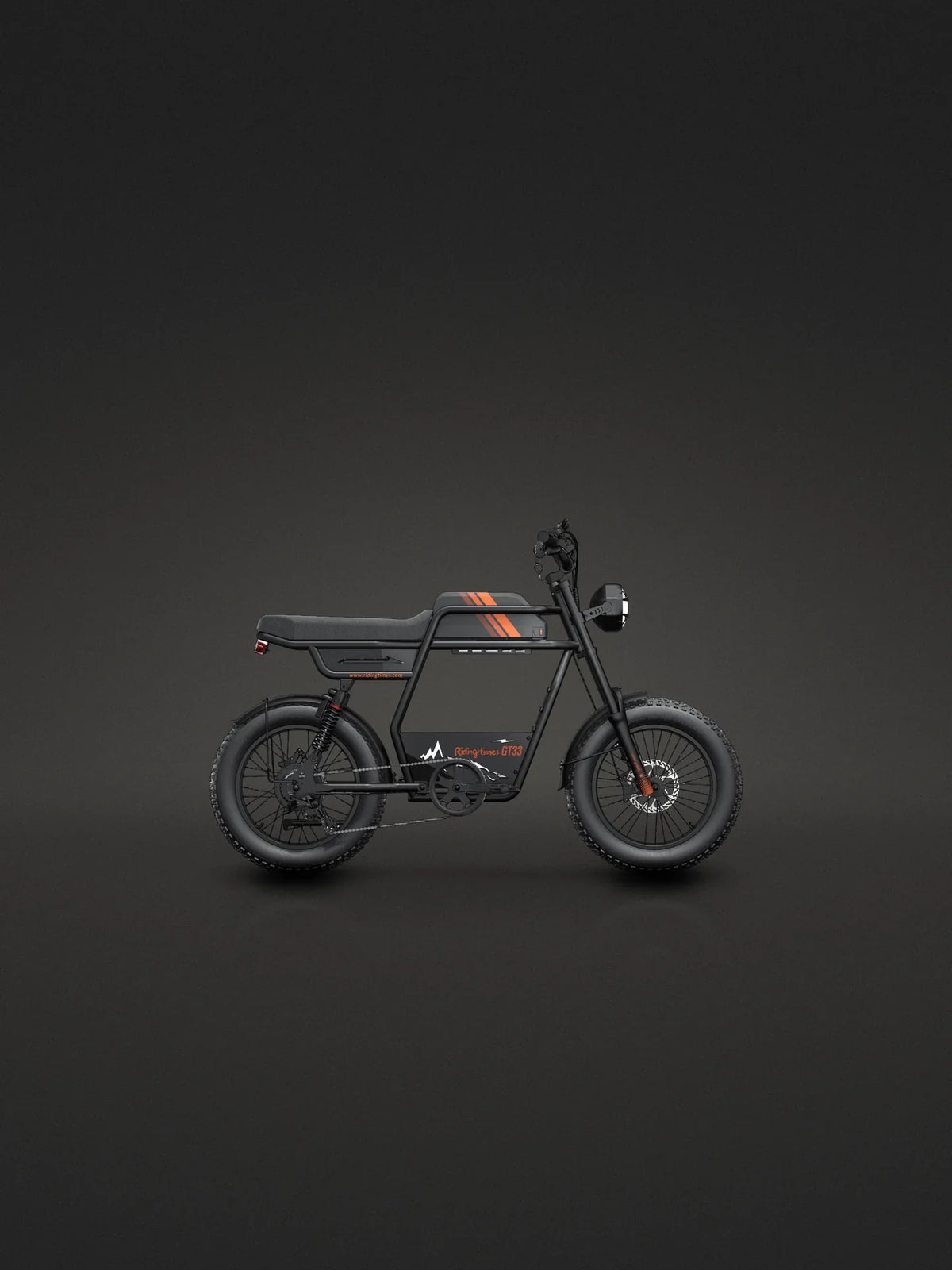
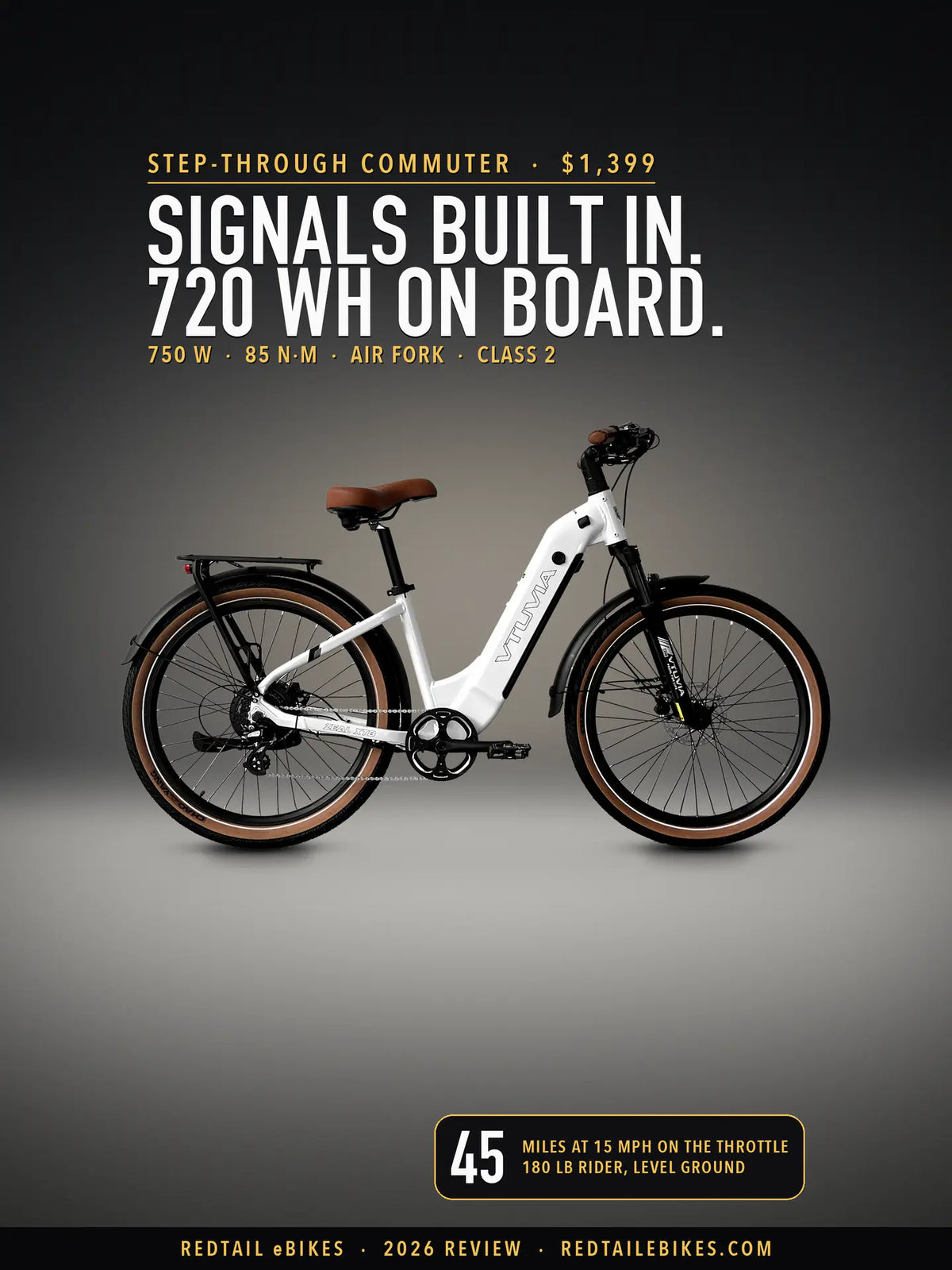
Share:
Bike Shops in Salinas, CA: 3 Verified eBike Stores
Bike Shops in Pomona, CA: 1 eBike Store, 9 More Nearby