


128 e-bikes and trikes · 11 brands · 50 states and DC screened · 4,197 cities and towns measured · 22 questions, three required: state, height and weight · every deciding spec read off the maker's own page on September 28 and 29, 2026
The right e-bike fits your body, your town and the rides you do, and your state still counts it as an e-bike. The finder below checks all four at once, so you can find the one that fits you.
Quick answer. Enter your state, height and weight in the finder below, add any of the other 19 answers you know, and press Calculate. It sets aside every machine your state's law, age, height, weight, stairs or balance rules out, then names your best match and the runners-up, with the reasons each one fits.
Across the twelve riders worked below, the VTUVIA CMB 8-Speed, a 500 W mid-drive step-through, ranks first for four: the short rider, the rider with stiff hips, the hill rider and the long commuter. The rest of the ranking comes from your hills, range, load, the bike's weight, your riding surface, motor, posture and snow.
Across the 128, a state's e-bike definition admits a median of 55 on September 29, 2026. The District of Columbia and Oregon admit 60, and New Jersey admits none: its 2025 law puts a throttle bike outside the definition, and 126 of the 128 carry a throttle. Connecticut admits 19 until September 30 and 55 from October 1. Sixty-eight of the 128 sit outside every state's definition and show only if you ride on private land.
The eBike finder: 128 bikes matched to your answers
Enter your state, height and weight, answer what else you know, and press Calculate. A bike that is too tall, too heavy for your stairs or short of your hills is a bike you stop riding, so read every reason the finder gives.
The eBike finder
Calculate the e-bike that fits you
Enter your state, height and weight, add anything else you know, and press Calculate. The finder checks all 128 machines against your answers and shows your best match, the next best, and why each one fits.
Your best match appears here after you press Calculate.
The finder applies each state's law as it stands on the day you use it. On October 1, 2026, Connecticut's motor limit changes from "fewer than" to "not more than" 750 watts, and 36 of these machines become e-bikes there that morning (Public Act 26-24, § 26). A machine outside your state's definition is regulated as some other vehicle.

A generated blue-hour scene of the Stone Arch Bridge over the Mississippi River in Minneapolis, drawn from the National Park Service's own photograph. The finder above reads the town you ride.
Last verified September 29, 2026. Every motor rating, battery, weight, payload, rider height, frame, suspension and top speed was read off the maker's own page on September 28 and 29, 2026, and every price and stock level on a result card is read from our store when you press Calculate.
By Milad Ghobadibeygvand, BScN (Western University, 2014), Redtail eBikes. Corrections: support@redtailebikes.com.
How we verified this finder
Every answer the finder gives is computed from published records: the maker's own pages, each state's statute, federal climate and elevation data, and peer-reviewed physics. The data behind every figure is published below, so you can check any result it gives you.
- The machines. All 128 e-bikes and trikes we carry from 11 brands, every brand except the five the finder never shows. Each deciding spec was read line by line off the maker's own page and saved, and 2,486 values were checked back against those saved pages (the machines' data). Where a maker prints two figures for one spec, the card prints both.
- The law. Each state's e-bike definition, read in the statute, with every machine screened against its motor, speed and throttle limits by one screener. A law that changes on a set date is applied from that date (the 128 × 51 legal matrix).
- The towns. All 4,197 US places of 10,000 people or more in the Census Bureau's American Community Survey 2024 5-year estimates, each placed at its USGS Geographic Names point and checked inside its own Census boundary.
- The weather. NOAA's 1991–2020 U.S. Climate Normals: the hourly normals for the 8 a.m. temperature and the commute-hour wind, and the monthly normals for snow and wet days, each from the nearest station with its distance recorded (every town's data).
- The ground. Slope measured on the U.S. Geological Survey's 3D Elevation Program in a window the size of each town's own land area, then calibrated against the street grades our city guides measured block by block in 18 cities.
- The physics. Climbing speed and range from the Martin et al. (1998) cycling power model, with drag and rolling resistance measured on urban riders by Tengattini and Bigazzi (2018) and cold-battery capacity from McMaster University's LG HG2 cell data.
- The price. Read from our store each time a result card appears, with stock checked before a card is shown.
- The picture. The cover is a scene of the Stone Arch Bridge over the Mississippi River in Minneapolis, generated with Nano Banana Pro on Playcut and drawn from the National Park Service's own photograph; the bridge's stone arches and parapet are those the National Park Service and the Minnesota Department of Transportation describe. No rider or machine appears in it.
Link to a result
Every answer lives in the page address, so a result can be bookmarked, shared or cited. A link such as a 5′10″, 185 lb rider in Denver who rides five days a week opens the finder with those answers filled in and calculated. A link calculates on its own when it carries the three required answers, st, ht and lb. These are the parameters it reads:
| Parameter | What it sets | Values |
|---|---|---|
st |
Your state | two-letter code, e.g. CO; required |
city |
Your town |
Town|ST as the town list prints it, e.g. Denver|CO
|
ht |
Height in inches | e.g. 70 for 5′10″; required |
lb |
Your weight in pounds | e.g. 185; required |
age |
Your age | a whole number |
exp |
When you last rode |
recent or years
|
fit |
How much you exercise |
casual or trained
|
mob |
Swinging a leg over the seat |
swing, hard or cannot
|
level |
Hills on your rides |
auto (from your town), flat, rolling, hilly or steep
|
seas |
Seasons you ride | repeat for each: winter, spring, summer, fall
|
days |
Riding days a week |
1 to 7
|
mi |
Miles on a riding day | all trips together |
pat |
How you ride |
stopgo, long or mix
|
speed |
Your speed |
relaxed (15 mph), moderate (20) or fast (28) |
surf |
What you ride on |
paved, mixed or trail
|
post |
Riding position |
upright, either or forward
|
susp |
Suspension |
any, front-ok or need-full
|
pax |
A passenger |
solo, child or adult
|
plb |
Passenger's weight in pounds | with pax
|
cargo |
Cargo in pounds | what you carry besides yourself |
store |
Where the bike lives |
ground, elevator or stairs
|
carry |
Most you can carry up stairs, pounds | with store=stairs
|
fold |
It has to fold | yes |
law |
Where you ride it |
within (your state's e-bike law) or private (private land only) |
Download the data
Each file below is the one the finder reads, published on our own server with the date it was built. The machines' JSON names the maker page each machine was read from and when, and whether each value came from that page's text, a maker's manual or a maker's photograph; the legal matrix gives the screener's reason for every machine in every state.
- Every machine: the deciding specs, one row each (CSV, 36 KB)
- Every machine, with each value's basis and the maker's two figures where it prints two (JSON, 306 KB)
- Every state's e-bike definition, age rule and helmet rule, with the statute cited (CSV, 53 KB)
- Every machine in every state, with the screener's reason, today and after October 1 (CSV, 1.9 MB)
- Every town of 10,000 people or more: hills, winter and summer mornings, snow, wet days, wind (CSV, 699 KB)
- The same towns, with the weather station and its distance for every value (JSON, 3.4 MB)
- The hill calibration: ground slope against measured street grades in 18 cities (CSV, 4 KB)
In this guide
- The finder
- How we verified this finder · link to a result · download the data
- How the finder decides: law · age · balance · getting on · passengers · payload · height · stairs · suspension · hills · range · motor · position · snow · speed · the score
- Twelve common riders and the bikes matched to them
- The 128 machines we checked · every state's e-bike law · the 25 largest cities
- Before you buy · The honest ledger · Limitations · FAQ · The bottom line · References
How the finder decides
The finder works in two passes. First it sets aside every machine a hard fact rules out for you: your state's law, an age rule, your balance, how you get on, a passenger, your weight, your height, your stairs, a fold you need or suspension you require. Then it scores what is left out of 100, and every card shows how its score was built.
Every rule below names its source, in the order the finder applies them. Two things are never scored: price, which is read live and never filtered, and brand, because the ranking is fit alone.
Your state's e-bike law
A machine counts as an e-bike in your state only if it sits inside every limb of that state's definition: the motor limit, the top assisted speed and the throttle limit. Some states add one. Alabama, Montana, New Jersey and Rhode Island define e-bikes on two wheels only, Pennsylvania caps the weight at 100 pounds and New York the width at 36 inches, so a trike can fail where two wheels pass.
The finder runs every machine through one screener built from the statutes and prints its reason, such as a 1,000 W motor over a 750 W limit, or a throttle that runs to 28 mph where the law stops it at 20. Each state's definition is in the state table below, and the reason for every machine in every state is in the legal matrix.
A law that changes on a set date is applied from that date. Connecticut's motor limit moves from "fewer than" to "not more than" 750 watts on October 1, 2026 (Public Act 26-24, § 26). North Carolina's new three-class definition takes effect December 1, 2026 (Session Law 2026-46, § 19), and it moves none of these 128 machines.
Alaska and Kentucky write no e-bike definition. There the finder applies the three-class model that 39 other jurisdictions write (750 W, pedal assist to 28 mph, a throttle to 20 mph) and labels it as the model, never as Alaska's or Kentucky's law (the state rules).
If you will ride only on private land, pick that answer: the finder drops the law screen and shows all 128, including the 68 that no state counts as an e-bike. Ride those where the landowner allows; on a public road each one is whatever vehicle your state's code makes it, which our state law pages set out state by state.
Your age
The finder applies three age rules, and any one of them sets a machine aside. First is your state's minimum age for the machine's class; every machine a state admits here is a Class 2, a throttle to 20 mph. Second is the maker's own minimum age, such as the 18 in DWMEIGI's manuals. Third, a machine outside every e-bike class is never shown to a rider under 16, even on private land.
Twenty-eight of the 51 jurisdictions set 16 as the minimum age for Class 3, New York sets 16 for any e-bike, and Minnesota and New Jersey set 15 for every class (every state's age rule). Illinois and Oregon change their age rules on January 1, 2027, and the finder applies the new ages from that date.
Where a state allows younger riders only under an adult's supervision, as Hawaii, Utah and Virginia do, the card says so. The maker's kids' e-bikes appear only when you enter an age under 18.
When you last rode a bicycle
If you have not ridden in years, the finder shows only machines that stand up on their own at a stop: three wheels. A bicycle steadies itself only inside a speed window, about 4.3 to 6.0 meters per second (roughly 10 to 13 mph) for the benchmark bicycle in Meijaard et al. (2007), and Kooijman et al. (2011) built a riderless bicycle from the same equations that steered itself back upright when pushed.
Below that window you do all of the balancing, and that is where you start, stop and climb off a machine that weighs 58 pounds or more here. The step from that physics to a third wheel is this page's reading, not the studies' finding.
A trike asks for its own skills. Eunorau's own page for its ONE-TRIKE 2.0 says "a trike handles differently from a bicycle and does not lean naturally into turns. New riders should practice in a flat, open area and slow down before cornering," and that it is "an electric trike—not a medical mobility device." Twenty-eight of the 128 machines have three wheels.
Getting on: step-through, step-over and sit-in
Tell the finder how easily you swing a leg over a bike's seat, and it matches the frame to you. If you cannot, it shows only step-through frames and sit-in trikes, where you walk into the frame or sit down into it. If it takes effort, it sets aside step-over and leg-over frames and keeps mid-step frames.
Each frame was read from the maker's own photographs (the machines' data): 64 step-through, 3 mid-step, 3 sit-in, 28 step-over, and 30 leg-over, where your leg swings over a motorcycle-style bench.
A passenger
An adult passenger rides only on a machine whose maker names a second rider for it: a passenger seat, a tandem, or words such as "Two riders, one e-bike." Eighteen of the 128 qualify, each read from the maker's own page (the machines' data). A child adds four more whose makers name a child seat, children or a passenger seat pad for them.
Your passenger's weight joins yours in every payload check and every hill and range figure. If you leave it blank, the finder uses 160 pounds for an adult and 50 for a child.
Your weight and the maker's payload
The finder adds your weight, your passenger's and your cargo, and sets aside any machine whose printed payload is lower. Where a maker also prints a separate rider limit, as Addmotor does when it splits a payload between rider and rack, you are checked against that too. A hundred and twelve of the 128 print a payload (the machines' data).
Within what is left, a machine scores full marks for load when at least 50 pounds of payload remain after you. If a maker prints no payload for a machine you like, the card asks you to check the limit with us before you order, rather than guess at one.
Your height and the maker's rider range
Your height is checked against the rider-height range the maker prints, with half an inch of tolerance at each end; 106 of the 128 print one. Inside the range, the middle scores best and the edge still scores well. A machine whose maker prints no range scores below every machine whose range includes you, because nobody can confirm it fits.
When a maker prints two ranges for one machine, the finder uses the height both of them include. Qiolor prints 5′1″ to 5′9″ for the TIGER RL in one place and 5′3″ to 6′6″ in another, so the finder checks 5′3″ to 5′9″ and says so on the card.
The same rule picks the lower of two load limits, the heavier of two weights, the higher of two top speeds and the lesser of two suspension claims. Seventeen machines carry that note (the machines' data).
Stairs, elevators and small spaces
If the bike lives up a flight of stairs, tell the finder the most you can carry, and it sets aside every machine heavier than that. A machine whose maker prints no weight is set aside too, because nothing can show it clears your stairs. If it has to fold, only the 23 folding machines stay.
Every rider gets a handling score from the bike's own weight: full marks at 55 pounds or less, none at 115 pounds or more. The weight you lift onto a car rack, push up a curb and wheel through a doorway is the bike's, and the heaviest machine here, Addmotor's E-325 family cargo trike, weighs 198 pounds.
Suspension and what you ride on
Tell the finder what you ride on, and it scores the suspension and tires for it. On pavement and bike paths, every machine scores full marks. On gravel and dirt roads, a machine with any suspension or tires 3 inches wide or more scores full marks, and on dirt trails full suspension scores best.
If you need full suspension, pick that answer, and the finder sets aside every machine without it. Sixty-five of the 128 print full suspension. Where a maker prints both a front fork and dual suspension for one machine, the finder does not count it as full.
Your hills
The finder reads your hills from the ground around your town, then works out how fast each machine climbs them with you on board. The ground is the average slope on the U.S. Geological Survey's 3D Elevation Program, in a window as wide as your town's land area and between 3 and 10 kilometers across. Under a 2.15% average slope, the town reads flat; under 4.0%, rolling; under 5.2%, hilly; above that, steep.
Those cuts come from our city guides, which measured the grade of every street block in 18 cities. Ranked across those cities, the average ground slope tracked the streets' 90th-percentile grade with a rank correlation of 0.885, and 15 of the 18 cities landed on the same level both ways (the calibration).
Each level then stands for a grade, the typical 90th-percentile street grade of its calibration cities: 1.38% flat, 3.08% rolling, 4.10% hilly and 6.24% steep. The ground is not your route, so the finder shows the level it read and lets you change it.
The climb uses the Martin et al. (1998) power model: the motor's rated watts at 80% efficiency, plus your own easy pedaling, against gravity, rolling resistance and air. Eighty percent is the floor Bafang's OEM workbook prints across its motors.
Easy pedaling is half the critical power Chorley et al. (2020) measured: 3.19 watts per kilogram for untrained riders and 4.17 for trained ones. The half is this page's definition of an effort you can hold without arriving wrecked, not a study finding. Critical power is a lab measure, and that study's twenty "untrained" men still played sport every week.
A machine scores full marks for hills when it holds 12 mph or more up your grade, and none at 4 mph. A maker that prints only a peak motor figure gets no climb figure at all, because a peak is not a rating.
Range: your miles, your seasons and how often you ride
Range is computed for the throttle alone, with no pedaling, on flat ground, at your speed (15, 20 or 28 mph, capped at what the machine allows), on a morning in the coldest season you ride. That is the harder case, so a card's second figure adds 75 watts of light pedaling.
Cold enters twice: denser air to push through, and a battery that holds less, 89.2% of its 77°F capacity at 32°F in McMaster University's LG HG2 cell tests. The morning is NOAA's 1991–2020 normal for 8 a.m. at the nearest hourly station.
The wind is that season's commute-hour average, cut to rider height over open ground as the World Meteorological Organization's roughness rule sets out. Drag and rolling resistance are Tengattini and Bigazzi's (2018) measurements of urban riders by bike type and tire, and air density follows the U.S. Standard Atmosphere.
Battery losses follow the curve Arango et al. (2021) fitted on a test pack, which returns 96.5% at about 4 amps, the current a 48-volt pack gives up at 200 watts.
A machine scores full marks for range when it covers your day's miles 1.25 times over on the throttle alone. Tell the finder how many days a week you ride, and each card also says how many charges a week that takes. Checked against the detailed range model in our URUS 2.0 review at its worked example, the finder's figure runs 5.0% lower: 17.54 watt-hours a mile against 18.46.
Stop and go, or one long ride: the motor
For stop-and-go riding the finder favors a geared hub or a mid-drive, and for one long steady ride a mid-drive or a gearless direct-drive hub. On hilly and steep ground it also leans toward a mid-drive. Each call rests on a published source, and none of them is a percentage the finder invents.
- A geared hub spins its motor "over 3000 rpm" through reduction gears, so "a much smaller motor can deliver the same power"; geared hubs "typically weigh about 50% less than an equivalently powerful direct drive machine" and freewheel when you coast (Grin Technologies).
- A direct-drive hub is "always mechanically engaged," with cogging drag of "0.3 to 1 N-m" that you feel when it is off, the same source says, so it pays for itself on long steady runs near its design speed.
- On steep city roads, a mid-drive let "both the cyclist and the motor" run "in the most efficient rpm," and the hub drive used 18% more energy (Arango et al., 2018).
Nine machines here are mid-drives and nine are geared hubs. The makers of 94 others print "hub" without saying geared or direct-drive, and 16 print no motor type; the finder scores all 110 in the middle, since an unprinted type proves neither.
Riding position
Tell the finder whether you want to sit upright or lean forward like a mountain biker, and it scores each machine's position, read from the maker's photographs. Upright frames and moto-style saddles suit an upright rider; forward and neutral frames suit a rider who leans.
The position also sets the air drag in every hill and range figure. Tengattini and Bigazzi (2018) measured 0.640 square meters of drag area on cruisers, which the finder gives upright frames, 0.579 on hybrids for neutral frames and 0.603 on mountain bikes for forward ones.
Snow
If you ride in a season when your town's normal snowfall is 5 inches or more, the finder favors tires 3.7 inches wide or wider. Eighty-five of the 128 machines ride on tires that wide.
The width comes from the equipment guideline the Minnesota Department of Natural Resources and the USDA Forest Service print word for word for a bike ridden on snow: "Deep snow coverage may require tires wider than 3.7 inches or larger. Low tire pressure (often under 8 PSI)." The guideline is written for riding on snow, and the finder cannot tell whether your streets are plowed.
Speed
If you want to ride fast, the finder favors machines that reach 28 mph. Forty-eight of the 51 state definitions stop a throttle at 20 mph (the state rules), so inside the law nearly every machine here runs at 20, and fast riders who stay inside it are matched on everything else. At a relaxed or steady pace, speed does not change the score.
The fit score
Every machine that survives the first pass is scored out of 100, and a card's score opens to show each part. When two machines tie, the one that climbs your hill faster ranks first, then the one that goes farther on a charge, then the lighter one. The weights are this page's own judgment of what matters most once the hard rules are met, published so you can weigh them differently.
| Part of the score | Points | Full marks when | Where it is explained |
|---|---|---|---|
| Your hill | 20 | Holds 12 mph or more up your hill's grade with you on it, pedaling easily | the rule |
| Range for your day | 16 | Covers your day's miles 1.25 times over on the throttle alone | the rule |
| Payload to spare | 10 | 50 lb or more of the maker's payload left after you, a passenger and cargo | the rule |
| Weight to lift and push | 10 | 55 lb or lighter (none at 115 lb or heavier) | the rule |
| Your riding surface | 8 | On dirt trails: full suspension; on gravel: suspension or 3 in tires | the rule |
| Motor for how you ride | 8 | The motor type the evidence favors for your riding pattern and hills | the rule |
| Riding position | 8 | The position you asked for | the rule |
| Height in the maker's range | 8 | Your height in the middle of the maker's printed rider range | the rule |
| Your snow season | 7 | Tires 3.7 in or wider when you ride through a snowy season | the rule |
| Your speed | 5 | A 28 mph machine when you asked for fast | the rule |
| Total | 100 |
Takeaway
Answer the questions that are true for you, skip the rest and press Calculate; a skipped question keeps the answer already selected. Every machine the finder sets aside is listed with its reason, so you can see what changing one answer would bring back.
Twelve common riders and the bikes matched to them
These are the finder's own answers for twelve riders whose questions come up again and again, each worked in a real US city on September 29, 2026. The picks change with your own state, town and body, so every one opens in the finder with its answers filled in for you to change. Machines that were sold out that day are left out.
Your state, your town and your body change the answer. The finder takes 22 questions and needs three: your state, height and weight.
Run the finder with your answersA tall rider: 6′4″ and 230 lb in Seattle
Seattle's ground reads steep, so the finder sets the climb at 6.24% and asks each machine to haul 230 pounds up it. Thirty-four machines drop out because the maker's rider range stops below 6′4″, and the three that rank first print ranges that reach 6′4″ or beyond. For a closer look at frame fit, see our guide to e-bikes for tall riders.

Eunorau's own photograph of the Defender in Army Green, first in this rider's list.
- Eunorau Defender Full-Suspension Fat eBike: step-over, 500 W rear hub, 66 lb, 300 lb payload, riders 5′3″ to 6′4″. For this rider it holds about 12 mph up a 6.2% grade and about 39 miles a charge on the throttle alone at 15 mph on a spring morning.
- VTUVIA SN100 750W Fat Tire Hunting Electric Mountain Bike: step-over, 750 W rear hub, 87 lb, 400 lb payload, riders 5′8″ to 6′5″. For this rider it holds about 14.7 mph up a 6.2% grade and about 36 miles a charge on the throttle alone at 15 mph on a spring morning.
- TIGER PLUS Electric Off Road Bike: leg-over, 750 W, 90 lb, 400 lb payload, riders 5′3″ to 6′5″. For this rider it holds about 14.4 mph up a 6.2% grade and about 84 miles a charge on the throttle alone at 15 mph on a spring morning.
The finder ranks 18 machines for this rider; 15 more are one tap away. Open this answer in the finder.
A short rider: 5′1″ and 125 lb in Houston
Texas takes a motor of "fewer than 750 watts," which leaves 19 of the 128 inside its definition, and eight more drop out for a rider range that starts above 5′1″. Houston reads flat, so every machine left that prints its weight holds its full assist speed on this rider's hills.

VTUVIA's own photograph of the CMB 8-Speed in Metallic Silver, first in this rider's list.
- VTUVIA CMB 8-Speed Mid-Drive City Electric Bike: step-thru, 500 W mid-drive, 60 lb, 300 lb payload, riders 5′1″ to 6′1″. For this rider it holds about 20 mph up a 1.4% grade and about 44 miles a charge on the throttle alone at 15 mph on a spring morning.
- Eunorau META20 Folding eBike: step-thru, 500 W rear hub, 63 lb, 286 lb payload, riders 5′1″ to 6′1″. For this rider it holds about 20 mph up a 1.4% grade and about 45 miles a charge on the throttle alone at 15 mph on a spring morning.
- Eunorau G30-CARGO 2.0 Cargo eBike: step-thru, 500 W geared rear hub, 78 lb, 440 lb payload, riders 5′1″ to 6′2″. For this rider it holds about 20 mph up a 1.4% grade and about 41 miles a charge on the throttle alone at 15 mph on a spring morning.
The finder ranks 9 machines for this rider; 6 more are one tap away. Open this answer in the finder.
A heavier rider: 300 lb in Phoenix
At 300 pounds, seven machines drop out on the maker's payload, and the load score then favors the ones with room to spare. The VTUVIA Zeal LT7 leaves 50 pounds of its 350 after this rider, and the Eunorau G30-CARGO 2.0 leaves 140 of its 440.

VTUVIA's own photograph of the Zeal LT7 in Lemon Yellow, first in this rider's list.
- VTUVIA Zeal LT7 Step-Through Commuter Electric Bike: step-thru, 500 W rear hub, 62 lb, 350 lb payload, riders 5′3″ to 6′2″. For this rider it holds about 20 mph up a 1.4% grade and about 35 miles a charge on the throttle alone at 15 mph on a spring morning.
- Eunorau G30-CARGO 2.0 Cargo eBike: step-thru, 500 W geared rear hub, 78 lb, 440 lb payload, riders 5′1″ to 6′2″. For this rider it holds about 20 mph up a 1.4% grade and about 34 miles a charge on the throttle alone at 15 mph on a spring morning.
- Eunorau ONE-TRIKE 2.0 Rear-Drive Electric Trike: three wheels, step-thru, 500 W rear hub, 86 lb, 440 lb payload, riders 5′2″ to 6′1″. For this rider it holds about 20 mph up a 1.4% grade and about 38 miles a charge on the throttle alone at 15 mph on a spring morning.
The finder ranks 9 machines for this rider; 6 more are one tap away. Open this answer in the finder.
Stiff hips or knees: 5′5″ and age 68 in Tampa
This rider cannot swing a leg over a seat, so only step-through frames and sit-in trikes stay, and each of the three below has a frame you walk into. Florida's "less than 750 watts" keeps 19 of the 128 inside its definition, and the frame, height and age answers leave 12 of them in stock.

Eunorau's own photograph of the META20 in Alpine White, second in this rider's list; the CMB 8-Speed above it is pictured with the short rider.
- VTUVIA CMB 8-Speed Mid-Drive City Electric Bike: step-thru, 500 W mid-drive, 60 lb, 300 lb payload, riders 5′1″ to 6′1″. For this rider it holds about 20 mph up a 1.4% grade and about 43 miles a charge on the throttle alone at 15 mph on a spring morning.
- Eunorau META20 Folding eBike: step-thru, 500 W rear hub, 63 lb, 286 lb payload, riders 5′1″ to 6′1″. For this rider it holds about 20 mph up a 1.4% grade and about 43 miles a charge on the throttle alone at 15 mph on a spring morning.
- Eunorau META24 City eBike: step-thru, 500 W rear hub, 62 lb, 286 lb payload, riders 5′3″ to 6′2″. For this rider it holds about 20 mph up a 1.4% grade and about 43 miles a charge on the throttle alone at 15 mph on a spring morning.
The finder ranks 12 machines for this rider; 9 more are one tap away. Open this answer in the finder.
Back on a bike after years off: age 71 in Scottsdale
With "not in years" selected, the finder shows only machines that stand on their own at a stop, and Arizona's definition admits four three-wheelers that were in stock. The Eunorau ONE-TRIKE 2.0 ranks first on a 440 lb payload and an 86 lb weight, 10 pounds under the Addmotor Citytan M-315; the other two print no weight.

Eunorau's own photograph of the ONE-TRIKE 2.0 in Deep Crimson, first in this rider's list.
- Eunorau ONE-TRIKE 2.0 Rear-Drive Electric Trike: three wheels, step-thru, 500 W rear hub, 86 lb, 440 lb payload, riders 5′2″ to 6′1″. For this rider it holds about 20 mph up a 1.4% grade and about 44 miles a charge on the throttle alone at 15 mph on a spring morning.
- Addmotor Citytan M-315 Folding eTrike: three wheels, step-thru, 500 W rear hub, 96 lb, riders 5′1″ to 5′9″. For this rider it holds about 20 mph up a 1.4% grade and about 38 miles a charge on the throttle alone at 15 mph on a spring morning.
- DWMEIGI MG708 Hera 350W Urban Electric Tricycle: three wheels, step-thru, 350 W front hub, 300 lb payload, riders 4′11″ to 6′2″.
The finder ranks 4 machines for this rider; 1 more is one tap away. Open this answer in the finder.
Steep hills, stop and go: 185 lb in San Francisco
San Francisco reads steep, and on the 6.24% grade the VTUVIA CMB 8-Speed, a 500 W mid-drive, holds about 13.1 mph with this rider aboard. It ranks first because stop-and-go riding and steep ground both favor a mid-drive; the two 750 W hub bikes behind it climb faster, at about 16 and 16.5 mph, on more motor.

Addmotor's own photograph of the Graoopro, second in this rider's list; the CMB 8-Speed above it is pictured with the short rider.
- VTUVIA CMB 8-Speed Mid-Drive City Electric Bike: step-thru, 500 W mid-drive, 60 lb, 300 lb payload, riders 5′1″ to 6′1″. For this rider it holds about 13.1 mph up a 6.2% grade and about 36 miles a charge on the throttle alone at 15 mph on a spring morning.
- Addmotor Graoopro Dual-Battery Cargo eBike: step-thru, 750 W geared rear hub, 72 lb, 450 lb payload, riders 5′4″ to 6′2″. For this rider it holds about 16 mph up a 6.2% grade and about 47 miles a charge on the throttle alone at 15 mph on a spring morning.
- VTUVIA SF20H Utility Folding Fat Tire Electric Bike: step-thru, 750 W rear hub, 60 lb, 330 lb payload, riders 5′3″ to 6′2″. For this rider it holds about 16.5 mph up a 6.2% grade and about 33 miles a charge on the throttle alone at 15 mph on a spring morning.
The finder ranks 50 machines for this rider; 47 more are one tap away. Open this answer in the finder.
A long commute: 30 miles a day in Atlanta
Thirty miles a day at a steady 20 mph is where range starts to decide things. On the throttle alone on a spring morning, the three below cover 28 to 37 miles a charge, which works out to 4.1 to 5.4 charges a week at five riding days; light pedaling stretches each charge further.

Addmotor's own photograph of the Foldtan M-160, third in this rider's list; the two above it are pictured with the short rider and the hill rider.
- VTUVIA CMB 8-Speed Mid-Drive City Electric Bike: step-thru, 500 W mid-drive, 60 lb, 300 lb payload, riders 5′1″ to 6′1″. For this rider it holds about 13 mph up a 6.2% grade and about 28 miles a charge on the throttle alone at 20 mph on a spring morning.
- Addmotor Graoopro Dual-Battery Cargo eBike: step-thru, 750 W geared rear hub, 72 lb, 450 lb payload, riders 5′4″ to 6′2″. For this rider it holds about 16 mph up a 6.2% grade and about 37 miles a charge on the throttle alone at 20 mph on a spring morning.
- Addmotor Foldtan M-160 Folding eBike: step-thru, 750 W rear hub, 82 lb, 280 lb payload, riders 5′2″ to 6′3″. For this rider it holds about 15.6 mph up a 6.2% grade and about 37 miles a charge on the throttle alone at 20 mph on a spring morning.
The finder ranks 40 machines for this rider; 37 more are one tap away. Open this answer in the finder.
Two adults on one machine: 185 and 150 lb in Denver
Eighteen of the 128 machines are ones whose makers name a second rider, and seven of those are e-bikes under Colorado's definition. In 21 jurisdictions none of the 18 is an e-bike (20 from October 1, when Connecticut's limit changes), so two adults there ride only on private land.

Qiolor's own photograph of the TIGER PLUS, first in this rider's list.
- TIGER PLUS Electric Off Road Bike: leg-over, 750 W, 90 lb, 400 lb payload, riders 5′3″ to 6′5″. For this rider it holds about 17.2 mph up a 3.1% grade and about 79 miles a charge on the throttle alone at 15 mph on a spring morning.
- Addmotor Greattan L Passenger Electric Trike: three wheels, step-thru, 750 W rear hub, 154 lb, 500 lb payload, riders 5′4″ to 6′4″. For this rider it holds about 15.8 mph up a 3.1% grade and about 42 miles a charge on the throttle alone at 15 mph on a spring morning.
- Addmotor Soletri II M-366X / Herotri II M-365X Full-Suspension eTrike: three wheels, step-thru, 750 W rear hub, 130 lb, 450 lb payload, riders 5′2″ to 6′2″. For this rider it holds about 16.3 mph up a 3.1% grade and about 43 miles a charge on the throttle alone at 15 mph on a spring morning.
The finder ranks 4 machines for this rider; 1 more is one tap away. Open this answer in the finder.
A child on the back in Columbus
A child passenger narrows the list to machines whose makers name a passenger, a child seat or children, and Ohio's "less than 750 watts" keeps one of those in play. Eunorau recommends its own safety seat for a child on the G30-CARGO 2.0, sold separately.

Eunorau's own photograph of the G30-CARGO 2.0 in Orange, the one machine in this rider's list.
- Eunorau G30-CARGO 2.0 Cargo eBike: step-thru, 500 W geared rear hub, 78 lb, 440 lb payload, riders 5′1″ to 6′2″. For this rider it holds about 15.8 mph up a 3.1% grade and about 34 miles a charge on the throttle alone at 15 mph on a spring morning.
The finder ranks 1 machine for this rider. Open this answer in the finder.
An apartment up the stairs: a 60 lb carry in Boston
A 60-pound carry limit leaves two machines, the VTUVIA SF20H and the VTUVIA CMB 8-Speed, both 60 pounds. Fifty others drop out as heavier than 60 pounds or with no printed weight, and the SF20H also folds.

VTUVIA's own photograph of the SF20H in White, first in this rider's list.
- VTUVIA SF20H Utility Folding Fat Tire Electric Bike: step-thru, 750 W rear hub, 60 lb, 330 lb payload, riders 5′3″ to 6′2″. For this rider it holds about 20 mph up a 3.1% grade and about 36 miles a charge on the throttle alone at 15 mph on a spring morning.
- VTUVIA CMB 8-Speed Mid-Drive City Electric Bike: step-thru, 500 W mid-drive, 60 lb, 300 lb payload, riders 5′1″ to 6′1″. For this rider it holds about 18 mph up a 3.1% grade and about 38 miles a charge on the throttle alone at 15 mph on a spring morning.
The finder ranks 2 machines for this rider. Open this answer in the finder.
Riding through a snowy winter in Minneapolis
Minneapolis winter mornings average 16°F at 8 a.m., so every range figure here is worked in that cold, and the snow guideline favors tires 3.7 inches or wider. The VTUVIA SF20H rides 4-inch tires and covers about 31 miles a charge on the throttle alone on a winter morning.

VTUVIA's own photograph of the SX20 Antelope in Teal Blue, second in this rider's list; the SF20H above it is pictured with the apartment rider.
- VTUVIA SF20H Utility Folding Fat Tire Electric Bike: step-thru, 750 W rear hub, 60 lb, 330 lb payload, riders 5′3″ to 6′2″. For this rider it holds about 20 mph up a 3.1% grade and about 31 miles a charge on the throttle alone at 15 mph on a winter morning.
- VTUVIA SX20 Antelope Folding Step-Through Electric Bike: step-thru, 750 W rear hub, 70 lb, 330 lb payload, riders 5′0″ to 6′2″. For this rider it holds about 20 mph up a 3.1% grade and about 31 miles a charge on the throttle alone at 15 mph on a winter morning.
- VTUVIA CMB 8-Speed Mid-Drive City Electric Bike: step-thru, 500 W mid-drive, 60 lb, 300 lb payload, riders 5′1″ to 6′1″. For this rider it holds about 17.3 mph up a 3.1% grade and about 34 miles a charge on the throttle alone at 15 mph on a winter morning.
The finder ranks 40 machines for this rider; 37 more are one tap away. Open this answer in the finder.
Dirt trails on private land near Bozeman
On private land the law screen is off, and full suspension as a must leaves 55 machines in stock. The three that rank first are Eunorau mid-drives that no state counts as an e-bike, so they belong on land whose owner allows them.

Eunorau's own photograph of the FAT-HS in Black, first in this rider's list.
- Eunorau FAT-HS Full-Suspension Mid-Drive Fat eBike (Hunter X8): step-over, 1,000 W mid-drive, 77 lb, 300 lb payload, riders 5′3″ to 6′4″. For this rider it holds about 22.3 mph up a 4.1% grade and about 42 miles a charge on the throttle alone at 15 mph on a fall morning.
- Eunorau SPECTER-S 3.0 Full-Suspension eMTB (Hunter X9): step-over, 1,000 W mid-drive, 84 lb, 300 lb payload, riders 5′3″ to 6′3″. For this rider it holds about 22.1 mph up a 4.1% grade and about 49 miles a charge on the throttle alone at 15 mph on a fall morning.
- Eunorau URUS 2.0 Full-Suspension eMTB: step-over, 500 W mid-drive, 62 lb, 300 lb payload, riders 5′3″ to 6′4″. For this rider it holds about 16.4 mph up a 4.1% grade and about 55 miles a charge on the throttle alone at 15 mph on a fall morning.
The finder ranks 55 machines for this rider; 52 more are one tap away. Open this answer in the finder.
Takeaway
Start from the rider closest to you, open that answer in the finder, change the answers that differ, and press Calculate. The machines it sets aside show you which answer is doing the narrowing.
The 128 machines we checked
Every machine the finder weighs is below, grouped by wheels and frame, with the specs that decide most matches: how many states count it as an e-bike, the maker's rider-height range, payload, weight, motor and battery. Each name opens its page in our store, where the price and stock are current.
A dash means the maker prints no figure for that spec, and the finder then does not check that limit; the card says so and offers to confirm it with you before you order. Where a maker prints only a peak motor figure, the table names it as a peak.
"An e-bike in" counts the 51 jurisdictions whose definition admits the machine, with Alaska and Kentucky counted on the three-class model. The full record, with the maker's page for every machine, is in the machines' data.
Shop by brand. Each brand in the finder has its own shelf in our store, with the number of its machines the finder weighs: Addmotor (28) · DWMEIGI (5) · Eahora (23) · Eunorau (25) · Freesky (8) · Qiolor (5) · Riding'times (4) · Samebike (10) · Smartravel (6) · Tesway (5) · VTUVIA (9).
Shop by kind. See every cargo e-bike we carry and every fat-tire e-bike we carry.
Two wheels, step-through or mid-step frame (42)
| Machine | An e-bike in | Rider height | Payload | Weight | Motor | Battery |
|---|---|---|---|---|---|---|
| Addmotor Citypro E-43 Step-Thru Electric Bike | 50 of 51 | 5′4″ to 5′11″ | — | 66 lb | 500 W geared rear hub | 720 Wh |
| Addmotor Foldtan M-120 Folding eBike | 30 of 51 (31 from Oct. 1) | 5′2″ to 6′3″ | 280 lb | 81 lb | 750 W geared rear hub | 720 Wh |
| Addmotor Foldtan M-140 Folding eBike | 30 of 51 (31 from Oct. 1) | — | 300 lb | 81 lb | 750 W rear hub | 960 Wh |
| Addmotor Foldtan M-160 Folding eBike | 30 of 51 (31 from Oct. 1) | 5′2″ to 6′3″ | 280 lb | 82 lb | 750 W rear hub | 960 Wh |
| Addmotor Garootan M-81 Cargo eBike | 30 of 51 (31 from Oct. 1) | 5′4″ to 5′9″ | 400 lb | 85 lb | 750 W geared rear hub | 720 Wh |
| Addmotor Graoopro Dual-Battery Cargo eBike | 30 of 51 (31 from Oct. 1) | 5′4″ to 6′2″ | 450 lb | 72 lb | 750 W geared rear hub | 960 Wh |
| Addmotor Kunlun Folding Fat-Tire Electric Bike | 0 of 51 | 5′4″ to 6′4″ | 280 lb | 68 lb | 750 W rear hub | — |
| Addmotor Soletan M-66X Full-Suspension eBike | 30 of 51 (31 from Oct. 1) | 5′2″ to 6′2″ | 300 lb | 99 lb | 750 W rear hub | 960 Wh |
| Eahora 2026 Juliet Long-Range Step-Through Electric Bike | 0 of 51 | 5′4″ to 6′1″ | 330 lb | 116 lb | 1,000 W rear hub | 2,880 Wh |
| Eahora Juliet II Step-Through Electric Bike | 0 of 51 | 5′4″ to 6′1″ | 330 lb | 116 lb | 1,500 W rear hub | 3,120 Wh |
| Eahora Juliet III AWD Electric Bike | 0 of 51 | 5′4″ to 6′1″ | 330 lb | 124 lb | 2,000 W two hubs | 3,120 Wh |
| Eahora Juliet Long-Range Step-Through Electric Bike (2025) | 0 of 51 | 5′4″ to 6′1″ | 330 lb | 116 lb | 1,000 W rear hub | 2,880 Wh |
| Eahora Juliet Pro Electric Bike | 0 of 51 | 5′7″ to 6′4″ | 330 lb | 148 lb | 2,500 W rear hub | 4,200 Wh |
| Eahora Juliet Pro II AWD Electric Bike | 0 of 51 | 5′7″ to 6′4″ | 400 lb | 148 lb | 4,400 W two hubs | 4,200 Wh |
| Eahora Luna II Dual-Motor Step-Through Electric Bike | 0 of 51 | 5′4″ to 6′1″ | 330 lb | 91 lb | 1,000 W two hubs | 960 Wh |
| Eahora Luna Step-Through Commuter Electric Bike | 0 of 51 | 5′4″ to 6′1″ | 330 lb | 91 lb | 1,000 W rear hub | 720 Wh |
| Eunorau FAT-AWD 3.0 All-Wheel-Drive Fat eBike | 4 of 51 | 5′3″ to 6′1″ | 375 lb | 82 lb | 1,000 W two hubs | 720 Wh |
| Eunorau FAT-HD 2.0 Mid-Drive Fat eBike (Hunter X7) | 0 of 51 | 5′3″ to 6′4″ | 375 lb | 82 lb | 1,000 W mid-drive | 720 Wh |
| Eunorau FLASH LITE ST Step-Thru eMoped | 0 of 51 | 4′8″ to 6′4″ | 440 lb | 82 lb | 750 W rear hub | 832 Wh |
| Eunorau G30-CARGO 2.0 Cargo eBike | 50 of 51 | 5′1″ to 6′2″ | 440 lb | 78 lb | 500 W geared rear hub | 672 Wh |
| Eunorau MAX-CARGO 2.0 Cargo eBike | 0 of 51 | 5′2″ to 6′1″ | 440 lb | 85 lb | 750 W rear hub | 672 Wh |
| Eunorau META20 Folding eBike | 50 of 51 | 5′1″ to 6′1″ | 286 lb | 63 lb | 500 W rear hub | 720 Wh |
| Eunorau META24 City eBike | 50 of 51 | 5′3″ to 6′2″ | 286 lb | 62 lb | 500 W rear hub | 720 Wh |
| Eunorau META26 City eBike | 50 of 51 | 5′4″ to 6′3″ | 286 lb | 68 lb | 500 W rear hub | 720 Wh |
| Eunorau META275 2.0 City eBike | 50 of 51 | 5′6″ to 6′1″ | 286 lb | 68 lb | 500 W rear hub | 720 Wh |
| Eunorau SPECTER-ST 2.0 Step-Thru eMTB | 0 of 51 | 5′3″ to 6′4″ | 300 lb | 88 lb | 1,000 W mid-drive | 840 Wh |
| Freesky Eurostar Turbo M-410 | 0 of 51 | 5′3″ to 6′8″ | 400 lb | 99 lb | 4,000 W peak (no rated figure printed), two hubs | 1,200 Wh |
| Freesky Ranger Air M-540 | 0 of 51 | 5′3″ to 6′8″ | 400 lb | 95 lb | 4,000 W peak (no rated figure printed), two hubs | 1,200 Wh |
| Freesky Ranger Plus M-540 | 0 of 51 | 5′3″ to 6′8″ | 400 lb | 95 lb | 5,000 W peak (no rated figure printed), two hubs | 1,440 Wh |
| Freesky Rocky Pro A-320 | 0 of 51 | 5′1″ to 5′11″ | 400 lb | 77 lb | 2,500 W peak (no rated figure printed) | 1,200 Wh |
| Freesky Swift Horse Ultra X-6E | 0 of 51 | 5′3″ to 6′8″ | 400 lb | 83 lb | 4,000 W peak (no rated figure printed) | 1,680 Wh |
| Samebike CREST Fat Tire Mountain Electric Bike | 0 of 51 | — | 331 lb | — | 1,000 W hub | 960 Wh |
| Samebike CY20 Pro Folding Commuter Electric Bike, Solid Wheel | 50 of 51 | — | 331 lb | 68 lb | 500 W | 468 Wh |
| Samebike CY20 Pro Folding Commuter Electric Bike, Spoked Wheel | 50 of 51 | — | 331 lb | 68 lb | 500 W | 624 Wh |
| Tesway C5 AWD Longtail Cargo Electric Bike, Dual Motor, 450 lb Payload | 0 of 51 | — | 450 lb | 132 lb | 2,000 W two hubs | 3,120 Wh |
| Tesway X5 AWD Step-Thru Dual-Motor Fat Tire Electric Bike, 52V 60Ah | 0 of 51 | — | 400 lb | 119 lb | 2,000 W two hubs | 3,120 Wh |
| VTUVIA CMB 8-Speed Mid-Drive City Electric Bike | 50 of 51 | 5′1″ to 6′1″ | 300 lb | 60 lb | 500 W mid-drive | 691 Wh |
| VTUVIA Reindeer 2.0 Step-Through Fat Tire Electric Bike | 29 of 51 (30 from Oct. 1) | 5′5″ to 6′5″ | 400 lb | — | 750 W rear hub | 672 Wh |
| VTUVIA SF20H Utility Folding Fat Tire Electric Bike | 30 of 51 (31 from Oct. 1) | 5′3″ to 6′2″ | 330 lb | 60 lb | 750 W rear hub | 672 Wh |
| VTUVIA SX20 Antelope Folding Step-Through Electric Bike | 30 of 51 (31 from Oct. 1) | 5′0″ to 6′2″ | 330 lb | 70 lb | 750 W rear hub | 672 Wh |
| VTUVIA Zeal LT7 Step-Through Commuter Electric Bike | 50 of 51 | 5′3″ to 6′2″ | 350 lb | 62 lb | 500 W rear hub | 624 Wh |
| VTUVIA Zeal XT8 750W Step-Through Commuter Electric Bike | 30 of 51 (31 from Oct. 1) | 5′3″ to 6′2″ | 350 lb | 65 lb | 750 W rear hub | 720 Wh |
Two wheels, step-over or leg-over frame (58)
| Machine | An e-bike in | Rider height | Payload | Weight | Motor | Battery |
|---|---|---|---|---|---|---|
| Eahora Cupid Compact Cargo Electric Bike | 0 of 51 | 5′7″ to 6′1″ | 330 lb | 95 lb | 1,000 W rear hub | 1,440 Wh |
| Eahora DL2000 Dual-Motor Moped-Style Electric Bike | 0 of 51 | 5′7″ to 6′4″ | 330 lb | 164 lb | 1,600 W two hubs | 1,560 Wh |
| Eahora FT-01 Max Single-Speed Moped-Style Electric Bike | 0 of 51 | 5′5″ to 6′3″ | — | 91 lb | 1,500 W hub | 1,440 Wh |
| Eahora FT-01 Single-Speed Moped-Style Electric Bike | 0 of 51 | 5′5″ to 6′3″ | 265 lb | 91 lb | 1,000 W rear hub | 960 Wh |
| Eahora P5 24-Inch Fat-Tire Electric Bike | 0 of 51 | 5′5″ to 6′1″ | — | 85 lb | 750 W hub | 960 Wh |
| Eahora P5 II 24-Inch Fat-Tire Electric Bike | 0 of 51 | 5′2″ to 6′4″ | — | 85 lb | 1,500 W hub | 960 Wh |
| Eahora P5 Plus 24-Inch Fat-Tire Electric Bike | 0 of 51 | 5′5″ to 6′1″ | — | 85 lb | 750 W hub | 960 Wh |
| Eahora Romeo II Moped-Style Electric Bike | 0 of 51 | 5′4″ to 6′2″ | 330 lb | 143 lb | 2,500 W two hubs | 3,120 Wh |
| Eahora Romeo Pro II 2026 Moped-Style Electric Bike | 0 of 51 | 5′6″ to 6′4″ | 500 lb | 161 lb | 4,000 W two hubs | 3,640 Wh |
| Eahora Romeo Pro III Moped-Style Electric Bike | 0 of 51 | 5′6″ to 6′4″ | 500 lb | 173 lb | 5,600 W peak (no rated figure printed), two hubs | 4,800 Wh |
| Eahora Romeo Pro Moped-Style Electric Bike | 0 of 51 | 5′6″ to 6′4″ | 330 lb | 125 lb | 1,200 W rear hub | 2,880 Wh |
| Eahora Romeo Ultra II 2026 Moped-Style Electric Bike | 0 of 51 | 5′6″ to 6′4″ | 500 lb | 174 lb | 6,000 W peak (no rated figure printed), two hubs | 4,800 Wh |
| Eahora Romeo Ultra Moped-Style Electric Bike | 0 of 51 | 5′6″ to 6′4″ | 330 lb | 160 lb | 3,000 W rear hub | 4,200 Wh |
| Eahora Terra II Dual-Motor Step-Through Electric Bike | 0 of 51 | 5′4″ to 6′1″ | 330 lb | 91 lb | 1,500 W two hubs | 960 Wh |
| Eahora Terra Step-Through Commuter Electric Bike | 0 of 51 | 5′4″ to 6′1″ | 330 lb | 91 lb | 1,000 W rear hub | 720 Wh |
| Eunorau Defender Full-Suspension Fat eBike | 50 of 51 | 5′3″ to 6′4″ | 300 lb | 66 lb | 500 W rear hub | 720 Wh |
| Eunorau DEFENDER-S 2.0 Dual-Motor Full-Suspension Fat eBike | 0 of 51 | 5′3″ to 6′4″ | 300 lb | 89 lb | 1,500 W two hubs | 816 Wh |
| Eunorau EKIDS20 Kids Electric Bike (20") | 50 of 51 | 3′5″ to 5′0″ | 200 lb | 37 lb | 250 W rear hub | 240 Wh |
| Eunorau EKIDS24 Kids Electric Bike (24") | 50 of 51 | 3′5″ to 5′5″ | 200 lb | 44 lb | 250 W rear hub | 240 Wh |
| Eunorau FAT-AWD 2.0 All-Wheel-Drive Fat eBike | 4 of 51 | 5′3″ to 6′1″ | 375 lb | 82 lb | 1,000 W two hubs | 720 Wh |
| Eunorau FAT-HD 1.0 Pro Mid-Drive Fat eBike (Hunter X7) | 4 of 51 | 5′7″ to 6′4″ | 375 lb | 79 lb | 1,000 W mid-drive | 1,200 Wh |
| Eunorau FAT-HS Full-Suspension Mid-Drive Fat eBike (Hunter X8) | 0 of 51 | 5′3″ to 6′4″ | 300 lb | 77 lb | 1,000 W mid-drive | 720 Wh |
| Eunorau FLASH 2.0 Mid-Drive Moto eBike | 0 of 51 | 5′2″ to 6′4″ | 440 lb | 82 lb | 1,000 W mid-drive | 832 Wh |
| Eunorau FLASH AWD 1.0 Dual-Motor Moto eBike | 0 of 51 | 5′2″ to 6′4″ | 440 lb | 82 lb | 1,500 W two hubs | 832 Wh |
| Eunorau FLASH LITE 2.0 Moto eBike | 0 of 51 | 5′2″ to 6′4″ | 440 lb | 82 lb | 750 W rear hub | 832 Wh |
| Eunorau META275 1.0 City eBike | 50 of 51 | 5′6″ to 6′1″ | 286 lb | 68 lb | 500 W rear hub | 624 Wh |
| Eunorau SPECTER-S 3.0 Full-Suspension eMTB (Hunter X9) | 0 of 51 | 5′3″ to 6′3″ | 300 lb | 84 lb | 1,000 W mid-drive | 840 Wh |
| Eunorau URUS 2.0 Full-Suspension eMTB | 0 of 51 | 5′3″ to 6′4″ | 300 lb | 62 lb | 500 W mid-drive | 840 Wh |
| Freesky Alaska Pro M-520 | 0 of 51 | 5′6″ to 6′8″ | 400 lb | 90 lb | 4,500 W peak (no rated figure printed) | 2,160 Wh |
| Freesky Cheetah MT-380 | 0 of 51 | 5′4″ to 6′5″ | 400 lb | 122 lb | 4,000 W peak (no rated figure printed), two hubs | 2,880 Wh |
| Freesky Warrior Ultra M-530 | 0 of 51 | 5′5″ to 6′8″ | 400 lb | 97 lb | 6,000 W peak (no rated figure printed), two hubs | 1,800 Wh |
| GT33 All-Terrain Cafe Racer Cargo Electric Bike | 0 of 51 | 4′2″ to 5′11″ | — | 105 lb | 750 W | 1,296 Wh |
| GT73 Electric Motorbike | 0 of 51 | 5′5″ to 6′3″ | 330 lb | 116 lb | 2,400 W peak (no rated figure printed), rear hub | 1,747 Wh |
| GT73 Pro Electric Motorbike | 0 of 51 | 5′5″ to 6′3″ | 330 lb | 123 lb | 3,000 W peak (no rated figure printed), rear hub | 2,160 Wh |
| NOVA Two-Seat Electric Bike | 30 of 51 (31 from Oct. 1) | 5′1″ to 5′9″ | 450 lb | 95 lb | 750 W rear hub | 720 Wh |
| Samebike LO26 Plus Folding Fat Tire Electric Bike | 0 of 51 | — | 331 lb | — | 1,000 W | 720 Wh |
| Samebike M20 Retro Off-Road Electric Bike | 0 of 51 | 5′6″ to 7′2″ | 330 lb | 128 lb | 1,200 W | 864 Wh |
| Samebike M20-III Dual-Battery Off-Road Electric Bike | 0 of 51 | — | 330 lb | 128 lb | 2,000 W two hubs | 1,728 Wh |
| Samebike RS-A02 Plus Folding Fat Tire Electric Bike | 0 of 51 | — | 331 lb | — | 1,200 W | 816 Wh |
| Samebike RS-A02 Pro Folding Fat Tire Electric Bike | 0 of 51 | — | 331 lb | — | 1,000 W | 720 Wh |
| Samebike RS-A08 II Fat Tire Mountain Electric Bike | 0 of 51 | — | 330 lb | 79 lb | 1,000 W | 816 Wh |
| Samebike STORM Fat Tire Mountain Electric Bike | 0 of 51 | — | 331 lb | 99 lb | 1,000 W | 960 Wh |
| Smartravel Explorer DK400 Fat Tire Electric Bike | 0 of 51 | 5′3″ to 5′9″ | 330 lb | 68 lb | 750 W rear hub | 874 Wh |
| Smartravel M23 6500W Electric Dirt Bike | 0 of 51 | 5′4″ to 6′5″ | 265 lb | 117 lb | 3,000 W rear hub | 1,800 Wh |
| Smartravel Raptor ST202 GPS Fat Tire Electric Bike | 0 of 51 | — | 350 lb | 114 lb | 1,200 W rear hub | 1,296 Wh |
| Smartravel Raptor ST202 Pro Dual Motor Electric Bike | 0 of 51 | — | 350 lb | 124 lb | 2,400 W two hubs | 2,600 Wh |
| Smartravel Rocket ST201F Fat Tire Electric Bike | 0 of 51 | — | 350 lb | 104 lb | 1,200 W rear hub | 1,229 Wh |
| Tesway X7 AWD Dual-Motor Fat Tire Electric Bike, 3600W Peak, 52V 60Ah | 0 of 51 | — | 400 lb | 119 lb | 2,000 W two hubs | 3,120 Wh |
| Tesway X7 PRO Long-Range Electric Bike, 52V 60Ah, 200-Mile Claimed Range | 0 of 51 | — | 350 lb | 106 lb | 1,000 W | 3,120 Wh |
| Tesway X9 Ultra 60V Dual-Motor Electric Mountain Bike, 4000W Peak | 0 of 51 | — | 400 lb | 117 lb | 2,400 W two hubs | 1,800 Wh |
| TIGER JR Commuter Electric Bike | 50 of 51 | 5′1″ to 5′9″ | 400 lb | 87 lb | 500 W rear hub | 720 Wh |
| TIGER PLUS Electric Off Road Bike | 30 of 51 (31 from Oct. 1) | 5′3″ to 6′5″ | 400 lb | 90 lb | 750 W | 1,680 Wh |
| TIGER RE Retro Electric Bike | 30 of 51 (31 from Oct. 1) | 5′1″ to 5′9″ | 400 lb | 98 lb | 750 W | 1,680 Wh |
| TIGER RL Electric Cruiser Bike | 30 of 51 (31 from Oct. 1) | 5′3″ to 5′9″ | 400 lb | 87 lb | 750 W rear hub | 624 Wh |
| VTUVIA Gemini 1000W Long-Range All-Terrain Electric Bike | 4 of 51 | 5′8″ to 6′5″ | 400 lb | 98 lb | 1,000 W rear hub | 1,092 Wh |
| VTUVIA SN100 750W Fat Tire Hunting Electric Mountain Bike | 30 of 51 (31 from Oct. 1) | 5′8″ to 6′5″ | 400 lb | 87 lb | 750 W rear hub | 672 Wh |
| Z8 Pro Electric Bike | 0 of 51 | — | 330 lb | 91 lb | 750 W geared rear hub | 1,498 Wh |
| ZOONLAI UrbanX Electric Bike | 0 of 51 | 4′7″ to 5′11″ | 330 lb | 58 lb | 500 W geared hub | 504 Wh |
Three wheels (28)
| Machine | An e-bike in | Rider height | Payload | Weight | Motor | Battery |
|---|---|---|---|---|---|---|
| Addmotor Arisetan II M-360 Mini Semi-Recumbent eTrike | 27 of 51 (28 from Oct. 1) | 5′6″ to 6′5″ | — | 108 lb | 750 W rear hub | 960 Wh |
| Addmotor Arisetan II M-360 Semi-Recumbent eTrike | 27 of 51 (28 from Oct. 1) | 5′7″ to 6′6″ | — | 110 lb | 750 W rear hub | 960 Wh |
| Addmotor Citytan M-315 Folding eTrike | 47 of 51 | 5′1″ to 5′9″ | — | 96 lb | 500 W rear hub | 648 Wh |
| Addmotor Citytri E-310 Folding Electric Trike | 28 of 51 (29 from Oct. 1) | 5′1″ to 5′9″ | — | 88 lb | 750 W rear hub | 960 Wh |
| Addmotor E-325 Family Electric Cargo Trike | 27 of 51 (28 from Oct. 1) | 5′2″ to 6′4″ | 550 lb | 198 lb | 750 W rear hub | 960 Wh |
| Addmotor Freetan M-368X Full-Suspension Semi-Recumbent eTrike | 27 of 51 (28 from Oct. 1) | 5′1″ to 6′7″ | — | 148 lb | 750 W rear hub | 960 Wh |
| Addmotor Grandtan M-340 eTrike | 27 of 51 (28 from Oct. 1) | 5′2″ to 6′4″ | — | 123 lb | 750 W rear hub | 960 Wh |
| Addmotor Grandtan Turbo Mid-Drive eTrike | 2 of 51 | 5′2″ to 6′4″ | — | 118 lb | 1,000 W mid-drive | 960 Wh |
| Addmotor Grandtan X Full-Suspension eTrike | 27 of 51 (28 from Oct. 1) | 5′2″ to 6′4″ | 380 lb | 128 lb | 750 W rear hub | 960 Wh |
| Addmotor Greattan D Cargo eTrike | 27 of 51 (28 from Oct. 1) | 5′2″ to 6′4″ | 500 lb | 148 lb | 750 W rear hub | — |
| Addmotor Greattan L Passenger Electric Trike | 27 of 51 (28 from Oct. 1) | 5′4″ to 6′4″ | 500 lb | 154 lb | 750 W rear hub | 960 Wh |
| Addmotor Landtan Fat Tire eTrike | 28 of 51 (29 from Oct. 1) | 5′1″ to 5′9″ | 300 lb | 90 lb | 750 W rear hub | 720 Wh |
| Addmotor M-380 Tandem eTrike | 27 of 51 (28 from Oct. 1) | 5′2″ to 6′4″ | 550 lb | 147 lb | 750 W rear hub | 960 Wh |
| Addmotor Soletri II M-366X / Herotri II M-365X Full-Suspension eTrike | 27 of 51 (28 from Oct. 1) | 5′2″ to 6′2″ | 450 lb | 130 lb | 750 W rear hub | 960 Wh |
| Addmotor Spytan 2 Front Wheel eTrike | 27 of 51 (28 from Oct. 1) | 4′9″ to 5′9″ | 380 lb | 126 lb | 750 W rear hub | 960 Wh |
| Addmotor SpytanX Reverse eTrike | 27 of 51 (28 from Oct. 1) | 4′9″ to 5′9″ | 380 lb | 105 lb | 750 W rear hub | 960 Wh |
| Addmotor Triketan M-330 eTrike | 27 of 51 (28 from Oct. 1) | 5′2″ to 6′4″ | — | 112 lb | 750 W rear hub | 960 Wh |
| Addmotor Triketan M-330F Folding eTrike | 27 of 51 (28 from Oct. 1) | 5′2″ to 6′4″ | — | 112 lb | 750 W rear hub | 960 Wh |
| Addmotor U-Trike U-710 Folding Tilting eTrike | 28 of 51 (29 from Oct. 1) | 5′1″ to 6′0″ | — | 90 lb | 750 W rear hub | 960 Wh |
| Addmotor U-Trike U-750 Tilting eTrike | 27 of 51 (28 from Oct. 1) | 5′1″ to 6′0″ | 440 lb | 167 lb | 750 W rear hub | 960 Wh |
| DWMEIGI MG1703 750W Fat Tire Electric Trike | 27 of 51 (28 from Oct. 1) | 5′2″ to 6′3″ | 330 lb | — | 750 W | 874 Wh |
| DWMEIGI MG2301 Silverado HD 750W Fat Tire Electric Tricycle | 27 of 51 (28 from Oct. 1) | — | 330 lb | — | 750 W front hub | 672 Wh |
| DWMEIGI MG2302 Silverado Urban 750W Folding Electric Tricycle | 0 of 51 | — | 330 lb | — | 750 W front hub | 624 Wh |
| DWMEIGI MG2303 Blazer 750W Full Suspension Electric Trike | 0 of 51 | — | 330 lb | — | 750 W front hub | 768 Wh |
| DWMEIGI MG708 Hera 350W Urban Electric Tricycle | 45 of 51 | 4′11″ to 6′2″ | 300 lb | — | 350 W front hub | 468 Wh |
| Eunorau NEW-TRIKE 2.0 Foldable Electric Trike | 45 of 51 | 5′1″ to 6′1″ | 440 lb | — | 500 W front hub | 960 Wh |
| Eunorau ONE-TRIKE 2.0 Rear-Drive Electric Trike | 46 of 51 | 5′2″ to 6′1″ | 440 lb | 86 lb | 500 W rear hub | 696 Wh |
| VTUVIA E-Cozy Electric Trike | 28 of 51 (29 from Oct. 1) | 5′1″ to 6′3″ | 450 lb | 95 lb | 750 W rear hub | 720 Wh |
Every state's e-bike law at a glance
Your state's definition decides which machines are e-bikes where you ride. The table gives each state's motor limit in the statute's own words, its assisted-speed and throttle limits, its age rule, and how many of our 128 machines the definition admits on September 29, 2026. Connecticut's count changes on October 1, and the table shows both.

The 18 states that admit 19 all set the motor limit below 750 watts, and 23 of the 25 that admit 55 allow 750 watts or less; Alaska and Kentucky write no definition and are counted on the three-class model. Connecticut moves from 19 to 55 on October 1, 2026.
| State | Motor limit, in the statute's own words | Assisted speed · throttle | Age to ride | Of our 128, e-bikes there |
|---|---|---|---|---|
| Alaska | no e-bike definition | — · — | Not established (13 AAC classification; a 2022 industry handout reports a 14-year minimum via motor-driven-cycle licensing, which we could not verify at the regulation) | 55 |
| Alabama | less than 750 W | 28 mph · throttle to 20 mph | Under 16 may not operate a Class 3; may ride as passenger (§ 32-5A-267(i)) | 15 |
| Arkansas | less than 750 W | 28 mph · throttle to 20 mph | Under 16 may not operate a Class 3; may ride as passenger (§ 27-51-1706(a)) | 19 |
| Arizona | less than 750 W | 28 mph · throttle to 20 mph | No e-bike-specific age rule in § 28-819 | 19 |
| California | does not exceed 750 W | 28 mph · throttle to 20 mph | 16+ for Class 3 (§ 312.5 / § 21213) | 55 |
| Colorado | not exceeding 750 W | 28 mph · throttle to 20 mph | 16+ for Class 3 (§ 42-4-1412) | 55 |
| Connecticut | fewer than 750 W (not more than 750 W from Oct. 1, 2026) | 28 mph · throttle to 20 mph | Under 16 may not ride a Class 3; may sit as passenger (§ 14-289k(e)) | 19 (55 from Oct. 1) |
| District of Columbia | no power figure | 20 mph · throttle to 20 mph | 16 — 18 DCMR § 1200.10 bars anyone under 16 from operating one on any public space | 60 |
| Delaware | less than or equal to 750 W | 28 mph · throttle to 20 mph | Under 16 may not operate a Class 3 (may ride as passenger) (§ 4198P(h)) | 55 |
| Florida | less than 750 W | 28 mph · throttle to 20 mph | No statewide minimum age for any class | 19 |
| Georgia | not more than 750 W | 28 mph · throttle to 20 mph | Under 15 may not operate a Class III (§ 40-6-303(b)); may ride as passenger on one built for passengers. No statewide minimum age for Class I or II — HB 454 § 5 removed electric assisted bicycles from § 40-6-351, which now reaches only mopeds | 55 |
| Hawaii | no more than 750 W | 28 mph · throttle to 20 mph | Under 16 may operate a Class 2 or Class 3 only "under the direct supervision of a parent or guardian" (§ 291C-143.5 as amended by Act 259 § 12, replacing the old flat 15+ rule); no Class 1 age floor in the section | 55 |
| Iowa | not more than 750 W | 28 mph · throttle to 20 mph | Under 16 may not operate a Class 3; may ride as passenger (§ 321.235B(6)) | 55 |
| Idaho | less than 750 W | 28 mph · throttle to 20 mph | No e-bike-specific rule in § 49-725 | 19 |
| Illinois | less than 750 W | 28 mph · throttle to 20 mph | Class 3: operator must be 16+; under-16 may ride as passenger (625 ILCS 5/11-1517(h)) | 19 |
| Indiana | not greater than 750 W | 28 mph · throttle to 20 mph | Under 15 may not operate a Class 3; may ride as passenger (IC 9-21-11-13.1(k)(3)-(4)) | 55 |
| Kansas | less than 750 W | 28 mph · throttle to 20 mph | Under 16 may not operate a Class 3; may ride as passenger (8-1592b(g)) | 19 |
| Kentucky | no e-bike definition | — · — | None found | 55 |
| Louisiana | less than 750 W | 28 mph · throttle to 20 mph | Under 12 may not operate a Class three; may ride as passenger (§ 204(G)) — the LOWEST Class-3 age floor read in any state | 19 |
| Massachusetts | 750 W or less | 20 mph · throttle to 20 mph | No e-bike-specific age rule in c.85 § 11B¾ | 55 |
| Maryland | 750 W or less | 28 mph · throttle to 20 mph | Under 16 may not operate a Class 3 on a public highway; may ride as passenger (§ 21-1205.2(b)) | 55 |
| Maine | less than 750 W | 28 mph · throttle to 20 mph | Under 16 may NOT operate a Class 2 OR Class 3 (§ 2063(14)(H)) — Maine is one of the few states that ages-restrict Class 2 | 19 |
| Michigan | not greater than 750 W | 28 mph · throttle to 20 mph | Under 14 may not operate a Class 3; may ride as passenger (§ 257.662a(4)(a)) — the lowest Class-3 age in the country among the 3-class states read | 55 |
| Minnesota | not more than 750 W | 28 mph · throttle to 20 mph | 15 for EVERY class (§ 169.222 subd. 6a) | 55 |
| Missouri | less than 750 W | 28 mph · throttle to 20 mph | Under 16 may not operate a Class 3; may ride as passenger (§ 307.194(8)(1)) | 19 |
| Mississippi | less than 750 W | 28 mph · throttle to 20 mph | Under 16 may not operate a Class 3; may ride as passenger (§ 63-3-1315(8)) | 19 |
| Montana | no power figure | 20 mph · throttle to 20 mph | None in the sections read | 34 |
| North Carolina | no more than 750 W | 20 mph · throttle to 20 mph | None in the current or new sections read | 55 |
| North Dakota | 750 W or fewer | 28 mph · throttle to 20 mph | None in the sections read | 55 |
| Nebraska | not exceeding 750 W (and no more than 1 brake hp) | 28 mph · throttle to 20 mph | None in LB 138 as read | 55 |
| New Hampshire | less than 750 W | 28 mph · throttle to 20 mph | Under 16 may not operate a Class 3; may ride as passenger (265:144-a, IX) | 19 |
| New Jersey | no power figure | 20 mph · no throttle in the definition | 15; a valid NJ driver license covers riders 17+ | 0 |
| New Mexico | not exceeding 750 W | 28 mph · throttle to 20 mph | Under 16 may not operate a Class 3 on any street, highway or path; may ride as passenger (§ 66-3-709(C)) | 55 |
| Nevada | not more than 750 W | 28 mph · throttle to 20 mph | None in NRS 484B.760-.790 as read | 55 |
| New York | less than 750 W | 25 mph · throttle to 20 mph | 16 to ride ANY e-bike statewide | 16 |
| Ohio | less than 750 W | 28 mph · throttle to 20 mph | Under 16 may not operate a Class 3; may ride as passenger (§ 4511.522(D)(1)) | 19 |
| Oklahoma | not more than 750 W | 28 mph · throttle to 20 mph | Under 16 may not operate a Class 3; may ride as passenger (§ 11-1209(F)(1)) | 55 |
| Oregon | no power figure | 28 mph · throttle to 20 mph | 16+ to operate ANY class without driving privileges (ORS 807.020(15)) — Oregon's age floor covers Class 1 and 2 as well as Class 3 | 60 |
| Pennsylvania | not more than 750 W | 20 mph · throttle to 20 mph | 16+ to operate a pedalcycle with electric assist (§ 3514, Act 154 of 2014) — applies to EVERY e-bike rather than just a fast class | 35 |
| Rhode Island | not more than 2 SAE hp | 28 mph · throttle to 20 mph | 16+ to operate any class: 'shall not be operated in this state by a person under the age of sixteen (16) years' (§ 31-3-2.2(a)) — the bar sits in the registration section rather than in ch. 31-19.7, and is not limited to highways | 34 |
| South Carolina | no more than 750 W (or one horsepower) | 20 mph · throttle to 20 mph | No statewide minimum age. None in the definition, the bicycle article or the moped article. Travelers Rest sets 14 locally (§ 8.16.040) | 55 |
| South Dakota | 750 W or less | 28 mph · throttle to 20 mph | 16+ to operate a Class III; younger may ride as passenger (SDCL 32-20B-13) | 55 |
| Tennessee | less than 750 W | 28 mph · throttle to 20 mph | Under 16 may not operate a Class 3 on a street/highway — raised from 14 by Public Chapter 651 (SB 1782), effective July 1, 2026; may ride as passenger; fine ≤$50 (§ 55-8-307(a), (c)) | 19 |
| Texas | fewer than 750 W | 28 mph · throttle to 20 mph | 15+ for Class 3 | 19 |
| Utah | not more than 750 W | 28 mph · throttle to 20 mph | Under 16: no Class 3. Under 14: no e-bike with motor engaged on public property/highway/path/sidewalk unless directly supervised by parent/guardian. Under 8: no motor-engaged e-bike at all (§ 41-6a-1115.5(4)-(6)); owner may not knowingly permit a violation (7) | 55 |
| Virginia | no more than 750 W (input) | 28 mph · throttle to 20 mph | Under 14 may not drive a Class three unless under immediate supervision of an adult 18+ (§ 46.2-908.1) — a supervision rule rather than a flat ban | 55 |
| Vermont | less than 750 W | 28 mph · throttle to 20 mph | Under 16 may not operate a Class 3; may ride as passenger (23 V.S.A. § 1136a(f)) | 19 |
| Washington | no more than 750 W | 28 mph · throttle to 20 mph | 16+ for Class 3 (RCW 46.61.710) | 55 |
| Wisconsin | 750 W or less | 28 mph · throttle to 20 mph | Under 16 may not operate a class 3; may ride as passenger (§ 346.806(4)) | 55 |
| West Virginia | fewer than 750 W | 28 mph · throttle to 20 mph | No operating-age floor in the enrolled text as read (subsection (i) carries only the under-15 helmet clause) | 19 |
| Wyoming | less than 750 W | 28 mph · throttle to 20 mph | None in § 31-5-707 | 19 |
Alaska and Kentucky write no e-bike definition, so their count is the machines inside the three-class model that 39 jurisdictions write, never a finding about either state's law (the state rules).
New Jersey's count is zero because P.L. 2025, c. 285 makes a throttle bike a motorized bicycle, which New Jersey requires you to register, license and insure, and 126 of the 128 carry a throttle. Each state's name opens its law page, where the statute is quoted and the helmet rule and local rules are set out.
The 25 largest US cities at a glance
The finder reads the hills, cold, snow and wind for 4,197 towns. The 25 largest are below, and each name opens the finder with that city filled in; every other town is in the places data.
The hills column is the finder's reading of the ground around the city center, which you can change when your route is flatter or steeper. The mornings are NOAA's 1991–2020 hourly normals for 8 a.m. at the nearest hourly station, averaged over winter (December to February) and summer (June to August), and the snow is the monthly normals' December-to-February total at the nearest station that reports it.
| Place | Hills, as the finder reads the ground | Winter 8 a.m. | Summer 8 a.m. | Winter snow | Of our 128, e-bikes in the state |
|---|---|---|---|---|---|
| New York, NY | flat (2.1% mean slope) | 34°F | 74°F | 23.8 in | 16 |
| Los Angeles, CA | steep (6.5% mean slope) | 54°F | 69°F | 0.0 in | 55 |
| Chicago, IL | flat (1.5% mean slope) | 26°F | 73°F | 30.5 in | 19 |
| Houston, TX | flat (1.1% mean slope) | 50°F | 81°F | 0.0 in | 19 |
| Phoenix, AZ | flat (1.4% mean slope) | 49°F | 87°F | 0.0 in | 19 |
| Philadelphia, PA | rolling (2.5% mean slope) | 33°F | 74°F | 13.9 in | 35 |
| San Antonio, TX | rolling (2.2% mean slope) | 48°F | 79°F | 0.1 in | 19 |
| San Diego, CA | steep (5.3% mean slope) | 54°F | 68°F | 0.0 in | 55 |
| Dallas, TX | rolling (2.6% mean slope) | 42°F | 80°F | 1.3 in | 19 |
| San Jose, CA | flat (1.4% mean slope) | 47°F | 61°F | 0.0 in | 55 |
| Austin, TX | hilly (5.1% mean slope) | 45°F | 79°F | 0.2 in | 19 |
| Jacksonville, FL | flat (1.3% mean slope) | 52°F | 80°F | 0.0 in | 19 |
| Fort Worth, TX | rolling (3.4% mean slope) | 40°F | 80°F | 1.7 in | 19 |
| Columbus, OH | rolling (2.2% mean slope) | 29°F | 70°F | 22.2 in | 19 |
| Charlotte, NC | hilly (4.3% mean slope) | 38°F | 75°F | 3.1 in | 55 |
| Indianapolis, IN | flat (2.1% mean slope) | 28°F | 71°F | 21.2 in | 55 |
| San Francisco, CA | steep (7.9% mean slope) | 49°F | 61°F | 0.0 in | 55 |
| Seattle, WA | steep (8.7% mean slope) | 40°F | 62°F | 3.6 in | 55 |
| Denver, CO | rolling (2.5% mean slope) | 27°F | 69°F | 18.7 in | 55 |
| Oklahoma City, OK | rolling (2.6% mean slope) | 34°F | 77°F | 5.4 in | 55 |
| Nashville, TN | steep (5.6% mean slope) | 38°F | 77°F | 3.9 in | 19 |
| Washington, DC | hilly (5.0% mean slope) | 35°F | 76°F | 11.6 in | 60 |
| El Paso, TX | steep (8.2% mean slope) | 40°F | 79°F | 2.3 in | 19 |
| Boston, MA | rolling (3.1% mean slope) | 30°F | 71°F | 37.7 in | 55 |
| Las Vegas, NV | flat (1.7% mean slope) | 45°F | 88°F | 0.0 in | 55 |
Los Angeles reads steep because the ground in the 10-kilometer window around its center averages a 6.5% slope; a rider on the city's flat streets sets the hills to flat in the finder.
Before you buy: why buy your match from us
Every machine the finder shows is one we sell and ship, free to any address in the contiguous United States, with warranty claims handled through us rather than left between you and a factory. A person answers questions before you order, usually within one business day.
- Free shipping to the lower 48. Under our shipping policy, every electric bike ships free within the contiguous United States; orders go out within 1 to 3 business days, and most e-bikes arrive 5 to 10 business days after that. Alaska, Hawaii, U.S. territories and P.O. boxes can carry extra charges or fall outside where we ship, so ask us before you order there.
- Warranty claims come to us. Under our refund policy, a bike that will not power on, will not charge, shows an error code or has a faulty part is covered by the manufacturer's warranty, and we coordinate the repair or replacement with you remotely.
- Damage in shipping is ours to chase. Report it within 48 hours of delivery, with photos, and we file the carrier claim and arrange the repair or a replacement.
- Pay over time with Shop Pay. Read from our product pages on September 29, 2026: under $1,000, 3 or 4 interest-free payments or 3, 6 or 12 monthly payments at 15% APR; from $1,000 up, 3, 6 or 12 monthly payments at 15% APR.
- A second opinion on your match. Send your finder link to sales@redtailebikes.com before you order, and a person reads your answers and replies.
Takeaway
Once the finder has narrowed your list, open the top two or three and compare them on the product page, where the price, colors and stock are live. If two are close, send us your finder link and ask.
Free shipping to the lower 48, warranty claims through us, and a person who reads your answers before you buy.
Match my e-bike in the finderThe honest ledger
The finder does a few things no quiz can, and it has blind spots you should know before you trust a ranking. The left column is what it checks for you; the right is where it can be wrong for you, and what to do then.
| What the finder checks for you | Where it can be wrong for you, and what to do |
|---|---|
| Your own state's statute, with each dated change applied on its date | Local rules, such as a city's park or trail rule, are not screened: your state's law page sets them out |
| Your weight, height, passenger and cargo against the maker's printed limits | A limit the maker does not print cannot be checked: the card asks you to confirm it with us |
| Your town's ground, cold, snow and wind from federal records | The ground around your town center may not be your route: set the hills yourself |
| Hill speed and range computed for your load and your coldest season | A computed figure is not a ridden one: stop-and-go, hills and gusts shorten range |
| Every machine it sets aside, with the reason | Price is not filtered: it is live on each card, so compare the top few |
| Only the maker's own figures, and the safer one where a maker prints two | Reach and inseam fit beyond the maker's height range are not modeled: check the frame |
Limitations
The finder is exact about what it reads and silent about what it cannot, and each limit below says which is which and what to do about it.
- The law is as of September 29, 2026, with the dated changes known that day: Connecticut's motor limit on October 1, 2026, North Carolina's three-class definition on December 1, 2026, and new age rules in Illinois and Oregon on January 1, 2027. A law changed after that date is not in the finder until its data is rebuilt: this page's law data expires at the first change it does not carry, and it is re-checked at least monthly and whenever a state's e-bike law changes, next by October 29, 2026.
- Specs are as the makers printed them on September 28 and 29, 2026. On those pages, 22 of the 128 machines carry no rider-height range, 16 no payload, 11 no weight and 12 only a peak motor figure; for 94 the maker writes "hub" without saying geared or direct-drive, and 16 carry no motor type at all. The finder leaves each such limit unchecked and says so on the card.
- The hill level is ground slope, not street grade. It is measured on a 30-meter elevation grid around each town's center and calibrated on 18 cities, where 15 landed on the same level both ways and Columbus, New York and San Jose each landed one level apart. Of the 4,197 towns, 1,290 read steep on this measure; set your own level when your routes are flatter.
- Climb and range are computed, never ridden. The motor delivers its rated watts at 80%; the easy pedaling effort on hills is this page's own half of a lab measure taken on twenty men; range is the throttle alone at a steady speed on flat ground, with wind averaged over every heading and the battery at air temperature on a morning in your coldest riding season.
- Weather is a 30-year normal at the nearest station. The 8 a.m. temperature and the wind come from NOAA's 467 hourly stations, so the nearest is a median 24 kilometers from a town and at most 170; snow and wet days come from its monthly network of 15,616 stations. Every town's stations and their distances are in the places data.
- Price and stock are read when you press Calculate. A machine that sells out after that can still show until you calculate again, and a machine sold out now drops back in when it restocks.
- The weights in the fit score are editorial. They order machines that already pass every hard rule, and the score opens on each card so you can weigh the parts differently.
- Passengers follow the maker's words. A machine whose maker names no passenger is left out for two riders even if a seat might fit its rack.
- The snow guideline is written for riding on snow. It favors wide tires for a snowy season, and the finder cannot tell whether your streets are plowed.
- Private-land results are not road advice. A machine outside your state's definition is regulated as another vehicle on public roads.
Frequently asked questions
Which e-bike is right for me?
The one that fits your body, your town and your rides, and that your state counts as an e-bike. Enter your state, height and weight in the finder above, answer what else you know and press Calculate: it sets aside every machine a hard fact rules out, tells you why, and names your best match and the next best by your hills, range, load and riding.
How do I choose an e-bike?
Decide in the order the hard facts fall: your state's law, your age, how you get on, a passenger, your weight and height, and where the bike lives. Then weigh the rest: your hills, your daily miles, the bike's weight, what you ride on, the motor type and your riding position. The finder above works in that order.
What size e-bike do I need for my height?
Check your height against the rider-height range the maker prints for the machine; 106 of our 128 print one. The finder sets aside any machine whose range leaves you out and ranks the middle of a range above its edge. If a maker prints no range, ask us to confirm the fit before you order.
Do e-bikes have a weight limit?
Yes. Most makers print a payload, the most the machine carries with rider and cargo together, and 112 of our 128 do, from 200 pounds on the kids' bikes to 550 on two Addmotor trikes. The finder adds your weight, a passenger and any cargo, and sets aside every machine whose payload falls short.
Which e-bike motor is best?
It depends on how you ride. For stop-and-go city riding, a geared hub or a mid-drive suits you best; for one long steady ride, a mid-drive or a gearless direct-drive hub. On steep roads, a hub drive used 18% more energy than a mid-drive in a published test. Most makers print only "hub," so check the type.
Is a geared hub or a direct-drive motor better?
A geared hub suits stop-and-go riding: it spins fast through reduction gears, weighs about half as much for the same power and freewheels when you coast. A direct-drive hub suits long steady runs: it is always engaged, so it drags slightly when off, but has no moving parts besides the wheel. The finder scores each by how you ride.
What is a step-through e-bike?
A frame with a low entry between the saddle and the handlebar, so you walk into it instead of swinging a leg over a seat or a top tube. Sixty-four of our 128 machines have one, and the finder shows only step-through frames and sit-in trikes when you tell it you cannot swing a leg over.
Are step-through bikes only for women?
No. A step-through frame is about getting on: its low entry lets any rider walk into the frame instead of swinging a leg over. The finder offers it to every rider and requires it only when you say you cannot swing a leg over, and it never asks your sex.
What is the best e-bike for seniors?
There is no single best one, because age alone does not decide the fit. What decides it is how easily you get on, whether you have ridden recently, your weight and height, and your hills. If you have not ridden in years, the finder matches you to three-wheelers, which stand up on their own at a stop.
Do I need suspension on an e-bike?
Not on pavement: there the finder gives every machine full marks. On gravel and dirt roads it favors any suspension or tires 3 inches wide or more, and on dirt trails full suspension. Choose "Full only" if you need it and the finder sets the rest aside; 65 of our 128 print full suspension.
Can two adults ride one e-bike?
Only on a machine its maker builds for a second rider. Eighteen of our 128 are, in the maker's own words, and up to seven of those are e-bikes in any one state; in 21 jurisdictions none of the 18 is (20 from October 1). The finder checks both riders together against the payload.
How do I store an e-bike in an apartment?
Pick one you can carry, or one that folds. Tell the finder about your stairs and the most you can lift, and it keeps only machines at or under that weight. For the battery, the Consumer Product Safety Commission says to charge only while you are home and awake, with the charger the maker provides or recommends.
What age can you ride an e-bike?
It depends on your state and the bike's class. Twenty-eight of the 51 jurisdictions set 16 as the minimum for Class 3; New York sets 16 for any e-bike, and Minnesota and New Jersey set 15 for every class. Every machine a state admits here is Class 2, and the finder applies your state's rule for it.
What is the best e-bike for steep hills?
One with enough rated motor for your weight on your grade, and on steep ground a mid-drive, which lets you and the motor both turn at an efficient cadence. The finder computes the speed each machine holds up your hill's grade with you aboard, and gives full marks at 12 mph or more.
Which e-bike has the longest range?
Among our 128, Eahora's Romeo Pro III and Romeo Ultra II 2026 carry 4,800 watt-hours and compute to about 246 miles on the throttle alone at 15 mph for a 180 lb rider, but no state counts either as an e-bike. The finder computes range for your own weight, speed and coldest season.
Which e-bike is the lightest?
Among our adult machines with a printed weight, Smartravel's ZOONLAI UrbanX is the lightest at 58.4 pounds, then the VTUVIA CMB 8-Speed and VTUVIA SF20H at 60; Eunorau's kids' e-bikes weigh less. Tell the finder you carry the bike up stairs, and it keeps only what you can lift.
Which e-bikes are street legal?
It depends on your state. Across our 128 machines, a state's e-bike definition admits a median of 55; the District of Columbia and Oregon admit 60, New Jersey none, and 68 fall outside every state's definition. The finder screens each machine against your own state's statute and applies each change from its date.
The bottom line
Start with your state, height and weight, answer only what you know, and read the reasons as closely as the matches, because they show which answer is doing the narrowing. When two machines are close, send your finder link to sales@redtailebikes.com: a person reads your answers and replies, usually within one business day, and Shop Pay can spread the cost once you choose.
Twenty-two questions, three required, every reason shown.
Calculate my matchSource register
Every source in the references below sits in one of five tiers, and this finder cites only the top two: primary law and government data, and makers, standards bodies and peer-reviewed science.
| Tier | What it is | Where it is used on this page |
|---|---|---|
| T1 — primary law, regulator and government data | each state's e-bike statute and session law, the Census Bureau's population and boundary files, the U.S. Geological Survey's elevation model and place names, NOAA's climate normals, NASA's Standard Atmosphere, the Consumer Product Safety Commission, the Minnesota Department of Natural Resources and the USDA Forest Service, and the first-party datasets built from them and published with this finder | every legal statement, the state table, every town's hills, cold, snow and wind, the air density, the charging guidance and the snow tire rule |
| T2 — manufacturer, standards body and peer-reviewed | the makers' own US product pages and manuals, Bafang's OEM workbook, Grin Technologies' motor notes, the World Meteorological Organization, and peer-reviewed studies and datasets | every machine's specification and passenger words, the motor efficiency, the motor rule, the wind height, the balance physics, and the drag, rolling, rider and battery inputs |
| T3 — reference collections | none cited | — |
| T4 — secondary | none cited | — |
| T5 — aggregators, forums, AI summaries | never cited on this page; forum threads, competitor quizzes and AI answers were read only to find the questions riders ask | — |
References
Each entry gives the source, its publisher and the part of it the finder relies on, in the order it first appears. The ledger with every retrieval date, archive copy and corroborating source is published with this finder.
- Public Act 26-24 (Senate Bill 413) — Connecticut General Assembly; § 26, amending C.G.S. § 14-1(31); effective October 1, 2026. Retrieved September 24, 2026.
- American Community Survey 2020-2024 5-year estimates, table B01003 (Total Population), table-based summary file — U.S. Census Bureau; B01003_E001 for every incorporated place and census-designated place in the 50 states and DC. Retrieved September 29, 2026.
- Geographic Names Information System (GNIS), domestic names download — U.S. Geological Survey, U.S. Board on Geographic Names; DomesticNames_AllStates_Text, feature class Populated Place. Retrieved September 29, 2026.
- TIGERweb Places, County Subdivisions, Consolidated Cities and Subminor Civil Divisions (MapServer) — U.S. Census Bureau; layer 4 (Incorporated Places) and layer 5 (Census Designated Places), point-in-polygon queries. Retrieved September 29, 2026.
- U.S. Climate Normals — NOAA National Centers for Environmental Information; the 1991-2020 normals product and its documentation. Retrieved September 28, 2026.
- U.S. Climate Normals 1991-2020, hourly normals, bulk archive — NOAA National Centers for Environmental Information; us-climate-normals_1991-2020_v1.0.0_hourly_multivariate_by-station_c20210423.tar.gz (467 stations): HLY-TEMP-NORMAL at 08 LST, HLY-WIND-AVGSPD at 07-09 and 15-18 LST. Retrieved September 29, 2026.
- U.S. Climate Normals 1991-2020, monthly normals, bulk archive — NOAA National Centers for Environmental Information; us-climate-normals_1991-2020_v1.0.1_monthly_multivariate_by-station_c20230404.tar.gz (15,616 stations): MLY-SNOW-NORMAL, MLY-PRCP-AVGNDS-GE010HI, MLY-TAVG-NORMAL. Retrieved September 29, 2026.
- 3D Elevation Program, 3DEPElevation ImageServer — U.S. Geological Survey; exportImage with the mosaic pinned to the seamless 1 arc-second product, one window per town. Retrieved September 29, 2026.
- Martin, Milliken, Cobb, McFadden & Coggan (1998), Validation of a mathematical model for road cycling power — Journal of Applied Biomechanics (Human Kinetics); the steady-state power equation. Retrieved September 28, 2026.
- Tengattini & Bigazzi (2018), Physical characteristics and resistance parameters of typical urban cyclists — Journal of Sports Sciences (Taylor & Francis); Table 4: CdA cruiser 0.640, hybrid 0.579, mountain 0.603; Crr knobby 0.0092, commuter 0.0074. Retrieved September 28, 2026.
- LG 18650HG2 Li-ion Battery Data and Example Deep Neural Network xEV SOC Estimator Script — McMaster University (Kollmeyer et al.), Mendeley Data; 0.5C discharge tests by temperature (0 C: 89.2% of 25 C). Retrieved September 23, 2026.
- Playcut image generation service — Playcut; image credit. Retrieved September 28, 2026.
- Stone Arch Bridge (NPGallery photograph, NPS/Gordon Dietzman, public domain) — National Park Service; the photograph passed as the cover plates' reference (3000 x 2000; the 3:2 plate used a crop of the arches). Retrieved September 29, 2026.
- Stone Arch Bridge — National Park Service, Mississippi National River & Recreation Area; Introduction: 'made of native granite and limestone, and measures 2100-feet long by 28-feet wide. The bridge consists of 23 arches'. Retrieved September 29, 2026.
- Historic Bridges - James J. Hill Stone Arch Bridge (Bridge 27004) — Minnesota Department of Transportation; Bridge features: 'an 817-foot, six-degree curve on the west end'; 'parapet wall, stone pylons'. Retrieved September 29, 2026.
- Session Law 2026-46 (Senate Bill 46), ratified July 2, 2026 — North Carolina General Assembly; § 19(a) rewriting G.S. 20-4.01(7a); § 19(f) effective December 1, 2026. Retrieved August 25, 2026.
- Linearized dynamics equations for the balance and steer of a bicycle: a benchmark and review — Meijaard JP, Papadopoulos JM, Ruina A, Schwab AL; p. 1970: about 4.3 to 6.0 m/s. Retrieved September 19, 2026.
- A bicycle can be self-stable without gyroscopic or caster effects — Kooijman JDG, Meijaard JP, Papadopoulos JM, Ruina A, Schwab AL; abstract. Retrieved September 19, 2026.
- ONE-TRIKE 2.0 product page — Eunorau; the rider notes: 'a trike handles differently from a bicycle and does not lean naturally into turns' and 'an electric trike—not a medical mobility device'. Retrieved September 29, 2026.
- BAFANG Workbook OEM 2021 — BAFANG; 'Efficiency (%) ≥ 80' on all nine motor tables. Retrieved September 23, 2026.
- Physiological and anthropometric determinants of critical power, W' and the reconstitution of W' in trained and untrained male cyclists — European Journal of Applied Physiology; Table 1: critical power 3.19 W/kg (untrained) and 4.17 W/kg (trained). Retrieved September 19, 2026.
- Guide to Instruments and Methods of Observation (WMO-No. 8), Volume I, 2023 edition — World Meteorological Organization; Volume I, section 4.2, roughness. Retrieved September 28, 2026.
- U.S. Standard Atmosphere, 1976 (NASA-TM-X-74335) — NASA / NOAA / U.S. Air Force; sea-level pressure, gas constant and the pressure-altitude relation. Retrieved September 28, 2026.
- Arango, Lopez & Ceren (2021), Improving the Autonomy of a Mid-Drive Motor Electric Bicycle Based on System Efficiency Maps and Its Performance, 12(2):59 — MDPI, World Electric Vehicle Journal; Equation (40): battery efficiency against discharge current (96.5% near 4 A). Retrieved September 29, 2026.
- Hub Motors - Learn (ebikes.ca), Wayback Machine snapshot of December 31, 2025 — Grin Technologies (Justin Lemire-Elmore); geared hubs 'typically weigh about 50% less'; direct drive 'always mechanically engaged'; cogging '0.3 to 1 N-m'. Retrieved September 29, 2026.
- Arango, Godoy & Lopez (2018), E-bikes for steep roads: mid drive and hub drive motor efficiency comparison, 13(1):44 — Inderscience, International Journal of Vehicle Systems Modelling and Testing; abstract: 'energy consumption in the hub drive motor is 18% higher'. Retrieved September 29, 2026.
- Winter fat bike riding — Minnesota Department of Natural Resources; What's a 'fat bike?': standard equipment guidelines for a fat bike primarily ridden on snow. Retrieved September 29, 2026.
- Recreation Opportunity: Biking — USDA Forest Service, Superior National Forest; What's a 'fat bike?': standard equipment guidelines (identical wording to the Minnesota DNR). Retrieved September 29, 2026.
- AS 28.90.990(a)(20)-(22) — Alaska legislature (official publisher); AS 28.90.990(a)(20)-(22). Retrieved September 24, 2026.
- Ala. Code § 32-1-1.1(16) — Alabama legislature (official publisher); Ala. Code § 32-1-1.1(16). Retrieved September 24, 2026.
- Ark. Code § 27-51-1702 — Arkansas legislature (official publisher); Ark. Code § 27-51-1702. Retrieved September 24, 2026.
- A.R.S. § 28-101(28) — Arizona legislature (official publisher); A.R.S. § 28-101(28). Retrieved September 24, 2026.
- Cal. Veh. Code § 312.5 — California legislature (official publisher); Cal. Veh. Code § 312.5. Retrieved September 24, 2026.
- C.R.S. § 42-1-102(28.5) — Colorado legislature (official publisher); C.R.S. § 42-1-102(28.5). Retrieved September 24, 2026.
- C.G.S. § 14-1(13)-(15) — Connecticut legislature (official publisher); C.G.S. § 14-1(13)-(15). Retrieved September 24, 2026.
- D.C. Code § 50-2201.02(11A) — District of Columbia legislature (official publisher); D.C. Code § 50-2201.02(11A). Retrieved September 24, 2026.
- 21 Del. C. § 101(18) — Delaware legislature (official publisher); 21 Del. C. § 101(18). Retrieved September 24, 2026.
- Fla. Stat. § 316.003(23) — Florida legislature (official publisher); Fla. Stat. § 316.003(23). Retrieved September 24, 2026.
- O.C.G.A. § 40-1-1(15.3) — Georgia legislature (official publisher); O.C.G.A. § 40-1-1(15.3). Retrieved September 24, 2026.
- HB 2021 CD1 (Act 259, 2026) — Hawaii State Legislature; § 9 amending HRS § 291C-1: Class 1-3 and the 'electric motor of no more than seven hundred fifty watts'. Retrieved September 29, 2026.
- Iowa Code § 321.1(36A) — Iowa legislature (official publisher); Iowa Code § 321.1(36A). Retrieved September 24, 2026.
- Idaho Code § 49-106(1) — Idaho legislature (official publisher); Idaho Code § 49-106(1). Retrieved September 24, 2026.
- 625 ILCS 5/1-140.10 — Illinois legislature (official publisher); 625 ILCS 5/1-140.10. Retrieved September 24, 2026.
- IC 9-13-2-49.2 — Indiana legislature (official publisher); IC 9-13-2-49.2. Retrieved September 24, 2026.
- K.S.A. 8-1489 — Kansas legislature (official publisher); K.S.A. 8-1489. Retrieved September 24, 2026.
- KRS 189.010 — Kentucky legislature (official publisher); KRS 189.010. Retrieved September 24, 2026.
- La. R.S. 32:1(95) — Louisiana legislature (official publisher); La. R.S. 32:1(95). Retrieved September 24, 2026.
- M.G.L. c.90 § 1 — Massachusetts legislature (official publisher); M.G.L. c.90 § 1. Retrieved September 24, 2026.
- Md. Code Transp. § 11-117.1 — Maryland legislature (official publisher); Md. Code Transp. § 11-117.1. Retrieved September 24, 2026.
- 29-A M.R.S. § 101(22-B) — Maine legislature (official publisher); 29-A M.R.S. § 101(22-B). Retrieved September 24, 2026.
- MCL 257.13e — Michigan legislature (official publisher); MCL 257.13e. Retrieved September 24, 2026.
- Minn. Stat. § 169.011 subd. 27 — Minnesota legislature (official publisher); Minn. Stat. § 169.011 subd. 27. Retrieved September 24, 2026.
- RSMo § 301.010(15) — Missouri legislature (official publisher); RSMo § 301.010(15). Retrieved September 24, 2026.
- Miss. Code Ann. § 63-3-103 — Mississippi legislature (official publisher); Miss. Code Ann. § 63-3-103. Retrieved September 24, 2026.
- MCA § 61-8-102(7) — Montana legislature (official publisher); MCA § 61-8-102(7). Retrieved September 24, 2026.
- G.S. 20-4.01(7a) — North Carolina legislature (official publisher); G.S. 20-4.01(7a). Retrieved September 24, 2026.
- N.D.C.C. § 39-01-01(19) — North Dakota legislature (official publisher); N.D.C.C. § 39-01-01(19). Retrieved September 24, 2026.
- Neb. Rev. Stat. § 60-611 — Nebraska legislature (official publisher); Neb. Rev. Stat. § 60-611. Retrieved September 24, 2026.
- RSA 259:27-a — New Hampshire legislature (official publisher); RSA 259:27-a. Retrieved September 24, 2026.
- P.L.2025, c.285 (amending R.S. 39:1-1) — New Jersey Legislature; the low-speed electric bicycle definition and the motorized bicycle provisions. Retrieved September 24, 2026.
- NMSA 1978 § 66-1-4.5 — New Mexico legislature (official publisher); NMSA 1978 § 66-1-4.5. Retrieved September 24, 2026.
- NRS 484B.017 — Nevada legislature (official publisher); NRS 484B.017. Retrieved September 24, 2026.
- N.Y. VTL § 102-c — New York legislature (official publisher); N.Y. VTL § 102-c. Retrieved September 24, 2026.
- R.C. 4511.01(SSS)-(VVV) — Ohio legislature (official publisher); R.C. 4511.01(SSS)-(VVV). Retrieved September 24, 2026.
- 47 O.S. § 1-104(B) — Oklahoma legislature (official publisher); 47 O.S. § 1-104(B). Retrieved September 24, 2026.
- ORS 801.258 — Oregon legislature (official publisher); ORS 801.258. Retrieved September 24, 2026.
- 75 Pa.C.S. § 102 — Pennsylvania legislature (official publisher); 75 Pa.C.S. § 102. Retrieved September 24, 2026.
- R.I. Gen. Laws § 31-1-3(g) — Rhode Island legislature (official publisher); R.I. Gen. Laws § 31-1-3(g). Retrieved September 24, 2026.
- S.C. Code § 56-1-10(29) — South Carolina legislature (official publisher); S.C. Code § 56-1-10(29). Retrieved September 24, 2026.
- SDCL 32-20B-9 — South Dakota legislature (official publisher); SDCL 32-20B-9. Retrieved September 24, 2026.
- Tennessee Public Chapter No. 823 (2016) — Tennessee Secretary of State (official publisher of the Public Acts); section 2, the definitions of the new part. Retrieved September 24, 2026.
- Tex. Transp. Code § 664.001 — Texas legislature (official publisher); Tex. Transp. Code § 664.001. Retrieved September 24, 2026.
- Utah Code § 41-6a-102(11)-(13) — Utah legislature (official publisher); Utah Code § 41-6a-102(11)-(13). Retrieved September 24, 2026.
- Va. Code § 46.2-100 — Virginia legislature (official publisher); Va. Code § 46.2-100. Retrieved September 24, 2026.
- 23 V.S.A. § 4(45)-(46) — Vermont legislature (official publisher); 23 V.S.A. § 4(45)-(46). Retrieved September 24, 2026.
- RCW 46.04.169 — Washington legislature (official publisher); RCW 46.04.169. Retrieved September 24, 2026.
- Wis. Stat. § 340.01(15ph) — Wisconsin legislature (official publisher); Wis. Stat. § 340.01(15ph). Retrieved September 24, 2026.
- W. Va. Code § 17C-1-70 — West Virginia legislature (official publisher); W. Va. Code § 17C-1-70. Retrieved September 24, 2026.
- W.S. 31-1-101(a)(xxxiv) — Wyoming legislature (official publisher); W.S. 31-1-101(a)(xxxiv). Retrieved September 24, 2026.
- Micromobility: E-Bikes, E-Scooters and Hoverboards — U.S. Consumer Product Safety Commission; After the Ride: 'Always be present when charging ... Never charge them while sleeping'. Retrieved September 29, 2026.

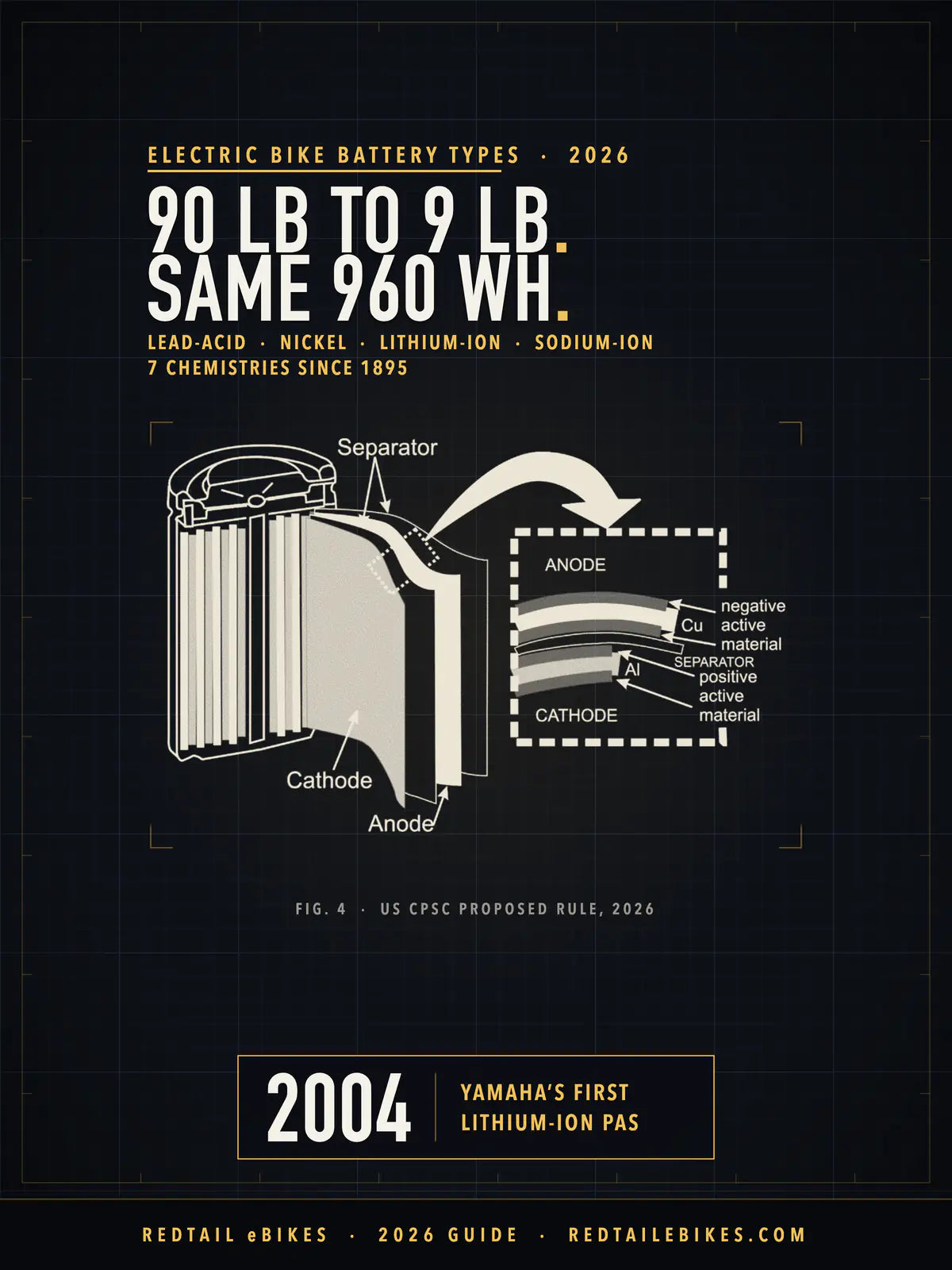

Share:
Bike Shops in Torrance, CA: 3 Verified eBike Stores
Eunorau ONE-TRIKE 2.0 Review 2026: 500W, 440 lb, $1,799