
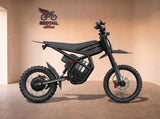
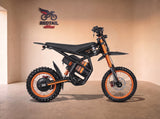
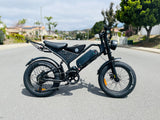
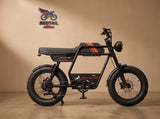
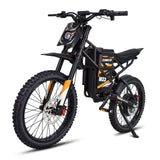
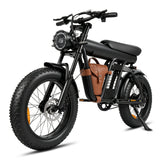
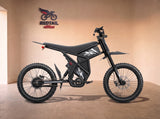
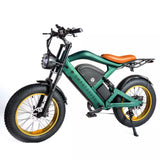
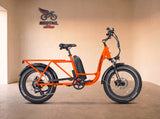
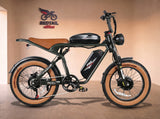
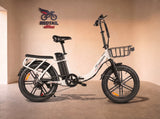
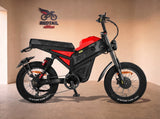
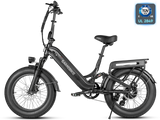
Quick Answer. The best electric bike for hills and mountains is the one the law, cold and distance allow where you ride. Rated under 750 W, an e-bike in 50 of the 51 jurisdictions: the Himiway D5 Pro ($1,999) for snow and distance, the VTUVIA CMB 8-Speed ($1,399) for shorter eastern climbs. Where 750 W is legal: the Qiolor TIGER PLUS ($2,499).
Those three answers come from measuring the 38 mountain ranges that reach into the United States, on up to eight tests each: how steep its e-bike routes are, how cold and snowy each season runs, how slippery the surface can get, how far you are from a town, a bike shop and a plug, whether a phone can reach anyone, and what the law allows.
Your weight, your height and your load then pick the size of motor, battery and frame.

Mount Hood above Trillium Lake in the Mount Hood National Forest, Oregon, in a scene generated with Playcut from two photographs of the lake on Wikimedia Commons, by the U.S. Forest Service, Pacific Northwest Region (public domain) and jhvanwa (CC0).
38 US mountain ranges · 152,912 miles of Forest Service roads and trails graded in 200-meter windows · grades checked on 1-meter lidar · 4 seasons · riders and loads from 162 to 321 lb · 12 bikes screened in all 51 jurisdictions. Prices and stock read from our store on November 3, 2026; maker figures verified on each maker's own site.
Written and reviewed by Milad Ghobadibeygvand, BScN (Western University, 2014), Redtail eBikes. Last verified: November 3, 2026. Corrections: support@redtailebikes.com.
A mountain asks four things of an e-bike that a city street never does. It asks the motor to hold a grade for a mile at a time, and the battery to bring you back from forest roads whose median point lies 17.3 miles from the nearest town in a straight line (Census population counts).
It asks the tires to grip when the surface turns to snow or ice, and you to be ready for trouble where, on 54% of the mapped network, no carrier reports a 4G or 5G signal (the FCC's mobile coverage map, via Esri).
So this guide to the best electric bikes for hills and mountains starts from the ground, range by range. It takes the 38 ranges of the Global Mountain Biodiversity Assessment's inventory that reach into the United States (Snethlage et al., 2022) and reads the Forest Service's own maps of the roads and trails open to motor vehicles and e-bikes.
It then grades those routes on the USGS elevation model, sets each season's cold from PRISM's 30-year normals, and asks of each bike here how far it climbs, how far it goes and where it is legal.
Start here. Find your situation, start with that bike, and read the last column for the fact that would change the answer. Each row opens its section.
| Your situation | Start with | Price | Where the answer changes |
|---|---|---|---|
| Snow, sand or a long way back, in a state that says less than 750 W | Buy the D5 Pro | $1,999 | steep, rough trail: the URUS 2.0 at $3,399; under 5 ft 3 in: the CMB 8-Speed |
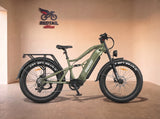
| Paved climbs and graded forest roads, in any state but New Jersey | Buy the CMB 8-Speed | $1,399 | over 6 ft 1 in, or rough roads: the A7 Pro at $1,999, full suspension |
| The West's long gaps, where 750 W is legal | Buy the TIGER PLUS | $2,499 | under 5 ft 10 in: the TIGER RE at $1,399, the same 1,680 Wh |
| A snow season, where 750 W is legal | Buy the D5 (Zebra) | $1,499 | rough roads: the D5 2.0 at $1,999, full suspension |
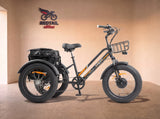
| Loads, passengers or hunting gear | Buy the G30-CARGO 2.0 | $1,444 | where 750 W is legal: the MAX-CARGO 2.0 at $1,444 |
The best electric bike for hills and mountains, by the law you ride under
The first question is a legal one, and it splits the country. 19 states define an e-bike as having a motor of less than 750 watts, so a bike rated at 750 W is not an e-bike there, while 31 jurisdictions write not more than 750 W or set no such line (how each state words it; Texas, for one). New Jersey's definition admits no throttle at all.
Every bike in the first group below is rated under 750 W and is an e-bike in 50 of the 51 jurisdictions; every bike in the second is rated at 750 W and is one in 31, apart from the VOYAGER, whose published 28 mph on a throttle puts it outside every definition.
Inside each group the bikes run from the least money to the most, with the VOYAGER, a machine for private land, last, and each card tells you who it is for, the ride, the published figure that decides it and the bike to read instead.
Rated under 750 W: an e-bike in 50 of the 51 jurisdictions
The short answer for this group: the CMB 8-Speed ($1,399) for budget climbing on roads, the D5 Pro ($1,999) for snow and long distances, the URUS 2.0 ($3,399) for steep trail.
Four of the five use a mid-drive motor, which drives the cranks and climbs through the bike's gears. A hub motor turns with the wheel, and power is torque times speed, so on a slow climb its published torque, not its watt rating, sets how hard it can push; a mid-drive in a low gear turns faster than the wheel and keeps its power.

VTUVIA CMB 8-Speed
$1,399The lightest bike on this page and a geared climber for paved mountain roads and graded forest roads.
Motor 500 W mid-drive (820 W peak), 175 N·m · Battery 691.2 Wh · Gears 8 · Tires 26 × 2.4 in
VTUVIA fits it to riders 5 ft 1 in to 6 ft 1 in, rates it for 300 lb in total and weighs it at 60 lb with rack and fenders, and ships it as a Class 2 e-bike.
The number that decides it: 5.0 mph on a 15% grade for a 191 lb rider on motor power alone, from the lightest bike on this page, which also makes it the easiest to lift onto a car rack at a trailhead.
List price: VTUVIA lists it at $1,899 and sells it at $1,399, the price you pay here.
Our full review: VTUVIA CMB 8-Speed review
Best for: you, if your mountain riding is on pavement and graded gravel, under about 6 ft 1 in. Not right for: snow or soft ground on its 2.4 in tires, where the D5 Pro runs 4 in tires; riders over 6 ft 1 in, whom the A7 Pro fits to 6 ft 5 in.
Ships free within the contiguous United States · dispatched within 1–3 business days · warranty claims made through us

Eunorau G30-CARGO 2.0
$1,444A longtail cargo bike rated under 750 W, for a hunting load, a camp kit or a passenger in a state that draws its line below 750 W.
Motor 500 W geared rear hub, 65 N·m · Battery 672 Wh, with an optional second pack · Tires 20 × 3.0 in
Eunorau rates it for 440 lb of rider, passengers and cargo, fits riders 5 ft 1 in to 6 ft 2 in and weighs it at 78 lb.
The number that decides it: 119 lb of payload still unused with a 291 lb rider and 30 lb of gear aboard, the most headroom of any bike in this group.
List price: Eunorau lists it at $1,699 and sells it at $1,444, the price you pay here.
Our full review: Eunorau G30-CARGO 2.0 review
Best for: you, if the load is the point of the trip. Not right for: long climbs fully loaded, where its hub's torque runs out sooner than a mid-drive's (what climbing takes); the D5 Pro carries 400 lb through its gears.
Ships free within the contiguous United States · dispatched within 1–3 business days · warranty claims made through us

Himiway A7 Pro
$1,999A full-suspension mid-drive for rough mountain roads, sized for taller riders.
Motor 500 W Ananda M100 mid-drive, 130 N·m · Battery 720 Wh · Gears 9 · Tires 27.5 × 2.4 in · Weight 77 lb
Himiway fits it to riders 5 ft 3 in to 6 ft 5 in and rates it for a 300 lb payload. Electric Bike Report, which rode it, lists it as Class 2 with the throttle to 20 mph and as Class 3 to 28 mph once Himiway supplies the passcode (Electric Bike Report), and Himiway's US owner's manual gives its range at speeds up to 28 mph (Himiway).
The number that decides it: full suspension and 130 N·m through 9 gears, at 77 lb, for riders up to 6 ft 5 in.
List price: Himiway lists it at $2,899 and sells it at $1,999 in its Black Friday sale, the price you pay here.
Our full review: Himiway A7 Pro review
Best for: you, if washboard and potholes are the problem more than snow. Not right for: you, if you and your gear weigh more than its 300 lb payload, as 291 lb plus 30 lb does; the D5 Pro carries 400 lb.
Ships free within the contiguous United States · dispatched within 1–3 business days · warranty claims made through us

Himiway D5 Pro
$1,999The answer for most western ranges under the 750 W line: 4 in tires for snow and sand, a 130 N·m mid-drive for the grade, and the biggest battery in this group for the distance.
Motor 500 W mid-drive, 130 N·m · Battery 960 Wh · Gears 9 · Tires 26 × 4.0 in
Himiway fits it to riders 5 ft 3 in to 6 ft 5 in, rates it for 400 lb and weighs it at 79 lb with the battery; on the throttle it reaches "up to 20 mph".
The number that decides it: in the range finder it is the under-750 W start in 32 of 38 ranges in winter, because it is the one bike in this group with 4 in tires, a mid-drive and 960 Wh.
List price: Himiway lists it at $2,599 and sells it at $1,999 in its Black Friday sale, the price you pay here.
Our full review: Himiway D5 Pro review
Best for: you, if your season includes snow, sand or a long way back. Not right for: you, if you stand under 5 ft 3 in (the CMB 8-Speed fits you from 5 ft 1 in); tight singletrack, where the URUS 2.0 has full suspension.
Ships free within the contiguous United States · dispatched within 1–3 business days · warranty claims made through us

Eunorau URUS 2.0
$3,399The steep-trail machine of the group: a Bafang M600 mid-drive on a full-suspension frame with an 11-42T cassette.
Motor 500 W Bafang M600 mid-drive, 120 N·m · Battery 840 Wh · Drivetrain SRAM NX, 11-42T · Tires 27.5 × 2.8 in
Eunorau fits it to riders 5 ft 3 in to 6 ft 4 in, rates it for 300 lb and weighs it at 61.7 lb. Eunorau's page prints a "Maximum Speed 20 MPH" and badges the bike "Class 3", "Speed limited" and "Unlockable"; its own product record prints 28 mph.
As shipped at 20 mph it is an e-bike in 50 of the 51 jurisdictions; unlocked to 28 mph with its throttle it falls outside the definition of every state that writes one, so keep it as it ships.
The number that decides it: 61.7 lb, the lightest full-suspension bike here by 15.3 lb, on an 11-42T cassette.
List price: Eunorau lists it at $3,999 and sells it at $3,399, the price you pay here.
Our full review: Eunorau URUS 2.0 review
Best for: you, if you ride steep, rough trail and care how the bike handles on the way down. Not right for: you, if you and your gear weigh more than its 300 lb payload; the D5 Pro carries 400 lb for $1,400 less.
Ships free within the contiguous United States · dispatched within 1–3 business days · warranty claims made through us
Under the 750 W line, the gears do the climbing. The D5 Pro is the default for snow and distance, the CMB 8-Speed the light budget climber, and the URUS 2.0 the trail bike; for loads, the G30-CARGO 2.0.
750 W: for the 31 jurisdictions where it is legal
The short answer for this group: the SN100 ($1,299) on a budget, the D5 (Zebra) ($1,499) for a snow season, the TIGER PLUS ($2,499) for the longest days.
Every bike here uses a 750 W hub motor, and each but the VOYAGER is an e-bike in 31 of the 51 jurisdictions. The 750 W rating buys speed on a grade: at 15% and 191 lb, these bikes hold 6.4 to 6.9 mph on motor power alone against 4.6 to 5.0 mph for the bikes rated under 750 W (the climbing table).

VTUVIA SN100
$1,299The least money for a 750 W fat-tire e-bike here, sold by VTUVIA as a hunting bike.
Motor 750 W rear hub (1,200 W peak), 85 N·m · Battery 672 Wh · Gears 7 · Tires 26 × 4.0 in
VTUVIA prints two figures for some specifications, and both are given here:
- Capacity: 400 lb (its product page) or 330 lb (its specifications page)
- Weight: 87 lb (with rack and fenders, on its product page) or 72 lb (battery included, on its specifications page)
- Rider window: 5 ft 8 in to 6 ft 5 in (its product page) or 5 ft 5 in to 6 ft 4 in (VTUVIA's buying guide)
It ships as Class 2, at 20 mph.
The number that decides it: 6.7 mph on a 15% grade for a 191 lb rider on motor power alone, at $1,299.
List price: VTUVIA lists it at $1,599 and sells it at $1,299, the price you pay here.
Best for: you, if the trip is a day of moderate trail from a truck or camp. Not right for: long days far from a plug on its 672 Wh pack, where the TIGER PLUS carries 1,680 Wh; you, if you stand under 5 ft 5 in (the TIGER RE fits you from 5 ft 1 in).
Ships free within the contiguous United States · dispatched within 1–3 business days · warranty claims made through us

Qiolor TIGER RE
$1,399The biggest battery here at a budget price, sized for riders from 5 ft 1 in to 5 ft 9 in.
Motor 750 W hub (1,100 W peak), 85 N·m · Battery 1,680 Wh · Suspension rear · Tires 20 × 4.0 in
Qiolor fits it to riders 5 ft 1 in to 5 ft 9 in, rates it for 400 lb and weighs it at 98 lb; it ships as a Class 2 e-bike with "the default maximum speed ... set to 20 MPH".
The number that decides it: even in winter, one charge on the TIGER RE reaches 67% of the Southern Rockies' mapped network out and back from the nearest town, against 28% for the D5 Pro's 960 Wh (the reach tables).
List price: Qiolor lists it at $2,099 and sells it at $1,399, the price you pay here.
Our full review: Qiolor Tiger RE review
Best for: you, if you stand under 5 ft 10 in and your rides start a long way from town. Not right for: you, if you stand over 5 ft 9 in (the TIGER PLUS fits you to 6 ft 6 in with the same battery), or if you have to lift the bike, at 98 lb the heaviest here.
Ships free within the contiguous United States · dispatched within 1–3 business days · warranty claims made through us

Eunorau MAX-CARGO 2.0
$1,444A 750 W longtail for loads and passengers where 750 W is legal.
Motor 750 W rear hub, 70 N·m · Battery 672 Wh, with an optional second pack · Gears 7 · Tires 24 × 2.4 in
Eunorau rates it for 440 lb, fits riders 5 ft 2 in to 6 ft 1 in and weighs it at 85 lb. Its highlights read "Class 3 Speed limited Unlockable", and its rows print "Maximum Speed 20MPH" and a half-twist throttle; as shipped it is an e-bike in 31 of the 51 jurisdictions.
The number that decides it: 4.6 mph on a 15% grade with a 291 lb rider and 30 lb of gear, against 3.1 mph for the 500 W G30-CARGO 2.0.
List price: Eunorau lists it at $1,699 and sells it at $1,444, the price you pay here.
Our full review: Eunorau MAX-CARGO 2.0 review
Best for: you, if you carry a lot and your state allows 750 W. Not right for: states that draw the line below 750 W, where the G30-CARGO 2.0 is the legal cargo bike.
Ships free within the contiguous United States · dispatched within 1–3 business days · warranty claims made through us

Himiway D5 (Zebra)
$1,499A 750 W fat bike for a snow season: 4 in tires, a geared hub and 960 Wh.
Motor 750 W geared hub, 85–86 N·m · Battery 960 Wh · Gears 7 · Tires 26 × 4.0 in
Himiway fits it to riders 5 ft 3 in to 6 ft 5 in, rates it for 400 lb and weighs it at 79 lb with the battery; on the throttle it reaches "up to 20 mph". Himiway prints its torque as 86 N·m in one place and 85 N·m in another; both are given.
The number that decides it: 6.9 mph on a 15% grade for a 191 lb rider on motor power alone, on 4 in tires, at $1,499.
List price: Himiway lists it at $2,299 and sells it at $1,499, the price you pay here.
Our full review: Himiway D5 (Zebra) review
Best for: you, if your riding season includes snow and you stand 5 ft 3 in or taller. Not right for: the longest gaps, where the TIGER PLUS carries 1,680 Wh; rough roads at speed, where the D5 2.0 has full suspension.
Ships free within the contiguous United States · dispatched within 1–3 business days · warranty claims made through us

Himiway D5 2.0
$1,999Full suspension on 4 in tires with a 750 W hub, in three frames: a 26 in step-over, a 26 in step-thru and a 20 in step-thru.
Motor 750 W rear geared hub, 90 N·m · Battery 720 Wh · Tires 26 × 4.0 in on the 26 in frames
Himiway's frames differ in fit, weight and payload: the 26 in bikes weigh 92 lb and carry 400 lb, the 20 in weighs 80 lb and carries 440 lb, and the windows run from 4 ft 11 in on the 20 in to 6 ft 5 in on the 26 in. Within that payload Himiway caps the rider at 265 lb. It ships at 20 mph, and the display can set it to Class 3 and 28 mph (Himiway).
The number that decides it: the only bike here with full suspension on 26 × 4.0 in tires, at $1,999 for the 26 in step-thru the button adds.
List price: Himiway lists it at $2,199 and sells it at $1,999, the price you pay here.
Our full review: Himiway D5 2.0 review
Best for: you, if your mountain riding is rough forest road and you want the ride to stay comfortable. Not right for: the longest days on its 720 Wh pack, or you, if you weigh over 265 lb; the TIGER PLUS carries 1,680 Wh and 400 lb.
Ships free within the contiguous United States · dispatched within 1–3 business days · warranty claims made through us

Qiolor TIGER PLUS
$2,499The bike for the West's longest gaps: the same 1,680 Wh battery as the TIGER RE on a frame Qiolor fits to riders from 5 ft 3 in to 6 ft 6 in, with a bench seat for two.
Motor 750 W hub (1,100 W peak), 85 N·m · Battery 1,680 Wh · Suspension air shock · Tires 20 × 4.0 in
Qiolor rates it for 400 lb and weighs it at 90 lb; it ships as a Class 2 e-bike set to 20 mph.
The number that decides it: it is the 750 W start in 18 of 38 ranges in summer in the range finder, because those ranges are the ones a 720 Wh pack cannot cover.
Our full review: Qiolor Tiger Plus review
Best for: you, if your days are long and the nearest plug is far. Not right for: you, if you stand under 5 ft 3 in (the TIGER RE fits you); states that draw the line below 750 W, where the D5 Pro is the long-distance bike.
Ships free within the contiguous United States · dispatched within 1–3 business days · warranty claims made through us
For private land and roads open to every motor vehicle

Samebike VOYAGER
$899A 960 Wh pack for the least money on this page, for riding where the e-bike classes do not decide access: your own land, a ranch, a hunting lease, and the roads a forest's map opens to all motor vehicles, under your state's vehicle rules.
Motor 750 W rear hub (1,500 W peak), "85+" N·m · Battery 960 Wh · Gears 8 · Tires 20 × 4.0 in
Samebike publishes a 45 km/h (28 mph) top speed and a throttle. Read that way, the VOYAGER sits outside the e-bike definition in all 51 jurisdictions, and on a national forest it rides as a motor vehicle on the routes the map opens to motor vehicles (the 750-watt line).
Samebike lists the motor at 750 W in its description and 1,000 W in its feature list (Samebike).
Its manual rates the load at 265 lb and its product page at 150 kg (about 331 lb); plan on the lower figure. Samebike's drawing fits riders 5 ft 3 in to 6 ft 11 in. If your state's wording hangs on the top speed, email us before ordering and we will get the delivered bike's figures from Samebike in writing.
The number that decides it: 960 Wh for $899, the lowest price here for a pack of 960 Wh or more.
Our full review: Samebike VOYAGER review
Best for: you, if you ride your own ground. Not right for: public e-bike trails and paths, where the D5 Pro or the D5 (Zebra) fits the class rules; you, if you and your gear weigh over 265 lb, the lower of Samebike's two load figures.
Ships free within the contiguous United States · dispatched within 1–3 business days · warranty claims made through us
At 750 W, the battery decides. The TIGER PLUS and TIGER RE carry 1,680 Wh for the long western gaps; the D5 (Zebra) is the snow-season fat bike, the D5 2.0 the full-suspension one, and the SN100 the least money for an e-bike.
For more on the bikes themselves, see our fat-tire e-bike guide, long-range e-bike guide and electric mountain bike guide, or browse the store's fat-tire e-bikes.
All twelve side by side
| Bike | Price | Motor | Battery | Weight | Payload | Legal in |
|---|---|---|---|---|---|---|
| CMB 8-Speed | $1,399 | 500 W mid-drive, 175 N·m | 691.2 Wh | 60 lb | 300 lb | 50 of 51 |
| A7 Pro | $1,999 | 500 W mid-drive, 130 N·m | 720 Wh | 77 lb | 300 lb | 50 of 51 |
| D5 Pro | $1,999 | 500 W mid-drive, 130 N·m | 960 Wh | 79 lb | 400 lb | 50 of 51 |
| URUS 2.0 | $3,399 | 500 W mid-drive, 120 N·m | 840 Wh | 61.7 lb | 300 lb | 50 of 51 |
| G30-CARGO 2.0 | $1,444 | 500 W hub, 65 N·m | 672 Wh | 78 lb | 440 lb | 50 of 51 |
| VOYAGER | $899 | 750 W hub, 85 N·m | 960 Wh | 87.1 lb | 265 or 331 lb | 0 of 51 as published |
| SN100 | $1,299 | 750 W hub, 85 N·m | 672 Wh | 87 or 72 lb | 330 or 400 lb | 31 of 51 |
| TIGER RE | $1,399 | 750 W hub, 85 N·m | 1,680 Wh | 98 lb | 400 lb | 31 of 51 |
| D5 (Zebra) | $1,499 | 750 W hub, 85–86 N·m | 960 Wh | 79 lb | 400 lb | 31 of 51 |
| D5 2.0 | $1,999 | 750 W hub, 90 N·m | 720 Wh | 92 or 80 lb | 400 or 440 lb; rider to 265 lb | 31 of 51 |
| TIGER PLUS | $2,499 | 750 W hub, 85 N·m | 1,680 Wh | 90 lb | 400 lb | 31 of 51 |
| MAX-CARGO 2.0 | $1,444 | 750 W hub, 70 N·m | 672 Wh | 85 lb | 440 lb | 31 of 51 |
Legal in counts the 51 jurisdictions whose e-bike definition each bike meets at the speed it ships at: the A7 Pro's 20 mph as Electric Bike Report found it after riding the bike, and the VOYAGER's 45 km/h as Samebike publishes it.
How fast each bike climbs, for your weight
| Bike (motor) | 15% grade, 191 lb rider | 15% grade, 291 lb rider + 30 lb | Steepest grade the hub's torque holds, 191 lb | Payload left, 291 lb + 30 lb |
|---|---|---|---|---|
| CMB 8-Speed (500 W mid-drive) | 5.0 mph motor, 6.6 pedaling easily | 3.3 mph, 5.0 | mid-drive: gears multiply it | over the payload by 21 lb |
| A7 Pro (500 W mid-drive) | 4.6 mph motor, 6.2 pedaling easily | 3.2 mph, 4.8 | mid-drive: gears multiply it | over the payload by 21 lb |
| D5 Pro (500 W mid-drive) | 4.6 mph motor, 6.1 pedaling easily | 3.1 mph, 4.7 | mid-drive: gears multiply it | 79 lb |
| URUS 2.0 (500 W mid-drive) | 4.9 mph motor, 6.5 pedaling easily | 3.3 mph, 4.9 | mid-drive: gears multiply it | over the payload by 21 lb |
| G30-CARGO 2.0 (500 W hub) | 4.6 mph motor, 6.2 pedaling easily | 3.1 mph, 4.7 | 20.6% (upper bound) | 119 lb |
| VOYAGER (750 W hub) | 6.7 mph motor, 8.1 pedaling easily | 4.6 mph, 6.1 | 26.8% (upper bound) | over the payload by 56 lb |
| SN100 (750 W hub) | 6.7 mph motor, 8.1 pedaling easily | 4.6 mph, 6.1 | 20.0% (upper bound) | 9 lb |
| TIGER RE (750 W hub) | 6.4 mph motor, 7.8 pedaling easily | 4.5 mph, 6.0 | 25.7% (upper bound) | 79 lb |
| D5 (Zebra) (750 W hub) | 6.9 mph motor, 8.3 pedaling easily | 4.7 mph, 6.3 | 20.7% (upper bound) | 79 lb |
| D5 2.0 (750 W hub) | 6.6 mph motor, 8.0 pedaling easily | 4.5 mph, 6.1 | 20.9% (upper bound) | rider over Himiway's 265 lb rider limit by 26 lb |
| TIGER PLUS (750 W hub) | 6.6 mph motor, 8.0 pedaling easily | 4.6 mph, 6.1 | 26.5% (upper bound) | 79 lb |
| MAX-CARGO 2.0 (750 W hub) | 6.7 mph motor, 8.2 pedaling easily | 4.6 mph, 6.2 | 17.8% (upper bound) | 119 lb |
The first two columns hold the bike at a steady 15% grade, the grade the steepest 5% of e-bike routes reach in most western ranges (how steep, measured), with the motor at its rated power and the rider either resting or pedaling easily (Martin et al., 1998).
The third column is the steepest grade a hub motor's published torque can hold at a crawl, and it is an upper bound: it uses the nominal wheel size, and a 4 in tire makes the wheel larger than that (how we computed it).
Find your range: 38 US mountain ranges, summer and winter
Find the range you ride in, then read across: how steep its steepest e-bike routes run, how cold and snowy its winter is, how much of its network has no reported phone signal, and the bike to start with in summer and in winter.
The first bike in each start column is rated under 750 W and is an e-bike in law on at least 90% of the range's land; the second is the 750 W choice, shown only where 750 W is legal on at least 90% of the range's land, with any state where it is not legal named.
| Range (states) | Steepest 5% of its e-bike routes | Winter: median low, snow days | No 4G or 5G reported | Start with, summer (rated under 750 W · or rated 750 W where legal) | Start with, winter (the same) |
|---|---|---|---|---|---|
| Appalachian Plateaus (WV, PA, NY, TN, KY, VA) | 9.5% | 20 °F (-6.9 °C), 40 days | 70% | CMB 8-Speed | D5 Pro |
| Appalachian Ridges (VA, PA, WV) | 13.9% | 23 °F (-5.0 °C), 20 days | 47% | CMB 8-Speed | D5 Pro |
| Blue Ridge Mountains (NC, VA, TN, GA) | 16.8% | 28 °F (-2.5 °C), 6 days | 33% | CMB 8-Speed | CMB 8-Speed |
| Northern U.S. Appalachians (VT, NH, ME) | 9.1% | 10 °F (-12.2 °C), 80 days | 41% | CMB 8-Speed | D5 Pro |
| Piedmont-Southeast Coast (NC) (no Forest Service network) | not graded | 29 °F (-1.6 °C), 2 days | 11% | CMB 8-Speed · or SN100 | CMB 8-Speed · or SN100 |
| Hawaiian Islands (HI) (no Forest Service network) | not graded | 62 °F (16.7 °C), 0 days | 24% | CMB 8-Speed · or SN100 | CMB 8-Speed · or SN100 |
| Alaska Range (AK) (no Forest Service network) | not graded | 2 °F (-16.4 °C), 90 days | 91% | D5 Pro · or TIGER PLUS | D5 Pro · or TIGER PLUS |
| Aleutian Ranges (AK) (no Forest Service network) | not graded | 15 °F (-9.5 °C), 44 days | 100% | D5 Pro · or TIGER PLUS | D5 Pro · or TIGER PLUS |
| Brooks Range (AK) (no Forest Service network) | not graded | -8 °F (-22.1 °C), no station | 100% | D5 Pro · or TIGER PLUS | D5 Pro · or TIGER PLUS |
| Cascade Range (WA, OR, CA) | 20.6% | 28 °F (-2.4 °C), 15 days | 60% | D5 Pro · or TIGER PLUS | D5 Pro · or TIGER PLUS |
| Coast Mountains (Alaska) (AK) | 14.2% | 28 °F (-2.0 °C), 55 days | 85% | D5 Pro · or TIGER PLUS | D5 Pro · or TIGER PLUS |
| Olympic Mountains (WA) | 22.2% | 33 °F (0.3 °C), no station | 47% | D5 Pro · or TIGER PLUS | D5 Pro · or TIGER PLUS |
| Saint Elias Mountains (AK) | 12.8% | 26 °F (-3.1 °C), 69 days | 32% | D5 Pro · or TIGER PLUS | D5 Pro · or TIGER PLUS |
| Sierra Nevada (CA) | 18.4% | 28 °F (-2.3 °C), 3 days | 51% | D5 Pro · or TIGER PLUS | D5 Pro · or TIGER PLUS |
| Colorado Plateau (UT, AZ, CO, NM) | 15.7% | 16 °F (-9.0 °C), 49 days | 26% | D5 Pro | D5 Pro |
| Southern Rocky Mountains (CO, NM, WY) | 16.8% | 9 °F (-12.6 °C), 71 days | 55% | D5 Pro · or TIGER PLUS (not in WY) | D5 Pro · or TIGER PLUS (not in WY) |
| Great Basin Ranges (NV, CA, UT, OR, ID, AZ) | 20.6% | 19 °F (-7.3 °C), 8 days | 44% | D5 Pro · or TIGER PLUS (not in AZ, ID) | D5 Pro · or TIGER PLUS (not in AZ, ID) |
| Columbia Mountains (WA, ID, MT) | 23.9% | 19 °F (-7.5 °C), 79 days | 61% | D5 Pro | D5 Pro |
| Klamath Mountains (CA, OR) | 23.9% | 31 °F (-0.3 °C), 1 day | 65% | D5 Pro · or TIGER PLUS | D5 Pro · or TIGER PLUS |
| Transverse Ranges (CA) | 18.2% | 33 °F (0.5 °C), 0 days | 26% | URUS 2.0 · or D5 2.0 | URUS 2.0 · or D5 2.0 |
| Peninsular Ranges (CA) | 15.6% | 37 °F (2.7 °C), 0 days | 7% | CMB 8-Speed · or SN100 | CMB 8-Speed · or SN100 |
| Columbia Plateau (OR, ID, WA) | 20.4% | 22 °F (-5.7 °C), 23 days | 46% | D5 Pro | D5 Pro |
| Alaska Intermountain Ranges (AK) (no Forest Service network) | not graded | -3 °F (-19.5 °C), 91 days | 98% | D5 Pro · or TIGER PLUS | D5 Pro · or TIGER PLUS |
| Adirondack Mountains (NY) (no Forest Service network) | not graded | 9 °F (-12.9 °C), 75 days | 37% | CMB 8-Speed | D5 Pro |
| Ouachita Mountains (AR, OK) | 14.4% | 31 °F (-0.8 °C), 1 day | 21% | CMB 8-Speed | CMB 8-Speed |
| Oregon Coast Range (OR, WA) | 13.6% | 37 °F (2.7 °C), 0 days | 53% | D5 Pro · or TIGER PLUS | D5 Pro · or TIGER PLUS |
| Black Hills (SD, WY) | 10.5% | 15 °F (-9.6 °C), 56 days | 22% | CMB 8-Speed | D5 Pro |
| South-Central Alaska (AK) | 20.5% | 15 °F (-9.3 °C), 88 days | 9% | D5 Pro · or TIGER PLUS | D5 Pro · or TIGER PLUS |
| Yukon Intermountain Ranges (AK) (no Forest Service network) | not graded | -10 °F (-23.4 °C), no station | 100% | D5 Pro · or TIGER PLUS | D5 Pro · or TIGER PLUS |
| Southwest Basins and Ranges (AZ, NM, TX) | 18.0% | 26 °F (-3.2 °C), 0 days | 45% | D5 Pro | D5 Pro |
| Ozark Plateau (AR) | 14.0% | 30 °F (-1.2 °C), 2 days | 47% | CMB 8-Speed | D5 Pro |
| Central Montana Rocky Mountains (MT, ID) | 19.6% | 15 °F (-9.3 °C), 78 days | 58% | D5 Pro · or TIGER PLUS (not in ID) | D5 Pro · or TIGER PLUS (not in ID) |
| Greater Yellowstone Rockies (WY, MT) | 19.3% | 9 °F (-12.9 °C), 65 days | 53% | D5 Pro | D5 Pro |
| Idaho-Bitterroot Rocky Mountains (ID, MT) | 20.1% | 17 °F (-8.3 °C), 77 days | 75% | D5 Pro | D5 Pro |
| Western Rocky Mountains (UT, ID, WY) | 20.4% | 12 °F (-11.2 °C), 63 days | 50% | D5 Pro | D5 Pro |
| Northern California Coast Ranges (CA) | 23.2% | 32 °F (0.1 °C), 0 days | 67% | D5 Pro · or TIGER PLUS | D5 Pro · or TIGER PLUS |
| Southern California Coast Ranges (CA) | 19.0% | 39 °F (3.7 °C), 0 days | 44% | D5 Pro · or TIGER PLUS | D5 Pro · or TIGER PLUS |
| Great Plains outlier ranges (MT, NM, CO, WY) (no Forest Service network) | not graded | 15 °F (-9.5 °C), 44 days | 33% | CMB 8-Speed · or SN100 (not in WY) | D5 Pro · or D5 (Zebra) (not in WY) |
The 9 ranges marked "no Forest Service network" have no national forest roads or trails in the Forest Service's motor vehicle maps, so their columns read the whole range instead, and riding there runs on the rules of whoever manages the land: the National Park Service, the Bureau of Land Management, a state or a borough (the 750-watt line).
How the finder chooses
Four tests decide each cell, and each one is a measurement this guide publishes:
- Legal. A bike is offered only where it is an e-bike in law on at least 90% of the range's land, from the same 51-jurisdiction screen behind the 750-watt line.
- Snow. A season counts as a snow season when the range's median NOAA weather station reports 20 or more days with an inch of snow on the ground in it, or, in winter, when the network's median daily low is 18 °F (-7.8 °C) or colder (cold and altitude).
- Steep. A range counts as steep when the steepest 5% of its mapped e-bike routes reach an 18% grade (how steep, measured).
- Far. A range counts as far when one 720 Wh charge, carrying a 191 lb rider, reaches less than 60% of its mapped network and back from the nearest town in that season (the reach tables); for a range with no Forest Service network, when its median point lies 25 miles (40 km) or more from the nearest town in a straight line.
Under 750 W, snow or distance points to the D5 Pro, steepness to the URUS 2.0, and anything else to the CMB 8-Speed. At 750 W, distance points to the TIGER PLUS, snow to the D5 (Zebra), steepness to the D5 2.0, and anything else to the SN100. Himiway limits the D5 2.0's rider to 265 lb, so if you weigh more, start a steep range with the TIGER PLUS instead.
The thresholds are our editorial choice; the inputs are measured, and each test reads its figure as the tables print it, so you can check any row yourself. If your own ride is shorter, gentler or warmer than the range's median, the cheaper bike in the same row may be the better buy.
West of the Great Plains, distance decides before steepness does. In 20 of the 29 ranges with a mapped network, a 720 Wh pack cannot reach 60% of it and back even in summer, and 5 of the ranges without one lie 25 miles or more from a town, which is why the D5 Pro and the TIGER PLUS lead most western rows; in the East, shorter networks keep the CMB 8-Speed in play.
Appalachians, Ozarks and the East
- Appalachian Plateaus (WV 37%, PA 17%, NY 16%, TN 10%, KY 10%, VA 6%, MD 2%, GA 1%): 413 miles of mapped Forest Service roads and trails; 78% of them open in winter and 88% in summer; one 960 Wh charge reaches 81% of the network and back in summer, 75% in winter; a 750 W bike is not an e-bike in New York, Tennessee, West Virginia.
- Appalachian Ridges (VA 52%, PA 22%, WV 21%, TN 2%, NY 1%, AL 1%, MD 1%): 1,314 miles of mapped Forest Service roads and trails; 76% of them open in winter and 73% in summer; one 960 Wh charge reaches 96% of the network and back in summer, 92% in winter; a 750 W bike is not an e-bike in Alabama, New York, Tennessee, West Virginia.
- Blue Ridge Mountains (NC 48%, VA 21%, TN 18%, GA 10%, SC 2%, MD under 1%): 2,417 miles of mapped Forest Service roads and trails; 55% of them open in winter and 68% in summer; one 960 Wh charge reaches 99% of the network and back in summer, 97% in winter; a 750 W bike is not an e-bike in Tennessee.
- Northern U.S. Appalachians (VT 38%, NH 29%, ME 27%, MA 4%, NY 2%, CT under 1%): 254 miles of mapped Forest Service roads and trails; 15% of them open in winter and 100% in summer; one 960 Wh charge reaches 100% of the network and back in summer, 100% in winter; a 750 W bike is not an e-bike in Maine, New Hampshire, New York, Vermont.
- Adirondack Mountains (NY 100%): no Forest Service roads or trails in its motor vehicle maps; its median point lies 12 miles from the nearest town; a 750 W bike is not an e-bike in New York.
- Piedmont-Southeast Coast (NC 100%): no Forest Service roads or trails in its motor vehicle maps; its median point lies 8 miles from the nearest town.
- Ozark Plateau (AR 100%): 476 miles of mapped Forest Service roads and trails; 99% of them open in winter and 97% in summer; one 960 Wh charge reaches 93% of the network and back in summer, 83% in winter; a 750 W bike is not an e-bike in Arkansas.
- Ouachita Mountains (AR 54%, OK 46%): 568 miles of mapped Forest Service roads and trails; 86% of them open in winter and 85% in summer; one 960 Wh charge reaches 100% of the network and back in summer, 98% in winter; a 750 W bike is not an e-bike in Arkansas.
Black Hills and the Great Plains outliers
- Black Hills (SD 69%, WY 31%): 556 miles of mapped Forest Service roads and trails; 64% of them open in winter and 98% in summer; one 960 Wh charge reaches 85% of the network and back in summer, 82% in winter; a 750 W bike is not an e-bike in Wyoming.
- Great Plains outlier ranges (MT 62%, NM 26%, CO 10%, WY 1%): no Forest Service roads or trails in its motor vehicle maps; its median point lies 17 miles from the nearest town; a 750 W bike is not an e-bike in Wyoming.
Southern Rockies, Colorado Plateau and the Southwest
- Southern Rocky Mountains (CO 82%, NM 12%, WY 6%): 15,225 miles of mapped Forest Service roads and trails; 63% of them open in winter and 92% in summer; one 960 Wh charge reaches 48% of the network and back in summer, 28% in winter; a 750 W bike is not an e-bike in Wyoming.
- Colorado Plateau (UT 49%, AZ 29%, CO 12%, NM 10%): 11,853 miles of mapped Forest Service roads and trails; 89% of them open in winter and 97% in summer; one 960 Wh charge reaches 40% of the network and back in summer, 33% in winter; a 750 W bike is not an e-bike in Arizona.
- Southwest Basins and Ranges (AZ 57%, NM 30%, TX 12%, CA 2%, NV under 1%): 4,568 miles of mapped Forest Service roads and trails; 82% of them open in winter and 83% in summer; one 960 Wh charge reaches 63% of the network and back in summer, 59% in winter; a 750 W bike is not an e-bike in Arizona, Texas.
Northern Rockies
- Central Montana Rocky Mountains (MT 98%, ID 2%): 9,589 miles of mapped Forest Service roads and trails; 73% of them open in winter and 94% in summer; one 960 Wh charge reaches 54% of the network and back in summer, 46% in winter; a 750 W bike is not an e-bike in Idaho.
- Greater Yellowstone Rockies (WY 71%, MT 24%, ID 3%, CO 1%, UT under 1%): 3,432 miles of mapped Forest Service roads and trails; 58% of them open in winter and 96% in summer; one 960 Wh charge reaches 29% of the network and back in summer, 18% in winter; a 750 W bike is not an e-bike in Idaho, Wyoming.
- Idaho-Bitterroot Rocky Mountains (ID 87%, MT 13%): 19,612 miles of mapped Forest Service roads and trails; 79% of them open in winter and 98% in summer; one 960 Wh charge reaches 33% of the network and back in summer, 28% in winter; a 750 W bike is not an e-bike in Idaho.
- Western Rocky Mountains (UT 53%, ID 26%, WY 16%, CO 4%): 5,796 miles of mapped Forest Service roads and trails; 80% of them open in winter and 98% in summer; one 960 Wh charge reaches 53% of the network and back in summer, 30% in winter; a 750 W bike is not an e-bike in Idaho, Wyoming.
- Columbia Mountains (WA 69%, ID 18%, MT 13%): 4,746 miles of mapped Forest Service roads and trails; 71% of them open in winter and 94% in summer; one 960 Wh charge reaches 48% of the network and back in summer, 40% in winter; a 750 W bike is not an e-bike in Idaho.
Great Basin and Columbia Plateau
- Great Basin Ranges (NV 58%, CA 20%, UT 10%, OR 7%, ID 3%, AZ 1%): 11,031 miles of mapped Forest Service roads and trails; 93% of them open in winter and 95% in summer; one 960 Wh charge reaches 29% of the network and back in summer, 23% in winter; a 750 W bike is not an e-bike in Arizona, Idaho.
- Columbia Plateau (OR 66%, ID 18%, WA 16%): 5,848 miles of mapped Forest Service roads and trails; 70% of them open in winter and 97% in summer; one 960 Wh charge reaches 42% of the network and back in summer, 34% in winter; a 750 W bike is not an e-bike in Idaho.
Sierra Nevada and the California ranges
- Sierra Nevada (CA 98%, NV 2%): 16,399 miles of mapped Forest Service roads and trails; 63% of them open in winter and 97% in summer; one 960 Wh charge reaches 77% of the network and back in summer, 68% in winter.
- Klamath Mountains (CA 69%, OR 31%): 6,157 miles of mapped Forest Service roads and trails; 80% of them open in winter and 99% in summer; one 960 Wh charge reaches 54% of the network and back in summer, 42% in winter.
- Transverse Ranges (CA 100%): 1,376 miles of mapped Forest Service roads and trails; 64% of them open in winter and 91% in summer; one 960 Wh charge reaches 93% of the network and back in summer, 91% in winter.
- Peninsular Ranges (CA 100%): 462 miles of mapped Forest Service roads and trails; 99% of them open in winter and 99% in summer; one 960 Wh charge reaches 96% of the network and back in summer, 96% in winter.
- Northern California Coast Ranges (CA 100%): 3,455 miles of mapped Forest Service roads and trails; 94% of them open in winter and 100% in summer; one 960 Wh charge reaches 51% of the network and back in summer, 47% in winter.
- Southern California Coast Ranges (CA 100%): 168 miles of mapped Forest Service roads and trails; 40% of them open in winter and 100% in summer; one 960 Wh charge reaches 76% of the network and back in summer, 71% in winter.
Pacific Northwest
- Cascade Range (WA 53%, OR 36%, CA 11%): 22,371 miles of mapped Forest Service roads and trails; 81% of them open in winter and 97% in summer; one 960 Wh charge reaches 44% of the network and back in summer, 37% in winter.
- Olympic Mountains (WA 100%): 1,363 miles of mapped Forest Service roads and trails; 92% of them open in winter and 100% in summer; one 960 Wh charge reaches 59% of the network and back in summer, 59% in winter.
- Oregon Coast Range (OR 88%, WA 12%): 1,750 miles of mapped Forest Service roads and trails; 97% of them open in winter and 99% in summer; one 960 Wh charge reaches 72% of the network and back in summer, 70% in winter.
Alaska and Hawaii
- Alaska Range (AK 100%): no Forest Service roads or trails in its motor vehicle maps; its median point lies 72 miles from the nearest town.
- Aleutian Ranges (AK 100%): no Forest Service roads or trails in its motor vehicle maps; its median point lies 87 miles from the nearest town.
- Brooks Range (AK 100%): no Forest Service roads or trails in its motor vehicle maps; its median point lies 165 miles from the nearest town.
- Coast Mountains (Alaska) (AK 100%, WA under 1%): 1,618 miles of mapped Forest Service roads and trails; 99% of them open in winter and 99% in summer; one 960 Wh charge reaches 50% of the network and back in summer, 45% in winter.
- Saint Elias Mountains (AK 100%): 34 miles of mapped Forest Service roads and trails; 100% of them open in winter and 100% in summer; one 960 Wh charge reaches 0% of the network and back in summer, 0% in winter; the reach tables start in a community of 1,000 people or more, and the nearest, Juneau, lies 41 miles away in a straight line, while a smaller Census place lies a median 10 miles away.
- Alaska Intermountain Ranges (AK 100%): no Forest Service roads or trails in its motor vehicle maps; its median point lies 92 miles from the nearest town.
- South-Central Alaska (AK 100%): 61 miles of mapped Forest Service roads and trails; 65% of them open in winter and 88% in summer; one 960 Wh charge reaches 72% of the network and back in summer, 59% in winter.
- Yukon Intermountain Ranges (AK 100%): no Forest Service roads or trails in its motor vehicle maps; its median point lies 153 miles from the nearest town.
- Hawaiian Islands (HI 100%): no Forest Service roads or trails in its motor vehicle maps; its median point lies 7 miles from the nearest town.
How steep America's mountains are, measured
The steepest 5% of mapped e-bike routes run at 9.1% to 23.9% grade across the ranges that have them, sustained over 200 meters. Each range's figure comes from its steepest kind of route: e-bike-marked trail, motorized trail or road, each graded as the 95th percentile of every 200-meter stretch of the Forest Service network on USGS elevations.
That is the climb your bike has to hold, and the number the climbing table is built around.
The network is the Forest Service's own: every road and trail with a mapped line in its motor vehicle use maps, 152,912 miles of it inside the 29 ranges that have national forest roads and trails, sampled at a point every 50 meters along each trail and every 100 meters along each road, and read against the USGS 3D Elevation Program's 1/3 arc-second elevation model (USGS 3DEP).
Grade is the rise over each 200-meter window after a three-point running median, so one bad elevation sample cannot set a grade on its own. A kind of route needs at least 10 km (6.2 miles) graded before its figure counts, because a percentile of a few hundred meters is not a measurement; the roads are graded together, every class the map draws.
| Range | E-bike-marked trail, miles | Median grade | Steepest 5% | Share at 15% or more | Motorized trail, steepest 5% | Roads, steepest 5% |
|---|---|---|---|---|---|---|
| Appalachian Plateaus | 0 | none mapped | none mapped | none mapped | none mapped | 9.5% |
| Appalachian Ridges | 0 | none mapped | none mapped | none mapped | 13.9% | 10.2% |
| Blue Ridge Mountains | 0 | none mapped | none mapped | none mapped | 16.8% | 11.4% |
| Northern U.S. Appalachians | 0 | none mapped | none mapped | none mapped | none mapped | 9.1% |
| Cascade Range | 590 | 6.3% | 17.9% | 10% | 20.6% | 12.0% |
| Coast Mountains (Alaska) | 0 | none mapped | none mapped | none mapped | 14.2% | 11.8% |
| Olympic Mountains | 0 | none mapped | none mapped | none mapped | 22.2% | 12.3% |
| Saint Elias Mountains | 0 | none mapped | none mapped | none mapped | 12.5% | 12.8% |
| Sierra Nevada | 604 | 5.5% | 16.7% | 7% | 18.4% | 11.4% |
| Colorado Plateau | 706 | 4.0% | 13.5% | 3% | 15.7% | 11.1% |
| Southern Rocky Mountains | 801 | 6.3% | 16.8% | 9% | 16.4% | 12.2% |
| Great Basin Ranges | 1,264 | 7.5% | 20.6% | 14% | 16.0% | 12.8% |
| Columbia Mountains | 309 | 7.7% | 19.7% | 14% | 23.9% | 9.8% |
| Klamath Mountains | 0 | none mapped | none mapped | none mapped | 23.9% | 13.0% |
| Transverse Ranges | 0 | none mapped | none mapped | none mapped | 18.2% | 12.2% |
| Peninsular Ranges | 0 | none mapped | none mapped | none mapped | 15.6% | 12.0% |
| Columbia Plateau | 309 | 7.0% | 20.4% | 15% | 16.0% | 9.3% |
| Ouachita Mountains | 73 | 3.9% | 14.4% | 4% | under 6.2 miles graded | 9.9% |
| Oregon Coast Range | 0 | none mapped | none mapped | none mapped | under 6.2 miles graded | 13.6% |
| Black Hills | 0 | none mapped | none mapped | none mapped | 10.5% | 9.5% |
| South-Central Alaska | 0 | none mapped | none mapped | none mapped | 20.5% | 7.3% |
| Southwest Basins and Ranges | 49 | 4.5% | 15.9% | 6% | 18.0% | 11.8% |
| Ozark Plateau | 1 | under 6.2 miles graded | under 6.2 miles graded | under 6.2 miles graded | none mapped | 14.0% |
| Central Montana Rocky Mountains | 14 | 8.0% | 15.2% | 5% | 19.6% | 9.4% |
| Greater Yellowstone Rockies | 367 | 6.9% | 19.3% | 13% | 16.8% | 11.7% |
| Idaho-Bitterroot Rocky Mountains | 4,636 | 6.7% | 20.0% | 14% | 20.1% | 10.9% |
| Western Rocky Mountains | 1,558 | 7.6% | 20.4% | 14% | 15.5% | 11.5% |
| Northern California Coast Ranges | 0 | none mapped | none mapped | none mapped | 23.2% | 13.3% |
| Southern California Coast Ranges | 0 | none mapped | none mapped | none mapped | 19.0% | 14.9% |

We checked the elevation model against lidar. On 304 trail windows of 200 meters, drawn at random across 23 ranges where the USGS has flown 1-meter lidar, the 10-meter grade and the lidar grade differ by a median of 0.32 percentage points. Of those windows, 88.2% agree within 1 point and 98.7% within 2, and the 90th percentile is 15.8% in both.
The roads passed the same check: on 343 road windows across 26 ranges, the two grades differ by a median of 0.23 points, with 91.3% within 1 point and 98.3% within 2.
A 200-meter grade is a sustained climb, so a short ramp on a switchback can be steeper than any figure here.
Two cautions sit under every row. The Forest Service maps a line, and a mapped line can sit a few meters off the ground track, which the 200-meter window and the median are there to absorb. And the national map repeats some segments, so 296 trail and 2,215 road features that duplicate another feature exactly were counted once (limitations).
What climbing takes: motor, torque, your weight and your load
On a 15% grade, a 191 lb rider on a 750 W bike holds 6.4 to 6.9 mph on motor power alone; on a bike rated under 750 W, 4.6 to 5.0 mph. Add about 100 lb of rider and 30 lb of gear and those fall to 4.5 to 4.7 and 3.1 to 3.3 mph (Martin et al., 1998).
The motor is pushing the whole weight of bike, rider and load up the hill, so every pound counts the same wherever it rides.
The figures come from the published physics of cycling power (Martin et al., 1998): the motor at its rated power, an 80% motor efficiency, the rolling resistance of a tire on dry pavement and the air at 4,921 feet.
Riders are the median American woman (162 lb), the median man (191 lb) and the man at the 95th percentile (291 lb), from the CDC's latest national body measurements (NCHS, 2025). "Pedaling easily" adds half of an untrained rider's critical power, 3.19 watts per kilogram in a published measurement (Chorley et al., 2020); the half is our assumption.

Is a mid-drive better than a hub motor for hills?
On the steepest grades, yes: a mid-drive drives the cranks and multiplies its torque through the bike's gears, while a hub motor's push is fixed by its torque and its wheel size. Below a hub's ceiling, both hold a steady speed set by their rated power.
Torque decides something the watt rating cannot: whether the bike climbs at all at a crawl. A hub motor's published torque, divided by the wheel's radius, is the most push it can put on the ground, so a heavier load or a smaller torque stalls it on a grade a mid-drive in a low gear will still climb.
For the 191 lb rider the hub bikes here hold a crawl to 17.8% to 26.8% at most; with 291 lb and 30 lb of gear, to 11.6% to 17.5%, which is below the steepest 5% of the routes in 16 ranges. Those ceilings are upper bounds, because a 4 in tire makes the wheel larger than its nominal size.
Payload is the other limit, and it is the maker's figure: rider, gear and anything on the racks together. With a 291 lb rider and 30 lb of gear, the CMB 8-Speed, A7 Pro and URUS 2.0 are over their 300 lb payloads and the VOYAGER over the 265 lb its manual prints.
The D5 2.0 has the payload, but Himiway caps its rider at 265 lb (Himiway). The D5 Pro, the TIGER pair, the D5 (Zebra) and both cargo bikes carry it (cargo and hunting loads).
For a heavy rider on a steep grade, the D5 Pro climbs through 9 gears on a 130 N·m mid-drive, carries 400 lb and holds 960 Wh, at $1,999. It ships free within the contiguous United States.
Buy the D5 Pro, the climber that carries 400 lbThe 750-watt line: why the strongest climber is not an e-bike in 19 states
A motor rated at exactly 750 W is outside the e-bike definition in 19 states, because their statutes say "less than" or "fewer than" 750 watts; it is inside in 31 jurisdictions that say "not more than", set a different line or set none. The same bike can be an e-bike on one side of a state line and a moped on the other, and a mountain range that crosses a line takes both rules with it.
| State | What its definition says | Statute |
|---|---|---|
| Alabama | "electric motor of less than 750 watts" | Ala. Code § 32-1-1.1 |
| Arkansas | "less than seven hundred fifty watts" | Ark. Code § 27-51-1702 |
| Arizona | "electric motor of less than seven hundred fifty watts" | A.R.S. § 28-101(28) |
| Florida | "electric motor of less than 750 watts" | Fla. Stat. § 316.003(23) |
| Idaho | "electric motor of less than seven hundred fifty (750) watts" | Idaho Code § 49-106(1) |
| Illinois | "electric motor of less than 750 watts" | 625 ILCS 5/1-140.10 |
| Kansas | "electric motor of less than 750 watts" | K.S.A. 8-1489 |
| Louisiana | "electric motor of less than seven hundred fifty watts" | La. R.S. 32:1(95) |
| Maine | "electric motor of less than 750 watts" | 29-A M.R.S. § 101(22-B) |
| Missouri | "electric motor of less than 750 watts" | RSMo § 301.010(15) |
| Mississippi | "electric motor of less than seven hundred fifty (750) watts" | Miss. Code Ann. § 63-3-103 |
| New Hampshire | "electric motor of less than 750 watts" | RSA 259:27-a |
| New York | "electric motor of less than seven hundred fifty watts" | N.Y. VTL § 102-c |
| Ohio | "electric motor of less than seven hundred fifty watts" | R.C. 4511.01(SSS)–(VVV) |
| Tennessee | "electric motor of less than seven hundred fifty (750) watts" | Pub. Ch. 823 (2016), § 2 |
| Texas | "an electric motor of fewer than 750 watts" | Tex. Transp. Code § 664.001 |
| Vermont | "electric motor of less than 750 watts" | 23 V.S.A. § 4(46) |
| West Virginia | "electric motor of fewer than 750 watts" | W. Va. Code § 17C-1-70 |
| Wyoming | "electric motor of less than seven hundred fifty (750) watts" | W.S. 31-1-101(a)(xxxiv) |
New Jersey is the twentieth case, and its line is not about watts at all: its low-speed electric bicycle "ceases to provide assistance when the bicycle reaches the speed of 20 miles per hour" and assists only while you pedal, so no throttle bike on this page fits it (P.L.2025, c.285; New Jersey's e-bike rules).
Oregon, from January 1, 2027. House Bill 4007 makes "selling an impostor vehicle" a Class D traffic violation, and its section 20 reaches a bike that "is designed, manufactured or intended by the manufacturer or seller to be configured or modified" to run outside the class it is sold as, including by "a mechanical switch or button" or "the use of an application to increase or override the electric drive system" (HB 4007, enrolled, sections 20 and 33).
Every bike here is screened in the class it ships in; in Oregon, ride it in that class, and our Oregon e-bike rules carry the rest of the bill.
Alaska and Kentucky write no e-bike definition at all, so this guide holds a bike there to the federal public-land definition below (36 CFR § 1.4). Each state's own page quotes and links its statute, and our 50-state law guide sets them side by side.
Are e-bikes allowed in national forests?
On the roads and trails a forest's motor vehicle use map opens to them, because the Forest Service treats every e-bike as a motor vehicle. Its rule defines a motor vehicle as "Any vehicle which is self-propelled", with exceptions only for vehicles on rails and for wheelchairs (36 CFR § 212.1), and it prohibits operating one "other than in accordance with" the designations on the forest's motor vehicle use map (36 CFR § 261.13).
Riding a route the map does not open breaks that prohibition, and the Forest Service's penalty for breaking one is "imprisonment of not more than six months or a fine in accordance with the applicable provisions of 18 U.S.C. 3571 or both" (36 CFR § 261.1b).
Its own e-bike page says that "Class 1, 2, and 3 e-bikes are allowed on motorized trails and roads on national forests and grasslands" (Forest Service).
The maps themselves show how far that reaches. Inside the 29 ranges that have national forest routes, the maps carry 11,279 miles of trail marked open to e-bikes, 34,603 miles of road marked open to them, and 13,354 miles of motorized trail.
On 99.8% of the e-bike-marked trail mileage the maps' marking admits all three classes, so a throttle bike is rarely shut out of a trail an e-bike may use; only 22 miles admit Class 1 alone.
Get the free map for the forest you ride before you go: the Forest Service warns that a route not on the map is not open to motorized travel even if it looks usable (Forest Service maps). A proposal published on August 24, 2026, would exempt Class 1 e-bikes from the designation requirement on trails where bicycles are allowed; its comment period closed on September 23, 2026, and it is not in force (Federal Register, 91 FR 54686).
On BLM land and in national parks, the classes decide
The Bureau of Land Management and the National Park Service write the line inclusively. Both define an electric bicycle as having "an electric motor of not more than 750 watts" and three classes (43 CFR § 8340.0-5; 36 CFR § 1.4), so a 750 W Class 2 bike is an e-bike under both definitions, wherever the state line falls.
Both leave the routes to the manager on the ground. On BLM land the authorized officer decides where e-bikes ride like bicycles (43 CFR § 8340.0-5). In a park the definition (36 CFR § 1.4) works with a rule that lets an e-bike go only where the superintendent has designated, adopts state law and bars it from designated wilderness (36 CFR § 4.30(i)).
On a park trail, pedal a throttle bike: "Except where use of motor vehicles by the public is allowed, using the electric motor exclusively to move an electric bicycle for an extended period of time without pedaling is prohibited" (36 CFR § 4.30(i)(3)).
Breaking a park rule is a federal offense too: a conviction carries "the criminal penalties provided under 18 U.S.C. 1865" (36 CFR § 1.3).
A Park Service proposal of September 1, 2026, would let e-bikes use park roads and parking areas that are open to cars without a superintendent's designation, as a bicycle already may (36 CFR § 4.30(a)); it set November 2, 2026, as its deadline for comments, and it is not in force (Federal Register, 91 FR 56095).
The three classes are the other half of that test. Class 1 assists only while you pedal and stops at 20 mph; Class 2 has a throttle that stops at 20 mph; Class 3 assists only while you pedal and stops at 28 mph (36 CFR § 1.4).
A bike that publishes a 28 mph top speed on a throttle, as Samebike does for the VOYAGER, sits in none of them, and so does a throttle bike unlocked past 20 mph on the throttle, which is why the URUS 2.0 card says to keep it as shipped.
Check two things before you buy for a mountain: your state's word and your forest's map. If your state says "less than 750 watts", choose from the under-750 W group; then ride the roads and trails your forest's motor vehicle use map shows open.
Ice, snow, mud and gravel: the traction ceiling
On smooth ice near freezing, a bicycle tire's peak grip measured 0.102 to 0.204 in a controlled test, which caps the grade any rear-driven bike can climb on ice at about 9% to 19%, however strong its motor. On packed snow, studded tires measured 0.31 to 0.46, enough for the steepest 5% of every range's routes, which tops out at 23.9%.
Grip sets a ceiling no motor can lift. A wheel can only push as hard as the surface lets it before it spins, so the steepest grade a bike can climb is set by the friction coefficient less the tire's rolling resistance. That ceiling assumes all the weight sits on the driving wheel, so a real bike's ceiling is lower still.
| Surface | Tires | Peak grip measured | Steepest grade that grip allows |
|---|---|---|---|
| Smooth indoor ice, 27 °F (-3 °C) | non-studded, 6 runs | 0.117 to 0.159 | 10% to 15% |
| Smooth indoor ice, 27 °F (-3 °C) | half-studded, 6 runs | 0.102 to 0.204 | 9% to 19% |
| Smooth indoor ice, 27 °F (-3 °C) | fully studded, 6 runs | 0.107 to 0.173 | 9% to 16% |
| Hard compacted snow | studded, 20 runs | 0.310 to 0.460 | 29% to 45% |
| Loose large-grained snow on an ice-based layer | studded, 10 runs | 0.360 to 0.450 | 34% to 44% |
The ice figures come from the Swedish National Road and Transport Research Institute, which braked six bicycle tires on indoor ice at -3 °C over three days (Hjort and Niska, 2015, VTI rapport 862): two without studs, two half-studded and two fully studded.
Studs did not settle it on smooth ice: the best half-studded tire reached 0.204, and one fully studded tire stayed with the plain ones. The snow figures come from braking runs on a Norwegian winter road at -1.4 °C (Rekilä, 2015, Aalto University), where the two studded bikes held 0.31 to 0.46.
On a mountain that becomes a question of the season. Where the range finder counts 20 or more snow days, expect packed snow, which the studded tires in the test gripped at 0.31 or better, and glaze ice at dawn and dusk, where no tire in the test passed 0.204.
The 4 in tires on the D5 Pro, D5 (Zebra), SN100 and the TIGER pair are what their makers sell for loose ground, and Samebike says its 4 in tires "can handle snow, sand, gravel, asphalt, and concrete surfaces" (Samebike); on ice, the friction above still sets the limit.
The D5 (Zebra) puts a 750 W geared hub on 26 × 4.0 in tires with 960 Wh, at $1,499, for states where 750 W is legal. It ships free within the contiguous United States.
Buy the D5 (Zebra) for a snow seasonCold and altitude: the battery in mountain seasons
A lithium-ion cell gives back 89% of its room-temperature energy at 32 °F, 82% at 14 °F and 67% at -4 °F, so a winter morning at -4 °F takes a third off the battery before the first climb, and the Brooks Range and the Yukon Intermountain Ranges run colder than that. (LG 18650HG2 cell data)
Those fractions come from a public cycler dataset of LG's 18650HG2 cell, discharged at a moderate rate to empty at each temperature (Kollmeyer et al., LG 18650HG2 Li-ion Battery Data); the cells in the bikes here are other 18650 and 21700 cells, and their curves are not published, so this one stands in for all of them.
This guide sets each range's cold from the median daily low of the season across its routes, or across its land where it has none, read from PRISM's 30-year normals at 800 meters, and from NOAA's station normals for Hawaii (PRISM Climate Group, Oregon State University; NOAA NCEI), and uses the measured point at or below that temperature, never an interpolation.
Where a range's low falls below the coldest measured point, -4 °F, the table reads "under 67%".
A pack you park overnight starts at the low; one you keep indoors and fit at the trailhead starts warmer and stays warmer while it works.

| Range | Winter median low | Summer median high | Winter snow days | Battery energy on a winter morning | Network open in winter |
|---|---|---|---|---|---|
| Appalachian Plateaus | 20 °F | 75 °F | 40 | 82% | 78% |
| Appalachian Ridges | 23 °F | 80 °F | 20 | 82% | 76% |
| Blue Ridge Mountains | 28 °F | 81 °F | 6 | 82% | 55% |
| Northern U.S. Appalachians | 10 °F | 74 °F | 80 | 67% | 15% |
| Piedmont-Southeast Coast | 29 °F | 84 °F | 2 | 82% | no network |
| Hawaiian Islands | 62 °F | 82 °F | 0 | 93% | no network |
| Alaska Range | 2 °F | 54 °F | 90 | 67% | no network |
| Aleutian Ranges | 15 °F | 53 °F | 44 | 82% | no network |
| Brooks Range | -8 °F | 53 °F | no station | under 67% | no network |
| Cascade Range | 28 °F | 75 °F | 15 | 82% | 81% |
| Coast Mountains (Alaska) | 28 °F | 62 °F | 55 | 82% | 99% |
| Olympic Mountains | 33 °F | 71 °F | no station | 89% | 92% |
| Saint Elias Mountains | 26 °F | 58 °F | 69 | 82% | 100% |
| Sierra Nevada | 28 °F | 79 °F | 3 | 82% | 63% |
| Colorado Plateau | 16 °F | 77 °F | 49 | 82% | 89% |
| Southern Rocky Mountains | 9 °F | 71 °F | 71 | 67% | 63% |
| Great Basin Ranges | 19 °F | 78 °F | 8 | 82% | 93% |
| Columbia Mountains | 19 °F | 75 °F | 79 | 82% | 71% |
| Klamath Mountains | 31 °F | 81 °F | 1 | 82% | 80% |
| Transverse Ranges | 33 °F | 84 °F | 0 | 89% | 64% |
| Peninsular Ranges | 37 °F | 87 °F | 0 | 89% | 99% |
| Columbia Plateau | 22 °F | 76 °F | 23 | 82% | 70% |
| Alaska Intermountain Ranges | -3 °F | 60 °F | 91 | 67% | no network |
| Adirondack Mountains | 9 °F | 74 °F | 75 | 67% | no network |
| Ouachita Mountains | 31 °F | 89 °F | 1 | 82% | 86% |
| Oregon Coast Range | 37 °F | 73 °F | 0 | 89% | 97% |
| Black Hills | 15 °F | 77 °F | 56 | 82% | 64% |
| South-Central Alaska | 15 °F | 63 °F | 88 | 82% | 65% |
| Yukon Intermountain Ranges | -10 °F | 63 °F | no station | under 67% | no network |
| Southwest Basins and Ranges | 26 °F | 85 °F | 0 | 82% | 82% |
| Ozark Plateau | 30 °F | 87 °F | 2 | 82% | 99% |
| Central Montana Rocky Mountains | 15 °F | 74 °F | 78 | 82% | 73% |
| Greater Yellowstone Rockies | 9 °F | 70 °F | 65 | 67% | 58% |
| Idaho-Bitterroot Rocky Mountains | 17 °F | 74 °F | 77 | 82% | 79% |
| Western Rocky Mountains | 12 °F | 74 °F | 63 | 67% | 80% |
| Northern California Coast Ranges | 32 °F | 82 °F | 0 | 89% | 94% |
| Southern California Coast Ranges | 39 °F | 89 °F | 0 | 89% | 40% |
| Great Plains outlier ranges | 15 °F | 77 °F | 44 | 82% | no network |
Altitude works the other way. Air at 4,921 feet is 17% thinner than at sea level (1.04 against 1.25 kg per cubic meter at 50 °F, by the pressure the U.S. Standard Atmosphere, 1976 gives for that height), so the air takes less of the motor's power on a fast descent or a flat; on a slow climb the air hardly matters and the weight does.
How far one charge goes: the reach tables
From the nearest town, the median kilometer of mapped network lies 17.3 miles away in a straight line and 1,700 feet above it; the farthest tenth lie 34.5 miles away and 3,450 feet above (Census towns; Forest Service maps). Getting there and back is the test a mountain battery has to pass.
In winter, at the range's normal winter low:
In summer:

Each cell is the share of the range's mapped roads and trails that one full charge can reach and return from, starting in the nearest town of 1,000 people or more, for a 191 lb rider in that season's cold, with 15% of the pack held back.
It is a lower bound on the energy a ride needs: it counts the climb from town to the point and twice the straight-line distance at 12 mph (Martin et al., 1998), and gives nothing back on the descent, while a real road is longer than a straight line and climbs and drops more than once.
The towns are every Census place of 1,000 or more residents, the unincorporated communities and New England towns included (16,877 in all, from the Census Bureau's 2020-2024 American Community Survey: table B01003). The bikes' own figures are their makers' weight and battery, and every bike's reach for each of the 29 ranges with a mapped network, season by season, at three rider weights, sits in our reach dataset (JSON).
Where 750 W is legal, the TIGER PLUS carries 1,680 Wh, the most on this page, on a frame Qiolor fits from 5 ft 3 in to 6 ft 6 in, at $2,499. It ships free within the contiguous United States.
Buy the TIGER PLUS for the longest daysHow far is help: towns, shops, chargers and a phone signal
On 54% of the mapped Forest Service network no carrier reports 4G or 5G service; in the Coast Mountains (Alaska), 85% (FCC mobile coverage, via Esri). Plan to need help where no one can hear you ask, and the rest of this section follows from that.
| Range | Nearest town, median | Nearest mapped bike shop, median | Nearest verified e-bike store, median | Nearest outlet station, median | No 4G or 5G reported |
|---|---|---|---|---|---|
| Appalachian Plateaus | 9 mi | 24 mi | not counted here | 87 mi | 70% |
| Appalachian Ridges | 10 mi | 21 mi | not counted here | 75 mi | 47% |
| Blue Ridge Mountains | 9 mi | 17 mi | 17 mi | 93 mi | 33% |
| Northern U.S. Appalachians | 5 mi | 12 mi | not counted here | 42 mi | 41% |
| Piedmont-Southeast Coast | 8 mi | 15 mi | 20 mi | 82 mi | 11% |
| Hawaiian Islands | 7 mi | 18 mi | not counted here | none listed in Hawaii | 24% |
| Alaska Range | 72 mi | 113 mi | not counted here | none listed in Alaska | 91% |
| Aleutian Ranges | 87 mi | 155 mi | not counted here | none listed in Alaska | 100% |
| Brooks Range | 165 mi | 282 mi | not counted here | none listed in Alaska | 100% |
| Cascade Range | 19 mi | 31 mi | 36 mi | 57 mi | 60% |
| Coast Mountains (Alaska) | 26 mi | 103 mi | not counted here | none listed in Alaska | 85% |
| Olympic Mountains | 17 mi | 27 mi | 32 mi | 141 mi | 47% |
| Saint Elias Mountains | 41 mi | 31 mi | not counted here | none listed in Alaska | 32% |
| Sierra Nevada | 12 mi | 19 mi | 43 mi | 75 mi | 51% |
| Colorado Plateau | 17 mi | 27 mi | not counted here | 209 mi | 26% |
| Southern Rocky Mountains | 16 mi | 22 mi | not counted here | 131 mi | 55% |
| Great Basin Ranges | 26 mi | 43 mi | not counted here | 176 mi | 44% |
| Columbia Mountains | 18 mi | 28 mi | not counted here | 84 mi | 61% |
| Klamath Mountains | 16 mi | 31 mi | 35 mi | 55 mi | 65% |
| Transverse Ranges | 6 mi | 12 mi | 12 mi | 42 mi | 26% |
| Peninsular Ranges | 6 mi | 10 mi | 21 mi | 65 mi | 7% |
| Columbia Plateau | 21 mi | 33 mi | not counted here | 155 mi | 46% |
| Alaska Intermountain Ranges | 92 mi | 191 mi | not counted here | none listed in Alaska | 98% |
| Adirondack Mountains | 12 mi | 17 mi | 20 mi | 26 mi | 37% |
| Ouachita Mountains | 12 mi | 36 mi | not counted here | 406 mi | 21% |
| Oregon Coast Range | 14 mi | 21 mi | 33 mi | 50 mi | 53% |
| Black Hills | 10 mi | 12 mi | not counted here | 314 mi | 22% |
| South-Central Alaska | 21 mi | 26 mi | not counted here | none listed in Alaska | 9% |
| Yukon Intermountain Ranges | 153 mi | 192 mi | not counted here | none listed in Alaska | 100% |
| Southwest Basins and Ranges | 14 mi | 27 mi | not counted here | 156 mi | 45% |
| Ozark Plateau | 14 mi | 28 mi | not counted here | 361 mi | 47% |
| Central Montana Rocky Mountains | 17 mi | 27 mi | not counted here | 169 mi | 58% |
| Greater Yellowstone Rockies | 23 mi | 38 mi | not counted here | 371 mi | 53% |
| Idaho-Bitterroot Rocky Mountains | 25 mi | 34 mi | not counted here | 201 mi | 75% |
| Western Rocky Mountains | 15 mi | 29 mi | not counted here | 366 mi | 50% |
| Northern California Coast Ranges | 18 mi | 38 mi | 47 mi | 106 mi | 67% |
| Southern California Coast Ranges | 15 mi | 21 mi | 30 mi | 110 mi | 44% |
| Great Plains outlier ranges | 17 mi | 70 mi | not counted here | 354 mi | 33% |

A phone signal. The coverage figures are the FCC's National Broadband Map of mobile broadband, which providers file for small hexagons across the country, read through Esri's Living Atlas layer of that map, which its publisher refreshes on the 10th and 25th of each month (FCC mobile coverage, via Esri).
A point counts as covered when any provider reports 4G LTE at 5/1 Mbps outdoors or better (FCC mobile coverage). The maps are the providers' own models, not drive tests, and a phone can often send a text or reach 911 on a weaker signal than broadband needs; a ridge between you and the tower can also block a signal the map shows.
Where the map shows nothing, a phone that texts by satellite is the backstop. Apple says Emergency SOS via satellite "can help you connect with public emergency services under exceptional circumstances" in the U.S. on iPhone 14 or later, and that "to connect to a satellite, you need to be outside with a clear view of the sky and horizon" (Apple). Leave your route and return time with someone who will call if you are late.
A bike shop. The nearest mapped bicycle shop comes from OpenStreetMap's 4,517 US shops tagged as bicycle shops (read October 30, 2026), which may not service e-bikes and may miss a shop, so a real shop can be nearer.
Our own verified e-bike stores are counted state by state in our national store directory; where a range crosses a state that directory had not reached when this guide read it, the table says so rather than reporting a distance.
A plug. An e-bike charger takes a household outlet; Himiway's manual says its charger "works on 110/220 V 56/60 Hz standard home AC power outlets" (Himiway owner's manual). Only 78 public, available charging stations in the federal Alternative Fuels Data Center list such an outlet (AFDC station locator), so on a mountain trip the plug is a campground, a lodge or a town, which is why the reach table counts from towns.
Fixing it out there
Carry what fixes a flat, and know what you cannot fix. On a hub-motor bike the motor is the rear axle, held by axle bolts and torque arms, and its cable runs into it (Himiway's manual).
Himiway's owner's manual for its hub-motor D7 Pro (Cobra Pro) tells owners to check that "all power cables running to hub motor are secured and undamaged" and to "make sure hub motor axle bolts are secured and all torque arms and torque washers are in place" (Himiway owner's manual). So a rear flat on a hub bike is a wrench job, and putting the wheel back means putting those parts back.
A mid-drive bike's motor sits at the cranks and is not a trailside job either way: Bafang's user manual for its mid-drive motors says "Maintenance must be carried out by authorized personnel with the correct equipment" and "Do not disassemble the motor" (Bafang user manual).
Water is the other limit. Bafang rates the drive at IP65 and tells owners to "Avoid water submerging" and "Avoid using high-pressure cleaning jets", so a creek crossing deep enough to cover the motor is one you walk the bike around.
Before a mountain day, check the tires' pressure, the brakes and the battery's charge, carry a tube in your tire size and the wrench sizes your manual lists (Himiway's, for one), and know the distance to the nearest shop in the help table. If something on the bike fails while it is under warranty, email us at support@redtailebikes.com and we open the claim with the maker for you.
Fit: tall and short riders
The makers' own windows run from 4 ft 11 in to 6 ft 11 in, and the TIGER pair splits them: the TIGER RE fits riders from 5 ft 1 in to 5 ft 9 in, the TIGER PLUS from 5 ft 3 in to 6 ft 6 in. The ends are Himiway's 20 in D5 2.0 and Samebike's VOYAGER.
A bike outside your window is a bike you cannot put a foot down on, or one that cramps you over its bars, and on a mountain both matter more than on a city street.
| Bike | Maker's rider window | Wheels and tires | Weight |
|---|---|---|---|
| CMB 8-Speed | 5 ft 1 in to 6 ft 1 in | 26 × 2.4 in | 60 lb |
| A7 Pro | 5 ft 3 in to 6 ft 5 in | 27.5 × 2.4 in | 77 lb |
| D5 Pro | 5 ft 3 in to 6 ft 5 in | 26 × 4.0 in | 79 lb |
| URUS 2.0 | 5 ft 3 in to 6 ft 4 in | 27.5 × 2.8 in | 61.7 lb |
| G30-CARGO 2.0 | 5 ft 1 in to 6 ft 2 in | 20 × 3.0 in | 78 lb |
| VOYAGER | 5 ft 3 in to 6 ft 11 in | 20 × 4.0 in | 87.1 lb |
| SN100 | 5 ft 8 in to 6 ft 5 in (its product page) or 5 ft 5 in to 6 ft 4 in (VTUVIA's buying guide) | 26 × 4.0 in | 87 lb (with rack and fenders, on its product page) or 72 lb (battery included, on its specifications page) |
| TIGER RE | 5 ft 1 in to 5 ft 9 in | 20 × 4.0 in | 98 lb |
| D5 (Zebra) | 5 ft 3 in to 6 ft 5 in | 26 × 4.0 in | 79 lb |
| D5 2.0 | 4 ft 11 in to 6 ft 3 in (20 in frame); 5 ft 1 in to 6 ft 5 in (26 in step-thru) | 26 × 4.0 in (26-inch frames) | 92 lb (26 in) or 80 lb (20 in) |
| TIGER PLUS | 5 ft 3 in to 6 ft 6 in | 20 × 4.0 in | 90 lb |
| MAX-CARGO 2.0 | 5 ft 2 in to 6 ft 1 in | 24 × 2.4 in | 85 lb |
The windows are the makers' figures, read on their own pages and records; where a maker prints two, both are shown.
If you are tall, the A7 Pro, D5 Pro, D5 (Zebra) and D5 2.0 reach 6 ft 5 in and the TIGER PLUS 6 ft 6 in; if you are short, the CMB 8-Speed, TIGER RE and G30-CARGO 2.0 start at 5 ft 1 in, and the D5 2.0's 20 in frame at 4 ft 11 in. Our guide for tall riders goes further.
Cargo, camping and hunting loads
Payload is everything you add to the bike, and the makers' payloads here run from 265 lb to 440 lb. The low end is the load in Samebike's VOYAGER manual, the high end Eunorau's two cargo bikes (G30-CARGO 2.0, MAX-CARGO 2.0) and Himiway's 20 in D5 2.0, whose rider is capped at 265 lb.
A 191 lb rider with 30 lb of camp gear uses 221 lb of it; the 95th-percentile man with the same gear uses 321 lb.
| Bike | Maker's payload | Left with a 191 lb rider and 30 lb of gear | Left with a 291 lb rider and 30 lb |
|---|---|---|---|
| CMB 8-Speed | 300 lb | 79 lb | over the payload by 21 lb |
| A7 Pro | 300 lb | 79 lb | over the payload by 21 lb |
| D5 Pro | 400 lb | 179 lb | 79 lb |
| URUS 2.0 | 300 lb | 79 lb | over the payload by 21 lb |
| G30-CARGO 2.0 | 440 lb | 219 lb | 119 lb |
| VOYAGER | 265 lb (manual) or 331 lb (150 kg, product page) | 44 lb | over the payload by 56 lb |
| SN100 | 330 lb (specifications page) or 400 lb (product page) | 109 lb | 9 lb |
| TIGER RE | 400 lb | 179 lb | 79 lb |
| D5 (Zebra) | 400 lb | 179 lb | 79 lb |
| D5 2.0 | 400 lb (26 in) or 440 lb (20 in); rider up to 265 lb | 179 lb | rider over Himiway's 265 lb rider limit by 26 lb |
| TIGER PLUS | 400 lb | 179 lb | 79 lb |
| MAX-CARGO 2.0 | 440 lb | 219 lb | 119 lb |
The two cargo bikes carry 440 lb: the G30-CARGO 2.0 under 750 W and the MAX-CARGO 2.0 at 750 W, both with an optional second battery.
For a hunting trip the SN100 and the D5 family put 4 in tires under the load: 330 or 400 lb on the SN100, as VTUVIA's two pages print it, and 400 lb on the D5 bikes, with the D5 2.0's rider capped at 265 lb. Our hunting e-bike guide and our reviews of the G30-CARGO 2.0 and MAX-CARGO 2.0 go deeper.
The G30-CARGO 2.0 carries 440 lb on a 500 W geared hub, legal in every state but New Jersey, at $1,444. It ships free within the contiguous United States.
Buy the G30-CARGO 2.0, 440 lb under 750 WBefore you go: a mountain checklist
Each line below comes from a section of this guide, in the order a mountain day asks for it: the law and the map first, then the bike, the battery, the weather and a way to call for help.
- Your state's word. If it says "less than 750 watts", choose from the under-750 W group (the 750-watt line).
- Your forest's map. Download the motor vehicle use map for the forest and ride only the routes it shows open (Forest Service maps).
- Your weight plus your gear. Add them and compare the sum with the bike's payload (cargo and hunting loads).
- Your height. Stand inside the maker's rider window (fit).
- The season's cold. Take a third off the battery for a winter morning below 14 °F, more below -4 °F, and keep the pack indoors overnight (cold and altitude).
- The distance back. Check your range's row in the reach tables and turn around at half your battery.
- A signal, or a way around one. Look up your range's no-signal share in the help table, and carry a phone that texts by satellite or leave your route with someone.
- A flat. Carry a tube in your tire size and the wrenches your manual lists; on a hub bike, the rear wheel is a wrench job (fixing it out there).
How we verified every number
Every figure on this page was read or computed from published data, by scripts we keep with the page and can run again, between October 30 and November 3, 2026:
- The ranges. The GMBA Mountain Inventory v2's standard selection, every unit that reaches into the US, split at its third level, with slivers under 100 km² of US land left out: 38 ranges, 768,297 square miles (Snethlage et al., 2022; the inventory's dataset).
- The routes. The Forest Service's motor vehicle use map layers for roads and trails (its map service), every feature with a mapped line, exact repeats counted once; 305,808 sample points, one at the start of each line and one every kilometer along it, each counted for the length of line it stands for, carry the distance, cold, signal and reach tables.
- Grades. USGS 3DEP elevations every 50 meters on trails and every 100 meters on roads, a three-point median and 200-meter windows, checked on 1-meter lidar on 304 trail and 343 road windows; a kind of route counts where at least 10 km of it is graded (grades).
- Seasons. PRISM's 1991-2020 normals for the lower 48 and 1981-2010 for Alaska; NOAA's 1991-2020 station normals for snow days and for Hawaii, which PRISM's normals do not cover (NOAA NCEI).
- Help. Census places and New England towns of 1,000 people or more, OpenStreetMap's bicycle shops, our verified store list, the AFDC's outlet stations and the FCC's mobile coverage, as straight-line distances from each point.
- The bikes. Every maker figure on the cards read on the maker's own page, product record, manual or drawing, apart from the A7 Pro's speeds, which come from Electric Bike Report after it rode the bike, and every price and stock read from our store on November 3, 2026; each bike screened against all 51 jurisdictions' definitions with our shared screener.
- The physics. Published cycling physics (Martin et al., 1998) with the riders' weights from the CDC's 2021-2023 measurements (NCHS, 2025).
- The sources. 66 sources are cited, each listed under sources with the date we read it, beside the cover's 3 image credits and this guide's own 4 dataset files. Two could not be retrieved directly: the FCC's own broadband map, whose mobile coverage we read through Esri's Living Atlas layer of the same data, and 45NRTH's tire pages, so no studded-tire size is named here.
The datasets behind the tables are published with this guide: every range, season by season (JSON), with the finder's inputs and start bikes, and every bike's reach (JSON) for each range with a mapped network, season and rider. Every speed, reach and ceiling is computed from the figures above, and every maker figure in them comes from the maker's own page, record, manual or drawing.
Why buy it here
Every e-bike on this page ships free within the contiguous United States. We dispatch an order within 1–3 business days of confirming it, and most arrive within 5–10 business days after that (shipping policy).
Check the box on delivery day. If the bike arrives damaged, note it with the carrier and send us photos within 48 hours of delivery, and we handle the claim from there (refund policy).
A fault under warranty starts with an email to us. We take it to the maker and coordinate the repair or the replacement part under the maker's warranty, whose terms set what it covers (refund policy; terms of service).
Pay with Shop Pay, Apple Pay, Google Pay or a card, as our checkout takes them.
Ask before you buy. Write to sales@redtailebikes.com with your range, your weight and your height, or to support@redtailebikes.com about an order; we usually answer within one business day (contact). Our terms of service name the company behind the store.
Every maker on this page, with its range on our store and our profile of the brand:
- Himiway: the Himiway range · our Himiway profile
- Eunorau: the Eunorau range · our Eunorau profile
- VTUVIA: the VTUVIA range · our VTUVIA profile
- Qiolor: the Qiolor range · our Qiolor profile
- Samebike: the Samebike range · our Samebike profile
Shop by situation: fat-tire e-bikes · cargo e-bikes · every e-bike we sell
For the rules where you ride, see our 50-state e-bike law guide and our guide to e-bikes on public land; for routes, our e-bike trail atlas; for winter riding in the city, our winter e-bike guide.
Questions riders ask about e-bikes for hills and mountains
Can electric bikes go up steep hills?
Yes. On a sustained 15% grade a 750 W bike holds about 6.4 to 6.9 mph with a 191 lb rider on motor power alone, and one rated under 750 W about 4.6 to 5.0 mph (Martin et al., 1998). A mid-drive keeps climbing through its gears where a hub's torque runs out; on smooth ice, the median grip in one measured test caps any bike near an 11% grade (what climbing takes).
Is 500 W enough for hills?
Yes, if the 500 W motor is a mid-drive. Our 500 W mid-drives hold 4.6 to 5.0 mph on a 15% grade with a 191 lb rider on the motor alone (Martin et al., 1998), and their gears keep them climbing at a crawl. In the 19 states whose definition stops below 750 W, a bike rated under 750 W is also the legal choice (the 750-watt line).
How much torque do I need for a steep hill?
On a hub motor, torque divided by the wheel's radius is the most push the motor can put on the ground. With a 191 lb rider, the hub bikes here could in principle hold a crawl up to 17.8% to 26.8% at most; with 291 lb and 30 lb of gear, up to 11.6% to 17.5%.
A mid-drive multiplies its torque through the bike's gears, so its published figure understates what reaches the wheel in a low gear (the climbing table).
Do heavier riders need more torque on an e-bike?
Yes, because the motor pushes the whole weight up the grade. Going from a 191 lb rider to 291 lb (NCHS, 2025) with 30 lb of gear takes a 750 W bike on a 15% grade from about 6.4 to 6.9 mph to 4.5 to 4.7 mph, and lowers a hub motor's ceiling by about a third. Check the payload too: three bikes here carry 300 lb, the two cargo bikes 440 lb (cargo).
Are e-bikes allowed on national forest trails in the US?
Yes, on the roads and trails the forest's motor vehicle use map shows open. The Forest Service treats e-bikes as motor vehicles and says Class 1, 2 and 3 e-bikes are allowed on motorized trails and roads; on 99.8% of the trail mileage its maps mark for e-bikes, all three classes are admitted (on a national forest).
Are e-bikes allowed in national parks?
Only where the park's superintendent has designated them, under state law, and never in designated wilderness, by the Park Service's rule (36 CFR § 4.30(i)). The Park Service defines an e-bike as having a motor of not more than 750 watts in one of three classes, so a 750 W Class 2 bike qualifies where e-bikes are allowed (BLM land and parks).
On its throttle, pedal: the rule bars riding on the motor alone "for an extended period of time without pedaling" except where the public may drive (36 CFR § 4.30(i)(3)).
Can you ride an e-bike in the snow?
Yes, on packed snow, where the studded tires in one measured test gripped at 0.31 to 0.46; fat 4 in tires, like those on the D5 Pro and D5 (Zebra), are what makers sell for loose ground. Glaze ice is different: no tire in the ice test gripped above 0.204, which limits any bike to a gentle grade (traction).
Can e-bikes get wet?
Rain and splashes, yes; submersion and pressure washers, no. Bafang rates its mid-drive motors at IP65 and tells owners to avoid submerging them and to avoid high-pressure cleaning jets, so walk the bike through a creek deep enough to reach the motor (fixing it out there).
How cold is too cold to ride an e-bike?
There is no single limit, but cold takes energy out of the battery. In published cell data, a lithium-ion cell gives 89% of its room-temperature energy at 32 °F, 82% at 14 °F and 67% at -4 °F. Keep the pack indoors until the ride, and plan on a third less range on a winter morning below 14 °F, and more below -4 °F (cold and altitude).
Where can you charge an e-bike?
At any standard household outlet: the charger plugs into 110 V. On public land that means a campground with power, a lodge or a town, because only 78 public stations in the federal charging directory list a household outlet. The median kilometer of mapped forest network lies 17.3 miles from the nearest town (how far is help).
How do you charge an e-bike battery while camping?
At a campsite with an electrical hookup, or from a power station large enough for your pack, on the charger that came with the bike; a pack charged at home and kept warm is the simpler plan. On a long trip, the size of the pack decides more than the plan does: 1,680 Wh on the TIGER pair against 672 to 960 Wh on the others (the reach tables).
How do you fix a flat tire on an electric bike?
As on any bike, with a tube or a plug, except that a hub motor's rear wheel comes off with a wrench: unplug the motor cable, loosen the axle bolts and keep track of the torque arms and washers, which Himiway's manual says must be in place when the wheel goes back. A mid-drive's rear wheel comes off like a normal bicycle wheel (fixing it out there).
Can you ride an electric bike with a flat battery?
Yes, by pedaling, but these bikes weigh 60 to 98 lb (VTUVIA; Qiolor), so a dead battery far up a forest road is a long push. The reach tables show how much of each range's network one charge reaches and returns from; turn around at half the battery.
What is the best electric bike for tall, heavy riders?
On this page, the D5 Pro under 750 W and the TIGER PLUS or D5 (Zebra) at 750 W: each fits riders to 6 ft 5 in or more and carries 400 lb. For the heaviest loads, the two cargo bikes carry 440 lb (fit; cargo).
How heavy is an electric bike?
The twelve bikes here weigh 60 to 98 lb by their makers' figures, from VTUVIA's CMB 8-Speed to Qiolor's TIGER RE. On a climb the bike's weight counts the same as yours, so a lighter bike climbs a little faster on the same motor (all twelve side by side).
The bottom line
Match the bike to the range before you match it to the price. Under the 750 W line, the D5 Pro is the bike for snow and distance and the CMB 8-Speed the light climber for shorter eastern days; where 750 W is legal, the TIGER PLUS carries the most battery for the West's long gaps. Then check your weight against the payload and your height against the window.
If your ride does not fit a row here, email sales@redtailebikes.com with your range, your weight, your height and the season, and we will tell you which bike fits it, or that none here does. Every bike ships free within the contiguous United States.
Fat tires, a 130 N·m mid-drive and 960 Wh, legal in every state but New Jersey, at $1,999. It ships free within the contiguous United States.
Buy the D5 Pro, the under-750 W mountain bikeOr buy the VTUVIA CMB 8-Speed, $1,399, for shorter eastern climbs, or, where 750 W is legal, buy the Qiolor TIGER PLUS, $2,499, for the West's long gaps.
Limitations: what this guide could not check
Every number on this page comes from published data and a stated method, and each method has edges; these are the ones we know, and what each means for the figures above.
- Computed from published figures. Every speed, reach and ceiling comes from published physics and the makers' figures; real motors, controllers and tires vary from one bike to the next.
- Routes without a mapped line. 7,569 trail features (10,086 miles) and 61,073 road features (66,239 miles) in the Forest Service's layers carry a length but no line, so they cannot be placed in a range and are left out of every table.
- Straight lines. Every distance is a straight line, so every ride is longer, and every reach figure is a lower bound on the energy needed.
- Towns of 1,000. The reach and help tables start from places of 1,000 people or more; a smaller place can be nearer and have a plug, which is why the Saint Elias Mountains read 0% (Alaska and Hawaii).
- One cell's curve. The cold figures come from one published cell, LG's 18650HG2; the cells in these bikes may behave differently.
- Modeled coverage. The FCC's mobile map is the providers' own model of their coverage, not a measurement in the field.
- Stores. Our verified store list covers the states our national store directory had reached when this guide read it; elsewhere the help table reads OpenStreetMap's mapped bicycle shops, which can miss a shop.
- Two figures from one maker. VTUVIA prints two weights, payloads and rider windows for the SN100, Samebike two motor ratings and two load figures for the VOYAGER, Himiway two torques for the D5 (Zebra), and Eunorau two top speeds for the URUS 2.0; both are given, and the lower load is the one we plan on. The A7 Pro's speeds are the figures Electric Bike Report recorded on the bike, beside Himiway's US manual, whose range table runs to 28 mph.
- Seasons. Alaska's temperatures are PRISM's 1981-2010 normals, the period PRISM publishes for Alaska; Hawaii's come from NOAA's station normals.
- Friction. The ice and snow figures come from two European studies, one on indoor ice at -3 °C; real mountain ice varies.
- Short stretches. A kind of route with under 10 km graded in a range is left out of that range's steepest figure (3 such stretches in 3 ranges), so a short, steep trail you ride there can climb harder than the figure says.
- The law moves. The definitions are those in force when our screen read them; a Forest Service proposal and a Park Service proposal of 2026 were proposals, not in force, on November 3, 2026. Re-check this guide when Oregon's HB 4007 section 20 becomes operative on January 1, 2027, when the Park Service's proposal of September 1, 2026, becomes final, when a state changes the words of its e-bike definition, when a national forest issues a new motor vehicle use map, and when a maker changes a figure or our price changes.
Source register
Every source this guide cites, graded by tier: T1 is a law, a regulation or a government dataset; T2 a maker's or publisher's own page, record, manual or data, or a peer-reviewed study whose published figures we compute from; T3 an open community dataset; T4 a published review, named in the sentence that uses it. Each one was read on the date given.
| Tier | Publisher | Source | What it supports |
|---|---|---|---|
| T2 | Playcut | Playcut | Mount Hood above Trillium Lake in the Mount Hood National Forest, Oregon, in a scene generated with Playcut from two photographs of the … |
| T2 | Wikimedia Commons | File:Mt Hood National Forest, Trillium Lake-2 (36379628033).jpg | A reference photograph for the cover, by U.S. Forest Service- Pacific Northwest Region (Public domain) |
| T2 | Wikimedia Commons | File:Trillium Lake at Mt. Hood in OR.jpg | A reference photograph for the cover, by jhvanwa (CC0) |
| T1 | U.S. Census Bureau | American Community Survey 2020-2024 5-year, table B01003 (total population) | It asks the motor to hold a grade for a mile at a time, and the battery to bring you back from forest roads whose median point lies 17.3 … |
| T2 | Esri Living Atlas (summarizing the FCC National Broadband Map) | FCC Mobile Broadband Data Collection | It asks the tires to grip when the surface turns to snow or ice, and you to be ready for trouble where, on 54% of the mapped network, no … |
| T2 | Scientific Data (Nature Portfolio) | A hierarchical inventory of the world’s mountains for global comparative mountain science | It takes the 38 ranges of the Global Mountain Biodiversity Assessment's inventory that reach into the United States (Snethlage et al. … |
| T1 | U.S. Geological Survey | 3D Elevation Program | It then grades those routes on the USGS elevation model, sets each season's cold from PRISM's 30-year normals, and asks of each bike here … |
| T1 | PRISM Climate Group, Oregon State University | 30-year normals, 800 m (30 arc-second) | It then grades those routes on the USGS elevation model, sets each season's cold from PRISM's 30-year normals, and asks of each bike here … |
| T1 | Texas Legislature | Transportation Code chapter 664 | Texas's e-bike definition: "an electric motor of fewer than 750 watts" |
| T2 | VTUVIA | VTUVIA CMB 8-Speed product page | Motor 500 W mid-drive (820 W peak), 175 N·m · Battery 691.2 Wh · Gears 8 · Tires 26 × 2.4 in |
| T2 | Eunorau | Eunorau G30-CARGO 2.0 product page | Motor 500 W geared rear hub, 65 N·m · Battery 672 Wh, with an optional second pack · Tires 20 × 3.0 in |
| T2 | Himiway | Himiway A7 Pro product page | Motor 500 W Ananda M100 mid-drive, 130 N·m · Battery 720 Wh · Gears 9 · Tires 27.5 × 2.4 in · Weight 77 lb |
| T4 | Electric Bike Report | Himiway A7 Pro Review | Electric Bike Report, which rode it, lists it as Class 2 with the throttle to 20 mph and as Class 3 to 28 mph once Himiway supplies the … |
| T2 | Himiway | Owner's Manual (A7 Pro-USA) | Electric Bike Report, which rode it, lists it as Class 2 with the throttle to 20 mph and as Class 3 to 28 mph once Himiway supplies the … |
| T2 | Himiway | Himiway D5 Pro product page | Motor 500 W mid-drive, 130 N·m · Battery 960 Wh · Gears 9 · Tires 26 × 4.0 in |
| T2 | Eunorau | Eunorau URUS 2.0 product page | Motor 500 W Bafang M600 mid-drive, 120 N·m · Battery 840 Wh · Drivetrain SRAM NX, 11-42T · Tires 27.5 × 2.8 in |
| T2 | VTUVIA | VTUVIA SN100 product page | Motor 750 W rear hub (1,200 W peak), 85 N·m · Battery 672 Wh · Gears 7 · Tires 26 × 4.0 in |
| T2 | Qiolor | Qiolor TIGER RE product page | Motor 750 W hub (1,100 W peak), 85 N·m · Battery 1,680 Wh · Suspension rear · Tires 20 × 4.0 in |
| T2 | Eunorau | Eunorau MAX-CARGO 2.0 product page | Motor 750 W rear hub, 70 N·m · Battery 672 Wh, with an optional second pack · Gears 7 · Tires 24 × 2.4 in |
| T2 | Himiway | Himiway D5 (Zebra) product page | Motor 750 W geared hub, 85–86 N·m · Battery 960 Wh · Gears 7 · Tires 26 × 4.0 in |
| T2 | Himiway | Himiway D5 2.0 product page | Motor 750 W rear geared hub, 90 N·m · Battery 720 Wh · Tires 26 × 4.0 in on the 26 in frames |
| T2 | Qiolor | Qiolor TIGER PLUS product page | Motor 750 W hub (1,100 W peak), 85 N·m · Battery 1,680 Wh · Suspension air shock · Tires 20 × 4.0 in |
| T2 | Samebike | Samebike VOYAGER product page | Motor 750 W rear hub (1,500 W peak), "85+" N·m · Battery 960 Wh · Gears 8 · Tires 20 × 4.0 in |
| T2 | Journal of Applied Biomechanics | Validation of a Mathematical Model for Road Cycling Power | The first two columns hold the bike at a steady 15% grade, the grade the steepest 5% of e-bike routes reach in most western ranges (how … |
| T1 | USDA Forest Service | Enterprise Data Warehouse: Motor Vehicle Use Map (EDW_MVUM_01) | The steepest 5% of mapped e-bike routes run at 9.1% to 23.9% grade across the ranges that have them, sustained over 200 meters. Each … |
| T1 | National Center for Health Statistics | Anthropometric Reference Data for Children and Adults: United States, August 2021–August 2023 | Riders are the median American woman (162 lb), the median man (191 lb) and the man at the 95th percentile (291 lb), from the CDC's latest … |
| T2 | European Journal of Applied Physiology | Physiological and anthropometric determinants of critical power, W′ and the reconstitution of W′ in trained and untrained male cyclists | "Pedaling easily" adds half of an untrained rider's critical power, 3.19 watts per kilogram in a published measurement (Chorley et al. … |
| T1 | Alabama Legislature | Code of Alabama | Alabama's e-bike definition: "electric motor of less than 750 watts" |
| T1 | Arkansas General Assembly | Act 956 of 2017 | Arkansas's e-bike definition: "less than seven hundred fifty watts" |
| T1 | Arizona Legislature | Arizona statutes | Arizona's e-bike definition: "electric motor of less than seven hundred fifty watts" |
| T1 | Florida Legislature | Florida statutes | Florida's e-bike definition: "electric motor of less than 750 watts" |
| T1 | Idaho Legislature | Idaho statutes | Idaho's e-bike definition: "electric motor of less than seven hundred fifty (750) watts" |
| T1 | Illinois Legislature | Illinois statutes | Illinois's e-bike definition: "electric motor of less than 750 watts" |
| T1 | Kansas Legislature | Kansas statutes | Kansas's e-bike definition: "electric motor of less than 750 watts" |
| T1 | Louisiana Legislature | Louisiana statutes | Louisiana's e-bike definition: "electric motor of less than seven hundred fifty watts" |
| T1 | Maine Legislature | Maine statutes | Maine's e-bike definition: "electric motor of less than 750 watts" |
| T1 | Missouri Legislature | Missouri statutes | Missouri's e-bike definition: "electric motor of less than 750 watts" |
| T1 | Mississippi Legislature | Mississippi statutes | Mississippi's e-bike definition: "electric motor of less than seven hundred fifty (750) watts" |
| T1 | New Hampshire Legislature | New Hampshire statutes | New Hampshire's e-bike definition: "electric motor of less than 750 watts" |
| T1 | New York Legislature | New York statutes | New York's e-bike definition: "electric motor of less than seven hundred fifty watts" |
| T1 | Ohio Legislature | Ohio statutes | Ohio's e-bike definition: "electric motor of less than seven hundred fifty watts" |
| T1 | Tennessee General Assembly | Public Chapter No. 823 (Senate Bill No. 1705) | Tennessee's e-bike definition: "electric motor of less than seven hundred fifty (750) watts" |
| T1 | Vermont Legislature | Vermont statutes | Vermont's e-bike definition: "electric motor of less than 750 watts" |
| T1 | West Virginia Legislature | West Virginia statutes | West Virginia's e-bike definition: "electric motor of fewer than 750 watts" |
| T1 | Wyoming Legislature | Wyoming statutes | Wyoming's e-bike definition: "electric motor of less than seven hundred fifty (750) watts" |
| T1 | New Jersey Legislature | P.L.2025, c.285 | New Jersey is the twentieth case, and its line is not about watts at all: its low-speed electric bicycle … |
| T1 | Oregon State Legislature | Enrolled House Bill 4007 (HB 4007-A), 83rd Legislative Assembly, 2026 Regular Session | Oregon, from January 1, 2027. House Bill 4007 makes "selling an impostor vehicle" a Class D traffic violation, and its section 20 reaches a … |
| T1 | Office of the Federal Register, eCFR | 36 CFR part 1, General provisions | Alaska and Kentucky write no e-bike definition at all, so this guide holds a bike there to the federal public-land definition below (36 CFR … |
| T1 | Office of the Federal Register, eCFR | 36 CFR part 212, Travel Management | Its rule defines a motor vehicle as "Any vehicle which is self-propelled", with exceptions only for vehicles on rails and for wheelchairs … |
| T1 | Office of the Federal Register, eCFR | 36 CFR part 261, Prohibitions | Its rule defines a motor vehicle as "Any vehicle which is self-propelled", with exceptions only for vehicles on rails and for wheelchairs … |
| T1 | eCFR (Office of the Federal Register) | 36 CFR § 261.1b, Penalty | Riding a route the map does not open breaks that prohibition, and the Forest Service's penalty for breaking one is … |
| T1 | USDA Forest Service | Electric Bicycle Use | Its own e-bike page says that "Class 1, 2, and 3 e-bikes are allowed on motorized trails and roads on national forests and grasslands" … |
| T1 | USDA Forest Service | Maps | Get the free map for the forest you ride before you go: the Forest Service warns that a route not on the map is not open to motorized … |
| T1 | Federal Register | Travel Management; National Forest System Lands (notice of intent) | A proposal published on August 24, 2026, would exempt Class 1 e-bikes from the designation requirement on trails where bicycles are … |
| T1 | Office of the Federal Register, eCFR | 43 CFR part 8340, Off-Road Vehicles | Both define an electric bicycle as having "an electric motor of not more than 750 watts" and three classes (43 CFR § 8340.0-5; 36 CFR § … |
| T1 | Office of the Federal Register, eCFR | 36 CFR part 4, Vehicles and traffic safety | In a park the definition (36 CFR § 1.4) works with a rule that lets an e-bike go only where the superintendent has designated, adopts state … |
| T1 | eCFR (Office of the Federal Register) | 36 CFR § 1.3, Penalties | Breaking a park rule is a federal offense too: a conviction carries "the criminal penalties provided under 18 U.S.C. 1865" (36 CFR § 1.3) |
| T1 | Federal Register | Bicycle Use in Park Areas (proposed rule) | A Park Service proposal of September 1, 2026, would let e-bikes use park roads and parking areas that are open to cars without a … |
| T2 | Swedish National Road and Transport Research Institute (VTI) | Hjort and Niska, VTI rapport 862 | The ice figures come from the Swedish National Road and Transport Research Institute, which braked six bicycle tires on indoor ice at -3 °C … |
| T2 | Aalto University | Rekilä, Bicycle braking friction measurements on winter roads | The snow figures come from braking runs on a Norwegian winter road at -1.4 °C (Rekilä, 2015, Aalto University), where the two studded bikes … |
| T2 | Mendeley Data (McMaster University) | LG 18650HG2 Li-ion Battery Data | A lithium-ion cell gives back 89% of its room-temperature energy at 32 °F, 82% at 14 °F and 67% at -4 °F, so a winter morning at -4 °F … |
| T1 | NOAA National Centers for Environmental Information | U.S. Climate Normals 1991-2020, monthly, by station | This guide sets each range's cold from the median daily low of the season across its routes, or across its land where it has none, read … |
| T1 | NOAA, NASA and the U.S. Air Force | U.S. Standard Atmosphere, 1976 | Air at 4,921 feet is 17% thinner than at sea level (1.04 against 1.25 kg per cubic meter at 50 °F, by the pressure the U.S. Standard … |
| T2 | Redtail eBikes | Redtail eBikes reach dataset, every bike, range, season and rider (CSV) | The bikes' own figures are their makers' weight and battery, and every bike's reach for each of the 29 ranges with a mapped network, season … |
| T2 | Redtail eBikes | Redtail eBikes reach dataset, every bike, range, season and rider (JSON) | The bikes' own figures are their makers' weight and battery, and every bike's reach for each of the 29 ranges with a mapped network, season … |
| T2 | Apple | Use Emergency SOS via satellite on your iPhone | Apple says Emergency SOS via satellite "can help you connect with public emergency services under exceptional circumstances" in the U.S. on … |
| T3 | OpenStreetMap contributors | shop=bicycle | A bike shop. The nearest mapped bicycle shop comes from OpenStreetMap's 4,517 US shops tagged as bicycle shops (read October 30, 2026) … |
| T2 | Himiway | D7 Pro (Cobra Pro) owner's manual | A plug. An e-bike charger takes a household outlet; Himiway's manual says its charger … |
| T1 | U.S. Department of Energy, Alternative Fuels Data Center | Alternative Fueling Station Locator | Only 78 public, available charging stations in the federal Alternative Fuels Data Center list such an outlet (AFDC station locator), so on … |
| T2 | Bafang | User manual BF-UM-C-MM G522-EN | A mid-drive bike's motor sits at the cranks and is not a trailside job either way: Bafang's user manual for its mid-drive motors says … |
| T2 | EarthEnv / GMBA | GMBA Mountain Inventory v2 | The ranges. The GMBA Mountain Inventory v2's standard selection, every unit that reaches into the US, split at its third level, with … |
| T2 | Redtail eBikes | Redtail eBikes mountain ranges by season (CSV) | The datasets behind the tables are published with this guide: every range, season by season (JSON), with the finder's inputs and start … |
| T2 | Redtail eBikes | Redtail eBikes mountain ranges by season (JSON) | The datasets behind the tables are published with this guide: every range, season by season (JSON), with the finder's inputs and start … |
References
The numbered list below gives every source this page cites in full, with its publisher, its date and the date we read it, in the order of the source register above.
- Playcut. Playcut. home page. undated. Accessed October 31, 2026.
- Wikimedia Commons. File:Mt Hood National Forest, Trillium Lake-2 (36379628033).jpg. file page: author U.S. Forest Service- Pacific Northwest Region; license Public domain. October 9, 2002. Accessed October 31, 2026.
- Wikimedia Commons. File:Trillium Lake at Mt. Hood in OR.jpg. file page: author jhvanwa; license CC0. January 26, 2022. Accessed October 31, 2026.
- U.S. Census Bureau. American Community Survey 2020-2024 5-year, table B01003 (total population). acsdt5y2024-b01003.dat: places (160) and New England county subdivisions (060). January 29, 2026. Accessed October 31, 2026.
- Esri Living Atlas (summarizing the FCC National Broadband Map). FCC Mobile Broadband Data Collection. H3 resolution-9 hexagons, _symbol: best 4G LTE / 5G service. refreshed on the 10th and 25th monthly. Accessed October 31, 2026.
- Scientific Data (Nature Portfolio). A hierarchical inventory of the world’s mountains for global comparative mountain science. 9:149, Methods (inventory levels; Selection_300). 2022. Accessed October 30, 2026.
- U.S. Geological Survey. 3D Elevation Program. 3DEPElevation ImageServer getSamples, 1/3 arc-second and native (1 m lidar) pixels. service description of October 26, 2026. Accessed October 30, 2026.
- PRISM Climate Group, Oregon State University. 30-year normals, 800 m (30 arc-second). monthly tmin and tmax: CONUS 1991-2020; Alaska 1981-2010. 2023 (CONUS 1991-2020 release). Accessed October 30, 2026.
- Texas Legislature. Transportation Code chapter 664. § 664.001. current. Accessed September 24, 2026.
- VTUVIA. VTUVIA CMB 8-Speed product page. specification table and product record. live product page. Accessed October 31, 2026.
- Eunorau. Eunorau G30-CARGO 2.0 product page. specification table and product record. live product page. Accessed October 31, 2026.
- Himiway. Himiway A7 Pro product page. specification table and product record. live product page. Accessed October 31, 2026.
- Electric Bike Report. Himiway A7 Pro Review. 'Class: Class 2 (throttle to 20 mph) | Class 3 (pedal assist to 28 mph)'; the unlock 'only after requesting the passcode from Himiway'. 2026. Accessed October 31, 2026.
- Himiway. Owner's Manual (A7 Pro-USA). Range Reference Table: speeds 10 to 28 mph. undated. Accessed September 24, 2026.
- Himiway. Himiway D5 Pro product page. specification table and product record. live product page. Accessed October 31, 2026.
- Eunorau. Eunorau URUS 2.0 product page. specification table and product record. live product page. Accessed October 31, 2026.
- VTUVIA. VTUVIA SN100 product page. specification table and product record. live product page. Accessed October 31, 2026.
- Qiolor. Qiolor TIGER RE product page. specification table and product record. live product page. Accessed October 31, 2026.
- Eunorau. Eunorau MAX-CARGO 2.0 product page. specification table and product record. live product page. Accessed October 31, 2026.
- Himiway. Himiway D5 (Zebra) product page. specification table and product record. live product page. Accessed October 31, 2026.
- Himiway. Himiway D5 2.0 product page. specification table and product record. live product page. Accessed October 31, 2026.
- Qiolor. Qiolor TIGER PLUS product page. specification table and product record. live product page. Accessed October 31, 2026.
- Samebike. Samebike VOYAGER product page. specification table and product record. live product page. Accessed October 31, 2026.
- Journal of Applied Biomechanics. Validation of a Mathematical Model for Road Cycling Power. 14(3):276-291, the power equation. 1998. Accessed September 23, 2026.
- USDA Forest Service. Enterprise Data Warehouse: Motor Vehicle Use Map (EDW_MVUM_01). layers 1 (roads) and 2 (trails): e_bike_class1-3, dates open, symbol. service as of October 30, 2026. Accessed October 30, 2026.
- National Center for Health Statistics. Anthropometric Reference Data for Children and Adults: United States, August 2021–August 2023. Series 3 No. 50, Table 4 (weight, adults 20+). June 2025. Accessed October 30, 2026.
- European Journal of Applied Physiology. Physiological and anthropometric determinants of critical power, W′ and the reconstitution of W′ in trained and untrained male cyclists. untrained critical power 3.19 W/kg. 2020. Accessed October 30, 2026.
- Alabama Legislature. Code of Alabama. § 32-1-1.1. current. Accessed September 8, 2026.
- Arkansas General Assembly. Act 956 of 2017. Ark. Code § 27-51-1702. 2017. Accessed September 24, 2026.
- Arizona Legislature. Arizona statutes. A.R.S. § 28-101(28). current. Accessed August 19, 2026.
- Florida Legislature. Florida statutes. Fla. Stat. § 316.003(23). current. Accessed September 8, 2026.
- Idaho Legislature. Idaho statutes. Idaho Code § 49-106(1). current. Accessed August 19, 2026.
- Illinois Legislature. Illinois statutes. 625 ILCS 5/1-140.10. current. Accessed August 19, 2026.
- Kansas Legislature. Kansas statutes. K.S.A. 8-1489. current. Accessed August 19, 2026.
- Louisiana Legislature. Louisiana statutes. La. R.S. 32:1(95). current. Accessed August 19, 2026.
- Maine Legislature. Maine statutes. 29-A M.R.S. § 101(22-B). current. Accessed August 19, 2026.
- Missouri Legislature. Missouri statutes. RSMo § 301.010(15). current. Accessed August 19, 2026.
- Mississippi Legislature. Mississippi statutes. Miss. Code Ann. § 63-3-103. current. Accessed August 19, 2026.
- New Hampshire Legislature. New Hampshire statutes. RSA 259:27-a. current. Accessed August 19, 2026.
- New York Legislature. New York statutes. N.Y. VTL § 102-c. current. Accessed August 13, 2026.
- Ohio Legislature. Ohio statutes. R.C. 4511.01(SSS)–(VVV). current. Accessed August 19, 2026.
- Tennessee General Assembly. Public Chapter No. 823 (Senate Bill No. 1705). section 2. 2016. Accessed August 19, 2026.
- Vermont Legislature. Vermont statutes. 23 V.S.A. § 4(46). current. Accessed August 19, 2026.
- West Virginia Legislature. West Virginia statutes. W. Va. Code § 17C-1-70. current. Accessed August 19, 2026.
- Wyoming Legislature. Wyoming statutes. W.S. 31-1-101(a)(xxxiv). current. Accessed August 19, 2026.
- New Jersey Legislature. P.L.2025, c.285. R.S. 39:1-1, 'Low-speed electric bicycle' ('provides assistance only when the rider is pedaling, and that ceases to provide assistance when the bicycle reaches the speed of 20 miles per hour'). 2025. Accessed August 15, 2026.
- Oregon State Legislature. Enrolled House Bill 4007 (HB 4007-A), 83rd Legislative Assembly, 2026 Regular Session. sections 20 (selling an impostor vehicle; 'configured or modified') and 33 (operative January 1, 2027). 2026. Accessed October 26, 2026.
- Office of the Federal Register, eCFR. 36 CFR part 1, General provisions. § 1.4, 'E-bike'. as amended 2026. Accessed November 2, 2026.
- Office of the Federal Register, eCFR. 36 CFR part 212, Travel Management. § 212.1, 'Motor vehicle'. 30 FR 5476 (1965), as amended. Accessed October 31, 2026.
- Office of the Federal Register, eCFR. 36 CFR part 261, Prohibitions. § 261.13. 70 FR 68291 (2005). Accessed October 31, 2026.
- eCFR (Office of the Federal Register). 36 CFR § 261.1b, Penalty. § 261.1b ('imprisonment of not more than six months or a fine in accordance with the applicable provisions of 18 U.S.C. 3571 or both'); 89 FR 92815. November 25, 2024. Accessed October 31, 2026.
- USDA Forest Service. Electric Bicycle Use. 'Class 1, 2, and 3 e-bikes are allowed on motorized trails and roads on national forests and grasslands'. page modified July 2, 2026. Accessed September 24, 2026.
- USDA Forest Service. Maps. 'Motor Vehicle Use Maps'. live page. Accessed September 24, 2026.
- Federal Register. Travel Management; National Forest System Lands (notice of intent). 91 FR 54686, 'Proposed Action'; comments closed September 23, 2026. August 24, 2026. Accessed November 2, 2026.
- Office of the Federal Register, eCFR. 43 CFR part 8340, Off-Road Vehicles. § 8340.0-5(a)(5), (j). as amended 2020. Accessed October 31, 2026.
- Office of the Federal Register, eCFR. 36 CFR part 4, Vehicles and traffic safety. § 4.30(a), (i)(1)-(4), (6). as amended 2020. Accessed November 2, 2026.
- eCFR (Office of the Federal Register). 36 CFR § 1.3, Penalties. § 1.3(a) ('the criminal penalties provided under 18 U.S.C. 1865'); 83 FR 26595, 89 FR 96550. December 5, 2024. Accessed October 31, 2026.
- Federal Register. Bicycle Use in Park Areas (proposed rule). 91 FR 56095, proposed § 4.30(a), (d)(2), (d)(6); DATES: comments by November 2, 2026. September 1, 2026. Accessed November 2, 2026.
- Swedish National Road and Transport Research Institute (VTI). Hjort and Niska, VTI rapport 862. Fig. 10 (maximum braking friction), smooth indoor ice at -3 C, six tires, three days. 2015. Accessed October 30, 2026.
- Aalto University. Rekilä, Bicycle braking friction measurements on winter roads. Table 1 (accelerometer friction), Dovre, air -1.4 C. 2015. Accessed October 30, 2026.
- Mendeley Data (McMaster University). LG 18650HG2 Li-ion Battery Data. 0.5C discharge to 2.8 V at 25, 10, 0, -10, -20 C: energy relative to 25 C. 2020. Accessed September 23, 2026.
- NOAA National Centers for Environmental Information. U.S. Climate Normals 1991-2020, monthly, by station. MLY-SNWD-AVGNDS-GE001WI; MLY-TMIN-AVGNDS-LSTH032; MLY-TMAX-AVGNDS-LSTH032; MLY-PRCP-AVGNDS-GE001HI. 2021. Accessed October 30, 2026.
- NOAA, NASA and the U.S. Air Force. U.S. Standard Atmosphere, 1976. NOAA-S/T-76-1562 / NASA-TM-X-74335: pressure by height; the gas constant for dry air. October 1, 1976. Accessed November 1, 2026.
- Redtail eBikes. Redtail eBikes reach dataset, every bike, range, season and rider (CSV). reach_share per bike x range x season x rider. November 2, 2026. Accessed November 2, 2026.
- Redtail eBikes. Redtail eBikes reach dataset, every bike, range, season and rider (JSON). reach_share per bike x range x season x rider. November 2, 2026. Accessed November 2, 2026.
- Apple. Use Emergency SOS via satellite on your iPhone. what it does; countries; iPhone 14 or later; clear view of the sky. live page. Accessed October 31, 2026.
- OpenStreetMap contributors. shop=bicycle. US features read through the Overpass API. the base of October 30, 2026. Accessed October 30, 2026.
- Himiway. D7 Pro (Cobra Pro) owner's manual. pre-ride checklist (motor drive); charger section. 2022. Accessed September 15, 2026.
- U.S. Department of Energy, Alternative Fuels Data Center. Alternative Fueling Station Locator. public, available electric stations with NEMA 5-15 or 5-20 connectors. live data. Accessed October 30, 2026.
- Bafang. User manual BF-UM-C-MM G522-EN. 6.3 Maintenance; Waterproof IP65. November 2019. Accessed September 23, 2026.
- EarthEnv / GMBA. GMBA Mountain Inventory v2. Selection_300 polygons and attribute table. 2022. Accessed October 30, 2026.
- Redtail eBikes. Redtail eBikes mountain ranges by season (CSV). the finder's inputs and start bikes per range x season. November 2, 2026. Accessed November 2, 2026.
- Redtail eBikes. Redtail eBikes mountain ranges by season (JSON). the finder's inputs and start bikes per range x season. November 2, 2026. Accessed November 2, 2026.


Share:
Georgia Bike Trails Map 2026: Where eBikes Can Ride
eBike Shops in Memphis (2026): 6 Stores, 3 in the City