
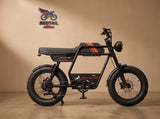
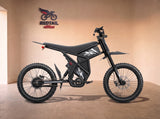
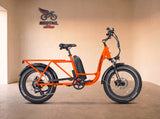
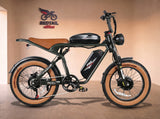
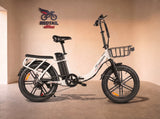
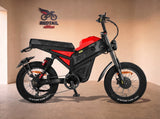
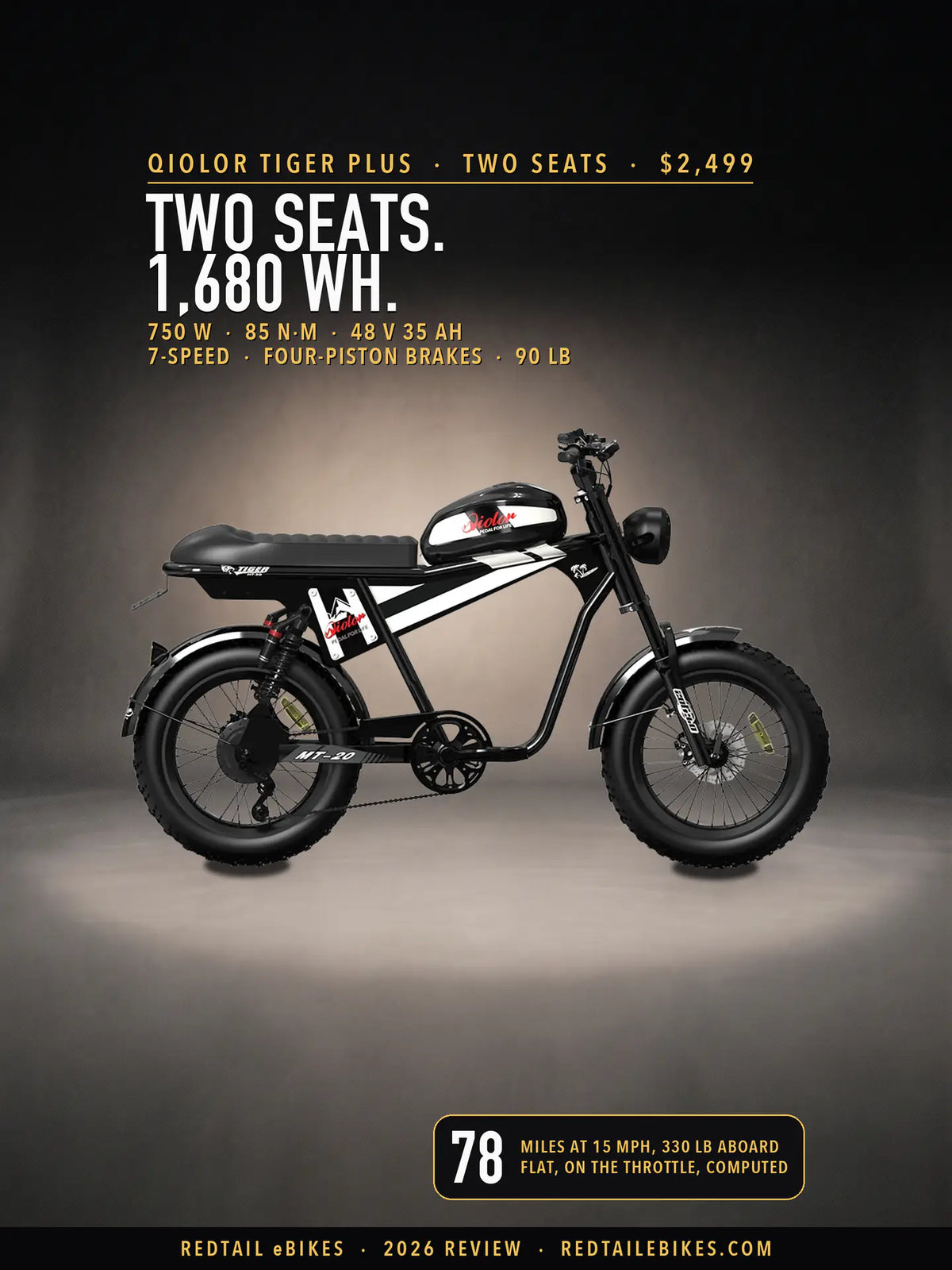

Two-seat moto-style e-bike · 750 W rear hub, 1,100 W peak, 85 N·m · removable 48 V 35 Ah pack, 1,680 Wh · seven speeds · air rear shock and hydraulic fork · four-piston hydraulic brakes · 90 lb, rated for 400 lb · Class 2 at 20 mph as shipped · $2,499, Qiolor's own US price · verified October 24, 2026
Quick Answer — Qiolor's Tiger Plus is a $2,499 two-seat moto-style e-bike with a 750 W rear hub, seven speeds and a 1,680 Wh pack. For a 180 lb rider holding 15 mph on the throttle over level pavement, the pack computes to 98 miles; with 330 lb aboard, 78. Qiolor rates it to 130 miles at assist level 1.
Its 32.3-inch bench is fixed, so check your stop first: in our model 66 of 100 riders at 5'8" sit flat-footed, and 27 of 100 at 5'6" (fit). Then read your state's passenger rule before you ride two-up (passenger).
Our Tiger Plus listing is $2,499 in black or silver, the price Qiolor's own US store showed on October 24, 2026, when both colors were in stock there. This button checks out the black bike; the silver one costs the same. Shipping is free within the contiguous United States.
Buy the Tiger Plus, $2,499What this review covers
Specification · What it is · Fit · Motor and gears · Battery · Range · Brakes and controls · Suspension and tires · Riding two-up · Passenger law · The Mercer fit test · UL · Recalls · Class · Green and red flags · Verdict · Checklist · Buying it from us · FAQ · Limitations · Bottom line · References
How we verified this Qiolor Tiger Plus review
Every figure here was read on October 24, 2026, at Qiolor's Tiger Plus page, with its dimension drawing and FAQ, in the 44-page Tiger Plus manual and on Qiolor's parts listings, then recomputed.
Our store supplied the price, the variants and the checkout the same day. The range and fit sections are computed by models that print their inputs. The questions it answers come from 931 search terms, headings, forum posts and AI-engine questions harvested from six kinds of source the same day.
We sell the Tiger Plus, so read the red flags as carefully as the green ones. Part of our e-bike reviews.
Written by Milad Ghobadibeygvand, BScN (Western University, 2014). Corrections: support@redtailebikes.com.
The Tiger Plus as Qiolor prints it
Qiolor sells the Tiger Plus in one form today, the 35 Ah pack at $2,499 in black or silver, and the figures below are the ones that decide how it sits, stops and climbs with two aboard. Read against your height, your passenger and your route, they tell you before it arrives how the Plus will ride for you.

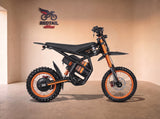
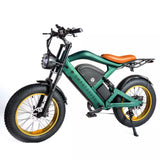
The silver Tiger Plus in Qiolor's own studio image from the Tiger Plus listing, used whole; the brown bench comes with the silver frame.
| What it measures | Qiolor's figure | Where Qiolor prints it |
|---|---|---|
| Motor | 750 W rear brushless hub, 1,100 W peak, 85 N·m | Product page header and Electronics block; the manual's illustration |
| Battery | Removable 48 V 35 Ah, 9.35 lb; 1,680 Wh by 48 × 35 | Electronics and Structural blocks |
| Charging | 10 to 12 hours | Electronics block |
| Range | Up to 130 miles, "pedal assist only under PAS 1" | The range panel and its footnote |
| Speed | Class 2, "default maximum speed is set to 20 MPH" | The class footnote |
| Assist and throttle | Eco, Normal and Sport; a thumb throttle | Structural block; comparison module |
| Gears | 7-speed | Header strip; comparison module |
| Brakes | Four-piston hydraulic disc | Brakes panel; Qiolor's brake set listing |
| Suspension | Air rear shock; "a full-suspension e-bike" | Structural block; FAQ |
| Tires | 20 × 4.0 INNOVA street tires | Structural block; tires panel |
| Frame | 6061 aluminum | Structural block |
| Weight | 90 lb | Structural block |
| Maximum load | 400 lb | Structural block; FAQ |
| Seat | Two riders on an extended bench; folding rear passenger footrests | Structural block; comfort panel |
| Rider height | 5'3" to 6'6" (the FAQ says 5'3" to 6'5") | Structural block; comparison module; FAQ |
| Size | 71.2 × 29.1 × 39.4 in; wheelbase 46.1 in; seat height 32.3 in | Structural block; dimension table |
| Price, October 24 | $2,499, ours and Qiolor's | Both stores |
Every row from Qiolor's Tiger Plus page and its dimension table, read October 24, 2026; the watt-hours are arithmetic on Qiolor's own volts and amp-hours.
Where Qiolor's owner's manual prints a different figure, both are here, with the one this review plans on. The manual's parameter page is on its printed page 4; it is metric, converted here.
| Figure | Qiolor's US product page | The Tiger Plus manual | What this review plans on |
|---|---|---|---|
| Weight | 90 lb | "Vehicle mass: 46kg" (101.4 lb) | 90 lb, with 101.4 lb run as a check in range |
| Load | 400 lb | "Load capacity: 155kg" (341.7 lb) | Both; the range table runs to each |
| Range | 130 miles at PAS 1 | "Continued mileage: 60km" (37.3 miles) | Our model, in range |
| Size | 71.2 × 29.1 × 39.4 in | 1800 × 700 × 1113 mm (70.9 × 27.6 × 43.8 in) | Both printed |
| Wheelbase | 46.1 in | "Center distance between front and rear wheels: 1180mm" (46.5 in) | 46.1 in |
| Charging | 10 to 12 hours | "about 4~8 hours", and about 12 hours the first time | 11 hours, computed from the charger in battery |
| Brakes | Four-piston hydraulic; the page's description says dual-piston | "QIOLOR Hydraulic Brake" | Four-piston, the set Qiolor sells for the Plus |
| Rear suspension | "Air Shock Absorber" | "Rear dual shock absorber" | Both printed |
From Qiolor's Tiger Plus page and the Tiger Plus manual, both read October 24, 2026.
Two seats on one bench: what the Tiger Plus is
The Tiger Plus is a Class 2 e-bike with pedals, a thumb throttle and a bench Qiolor rates for two riders. Against Qiolor's other Tigers it adds the seven speeds, the second seat with footrests, the air shock and the four-piston brakes, and it comes with the 35 Ah pack, by Qiolor's own comparison module.

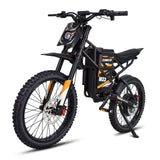
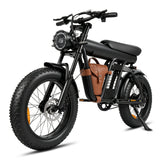
The black Tiger Plus from the front three-quarter, Qiolor's studio image from the Tiger Plus listing.
| Tiger | Pack | Drive and brakes | Seat and rider height | Our price |
|---|---|---|---|---|
| Plus | 48 V 35 Ah | 750 W, 7-speed, four-piston | Two riders, 5'3" to 6'6" | $2,499 |
| RE | 48 V 15 or 35 Ah | 750 W, single speed, dual-piston | One rider, 5'1" to 5'9" | $1,399, 35 Ah |
| RL | 48 V 13 Ah | 750 W, single speed, hydraulic | One rider, 5'3" to 6'6" | $1,099 |
| JR | 48 V 15 Ah | 500 W, single speed, hydraulic | One rider, 5'1" to 5'9" | $899 |
Packs, drives, seats and heights from Qiolor's comparison module on the Tiger Plus page, prices from our store, both read October 24, 2026.
If you are weighing the Plus against the single-seat Tiger, our Tiger RE review covers the bike with the same 750 W rating and, on our listing, the same 35 Ah pack, at $1,100 less. Asked the difference between the Tiger and the Tiger Plus, Qiolor's FAQ answers that the Plus "features full suspension for smoother off-road rides, a powerful 750W motor, upgraded hydraulic brakes, and offers a longer range with larger battery options."
One name to know before you search. Qiolor's studio images on its Tiger Plus listing print MT-20 on the Plus's swingarm, while Qiolor's Tiger, Tiger MT20 and Tiger RE names belong to one product record, as our RE review traced. Check which bike a listing means before you compare MT-20 prices.
In a review published October 9, 2024, Mountain Weekly News founder Mike Hardaker wrote that "people searching for powerful moto-inspired performance will be drawn to this café racer setup", and that the bike "handles nicely at speed and tracks well, gripping the road and providing a fluid ride" (Mountain Weekly News). The brand behind it has its own page: our Qiolor profile.
Will the Tiger Plus fit you?
Qiolor's fixed 32.3-inch bench sits below the 109%-of-inseam saddle height for the median rider at every height from 5'0" to 6'2" in the US Army's ANSUR II survey, so the knee stays bent; and the taller you are, the likelier both feet reach the ground: 27 of 100 riders at 5'6", 66 at 5'8" and 94 at 5'10".
Qiolor recommends the Plus for riders 5'3" to 6'6" (its specification block; its FAQ says 6'5"). The bench is a motorcycle stance: low, fixed and long. Three steps tell you how it will sit with you:
- Measure your inseam barefoot, a book pressed up between your legs against a wall, floor to the top of the book.
- Find your height row in the stop table and the seat table below.
- Plan your ride by the rows: a bent knee when you pedal, and the throttle doing most of the work, is how the bench is set.

Qiolor's dimension drawing, from the Tiger Plus page: D is the 32.3 in seat height and H the 19.3 to 35.5 in seat-to-handlebar span. Two of its labels read "Wheel Diameter" over arrows that run elsewhere: F from the rear axle toward the crank, G across the headlight.
Will the seat be high enough to pedal?
For riders from 5'4" up, the bench sits below the saddle height the 109%-of-inseam formula sets, by 3.2 inches for the median rider at 5'4" and 8.4 inches at 6'2", so the knee stays more bent at the bottom of each pedal stroke. The bench suits the formula's band for 28 of 100 riders at 5'0".
| Your height | Typical inseam | Formula saddle height, median rider | The 32.3 in seat, median rider | Riders it suits, of 100 |
|---|---|---|---|---|
| 5'0" | 27.1–29.7 in | 33.5 in | 1.2 in low | 28 |
| 5'2" | 28.0–31.1 in | 34.6 in | 2.3 in low | 4 |
| 5'4" | 29.1–32.2 in | 35.5 in | 3.2 in low | 0 |
| 5'6" | 30.2–33.5 in | 36.6 in | 4.3 in low | 0 |
| 5'8" | 31.1–34.3 in | 37.5 in | 5.2 in low | 0 |
| 5'10" | 32.2–35.5 in | 38.6 in | 6.3 in low | 0 |
| 6'0" | 33.2–36.7 in | 39.7 in | 7.4 in low | 0 |
| 6'2" | 34.3–37.5 in | 40.7 in | 8.4 in low | 0 |
Riders it suits: those whose band of 106% to 110.4% of inseam, measured from the pedal along the line from the crank axle to where the front rider sits, contains the bench. Bodies from the US Army's ANSUR II survey; the 5th to 95th percentile inseam at each height; the bench at Qiolor's 32.3 in; the crank as measured on Qiolor's manual photograph (5.64 in).
The crank length is read from a small photograph in Qiolor's manual, so the model also runs it at both ends of its measured bracket, 5.07 and 6.25 in. The table changes at the short end only: 14 or 41 riders of 100 at 5'0", 1 or 14 at 5'2", and no more than 1 of 100 at 5'4". From 5'6" up the count is 0 at either end.
Mike Hardaker, who gave his height as 5'11" in a reply to a reader, wrote the same from the saddle: "The static bench seat means there's a low riding position that doesn't offer much leverage while pedaling" (Mountain Weekly News). His next sentence is the fair half: "The upgrade to 7-speed gearing helps avoid ghost pedaling and spinning out, though."
Can you put a foot down at a stop?
Sitting on the bench, a rider puts both feet flat only if their barefoot inseam reaches 32.3 inches, and 66 of 100 riders at 5'8" have one that long. At Qiolor's lower recommended heights the share is small: 5 of 100 at 5'4" and 27 at 5'6".
| Your height | Typical inseam | Sit flat-footed at 32.3 in, of 100 | At 33.39 in, of 100 |
|---|---|---|---|
| 5'0" | 28.4 in | 0 | 0 |
| 5'2" | 29.5 in | 0 | 0 |
| 5'4" | 30.5 in | 5 | 0 |
| 5'6" | 31.7 in | 27 | 5 |
| 5'8" | 32.6 in | 66 | 22 |
| 5'10" | 33.8 in | 94 | 67 |
| 6'0" | 34.9 in | 99 | 92 |
| 6'2" | 36.0 in | 100 | 100 |
Flat-footed: barefoot inseam at or above the seat height, sitting upright on the bench, the bike level. 32.3 in is Qiolor's printed seat height; 33.39 in is the seat top where Qiolor's own drawing places it. Typical inseam is the median at each height in ANSUR II. Shoes add their sole.
Qiolor's J arrow, labeled "Stand over Height 12.9"", runs from the ground to the underside of the low tube beside the cranks. On a bench bike the foot-down question is the seat, so this table uses the seat. A rider whose inseam falls short of the bench reaches the ground on tiptoe, or with one foot as the bike leans; practice that stop in a parking lot before the first one on a street.
If your barefoot inseam reaches 32.3 inches, both feet go flat at a stop; if it falls short, you stop on tiptoe or on one foot. Either way the knee stays bent when you pedal, so plan to ride mostly on the throttle.
Will you sit stretched or cramped?
You sit nearly upright: the median rider at 5'8" leans 4 degrees forward to reach the grips, and at 6'2", 61 of 100 riders reach them without leaning at all, with a 26-degree bend in the elbows. A shorter rider leans further, 10 degrees at 5'0".
| Your height | Lean from upright, median rider | Riders who reach the grips sitting upright, of 100 | Elbow bend sitting upright, median rider |
|---|---|---|---|
| 5'0" | 10° | 0 | — |
| 5'2" | 9° | 0 | — |
| 5'4" | 7° | 1 | — |
| 5'6" | 5° | 6 | — |
| 5'8" | 4° | 13 | — |
| 5'10" | 2° | 24 | — |
| 6'0" | 1° | 38 | — |
| 6'2" | 0° | 61 | 26° |
Lean: the median rider's smallest trunk lean from vertical at which straight arms reach the grips, sitting in the middle of the front rider's half of the bench; a rider who reaches them sitting upright gets the elbow bend instead. Grips where Qiolor's drawing places them; arm and torso lengths from ANSUR II.
How much weight goes through your wrists?
About 13 pounds across both hands for the median rider at 5'8", 7% of body weight with the back relaxed, and a smaller share as height rises. Ten road racers on the brake hoods put about 15% of body weight on the bars (Carahalios, 2015), so this cockpit asks roughly half that of the hands.
| Your height | Share of your weight, back relaxed | Median rider's weight | On each hand |
|---|---|---|---|
| 5'0" | 12% (5–17%) | 126 lb | about 7 lb |
| 5'2" | 11% (5–16%) | 139 lb | about 7 lb |
| 5'4" | 10% (5–15%) | 147 lb | about 7 lb |
| 5'6" | 8% (5–14%) | 166 lb | about 7 lb |
| 5'8" | 7% (5–14%) | 179 lb | about 6 lb |
| 5'10" | 6% (5–13%) | 192 lb | about 6 lb |
| 6'0" | 5% (5–12%) | 204 lb | about 6 lb |
| 6'2" | 5% (5–11%) | 216 lb | about 6 lb |
The vertical load at the grips that holds the head, trunk and arms with the back muscles relaxed, a ceiling: the back carries part of it in practice. In brackets, the range from the front to the back of the front rider's half of the bench and across the grip's measured position. Segment weights from Clauser and colleagues (1969).
Setting up a fixed bench
The bench does not adjust; Qiolor sells it as the Plus Saddle, "only compatible with the TIGER PLUS. Single Seat: 2 Riders", on our shelf at $118.80. So setup is about knowing where you sit. The cycling literature that Peveler, Pounders and Bishop (2007) cite sets the knee at 25 to 35 degrees of bend at the bottom of the stroke; Ferrer-Roca and colleagues (2012) aim for 30 to 40.
The heel method shows where you are against it: sit on the bench, put a heel on the pedal at its lowest point, and the leg should be straight; with the ball of the foot on the pedal it then bends to the target (Peveler and colleagues, 2005). On the Plus most riders will feel the knee bend before the heel reaches the pedal, which is the seat table in your own leg.
Two settings are yours: tire pressure, which Qiolor's manual gives as "240KPa" (34.8 psi) front and rear, and the handlebar angle, which its manual says to adjust without exposing "the safety line markings" (Tiger Plus manual).
How we computed fit
The saddle formula is Hamley and Thomas's 109% of inseam, measured from the pedal axle with the crank in line with the seat; LeMond's 88.3% from the crank axle is the same saddle on a typical crank (Peveler and colleagues, 2005).
The band of 106% to 110.4% spans the two ranges in Ferrer-Roca and colleagues (2012): the recommended 106% to 109% of inseam and the 108.6% to 110.4% their equation proposes. A fixed bench suits a body when that band contains it. The bodies are the 6,068 soldiers of the US Army's ANSUR II survey.
| Input | Value | Source |
|---|---|---|
| Seat height, ground to top | 32.3 in, fixed | Qiolor's dimension table, D |
| Crank | 5.64 in (5.07–6.25) | Measured on the manual's photograph, printed page 5 |
| Crank axle height | 11.47 in | Measured twice, the drawing and the manual photograph |
| Where the front rider sits | 19.3 to 27.4 in behind the grip | The front half of Qiolor's H span, 19.3 to 35.5 in |
| Grip | 11.5 in ahead of the crank axle, 29.4 in above it | Measured on Qiolor's drawing |
| Bodies | 4,082 men, 1,986 women | ANSUR II |
| Segment weights | Head and trunk 58.01% of body weight | Clauser and colleagues (1969) |
| Hand reference | 15% of body weight, road racers on the hoods | Carahalios (2015) |
Every row read or measured October 24, 2026.
A worked example. At 5'8", the median inseam in ANSUR II is 32.6 inches. Hamley's 109% puts the saddle 35.6 inches from the pedal axle, 29.9 inches from the crank axle once the 5.64-inch crank is taken off.
Placed along the line from the crank axle to where the front rider sits, that is a seat 37.5 inches off the ground. The bench is at 32.3 inches, 5.2 inches lower.
How the measurements were checked. Qiolor's drawing was scaled by its own wheelbase arrow, 46.1 inches, and then had to reproduce Qiolor's other printed dimensions:
| Dimension | Qiolor lists | Measured on its dimension drawing (seat, grips, bracket) and manual photograph (crank, bracket) | Gap |
|---|---|---|---|
| A total length | 71.2 in | 70.8 in | −0.6% |
| A total length (tire extremes) | 71.2 in | 69.9 in | −1.8% |
| E wheel diameter (front tire fit) | 22.8 in | 23.1 in | +1.2% |
| E wheel diameter (rear tire fit) | 22.8 in | 23.0 in | +0.8% |
| D seat height | 32.3 in | 33.4 in | +3.4% |
| B handlebar height | 39.4 in | 40.7 in | +3.4% |
| J standover | 12.9 in | 11.4 in | −11.3% |
| wheelbase from the tire fits | 46.1 in | 46.9 in | +1.7% |
Six measurements of Qiolor's printed dimensions land within 3.5% on its drawing: A and E two ways each, D and B. J does not, because its arrow, as drawn, stops at the underside of the low tube beside the cranks; the label and the arrow disagree, and both are printed.
The manual photograph, scaled the same way, reproduced the front tire (−1.6%), the length (−2.5%) and the seat height (+0.35%), and put the crank axle at 11.47 inches against the drawing's 11.48. Its rear tire (+6.3%) and bar top (+10.4%) did not reproduce, so the photograph supplies only the crank and the bracket height.
Peveler and colleagues measured LeMond's 88.3% at 109.2 ± 0.9% of inseam from the pedal, beside Hamley's 109%; with this bike's measured crank, LeMond's setting comes to 105.7%. The seat table uses Hamley's 109%.
Not sure of your row? Email your height and inseam to support@redtailebikes.com, and the reply gives your seat, your stop and your reach from this model before you order. Silver comes with the brown bench, $2,499; the black Plus is priced the same.
Buy the silver Tiger PlusMotor, throttle and gears: 750 W, 85 N·m, seven speeds
A rear hub motor rated at 750 watts, 1,100 at peak and 85 newton-meters, drives the Tiger Plus, and you call on it with a thumb throttle or by pedaling in one of Qiolor's assist modes. The seven gears change your pedaling cadence; the motor turns with the wheel in every gear.

The rear hub motor and its seven-speed cassette in Qiolor's own close-up from the Tiger Plus listing; the swingarm's "MT-20" is printed on the frame.
Qiolor's page lists the assist as "Eco Mode, Normal Mode, Sport Mode" and the throttle as a thumb throttle. The manual describes the display's assist gears differently, "six modes by default: 0/1/2/3/4/5", and is explicit that "When 0 gear is displayed, it is no power assist gear." The manual's motor table gives "Rated speed: 350r/min" at 48 volts, the figure the range model below is built on.
On a hill the motor's 85 N·m and 750 W, by Qiolor's Electronics block, set the pace. Computed for a 180 lb rider on the throttle, the Plus holds 16.1 mph up a 6% grade and 13.6 mph up 8%; with 330 lb aboard, 11.8 and 9.5 mph. The full table is in range.
Qiolor's own sentence about the speed setting, in full: "All of our ebikes come out of the box as a Class II e-bike, equipped with pedal assist and throttle. The default maximum speed is set to 20 MPH, which can be adjusted according to user preferences." (Qiolor's Tiger Plus page, its class footnote.) The screen in class runs that 20 mph setting against each state's own e-bike definition.
Battery and charging: 48 V, 35 Ah, 1,680 Wh
The pack holds 1,680 watt-hours, Qiolor's 48 volts times 35 amp-hours, it weighs 9.35 pounds and it lifts out to charge indoors. Qiolor's 35 Ah charger fills it in about 11 hours from empty by our arithmetic, inside the 10 to 12 hours Qiolor prints.
The arithmetic: Qiolor's charger listing prints an output of "54.5V--2.0A/2.8A" and says "The 35AH charger charges faster than the 15AH charger".
At 54.5 V and 2.8 A the charger delivers 152.6 watts, and 1,680 Wh divided by 152.6 W is 11.0 hours, inside Qiolor's 10 to 12. The manual prints "about 4~8 hours", depending on the charge left in the pack, so plan on the product page's figure from empty.
A full charge costs about 31 cents of electricity at the August 2026 US residential average of 18.16 cents per kilowatt-hour, before charging losses (US Energy Information Administration). Ride 1,000 miles in a year at 15 mph on the throttle and, at the model's 17.2 Wh a mile, that is about $3.13 a year.
The manual's charging rules are short and worth keeping: indoors, "in a dry and well-ventilated environment", with nothing flammable or explosive "within 3 meters", never more than 12 hours at a stretch, and the battery used between −15 and 45 °C, best at 20 °C ± 10 °C (Tiger Plus manual).
A second pack doubles the day: the Tiger Plus 35 Ah battery is $1,198.80 on our shelf, and the 35 Ah charger $142.80. Qiolor's battery listing says its 48 V 35 Ah pack fits the "Tiger PLUS/RL/JR/750W-RE".
Range: 98 miles at 15 mph for a 180 lb rider, computed
For a 180 lb rider on level pavement at 77 °F, riding the throttle alone, the 1,680 Wh pack computes to 69 miles at 20 mph, 98 at 15 mph and 136 at 10 mph; keep a quarter in the pack and plan on 52, 73 and 102. Easy pedaling at 15 mph stretches 98 miles to 153.
Three steps find your ride:
- Pick your speed and effort in the first two tables.
- Adjust for your hills, your load and the cold in the tables after them.
- Plan on the "With 25% kept" column, because Qiolor's manual asks you not to run the pack down to its cutoff ("please do not use the power to the minimum allowable voltage when riding every time").
A first-time buyer weighing the Tiger Plus on r/ebikes named the gap this section fills: the range claims "all just say 'it depends on level of assist etc.' With no baseline or even guide to understand how it would vary" (r/ebikes). The tables are that baseline, computed, with every input linked in the formula.
How far does a full charge take you?
On the throttle, speed sets the range: 98 miles at 15 mph becomes 69 at 20 mph, because the power that pushes through the air rises with the cube of speed (Martin and colleagues, 1998). Riding at 12 mph instead of 15 adds 22 miles.
| Speed, flat | Per mile | Full charge | With 25% kept |
|---|---|---|---|
| 8 mph | 11.0 Wh | 152 mi | 114 mi |
| 10 mph | 12.3 Wh | 136 mi | 102 mi |
| 12 mph | 14.0 Wh | 120 mi | 90 mi |
| 15 mph | 17.2 Wh | 98 mi | 73 mi |
| 18 mph | 21.2 Wh | 79 mi | 59 mi |
| 20 mph | 24.4 Wh | 69 mi | 52 mi |
180 lb rider plus the 90 lb bike, throttle only, level pavement, no wind, 77 °F, fat tires at the median measured rolling resistance; the full 1,680 Wh, and a column with a quarter kept in the pack.
| Speed, flat | Throttle only | Easy pedaling (75 W) | Steady pedaling (150 W) |
|---|---|---|---|
| 15 mph | 98 mi | 153 mi | 318 mi |
| 18 mph | 79 mi | 105 mi | 153 mi |
| 20 mph | 69 mi | 86 mi | 112 mi |
The same rider and conditions; easy and steady pedaling are 75 W and 150 W at the pedals. At 15 mph a rider at 150 W does most of the work, which is why that cell runs past 300.
Plan your rides on the "With 25% kept" column: 73 miles at 15 mph and 52 at 20 mph for a 180 lb rider on the throttle over level pavement. A passenger takes the 98 miles at 15 mph down to 78, and a steady 8% climb at 10 mph empties the pack in 17.
Seven gears on a hub motor
On the Plus the gears sit between your legs and the wheel, and the hub motor is on the wheel, so a gear changes how fast you pedal, never how the motor runs. What saves battery is your effort, and the gears let you give it at a comfortable cadence.
| Your ride | Throttle only | Easy pedaling (75 W) | Steady pedaling (150 W) |
|---|---|---|---|
| 15 mph, flat | 17.2 Wh | 11.0 Wh | 5.3 Wh |
| 20 mph, flat | 24.4 Wh | 19.6 Wh | 15.0 Wh |
| 12 mph, 4% grade | 48.2 Wh | 37.3 Wh | 27.3 Wh |
| 12 mph, 8% grade | 94.7 Wh | 80.0 Wh | 66.4 Wh |
Watt-hours drawn from the pack per mile, 180 lb rider, 90 lb bike, 77 °F. Legs alone carry this rider and bike at 8.8 mph at 75 W and 12.9 mph at 150 W on the flat.
How much does a hill cost the pack?
Climbing costs about 168 Wh for every 1,000 feet on a 4% grade on the throttle, 10% of the pack, and 203 Wh on an 8% grade. On a steady 8% climb at 10 mph the pack lasts 17 miles; two-up, the motor's rating holds 9.5 mph there.
| Grade | Per mile, throttle | Full charge, throttle | Full charge, easy pedaling |
|---|---|---|---|
| 2% | 28 Wh | 59 mi | 98 mi |
| 4% | 48 Wh | 35 mi | 49 mi |
| 6% | 71 Wh | 24 mi | 31 mi |
| 8% | 98 Wh | 17 mi | 21 mi |
| 10% | 128 Wh | 13 mi | 16 mi |
| 12% | 164 Wh | 10 mi | 12 mi |
A steady climb at 10 mph, 180 lb rider, 90 lb bike, 77 °F; miles if the whole pack went into that grade. A 15% grade at 10 mph is past the motor's rated 750 W and 85 N·m, so it is left out here and shown as a speed below.
| Grade | Solo, 180 lb | Two-up, 330 lb | Two-up, easy pedaling |
|---|---|---|---|
| 2% | 20 mph (cap) | 19.5 mph | 20 mph (cap) |
| 4% | 19 mph | 15 mph | 16.1 mph |
| 6% | 16.1 mph | 11.8 mph | 12.7 mph |
| 8% | 13.6 mph | 9.5 mph | 10.4 mph |
| 10% | 11.7 mph | 7.9 mph | 8.7 mph |
| 12% | 10.2 mph | 6.8 mph | 7.4 mph |
| 15% | 8.5 mph | — | 6.1 mph |
The fastest steady speed the motor holds within its rated 750 W and 85 N·m, on the throttle unless marked, capped at the 20 mph Class 2 setting; 77 °F, 90 lb bike. A dash: no steady speed within the rating. Qiolor's 1,100 W peak adds pace on a short climb.
Each 1,000 feet of climbing takes 168 to 221 Wh from the pack at 4% to 10% on the throttle, against 102 Wh of pure lifting at the wheel; the difference is the motor working at low speed and high torque.
How far does it go with a passenger aboard?
With 330 lb aboard, a 180 lb rider and a 150 lb passenger, the computed range at 15 mph on the throttle is 78 miles against 98 solo; at Qiolor's 400 lb maximum, 71. On the flat, the passenger costs 20 miles at 15 mph, and riding solo at 20 mph instead of 15 costs 29.
| You plus your load | 15 mph flat, throttle | 20 mph flat, throttle | 8% climb, 10 mph |
|---|---|---|---|
| 130 lb | 106 mi | 73 mi | 22 mi |
| 180 lb | 98 mi | 69 mi | 17 mi |
| 220 lb | 92 mi | 66 mi | 14 mi |
| 260 lb | 86 mi | 63 mi | 12 mi |
| 330 lb | 78 mi | 59 mi | under 10 mph |
| 342 lb | 77 mi | 58 mi | under 10 mph |
| 400 lb | 71 mi | 55 mi | under 10 mph |
Riders and cargo together, 90 lb bike, level pavement or a steady 8% grade, 77 °F, full pack. 342 lb is the manual's 155 kg load capacity and 400 lb the product page's maximum load; "under 10 mph": the rated motor cannot hold 10 mph there, and the climb table above gives the speed it can.
| Bike weight | 15 mph flat, throttle | 20 mph flat, throttle | 8% climb, 10 mph |
|---|---|---|---|
| 101.4 lb | 96 mi | 68 mi | 16 mi |
| 90.0 lb | 98 mi | 69 mi | 17 mi |
The model at Qiolor's two printed weights, 90 lb on the product page and 46 kg (101.4 lb) in the manual, 180 lb rider.
Does cold weather cut the range?
Yes, by about a fifth at freezing: 98 miles at 77 °F becomes 77 at 32 °F and 69 at 14 °F at 15 mph, as the cells give up energy, the air thickens and the tires roll a little harder. The brackets in the two coldest rows span published cell data.
| Air | Pack energy vs 77 °F | 15 mph flat, throttle |
|---|---|---|
| 95 °F | 99% | 102 mi |
| 77 °F | 100% | 98 mi |
| 68 °F | 98% | 93 mi |
| 50 °F | 93% | 83 mi |
| 41 °F | 91% | 79 mi |
| 32 °F | 89% (80–93) | 77 mi (69–80) |
| 14 °F | 82% (40–83) | 69 mi (34–70) |
180 lb rider, 90 lb bike, throttle, level pavement, the pack at air temperature; pack energy from an LG HG2 cell's measured discharge, with the spread across published cell data in brackets. Qiolor's manual rates the battery for use from −15 °C (5 °F) to 45 °C.
Charge it indoors in winter, as the manual advises, and carry it out warm.
Fat tires and how you sit
The model brackets the INNOVA 20 × 4.0 street tires with ten fat tires Bicycle Rolling Resistance measured on a drum: the lowest gives 114 miles at 15 mph, the median 98 and the highest 90.
| Rolling resistance | 15 mph flat, throttle | 20 mph flat, throttle |
|---|---|---|
| 0.0070 · the lowest of ten fat tires | 114 mi | 77 mi |
| 0.0105 · the median of ten fat tires (used) | 98 mi | 69 mi |
| 0.0126 · the highest of ten fat tires | 90 mi | 65 mi |
Ten 26 × 4.00 fat tires measured by Bicycle Rolling Resistance at 12 psi; 180 lb rider, 90 lb bike, 77 °F. Qiolor's manual sets the tires at 240 kPa, 34.8 psi.
The upright bench position is modeled with the drag area Tengattini and Bigazzi (2018) measured for riders of upright cruiser bicycles, 0.640 m²; their everyday mountain-bike riders' 0.603 m² computes to 101 miles at 15 mph instead of 98.
How many miles does Qiolor say the Tiger Plus goes?
Qiolor's 130 miles is 12.9 Wh a mile, which the model reaches on the throttle alone at 10.8 mph, with easy pedaling at 16.2 mph and with steady pedaling at 19 mph. Qiolor's footnote says the figure is "experimental data obtained when using pedal assist only under PAS 1", the lowest assist level, which is a ride where the rider supplies a share of the power.
| Qiolor's figure | Per mile | Motor only | Easy pedaling (75 W) | Steady pedaling (150 W) |
|---|---|---|---|---|
| 130 mi, PAS 1 (product page) | 12.9 Wh | 10.8 mph | 16.2 mph | 19 mph |
| 37 mi (60 km), mode not printed (manual) | 45.1 Wh | — | — | — |
The speed at which a 180 lb rider on level pavement at 77 °F uses Qiolor's figure's watt-hours per mile; a dash where no level-ground speed reaches it. The manual prints its 60 km beside both of its packs, 15 Ah and 35 Ah, with no mode named.
In the model, a ride that averages Qiolor's 12.9 Wh a mile is about 16 mph on the flat with easy pedaling, the kind of light-assist ride its footnote describes. Your own number is the row in the tables above that matches how you ride.
How the range figures are computed
The power a bike needs is the rolling and climbing load plus the air, P = v × [m × g × (Crr × cos θ + sin θ) + ½ × ρ × CdA × v²], from Martin and colleagues (1998), whose road test the model reproduces. The motor supplies what the rider does not, through a hub-motor model with its losses, and the pack supplies the motor through its own efficiency.
| Input | Value | Source |
|---|---|---|
| Pack | 48 V × 35 Ah = 1,680 Wh | Qiolor's Tiger Plus page |
| Bike weight | 90 lb; 101.4 lb checked | Qiolor's page; manual |
| Wheel | 22.8 in | Qiolor's dimension table, E |
| Motor | 750 W rated, 85 N·m, rated speed 350 r/min at 48 V | Qiolor's page; manual |
| Motor's losses | A comparable hub motor's, at 80% efficiency at its rated point | Bafang OEM workbook 2021 |
| Rolling resistance | 0.0105 (0.0070–0.0126) | Bicycle Rolling Resistance |
| Rolling resistance vs temperature | 0.9% lower per °C warmer, held below 41 °F; BRR measured 17.6% lower from 20 to 40 °C (0.88% a degree, our division), Rothhämel 0.97% a degree | BRR temperature test; Rothhämel (2023) |
| Drag area | 0.640 m², upright cruiser riders | Tengattini and Bigazzi (2018) |
| Battery efficiency | A measured curve at the same C-rate; 97.0% in the worked ride | Arango, Lopez and Ceren (2021) |
| Planning reserve | 25% kept in the pack | Schmitt and colleagues (2019) |
| Cold | LG HG2 cell energy by temperature | LG 18650HG2 cell data |
| Air density | 1.184 kg/m³ at 77 °F | U.S. Standard Atmosphere, 1976 |
Each row read for this model on October 24, 2026; the physics sources were deposited between September 23 and October 4, 2026.
The worked ride: 15 mph on the throttle, 180 lb rider, level pavement, 77 °F. Rider and bike weigh 270 lb, 122.5 kg. Rolling takes 84.9 W and the air 114.2 W, so the wheel needs 199.1 W.
The motor, turning 221 times a minute and pushing 8.6 N·m, does that at 79.5% efficiency, drawing 250.6 W; the pack's own losses take it to 258.3 W. At 15 mph that is 17.2 Wh a mile, and 1,680 Wh lasts 98 miles, 73 with a quarter kept.
How the model was checked. It reproduces Martin and colleagues' Appendix I road test: 45.7 W of rolling and climbing and 158.8 W of air, against their 45.7 and 158.8. No independent measurement of a Tiger Plus emptying its pack at a stated speed and weight was found for this review; the assumptions that leaves are listed in Limitations.
Your route, your usual speed and who rides with you are enough: write to us and get your miles and your planning figure back from this range model. Black checks out here at $2,499, Qiolor's own price that day, or pick silver.
Buy the black Tiger PlusBrakes, lights, display and NFC
By Qiolor's page, four-piston hydraulic disc brakes stop the Tiger Plus, a set Qiolor sells for the Plus alone, and the cockpit carries a 3.2-inch color display, a horn and a headlight key, with a card unlock on Qiolor's NFC module listing. With up to 400 lb aboard, the brakes are the part to keep in tune.

The rear disc rotor and hub motor in Qiolor's close-up from the Tiger Plus listing.
Qiolor's page calls them "advanced four-piston hydraulic brakes, engineered for rapid stops and precise control", and its brake set listing sells "Tiger Plus (Four-Piston)" front and rear sets apart from the RE and RL's dual-piston ones. Our shelf carries the Plus's four-piston sets at $202.80 each. The product page's one-paragraph description says dual-piston; the brake panel, the comparison module and the parts listing all say four.

The cockpit as Qiolor's manual numbers it: 1 front brake, 2 controls, 3 throttle, 4 display, 5 rear brake, 6 shift, 7 keys, 8 electronic locks (Tiger Plus manual, printed page 5, reproduced whole).
The manual lists the display as a "3.2” LCD(VA)" with a protection grade of IPX5, and its keys include a headlight key, a horn key and a "Steering key" that lights a "Steering prompt" on the screen. It shows speed in KM/H or MPH, so check which one yours reads before your first ride.
Qiolor's NFC module listing says it fits the "TIGER RE/PLUS with NFC function" and gives two ways to start the bike: tap the NFC card to the sensing area for two seconds, then turn on the display; or hold the display's power button while touching the card to the sensing area.
It also says "NFC functionality cannot be copied to a mobile phone". Mountain Weekly found "two NFC cards that riders can use as key fobs" with its test bike (Mountain Weekly News); a replacement module is $82.80 on our shelf.
Suspension, tires and the ride
A hydraulic front fork and a rear shock Qiolor calls an "Air Shock Absorber" carry the Plus on 20 × 4.0 INNOVA street tires, and Qiolor's FAQ calls it "a full-suspension e-bike, providing better shock absorption for smoother off-road rides". The rear shock adjusts for spring stiffness and rebound.

The front wheel, fork and tire in Qiolor's own photograph from the Tiger Plus listing.
Qiolor's page describes the rear shock as "advanced pneumatic shock absorption, an adjustable spring stiffness compression knob, and a multi-setting rebound damping knob". The manual lists an "Aluminum alloy hydraulic front fork" and a "Rear dual shock absorber"; Qiolor's studio images show a spring and red adjusters on the rear shock. Mountain Weekly's ride found the setup gives "a smooth ride, whether it's paved streets or light off-roading" (Mountain Weekly News).
The tires are INNOVA street tires, which Qiolor's page credits with "unmatched smoothness and heightened efficiency", at the manual's 240 kPa, 34.8 psi. Qiolor's tube listing gives the size, "20"*4.0"", and the tubes are on our shelf.
On water, Qiolor's page says the bike "is built to the IP5-rated standard, making it suitable for riding through creeks, mud, and snow. However, please avoid prolonged or intentional immersion in water", and to skip the pressure washer.
The manual sets the limits on wet roads: it is "strictly prohibited to drive at high speeds in rainy and snowy weather", and you should not ride where standing water rises above "the lowest position on the outer edge of the wheel motor".
Riding two-up: the bench, the footrests and the 400 lb rating
Qiolor builds the Plus for two: its page lists the seat as "2 riders" and "Rear Passenger Footrests Included!", the bench is an "Extended Ergonomic Memory Seat", and the bike is rated for 400 lb in all. Two-up at 15 mph on the throttle over level pavement, with 330 lb aboard, the pack computes to 78 miles.

The pleated bench in Qiolor's close-up from the Tiger Plus listing; Qiolor sells it as the Plus Saddle, "Single Seat: 2 Riders".
Qiolor describes the footrests as "Comfortable, sturdy, and foldable footrests that provide excellent support and can be easily stored when not in use" (Qiolor). Fold them up when you ride alone.

A rear passenger footrest folded down, in Qiolor's close-up from the Tiger Plus listing.
Set the load before the passenger. Qiolor's page rates the Plus at 400 lb, riders and cargo together; its manual's parameter page prints "Load capacity: 155kg", 341.7 lb. A 180 lb rider and a 150 lb passenger are 330 lb, under both; a 200 lb rider and a 180 lb passenger are 380 lb, under the page's figure and over the manual's.
What a passenger does to the ride is in the numbers: range at 15 mph falls from 98 miles to 78, and on a 6% grade the motor's rated output holds 11.8 mph with two aboard against 16.1 solo (range). Helmet rules differ by state, and our state-by-state law guide lists who must wear one; Qiolor's helmet is $82.80 on our shelf.
For cargo, Qiolor's page offers an in-frame panel, a rack pannier bag and a rear rack with cargo net as add-ons; on our shelf today are the rack pannier bag, $166.80, and the Cargo Combo, $202.80. Ask us before you order a bag, and we will confirm what it mounts to on the Plus.
Two riders and their bags: email the weights, and the reply sets the total against Qiolor's 400 lb and its manual's 155 kg before you pay. The footrests come with every Plus, black at this button or silver at this one, $2,499 either way.
Buy the Plus for twoCarrying a passenger: what your state's code says
Of the 29 jurisdictions whose e-bike definitions take in the Tiger Plus on Qiolor's figures, 23 count riders against what the bike is designed or equipped to carry, in three wordings, 3 ask for a seat for the passenger, and 3 set no count in the sections read. Each rule below was read in the jurisdiction's own text and re-checked against its deposit on October 24, 2026.
Qiolor's page lists the Plus's seat as "2 riders", footrests included. How a state's words read one bench shared by two is that state's question, and this table gives each one's wording:
| What the rule asks | Jurisdictions |
|---|---|
| No more persons than the bicycle is "designed and equipped" for (13) | GA, HI, IA, IN, MI, ND, NE, NM, NV, OK, PA, SC, WA |
| No more than it is "designed or equipped" for (9) | CO, CT, DC, DE, MN, OR, RI, UT, VA |
| No more than it is "designed" for (1) | WI |
| A seat for the passenger (3) | CA, MA, MD |
| No passenger count in the sections read (3) | MT, NC, SD |
Each rule read in the jurisdiction's official text between August and October 2026 and re-checked against its deposit on October 24; the current text of Georgia's and New Mexico's was read in a FindLaw copy of the code. New Mexico counts an e-bike as a "bicycle" for its child helmet act only, in the sections read, which leaves open whether its passenger rule reaches the Plus.
The three seat states word it three ways, and the Plus carries its passenger on the rear of one bench. California's § 21204(b) seats a passenger "upon or astride a separate seat attached thereto". Massachusetts asks for "a permanent and regular seat attached to the bicycle" (c. 85, § 11B). Maryland's § 21-1203(b) wants a bicycle "designed for and equipped with a seat securely attached to it for each passenger".
California's reaches further from January 1, 2027: AB 1614, Chapter 40 of the 2026 statutes, applies § 21204's seat rules on "a highway or a Class I bikeway", where until then they apply on a highway.
If you live in one of those three, read your state's words beside Qiolor's own description of the bench, "Single Seat: 2 Riders" (its Plus Saddle listing), and decide before you ride two-up there; our California page, Massachusetts page and Maryland page carry the rest of each state's rules.
In Oregon, carrying more people than a bicycle "is designed or safely equipped" for is a Class D traffic violation (ORS § 814.460).
Children ride under their own rules. Eleven of the 29 write in how a young child may ride:
| State | What the code says about a child |
|---|---|
| CA | a passenger four or younger, or 40 lb or less, rides in a seat that retains and protects them (§ 21204(b)) |
| MA | a child aged one to four, or 40 lb or less, rides only in a "baby seat" with a harness or on a tandem's seat; no child under one (c. 85, § 11B) |
| MN | an adult may carry a child in a trailer or a securely attached child seat (§ 169.222) |
| PA | an adult may carry a child "in a pedalcycle child carrier which is securely attached" or a trailer (§ 3504(b)) |
| RI | a child six or younger in "a rear-mounted bicycle carrier and/or trailer" meeting ASTM standards (§ 31-19-4) |
| VA | a child under six in a seat or trailer designed for children (§ 46.2-906) |
| WI | a child in an auxiliary child's seat or trailer, on a bicycle built for the operator alone (§ 346.79) |
| GA | a child under one only on a bicycle trailer or in an infant sling, and one aged one to four only in a child seat, a trailer or a sling (§ 40-6-292(c)–(d), as enacted in 2011) |
| DE, UT | a child carried on the adult in a backpack or sling (21 Del. C. § 4194(a); Utah Code § 41-6a-1103) |
| CT | a rider 18 or older may carry a child under four in a back pack or sling, written for "a bicycle propelled solely by foot or hand power" (§ 14-286b(d)) |
From the passenger-law census of the 29 jurisdictions, re-checked October 24, 2026.
North Carolina's § 20-171.9 asks for a helmet under 16, seats a passenger under 16 "properly seated alone on a saddle seat", and puts one under 40 pounds or 40 inches in "a restraining seat"; a parent or guardian who breaks it commits an infraction, with a civil fine of up to $10.
North Carolina's rules are written for the "human-powered vehicle" that § 20-171.8 calls a bicycle, and the sections read leave open whether an e-bike counts; with a child aboard, ride as if they apply.
Read your state's row before you ride two-up: 23 of the 29 jurisdictions count riders against what the bike is designed or equipped to carry, 3 ask for a seat for the passenger, and 11 set their own rules for a young child.
Name your state and who rides behind you in a short email, and the reply quotes that state's passenger rule word for word before you order. Silver with the brown bench here, black here; both $2,499.
Buy the silver PlusThe Mercer fit test
Every Redtail review measures the bike against the same seven people, our editorial cast, the Mercers and the Kowalskis, and reads each verdict from published numbers and the fit model. On the Plus the decision is the stop and the passenger, so those are the numbers below.
| Member | Verdict | The number behind it |
|---|---|---|
| Frank Kowalski, 63, 5'10" | Fits the stop; pedals with a bent knee | 94 of 100 riders 5'10" sit flat-footed on the 32.3 in bench, inside Qiolor's 5'3" to 6'6"; the bench is 6.3 in under his formula saddle height |
| Ruth Kowalski, 61, 5'5" | Inside Qiolor's window; try the stop first | 10 of 100 riders 5'5" sit flat-footed at 32.3 in; Qiolor recommends 5'3" to 6'6" |
| Jack Mercer, 48, 6'1" | Sits upright with room to spare | 100 of 100 riders 6'1" sit flat-footed; the median one reaches the grips leaning under a degree |
| Dana Mercer, 45, 5'7" | Rides it; sets the passenger by the load | 45 of 100 riders 5'7" sit flat-footed; 400 lb maximum load on Qiolor's page, 155 kg in its manual |
| Maya Torres, 32, 5'6" | Commutes on the throttle; checks the stop | 27 of 100 riders 5'6" sit flat-footed; 98 miles at 15 mph on the throttle over level pavement, computed for a 180 lb rider |
| Cole Mercer, 16, 5'11" | Fits his body; his state's age rule decides | 100 of 100 riders 5'11" sit flat-footed; the age line is on his state's page |
| Ivy Mercer, 12 | Not a rider; as a passenger, read the child rules | 11 of 29 jurisdictions say how a young child may ride, in passenger |
Heights and ages from the Mercers' profile; flat-footed shares from the fit model on ANSUR II bodies; Qiolor's window and load from its Tiger Plus page.
Good for Jack, a closer call for Ruth. At 6'1", 100 of 100 riders in the survey sit flat-footed on the bench; at 5'5", 10 of 100 do, though both heights sit inside Qiolor's window.
The Tigers Qiolor recommends for 5'1" to 5'9" are the Tiger RE and the Tiger JR, each for one rider. Cole's age question goes to his state's page, and Ivy is a passenger, with the child rules above.
Is the Qiolor Tiger Plus UL certified?
If your building, landlord or city asks for certification papers, email us before you order and we will request them from Qiolor in writing. What Qiolor's documents print for the Plus is a water rating: IPX5 for the display in its manual, and "the IP5-rated standard" for the bike on its page.
UL Solutions describes UL 2849, "the Standard for Electrical Systems for eBikes", as fire safety certification "by examining the electrical drive train, battery, and charger system combinations in e-bikes". Ask for a certificate by model name, Tiger Plus, and check that the model and the standard appear on its face.
Has the Qiolor Tiger Plus been recalled?
No. On October 24, 2026, no recall and no public safety warning in the US Consumer Product Safety Commission's records named Qiolor, VTUVIA or the Tiger Plus. We read all 10,058 of the commission's recall records, its 379 public safety warnings and its recall feed.
| Check | Result, October 24, 2026 |
|---|---|
| CPSC recalls, all 10,058, for Qiolor, VTUVIA or Tiger Plus | None found |
| CPSC public safety warnings, all 379, for the same names | None found |
| CPSC recall feed, September 24 to October 22, 2026 | None found |
Read through the CPSC's own recall service and files on October 24, 2026. The one bicycle named Tiger among the 10,058 recalls is the X2 Tiger Parkcycle, a boys' sidewalk bicycle in a 1984 Columbia fork recall.
Is the Tiger Plus street legal? Class 2 at 20 mph
Set as Qiolor ships it, a 750 W Class 2 e-bike stopping its motor at 20 mph, the Tiger Plus sits inside the e-bike definition in 29 jurisdictions and outside it in 20, where the statute reads "less than" or "fewer than" 750 watts or sets its own throttle rule; Alaska and Kentucky have no definition. Where it sits outside, the state's code treats it as whatever other vehicle its words describe.
The screen ran Qiolor's published figures, 750 watts, 20 mph, a throttle and 90 lb, against each jurisdiction's own definition, read in its code:
| Where the Plus sits | Jurisdictions |
|---|---|
| Inside the e-bike definition (29) | CA, CO, CT, DC, DE, GA, HI, IA, IN, MA, MD, MI, MN, MT, NC, ND, NE, NM, NV, OK, OR, PA, RI, SC, SD, UT, VA, WA, WI |
| Outside: the definition reads "less than" or "fewer than" 750 watts (19) | AL, AR, AZ, FL, ID, IL, KS, LA, ME, MO, MS, NH, NY, OH, TN, TX, VT, WV, WY |
| Outside: New Jersey's throttle rule (1) | NJ |
| No statutory definition (2) | AK, KY |
Each state's definition and boundary word from the 51-jurisdiction rule table, screened October 24, 2026 on Qiolor's printed figures.
The screen runs the 20 mph setting Qiolor ships. Qiolor's sentence that the default "can be adjusted according to user preferences" puts that setting in your hands, and our state-by-state law guide gives each state's definition, helmet rules and age limits.
New Jersey is its own case: P.L.2025, c.285, in force since January 19, 2026, makes a bike whose motor can propel it without pedaling a "motorized bicycle" there, with the registration, license and insurance steps on our New Jersey page. Trails and public land run their own rules, collected in our public-land guide.
Green flags / Red flags
What the Tiger Plus does well, in Qiolor's figures and our model's, and the riders it suits less well, each with the page or the section that serves them better.
Green flags
- A 1,680 Wh pack: 98 miles at 15 mph on the throttle over level pavement for a 180 lb rider, 78 with a passenger aboard (range).
- Built for two: a bench Qiolor rates for two riders, folding footrests and a 400 lb rating (two-up).
- Four-piston hydraulic brakes, a set Qiolor makes for the Plus (brakes).
- Seven speeds that let you pedal at a comfortable cadence, and an adjustable rear shock over a hydraulic fork.
- Class 2 at 20 mph as shipped, inside the e-bike definition in 29 jurisdictions on Qiolor's figures (class).
- No CPSC recall or warning names Qiolor or the Tiger Plus, read October 24, 2026 (recalls).
- $2,499, Qiolor's own price, with free shipping in the contiguous US (buying it from us).
Red flags
- A pedaling-first rider: the bench sits under the 109% formula for the median rider at every height from 5'0" to 6'2". Our pedal-assist vs throttle guide measures 21 bikes both ways and matches its picks to how you ride.
- Under about 5'7" and wanting both feet down: 27 of 100 riders at 5'6" sit flat-footed. The Tiger JR is the Tiger Qiolor recommends for 5'1" to 5'9", for one rider.
- Stairs, a car rack or a small closet: the Plus weighs 90 lb. Our VTUVIA SF20H review covers a two-seat bike that folds.
- Long, steep climbs two-up: on a 10% grade, 330 lb aboard, the rated motor holds 7.9 mph. Find your grade in the climb table before you plan a two-up hill route.
- Riders and cargo over 400 lb, or over 341.7 lb by the manual: our guide for heavier riders reads the weight ratings on 217 spec sheets and sorts the frames rated 440 lb and up.
- A passenger in California, Massachusetts or Maryland: read your state's seat wording in passenger before you ride two-up there.
Buy it if / Buy something else if
Buy the Tiger Plus if you want a moto-styled e-bike you can ride with a partner, you stand 5'8" or taller or are content to toe down at a stop, and you will ride mostly on the throttle with the gears for easy pedaling. It computes to 98 miles at 15 mph on the throttle over level pavement for a 180 lb rider and 78 two-up, and its electricity comes to about $3.13 a year for 1,000 miles.
Buy something else if you want to pedal for exercise (pedal assist vs throttle), you are under about 5'7" and want both feet flat at every stop (the Tiger JR, or the single-seat Tiger RE), or the bike has to fold or climb stairs (the VTUVIA SF20H). Not sure which side you are on? Email us and we will tell you straight, including when the answer is a different bike.
Before you buy: the checklist
Eight checks before you order a Tiger Plus, in the order they come up: your stop, your load, your state's passenger rule, where it charges, your hills, its weight, and the first two jobs on delivery.
- Measure your inseam and find your row in the stop table.
- Add up both riders and any cargo against 400 lb, and against the manual's 155 kg (341.7 lb).
- Read your state's passenger rule in passenger, and its helmet ages on your state's page.
- Find a charging spot indoors, away from flammable items, and plan on about 11 hours from empty.
- Check your hills in the climb table, especially two-up.
- Plan for 90 lb through doors, up steps and onto any rack.
- On delivery, torque the axle nuts to the manual's figures, at least 30 N·m at the rear and 18 N·m at the front, set the tires to 240 kPa (34.8 psi), and check the handlebar for play before the first ride.
- Book the first check-up the manual asks for at 300 km, about 186 miles.
Buying it from us
Every Tiger Plus we sell is priced at Qiolor's own US figure, read October 24, 2026, and each row below is a term our policies oblige us to keep. Qiolor warrants the frame for 5 years and the battery for 1 year, prorated, and we open the claim with Qiolor for you.
| What you get | Our terms on October 24, 2026 |
|---|---|
| Who sells it | Redtail Ebikes, the business name of the Florida corporation named in our terms of service; Qiolor makes the Tiger Plus |
| Questions before you buy | support@redtailebikes.com; our contact page says "We typically respond to email within one business day" |
| Price | $2,499 in black or silver, the price on Qiolor's own US store that day |
| Shipping | "free shipping on every electric bike within the contiguous United States", by our shipping policy |
| Dispatch and transit | "prepared and dispatched within 1–3 business days of confirmation"; "most e-bikes arrive within 5–10 business days after dispatch" |
| Damage in transit | Photos of any damage within 48 hours of delivery, so we can "file a freight claim on your behalf" |
| Warranty | Qiolor's terms: the frame 5 years, the battery 1 year prorated, and the motor, controller, display and charger 1 year each, by Qiolor's warranty page; we open the claim |
| Defective on arrival | "covered under manufacturer warranty — we coordinate repair or replacement remotely", per our refund policy |
| Payment | A credit card or Google Pay at checkout |
| Your fit | Email your height and inseam, and the reply runs them through this page's model |
Each term quoted from the page that states it, as published on October 24, 2026; the payment row read from our checkout the same day.
Our refund policy takes back a bike you no longer want only if you ask within 72 hours of delivery and it is unopened in its factory-sealed packaging, with a 15% restocking fee plus return shipping; a canceled order carries a 3% transaction fee.
Black or silver, the Tiger Plus is $2,499 here and at Qiolor, and the pack, the bench for two and the footrests come with it. Black goes straight to checkout from here; choose silver for the brown bench.
Buy now: black, $2,499Frequently asked questions
Is the Qiolor Tiger Plus a good e-bike?
For a rider who wants a moto-styled bike with room for a passenger and a pack that goes a long way, yes. The 1,680 Wh pack computes to 98 miles at 15 mph on the throttle over level pavement for a 180 lb rider, it has four-piston hydraulic brakes and seven speeds, and Qiolor rates it for 400 lb. Its fixed 32.3 in bench suits a throttle-first rider of 5'8" or taller best.
How far can the Qiolor Tiger Plus go on one charge?
Computed for a 180 lb rider on level pavement at 77 °F, throttle only: 69 miles at 20 mph, 98 at 15 mph and 136 at 10 mph, or 52, 73 and 102 keeping a quarter in the pack. Easy pedaling at 15 mph stretches it to 153. Qiolor rates it to 130 miles at assist level 1.
How fast does the Qiolor Tiger Plus go?
Qiolor ships it as a Class 2 e-bike: "The default maximum speed is set to 20 MPH, which can be adjusted according to user preferences." The throttle and the assist carry you to that setting; your state's page gives the rule for your roads.
Is the Qiolor Tiger Plus street legal?
On Qiolor's figures, 750 W, 20 mph and a throttle, it sits inside the e-bike definition in 29 jurisdictions, outside it in 20 where the statute reads "less than" or "fewer than" 750 watts or sets its own throttle rule, and Alaska and Kentucky have no definition. The full list is in class.
Can you carry a passenger on the Qiolor Tiger Plus?
Qiolor builds it for two: a seat for "2 riders", an extended bench and folding rear passenger footrests, with a 400 lb maximum load. Two-up, 330 lb aboard, it computes to 78 miles at 15 mph on the throttle over level pavement. Read your state's passenger rule in passenger first.
Is it legal to have a passenger on an e-bike?
It depends on your state's words. Of the 29 jurisdictions whose definitions take in the Tiger Plus, 23 limit riders to what the bike is designed or equipped to carry, in three wordings; California, Massachusetts and Maryland ask for a seat for the passenger, and Montana, North Carolina and South Dakota set no count in the sections read. Children ride under separate rules in 11.
How much weight can the Qiolor Tiger Plus carry?
Qiolor's product page and FAQ say 400 lb, riders and cargo together; its manual's parameter page says "Load capacity: 155kg", 341.7 lb. Plan two riders and their bags against both figures.
What size rider fits the Qiolor Tiger Plus?
Qiolor recommends 5'3" to 6'6" (its FAQ says 6'5"). On the fixed 32.3 in bench, sitting flat-footed is likely from about 5'8": 66 of 100 riders at 5'8" have an inseam of 32.3 in or more, and 27 of 100 at 5'6".
How much does the Qiolor Tiger Plus weigh?
Qiolor's product page says 90 lb; its manual's parameter page says 46 kg, 101.4 lb. The removable battery is 9.35 lb of that. The range model runs both weights, 98 and 96 miles at 15 mph.
What is the difference between the Tiger Plus and the Tiger RE?
The Plus seats two and adds seven speeds, four-piston brakes and an air rear shock; the RE seats one, on a single speed with dual-piston brakes. Both carry a 750 W motor, our RE listing carries the same 35 Ah pack, and Qiolor recommends the RE for 5'1" to 5'9" and the Plus for 5'3" to 6'6". The Plus is $2,499 and the RE $1,399 on our shelf.
Is the Tiger Plus the same as the Qiolor Tiger MT-20?
Qiolor's studio images on its listing print MT-20 on the Plus's swingarm, while Qiolor's Tiger, Tiger MT20 and Tiger RE names belong to one product record, the single-seat bike our RE review covers. A listing that says MT-20 may mean either bike; the Plus is the one with two seats and seven speeds.
How long does the Tiger Plus battery take to charge?
Qiolor prints 10 to 12 hours. Its 35 Ah charger puts out 54.5 V at 2.8 A, 152.6 watts, and 1,680 Wh at that rate is about 11 hours from empty. The manual says never charge more than 12 hours at a stretch.
Is the Tiger Plus a full-suspension e-bike?
Qiolor's FAQ says it is "a full-suspension e-bike": a hydraulic front fork, by the manual, and a rear shock Qiolor calls an "Air Shock Absorber", with knobs for spring stiffness and rebound.
Can you ride the Tiger Plus in winter or snow?
Qiolor's page says it is "suitable for riding through creeks, mud, and snow", while its manual makes it "strictly prohibited to drive at high speeds in rainy and snowy weather" and rates the battery for use down to −15 °C (5 °F). Cold cuts range: 98 miles at 77 °F becomes 77 at 32 °F at 15 mph. Charge the pack indoors.
Is the Tiger Plus good for tall riders?
Yes, for the stop and the reach: 100 of 100 riders at 6'1" in the Army survey sit flat-footed on the bench, and at 6'2", 61 of 100 reach the grips sitting upright. Pedaling is the trade: at 6'2" the bench sits 8.4 in under the formula saddle height.
Is the Tiger Plus good for short riders?
At Qiolor's low end, 5'3" to 5'5", from 1 to 10 of 100 riders sit flat-footed on the 32.3 in bench. Qiolor recommends its Tiger JR and Tiger RE for 5'1" to 5'9", each for one rider.
Is the Tiger Plus a moped or an e-bike?
It is an e-bike with a moped's look: pedals, a 750 W motor and a 20 mph Class 2 setting, which is what the state e-bike definitions test. In the 20 jurisdictions whose definitions leave it outside, the code's other vehicle words apply, listed in class.
Can you add a rack or bags to the Tiger Plus?
Qiolor's FAQ says it "can be customized with accessories like racks, lights, fenders, and extra battery packs using standard mounting points". On our shelf are the rack pannier bag and the Cargo Combo, listed in two-up, and a second 35 Ah pack, in battery.
How does the Tiger Plus NFC lock work?
Qiolor's NFC module listing gives two ways: tap the card to the sensing area for two seconds and then turn on the display, or hold the display's power button while touching the card to it. It says "NFC functionality cannot be copied to a mobile phone".
Limitations of this review
Every figure above is read from a named source or computed by a model that prints its inputs, and each has limits. These are the ones that decide how far you can lean on a number on this page.
- We sell the Tiger Plus. Every figure is linked so you can check it without us.
- The range model assumes a steady ride. No stops, no wind, and every row level pavement or a steady grade at the stated speed.
- The motor's losses are a comparable motor's. Qiolor prints the Plus motor's rated power, torque and rated speed but no efficiency, so the model uses a comparable hub motor's shape at 80% efficiency, rebased to Qiolor's 350 r/min.
- The tires were not measured in this size. The rolling resistance is bracketed by ten 26 × 4.00 fat tires on a drum at 12 psi.
- The cold rows hold the cells at air temperature and use one cell type's data, bracketed by others; Qiolor names no cell for the pack.
- The planning reserve is a measured pedelec's 25%, because Qiolor's manual asks you not to run the pack to its cutoff but gives no figure.
- Qiolor's documents print two weights and two loads, 90 lb and 46 kg (101.4 lb), 400 lb and 155 kg (341.7 lb); the review plans on the product page and runs both.
- The fit model's bodies are US Army personnel in the ANSUR II survey, not the general public.
- The pedaling formula is a starting point. 109% of inseam, with the knee range the cycling literature recommends, sets a saddle for pedaling, and the Plus's bench is fixed below it for most riders.
- The hand loads are a relaxed-back ceiling: the back carries part of that load in practice.
- The crank was measured on a small photograph in Qiolor's manual, with its bracket of 5.07 to 6.25 in carried through the seat table, and the front rider's sit bones are placed across the front half of Qiolor's seat span.
- The grip was measured on Qiolor's dimension drawing, where its H arrow meets the bar.
- Two labels on Qiolor's drawing name a "Wheel Diameter" over arrows that run elsewhere, and its standover arrow reads 11.4 in as drawn against the 12.9 in label; both are printed.
- No certification document was retrieved for this page. If your building, landlord or city asks for one, email us and we will request it from Qiolor.
- Qiolor's manual and its US product page print different figures for weight, load, range, size, charging and the rear shock; this review plans on the US product page and prints the manual's figures beside it.
- The passenger rules were read in each jurisdiction's own text between August and October 2026, the current text of Georgia's and New Mexico's in a FindLaw copy of the code; New Mexico's and North Carolina's reach to e-bikes is open in the sections read.
- Mountain Weekly rode a 2024 Tiger Plus, when Qiolor offered 15 Ah and 35 Ah packs; its words are quoted as its own.
- Prices, stock, the checkout and our policies were read October 24, 2026, and change.
The bottom line
The Tiger Plus is Qiolor's two-seat Tiger: 1,680 Wh, seven speeds, four-piston brakes and a bench for two, for $2,499. For a 180 lb rider it computes to 98 miles at 15 mph on the throttle over level pavement and 78 two-up, about $3.13 of electricity a year for 1,000 miles.
Buy it to ride with someone, on the throttle, at 5'8" or taller or happy to toe down; pedal-first riders and anyone who carries a bike upstairs will be happier on another of ours.
Order today and it leaves us within 1–3 business days, shipping free in the contiguous US. Questions about your height, your passenger or your hills can go to support@redtailebikes.com first, and the answer comes back with numbers. Silver from this button, black from this link.
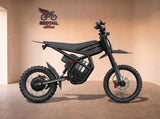
Buy two seats: silver PlusImage credit: the cover's machine is Qiolor's own studio image of the black Tiger Plus, its pixels unchanged, set in a studio generated on Playcut (playcut.ai) by Nano Banana Pro at 2K for another of our reviews; below the cover, each photograph is Qiolor's own file from its Tiger Plus listing, used whole, and the handlebar figure is printed page 5 of its manual.
Source register
Each document behind this review, with the tier of its publisher (T1 government records, T2 the maker's own documents and the studies, T4 accounts quoted as their authors'), what it supports here and the day we read it.
| Source | Tier | What it supports | Date read |
|---|---|---|---|
| 2012 Anthropometric Survey of U.S. Army Personnel (ANSUR II), public data release 2017 | T1 | US Army ANSUR II survey, 6,068 bodies (4,082 men, 1,986 women): the inseams, arm and torso lengths and weights behind the fit tables, the Mercer rows and the 5'8" worked rider | September 26, 2026 |
| Peveler W, Bishop P, Smith J, Richardson M, Whitehorn E. Comparing Methods For Setting Saddle Height In Trained Cyclists. JEPonline 8(1):51-55 | T3 | Peveler et al. (2005): the 109% of inseam formula and the heel method compared, and LeMond's 88.3% measured at 109.2 ± 0.9% of inseam from the pedal | September 26, 2026 |
| Ferrer-Roca V, Roig A, Galilea P, Garcia-Lopez J. Influence of saddle height on lower limb kinematics in well-trained cyclists: static vs. dynamic evaluation in bike fitting. J Strength Cond Res 26(11):3025-9; doi 10.1519/JSC.0b013e318245c09d | T2 | Ferrer-Roca et al. (2012): the recommended 106-109% of inseam range and the 108.6-110.4% their equation proposes, the ends of the page's saddle band; their optimal knee flexion of 30 to 40 degrees | September 25, 2026 |
| Peveler, Pounders & Bishop, Effects of saddle height on anaerobic power production in cycling, JSCR 21(4):1023-7 | T2 | Peveler, Pounders and Bishop (2007): the 25 to 35 degree knee angle at the bottom of the stroke that the cycling literature recommends | September 25, 2026 |
| Carahalios A. An Analysis of the Bicycle-Rider Interface Forces in Stationary Road Cycling (MS thesis, Department of Integrative Physiology, University of Colorado) | T2 | Carahalios (2015): about 15% of body weight through the stem for ten road racers on the hoods, the hand-load landmark | September 25, 2026 |
| Clauser, McConville & Young, Weight, volume, and center of mass of segments of the human body, AMRL-TR-69-70 | T2 | Clauser, McConville and Young (1969): segment weights, head and trunk 58.01% of body weight, behind the hand-load table | September 25, 2026 |
| OEM Workbook 2021 | T2 | Bafang OEM workbook 2021, RM G0H0: the comparable hub motor's curve and its 80% efficiency floor, rebased to the Tiger Plus manual's 350 r/min rated speed | October 3, 2026 |
| Fat Bike Tires Test Results | T2 | Bicycle Rolling Resistance fat-bike tests: ten 26 x 4.00 tires on a drum at 12 psi, median rolling resistance 0.0105, lowest 0.0070, highest 0.0126 | September 25, 2026 |
| CRR at Different Temperatures: Examining Temperature Dependence of Rolling Resistance | T2 | Bicycle Rolling Resistance temperature test: rolling resistance 17.6% lower from 20 °C to 40 °C, about 0.88% a degree by our division | September 23, 2026 |
| Rothhämel (2023), International Journal of Vehicle Systems Modelling and Testing | T2 | Rothhämel (2023): rolling resistance about 0.97% lower per degree Celsius warmer between +5 and +25 °C | September 23, 2026 |
| Validation of a Mathematical Model for Road Cycling Power (Martin JC, Milliken DL, Cobb JE, McFadden KL, Coggan AR), J Appl Biomech 14(3):276-291 | T2 | Martin et al. (1998): the cycling-power equation, validated against measured power, and its Appendix I example the model reproduces (45.7 W and 158.8 W) | October 4, 2026 |
| Physical characteristics and resistance parameters of typical urban cyclists (Tengattini S, Bigazzi AY) | T2 | Tengattini and Bigazzi (2018): drag area 0.640 m² for upright cruiser riders and 0.603 m² for everyday mountain-bike riders | October 4, 2026 |
| Arango I, Lopez C, Ceren A. Improving the Autonomy of a Mid-Drive Motor Electric Bicycle Based on System Efficiency Maps and Its Performance | T2 | Arango, Lopez and Ceren (2021): the battery-efficiency curve applied at the same C-rate, 97.0% in the worked ride | October 4, 2026 |
| Schmitt M, Decker S, Doppelbauer M. Measuring and Characterization of a Pedal Electric Cycle (Pedelec) on a Full System Test-Bench | T2 | Schmitt, Decker and Doppelbauer (2019): the 25% planning reserve kept in the pack | October 4, 2026 |
| LG 18650HG2 Li-ion Battery Data and Example Deep Neural Network xEV SOC Estimator Script | T2 | LG HG2 cell discharge data by temperature: the pack-energy column of the cold table and its brackets below freezing | October 4, 2026 |
| U.S. Standard Atmosphere, 1976 (NOAA-S/T 76-1562; NASA TM-X-74335) | T1 | U.S. Standard Atmosphere, 1976 (NOAA, NASA, USAF): air density by temperature, 1.184 kg/m³ at 77 °F | October 4, 2026 |
| Electric Power Monthly, Table 5.6.A. Average Price of Electricity to Ultimate Customers by End-Use Sector | T1 | US EIA Electric Power Monthly Table 5.6.A: residential electricity averaged 18.16 cents per kWh in August 2026, the cost of a full 1,680 Wh charge (about 31 cents) and of 1,000 miles at 15 mph on the throttle ($3.13) | October 24, 2026 |
| E-Bikes Certification: Evaluating and Testing to UL 2849 | T3 | UL Solutions: UL 2849, 'the Standard for Electrical Systems for eBikes', fire safety certification 'by examining the electrical drive train, battery, and charger system combinations in e-bikes' | October 24, 2026 |
| Recall database (saferproducts.gov REST API), query by field | T1 | CPSC recall service on October 24, 2026: all 10,058 recall records read, none naming Qiolor, VTUVIA or the Tiger Plus; the one Tiger bicycle is recall 84070 (1984); a known recall was found by the same read | October 24, 2026 |
| Product safety warning listing (CSV) — U.S. Consumer Product Safety Commission | T1 | CPSC product safety warnings on October 24, 2026: all 379 rows read, none naming Qiolor, VTUVIA or the Tiger Plus; a known warning was found by the same read | October 24, 2026 |
| Recalls RSS feed — U.S. Consumer Product Safety Commission | T1 | CPSC recalls feed on October 24, 2026: 40 items, September 24 to October 22, 2026, none naming Qiolor, VTUVIA or the Tiger Plus | October 24, 2026 |
| P.L.2025, c.285 | T1 | New Jersey P.L.2025, c.285, in force since January 19, 2026: a bicycle whose motor can propel it without pedaling is a 'motorized bicycle', registered, licensed and insured | October 24, 2026 |
| California Vehicle Code § 21204 | T1 | Cal. Veh. Code § 21204(b): a passenger rides 'upon or astride a separate seat attached thereto'; a passenger four or younger, or 40 lb or less, in a seat that retains and protects them | October 16, 2026 |
| AB 1614 (Dixon), Vehicles: bicycles — chaptered text, history and status | T1 | California AB 1614, Chapter 40, Statutes of 2026, approved June 30, 2026: § 21204's seat rules apply on 'a highway or a Class I bikeway' from January 1, 2027 | October 16, 2026 |
| General Laws c. 85, § 11B | T1 | M.G.L. c. 85, § 11B: a passenger rides 'a permanent and regular seat attached to the bicycle'; a child aged one to four, or 40 lb or less, only in a baby seat with a harness or on a tandem's seat | October 1, 2026 |
| Maryland Transportation § 21-1203 | T1 | Md. Transp. § 21-1203(b): a bicycle 'designed for and equipped with a seat securely attached to it for each passenger' | October 1, 2026 |
| ORS 814.460, Unlawful passengers on bicycle; penalty | T1 | ORS § 814.460: carrying more persons than a bicycle 'is designed or safely equipped' for is a Class D traffic violation | October 20, 2026 |
| Minn. Stat. § 169.222, Operation of bicycle | T1 | Minn. Stat. § 169.222: an adult may carry a child in a trailer or a securely attached child seat | October 21, 2026 |
| 75 Pa.C.S. § 3504 — Riding on pedalcycles | T1 | 75 Pa.C.S. § 3504(b): an adult may transport a child 'in a pedalcycle child carrier which is securely attached' or a trailer | October 2, 2026 |
| R.I. Gen. Laws § 31-19-4 | T1 | R.I. Gen. Laws § 31-19-4: a child six or younger in 'a rear-mounted bicycle carrier and/or trailer' meeting ASTM standards | October 16, 2026 |
| Code of Virginia § 46.2-906 | T1 | Va. Code § 46.2-906: an adult may carry a child under six in a seat or trailer designed for children | October 1, 2026 |
| Wis. Stat. § 346.79 | T1 | Wis. Stat. § 346.79(2): a bicycle designed for the operator alone may carry a child in an auxiliary child's seat or trailer | October 1, 2026 |
| House Bill 101 (Senate substitute as passed), 2011-2012 session | T1 | O.C.G.A. § 40-6-292(c) and (d), as enacted in 2011 (HB 101): a child under one only on a bicycle trailer or in an infant sling; one aged one to four only in a child seat, a trailer or a sling | October 2, 2026 |
| 21 Del. C. § 4194 | T1 | 21 Del. C. § 4194(a): an adult rider may carry a child securely attached to the person in a backpack or sling | October 1, 2026 |
| Utah Code § 41-6a-1103 | T1 | Utah Code § 41-6a-1103(2): an adult rider may carry a child securely attached in a back pack or sling | October 1, 2026 |
| Conn. Gen. Stat. § 14-286b | T1 | Conn. Gen. Stat. § 14-286b(d): a rider 18 or older may carry a child under four in a back pack or sling, written for 'a bicycle propelled solely by foot or hand power' | October 1, 2026 |
| N.C.G.S. § 20-171.8 — Definitions | T1 | N.C.G.S. § 20-171.8: 'Bicycle' means 'a human-powered vehicle', the vehicle the child rules of § 20-171.9 are written for | October 1, 2026 |
| N.C.G.S. § 20-171.9, Requirements for helmet and restraining seat use | T1 | N.C.G.S. § 20-171.9: a helmet under 16, a passenger under 16 'properly seated alone on a saddle seat', and one under 40 pounds or 40 inches in 'a restraining seat'; a parent or guardian found responsible commits an infraction, with a civil fine of up to $10 | October 24, 2026 |
| Terms of service | T2 | Our terms of service: a Florida corporation doing business as Redtail Ebikes; damage reported within 48 hours, and we 'file a freight claim on your behalf' | October 24, 2026 |
| Contact | T2 | Our contact page: 'We typically respond to email within one business day' | October 24, 2026 |
| Shipping policy | T2 | Our shipping policy: free on every electric bike within the contiguous United States; 'prepared and dispatched within 1–3 business days of confirmation'; 'most e-bikes arrive within 5–10 business days after dispatch' | October 24, 2026 |
| Refund policy | T2 | Our refund policy: a defective bike is 'covered under manufacturer warranty — we coordinate repair or replacement remotely'; change-of-mind returns unopened, in factory-sealed packaging, within 72 hours of delivery, 15% restocking fee plus return shipping; a 3% fee to cancel | October 24, 2026 |
| Qiolor, Tiger Plus listing | T2 | Qiolor's Tiger Plus listing: $2,499 in black and silver, both in stock; '750W', 'Peak 1100W', 'Max Torque 85N.m', 'Removable Battery 48V 35Ah', 'Charging Time 10-12 hours', 'Max Ranges 130 miles' with the PAS 1 footnote, 'Class 2' and 'The default maximum speed is set to 20 MPH'; 'Max Load 400 lbs', 'Bike Weight 90 lbs', 20" x 4.0 INNOVA tires, a 6061 aluminum frame, 'Battery Weight 9.35 lbs', 'Eco Mode, Normal Mode, Sport Mode', 'Recommended Height 5'3" - 6'6"', 'Seat 2 riders', 'Air Shock Absorber', four-piston hydraulic brakes, the footrests and cargo panels, the comparison module, the dimension table and drawing, and the FAQ | October 24, 2026 |
| Qiolor, Tiger Plus manual | T2 | Qiolor's TIGER Plus Electric Bicycle Instruction Manual (44 pp.): printed page 4's parameters (1800mm x 700mm x 1113mm, 1180mm wheelbase, 46kg, 155kg load, 60km, motor 'Rated speed: 350r/min'), printed page 5's figure numbering the handlebar, printed page 6's display ('3.2” LCD(VA)', IPX5, the keys), charging ('about 4~8 hours', not more than 12 hours, 'a dry and well-ventilated environment', 'within 3 meters'), battery use from -15 °C to 45 °C, 'Rear wheel locking torque ≥30N.m', 240KPa, the 300Km check and the wet-road precautions | October 24, 2026 |
| Charger — qiolor.com | T2 | Qiolor's charger listing: 'OUTPUT : 54.5V--2.0A/2.8A' and 'The 35AH charger charges faster than the 15AH charger' (152.6 W at 2.8 A, about 11 hours for 1,680 Wh) | October 24, 2026 |
| Hydraulic Brake Disc Set — qiolor.com | T2 | Qiolor's Hydraulic Brake Disc Set listing: 'Tiger Plus (Four-Piston)' front and rear sets, apart from the 'Tiger RE/RL (Dual-Piston)' sets | October 24, 2026 |
| Plus Saddle — qiolor.com | T2 | Qiolor's Plus Saddle listing: 'It is only compatible with the TIGER PLUS. Single Seat: 2 Riders' | October 24, 2026 |
| New NFC Module — qiolor.com | T2 | Qiolor's NFC module listing: 'TIGER RE/PLUS with NFC function', two ways to start the bike, and 'NFC functionality cannot be copied to a mobile phone' | October 24, 2026 |
| Battery 48V 35Ah — qiolor.com | T2 | Qiolor's battery listing: a 48V 35Ah pack 'compatible with our e-bikes ( Tiger PLUS/RL/JR/750W-RE )' | October 24, 2026 |
| Fat Tire Inner Tubes — qiolor.com | T2 | Qiolor's Fat Tire Inner Tubes listing: 'Applicable to all ebike models. Size: 20"*4.0"' | October 24, 2026 |
| Warranty Policy and Replacement Procedures — qiolor.com | T2 | Qiolor's warranty page: the frame 'for a period of 5 years', batteries 'a 1-year prorated warranty', and the motor, controller box, display and charger 1 year each | October 24, 2026 |
| Mountain Weekly News, Tiger Plus review | T4 | Mountain Weekly News, 'QIOLOR Tiger Plus E-Bike Review' by Mike Hardaker (October 9, 2024): the café racer setup, the handling, the static bench and the 7-speed gearing, the NFC cards and the ride on paved streets and light off-roading, quoted as the reviewer's own; his height, 5'11", given in a reply to a reader on May 9, 2025 | October 24, 2026 |
| r/ebikes, First Time Commuter | T4 | r/ebikes, 'First Time Commuter' (August 31, 2024): a first-time buyer weighing the Qiolor Tiger Plus writes that range claims 'all just say "it depends on level of assist etc." With no baseline or even guide to understand how it would vary' | October 24, 2026 |
Expiry conditions
Re-read this review when Qiolor changes the Tiger Plus page, its manual or its price, when the CPSC lists a recall or a warning naming Qiolor, when a state in the screen changes its e-bike definition or passenger rule, and in any case by October 24, 2027.
References
The same documents, numbered for citation: the publisher, the title, the passage this review relies on, the day it was read and the full web address.
- U.S. Army Natick Soldier Research, Development and Engineering Center, 2012 Anthropometric Survey of U.S. Army Personnel (ANSUR II), public data release 2017. US Army ANSUR II survey, 6,068 bodies (4,082 men, 1,986 women): the inseams, arm and torso lengths and weights behind the fit tables, the Mercer rows and the 5'8" worked rider. Retrieved September 26, 2026. https://www.army.mil/article/188601/for_good_measure_natick_releases_raw_data_from_army_wide_anthropometric_survey
- Journal of Exercise Physiology Online (American Society of Exercise Physiologists), Peveler W, Bishop P, Smith J, Richardson M, Whitehorn E. Comparing Methods For Setting Saddle Height In Trained Cyclists. JEPonline 8(1):51-55. Peveler et al. (2005): the 109% of inseam formula and the heel method compared, and LeMond's 88.3% measured at 109.2 ± 0.9% of inseam from the pedal. Retrieved September 26, 2026. https://www.asep.org/asep/asep/JEPonlineFEBRUARY2005_PevelerSaddle.doc
- Journal of Strength and Conditioning Research (NSCA), Ferrer-Roca V, Roig A, Galilea P, Garcia-Lopez J. Influence of saddle height on lower limb kinematics in well-trained cyclists: static vs. dynamic evaluation in bike fitting. J Strength Cond Res 26(11):3025-9; doi 10.1519/JSC.0b013e318245c09d. Ferrer-Roca et al. (2012): the recommended 106-109% of inseam range and the 108.6-110.4% their equation proposes, the ends of the page's saddle band; their optimal knee flexion of 30 to 40 degrees. Retrieved September 25, 2026. https://pubmed.ncbi.nlm.nih.gov/22190163/
- Journal of Strength and Conditioning Research (NSCA), Peveler, Pounders & Bishop, Effects of saddle height on anaerobic power production in cycling, JSCR 21(4):1023-7. Peveler, Pounders and Bishop (2007): the 25 to 35 degree knee angle at the bottom of the stroke that the cycling literature recommends. Retrieved September 25, 2026. https://pubmed.ncbi.nlm.nih.gov/18076230/
- University of Colorado Boulder (MS thesis), Carahalios A. An Analysis of the Bicycle-Rider Interface Forces in Stationary Road Cycling (MS thesis, Department of Integrative Physiology, University of Colorado). Carahalios (2015): about 15% of body weight through the stem for ten road racers on the hoods, the hand-load landmark. Retrieved September 25, 2026. https://scholar.colorado.edu/downloads/70795789x
- Aerospace Medical Research Laboratory, Wright-Patterson AFB, Clauser, McConville & Young, Weight, volume, and center of mass of segments of the human body, AMRL-TR-69-70. Clauser, McConville and Young (1969): segment weights, head and trunk 58.01% of body weight, behind the hand-load table. Retrieved September 25, 2026. https://ntrs.nasa.gov/api/citations/19700027497/downloads/19700027497.pdf
- Bafang, OEM Workbook 2021. Bafang OEM workbook 2021, RM G0H0: the comparable hub motor's curve and its 80% efficiency floor, rebased to the Tiger Plus manual's 350 r/min rated speed. Retrieved October 3, 2026. https://www.bafang-e.com/Uploaded/Labels/BAFANG%20Workbook%20OEM%202021.pdf
- Bicycle Rolling Resistance (Jarno Bierman), Fat Bike Tires Test Results. Bicycle Rolling Resistance fat-bike tests: ten 26 x 4.00 tires on a drum at 12 psi, median rolling resistance 0.0105, lowest 0.0070, highest 0.0126. Retrieved September 25, 2026. https://www.bicyclerollingresistance.com/fat-bike-reviews
- Bicycle Rolling Resistance (Jarno Bierman), CRR at Different Temperatures: Examining Temperature Dependence of Rolling Resistance. Bicycle Rolling Resistance temperature test: rolling resistance 17.6% lower from 20 °C to 40 °C, about 0.88% a degree by our division. Retrieved September 23, 2026. https://www.bicyclerollingresistance.com/specials/crr-temperature-test
- International Journal of Vehicle Systems Modelling and Testing (Inderscience), Rothhamel M. On rolling resistance of bicycle tyres with ambient temperature in focus. Rothhämel (2023): rolling resistance about 0.97% lower per degree Celsius warmer between +5 and +25 °C. Retrieved September 23, 2026. https://www.inderscience.com/filter.php?aid=132317
- Journal of Applied Biomechanics (Human Kinetics), Validation of a Mathematical Model for Road Cycling Power (Martin JC, Milliken DL, Cobb JE, McFadden KL, Coggan AR), J Appl Biomech 14(3):276-291. Martin et al. (1998): the cycling-power equation, validated against measured power, and its Appendix I example the model reproduces (45.7 W and 158.8 W). Retrieved October 4, 2026. https://collections.lib.utah.edu/dl_files/b4/8e/b48ef26086091662c561e673d7bd990d77868437.pdf
- Journal of Sports Sciences (Taylor & Francis), Physical characteristics and resistance parameters of typical urban cyclists (Tengattini S, Bigazzi AY). Tengattini and Bigazzi (2018): drag area 0.640 m² for upright cruiser riders and 0.603 m² for everyday mountain-bike riders. Retrieved October 4, 2026. https://civil-reactlab.sites.olt.ubc.ca/files/2022/11/Tengattini_2018_Physical-characteristics-and-resistance-parameters-of-typical-urban-cyclists.pdf
- World Electric Vehicle Journal (MDPI), Arango I, Lopez C, Ceren A. Improving the Autonomy of a Mid-Drive Motor Electric Bicycle Based on System Efficiency Maps and Its Performance. Arango, Lopez and Ceren (2021): the battery-efficiency curve applied at the same C-rate, 97.0% in the worked ride. Retrieved October 4, 2026. https://mdpi-res.com/d_attachment/wevj/wevj-12-00059/article_deploy/wevj-12-00059.pdf
- IEEE / EPE'19 ECCE Europe (Karlsruhe Institute of Technology authors), Schmitt M, Decker S, Doppelbauer M. Measuring and Characterization of a Pedal Electric Cycle (Pedelec) on a Full System Test-Bench. Schmitt, Decker and Doppelbauer (2019): the 25% planning reserve kept in the pack. Retrieved October 4, 2026. https://publikationen.bibliothek.kit.edu/1000100371/50695920
- McMaster University (Kollmeyer et al.), Mendeley Data, LG 18650HG2 Li-ion Battery Data and Example Deep Neural Network xEV SOC Estimator Script. LG HG2 cell discharge data by temperature: the pack-energy column of the cold table and its brackets below freezing. Retrieved October 4, 2026. https://doi.org/10.17632/b5mj79w5w9.2
- NOAA, NASA, US Air Force, U.S. Standard Atmosphere, 1976 (NOAA-S/T 76-1562; NASA TM-X-74335). U.S. Standard Atmosphere, 1976 (NOAA, NASA, USAF): air density by temperature, 1.184 kg/m³ at 77 °F. Retrieved October 4, 2026. https://ntrs.nasa.gov/api/citations/19770009539/downloads/19770009539.pdf
- U.S. Energy Information Administration, Electric Power Monthly, Table 5.6.A. Average Price of Electricity to Ultimate Customers by End-Use Sector. US EIA Electric Power Monthly Table 5.6.A: residential electricity averaged 18.16 cents per kWh in August 2026, the cost of a full 1,680 Wh charge (about 31 cents) and of 1,000 miles at 15 mph on the throttle ($3.13). Retrieved October 24, 2026. https://www.eia.gov/electricity/monthly/epm_table_grapher.php?t=epmt_5_06_a
- UL Solutions, E-Bikes Certification: Evaluating and Testing to UL 2849. UL Solutions: UL 2849, 'the Standard for Electrical Systems for eBikes', fire safety certification 'by examining the electrical drive train, battery, and charger system combinations in e-bikes'. Retrieved October 24, 2026. https://www.ul.com/services/e-bikes-certificationevaluating-and-testing-ul-2849
- U.S. Consumer Product Safety Commission, Recall database (saferproducts.gov REST API), query by field. CPSC recall service on October 24, 2026: all 10,058 recall records read, none naming Qiolor, VTUVIA or the Tiger Plus; the one Tiger bicycle is recall 84070 (1984); a known recall was found by the same read. Retrieved October 24, 2026. https://www.saferproducts.gov/RestWebServices/Recall
- U.S. Consumer Product Safety Commission, Product safety warning listing (CSV) — U.S. Consumer Product Safety Commission. CPSC product safety warnings on October 24, 2026: all 379 rows read, none naming Qiolor, VTUVIA or the Tiger Plus; a known warning was found by the same read. Retrieved October 24, 2026. https://www.cpsc.gov/s3fs-public/recall-data/product_safety_warning_listing.csv
- U.S. Consumer Product Safety Commission, Recalls RSS feed — U.S. Consumer Product Safety Commission. CPSC recalls feed on October 24, 2026: 40 items, September 24 to October 22, 2026, none naming Qiolor, VTUVIA or the Tiger Plus. Retrieved October 24, 2026. https://www.cpsc.gov/Newsroom/CPSC-RSS-Feed/Recalls-RSS
- New Jersey Legislature, P.L.2025, c.285. New Jersey P.L.2025, c.285, in force since January 19, 2026: a bicycle whose motor can propel it without pedaling is a 'motorized bicycle', registered, licensed and insured. Retrieved October 24, 2026. https://pub.njleg.gov/Bills/2024/PL25/285_.HTM
- California Legislature, California Vehicle Code § 21204. Cal. Veh. Code § 21204(b): a passenger rides 'upon or astride a separate seat attached thereto'; a passenger four or younger, or 40 lb or less, in a seat that retains and protects them. Retrieved October 16, 2026. https://leginfo.legislature.ca.gov/faces/codes_displaySection.xhtml?lawCode=VEH§ionNum=21204.
- California Legislative Information, AB 1614 (Dixon), Vehicles: bicycles — chaptered text, history and status. California AB 1614, Chapter 40, Statutes of 2026, approved June 30, 2026: § 21204's seat rules apply on 'a highway or a Class I bikeway' from January 1, 2027. Retrieved October 16, 2026. https://leginfo.legislature.ca.gov/faces/billNavClient.xhtml?bill_id=202520260AB1614
- Massachusetts Legislature, General Laws c. 85, § 11B. M.G.L. c. 85, § 11B: a passenger rides 'a permanent and regular seat attached to the bicycle'; a child aged one to four, or 40 lb or less, only in a baby seat with a harness or on a tandem's seat. Retrieved October 1, 2026. https://malegislature.gov/Laws/GeneralLaws/PartI/TitleXIV/Chapter85/Section11B
- Maryland General Assembly, Maryland Transportation § 21-1203. Md. Transp. § 21-1203(b): a bicycle 'designed for and equipped with a seat securely attached to it for each passenger'. Retrieved October 1, 2026. https://mgaleg.maryland.gov/mgawebsite/Laws/StatuteText?article=gtr§ion=21-1203&enactments=false
- Oregon Legislature (Oregon Revised Statutes; Oregon Legislative Information System), ORS 814.460, Unlawful passengers on bicycle; penalty. ORS § 814.460: carrying more persons than a bicycle 'is designed or safely equipped' for is a Class D traffic violation. Retrieved October 20, 2026. https://www.oregonlegislature.gov/bills_laws/ors/ors814.html
- Minnesota Office of the Revisor of Statutes, Minn. Stat. § 169.222, Operation of bicycle. Minn. Stat. § 169.222: an adult may carry a child in a trailer or a securely attached child seat. Retrieved October 21, 2026. https://www.revisor.mn.gov/statutes/cite/169.222
- Pennsylvania General Assembly, 75 Pa.C.S. § 3504 — Riding on pedalcycles. 75 Pa.C.S. § 3504(b): an adult may transport a child 'in a pedalcycle child carrier which is securely attached' or a trailer. Retrieved October 2, 2026. https://www.legis.state.pa.us/WU01/LI/LI/CT/PDF/75/00.035.004.000..PDF
- Rhode Island General Assembly, R.I. Gen. Laws § 31-19-4. R.I. Gen. Laws § 31-19-4: a child six or younger in 'a rear-mounted bicycle carrier and/or trailer' meeting ASTM standards. Retrieved October 16, 2026. https://webserver.rilegislature.gov/Statutes/TITLE31/31-19/31-19-4.htm
- Virginia General Assembly, Code of Virginia § 46.2-906. Va. Code § 46.2-906: an adult may carry a child under six in a seat or trailer designed for children. Retrieved October 1, 2026. https://law.lis.virginia.gov/vacode/title46.2/chapter9/section46.2-906/
- Wisconsin Legislature, Wis. Stat. § 346.79. Wis. Stat. § 346.79(2): a bicycle designed for the operator alone may carry a child in an auxiliary child's seat or trailer. Retrieved October 1, 2026. https://docs.legis.wisconsin.gov/document/statutes/346.79
- Georgia General Assembly, House Bill 101 (Senate substitute as passed), 2011-2012 session. O.C.G.A. § 40-6-292(c) and (d), as enacted in 2011 (HB 101): a child under one only on a bicycle trailer or in an infant sling; one aged one to four only in a child seat, a trailer or a sling. Retrieved October 2, 2026. https://www.legis.ga.gov/api/legislation/document/20112012/115917
- Delaware General Assembly, 21 Del. C. § 4194. 21 Del. C. § 4194(a): an adult rider may carry a child securely attached to the person in a backpack or sling. Retrieved October 1, 2026. https://delcode.delaware.gov/title21/c041/sc12/index.html
- Utah State Legislature, Utah Code § 41-6a-1103. Utah Code § 41-6a-1103(2): an adult rider may carry a child securely attached in a back pack or sling. Retrieved October 1, 2026. https://le.utah.gov/xcode/Title41/Chapter6A/C41-6a-S1103_1800010118000101.html
- Connecticut General Assembly, Conn. Gen. Stat. § 14-286b. Conn. Gen. Stat. § 14-286b(d): a rider 18 or older may carry a child under four in a back pack or sling, written for 'a bicycle propelled solely by foot or hand power'. Retrieved October 1, 2026. https://www.cga.ct.gov/current/pub/chap_248.htm#sec_14-286b
- North Carolina General Assembly, N.C.G.S. § 20-171.8 — Definitions. N.C.G.S. § 20-171.8: 'Bicycle' means 'a human-powered vehicle', the vehicle the child rules of § 20-171.9 are written for. Retrieved October 1, 2026. https://www.ncleg.gov/EnactedLegislation/Statutes/HTML/BySection/Chapter_20/GS_20-171.8.html
- North Carolina General Assembly, N.C.G.S. § 20-171.9, Requirements for helmet and restraining seat use. N.C.G.S. § 20-171.9: a helmet under 16, a passenger under 16 'properly seated alone on a saddle seat', and one under 40 pounds or 40 inches in 'a restraining seat'; a parent or guardian found responsible commits an infraction, with a civil fine of up to $10. Retrieved October 24, 2026. https://www.ncleg.gov/EnactedLegislation/Statutes/HTML/BySection/Chapter_20/GS_20-171.9.html
- Redtail eBikes, Terms of service. Our terms of service: a Florida corporation doing business as Redtail Ebikes; damage reported within 48 hours, and we 'file a freight claim on your behalf'. Retrieved October 24, 2026. https://redtailebikes.com/policies/terms-of-service
- Redtail eBikes, Contact. Our contact page: 'We typically respond to email within one business day'. Retrieved October 24, 2026. https://redtailebikes.com/pages/contact
- Redtail eBikes, Shipping policy. Our shipping policy: free on every electric bike within the contiguous United States; 'prepared and dispatched within 1–3 business days of confirmation'; 'most e-bikes arrive within 5–10 business days after dispatch'. Retrieved October 24, 2026. https://redtailebikes.com/policies/shipping-policy
- Redtail eBikes, Refund policy. Our refund policy: a defective bike is 'covered under manufacturer warranty — we coordinate repair or replacement remotely'; change-of-mind returns unopened, in factory-sealed packaging, within 72 hours of delivery, 15% restocking fee plus return shipping; a 3% fee to cancel. Retrieved October 24, 2026. https://redtailebikes.com/policies/refund-policy
- Qiolor (qiolor.com), TIGER PLUS Electric Off Road Bike — qiolor.com. Qiolor's Tiger Plus listing: $2,499 in black and silver, both in stock; '750W', 'Peak 1100W', 'Max Torque 85N.m', 'Removable Battery 48V 35Ah', 'Charging Time 10-12 hours', 'Max Ranges 130 miles' with the PAS 1 footnote, 'Class 2' and 'The default maximum speed is set to 20 MPH'; 'Max Load 400 lbs', 'Bike Weight 90 lbs', 20" x 4.0 INNOVA tires, a 6061 aluminum frame, 'Battery Weight 9.35 lbs', 'Eco Mode, Normal Mode, Sport Mode', 'Recommended Height 5'3" - 6'6"', 'Seat 2 riders', 'Air Shock Absorber', four-piston hydraulic brakes, the footrests and cargo panels, the comparison module, the dimension table and drawing, and the FAQ. Retrieved October 24, 2026. https://qiolor.com/products/tiger-plus
- Qiolor, TIGER Plus Electric Bicycle Instruction Manual. Qiolor's TIGER Plus Electric Bicycle Instruction Manual (44 pp.): printed page 4's parameters (1800mm x 700mm x 1113mm, 1180mm wheelbase, 46kg, 155kg load, 60km, motor 'Rated speed: 350r/min'), printed page 5's figure numbering the handlebar, printed page 6's display ('3.2” LCD(VA)', IPX5, the keys), charging ('about 4~8 hours', not more than 12 hours, 'a dry and well-ventilated environment', 'within 3 meters'), battery use from -15 °C to 45 °C, 'Rear wheel locking torque ≥30N.m', 240KPa, the 300Km check and the wet-road precautions. Retrieved October 24, 2026. https://cdn.shopify.com/s/files/1/0852/9231/9010/files/TIGER_PLUS_Manual.pdf?v=1719566625
- Qiolor (qiolor.com), Charger — qiolor.com. Qiolor's charger listing: 'OUTPUT : 54.5V--2.0A/2.8A' and 'The 35AH charger charges faster than the 15AH charger' (152.6 W at 2.8 A, about 11 hours for 1,680 Wh). Retrieved October 24, 2026. https://qiolor.com/products/charger
- Qiolor (qiolor.com), Hydraulic Brake Disc Set — qiolor.com. Qiolor's Hydraulic Brake Disc Set listing: 'Tiger Plus (Four-Piston)' front and rear sets, apart from the 'Tiger RE/RL (Dual-Piston)' sets. Retrieved October 24, 2026. https://qiolor.com/products/luggage
- Qiolor (qiolor.com), Plus Saddle — qiolor.com. Qiolor's Plus Saddle listing: 'It is only compatible with the TIGER PLUS. Single Seat: 2 Riders'. Retrieved October 24, 2026. https://qiolor.com/products/plus-saddle
- Qiolor (qiolor.com), New NFC Module — qiolor.com. Qiolor's NFC module listing: 'TIGER RE/PLUS with NFC function', two ways to start the bike, and 'NFC functionality cannot be copied to a mobile phone'. Retrieved October 24, 2026. https://qiolor.com/products/nfc-module
- Qiolor (qiolor.com), Battery 48V 35Ah — qiolor.com. Qiolor's battery listing: a 48V 35Ah pack 'compatible with our e-bikes ( Tiger PLUS/RL/JR/750W-RE )'. Retrieved October 24, 2026. https://qiolor.com/products/battery-15ah-35ah
- Qiolor (qiolor.com), Fat Tire Inner Tubes — qiolor.com. Qiolor's Fat Tire Inner Tubes listing: 'Applicable to all ebike models. Size: 20"*4.0"'. Retrieved October 24, 2026. https://qiolor.com/products/fat-tire-inner-tubes
- Qiolor (qiolor.com), Warranty Policy and Replacement Procedures — qiolor.com. Qiolor's warranty page: the frame 'for a period of 5 years', batteries 'a 1-year prorated warranty', and the motor, controller box, display and charger 1 year each. Retrieved October 24, 2026. https://qiolor.com/pages/warranty
- Mountain Weekly News, QIOLOR Tiger Plus E-Bike Review. Mountain Weekly News, 'QIOLOR Tiger Plus E-Bike Review' by Mike Hardaker (October 9, 2024): the café racer setup, the handling, the static bench and the 7-speed gearing, the NFC cards and the ride on paved streets and light off-roading, quoted as the reviewer's own; his height, 5'11", given in a reply to a reader on May 9, 2025. Retrieved October 24, 2026. https://mtnweekly.com/reviews/ebikes/qiolor-tiger-plus-moto-electric-bike/
- Reddit (r/ebikes), First Time Commuter. r/ebikes, 'First Time Commuter' (August 31, 2024): a first-time buyer weighing the Qiolor Tiger Plus writes that range claims 'all just say "it depends on level of assist etc." With no baseline or even guide to understand how it would vary'. Retrieved October 24, 2026. https://www.reddit.com/r/ebikes/comments/1f5nl6r/first_time_commuter/
Share:
Best eBike for Boston (2026): 12 Picks for 6 Problems
eBike Shops in Seattle (2026): 22 Verified Stores