
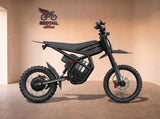
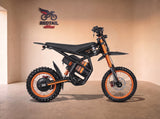
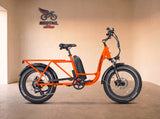
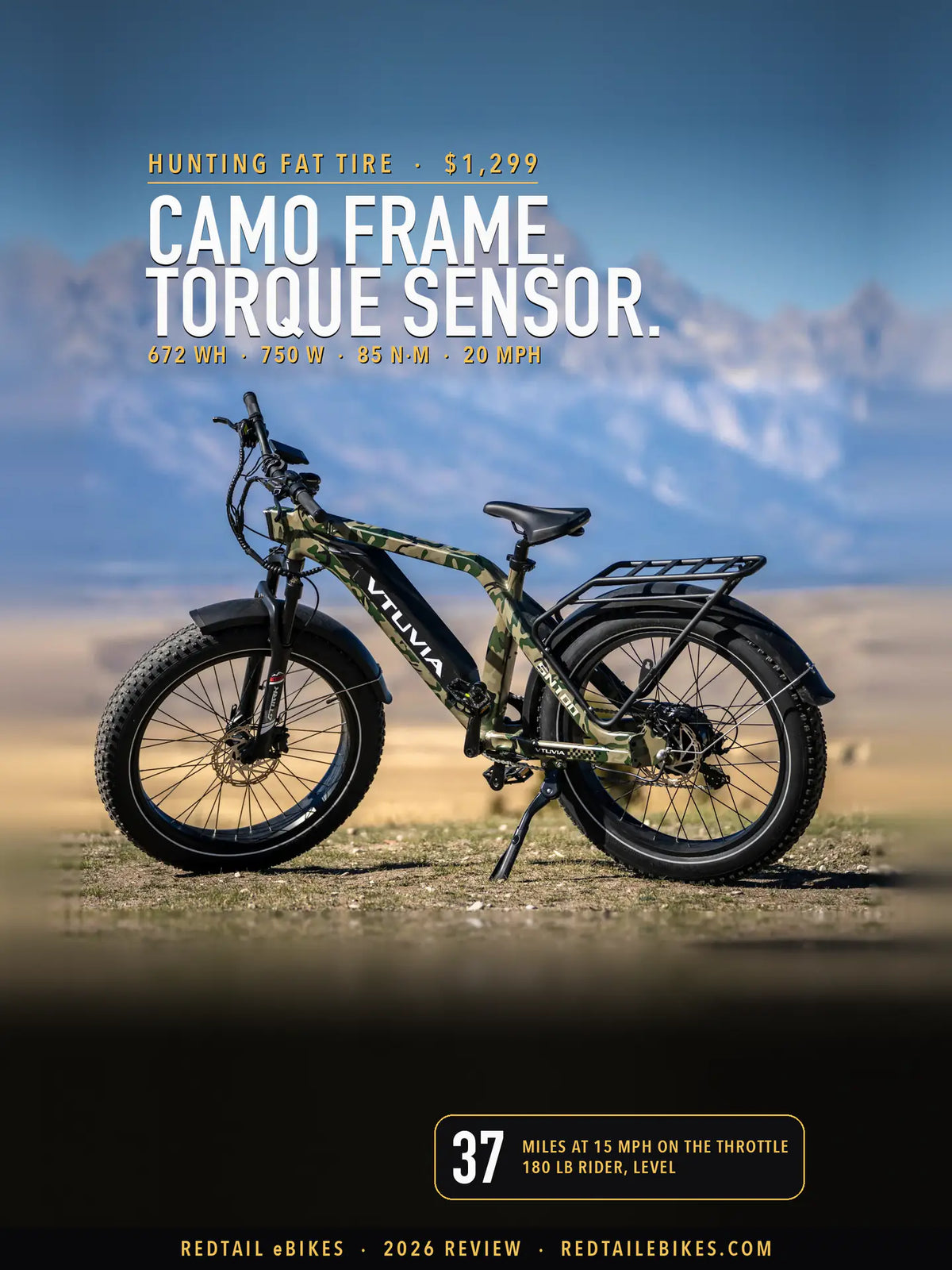

VTUVIA's own photograph, unaltered; the sky and ground around the bike are extended.
$1,299 · 750 W rear hub (1,200 W peak, 85 N·m) · 672 Wh LG pack, UL 2271 on VTUVIA's specification · Class 2 as delivered, 20 mph · torque sensor · 26 × 4.0 fat tires, hydraulic brakes · 87 lb, 400 lb capacity (330 lb on VTUVIA's specifications page) · verified November 6, 2026
Quick Answer — The VTUVIA SN100 is a $1,299 camo hunting fat tire e-bike for riders about 5'9" to 6'4": a 750 W hub with a torque sensor, a 672 Wh pack VTUVIA lists under UL 2271, hydraulic brakes and a rack. One charge computes to about 37 miles at 15 mph on the throttle with a 180 lb rider on level ground.
Pedal easily and the same pack reaches about 58 miles; at a steady 20 mph on the throttle it falls to about 26. VTUVIA lists 70 on pedal assist and 40 on the throttle; the range tables show the steady ride behind each.
Under about 5'9", fewer than half of riders clear the 33-inch top tube. It ships as Class 2 at 20 mph, and its 750 W rating meets the state e-bike definition in 28 states and DC and misses it in 20; the class section names them.
Our SN100 listing is $1,299 in Camo, its one color, down from a regular $1,599 and the same price as VTUVIA's anniversary sale on November 6, 2026. Shipping is free within the contiguous United States. Stock was thin that day, so if a hunt date rides on it, ask us to confirm a bike before you order.
Buy the Camo SN100, $1,299What this review covers
The specification · What it is · Fit · The motor · The battery · Range · Brakes, display and lights · Fork, tires, gears and water · Weight, load and the rack · The Mercer fit test · UL · Recalls · Class · Trails and public land · Green and red flags · The verdict · Checklist · Buying it from us · FAQ · Limitations · The bottom line · References
How we verified this VTUVIA SN100 review
The specification, price and stock figures here were read on November 6, 2026, from VTUVIA's SN100 product page, its product record, VTUVIA's SN100 specifications page, its electric bike guide and our own listing, and each statute and regulation quoted in the class and trails sections carries its own read date in the references. Range and fit figures are our own computation, with the inputs named beside each formula.
This review is specification-verified: every number traces to VTUVIA, our listing and policies, a statute or regulation, a linked study, dataset or review, or arithmetic shown on this page, and the model must match its published benchmarks before it computes a single mile. We sell the SN100, so hold the red flags up beside the green ones and judge for yourself. It is part of our e-bike reviews.
Written by Milad Ghobadibeygvand, BScN (Western University, 2014). Corrections: support@redtailebikes.com.
The SN100 on paper: VTUVIA's specification
| As VTUVIA publishes it | |
|---|---|
| Frame | 6061 aluminum alloy, step-over, not foldable |
| Motor | "48V 750W(PEAK 1200W) Rear Brushless Motor" |
| Torque | 85 N·m |
| Controller | 48 V, 25 A |
| Battery | "48V 14AH(672Wh) LG Lithium-Ion Battery UL2271"; 48 V 15 Ah on the specifications page |
| Range | 70 miles on pedal assist, 40 on the throttle alone; "Up to 52 miles" on the specifications page |
| Class and speed | Class 2; "the default maximum speed is set to 20 MPH" |
| Sensor and throttle | torque sensor; thumb throttle |
| Pedal assist | 3 modes × 5 levels |
| Charger and time | 54.6 V, 2 A; "About 7 Hours" on the product page, 5 to 6 hours on the specifications page |
| Brakes | dual LOGAN hydraulic disc brakes on 180 mm rotors |
| Fork | EXSHO suspension fork |
| Tires | 26 × 4.0; "Anti-puncture Reflective Tires" on the specifications page |
| Gears | Shimano M315 shifter, TY300D derailleur, DNP 7-speed cassette, 11–28T |
| Display | 3.5-inch full color, high brightness, adjustable angle; USB-A phone charging |
| Lights | 48 V, 5 W, 150 lux LED headlight; brake light |
| Included | fenders, rear rack, kickstand; bell not included |
| Weight | 87 lb "include rear racks and fenders" on the product page; 72 lb "battery included" on the specifications page |
| Capacity | 400 lb total on the product page; "Max Load 330 lbs" on the specifications page |
| Lengths | 75.59 in overall on a 48 in wheelbase; 33 in standover; seat 36.6 in from the floor at its lowest and 42 in at its highest; 22.5 in top tube; 27 in handlebar |
| Rider height and inseam | 5'8" to 6'5" and a 30 to 36 in inseam on the product page; 5'5" to 6'4" in VTUVIA's electric bike guide |
| Certification | "UL2271(Battery) UL2849(E-bike System)" |
| Warranty | 5 years on the frame; 2 years on the motor, throttle, controller, wiring, lights, sensors, charger and display; 1 year on the battery, accessories and other essential components, from delivery |
Every row is VTUVIA's wording or VTUVIA's figure, read on November 6, 2026: the specification table, notes and FAQ of the SN100 page, the specifications page for its 15 Ah pack, 72 lb, 330 lb, 52 miles and 5-to-6-hour charge, VTUVIA's guide for the second height window, and its warranty page for the terms. 48 V times 14 Ah gives the 672 Wh.
VTUVIA's two SN100 pages describe two builds. The product page carries the torque sensor, a 14 Ah pack marked UL 2271, 85 N·m and 400 lb. The specifications page carries a 15 Ah pack, 72 lb and 330 lb, the pack size VTUVIA's August 14, 2024, post gives for the SN100 and the 72 lb weight that same post states.
This page plans on the product page, the bike our listing sells, and prints the second figure beside the first wherever the two differ. That reading of the two pages as two builds is our inference from VTUVIA's dates; VTUVIA does not label either page by year.
A hunting fat tire bike on a camo step-over frame
The SN100 is VTUVIA's bike for the backcountry, and it is dressed for it: a camo frame, 26 × 4.0 fat tires, a suspension fork, a rear rack and fenders. VTUVIA's page heads it "Built for Hunters. Trusted by Riders." and names "All Terrain" as its ideal use.

VTUVIA's studio view of the drive side: the camo step-over frame, VTUVIA on the down tube, SN100 on the seat stay, the rear rack and both fenders over the 26 × 4.0 tires.
Three things make the case for a hunter. It reaches: 15 level miles on the throttle plus a 500-foot climb at 8% takes 55% of the pack with 180 lb aboard (the hills table). It hauls: VTUVIA's page pitches it for "rifles, decoys, camping gear", on a frame it puts through "400,000 vibration cycles". And it starts softly, the job of the torque sensor VTUVIA sets against the cadence sensors on "most hunting e-bikes".
The model is older than its current parts. VTUVIA's store record for the SN100 was created on May 18, 2020, and in an August 14, 2024, post VTUVIA announced the "SN100 Upgraded UL2849 Certified Version with Torque Sensor".
A December 6, 2025, post describes the current bike: "V-Adapt™ intelligent assistance, which combines torque sensing and speed sensing", and "a 48V 14Ah (672Wh) LG lithium-ion battery, certified to UL 2271 standards". That is the SN100 on VTUVIA's product page and on ours today.
Buy parts for the build you own. Our VTUVIA parts shelf keeps the two apart the way VTUVIA's fitment lists do: a color display for the UL SN100, a crankset in an "SN100 UL Version", and a saddle and an older display marked for the "Non-UL-SN100".
On paper, then, the SN100 is a 26-inch hunting fat tire bike with a torque sensor, a 750 W rear motor, a 672 Wh pack VTUVIA lists under UL 2271 and a rack for gear, at $1,299 with a camo frame. Our VTUVIA brand profile covers the company behind it and the rest of its lineup.
How quiet is the SN100 on a hunt?
Expect a smooth start, and plan your approach as if game can still notice you. VTUVIA's claim is "Ultra-smooth, silent starts with zero jerky movement", so that you can "sneak through the forest quietly". The torque sensor is what that claim rests on: it eases the motor in as you press the pedal.
Elk moved for bikes with no motor at all. In a two-season Oregon study, 13 radio-collared elk traveled more during ATV riding, mountain biking, hiking and horseback riding alike, and most of all in the mornings. ATVs moved them most and mountain bikes came second, ahead of hikers. No e-bike was in that study, so reading it across to the SN100 is our inference.
So treat the last stretch as you would on foot: leave the bike well short of your stand and walk in. Quiet buys no access either, since the trail rules turn on the motor and the class.
Does the SN100 fit you? Saddle, top tube and reach
VTUVIA sizes the SN100 for riders from 5'8" to 6'5" with a 30- to 36-inch inseam on its product page, and from 5'5" to 6'4" in its guide. US Army survey data (ANSUR II) put the median 5'5" rider's saddle top 33.8 inches over the pedal axle at 109% of inseam, and the median 6'4" rider's at 41.0 inches.
Measure it on the bike with a tape and a helper: pedal center to saddle top, with that crank pointed straight down along the seat tube. The tables run the heights in VTUVIA's two windows through the Army survey's 6,068 measured bodies.
Find your fit in three steps:
- Measure your inseam with your socks on, back to a wall: pull a hardcover book up snug under you, spine on top, and tape from the floor to that spine.
- Look up your height in the saddle table, then check your inseam against that row's range and against VTUVIA's 30 to 36 inches; if it is under 33 inches, read the top-tube table too.
- Put the saddle top at your row's figure above the pedal axle when the bike arrives, and finish with the knee and heel checks.
How high should the saddle go?
The median 5'5" rider needs the saddle top 33.8 inches above the pedal axle, and the median 6'4" rider 41.0 inches. Each row applies 109% to the median inseam at that height, the Hamley method Peveler and colleagues compared, measured from the pedal axle.
The last two columns set the saddle at 106% and 110.4%, the outer ends of two ranges in Ferrer-Roca et al., 2012: 106 to 109%, the range usually recommended, and 108.6 to 110.4%, their own.
| Your height | Typical inseam | Saddle top to pedal axle | At 106% | At 110.4% |
|---|---|---|---|---|
| 5'5" | 29.7–32.6 in | 33.8 in | 32.9 in | 34.3 in |
| 5'6" | 30.2–33.5 in | 34.5 in | 33.6 in | 34.9 in |
| 5'7" | 30.7–33.9 in | 35.1 in | 34.1 in | 35.5 in |
| 5'8" | 31.1–34.3 in | 35.6 in | 34.6 in | 36.0 in |
| 5'9" | 31.7–34.8 in | 36.1 in | 35.1 in | 36.6 in |
| 5'10" | 32.2–35.5 in | 36.8 in | 35.8 in | 37.3 in |
| 5'11" | 32.9–36.1 in | 37.4 in | 36.4 in | 37.9 in |
| 6'0" | 33.2–36.7 in | 38.1 in | 37.0 in | 38.6 in |
| 6'1" | 33.9–37.2 in | 38.8 in | 37.8 in | 39.3 in |
| 6'2" | 34.3–37.5 in | 39.3 in | 38.2 in | 39.8 in |
| 6'3" | 35.3–38.0 in | 39.9 in | 38.8 in | 40.4 in |
| 6'4" | 36.3–39.1 in | 41.0 in | 39.9 in | 41.6 in |
Saddle top measured from the pedal axle with the crank down along the seat tube, at 109%, 106% and 110.4% of each height's median inseam. Inseams show the middle 90% of the Army's ANSUR II bodies at that height (5th to 95th percentile), women and men pooled. VTUVIA's window reaches 6'5", where the survey measured 17 people, too few to print a row.
At 6'3" and up, set your inseam against VTUVIA's 36 inches first. The survey's median inseam is 36.6 inches at 6'3" and 37.6 inches at 6'4", so the top of VTUVIA's height window is where legs start to outgrow its recommended inseam.
VTUVIA prints the seat at 36.6 inches from the floor at its lowest and 42 inches at its highest, and its size guide draws both from the floor to the top of the saddle. Floor heights can't sit beside the formula without the crank's length and its axle's height off the ground, so the table works from the pedal axle (Limitations).

VTUVIA's SN100 size guide, from the product page: the top tube, head tube, standover, wheelbase and seat heights on the drawing carry their figures in the specification table, and both seat heights are drawn from the floor to the top of the saddle.
Can I put a foot down at a stop?
On a step-over frame, that depends on your inseam: of every 100 riders at 5'8", 37 have an inseam longer than VTUVIA's 33-inch standover, 94 do at 5'11", and all 100 do from 6'2" up. Below that line you straddle the top tube with the bike leaned toward the foot you put down, rather than standing over it upright.
| Your height | Typical inseam | Clear the 33-inch top tube, of 100 |
|---|---|---|
| 5'5" | 31.0 in | 3 |
| 5'6" | 31.7 in | 11 |
| 5'7" | 32.2 in | 19 |
| 5'8" | 32.6 in | 37 |
| 5'9" | 33.1 in | 55 |
| 5'10" | 33.8 in | 79 |
| 5'11" | 34.3 in | 94 |
| 6'0" | 34.9 in | 96 |
| 6'1" | 35.6 in | 99 |
| 6'2" | 36.0 in | 100 |
| 6'3" | 36.6 in | 100 |
| 6'4" | 37.6 in | 100 |
Out of 100 riders at each height, the number with a barefoot inseam longer than VTUVIA's 33-inch "Standover height", from the Army survey's bodies; the middle column is the median inseam. Shoes add a little to your inseam.
Between 5'5" and 5'7", inside the window in VTUVIA's guide, at most 19 of every 100 riders clear the top tube. If that is your height and you want to stand flat-footed over the frame, the VTUVIA SF20H steps through at 16 inches, with the same 750 W rating and a 672 Wh pack.
Will I feel cramped, or stretched out?
The stem decides it: VTUVIA's specification shows an "Aluminum Alloy Adjustable" stem with a 27-inch handlebar, so the grips can come up and back toward you. Comfort favors that move: the twenty recreational cyclists of Priego Quesada et al., 2017 rode three trunk angles and liked the most upright best.
The lean angle is not computed here, because it needs the grip position on the frame. Use VTUVIA's adjustable stem: tilt it up if you reach down and forward to the grips, and down if your elbows stay bent and your weight sits back on the saddle.
How much weight goes on my hands?
Sit more upright and your hands carry less of you, so on the SN100 the stem angle sets how much your wrists take. The hand load is not computed here either, since it too needs the grip position. As a yardstick, Carahalios, 2015 measured ten road racers riding on the brake hoods and found 15% of their weight on the bars.
Sore palms after a long ride in the field? Raise the grips and bring them closer: sit taller and the saddle takes more of your trunk's weight (Clauser et al., 1969 list each body segment's share). Padded gloves are the cheap fix: Slane et al., 2011 measured 10 to 28% less pressure on the ulnar nerve across 36 riders.
How do I set the saddle when it arrives?
Start from your row's figure, then read the knee: with the pedal at its lowest, look for 25 to 35 degrees of bend, the range the cycling literature recommends (Peveler, Pounders and Bishop, 2007). Short on time? Set the saddle so your leg just goes straight with your heel resting on the bottom pedal.
Peveler et al., 2005 tried all three on 19 trained cyclists: 70% landed inside that knee range with the heel method, against 55% for the 109% formula and 65% for LeMond's. Do the adjusting with the bike on its kickstand: release the seat clamp, move the post, then clamp it hard before the first ride.
For a softer seat on rough two-tracks, VTUVIA's suspension seatpost for the SN100 is a 350 mm post with 50 mm of travel, $154.80 on our store.
How we computed fit
The saddle table's main column is 109% of your inseam, measured pedal axle to saddle top. Take a 5'8" reader at the survey's median, a 32.6-inch inseam: 109% of that is 35.6 inches, with 34.6 at the 106% end of the band and 36.0 at the 110.4% end.
LeMond's rule starts from the crank axle at 88.3% of inseam, which is 28.8 inches here; the crank's own length on top brings it close to the table's figure.
| Input | Value | Source |
|---|---|---|
| Rider window | 5'8" to 6'5", inseam 30 to 36 in; 5'5" to 6'4" | VTUVIA's product page; VTUVIA's guide |
| Standover | 33 in | VTUVIA's specification table |
| Seat height | 36.6 to 42 in from the floor, printed beside the table | VTUVIA's specification table |
| Bodies | 6,068 US Army personnel, women and men | ANSUR II |
| Saddle formula | 109% of inseam from the pedal axle (Hamley and Thomas, 1967); columns at 106% and 110.4% | Peveler et al., 2005; Ferrer-Roca et al., 2012 |
VTUVIA's camo side photograph was scaled at its published 48-inch wheelbase and checked against four more of its published lengths: the overall length, the chainstay, the standover and the head tube. None came within 3.5%, and three matches are the minimum before a photograph is used, so no saddle position, lean or hand load is taken from it (Limitations).
Between 5'5" and 6'4"? Your saddle figure is in the table. Send sales@redtailebikes.com your height and inseam, and we will reply with your row and the top-tube answer before you order the $1,299 Camo SN100.
Fits you? Buy the SN100The motor: 750 W in the rear hub, 1,200 W at peak
The SN100's rear hub motor carries VTUVIA's 750 W rating, peaks at 1,200 W and makes 85 N·m, and the peak follows from its 48 V, 25 A controller: 48 × 25 = 1,200. Its FAQ calls it "a 750W continuous, 1200W peak motor with torque sensor"; the class section reads state definitions against that 750 W.

The rear hub motor in VTUVIA's close-up, with the seven-speed cassette on one side and the brake rotor on the other.
A hub motor turns the rear wheel from inside the hub, so it works at road speed in any gear. Hub against mid-drive gets its full treatment in our e-bike motor guide, and the gear table counts what your legs save on the SN100.
The assist reads how hard you push. VTUVIA's page says the SN100 "senses your pedal force directly" for "a smooth, natural acceleration without chain jerks", and its December 2025 post describes the assist as combining "torque sensing and speed sensing".

The torque-sensing spindle VTUVIA pictures on the SN100 page; it sits in the bottom bracket, where the cranks turn.
You get "3 Modes x 5 Levels" of pedal assist, plus a thumb throttle that needs no pedaling. VTUVIA's note on speed reads that "the default maximum speed is set to 20 MPH, which can be adjusted according to user preferences"; the class section reads the 20 mph default beside the law.
The battery: 48 V × 14 Ah = 672 Wh, UL 2271 on VTUVIA's specification
VTUVIA's product page gives the pack at 48 V and 14 Ah, which makes 672 Wh, with LG cells and UL 2271, and the motor, the lights and the display all draw from it. The specifications page lists a 48 V 15 Ah pack, which multiplies out to 720 Wh, and weighs the pack at 9.35 lb.

The pack in the down tube, lettered VTUVIA, in VTUVIA's close-up; the frame around it is faded out in the image.
The pack is removable, which VTUVIA's text says makes it "convenient to charge whether at home or on the go": carry it inside to a charger while the bike stays in the truck bed or the garage. A replacement key set for the SN100, cut to your lock number, is $106.80 on our parts shelf.
The 2 A charger puts out about 109 W. Run the sum yourself and a 672 Wh pack needs about 6.2 hours on VTUVIA's 54.6 V, 2 A charger, charger losses aside. That lands between the two figures VTUVIA prints, "About 7 Hours" on the product page and 5 to 6 on the specifications page, so leave 7.
A full pack costs about 12 cents before those losses, at the 18.16 cents a kilowatt-hour US homes averaged in August 2026.
A second pack for long days is VTUVIA's 48 V battery for the SN100 and SJ26, $598.80 on our shelf as a "48V 14AH (UL)" pack; the 20 Ah ($958.80) and 17.5 Ah ($838.80) versions are made to order.
With a spare on the rack, the level 15 mph throttle ride computes to about 73 miles for a 180 lb rider. Before you pay, photograph the label on your pack and send it over so we can match the build.
How far the SN100 goes: range by speed, hill, load and cold
Level ground, 180 lb aboard: 15 mph on the throttle empties the pack in about 37 miles, 20 mph in about 26, and 15 mph with easy pedaling in about 58. A steady 8% grade at 10 mph drains it in about 7 miles on the throttle alone.
Work out your own figure in three steps:
- Open the speed tables and settle on a pace and an effort that match how you ride.
- Budget for the climbing: 1,000 feet of gain adds 163 Wh up a 4% grade and 222 Wh up a 10% grade at 10 mph on the throttle, less if you pedal (the hills table).
- Correct for what you and your gear weigh and a cold start, then count on only 75% of the pack.
Each figure is one steady ride, and four things feed it: a cycling-power model validated on an open road, VTUVIA's specifications, published figures for a comparable hub motor, and ten 26 × 4.00 fat tires measured on a drum. The formula subsection follows one ride from wheel to pack, then holds the model up against a reviewer's measured run.
Does speed cut the SN100's range? Miles at each speed
Yes, sharply: with 180 lb aboard, the throttle gets about 50 miles from a full charge at 10 mph and about 26 at 20 mph. Those last 5 mph, from 15 to 20, take 37 miles down to 26.
The air is the cause. Pushing through it takes power that grows with the cube of speed: (20 ÷ 15)³ comes to about 2.37, which puts 20 mph at well over twice the air power of 15 mph.
| Speed, flat | Per mile | Full charge | With 25% kept |
|---|---|---|---|
| 10 mph | 13.5 Wh | 50 mi | 37 mi |
| 12 mph | 15.1 Wh | 44 mi | 33 mi |
| 15 mph | 18.2 Wh | 37 mi | 28 mi |
| 18 mph | 22.3 Wh | 30 mi | 23 mi |
| 20 mph | 25.6 Wh | 26 mi | 20 mi |
A 180 lb rider on level ground in 77 °F air, throttle alone, up to VTUVIA's 20 mph default. Why keep 25%? On one pedelec measured at KIT over a standard range test, 75% of the pack was in use (Schmitt, Decker and Doppelbauer, 2019).
At 15 mph, about 75 W of easy pedaling turns 37 miles into 58. We call 75 W easy and 150 W steady. Which are you? Switch the motor off in your head and roll the SN100 across flat ground: your legs' 75 W holds about 9.0 mph and 150 W about 13.2 mph, so pick the column closest to the pace you could keep unaided.
| Speed, flat | Throttle only | Easy pedaling (75 W) | Steady pedaling (150 W) |
|---|---|---|---|
| 15 mph | 37 mi | 58 mi | 117 mi |
| 18 mph | 30 mi | 40 mi | 59 mi |
| 20 mph | 26 mi | 33 mi | 44 mi |
A full charge, 180 lb aboard, flat ground. The pack's cost at 15 mph is 18.2 Wh a mile with the throttle alone, 11.7 Wh with easy pedaling. Treat 117 miles with the most suspicion, since your legs are out-working the motor there and no published data checks the model's motor losses when the load is that light (Limitations, item 5).
The assist level on the display does not change these numbers by itself. The pack answers to two things, your speed and how much work your legs hand to the motor; VTUVIA's own range note widens the list to "the rider's weight, pedal assist level, throttle use, terrain, speed, weather, and towing weight".
Do gears or pedaling save battery on the SN100?
Your legs save battery; the gears alone do not. Shifting changes your cadence and nothing else here, because the motor sits in the rear hub past the chain; hold the speed and grade steady and the pack's draw falls only when you push harder:
| Your ride | Throttle only | Easy pedaling (75 W) | Steady pedaling (150 W) |
|---|---|---|---|
| 15 mph, flat | 18.2 Wh | 11.7 Wh | 5.7 Wh |
| 20 mph, flat | 25.6 Wh | 20.3 Wh | 15.4 Wh |
| 12 mph, 4% grade | 53.1 Wh | 40.3 Wh | 29.1 Wh |
| 12 mph, 8% grade | 116.6 Wh | 94.1 Wh | 75.5 Wh |
Watt-hours the pack gives up per mile, 180 lb aboard, 77 °F air, with 75 W of yours in the easy column and 150 W in the steady one.

The Shimano derailleur in VTUVIA's close-up, lettered Tourney, the family the TY300D belongs to, with the 11–28T cassette behind it.
Shift for a cadence you like, and grab a low gear ahead of any stop or climb so you pull away cleanly. On a grade your own effort matters most, and the hills table shows by how much.
How much battery does a climb cost?
Climbing 1,000 feet at 10 mph adds 163 to 222 Wh to the flat cost on the throttle across 4 to 10% grades, or 147 to 194 Wh if you pedal easily. Raising rider and bike accounts for just 101 Wh of that at the rear wheel; everything else is motor and pack heat.
A 180 lb rider on the 87 lb SN100 makes 267 lb. Send that weight up an 8% climb on the throttle at 10 mph and each 1,000 feet costs 197 Wh beyond the same miles on the flat. Counting those miles as well, a full 672 Wh pack runs out after about 2,900 feet of climbing with no flat miles at all. The model earns nothing back on the way down, so these figures lean cautious.
| Grade | Wh a mile | Miles, throttle | Miles, easy pedaling | Top steady speed |
|---|---|---|---|---|
| 2% | 30 Wh | 23 mi | 36 mi | 20.0 mph |
| 4% | 48 Wh | 14 mi | 19 mi | 20.0 mph |
| 6% | 70 Wh | 10 mi | 12 mi | 17.9 mph |
| 8% | 97 Wh | 7 mi | 9 mi | 14.4 mph |
| 10% | 130 Wh | 5 mi | 6 mi | 11.1 mph |
| 12% | past the peak | — | 5 mi | 8.1 mph |
| 15% | past the peak | — | — | 4.1 mph |
Each row holds 10 mph with 180 lb aboard. Nobody pedals in the watt-hour or throttle columns; the easy-pedaling miles include 75 W from you. The last column is the fastest the throttle alone can keep going up that grade, staying within the 750 W rating, the 1,200 W peak and the 20 mph default.
From 12% up, pedal. The throttle alone manages about 8.1 mph up a 12% grade, and adding 75 W of your own gets that to about 10.2 mph; at 15% it crawls at about 4.1 mph, or about 6.8 with easy pedaling.
Add the hills to the flat miles. A 15-mile level approach on the throttle at 15 mph uses about 273 Wh; one 500-foot climb at 8% adds about 99 Wh, for 372 Wh in all, 55% of the pack. The model rides at one steady speed, so add wind, soft ground and every stop on top of that.
How much does a heavier rider or a load of gear cost?
Extra weight trims the range on the flat and cuts it hard on a climb. Each added pound loads the tires and has to go up every grade with you, and the air's drag ignores it, which is why the heavy load loses more ground as the trail steepens. The pack can't tell a loaded rack from a heavier rider.
| You plus your load | 15 mph flat, throttle | 20 mph flat, throttle | 8% climb, 10 mph |
|---|---|---|---|
| 130 lb | 40 mi | 28 mi | 9 mi |
| 180 lb | 37 mi | 26 mi | 7 mi |
| 230 lb | 34 mi | 25 mi | 5 mi |
| 280 lb | 32 mi | 23 mi | past the motor's peak |
| 330 lb | 29 mi | 22 mi | past the motor's peak |
| 400 lb | 27 mi | 20 mi | past the motor's peak |
Rows count you and all you carry; every row adds the bike's 87 lb, the heavier of VTUVIA's two weights. Throttle only. The 400 lb row is the total capacity on VTUVIA's product page, and the 330 lb row the "Max Load" on its specifications page.
Take a 200 lb hunter carrying 30 lb of gear: that 230 lb row reads 34 flat miles at 15 mph, or about 5 miles of steady 8% climbing at 10 mph. At 280 lb and above, the throttle alone can't keep 10 mph on that 8% grade in the model, so pedal, or take the grade slower.
At the full 400 lb, the flat range at 15 mph falls from 37 miles to 27, more than a quarter down, and the climbing gets harder still (the hills section).
How much range does the cold take?
Colder air, fewer miles. Those 37 miles at 15 mph on the throttle in 77 °F air shrink to about 29 at 32 °F and about 26 at 14 °F, the kind of morning a fall hunt starts in. Warm air runs the other way: the 95 °F row beats 77 °F on less pack energy, because the air is thinner and the tires roll easier.
| Air | Pack energy vs 77 °F | 15 mph flat, throttle |
|---|---|---|
| 95 °F | 99% | 39 mi |
| 77 °F | 100% | 37 mi |
| 68 °F | 98% | 35 mi |
| 50 °F | 93% | 31 mi |
| 41 °F | 91% | 30 mi |
| 32 °F | 89% (80–93) | 29 mi (26–30) |
| 14 °F | 82% (40–83) | 26 mi (13–26) |
Level ground, 180 lb aboard. Row centers rest on McMaster University's LG HG2 cell tests at 77, 50, 32 and 14 °F, worked out here for a 0.5C discharge. We interpolate between those four and assume the cells match the air's temperature. The HG2 is our stand-in for VTUVIA's LG cells because its cold data is published.
Brackets mark the spread in published cell data. Casado and colleagues set the high end with the most energy they measured in 2025 on a slower discharge, and the low end is the least capacity any Samsung data sheet gives for that temperature over a one- to four-hour discharge (25R and 30Q at 32 °F, 35E at 14 °F).
Three losses stack up below freezing. The cells come first: at 32 °F you get back about 89% of what they hold at 77 °F (80 to 93%, by source). The air is next, denser by about 9% under the gas law behind the U.S. Standard Atmosphere, and you push through more of it every mile.
The tires add the last loss, since rubber stiffens as it cools. Each °F below 77 °F costs another 0.5% in rolling resistance in the model (0.9% per °C), down to a floor at 41 °F; that rate lies between Rothhämel's fit for a 42 mm tire and Bicycle Rolling Resistance's road-tire average.
VTUVIA describes the cells as "designed for cold mornings"; store the pack indoors overnight and slide it in right before you head out.
Do the fat tires cost range, and does posture matter?
The tire you roll on matters more than how you sit. Fat tires differ: Bicycle Rolling Resistance's drum put ten in the SN100's 26 × 4.00 size between 23.2 and 42.1 W each, at 18 mph under 94 lb at 12 psi.
We use the ten's median, a coefficient of 0.0105, and the table also runs the lightest-rolling and the heaviest-rolling tire.
| Rolling resistance | 15 mph flat, throttle | 20 mph flat, throttle |
|---|---|---|
| 0.0070 · the lowest of ten fat tires on the drum | 43 mi | 30 mi |
| 0.0105 · the median of ten fat tires (used) | 37 mi | 26 mi |
| 0.0126 · the heaviest-rolling fat tire on the drum | 34 mi | 25 mi |
Level ground, 180 lb aboard, a full pack. The heaviest-rolling tire is the Kenda Juggernaut Pro, which its own drum page puts at 0.01262.

The 26 × 4.0 front tire in VTUVIA's close-up, with the reflective sidewall stripe VTUVIA's FAQ describes "for added visibility and safety after dark".
Stay inside the pressure range on your tire's sidewall, whatever the drum's 12 psi suggests. Posture counts for more as the speed climbs. The model uses the 0.603 m² drag area that Tengattini and Bigazzi measured on 90 everyday mountain-bike riders; sit up like their 37 cruiser riders, at 0.640 m², and the 20 mph throttle ride drops from 26 miles to 25.
VTUVIA's 70 and 40 miles, as steady rides
The model can put a steady ride to both of VTUVIA's product-page figures. VTUVIA's page gives 70 miles for pedal assist and 40 for the throttle only.
| VTUVIA's figure | Throttle only | Easy pedaling (75 W) | Steady pedaling (150 W) |
|---|---|---|---|
| Pedal assist, 70 miles | — | about 13.7 mph | about 17.1 mph |
| Throttle only, 40 miles | about 13.8 mph | about 18.2 mph | — |
How fast a 180 lb rider could go on level ground and spend all 672 Wh over VTUVIA's distance: 70 miles allows 9.6 Wh a mile and 40 miles allows 16.8. Dashes mark pairs the model can't reach at any steady speed from 5 to 20 mph: throttle-only riding stays above 9.6 Wh a mile throughout, and 150 W of pedaling stays under 16.8 as far as 20 mph.
So VTUVIA's 70 miles looks like easy pedaling at about 13.7 mph, and its throttle 40 like a steady 13.8 mph. At 15 mph the throttle figure, 37 miles, comes in just short of that 40.
The specifications page's "Up to 52 miles" comes with its 15 Ah pack and 72 lb, so it is not mapped onto the 672 Wh pack here. On 72 lb the model's 15 mph throttle ride grows from 37 miles to 38.
Plan on 75% of the miles in your row. That quarter is the reserve from KIT's measurement, and at 15 mph on the throttle it turns the full 37 miles into a planning figure of 28.
Start from your row, spend three-quarters of the pack, and take the climbs out of that. Climbing puts another 163 to 222 Wh per 1,000 feet on the bill at 10 mph on the throttle, less if you pedal. Held to that reserve, your flat range is 28 miles at 15 mph on the throttle, or 20 at 20 mph, with 180 lb aboard.
A morning of 15 level miles at 15 mph with 500 feet of 8% climbing draws about 372 Wh on the throttle, 74% of your planning budget of 504 Wh. Tell us how far in you go, how much you climb, your load and your usual speed, and we will run that ride before you order.
Buy the SN100 for $1,299The range formula, worked through
All of the range figures above come from one equation. Speed, weight, slope and air go in, and out comes what the rear wheel has to deliver to keep a steady speed in still air, by Martin and colleagues' 1998 model, checked against power measured on an open road:
P = v × [ m × g × (Crr × cos θ + sin θ) + ½ × ρ × CdA × v² ], with P the power at the rear wheel.
Here v is road speed, m the mass of rider, gear and bike together, g gravity, θ the angle of the slope, Crr the tires' rolling-resistance coefficient (0.0105 means a drag of 1.05% of the weight on the tires), ρ the air's density, and CdA the drag area, how big a hole you punch in the air (Martin et al.).
Four stages separate the wheel from the pack:
- You: of what you put into the pedals, 97.7% survives the chain to the rear wheel (Martin and colleagues' figure); the motor covers what the wheel still needs.
- The rear hub handles the motor's whole share.
- The motor borrows its behavior from a comparable hub with published figures, the RM G062.750.D/DC in Bafang's 2021 OEM workbook: 400 rpm unloaded, 350 rpm at its rating on 48 V, 85 N·m, and an efficiency of "≥ 80" percent. Our version runs 80% efficient at that point and less at light load, with torque stopped at VTUVIA's 85 N·m and pack draw at the 1,200 W peak.
- The pack loses a little to its own heat, as Arango, Lopez and Ceren measured on a 48 V pack.
The rest is division: Wh per mile = pack watts ÷ mph, then range = 672 Wh × the cells' remaining share of energy at that temperature ÷ Wh per mile.
| Input | Value used | Where it comes from |
|---|---|---|
| Bike | 87 lb | VTUVIA's product page |
| Rider and cargo | 180 lb; the weight table also runs 130, 230, 280, 330 and 400 | 400 lb on VTUVIA's product page, 330 lb on its specifications page |
| Battery | 48 V × 14 Ah = 672 Wh | VTUVIA's specification |
| Motor | 750 W at its rated speed, 80% at the rated point, torque capped at 85 N·m, pack draw capped at 1,200 W | Bafang OEM workbook 2021, RM G062.750.D/DC; VTUVIA's 750 W, 1,200 W, 85 N·m and 25 A |
| Wheel | 30.0 inches across, the 26 × 4.0 size's nominal diameter | VTUVIA's 26 × 4.0 tire: a 559 mm bead seat plus twice the 4.0-inch width |
| Rolling resistance | 0.0105, the median of ten 26 × 4.00 fat tires at 12 psi | Bicycle Rolling Resistance |
| Drag area | 0.603 m², 90 everyday mountain-bike riders | Tengattini and Bigazzi, 2018 |
| Chain | 97.7%, your pedaling only | Martin et al., 1998 |
| Battery losses | 3.6% at 15 mph, more at climbing currents | Arango, Lopez and Ceren, 2021 |
| Air | 77 °F at sea-level pressure, 1.184 kg/m³ | U.S. Standard Atmosphere, 1976 |
| Cold | the share of a cell's energy left at each temperature | McMaster University's LG HG2 cell data |
| Planning reserve | 25% of the pack kept back | Schmitt, Decker and Doppelbauer, 2019 |
Worked through for one ride, the 37-mile one: 180 lb aboard, level ground, 15 mph on the throttle alone. The rear wheel has to deliver 191.6 W to hold it, 83.9 W of that for the tires and 107.6 W for the air.
The 30-inch wheel is doing 168 revolutions a minute at that speed. The wheel needs 10.9 N·m there. Bafang's published figures yield 1.146 N·m per amp, a 0.307 Ω winding and 1.67 A with no load, so that torque takes 11.2 A, at 73% efficiency and 263.7 W going in.
Count the pack's internal losses and the cells give up 273.5 W, which at 15 mph is 18.23 Wh a mile; 672 Wh divided by 18.23 is about 36.9 miles, or 27.6 with a quarter of the pack held back.
Before it computes a mile, the model must return two published figures.
| Check | Published figure | This model |
|---|---|---|
| Road physics, Martin and colleagues' worked example | 45.7 W for tires and grade, 158.8 W for the air | 45.7 W and 158.8 W |
| The comparable motor at Bafang's rated point | at least 80% efficient | 80% |
The self-test runs Appendix I of Martin and colleagues (8.36 m/s, a 90 kg system, a 0.3% grade) and the rated point of Bafang's RM G062.750.D/DC.
A reviewer's measured ride, on the earlier build. BikeRide's review of the SN100, with its video posted June 28, 2024, ran a pack of the same 672 Wh to empty on its third assist level: 37.73 miles at a 14.5 mph average with 1,302 feet of climbing, by a 6'0" tester whose weight is not given. BikeRide calls that run "a closer representation of the real-world range".
On level ground at 14.5 mph on the throttle alone, the model gives that pack about 38.1 miles; the 1,302 feet of climbing would cost another 213 to 289 Wh on the throttle, 32 to 43% of the pack.
On that third assist level, the rider's own watts went into those miles, which the review does not measure, so read the run as a floor under the model rather than a calibration of it; that bike also had a cadence sensor and no rack or fenders.
Brakes, display and lights
Stopping falls to "Dual LOGAN Hydraulic Disc Brakes" on stainless rotors of 180 mm, which VTUVIA's text credits with "strong and consistent stopping power". Hydraulic pads listed for the SN100 are $30 a pair on our pad listing, and a front hydraulic brake for the SN100 is $118.80, read November 6, 2026.
Up on the bars, a tilting 3.5-inch full-color screen carries a USB-A port for a phone; VTUVIA says it shows "speed, battery life, and mileage, with excellent visibility in all light conditions".

The display in VTUVIA's close-up: speed in the middle, the battery percentage along the top, and the assist level and trip distance underneath.
Up front sits a "48V 5W 150 Lux LED Headlight", which VTUVIA pitches for "early-morning departures and late-day returns", with a brake light at the back and reflective stripes on both tires. There is no bell or horn, so fit one if your trails or your state call for it; a seat tail light for the UL SN100 is $23.99 on our shelf.

The LED headlight on its mount in VTUVIA's close-up; VTUVIA rates it at 5 W and 150 lux.
Fork, tires, gears and water
Up front is an EXSHO suspension fork, listed on VTUVIA's page as a "Lockable Hydraulic Front Fork" built to soak up shocks. Lock it on smooth gravel and pavement, and open it for roots and rock.

The suspension fork in VTUVIA's close-up, with the yellow EXSHO label on the lower leg.
The tires are 26 × 4.0, "Anti-puncture Reflective Tires" on the specifications page. The gearing pairs a Shimano M315 shifter and TY300D derailleur with a DNP seven-speed cassette from 11 to 28 teeth. Spares for the wheels sit on our VTUVIA parts shelf: a 26 × 4.0 tube at $46.80 and a 26-inch reflective fat tire at $106.80, priced on November 6, 2026.
VTUVIA writes about water in two places, and they do not say the same thing. In the class note, the SN100 "is built to the IP67-rated standard", which VTUVIA takes as "suitable for riding through creeks, mud, and snow", short of "prolonged or intentional immersion in water".
The FAQ is more careful: "light rain or wet conditions won't be a problem. However, avoid submerging the bike in water or riding in heavy downpours to protect the electrical components." Plan on the FAQ's line: shallow water and wet grass yes, a soaking downpour no. The class note also rules out pressure washers and sprayers, so wipe it down with a damp cloth.
Weight, load and the rack
Plan on 87 lb, the product page's weight "include rear racks and fenders"; VTUVIA's specifications page gives 72 lb "battery included". At either weight, bring a second pair of hands for the lift into a truck bed, and make sure a hitch rack is rated for it: check the rack's per-bike limit against 87 lb, or about 78 lb with the pack out, going by the 9.35 lb the specifications page gives its pack.
Capacity comes as two figures as well. The product page, its highlight strip and its FAQ give 400 lb ("The SN100 supports up to 400 lbs"), and the specifications page gives "Max Load 330 lbs". The range tables run both, and the 400 lb covers you plus everything on the bike.
Load the rack to 55 lb. VTUVIA's rear rack listing rates the "New SN100" rack at "25 kg (55 lbs)", and a September 12, 2025, VTUVIA post describes "a rear rack capable of 100 lbs". Keep to the lower figure until VTUVIA confirms the higher one for your bike; email us and we will ask in writing.
A rifle or bow counts toward that 55 lb. VTUVIA's page names "rifles" among the gear, and our shelf has no gun or bow mount for the SN100 today, so strap a hard case to the rack or carry it on your back, and check how your state wants a firearm carried on a vehicle before you ride.

Walked through tall grass in VTUVIA's photograph, with gear strapped to the rack; that gear is not part of the bike, and the rack's rated 55 lb is the limit to plan on.
For bigger loads, a trailer puts the weight on its own wheels. VTUVIA's cargo trailer is rated by VTUVIA to 60 kg, about 132 lb, and is $310.80 on our store; its load still counts toward the range, since VTUVIA's range note lists "towing weight" among the things that move it, so ask us about the hitch for your SN100 before you order one.
A whole deer fits that rating, barely. Ohio's wildlife division weighed antlered deer at an average 129.69 lb field dressed, just under the trailer's 132 lb, so a heavier animal means quartering it or a second trip. Our deer cart guide rates the other trailers and carts we read.
The trailer itself weighs 22 lb. With that deer on it, a 180 lb rider and 30 lb of gear, the model carries about 362 lb: about 35 level miles at 10 mph on the throttle, about 9.8 mph up a 6% grade, about 5.1 mph up 8%, and nothing at 10%, where your legs take over. It leaves out the trailer's own drag, so a real haul costs more.
Add yourself, your pack and whatever rides on the rack before you head out. VTUVIA's rack listing allows the rack 55 lb; the whole bike gets 400 lb on its product page and 330 lb on its specifications page. Every extra pound shows up first on the climbs.
The Mercer fit test
One family of seven, the Mercers of Fair Oaks, California, meets every bike we review, so the fit questions never change (meet the Mercers). Their verdicts below come from a figure VTUVIA publishes (its 5'8" to 6'5" and 5'5" to 6'4" windows, the 30 to 36 inch inseam, the 33-inch standover, the 400 lb capacity), the fit tables, or the California code sections named in the row.
| Member | Age · Height | Verdict | The number behind it |
|---|---|---|---|
| Frank Kowalski | 63 · 5'10" | Fits | Inside both windows; his row sets the saddle 36.8 in from the pedal axle, and 79 of 100 riders his height clear the 33-inch top tube; his height's inseam runs 32.2 to 35.5 in, inside VTUVIA's 30 to 36 |
| Ruth Kowalski | 61 · 5'5" | The top tube is the check | Inside the guide's 5'5" to 6'4" window, below the product page's 5'8"; 3 of 100 riders her height clear the top tube, and her saddle goes 33.8 in from the pedal axle; the SF20H steps through at 16 in |
| Jack Mercer | 48 · 6'1" | Fits | Inside both windows; 99 of 100 riders his height clear the top tube, his row's median inseam is 35.6 in against VTUVIA's 36, and the saddle goes 38.8 in from the pedal axle |
| Dana Mercer | 45 · 5'7" | The top tube is the check | Inside the guide's window, below the product page's; 19 of 100 riders her height clear the top tube, and her saddle goes 35.1 in from the pedal axle |
| Maya Torres | 32 · 5'6" | The top tube is the check | Inside the guide's window, below the product page's; 11 of 100 riders her height clear the top tube, and her saddle goes 34.5 in from the pedal axle |
| Cole Mercer | 16 · 5'11" | Fits, with a helmet | Inside both windows; 94 of 100 riders his height clear the top tube and his saddle goes 37.4 in from the pedal axle; California's § 21212(a) puts every bicycle rider under 18 in a helmet, and § 21213(a)'s under-16 rule is written for class 3, where VTUVIA ships the SN100 as class 2 |
| Ivy Mercer | 12 · — | Not as a passenger | As a rider, VTUVIA's windows start at 5'5"; as a passenger, the SN100 has no passenger seat, and California lets a passenger ride only "upon or astride a separate seat attached thereto" (§ 21204(b)) |
Frank, Jack and Cole fit inside both of VTUVIA's windows, and most riders their heights clear the top tube. Ruth, Maya and Dana sit inside the window in VTUVIA's guide, where at most 19 of every 100 riders at their heights clear the 33-inch top tube; for them the step-through SF20H is the easier mount.

Walking the SN100 through an autumn wood in VTUVIA's photograph; the orange bag on the rack does not come with the bike.
Between 5'8" and 6'4" with an inseam of 33 inches or more? Then the top tube and both of VTUVIA's height windows are behind you, and the saddle table has your number. The Camo SN100 is $1,299 and ships free within the contiguous United States.
That's me: buy the SN100Is it UL certified?
By VTUVIA's account, yes, for the pack and the whole electrical system: its specification lists "UL2271(Battery) UL2849(E-bike System)", and its highlight strip reads "UL2271 & UL2849 Safety Certified". A December 2024 post puts the SN100 on VTUVIA's list of models "certified by SGS TO UL2849".
Check it on your own bike: VTUVIA's January 28, 2024, post says "You can find the certification mark directly on our product frame", so look for that mark when yours arrives.
The two standards cover different parts. UL 2271 covers "Batteries for Use In Light Electric Vehicle (LEV) Applications", and UL 2849, "Electrical Systems for eBikes", takes in "the drive unit, battery, battery management system (BMS), interconnecting wiring, and power inlet" at a minimum. If your landlord, building or insurer wants proof, email us and we will ask VTUVIA for the certificate in writing.
Has it been recalled?
No. On November 6, 2026, we read the recall and public safety warning records of the US Consumer Product Safety Commission, and neither VTUVIA nor the SN100 is in them. We read all 10,082 of its recall records, the newest dated November 5, 2026, then its 382 public safety warnings and the 40 items in its recall feed, for the brand and the model name.
To prove the search could find a recall at all, we ran the same read for two brands with recalls on file, Ancheer and Specialized, and it found both.
Is the SN100 street legal? 750 W, Class 2, state by state
At VTUVIA's 750 W rating and 20 mph default, the SN100 meets the state e-bike definition in 28 states and DC and misses it in 20 states, and two more states have no e-bike definition. Find your state in the table before you buy, then open its page: your state decides where you may ride.
| Verdict at 750 W, 20 mph | Where |
|---|---|
| Inside the definition | 28 states and DC: CA, CO, CT, DC, DE, GA, HI, IA, IN, MA, MD, MI, MN, MT, NC, ND, NE, NM, NV, OK, OR, PA, RI, SC, SD, UT, VA, WA, WI |
| Outside the definition | 20 states: AL, AR, AZ, FL, ID, IL, KS, LA, ME, MO, MS, NH, NJ, NY, OH, TN, TX, VT, WV, WY |
| No statutory definition | AK, KY |
Screened November 6, 2026, against each jurisdiction's own definition, with VTUVIA's rated 750 W, a thumb throttle, the 20 mph default, two wheels and 87 lb. Not legal advice; for the definition itself, follow the link in our 50-state e-bike law atlas.
One word before the number decides most of it. Of the 20 states outside, 19 word the limit as "less than" or "fewer than" 750 watts, and a rating of 750 W does not meet those words, on this bike or any other rated there. Texas writes "fewer than" (Tex. Transp. Code § 664.001), and Florida and Ohio write "less than" (Fla. Stat. § 316.003, Ohio R.C. 4511.01).
The twentieth is New Jersey, where a low-speed electric bicycle's motor "provides assistance only when the rider is pedaling" (P.L.2025, c.285), so a thumb throttle puts the SN100 in another class there.
Outside the definition, a machine stops counting as an electric bicycle in that state. Florida lifts "financial responsibility, driver or motor vehicle licenses, vehicle registration" only for an electric bicycle (§ 316.20655(2)), so on our reading those rules return. Maine counts a motor "under 1,500 watts" as a moped unless it drives an electric bicycle (29-A M.R.S. § 101(36)). Read your state's page, or send us your state for a bike under the line.
15 U.S.C. § 2085(b), the federal consumer-product definition, draws two lines for a low-speed electric bicycle: "fully operable pedals and an electric motor of less than 750 watts (1 h.p.)", and a top speed on motor power alone, with a 170-pound rider, that "is less than 20 mph".
California words it differently. Vehicle Code § 312.5(a), read on November 3, 2026, defines an electric bicycle as "a bicycle equipped with fully operable pedals and an electric motor that does not exceed 750 watts of power".
A 750 W rating reads one way under the federal words and the other way under California's. Sitting on the line, the rating misses "less than 750 watts" and still satisfies "does not exceed 750 watts". VTUVIA prints 750 W rated and 1,200 W peak, and neither text says which of the two the law measures.
| The line | Where the SN100 sits, in VTUVIA's figures |
|---|---|
| Federal motor line, "less than 750 watts" | 750 W rated is on the line, not below it; 1,200 W peak is above it |
| Federal speed line, "less than 20 mph" on the motor alone with a 170-pound rider | 20 mph as delivered is on the line, not below it |
| California's line, "does not exceed 750 watts" | 750 W rated meets it; 1,200 W peak is above it |
| California class 2, a throttle that stops assisting "when the bicycle reaches the speed of 20 miles per hour" | 20 mph as delivered |
Cells read between November 3 and 6, 2026, on VTUVIA's SN100 page and in § 2085(b) and § 312.5(a).
The federal text speaks to the Consumer Product Safety Commission's handling of the product; your state decides where and how you ride it. For more on California, open our California e-bike law page.
VTUVIA ships the SN100 as Class 2, its throttle and pedal assist both cut off at 20 mph, on a 750 W motor rating. Read your state's watt wording, name your riding ground in an email, and we will reply before you order.
Trails and public land: who decides
Leave the pavement and the decision passes to the landowner or the land agency. The federal line is a motor of "not more than 750 watts" for both the Bureau of Land Management and the National Park Service, while the Forest Service manages e-bikes as motor vehicles.
43 CFR 8340.0-5(j) lists three classes of cycle with "an electric motor of not more than 750 watts (1 h.p.)", and its second class has a motor "that may be used exclusively to propel the bicycle", which stops assisting at 20 mph. VTUVIA's 750 W meets that "not more than 750 watts".
That definition alone opens no trail. Three conditions in paragraph (a)(5) must all hold before an e-bike stops counting as an off-road vehicle: it is on "roads and trails upon which mechanized, non-motorized use is allowed", it is ridden "in a manner where the motor is not exclusively propelling the e-bike for an extended period of time", and the authorized officer "has expressly determined" that e-bikes get non-motorized treatment there.
National Forests go further. The Forest Service's notice at 87 FR 41278 says its directives, issued March 31, 2022, provide for "managing all classes of e-bikes as motor vehicles", and once a district's roads and trails appear on a motor vehicle use map, 36 CFR 261.13 forbids possessing or operating a motor vehicle there "other than in accordance with those designations".
| Where you plan to ride | Who decides | What to read |
|---|---|---|
| Private land, yours or with permission | the owner | the owner's permission |
| A state wildlife or hunting area | that state's wildlife agency | its posted vehicle and e-bike rules (our 50-state hunting-land table) |
| A state or county park or trail system | that agency | its posted e-bike rules |
| A National Forest road or trail | the Ranger District | its motor vehicle use map (36 CFR 261.13) |
| BLM land | the field office | its e-bike determination and route designations (43 CFR 8340.0-5) |
VTUVIA's specification settles none of these rows; the land manager's own rules do.
State hunting land can be narrower than the road, and the throttle can change the answer. On Utah's wildlife management areas, its wildlife agency says "Motorized vehicles (including Class 2 and 3 e-bikes) are only allowed on marked roads", and the SN100 leaves VTUVIA as Class 2. Our hunting-land table gives each state agency's rule.
Under 43 CFR 8340.0-7, a breach of the BLM's off-road vehicle rules in subparts 8341 and 8343 can mean "a fine of not more than $1,000", up to 12 months in prison, or both. For the rest of the federal map, read our public-land e-bike guide.
Headed for a forest road, BLM ground or a state hunting area? Tell us which one first. Email sales@redtailebikes.com with the name of the land, and we will point you to the rule that governs it before you buy.
Ground cleared? Buy the SN100Green flags / Red flags
Green flags
- A torque sensor on a hub-drive fat tire bike, with pedal assist in three modes and five levels plus a thumb throttle.
- UL certification VTUVIA states for pack and system: UL 2271 on the pack, UL 2849 on the e-bike system, and SGS named as the certifier in VTUVIA's post.
- VTUVIA's terms on a bike bought from us: 5 years on the frame, 2 on the motor and electrical parts, 1 on the battery, with us running the claim.
- A camo frame, a rear rack and fenders as delivered, with a 150 lux headlight and reflective tire stripes for dark starts.
- Hydraulic brakes on 180 mm rotors, an EXSHO fork and 26 × 4.0 tires, with seven Shimano-shifted gears.
- A computed 37 flat miles on the throttle at 15 mph, for 180 lb aboard, or 58 with gentle pedaling.
- A 400 lb total capacity on VTUVIA's product page, for a big rider with gear.
- $1,299, VTUVIA's own price, and our shelf stocks the SN100's spare pack ($598.80), color display ($118.80), charger ($118.80) and pads ($30).
Red flags
All of these are fit calls: who should pass on the SN100, and the next step if that is you.
- Wrong for a rider who wants to stand flat-footed over the frame below about 5'9". Fewer than half of riders under that height clear the 33-inch top tube; the VTUVIA SF20H steps through at 16 inches with the same 750 W rating and a 672 Wh pack.
- Wrong for legs past a 36-inch inseam if the saddle has to sit at the formula's height; give us your height and inseam and we will name a taller frame we sell, or start with our tall-rider guide.
- Wrong if you want the motor working through the gears on steep ground. The SN100's motor is in the rear hub; the Eunorau FAT-HD 1.0 Pro drives the chain with a mid-drive and comes in Camo at $2,099; its motor is 1000 W, so read its legality section against your state.
- Wrong if you want both wheels driven in mud and snow. The Eunorau FAT-AWD 2.0 puts a motor at each end from $1,444; its two motors total 1,000 W, which its review sets against the law.
- Wrong if you plan to carry more than 55 lb on the rack. The rack's listed limit is 55 lb, so the rest goes in VTUVIA's cargo trailer or a backpack; for loads past that, email us for a cargo bike we sell that fits.
- Wrong if rider and gear together pass 330 lb and you want both of VTUVIA's figures to cover you. The product page says 400 lb and the specifications page 330 lb; tell us the total and we will find you a bike rated for it.
- Wrong if your state is among the 19 whose definition ends short of 750 watts. VTUVIA rates this motor at 750 W, so find your state in the class table first; email us and we will match a bike of ours rated under that line.
- Wrong for trails that admit Class 1 bikes and nothing else. A thumb throttle makes the SN100 Class 2; name the trail in an email and we will check it, or use our public-land guide to find who manages it.
- Wrong if it has to be lifted onto a hitch rack or up stairs alone. That 87 lb takes two people; email us your rack's limit and we will name a lighter bike we sell.
Buy it if / Buy something else if
Buy it if a camo fat tire bike for forest roads and two-tracks is the job, with room for your gear, a torque sensor, a 672 Wh LG pack and hydraulic brakes for $1,299. With 180 lb aboard, expect a computed 37 miles on the throttle at 15 mph, and the throttle takes you home when your legs are done.
It fits riders inside VTUVIA's 5'8" to 6'5" window with a 30 to 36 inch inseam, or anyone whose inseam clears the 33-inch top tube, with a total load under 400 lb and a rack load under 55 lb.
That $1,299 covers the frame and a rear hub motor rated at 750 W and peaking at 1,200 W with 85 N·m, then a torque sensor, LOGAN hydraulic brakes, an EXSHO fork, a removable 672 Wh LG pack, seven gears, fenders, a rack, a headlight and a color display. Charging it for 1,000 throttle miles at 15 mph comes to about $3.31 a year in electricity (the running cost).
How it lines up. Beside the other bikes this review sends you to, the SN100 ties for the lowest price, and its product page lists the highest capacity.
| Bike | Our price | Drive | Pack | Capacity |
|---|---|---|---|---|
| SN100 | $1,299 | 750 W hub | 672 Wh | 400 lb |
| SF20H | $1,299 | 750 W hub | 672 Wh | 330 lb |
| FAT-AWD 2.0 | from $1,444 | 2 × 500 W | 720 Wh | 375 lb |
| FAT-HD 1.0 Pro | from $1,999 | 1000 W mid | 1,200 Wh | 375 lb |
Prices from our store on November 6, 2026; the rest as each bike's review prints it, the SN100 and SF20H from VTUVIA and the two FAT models from Eunorau. All but the mid-drive FAT-HD use hub motors. The SN100's 400 lb is its product page's figure, and its specifications page says 330 lb.
Two brands hunters also shop start higher: on November 6, 2026, the lowest-priced e-bikes available from QuietKat and Bakcou read $1,999 and $3,899.
Buy something else if you stand under about 5'9" and need to straddle the frame flat-footed, want a mid-drive, or want two driven wheels: the SF20H steps through, the FAT-HD 1.0 Pro drives the chain, and the FAT-AWD 2.0 drives both wheels. Past 400 lb with your gear? Email us and we will match the load.
Our e-bike reviews hub gathers the other machines we sell, our 750 W buying guide lines up bikes of this rating, and our hunting e-bike guide and our under-$2,000 hunting list match more of our shelf to the hunt.
Before you buy: the checklist
Ten checks to clear before $1,299 leaves your account, starting with where you may ride.
- Learn the ground rules: your state's e-bike definition, then the land manager's rule for every place you plan to hunt or ride.
- Hold the bike up to those rules: a 750 W motor rating, shipped as Class 2 at 20 mph.
- Take your inseam to the fit tables and compare it with the saddle figure, VTUVIA's 30-to-36-inch range and the 33-inch top tube.
- Check your height against VTUVIA's 5'8" to 6'5" and 5'5" to 6'4" windows.
- Weigh yourself with your gear and keep the total under 400 lb, or 330 lb to satisfy both of VTUVIA's figures.
- Stay under 55 lb on the rack; a trailer takes whatever is left over.
- Plan the lift and the transport: 87 lb, and a hitch rack rated for that weight.
- Run your ride through the range tables, allow for climbing and cold, and spend only three-quarters of the pack.
- Plan the water: shallow crossings and wet grass, not a heavy downpour or a pressure washer.
- Charge where you can keep an eye on it, and allow up to 7 hours on the 2 A charger.
Buying it from us
Why buy the SN100 from Redtail
Our listing priced the Camo SN100 at $1,299 on November 6, 2026, with $1,599 as the regular price. VTUVIA's 10th Anniversary Sale page showed the same two figures that day, so you pay the same price here.
| What you get | Our terms on November 6, 2026 |
|---|---|
| Who sells it | Redtail Ebikes, the business name of the Florida corporation named in our terms of service; VTUVIA makes the SN100 |
| Questions first | sales@redtailebikes.com, on our contact page: "We typically respond to email within one business day" |
| Price | $1,299 in Camo, the one color VTUVIA makes it in |
| Shipping | "free shipping on every electric bike within the contiguous United States", by our shipping policy; Alaska, Hawaii, U.S. territories, P.O. boxes and remote areas "may incur additional charges or be excluded" |
| Dispatch and transit | "prepared and dispatched within 1–3 business days of confirmation"; "most e-bikes arrive within 5–10 business days after dispatch", by our shipping policy |
| Warranty | VTUVIA's terms on a bike bought from us, by its warranty page: the frame 5 years; the motor, throttle, PAS control panel, controller, wiring harness, lights, sensors, charger and display 2 years; the original battery, original accessories and other essential components 1 year, from delivery, for the original purchaser. We open the claim with VTUVIA and manage it |
| If it arrives damaged | Photos within 48 hours of delivery, and we file the carrier claim and arrange the repair or replacement |
| If something fails on arrival | Our refund policy covers a bike that "won't power on, won't charge, shows an error code, or has a faulty component": "we coordinate repair or replacement remotely" |
| Payment | A credit card, Apple Pay or Google Pay at checkout |
| Parts and add-ons | For the SN100: the 2 A charger ($118.80), hydraulic pads ($30), the UL color display ($118.80), a spare 14 Ah UL pack ($598.80), a 350 mm suspension seatpost ($154.80) and 26 × 4.0 tubes ($46.80) in our VTUVIA parts, with bags and racks in our VTUVIA accessories |
| A fit answer first | Send your height and inseam, and we will run them through the fit model before you pay |
Read on November 6, 2026; anything in quotation marks is the linked page's wording.
A year of riding costs little to charge. A thousand throttle miles at 15 mph with a 180 lb rider, at 18.2 Wh each, come to about 18.2 kWh, or about $3.31 a year at 18.16 cents a kilowatt-hour, the EIA's US residential average for August 2026, charger losses aside.
Changing your mind runs on different terms: ask within 72 hours of delivery and a bike still sealed in its factory packaging can come back, less a 15% restocking fee and the return shipping; a canceled order carries a 3% transaction fee. A question costs you nothing, so ask about the fit, the range, the rack or the trails before you order.
Each row above comes from our policies, our SN100 listing and VTUVIA's warranty page as they read on November 6, 2026. If a part fails, you email us, and we run the claim with VTUVIA; the Camo SN100 costs $1,299.
Buy the SN100 in CamoFrequently asked questions
How far can the VTUVIA SN100 go on one charge?
VTUVIA's specification puts range at 70 miles with pedal assist and 40 on the throttle, while its specifications page says "Up to 52 miles" with a 15 Ah pack. On level ground with 180 lb aboard the model gives about 37 miles on the throttle at 15 mph, 58 at 15 mph pedaling easily and 26 at 20 mph, and every 1,000 feet of climbing at 10 mph on the throttle adds 163 to 222 Wh (range).
What is the top speed of the VTUVIA SN100?
The default is 20 mph, as a Class 2 bike, and VTUVIA's class note says that default "can be adjusted according to user preferences". The range tables stop at 20 mph for that reason, and the class section reads the 20 mph default against the law.
Is the VTUVIA SN100 street legal, and which class is it?
VTUVIA's page has it leaving the factory as Class 2, where pedal assist and the thumb throttle cut out at 20 mph. The 750 W rating meets the state definition in 28 states and DC and misses it in 20, where 19 set it at "less than" or "fewer than" 750 watts. The class section names them all, and your state decides where you may ride.
Does the SN100 have a torque sensor?
Yes. VTUVIA's specification lists a torque sensor, its page says the bike "senses your pedal force directly", and its December 2025 post describes the current assist as combining "torque sensing and speed sensing". VTUVIA's August 2024 post announced the torque sensor as an upgrade, so match the parts you buy to the UL build (the motor section).
How much weight can the VTUVIA SN100 carry?
VTUVIA gives two totals: 400 lb on its product page, highlight strip and FAQ, and 330 lb on its specifications page. VTUVIA's rack listing holds the rear rack to 55 lb. At 400 lb in total, you plus your gear, the flat 15 mph throttle ride comes to about 27 miles (the weight table).
How much does the SN100 weigh?
The product page prints 87 lb "include rear racks and fenders"; the specifications page prints 72 lb "battery included", with a 9.35 lb pack. Plan on 87 lb for lifting it and for any hitch rack's per-bike limit (the weight section).
What height rider does the VTUVIA SN100 fit?
VTUVIA gives 5'8" to 6'5" with a 30 to 36 inch inseam, and 5'5" to 6'4" in its guide. Picture the median 5'8" soldier in the US Army's ANSUR II survey, a 32.6-inch inseam: the saddle top goes 35.6 inches above the pedal axle. Of every 100 riders at 5'8", 37 clear the 33-inch top tube, and at 5'11", 94 (fit).
How long does the SN100 battery take to charge?
Plan on about 7 hours: that is the figure on VTUVIA's product page, while its specifications page says 5 to 6. The arithmetic sits between them: about 109 W from the 54.6 V, 2 A charger fills 672 Wh in about 6.2 hours, charger losses aside (the battery section).
Can I buy a spare or replacement battery for the SN100?
Yes. VTUVIA's 48 V battery for the SN100 and SJ26 is $598.80 on our store as a "48V 14AH (UL)" pack, and 20 Ah ($958.80) and 17.5 Ah ($838.80) versions are made to order. Yours arrives with a 14 Ah LG pack under UL 2271; photograph its label for us and we will check the match before you pay.
What brake pads does the VTUVIA SN100 use?
The hydraulic pair: our pad listing carries VTUVIA's fitment, which names the SN100 on the $30 hydraulic pads, the ones for its LOGAN hydraulic brakes. If a caliper needs replacing, a front hydraulic brake for the SN100 is $118.80 in our VTUVIA parts.
Can I pull a game cart or trailer with the SN100?
Yes, on a trailer rated for the load. VTUVIA's cargo trailer is rated to about 132 lb, just over the 129.69 lb Ohio weighed for an average antlered deer, field dressed. Hauling one with 210 lb of rider and gear, the model gives about 35 level miles at 10 mph. Ask us about the hitch for your SN100 first (the load section), and our deer cart guide rates the others.
Is the SN100 good for hunting?
VTUVIA builds it for that: a camo frame, 26 × 4.0 tires, a rack, a headlight VTUVIA pitches for "early-morning departures and late-day returns", and a torque sensor it describes as giving "silent starts". The limits to plan around are the 55 lb rack, the land manager's e-bike rules, and range in the cold: about 29 miles at 32 °F at 15 mph on the throttle (the trails section).
Is the SN100 quiet enough for hunting?
VTUVIA promises "silent starts", which is the torque sensor easing the motor in. Treat that as a smooth start and keep your distance: in a two-season Oregon study, elk traveled more during mountain biking than during hiking or horseback riding, with no motor involved. No e-bike was in that study, so leave the SN100 well short of your stand and walk in (how quiet it is).
Can you use the SN100 for hunting on public land?
Where the land manager admits e-bikes, yes, and two rules apply: the land agency's vehicle rule and the state wildlife agency's rule for its hunting land. Utah's agency, for one, says "Motorized vehicles (including Class 2 and 3 e-bikes) are only allowed on marked roads" on its wildlife management areas. Name the land and we will find its rule, or read our 50-state hunting-land table.
Hub motor or mid-drive for hunting?
The SN100 carries its motor in the rear hub, outside the gears, so on a climb your own pedaling is what lowers the pack's draw (the gear table). A mid-drive turns the chain and uses the gears; our e-bike motor guide sets the two side by side, and the Eunorau FAT-HD 1.0 Pro is a camo mid-drive fat bike we sell.
Is the VTUVIA SN100 UL certified?
VTUVIA's specification lists "UL2271(Battery) UL2849(E-bike System)", and its December 2024 post names the SN100 as "certified by SGS TO UL2849". A building manager or insurer wants the paper? We will ask VTUVIA for the certificate in writing (the UL section).
Can you ride the SN100 through creeks or in the rain?
VTUVIA's class note calls it "suitable for riding through creeks, mud, and snow" under "the IP67-rated standard", while its FAQ says to "avoid submerging the bike in water or riding in heavy downpours". Plan on the FAQ's line, and clean it with a damp cloth, never a pressure washer or sprayer (the water section).
Can I ride the SN100 on BLM land or national forest trails?
Only where the land manager admits e-bikes. A 750 W motor fits the BLM's definition, "not more than 750 watts", but the e-bike exclusion needs a route open to bicycles and an authorized officer who "has expressly determined" that e-bikes count as non-motorized; the Forest Service manages "all classes of e-bikes as motor vehicles" (the trails section).
What warranty does the VTUVIA SN100 have?
VTUVIA's terms, on a bike bought from us: the frame 5 years; the motor, throttle, PAS control panel, controller, wiring harness, lights, sensors, charger and display 2 years; the original battery, accessories and other essential components 1 year, from delivery, for the original purchaser (its warranty page). Email us photos with your order number; we take the claim to VTUVIA and handle it from there.
Is the VTUVIA SN100 worth it?
Our store has it at $1,299 (regular $1,599, read November 6, 2026) with free contiguous-US shipping: a camo fat tire frame, a torque sensor, hydraulic brakes, a 672 Wh LG pack and a 400 lb rating on the product page. QuietKat's and Bakcou's lowest-priced available e-bikes read $1,999 and $3,899 that day. It suits riders from about 5'9" up (the verdict), and our VTUVIA brand profile covers the company.
Limitations of this review
This review leaves thirty things open, and here they are for you to weigh.
- We sell this bike. Give the red flags the weight you would give them from a stranger.
- This review is specification-verified. The numbers on this page trace to statutes and regulations, VTUVIA's published pages, our own store record, the studies linked where they are used, or arithmetic you can follow here.
- Our range figures are idealized rides: a single speed, a single grade, still air and no stopping. Starts, stops, headwinds and soft ground cost more.
- Bafang's figures stand in for VTUVIA's motor. Rating, peak, torque and controller are VTUVIA's; who builds the motor and what is inside it are outside the documents read here. Move the efficiency from Bafang's 80% floor to 82% and the 15 mph throttle ride goes from 37 miles to 39, the 20 mph ride from 26 to 27.
- Nothing published checks the model when the motor is barely working. The steady-pedaling column at 15 mph is the case: your legs out-work the motor, and the result leans on motor losses that no published map of a hub motor confirms.
- The rated-power reading is the model's. Suppose that 750 W sits on a comparable motor with a 1,000 W rating: the 15 mph throttle ride becomes 36 miles and the 20 mph ride stays at 26.
- The steep rows count on all 1,200 W from the controller's 48 V and 25 A. If it delivers less, expect to climb slower than the hills table shows.
- The reviewer's measured ride is on the earlier build, with a cadence sensor and no rack or fenders, and gives no rider weight. BikeRide also ran a pack down at its highest assist level; this page compares only the third-level run, the one BikeRide calls closer to real-world range. BikeRide's page says it earns affiliate commission.
- Every figure assumes VTUVIA's 672 Wh. The share of the pack the battery management lets go is outside the documents read here, so the planning column holds back the quarter researchers at KIT saw left unused on one pedelec.
- The tire figure is a median of ten fat tires, 26 × 4.00, at 12 psi. VTUVIA's pages name no tire model for the SN100, so which of the ten it rolls like is not known; the tire table brackets it.
- One cell's laboratory results carry the cold figures. VTUVIA says LG without saying which cell, so McMaster University's measured LG HG2 sets the central line and other published cell data set the brackets.
- The wheel is the 26 × 4.0 size's nominal 30 inches. The documents read here print no wheel diameter for the SN100, so the model takes the size's bead seat plus twice the tire's width.
- Two weights appear, 87 lb and 72 lb. We plan on 87; at 72 the 15 mph throttle ride grows from 36.9 miles to 37.8.
- VTUVIA prints two packs, 14 Ah (672 Wh) on the product page and 15 Ah on the specifications page; the page plans on the smaller.
- VTUVIA prints two capacities, 400 lb and 330 lb; the range tables run both and the page names both wherever a load is planned.
- VTUVIA prints two rack figures, 55 lb on its rack listing and 100 lbs in a 2025 post; the page plans on 55.
- Charge time comes two ways, "About 7 Hours" and 5 to 6 hours; we plan on 7.
- VTUVIA writes about water two ways, IP67 creeks in the class note and no heavy downpours in the FAQ; the page plans on the FAQ.
- The UL statements are VTUVIA's, and we print no certificate number because the pages read here link none.
- Trail access is set locally. Each land manager's rule can change, neighboring areas differ, and state wildlife areas set their own.
- We read the CPSC's US records under the names listed; a recall filed under some other company name would not show here.
- VTUVIA's seat heights stay beside the formula, never set against it. Comparing them would take the crank's length and its axle's height off the floor, and the pages read here give neither, so the saddle table starts at the pedal axle, easy to find on the bike.
- The cockpit is unmeasured. None of four published lengths came within 3.5% on VTUVIA's side photograph, and its size guide prints no figures, which leaves grip position, lean angle and hand load uncomputed; the hands answer is guidance from published studies.
- The fit figures come from soldiers: 6,068 of them, aged 17 to 58, in the US Army's ANSUR II survey of 2010 to 2012. They are not the US public, so go by your own inseam.
- The 109% formula only starts you off. Of 19 trained cyclists, 55% landed in the 25-to-35-degree knee range on it, 65% on LeMond's 88.3% and 70% on the heel check, so finish with the knee and the heel.
- The state counts read definitions, never trails. The screen sets VTUVIA's rated 750 W, thumb throttle, 20 mph default and 87 lb against each state's e-bike definition; it does not screen the 1,200 W peak, and it is not legal advice.
- The warranty terms are VTUVIA's, read on its warranty page, which applies them to bikes bought on or after August 17, 2026.
- The price, the colorway and the stock were read on November 6, 2026, the part prices the same day; each can change, as can what our checkout offers.
- The noise answer is VTUVIA's words and one elk study. The pages read here print no decibel figure for the SN100, the figures we found for hunting e-bikes are dealer ranges with no test method behind them, so this page prints none, and the study had no e-bike in it.
- The deer haul understates the cost. It counts the whole load as weight on the bike's tires, leaves out the trailer's own drag and uses one state's average antlered deer.
The bottom line
Buy the SN100 if you stand about 5'9" to 6'4", your state's definition takes a 750 W motor and your hunting ground admits e-bikes. If one of those fails, the verdict names your next bike.
Your $1,299 buys a camo step-over frame carrying a 750 W hub motor in the rear wheel with a torque sensor and 85 N·m, plus a 672 Wh pack VTUVIA lists under UL 2271, along with an EXSHO fork, 26 × 4.0 tires, LOGAN hydraulic brakes, seven gears, a rack and fenders.
A 180 lb rider gets a computed 37 flat miles on the throttle at 15 mph, or 58 pedaling easily; each 1,000 feet gained at 10 mph on the throttle adds 163 to 222 Wh, and the full 400 lb takes more than a quarter off the flat figure.
The right owner clears the 33-inch top tube, rides inside VTUVIA's 5'8" to 6'5" window with an inseam up to 36 inches, and wants a hunting bike that carries gear on a 55 lb rack and brings the rider home on the throttle.
Charged at home for 1,000 throttle miles at 15 mph, it runs about $3.31 a year in electricity at the August 2026 US average.
Before you pay, know your state's class rule and the rules for the ground you hunt: VTUVIA ships the SN100 at Class 2 and 20 mph with a 750 W rating. Send us the roads, trails and hunting grounds on your list, and we will answer with the rule for each.
$1,299 buys the Camo SN100, shipped free within the contiguous United States. Leave the carrier claim to us if it arrives damaged, and ask sales@redtailebikes.com anything first.
Buy your Camo SN100, $1,299Source register
What each document behind this review supports.
T1 is the record itself, read from whoever issued it: a statute, a federal or state regulation or notice, the maker's own product pages, record, guide, warranty and posts, and our own store record and policies.
T2 is a party's own publication about its product or its measurements: the motor maker's workbook, research groups' and laboratories' published measurements, and a reviewer's recorded ride.
| Source | Tier | What it supports |
|---|---|---|
| VTUVIA, SN100 product page and product record | T1 (manufacturer, primary) | Every specification row, the range figures, the class note and FAQ, the water lines, the capacity, the lengths and size guide, the rider window and inseam, the features quoted, the price and the stock |
| VTUVIA, SN100 specifications page · VTUVIA's electric bike guide · VTUVIA rear rack · VTUVIA warranty · VTUVIA 10th Anniversary Sale | T1 (manufacturer, primary) | The 15 Ah pack, 72 lb, 330 lb, 52 miles, 5-to-6-hour charge and 9.35 lb pack; the 5'5" to 6'4" window; the rack's 55 lb; the warranty periods; the anniversary and regular prices |
| VTUVIA posts: SN100 upgrade, 2024 · hunting post, 2025 · long-term post, 2025 · UL certification, 2024 · UL 2849 announcement, 2024 | T1 (manufacturer) | The SN100's history and builds, the 100 lbs rack line, the V-Adapt assist and 14 Ah pack, the SGS statement, the mark on the frame |
| UL 2849 · UL 2271 | T1 (standards body) | The titles and scopes of the two standards VTUVIA names |
| 15 U.S.C. § 2085 · Cal. Veh. Code § 312.5, § 21204, § 21212, § 21213 | T1 (GPO, legislature) | The definitions and class lines; the passenger, helmet and class 3 age rules, quoted |
| Tex. Transp. Code § 664.001 · Fla. Stat. § 316.003 · Ohio R.C. 4511.01 · New Jersey P.L.2025, c.285 · Fla. Stat. § 316.20655 · 29-A M.R.S. § 101 | T1 (state code publishers) | The boundary words, the throttle line and what falling outside a definition means, named in the class section |
| Naylor, Wisdom and Anthony, 2009, in the USGS Publications Warehouse · Ohio Division of Wildlife, Venison Meat Yield | T1 (federal and state agency) | Elk responses to recreation; field-dressed deer weights |
| Utah Division of Wildlife Resources, wildlife management areas | T1 (state agency) | The motorized-vehicle rule quoted in the trails section and the FAQ |
| 43 CFR 8340.0-5 · 43 CFR 8340.0-7 · 36 CFR 261.13 · 36 CFR 1.4 · 87 FR 41278 | T1 (federal regulation and notice) | BLM, Forest Service and Park Service rules for e-bikes, and the penalty |
| CPSC recall records, public safety warnings and recall feed | T1 (federal agency) | The recall search and its controls |
| US Energy Information Administration, Electric Power Monthly, Table 5.6.A | T1 (federal agency) | The residential electricity price behind the running cost |
| Redtail eBikes shipping policy, refund policy, terms of service, contact page, our SN100 listing, parts and accessories | T1 (first party) | Price, colorway, who sells it, the reply window, shipping scope and times, the damage window, claim handling, change-of-mind terms, part prices and fitment |
| VTUVIA, Bike Cargo Trailer · QuietKat and Bakcou product records | T1 (manufacturer, primary) | The trailer's rating and net weight; each brand's lowest-priced available e-bike |
| Bafang workbook 2021 | T2 (motor maker, primary) | The comparable hub motor's speeds, rating, efficiency floor and torque |
| Martin et al., 1998 | T2 (own validation) | The cycling-power model, its worked example and chain efficiency |
| Bicycle Rolling Resistance (Kenda Juggernaut Pro, temperature test) · Rothhämel, 2023 | T2 (own published measurements) | Fat-tire rolling resistance and its change with temperature |
| Tengattini and Bigazzi, 2018 | T2 (own field measurements) | Drag areas, mountain-bike and upright |
| Arango, Lopez and Ceren, 2021 · Schmitt, Decker and Doppelbauer, 2019 | T2 (own measurements) | Battery efficiency; usable pack energy on a measured pedelec |
| McMaster HG2 data; Samsung sheets (25R, 30Q, 35E); Casado et al., 2025 · U.S. Standard Atmosphere, 1976 | T2 / T1 | Cell energy by temperature and its brackets; air density |
| BikeRide, SN100 review | T2 (own recorded measurements) | The reviewer's measured ride set against the range model |
| US Army ANSUR II, 2012 | T1 (federal agency data) | The 6,068 bodies behind every fit figure |
| Peveler et al., 2005 · Peveler, Pounders and Bishop, 2007 · Ferrer-Roca et al., 2012 | T2 (peer-reviewed measurements) | The saddle formula, the two ranges behind the 106% and 110.4% columns, the knee target and the heel method |
| Priego Quesada et al., 2017 · Slane et al., 2011 · Carahalios, 2015 · Clauser et al., 1969 | T2 (own published measurements) | Comfort by trunk position, hand pressure, the measured load on the bars, and the segment weights |
Expiry conditions
Re-read this page if VTUVIA changes the SN100's price, specification, motor rating, range figures, default speed, class note, weights, capacities, rack rating, size guide or FAQ; if VTUVIA publishes a UL certificate for the SN100; or if the price, the stock, the parts prices or what our checkout offers change on our store.
Re-read it as well if a recall is published naming VTUVIA, if the BLM or the Forest Service changes its e-bike rules, or if a state changes the watt line the class table reads, or if California amends §§ 312.5, 21204, 21212 or 21213. Verified November 6, 2026.
References
The full bibliographic record for each document cited above, with the date it was retrieved.
- VTUVIA, VTUVIA SN100 Hunting Ebike — product page (highlight strip, feature blocks, Specs table, Size guide, the three notes under the table, FAQs, as rendered for the US market). Retrieved November 6, 2026. https://vtuviaebike.com/products/sn100-750w-fat-tire-hunting-electric-mountain-bike
- VTUVIA, VTUVIA SN100 Hunting Ebike — product record, variant price, compare-at price, availability, SKU and creation date. Retrieved November 6, 2026. https://vtuviaebike.com/products/sn100-750w-fat-tire-hunting-electric-mountain-bike.json
- VTUVIA, SN100 Specifications (motor, battery, ranges, battery weight, recommended height, max load, bike weight, charger, charging time, tires, pedal assist, fork, derailleur, brakes). Retrieved November 6, 2026. https://vtuviaebike.com/pages/sn100-specifications
- VTUVIA, VTUVIA Electric Bike Guide ("Does my height fit VTUVIA Ebikes?"). Retrieved November 6, 2026. https://vtuviaebike.com/pages/guide
- VTUVIA, VTUVIA Rear Rack (features: "Load capacity: 25 kg (55 lbs)"). Retrieved November 6, 2026. https://vtuviaebike.com/products/rear-rack
- VTUVIA, SN100 Reviews: The Most INSANE Hunting Off Road E-Bike EVER (August 14, 2024). Retrieved November 6, 2026. https://vtuviaebike.com/blogs/news/sn100-reviews-the-most-insane-hunting-off-road-e-bike-ever
- VTUVIA, Best Hunting Electric Bike 2025: VTUVIA SN100 Review (September 14, 2025; dated September 12 above its text). Retrieved November 6, 2026. https://vtuviaebike.com/blogs/news/best-hunting-electric-bike-2025-sn100
- VTUVIA, VTUVIA SN100 Long-Term Review: A Fat Tire Electric Bike Built to Last (December 25, 2025; dated December 6 above its text). Retrieved November 6, 2026. https://vtuviaebike.com/blogs/news/vtuvia-sn100-long-term-review
- VTUVIA, Why does UL certification matter? (December 29, 2024). Retrieved November 6, 2026. https://vtuviaebike.com/blogs/news/why-does-ul-certification-matter
- UL Standards & Engagement, UL 2849, Electrical Systems for eBikes, Scope 1.1–1.3. Retrieved November 6, 2026. https://www.shopulstandards.com/ProductDetail.aspx?productId=UL2849
- UL Standards & Engagement, UL 2271, Batteries for Use In Light Electric Vehicle (LEV) Applications, Scope. Retrieved November 6, 2026. https://www.shopulstandards.com/ProductDetail.aspx?productId=UL2271
- US Government Publishing Office, 15 U.S.C. § 2085 — Low-speed electric bicycles, subsection (b). Retrieved November 6, 2026. https://www.govinfo.gov/content/pkg/USCODE-2024-title15/html/USCODE-2024-title15-chap47-sec2085.htm
- California Legislative Information, California Vehicle Code § 312.5, subdivisions (a) and (a)(2), read in the Legislature's public code download. Retrieved November 3, 2026. https://leginfo.legislature.ca.gov/faces/codes_displaySection.xhtml?lawCode=VEH§ionNum=312.5.
- California Legislative Information, California Vehicle Code § 21204, subdivision (b). Retrieved November 2, 2026. https://leginfo.legislature.ca.gov/faces/codes_displaySection.xhtml?lawCode=VEH§ionNum=21204.
- California Legislative Information, California Vehicle Code § 21212, subdivision (a), read in the Legislature's public code download. Retrieved November 3, 2026. https://leginfo.legislature.ca.gov/faces/codes_displaySection.xhtml?lawCode=VEH§ionNum=21212.
- California Legislative Information, California Vehicle Code § 21213, subdivision (a), read in the Legislature's public code download. Retrieved November 3, 2026. https://leginfo.legislature.ca.gov/faces/codes_displaySection.xhtml?lawCode=VEH§ionNum=21213.
- Bureau of Land Management, 43 CFR § 8340.0-5 — Definitions, paragraphs (a)(5) and (j). Retrieved November 6, 2026. https://www.ecfr.gov/current/title-43/subtitle-B/chapter-II/subchapter-H/part-8340/subpart-8340/section-8340.0-5
- Bureau of Land Management, 43 CFR § 8340.0-7 — Penalties. Retrieved November 6, 2026. https://www.ecfr.gov/current/title-43/subtitle-B/chapter-II/subchapter-H/part-8340/subpart-8340/section-8340.0-7
- Forest Service, US Department of Agriculture, 36 CFR § 261.13 — Motor vehicle use. Retrieved November 6, 2026. https://www.ecfr.gov/current/title-36/chapter-II/subchapter-B/part-261/subpart-A/section-261.13
- National Park Service, 36 CFR § 1.4 — What terms do I need to know?, definition "Electric bicycle". Retrieved November 6, 2026. https://www.ecfr.gov/current/title-36/chapter-I/part-1/section-1.4
- US Forest Service, Directive Publication Notice, 87 FR 41278 (July 12, 2022), recording the final e-bike directives issued March 31, 2022. Retrieved November 6, 2026. https://www.federalregister.gov/documents/2022/07/12/2022-14777/directive-publication-notice
- US Consumer Product Safety Commission, Recall records, public safety warnings and recall feed: all 10,082 recall records (newest November 5, 2026), 382 warnings and 40 feed items, read for VTUVIA, vtuviaebike and the model name SN100, with controls Ancheer and Specialized. Retrieved November 6, 2026. https://www.saferproducts.gov/RestWebServices/Recall
- Redtail eBikes, Shipping policy (processing and transit times, contiguous US scope). Retrieved November 6, 2026. https://redtailebikes.com/policies/shipping-policy
- Redtail eBikes, Refund policy (48-hour damage window, defect handling, change-of-mind and cancellation terms). Retrieved November 6, 2026. https://redtailebikes.com/policies/refund-policy
- Redtail eBikes, VTUVIA SN100 storefront record (price, compare-at price, availability). Retrieved November 6, 2026. https://redtailebikes.com/products/vtuvia-sn100-hunting
- Redtail eBikes, VTUVIA parts and accessories listings: Brake Pads, Hydraulic Disc Brake for SN100 and Gemini, 2A Charger, Color Display for the UL SN100, 48V Battery for SN100 and SJ26, Replacement Key Set, Suspension Seatpost, Seat Tail Light for the UL SN100, Fat Tire Inner Tube, Reflective Fat Tire, Cargo Bike Trailer (fitment, price, availability). Retrieved November 6, 2026. https://redtailebikes.com/collections/vtuvia-parts
- BAFANG, Workbook OEM 2021, MOTORS table, RM G062.750.D/DC (H550) column: n0, nT, rated voltage, efficiency, maximum torque. Retrieved September 23, 2026. https://www.bafang-e.com/Uploaded/Labels/BAFANG%20Workbook%20OEM%202021.pdf
- Martin, J. C., Milliken, D. L., Cobb, J. E., McFadden, K. L. and Coggan, A. R., Validation of a Mathematical Model for Road Cycling Power, Journal of Applied Biomechanics 14(3):276–291 (1998), Eq. 14 and Appendix I; doi 10.1123/jab.14.3.276. Retrieved September 23, 2026. https://collections.lib.utah.edu/dl_files/b4/8e/b48ef26086091662c561e673d7bd990d77868437.pdf
- Bierman, J., Fat Bike Tires Test Results, BicycleRollingResistance.com, rolling resistance at 12 psi, 28.8 km/h, 42.5 kg. Retrieved September 25, 2026. https://www.bicyclerollingresistance.com/fat-bike-reviews
- Bierman, J., Kenda Juggernaut Pro 2016, BicycleRollingResistance.com, rolling-resistance results. Retrieved September 25, 2026. https://www.bicyclerollingresistance.com/fat-bike-reviews/kenda-juggernaut-pro-2016
- Bierman, J., CRR at Different Temperatures: Examining Temperature Dependence of Rolling Resistance, BicycleRollingResistance.com. Retrieved September 23, 2026. https://www.bicyclerollingresistance.com/specials/crr-temperature-test
- Rothhämel, M., On rolling resistance of bicycle tyres with ambient temperature in focus, International Journal of Vehicle Systems Modelling and Testing 17:67–80 (2023); doi 10.1504/IJVSMT.2023.132317. Retrieved September 23, 2026. https://www.inderscience.com/filter.php?aid=132317
- Tengattini, S. and Bigazzi, A. Y., Physical characteristics and resistance parameters of typical urban cyclists, Journal of Sports Sciences 36(20):2383–2391 (2018), Table 4; doi 10.1080/02640414.2018.1458587. Retrieved September 23, 2026. https://civil-reactlab.sites.olt.ubc.ca/files/2022/11/Tengattini_2018_Physical-characteristics-and-resistance-parameters-of-typical-urban-cyclists.pdf
- Arango, I., Lopez, C. and Ceren, A., Improving the Autonomy of a Mid-Drive Motor Electric Bicycle Based on System Efficiency Maps and Its Performance, World Electric Vehicle Journal 12(2):59 (2021), Eq. (40); doi 10.3390/wevj12020059. Retrieved September 23, 2026. https://mdpi-res.com/d_attachment/wevj/wevj-12-00059/article_deploy/wevj-12-00059.pdf
- Schmitt, M., Decker, S. and Doppelbauer, M., Measuring and Characterization of a Pedal Electric Cycle (Pedelec) on a Full System Test-Bench with Full Range Emulation of a Cyclist, EPE'19 ECCE Europe (IEEE, 2019); doi 10.23919/EPE.2019.8915567. Retrieved September 23, 2026. https://publikationen.bibliothek.kit.edu/1000100371/50695920
- Kollmeyer, P. et al., LG 18650HG2 Li-ion Battery Data, Mendeley Data, v2, McMaster University; doi 10.17632/b5mj79w5w9.2 (0.5C discharge files, recomputed). Retrieved September 23, 2026. https://doi.org/10.17632/b5mj79w5w9.2
- Samsung SDI, Specification of Product INR18650-25R, § 7.6 Temperature dependence of discharge capacity. Retrieved September 23, 2026. https://e2e.ti.com/cfs-file/__key/communityserver-discussions-components-files/196/4628.130109_5F00_INR18650_2D00_25R-Cell-SPEC-_2800_3_2900_-_2800_1_2900_.pdf
- Samsung SDI, Specification of Product INR18650-30Q, discharge characteristics by temperature. Retrieved September 23, 2026. https://e2e.ti.com/cfs-file/__key/communityserver-discussions-components-files/196/INR18650_2D00_30Q_5F00_datasheet.PDF
- Samsung SDI, Technical Information INR18650-35E, discharge by temperature. Retrieved September 23, 2026. https://enerpower.de/wp/wp-content/uploads/2016/03/Technical_Information_INR18650-35E.pdf
- Casado, P., Blanes, J. M., Garrigós, A., Marroquí, D. and Torres, C., Evaluation of commercial Li-Ion 18650 battery cells for deep space applications, Journal of Power Sources 638:236552 (2025); doi 10.1016/j.jpowsour.2025.236552. Retrieved September 23, 2026. https://doi.org/10.1016/j.jpowsour.2025.236552
- NOAA, NASA and USAF, U.S. Standard Atmosphere, 1976 (NOAA-S/T 76-1562). Retrieved September 23, 2026. https://ntrs.nasa.gov/api/citations/19770009539/downloads/19770009539.pdf
- BikeRide, Vtuvia SN100 Review and Expert Summary (range tests at two assist levels; page dated January 26, 2023, its video posted June 28, 2024). Retrieved September 28, 2026, through its archived copy of February 13, 2025. https://www.bikeride.com/vtuvia-sn100/
- US Army, For good measure: Natick releases raw data from Army-wide anthropometric survey (ANSUR II, 2012). Retrieved September 25, 2026. https://www.army.mil/article/188601/for_good_measure_natick_releases_raw_data_from_army_wide_anthropometric_survey
- Peveler, W., Bishop, P., Smith, J., Richardson, M. and Whitehorn, E., Comparing Methods For Setting Saddle Height In Trained Cyclists, JEPonline 8(1):51–55 (2005). Retrieved September 25, 2026. https://www.asep.org/asep/asep/JEPonlineFEBRUARY2005_PevelerSaddle.doc
- Peveler, W. W., Pounders, J. D. and Bishop, P. A., Effects of saddle height on anaerobic power production in cycling, Journal of Strength and Conditioning Research 21(4):1023–1027 (2007). Retrieved September 25, 2026. https://pubmed.ncbi.nlm.nih.gov/18076230/
- Ferrer-Roca, V., Roig, A., Galilea, P. and Garcia-Lopez, J., Influence of saddle height on lower limb kinematics in well-trained cyclists: static vs. dynamic evaluation in bike fitting, Journal of Strength and Conditioning Research 26(11):3025–3029 (2012). Retrieved September 25, 2026. https://pubmed.ncbi.nlm.nih.gov/22190163/
- Priego Quesada, J. I. et al., Effect of bike-fit in the perception of comfort, fatigue and pain (2017). Retrieved September 25, 2026. https://pubmed.ncbi.nlm.nih.gov/27490817/
- Slane, J. et al., The influence of glove and hand position on pressure over the ulnar nerve during cycling (2011). Retrieved September 25, 2026. https://pubmed.ncbi.nlm.nih.gov/21458120/
- Carahalios, A., An Analysis of the Bicycle-Rider Interface Forces in Stationary Road Cycling (M.S. thesis, University of Colorado Boulder, 2015). Retrieved September 25, 2026. https://scholar.colorado.edu/downloads/70795789x
- Clauser, C. E., McConville, J. T. and Young, J. W., Weight, Volume, and Center of Mass of Segments of the Human Body (NASA/AMRL, 1969). Retrieved September 25, 2026. https://ntrs.nasa.gov/api/citations/19700027497/downloads/19700027497.pdf
- VTUVIA, VTUVIA E-Bikes Warranty Policy and Replacement Procedures (coverage table, for bikes purchased on or after August 17, 2026). Retrieved November 6, 2026. https://vtuviaebike.com/pages/warranty
- VTUVIA, 10th Anniversary Sale (the SN100's anniversary price and regular price). Retrieved November 6, 2026. https://vtuviaebike.com/pages/10th-anniversary-sale
- Redtail eBikes, Terms of service (the seller's legal name, warranty handling) and Contact page (sales address, reply window). Retrieved November 6, 2026. https://redtailebikes.com/policies/terms-of-service https://redtailebikes.com/pages/contact
- US Energy Information Administration, Electric Power Monthly, Table 5.6.A, average price to residential customers, US total, August 2026. Retrieved November 6, 2026. https://www.eia.gov/electricity/monthly/epm_table_grapher.php?t=epmt_5_06_a
- Utah Division of Wildlife Resources, Wildlife management areas ("Motorized vehicles (including Class 2 and 3 e-bikes) are only allowed on marked roads"). Retrieved November 6, 2026. https://wildlife.utah.gov/wmas
- Texas Legislature, Transportation Code § 664.001, the definition of an electric bicycle. Retrieved October 16, 2026. https://statutes.capitol.texas.gov/Docs/TN/htm/TN.664.htm
- Florida Legislature, Florida Statutes § 316.003. Retrieved November 6, 2026. https://www.flsenate.gov/Laws/Statutes/2025/316.003
- Ohio Legislative Service Commission, Ohio Revised Code § 4511.01, (SSS) to (VVV). Retrieved October 30, 2026. https://codes.ohio.gov/ohio-revised-code/section-4511.01
- New Jersey Legislature, P.L.2025, c.285, section 1 (R.S. 39:1-1). Retrieved October 30, 2026. https://pub.njleg.gov/Bills/2024/PL25/285_.HTM
- VTUVIA, Congratulations! Vtuvia E-bikes Receive UL 2849 Certification (January 28, 2024). Retrieved November 6, 2026. https://vtuviaebike.com/blogs/news/ul-2849-certification
- VTUVIA, VTUVIA Bike Cargo Trailer (Maximum Load, Net Weight). Retrieved November 6, 2026. https://vtuviaebike.com/products/vtuvia-bike-cargo-trailer
- Naylor, L. M., Wisdom, M. J. and Anthony, R. G., Behavioral responses of North American elk to recreational activity, Journal of Wildlife Management 73(3):328–338 (2009); doi 10.2193/2008-102. Retrieved November 6, 2026. https://pubs.usgs.gov/publication/70035402
- Ohio Department of Natural Resources, Division of Wildlife, Venison Meat Yield (115 deer, 2017 Deer Gun Season). Retrieved November 6, 2026. https://dam.assets.ohio.gov/image/upload/ohiodnr.gov/documents/wildlife/wild-ohio-harvest-community/Venison%20Yield.pdf
- Florida Legislature, Florida Statutes § 316.20655, subsection (2). Retrieved November 6, 2026. https://www.flsenate.gov/Laws/Statutes/2026/316.20655
- Maine Legislature, 29-A M.R.S. § 101, subsection 36. Retrieved November 6, 2026. https://legislature.maine.gov/statutes/29-A/title29-Asec101.html
- QuietKat, product record and Bakcou, product record (each brand's lowest-priced available e-bike in its own catalog). Retrieved November 6, 2026. https://quietkat.com/products/ranger-xr https://bakcou.com/products/flatlander-sd
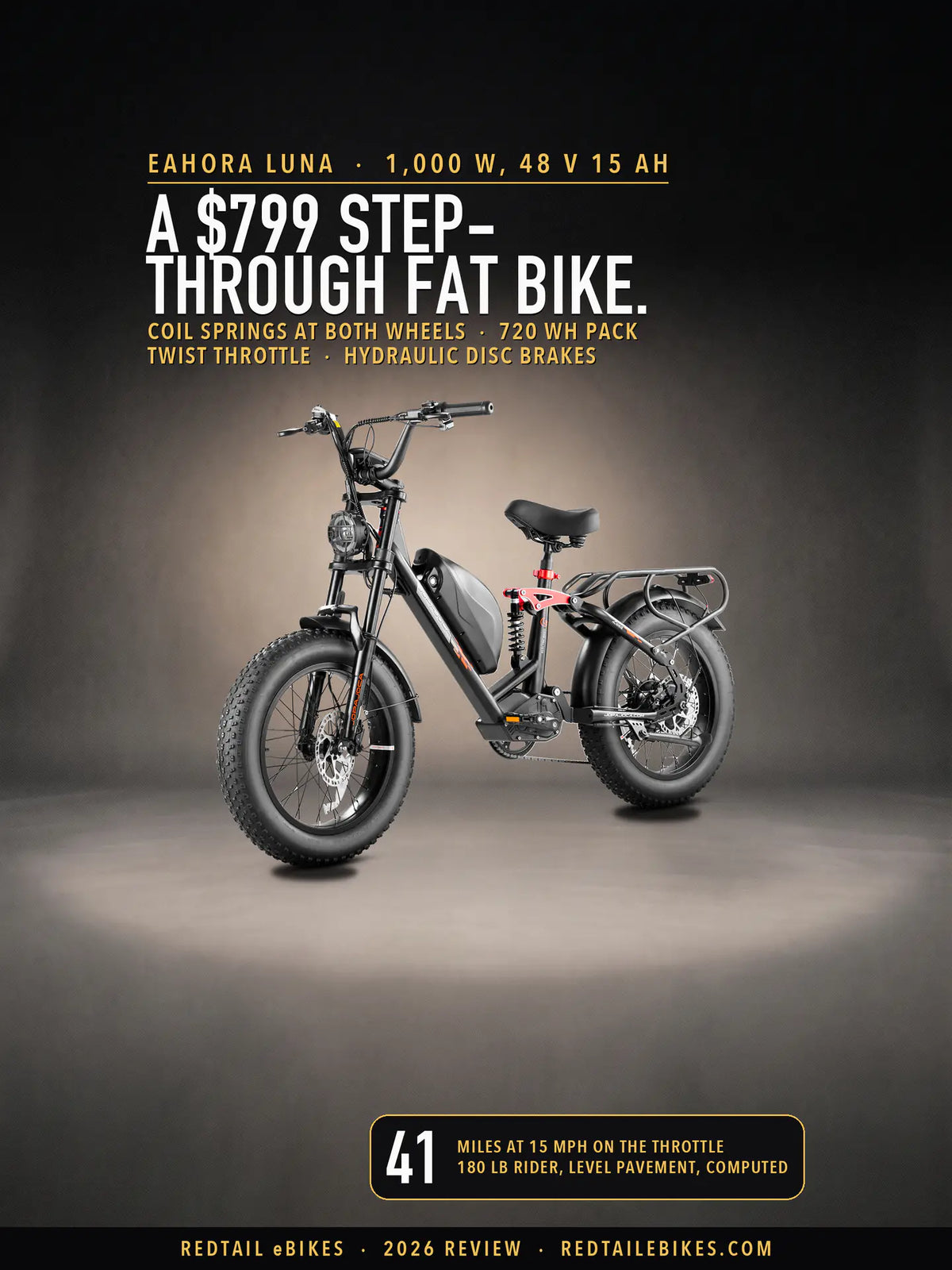
Share:
Arizona Bike Trails Map 2026: Where eBikes Can Ride
DWMEIGI Silverado Urban Review: 14-Inch Step, 624 Wh