
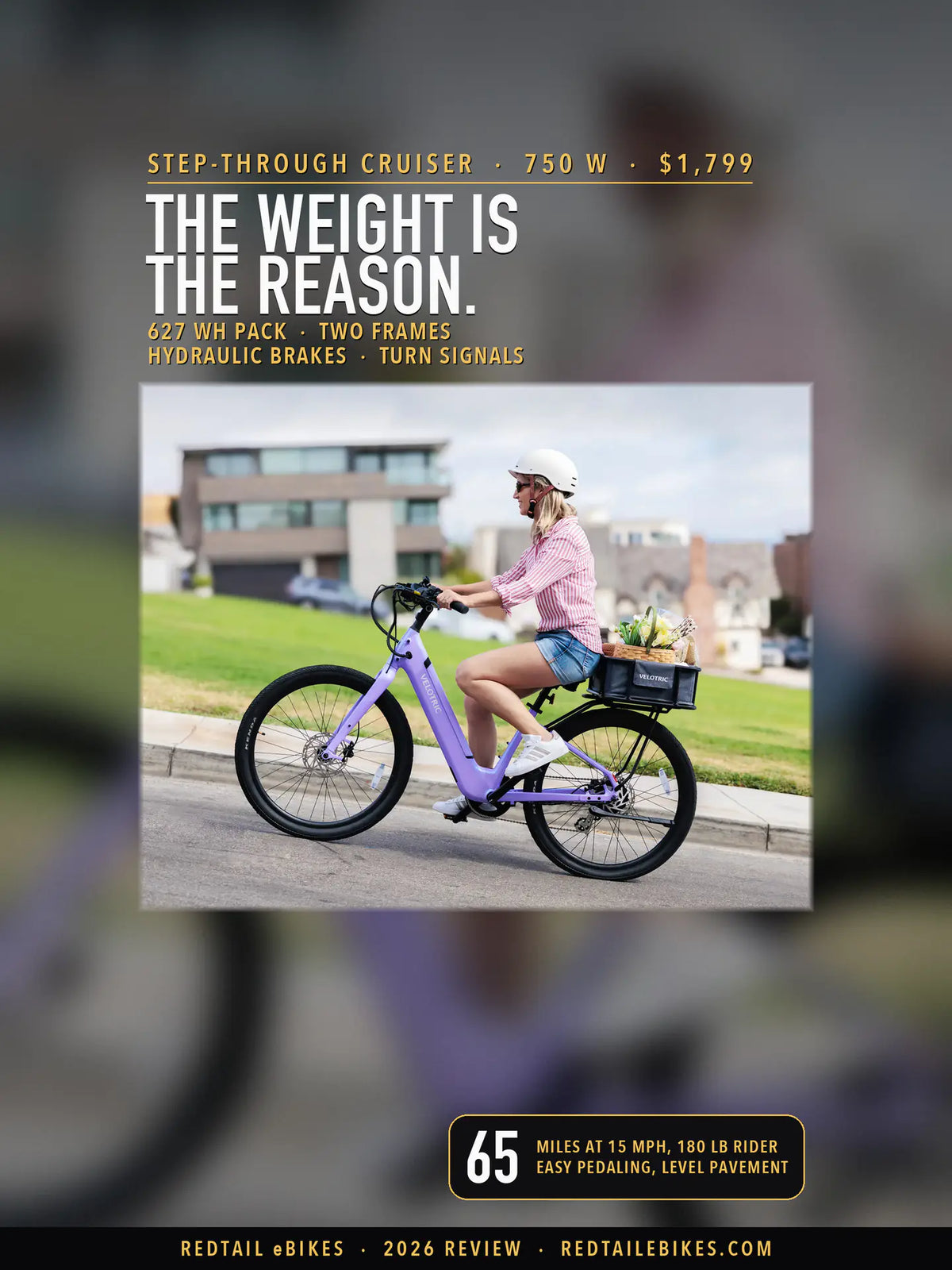

Step-through cruiser e-bike · 750 W hub motor, 900 W peak, 65 N·m · removable 48 V 13.4 Ah pack, 627 Wh · 20 mph default pedal limit, adjustable from 12 to 28 mph · Tektro hydraulic discs on 180 mm rotors · rigid aluminum fork · Kenda 27.5 × 2.2 in tires · 48 lb on Velotric's product page, 50 lb in its manual · 330 lb of rider and cargo · verified November 12, 2026
Quick Answer — The Velotric Breeze 1 is a $1,799 step-through cruiser for riders 4'11" to 6'4", with a 750 W hub motor, a 627 Wh pack and hydraulic brakes. For a 180 lb rider on level pavement, the pack computes to 27 miles at 20 mph on the throttle and 65 miles at 15 mph with easy pedaling.
Velotric rates it at up to 70 miles on pedal assist and 55 on the throttle for a 187 lb rider (Velotric's page), and the range section maps both figures to the rides that produce them. The Regular frame is drawn for 4'11" to 5'8" and the Large for 5'6" to 6'4", and the fit tables show which one serves you if you stand in the overlap.
Our Breeze 1 listing is $1,799 in both frame sizes, and it ships free within the contiguous United States. Checkout opens on the Regular frame in Violet Haze; riders 5'6" and taller can take the Large in Violet Haze.
Buy Regular, Violet HazeWhat this review covers
Specification · Against its siblings · What it is · Fit · Motor and throttle · Battery · Range · Brakes · Fork and tires · Lights and app · Weight · The Mercer fit test · UL · Recalls · Class and law · Green and red flags · Verdict · Checklist · Buying it from us · FAQ · Limitations · Bottom line
How we verified this Velotric Breeze 1 review
Velotric's own figures for the Breeze 1 are verified against its documents and recomputed: its Breeze 1 product page with its specification table, geometry chart and FAQ, its owner's manual and its speed guide, all read November 12, 2026. Electric Bike Report's scale weight and range runs are credited to it where they appear. The page's own range and fit figures come from two saved models, and each section lists its inputs.
We sell the Breeze 1, so the riders it does not suit are named here as plainly as the riders it does. Part of our e-bike reviews.
Written by Milad Ghobadibeygvand, BScN (Western University, 2014). Corrections: support@redtailebikes.com.
The Velotric Breeze 1 as Velotric prints it
Velotric sells the Breeze 1 in two frame sizes and six colors, at one price, and every row below is its own figure. When Velotric prints one figure two ways, both appear, with the source of each.
| Part | Velotric's figure |
|---|---|
| Frame | Step-through only, triple-butted aluminum alloy; Regular and Large |
| Rider height | Regular 4'11" to 5'8"; Large 5'6" to 6'4" |
| Motor | Hub motor, "750W, 65Nm Torque"; the header card prints "750W(900W Peak)/65Nm" |
| Sensor | SensorSwap, torque or cadence, chosen on the display |
| Assist | "3 Modes x 5 PAS Levels" |
| Throttle | "Trigger-control, removable" |
| Battery | "Removable, 48V, 13.4Ah (627Wh), IPX7 & UL 2271 Certified" |
| Cells | "18650 cell, UL 2580 Certified" |
| Charger | 48 V, 3.0 A; "It takes 4–6 hours for a full charge" (its FAQ) |
| Top speed | 20 mph default; adjustable from 12 to 28 mph; "Class 1/2/3" |
| Range, spec table | 70 miles on pedal assist, 55 on the throttle, for "A 187-lb rider using PAS 1 in Eco mode on flat roads." |
| Range, FAQ | "Up to 50–60 miles (varies by terrain/assist level/ tire pressure/weights/wind)" |
| Brakes | Tektro hydraulic discs, 180 mm rotors front and rear, levers with power cutoff |
| Drivetrain | 46-tooth narrow-wide ring, 170 mm cranks, 8-speed cassette, KMC chain, Shimano 8-speed derailleur and shifter |
| Fork | Aluminum alloy, no suspension |
| Wheels and tires | Double-wall rims, 15 × 110 mm thru-axle front hub, Kenda 27.5 × 2.2 in puncture-resistant tires |
| Cockpit | 31.8 mm bar, 660 mm wide (Regular) or 680 mm (Large); adjustable stem; 30.9 × 350 mm seatpost |
| Weight, product page | 48 lb; 40.8 lb without the battery |
| Weight, owner's manual | 50 lb |
| Load | "330 lbs (rider + cargo)" (its FAQ); the rear rack, sold separately, holds 66 lb |
| Headlight | "500 LM high-output integrated LED, adjustable angle" in one specification block; "400 LM" in a second block on the same page |
| Lights and electronics | Rear light with brake highlight and turn signals; 3.5 in color display with Bluetooth; USB-C port; app and Apple Find My |
| Water | Battery IPX7; whole bike IPX6 |
| Certification | "UL 2849 & UL 2271"; ISO 4210 |
Read November 12, 2026, on Velotric's Breeze 1 product page and in its owner's manual.
Velotric's own pages give two figures in three places, and each is printed. The pack is rated 627 Wh, while 48 V times 13.4 Ah would make 643 Wh, so the range model uses the 627 Wh Velotric prints (product page).
The bike weighs 48 lb on the product page and 50 lb in the manual's specification table, and the model rides the 50 lb. The headlight is 500 lumens in one block and 400 in another (product page; owner's manual).

Velotric's own studio photograph of the Breeze 1 in Ocean Mist, from its product record, scaled evenly; the rear rack and fenders shown are options.
Velotric Breeze 1 vs Discover 2, Discover 3 or Tempo?
Velotric's own catalog splits the choice four ways, and of the three 750 W bikes here the Breeze 1 is the lightest: 48 lb against 61 lb for the Discover 3 and 63 lb for the Discover 2, on Velotric's product pages. The Tempo weighs less still, at 39 lb, with a 350 W motor and a 374 Wh pack.
| Velotric's figures | Breeze 1 | Discover 3 | Discover 2 | Tempo |
|---|---|---|---|---|
| Our price | $1,799 | $1,899 | $1,499 | $1,399 |
| Motor | 750 W, 65 N·m | 750 W, 75 N·m | 750 W, 75 N·m | 350 W, 45 N·m |
| Pack | 627 Wh | 730 Wh | 705.6 Wh | 374 Wh |
| Weight | 48 lb | 61 lb | 63 lb | 39 lb |
| Front fork | Rigid | 80 mm air | 80 mm hydraulic | Rigid |
Each figure from Velotric's product page for that bike, read November 12, 2026: Breeze 1, Discover 3, Discover 2 and Tempo; our prices from our listings the same day.
Choose the Breeze 1 if you lift your bike: up stairs, onto a car rack or into a building. Choose the Discover 3 or the Discover 2 if your roads are rough enough to want a suspension fork and you will carry 13 or 15 more pounds for it (Discover 3, Discover 2). The Tempo suits you if you want a lighter bike and a smaller motor, on a mid-step or high-step frame rather than a step-through.
If you are also looking at Aventon, our reviews of the Aventon Level 3 and the Aventon Pace 5 Rec set those bikes out section by section.
Velotric's whole lineup, with its warranty part by part, is in our Velotric brand profile, and our Velotric collection carried 20 of its bikes on November 12, 2026, the Breeze 1 among them. Across brands, our step-through guide sets the Breeze 1's published figures beside step-throughs from other makers we carry.
A 48-pound cruiser built around an upright seat
The Breeze 1 is a cruiser in posture and a commuter in parts: a swept-back bar over a low step-through frame, with a 750 W motor, a removable pack, turn signals and hydraulic brakes. Velotric's own words for it are "Lightweight City Ebike", and its FAQ answers "What is a cruiser ebike?" with "comfort, style, and electric assist, perfect for relaxed city rides and weekend cruising" (product page).

Velotric's photograph from its Breeze 1 product record, at its native size: the swept-back bar sets the rider upright, and the front basket is an accessory.
The frame is the deciding fact. Velotric draws a 380 mm (15 in) stand-over for both sizes, so a rider steps through the frame rather than over it (our frame-types guide weighs the two shapes), and the stem's angle adjusts.
The fork is rigid aluminum and the tires are 2.2 inches wide; no suspension fork or seatpost comes in the box, and Velotric's FAQ lists a suspension seatpost among the accessories the Breeze 1 takes (product page).
What it is for, by Velotric's figures: errands, paved paths and town riding at up to 20 mph out of the box, with the pack lifted out to charge indoors; our commuter guide sets commuters from other brands we carry side by side.
By the same figures, it is not built for you if you and your cargo pass 330 lb, if your trails want a suspension fork, or if your climb asks the throttle to work alone for miles (hills).
The weight is the reason to choose it. At 48 lb by Velotric's page, the Breeze 1 is 13 lb lighter than the Discover 3, and 40.8 lb with the pack lifted out.
Will the Breeze 1 fit you?
Hamley's 109% formula puts a 5'8" rider's saddle top 35.6 inches above the pedal, from that height's median inseam of 32.64 inches in the US Army's body survey; the Regular's seatpost reaches that for 27 of 100 riders 5'8" tall and the Large's for 98.
By Velotric's geometry chart, the Regular's saddle sits 745 to 945 mm (29.3 to 37.2 in) off the ground and the Large's 810 to 1,015 mm (31.9 to 40.0 in), over a 380 mm (15 in) stand-over (product page).
Three steps find your fit:
- Measure your inseam: standing against a wall in socks, pull a hardback up into your crotch as firmly as a saddle would press, and note the height of the book's top edge.
- Look up your height in the tables below, which give the inseam range of the middle 90 of every 100 people that tall and the saddle height the formula sets for them.
- Finish with the heel check after assembly (setup).
Velotric prints one height window per frame: 4'11" to 5'8" for the Regular and 5'6" to 6'4" for the Large (size chart). Both appear beside the tables, which measure your own body against them. Velotric does not say where its saddle heights are measured from; they are read here as ground to saddle top, because the saddle on Velotric's own side view measures 965 mm above the ground, inside the Large's range.

Velotric's image of the cockpit and the saddle, from its Breeze 1 product page, scaled evenly; the stem under the display is the adjustable one the fit tables allow for.
Will the saddle go high enough (or low enough) for me?
At every height through 5'5", 86 or more of 100 riders reach the formula's saddle height on the Regular; on the Large it is 87 or more from 5'0" through 5'10". Each row counts how many of 100 riders that tall have an inseam the seatpost can serve at 109% of inseam, the formula, and at 106%, the low end of the published band.
| Your height, Regular | Typical inseam | Saddle height, median rider | At 109% | At 106% |
|---|---|---|---|---|
| 4'11" | 26.8–29.3 in | 33.1 in | 100 of 100 | 100 of 100 |
| 5'0" | 27.1–29.7 in | 33.5 in | 100 of 100 | 100 of 100 |
| 5'1" | 27.7–30.3 in | 34.2 in | 100 of 100 | 100 of 100 |
| 5'2" | 28.0–31.1 in | 34.6 in | 99 of 100 | 100 of 100 |
| 5'3" | 28.7–31.6 in | 35.1 in | 98 of 100 | 100 of 100 |
| 5'4" | 29.1–32.2 in | 35.6 in | 94 of 100 | 100 of 100 |
| 5'5" | 29.7–32.6 in | 36.1 in | 86 of 100 | 98 of 100 |
| 5'6" | 30.2–33.5 in | 36.7 in | 68 of 100 | 90 of 100 |
| 5'7" | 30.7–33.9 in | 37.2 in | 50 of 100 | 82 of 100 |
| 5'8" | 31.1–34.3 in | 37.7 in | 27 of 100 | 65 of 100 |
Regular frame (saddle 745 to 945 mm, Velotric). At 5'7" the riders the post does not reach sit a median of about 0.6 in low; at 5'8" about 0.9 in.
| Your height, Large | Typical inseam | Saddle height, median rider | At 109% | At 106% |
|---|---|---|---|---|
| 5'6" | 30.2–33.5 in | 36.7 in | 99 of 100 | 100 of 100 |
| 5'7" | 30.7–33.9 in | 37.2 in | 100 of 100 | 100 of 100 |
| 5'8" | 31.1–34.3 in | 37.7 in | 98 of 100 | 100 of 100 |
| 5'9" | 31.7–34.8 in | 38.2 in | 95 of 100 | 99 of 100 |
| 5'10" | 32.2–35.5 in | 38.9 in | 87 of 100 | 98 of 100 |
| 5'11" | 32.9–36.1 in | 39.4 in | 73 of 100 | 92 of 100 |
| 6'0" | 33.2–36.7 in | 40.0 in | 48 of 100 | 81 of 100 |
| 6'1" | 33.9–37.2 in | 40.8 in | 27 of 100 | 60 of 100 |
| 6'2" | 34.3–37.5 in | 41.2 in | 12 of 100 | 42 of 100 |
| 6'3" | 35.3–38.0 in | 41.8 in | 2 of 100 | 27 of 100 |
| 6'4" | 36.3–39.1 in | 42.8 in | 0 of 100 | 3 of 100 |
Large frame (saddle 810 to 1,015 mm, Velotric). At 6'0" the riders the post does not reach sit a median of about 0.7 in low; at 6'2" about 1.4 in.
Between 5'6" and 5'8", where Velotric's windows overlap, the Large serves the formula height for more riders at every one of those heights: 100 of 100 at 5'7" against 50 on the Regular. From 6'0" up on the Large, fewer than half reach the formula height, so a tall rider sits with a little more knee bend, or emails us and we ask Velotric about a longer seatpost.
Can I put a foot down at a stop?
All 100 of 100 riders at every height from 4'11" to 6'4" in the survey clear the Breeze 1's 380 mm (15 in) stand-over, and at 4'11" 95 of 100 clear it by 11.8 inches or more. Each row gives the clearance 95 of 100 riders that tall have, against Velotric's stand-over and against the step-through's lowest top edge as measured on Velotric's own side view.
| Your height, Regular | Typical inseam | Clearance at 15.0 in | At 14.9 in |
|---|---|---|---|
| 4'11" | 28.1 in | 11.8 in | 11.9 in |
| 5'0" | 28.4 in | 12.1 in | 12.2 in |
| 5'1" | 29.2 in | 12.8 in | 12.8 in |
| 5'2" | 29.5 in | 13.1 in | 13.1 in |
| 5'3" | 30.1 in | 13.8 in | 13.8 in |
| 5'4" | 30.5 in | 14.1 in | 14.1 in |
| 5'5" | 31.0 in | 14.8 in | 14.8 in |
| 5'6" | 31.7 in | 15.3 in | 15.3 in |
| 5'7" | 32.2 in | 15.8 in | 15.8 in |
| 5'8" | 32.6 in | 16.2 in | 16.2 in |
| Your height, Large | Typical inseam | Clearance at 15.0 in | At 14.9 in |
|---|---|---|---|
| 5'6" | 31.7 in | 15.3 in | 15.3 in |
| 5'7" | 32.2 in | 15.8 in | 15.8 in |
| 5'8" | 32.6 in | 16.2 in | 16.2 in |
| 5'9" | 33.1 in | 16.7 in | 16.8 in |
| 5'10" | 33.8 in | 17.3 in | 17.3 in |
| 5'11" | 34.3 in | 17.9 in | 18.0 in |
| 6'0" | 34.9 in | 18.2 in | 18.2 in |
| 6'1" | 35.6 in | 18.9 in | 19.0 in |
| 6'2" | 36.0 in | 19.4 in | 19.4 in |
| 6'3" | 36.6 in | 20.3 in | 20.3 in |
| 6'4" | 37.6 in | 21.3 in | 21.3 in |
Velotric draws a 380 mm (15 in) stand-over for both frames; its side view measures 14.9 in at the step-through's lowest top edge.
Will I feel cramped, or stretched?
The median rider leans 7 to 12 degrees from upright on the Regular and 11 to 16 on the Large to reach the grips with straight arms. That is a sitting-up posture, the one the swept bar is drawn for; the bracket beside each figure spans the saddle's range and the grip positions the adjustable stem allows.
| Your height, Regular | Lean from upright, median rider | Across saddle and grip positions |
|---|---|---|
| 4'11" | 7° | 0–18° |
| 5'0" | 8° | 0–18° |
| 5'1" | 9° | 0–19° |
| 5'2" | 10° | 0–19° |
| 5'3" | 10° | 0–19° |
| 5'4" | 11° | 1–20° |
| 5'5" | 11° | 1–20° |
| 5'6" | 12° | 2–20° |
| 5'7" | 12° | 2–20° |
| 5'8" | 12° | 3–20° |
| Your height, Large | Lean from upright, median rider | Across saddle and grip positions |
|---|---|---|
| 5'6" | 11° | 1–20° |
| 5'7" | 12° | 2–21° |
| 5'8" | 13° | 3–21° |
| 5'9" | 13° | 4–22° |
| 5'10" | 14° | 5–22° |
| 5'11" | 15° | 6–23° |
| 6'0" | 15° | 7–23° |
| 6'1" | 16° | 7–23° |
| 6'2" | 15° | 7–22° |
| 6'3" | 15° | 7–22° |
| 6'4" | 13° | 5–21° |
How much weight goes through my wrists?
With the back relaxed, the median rider carries about 13% of body weight through the hands on the Regular at 5'6", against the 15% measured for road racers on the hoods (Carahalios 2015). The figures are a ceiling: a rider who holds the back up puts less weight on the bar.
| Your height, Regular | Share of your weight, back relaxed | Median rider's weight | On each hand |
|---|---|---|---|
| 4'11" | 10% (5–15%) | 128 lb | about 6 lb |
| 5'0" | 11% (5–16%) | 126 lb | about 7 lb |
| 5'1" | 11% (5–16%) | 134 lb | about 7 lb |
| 5'2" | 12% (5–17%) | 139 lb | about 8 lb |
| 5'3" | 12% (5–17%) | 144 lb | about 9 lb |
| 5'4" | 13% (5–17%) | 147 lb | about 9 lb |
| 5'5" | 13% (6–17%) | 157 lb | about 10 lb |
| 5'6" | 13% (7–17%) | 166 lb | about 11 lb |
| 5'7" | 13% (7–17%) | 172 lb | about 12 lb |
| 5'8" | 14% (7–17%) | 179 lb | about 12 lb |
| Your height, Large | Share of your weight, back relaxed | Median rider's weight | On each hand |
|---|---|---|---|
| 5'6" | 13% (6–17%) | 166 lb | about 11 lb |
| 5'7" | 14% (7–18%) | 172 lb | about 12 lb |
| 5'8" | 14% (8–18%) | 179 lb | about 12 lb |
| 5'9" | 15% (9–18%) | 185 lb | about 13 lb |
| 5'10" | 15% (10–19%) | 192 lb | about 15 lb |
| 5'11" | 16% (11–19%) | 196 lb | about 16 lb |
| 6'0" | 16% (11–19%) | 204 lb | about 16 lb |
| 6'1" | 16% (11–20%) | 206 lb | about 17 lb |
| 6'2" | 16% (11–19%) | 216 lb | about 17 lb |
| 6'3" | 16% (11–20%) | 227 lb | about 18 lb |
| 6'4" | 15% (9–19%) | 220 lb | about 16 lb |
How do I set the saddle when it arrives?
Peveler, Pounders and Bishop (2007) give the knee angle the cycling literature recommends at the bottom of the stroke: still bent, by 25 to 35 degrees. The heel check finds that setting without tools: set your heel on the pedal when the crank points straight down, raise the saddle until that leg just straightens, and pedaling on the forefoot restores the bend.
Velotric's manual covers the adjustable stem and handlebar at assembly (owner's manual), and the seat clamp is a quick release by its specification table, so set the saddle first and the bar after it.
Between frames? Tell us how tall you are and your inseam at support@redtailebikes.com; the answer names the frame these tables point to. That button buys the Large in Ocean Mist, and the Ocean Mist Regular suits riders under 5'6".
Buy the Large, Ocean MistHow we computed fit
Hamley and Thomas's 109% of inseam from the pedal and LeMond's 88.3% from the crank axle give the same saddle: averaged over the survey's 6,068 bodies, LeMond's 88.3% plus the 170 mm crank comes to 109.0% of inseam, and in Peveler et al. (2005) the LeMond method put 19 trained cyclists at 109.2% of inseam, plus or minus 0.9%.
The bodies are the US Army's ANSUR II survey (4,082 men and 1,986 women), and the segment weights behind the lean and hand figures are Clauser, McConville and Young (1969).
| Input | Value | Source |
|---|---|---|
| Saddle range, ground to top | 29.3 to 37.2 in (Regular); 31.9 to 40.0 in (Large) | Velotric's geometry chart |
| Stand-over | 15.0 in | Velotric's geometry chart |
| Crank | 170 mm | Velotric's specification table |
| Bottom-bracket height | 10.5 in | Measured on Velotric's side view |
| Seatpost angle | 68.8° from horizontal | Measured on Velotric's side view |
One rider worked through: at 5'8" the Army survey's median inseam is 32.64 inches; 109% of it puts the saddle top 35.6 inches above the pedal at the bottom of the stroke, which is 28.9 inches from the crank axle along the seatpost and about 37.7 inches above the ground. That sits inside the Large's range and above the Regular's highest setting, 37.2 inches.
Velotric does not publish a bottom-bracket height, a seatpost angle or where the grips sit, so the side view supplies them. Its scale, taken from the published wheelbase, reproduces three other published dimensions within 3.5%; the seatpost's width, the fourth control, reads 4.8 to 5.1% narrow and is printed with the rest.
| Dimension, Large | Velotric lists | Measured on its photograph | Gap |
|---|---|---|---|
| tire outer diameter, KENDA 27.5 x 2.2 in read as ETRTO 56-584 (a nominal 696 mm) | 27.4 in | 27.3 in | −0.3% |
| reach, crank axle to the top of the head tube | 15.9 in | 15.7 in | −1.2% |
| seat post, 30.9 mm across, as it crosses the photo at its angle | 1.3 in | 1.2 in | −4.8% |
| stand-over, the step-through frame's lowest upper edge between the seat tube and the head tube | 15.0 in | 14.9 in | −0.1% |
Measured on Velotric's Ocean Mist side view; the photographed frame size is not stated, and each size is scaled by its own published wheelbase.
A 750 W hub motor with a torque-or-cadence switch
Velotric rates the Breeze 1's hub motor at 750 W and 65 N·m of torque, and prints a 900 W peak on the page's header card. The motor turns the rear wheel: Velotric lists the front hub separately, as a NOVATEC 15 × 110 mm thru-axle hub, and its side views show the motor's shell behind the cassette (product page).
What a 750 W rating means on a spec sheet and in the law is the subject of our 750 W guide.

Velotric's photograph from its Breeze 1 product record, scaled evenly: the SensorSwap screen, where the pedal sensor is switched between torque and cadence.
SensorSwap is the motor's control choice. The display switches between a torque sensor and a cadence sensor, and the manual sets torque as the default (owner's manual). Velotric's page puts the difference this way: with torque, "Power matches your pedaling force, enjoy smoother starts and better control"; the cadence setting "Delivers consistent speed up with minimal pedaling" (product page).
On top of the sensor sit three riding modes, ECO, TRAIL and BOOST, each with five assist levels; ECO is the default, and the assist level reads "0" each time the bike is switched on (owner's manual).
The throttle is a removable trigger on the bar. Velotric's manual calls its start-up feature "throttle on demand" and says it "allows you to apply throttle power when starting from a complete stop", then recommends "pedaling initially and using the throttle as a secondary option to ensure proper stability and readiness". With the throttle and pedal assist engaged together, "only the throttle works and there is no stacking power from the motor" (owner's manual).
Three more controls come from the same manual. Walk mode moves the bike "at a constant speed of 2.9mph" while you push it. Cruise control is off by default; switched on, it engages from 5 mph and ends when you pull either brake lever, change the assist level, change the riding mode or push the throttle (owner's manual).
The pedal speed limit is set on the display, where "The adjustable range is 12 mph to 28 mph, with a default of 20 mph", and the same screen switches to a separate throttle speed limit (owner's manual); Velotric's speed guide walks through the buttons.
Your state's e-bike classes decide which limit fits the paths you ride, and the law section sets them out.
Velotric Breeze 1 battery: a 627 Wh removable pack
Velotric lists the Breeze 1's pack as "Removable, 48V, 13.4Ah (627Wh), IPX7 & UL 2271 Certified", built from "18650 cell, UL 2580 Certified", and its FAQ gives "4–6 hours for a full charge" on the 48 V, 3.0 A charger in the box. The pack lifts out of the down tube to charge indoors, which Velotric's FAQ names as the reason it is removable (product page).

Velotric's photograph of the Ocean Mist pack, from its Breeze 1 product page, scaled evenly; Velotric publishes a battery photograph for each of the six colorways.
Velotric's manual sets the conditions: "Charge the battery in an environment from 50–86°F (10–30°C)", and "The battery won't charge when it is over 113°F (45°C) or below 32°F (0°C)". For storage it asks for "an ambient temperature of 50°F to 77°F (10°C to 25°C)" (owner's manual). In winter, you bring the pack inside to charge, as the cold table assumes.
On life, Velotric's FAQ says "500+ cycles to 75% battery's original capacity (~3–5 years with regular use)". At the US average residential price of 18.16 cents a kilowatt-hour for August 2026, the newest month in the US Energy Information Administration's table, a full 627 Wh charge costs about 11 cents before charger losses.
Velotric Breeze 1 range: 65 miles at 15 mph for a 180 lb rider, computed
The 627 Wh pack computes to 65 miles for a 180 lb rider on the 50 lb Breeze 1 holding 15 mph with 75 watts of easy pedaling over level pavement at 77 °F, and to 52 with 20% held back. The model's figures below come from published road physics fed with Velotric's own numbers, and each table states the conditions behind its figures.
Three steps find your ride:
- Choose a row by speed in the first two tables: motor only, or with your legs adding 75 or 150 watts.
- Adjust for the ride you have: the hill, load, cold and tire tables follow.
- Keep 20% in reserve: Velotric's battery icon turns yellow below 20%, so plan your ride on that column (formula).
Does riding faster cut range?
Yes: on the throttle alone, a full charge carries the 180 lb rider 50 miles at 12 mph and 27 at 20 mph, because the air term in Martin and colleagues' road equation grows with the square of speed. Pedaling stretches every row: at 15 mph, 75 watts from the rider takes a full charge from 40 miles to 65.
| Speed, flat | Throttle | Easy, 75 W | Steady, 150 W | Easy, 20% kept |
|---|---|---|---|---|
| 12 mph | 50 mi | 125 mi | legs alone | 100 mi |
| 15 mph | 40 mi | 65 mi | 159 mi | 52 mi |
| 18 mph | 32 mi | 43 mi | 65 mi | 34 mi |
| 20 mph | 27 mi | 34 mi | 46 mi | 27 mi |
| 25 mph | — | 21 mi | 25 mi | 17 mi |
| 28 mph | — | — | 18 mi | — |
180 lb rider on the 50 lb bike, level pavement, 77 °F, no wind, commuter-tire rolling resistance, upright cruiser posture. "Legs alone": the pedal power by itself holds that speed, so the motor draws nothing. A dash: the motor cannot hold that speed at its rated power, or the throttle is above Velotric's 20 mph setting.
Plan with 52 miles at 15 mph with easy pedaling, or 22 at 20 mph on the throttle. Those figures keep 20% of the pack in reserve for a 180 lb rider on level pavement.
What gear saves battery?
On the Breeze 1 the gear changes your cadence, not the motor's, because the motor sits in the wheel; what saves battery is your own effort. The table gives the battery's watt-hours per mile at four rides for three efforts: at 15 mph on the flat, 75 watts from your legs cuts the battery's draw by 39%.
| Your ride | Throttle only | Easy pedaling (75 W) | Steady pedaling (150 W) |
|---|---|---|---|
| 15 mph, flat | 15.7 Wh | 9.6 Wh | 3.9 Wh |
| 20 mph, flat | 23.2 Wh | 18.2 Wh | 13.6 Wh |
| 12 mph, 4% grade | 41.0 Wh | 30.3 Wh | 20.8 Wh |
| 10 mph, 8% grade | 82.6 Wh | 63.3 Wh | 47.0 Wh |
Battery watt-hours per mile, 180 lb rider, 77 °F, no wind. Choose a gear that lets you spin the cranks comfortably at each speed; the 8-speed cassette is there for your legs.
Does going uphill drain it faster?
Yes: on the throttle the 180 lb rider holds 20.0 mph up a 4% grade, 15.5 mph up 8% and 10.0 mph up 15%, and an 8% climb at 10 mph uses 83 watt-hours a mile. Climbing 1,000 feet costs 138 to 192 watt-hours on the throttle across grades of 4 to 10%, and 127 to 167 with easy pedaling.
| Grade | Fastest steady, throttle | Per mile, 10 mph | Full charge, throttle | Full charge, easy pedaling |
|---|---|---|---|---|
| 2% | 20.0 mph | 24 Wh | 26 mi | 48 mi |
| 4% | 20.0 mph | 40 Wh | 16 mi | 23 mi |
| 6% | 17.9 mph | 59 Wh | 11 mi | 14 mi |
| 8% | 15.5 mph | 83 Wh | 8 mi | 10 mi |
| 10% | 13.6 mph | 112 Wh | 6 mi | 7 mi |
| 12% | 11.9 mph | 149 Wh | 4 mi | 5 mi |
| 15% | 10.0 mph | 233 Wh | 3 mi | 3 mi |
180 lb rider, 77 °F, no wind, the motor held to its 750 W rating and Velotric's 65 N·m. A short climb can run faster on the motor's 900 W peak; these are sustained figures.
A hilly ride is priced as level miles plus the climbing: 20 level miles at 15 mph with easy pedaling (192 Wh) and 1,000 feet of 8% grade on the throttle (171 Wh) come to 363 Wh, 72% of the 502 Wh the planning column uses.
Does rider weight affect range?
Yes: at 15 mph with easy pedaling, a 130 lb rider computes to 72 miles and a load of 330 lb, Velotric's limit for rider and cargo, to 51. Weight costs most on climbs, where the 6% row falls from 20 miles to 7.
| You plus your load | 15 mph, easy pedaling | 20 mph, throttle | 6% climb at 10 mph, easy |
|---|---|---|---|
| 130 lb | 72 mi | 28 mi | 20 mi |
| 180 lb | 65 mi | 27 mi | 14 mi |
| 220 lb | 61 mi | 26 mi | 11 mi |
| 280 lb | 55 mi | 25 mi | 8 mi |
| 330 lb (the limit) | 51 mi | 24 mi | 7 mi |
You plus your load: rider, clothing and cargo, on the 50 lb bike; 77 °F, no wind. Velotric's FAQ gives "330 lbs (rider + cargo)".
Does cold weather drain it?
Yes: at 32 °F the 15 mph easy ride computes to 50 miles against 65 at 77 °F, as colder cells give up less of their energy and colder air pushes back harder. Below freezing the published cell data disagree with one another, so those rows carry a bracket.
| Air | Pack energy vs 77 °F | 15 mph, easy pedaling | 20 mph, throttle |
|---|---|---|---|
| 95 °F | 99% | 69 mi | 28 mi |
| 77 °F | 100% | 65 mi | 27 mi |
| 68 °F | 98% | 62 mi | 26 mi |
| 50 °F | 93% | 55 mi | 23 mi |
| 41 °F | 91% | 52 mi | 22 mi |
| 32 °F | 89% (80–93) | 50 mi (45–52) | 22 mi (19–23) |
| 14 °F | 82% (40–83) | 45 mi (22–45) | 19 mi (9–19) |
Cells at the air's temperature, charged indoors within Velotric's 50 to 86 °F band; the bracket is the spread between the cell sources the model read.
Do the tires cut range?
A little: across the field averages for slick, commuter and knobby tires, the 15 mph easy ride runs 59 to 67 miles. For the Breeze 1's Kenda 27.5 × 2.2 in tires, a fine-treaded puncture-resistant pair on Velotric's photographs, the model takes the commuter-tire average measured on everyday riders.
| Rolling resistance | 15 mph, easy pedaling | 20 mph, throttle |
|---|---|---|
| 0.0070 · slick tires | 67 mi | 27 mi |
| 0.0074 · commuter tires (used here) | 65 mi | 27 mi |
| 0.0092 · knobby tires | 59 mi | 26 mi |
Tengattini and Bigazzi (2018), rolling resistance measured on everyday riders: slick, commuter and knobby tires. 180 lb rider, 77 °F.
Pressure moves rolling resistance too. Velotric's FAQ tip is "keep tires at 60 PSI for best range", and its manual says to "Follow the tire markings for the maximum recommended pressure" and to check before every ride (FAQ; owner's manual).
Is Velotric's range real?
Velotric's 70 miles is a steady 14.6 mph with 75 watts of pedaling for its 187 lb rider, by this model, and its 55 throttle miles is 10.7 mph on the throttle alone.
Its condition, "A 187-lb rider using PAS 1 in Eco mode on flat roads", describes a gentle ride: at the 11.2 mph Electric Bike Report measured at PAS 1 in Class 2, the model reaches Velotric's 70 miles with 26 watts of pedaling.
Velotric's FAQ gives a third figure, "Up to 50–60 miles (varies by terrain/assist level/ tire pressure/weights/wind)", under the spec table's 70 (FAQ).
Electric Bike Report's two measured runs in Class 2 land on both sides of Velotric's figures: 35.6 miles at PAS 5 and 74.3 at PAS 1 in its text, and 38.1 and 85.7 on its own chart (Electric Bike Report, March 18, 2025). For a bigger pack, our long-range guide compares long-range bikes from the brands we carry.
Tell us your weight, your usual speed and your longest ride at support@redtailebikes.com, and the reply runs them through this model. Satin White on the Regular frame goes to checkout here; from 5'6" up, the Large frame comes in the same color.
Buy Regular, Satin WhiteHow the range figures are computed
The power at the wheel is Martin and colleagues' road equation: P = v × [m × g × (Crr × cos θ + sin θ) + ½ × ρ × CdA × v²], divided through the drivetrain, the motor and the battery. Each physical input below comes from the source named in its row.
| Input | Value | Source |
|---|---|---|
| Bike | 50 lb (48 lb a sensitivity run) | Velotric's owner's manual and product page |
| Pack | 627 Wh | Velotric's product page |
| Motor | A Bafang G062 750 W hub as a comparable, held to Velotric's 65 N·m | Bafang's 2021 OEM workbook |
| Wheel | 27.3 in | Measured on Velotric's side view |
| Rolling resistance | 0.0074 | Tengattini and Bigazzi (2018), commuter tires |
| Drag area | 0.640 m² | Tengattini and Bigazzi (2018), cruiser riders |
| Chain | 97.698% | Martin et al. (1998) |
| Pack efficiency | 96.9% at the worked ride | Arango, Lopez and Ceren (2021) |
| Air | 1.184 kg/m³ at 77 °F | U.S. Standard Atmosphere, 1976 |
| Cold | Pack energy by temperature, LG HG2 cell | Kollmeyer's LG HG2 data |
| Reserve | 20% kept, where the display's battery icon turns yellow | Velotric's owner's manual |
The motor is modeled as Bafang's published G062 750 W hub, whose rated speed on this wheel, 28.4 mph, sits closest above the 28 mph setting, held to Velotric's own 65 N·m.
One ride worked through: a 180 lb rider on the 50 lb bike at 15 mph on the flat needs 50.8 W against the tires and 114.2 W against the air, 165.0 W at the wheel.
Easy pedaling supplies 73.3 W of that through the chain, so the motor makes 91.7 W, drawing 139.2 W from the pack and 143.7 W of its chemical energy. That is 9.58 Wh a mile, or 65.5 miles on a full charge and 52.4 with 20% kept.
| Check | Measured or published | This model |
|---|---|---|
| Electric Bike Report, PAS 5, Class 2 | 35.6 miles in its text (38.1 on its chart) | matched at 20 mph with 85 W from the rider (103 W for the chart's) |
| Electric Bike Report, PAS 1, Class 2 | 74.3 miles in its text (85.7 on its chart) | matched at its measured 11.2 mph with 30 W from the rider (41 W for the chart's) |
| Road physics, Martin and colleagues' worked example | 45.7 W for tires and grade, 158.8 W for the air | 45.7 W and 158.8 W |
| The comparable motor at Bafang's rated point | at least 80% efficient | 80% |
The two Electric Bike Report rows are matched at its measured top speed for each level in Class 2 (its speed chart), with the pedal power the model needs printed beside each; its rider's weight is not stated.
Tektro hydraulic discs on 180 mm rotors
Velotric fits Tektro hydraulic disc brakes with 180 mm rotors front and rear, and levers that cut the motor. Its manual says the brake levers carry motor cutoffs that "cut off power from the motor whenever the brakes are applied", including while the throttle is pushed (owner's manual).

A crop of Velotric's Ocean Mist studio photograph at its native scale: the 180 mm front rotor and the Tektro caliper on the fork.
The rear light carries a brake highlight, by Velotric's specification table. Velotric's manual lists the brake among the covered components of its warranty and the brake pads among the wear parts it does not cover, so plan for pads as a running cost of your own (owner's manual); our maintenance guide walks a new owner through the first month.
A rigid fork, a cruiser bar and Kenda 2.2-inch tires
The Breeze 1 has no suspension: an aluminum fork, a 30.9 mm aluminum seatpost and Kenda 27.5 × 2.2 in puncture-resistant tires, by Velotric's specification table. Velotric's FAQ lists a suspension seatpost among the accessories the Breeze 1 takes, beside racks, a front basket, fenders and phone holders (product page).

A crop of the same photograph at its native scale: the Kenda 27.5 × 2.2 in tire and its fine tread.
In the wet, Velotric's FAQ says the bike is "IPX6 waterproof (safe in light rain). Avoid heavy downpours/flooded roads." Its manual asks for a tire pressure check before every ride by the markings on the tire, with a pump that fits the AV valve (FAQ; owner's manual).
Fenders and the rear rack are optional on the Breeze 1. The rack, by Velotric's figure, holds 66 lb, and anything you carry on it counts toward the 330 lb for you and your cargo (product page).
Lights, turn signals, Find My and the app
The Breeze 1 lights the road ahead from the frame, signals turns from the rear light and reports its location through Apple Find My. Velotric prints the headlight as "500 LM" in one specification block and "400 LM" in another on the same page; the rear light adds the brake highlight and left and right turn signals, worked from buttons on the bar (product page).

Velotric's photograph from its Breeze 1 product record, at its native size; the baskets and racks are accessories.
Auto Light, on by default, switches both lights by the ambient light sensor. The 3.5-inch color display carries Bluetooth by Velotric's specification table, and the speed limit, the riding mode and firmware updates are set in Velotric's app (app manual). A USB-C port charges a phone.
Find My pairs from the Find My app on an Apple device; Velotric's manual asks you to finish the pairing within 5 minutes of starting it (owner's manual).
Velotric Breeze 1 weight: 48 pounds on the page, 50 in the manual
Velotric's product page gives 48 lb and 40.8 lb without the battery; its owner's manual gives 50 lb. Electric Bike Report weighed its Large at 50.1 lb (Electric Bike Report). The range model rides the 50 lb.
Lifting the pack out first takes about 7 lb off what you carry up stairs or onto a rack, by Velotric's two page figures. The 330 lb limit is for you and your cargo, so at 180 lb you have 150 lb for bags and groceries before you reach it.

Velotric's photograph from its Breeze 1 product record, at its native size.
The Mercer fit test
The Mercers, our editorial cast, are seven fit archetypes in one family with fixed heights and ages, and here they size up the Breeze 1. Every verdict rests on a figure Velotric prints, a row of this page's fit model or a statute; the family is a set of archetypes, and none of them has ridden the bike.
| Member | Verdict | The number behind it |
|---|---|---|
| Frank Kowalski, 63, 5'10" | Fits the Large | Inside the Large's 5'6" to 6'4"; its post reaches the formula height for 87 of 100 riders his height |
| Ruth Kowalski, 61, 5'5" | Fits the Regular | Inside the Regular's 4'11" to 5'8"; 86 of 100 riders her height reach the formula height, and all clear the 15 in stand-over |
| Jack Mercer, 48, 6'1" | Fits the Large's window; ask us about the seatpost | Inside 5'6" to 6'4"; the Large's post reaches the formula height for 27 of 100 riders his height, the rest a median 1.1 in low |
| Dana Mercer, 45, 5'7" | Fits both windows; the Large serves the formula | 100 of 100 on the Large and 50 on the Regular; rider and cargo count toward 330 lb |
| Maya Torres, 32, 5'6" | Fits both windows; the Large serves more | 99 of 100 on the Large and 68 on the Regular |
| Cole Mercer, 16, 5'11" | Fits the Large; his state's class rules decide | 73 of 100 on the Large; California bars riders under 16 from Class 3 (§ 21213), and our state guides carry each state's rule |
| Ivy Mercer, 12 | Not sized on this page | The Regular's window opens at 4'11", the Army survey measured no 12-year-olds, and our kids and teens guide sizes bikes by age |
Ages from the Mercers' profile and heights as each member is cast; every height is read against Velotric's two windows and the ANSUR II tables above, every age against the statutes in the law section.
Jack and Ruth make the family's sharpest contrast. Ruth at 5'5" sits in the middle of the Regular's window, and 86 of 100 riders her height reach the formula height on it; Jack at 6'1" sits inside the Large's window too, yet its post reaches the formula height for only 27 of 100 riders his height, so he rides with a little more knee bend or asks us about a longer seatpost first.
Is the Velotric Breeze 1 UL certified?
Velotric lists the Breeze 1 under "UL 2849 & UL 2271", and its cells under UL 2580 (product page). Velotric's UL certification page describes the two standards: UL 2849 for the e-bike's electrical system and UL 2271 for its lithium-ion pack.
Velotric can supply the certificate numbers; email us and we will ask for them in writing, so you can check them in UL's own directory.
Has the Velotric Breeze 1 been recalled?
No recall names the Velotric Breeze 1 or Velotric: the CPSC's recall database, read on November 12, 2026, holds 10,089 records and none names either. The CPSC's product safety warning listing carried 389 rows that day, none naming Velotric, and its recall feed's newest notice was dated November 12, 2026 (CPSC recall database).
Recalls can come after a review is written, so check a used Breeze 1's frame number against the CPSC's recall search before you buy it, and keep your own bike's frame number where you can find it.
Is the Velotric Breeze 1 street legal?
Velotric ships the Breeze 1 at Class 2, "20 mph (throttle + pedal assist)" by its FAQ, and the same answer lists two other settings: Class 1, pedal only, and Class 3 at 28 mph. Your state decides which class may ride which paths, and the Breeze 1's 750 W rating meets each state's motor limit differently.
Arizona's A.R.S. § 28-101 shows the three-class pattern most states use, and our Arizona guide has the rest of that state's rules:
- Class 1: a motor that "provides assistance only when the rider is pedaling and that ceases to provide assistance when the bicycle or tricycle reaches the speed of twenty miles per hour."
- Class 2: a motor that "may be used exclusively to propel the bicycle or tricycle and that is not capable of providing assistance when the bicycle or tricycle reaches the speed of twenty miles per hour."
- Class 3: a motor that "provides assistance only when the rider is pedaling and that ceases to provide assistance when the bicycle or tricycle reaches the speed of twenty-eight miles per hour."
The motor limit is where states differ. The 51 US jurisdictions (the 50 states and DC) fall into five groups by how, or whether, their electric-bicycle definitions set a motor limit:
| How the definition writes the motor limit | Jurisdictions |
|---|---|
| "less than" or "fewer than" 750 watts | 19: Alabama, Arkansas, Arizona, Florida, Idaho, Illinois, Kansas, Louisiana, Maine, Missouri, Mississippi, New Hampshire, New York, Ohio, Tennessee, Texas, Vermont, West Virginia and Wyoming |
| 750 watts or less, in words such as "not more than", "no more than" or "not exceeding" | 25 |
| A higher limit: Rhode Island's "rated not more than two (2) (S.A.E.) horsepower" (R.I. Gen. Laws § 31-1-3(g)) | 1 |
| No wattage figure | 4: the District of Columbia, Montana, New Jersey and Oregon |
| No electric-bicycle definition | 2: Alaska and Kentucky |
Each state's definition as recorded in the 51-jurisdiction census behind our state guides, with the boundary word its statute prints, screened November 12, 2026; a reading of the statutes, not legal advice. Two of the 19 are quoted in full in our Texas and Ohio guides.
In the 19 states whose definitions say "less than 750 watts", a 750 W motor falls outside the words, and that decides which rules reach the bike. Florida shows what the definition carries: under Fla. Stat. § 316.20655, an electric bicycle "is not subject to the provisions of law relating to financial responsibility, driver or motor vehicle licenses, vehicle registration".
Riders in those states can ask their state's motor-vehicle office how a 750 W bike is treated, and our Florida guide sets out that state's terms.
Where a state recognizes Class 3, it adds rules of its own. California's § 21213(a) says: "A person under 16 years of age shall not operate a class 3 electric bicycle." Its subsection (b) requires a properly fitted and fastened helmet on a Class 3 bike, and our California guide covers where Class 3 may ride.
Federal land has its own map. On National Forest System land a "Motor vehicle" includes an e-bike (36 C.F.R. § 212.1), so once a district publishes its motor vehicle use map, an e-bike rides only where that map allows (§ 261.13), and a violation can bring "imprisonment of not more than six months or a fine in accordance with the applicable provisions of 18 U.S.C. 3571 or both" under § 261.1b.
On Bureau of Land Management land, an e-bike is one with "an electric motor of not more than 750 watts (1 h.p.)" (43 C.F.R. § 8340.0-5), and breaking the off-road vehicle rules of subparts 8341 and 8343 can bring "a fine of not more than $1,000 or imprisonment for not longer than 12 months, or both" (§ 8340.0-7).
Check the ranger district's map before a trail ride; the rest of the federal rules are in our public-land guide.
Ride in the class your state allows, and read your state's motor limit before a ride. The table above shows how your state writes it, and our state law atlas is the place to read the rest.
Green flags / Red flags
The Breeze 1's strengths are its weight and its parts list; its limits are about which riders and which roads it suits. Each red flag below names the rider it is wrong for and where that rider goes instead.
Green flags
- 48 lb on Velotric's page, 40.8 lb without the pack, the lightest of Velotric's three 750 W bikes compared above.
- 750 W and 65 N·m, with a torque-or-cadence switch and three riding modes, by Velotric's specification table.
- Tektro hydraulic discs on 180 mm rotors, with levers that cut the motor (brakes).
- Two frames for riders 4'11" to 6'4", over a 15 in stand-over that every rider in the survey clears (fit).
- Turn signals, a brake light and Apple Find My on the bike, and a pack that lifts out to charge indoors.
- 65 miles computed for a 180 lb rider at 15 mph on level pavement with easy pedaling, or 52 with 20% kept (range).
Red flags
- Rough roads or gravel every day. The fork and seatpost are rigid; the Discover 3 adds an 80 mm air fork and a suspension seatpost for 13 lb more.
- Riders of 5'7" or 5'8" on the Regular. Only 50 and 27 of 100 reach the formula height on it; choose the Large, or send us your inseam first.
- Riders of 6'0" and up. Fewer than half reach the formula height even on the Large; our tall-rider guide sizes bikes in height bands from 6'0" to 6'8".
- A rider and cargo over 330 lb. That is Velotric's limit; our heavy-rider guide compares bikes rated for more.
- Long climbs on the throttle alone. The model holds 15.5 mph on an 8% grade and 10.0 mph on 15%; a mid-drive that shifts with the gears, like the Velotric Discover M, suits a hill commute.
Buy it if / Buy something else if
Buy the Breeze 1 if you will lift it often, ride paved paths and streets at up to 20 mph, stand between 4'11" and 6'4", the span of Velotric's two frames, and want hydraulic brakes, turn signals and a removable pack at $1,799.
At 18.16 cents a kilowatt-hour, riding 1,000 miles a year at 15 mph with easy pedaling costs about $1.74 a year in electricity before charger losses, at 9.6 Wh a mile (EIA).
Buy something else if your roads are rough (the Discover 3), your rides leave the pavement for dirt paths (our Summit 2 review, Velotric's hardtail hybrid), your rider and cargo pass 330 lb (our heavy-rider guide), your commute is a long climb (our Discover M review), or you want suspension at a lower price: the Discover 2 is $1,499 with an 80 mm fork, at 63 lb by Velotric's page.
The Large in Slate Gray, for riders from 5'6" to 6'4" by Velotric's chart. Under 5'6"? The Regular in Slate Gray is the same bike on the smaller frame.
Buy Large, Slate GrayBefore you buy: the checklist
- Take your inseam and look up your height in the fit tables; between 5'6" and 5'8", read both frames.
- Total your weight and your cargo: Velotric's limit is 330 lb for the two together.
- Read your state's motor limit in our state guides, since 19 states write theirs as "less than 750 watts".
- Plan your longest ride with the range tables, keeping 20% in reserve.
- Find an indoor place where you can charge, inside Velotric's 50 to 86 °F band.
- Pick your color and size: six colors, both frames, one price.
- Keep your frame number once your bike arrives, for a recall check or a warranty claim.
To set the Breeze 1 against another bike, our buying guide lists seven specs worth comparing on any e-bike.
Buying it from us
Our Breeze 1 listing is $1,799 in every color and both frames, and each term below comes from the page or setting that states it. If you buy here, your warranty claim starts with one email to support@redtailebikes.com, and Velotric's terms set what it covers.

Velotric's six studio photographs, from its product record, each scaled evenly and set side by side: Violet Haze, Slate Gray and Satin White on top; Ocean Mist, Classic Scarlet and Lemans Blue below; each with the optional rack and fenders.
| What you get | Our terms on November 12, 2026 |
|---|---|
| Who sells it | Redtail eBikes, the business name of the Florida company named in our terms of service; Velotric makes the Breeze 1 |
| Questions before you buy | support@redtailebikes.com; our contact page says "We typically respond to email within one business day" |
| Shipping | "free shipping on every electric bike within the contiguous United States", by our shipping policy; Alaska, Hawaii, U.S. territories, P.O. boxes and remote areas "may incur additional charges or be excluded" |
| Dispatch and transit | "orders are prepared and dispatched within 1–3 business days of confirmation"; "most e-bikes arrive within 5–10 business days after dispatch" |
| Damage in transit | "email us photos within 48 hours of delivery so we can resolve it"; "we file the carrier claim and arrange a replacement or repair", by our refund policy |
| Warranty | Velotric's coverage periods: five years on the frame, two years on the battery and electrical parts, one year on other components (Velotric's warranty terms). As the dealer, we route your claim to Velotric |
| Defective on arrival | "covered under manufacturer warranty — we coordinate repair or replacement remotely", per our refund policy |
| Payment | A card, Apple Pay, Google Pay or Shop Pay at checkout |
| Your fit | Email your height and inseam, and the reply runs them through this page's tables |
Every row was read on November 12, 2026, from our policy pages and checkout settings; the warranty row gives Velotric's published periods, and the fit row is an offer this page makes. Where to buy an e-bike weighs a brand's own store against a multi-brand shop.
The 627 Wh pack, the 48 V charger, the headlight and the display come in the box, by Velotric's list. Lemans Blue on the Regular frame, straight to checkout; taller riders can switch to Lemans Blue in the Large.
Buy Regular, Lemans BlueFrequently asked questions
Is the Velotric Breeze 1 a good bike?
If you lift your bike and ride paved roads, it carries a 750 W hub motor, a 627 Wh pack, Tektro hydraulic brakes and turn signals at 48 lb by Velotric's page. Its limits are rough roads, with no suspension, and a load over 330 lb. It computes to 65 miles at 15 mph with easy pedaling for a 180 lb rider on level pavement (range).
How far can the Velotric Breeze 1 go on a charge?
For a 180 lb rider on level pavement at 77 °F, the 627 Wh pack computes to 27 miles at 20 mph on the throttle, 40 at 15 mph on the throttle and 65 at 15 mph with 75 watts of easy pedaling. Velotric rates it at up to 70 miles on pedal assist and 55 on the throttle for a 187 lb rider in PAS 1 and Eco mode on flat roads (Velotric's page; range).
Does the Velotric Breeze 1 have a throttle?
Yes. Velotric fits a removable trigger throttle, and its FAQ gives the default as "Class 2 default: 20 mph (throttle + pedal assist)". The manual's throttle-on-demand feature starts the bike from a stop, and with the throttle and pedal assist engaged together "only the throttle works" (owner's manual; motor).
What class is the Velotric Breeze 1?
Velotric's FAQ says it ships at "Class 2 default: 20 mph (throttle + pedal assist)" and lists Class 1, pedal only, and Class 3 at 28 mph as its other settings (FAQ). Which class your paths allow is your state's call, and 19 states write their motor limit as "less than 750 watts" (law).
What is the Velotric Breeze 1's top speed?
Velotric sets 20 mph by default and lets the rider adjust the pedal speed limit from 12 to 28 mph on the display, with the throttle's own limit on the same screen, by its owner's manual. On the throttle, this page's model holds 20 mph up to a 4% grade for a 180 lb rider (hills).
What is the Velotric Breeze 1's weight capacity?
Velotric's FAQ gives "330 lbs (rider + cargo)", and the optional rear rack holds 66 lb inside that total. At the 330 lb limit, the model computes 51 miles at 15 mph with easy pedaling on level pavement (weight).
How much does the Velotric Breeze 1 weigh?
Velotric's product page gives 48 lb and 40.8 lb without the battery; its owner's manual gives 50 lb. Electric Bike Report weighed its Large at 50.1 lb. Lifting the pack out first takes about 7 lb off what you carry (weight).
Does the Velotric Breeze 1 have suspension?
No. The fork is aluminum and the seatpost is a 30.9 mm aluminum post, by Velotric's specification table, and Velotric's FAQ lists a suspension seatpost among the accessories the Breeze 1 takes. For a suspension fork in the same family, the Discover 3 carries an 80 mm air fork.
What tire pressure does the Velotric Breeze 1 use?
Velotric's FAQ tip is "keep tires at 60 PSI for best range", and its manual says to "Follow the tire markings for the maximum recommended pressure", checking before every ride with a pump that fits the AV valve. The tires are Kenda 27.5 × 2.2 in (FAQ; owner's manual).
What size Velotric Breeze 1 do I need?
Velotric draws the Regular for 4'11" to 5'8" and the Large for 5'6" to 6'4" (size chart). At 5'8", the survey's median inseam is 32.64 in and the formula sets the saddle about 37.7 in off the ground, above the Regular's 37.2 in top setting, so at 5'8" you fit the Large; 98 of 100 reach it there (fit).
How long does the Velotric Breeze 1 take to charge?
Velotric's FAQ says "It takes 4–6 hours for a full charge" on the 48 V, 3.0 A charger, and the pack is removable for indoor charging. Its manual asks for a room between 50 and 86 °F, and the pack will not charge below 32 °F or above 113 °F (FAQ; owner's manual; battery).
Is the Velotric Breeze 1 waterproof?
Velotric rates the whole bike IPX6 and the pack IPX7, and its FAQ says "IPX6 waterproof (safe in light rain). Avoid heavy downpours/flooded roads." Store and charge the pack indoors between rides (product page).
Does the Velotric Breeze 1 have cruise control?
Yes. Velotric's manual says cruise control is off by default; switched on, it engages from 5 mph and ends when you pull either brake lever, change the assist level or riding mode, or push the throttle (owner's manual; motor).
What is the difference between the Velotric Breeze 1 and the Discover 2?
The Discover 2 carries an 80 mm hydraulic fork, a 705.6 Wh pack and 75 N·m at 63 lb for $1,499; the Breeze 1 is rigid, with a 627 Wh pack and 65 N·m at 48 lb for $1,799, each by Velotric's page (Discover 2, Breeze 1). Choose by the road and by how often you lift the bike (siblings).
Should I buy the Velotric Breeze 1 or the Discover 3?
The Discover 3 adds an 80 mm air fork, a suspension seatpost, a 730 Wh pack and 75 N·m at 61 lb for $1,899, by Velotric's page; the Breeze 1 saves 13 lb and costs less. Your roads decide it: rough ones favor the Discover 3, and a bike you lift up stairs or onto a car rack favors the Breeze 1 (siblings). Our Velotric Discover 3 review sizes it and computes its miles.
Can the Velotric Breeze 1 climb hills?
On the throttle alone, this page's model holds 17.9 mph on a 6% grade and 13.6 mph on 10% for a 180 lb rider, and pedaling adds speed. Climbing 1,000 feet costs 138 to 192 Wh on the throttle at 10 mph (hills).
Is the Velotric Breeze 1 UL certified, and has it been recalled?
Velotric lists the Breeze 1 under UL 2849 and UL 2271, and we will request the certificate numbers from Velotric for you. No CPSC recall names the Breeze 1 or Velotric in the recall database read on November 12, 2026 (recalls).
What warranty does the Velotric Breeze 1 have?
Velotric's terms give five years on the frame, two years on the battery and electrical parts and one year on other components. Buy it from us and the claim starts with an email to support@redtailebikes.com, and we route it to Velotric (buying).
What colors does the Velotric Breeze 1 come in?
Velotric sells it in Violet Haze, Ocean Mist, Classic Scarlet, Satin White, Slate Gray and Lemans Blue, each in the Regular and the Large (product page), and our listing carries all twelve at one price.
Limitations of this review
These fifteen points mark where this review's sources stop: Velotric's own documents, the published studies and this page's two saved models.
- We sell the Breeze 1. The red flags below carry as much weight as the green; each figure traces to Velotric, a statute, a published study, a public record, an independent test, our own terms, or arithmetic on them.
- Velotric's figures as read on November 12, 2026. Velotric can change its specification table, geometry chart and FAQ at any time, and this page is re-read when it does (expiry).
- Velotric's pages give two figures in three places: 627 Wh against 48 V times 13.4 Ah (643 Wh), 48 lb against the manual's 50 lb, and a 500 against a 400 lumen headlight. Both are printed, and the model uses the 627 Wh and the 50 lb.
- Every computed range figure is a steady ride on still air, with the cells at the air's temperature and the rider upright; stops and starts use more.
- The motor is a comparable's curve. Velotric does not name the motor's maker or print its efficiency or rated speed, so the model uses Bafang's published G062 750 W hub, held to Velotric's 65 N·m; the sensitivity cases show how far that choice moves the answer.
- The throttle is modeled to 20 mph, the default Velotric prints. The throttle's own speed limit is set on the display, and its adjustable range is not printed in the product page, FAQ, speed guide, owner's manual or app manual.
- The tire is a field average. Velotric names no Kenda tread model, so the commuter-tire average from everyday riders stands in, bracketed by the slick and knobby averages.
- The battery efficiency comes from Arango and colleagues' measurements on a 48 V, 11.4 Ah pack, applied here at the same current per amp-hour, and the cold figures come from another maker's 18650 cell; Velotric names no cell maker.
- The model is checked against Electric Bike Report's two runs at the speeds its chart measured; the rider's weight is not stated, and its text and its chart give different miles for the same runs.
- The fit tables use the Army's measured bodies, a population that differs from the public at large, and the 109% saddle height is a first setting that the heel check refines.
- Three fit inputs are measured on Velotric's photograph: the bottom-bracket height, the seatpost angle and the grips. The scale reproduces three published dimensions within 3.5%, the seatpost width reads 4.8 to 5.1% narrow, and the photographed frame size is not stated.
- Velotric's saddle heights are read as ground to saddle top, because the saddle on its side view measures 965 mm above the ground, inside the Large's range; Velotric does not say where they are measured from.
- The hand figures are a ceiling. They assume a relaxed back and the body-segment weights Clauser, McConville and Young measured in 1969; a rider who holds the back up puts less weight through the hands.
- The certification is Velotric's listing. Its product page and owner's manual name the standards and give no certificate numbers; ask us, and we will request them from Velotric in writing.
- The state table screens each definition as the census recorded it (the screen ran November 12, 2026), and it is not legal advice; a city, county or land manager can set rules of its own.
The bottom line
The Breeze 1 is Velotric's 750 W cruiser for riders who lift their bike: 48 lb by Velotric's page, a 627 Wh pack that computes to 65 miles at 15 mph with easy pedaling for a 180 lb rider, Tektro hydraulic brakes and two frames for 4'11" to 6'4". At the US average residential price, a full charge costs about 11 cents before charger losses, and 1,000 miles of that riding about $1.74.
Buy it if your roads are paved and your frame size is clear from the fit tables. If your rides are rough, start with the Discover 3; if you are over 6 feet, read our tall-rider guide. Read the checklist before you order, and for a different kind of bike, our all-e-bikes collection held 219 on November 12, 2026.
Our Breeze 1 listing is $1,799, and it ships free within the contiguous United States. This button is the Classic Scarlet Large; the Classic Scarlet Regular is the smaller frame.
Buy Large, Classic ScarletCover: Velotric's own photograph of a rider on the Breeze 1 in Violet Haze, from its Breeze 1 product page, whole and scaled evenly, on a blurred copy of the same photograph; the type is our work.
Every other photograph on this page is Velotric's own, from its Breeze 1 product page and product record, cropped at its native scale or scaled evenly and otherwise untouched.
Source register
Each document behind this review, with the tier of its publisher (T1 government records, T2 the maker's own documents, our own policies and the studies, T3 independent tests and reference works), what it supports here and the day we read it, on US Eastern time.
| Source | Tier | What it supports | Date read |
|---|---|---|---|
| 2012 Anthropometric Survey of U.S. Army Personnel (ANSUR II), public data release 2017 | T1 | US Army ANSUR II survey, 6,068 bodies (4,082 men, 1,986 women): the inseams behind the fit tables, the Mercer rows and the 5'8" worked rider | September 26, 2026 |
| Peveler W, Bishop P, Smith J, Richardson M, Whitehorn E. Comparing Methods For Setting Saddle Height In Trained Cyclists. JEPonline 8(1):51-55 | T3 | Peveler et al. (2005): Hamley and Thomas's 109% of inseam from the pedal and LeMond's 88.3% from the crank axle; the LeMond method put 19 trained cyclists at 109.2% of inseam, plus or minus 0.9% | September 26, 2026 |
| Peveler, Pounders & Bishop, Effects of saddle height on anaerobic power production in cycling, JSCR 21(4):1023-7 | T2 | Peveler, Pounders and Bishop (2007): the 25 to 35 degree knee angle at the bottom of the stroke, behind the heel check | October 13, 2026 |
| Carahalios A. An Analysis of the Bicycle-Rider Interface Forces in Stationary Road Cycling (MS thesis, Department of Integrative Physiology, University of Colorado) | T2 | Carahalios (2015): road racers on the hoods carry about 15% of their body weight through the bars, the hand-load reference | September 25, 2026 |
| Clauser, McConville & Young, Weight, volume, and center of mass of segments of the human body, AMRL-TR-69-70 | T2 | Clauser, McConville and Young (1969): the body-segment weights behind the lean and hand-load figures | September 25, 2026 |
| OEM Workbook 2021 | T2 | Bafang's 2021 OEM workbook: the G062 750 W hub's rated speeds, torque and efficiency behind the range model's comparable motor | October 3, 2026 |
| Validation of a Mathematical Model for Road Cycling Power (Martin JC, Milliken DL, Cobb JE, McFadden KL, Coggan AR), J Appl Biomech 14(3):276-291 | T2 | Martin et al. (1998): the road power model, its 97.698% chain efficiency and the worked example the model reproduces | October 4, 2026 |
| Physical characteristics and resistance parameters of typical urban cyclists (Tengattini S, Bigazzi AY) | T2 | Tengattini and Bigazzi (2018): the commuter-tire rolling resistance (0.0074) with its slick (0.0070) and knobby (0.0092) brackets, and the cruiser riders' drag area (0.640 m²) | October 4, 2026 |
| Arango I, Lopez C, Ceren A. Improving the Autonomy of a Mid-Drive Motor Electric Bicycle Based on System Efficiency Maps and Its Performance | T2 | Arango, Lopez and Ceren (2021): battery efficiency measured on a 48 V pack | October 4, 2026 |
| LG 18650HG2 Li-ion Battery Data | T2 | Kollmeyer's LG HG2 cell data: pack energy by temperature, behind the cold table | October 4, 2026 |
| U.S. Standard Atmosphere, 1976 (NOAA-S/T 76-1562; NASA TM-X-74335) | T1 | US Standard Atmosphere (1976): the 1.184 kg/m³ air density at 77 °F | October 4, 2026 |
| Electric Power Monthly, Table 5.6.A. Average Price of Electricity to Ultimate Customers by End-Use Sector | T1 | EIA Electric Power Monthly, Table 5.6.A: the 18.16 cents per kWh US residential average for August 2026 (preliminary), behind the 11-cent charge and the $1.74 per 1,000 miles | November 12, 2026 |
| Recall database (saferproducts.gov REST API), query by field | T1 | CPSC recall records, all 10,089 read November 12, 2026: none names Velotric or the Breeze 1 | November 12, 2026 |
| Product safety warning listing (CSV) — U.S. Consumer Product Safety Commission | T1 | CPSC public safety warnings, all 389 read November 12, 2026: none names Velotric or the Breeze 1 | November 12, 2026 |
| Recalls RSS feed — U.S. Consumer Product Safety Commission | T1 | CPSC recall feed read November 12, 2026: newest notice November 12, 2026, no Velotric item | November 12, 2026 |
| Florida Statutes § 316.20655 | T1 | Fla. Stat. § 316.20655: an electric bicycle 'is not subject to the provisions of law relating to financial responsibility, driver or motor vehicle licenses, vehicle registration' | November 12, 2026 |
| 36 CFR § 212.1 — Definitions | T1 | 36 CFR 212.1: a 'Motor vehicle' on National Forest System land, a definition that takes in an e-bike | November 12, 2026 |
| 36 CFR § 261.13 — Motor vehicle use | T1 | 36 CFR 261.13: a motor vehicle rides only where the motor vehicle use map allows | November 12, 2026 |
| 36 CFR § 261.1b — Penalty | T1 | 36 CFR 261.1b: the penalty, 'imprisonment of not more than six months or a fine in accordance with the applicable provisions of 18 U.S.C. 3571 or both' | November 12, 2026 |
| 43 CFR § 8340.0-5 — Definitions | T1 | 43 CFR 8340.0-5(j): BLM's e-bike has 'an electric motor of not more than 750 watts (1 h.p.)' | November 12, 2026 |
| 43 CFR § 8340.0-7 — Penalties | T1 | 43 CFR 8340.0-7: a breach of subparts 8341 and 8343 can mean 'a fine of not more than $1,000 or imprisonment for not longer than 12 months, or both' | November 12, 2026 |
| Terms of service | T2 | Our terms of service: the Florida company that trades as Redtail eBikes | November 12, 2026 |
| Contact | T2 | Our contact page: 'We typically respond to email within one business day' | November 12, 2026 |
| Shipping policy | T2 | Our shipping policy: free shipping on every electric bike within the contiguous United States; Alaska, Hawaii, U.S. territories, P.O. boxes and remote areas may incur additional charges or be excluded; dispatch in 1–3 business days, most e-bikes arriving within 5–10 | November 12, 2026 |
| Refund policy | T2 | Our refund policy: photos within 48 hours of delivery, and we file the carrier claim and arrange a replacement or repair; defects on arrival under the manufacturer's warranty, coordinated by us | November 12, 2026 |
| Velotric, Breeze 1 page | T2 | Velotric's Breeze 1 page: the specification table (750 W, 65 N·m; the header card's 900 W peak; 48 V 13.4 Ah 627 Wh, IPX7, UL 2271; 18650 cells, UL 2580; 3 modes x 5 levels; trigger throttle; 20 mph default, 12–28 adjustable, Class 1/2/3; 70 and 55 miles for 'A 187-lb rider using PAS 1 in Eco mode on flat roads'; 48 lb, 40.8 lb without the battery; 330 lb; Tektro hydraulic discs, 180 mm rotors; Kenda 27.5 x 2.2 in; 500 and 400 lm), the geometry chart (both frames), the FAQ (cruiser, class, charge time, range, waterproofing, tire pressure, battery life, accessories) and the box list; $1,799 for every variant | November 12, 2026 |
| Velotric, Breeze 1 owner's manual | T2 | Velotric's Breeze 1 owner's manual: 50 lb and 330 lb in its specification table; charging between 50 and 86 °F and not over 113 or under 32 °F; storage at 50–77 °F; the yellow icon below 20%; throttle on demand; walk mode at 2.9 mph; cruise control from 5 mph and its cancels; the pedal and throttle speed limits on one screen; SensorSwap; Auto Light; Find My pairing; brake cutoffs; tire pressure by the sidewall; the warranty's covered and wear parts | November 12, 2026 |
| Velotric, Breeze 1 speed guide | T2 | Velotric's speed guide for the Breeze 1: the speed-limit screen and its buttons, adjustable from 12 to 28 mph | November 12, 2026 |
| Velotric, app manual | T2 | Velotric's app manual: the speed limit, the riding mode and firmware updates set from the app over Bluetooth | November 12, 2026 |
| Velotric, warranty page | T2 | Velotric's warranty page: five years on the frame, two years on the battery and electrical parts, one year on other components | November 12, 2026 |
| Velotric, UL page | T2 | Velotric's UL page: UL 2849 for the e-bike's electrical system and UL 2271 for its battery pack, described | November 12, 2026 |
| Velotric, Discover 2 page | T2 | Velotric's Discover 2 page: 750 W, 75 N·m; 705.6 Wh; an 80 mm hydraulic suspension fork; 63 lb | November 12, 2026 |
| Velotric, Discover 3 page | T2 | Velotric's Discover 3 page: 750 W, 75 N·m; 730 Wh; an 80 mm air fork and a suspension seatpost; 61 lb | November 12, 2026 |
| Velotric, Tempo page | T2 | Velotric's Tempo page: 350 W, 45 N·m; 374 Wh; a rigid fork; 39 lb; mid-step and high-step frames | November 12, 2026 |
| Electric Bike Report, Breeze 1 review | T3 | Electric Bike Report's Breeze 1 review (March 18, 2025): its scale weight, 50.1 lb for the Large; its two range runs in Class 2, 35.62 miles at PAS 5 and 74.28 at PAS 1 in its text, 38.1 and 85.7 on its chart; its speed chart's 11.2 mph at PAS 1 | November 12, 2026 |
| Arizona Revised Statutes § 28-101 | T1 | A.R.S. § 28-101: Arizona's three classes of electric bicycle, quoted | November 12, 2026 |
| R.I. Gen. Laws § 31-1-3 | T1 | R.I. Gen. Laws § 31-1-3(g): an electric bicycle's motor 'rated not more than two (2) (S.A.E.) horsepower', a line above 750 W | November 12, 2026 |
| Vehicle Code § 21213 | T1 | Cal. Veh. Code § 21213(a): 'A person under 16 years of age shall not operate a class 3 electric bicycle', and subdivision (b)'s helmet rule | November 12, 2026 |
| CPSC, recall search | T1 | CPSC recall search: where a reader checks a used bike's frame number; the full recall list behind it, 10,089 records read November 12, 2026, names neither Velotric nor the Breeze 1 | November 12, 2026 |
Expiry conditions
This review is re-verified when Velotric changes the Breeze 1's motor rating, top speed, pack, load limit or geometry chart; when a state changes its electric-bicycle definition; when the CPSC posts a recall or warning naming Velotric; and at least every six months from November 12, 2026.
References
The same documents, numbered for citation: the publisher, the title, the passage this review relies on, the day it was read and the full web address.
- U.S. Army Natick Soldier Research, Development and Engineering Center, 2012 Anthropometric Survey of U.S. Army Personnel (ANSUR II), public data release 2017. US Army ANSUR II survey, 6,068 bodies (4,082 men, 1,986 women): the inseams behind the fit tables, the Mercer rows and the 5'8" worked rider. Retrieved September 26, 2026. https://www.army.mil/article/188601/for_good_measure_natick_releases_raw_data_from_army_wide_anthropometric_survey
- Journal of Exercise Physiology Online (American Society of Exercise Physiologists), Peveler W, Bishop P, Smith J, Richardson M, Whitehorn E. Comparing Methods For Setting Saddle Height In Trained Cyclists. JEPonline 8(1):51-55. Peveler et al. (2005): Hamley and Thomas's 109% of inseam from the pedal and LeMond's 88.3% from the crank axle; the LeMond method put 19 trained cyclists at 109.2% of inseam, plus or minus 0.9%. Retrieved September 26, 2026. https://www.asep.org/asep/asep/JEPonlineFEBRUARY2005_PevelerSaddle.doc
- Journal of Strength and Conditioning Research (NSCA), Peveler, Pounders & Bishop, Effects of saddle height on anaerobic power production in cycling, JSCR 21(4):1023-7. Peveler, Pounders and Bishop (2007): the 25 to 35 degree knee angle at the bottom of the stroke, behind the heel check. Retrieved October 13, 2026. https://pubmed.ncbi.nlm.nih.gov/18076230/
- University of Colorado Boulder (MS thesis), Carahalios A. An Analysis of the Bicycle-Rider Interface Forces in Stationary Road Cycling (MS thesis, Department of Integrative Physiology, University of Colorado). Carahalios (2015): road racers on the hoods carry about 15% of their body weight through the bars, the hand-load reference. Retrieved September 25, 2026. https://scholar.colorado.edu/downloads/70795789x
- Aerospace Medical Research Laboratory, Wright-Patterson AFB, Clauser, McConville & Young, Weight, volume, and center of mass of segments of the human body, AMRL-TR-69-70. Clauser, McConville and Young (1969): the body-segment weights behind the lean and hand-load figures. Retrieved September 25, 2026. https://ntrs.nasa.gov/api/citations/19700027497/downloads/19700027497.pdf
- Bafang, OEM Workbook 2021. Bafang's 2021 OEM workbook: the G062 750 W hub's rated speeds, torque and efficiency behind the range model's comparable motor. Retrieved October 3, 2026. https://www.bafang-e.com/Uploaded/Labels/BAFANG%20Workbook%20OEM%202021.pdf
- Journal of Applied Biomechanics (Human Kinetics), Validation of a Mathematical Model for Road Cycling Power (Martin JC, Milliken DL, Cobb JE, McFadden KL, Coggan AR), J Appl Biomech 14(3):276-291. Martin et al. (1998): the road power model, its 97.698% chain efficiency and the worked example the model reproduces. Retrieved October 4, 2026. https://collections.lib.utah.edu/dl_files/b4/8e/b48ef26086091662c561e673d7bd990d77868437.pdf
- Journal of Sports Sciences (Taylor & Francis), Physical characteristics and resistance parameters of typical urban cyclists (Tengattini S, Bigazzi AY). Tengattini and Bigazzi (2018): the commuter-tire rolling resistance (0.0074) with its slick (0.0070) and knobby (0.0092) brackets, and the cruiser riders' drag area (0.640 m²). Retrieved October 4, 2026. https://civil-reactlab.sites.olt.ubc.ca/files/2022/11/Tengattini_2018_Physical-characteristics-and-resistance-parameters-of-typical-urban-cyclists.pdf
- World Electric Vehicle Journal (MDPI), Arango I, Lopez C, Ceren A. Improving the Autonomy of a Mid-Drive Motor Electric Bicycle Based on System Efficiency Maps and Its Performance. Arango, Lopez and Ceren (2021): battery efficiency measured on a 48 V pack. Retrieved October 4, 2026. https://mdpi-res.com/d_attachment/wevj/wevj-12-00059/article_deploy/wevj-12-00059.pdf
- McMaster University (Kollmeyer et al.), Mendeley Data, LG 18650HG2 Li-ion Battery Data. Kollmeyer's LG HG2 cell data: pack energy by temperature, behind the cold table. Retrieved October 4, 2026. https://doi.org/10.17632/b5mj79w5w9.2
- NOAA, NASA, US Air Force, U.S. Standard Atmosphere, 1976 (NOAA-S/T 76-1562; NASA TM-X-74335). US Standard Atmosphere (1976): the 1.184 kg/m³ air density at 77 °F. Retrieved October 4, 2026. https://ntrs.nasa.gov/api/citations/19770009539/downloads/19770009539.pdf
- U.S. Energy Information Administration, Electric Power Monthly, Table 5.6.A. Average Price of Electricity to Ultimate Customers by End-Use Sector. EIA Electric Power Monthly, Table 5.6.A: the 18.16 cents per kWh US residential average for August 2026 (preliminary), behind the 11-cent charge and the $1.74 per 1,000 miles. Retrieved November 12, 2026. https://www.eia.gov/electricity/monthly/epm_table_grapher.php?t=epmt_5_06_a
- U.S. Consumer Product Safety Commission, Recall database (saferproducts.gov REST API), query by field. CPSC recall records, all 10,089 read November 12, 2026: none names Velotric or the Breeze 1. Retrieved November 12, 2026. https://www.saferproducts.gov/RestWebServices/Recall
- U.S. Consumer Product Safety Commission, Product safety warning listing (CSV) — U.S. Consumer Product Safety Commission. CPSC public safety warnings, all 389 read November 12, 2026: none names Velotric or the Breeze 1. Retrieved November 12, 2026. https://www.cpsc.gov/s3fs-public/recall-data/product_safety_warning_listing.csv
- U.S. Consumer Product Safety Commission, Recalls RSS feed — U.S. Consumer Product Safety Commission. CPSC recall feed read November 12, 2026: newest notice November 12, 2026, no Velotric item. Retrieved November 12, 2026. https://www.cpsc.gov/Newsroom/CPSC-RSS-Feed/Recalls-RSS
- Florida Legislature, Florida Statutes § 316.20655. Fla. Stat. § 316.20655: an electric bicycle 'is not subject to the provisions of law relating to financial responsibility, driver or motor vehicle licenses, vehicle registration'. Retrieved November 12, 2026. https://www.flsenate.gov/Laws/Statutes/2026/316.20655
- Forest Service, USDA (eCFR), 36 CFR § 212.1 — Definitions. 36 CFR 212.1: a 'Motor vehicle' on National Forest System land, a definition that takes in an e-bike. Retrieved November 12, 2026. https://www.ecfr.gov/current/title-36/chapter-II/part-212/subpart-A/section-212.1
- Forest Service, USDA (eCFR), 36 CFR § 261.13 — Motor vehicle use. 36 CFR 261.13: a motor vehicle rides only where the motor vehicle use map allows. Retrieved November 12, 2026. https://www.ecfr.gov/current/title-36/chapter-II/subchapter-B/part-261/subpart-A/section-261.13
- Forest Service, USDA (eCFR), 36 CFR § 261.1b — Penalty. 36 CFR 261.1b: the penalty, 'imprisonment of not more than six months or a fine in accordance with the applicable provisions of 18 U.S.C. 3571 or both'. Retrieved November 12, 2026. https://www.ecfr.gov/current/title-36/chapter-II/subchapter-B/part-261/subpart-A/section-261.1b
- Bureau of Land Management, Interior (eCFR), 43 CFR § 8340.0-5 — Definitions. 43 CFR 8340.0-5(j): BLM's e-bike has 'an electric motor of not more than 750 watts (1 h.p.)'. Retrieved November 12, 2026. https://www.ecfr.gov/current/title-43/subtitle-B/chapter-II/subchapter-H/part-8340/subpart-8340/section-8340.0-5#p-8340.0-5%28j%29
- Bureau of Land Management, Interior (eCFR), 43 CFR § 8340.0-7 — Penalties. 43 CFR 8340.0-7: a breach of subparts 8341 and 8343 can mean 'a fine of not more than $1,000 or imprisonment for not longer than 12 months, or both'. Retrieved November 12, 2026. https://www.ecfr.gov/current/title-43/subtitle-B/chapter-II/subchapter-H/part-8340/subpart-8340/section-8340.0-7
- Redtail eBikes, Terms of service. Our terms of service: the Florida company that trades as Redtail eBikes. Retrieved November 12, 2026. https://redtailebikes.com/policies/terms-of-service
- Redtail eBikes, Contact. Our contact page: 'We typically respond to email within one business day'. Retrieved November 12, 2026. https://redtailebikes.com/pages/contact
- Redtail eBikes, Shipping policy. Our shipping policy: free shipping on every electric bike within the contiguous United States; Alaska, Hawaii, U.S. territories, P.O. boxes and remote areas may incur additional charges or be excluded; dispatch in 1–3 business days, most e-bikes arriving within 5–10. Retrieved November 12, 2026. https://redtailebikes.com/policies/shipping-policy
- Redtail eBikes, Refund policy. Our refund policy: photos within 48 hours of delivery, and we file the carrier claim and arrange a replacement or repair; defects on arrival under the manufacturer's warranty, coordinated by us. Retrieved November 12, 2026. https://redtailebikes.com/policies/refund-policy
- Velotric, Velotric Breeze 1 / Lightweight City Ebike. Velotric's Breeze 1 page: the specification table (750 W, 65 N·m; the header card's 900 W peak; 48 V 13.4 Ah 627 Wh, IPX7, UL 2271; 18650 cells, UL 2580; 3 modes x 5 levels; trigger throttle; 20 mph default, 12–28 adjustable, Class 1/2/3; 70 and 55 miles for 'A 187-lb rider using PAS 1 in Eco mode on flat roads'; 48 lb, 40.8 lb without the battery; 330 lb; Tektro hydraulic discs, 180 mm rotors; Kenda 27.5 x 2.2 in; 500 and 400 lm), the geometry chart (both frames), the FAQ (cruiser, class, charge time, range, waterproofing, tire pressure, battery life, accessories) and the box list; $1,799 for every variant. Retrieved November 12, 2026. https://www.velotricbike.com/products/velotric-breeze-1
- Velotric, Velotric Breeze 1 Owner's Manual and Quick Start Guide. Velotric's Breeze 1 owner's manual: 50 lb and 330 lb in its specification table; charging between 50 and 86 °F and not over 113 or under 32 °F; storage at 50–77 °F; the yellow icon below 20%; throttle on demand; walk mode at 2.9 mph; cruise control from 5 mph and its cancels; the pedal and throttle speed limits on one screen; SensorSwap; Auto Light; Find My pairing; brake cutoffs; tire pressure by the sidewall; the warranty's covered and wear parts. Retrieved November 12, 2026. https://velotric.zendesk.com/hc/en-us/articles/35060183779611-Velotric-Breeze-1-Owner-s-manual-and-Quick-Start-Guide
- Velotric, How to Adjust Speed For Velotric Breeze 1. Velotric's speed guide for the Breeze 1: the speed-limit screen and its buttons, adjustable from 12 to 28 mph. Retrieved November 12, 2026. https://velotric.zendesk.com/hc/en-us/articles/47317371884699-How-to-Adjust-Speed-For-Velotric-Breeze-1
- Velotric, Velotric App Manual. Velotric's app manual: the speed limit, the riding mode and firmware updates set from the app over Bluetooth. Retrieved November 12, 2026. https://velotric.zendesk.com/hc/en-us/articles/23522731151003-Velotric-App-Manual
- Velotric, Velotric Warranty. Velotric's warranty page: five years on the frame, two years on the battery and electrical parts, one year on other components. Retrieved November 12, 2026. https://www.velotricbike.com/pages/warranty
- Velotric, Velotric UL Certification. Velotric's UL page: UL 2849 for the e-bike's electrical system and UL 2271 for its battery pack, described. Retrieved November 12, 2026. https://www.velotricbike.com/pages/ul-certification
- Velotric, Velotric Discover 2. Velotric's Discover 2 page: 750 W, 75 N·m; 705.6 Wh; an 80 mm hydraulic suspension fork; 63 lb. Retrieved November 12, 2026. https://www.velotricbike.com/products/velotric-discover-2
- Velotric, Velotric Discover 3 / Upgraded Comfort Commuter Ebike. Velotric's Discover 3 page: 750 W, 75 N·m; 730 Wh; an 80 mm air fork and a suspension seatpost; 61 lb. Retrieved November 12, 2026. https://www.velotricbike.com/products/velotric-discover-3-commuter-ebike
- Velotric, Velotric Tempo. Velotric's Tempo page: 350 W, 45 N·m; 374 Wh; a rigid fork; 39 lb; mid-step and high-step frames. Retrieved November 12, 2026. https://www.velotricbike.com/products/velotric-tempo-city-ebike
- Electric Bike Report, Velotric Breeze 1 Review. Electric Bike Report's Breeze 1 review (March 18, 2025): its scale weight, 50.1 lb for the Large; its two range runs in Class 2, 35.62 miles at PAS 5 and 74.28 at PAS 1 in its text, 38.1 and 85.7 on its chart; its speed chart's 11.2 mph at PAS 1. Retrieved November 12, 2026. https://electricbikereport.com/velotric-breeze-review/
- Arizona State Legislature, Arizona Revised Statutes § 28-101. A.R.S. § 28-101: Arizona's three classes of electric bicycle, quoted. Retrieved November 12, 2026. https://www.azleg.gov/ars/28/00101.htm
- Rhode Island General Assembly, R.I. Gen. Laws § 31-1-3. R.I. Gen. Laws § 31-1-3(g): an electric bicycle's motor 'rated not more than two (2) (S.A.E.) horsepower', a line above 750 W. Retrieved November 12, 2026. https://webserver.rilegislature.gov/Statutes/TITLE31/31-1/31-1-3.htm
- California Legislative Information, Vehicle Code § 21213. Cal. Veh. Code § 21213(a): 'A person under 16 years of age shall not operate a class 3 electric bicycle', and subdivision (b)'s helmet rule. Retrieved November 12, 2026. https://leginfo.legislature.ca.gov/faces/codes_displaySection.xhtml?lawCode=VEH§ionNum=21213
- U.S. Consumer Product Safety Commission, Recalls. CPSC recall search: where a reader checks a used bike's frame number; the full recall list behind it, 10,089 records read November 12, 2026, names neither Velotric nor the Breeze 1. Retrieved November 12, 2026. https://www.cpsc.gov/Recalls

Share:
eBike Shops in Kansas City (2026): 14 Stores, 3 in the City
Hyper eBikes 2026: Who Makes Them, All 12 Bikes