
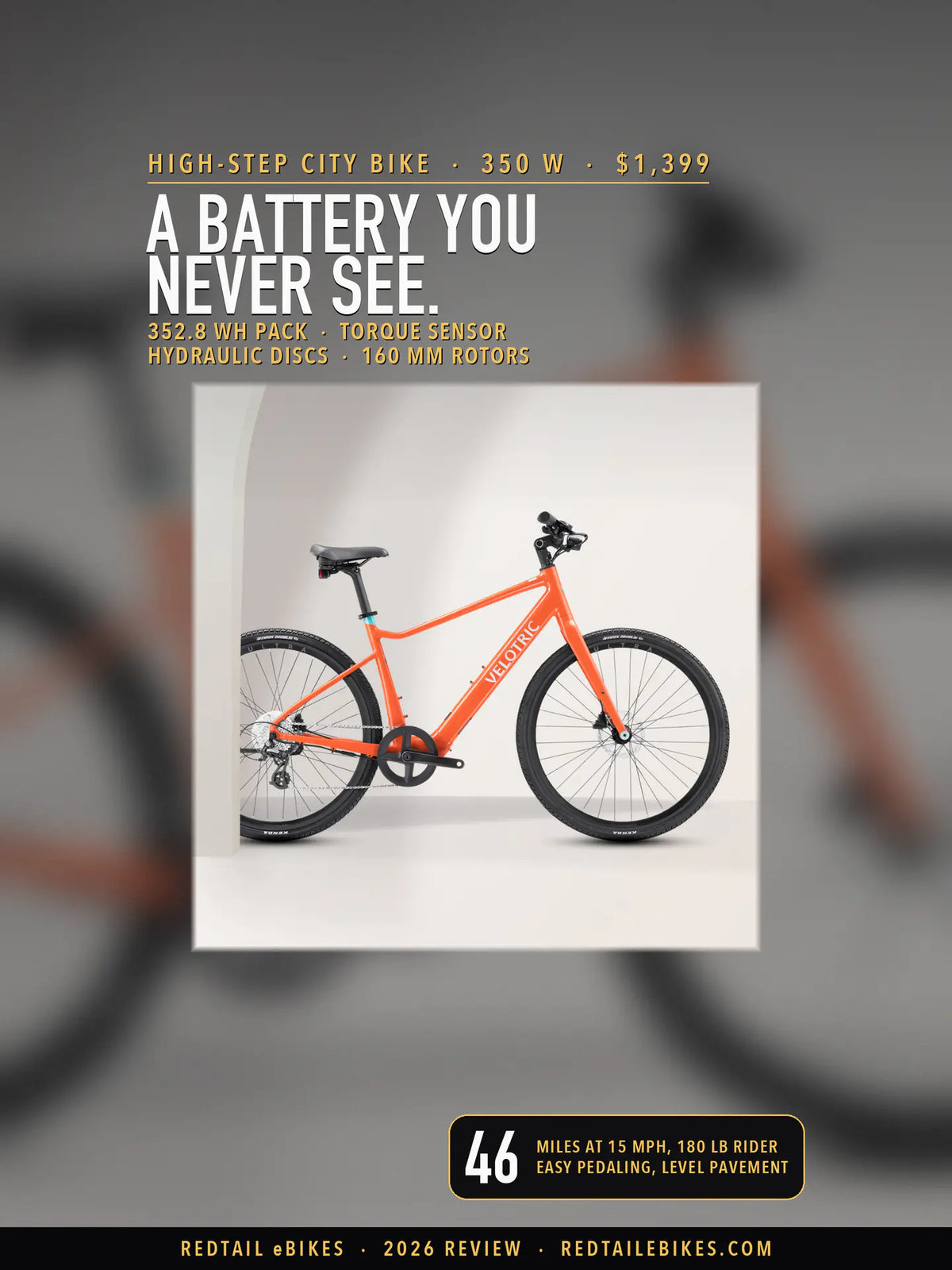

City e-bike, high-step frame · 350 W rear hub motor, 600 W peak, 40 N·m · 36 V pack inside the down tube, 352.8 Wh · torque sensor, pedal assist only, no throttle · 20 mph default, adjustable from 12 to 28 mph · Tektro hydraulic discs on 160 mm rotors · rigid aluminum fork · Kenda 700 × 40c tires · 39 lb in Velotric's specification table, 36 lb in its FAQ · 330 lb with the bike counted · verified November 16, 2026
Quick Answer — The Velotric T1 ST Plus is a $1,399 pedal-assist city bike for riders 4'11" to 5'9": 39 lb, a 350 W hub motor, a 352.8 Wh pack and no throttle. For a 180 lb rider on level pavement with easy pedaling, the pack computes to 46 miles at 15 mph and 21 miles at 20 mph.
Velotric rates it at up to 70 miles for "A 187-lb rider using PAS 1 in Eco mode on flat roads" (Velotric's page), and the range section shows you the ride that produces that figure. It moves only while you pedal, so if you want a thumb throttle for the first push from a light, start with our guide to e-bikes under $1,500, whose finder prints each match's miles on the throttle alone.
Our T1 ST Plus listing is $1,399 for the Regular frame in Lava, and it ships free within the contiguous United States. The button opens checkout with that frame and color already in your cart.
Buy the T1 ST Plus in LavaWhat this review covers
Specification · Against the Tempo · What it is · Fit · Motor · Battery · Range · Brakes · Ride and tires · Lights and app · Weight · The Mercer fit test · UL · Recalls · Class and law · Green and red flags · Verdict · Checklist · Buying it from us · FAQ · Limitations · Bottom line
How we verified this Velotric T1 ST Plus review
Velotric's own figures for the T1 ST Plus are verified against its documents and recomputed: its product page, with its specification table, geometry chart, comparison table and FAQ, and the owner's manual and app manual on its help center, all read November 16, 2026. The range and fit figures come from two saved models, each section listing its inputs, and Electric Bike Report's measurements, named wherever they appear, are the independent check.
Velotric's pages, each statute and each study are the only publisher of their own text, so the register cites each to that publisher alone. We sell the T1 ST Plus, which is why the ledger gives the five kinds of rider it does not suit as much room as its strengths. Part of our e-bike reviews.
Written by Milad Ghobadibeygvand, BScN (Western University, 2014). Corrections: support@redtailebikes.com.
The Velotric T1 ST Plus as Velotric prints it
Every row below is Velotric's own figure, from its T1 ST Plus page, read November 16, 2026. Where Velotric prints one figure two ways, both appear with their sources. Velotric writes the name two ways too: T1 ST Plus on its product page, and Velotric T1ST Plus in its help center's assembly guide.

Velotric's own studio photograph of the T1 ST Plus in Lava, from its product record, cropped and scaled evenly.
| Part | Velotric's figure |
|---|---|
| Price | $1,399 at Velotric and on our listing, compare-at $1,649 at both |
| Frame | 6061 triple-butted aluminum, internal battery, integrated cable routing; "High Step Only" in Velotric's comparison table |
| Sizes | Regular, 4'11" to 5'9"; Large, 5'6" to 6'4" (our listing is the Regular) |
| Colors | Lava and Sand on Velotric's page; our listing is Lava |
| Motor | Rear hub, "350W (Peak 600W), 40Nm" |
| Battery | "36V, 352.8Wh, IPX7, UL 2271 Certified"; Samsung or LG 21700 cells, "UL 2580 Certified" |
| Charger | 36 V, 2 A |
| Assist | Torque sensor; 3 riding modes × 5 assist levels; walk mode at 2.9 mph |
| Throttle | None: "Top Speed 28 MPH(No Throttle)" |
| Speed and class | 20 mph by default, adjustable from 12 to 28 mph; "Class 1 / 3" |
| Range | Up to 70 miles on pedal assist, "*A 187-lb rider using PAS 1 in Eco mode on flat roads." |
| Brakes | Tektro hydraulic discs, 160 mm rotors front and rear |
| Drivetrain | 46T chainring, 170 mm cranks, 8-speed 11–32T freewheel, Shimano derailleur and shifter, KMC chain |
| Wheels and tires | Double-wall rims, Novatec 12 × 100 mm thru-axle front hub, Kenda 700 × 40c puncture-resistant tires |
| Fork | 6061 aluminum alloy, internal brake routing, 12 × 100 mm thru-axle |
| Cockpit | 660 mm bar, adjustable 60 mm stem, 30.9 mm × 350 mm seatpost |
| Weight | 39 lb in the specification table ("*without fenders, kickstand and pedals" in the comparison table); "Only 36 lbs" in Velotric's FAQ |
| Load | 330 lb; the owner's manual counts the bike, rider, clothing and cargo inside it |
| Lights and display | Integrated front light, 60 lux in the specification table and 120 lumens in the comparison table; rear light; 1.8 in color display; USB-A |
| Water | IPX6 for the bike, IPX7 for the pack |
| Certification | UL 2849 for the bike, by Velotric's specification table; ISO 4210 |
Velotric's figures as printed; the two weights and the two light figures are each the product page's own, in different places on that page.
Velotric T1 ST Plus vs Tempo: Velotric's own comparison
Velotric sets the T1 ST Plus beside its Tempo on the T1 ST Plus page, and the two differ on the throttle, the battery and the frame. The rows below are Velotric's comparison table, read November 16, 2026; the prices are our listings'.
| T1 ST Plus | Tempo | |
|---|---|---|
| Our price | $1,399 | $1,399 |
| Frame | High step only | High step or mid step |
| Motor | 350 W, 600 W peak, 40 N·m | 350 W, 650 W peak, 45 N·m |
| Throttle | No | Thumb throttle |
| Removable, lockable battery | No | Yes |
| Brakes | Tektro, 160 mm rotors | Shimano, 180 mm rotors |
| Weight | 39 lb | 39 lb |
| Tires | Kenda 700 × 40c | Kenda 700 × 42c gravel |
| Front light | 120 lumens | 500 lumens, with turn signals |
Velotric's comparison table on its T1 ST Plus page; Velotric's weight footnote reads "without fenders, kickstand and pedals".
By that table, the T1 ST Plus is the one with no throttle and its pack sealed in the frame, and the Tempo the one with a thumb throttle, a pack that comes out and a mid-step option. Our Tempo review works out the Tempo's own range and fit.
Against the first T1 ST, the Plus trades torque for range: Velotric's T1 ST owner's manual lists 52 miles and 45 N·m for the T1 ST, against the Plus page's 70 miles and 40 N·m, and Electric Bike Report records the same two changes (its review).
A 39-pound high-step city bike with its pack in the down tube
The T1 ST Plus is a light, rigid city bike: no suspension, no throttle, a 700c wheel and a battery you never see. Velotric calls it "lightweight" and "ready to grab and go" on its page, and its own comparison table lists the frame as "High Step Only", so despite the "ST" in its name, the frame is not a step-through.

Velotric's photograph from its T1 ST Plus product page, at its native size: a helmeted rider on the Lava frame on a city street.
Its 40 N·m sits 5 N·m under the Tempo's 45 in Velotric's own comparison table, and with no throttle the motor answers your pedal force through the torque sensor. It suits a rider who wants help over a long commute and still wants to pedal.
Buy the T1 ST Plus for light weight and pedaling feel; choose another bike for a throttle, a removable pack or a lower step. The fit tables show whether the Regular frame serves your height.
Will the T1 ST Plus fit you?
At 5'5" the Regular frame's seatpost reaches 109% of inseam for 99 of 100 riders, and at 5'9", the top of Velotric's window, for 53 of 100, by the US Army's survey of 6,068 bodies. Hamley and Thomas's formula sets the saddle at 109% of your inseam, measured from the pedal.
- Your inseam in inches, measured standing, is the one number besides your height that the tables below need.
- Find your height below and read the share of riders the seatpost serves, and the stand-over clearance.
- On delivery day, use the heel check in the setup steps for the saddle's first height.
Velotric's size chart draws the Regular frame for 4'11" to 5'9" and the Large for 5'6" to 6'4"; the tables cover the Regular, the frame our listing carries.

Velotric's image of the T1 ST Plus's adjustable 60 mm stem, from its product record, at its native size.
Will the saddle go high enough (or low enough) for me?
From 4'11" to 5'4", the seatpost reaches the formula height for 100 of 100 riders at each height, and at 5'5" for 99. Above that the share falls as the post runs out: 86 of 100 at 5'7" and 53 at 5'9".
| Your height, Regular | Typical inseam | Saddle height, median rider | At 109% | At 106% |
|---|---|---|---|---|
| 4'11" | 26.8–29.3 in | 33.9 in | 100 of 100 | 98 of 100 |
| 5'0" | 27.1–29.7 in | 34.3 in | 100 of 100 | 100 of 100 |
| 5'1" | 27.7–30.3 in | 35.1 in | 100 of 100 | 100 of 100 |
| 5'2" | 28.0–31.1 in | 35.5 in | 100 of 100 | 100 of 100 |
| 5'3" | 28.7–31.6 in | 36.1 in | 100 of 100 | 100 of 100 |
| 5'4" | 29.1–32.2 in | 36.5 in | 100 of 100 | 100 of 100 |
| 5'5" | 29.7–32.6 in | 37.0 in | 99 of 100 | 100 of 100 |
| 5'6" | 30.2–33.5 in | 37.7 in | 93 of 100 | 99 of 100 |
| 5'7" | 30.7–33.9 in | 38.2 in | 86 of 100 | 97 of 100 |
| 5'8" | 31.1–34.3 in | 38.7 in | 72 of 100 | 93 of 100 |
| 5'9" | 31.7–34.8 in | 39.3 in | 53 of 100 | 84 of 100 |
Typical inseam is the middle 90% of the US Army's ANSUR II bodies at each height; the saddle height is measured from the ground to the top of the saddle, for the median rider at 109% of inseam from the pedal.
The Regular's saddle runs from 770 to 1,000 mm (30.3 to 39.4 in) by Velotric's geometry chart, read as ground to saddle top. Riders the post does not reach at 109% sit about 0.7 in low at 5'9", the median of those short.
At 106% of inseam, a lower setting that leaves more bend in the knee, the post serves 84 of 100 riders at 5'9".
Can I put a foot down at a stop?
The Regular's stand-over is 687 mm (27.0 in) by Velotric's chart, and 84 of 100 riders 4'11" tall clear it, rising to 99 of 100 at 5'1". The top tube slopes down, but the frame is a high-step one, so a rider at the bottom of the window may touch it when standing over the bike.
| Your height, Regular | Typical inseam | Clearance at 27.0 in |
|---|---|---|
| 4'11" | 28.1 in | −0.3 in |
| 5'0" | 28.4 in | 0.0 in |
| 5'1" | 29.2 in | 0.7 in |
| 5'2" | 29.5 in | 1.0 in |
| 5'3" | 30.1 in | 1.7 in |
| 5'4" | 30.5 in | 2.0 in |
| 5'5" | 31.0 in | 2.7 in |
| 5'6" | 31.7 in | 3.2 in |
| 5'7" | 32.2 in | 3.7 in |
| 5'8" | 32.6 in | 4.1 in |
| 5'9" | 33.1 in | 4.7 in |
Clearance is inseam minus Velotric's 687 mm stand-over, for the rider 95 of 100 at each height are taller in the leg than: a minus sign means that rider touches the tube. Shoes add clearance; the table assumes none.

Velotric's image of the bare Lava frame, from its T1 ST Plus product page, scaled evenly: the top tube slopes down to the seat tube, and the frame is a high-step one.
If you are 4'11" or 5'0" and want both feet flat at a light, our frame-types guide sets out frames whose rider windows start low, one of them at 4'8".
Will I feel cramped, or stretched?
The median Regular rider leans 18 to 22 degrees forward of upright to reach the grips. The stem is adjustable, so the range below runs from the most upright setting to the most stretched.
| Your height, Regular | Lean from upright, median rider | Across saddle and grip positions |
|---|---|---|
| 4'11" | 18° | 10–25° |
| 5'0" | 18° | 11–26° |
| 5'1" | 19° | 11–26° |
| 5'2" | 19° | 12–26° |
| 5'3" | 20° | 12–27° |
| 5'4" | 21° | 13–27° |
| 5'5" | 21° | 14–28° |
| 5'6" | 22° | 14–28° |
| 5'7" | 22° | 15–29° |
| 5'8" | 22° | 15–29° |
| 5'9" | 22° | 15–29° |
Lean is the trunk's angle forward of vertical with the saddle at 109% of inseam and the grips where Velotric's photograph shows them, moved to the Regular frame by its published reach and stack. The range covers the saddle's fore-aft travel and the grip's photographed extent.
How much weight goes through my wrists?
With the back relaxed, the hands carry about 16% to 20% of a median rider's weight on the Regular, a ceiling that holding your back up lowers. Road racers on their brake hoods carry about 15% (Carahalios 2015).
| Your height, Regular | Share of your weight, back relaxed | Median rider's weight | On each hand |
|---|---|---|---|
| 4'11" | 16% (12–19%) | 128 lb | about 10 lb |
| 5'0" | 17% (12–20%) | 126 lb | about 10 lb |
| 5'1" | 17% (13–20%) | 134 lb | about 11 lb |
| 5'2" | 18% (14–21%) | 139 lb | about 12 lb |
| 5'3" | 18% (14–21%) | 144 lb | about 13 lb |
| 5'4" | 18% (14–21%) | 147 lb | about 13 lb |
| 5'5" | 19% (15–22%) | 157 lb | about 15 lb |
| 5'6" | 19% (15–22%) | 166 lb | about 16 lb |
| 5'7" | 19% (16–22%) | 172 lb | about 17 lb |
| 5'8" | 20% (16–23%) | 179 lb | about 18 lb |
| 5'9" | 20% (16–23%) | 185 lb | about 19 lb |
The share is computed from the lean above and the segment weights of Clauser and colleagues (1969); the pounds per hand use the median weight of riders at each height in the Army survey. It is an upper bound: pedaling takes weight off the hands.
How do I set the saddle when it arrives?
A saddle at the right height leaves the knee bent 25 to 35 degrees at the bottom of the stroke, the range Peveler, Pounders and Bishop (2007) give. It takes no tools: raise the saddle in small steps until your leg locks straight with your heel set on the down pedal; pedaling normally, on the ball of the foot, restores the bend.
Velotric's owner's manual walks through the seat clamp and the adjustable stem at assembly; do the saddle first, since its height changes where the bar should sit.
Near 4'11" or 5'9"? Send both numbers to support@redtailebikes.com, and we work the tables above for your own body before you buy. Velotric draws this frame for riders 4'11" to 5'9", and it is the frame this button orders.
Buy the Regular frame nowHow we computed fit
The bike's figures come from Velotric's geometry chart, specification table and side-view photograph, and the bodies from the US Army's ANSUR II survey of 4,082 men and 1,986 women. The saddle formula is Hamley and Thomas's 109% of inseam from the pedal; LeMond's 88.3% from the crank axle gives nearly the same height.
| Input | Value | Source |
|---|---|---|
| Saddle range | 770 to 1,000 mm, ground to saddle top | Velotric's geometry chart, Regular |
| Stand-over | 687 mm | Velotric's geometry chart, Regular |
| Crank length | 170 mm | Velotric's specification table |
| Seat-tube angle | 73.6 degrees | Computed from Velotric's Regular stack (586 mm), reach (437.5 mm) and level top tube (610 mm) |
| Bottom-bracket height | 11.0 in | Measured on Velotric's side view (the Large frame; no drop is published, so the Regular is taken to share it) |
| Grip position | as photographed, moved to the Regular | Velotric's side view, reach and stack |
| Bodies | 6,068 | ANSUR II, 2012 |
Velotric's side view measures as the Large frame: scaled by the Large's 467 mm reach on Velotric's geometry chart, it reproduces four of Velotric's published dimensions within 1.0% and the seatpost's width within 3.6%. The controls below are that check; the Regular's figures are carried from it by Velotric's published size differences.
| Dimension, Regular | Velotric lists | Measured on its photograph | Gap |
|---|---|---|---|
| stack, crank axle to the top of the head tube | 24.4 in | 24.4 in | −0.0% |
| top tube, measured level | 25.6 in | 25.4 in | −0.9% |
| seat tube, crank axle to the top of the tube | 19.3 in | 19.5 in | +1.0% |
| tire outer diameter, KENDA 700 x 40c read as ETRTO 40-622 (a nominal 702 mm) | 27.6 in | 27.5 in | −0.4% |
| seat post, 30.9 mm across, as it crosses the photo at its angle | 1.3 in | 1.2 in | −3.6% |
Measured on Velotric's own studio photograph of the Lava T1 ST Plus; Velotric does not state the photographed size, and the Large's scale is the one that fits four of the five controls within 1.0%.
Worked through for a 5'8" rider with a 32.64-inch median inseam: 109% of that inseam is 35.6 in from the pedal, and with the 170 mm crank and the 11.0-inch bottom bracket the saddle top sits 38.7 in above the ground, inside the Regular's 30.3 to 39.4 in.
Averaged over the survey's 6,068 bodies, LeMond's 88.3% plus the 170 mm crank comes to 109.0% of inseam, and Peveler et al. (2005) found the LeMond method placed its 19 trained cyclists at 109.2% of inseam, plus or minus 0.9%.
A 350 W rear hub that answers your pedal force
Velotric rates the T1 ST Plus's rear hub at 350 W, 600 W peak and 40 N·m, and a torque sensor sets the assist from how hard you press the pedals. There is no throttle and no cadence mode: with the pedals still, the motor stays off, apart from the 2.9 mph walk mode that helps you push the bike.

Velotric's photograph from its T1 ST Plus product record, at its native size: the rear hub motor, the derailleur and the 8-speed freewheel.
Three riding modes, Eco, Trail and Boost, each carry five assist levels, so the display offers fifteen settings (Velotric's page; the mode names from its app manual). Electric Bike Report's Speed Test in Class 1 averaged 14.2 mph at PAS 1 and 20.0 mph at PAS 5 in Boost (its review).
Velotric's comparison table calls it an outer-rotor motor; it does not name the motor's maker or say whether it is geared, and the range formula uses a published hub of the same rating to model it.
Velotric T1 ST Plus battery: 352.8 Wh sealed in the frame
The pack is 36 V and 352.8 Wh, inside the down tube, and Velotric's comparison table lists "Removal & Lockable Battery" as "No" for the T1 ST Plus. You charge it on the bike, from the 36 V, 2 A charger in the box, so the bike goes where the outlet is.
The owner's manual Velotric files under the T1 ST Plus asks you to charge between 41 °F and 104 °F, "but preferably at room temperature ranges from 50°F to 86°F", and to store the bike between 50 °F and 77 °F (owner's manual). When the charge drops to between 6% and 20%, the battery icon turns to one yellow segment.
Velotric's US store, read on November 16, 2026, lists no range extender, and its Extra Battery Pack can be ordered for 13 model groups, none of them a T1 (Velotric's store). If your ride runs past the planning figures below, our long-range guide works out what a second pack adds.
Velotric T1 ST Plus range: 46 miles at 15 mph for a 180 lb rider, computed
A 180 lb rider pedaling easily at 15 mph on level pavement computes to 46 miles a charge, or 37 miles with 20% of the pack kept back, and the same rider at 20 mph to 21. Velotric's 70 miles is the ride at the slow end of that range.
- Pick your speed and effort in the table below: light (50 W), easy (75 W) or brisk (150 W) pedaling.
- Correct that figure with the tables below for your hills, your weight and the air temperature.
- Read the 20%-kept column as your plan: Velotric's battery icon turns yellow there.
The figures come from a saved model of this bike with every input verified against its published source, and How the range figures are computed lists each one.
Does riding faster cut range?
Yes, sharply: easy pedaling on the flat computes to 46 miles at 15 mph and 21 miles at 20 mph for a 180 lb rider. The power to push through the air grows with the cube of speed in Martin and colleagues' road equation, and with no throttle your own watts are part of every row.
| Speed, flat | Light, 50 W | Easy, 75 W | Brisk, 150 W | Easy, 20% kept |
|---|---|---|---|---|
| 12 mph | 62 mi | 110 mi | legs alone | 88 mi |
| 15 mph | 36 mi | 46 mi | 192 mi | 37 mi |
| 18 mph | 24 mi | 28 mi | 49 mi | 22 mi |
| 20 mph | 19 mi | 21 mi | 31 mi | 17 mi |
| 22 mph | 15 mi | 16 mi | 22 mi | 13 mi |
180 lb rider and 39 lb bike, level pavement, 77 °F air, no wind, the full 352.8 Wh; "legs alone" marks a speed your pedaling holds with no help from the motor, so the motor adds nothing there.
Held to its 350 W rating, the model's motor does not hold 24 mph or more even with 150 W of pedaling; Electric Bike Report's Class 3 Speed Test averaged 23.1 mph at PAS 5 (its review). At 15 mph with 150 W the motor adds only 1.8 Wh a mile, so the legs carry almost the whole ride.
Plan on 37 miles at 15 mph with easy pedaling, not the full 46. The 20% kept back is where Velotric's battery icon turns yellow.
What gear saves battery?
Shifting changes how fast your legs turn; the rear-hub motor's draw does not change with the gear, so the battery saving comes from how hard you pedal. At 15 mph on the flat, easy pedaling uses 22% less battery than light pedaling.
| Your ride | Light (50 W) | Easy (75 W) | Brisk (150 W) |
|---|---|---|---|
| 15 mph, flat | 9.9 Wh | 7.7 Wh | 1.8 Wh |
| 20 mph, flat | 18.7 Wh | 16.7 Wh | 11.3 Wh |
| 12 mph, 4% grade | 37.3 Wh | 32.4 Wh | 19.8 Wh |
| 10 mph, 8% grade | — | 87.2 Wh | 55.7 Wh |
Watt-hours a mile, 180 lb rider, 77 °F air. Shift to a gear where 50 to 75 W feels easy at your cadence, and the battery does the rest. "—" marks a ride the 350 W rating cannot hold with that pedaling.
Does going uphill drain it faster?
Yes: at 8 mph a 6% grade costs 46 Wh a mile with easy pedaling, and the 352.8 Wh pack lasts 8 miles of that climb. Climbing at 8 mph with easy pedaling costs 111 to 252 Wh for every 1,000 feet on 4 to 10% grades, against 82 Wh that lifting rider and bike takes at the wheel.
| Grade | Fastest steady, easy | Per mile, 8 mph | Full charge, easy | Full charge, brisk |
|---|---|---|---|---|
| 2% | 18.6 mph | 8 Wh | 46 mi | legs alone |
| 4% | 15.2 mph | 23 Wh | 15 mi | 51 mi |
| 6% | 12.4 mph | 46 Wh | 8 mi | 16 mi |
| 8% | 10.2 mph | 79 Wh | 4 mi | 8 mi |
| 10% | 8.6 mph | 133 Wh | 3 mi | 5 mi |
| 12% | 7.4 mph | — | — | 3 mi |
| 15% | 4.2 mph | — | — | — |
180 lb rider, 77 °F air. "Fastest steady" is the speed the 350 W rating holds on that grade with easy pedaling; "—" marks a ride the rating cannot hold at 8 mph with easy pedaling.
A hilly commute adds up fast: twenty level miles at 15 mph with easy pedaling take 154 Wh, and 500 feet of 8% climbing at 8 mph takes 94 Wh more, 248 Wh in all, 88% of what the pack gives before the yellow icon.
Does rider weight affect range?
Yes, most on climbs: at 15 mph on the flat a 130 lb rider computes to 52 miles and a 291 lb rider to 36. Velotric rates the bike at 330 lb, and its owner's manual counts the bike inside that figure, so 291 lb is the most rider and cargo the rows run to.
| You plus your load | 15 mph, easy | 20 mph, easy | 6% climb at 10 mph, easy |
|---|---|---|---|
| 130 lb | 52 mi | 23 mi | 11 mi |
| 180 lb | 46 mi | 21 mi | 7 mi |
| 220 lb | 42 mi | 20 mi | 5 mi |
| 260 lb | 38 mi | 19 mi | not held at 75 W |
| 291 lb (330 lb less the bike) | 36 mi | 18 mi | not held at 75 W |
Rider plus load, 39 lb bike, easy pedaling (75 W), 77 °F air. "Not held at 75 W" means the 350 W rating cannot hold 10 mph up a 6% grade at that weight with easy pedaling; more pedaling or a slower speed holds it.
If you weigh more than about 260 lb and ride hills, our guide to e-bikes for heavier riders sets bikes with larger motors and higher load ratings side by side.
Does cold weather drain it?
Yes: at 32 °F the pack gives about 89% of its 77 °F energy, and easy pedaling at 15 mph computes to 34 miles. Velotric's manual says the bike "is not intended to be used at ambient temperatures lower than 14°F", so the table stops there.
| Air | Pack energy vs 77 °F | 15 mph, easy | 20 mph, easy |
|---|---|---|---|
| 95 °F | 99% | 50 mi | 22 mi |
| 77 °F | 100% | 46 mi | 21 mi |
| 68 °F | 98% | 43 mi | 20 mi |
| 50 °F | 93% | 38 mi | 18 mi |
| 41 °F | 91% | 35 mi | 17 mi |
| 32 °F | 89% (80–93) | 34 mi (30–35) | 16 mi (14–17) |
| 14 °F | 82% (40–83) | 30 mi (15–30) | 14 mi (7–14) |
The cell's energy at each temperature against 77 °F, from Kollmeyer's laboratory discharge data for the LG HG2 cell, a comparable lithium-ion cell; in brackets, the spread across published cell sources where they disagree. 180 lb rider, easy pedaling, level pavement.
Charge the pack indoors at room temperature before a cold ride, as Velotric's manual asks, and ride the cold miles with the battery already warm.
Do the tires cut range?
A little: the field average for knobby tires computes to 40 miles at 15 mph against 46 for the commuter tires the model uses. Velotric names the Kenda 700 × 40c tires as puncture resistant but gives no tread model, so the model brackets them.
| Rolling resistance | 15 mph, easy | 20 mph, easy |
|---|---|---|
| 0.0070 · slick tires | 47 mi | 21 mi |
| 0.0074 · commuter tires (used here) | 46 mi | 21 mi |
| 0.0092 · knobby tires | 40 mi | 20 mi |
Rolling-resistance coefficients from Tengattini and Bigazzi's coast-down study of everyday riders (2018); 180 lb rider, easy pedaling, 77 °F air.
Riding position counts too: the same ride computes to 46 miles with the flat-bar position the model uses, and 41 miles sitting fully upright.
Is Velotric's range real?
Velotric's 70 miles matches a 187 lb rider pedaling at about 13.2 mph with easy effort, or at Electric Bike Report's 11.3 mph with about 49 W from the legs. That is the ride Velotric's footnote describes, "PAS 1 in Eco mode on flat roads", worked through the model at 5.0 Wh a mile.
Electric Bike Report rode its T1 ST Plus 84.6 miles at PAS 1 and 23.8 miles at PAS 5 in Boost, both with a 20 mph limit (its review), and the model lands on both with steady pedaling, as the check table shows.
Write to support@redtailebikes.com with your usual ride, its miles, speed and climbs, and we will work it out in watt-hours on this model before you buy. If the tables already answer it, the bike is a click from your cart.
Buy it, plan with the tablesHow the range figures are computed
Power at the wheel is rolling resistance plus climbing plus air drag, after Martin and colleagues' road equation (1998), and the motor supplies whatever your pedaling does not, held to its 350 W rating. It is the hub-drive model our Breeze 1 review uses, run here on pedal effort alone because the T1 ST Plus has no throttle. Battery watt-hours a mile follow from that power, the motor's efficiency and the pack's.
| Input | Value | Source |
|---|---|---|
| Bike | 39 lb | Velotric's specification table (36 lb in its FAQ: a sensitivity run) |
| Pack | 352.8 Wh, 36 V | Velotric's specification table |
| Wheel | 27.5 in, 2,197 mm around | Measured on Velotric's side view |
| Tire rolling resistance | 0.0074 (commuter), 0.0070 to 0.0092 bracket | Tengattini and Bigazzi (2018) |
| Drag area | 0.579 m² (flat bar) | Tengattini and Bigazzi (2018) |
| Motor | Bafang's RM G360 350 W rear hub as a comparable, held to Velotric's 40 N·m | Bafang's 2021 workbook; Velotric's table |
| Pack efficiency | 96.7% at the worked ride | Arango, Lopez and Ceren (2021) |
| Cold | Pack energy by temperature, LG HG2 cell | Kollmeyer's LG HG2 data |
| Air | 1.184 kg/m³ at 77 °F | U.S. Standard Atmosphere, 1976 |
| Planning reserve | 20% | Velotric's manual: the battery icon turns yellow below 20% |
Worked through: a 180 lb rider at 15 mph on level pavement. The tires take 48.34 W and the air 103.34 W, for 151.68 W at the wheel. Easy pedaling puts 73.27 W of that through the chain, and the motor supplies 78.41 W.
The pack delivers 111.33 W to do it, drawing 115.18 W from its cells at 96.7% pack efficiency, or 7.68 Wh a mile: 45.9 miles from the full pack and 36.8 with 20% kept.
| Check | Measured or published | This model |
|---|---|---|
| Electric Bike Report, PAS 5, Boost, 20 mph limit | 23.8 miles | matched at 20 mph with 100 W from the rider |
| Electric Bike Report, PAS 1, Boost | 84.6 miles | matched at its stated 11.3 mph with 56 W from the rider |
| Road physics, Martin and colleagues' worked example | 45.7 W for tires and grade, 158.8 W for the air | 45.7 W and 158.8 W |
| The comparable motor at Bafang's rated point | at least 80% efficient | 80% |
The two Electric Bike Report runs are matched at its own stated speeds with a 180 lb rider, its test rider's weight; its PAS 5 run is about 24 miles in about an hour and a half by its text, nearer 16 mph than 20, and at 16 mph the model matches it with only 12 W from the rider.
Its hill test is not used: its 110 seconds at 9.9 mph cover 0.30 mile on a course its write-up does not describe.
Velotric does not name the motor's maker, so the motor is modeled on Bafang's RM G360, a 36 V, 350 W rear hub whose rated speed on this wheel sits just above 28 mph (Bafang's 2021 OEM workbook). With Bafang's G020 hub at the same 40 N·m instead, easy pedaling at 15 mph computes to 46 miles; at a 36 lb bike weight, 46; at Electric Bike Report's 44 lb scale weight, 45.
Tektro hydraulic discs on 160 mm rotors
Velotric fits Tektro hydraulic disc brakes with 160 mm rotors front and rear, and levers in aluminum alloy. Electric Bike Report's Brake Test stopped the T1 ST Plus in 25 feet 0 inches on average (its review).

A crop of Velotric's Lava studio photograph at its native scale: the 160 mm front rotor and the caliper on the rigid fork.
Velotric's manual lists the brake among the components its warranty covers and its pads among the wear parts it leaves out, so budget for pads as a cost you carry (owner's manual).
A rigid fork and Kenda 700 × 40c tires
There is no suspension: the 6061 aluminum fork is rigid with a 12 × 100 mm thru-axle, and the comfort comes from 40 mm Kenda tires and Velotric's "urban comfort ergonomic seat". Velotric's warranty terms list the T1 ST Plus among its rigid-fork bikes, and its product page names the seat. On broken pavement, the tire pressure you choose is the setting that changes the ride.

A crop of the same photograph at its native scale: the Kenda 700 × 40c tire.
Velotric's manual says to inflate your tires to the pressure stamped on the sidewall, and it gives 80 PSI as the T1 ST's standard pressure; the tire table prices rolling resistance in miles.
The 8-speed Shimano derailleur shifts an 11–32T freewheel against a 46T chainring, by Velotric's specification table, so on a climb your lowest gear turns 46 teeth against 32.
Lights, display, app and Find My
Velotric integrates a front light, 60 lux by its specification table and 120 lumens by its comparison table, a rear light, a 1.8 in color display with Bluetooth and a USB-A charging port. The display sets the riding mode, the assist level and the speed limit.
Velotric's T1 ST Plus app manual says you can "Adjust the speed limit to your eBike, ranging from 12 mph to 28 mph" in the app's bike settings (the app manual, attached to Velotric's T1ST Plus assembly article). The bike works with Apple Find My, which Electric Bike Report notes "does nothing to prevent theft" (its review), so carry a lock.
Velotric T1 ST Plus weight: 39 pounds, or 36
Velotric prints 39 lb in its specification table and "Only 36 lbs" in its FAQ, and its comparison table says the 39 lb is "without fenders, kickstand and pedals". Electric Bike Report weighed its test bike at 44 lb (its review).

Velotric's photograph from its T1 ST Plus product page, at its native size, showing the Sand frame, the page's other color; our listing is the Lava Regular.
Because the pack does not come out, the whole bike goes to the outlet, so its weight is the figure to read if your charger sits up a flight of stairs. Lift it by the top tube and the seat post, and keep the chain side away from your clothes.
The Mercer fit test
The Mercers, our editorial cast, are seven fit archetypes in one family with fixed heights and ages, and here they size up the T1 ST Plus's Regular frame. Every verdict rests on a figure Velotric prints, a row of this page's fit model or a statute; none of them has ridden the bike.
| Member | Verdict | The number behind it |
|---|---|---|
| Frank Kowalski, 63, 5'10" | Above the Regular's window | Velotric's Regular runs to 5'9"; its post reaches the formula height for 27 of 100 riders his height |
| Ruth Kowalski, 61, 5'5" | Fits the Regular | Inside 4'11" to 5'9"; 99 of 100 riders her height reach the formula height, and all clear the 27.0 in stand-over |
| Jack Mercer, 48, 6'1" | Above the Regular's window | The post reaches the formula height for 2 of 100 riders his height |
| Dana Mercer, 45, 5'7" | Fits the Regular | 86 of 100 riders her height reach the formula height; rider, cargo and the bike count toward Velotric's 330 lb |
| Maya Torres, 32, 5'6" | Fits the Regular | 93 of 100 riders her height reach the formula height |
| Cole Mercer, 16, 5'11" | Above the Regular's window | 11 of 100 riders his height reach the formula height; at 16 he is past California's bar on Class 3 riders under 16 (§ 21213) |
| Ivy Mercer, 12 | Not sized on this page | The window opens at 4'11", the Army survey measured no 12-year-olds, and our kids and teens guide sizes bikes by age |
Ages from the Mercers' profile and heights as each member is cast; every height is read against Velotric's Regular window and the ANSUR II tables above, every age against the statutes in the law section.
Ruth and Jack make the family's sharpest contrast. At 5'5" Ruth sits in the middle of the Regular's window and 99 of 100 riders her height reach the formula height; at 6'1" Jack sits above it, where the post serves 2 of 100, so a tall rider reads our guide for tall riders instead.
Is the Velotric T1 ST Plus UL certified?
Velotric lists the T1 ST Plus under UL 2849, its pack under UL 2271 and its cells under UL 2580 (product page). On its UL certification page, Velotric explains the two: UL 2849 covers the e-bike's electrical system, and UL 2271 its lithium-ion pack.
For the certificate numbers themselves, write to us and we will ask Velotric for them in writing.
Has the Velotric T1 ST Plus been recalled?
No recall names the Velotric T1 ST Plus or Velotric: the CPSC's recall database, read on November 16, 2026, holds 10,089 records and none names either. None of the 389 rows in the CPSC's product safety warning listing named Velotric that day, and the newest notice in its recall feed was dated November 12, 2026 (CPSC recall database).
A recall can be issued after this read, so run a used T1 ST Plus's frame number through the CPSC's recall search before paying for it, and note your own bike's frame number on delivery.
What class is the Velotric T1 ST Plus, and where can it ride?
Velotric prints "Class 1 / 3" and "No Throttle" for the T1 ST Plus: it ships with a 20 mph default and a setting that runs from 12 to 28 mph. Which paths each class may use is a state's call; the 350 W rating clears every wattage figure a state definition writes.
Arizona's A.R.S. § 28-101 shows how one state words Class 1 and Class 3, and our Arizona guide covers that state's other e-bike rules:
- Class 1: a motor that "provides assistance only when the rider is pedaling and that ceases to provide assistance when the bicycle or tricycle reaches the speed of twenty miles per hour."
- Class 3: a motor that "provides assistance only when the rider is pedaling and that ceases to provide assistance when the bicycle or tricycle reaches the speed of twenty-eight miles per hour."
The 51 US jurisdictions, the 50 states and DC, write the motor limit into their electric-bicycle definitions in five ways:
| How the definition writes the motor limit | Jurisdictions |
|---|---|
| 750 watts, as a ceiling the motor may reach | 25 |
| "Less than" or "fewer than" 750 watts | 19 |
| Two horsepower | 1: Rhode Island, "rated not more than two (2) (S.A.E.) horsepower" (R.I. Gen. Laws § 31-1-3(g)) |
| No wattage figure | 4: the District of Columbia, Montana, New Jersey and Oregon |
| No electric-bicycle definition | 2: Alaska and Kentucky |
Each state's definition as recorded in the 51-jurisdiction census behind our state guides, screened November 16, 2026; a reading of the statutes, not legal advice.
The T1 ST Plus's 350 W rating, and its 600 W peak, both sit under the lowest of those wattage figures. The federal definition of a low-speed electric bicycle uses the same line, "an electric motor of less than 750 watts (1 h.p.)" (15 U.S.C. § 2085).
Being an electric bicycle under a state's definition carries benefits: in Florida, an electric bicycle "is not subject to the provisions of law relating to financial responsibility, driver or motor vehicle licenses, vehicle registration" (Fla. Stat. § 316.20655), and our Florida guide sets out the rest.
Class 3 carries extra rules in the states that define it. In California, § 21213(a) reads: "A person under 16 years of age shall not operate a class 3 electric bicycle." Subsection (b) adds a properly fitted and fastened helmet for Class 3 riders, and our California guide covers where Class 3 may ride.
Federal land has its own map. The Forest Service counts an e-bike as a "Motor vehicle" on National Forest System land (36 C.F.R. § 212.1); where a district has published its motor vehicle use map, the e-bike is limited to the routes that map shows (§ 261.13), and breaking that limit can bring "imprisonment of not more than six months or a fine in accordance with the applicable provisions of 18 U.S.C. 3571 or both" under § 261.1b.
The Bureau of Land Management defines an e-bike by "an electric motor of not more than 750 watts (1 h.p.)" (43 C.F.R. § 8340.0-5); a breach of the off-road vehicle rules in subparts 8341 and 8343 carries "a fine of not more than $1,000 or imprisonment for not longer than 12 months, or both" (§ 8340.0-7).
A ranger district's motor vehicle use map settles a forest trail before you ride it, and our public-land guide carries the federal rules this section leaves out.
Leave the 20 mph default on unless your state and your path allow Class 3, and read your state's page before a ride. Our national law guide sets out each state's rules in a row of its own.
Green flags / Red flags
Light weight and a torque sensor make the T1 ST Plus's case; a sealed pack, no throttle and a Regular frame that stops at 5'9" decide who it leaves out. Every red flag ends with the guide that rider should read.
Green flags
- 39 lb in Velotric's specification table, with the pack hidden in the frame (weight).
- A torque sensor with fifteen assist settings, so the motor follows your pedal force (motor).
- 46 miles a charge, computed at 15 mph for a 180 lb rider pedaling easily on level pavement, or 37 with 20% kept (range).
- A geometry chart Velotric publishes in full, so the fit tables rest on its own dimensions (fit).
- Tektro hydraulic discs, which stopped Electric Bike Report's test bike in 25 feet on average (brakes).
- A 350 W rating under every state's wattage figure (class).
Red flags
- Riders who want a throttle. There is none; our guide to e-bikes under $1,500 compares bikes at this price, and its finder prints each match's miles on the throttle alone.
- Riders who charge away from the bike. The pack does not come out; our frame-types guide explains why a removable pack matters if you park outside or live up stairs.
- Riders under 5'1" who want both feet flat at a stop. The 27.0 in stand-over clears 84 of 100 riders at 4'11"; our frame-types guide sets out frames whose windows start lower.
- Riders of 5'10" and up. The Regular's window ends at 5'9"; our tall-rider guide sizes bikes for taller riders.
- Riders who climb long, steep grades with easy pedaling. The model holds 10.2 mph on an 8% grade with easy pedaling; our commuter guide's hills section explains why torque at the wheel is the figure to read for a grade.
Buy it if / Buy something else if
Buy the T1 ST Plus if you stand between 4'11" and 5'9", will pedal every ride, want a 39 lb bike with hydraulic brakes, and can charge it where you park it, at $1,399.
At 18.16 cents a kilowatt-hour, the US average residential price for August 2026, riding 1,000 miles a year at 15 mph with easy pedaling costs about $1.39 a year in electricity before charger losses, at 7.7 Wh a mile (EIA).
Buy something else if you want a throttle (our guide to e-bikes under $1,500), a battery you can carry indoors (our frame-types guide on where the battery sits), a long hill commute (our commuter guide's hills section), rides that leave the pavement (our first electric mountain bikes under $2,000), or a frame for 5'10" and up (our tall-rider guide).
The 352.8 Wh pack, the 36 V charger, the front light and the pedals come in the box, by Velotric's list. One click puts it in your cart at $1,399.
Buy the T1 ST Plus nowBefore you buy: the checklist
- Look up your height and inseam in the fit tables; below 5'1", the stand-over table matters as much.
- Total your weight, your cargo and the bike's 39 lb: Velotric's manual counts all three inside 330 lb.
- Find the outlet you will charge at, since the pack stays in the frame, inside Velotric's preferred 50 to 86 °F band.
- Size your longest ride against the range tables, with 20% of the pack left over.
- Read your state's rules in our state guides before you set the speed above 20 mph.
- Photograph the frame number when the bike arrives; a recall search and a warranty claim both start from it.
Our buying guide sets out a seven-spec checklist for comparing this bike with any other.
Buying it from us
Our T1 ST Plus listing is $1,399 for the Regular frame in Lava, and each term below comes from the page or setting that states it. Your warranty claim runs through us: email support@redtailebikes.com, and we take it to Velotric, whose terms decide the cover.

Velotric's studio photograph of the Lava T1 ST Plus from behind, from its product record, cropped and scaled evenly.
| What you get | Our terms on November 16, 2026 |
|---|---|
| Price | $1,399 on our T1 ST Plus listing, the price Velotric lists, against a $1,649 compare-at at both stores |
| Shipping | "free shipping on every electric bike within the contiguous United States", by our shipping policy; Alaska, Hawaii, U.S. territories, P.O. boxes and remote areas "may incur additional charges or be excluded" |
| Dispatch and transit | "orders are prepared and dispatched within 1–3 business days of confirmation"; "most e-bikes arrive within 5–10 business days after dispatch" |
| Payment | A card, Apple Pay, Google Pay or Shop Pay at checkout |
| Warranty | Velotric's coverage periods: five years on the frame, two years on the battery and electrical parts, one year on other components (Velotric's warranty terms). As the dealer, we route your claim to Velotric |
| Damage in transit | "email us photos within 48 hours of delivery so we can resolve it"; "we file the carrier claim and arrange a replacement or repair", by our refund policy |
| Defective on arrival | "covered under manufacturer warranty — we coordinate repair or replacement remotely", per our refund policy |
| Your fit | Email your height and inseam, and the reply runs them through this page's tables |
| Questions before you buy | support@redtailebikes.com; our contact page says "We typically respond to email within one business day" |
Every row was read on November 16, 2026, from our policy pages and checkout settings; the warranty row gives Velotric's published periods. Returns for a change of mind carry a 15% restocking fee plus return shipping, by our refund policy.
Our Velotric collection carried 20 of Velotric's bikes on November 16, 2026, the T1 ST Plus among them, and our all-e-bikes collection held 209. Whether you buy from Velotric direct or from a multi-brand shop like ours is the question our where-to-buy guide takes on.
Redtail eBikes is the seller and Velotric makes the T1 ST Plus; your order and any claim come to us first. Checkout takes a card, Apple Pay, Google Pay or Shop Pay, and shipping to the lower 48 costs you nothing.
Buy it, free 48-state shippingFrequently asked questions
Is the Velotric T1 ST Plus worth it?
If you stand between 4'11" and 5'9", will pedal every ride and can charge where the bike parks, yes on the published figures: 39 lb in Velotric's specification table, Tektro hydraulic discs, and 46 miles computed at 15 mph for a 180 lb rider pedaling easily, at $1,399. For a throttle, a battery you can carry indoors or a frame above 5'9", it is the wrong bike (verdict).
How much does the Velotric T1 ST Plus cost?
Our listing is $1,399 for the Regular frame in Lava, the price Velotric lists, against a $1,649 compare-at at both stores on November 16, 2026, and it ships free within the contiguous United States (buying it from us).
Does the Velotric T1 ST Plus have a throttle?
No. Velotric's page prints "Top Speed 28 MPH(No Throttle)" and "Class 1 / 3" for the T1 ST Plus, so the motor helps only while you pedal, apart from a 2.9 mph walk mode. For a throttle, our guide to e-bikes under $1,500 compares bikes at this price.
Does the Velotric T1 ST Plus have a torque sensor?
Yes. Velotric's page lists a torque sensor and three riding modes with five assist levels in each, fifteen settings in all, and no cadence mode, so the motor's help follows how hard you press the pedals (motor).
What motor does the Velotric T1 ST Plus have?
A rear hub that Velotric's page rates at 350 W, 600 W peak and 40 N·m. Its comparison table calls it an outer-rotor motor, and Velotric does not name the motor's maker (motor).
How far can the Velotric T1 ST Plus go on a charge?
For a 180 lb rider on level pavement with easy pedaling, about 46 miles at 15 mph and 21 miles at 20 mph, computed; plan on 37 at 15 mph with 20% kept. Velotric rates it at up to 70 miles for a 187 lb rider at PAS 1 in Eco on flat roads (range).
What is the Velotric T1 ST Plus's top speed?
The assist stops at 20 mph by default, and Velotric's display and app set the limit anywhere from 12 to 28 mph. Held to its 350 W rating, the model holds 22.5 mph on the flat with easy pedaling; Electric Bike Report's Class 3 Speed Test averaged 23.1 mph at PAS 5.
What class is the Velotric T1 ST Plus?
The Velotric T1 ST Plus class is "Class 1 / 3" on Velotric's page: pedal assist only, to 20 mph at its default and to 28 mph at its top setting. Class 2 is the class a throttle adds, and the T1 ST Plus has none (class).
How much does the Velotric T1 ST Plus weigh?
39 lb in Velotric's specification table, measured "without fenders, kickstand and pedals" by its comparison table, and "Only 36 lbs" in its FAQ. Electric Bike Report weighed its test bike at 44 lb (weight).
Does the Velotric T1 ST Plus have a removable battery?
No. Velotric's comparison table lists "Removal & Lockable Battery" as "No" for the T1 ST Plus; the 352.8 Wh pack stays in the down tube and charges on the bike. Our frame-types guide explains why a removable pack matters if you park outside or live up stairs.
Is there a Velotric T1 ST Plus range extender?
Velotric's US store, read on November 16, 2026, listed no range extender, and its Extra Battery Pack could be ordered for no T1 model. For more miles, plan with the speed table: slowing from 20 to 15 mph with easy pedaling lifts the computed range from 21 to 46 miles.
What charger comes with the Velotric T1 ST Plus?
A 36 V, 2 A charger, in the box by Velotric's list. The pack charges on the bike, and the owner's manual Velotric files under the T1 ST Plus asks you to charge between 41 °F and 104 °F, preferably 50 °F to 86 °F (battery).
What size Velotric T1 ST Plus do I need?
Velotric draws the Regular for 4'11" to 5'9", and our listing is the Regular. A 5'5" rider with the survey's median 31.0-inch inseam needs the saddle top 37.0 inches above the ground at 109% of inseam, and the post serves 99 of 100 riders that tall (fit).
What is the Velotric T1 ST Plus tire pressure?
Velotric's manual says to inflate the tires to the pressure stamped on the sidewall, and it gives 80 PSI as the T1 ST's standard pressure. Check the sidewall of your Kenda 700 × 40c tires before the first ride; our maintenance guide covers pressure checks and fixing a flat.
What tires does the Velotric T1 ST Plus use?
Kenda 700 × 40c puncture-resistant tires on double-wall aluminum rims, by Velotric's specification table. With a rigid fork, tire pressure is the setting that changes the ride on broken pavement (ride and tires).
Is the Velotric T1 ST Plus a step-through?
No. Velotric's comparison table lists the frame as "High Step Only", and its stand-over is 687 mm (27.0 in) on the Regular. Our frame-types guide sets out step-through frames.
What is the difference between the Velotric T1 ST Plus and the Tempo?
In Velotric's comparison table, the Tempo adds a thumb throttle, a removable, lockable battery, 180 mm rotors and a mid-step frame option, at 45 N·m against the T1 ST Plus's 40. Both weigh 39 lb by that table, and our listings price both at $1,399 (comparison). Our Tempo review works out the Tempo's own range and fit.
Velotric T1 ST Plus vs T1 ST: what changed?
Velotric's T1 ST owner's manual lists 52 miles and 45 N·m for the T1 ST; the Plus page lists 70 miles and 40 N·m, in Regular and Large frames. Electric Bike Report records the same two changes in its T1 ST Plus review.
Is a 350 W e-bike enough?
On this bike, for a 180 lb rider pedaling easily, the model holds 22.5 mph on the flat, 15.2 mph on a 4% grade and 10.2 mph on 8%, with the motor held to its 350 W rating. Steeper, longer climbs need more of your own pedaling (hills). How much a motor's watt rating says about its pull is the subject of our 750 W guide.
How fast can a 350 W e-bike go?
The motor stops helping at the speed limit you set, 20 mph by default and up to 28 on the T1 ST Plus. With 150 W of pedaling the model holds 23.9 mph on the flat at the 350 W rating, and Electric Bike Report's Class 3 run averaged 23.1 mph at PAS 5.
Limitations of this review
The points below mark where this page's evidence ends, from what Velotric publishes to what the two saved models assume about your ride, so you can weigh the figures before you buy.
- We sell the T1 ST Plus. Every figure on this page names its source, so you can check it without taking our word for it.
- Every range and fit figure is computed from published inputs. The models use Velotric's published figures and the studies named in each section; Electric Bike Report's runs are the independent check.
- The motor is modeled on a comparable. Velotric does not name its motor's maker or say whether it is geared; the model uses Bafang's RM G360 350 W hub, held to Velotric's 40 N·m, and the G020 is a sensitivity run.
- The tires are bracketed. Velotric names no Kenda tread model, so rolling resistance comes from a field study of everyday riders' tires.
- The cells are a comparable. Velotric names Samsung or LG 21700 cells without a model; the cold table uses laboratory data for another lithium-ion cell, bracketed by the published spread, and the pack efficiency comes from Arango and colleagues' measurements on a 48 V, 11.4 Ah pack, applied at the same current per amp-hour.
- The fit model reads the Large frame's photograph. Velotric's side view measures as the Large; the Regular's figures are carried from it by Velotric's published size differences, and the Regular is taken to share the Large's bottom-bracket height, which Velotric does not publish.
- Bodies are the Army's. ANSUR II's 6,068 bodies are soldiers' bodies, and the 109% saddle height is a starting point the heel check refines.
- Velotric's saddle heights are read from the ground to the saddle top, since its geometry chart does not say where its 770 and 1,000 mm are measured; the cockpit and grip positions are measured on its side photograph.
- The hand figures are a ceiling. The figures take the back as relaxed and use the segment weights Clauser and colleagues measured in 1969; hold your back up and less weight reaches your hands.
- The owner's manual Velotric files under the T1 ST Plus is titled for the T1 ST. This page takes the Plus's specifications from the Plus's product page, and the manual's guidance on charging, storage and load as Velotric's.
- Electric Bike Report's hill test is not used, because its course is not described in a way the model can match.
- The figures assume steady riding: no wind, no stops and starts, cells at air temperature.
The bottom line
The Velotric T1 ST Plus is a 39 lb pedal-only city bike for riders 4'11" to 5'9", and for a 180 lb rider pedaling easily at 15 mph it computes to 46 miles a charge. Buy it if you want to pedal with help; if you need a throttle, a removable pack or a frame above 5'9", choose another bike.
Cover: Velotric's own studio photograph of the T1 ST Plus in Lava, from its T1 ST Plus product page, whole and scaled evenly, on a blurred copy of the same photograph; the type is our work.
Every other image on this page is Velotric's own, from its T1 ST Plus product page and product record, cropped at its native scale or scaled evenly and otherwise untouched.
$1,399 with free shipping across the 48 contiguous states, Velotric's warranty periods, and a claim that starts with one email to us. A fit question first? Send your height and inseam to support@redtailebikes.com.
Buy the Regular in LavaSource register
Each document behind this review, with the tier of its publisher (T1 government records, T2 the maker's own documents, our own policies and the studies, T3 independent tests and reference works), what it supports here and the day we read it, on US Eastern time.
| Source | Tier | What it supports | Date read |
|---|---|---|---|
| 2012 Anthropometric Survey of U.S. Army Personnel (ANSUR II), public data release 2017 | T1 | US Army ANSUR II survey, 6,068 bodies (4,082 men, 1,986 women): the inseams behind the fit tables, the Mercer rows and the 5'8" worked rider | September 26, 2026 |
| Peveler W, Bishop P, Smith J, Richardson M, Whitehorn E. Comparing Methods For Setting Saddle Height In Trained Cyclists. JEPonline 8(1):51-55 | T3 | Peveler et al. (2005): Hamley and Thomas's 109% of inseam from the pedal and LeMond's 88.3% from the crank axle; the LeMond method put 19 trained cyclists at 109.2% of inseam, plus or minus 0.9% | September 26, 2026 |
| Peveler, Pounders & Bishop, Effects of saddle height on anaerobic power production in cycling, JSCR 21(4):1023-7 | T2 | Peveler, Pounders and Bishop (2007): the 25 to 35 degree knee angle at the bottom of the stroke, behind the heel check | October 13, 2026 |
| Carahalios A. An Analysis of the Bicycle-Rider Interface Forces in Stationary Road Cycling (MS thesis, Department of Integrative Physiology, University of Colorado) | T2 | Carahalios (2015): road racers on the hoods carry about 15% of their body weight through the bars, the hand-load reference | September 25, 2026 |
| Clauser, McConville & Young, Weight, volume, and center of mass of segments of the human body, AMRL-TR-69-70 | T2 | Clauser, McConville and Young (1969): the body-segment weights behind the lean and hand-load figures | September 25, 2026 |
| OEM Workbook 2021 | T2 | Bafang's 2021 OEM workbook: the RM G360 350 W rear hub's rated speeds, torque and efficiency behind the range model's comparable motor, and the G020 sensitivity run | October 3, 2026 |
| Validation of a Mathematical Model for Road Cycling Power (Martin JC, Milliken DL, Cobb JE, McFadden KL, Coggan AR), J Appl Biomech 14(3):276-291 | T2 | Martin et al. (1998): the road power model, its 97.698% chain efficiency and the worked example the model reproduces | October 4, 2026 |
| Physical characteristics and resistance parameters of typical urban cyclists (Tengattini S, Bigazzi AY) | T2 | Tengattini and Bigazzi (2018): the commuter-tire rolling resistance (0.0074) with its slick (0.0070) and knobby (0.0092) brackets, and the flat-bar riders' drag area (0.579 m²) | October 4, 2026 |
| Arango I, Lopez C, Ceren A. Improving the Autonomy of a Mid-Drive Motor Electric Bicycle Based on System Efficiency Maps and Its Performance | T2 | Arango, Lopez and Ceren (2021): battery efficiency measured on a 48 V, 11.4 Ah pack, applied here at the same current per amp-hour | October 4, 2026 |
| LG 18650HG2 Li-ion Battery Data | T2 | Kollmeyer's LG HG2 cell data: pack energy by temperature, behind the cold table | October 4, 2026 |
| U.S. Standard Atmosphere, 1976 (NOAA-S/T 76-1562; NASA TM-X-74335) | T1 | US Standard Atmosphere (1976): the 1.184 kg/m³ air density at 77 °F | October 4, 2026 |
| Electric Power Monthly, Table 5.6.A. Average Price of Electricity to Ultimate Customers by End-Use Sector | T1 | EIA Electric Power Monthly, Table 5.6.A: the 18.16 cents per kWh US residential average for August 2026, behind the $1.39 per 1,000 miles | November 16, 2026 |
| Recall database (saferproducts.gov REST API), query by field | T1 | CPSC recall records, all 10,089 read November 16, 2026: none names Velotric or the T1 ST Plus | November 16, 2026 |
| Product safety warning listing (CSV) — U.S. Consumer Product Safety Commission | T1 | CPSC product safety warnings, all 389 read November 16, 2026: none names Velotric | November 16, 2026 |
| Recalls RSS feed — U.S. Consumer Product Safety Commission | T1 | CPSC recall feed read November 16, 2026: no Velotric item | November 16, 2026 |
| Florida Statutes § 316.20655 | T1 | Fla. Stat. § 316.20655: an electric bicycle 'is not subject to the provisions of law relating to financial responsibility, driver or motor vehicle licenses, vehicle registration' | November 16, 2026 |
| 36 CFR § 212.1 — Definitions | T1 | 36 CFR 212.1: a 'Motor vehicle' on National Forest System land, a definition that takes in an e-bike | November 16, 2026 |
| 36 CFR § 261.13 — Motor vehicle use | T1 | 36 CFR 261.13: a motor vehicle rides only where the motor vehicle use map allows | November 16, 2026 |
| 36 CFR § 261.1b — Penalty | T1 | 36 CFR 261.1b: the penalty, 'imprisonment of not more than six months or a fine in accordance with the applicable provisions of 18 U.S.C. 3571 or both' | November 16, 2026 |
| 43 CFR § 8340.0-5 — Definitions | T1 | 43 CFR 8340.0-5(j): BLM's e-bike has 'an electric motor of not more than 750 watts (1 h.p.)' | November 16, 2026 |
| 43 CFR § 8340.0-7 — Penalties | T1 | 43 CFR 8340.0-7: breaking the off-road vehicle rules can bring 'a fine of not more than $1,000 or imprisonment for not longer than 12 months' | November 16, 2026 |
| Contact | T2 | Our contact page: 'We typically respond to email within one business day' | November 16, 2026 |
| Shipping policy | T2 | Our shipping policy: free shipping on every electric bike within the contiguous United States; dispatch within 1–3 business days; most e-bikes arrive within 5–10 business days after dispatch | November 16, 2026 |
| Refund policy | T2 | Our refund policy: photos within 48 hours of delivery, and we file the carrier claim and arrange a replacement or repair; defects on arrival under the manufacturer's warranty, coordinated by us; a 15% restocking fee plus return shipping on change-of-mind returns | November 16, 2026 |
| Arizona Revised Statutes § 28-101 | T1 | A.R.S. § 28-101: Arizona's Class 1 and Class 3 definitions, quoted | November 16, 2026 |
| R.I. Gen. Laws § 31-1-3 | T1 | R.I. Gen. Laws § 31-1-3(g): an electric bicycle's motor 'rated not more than two (2) (S.A.E.) horsepower', a line above 750 W | November 12, 2026 |
| Vehicle Code § 21213 | T1 | Cal. Veh. Code § 21213(a): 'A person under 16 years of age shall not operate a class 3 electric bicycle', and subdivision (b)'s helmet rule | November 16, 2026 |
| CPSC, recall search | T1 | CPSC recall search: where a reader checks a used bike's frame number; the full recall list behind it, 10,089 records read November 16, 2026, names neither Velotric nor the T1 ST Plus | November 16, 2026 |
| Velotric, T1 ST Plus page | T2 | Velotric's T1 ST Plus page: the specification table ('350W (Peak 600W), 40Nm'; '36V, 352.8Wh, IPX7, UL 2271 Certified'; 'Samsung/LG 21700 cell, UL 2580 Certified'; 36 V 2 A charger; 3 modes x 5 levels; 'Top Speed 28 MPH(No Throttle)'; 20 mph default, '12~28 MPH', its Class 1 and Class 3 rating; 70 miles for 'A 187-lb rider using PAS 1 in Eco mode on flat roads'; 'Bike Weight 39 lbs'; 'Max Bike Load 330 lbs'; Tektro hydraulic discs, 160 mm rotors; KENDA 700x40c; 60Lux; IPX6; 660 mm bar, adjustable 60 mm stem, 30.9 x 350 mm seatpost; 46T, 170 mm, 8-speed 11–32T; UL 2849, ISO 4210), the geometry chart (Regular and Large), the comparison table with the Tempo ('High Step Only'; 'Outer Roter Motor'; 'Removal & Lockable Battery' No; '* without fenders, kickstand and pedals'; 120 lumens), the FAQ ('Only 36 lbs'), 'ready to grab and go', the 'urban comfort ergonomic seat', the New York City delivery notice and the box list; $1,399, compare-at $1,649 | November 16, 2026 |
| Velotric, owner's manual filed for the T1 ST Plus | T2 | The owner's manual Velotric files under the T1 ST Plus, titled and tabled for the T1 ST: charging between 41 °F and 104 °F, 'but preferably at room temperature ranges from 50°F to 86°F'; storage at 50–77 °F; one yellow segment between 6% and 20%; 'not intended to be used at ambient temperatures lower than 14°F'; the 330 lb limit 'including the weight of the ebike, rider, clothing, cargo'; tire pressure by the sidewall and 'The standard tire pressure on a Velotric T1 ST is 80 PSI'; the warranty's covered parts and its wear parts, brake pads among them | November 16, 2026 |
| Velotric, T1 ST Plus app manual | T2 | The T1 ST Plus App Manual attached to Velotric's T1ST Plus assembly article: 'Adjust the speed limit to your eBike, ranging from 12 mph to 28 mph' | November 16, 2026 |
| Velotric, warranty page | T2 | Velotric's warranty page: 'Your 2-Year Limited Warranty still applies: 5 years on the frame, 2 years on the battery and electrical parts, 1 year on other components' | November 16, 2026 |
| Velotric, UL page | T2 | Velotric's UL page: UL 2849 for the e-bike's electrical system and UL 2271 for its battery pack, described | November 16, 2026 |
| Velotric, Extra Battery Pack listing | T2 | Velotric's Extra Battery Pack listing on its US store, read November 16, 2026: its Model option offers 13 groups, none a T1, across 23 variants (the groups are named in the deposited record); the record's tags list 'VELOTRIC T1 ST PLUS' (a store filter tag, not an order option); the 140-product catalog lists no range extender | November 16, 2026 |
| Electric Bike Report, T1 ST Plus review | T3 | Electric Bike Report's T1 ST Plus review: 'Tested Weight: 44 lbs'; its Speed Test 'in Boost with a 20 mph and a 28 mph speed limit', 14.2 mph at PAS 1 and 20.0 mph at PAS 5 in Class 1 on its chart; its Range Test, 23.8 miles at PAS 5 and 84.6 at PAS 1, 'using Boost mode and limited to 20 mph', 11.3 mph in the low-PAS test; its Brake Test, 'an average stopping distance of 25’0”'; Find My 'does nothing to prevent theft' | November 16, 2026 |
| 15 U.S.C. § 2085 | T1 | 15 U.S.C. § 2085: the federal low-speed electric bicycle has 'an electric motor of less than 750 watts (1 h.p.)' | November 16, 2026 |
Expiry conditions
This review is current while Velotric's T1 ST Plus page prints the figures above and our listing holds its price. A change to the motor, the pack, the frame sizes or the price, a recall, or a change to a state definition the law section quotes, sends it back for a re-read.
References
The same documents, numbered for citation: the publisher, the title, the passage this review relies on, the day it was read and the full web address.
- U.S. Army Natick Soldier Research, Development and Engineering Center, 2012 Anthropometric Survey of U.S. Army Personnel (ANSUR II), public data release 2017. US Army ANSUR II survey, 6,068 bodies (4,082 men, 1,986 women): the inseams behind the fit tables, the Mercer rows and the 5'8" worked rider. Retrieved September 26, 2026. https://www.army.mil/article/188601/for_good_measure_natick_releases_raw_data_from_army_wide_anthropometric_survey
- Journal of Exercise Physiology Online (American Society of Exercise Physiologists), Peveler W, Bishop P, Smith J, Richardson M, Whitehorn E. Comparing Methods For Setting Saddle Height In Trained Cyclists. JEPonline 8(1):51-55. Peveler et al. (2005): Hamley and Thomas's 109% of inseam from the pedal and LeMond's 88.3% from the crank axle; the LeMond method put 19 trained cyclists at 109.2% of inseam, plus or minus 0.9%. Retrieved September 26, 2026. https://www.asep.org/asep/asep/JEPonlineFEBRUARY2005_PevelerSaddle.doc
- Journal of Strength and Conditioning Research (NSCA), Peveler, Pounders & Bishop, Effects of saddle height on anaerobic power production in cycling, JSCR 21(4):1023-7. Peveler, Pounders and Bishop (2007): the 25 to 35 degree knee angle at the bottom of the stroke, behind the heel check. Retrieved October 13, 2026. https://pubmed.ncbi.nlm.nih.gov/18076230/
- University of Colorado Boulder (MS thesis), Carahalios A. An Analysis of the Bicycle-Rider Interface Forces in Stationary Road Cycling (MS thesis, Department of Integrative Physiology, University of Colorado). Carahalios (2015): road racers on the hoods carry about 15% of their body weight through the bars, the hand-load reference. Retrieved September 25, 2026. https://scholar.colorado.edu/downloads/70795789x
- Aerospace Medical Research Laboratory, Wright-Patterson AFB, Clauser, McConville & Young, Weight, volume, and center of mass of segments of the human body, AMRL-TR-69-70. Clauser, McConville and Young (1969): the body-segment weights behind the lean and hand-load figures. Retrieved September 25, 2026. https://ntrs.nasa.gov/api/citations/19700027497/downloads/19700027497.pdf
- Bafang, OEM Workbook 2021. Bafang's 2021 OEM workbook: the RM G360 350 W rear hub's rated speeds, torque and efficiency behind the range model's comparable motor, and the G020 sensitivity run. Retrieved October 3, 2026. https://www.bafang-e.com/Uploaded/Labels/BAFANG%20Workbook%20OEM%202021.pdf
- Journal of Applied Biomechanics (Human Kinetics), Validation of a Mathematical Model for Road Cycling Power (Martin JC, Milliken DL, Cobb JE, McFadden KL, Coggan AR), J Appl Biomech 14(3):276-291. Martin et al. (1998): the road power model, its 97.698% chain efficiency and the worked example the model reproduces. Retrieved October 4, 2026. https://collections.lib.utah.edu/dl_files/b4/8e/b48ef26086091662c561e673d7bd990d77868437.pdf
- Journal of Sports Sciences (Taylor & Francis), Physical characteristics and resistance parameters of typical urban cyclists (Tengattini S, Bigazzi AY). Tengattini and Bigazzi (2018): the commuter-tire rolling resistance (0.0074) with its slick (0.0070) and knobby (0.0092) brackets, and the flat-bar riders' drag area (0.579 m²). Retrieved October 4, 2026. https://civil-reactlab.sites.olt.ubc.ca/files/2022/11/Tengattini_2018_Physical-characteristics-and-resistance-parameters-of-typical-urban-cyclists.pdf
- World Electric Vehicle Journal (MDPI), Arango I, Lopez C, Ceren A. Improving the Autonomy of a Mid-Drive Motor Electric Bicycle Based on System Efficiency Maps and Its Performance. Arango, Lopez and Ceren (2021): battery efficiency measured on a 48 V, 11.4 Ah pack, applied here at the same current per amp-hour. Retrieved October 4, 2026. https://mdpi-res.com/d_attachment/wevj/wevj-12-00059/article_deploy/wevj-12-00059.pdf
- McMaster University (Kollmeyer et al.), Mendeley Data, LG 18650HG2 Li-ion Battery Data. Kollmeyer's LG HG2 cell data: pack energy by temperature, behind the cold table. Retrieved October 4, 2026. https://doi.org/10.17632/b5mj79w5w9.2
- NOAA, NASA, US Air Force, U.S. Standard Atmosphere, 1976 (NOAA-S/T 76-1562; NASA TM-X-74335). US Standard Atmosphere (1976): the 1.184 kg/m³ air density at 77 °F. Retrieved October 4, 2026. https://ntrs.nasa.gov/api/citations/19770009539/downloads/19770009539.pdf
- U.S. Energy Information Administration, Electric Power Monthly, Table 5.6.A. Average Price of Electricity to Ultimate Customers by End-Use Sector. EIA Electric Power Monthly, Table 5.6.A: the 18.16 cents per kWh US residential average for August 2026, behind the $1.39 per 1,000 miles. Retrieved November 16, 2026. https://www.eia.gov/electricity/monthly/epm_table_grapher.php?t=epmt_5_06_a
- U.S. Consumer Product Safety Commission, Recall database (saferproducts.gov REST API), query by field. CPSC recall records, all 10,089 read November 16, 2026: none names Velotric or the T1 ST Plus. Retrieved November 16, 2026. https://www.saferproducts.gov/RestWebServices/Recall
- U.S. Consumer Product Safety Commission, Product safety warning listing (CSV) — U.S. Consumer Product Safety Commission. CPSC product safety warnings, all 389 read November 16, 2026: none names Velotric. Retrieved November 16, 2026. https://www.cpsc.gov/s3fs-public/recall-data/product_safety_warning_listing.csv
- U.S. Consumer Product Safety Commission, Recalls RSS feed — U.S. Consumer Product Safety Commission. CPSC recall feed read November 16, 2026: no Velotric item. Retrieved November 16, 2026. https://www.cpsc.gov/Newsroom/CPSC-RSS-Feed/Recalls-RSS
- Florida Legislature, Florida Statutes § 316.20655. Fla. Stat. § 316.20655: an electric bicycle 'is not subject to the provisions of law relating to financial responsibility, driver or motor vehicle licenses, vehicle registration'. Retrieved November 16, 2026. https://www.flsenate.gov/Laws/Statutes/2026/316.20655
- Forest Service, USDA (eCFR), 36 CFR § 212.1 — Definitions. 36 CFR 212.1: a 'Motor vehicle' on National Forest System land, a definition that takes in an e-bike. Retrieved November 16, 2026. https://www.ecfr.gov/current/title-36/chapter-II/part-212/subpart-A/section-212.1
- Forest Service, USDA (eCFR), 36 CFR § 261.13 — Motor vehicle use. 36 CFR 261.13: a motor vehicle rides only where the motor vehicle use map allows. Retrieved November 16, 2026. https://www.ecfr.gov/current/title-36/chapter-II/subchapter-B/part-261/subpart-A/section-261.13
- Forest Service, USDA (eCFR), 36 CFR § 261.1b — Penalty. 36 CFR 261.1b: the penalty, 'imprisonment of not more than six months or a fine in accordance with the applicable provisions of 18 U.S.C. 3571 or both'. Retrieved November 16, 2026. https://www.ecfr.gov/current/title-36/chapter-II/subchapter-B/part-261/subpart-A/section-261.1b
- Bureau of Land Management, Interior (eCFR), 43 CFR § 8340.0-5 — Definitions. 43 CFR 8340.0-5(j): BLM's e-bike has 'an electric motor of not more than 750 watts (1 h.p.)'. Retrieved November 16, 2026. https://www.ecfr.gov/current/title-43/subtitle-B/chapter-II/subchapter-H/part-8340/subpart-8340/section-8340.0-5#p-8340.0-5%28j%29
- Bureau of Land Management, Interior (eCFR), 43 CFR § 8340.0-7 — Penalties. 43 CFR 8340.0-7: breaking the off-road vehicle rules can bring 'a fine of not more than $1,000 or imprisonment for not longer than 12 months'. Retrieved November 16, 2026. https://www.ecfr.gov/current/title-43/subtitle-B/chapter-II/subchapter-H/part-8340/subpart-8340/section-8340.0-7
- Redtail eBikes, Contact. Our contact page: 'We typically respond to email within one business day'. Retrieved November 16, 2026. https://redtailebikes.com/pages/contact
- Redtail eBikes, Shipping policy. Our shipping policy: free shipping on every electric bike within the contiguous United States; dispatch within 1–3 business days; most e-bikes arrive within 5–10 business days after dispatch. Retrieved November 16, 2026. https://redtailebikes.com/policies/shipping-policy
- Redtail eBikes, Refund policy. Our refund policy: photos within 48 hours of delivery, and we file the carrier claim and arrange a replacement or repair; defects on arrival under the manufacturer's warranty, coordinated by us; a 15% restocking fee plus return shipping on change-of-mind returns. Retrieved November 16, 2026. https://redtailebikes.com/policies/refund-policy
- Arizona State Legislature, Arizona Revised Statutes § 28-101. A.R.S. § 28-101: Arizona's Class 1 and Class 3 definitions, quoted. Retrieved November 16, 2026. https://www.azleg.gov/ars/28/00101.htm
- Rhode Island General Assembly, R.I. Gen. Laws § 31-1-3. R.I. Gen. Laws § 31-1-3(g): an electric bicycle's motor 'rated not more than two (2) (S.A.E.) horsepower', a line above 750 W. Retrieved November 12, 2026. https://webserver.rilegislature.gov/Statutes/TITLE31/31-1/31-1-3.htm
- California Legislative Information, Vehicle Code § 21213. Cal. Veh. Code § 21213(a): 'A person under 16 years of age shall not operate a class 3 electric bicycle', and subdivision (b)'s helmet rule. Retrieved November 16, 2026. https://leginfo.legislature.ca.gov/faces/codes_displaySection.xhtml?lawCode=VEH§ionNum=21213
- U.S. Consumer Product Safety Commission, Recalls. CPSC recall search: where a reader checks a used bike's frame number; the full recall list behind it, 10,089 records read November 16, 2026, names neither Velotric nor the T1 ST Plus. Retrieved November 16, 2026. https://www.cpsc.gov/Recalls
- Velotric, Velotric T1 ST Plus / Lightweight City Ebike for Urban Commutes. Velotric's T1 ST Plus page: the specification table ('350W (Peak 600W), 40Nm'; '36V, 352.8Wh, IPX7, UL 2271 Certified'; 'Samsung/LG 21700 cell, UL 2580 Certified'; 36 V 2 A charger; 3 modes x 5 levels; 'Top Speed 28 MPH(No Throttle)'; 20 mph default, '12~28 MPH', its Class 1 and Class 3 rating; 70 miles for 'A 187-lb rider using PAS 1 in Eco mode on flat roads'; 'Bike Weight 39 lbs'; 'Max Bike Load 330 lbs'; Tektro hydraulic discs, 160 mm rotors; KENDA 700x40c; 60Lux; IPX6; 660 mm bar, adjustable 60 mm stem, 30.9 x 350 mm seatpost; 46T, 170 mm, 8-speed 11–32T; UL 2849, ISO 4210), the geometry chart (Regular and Large), the comparison table with the Tempo ('High Step Only'; 'Outer Roter Motor'; 'Removal & Lockable Battery' No; '* without fenders, kickstand and pedals'; 120 lumens), the FAQ ('Only 36 lbs'), 'ready to grab and go', the 'urban comfort ergonomic seat', the New York City delivery notice and the box list; $1,399, compare-at $1,649. Retrieved November 16, 2026. https://www.velotricbike.com/products/velotric-t1st-ebike
- Velotric, Velotric T1 ST Plus Owner's Manual and Quick Start Guide (the attached PDF opens 'Velotric T1 ST'). The owner's manual Velotric files under the T1 ST Plus, titled and tabled for the T1 ST: charging between 41 °F and 104 °F, 'but preferably at room temperature ranges from 50°F to 86°F'; storage at 50–77 °F; one yellow segment between 6% and 20%; 'not intended to be used at ambient temperatures lower than 14°F'; the 330 lb limit 'including the weight of the ebike, rider, clothing, cargo'; tire pressure by the sidewall and 'The standard tire pressure on a Velotric T1 ST is 80 PSI'; the warranty's covered parts and its wear parts, brake pads among them. Retrieved November 16, 2026. https://velotric.zendesk.com/hc/en-us/articles/17449731332507-Velotric-T1-ST-Plus-Owner-s-Manual-and-Quick-Start-Guide
- Velotric, How to Assemble your Velotric T1ST Plus (attached: T1 ST Plus App Manual). The T1 ST Plus App Manual attached to Velotric's T1ST Plus assembly article: 'Adjust the speed limit to your eBike, ranging from 12 mph to 28 mph'. Retrieved November 16, 2026. https://velotric.zendesk.com/hc/en-us/articles/26961417410971-How-to-Assemble-your-Velotric-T1ST-Plus
- Velotric, Velotric Warranty. Velotric's warranty page: 'Your 2-Year Limited Warranty still applies: 5 years on the frame, 2 years on the battery and electrical parts, 1 year on other components'. Retrieved November 16, 2026. https://www.velotricbike.com/pages/warranty
- Velotric, Velotric UL Certification. Velotric's UL page: UL 2849 for the e-bike's electrical system and UL 2271 for its battery pack, described. Retrieved November 16, 2026. https://www.velotricbike.com/pages/ul-certification
- Velotric, Velotric Extra Battery Pack. Velotric's Extra Battery Pack listing on its US store, read November 16, 2026: its Model option offers 13 groups, none a T1, across 23 variants (the groups are named in the deposited record); the record's tags list 'VELOTRIC T1 ST PLUS' (a store filter tag, not an order option); the 140-product catalog lists no range extender. Retrieved November 16, 2026. https://www.velotricbike.com/products/velotric-extra-battery-pack-2
- Electric Bike Report, Velotric T1 ST Plus Review. Electric Bike Report's T1 ST Plus review: 'Tested Weight: 44 lbs'; its Speed Test 'in Boost with a 20 mph and a 28 mph speed limit', 14.2 mph at PAS 1 and 20.0 mph at PAS 5 in Class 1 on its chart; its Range Test, 23.8 miles at PAS 5 and 84.6 at PAS 1, 'using Boost mode and limited to 20 mph', 11.3 mph in the low-PAS test; its Brake Test, 'an average stopping distance of 25’0”'; Find My 'does nothing to prevent theft'. Retrieved November 16, 2026. https://electricbikereport.com/velotric-t1-st-review/
- U.S. Government Publishing Office, 15 U.S.C. § 2085, Low-speed electric bicycles. 15 U.S.C. § 2085: the federal low-speed electric bicycle has 'an electric motor of less than 750 watts (1 h.p.)'. Retrieved November 16, 2026. https://www.govinfo.gov/content/pkg/USCODE-2024-title15/html/USCODE-2024-title15-chap47-sec2085.htm

Share:
Antic eBike 2026: 35 mph, No Pedals, Street Legal?
eBike Shops in Omaha (2026): 12 Stores, 11 in the City