
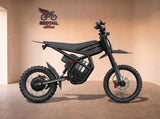
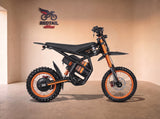
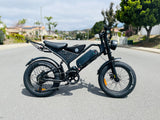
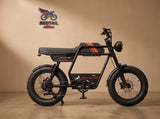


Eahora Romeo Pro 3 review · two hub motors, 2 × 2,800 W peak · 60 V 80 Ah, 4,800 Wh · air fork, rear shock · hydraulic discs, 240 mm rotors · 173 lb, rated for 500 lb · 161 miles at 20 mph on the throttle, 180 lb rider, level pavement, computed · 48–50 mph, outside the e-bike definition in 49 of 51 jurisdictions · $2,999 · verified November 18, 2026
Quick Answer — The Eahora Romeo Pro III is a $2,999 moped-style e-bike with two 2,800 W peak hub motors, a 4,800 Wh battery and suspension at both ends, rated for 500 lb. On level pavement at 20 mph, throttle only, this page's model gives a 180 lb rider 161 miles; Eahora's own figure without pedal assist is 70 to 76 miles.
Eahora's spec block for it differs from the Romeo Ultra II's in 5 of 45 rows (Pro III, Ultra II). On our store it costs $400 less than the Ultra II. Its printed 48 to 50 mph and 5,600 W of peak motor output put it outside the e-bike definition in 49 of 51 US jurisdictions, so read where it can be ridden before you plan a route, then find your height in the fit tables.
Our Romeo Pro III listing asks $2,999 in black, gray or green, the price Eahora's own US checkout charged on November 18, 2026, after its $500 Black Friday Early Deals discount from a $3,499 list price. Prefer gray, green or blue at $3,099? Each link opens checkout with that color, shipped free within the contiguous United States.
Buy the Romeo Pro III, $2,999What this review covers
Specification · Pro III vs Ultra II · What it is · Fit · Motors · Battery · Range · Brakes · Suspension and tires · Weight · Cargo sets · Lights and display · The Mercer fit test · UL · Recalls · Where to ride · Green and red flags · Verdict · Checklist · Buying it from us · FAQ · Limitations · Bottom line · References
How we verified this Eahora Romeo Pro 3 review
Every figure about the bike was read on Eahora's own site, its Romeo Pro III page and product record first, then its comparison, FAQ and warranty pages, and recomputed. Those reads, and our price, listing and policies from our own store, are all dated November 18, 2026.
This Eahora Romeo Pro 3 review uses the name on Eahora's product page, Romeo Pro III; Eahora's own FAQ calls the bike the Pro 3. Range and fit come from models whose inputs are printed beside them, and the law section screens Eahora's figures against each jurisdiction's own definition. The questions answered here come from search suggestions, Search Console, competing pages and an AI-search panel.
We sell the Romeo Pro III, so weigh the red flags as carefully as the green. Part of our e-bike reviews.
Written by Milad Ghobadibeygvand, BScN (Western University, 2014). Corrections: support@redtailebikes.com.
The Eahora Romeo Pro III as Eahora prints it
Four figures carry most of the decision: a 60 V 80 Ah pack, two 2,800 W peak motors, a printed top speed of 48 to 50 mph and a 173 lb curb weight. Eahora describes it as "upgraded to 2 high-torque motors with Peak 5600W power to provide unstoppable journeys for adventurous riders" (its Romeo Pro III page).

The Romeo Pro III from its drive side, Eahora's own studio photograph from its product record, cropped to the bike.
| Eahora's row | Eahora's figure |
|---|---|
| Top Speed | 28+ Mph(48-50mph) for both pedal-assist and throttle |
| Range per Charge | 104 - 235 miles with PAS, or 70 - 76 miles w/o PAS |
| Max Load | ≤ 500 lbs to ensure the performance and safety |
| Rider Height | 5'6" - 6'4", or inseam ≥ 28.7" |
| Bike Weight | 173 lbs with the battery (40.5 lbs) installed |
| Ideal Use | IPX6 weather-proof, off-road / mountain / urban riding |
| Battery Capacity | 4800 Watt·hour (60V 80Ah) |
| Cells Type | Lithium-ion pouch cells, Grade A |
| Battery Lifespan | ≥ 1,200 charge cycles to 80% of capacity |
| Motor Power | 2 x 2,800 Watt Peak |
| Motor Torque | 2 x 100 N·m (max) |
| Motor Type | Dual hub motors, brushless, IPX6 |
| PAS Levels | 5 Levels with Cadence Sensor |
| Throttle Type | 5 Levels twist, slightly delayed response (safe design) |
| Display / Dashboard | 4" color LCD, motors switch, Bluetooth, USB charge port |
| Shifting Gears | Shimano 7s 14-28T, 44T chainring |
| Battery Charger | 67.2V 7A Quick charger, 8-12H charge time |
| Additional Modes | Cruise Control, 6 km/h Walk |
| Brake System | Hydraulic disc brakes with motor cutoff |
| Brake Rotors | 240mm (φ) x 3.0mm (t) steel rotors |
| Brake Caliper/Pads | 4-Piston calipers with semi-metallic pads |
| Bike Frame | High-carbon steel 26" x 18" frame |
| Front Fork | Adjustable air suspension, 100mm travel |
| Shock Absorber | Air suspension with damping, 50mm travel |
| Head Light | 2,500 Lumens (25W) LED with built-in horn |
| Tail Light | LED with integrated brake signal blinker |
| Additinal Reflectors | Pedals, spokes, tires |
| Tire Type | 26" x 4.0" tires with tube (28-33 psi) |
| Saddle | Leather with memory foam, pressure-relief design |
| Handlebar | Aluminum 720mm x 31.8mm (φ, center), rise |
| Bell | Electric horn built-in headlight |
| Crankset | 170mm Aluminum, 44T chainring w/ single-sided cover |
| Pedals | WELLGO "16/9" aluminum alloy platform |
| Derailleur | SHIMANO RD-TY300 7 speed |
| Shifter | SHIMANO ASLTX50R7CT 22.2mm x 2400mm |
| Freewheel / Cassette | SHIMANO MF-TZ500-7 14-28T |
| Rims | 36H aluminum alloy rims |
| Spokes | Black stainless steel 12 Gauge |
| Grips | 120mm x 22.2mm (φ) rubber, ergonomic, anti-slip |
| Seatpost | No Seatpost for motorcycle-style seat |
| Headset | Integrated threadless headset |
| Stem | 31.8mm (φ, handlebar) * 35° A-head |
| Kickstand | Aluminum alloy heavy-duty |
| Racks & Baskset | Optional rear rack, basket |
| Fenders | Included plastic front and rear fenders |
Eahora prints a few of these figures more than one way, and this page shows each version where it changes a decision. The speed row on its Romeo Pro III page reads "28+ Mph(48-50mph) for both pedal-assist and throttle", the stat strip above it "28+MPH", the page's own FAQ "48 mph (pro 3)" for a 150 lb rider, and Eahora's model comparison page "44 - 47 MPH".
The spec block on its Romeo Pro III page calls the motor output "2 x 2,800 Watt Peak", while the motor photograph labels "5600W" as "Sustain" and prints "150Nm × 2" of torque against the spec block's 2 × 100 N·m. The size photograph gives "600 LBS Max Load Capacity" where the spec block says "≤ 500 lbs", and the battery photograph prints "150-250" miles beside the spec block's 104 to 235 with pedal assist.
Where two figures disagree, this page plans on the lower one: 500 lb of load, 200 N·m of torque between the two motors, and range from the model further down, which reads every range figure Eahora prints against the ride that produces it.
Romeo Pro III vs Romeo Pro II or Romeo Ultra II?
Eahora prints the same frame, battery, brake and suspension rows for the Romeo Pro III and the Romeo Ultra II, and the same geometry drawing for both. Of the 45 rows in the two spec blocks, five differ, and every one is in the table below; the Romeo Pro II carries a 3,640 Wh pack (Eahora's comparison page).
| Row | Romeo Pro III | Romeo Ultra II |
|---|---|---|
| Top Speed | 28+ Mph(48-50mph) for both pedal-assist and throttle | 28+ Mph(50mph) for both pedal-assist and throttle |
| Bike Weight | 173 lbs with the battery (40.5 lbs) installed | 174.17 lbs with the battery (40.5 lbs) installed |
| Motor Power | 2 x 2,800 Watt Peak | 2 x 3,000 Watt Peak |
| Motor Torque | 2 x 100 N·m (max) | 2 x 125 N·m (max) |
| Spokes | Black stainless steel 12 Gauge | Black stainless steel 10 Gauge |
| Our price, November 18, 2026 | from $2,999 | from $3,399 |
Asked the Eahora Romeo Pro 3 vs Ultra 2 question on its own FAQ, Eahora answers: "The motors of Ultra 2 are 3000W peak and 120Nm, while the Pro 3 are 2800W peak and 100Nm. That allows a 150 lbs rider to reach 51 mph (ultra 2) and 48 mph (pro 3) on the road." The spec blocks print 125 N·m per motor for the Ultra II, and both sets of figures are Eahora's.
For the same printed 4,800 Wh battery and frame, the Romeo Pro III costs $400 less here than the Ultra II. If the extra 200 W per motor and the 10-gauge spokes are what you are buying, our Romeo Ultra II review walks through that bike; if a lighter price and a 3,640 Wh pack suit your riding, our Romeo Pro II review covers the $2,449 model.
Both are on our store: the Ultra II from $3,399 and the Pro II at $2,449.
What the Romeo Pro III is: a two-motor, long-range moped-style e-bike
The Romeo Pro III is built around one idea: carry a 60 V, 80 Ah battery and two hub motors on a moped-style frame, and keep the pedals. The seat is a fixed, motorcycle-style bench with no seatpost, the tires are 26 × 4.0 in, and Shimano's 7-speed drivetrain turns 170 mm cranks. Other machines in this style sit side by side in our moped-style e-bike guide.

Eahora's front three-quarter of the black Romeo Pro III, from the same record, cropped to the bike; the front motor sits in the hub behind the disc rotor.
Eahora calls the pack "the largest capacity battery from Eahora for 2026" (its Romeo Pro III page), and 60 volts times 80 amp-hours gives the 4,800 Wh it prints. The battery alone weighs 40.5 lb, part of the 173 lb Eahora gives for the whole bike with it installed.
Each wheel carries its own motor, and Eahora's spec block lists a "motors switch" on the 4-inch color display. Five pedal-assist levels read a cadence sensor, the twist throttle has five levels of its own, and the spec block adds cruise control and a 6 km/h walk mode.
Pedaling is the second way to move it, not the first. The bench sits 4 to 13 inches below the saddle height the 109% formula sets for median riders from 5'2" to 6'4" (the fit section), and on public roads your state decides what vehicle it is (where to ride).
The black one ships free within the contiguous United States at $2,999. For a rack and basket already fitted, order the Cargo Set at $3,129 or the Cargo & Bag Set at $3,179, each Eahora's own bundle.
Buy it in black, $2,999Will the Romeo Pro III fit you?
The Romeo Pro III's fixed bench, measured at 33.8 inches on Eahora's drawing, lets 49 of 100 riders at 5'10" and 87 of 100 at 6'0" in the US Army's ANSUR II survey sit with both feet flat; at every height from 5'2" to 6'4" it sits 4.2 to 12.7 inches below the saddle height the 109%-of-inseam formula sets, so your knee stays bent when you pedal.
That 109% is the Hamley method, measured from the pedal; the LeMond method's 88.3%, measured from the crank axle, gives the same saddle, and Peveler et al. (2005) compared both. Eahora fits the Romeo Pro III to riders 5'6" to 6'4", or an inseam of at least 28.7 inches (its spec block). Three steps place you:
- Measure your inseam in socks: stand against a wall, press a hardback book up between your legs, and measure from the floor to the book's top edge.
- Find your height in the stop table and the bench table below; your inseam tells you whether you sit at the short or the long end of your row.
- Plan the ride around the throttle: the bench is fixed, so a bent knee is how this machine pedals, and the motors carry most of the load (the range model).

Eahora's size drawing, shown on its Romeo Pro III page and its Romeo Ultra II page, cropped to the side view: C is the seat height, F the standover and B the 51.6-inch wheelbase. How we computed fit explains which lines the model reads.
Will the bench give your knees a pedaling position?
No rider in the table gets the formula's knee angle from this bench. At 5'10", the median rider's 109% saddle sits 42.5 inches off the ground, and the bench is 8.7 inches lower; Eahora prints a 34.6-inch seat height, and the 33.8 inches here is the seated low point of the bench on its own drawing.
| Your height | Typical inseam | Formula saddle height, median rider | The 33.8 in seat, median rider | Riders it suits, of 100 |
|---|---|---|---|---|
| 5'2" | 28.0–31.1 in | 38.0 in | 4.2 in low | 0 |
| 5'4" | 29.1–32.2 in | 39.0 in | 5.2 in low | 0 |
| 5'6" | 30.2–33.5 in | 40.2 in | 6.4 in low | 0 |
| 5'8" | 31.1–34.3 in | 41.3 in | 7.4 in low | 0 |
| 5'10" | 32.2–35.5 in | 42.5 in | 8.7 in low | 0 |
| 6'0" | 33.2–36.7 in | 43.7 in | 9.9 in low | 0 |
| 6'2" | 34.3–37.5 in | 44.9 in | 11.0 in low | 0 |
| 6'4" | 36.3–39.1 in | 46.6 in | 12.7 in low | 0 |
Bodies come from the US Army's ANSUR II survey. Each inseam range is the middle 90% of its height band, and the formula height is 109% of inseam from the pedal, on the 170 mm cranks Eahora prints, over the crank-axle height measured on its drawing.
Riders suited are those for whom the bench falls between 106% and 110.4% of inseam, the low end of the range Ferrer-Roca and colleagues (2012) compared and the top of the range their equation gives.
On a bench this low, the pedals assist; they do not set your pace. Eahora's five pedal-assist levels read cadence (spec block), so a light spin calls up the motors, and the range model prices every speed for the throttle alone and for two pedaling efforts.
Can you put a foot down at a stop?
Seated, you touch down flat-footed only when your inseam reaches the bench: 3 of 100 riders at 5'6", 12 of 100 at 5'8", 49 at 5'10", 87 at 6'0" and every rider from 6'2". Standing astride the frame ahead of the seat is a different number, and Eahora's 26.4-inch standover clears 100 of 100 riders at every height in the table.
| Your height | Typical inseam | Sit flat-footed at 33.8 in, of 100 | At 26.4 in, of 100 |
|---|---|---|---|
| 5'2" | 29.5 in | 0 | 100 |
| 5'4" | 30.5 in | 0 | 100 |
| 5'6" | 31.7 in | 3 | 100 |
| 5'8" | 32.6 in | 12 | 100 |
| 5'10" | 33.8 in | 49 | 100 |
| 6'0" | 34.9 in | 87 | 100 |
| 6'2" | 36.0 in | 100 | 100 |
| 6'4" | 37.6 in | 100 | 100 |
Flat-footed means the inseam reaches the bench's seated low point, 33.8 inches, in the ANSUR II bodies at each height; standover is Eahora's printed "Standover: 26.4" or 67cm" against the same inseams.
Below 5'10", plan your stops the way moped riders do: slide forward off the bench onto the frame, then put a foot down. A rider at 5'6" sits 2.2 inches short of the ground at the median, so the slide is part of every stop; the Mercer fit test puts names on these rows.
On the fixed bench, half of riders 5'10" tall and nearly all from 6'1" sit flat-footed, and below 5'8" 6 or fewer riders in 100 sit flat-footed, so most stops are a slide forward onto the frame. At every height the pedals turn with a bent knee, so the throttle carries the ride.
Will you feel cramped or stretched?
From 5'6" up, the median rider reaches the grips sitting upright, with the elbows bent 27 to 48 degrees. At 5'2" the median rider leans 3 degrees forward to reach them, and the share who reach upright climbs from 50 of 100 at 5'6" to all 100 at 6'4".
| Your height | Lean from upright, median rider | Riders who reach the grips sitting upright, of 100 | Elbow bend sitting upright, median rider |
|---|---|---|---|
| 5'2" | 3° | 16 | — |
| 5'4" | 2° | 26 | — |
| 5'6" | 0° | 50 | 27° |
| 5'8" | 0° | 69 | 30° |
| 5'10" | 0° | 84 | 34° |
| 6'0" | 0° | 94 | 37° |
| 6'2" | 0° | 98 | 41° |
| 6'4" | 0° | 100 | 48° |
Lean and elbow bend come from the grip position measured on Eahora's drawing and the ANSUR II arm and torso lengths at each height; the range covers sitting anywhere along a 4-inch span of the bench.
How much weight goes through your wrists?
Sitting upright with the back relaxed, the hands carry about 5% of body weight, about 9 pounds between both grips for the median rider at 5'10". Ten male road racers on the brake hoods put 15% of body weight on the stem in a measured study (Carahalios 2015), so this cockpit asks little of your wrists.
| Your height | Share of your weight, back relaxed | Median rider's weight | On each hand |
|---|---|---|---|
| 5'2" | 7% (5–14%) | 139 lb | about 5 lb |
| 5'4" | 6% (5–13%) | 147 lb | about 5 lb |
| 5'6" | 5% (5–12%) | 166 lb | about 4 lb |
| 5'8" | 5% (5–11%) | 179 lb | about 5 lb |
| 5'10" | 5% (5–10%) | 192 lb | about 5 lb |
| 6'0" | 5% (5–9%) | 204 lb | about 5 lb |
| 6'2" | 5% (5–8%) | 216 lb | about 5 lb |
| 6'4" | 5% (5–6%) | 220 lb | about 6 lb |
The share is a ceiling with the back relaxed, computed from the segment weights in Clauser, McConville and Young (1969). The model applies them to the ANSUR II bodies, and a rider who braces against the bars carries more.
How do you set up a fixed bench?
A fixed bench leaves one adjustment: where you sit along it. The bench has no seatpost, so its height is the frame's; sit back to give the knee more room when you pedal, and forward to reach the ground at a stop.
On a seat you can move, the check is the heel method in Peveler et al. (2005): heel on the pedal at its lowest point, leg straight. Cycling studies put the knee bend there at 25 to 35 degrees, as Peveler, Pounders and Bishop (2007) summarize them. On this bench the heel stays short of the low pedal at most heights, the pedaling table's 4 to 13 inches showing up at the cranks.
Email your height and inseam to sales@redtailebikes.com, and the reply will carry your row from this model: the stop, the bench and the reach. Black and green are the same $2,999 (black, green).
Buy it in gray, $2,999How we computed fit
The model is a calculator: published formulas run on 6,068 measured bodies against Eahora's own geometry. Bodies come from the US Army's ANSUR II survey.
The saddle formulas are the Hamley method's 109% of inseam from the pedal and the LeMond method's 88.3% from the crank axle, as Peveler and colleagues (2005) compare them. The fit band runs from 106% to 110.4%, the ends of two ranges in Ferrer-Roca and colleagues (2012). Segment weights come from Clauser, McConville and Young (1969).
| Input | Value | Source |
|---|---|---|
| Bodies | 6,068 measured US Army personnel, aged 17 to 58 | ANSUR II |
| Bench | 33.8 in, the seated low point (Eahora prints 34.6 in) | Eahora's drawing, measured |
| Crank-axle height | 13.3 in (12.9 to 13.6) | Eahora's drawing, measured |
| Cranks | 170 mm | Eahora's spec block |
| Grips | 15.0 to 17.5 in ahead of the crank axle, 28.1 to 30.6 in above it | Eahora's drawing, measured |
| Saddle formulas | 109% of inseam from the pedal; 88.3% from the crank axle | Peveler et al. (2005) |
| Fit band | 106% to 110.4% of inseam | Ferrer-Roca et al. (2012) |
| Segment weights | the head and trunk, upper arm, forearm and hand as shares of body weight | Clauser et al. (1969) |
Worked through for one rider: at 5'10" the median inseam in ANSUR II is 33.8 inches. Hamley's 109% from the pedal is 33.8 × 1.09, about 36.8 inches; less the 6.7-inch crank, the saddle should sit 30.1 inches from the crank axle, and LeMond's 88.3% gives 29.8.
Over the 13.3-inch crank-axle height measured on Eahora's drawing, that is a seat 42.5 inches off the ground, and the bench sits 8.7 inches below it.
Averaged over the survey's 6,068 bodies, LeMond's 88.3% plus the 6.7-inch crank comes to 109.0% of inseam, against the 109.2 ± 0.9% Peveler et al. (2005) measured; the two formulas agree on this machine.
Eahora's drawing was measured, and its printed labels were checked against it. Scaled from its own wheelbase arrow, 51.6 inches, the drawing reproduces three other printed dimensions within 3.5%, the seat height, the standover and the chainstay, which is the bar this model sets before it reads a drawing. Four labels do not match the lines they sit on, and the table prints both.
| Dimension | Eahora lists | Measured on Eahora's drawing | Gap |
|---|---|---|---|
| A total length (Eahora's arrow) | 79.1 in | 73.8 in | −6.7% |
| C seat height (Eahora's arrow) | 34.6 in | 34.8 in | +0.7% |
| D handlebar height (Eahora's arrow) | 45.3 in | 42.1 in | −7.1% |
| E rim diameter (Eahora's arrow) | 24.0 in | 28.5 in | +18.7% |
| F standover (Eahora's arrow) | 26.4 in | 25.8 in | −2.4% |
| G reach distance (Eahora's arrow) | 21.3 in | 16.1 in | −24.2% |
| H chainstay length (Eahora's arrow) | 22.0 in | 22.4 in | +1.8% |
Eahora prints one Size & Geometry block and one drawing, its file named for the Romeo Ultra II, on the Romeo Pro III page and the Ultra II page; the 13 printed rows are identical on both. The model reads the seat, the crank axle and the grips from the drawing at the wheelbase scale.
The motors: two 2,800 W peak hubs, front and rear
Eahora rates each of the two brushless hub motors at 2,800 W peak and 100 N·m, lists them as IPX6, and pairs them with a cadence sensor for the pedal assist. The front and rear wheels each carry a motor, and the 4-inch color display lists a "motors switch" beside its Bluetooth and USB port (spec block).

Cropped from Eahora's side photograph: the rear motor sits in the wheel's hub, beside the 7-speed cassette.
Five pedal-assist levels read a cadence sensor, so the motors respond to the pedals turning, not to how hard you push. The twist throttle has five levels of its own, described on its Romeo Pro III page as "slightly delayed response (safe design)", and Eahora's 70 to 76 miles is printed for riding without pedal assist.
What two motors buy you is traction and climbing torque, and the model prices both. At a steady 10 mph up an 8% grade, the two motors share about 54 N·m at the wheels between them, and the battery supplies about 1,037 W; the hills table shows what that does to range.
Eahora's own figures for the drive come in four wordings: "2 x 2,800 Watt Peak" in the spec block, "PEAK 5600W" on the version selector and "5600W Sustain" on the motor photograph, all on its Romeo Pro III page, and "2,400W Dual Motor" on its comparison page. Its controller photograph prints "36A" and "60V". This page plans on the spec block's peak figure, the one tied to this model's own specification row.
Two-motor machines from several makers are compared in our dual-motor e-bike guide, bikes rated near this output in our 5000W e-bike guide and our 6000W e-bike guide, and the two-motor bikes we stock are in our dual-motor collection.
The battery and charging: 60 V, 80 Ah, 4,800 Wh
Eahora's 60 V 80 Ah pack of Grade A lithium-ion pouch cells holds 4,800 Wh and is rated for at least 1,200 charge cycles to 80% of its capacity. The pack weighs 40.5 lb on its own, and Eahora packs it with "Battery * 1 (2 keys)" (its Romeo Pro III page).
Our guide to e-bike battery types sets pouch cells beside 18650 and 21700 cylinders, and our long-range e-bike guide puts other large batteries side by side.

Cropped from the same photograph: the 60 V, 80 Ah pack sits in the frame's main triangle.
The charger is a 67.2 V, 7 A unit, and Eahora prints an 8 to 12 hour charge (spec block). At 67.2 volts and 7 amps the charger delivers about 470 W, so refilling all 4,800 Wh from empty takes at least 10.2 hours, the upper half of Eahora's window; plan on an overnight charge. Half the pack refills in about 5 hours at the charger's full rate.
Eahora's battery photograph labels the pack "IP65 Waterproof", and the product page's FAQ gives the bike an "IPX6 weather-proof" rating that "withstands light rain/wet roads", with the advice to avoid heavy rain, submerging and pressure washing (its Romeo Pro III page).
Romeo Pro III range: 161 miles at 20 mph for a 180 lb rider, computed
Hold 20 mph on the throttle alone with 180 lb aboard, on level pavement at 77 °F, and the 4,800 Wh pack runs 161 miles, or 121 with a quarter left in reserve. Eahora rates 70 to 76 miles without pedal assist and 104 to 235 with it (spec block); the tables below turn each figure into the speed that produces it.
This section's figures come from published physics run on Eahora's own numbers, so you can redo any of them. Find your ride in three steps:
- Start with the speed you ride and how hard you pedal in the speed tables.
- Then correct for climbing, cargo and winter with the hill table, the weight table and the cold table.
- Read the reserve column for planning: it leaves a quarter of the pack unused at the end of the ride.
Does riding faster cut range?
Yes, and hard: at 30 mph the same 180 lb rider on the throttle covers 98 miles on level pavement, and at 45 mph, 50 miles, because the air's drag grows with the square of speed. The Romeo Pro III's printed top speed puts those rows within reach.
| Speed, flat | Per mile | Full charge | With 25% kept |
|---|---|---|---|
| 10 mph | 18.9 Wh | 254 mi | 191 mi |
| 12 mph | 20.4 Wh | 235 mi | 176 mi |
| 15 mph | 23.3 Wh | 206 mi | 154 mi |
| 20 mph | 29.9 Wh | 161 mi | 121 mi |
| 25 mph | 38.4 Wh | 125 mi | 94 mi |
| 28 mph | 44.6 Wh | 108 mi | 81 mi |
| 30 mph | 49.2 Wh | 98 mi | 73 mi |
| 35 mph | 62.2 Wh | 77 mi | 58 mi |
| 40 mph | 77.8 Wh | 62 mi | 46 mi |
| 45 mph | 96.6 Wh | 50 mi | 37 mi |
Motors only, no pedaling; rider and load 180 lb on a 173 lb bike; flat pavement at 77 °F; tire drag set to the median of ten measured fat tires. The right-hand column holds back 25% of the pack.
| Speed, flat | Throttle only | Easy pedaling (75 W) | Steady pedaling (150 W) |
|---|---|---|---|
| 15 mph | 206 mi | 273 mi | 400 mi |
| 20 mph | 161 mi | 188 mi | 226 mi |
| 25 mph | 125 mi | 137 mi | 152 mi |
| 28 mph | 108 mi | 116 mi | 125 mi |
| 30 mph | 98 mi | 104 mi | 111 mi |
| 35 mph | 77 mi | 81 mi | 84 mi |
| 40 mph | 62 mi | 64 mi | 66 mi |
| 45 mph | 50 mi | 51 mi | 52 mi |
A 180 lb rider plus load, level pavement, 77 °F; the motors make up whatever the rider's watts do not.
What gear saves battery?
On a hub-drive bike the gear sets your legs' cadence, not the motors' speed, so effort saves more battery than any cog. Each motor turns at the wheel's speed whatever gear you choose; what changes the draw is how much of the work your pedaling covers.
| Your ride | Throttle only | Easy pedaling (75 W) | Steady pedaling (150 W) |
|---|---|---|---|
| 15 mph, flat | 23.3 Wh | 17.6 Wh | 12.0 Wh |
| 20 mph, flat | 29.9 Wh | 25.5 Wh | 21.3 Wh |
| 12 mph, 4% grade | 58.5 Wh | 49.5 Wh | 40.9 Wh |
| 12 mph, 8% grade | 104.4 Wh | 93.7 Wh | 83.3 Wh |
Energy per mile in watt-hours from the pack, for 180 lb of rider and load at 77 °F; every climb is ridden at 12 mph.
Does going uphill drain it faster?
Yes: at 10 mph on the throttle, a steady 8% grade costs 107 Wh a mile against 19 Wh on the flat, and the pack covers 45 miles of it. Measured by height instead of distance, climbing on the throttle costs about 187 Wh for every 1,000 feet gained at 4%, and 209 Wh at 8%.
| Grade | Per mile, throttle | Full charge, throttle | Full charge, easy pedaling |
|---|---|---|---|
| 2% | 37 Wh | 128 mi | 175 mi |
| 4% | 58 Wh | 82 mi | 102 mi |
| 6% | 81 Wh | 59 mi | 70 mi |
| 8% | 107 Wh | 45 mi | 51 mi |
| 10% | 135 Wh | 36 mi | 40 mi |
| 12% | 165 Wh | 29 mi | 32 mi |
| 15% | 215 Wh | 22 mi | 24 mi |
Ridden at 10 mph up a steady paved grade, 180 lb of rider and load, 77 °F; the easy-pedaling column adds 75 watts from the legs.
Does rider weight affect range?
Yes, mostly on climbs: at 20 mph on the flat, a 500 lb load covers 126 miles against 161 for 180 lb, while on an 8% climb at 10 mph it covers 20 miles against 45. Every row stays inside the 500 lb Eahora rates the bike to carry.
| You plus your load | 15 mph flat, throttle | 20 mph flat, throttle | 8% climb, 10 mph |
|---|---|---|---|
| 130 lb | 217 mi | 168 mi | 53 mi |
| 180 lb | 206 mi | 161 mi | 45 mi |
| 220 lb | 197 mi | 156 mi | 40 mi |
| 260 lb | 189 mi | 151 mi | 35 mi |
| 330 lb | 177 mi | 143 mi | 29 mi |
| 400 lb | 166 mi | 135 mi | 25 mi |
| 500 lb | 152 mi | 126 mi | 20 mi |
Motors only at 77 °F, on flat pavement or holding 10 mph up an 8% grade; each row's weight counts the rider and everything carried, to Eahora's 500 lb limit.
Does cold weather drain it?
At freezing, the same 15 mph ride on the throttle comes to about 166 miles against 206 at 77 °F, and at 14 °F, about 151. A lithium-ion cell gives up part of its energy in the cold, measured here on Kollmeyer's LG HG2 cell data, and the bracketed figures span that data.
| Air | Pack energy vs 77 °F | 15 mph flat, throttle |
|---|---|---|
| 95 °F | 99% | 213 mi |
| 77 °F | 100% | 206 mi |
| 68 °F | 98% | 196 mi |
| 50 °F | 93% | 178 mi |
| 41 °F | 91% | 171 mi |
| 32 °F | 89% (80–93) | 166 mi (149–174) |
| 14 °F | 82% (40–83) | 151 mi (73–151) |
15 mph on the motors over flat pavement, 180 lb of rider and load, with the cells at the air's temperature; the brackets span the cold-cell data cited, and cold air and stiffer rubber also add drag.
Do the tires cut range?
A little: across ten measured fat tires, the 15 mph throttle ride runs from 191 to 236 miles, with 206 at the median. The model reads the 26 × 4.0 in tires at the median of the ten and brackets them with the lowest and the highest.
| Rolling resistance | 15 mph flat, throttle | 20 mph flat, throttle |
|---|---|---|
| 0.0070 · the lowest of ten fat tires | 236 mi | 179 mi |
| 0.0105 · the median of ten fat tires (used) | 206 mi | 161 mi |
| 0.0126 · the highest of ten fat tires | 191 mi | 152 mi |
Motors only, flat pavement, 77 °F, 180 lb of rider and load; the tire drag comes from drum tests of ten 26 × 4.00 fat tires run at 12 psi.
Is Eahora's range real?
Each of Eahora's figures is a real ride at a particular speed: its 235 miles with pedal assist matches about 12 mph on the motors alone, and its 70 to 76 miles without pedal assist matches a steady 35 to 37 mph on the throttle. Read Eahora's band as a speed band, and pick the row you will ride.
| Eahora's figure | Per mile | Motor only | Easy (75 W) | Steady (150 W) |
|---|---|---|---|---|
| 235 mi, assist (spec block) | 20.4 Wh | 12.1 mph | 16.9 mph | 19.6 mph |
| 104 mi, assist (spec block) | 46.2 Wh | 28.7 mph | 30 mph | 31.2 mph |
| 76 mi, throttle (spec block) | 63.2 Wh | 35.4 mph | 36.3 mph | 37.1 mph |
| 70 mi, throttle (spec block) | 68.6 Wh | 37.2 mph | 38 mph | 38.7 mph |
| 250 mi, mode not printed | 19.2 Wh | 10.5 mph | 16.1 mph | 19 mph |
| 150 mi, mode not printed | 32.0 Wh | 21.4 mph | 23.6 mph | 25.3 mph |
For each range Eahora prints, the table finds the steady flat-pavement speed that would yield it with 180 lb of rider and load at 77 °F, motors alone or with 75 or 150 watts from the pedals.
The "150-250" on Eahora's battery photograph maps the same way: 250 miles is a level ride at about 10.5 mph on the motors alone, and 150 miles about 21.4 mph, both in the table above.
Plan on the column with a quarter kept: 121 miles at 20 mph and 73 at 30 mph on the throttle for a 180 lb rider on level pavement, and fewer on climbs, in the cold and with a heavier load.
Send us your ride: the distance, your speed, your weight and anything you carry, and we will run it through this model. Email sales@redtailebikes.com, or order now: gray costs the same $2,999 as green.
Buy it in green, $2,999How the range figures are computed
The model adds up the power to roll the tires, push the air and climb, then divides by how efficiently the motors and the battery turn stored energy into that power.
The road physics is Martin et al. (1998), reproduced to the watt on their published worked example. The motors take the efficiency shape of a hub motor in Bafang's OEM workbook (2021), rebased to the 60 V, 2,800 W per motor and top speed in Eahora's spec block.
| Input | Value | Source |
|---|---|---|
| Bike | 173 lb with the battery | Eahora's spec block |
| Pack | 4,800 Wh, 60 V × 80 Ah | Eahora's spec block |
| Motors | two hubs, 2,800 W peak each, 50 mph top; a comparable 48 V hub's curve at its 80% efficiency floor, rebased to 60 V | Eahora; Bafang's OEM workbook (2021) |
| Wheel | 28.39 in, measured on Eahora's drawing | Eahora's size drawing |
| Rolling resistance | 0.0105, the median of ten fat tires (0.0070 to 0.0126) | Bicycle Rolling Resistance |
| Drag area | 0.640 m², upright riders | Tengattini and Bigazzi (2018) |
| Air density | 1.184 kg/m³ at 77 °F | US Standard Atmosphere (1976) |
| Chain | 97.7% of the rider's pedal power reaches the wheel | Martin et al. (1998) |
| Battery efficiency | measured on a 48 V pack | Arango, Lopez and Ceren (2021) |
| Reserve | 25% kept | Schmitt, Decker and Doppelbauer (2019) |
| Cold | energy by temperature, LG HG2 cell | Kollmeyer's LG HG2 data |
One ride worked through: at 15 mph on level pavement, a 180 lb rider on the 173 lb bike needs about 111 W to roll the tires and 114 W to push the air, 225 W at the wheels. At 66% motor efficiency and 97% battery efficiency the pack supplies about 350 W, 23.3 Wh a mile, so 4,800 Wh lasts 206 miles, or 154 with a quarter kept.
Eahora's figures read November 18, 2026; the studies as cited in the table.
Brakes: hydraulic discs on 240 mm rotors
Eahora fits hydraulic disc brakes with semi-metallic pads on 240 mm steel rotors 3.0 mm thick, and lists them "with motor cutoff". Its page prints the calipers two ways: "4-Piston calipers with semi-metallic pads" in the spec block and "advanced 2-piston calipers" in the brake panel (its Romeo Pro III page). Ask us which your bike carries before you order, and we will confirm it with Eahora.

Cropped from Eahora's front three-quarter photograph: the front rotor and caliper, with the front motor in the hub behind; Eahora prints 240 mm rotors and hydraulic calipers.
Speed is what the brakes have to absorb, and it grows with the square: stopping from 45 mph takes about five times the energy of stopping from 20 mph. Asked on its own FAQ what makes the bike safe above 45 mph, Eahora answers, "We have enhanced the braking system, suspension system, frame strength, and tire tread patterns" (its Romeo Pro III page).
Pads wear with use, and the checklist below puts a pad and rotor check in your first month of riding.
Suspension and tires: a 100 mm air fork, 26 × 4.0 in rubber
The fork is "Adjustable air suspension, 100mm travel", and the rear shock is "Air suspension with damping, 50mm travel" (spec block). Eahora's suspension photograph labels them an "EAHORA CUSTOM FRONT FORK" and an "ADJUSTABLE REAR SHOCK".
In Eahora's studio photographs of the bike on its Romeo Pro III page, the rear shock carries a coil spring. If the shock's type decides your purchase, email us before you order, and we will confirm it with Eahora.

Cropped from the same photograph: the fork Eahora prints as adjustable air suspension with 100 mm of travel, the headlight between its legs.
The tires are 26 × 4.0 in with inner tubes, run at 28 to 33 psi (spec block), on 36-hole aluminum rims laced with 12-gauge stainless spokes. The Romeo Ultra II's spokes are 10-gauge, one of the five rows where the two spec blocks differ. Our fat-tire e-bike guide covers tires this wide, and our fat-tire collection is the shelf for them.
Weight: 173 lb with the battery, rated for 500 lb
The Romeo Pro III weighs 173 lb with its 40.5 lb battery installed, and Eahora rates it to carry "≤ 500 lbs to ensure the performance and safety". The frame is high-carbon steel, 26 × 18 in, on a heavy-duty aluminum kickstand.
At 173 lb, you move this bike on its wheels. Eahora lists a 6 km/h walk mode among its additional modes (spec block). That is about 3.7 mph, a walking pace.
Plan your load on the 500 lb in the spec block. Eahora's size photograph prints "600 LBS Max Load Capacity", and this page reads the lower of its two figures, so the range table by weight stops at 500 lb. Our guide for heavier riders compares the load ratings of its picks.
The Cargo Set and the Cargo & Bag Set
Eahora sells the Romeo Pro III three ways, and our listing carries all three: the bike alone, the Cargo Set for $130 more, and the Cargo & Bag Set for $180 more. Its own record names the options "Only E-bike", "Cargo Set" and "Cargo & Bag Set", in each of the four colors (its Romeo Pro III page).

Eahora's photograph of the Cargo Set version, scaled evenly: the rear rack and the basket the set adds.

The Cargo & Bag Set adds a green bag to the rack and basket, in Eahora's own photograph, scaled evenly.
Eahora's spec block lists an "Optional rear rack, basket" for the model, and its "Included plastic front and rear fenders" come with every option; the buying table prices each one.
The Cargo Set version ships free at $3,129 in black, gray or green, and $3,229 in blue. The Cargo & Bag Set is $3,179 in black, gray or green, and $3,279 in blue.
Buy with the Cargo Set, $3,129Lights, horn and display
A 2,500-lumen, 25 W LED headlight carries a built-in horn, and the LED tail light has an integrated brake signal blinker (spec block). Reflectors sit on the pedals, the spokes and the tires.

Cropped from the same photograph: the handlebar, with the color display at its center facing the rider.
Eahora names the display the KDS986TFT and says it lets you "view all key riding data, including speed, battery level, mileage"; its spec block adds Bluetooth, a USB charge port and the "motors switch". The display photograph is headed "App Control & Monitoring".
The Mercer fit test
Seven people sit on this bench in turn, the Mercers and the Kowalskis, our editorial cast, and each verdict is read from a published number, a row of the fit model or a statute. For the Romeo Pro III, the fixed bench and the law decide most rows.
| Member | Verdict | The number behind it |
|---|---|---|
| Frank Kowalski, 63, 5'10" | Fits; touches down seated about half the time | Inside Eahora's 5'6" to 6'4" window; 49 of 100 riders at 5'10" sit flat-footed on the 33.8 in bench |
| Ruth Kowalski, 61, 5'5" | Below the window; stops by sliding forward | One inch under Eahora's 5'6" floor; 0 of 100 riders at 5'5" reach the ground seated, all 100 clear the 26.4 in standover |
| Jack Mercer, 48, 6'1" | Fits | Inside the window; 96 of 100 riders at 6'1" sit flat-footed, and the hands carry about 5% of body weight upright |
| Dana Mercer, 45, 5'7" | Fits the frame; loads to 500 lb | Inside the window; 6 of 100 riders at 5'7" sit flat-footed, and rider plus cargo stays inside Eahora's 500 lb |
| Maya Torres, 32, 5'6" | At the floor of the window; her state decides the commute | 3 of 100 riders at 5'6" reach the ground seated; 161 miles at 20 mph on the throttle, 180 lb, level, computed |
| Cole Mercer, 16, 5'11" | Not as an e-bike | Outside the e-bike definition in 49 jurisdictions, it falls under his state's rules for another vehicle class, with that class's own age and license rules (state law table) |
| Ivy Mercer, 12 | No | The same vehicle-class line applies at 12, and we do not recommend it for her |
Ages from the Mercers' profile, heights as each member is cast; shares from this page's fit model on ANSUR II bodies; window and load from Eahora's Romeo Pro III page.
Jack and Ruth sit at the two ends of this bench. At 6'1", 96 riders in 100 his height put both feet down without leaving the seat; at 5'5", Ruth is an inch under Eahora's window and fewer than 1 rider in 100 her height reaches the ground seated, so her stops are a slide forward onto the frame. Above Eahora's 6'4" ceiling, our tall-rider guide lists frames that reach 6'6".
If you stand 5'5" or less, send us your inseam before you order, and the reply will read it against the bench.
Is the Eahora Romeo Pro III UL certified?
By Eahora's account, its batteries "are fully compliant with the rigorous UL certification standards", a line from the answer to "Can I remove the battery and charge it at home?" on its FAQ page. That answer covers Eahora's bikes as a group and names no standard number or certificate for the Romeo Pro III.
If a certificate decides your purchase, for a building's battery rules or an insurer, email us before you order, and we will ask Eahora for the document that names this model and send you what it returns.
Has the Eahora Romeo Pro III been recalled?
No. On November 18, 2026, no recall and no public safety warning in the US Consumer Product Safety Commission's records named Eahora or the Romeo Pro III's SKU stem, LZT1042. All 10,089 of its recall records, all 393 public safety warnings and its recall feed were read for this check.
| Check | Result, November 18, 2026 |
|---|---|
| CPSC recalls, all 10,089, for Eahora, the SKU stem LZT1042 or a Romeo bike | None found |
| CPSC public safety warnings, all 393, for the same | None found |
| CPSC recall feed, October 15 to November 12, 2026 | None found |
Source: the CPSC's recall service and its files, queried November 18, 2026, when the newest recall there carried a November 12 date. As a control, the same queries returned the recalls of Ancheer and Specialized, so a blank for Eahora means the search worked.
Is the Eahora Romeo Pro III street legal? 48–50 mph, two motors and your state
The federal "low-speed electric bicycle" has "an electric motor of less than 750 watts (1 h.p.), whose maximum speed on a paved level surface, when powered solely by such a motor while ridden by an operator who weighs 170 pounds, is less than 20 mph" (15 U.S.C. § 2085). Eahora prints 2 × 2,800 W peak and 48 to 50 mph for the Romeo Pro III (its spec block).
Riding rules are set by each state, so the screen below runs Eahora's printed motor figures, the top of its speed range at 50 mph, a twist throttle and 173 lb against each jurisdiction's own definition:
| Outcome | Jurisdictions | Count |
|---|---|---|
| Qualifies as an electric bicycle | none | 0 |
| Outside the state's e-bike definition | AL, AR, AZ, CA, CO, CT, DC, DE, FL, GA, HI, IA, ID, IL, IN, KS, LA, MA, MD, ME, MI, MN, MO, MS, MT, NC, ND, NE, NH, NJ, NM, NV, NY, OH, OK, OR, PA, RI, SC, SD, TN, TX, UT, VA, VT, WA, WI, WV, WY | 49 |
| No statutory e-bike definition | AK, KY | 2 |
Each jurisdiction's own statutory definition, applied on November 18, 2026, to Eahora's printed 5,600 W between the two motors ("2 x 2,800 Watt Peak" in its spec block, "5600W Sustain" on its motor photograph; its comparison page's "2,400W Dual Motor" gives the same verdict in every row) and to the 50 mph top of its printed range.
This is our reading of each statute and not legal advice; how it applies to you is your state motor vehicle office's call.
California's line shows how far past the watt limit this sits: an "electric bicycle" there has "an electric motor that does not exceed 750 watts of power" (California Vehicle Code § 312.5), and our California page walks through the classes.
Outside the definition, the rider takes on what the e-bike exemption spared. Florida's reads: "An electric bicycle or an operator of an electric bicycle is not subject to the provisions of law relating to financial responsibility, driver or motor vehicle licenses, vehicle registration" (Fla. Stat. § 316.20655), so a machine outside it answers to those provisions instead.
Which vehicle the Romeo Pro III becomes depends on the state's other definitions, with their own license, registration and insurance rules; our Florida page and our Texas page set out what each of those states asks.
Away from public roads, whoever manages the land decides, and on federal land the penalties are federal. On National Forest System land a "Motor vehicle" is "Any vehicle which is self-propelled, other than" a rail vehicle or a mobility device (36 CFR § 212.1). That definition reaches the Romeo Pro III, which is self-propelled.
On Bureau of Land Management (BLM) land an e-bike has "an electric motor of not more than 750 watts (1 h.p.)" (43 CFR § 8340.0-5), so this machine rides there as an off-road vehicle, "any motorized vehicle capable of, or designed for, travel on or immediately over land" (the same section).
| On federal land | Where the Romeo Pro III may go | If it goes where the rules close it |
|---|---|---|
| National Forest System | Roads, trails and areas the forest's motor vehicle use map opens to motor vehicles (36 CFR § 261.13) | Unless another law provides otherwise, "imprisonment of not more than six months or a fine in accordance with the applicable provisions of 18 U.S.C. 3571 or both" (36 CFR § 261.1b) |
| BLM | Areas and trails "designated as open to off-road vehicle use", under your state's off-road vehicle rules (43 CFR § 8341.1) | "a fine of not more than $1,000 or imprisonment for not longer than 12 months, or both" (43 CFR § 8340.0-7) |
Quoted from the eCFR's current text of each federal regulation on November 18, 2026. Section 8340.0-7's penalties apply to the rules in its own subparts, 8341 and 8343.
Before the first ride, find your state's entry in our law table and ask its motor vehicle office how it classes a two-motor, 50 mph bike; on public land, read the forest's motor vehicle use map or the BLM area's designation, and our public-land guide covers both. On private land, the owner's rules decide.
On Eahora's printed figures the Romeo Pro III falls outside the e-bike definition in 49 jurisdictions and meets no definition in Alaska or Kentucky, which have none. On public roads the vehicle class your state assigns decides the license and registration; on forest and BLM land the managers decide which routes are open; on private land the owner decides.
Check your state's class first, then order it in blue at $3,099, or in black, gray or green at $2,999. Questions about where you plan to ride come to us by email, and the reply cites the code.
Buy it in blue, $3,099Green flags / Red flags
Green flags
- A 4,800 Wh pack. 161 miles at 20 mph on the throttle for a 180 lb rider on level pavement, computed, and 121 with a quarter kept (range).
- Two motors at 100 N·m each. At 10 mph up an 8% grade they share about 54 N·m at the wheels, and the pack covers 45 miles of that climb (hills).
- Hydraulic brakes on 240 mm rotors, 3.0 mm thick, listed by Eahora "with motor cutoff" (brakes).
- Suspension at both ends. A 100 mm adjustable air fork and a 50 mm rear shock (suspension).
- Rated for 500 lb of rider and cargo in the spec block, with Eahora's own Cargo Set and Cargo & Bag Set on our listing (load).
- The Romeo Ultra II's printed battery, frame and brakes for $400 less here, with five spec rows between them (the comparison).
Red flags
- 173 lb with the battery. Wrong if the bike must climb stairs to where you keep it; read our folding e-bike guide before you choose.
- A fixed bench at 33.8 inches. Below 5'8", 6 or fewer riders in 100 sit flat-footed at a stop; enter your height in our e-bike finder, or email us your inseam.
- Outside the e-bike definition in 49 jurisdictions. Wrong for a bike-path commute; read our commuter guide for that ride.
- A bent knee when you pedal. Wrong if pedaling is your exercise; read our electric mountain bike guide instead.
The red column is about fit: who this machine is wrong for, and which of our pages to read instead.
Buy it if / Buy something else if
Buy it if you want a 4,800 Wh battery, two motors, suspension at both ends and a machine rated to carry 500 lb, and you will ride where your state's class for it and your land manager's rules allow. At $2,999 here, it carries the Romeo Ultra II's printed battery, frame and brakes for $400 less.
Running it costs little: a full 4,800 Wh charge costs about 87 cents of electricity, and 1,000 miles at 20 mph on the throttle comes to about $5.42 a year, before charger losses. Both figures use the 18.16 cents per kilowatt-hour the US Energy Information Administration reports as the August 2026 residential average (EIA Table 5.6.A).
Buy something else if you need a bike-path e-bike in your state (our commuter guide), a lighter machine to carry (our folding e-bike guide), or more top speed and 125 N·m per motor from the same battery (our Romeo Ultra II review).
Before you buy: the checklist
The first five checks come before you pay: your inseam, your state's class, your storage, your charging and your bundle; the sixth is for the first month of riding. Work through them in order.
- Measure your inseam and read your row in the stop table; under 33.8 inches, plan your stops off the bench.
- Ask your state's motor vehicle office how it classes a two-motor, 50 mph machine, and what license, registration and insurance that class needs (our law table).
- Measure your storage path: 173 lb rolls in on its wheels, so plan a ground-floor space or a ramp.
- Plan charging overnight: the 470 W charger refills the full 4,800 Wh in at least 10.2 hours (battery).
- Choose the bundle at checkout if you carry cargo: the Cargo Set adds $130 and the Cargo & Bag Set $180 (bundles).
- Check pads and rotors in the first month, and keep the fork's air pressure set for your load (brakes, suspension).
Buying it from us
You pay $2,999 here, the price Eahora's own US checkout charged for the black Romeo Pro III on November 18, 2026, after its $500 Black Friday Early Deals discount, and buying here adds the terms below. Warranty claims take one email to support@redtailebikes.com, and Eahora's terms decide what is covered. The rest of Eahora's line on our store is in our Eahora collection.

The blue Romeo Pro III, Eahora's own studio photograph, scaled evenly; blue is $3,099 here.
| What you get | Our terms on November 18, 2026 |
|---|---|
| Who sells it | Redtail Ebikes, the trading name of the Florida corporation named in our terms of service; Eahora makes the Romeo Pro III |
| Questions before you buy | sales@redtailebikes.com; our contact page says "We typically respond to email within one business day" |
| Price | $2,999 in black, gray or green, $3,099 in blue, on our Romeo Pro III listing; the Cargo Set adds $130 and the Cargo & Bag Set $180 |
| Shipping | "free shipping on every electric bike within the contiguous United States", by our shipping policy; P.O. boxes and remote areas may cost extra or be excluded |
| Dispatch and transit | "prepared and dispatched within 1–3 business days of confirmation"; "most e-bikes arrive within 5–10 business days after dispatch" |
| Damage in transit | "email us photos within 48 hours of delivery so we can resolve it", and "we file the carrier claim", by our refund policy |
| Warranty | Eahora's terms, by its warranty page; we open the claim |
| Defective on arrival | "covered under manufacturer warranty — we coordinate repair or replacement remotely", per our refund policy |
| Payment | A credit card, Shop Pay or Google Pay, as our checkout offered them for this bike on November 18, 2026 |
| Your fit | Email your height and inseam, and the reply reads them against this page's tables |
Each term quoted from the page that states it, as published on November 18, 2026; the payment row read from our listing the same day.
Eahora's warranty runs 24 months on the frame; 12 months on the fork, the motors and the battery; 6 months on the controller; and 3 months on the charger, the display, the tires, the saddle and the other parts (the coverage table on its warranty page).
A claim needs proof of purchase and photos or video of the defect, and approved claims get free replacement parts shipped to the continental U.S. (its warranty page). Send your claim to us and we open it with Eahora. The same page closes with "Claims deadline : 1 year from purchase date", so if a frame claim in the second year matters to you, tell us before you order and we will put it to Eahora in writing.
If you change your mind, our refund policy takes the bike back when you ask within 72 hours of delivery and it is still unopened in its factory-sealed packaging; the return costs a 15% restocking fee plus return shipping, and canceling an order costs a 3% transaction fee. How buying from us works walks through delivery day, damage and returns step by step.
It is $2,999 here, the same as Eahora's own checkout charged on November 18, 2026, with the fenders, lights and horn included; gray and green cost the same. Report damage with photos within 48 hours of delivery, and filing the carrier claim falls to us.
Order the black one, $2,999Frequently asked questions
How fast does the Eahora Romeo Pro III go?
For the Eahora Romeo Pro 3 top speed, Eahora's spec block prints "28+ Mph(48-50mph) for both pedal-assist and throttle", and its FAQ gives 48 mph for a 150 lb rider (its Romeo Pro III page). For a 180 lb rider on level pavement, this page's model finds a fastest steady speed of 45.1 mph. At those speeds it falls outside the e-bike definition in 49 of 51 US jurisdictions (where to ride).
How far does the Romeo Pro III go on one charge?
A 180 lb rider on the throttle at 20 mph over level pavement at 77 °F covers 161 miles, computed, or 121 with a quarter of the pack kept; at 30 mph, 98 miles. Eahora rates 70 to 76 miles without pedal assist and 104 to 235 with it (spec block), and the range tables map each figure to its speed.
How much does the Romeo Pro III weigh, and how much can it carry?
Eahora prints 173 lb with the 40.5 lb battery installed, and rates the bike for "≤ 500 lbs to ensure the performance and safety" (spec block). Its size photograph prints 600 lb; this page plans on the spec block's 500 lb, the lower of the two.
Is the Eahora Romeo Pro III street legal?
Not as an e-bike in 49 of the 51 US jurisdictions on November 18, 2026; Alaska and Kentucky have no statutory e-bike definition. Eahora's printed 2 × 2,800 W peak and 48 to 50 mph exceed every state definition, so your state's rules for another vehicle class decide the license, registration and insurance (our law table).
What is the difference between the Romeo Pro III and the Romeo Ultra II?
Five rows in Eahora's two spec blocks (Pro III, Ultra II): the Ultra II prints 2 × 3,000 W peak and 2 × 125 N·m against 2 × 2,800 W and 2 × 100 N·m, "28+ Mph(50mph)" against "(48-50mph)", 174.17 lb against 173, and 10-gauge spokes against 12. The battery, brakes, frame and geometry rows match, and here the Pro III costs $400 less (our Ultra II review).
Should I buy the Romeo Pro III or the Romeo Pro II?
Eahora's comparison page prints the Romeo Pro II with a 3,640 Wh pack, a "1,500W Dual Motor", 41 to 46 mph and 160.94 lb, against 4,800 Wh, "2,400W Dual Motor", 44 to 47 mph and 173 lb for the Pro III (comparison page). Here the Pro II is $2,449 and the Pro III $2,999 (our Pro II review).
Will the Romeo Pro III fit a 5'10" rider?
At 5'10" the median inseam in the Army's ANSUR II survey is 33.8 inches, and the formula saddle for that rider sits 42.5 inches off the ground; the bench, measured at 33.8 inches, is 8.7 inches lower. Seated, 49 of 100 riders that height put both feet flat, and Eahora's window runs 5'6" to 6'4" (fit).
Is the Romeo Pro III a 5,600 W e-bike?
Eahora prints its output four ways: "2 x 2,800 Watt Peak" in the spec block, 5,600 W for the pair, then "PEAK 5600W" on the version selector and "5600W Sustain" on the motor photograph (its Romeo Pro III page), and "2,400W Dual Motor" on its comparison page. This page plans on the spec block's peak figure, and the motor section sets the four side by side.
What battery does the Romeo Pro III have?
A 60 V, 80 Ah pack of Grade A lithium-ion pouch cells holding 4,800 Wh, rated for at least 1,200 charge cycles to 80% of its capacity; the pack weighs 40.5 lb and ships with two keys (spec block). The charger is a 67.2 V, 7 A unit, and the battery section works out the charge time.
How long does the battery take to charge?
At least 10.2 hours from empty: the 67.2 V, 7 A charger delivers about 470 W, and the pack holds 4,800 Wh. Eahora prints an 8 to 12 hour charge time (spec block); a half-empty pack needs about half as long.
What comes with the Cargo Set and the Cargo & Bag Set?
In Eahora's photographs, the Cargo Set adds a rear rack and a wire basket behind the bench, and the Cargo & Bag Set adds a green bag on top of both (its Romeo Pro III page). Here the Cargo Set is $3,129 and the Cargo & Bag Set $3,179 in black, gray or green, and blue adds $100 to either; email us to confirm the exact contents with Eahora.
Is the Romeo Pro III UL certified?
By Eahora's account, its batteries "are fully compliant with the rigorous UL certification standards" (its FAQ page); the line covers Eahora's bikes as a group and names no certificate for this model. Email us, and we will ask Eahora for the document that names the Romeo Pro III.
Has the Eahora Romeo Pro III been recalled?
No. On November 18, 2026, none of the 10,089 recall records and 393 public safety warnings in the CPSC's files named Eahora or the Romeo Pro III's SKU stem, LZT1042; the newest recall in the service is dated November 12 (the three checks).
How much is the Eahora Romeo Pro III?
$2,999 in black, gray or green and $3,099 in blue on our listing on November 18, 2026, the price Eahora's own US checkout charged for the black model that day after its $500 Black Friday Early Deals discount. The Cargo Set adds $130 and the Cargo & Bag Set $180.
Is Eahora a good e-bike brand?
Start with our Eahora brand profile, then read the other Eahora models in our e-bike reviews.
Limitations of this review
The figures on this page are Eahora's published numbers, our store's, the cited studies' and statutes', and what we computed from them; each item below names one place where that method can differ from your ride. Read them before you lean on a figure.
- We sell the Romeo Pro III. Read the red flags as carefully as the green, and weigh every figure by its source.
- The range model assumes steady riding with no stops, cells at air temperature and a calm day; real rides with starts, wind and traffic use more.
- No measured ride of this model with the rider's weight and speed stated was found, so the motors' efficiency rests on a published hub motor's shape, rebased to Eahora's 60 V, 2,800 W per motor and top speed, and bracketed in the model.
- Eahora prints the motors four ways: "2 x 2,800 Watt Peak" in the spec block, "PEAK 5600W" on the version selector, "5600W Sustain" on the motor photograph and "2,400W Dual Motor" on the comparison page, which does not say whether that is per motor or combined. The model uses the spec block's 2,800 W per motor.
- The planning reserve is a study's figure, a quarter of the pack, because Eahora's page prints no reserve for planning.
- The wheel is measured on Eahora's drawing at 28.39 inches; on the drawing's axle-to-axle scale it reads 29.00, and the tire's nominal diameter is 30.01. The wheel size cancels out of the flat-road figures and sets only the torque a climb needs.
- The tires are bracketed by drum tests of ten measured fat tires, because the rolling resistance of this tire is not in any record read.
- Eahora prints some figures more than one way: the speed as "28+ Mph(48-50mph)", "28+MPH", 48 mph and "44 - 47 MPH"; the torque as 2 × 100 N·m and "150Nm × 2"; the load as 500 lb and "600 LBS"; the range as 104 to 235 miles with assist and "150-250". This page plans on the spec block and the lower figure.
- Fit is a calculation on the US Army's ANSUR II bodies, personnel aged 17 to 58 measured in 2010 to 2012, who are not the public; your own inseam decides your row.
- The bench, grips and crank axle are measured on a drawing, the one Eahora prints for the Romeo Pro III and the Romeo Ultra II, scaled from its wheelbase; four of its printed labels do not match their arrows, and the fit model reads the lines.
- The hand figure is a ceiling with the back relaxed, from body-segment weights measured in 1969; a rider who braces against the bars carries more.
- The legal screen reads Eahora's printed figures against each statute; your state's motor vehicle office and your land manager apply the law.
- No UL certificate number for this model was read; the UL line is Eahora's FAQ statement for its batteries as a group.
- Prices and Eahora's $500 discount are as of November 18, 2026, read from our listing and Eahora's own checkout that day.
The bottom line
The Eahora Romeo Pro III is a two-motor, 4,800 Wh moped-style e-bike for riders who want range and load capacity first: 161 miles at 20 mph on the throttle for a 180 lb rider on level pavement, computed, on a frame rated for 500 lb. At $2,999 here, it prints the Romeo Ultra II's battery, frame and brakes for $400 less.
It falls outside the e-bike definition in 49 jurisdictions, half of riders 5'10" tall sit flat-footed on its fixed bench, and it weighs 173 lb. If those three fit your roads, your height and your garage, buy it.
A full charge costs about 87 cents of electricity at the EIA's August 2026 residential average, before charger losses.
Buy it at $2,999 in black, gray or green, or $3,099 in blue, shipped free within the contiguous United States. The fenders, lights and horn come with every order, and a question about your state gets an answer cited to its code before you pay.
Get the Romeo Pro III, $2,999Image credit: the cover's bike is Eahora's own studio photograph of the black Romeo Pro III, scaled evenly and otherwise untouched, with its own shadow. Behind it, the charcoal studio is a Nano Banana Pro render from Playcut, first made for an earlier Redtail cover and reused as it was; the contact shadows and the type are ours. Every image below the cover is Eahora's own file, some of them cropped.
Source register
Each document behind this review, with the tier of its publisher (T1 government records, T2 the maker's own documents, our own policies and the studies, T4 a service credited for an image), what it supports here and the day we read it.
| Source | Tier | What it supports | Date read |
|---|---|---|---|
| 2012 Anthropometric Survey of U.S. Army Personnel (ANSUR II), public data release 2017 | T1 | US Army ANSUR II survey, 6,068 bodies: the inseams, arm and torso lengths behind the fit tables, the Mercer rows and the 5'10" worked rider | September 26, 2026 |
| Peveler W, Bishop P, Smith J, Richardson M, Whitehorn E. Comparing Methods For Setting Saddle Height In Trained Cyclists. JEPonline 8(1):51-55 | T2 | Peveler et al. (2005): Hamley's 109% of inseam from the pedal and LeMond's 88.3% from the crank axle, the heel method, and LeMond's method at 109.2% of inseam from the pedal, give or take 0.9% | September 26, 2026 |
| Peveler, Pounders & Bishop, Effects of saddle height on anaerobic power production in cycling, JSCR 21(4):1023-7 | T2 | Peveler, Pounders and Bishop (2007): the 25 to 35 degree knee angle at the bottom of the stroke that the cycling literature recommends | October 13, 2026 |
| Carahalios A. An Analysis of the Bicycle-Rider Interface Forces in Stationary Road Cycling (MS thesis, Department of Integrative Physiology, University of Colorado) | T2 | Carahalios (2015): ten male road racers put 15% of body weight on the stem on the brake hoods, the reference beside the hand-load paragraph | September 25, 2026 |
| Ferrer-Roca V, Roig A, Galilea P, Garcia-Lopez J. Influence of saddle height on lower limb kinematics in well-trained cyclists: static vs. dynamic evaluation in bike fitting. J Strength Cond Res 26(11):3025-9; doi 10.1519/JSC.0b013e318245c09d | T2 | Ferrer-Roca et al. (2012): the 106% of inseam they compared and the 110.4% their equation gives, the two ends of the fit band | September 25, 2026 |
| Clauser, McConville & Young, Weight, volume, and center of mass of segments of the human body, AMRL-TR-69-70 | T2 | Clauser, McConville and Young (1969): body-segment weights, the share of body weight on the hands with the back relaxed | September 25, 2026 |
| OEM Workbook 2021 | T2 | Bafang's OEM workbook (2021): the comparable hub motor's published curve at its 80% efficiency floor, rebased to Eahora's 60 V and 2,800 W per motor | October 3, 2026 |
| Fat Bike Tires Test Results | T2 | Bicycle Rolling Resistance: ten 26 x 4.00 fat tires measured on a drum at 12 psi, the bracket for the Romeo Pro III's tires | September 25, 2026 |
| Validation of a Mathematical Model for Road Cycling Power (Martin JC, Milliken DL, Cobb JE, McFadden KL, Coggan AR), J Appl Biomech 14(3):276-291 | T2 | Martin et al. (1998): the validated road power model every range figure starts from, its worked example reproduced, and the 97.698% chain efficiency | October 4, 2026 |
| Physical characteristics and resistance parameters of typical urban cyclists (Tengattini S, Bigazzi AY) | T2 | Tengattini and Bigazzi (2018): drag area 0.640 m2 for riders of upright cruiser bicycles, the range model's figure | October 4, 2026 |
| Arango I, Lopez C, Ceren A. Improving the Autonomy of a Mid-Drive Motor Electric Bicycle Based on System Efficiency Maps and Its Performance | T2 | Arango, Lopez and Ceren (2021): battery efficiency measured on a 48 V pack | October 4, 2026 |
| Schmitt M, Decker S, Doppelbauer M. Measuring and Characterization of a Pedal Electric Cycle (Pedelec) on a Full System Test-Bench | T2 | Schmitt, Decker and Doppelbauer (2019): a measured pedelec used 75% of its nominal pack, the page's quarter kept in reserve | October 4, 2026 |
| LG 18650HG2 Li-ion Battery Data | T2 | Kollmeyer's LG HG2 cell data: energy by temperature, the range model's cold rows | October 4, 2026 |
| U.S. Standard Atmosphere, 1976 (NOAA-S/T 76-1562; NASA TM-X-74335) | T1 | US Standard Atmosphere (1976): air density, 1.184 kg/m3 at 77 F | October 4, 2026 |
| Electric Power Monthly, Table 5.6.A. Average Price of Electricity to Ultimate Customers by End-Use Sector | T1 | US EIA Electric Power Monthly Table 5.6.A: residential electricity averaged 18.16 cents per kWh in August 2026, the cost of a full 4,800 Wh charge (about 87 cents) and of 1,000 miles a year at 20 mph on the throttle ($5.42), before charger losses | November 18, 2026 |
| Recall database (saferproducts.gov REST API), query by field | T1 | CPSC recall service, all 10,089 records read November 18, 2026, newest dated November 12, 2026: none names Eahora, the SKU stem LZT1042 or a Romeo bike; a second whole read the same morning agrees | November 18, 2026 |
| Product safety warning listing (CSV) — U.S. Consumer Product Safety Commission | T1 | CPSC product safety warnings, all 393 rows read November 18, 2026: none names Eahora or the Romeo Pro III | November 18, 2026 |
| Recalls RSS feed — U.S. Consumer Product Safety Commission | T1 | CPSC recall feed, 40 items, October 15 to November 12, 2026: none names Eahora or the Romeo Pro III | November 18, 2026 |
| 15 U.S.C. § 2085 — Low-speed electric bicycles | T1 | 15 U.S.C. § 2085: the federal 'low-speed electric bicycle', with 'an electric motor of less than 750 watts (1 h.p.)' and a top speed on the motor alone 'less than 20 mph' | November 18, 2026 |
| California Vehicle Code § 312.5 | T1 | Cal. Veh. Code § 312.5: an 'electric bicycle' has 'an electric motor that does not exceed 750 watts of power', read from the Legislative Counsel's bulk database (republication of November 16, 2026; leginfo's page walls this machine); SB 1167, in force January 1, 2027, keeps the words | November 18, 2026 |
| Florida Statutes § 316.20655 | T1 | Fla. Stat. § 316.20655: 'An electric bicycle or an operator of an electric bicycle is not subject to the provisions of law relating to financial responsibility, driver or motor vehicle licenses, vehicle registration' | November 18, 2026 |
| 36 CFR § 212.1 — Definitions | T1 | 36 CFR § 212.1: on National Forest System land a 'Motor vehicle' is 'Any vehicle which is self-propelled, other than' a rail vehicle or a mobility device | November 18, 2026 |
| 36 CFR § 261.13 — Motor vehicle use | T1 | 36 CFR § 261.13: motor vehicles on National Forest System roads, trails and areas only where the forest's motor vehicle use map designates them | November 18, 2026 |
| 36 CFR § 261.1b — Penalty | T1 | 36 CFR § 261.1b: 'imprisonment of not more than six months or a fine in accordance with the applicable provisions of 18 U.S.C. 3571 or both' | November 18, 2026 |
| 43 CFR § 8340.0-5 — Definitions | T1 | 43 CFR § 8340.0-5: on BLM land an e-bike has 'an electric motor of not more than 750 watts (1 h.p.)', and an off-road vehicle is 'any motorized vehicle capable of, or designed for, travel on or immediately over land' | November 18, 2026 |
| 43 CFR § 8341.1 — Regulations governing use | T1 | 43 CFR § 8341.1: off-road vehicles on areas and trails 'designated as open to off-road vehicle use', under the state's off-road vehicle rules | November 18, 2026 |
| 43 CFR § 8340.0-7 — Penalties | T1 | 43 CFR § 8340.0-7: 'a fine of not more than $1,000 or imprisonment for not longer than 12 months, or both', for the rules of subparts 8341 and 8343 | November 18, 2026 |
| Terms of service | T2 | Our terms of service: the Florida corporation doing business as Redtail Ebikes | November 18, 2026 |
| Contact | T2 | Our contact page: 'We typically respond to email within one business day', with pre-purchase questions to sales@ and orders, damage, warranty and returns to support@ | November 18, 2026 |
| Shipping policy | T2 | Our shipping policy: 'free shipping on every electric bike within the contiguous United States', with P.O. boxes and remote areas excepted, and the dispatch and transit windows | November 18, 2026 |
| Refund policy | T2 | Our refund policy: damage photos 'within 48 hours of delivery', 'we file the carrier claim', defects 'covered under manufacturer warranty', the 72-hour change-of-mind window, the 15% restocking fee and the 3% cancellation fee | November 18, 2026 |
| Eahora Warranty | T2 | Eahora's warranty page: its coverage table (24 months on the frame; 12 on the fork, motors and battery; 6 on the controller; 3 on the charger, display, tires, saddle and other parts) and its claims process (proof of purchase, photos or video, replacement parts shipped free within the continental U.S.) | November 18, 2026 |
| Eahora FAQ | T2 | Eahora's FAQ: its batteries 'are fully compliant with the rigorous UL certification standards', the answer to 'Can I remove the battery and charge it at home?' | November 18, 2026 |
| Playcut | T4 | Playcut (playcut.ai): the image service on which Nano Banana Pro generated the cover's charcoal studio for an earlier cover | November 6, 2026 |
| Eahora, Romeo Pro III listing | T2 | Eahora's Romeo Pro III page: the 45-row spec block, the Size & Geometry block and drawing, the stat strip ('28+MPH'), the feature panels, the FAQ ('48 mph (pro 3)' for a 150 lb rider; 'Ultra 2' against 'Pro 3'), the 'IPX6 weather-proof' answer, the package list and its 22 gallery images; the record's four colors and three Accessories options | November 18, 2026 |
| Eahora, Romeo Ultra II listing | T2 | Eahora's Romeo Ultra II page: its 45-row spec block, compared row by row with the Pro III's (five rows differ) | November 18, 2026 |
| Eahora, model comparison page | T2 | Eahora's model comparison page: the Romeo Pro III's '2,400W Dual Motor' and '44 - 47 MPH', and the Romeo Pro II's 3,640 Wh, '1,500W Dual Motor', 41 to 46 mph and 160.94 lb | November 18, 2026 |
Expiry conditions
This review is re-checked when Eahora changes the Romeo Pro III's motors, battery, top speed or price on its own page, when its $500 checkout discount ends, when a state on our law table changes its e-bike definition, or when the CPSC publishes a record naming this model, and at the latest by May 18, 2027.
References
The same documents, numbered for citation: the publisher, the title, the passage this review relies on, the day it was read and the full web address. For Eahora's own pages, our own policies, the statutes and regulations, the CPSC's records, the EIA table and each study, the issuer is the sole publisher, so each of those rows is cited alone, without a second publisher.
- U.S. Army Natick Soldier Research, Development and Engineering Center, 2012 Anthropometric Survey of U.S. Army Personnel (ANSUR II), public data release 2017. US Army ANSUR II survey, 6,068 bodies: the inseams, arm and torso lengths behind the fit tables, the Mercer rows and the 5'10" worked rider. Retrieved September 26, 2026. https://www.army.mil/article/188601/for_good_measure_natick_releases_raw_data_from_army_wide_anthropometric_survey
- Journal of Exercise Physiology Online (American Society of Exercise Physiologists), Peveler W, Bishop P, Smith J, Richardson M, Whitehorn E. Comparing Methods For Setting Saddle Height In Trained Cyclists. JEPonline 8(1):51-55. Peveler et al. (2005): Hamley's 109% of inseam from the pedal and LeMond's 88.3% from the crank axle, the heel method, and LeMond's method at 109.2% of inseam from the pedal, give or take 0.9%. Retrieved September 26, 2026. https://www.asep.org/asep/asep/JEPonlineFEBRUARY2005_PevelerSaddle.doc
- Journal of Strength and Conditioning Research (NSCA), Peveler, Pounders & Bishop, Effects of saddle height on anaerobic power production in cycling, JSCR 21(4):1023-7. Peveler, Pounders and Bishop (2007): the 25 to 35 degree knee angle at the bottom of the stroke that the cycling literature recommends. Retrieved October 13, 2026. https://pubmed.ncbi.nlm.nih.gov/18076230/
- University of Colorado Boulder (MS thesis), Carahalios A. An Analysis of the Bicycle-Rider Interface Forces in Stationary Road Cycling (MS thesis, Department of Integrative Physiology, University of Colorado). Carahalios (2015): ten male road racers put 15% of body weight on the stem on the brake hoods, the reference beside the hand-load paragraph. Retrieved September 25, 2026. https://scholar.colorado.edu/downloads/70795789x
- Journal of Strength and Conditioning Research (NSCA), Ferrer-Roca V, Roig A, Galilea P, Garcia-Lopez J. Influence of saddle height on lower limb kinematics in well-trained cyclists: static vs. dynamic evaluation in bike fitting. J Strength Cond Res 26(11):3025-9; doi 10.1519/JSC.0b013e318245c09d. Ferrer-Roca et al. (2012): the 106% of inseam they compared and the 110.4% their equation gives, the two ends of the fit band. Retrieved September 25, 2026. https://pubmed.ncbi.nlm.nih.gov/22190163/
- Aerospace Medical Research Laboratory, Wright-Patterson AFB, Clauser, McConville & Young, Weight, volume, and center of mass of segments of the human body, AMRL-TR-69-70. Clauser, McConville and Young (1969): body-segment weights, the share of body weight on the hands with the back relaxed. Retrieved September 25, 2026. https://ntrs.nasa.gov/api/citations/19700027497/downloads/19700027497.pdf
- Bafang, OEM Workbook 2021. Bafang's OEM workbook (2021): the comparable hub motor's published curve at its 80% efficiency floor, rebased to Eahora's 60 V and 2,800 W per motor. Retrieved October 3, 2026. https://www.bafang-e.com/Uploaded/Labels/BAFANG%20Workbook%20OEM%202021.pdf
- Bicycle Rolling Resistance (Jarno Bierman), Fat Bike Tires Test Results. Bicycle Rolling Resistance: ten 26 x 4.00 fat tires measured on a drum at 12 psi, the bracket for the Romeo Pro III's tires. Retrieved September 25, 2026. https://www.bicyclerollingresistance.com/fat-bike-reviews
- Journal of Applied Biomechanics (Human Kinetics), Validation of a Mathematical Model for Road Cycling Power (Martin JC, Milliken DL, Cobb JE, McFadden KL, Coggan AR), J Appl Biomech 14(3):276-291. Martin et al. (1998): the validated road power model every range figure starts from, its worked example reproduced, and the 97.698% chain efficiency. Retrieved October 4, 2026. https://collections.lib.utah.edu/dl_files/b4/8e/b48ef26086091662c561e673d7bd990d77868437.pdf
- Journal of Sports Sciences (Taylor & Francis), Physical characteristics and resistance parameters of typical urban cyclists (Tengattini S, Bigazzi AY). Tengattini and Bigazzi (2018): drag area 0.640 m2 for riders of upright cruiser bicycles, the range model's figure. Retrieved October 4, 2026. https://civil-reactlab.sites.olt.ubc.ca/files/2022/11/Tengattini_2018_Physical-characteristics-and-resistance-parameters-of-typical-urban-cyclists.pdf
- World Electric Vehicle Journal (MDPI), Arango I, Lopez C, Ceren A. Improving the Autonomy of a Mid-Drive Motor Electric Bicycle Based on System Efficiency Maps and Its Performance. Arango, Lopez and Ceren (2021): battery efficiency measured on a 48 V pack. Retrieved October 4, 2026. https://mdpi-res.com/d_attachment/wevj/wevj-12-00059/article_deploy/wevj-12-00059.pdf
- IEEE / EPE'19 ECCE Europe (Karlsruhe Institute of Technology authors), Schmitt M, Decker S, Doppelbauer M. Measuring and Characterization of a Pedal Electric Cycle (Pedelec) on a Full System Test-Bench. Schmitt, Decker and Doppelbauer (2019): a measured pedelec used 75% of its nominal pack, the page's quarter kept in reserve. Retrieved October 4, 2026. https://publikationen.bibliothek.kit.edu/1000100371/50695920
- McMaster University (Kollmeyer et al.), Mendeley Data, LG 18650HG2 Li-ion Battery Data. Kollmeyer's LG HG2 cell data: energy by temperature, the range model's cold rows. Retrieved October 4, 2026. https://doi.org/10.17632/b5mj79w5w9.2
- NOAA, NASA, US Air Force, U.S. Standard Atmosphere, 1976 (NOAA-S/T 76-1562; NASA TM-X-74335). US Standard Atmosphere (1976): air density, 1.184 kg/m3 at 77 F. Retrieved October 4, 2026. https://ntrs.nasa.gov/api/citations/19770009539/downloads/19770009539.pdf
- U.S. Energy Information Administration, Electric Power Monthly, Table 5.6.A. Average Price of Electricity to Ultimate Customers by End-Use Sector. US EIA Electric Power Monthly Table 5.6.A: residential electricity averaged 18.16 cents per kWh in August 2026, the cost of a full 4,800 Wh charge (about 87 cents) and of 1,000 miles a year at 20 mph on the throttle ($5.42), before charger losses. Retrieved November 18, 2026. https://www.eia.gov/electricity/monthly/epm_table_grapher.php?t=epmt_5_06_a
- U.S. Consumer Product Safety Commission, Recall database (saferproducts.gov REST API), query by field. CPSC recall service, all 10,089 records read November 18, 2026, newest dated November 12, 2026: none names Eahora, the SKU stem LZT1042 or a Romeo bike; a second whole read the same morning agrees. Retrieved November 18, 2026. https://www.saferproducts.gov/RestWebServices/Recall
- U.S. Consumer Product Safety Commission, Product safety warning listing (CSV) — U.S. Consumer Product Safety Commission. CPSC product safety warnings, all 393 rows read November 18, 2026: none names Eahora or the Romeo Pro III. Retrieved November 18, 2026. https://www.cpsc.gov/s3fs-public/recall-data/product_safety_warning_listing.csv
- U.S. Consumer Product Safety Commission, Recalls RSS feed — U.S. Consumer Product Safety Commission. CPSC recall feed, 40 items, October 15 to November 12, 2026: none names Eahora or the Romeo Pro III. Retrieved November 18, 2026. https://www.cpsc.gov/Newsroom/CPSC-RSS-Feed/Recalls-RSS
- US Government Publishing Office, 15 U.S.C. § 2085 — Low-speed electric bicycles. 15 U.S.C. § 2085: the federal 'low-speed electric bicycle', with 'an electric motor of less than 750 watts (1 h.p.)' and a top speed on the motor alone 'less than 20 mph'. Retrieved November 18, 2026. https://www.govinfo.gov/content/pkg/USCODE-2024-title15/html/USCODE-2024-title15-chap47-sec2085.htm
- California Legislature, California Vehicle Code § 312.5. Cal. Veh. Code § 312.5: an 'electric bicycle' has 'an electric motor that does not exceed 750 watts of power', read from the Legislative Counsel's bulk database (republication of November 16, 2026; leginfo's page walls this machine); SB 1167, in force January 1, 2027, keeps the words. Retrieved November 18, 2026. https://leginfo.legislature.ca.gov/faces/codes_displaySection.xhtml?lawCode=VEH§ionNum=312.5.
- Florida Legislature, Florida Statutes § 316.20655. Fla. Stat. § 316.20655: 'An electric bicycle or an operator of an electric bicycle is not subject to the provisions of law relating to financial responsibility, driver or motor vehicle licenses, vehicle registration'. Retrieved November 18, 2026. https://www.flsenate.gov/Laws/Statutes/2026/316.20655
- Forest Service, USDA (eCFR), 36 CFR § 212.1 — Definitions. 36 CFR § 212.1: on National Forest System land a 'Motor vehicle' is 'Any vehicle which is self-propelled, other than' a rail vehicle or a mobility device. Retrieved November 18, 2026. https://www.ecfr.gov/current/title-36/chapter-II/part-212/subpart-A/section-212.1
- Forest Service, USDA (eCFR), 36 CFR § 261.13 — Motor vehicle use. 36 CFR § 261.13: motor vehicles on National Forest System roads, trails and areas only where the forest's motor vehicle use map designates them. Retrieved November 18, 2026. https://www.ecfr.gov/current/title-36/chapter-II/subchapter-B/part-261/subpart-A/section-261.13
- Forest Service, USDA (eCFR), 36 CFR § 261.1b — Penalty. 36 CFR § 261.1b: 'imprisonment of not more than six months or a fine in accordance with the applicable provisions of 18 U.S.C. 3571 or both'. Retrieved November 18, 2026. https://www.ecfr.gov/current/title-36/chapter-II/subchapter-B/part-261/subpart-A/section-261.1b
- Bureau of Land Management, Interior (eCFR), 43 CFR § 8340.0-5 — Definitions. 43 CFR § 8340.0-5: on BLM land an e-bike has 'an electric motor of not more than 750 watts (1 h.p.)', and an off-road vehicle is 'any motorized vehicle capable of, or designed for, travel on or immediately over land'. Retrieved November 18, 2026. https://www.ecfr.gov/current/title-43/subtitle-B/chapter-II/subchapter-H/part-8340/subpart-8340/section-8340.0-5
- Bureau of Land Management, Interior (eCFR), 43 CFR § 8341.1 — Regulations governing use. 43 CFR § 8341.1: off-road vehicles on areas and trails 'designated as open to off-road vehicle use', under the state's off-road vehicle rules. Retrieved November 18, 2026. https://www.ecfr.gov/current/title-43/subtitle-B/chapter-II/subchapter-H/part-8340/subpart-8341/section-8341.1
- Bureau of Land Management, Interior (eCFR), 43 CFR § 8340.0-7 — Penalties. 43 CFR § 8340.0-7: 'a fine of not more than $1,000 or imprisonment for not longer than 12 months, or both', for the rules of subparts 8341 and 8343. Retrieved November 18, 2026. https://www.ecfr.gov/current/title-43/subtitle-B/chapter-II/subchapter-H/part-8340/subpart-8340/section-8340.0-7
- Redtail eBikes, Terms of service. Our terms of service: the Florida corporation doing business as Redtail Ebikes. Retrieved November 18, 2026. https://redtailebikes.com/policies/terms-of-service
- Redtail eBikes, Contact. Our contact page: 'We typically respond to email within one business day', with pre-purchase questions to sales@ and orders, damage, warranty and returns to support@. Retrieved November 18, 2026. https://redtailebikes.com/pages/contact
- Redtail eBikes, Shipping policy. Our shipping policy: 'free shipping on every electric bike within the contiguous United States', with P.O. boxes and remote areas excepted, and the dispatch and transit windows. Retrieved November 18, 2026. https://redtailebikes.com/policies/shipping-policy
- Redtail eBikes, Refund policy. Our refund policy: damage photos 'within 48 hours of delivery', 'we file the carrier claim', defects 'covered under manufacturer warranty', the 72-hour change-of-mind window, the 15% restocking fee and the 3% cancellation fee. Retrieved November 18, 2026. https://redtailebikes.com/policies/refund-policy
- Eahora, Eahora Warranty. Eahora's warranty page: its coverage table (24 months on the frame; 12 on the fork, motors and battery; 6 on the controller; 3 on the charger, display, tires, saddle and other parts) and its claims process (proof of purchase, photos or video, replacement parts shipped free within the continental U.S.). Retrieved November 18, 2026. https://www.eahoraebike.com/pages/warranty
- Eahora, Eahora FAQ. Eahora's FAQ: its batteries 'are fully compliant with the rigorous UL certification standards', the answer to 'Can I remove the battery and charge it at home?' Retrieved November 18, 2026. https://www.eahoraebike.com/pages/faq
- Playcut, Playcut. Playcut (playcut.ai): the image service on which Nano Banana Pro generated the cover's charcoal studio for an earlier cover. Retrieved November 6, 2026. https://playcut.ai
- Eahora, Eahora Romeo Pro III Moped-Style Electric Bike. Eahora's Romeo Pro III page: the 45-row spec block, the Size & Geometry block and drawing, the stat strip ('28+MPH'), the feature panels, the FAQ ('48 mph (pro 3)' for a 150 lb rider; 'Ultra 2' against 'Pro 3'), the 'IPX6 weather-proof' answer, the package list and its 22 gallery images; the record's four colors and three Accessories options. Retrieved November 18, 2026. https://www.eahoraebike.com/products/eahora-romeo-pro-iii
- Eahora, Eahora Romeo Ultra II 2026. Eahora's Romeo Ultra II page: its 45-row spec block, compared row by row with the Pro III's (five rows differ). Retrieved November 18, 2026. https://www.eahoraebike.com/products/eahora-romeo-ultra-ii-2026
- Eahora, Comparison of bicycle models. Eahora's model comparison page: the Romeo Pro III's '2,400W Dual Motor' and '44 - 47 MPH', and the Romeo Pro II's 3,640 Wh, '1,500W Dual Motor', 41 to 46 mph and 160.94 lb. Retrieved November 18, 2026. https://www.eahoraebike.com/pages/comparison-of-bicycle-models



Share:
Best Oakland eBike (2026): 15 Picks for Hills and BART
Eunorau T1 Review: A 750 W Recumbent Electric Trike