
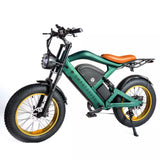

Full suspension electric trike · 750 W front hub, thumb throttle, assist levels 0 to 9 · removable 48 V 16 Ah pack, 768 Wh · 15 mph default, up to 25 mph by DWMEIGI's figure · lockable fork, rear shock, sprung seatpost · reverse gear, rear differential, two parking brakes · 15-inch step · rated to 330 lb · $2,299, DWMEIGI's own US price · verified November 3, 2026
Quick Answer — The DWMEIGI Blazer is a $2,299 full suspension electric trike: lockable fork, rear shock and sprung seatpost, a 15-inch step-through, reverse gear, a 750 W front hub and a 768 Wh battery. Level, at 12 mph on the throttle, it computes to 62 miles for 300 lb of rider, cargo and trike; DWMEIGI rates 45 on pure electric.
It suits a rider who wants a cushioned, upright seat and an easy step for errands and rolling roads: at that 300 lb in all, the throttle holds the 15 mph default up a 6% grade (hills), and DWMEIGI's manual sets 18 as the youngest rider's age (the law).
Our Blazer listing is $2,299 in white, champagne or green, the same price DWMEIGI's own US store showed on November 3, 2026, with all three colors in stock with us that evening. This button checks out the green one; white and champagne are the same trike in another paint. Shipping is free within the contiguous United States.
Buy the green Blazer, $2,299What this review covers
Specification · What it is · Fit · Suspension · Motor and controls · Battery · Range · Reverse, differential and brakes · Baskets · The Mercer fit test · UL · Recalls · Class and law · Green and red flags · Verdict · Checklist · Buying it from us · FAQ · Limitations · Bottom line
How we verified this DWMEIGI Blazer review
Every figure about the Blazer here comes from DWMEIGI's own documents and is then recomputed: its Blazer product page, its product record, its 44-page Blazer manual and its warranty policy, read November 3, 2026, and the Blazer card on its MG708 page, read October 14, 2026. Range and fit are computed from those figures; each table names what it assumes.
We sell this trike, and a seller's review earns a skeptical read: weigh the red flags first. Part of our e-bike reviews.
Written by Milad Ghobadibeygvand, BScN (Western University, 2014). Corrections: support@redtailebikes.com.
The DWMEIGI MG2303 Blazer as DWMEIGI prints it
DWMEIGI's documents agree on the Blazer's motor, pack, tires and suspension, and print two figures for its top speed and its charging time; both are shown. Every row names the document it was read from, on November 3, 2026, unless dated.
| Part | DWMEIGI's figure | Where DWMEIGI prints it |
|---|---|---|
| Motor | "750W Front Brushless Hub", "80N.m torque" | Product page |
| Controller | "48V 22A Controller" | Product page |
| Battery | "Removable 48V 16AH Battery", "sumsang cell": 768 Wh | Product page |
| Top speed | "up to 25MPH speed (15MPH default)" | Product record |
| Top speed, second figure | "Speed: 15MPH" | Blazer card on its MG708 page, October 14 |
| Range | "45 miles under pure electric mode and 65 miles in pedal assisted mode" | Product page |
| Charging | "3A charger for fast charging (4-5 hrs)"; the manual says "about 4-6 hours" | Product page; Blazer manual |
| Charger | "3A AC 100V-240V UL Charger,US" | Product page |
| Throttle and assist | "Thumb Throttle"; "Walking Mode, Pedal Assistant & Thumb Throttle"; assist "from 0 to 9" | Product page; manual |
| Display | "3 Inch LCD Display With USB Port" | Product page |
| Gears | "SHIMANO 7 SPEED SHIFTER" | Product page |
| Suspension | "MOZO lockable hydraulic suspension front forks and seatpost suspension"; "rear frame shock absorber" | Product page; product record |
| Brakes | "180mm front and rear brakes, plus two parking brakes" | Product record |
| Turning | "The clever rear differential" | Product record |
| Reverse, lights, horn | "The riding/reverse gear", "The turn single", "The horn" | Product page |
| Tires | "24 x 2.4-inch fat tires"; Kenda, 24 × 2.4 in, on its Blazer card | Product page; Blazer card |
| Frame | "6061 aluminum alloy", step-through, "stepover to floor height is 15”" | Product page |
| Front basket | "a 5 kilograms weight limit" | Product page |
| Maximum load | "Maximum load capacity = 330lbs." | Blazer manual, page 1 |
| Colors and price | White, Champagne, Green; $2,299, no struck price | Product page |
Quotation marks hold DWMEIGI's own words and spellings. 48 V × 16 Ah = 768 Wh. The 750 W figure is not labeled rated or peak; the hub's casing in DWMEIGI's photograph reads "48V750W".
A full suspension electric trike with a 15-inch step
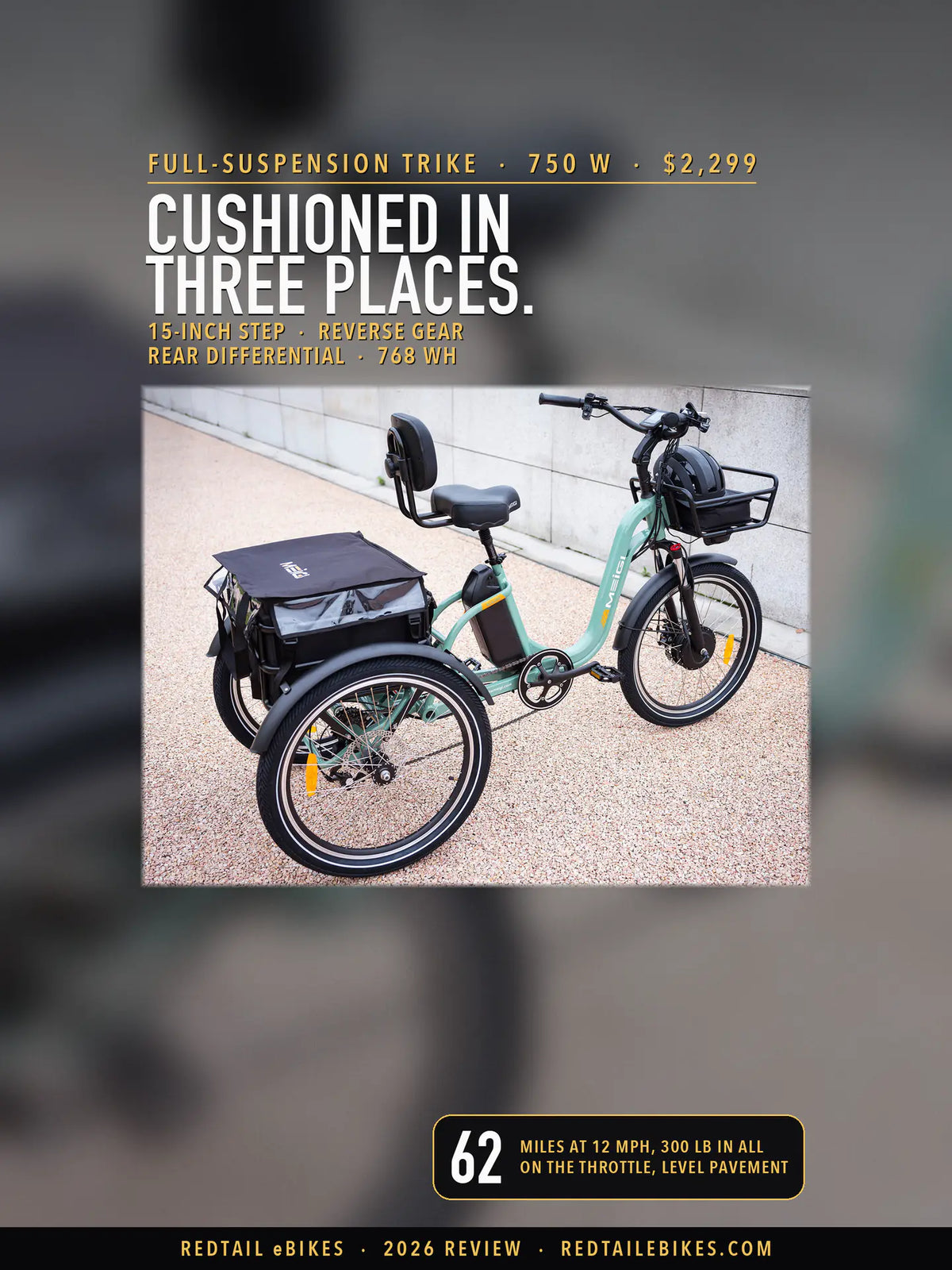
The Blazer is a three-wheel step-through with springs at three points, the fork, a shock in the rear frame and the seatpost, and a backrest saddle on top. If two wheels have started to feel like a balancing act, or a high frame and a stiff ride have kept you off a bike, a trike like this answers both.
The decision here is whether the Blazer's softness, step and range fit your body and your roads.
The step-through sits 15 inches off the floor, in DWMEIGI's words "friendly for women, the elderly and people with knee problems for ride" (product page). Behind the seat rides a rear basket with a waterproof bag; ahead of the bars, a front basket limited to 5 kg.

DWMEIGI sells the Blazer in white, champagne and green; the white one in its studio photograph shows the backrest saddle, the rear basket and bag, and the hub in the front wheel.
The motor sits in the front wheel, the chain drives the rear axle through a Shimano 7-speed, and a differential splits the rear wheels in a turn. The 48 V pack locks into the frame below the saddle and lifts out to charge indoors (product page, product record, manual).
Who it is built for: a rider who wants a soft, upright seat and a low step on paved roads and paths, at a 15 mph default. Read the fit tables for your height before you order the Blazer, and the hill table if your route climbs.
Will the Blazer fit you?
At the Blazer's 15-inch step, 95 of 100 riders 5'4" tall in the US Army's body survey have 14.1 inches or more of clearance, and the saddle belongs at 109% of your inseam from the pedal axle. DWMEIGI prints no seat-height range for the Blazer, so this section gives your saddle target and the check to run on delivery.

The step-through in DWMEIGI's studio photograph: the frame dips to 15 inches between the bars and the backrest saddle.
Find your fit in three steps:
- Stand barefoot against a wall and measure from the floor to your crotch: that is your inseam.
- Find your height row in the saddle table and note the saddle target beside your inseam.
- When the trike arrives, set the saddle with the heel check.
Will the saddle go high enough (or low enough) for me?
Your saddle target is 109% of your inseam, measured from the pedal axle to the top of the saddle: 35.6 inches for the median 5'8" rider. DWMEIGI publishes no seat-height range for the Blazer on its page, its record or its manual, so whether the post reaches your target is a measurement to ask for before you order.
| Your height | Typical inseam | Saddle top to pedal axle | At 106% | At 110.4% |
|---|---|---|---|---|
| 5'0" | 27.1–29.7 in | 31.0 in | 30.2 in | 31.4 in |
| 5'2" | 28.0–31.1 in | 32.2 in | 31.3 in | 32.6 in |
| 5'4" | 29.1–32.2 in | 33.3 in | 32.3 in | 33.7 in |
| 5'6" | 30.2–33.5 in | 34.5 in | 33.6 in | 34.9 in |
| 5'8" | 31.1–34.3 in | 35.6 in | 34.6 in | 36.0 in |
| 5'10" | 32.2–35.5 in | 36.8 in | 35.8 in | 37.3 in |
| 6'0" | 33.2–36.7 in | 38.1 in | 37.0 in | 38.6 in |
| 6'2" | 34.3–37.5 in | 39.3 in | 38.2 in | 39.8 in |
Typical inseam: the middle 90 of 100 bodies of that height in ANSUR II (6,068 US Army personnel, aged 17 to 58, measured 2010 to 2012). The saddle columns are the median body's target at 109% of inseam (Hamley and Thomas), and the two ends of the 106% to 110.4% band. No crank length is published, so the distance runs to the pedal axle, with the pedal at its lowest.
Can I put a foot down at a stop?
Yes for nearly every adult: the Blazer's frame is 15 inches high where you step through, and even at 5'0" 95 of 100 riders clear it by 12.1 inches or more. On a trike the frame height matters for getting on and off, since three wheels hold the machine upright at a stop.
| Your height | Typical inseam | Clearance over the frame |
|---|---|---|
| 5'0" | 28.4 in | 12.1 in or more for 95 of 100 riders |
| 5'2" | 29.5 in | 13.0 in or more for 95 of 100 riders |
| 5'4" | 30.5 in | 14.1 in or more for 95 of 100 riders |
| 5'6" | 31.7 in | 15.2 in or more for 95 of 100 riders |
| 5'8" | 32.6 in | 16.1 in or more for 95 of 100 riders |
| 5'10" | 33.8 in | 17.2 in or more for 95 of 100 riders |
| 6'0" | 34.9 in | 18.2 in or more for 95 of 100 riders |
| 6'2" | 36.0 in | 19.3 in or more for 95 of 100 riders |
Typical inseam is the median body of that height in ANSUR II; the clearance is barefoot inseam minus DWMEIGI's 15-inch stepover, at the fifth percentile of inseam for that height.
Will I feel cramped, or stretched?
This one is measured at home: in its page, record and manual, DWMEIGI publishes no handlebar height, reach or saddle-to-grip distance for the Blazer, so the lean from upright cannot be computed. The photographs show swept-back bars above a backrest saddle, an upright layout.
On delivery, sit back against the backrest and check that your elbows stay slightly bent at the grips; the manual sets the bar "to the comfortable angle" with an adjuster bolt and a quick-release lever on the stem.
How much weight goes through my wrists?
In its page, record and manual, DWMEIGI publishes no grip position for the Blazer, so this page cannot put a number on the weight your hands carry. The backrest and the swept-back bars are the two parts that set it; if your wrists ache on a bike today, sit on the trike with the bar tilted toward you and adjust until your hands rest without pushing.
The one measured hand load we can point to comes from road racing: in a study by Carahalios, ten racers on their brake hoods carried about 15% of their body weight through the stem (Carahalios, 2015). That was a road bike's racing position, not a trike seat with a backrest.
How do I set the saddle when it arrives?
With the pedal at the bottom of its stroke, a 25 to 35 degree bend should stay in your knee; the heel check finds it. Seated, put a heel on the lowest pedal and turn the cranks backward: your leg should be straight with the heel on the pedal, which leaves the bend when you pedal on the ball of your foot.
The manual's own rule for the post: "There's min insert line on the seat post, it must keep in the frame tube" (Blazer manual).
Tell us your height and inseam by email; we enter them in this page's fit model and reply with your saddle height on a Blazer.
Send us your heightHow we computed fit
The saddle target is 109% of inseam from the pedal axle (Hamley and Thomas 1967), the knee target is a 25 to 35 degree bend, the range Peveler and colleagues describe as recommended, and the bodies are the US Army's ANSUR II survey.
In Peveler and colleagues' test of 19 trained cyclists, the 109% formula put 55% of them inside that knee range, LeMond's 88.3% from the crank axle put 65% there, and the heel-toe method 70% (Peveler et al., 2005).
The 106% to 110.4% band spans two ranges that Ferrer-Roca and colleagues report, the recommended 106 to 109% and their own 108.6 to 110.4% (Ferrer-Roca et al., 2012). LeMond's 88.3% of inseam puts the median 5'8" rider's saddle 28.8 inches from the bottom bracket.
| Input | Value | Source |
|---|---|---|
| Stepover height | 15 in | DWMEIGI's product page: "The stepover to floor height is 15”" |
| Seat-height range | Not published | DWMEIGI's page, record and manual, read November 3, 2026 |
| Crank length | Not published | The same three documents |
| Bodies | 6,068 | ANSUR II, US Army, 2010 to 2012 |
| Saddle formula | 109% of inseam from the pedal axle | Hamley and Thomas (1967), via Peveler and colleagues (2005) |
Worked example: the median 5'8" body in the survey has a 32.6-inch inseam; 109% of it is a saddle top 35.6 inches above the pedal axle, and the band runs from 34.6 to 36.0 inches.
Front, rear and seatpost: the Blazer's three suspension points
The Blazer's rider is cushioned in three places: a MOZO lockable hydraulic fork up front, a shock in the rear frame, and a sprung seatpost under a backrest saddle. DWMEIGI names all three in its own documents: the fork and seatpost on its product page, the "rear frame shock absorber" in its product record, and a "Rear Shock Absorber Installation" step in its manual.
Some AI search answers on November 3, 2026, listed only the fork and the seatpost for the Blazer; the rear shock is in DWMEIGI's record and manual, so "full suspension" here means front, rear and seat. The lockout on the fork stiffens it for smooth pavement, and the seatpost spring sits under the saddle you lean back against.

The front fork in DWMEIGI's photograph, the first of the three suspension points, above the front disc brake and fender.
Its tires are 24 x 2.4-inch Kenda, which its product page calls fat tires; at 2.4 inches wide, they give up 1.6 inches to the 4-inch tires of the Addmotor Grandtan X.
What the suspension does for you: softer bumps at the bars, the seat and the rear wheels on cracked pavement and packed trails. If you want 4-inch tires for sand and snow with suspension at both ends, read our Addmotor Grandtan X review, a $2,799 trike with a 960 Wh pack.
A 750 W front hub, a thumb throttle and nine assist levels
The Blazer's 750 W brushless hub sits in the front wheel and DWMEIGI rates it at 80 N·m of torque, fed by a 48 V, 22 A controller. You can ride it three ways, in DWMEIGI's words "Walking Mode, Pedal Assistant & Thumb Throttle": a push-assist that walks the trike at 6 km/h, pedal assist from level 1 to level 9, and a thumb throttle that moves it without pedaling.

The front hub's casing reads "48V750W" in DWMEIGI's photograph, with the front brake's disc beside it.
DWMEIGI's record gives the Blazer a 15 mph default and "up to 25MPH" from the motor (product record). A speed limit is one of the display settings in its manual, which leaves the steps to a separate display guide. At 25 mph the Blazer sits outside every state definition in the class section's screen, so before your first ride, ask us which top speed your trike carries.
The manual's assist scale runs "from 0 to 9": level 0 gives no motor output, level 1 is the least and level 9 the most, and the display starts at level 1. The 3-inch LCD shows speed, trip, battery bars and the assist level, with a USB port beside them.

The 3-inch display carries a USB port; DWMEIGI's manual sets the assist level with its plus and minus buttons.
A front hub pulls the trike by its front wheel, and on a loose or wet climb the grip of that one tire sets the limit. The hill table prices paved grades only. If your route climbs steep gravel, read our Addmotor Grandtan Turbo review before you choose: it covers a $3,299 trike with a 1,000 W mid-drive.
A 48 V, 16 Ah pack: 768 Wh that charges indoors
The Blazer's battery is 48 V and 16 Ah, 768 Wh, built from cells DWMEIGI's page calls "sumsang cell" and its record "Samsung cells", and it lifts out to charge. The manual's sequence: unlock the battery with the ignition key, lift the saddle with the lever under it, and slide the pack out (Blazer manual).

The pack rides in the frame below the saddle and locks in place with a key.
DWMEIGI's page gives "4-5 hrs" on its 3 A charger and the manual "about 4-6 hours"; plan on six. For storage, the manual wants a charge "at least one time per month", and its charger is "designed for indoor use only".
Each full charge is 768 Wh, about 14 cents at the US residential average of 18.16 cents a kilowatt-hour for August 2026 (US Energy Information Administration), before charging losses. Ride 1,000 throttle miles in a year at 12 mph and the model's 12.4 Wh a mile at 300 lb in all comes to about $2.26 in electricity.
Range: 62 miles at 12 mph for 300 lb in all, computed
On the throttle alone at 12 mph on level pavement, with 300 lb of rider, cargo and trike, the Blazer's 768 Wh computes to 62 miles, or 46 once a quarter of the pack is held back. DWMEIGI's page, record and manual give no weight for the Blazer, so every table here is indexed by the total weight you put on the road, the trike included.
Find your ride in three steps: read the speed table at the pace and pedaling you plan; adjust for hills, weight and cold; then plan your trip on the 25% reserve column. Every row stops at the 15 mph default DWMEIGI states.
How far does a full charge take you?
Slower is farther: 72 miles at 10 mph and 49 at 15 mph on the throttle at 300 lb in all on level pavement. Pedaling with 75 watts stretches 15 mph to 81 miles, and at 10 mph your legs carry most of the load.
| Speed | Throttle only | 75 W from your legs | 150 W from your legs | Throttle, 25% kept |
|---|---|---|---|---|
| 6 mph | 91 mi | your legs alone | your legs alone | 68 mi |
| 8 mph | 82 mi | your legs alone | your legs alone | 61 mi |
| 10 mph | 72 mi | 395 mi | your legs alone | 54 mi |
| 12 mph | 62 mi | 155 mi | your legs alone | 46 mi |
| 15 mph | 49 mi | 81 mi | 198 mi | 37 mi |
300 lb total (rider, cargo and trike), level pavement, 77 °F, Kenda 24 x 2.4 tires at the commuter-tire figure, upright riding, no wind, steady speed. "Your legs alone": at that speed your pedaling covers the road's demand and the pack spends nothing; legs alone carry 300 lb at 9.7 mph with 75 W and 13.7 mph with 150 W.
Which gear saves battery on a front hub?
On the Blazer, a shift sets your pedaling cadence and leaves the motor alone: the hub sits in the front wheel and spins with it, so the battery's draw depends on speed, grade and how hard you pedal. Pick the gear that lets you spin comfortably; the table below shows what your pedaling saves at each speed and grade.
| Speed and grade | Throttle only | 75 W from your legs | 150 W from your legs |
|---|---|---|---|
| 8 mph, level | 82 mi | your legs alone | your legs alone |
| 8 mph, 4% grade | 15 mi | 23 mi | 44 mi |
| 8 mph, 8% grade | 6 mi | 8 mi | 12 mi |
| 12 mph, level | 62 mi | 155 mi | your legs alone |
| 12 mph, 4% grade | 15 mi | 19 mi | 26 mi |
| 12 mph, 8% grade | 7 mi | 8 mi | 10 mi |
| 15 mph, level | 49 mi | 81 mi | 198 mi |
| 15 mph, 4% grade | 14 mi | 17 mi | 21 mi |
| 15 mph, 8% grade | beyond the motor | beyond the motor | 9 mi |
300 lb total, 77 °F, the same tires and riding position; each row is a steady ride at that speed held on that grade for the whole pack. "Beyond the motor": the 750 W hub cannot hold that speed on that grade with that pedaling.
Does going uphill drain it faster?
Yes, steeply: at 300 lb in all the Blazer holds its 15 mph default up a 6% grade, slows to 11 mph on 10%, and climbing 1,000 feet at 6 mph costs about 227 Wh on a 4% grade. The table lists, for each grade, the top steady speed the motor can hold and how far the pack goes at it.
| Grade | Fastest steady speed, throttle | Miles at that speed | Fastest, 75 W from your legs | Miles at that speed |
|---|---|---|---|---|
| 2% | 15.0 mph | 23 mi | 15.0 mph | 30 mi |
| 4% | 15.0 mph | 14 mi | 15.0 mph | 17 mi |
| 6% | 15.0 mph | 9 mi | 15.0 mph | 11 mi |
| 8% | 12.9 mph | 7 mi | 14.0 mph | 8 mi |
| 10% | 11.0 mph | 5 mi | 11.9 mph | 6 mi |
| 12% | 9.5 mph | 3 mi | 10.4 mph | 4 mi |
| 15% | 7.8 mph | 2 mi | 8.6 mph | 2 mi |
300 lb total on a steady paved grade, 77 °F; the miles are what the pack gives if the whole charge is spent on that grade.
| Grade | Battery per 1,000 ft climbed at 6 mph, throttle | With 75 W from your legs |
|---|---|---|
| 4% | 227 Wh | 133 Wh |
| 6% | 265 Wh | 175 Wh |
| 8% | 308 Wh | 216 Wh |
| 10% | 359 Wh | 259 Wh |
300 lb total at a steady 6 mph. Raising 300 lb by 1,000 feet needs 113 Wh at the wheel; rolling, air and the motor's losses at a slow, hard pull make up the rest.
Does a heavier load cut the range?
Yes, gently on the flat and sharply on a climb: at 12 mph on level pavement the Blazer goes 67 miles at 250 lb in all and 50 miles at 450 lb. Sum your weight, your cargo and the trike's own weight, which DWMEIGI's documents do not give, and read your row.
| Rider, cargo and trike | 12 mph, level | 12 mph, level, 25% kept | Fastest level speed, throttle | 8 mph, 4% grade |
|---|---|---|---|---|
| 250 lb | 67 mi | 50 mi | 15.0 mph | 18 mi |
| 300 lb | 62 mi | 46 mi | 15.0 mph | 15 mi |
| 350 lb | 57 mi | 43 mi | 15.0 mph | 12 mi |
| 400 lb | 53 mi | 40 mi | 15.0 mph | 10 mi |
| 450 lb | 50 mi | 37 mi | 15.0 mph | 8 mi |
Throttle only, 77 °F. DWMEIGI caps rider and cargo together at 330 lb ("Maximum load capacity = 330lbs.", its manual); the trike's own weight comes on top.
Does cold weather drain it?
Yes: the same 12 mph throttle ride that gives 62 miles at 77 °F gives about 49 at freezing and 44 at 14 °F, because the cells deliver less and the air is denser. In winter, keep the pack inside for charging and storage; DWMEIGI's manual already asks that its charger be used indoors.
| Air temperature | Miles at 12 mph, throttle | Cell-data bracket |
|---|---|---|
| 95 °F | 65 mi | — |
| 77 °F | 62 mi | — |
| 68 °F | 59 mi | — |
| 50 °F | 53 mi | — |
| 41 °F | 50 mi | — |
| 32 °F | 49 mi | 44–51 mi |
| 14 °F | 44 mi | 21–44 mi |
300 lb total, level, the cells at air temperature. The bracket is the spread across published cell data at that temperature; DWMEIGI names no cell model, so the central figure uses a representative 18650 cell.
Do the 24 x 2.4 tires cut range?
A little: at 12 mph the Blazer's range runs from 63 miles on a slick tire to 51 on a tire rolling one standard deviation heavier than the commuter average. DWMEIGI names Kenda as the tire maker and no tread model, so the tables use the measured average for commuter tires.
| Tire case | Rolling resistance | 12 mph, throttle | 15 mph, throttle |
|---|---|---|---|
| slick tires, 137 everyday riders | 0.0070 | 63 mi | 50 mi |
| commuter tires, 273 everyday riders (used) | 0.0074 | 62 mi | 49 mi |
| commuter tires, one standard deviation up | 0.0107 | 51 mi | 42 mi |
300 lb total, level, 77 °F, throttle only. Rolling resistance from Tengattini and Bigazzi (2018), field measurements of everyday riders' tires.
| Riding position | Drag area | 12 mph, throttle | 15 mph, throttle |
|---|---|---|---|
| upright cruiser riders (used) | 0.640 m² | 62 mi | 49 mi |
| everyday mountain-bike riders | 0.603 m² | 64 mi | 51 mi |
The same ride with the drag area of a more forward riding position; a trike's two rear wheels and baskets add frontal area the measured figures do not include.
Is DWMEIGI's range real?
DWMEIGI's 45 miles on pure electric matches a heavier or slightly uphill ride than our central case: at 15 mph on level pavement the model gives 46 miles at 350 lb in all and 44 at 400 lb. At 300 lb the same energy per mile, 17.1 Wh, comes from a steady 15 mph throttle ride up a 0.18% grade.
DWMEIGI's 65 miles in pedal-assisted mode (product page), and the "65 MILES" on its Blazer card, fit an easy ride: at 10 mph the throttle alone reaches 72 miles at 300 lb in all, and at 15 mph about 46 watts from your legs bring the pack to 65 miles. DWMEIGI names a mode for each figure and no speed or weight, so the tables above are the figures to plan with.
AI search answers on November 3, 2026, also credited the Blazer with "25 miles (pure electric) / 35 miles (pedal assist)". Those figures are DWMEIGI's card for its MG708 Hera, which appears in the "Recommend" strip on the Blazer's own product page.
Email sales@redtailebikes.com with your weight, your speed and your route, and we will price that exact ride with this model before you buy. Or order the green Blazer here at $2,299; white and champagne carry the same 768 Wh pack.
Buy the 768 Wh BlazerHow the range figures are computed
Each figure is the battery energy a steady ride takes, from the road power formula of Martin and colleagues (1998), divided by the motor's and battery's efficiency, then divided into the 768 Wh pack. Power at the wheel equals speed times the sum of rolling, gravity and air resistance: P = v·[m·g·(Crr·cos θ + sin θ) + ½·ρ·CdA·v²].
| Input | Value | Source |
|---|---|---|
| Battery | 48 V × 16 Ah = 768 Wh | DWMEIGI's product page |
| Motor | 750 W, 80 N·m, front hub | DWMEIGI's product page |
| Motor shape | Bafang RM G0H0, rated efficiency 80% | Bafang OEM workbook, 2021, a comparable hub; DWMEIGI names no motor maker |
| Wheel | 24.76 in outer diameter | 507 mm bead seat plus twice 2.4 in (Sheldon Brown, tire sizing) |
| Rolling resistance | 0.0074 | Tengattini and Bigazzi, 2018, commuter tires |
| Drag area | 0.640 m² | Tengattini and Bigazzi, 2018, upright riders |
| Air | 1.184 kg/m³ at 77 °F | US Standard Atmosphere, 1976 |
| Battery efficiency | about 97% at this draw | Arango, Lopez and Ceren, 2021 |
| Cold cells | LG HG2 energy by temperature | McMaster University (Kollmeyer) |
| Planning reserve | 25% kept | Schmitt, Decker and Doppelbauer, 2019; DWMEIGI publishes no percentage |
Worked ride: 300 lb is 136.1 kg; at 12 mph (5.36 m/s) rolling takes 53.0 W and air 58.5 W, so the wheel needs 111.5 W.
The hub turns the wheel at 163 rpm with 6.5 N·m, drawing 144.6 W from the pack at 77% motor efficiency and 149.2 W from the cells at 97% battery efficiency. That is 12.4 Wh a mile, and 768 Wh divided by 12.4 Wh a mile gives 62 miles on the throttle over level pavement at 300 lb in all, or 46 with a quarter kept.
The model reproduces Martin and colleagues' published benchmark, 45.7 W of rolling and gravity power on their test ride, and the motor's efficiency at its rated point equals the 80% floor the comparable's maker publishes (Bafang OEM workbook, 2021).
Reverse, a rear differential and a parking brake on each lever
The Blazer backs up under power, splits its rear wheels in a turn, and parks with a brake that stays locked: DWMEIGI lists "The riding/reverse gear" and "The parking brake" on its page and "The clever rear differential" and "two parking brakes" in its record. Reverse backs the trike out of a tight driveway or parking spot under power instead of by hand.
Through a bend the outer rear wheel travels a longer arc than the inner one, and a differential lets it turn faster to match; DWMEIGI's record says it "provide the superior stability and confidence in the corners" (product record). The manual's parts list names a "Reverse&Turning" control and a "Parking Brake Lever".

The rear axle in DWMEIGI's photograph, with the tail lamp above it; the chain drives the axle between the two rear wheels.
DWMEIGI's record gives "180mm front and rear brakes, plus two parking brakes", and its manual's parts list names a disc brake. DWMEIGI's page lists a turn signal and a horn among the Blazer's features ("The turn single", "The horn"), and its photograph shows a tail lamp above the rear axle.
Baskets: 5 kg up front, a covered rear basket
The front basket is rated for 5 kilograms, about 11 lb, and the rear basket carries a waterproof bag; together with you they come under DWMEIGI's 330 lb maximum load. DWMEIGI lists shopping, travel, fishing, camping and pets as the rear basket's uses (product page).

The front basket's label reads MAX 5KG; heavier things belong in the rear basket.
A small dog or a bag of groceries goes in the rear basket, whose weight counts against the 330 lb together with yours. For bigger loads, read our Addmotor Greattan D review, a cargo trike with a 500 lb rating.
The Mercer fit test
The Blazer meets the seven people of our fit test: the Mercers, our editorial cast, a family of fixed heights and ages. Every verdict below rests on a figure DWMEIGI prints or a row of this page's fit and range models.
| Member | Verdict | The number behind it |
|---|---|---|
| Frank Kowalski, 63, 5'10" | Steps in easily; confirm the seat height | 95 of 100 riders at 5'10" clear the 15-inch step by 17.2 inches or more; his saddle target is 36.8 inches from the pedal axle; ask for the seat range before you order |
| Ruth Kowalski, 61, 5'5" | Steps in easily | 95 of 100 riders at 5'5" clear the step by 14.7 inches or more; her saddle target is 33.8 inches |
| Jack Mercer, 48, 6'1" | Steps in; confirm the post reaches him | His target is 38.8 inches from the pedal axle, the highest of the family; ask for the seat range in writing |
| Dana Mercer, 45, 5'7" | Fits the errand run | 15.7 inches or more of clearance for 95 of 100 riders at 5'7"; she and her shopping share the 330 lb limit |
| Maya Torres, 32, 5'6" | Fits at the 15 mph default | Target 34.5 inches; the throttle holds 15 mph up a 6% grade at 300 lb in all |
| Cole Mercer, 16, 5'11" | Not yet | DWMEIGI's manual: "Don't let children under the age of 18 ride the bike." |
| Ivy Mercer, 12, height not used | No | The same manual line; she is six years short of it |
Ages from the Mercers' profile; each height is the one the member is cast at. Fit figures from this page's model at each member's height (ANSUR II bodies); the age line from the Blazer manual.
The sharpest contrast in the family is age: Frank and Ruth, in their sixties, stand at heights where 95 of 100 riders clear the 15-inch step by 14.7 inches or more, while DWMEIGI's own manual puts the Blazer off the table for Cole at 16 and Ivy at 12.
Is the DWMEIGI Blazer UL certified?
Does your building, landlord or city want to see certification papers? Ask us before you order; we will put the request to DWMEIGI in writing. DWMEIGI's page lists the Blazer's charger as a "3A AC 100V-240V UL Charger,US" (product page).
UL 2849 is what UL Solutions calls "the Standard for Electrical Systems for eBikes": a fire safety certification reached "by examining the electrical drive train, battery, and charger system combinations in e-bikes". For the whole system, the certificate to ask for is one that names the MG2303 itself.
Has the DWMEIGI Blazer been recalled?
No. On November 3, 2026, neither a recall nor a public safety warning in the US Consumer Product Safety Commission's records named DWMEIGI, MEIGI or the MG2303. The search ran through all 10,070 of the commission's recall records, its 382 public safety warnings and its recall feed, looking for those three names.
| Check | Result, November 3, 2026 |
|---|---|
| CPSC recalls, all 10,070, for DWMEIGI, MEIGI or MG2303 | None found |
| CPSC public safety warnings, all 382, for the same names | None found |
| CPSC recall feed, October 1 to 29, 2026 | None found |
Searched in the CPSC's own recall service and files; the newest recall in them was dated October 29, 2026. As a check on the empty result, the same search did find the Ancheer and Specialized recalls already on record.
Is the Blazer street legal? 750 W, 15 or 25 mph, three wheels
At its 15 mph default the Blazer sits inside the e-bike definition in 24 states and DC; at DWMEIGI's 25 mph it sits outside every definition that exists. Before you ride, confirm the setting your trike carries and read your state's own page; the table names each one.
| Verdict | At the 15 mph default | At 25 mph |
|---|---|---|
| Inside the definition | 24 states and DC: CA, CO, DC, DE, GA, HI, IA, IN, MA, MD, MI, MN, NC, ND, NE, NM, NV, OK, OR, SC, SD, UT, VA, WA, WI | None |
| Outside the definition | 22 states: AL, AR, AZ, FL, ID, IL, KS, LA, ME, MO, MS, MT, NH, NJ, NY, OH, RI, TN, TX, VT, WV, WY | 49 states and DC |
| Not settled | CT, PA | None |
| No statutory definition | AK, KY | AK, KY |
Screened November 3, 2026, against each jurisdiction's definition: DWMEIGI's 750 W, a thumb throttle, three wheels, at each speed. Not legal advice; your state's page links its statute.
The trap is the 750 W label: in 19 of the 22 states outside at 15 mph, the definition sets the motor at "less than" or "fewer than" 750 watts, which a 750 W rating does not meet.
That holds for every e-bike rated at 750 W, and it is why Texas, Florida, New York and Ohio leave the Blazer outside their definitions (Tex. Transp. Code § 664.001, Fla. Stat. § 316.003, N.Y. VTL § 102-c, Ohio R.C. 4511.01).
The other three: Montana's definition reads "two tandem wheels" (MCA § 61-8-102(7)) and Rhode Island's "a two-wheel (2) vehicle" (R.I. Gen. Laws § 31-1-3), and New Jersey counts a bike whose throttle can propel it on the motor alone as a motorized bicycle under P.L.2025, c.285.
Two more stay open. Connecticut's text leaves a three-wheeler open (C.G.S. § 14-1), and Pennsylvania's caps its pedalcycle at a "vehicle weighing not more than 100 pounds" (75 Pa.C.S. § 102), a line DWMEIGI's documents give no weight to test.
Federal law, for its part, calls a low-speed electric bicycle "a two- or three-wheeled vehicle with fully operable pedals and an electric motor of less than 750 watts (1 h.p.)", with a motor-only top speed under 20 mph (15 U.S.C. § 2085(b)). Neither Alaska's motor vehicle definitions (AS 28.90.990) nor Kentucky's traffic definitions (KRS 189.010) define an e-bike, and our state-by-state guide walks the rest.
On federal land, where the Blazer may go is the land manager's call, and riding off the designated routes carries a criminal penalty. National Forest System rules define a motor vehicle as "Any vehicle which is self-propelled", rail vehicles and mobility devices excepted (36 CFR § 212.1).
| Federal land | Where the Blazer may go | The penalty |
|---|---|---|
| National Forest System | Where the forest's motor vehicle use map designates: "it is prohibited to possess or operate a motor vehicle ... other than in accordance with those designations" (36 CFR § 261.13) | "imprisonment of not more than six months or a fine in accordance with the applicable provisions of 18 U.S.C. 3571 or both" (36 CFR § 261.1b) |
| Bureau of Land Management | Areas and trails "designated as open to off-road vehicle use" (43 CFR § 8341.1), unless it counts as a bicycle there | "a fine of not more than $1,000 or imprisonment for not longer than 12 months, or both" (43 CFR § 8340.0-7) |
Read through the eCFR, current text. Before riding federal land, look up the route on the forest's motor vehicle use map or in the BLM field office's designations.
On BLM land an e-bike counts as a bicycle only on roads and trails "upon which mechanized, non-motorized use is allowed", and only where the authorized officer "has expressly determined" that e-bikes "should be treated the same as non-motorized bicycles" (43 CFR § 8340.0-5(a)(5)). For age, DWMEIGI's manual sets the line at 18 whatever your state allows.
Before your first ride: ask us which top speed your trike is set to, read your state's page in the table above, and on federal land check the route's designation first.
Green flags / Red flags
The Blazer's strengths below come from DWMEIGI's own documents and this page's models, and each red flag names who the trike is not for and where to read next.
Green flags
- Three points of suspension: a MOZO lockable hydraulic fork and a suspension seatpost on DWMEIGI's page, and a rear frame shock absorber in its record.
- A 15-inch step with a backrest saddle above it.
- Reverse gear, a rear differential and two parking brakes for driveways, turns and slopes.
- 768 Wh: 62 computed miles at 12 mph on the throttle at 300 lb in all on level pavement.
- A two-year frame warranty under DWMEIGI's warranty policy.
- The same $2,299 at both stores, read November 3, 2026.
Red flags (who should read another of ours)
- Steep loose climbs: the hub drives the front wheel; read our Grandtan Turbo review for a mid-drive trike.
- Sand, snow and soft trails: its tires are 2.4 inches wide; the Grandtan X review covers a 4-inch-tire trike with suspension at both ends.
- A tight budget for flat errands: our DWMEIGI MG708 Hera review covers a $1,499 trike with the same 15-inch step.
- A trike that folds into a car: the DWMEIGI MG2302 Silverado Urban folds and costs the same $2,299.
- A reclined seat for the back: our Addmotor Freetan M-368X review, a semi-recumbent trike with suspension front and rear.
- Riders under 18: DWMEIGI's manual says no, whatever your state allows; check the age line in the manual of any trike you weigh for a younger rider, and our state-by-state guide for your state's own.
Buy it if / Buy something else if
Buy the Blazer if you want a soft, upright ride and a low step on paved roads, paths and gentle hills, reverse and a differential for tight spots, and 768 Wh for long errands at an easy pace; the electricity for 1,000 miles a year at 12 mph comes to about $2.26.
Buy something else if your route is steep and loose (a mid-drive such as the Addmotor Grandtan Turbo), your trike must fold (the DWMEIGI MG2302 Silverado Urban), or your errands are flat and short and $800 matters (the DWMEIGI MG708 Hera). To see it beside the rest, browse DWMEIGI's collection on our store or the electric trikes we carry.
The white Blazer checks out here; green and champagne carry the same suspension, step and pack. Ask sales@redtailebikes.com for your saddle target and your range row; we typically reply within one business day.
Buy the white Blazer, $2,299Before you buy: the checklist
Seven checks before you order the Blazer, from your inseam and your heaviest load to your steepest climb, your state's rule, and where you will charge and assemble it.
- ☐ Your inseam measured, and your saddle target read from the saddle table.
- ☐ The seat-height range asked for in writing if you are 6'0" or taller.
- ☐ Your heaviest load added up, you plus cargo, under 330 lb.
- ☐ Your steepest climb found in the hill table.
- ☐ Your state's rule read for the setting your trike carries, in the class section.
- ☐ A space to charge indoors, since the charger is for indoor use.
- ☐ A mechanic booked for assembly day if you would rather not build it; our shop directory lists shops by state.
Buying it from us
On November 3, 2026, the Blazer cost $2,299 from us, the same as DWMEIGI's own US store that day; the terms below are quoted from our policies, contact page and listing as they read that evening.
| What you get | Our terms on November 3, 2026 |
|---|---|
| Who sells it | Redtail Ebikes, the business name of the Florida corporation named in our terms of service; DWMEIGI makes the Blazer |
| Questions before you buy | sales@redtailebikes.com, which our contact page lists; "We typically respond to email within one business day" |
| Price | $2,299 on our listing, the same as DWMEIGI's own US store that day |
| Shipping | "free shipping on every electric bike within the contiguous United States", by our shipping policy; Alaska, Hawaii, U.S. territories, P.O. boxes and remote areas "may incur additional charges or be excluded" |
| Dispatch and transit | "prepared and dispatched within 1–3 business days of confirmation"; "most e-bikes arrive within 5–10 business days after dispatch", by our shipping policy |
| Damage in transit | Photos within 48 hours of delivery, and "we file the carrier claim and arrange a replacement or repair", by our refund policy |
| Defective on arrival | "covered under manufacturer warranty — we coordinate repair or replacement remotely", by our refund policy |
| Warranty | DWMEIGI's terms: the frame 2 years, other parts 1 year (limited), consumables including the battery and tires 1 year, by its warranty policy; our terms say "We will help facilitate warranty claims with the manufacturer" |
| Payment | A credit card, Apple Pay or Google Pay at checkout |
| Fit before you pay | Email your height and inseam, and we reply with your row in the fit tables |
Each row as it read on November 3, 2026; words in quotation marks are the linked page's own.
Running costs: 1,000 miles of the 12 mph throttle ride at 300 lb in all on the flat use about 12.4 kWh at 12.4 Wh a mile, about $2.26 a year at the US average residential price of 18.16 cents per kWh, before the charger's own losses.
Returns for a change of mind run on our refund policy: unopened, in the factory packaging, requested within 72 hours of delivery, less a 15% restocking fee and the return shipping. Canceling before it ships carries a 3% transaction fee, because card-processing fees cannot be recovered.
Tell us your weight, your cargo and your steepest street, and we reply with your range row, your hill speed and the setting your trike ships at. One email covers all three.
Ask us before you orderFrequently asked questions
Is the DWMEIGI Blazer a full suspension electric trike?
Yes. It carries a MOZO lockable hydraulic front fork and seatpost suspension, both on DWMEIGI's product page, and a "rear frame shock absorber" in DWMEIGI's product record, with a matching installation step in its manual. That makes three cushioned points: the front wheel, the rear frame and the saddle.
How far can the DWMEIGI Blazer go on one charge?
On the throttle at 12 mph on level pavement, with 300 lb of rider, cargo and trike, the 768 Wh pack computes to 62 miles, or 46 with a quarter kept in reserve. At 15 mph it is 49 miles. DWMEIGI rates 45 miles on pure electric and 65 with pedal assist.
Does the DWMEIGI Blazer have a reverse gear?
Yes. DWMEIGI's product page lists "The riding/reverse gear", and its manual's parts list names a "Reverse&Turning" control on the handlebar. Reverse backs the trike up under power, which helps in a driveway or a tight parking spot where a trike cannot turn in place.
Does the Blazer have a rear differential?
Yes. DWMEIGI's product record lists "The clever rear differential", so in a bend the outer rear wheel can outpace the inner one. Without one, two rear wheels on a solid axle scrub through a turn.
Is the DWMEIGI Blazer good for seniors?
For many, yes: a 15-inch step, a backrest saddle, no foot down at a stop, and two parking brakes to hold it on a slope. Even at 5'0", 95 of 100 bodies in the US Army's survey have an inseam that clears the step by 12.1 inches or more. DWMEIGI's page calls the frame "friendly for women, the elderly and people with knee problems". Ask your doctor whether a trike suits your health.
Can the Blazer climb hills?
On pavement, yes: at 300 lb in all the throttle holds 15 mph up a 6% grade and 11 mph up 10%. DWMEIGI's product page says it will "go over 15° high slope". On loose, steep ground the grip of the front tire, the one the motor drives, sets the limit; our Addmotor Grandtan Turbo review covers a mid-drive trike for that ground.
How fast does the DWMEIGI Blazer go?
DWMEIGI's record says 15 mph by default and "up to 25MPH speed" from the motor, and its Blazer card prints 15 mph. At the 15 mph default it sits inside the e-bike definition in 24 states and DC; at 25 mph it sits outside every state definition that exists.
Is a 750 W electric trike street legal?
Your state and the speed your trike is set to decide it. At the Blazer's 15 mph default it sits inside the definition in 24 states and DC; in 19 states the definition's boundary word, "less than" or "fewer than" 750 watts, leaves a 750 W motor outside. At 25 mph it is outside every state definition.
What is the DWMEIGI Blazer's weight limit?
330 lb, in the words of DWMEIGI's Blazer manual: "Maximum load capacity = 330lbs." That covers you and your cargo together; the front basket on its own is rated for 5 kg, about 11 lb.
How much does the DWMEIGI Blazer weigh?
DWMEIGI does not print a weight for the Blazer on its product page, its product record or its manual. Ask us and we will request the figure from DWMEIGI before you order; the range tables here are indexed by total weight so you can add it in.
How long does the Blazer's battery take to charge?
DWMEIGI's page gives 4 to 5 hours on its 3 A charger, and its manual says about 4 to 6 hours. Plan on six. The pack lifts out with the ignition key to charge indoors.
Can I take my dog on the Blazer?
A small dog can ride in the rear basket; DWMEIGI's product page names pets among its uses, with shopping, travel, fishing and camping. The dog's weight counts against the 330 lb limit with yours, and the front basket's 5 kg rating, about 11 lb, rules it out for any dog heavier than that.
Is the Blazer good for camping or fishing trips?
For gear on paved roads and packed paths, yes: DWMEIGI's product page names fishing and camping among the rear basket's uses, and the 768 Wh pack computes to 62 miles at 12 mph on level pavement with 300 lb of rider, gear and trike. For soft sand, our Addmotor Grandtan X review covers a trike on 4-inch tires.
Does the DWMEIGI Blazer fold?
No; DWMEIGI's documents describe no folding frame for the Blazer. If you need a trike that folds, the DWMEIGI MG2302 Silverado Urban folds and costs the same $2,299.
Does a heavier trike get less range?
Yes. On the throttle at 12 mph on level pavement, the Blazer's 768 Wh computes to 67 miles with 250 lb of rider, cargo and trike, 62 at 300 lb and 50 at 450 lb. On a climb the drop is steeper: at 8 mph up a steady 4% grade it is 18 miles at 250 lb and 8 at 450 lb.
Limitations of this review
This review rests on DWMEIGI's documents and two computed models; the items below name the limits of that basis, so you can weigh every figure on the page with them in mind.
- We sell the Blazer; weigh the red flags above with that in mind.
- Every range figure is computed for steady riding with no stops, wind or loose ground, and the model is not checked against a measured ride of this trike.
- DWMEIGI prints no weight for the Blazer in any document read on November 3, 2026, so the range tables use the total weight on the road, and the trike's share of it is unknown until it is weighed.
- The motor model is a comparable hub's published shape at DWMEIGI's 750 W and 48 V; DWMEIGI names no motor maker.
- The tire figures are measured averages for commuter tires; DWMEIGI names Kenda and no tread.
- The cold rows assume cells at air temperature and use a representative 18650 cell; DWMEIGI names no cell model.
- The planning reserve of 25% is a measured pedelec's figure; DWMEIGI's manual asks you to pedal on when the battery runs low and gives no percentage.
- In its page, record and manual, DWMEIGI publishes no seat-height range, crank length, handlebar height or reach for the Blazer, so the fit section gives saddle targets and clearances, never a verdict on whether the post reaches you, and computes no cockpit lean or grip load.
- The fit bodies are US Army personnel measured 2010 to 2012, and the saddle formula is a starting point.
- The saddle targets aim at the knee range of 25 to 35 degrees that the heel check approximates; your first rides are the final test, and the saddle can be moved after them.
- DWMEIGI prints two top speeds, a 15 mph default and up to 25 mph, and two charging times, 4 to 5 hours and about 4 to 6; both are shown.
- A "User Manual MG2303" on another store's site gives 300 lb as the load; DWMEIGI's own manual gives 330 lb, which this page uses.
- The legal screen reads each state's definition on November 3, 2026; laws change, and your state's page has the current text.
- DWMEIGI's page, record and manual give no travel figure for the fork or the rear shock, so the suspension section names its parts and never how far they move.
The bottom line
The DWMEIGI MG2303 Blazer is a $2,299 full suspension electric trike with a 15-inch step, reverse, a rear differential and a 768 Wh pack. Ridden on the throttle at 12 mph over level pavement with 300 lb in all, it computes to 62 miles, and a year of 1,000 such miles costs about $2.26 in electricity.
Buy it for comfortable, upright riding on pavement and gentle hills, over a 15-inch step DWMEIGI's page calls friendly for people with knee problems; riders who face steep loose climbs or need a folding frame have a closer match in another of ours, and DWMEIGI's manual sets the Blazer's age line at 18.
Order the green Blazer at $2,299, shipped free within the contiguous United States, or choose white or champagne. Questions first? sales@redtailebikes.com answers before you pay.
Buy it, shipped freeSource register
Each document behind this review, with the tier of its publisher (T1 government records, T2 the maker's own documents, our own policies and the studies, T3 reference works), what it supports here and the day we read it.
| Source | Tier | What it supports | Date read |
|---|---|---|---|
| 2012 Anthropometric Survey of U.S. Army Personnel (ANSUR II), public data release 2017 | T1 | US Army ANSUR II survey, 6,068 bodies aged 17 to 58, measured 2010 to 2012: the inseams behind the saddle and clearance tables, the FAQ's 5'0" figure and the Mercer rows | September 26, 2026 |
| Peveler W, Bishop P, Smith J, Richardson M, Whitehorn E. Comparing Methods For Setting Saddle Height In Trained Cyclists. JEPonline 8(1):51-55 | T2 | Peveler et al. (2005), 19 trained cyclists: the 109% (Hamley) formula put 55% inside the recommended 25 to 35 degree knee range, LeMond's 88.3% from the crank axle 65% and the heel-toe method 70% | September 26, 2026 |
| Ferrer-Roca V, Roig A, Galilea P, Garcia-Lopez J. Influence of saddle height on lower limb kinematics in well-trained cyclists: static vs. dynamic evaluation in bike fitting. J Strength Cond Res 26(11):3025-9; doi 10.1519/JSC.0b013e318245c09d | T2 | Ferrer-Roca et al. (2012): the recommended 106 to 109% of inseam and their own 108.6 to 110.4%, the two ranges the page's 106% to 110.4% band spans | September 25, 2026 |
| Carahalios A. An Analysis of the Bicycle-Rider Interface Forces in Stationary Road Cycling (MS thesis, Department of Integrative Physiology, University of Colorado) | T2 | Carahalios (2015): about 15% of body weight through the stem for ten road racers on the brake hoods, the one measured hand load the page cites | September 25, 2026 |
| Validation of a Mathematical Model for Road Cycling Power (Martin JC, Milliken DL, Cobb JE, McFadden KL, Coggan AR), J Appl Biomech 14(3):276-291 | T2 | Martin et al. (1998): the road-cycling power equation behind every range figure, and its Appendix I benchmark (45.7 W rolling and climbing) the model reproduces | October 4, 2026 |
| Physical characteristics and resistance parameters of typical urban cyclists (Tengattini S, Bigazzi AY) | T2 | Tengattini and Bigazzi (2018): rolling resistance for commuter tires (0.0074, SD 0.0033) and slick tires, and the upright riders' drag area (0.640 m2) behind the range tables | October 4, 2026 |
| Arango I, Lopez C, Ceren A. Improving the Autonomy of a Mid-Drive Motor Electric Bicycle Based on System Efficiency Maps and Its Performance | T2 | Arango, Lopez and Ceren (2021): the battery-efficiency equation, about 97% at the Blazer's 12 mph draw | October 4, 2026 |
| Schmitt M, Decker S, Doppelbauer M. Measuring and Characterization of a Pedal Electric Cycle (Pedelec) on a Full System Test-Bench | T2 | Schmitt, Decker and Doppelbauer (2019): a measured pedelec used 75% of its nominal pack, the 25% planning reserve | October 4, 2026 |
| LG 18650HG2 Li-ion Battery Data | T2 | LG HG2 18650 cell data (Kollmeyer, McMaster University): energy by temperature behind the cold table | October 4, 2026 |
| U.S. Standard Atmosphere, 1976 (NOAA-S/T 76-1562; NASA TM-X-74335) | T1 | U.S. Standard Atmosphere, 1976: air density by temperature (1.184 kg per cubic meter at 77 F) | October 4, 2026 |
| OEM Workbook 2021 | T2 | Bafang's OEM workbook (2021): the comparable hub motor's no-load and rated speeds and its 80% efficiency floor, the motor shape rebased to DWMEIGI's 750 W and 48 V | October 3, 2026 |
| Tire Sizing Systems | T3 | Sheldon Brown's tire sizing table: the 507 mm bead seat of a decimal 24-inch tire, behind the 24.76 in wheel | September 28, 2026 |
| Electric Power Monthly, Table 5.6.A. Average Price of Electricity to Ultimate Customers by End-Use Sector | T1 | US EIA Electric Power Monthly Table 5.6.A: the August 2026 US residential average, 18.16 cents per kilowatt-hour, behind about 14 cents a charge and $2.26 per 1,000 miles | November 4, 2026 |
| 15 U.S.C. § 2085 — Low-speed electric bicycles | T1 | 15 U.S.C. § 2085(b): a low-speed electric bicycle is 'a two- or three-wheeled vehicle with fully operable pedals and an electric motor of less than 750 watts (1 h.p.)', under 20 mph on the motor alone | November 4, 2026 |
| Tex. Transp. Code § 664.001 | T1 | Tex. Transp. Code § 664.001: Texas's electric bicycle, whose motor is rated 'fewer than' 750 watts | October 16, 2026 |
| Fla. Stat. § 316.003(23) | T1 | Fla. Stat. § 316.003: Florida's electric bicycle, whose motor is rated 'less than' 750 watts | October 30, 2026 |
| N.Y. VTL § 102-c | T1 | N.Y. VTL § 102-c: New York's bicycle with electric assist, whose motor is 'less than' 750 watts | October 30, 2026 |
| R.C. 4511.01(SSS)-(VVV) | T1 | Ohio R.C. 4511.01: Ohio's electric bicycle classes, each with 'an electric motor of less than seven hundred fifty watts' | October 30, 2026 |
| Montana Code Annotated 61-8-102, Uniform Operation of Vehicles — definitions | T1 | MCA § 61-8-102(7): Montana's 'two tandem wheels' | October 25, 2026 |
| R.I. Gen. Laws § 31-1-3 | T1 | R.I. Gen. Laws § 31-1-3: Rhode Island's 'a two-wheel (2) vehicle' | November 3, 2026 |
| P.L.2025, c.285 (S4834) | T1 | New Jersey P.L.2025, c.285: a bicycle whose motor moves it without pedaling is a motorized bicycle | October 30, 2026 |
| C.G.S. § 14-1 — Definitions (chapter 246) | T1 | C.G.S. § 14-1: Connecticut's definitions, whose electric bicycle leaves a three-wheeler open | October 19, 2026 |
| 75 Pa.C.S. § 102, Definitions | T1 | 75 Pa.C.S. § 102: Pennsylvania's pedalcycle with electric assist, a 'vehicle weighing not more than 100 pounds' | November 2, 2026 |
| Alaska Statutes § 28.90.990 | T1 | AS 28.90.990: Alaska's motor vehicle definitions, with no e-bike definition | October 25, 2026 |
| Kentucky Revised Statutes § 189.010 | T1 | KRS 189.010: Kentucky's traffic definitions, with no e-bike definition | October 25, 2026 |
| 36 CFR § 212.1 — Definitions | T1 | 36 CFR § 212.1: on National Forest System land a motor vehicle is 'Any vehicle which is self-propelled', rail vehicles and mobility devices aside | November 4, 2026 |
| 36 CFR § 261.13 — Motor vehicle use | T1 | 36 CFR § 261.13: 'it is prohibited to possess or operate a motor vehicle ... other than in accordance with those designations' | November 4, 2026 |
| 36 CFR § 261.1b — Penalty | T1 | 36 CFR § 261.1b: 'imprisonment of not more than six months or a fine in accordance with the applicable provisions of 18 U.S.C. 3571 or both' | November 4, 2026 |
| 43 CFR § 8341.1 — Regulations governing use | T1 | 43 CFR § 8341.1: off-road vehicles on BLM land in areas and trails 'designated as open to off-road vehicle use' | November 4, 2026 |
| 43 CFR § 8340.0-7 — Penalties | T1 | 43 CFR § 8340.0-7: 'a fine of not more than $1,000 or imprisonment for not longer than 12 months, or both' | November 4, 2026 |
| 43 CFR part 8340, Off-Road Vehicles | T1 | 43 CFR § 8340.0-5(a)(5): an e-bike is treated as a bicycle only on routes 'upon which mechanized, non-motorized use is allowed' where the authorized officer 'has expressly determined' so | November 4, 2026 |
| Recall database (saferproducts.gov REST API), query by field | T1 | CPSC recall service: all 10,070 recall records read November 3, 2026, none naming DWMEIGI, MEIGI or the MG2303 (Ancheer and Specialized controls found) | November 4, 2026 |
| Product safety warning listing (CSV) — U.S. Consumer Product Safety Commission | T1 | CPSC product safety warnings file: all 382 rows read November 3, 2026, none naming DWMEIGI, MEIGI or the MG2303 | November 4, 2026 |
| Recalls RSS feed — U.S. Consumer Product Safety Commission | T1 | CPSC recall feed, October 1 to 29, 2026: no item naming DWMEIGI or the MG2303 | November 4, 2026 |
| E-Bikes Certification: Evaluating and Testing to UL 2849 | T3 | UL Solutions: UL 2849, 'the Standard for Electrical Systems for eBikes', examining 'the electrical drive train, battery, and charger system combinations' | November 4, 2026 |
| Warranty Policy | T2 | DWMEIGI's warranty policy: the frame 2 years, all other parts 1 year limited, consumables including batteries and tires 1 year | November 4, 2026 |
| MG2303-BLAZER FULL SUSPENSION ELECTRIC TRIKE | T2 | DWMEIGI's Blazer product page: '750W Front Brushless Hub', 80 N.m torque, '48V 22A Controller', 'Removable 48V 16AH Battery', '45 miles under pure electric mode and 65 miles in pedal assisted mode', '3A charger for fast charging (4-5 hrs)', the MOZO lockable fork and seatpost suspension, the reverse gear, parking brake, turn signals and horn, 24 x 2.4-inch tires, the 15-inch stepover, the 5 kg front basket, $2,299 in White, Champagne and Green; and the MG708 Hera card in its Recommend strip | November 4, 2026 |
| Hera (MG708) product page | T2 | DWMEIGI's Blazer card on its MG708 page (read October 14, 2026): 'Motor: 750W 80N.M', 'Battery: 48V 16AH SUMSANG', 'Speed: 15MPH', 'Tire: KENDA 24"*2.4', 'Range: 65 MILES' | October 14, 2026 |
| Terms of Service | T2 | Our terms of service: the Florida corporation that sells the Blazer, and 'We will help facilitate warranty claims with the manufacturer' | November 4, 2026 |
| Contact | T2 | Our contact page: sales@redtailebikes.com and 'We typically respond to email within one business day' | November 4, 2026 |
| Shipping policy | T2 | Our shipping policy: 'free shipping on every electric bike within the contiguous United States'; dispatch in 1-3 business days, transit 5-10; Alaska, Hawaii, territories, P.O. boxes and remote areas may cost extra or be excluded | November 4, 2026 |
| Refund policy | T2 | Our refund policy: damage photos within 48 hours and we file the carrier claim; defects covered under the manufacturer's warranty, which we coordinate; change-of-mind returns within 72 hours, unopened, with a 15% restocking fee plus return shipping; a 3% fee on canceled orders | November 4, 2026 |
| MG2303-BLAZER Full Suspension Electric Trike — product record (.js) | T2 | DWMEIGI's Blazer product record: $2,299 in White, Champagne and Green, each available; 'up to 25MPH speed (15MPH default)'; 'rear frame shock absorber'; '180mm front and rear brakes, plus two parking brakes'; 'The clever rear differential'; 'Samsung cells' | November 4, 2026 |
| Blazer User Manual (44 pages, PDF created October 27, 2023) | T2 | DWMEIGI's Blazer user manual: 'Maximum load capacity = 330lbs.'; 'Don't let children under the age of 18 ride the bike.'; charging 'about 4-6 hours'; a charge 'at least one time per month' in storage; the charger 'designed for indoor use only'; the seat post's minimum insertion line; assist 'from 0 to 9'; the 'Rear Shock Absorber Installation' step; the 'Reverse&Turning' control and 'Parking Brake Lever'; the bar set 'to the comfortable angle' | November 4, 2026 |
Expiry conditions
This review expires and is re-verified when DWMEIGI changes the Blazer's price, battery, motor, speed or warranty; when a state named in the class section changes its e-bike definition; or six months after November 3, 2026, whichever comes first.
References
The same documents, numbered for citation: the publisher, the title, the passage this review relies on, the day it was read and the full web address.
- U.S. Army Natick Soldier Research, Development and Engineering Center, 2012 Anthropometric Survey of U.S. Army Personnel (ANSUR II), public data release 2017. US Army ANSUR II survey, 6,068 bodies aged 17 to 58, measured 2010 to 2012: the inseams behind the saddle and clearance tables, the FAQ's 5'0" figure and the Mercer rows. Retrieved September 26, 2026. https://www.army.mil/article/188601/for_good_measure_natick_releases_raw_data_from_army_wide_anthropometric_survey
- Journal of Exercise Physiology Online (American Society of Exercise Physiologists), Peveler W, Bishop P, Smith J, Richardson M, Whitehorn E. Comparing Methods For Setting Saddle Height In Trained Cyclists. JEPonline 8(1):51-55. Peveler et al. (2005), 19 trained cyclists: the 109% (Hamley) formula put 55% inside the recommended 25 to 35 degree knee range, LeMond's 88.3% from the crank axle 65% and the heel-toe method 70%. Retrieved September 26, 2026. https://www.asep.org/asep/asep/JEPonlineFEBRUARY2005_PevelerSaddle.doc
- Journal of Strength and Conditioning Research (NSCA), Ferrer-Roca V, Roig A, Galilea P, Garcia-Lopez J. Influence of saddle height on lower limb kinematics in well-trained cyclists: static vs. dynamic evaluation in bike fitting. J Strength Cond Res 26(11):3025-9; doi 10.1519/JSC.0b013e318245c09d. Ferrer-Roca et al. (2012): the recommended 106 to 109% of inseam and their own 108.6 to 110.4%, the two ranges the page's 106% to 110.4% band spans. Retrieved September 25, 2026. https://pubmed.ncbi.nlm.nih.gov/22190163/
- University of Colorado Boulder (MS thesis), Carahalios A. An Analysis of the Bicycle-Rider Interface Forces in Stationary Road Cycling (MS thesis, Department of Integrative Physiology, University of Colorado). Carahalios (2015): about 15% of body weight through the stem for ten road racers on the brake hoods, the one measured hand load the page cites. Retrieved September 25, 2026. https://scholar.colorado.edu/downloads/70795789x
- Journal of Applied Biomechanics (Human Kinetics), Validation of a Mathematical Model for Road Cycling Power (Martin JC, Milliken DL, Cobb JE, McFadden KL, Coggan AR), J Appl Biomech 14(3):276-291. Martin et al. (1998): the road-cycling power equation behind every range figure, and its Appendix I benchmark (45.7 W rolling and climbing) the model reproduces. Retrieved October 4, 2026. https://collections.lib.utah.edu/dl_files/b4/8e/b48ef26086091662c561e673d7bd990d77868437.pdf
- Journal of Sports Sciences (Taylor & Francis), Physical characteristics and resistance parameters of typical urban cyclists (Tengattini S, Bigazzi AY). Tengattini and Bigazzi (2018): rolling resistance for commuter tires (0.0074, SD 0.0033) and slick tires, and the upright riders' drag area (0.640 m2) behind the range tables. Retrieved October 4, 2026. https://civil-reactlab.sites.olt.ubc.ca/files/2022/11/Tengattini_2018_Physical-characteristics-and-resistance-parameters-of-typical-urban-cyclists.pdf
- World Electric Vehicle Journal (MDPI), Arango I, Lopez C, Ceren A. Improving the Autonomy of a Mid-Drive Motor Electric Bicycle Based on System Efficiency Maps and Its Performance. Arango, Lopez and Ceren (2021): the battery-efficiency equation, about 97% at the Blazer's 12 mph draw. Retrieved October 4, 2026. https://mdpi-res.com/d_attachment/wevj/wevj-12-00059/article_deploy/wevj-12-00059.pdf
- IEEE / EPE'19 ECCE Europe (Karlsruhe Institute of Technology authors), Schmitt M, Decker S, Doppelbauer M. Measuring and Characterization of a Pedal Electric Cycle (Pedelec) on a Full System Test-Bench. Schmitt, Decker and Doppelbauer (2019): a measured pedelec used 75% of its nominal pack, the 25% planning reserve. Retrieved October 4, 2026. https://publikationen.bibliothek.kit.edu/1000100371/50695920
- McMaster University (Kollmeyer et al.), Mendeley Data, LG 18650HG2 Li-ion Battery Data. LG HG2 18650 cell data (Kollmeyer, McMaster University): energy by temperature behind the cold table. Retrieved October 4, 2026. https://doi.org/10.17632/b5mj79w5w9.2
- NOAA, NASA, US Air Force, U.S. Standard Atmosphere, 1976 (NOAA-S/T 76-1562; NASA TM-X-74335). U.S. Standard Atmosphere, 1976: air density by temperature (1.184 kg per cubic meter at 77 F). Retrieved October 4, 2026. https://ntrs.nasa.gov/api/citations/19770009539/downloads/19770009539.pdf
- Bafang, OEM Workbook 2021. Bafang's OEM workbook (2021): the comparable hub motor's no-load and rated speeds and its 80% efficiency floor, the motor shape rebased to DWMEIGI's 750 W and 48 V. Retrieved October 3, 2026. https://www.bafang-e.com/Uploaded/Labels/BAFANG%20Workbook%20OEM%202021.pdf
- Sheldon Brown and John Allen (Harris Cyclery), Tire Sizing Systems. Sheldon Brown's tire sizing table: the 507 mm bead seat of a decimal 24-inch tire, behind the 24.76 in wheel. Retrieved September 28, 2026. https://www.sheldonbrown.com/tire-sizing.html
- U.S. Energy Information Administration, Electric Power Monthly, Table 5.6.A. Average Price of Electricity to Ultimate Customers by End-Use Sector. US EIA Electric Power Monthly Table 5.6.A: the August 2026 US residential average, 18.16 cents per kilowatt-hour, behind about 14 cents a charge and $2.26 per 1,000 miles. Retrieved November 4, 2026. https://www.eia.gov/electricity/monthly/epm_table_grapher.php?t=epmt_5_06_a
- US Government Publishing Office, 15 U.S.C. § 2085 — Low-speed electric bicycles. 15 U.S.C. § 2085(b): a low-speed electric bicycle is 'a two- or three-wheeled vehicle with fully operable pedals and an electric motor of less than 750 watts (1 h.p.)', under 20 mph on the motor alone. Retrieved November 4, 2026. https://www.govinfo.gov/content/pkg/USCODE-2024-title15/html/USCODE-2024-title15-chap47-sec2085.htm
- Texas Legislature (official code or session-law publisher), Tex. Transp. Code § 664.001. Tex. Transp. Code § 664.001: Texas's electric bicycle, whose motor is rated 'fewer than' 750 watts. Retrieved October 16, 2026. https://statutes.capitol.texas.gov/Docs/TN/htm/TN.664.htm
- Florida (official code or session law), Fla. Stat. § 316.003(23). Fla. Stat. § 316.003: Florida's electric bicycle, whose motor is rated 'less than' 750 watts. Retrieved October 30, 2026. https://www.flsenate.gov/Laws/Statutes/2025/316.003
- New York (official code or session law), N.Y. VTL § 102-c. N.Y. VTL § 102-c: New York's bicycle with electric assist, whose motor is 'less than' 750 watts. Retrieved October 30, 2026. https://www.nysenate.gov/legislation/laws/VAT/102-C
- Ohio (official code or session law), R.C. 4511.01(SSS)-(VVV). Ohio R.C. 4511.01: Ohio's electric bicycle classes, each with 'an electric motor of less than seven hundred fifty watts'. Retrieved October 30, 2026. https://codes.ohio.gov/ohio-revised-code/section-4511.01
- Montana Legislature, Montana Code Annotated 61-8-102, Uniform Operation of Vehicles — definitions. MCA § 61-8-102(7): Montana's 'two tandem wheels'. Retrieved October 25, 2026. https://archive.legmt.gov/bills/mca/title_0610/chapter_0080/part_0010/section_0020/0610-0080-0010-0020.html
- Rhode Island General Assembly, R.I. Gen. Laws § 31-1-3. R.I. Gen. Laws § 31-1-3: Rhode Island's 'a two-wheel (2) vehicle'. Retrieved November 3, 2026. https://webserver.rilegislature.gov/Statutes/TITLE31/31-1/31-1-3.htm
- New Jersey Legislature, P.L.2025, c.285 (S4834). New Jersey P.L.2025, c.285: a bicycle whose motor moves it without pedaling is a motorized bicycle. Retrieved October 30, 2026. https://pub.njleg.gov/Bills/2024/PL25/285_.HTM
- Connecticut General Assembly, C.G.S. § 14-1 — Definitions (chapter 246). C.G.S. § 14-1: Connecticut's definitions, whose electric bicycle leaves a three-wheeler open. Retrieved October 19, 2026. https://www.cga.ct.gov/current/pub/chap_246.htm#sec_14-1
- Commonwealth of Pennsylvania, 75 Pa.C.S. § 102, Definitions. 75 Pa.C.S. § 102: Pennsylvania's pedalcycle with electric assist, a 'vehicle weighing not more than 100 pounds'. Retrieved November 2, 2026. https://www.palegis.us/statutes/consolidated/view-statute?txtType=HTM&ttl=75&div=0&chapter=1§ion=102
- Alaska State Legislature, Alaska Statutes § 28.90.990. AS 28.90.990: Alaska's motor vehicle definitions, with no e-bike definition. Retrieved October 25, 2026. https://www.akleg.gov/basis/statutes.asp?media=print&secStart=28.90.990&secEnd=28.90.990
- Kentucky General Assembly, Kentucky Revised Statutes § 189.010. KRS 189.010: Kentucky's traffic definitions, with no e-bike definition. Retrieved October 25, 2026. https://apps.legislature.ky.gov/law/statutes/statute.aspx?id=57661
- Forest Service, USDA (eCFR), 36 CFR § 212.1 — Definitions. 36 CFR § 212.1: on National Forest System land a motor vehicle is 'Any vehicle which is self-propelled', rail vehicles and mobility devices aside. Retrieved November 4, 2026. https://www.ecfr.gov/current/title-36/chapter-II/part-212/subpart-A/section-212.1
- Forest Service, USDA (eCFR), 36 CFR § 261.13 — Motor vehicle use. 36 CFR § 261.13: 'it is prohibited to possess or operate a motor vehicle ... other than in accordance with those designations'. Retrieved November 4, 2026. https://www.ecfr.gov/current/title-36/chapter-II/subchapter-B/part-261/subpart-A/section-261.13
- Forest Service, USDA (eCFR), 36 CFR § 261.1b — Penalty. 36 CFR § 261.1b: 'imprisonment of not more than six months or a fine in accordance with the applicable provisions of 18 U.S.C. 3571 or both'. Retrieved November 4, 2026. https://www.ecfr.gov/current/title-36/chapter-II/subchapter-B/part-261/subpart-A/section-261.1b
- Bureau of Land Management, Interior (eCFR), 43 CFR § 8341.1 — Regulations governing use. 43 CFR § 8341.1: off-road vehicles on BLM land in areas and trails 'designated as open to off-road vehicle use'. Retrieved November 4, 2026. https://www.ecfr.gov/current/title-43/subtitle-B/chapter-II/subchapter-H/part-8340/subpart-8341/section-8341.1
- Bureau of Land Management, Interior (eCFR), 43 CFR § 8340.0-7 — Penalties. 43 CFR § 8340.0-7: 'a fine of not more than $1,000 or imprisonment for not longer than 12 months, or both'. Retrieved November 4, 2026. https://www.ecfr.gov/current/title-43/subtitle-B/chapter-II/subchapter-H/part-8340/subpart-8340/section-8340.0-7
- Office of the Federal Register, eCFR, 43 CFR part 8340, Off-Road Vehicles. 43 CFR § 8340.0-5(a)(5): an e-bike is treated as a bicycle only on routes 'upon which mechanized, non-motorized use is allowed' where the authorized officer 'has expressly determined' so. Retrieved November 4, 2026. https://www.ecfr.gov/current/title-43/subtitle-B/chapter-II/subchapter-H/part-8340/subpart-8340/section-8340.0-5
- U.S. Consumer Product Safety Commission, Recall database (saferproducts.gov REST API), query by field. CPSC recall service: all 10,070 recall records read November 3, 2026, none naming DWMEIGI, MEIGI or the MG2303 (Ancheer and Specialized controls found). Retrieved November 4, 2026. https://www.saferproducts.gov/RestWebServices/Recall
- U.S. Consumer Product Safety Commission, Product safety warning listing (CSV) — U.S. Consumer Product Safety Commission. CPSC product safety warnings file: all 382 rows read November 3, 2026, none naming DWMEIGI, MEIGI or the MG2303. Retrieved November 4, 2026. https://www.cpsc.gov/s3fs-public/recall-data/product_safety_warning_listing.csv
- U.S. Consumer Product Safety Commission, Recalls RSS feed — U.S. Consumer Product Safety Commission. CPSC recall feed, October 1 to 29, 2026: no item naming DWMEIGI or the MG2303. Retrieved November 4, 2026. https://www.cpsc.gov/Newsroom/CPSC-RSS-Feed/Recalls-RSS
- UL Solutions, E-Bikes Certification: Evaluating and Testing to UL 2849. UL Solutions: UL 2849, 'the Standard for Electrical Systems for eBikes', examining 'the electrical drive train, battery, and charger system combinations'. Retrieved November 4, 2026. https://www.ul.com/services/e-bikes-certificationevaluating-and-testing-ul-2849
- DWMEIGI (dwmeigi.com), Warranty Policy. DWMEIGI's warranty policy: the frame 2 years, all other parts 1 year limited, consumables including batteries and tires 1 year. Retrieved November 4, 2026. https://dwmeigi.com/pages/warranty-policy
- DWMEIGI (dwmeigi.com), MG2303-BLAZER FULL SUSPENSION ELECTRIC TRIKE. DWMEIGI's Blazer product page: '750W Front Brushless Hub', 80 N.m torque, '48V 22A Controller', 'Removable 48V 16AH Battery', '45 miles under pure electric mode and 65 miles in pedal assisted mode', '3A charger for fast charging (4-5 hrs)', the MOZO lockable fork and seatpost suspension, the reverse gear, parking brake, turn signals and horn, 24 x 2.4-inch tires, the 15-inch stepover, the 5 kg front basket, $2,299 in White, Champagne and Green; and the MG708 Hera card in its Recommend strip. Retrieved November 4, 2026. https://dwmeigi.com/products/mg2303-blazer-full-suspension-electric-trike
- DWMEIGI, Hera (MG708) product page. DWMEIGI's Blazer card on its MG708 page (read October 14, 2026): 'Motor: 750W 80N.M', 'Battery: 48V 16AH SUMSANG', 'Speed: 15MPH', 'Tire: KENDA 24"*2.4', 'Range: 65 MILES'. Retrieved October 14, 2026. https://dwmeigi.com/products/mg708-hera-urban-electric-tricycle
- Redtail eBikes, Terms of Service. Our terms of service: the Florida corporation that sells the Blazer, and 'We will help facilitate warranty claims with the manufacturer'. Retrieved November 4, 2026. https://redtailebikes.com/policies/terms-of-service
- Redtail eBikes, Contact. Our contact page: sales@redtailebikes.com and 'We typically respond to email within one business day'. Retrieved November 4, 2026. https://redtailebikes.com/pages/contact
- Redtail eBikes, Shipping policy. Our shipping policy: 'free shipping on every electric bike within the contiguous United States'; dispatch in 1-3 business days, transit 5-10; Alaska, Hawaii, territories, P.O. boxes and remote areas may cost extra or be excluded. Retrieved November 4, 2026. https://redtailebikes.com/policies/shipping-policy
- Redtail eBikes, Refund policy. Our refund policy: damage photos within 48 hours and we file the carrier claim; defects covered under the manufacturer's warranty, which we coordinate; change-of-mind returns within 72 hours, unopened, with a 15% restocking fee plus return shipping; a 3% fee on canceled orders. Retrieved November 4, 2026. https://redtailebikes.com/policies/refund-policy
- DWMEIGI (dwmeigi.com), MG2303-BLAZER Full Suspension Electric Trike — product record (.js). DWMEIGI's Blazer product record: $2,299 in White, Champagne and Green, each available; 'up to 25MPH speed (15MPH default)'; 'rear frame shock absorber'; '180mm front and rear brakes, plus two parking brakes'; 'The clever rear differential'; 'Samsung cells'. Retrieved November 4, 2026. https://dwmeigi.com/products/mg2303-blazer-full-suspension-electric-trike.js
- DWMEIGI (dwmeigi.com), Blazer User Manual (44 pages, PDF created October 27, 2023). DWMEIGI's Blazer user manual: 'Maximum load capacity = 330lbs.'; 'Don't let children under the age of 18 ride the bike.'; charging 'about 4-6 hours'; a charge 'at least one time per month' in storage; the charger 'designed for indoor use only'; the seat post's minimum insertion line; assist 'from 0 to 9'; the 'Rear Shock Absorber Installation' step; the 'Reverse&Turning' control and 'Parking Brake Lever'; the bar set 'to the comfortable angle'. Retrieved November 4, 2026. https://cdn.shopify.com/s/files/1/0590/4246/3929/files/Blazer_USER_MANUAL.pdf?v=1715569570


Share:
Ride1Up eBikes 2026: Company, 19 Models and Warranty
HappyRun eBikes 2026: Who Makes Them, All 9 Models