
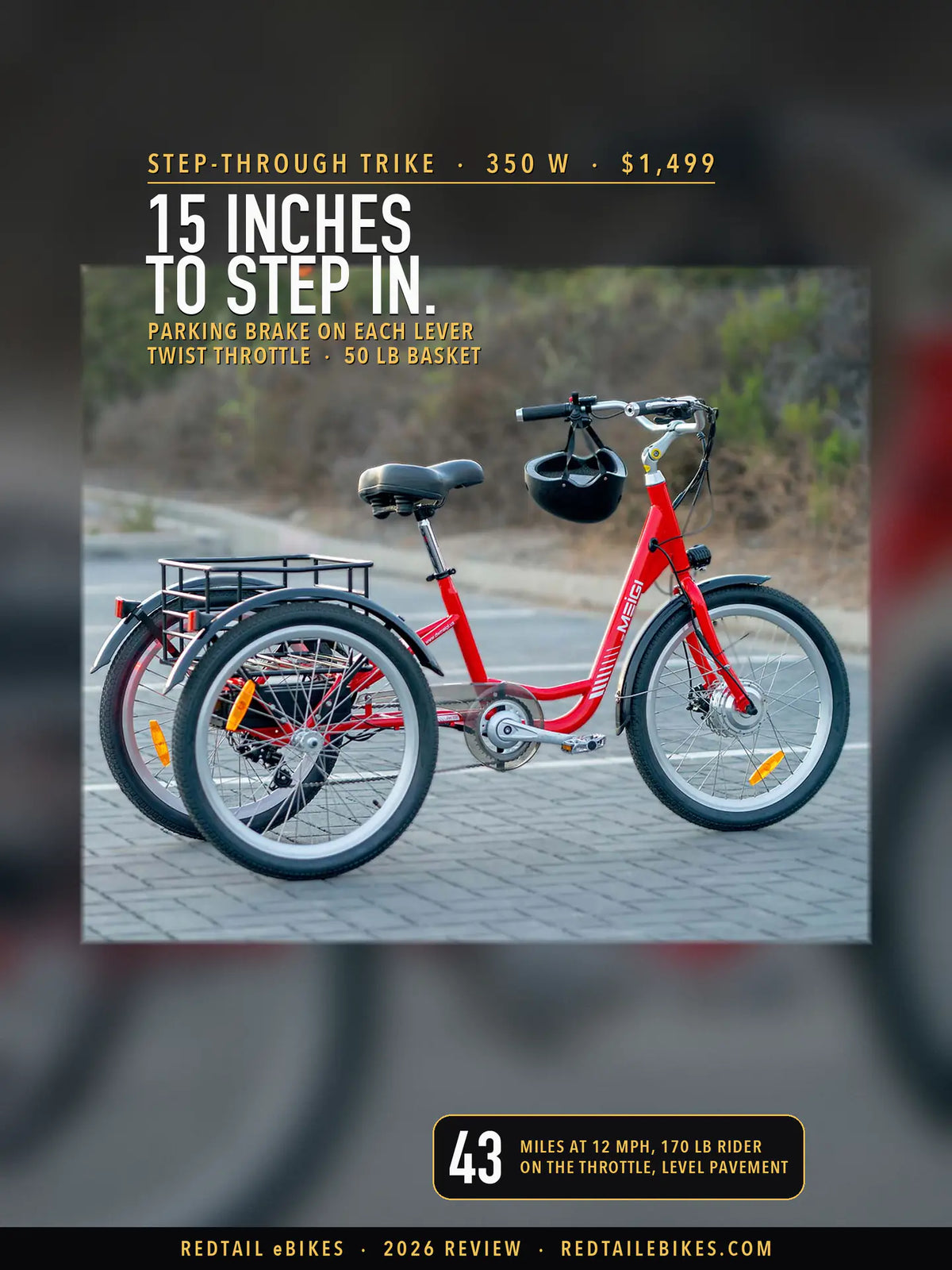

Step-through electric trike · 350 W front hub · removable 36 V 13 Ah pack, 468 Wh · 15 mph top speed · twist throttle and three assist levels · Shimano 7-speed · 180 mm discs front and rear, a parking brake on each lever · 88 lb, rated to 300 lb · $1,499, DWMEIGI's own US price · verified October 28, 2026
Quick Answer — The DWMEIGI MG708 Hera is a $1,499 step-through electric trike: a 15-inch step-in, a 350 W front hub, a twist throttle and a 15 mph top speed. For a 170 lb rider at 12 mph on the throttle over level pavement, its 468 Wh pack computes to 43 miles; DWMEIGI rates it 25 to 40.
It is built for flat errands at an easy pace: on a steady 6% grade the throttle holds 9.3 mph in the same model (hills), and DWMEIGI's own manual asks that no one under 18 ride it (the law).
Our MG708 listing is $1,499 in red or blue, the price DWMEIGI's own US store showed on October 28, 2026, with both colors in stock there and here. Red checks out from here; pick blue for an identical trike. Shipping is free within the contiguous United States.
Buy the red MG708, $1,499What this review covers
Specification · What it is · Fit · Motor and throttle · Battery · Range · Brakes and controls · The basket · The Mercer fit test · UL · Recalls · Class and law · Green and red flags · Verdict · Checklist · Buying it from us · FAQ · Limitations · Bottom line
How we verified this DWMEIGI MG708 review
Every figure about the MG708 here comes from DWMEIGI's own documents, then recomputed: its MG708 product record, the 39-page MG708 manual, its display manual and its MG708 specification post, read October 28, 2026, and its product page with its size table, its MG708 electronics page and the Hera card on its Silverado HD page, read October 14, 2026. Two models work out the range and the fit, and each prints the inputs it uses.
The MG708 is on our own shelf, which is why its red flags get the same space as its green ones. Part of our e-bike reviews.
Written by Milad Ghobadibeygvand, BScN (Western University, 2014). Corrections: support@redtailebikes.com.
The DWMEIGI MG708 as DWMEIGI prints it
DWMEIGI sells the MG708 under the name HERA Urban Electric Tricycle, and every row below is its own figure. Where two of its documents print different numbers, both are in the table. This page plans on the lower load and basket limits; its range and fit figures use the product page's battery, tires and size table, and the range formula also works the main ride on the electronics page's smaller battery.

DWMEIGI's own studio photograph of the blue MG708 from its drive side, the basket riding over the two rear wheels.
| What | DWMEIGI's figure | Where it prints it |
|---|---|---|
| Price | $1,499, red or blue | its US product record |
| Motor | "350W Front Brushless Hub" | its product page |
| Torque | 40 N·m | the Hera card on its Silverado HD page |
| Top speed | "15MPH" | its product page |
| Battery | 36 V, 13 Ah, removable; 9 lb | its MG708 post |
| Energy | 468 Wh | 36 V × 13 Ah |
| Battery, second figure | 36 V, 10.4 Ah, 374.4 Wh | its MG708 electronics page |
| Range | 25 miles electric, 40 assisted | its product page |
| Range, second figure | 25 to 35 miles | its product record |
| Charging | 4–5 hours | its MG708 post |
| Charging, second figure | "about 4-6 hours" | the MG708 manual |
| Charging, third figure | 6 hours from empty | its MG708 electronics page |
| Weight | 88 lb | its MG708 post |
| Load limit | 300 lb | the MG708 manual |
| Load limit, second figure | 330 lb | its product page |
| Rider height | 4'11" to 6'2" | its product page |
| Rider height, second figure | 5'1" to 6'1" | its MG708 post |
| Step-in height | 15 in (38 cm) | its product page |
| Seat height | 32–38 in | its size table |
| Handlebar height | 41–44 in | its size table |
| Handlebar length | 26 in | its size table |
| Handlebar, second figure | 25 in (63.5 cm) wide | its MG708 electronics page |
| Length, wheelbase | 74 in, 49 in | its size table |
| Tires | KENDA 24 × 2.125 in | its MG708 post |
| Tires, second figure | KENDA K1167, 20 × 4 in | its MG708 electronics page |
| Gears | Shimano 7-speed, 38T chainring | its MG708 post |
| Cranks | 170 mm | its MG708 electronics page |
| Brakes | 180 mm discs; a parking brake on each lever | its MG708 post |
| Assist levels | 0 to 3, starting at 1 | the display manual |
| Assist levels, second figure | "Intelligent 5 level pedal assist" | its MG708 electronics page |
| Sensor and throttle | cadence sensor; twist throttle | its MG708 post |
| Lights | 200-lumen headlight and a rear light | its MG708 post |
| Basket | 19 × 15 × 10 in, 50 lb limit | its product page |
| Basket, second figure | rear basket "Max load 25kg" | its MG708 electronics page |
| Frame | carbon steel | its MG708 post |
The product record, the manuals and the post read October 28, 2026; the product page's size table and feature cards, its electronics page and the Hera card on its Silverado HD page read October 14, 2026, as DWMEIGI publishes them for the US market.
A 24-inch step-through trike for flat errands
The MG708 is a three-wheeled step-through with 15 inches to step in: you walk into it, sit on an 11 × 10 inch saddle, and steer a front wheel that carries the motor. DWMEIGI describes it as a "recreational electric tricycle, used for leisure activities, suitable for adults and seniors due to its stability" in its MG708 post.

DWMEIGI's own photograph of the red MG708 parked with its basket empty. Both brake levers carry a parking lock, so it stays where you leave it on a slope.
Three wheels keep it upright at a stop, and the basket rides over the rear axle. DWMEIGI's post sells it on "making grocery runs a breeze", and its product page sizes the basket "to carry shopping goods or take your pets dogs/cats around" (product page).
The trade is speed and hills. DWMEIGI publishes 15 mph as the top speed and 350 W for the motor (product page). For steady climbs, the DWMEIGI Silverado HD we sell carries a 750 W motor in the same front-hub layout.

DWMEIGI's photograph of the blue MG708. The blue and the red are the same trike at the same price.
If you are choosing between a trike and a two-wheeler, our electric trike guide lays out the differences, and our guide to e-bikes for seniors covers the two-wheel step-throughs as well. DWMEIGI's other trikes, and how its warranty works when you buy from us, are in our DWMEIGI brand profile and our DWMEIGI collection; the MG708 itself is $1,499 on our store, in red or blue, and our electric trike collection holds the rest.
Will the MG708 fit you?
Hamley's classic formula, given a 5'8" rider with that height's median inseam of 32.6 inches in the US Army's body survey, sets the saddle top 35.6 inches above the pedal in its lowest position: 109% of the inseam. The MG708 sets that saddle between 32 and 38 inches off the ground, by DWMEIGI's size table, and its step-in is 15 inches (product page).
Three steps find your fit:
- Measure your inseam: stand shoeless with your back on a wall, lift a hardcover book snug into your crotch, and run a tape from the floor to the book's top.
- Find your row in the tables below: your height, the inseam range most people of that height have, and the saddle distance the formula gives.
- Set the saddle with the heel check when the trike arrives (setup).
DWMEIGI prints two rider windows for the MG708: 4'11" to 6'2" on its product page and 5'1" to 6'1" in its MG708 post. Both are printed here, and the rows below let you place your own body inside them.
Will the saddle go high enough (or low enough) for me?
Measured to the pedal, the median rider's saddle height runs from 31.0 inches at 5'0" to 39.3 inches at 6'2" under the formula. The table reads the 6,068 bodies of the US Army's ANSUR II survey, each set at 109% of inseam (Peveler et al., 2005), with the band's two ends at 106% and 110.4% (Ferrer-Roca et al., 2012).
| Your height | Typical inseam | Saddle top to pedal axle | At 106% | At 110.4% |
|---|---|---|---|---|
| 5'0" | 27.1–29.7 in | 31.0 in | 30.2 in | 31.4 in |
| 5'2" | 28.0–31.1 in | 32.2 in | 31.3 in | 32.6 in |
| 5'4" | 29.1–32.2 in | 33.3 in | 32.3 in | 33.7 in |
| 5'6" | 30.2–33.5 in | 34.5 in | 33.6 in | 34.9 in |
| 5'8" | 31.1–34.3 in | 35.6 in | 34.6 in | 36.0 in |
| 5'10" | 32.2–35.5 in | 36.8 in | 35.8 in | 37.3 in |
| 6'0" | 33.2–36.7 in | 38.1 in | 37.0 in | 38.6 in |
| 6'2" | 34.3–37.5 in | 39.3 in | 38.2 in | 39.8 in |
Saddle top to the pedal axle with the crank pointing down, at the median inseam for each height, in the 6,068 bodies of ANSUR II (4,082 men, 1,986 women). The inseam range spans the 5th to the 95th percentile of riders that height. Computed from the survey's bodies.
DWMEIGI measures its 32 to 38 inches from the ground; the table measures from the pedal, a few inches up at the bottom of its stroke. DWMEIGI's electronics page gives a 170 mm crank length, but none of its documents gives the bottom bracket height, so the two scales cannot be laid over each other here (limitations).
Can I put a foot down at a stop?
You do not need to: a trike stands on its three wheels, so the question that decides your day is how easily you step in. DWMEIGI puts the MG708's down tube 15 inches off the floor and says that makes it easy to get on "for the elderly people and disabled people" (product page).

A crop of DWMEIGI's studio photograph of the red MG708: the down tube dips to the 15 inches DWMEIGI lists, with the chain covered beside it.
| Your height | Typical inseam | Clearance over the frame |
|---|---|---|
| 5'0" | 28.4 in | 12.1 in or more for 95 of 100 riders |
| 5'2" | 29.5 in | 13.0 in or more for 95 of 100 riders |
| 5'4" | 30.5 in | 14.1 in or more for 95 of 100 riders |
| 5'6" | 31.7 in | 15.2 in or more for 95 of 100 riders |
| 5'8" | 32.6 in | 16.1 in or more for 95 of 100 riders |
| 5'10" | 33.8 in | 17.2 in or more for 95 of 100 riders |
| 6'0" | 34.9 in | 18.2 in or more for 95 of 100 riders |
| 6'2" | 36.0 in | 19.3 in or more for 95 of 100 riders |
Barefoot inseam minus DWMEIGI's 15-inch step-in height, ANSUR II bodies. The typical inseam here is each height's median. Computed.
Seated, the lowest saddle setting is 32 inches from the ground. This table shows how many riders at each height reach the ground flat-footed from the saddle at that setting, which is the reach you use when you stop and steady yourself before standing up:
| Your height | Typical inseam | Inseam minus the 32.0 in seat, median rider | Riders flat-footed astride it, of 100 |
|---|---|---|---|
| 5'0" | 27.1–29.7 in | −3.6 in | 0 |
| 5'2" | 28.0–31.1 in | −2.5 in | 1 |
| 5'4" | 29.1–32.2 in | −1.5 in | 7 |
| 5'6" | 30.2–33.5 in | −0.3 in | 37 |
| 5'8" | 31.1–34.3 in | 0.6 in | 78 |
| 5'10" | 32.2–35.5 in | 1.8 in | 98 |
| 6'0" | 33.2–36.7 in | 2.9 in | 100 |
| 6'2" | 34.3–37.5 in | 4.0 in | 100 |
Barefoot inseam minus DWMEIGI's lowest published seat height, 32 inches, ANSUR II bodies. Computed.
Below 5'7", most riders touch down on their toes from the lowest setting, and at 5'0" none reach flat. On a trike that is a matter of comfort: the parking brakes hold it while you slide forward to the ground (brakes).
Your step-in is 15 inches at every height. Your saddle row in the first table is the setting to start from, and the flat-foot table tells you whether you will stand up from the saddle on your toes or your heels.
Will I feel cramped, or stretched?
DWMEIGI's size table puts the grips 41 to 44 inches above the ground and lists a 24-inch reach and a 26-inch handlebar length. It does not say where the 24 inches are measured from, so no lean angle is computed from it (product page). Its electronics page gives the bar's width as 25 inches, 63.5 cm (electronics page).
No grip position relative to the saddle is published, so the lean is not computed. The bars sweep back toward you, and the stem adjusts in height by DWMEIGI's own description, "adjustable seat tube&handle stem" (product record). Set the bars so your elbows keep a soft bend with your back upright.
How much weight goes through my wrists?
No grip position is published relative to the saddle, so no hand-load figure is computed for the MG708. As a reference point, Carahalios found ten road racers on their brake hoods putting about 15% of their body weight through the stem (Carahalios, 2015); that is a racing position, measured on a road bike.
If your wrists or hands ache on a bicycle today, compare the MG708's 41 to 44 inch grips with the bars you ride now before you order.
How do I set the saddle when it arrives?
After setting the saddle to your row, look at your knee with the pedal at its lowest: it should still bend 25 to 35 degrees (Peveler, Pounders and Bishop, 2007). For a first pass with no angle gauge, use the heel check: heel on the bottom pedal, the leg should just straighten, which leaves about the right bend once the ball of your foot takes over (Peveler et al., 2005).
The MG708's manual marks a minimum insertion line on the seat post and asks that it stay inside the frame tube (manual, saddle installation). If your row needs the post above that line, tell us before you order.
How we computed fit
The saddle table comes from a single formula: 109% of your inseam, from the pedal axle up to the saddle top. Take a 5'8" rider carrying that height's median inseam in the survey, 32.6 inches: 109% is 35.6 inches, the band runs from 34.6 inches at 106% to 36.0 at 110.4%, and the same body sits 28.8 inches above the crank axle by LeMond's 88.3% (Peveler et al., 2005).
| Input | Value | Source |
|---|---|---|
| Bodies | 6,068 (4,082 men, 1,986 women) | ANSUR II |
| Saddle formula | 109% of inseam, pedal to saddle | Peveler et al., 2005 |
| Saddle band | 106% to 110.4% | Ferrer-Roca et al., 2012 |
| Knee target | 25 to 35 degrees | Peveler, Pounders and Bishop, 2007 |
| Step-in height | 15 in | DWMEIGI product page |
| Seat height | 32–38 in from the ground | DWMEIGI size table |
| Handlebar height, reach | 41–44 in; 24 in | DWMEIGI size table |
| Crank length | 170 mm | DWMEIGI electronics page |
Every table in this section is computed from these inputs alone. Nothing was measured off a photograph: DWMEIGI's size image was not used for measurement, and its documents give a 170 mm crank length but no bottom bracket height for the MG708.
Finish on the knee because the formula only gets you close: Peveler's team, testing 19 trained cyclists, saw the formulas put 55 to 65 of 100 inside the 25 to 35 degree knee range and the heel method 70 (Peveler et al., 2005).
Between two rows? Send your height and inseam to support@redtailebikes.com, and the reply gives your saddle setting from these tables. Blue from this button; red if you prefer it.
Buy the blue MG708, $1,499A 350 W front hub, a cadence sensor and a twist throttle
The MG708's motor is a 350 W brushless hub in the front wheel, and it answers to two controls: a twist throttle that drives the trike without pedaling, and a cadence sensor that adds power once the pedals turn. DWMEIGI lists "Walking Mode, Pedal Assistant & Twist Throttle" as its three ways to ride (product page), and its manual has you seat "the motor wheel on the fork" during assembly (manual).
DWMEIGI rates the hub at 40 N·m of torque on the Hera card it shows beside its other trikes (Silverado HD page), and that figure sets the limit on the steepest rows of the hill table.

DWMEIGI's own close-up of the red MG708 on the move. The silver hub inside the front wheel is the motor, and the headlight rides on the fork above it.
The display offers four assist levels, from 0, where "The output power is zero", up to 3, the most help, and it starts on the first step each time (display manual); DWMEIGI's electronics page lists "Intelligent 5 level pedal assist" (electronics page). Hold the down button and the trike walks itself "at a uniform speed of 6 Km/h", about 3.7 mph, which helps up a ramp or into a garage.
DWMEIGI's own advice for the longest range is the lowest level, "With low mode cadence sensor, you can pedal as much as possible for maximum range 40 miles" (MG708 post).
The seven Shimano gears turn the rear wheels through a 38-tooth Prowheel chainring under a chain cover, by DWMEIGI's parts list in its MG708 post. They change your pedaling cadence and leave the motor's pull alone: "Gearing is independent to pedal assistance, so pedal assistance operates the same regardless of selected gear" (manual).
Touch a brake lever and the motor drops out; the manual puts it as "If either of the brake levers are pulled, the power will be cut off automatically and the motor will not work" (manual).
A 36 V, 13 Ah pack: 468 Wh you can carry indoors
The pack is 36 volts and 13 amp-hours, 468 watt-hours, and DWMEIGI weighs it at 9 lb (MG708 post). It locks with a key and comes out once the saddle is lifted, so it can charge indoors while the trike stays in the garage.
DWMEIGI's MG708 electronics page lists the pack as "36V10.4AH(374.4Wh)" (electronics page); its product page, product record, Hera card and post print 13 Ah, and the range formula works the main ride on both.
The manual's own sequence: "You should lift the saddle with the lever that is underneath it, which will enable you to remove the battery. Before you do this, you will have to unlock the battery with the ignition key" (manual).
Charging takes 4 to 5 hours by DWMEIGI's post, 6 hours from empty by its electronics page and "about 4-6 hours" by its manual, which also sets a ceiling: "Do not charge the battery for more than 10 hours to avoid overcharging and damaging the battery." The charger is 36 V and 2 A, which DWMEIGI's page lists with "UL certification" (product page).
At August 2026's US residential average of 18.16 cents a kilowatt-hour, filling the 468 Wh pack runs about 8.5 cents before charging losses (US Energy Information Administration). A year of 1,000 throttle miles at 12 mph, at the model's 11.0 Wh a mile, adds up to about $1.99 a year in electricity.
For a trike you park through the winter, the manual asks for a charge "at least one time per month" and warns against leaving the pack fully discharged (manual). When the time comes for a second pack, we stock the MG708's replacement battery; email us and we will confirm it against your trike's serial number.
Range: 43 miles at 12 mph for a 170 lb rider, computed
With a 170 lb rider on the 88 lb trike, riding the throttle at a steady 12 mph over level pavement at 77 °F, the MG708's 468 Wh pack computes to 43 miles, or 32 if you keep a quarter of it in reserve. That is a model, built on published physics and DWMEIGI's own figures, and every row below names its rider weight, speed, effort and grade.
Three steps find your ride:
- Find your speed and how hard you pedal in the first table: the throttle alone, or 75 or 150 watts of your own.
- Correct for your grades, your load and the temperature with the tables below it.
- Hold back a quarter: plan on the column that keeps 25% of the pack in hand, so a ride ends with charge to spare (reserve).
How far does a full charge take you?
On the throttle alone, a 170 lb rider covers 33 miles at 15 mph and 50 at 10 mph over level pavement; pedaling with 75 watts stretches 15 mph to 56 miles. At 10 mph and below, 75 watts from your legs moves the trike by itself on the flat, so the motor's share drops to nothing in this model.
| Speed | Throttle only | 75 W from your legs | 150 W from your legs | Throttle, 25% kept |
|---|---|---|---|---|
| 6 mph | 67 mi | your legs alone | your legs alone | 50 mi |
| 8 mph | 59 mi | your legs alone | your legs alone | 44 mi |
| 10 mph | 50 mi | your legs alone | your legs alone | 38 mi |
| 12 mph | 43 mi | 119 mi | your legs alone | 32 mi |
| 15 mph | 33 mi | 56 mi | 160 mi | 25 mi |
Miles on one full charge, 258 lb moving weight (a 170 lb rider on the 88 lb trike), level pavement, no wind, 77 °F, commuter-tire rolling resistance, upright riding position. "Your legs alone": at that speed your pedaling covers the road's demand and the motor adds nothing. Computed from the model.
Pedaling at 75 watts, with no help from the motor, carries this trike and a 170 lb rider at 10.1 mph on the flat in the same model; 150 watts carries them at 14.0 mph.
Plan on 32 miles at 12 mph on the throttle with a quarter of the pack kept, or 25 at 15 mph, for a 170 lb rider on level ground on the MG708. Turning the pedals with you lifts each figure, and below 10 mph your legs can carry the whole load.
Which gear saves battery on a front hub?
On a hub-drive trike the gears change your cadence, not the motor's, so they matter to range only through how much you pedal. The table shows what that pedaling is worth at three speeds on three grades, for a 170 lb rider.
| Speed and grade | Throttle only | 75 W from your legs | 150 W from your legs |
|---|---|---|---|
| 8 mph, level | 59 mi | your legs alone | your legs alone |
| 8 mph, 4% grade | 12 mi | 20 mi | 44 mi |
| 8 mph, 8% grade | beyond the motor | 8 mi | 11 mi |
| 12 mph, level | 43 mi | 119 mi | your legs alone |
| 12 mph, 4% grade | beyond the motor | 15 mi | 22 mi |
| 12 mph, 8% grade | beyond the motor | beyond the motor | beyond the motor |
| 15 mph, level | 33 mi | 56 mi | 160 mi |
| 15 mph, 4% grade | beyond the motor | beyond the motor | beyond the motor |
| 15 mph, 8% grade | beyond the motor | beyond the motor | beyond the motor |
Miles on one full charge, 258 lb moving weight, steady speed, 77 °F. "Beyond the motor": the 350 W motor, with the stated pedaling, cannot hold that speed on that grade, so the trike slows. Computed.
Pick a low gear before a climb so your legs can keep turning at a comfortable pace; on a hub motor the throttle's pull does not change with the gear, by the manual's own account (manual).
How much does a hill cost the pack?
On a steady 6% grade, the throttle alone holds 9.3 mph with a 170 lb rider, and 75 watts of pedaling lifts that to 10.9 mph; on 10% the figures are 6.2 and 7.4. This is the section that tells you whether the MG708 suits your streets.
| Grade | Fastest steady speed, throttle | Miles at that speed | Fastest, 75 W from your legs | Miles at that speed |
|---|---|---|---|---|
| 2% | 14.0 mph | 18 mi | 14.5 mph | 23 mi |
| 4% | 11.9 mph | 11 mi | 13.6 mph | 14 mi |
| 6% | 9.3 mph | 8 mi | 10.9 mph | 10 mi |
| 8% | 7.5 mph | 5 mi | 8.9 mph | 7 mi |
| 10% | 6.2 mph | 4 mi | 7.4 mph | 5 mi |
| 12% | below 2 mph | beyond the motor | 6.3 mph | 4 mi |
| 15% | below 2 mph | beyond the motor | 3.3 mph | 3 mi |
The fastest steady speed the 350 W motor holds on each grade within DWMEIGI's 40 N·m torque rating, and the miles one charge would cover if the whole ride were that grade at that speed, 258 lb moving weight, 77 °F. "Below 2 mph": the motor alone cannot hold a walking pace on that grade. Computed.
Past 10%, the hub's torque sets the limit: DWMEIGI rates it at 40 N·m (Hera card), so on 12% and 15% the throttle alone cannot hold a steady 2 mph, and 75 watts from your legs holds 6.3 and 3.3 mph.
Climbing 1,000 ft on the throttle at 6 mph costs 157 Wh on a 4% grade, about a third of the pack, and 228 Wh on 10%; pedaling with 75 watts cuts the figures by 29 to 44%:
| Grade | Battery per 1,000 ft climbed at 6 mph, throttle | With 75 W from your legs |
|---|---|---|
| 4% | 157 Wh | 88 Wh |
| 6% | 177 Wh | 114 Wh |
| 8% | 200 Wh | 138 Wh |
| 10% | 228 Wh | 161 Wh |
Watt-hours from the pack to climb 1,000 vertical feet at a steady 6 mph, 258 lb moving weight. The pack holds 468 Wh. Computed.
A neighborhood with short rises suits it; a daily climb of several hundred feet takes a bigger share of the pack and holds you to the speeds in the hill table. If your ride has long grades, the DWMEIGI Silverado HD carries a 750 W motor, and our electric trike guide sorts the rest of the trikes we sell by power.
Does a heavier load cut the range?
At 12 mph on the throttle over level pavement, the trike covers 46 miles with 120 lb aboard and 35 miles at DWMEIGI's 300 lb limit, losing 2 to 4 miles with each added 40 to 50 lb in this model. Rider plus cargo is the figure DWMEIGI rates; the trike's own 88 lb comes on top.
| Rider and cargo | With the 88 lb trike | 12 mph, level | Fastest level speed, throttle | 8 mph, 4% grade |
|---|---|---|---|---|
| 120 lb | 208 lb | 46 mi | 15.0 mph | 15 mi |
| 170 lb | 258 lb | 43 mi | 15.0 mph | 12 mi |
| 220 lb | 308 lb | 39 mi | 14.9 mph | 10 mi |
| 260 lb | 348 lb | 37 mi | 14.8 mph | 8 mi |
| 300 lb | 388 lb | 35 mi | 14.8 mph | 7 mi |
Miles on one full charge on the throttle alone, 77 °F; the 300 lb row is DWMEIGI's manual limit, and its product page prints 330 lb. Computed.
Does cold weather cut the range?
At 32 °F the same 12 mph ride computes to 34 miles, against 43 at 77 °F; at 14 °F it is 31, and cell data put it anywhere from 15 to 31. The cells give up energy in the cold (LG HG2 data, McMaster University), and colder air is denser to push through (US Standard Atmosphere).
| Air temperature | Miles at 12 mph, throttle | Cell-data bracket |
|---|---|---|
| 95 °F | 45 mi | — |
| 77 °F | 43 mi | — |
| 68 °F | 41 mi | — |
| 50 °F | 37 mi | — |
| 41 °F | 35 mi | — |
| 32 °F | 34 mi | 30–35 mi |
| 14 °F | 31 mi | 15–31 mi |
258 lb moving weight, level pavement, the cells at air temperature. The central column uses LG HG2 cell data measured at McMaster University (Kollmeyer); the bracket spans the published cell data. Computed.
The rows put the cells at the air's temperature, and a pack charged indoors sets out warmer than that.
The 24-inch tires and how you sit
The KENDA 24 × 2.125 tires are city tires, and the range figures use the rolling resistance measured on 273 everyday commuter tires: 0.0074. DWMEIGI's product page and post name no tread at this size, and its electronics page lists a KENDA K1167 at 20 × 4 inches, another size, so the table brackets the tread between slick tires and one standard deviation up.
| Tire case | Rolling resistance | 12 mph, throttle | 15 mph, throttle |
|---|---|---|---|
| slick tires, 137 everyday riders | 0.0070 | 44 mi | 34 mi |
| commuter tires, 273 everyday riders (used) | 0.0074 | 43 mi | 33 mi |
| commuter tires, one standard deviation up | 0.0107 | 36 mi | beyond the motor |
258 lb moving weight, level pavement, 77 °F; field measurements by Tengattini and Bigazzi (2018). Computed.
The manual asks for the pressure printed on the tire sidewall (manual); ride them soft and you are in the high row.
| Riding position | Drag area | 12 mph, throttle | 15 mph, throttle |
|---|---|---|---|
| upright cruiser riders (used) | 0.640 m² | 43 mi | 33 mi |
| everyday mountain-bike riders | 0.603 m² | 44 mi | 34 mi |
258 lb moving weight, level pavement, 77 °F; drag areas measured on riders by Tengattini and Bigazzi (2018). Computed.
How far does DWMEIGI say it goes?
DWMEIGI rates the MG708 at "up to 25 miles under pure electric mode and 40 miles in pedal assisted mode" (product page), and both figures match rides this model can name.
The 25 throttle miles are what a 170 lb rider uses at a steady 12 mph up a 1.2% grade, or 10 mph up 1.4%. The 40 assisted miles match 12 mph on level ground with the throttle alone, or 15 mph with about 31 watts from your legs.
DWMEIGI's own product record prints a second assisted figure, "25miles(E-Bike Mode) to 35miles (Assisted Mode)" (product record); 35 miles matches 15 mph with about 10 watts of pedaling.
Keep a reserve when you plan. The manual's instruction is to "turn OFF the power switch and only use the pedals" once the battery gauge empties (manual), and the planning column keeps the 25% a measured pedelec needed: "The remaining 25 % are needed to prevent deep discharge" (Schmitt, Decker and Doppelbauer, 2019).
How the range figures are computed
The power to roll the trike is Martin and colleagues' road-cycling equation, P = v·[m·g·(Crr·cos θ + sin θ) + ½·ρ·CdA·v²] (Martin et al., 1998), divided through the motor's and the battery's efficiency. One ride, worked through:
- The ride: 12 mph is 5.364 meters a second; 258 lb is 117.0 kg; air at 77 °F weighs 1.184 kg per cubic meter.
- Rolling: 5.364 × 117.0 × 9.81 × 0.0074 = 45.6 watts.
- Air: ½ × 1.184 × 0.64 × 5.364³ = 58.5 watts, so 104.0 watts at the wheel.
- The motor delivers that at 81.8% efficiency and the battery at 96.8%, so the cells give 131.5 watts.
- The miles: 131.5 watts for 1/12 of an hour per mile is 11.0 Wh a mile; 468 Wh ÷ 11.0 = 42.7, printed as 43, and 32.0 with a quarter kept.
| Input | Value | Source |
|---|---|---|
| Pack | 36 V × 13 Ah = 468 Wh | DWMEIGI MG708 post |
| Pack, second figure | 36 V × 10.4 Ah = 374.4 Wh | DWMEIGI electronics page |
| Motor | 350 W front hub, 15 mph | DWMEIGI product page |
| Torque | 40 N·m | DWMEIGI's Hera card |
| Trike weight | 88 lb | DWMEIGI MG708 post |
| Reference rider | 170 lb, the federal definition's operator | 15 U.S.C. § 2085 |
| Wheel | 24 × 2.125 in, 614.95 mm across | Sheldon Brown, tire sizing |
| Motor shape | a comparable hub motor's efficiency curve, 80% at its rated point | Bafang OEM workbook |
| Rolling resistance | 0.0074, commuter tires | Tengattini and Bigazzi, 2018 |
| Drag area | 0.64 m², upright riders | Tengattini and Bigazzi, 2018 |
| Battery efficiency | about 97% at this draw | Arango, Lopez and Ceren, 2021 |
| Air | US Standard Atmosphere | NOAA, NASA and USAF, 1976 |
| Cold cells | LG HG2 energy by temperature | McMaster University (Kollmeyer) |
| Reserve | 25% kept | Schmitt, Decker and Doppelbauer, 2019 |
The equation reproduces the published benchmark in Martin et al.'s Appendix I (45.7 watts rolling and climbing, 158.8 watts air) to the tenth. The motor's no-load speed is set so a 170 lb rider on the throttle reaches DWMEIGI's 15 mph on level ground and no faster.
On the electronics page's 374.4 Wh, the same 12 mph ride works out to 34.1 miles, printed as 34, and every mileage of 10 miles or more in this section's tables falls by 17 to 23%. The tables use the 13 Ah that DWMEIGI's product page, product record, Hera card and MG708 post print.
Tell us your usual ride, its distance and hills and your weight, at support@redtailebikes.com: the reply runs it through this model and gives your miles. Red at checkout from here, or blue at the same $1,499.
Buy the MG708 for errandsTwo 180 mm discs and a parking brake on each lever
Both brakes are 180 mm discs, and each lever carries a parking lock: "left side brake lever is for front wheel and right side is for rear axle. Also, both sides are equipped with parking brake," in DWMEIGI's MG708 post. The same post explains why that matters on a trike: the locks "keep MG708 stationary when parked, especially on uneven or sloped surfaces."

A crop of DWMEIGI's studio photograph of the red MG708. The stem adjusts, and DWMEIGI lists the grips at 41 to 44 inches from the ground.
Use both levers together to stop; the manual's own words are that "the rider must action both brake levers to the correct degree" (manual). Pulling either lever also cuts the motor, so a stop never fights the throttle (motor).
The display shows the assist level and "5 level battery indicator", by DWMEIGI's product page, and its post lists a "200lumen front light and rear light", Wellgo alloy pedals with reflectors and black fenders with red reflectors (MG708 post). The display switches the system off by itself after about 10 minutes parked (display manual).

A crop of DWMEIGI's studio photograph: the Shimano gear cluster sits on the rear axle, under the basket.
If you have not ridden a trike, DWMEIGI's own first-ride advice is worth following: "find a flat, open parking lot, don't turn on the display just yet; instead, ride the tricycle using only your own power for a while. Practicing S-shaped patterns is a good way to get used to its handling characteristics" (MG708 post). The same post warns that "the feel will be noticeably different from riding a bicycle", so give yourself that first afternoon.
A 50 lb basket for groceries and a small dog
The rear basket measures 19 by 15 by 10 inches and is rated to 50 lb, "designed in order to carry shopping goods or take your pets dogs/cats around," by DWMEIGI's product page. It rides over the rear axle, between the two rear wheels. DWMEIGI's electronics page gives the rear basket "Max load 25kg", about 55 lb; this page plans on the lower 50.

DWMEIGI's own photograph of the red MG708 with a loaded basket. The helmet goes on before the ride, as its product page asks of every rider.
The 50 lb counts inside the trike's overall rating, which DWMEIGI's manual sets at "Maximum load capacity = 300lbs." and its product page at 330 lb (manual). A 250 lb rider with a full 50 lb basket reaches the 300 lb figure, and the range table gives that load 35 miles at 12 mph on the throttle.
Secure a pet carrier inside the basket before you ride. If you plan to carry a dog, email us its weight, and we will check it against the basket's 50 lb and your own weight against the 300.
The basket, the fenders, the rear rack and both parking brakes come with the trike at $1,499, the same price DWMEIGI charges on its own store. Blue goes straight to checkout; switch to red in one tap.
Buy the blue Hera trikeThe Mercer fit test
This test holds the MG708 against the same seven people our reviews use: the Mercers, our editorial cast, a family of fit archetypes with fixed heights and ages. Each row reads a number DWMEIGI publishes or a row of this page's fit model; none of them has ridden the MG708.
| Member | Verdict | The number behind it |
|---|---|---|
| Frank Kowalski, 63, 5'10" | Fits; DWMEIGI's post names seniors as its riders | 5'10" sits inside both of DWMEIGI's windows, 4'11" to 6'2" and 5'1" to 6'1"; 98 of 100 riders his height reach the ground flat-footed from the 32-inch seat |
| Ruth Kowalski, 61, 5'5" | Fits; she steps in and stands up on her toes | Inside both windows; 17 of 100 riders at 5'5" sit flat-footed at the lowest seat, and 95 of 100 clear the 15-inch step-in by 14.7 inches or more |
| Jack Mercer, 48, 6'1" | Fits at the top of the range | 6'1" is the top of the 5'1" to 6'1" window and inside the 4'11" to 6'2" one; the formula wants 38.8 inches from pedal to saddle at his height, and the 15 mph top speed is the same for him as for everyone |
| Dana Mercer, 45, 5'7" | Fits; the errand runner | Inside both windows; the basket takes 50 lb inside the trike's 300 lb, and 57 of 100 riders at 5'7" sit flat-footed at the lowest seat |
| Maya Torres, 32, 5'6" | Fits, at 15 mph | Inside both windows; the 15 mph top speed and the hill table decide her commute, 9.3 mph on a 6% grade on the throttle with a 170 lb rider |
| Cole Mercer, 16, 5'11" | Not yet | DWMEIGI's manual: "Don't let children under the age of 18 ride the bike." |
| Ivy Mercer, 12, height not used | No | The same manual line; at 12 she is six years short of it |
Heights against DWMEIGI's two published rider windows and this page's fit tables (ANSUR II bodies); ages against the MG708 manual. No cast member has ridden the trike.
The sharpest contrast in the family is Frank and Cole. They stand an inch apart and the frame fits both, yet Frank rides it the day it arrives and Cole waits two years: DWMEIGI's manual draws its age line at 18, and your state's e-bike page may add its own.
Is the DWMEIGI MG708 UL certified?
Need certification papers for a building, a landlord or a city? Email us before you order, and we ask DWMEIGI for them in writing. What DWMEIGI's page prints for the MG708 is a charger rating, "36V 2A UL certification" (product page).
UL 2849 is, in UL Solutions' words, "the Standard for Electrical Systems for eBikes", a fire safety certification reached "by examining the electrical drive train, battery, and charger system combinations in e-bikes". If you need a certificate for the whole system, ask for one that names the MG708 on its face.
Has the DWMEIGI MG708 been recalled?
No. The US Consumer Product Safety Commission's records held no recall and no public safety warning naming DWMEIGI, MEIGI or the MG708 on October 28, 2026. Behind that answer sit the commission's 10,058 recall records, its 379 public safety warnings and its recall feed, searched for DWMEIGI, MEIGI and the MG708.
| Check | Result, October 28, 2026 |
|---|---|
| CPSC recalls, all 10,058, for DWMEIGI, MEIGI or MG708 | None found |
| CPSC public safety warnings, all 379, for the same names | None found |
| CPSC recall feed, September 24 to October 22, 2026 | None found |
Read on October 28, 2026 through the CPSC's own recall service and files, whose newest recall was dated October 22, 2026. Before the empty result was trusted, the same reads found the known recalls for Ancheer and for Specialized.
Is the MG708 street legal? 350 W, 15 mph and three wheels
The MG708's published figures fall inside the federal definition of a "low-speed electric bicycle": "a two- or three-wheeled vehicle with fully operable pedals and an electric motor of less than 750 watts (1 h.p.), whose maximum speed on a paved level surface, when powered solely by such a motor while ridden by an operator who weighs 170 pounds, is less than 20 mph" (15 U.S.C. § 2085).
The federal line sets the safety rules a seller meets; the roads, paths and ages you ride under are set by your state.
Run against every state's e-bike definition on October 28, 2026, using DWMEIGI's 350 W, 15 mph, twist throttle, three wheels and 88 lb:
| Outcome | States | Count |
|---|---|---|
| Qualifies as an electric bicycle | AZ, CA, CO, DC, DE, FL, GA, HI, IA, IL, IN, KS, LA, MA, MD, ME, MI, MN, MS, NC, ND, NE, NH, NM, NV, OH, OK, OR, PA, SC, SD, TN, TX, UT, VA, WA, WI, WV, WY | 39 |
| Outside the state's definition | AL, ID, MT, NJ, RI | 5 |
| The statute leaves a three-wheeler open | AR, CT, MO, NY, VT | 5 |
| No statutory e-bike definition | AK, KY | 2 |
Each row applies that state's own statutory definition to DWMEIGI's published figures. Not legal advice: the statute decides, and your state's motor vehicle office applies it.
In four of the five "outside" states the reason is the wheel count. Alabama (§ 32-1-1.1), Montana, Rhode Island and Idaho (§ 49-106) write their definitions around two wheels; Montana's is "two tandem wheels" (MCA § 61-8-102(7)) and Rhode Island's "a two-wheel (2) vehicle" (R.I. Gen. Laws § 31-1-3).
New Jersey's 2025 law classes a bicycle whose motor moves it without pedaling as a motorized bicycle (P.L.2025, c.285), and the MG708's throttle does that.
In Arkansas, Connecticut, Missouri, New York and Vermont, the MG708's power and speed fit the definition, but the text does not settle a three-wheeler either way; New York's describes "a bicycle which is no more than thirty-six inches wide" (N.Y. VTL § 102-c), and Vermont's sits in 23 V.S.A. § 4.
Alaska and Kentucky have no e-bike definition in their codes (AS 28.90.990; KRS 189.010). In all twelve, read your state's page and ask its motor vehicle office before your first ride.
Read against the state statutes, the MG708's published figures fall inside the e-bike definition in 38 states and DC and outside it in AL, ID, MT, NJ and RI; in AR, CT, MO, NY and VT the statute leaves a three-wheeler open. DWMEIGI's manual sets its own age line at 18 in every state.
Green flags / Red flags
The green column is what the MG708 does well, each item linked to its source; the red column is about fit, who it suits less, and where to go instead.
Green flags
- A 15-inch step-in, by DWMEIGI's product page; 95 of 100 riders at 5'0" clear it by 12.1 inches or more (fit).
- A parking brake on each lever, so the trike stays put on a slope while you get on and off (MG708 post).
- A twist throttle and a walk mode that rolls it at 6 km/h while you push (display manual).
- A 9 lb pack that comes out with a key and charges indoors in 4 to 5 hours (MG708 post).
- A 50 lb basket, fenders, a rear rack and lights in the $1,499 (product page).
- A two-year frame warranty, by DWMEIGI's warranty policy.
- No recall and no public safety warning naming DWMEIGI or the MG708 on October 28, 2026 (recalls).
Red flags
- Long hills slow it. The 350 W hub holds 9.3 mph on a 6% grade on the throttle with a 170 lb rider, and from 12% up it needs your legs (hills); for daily climbs, read the DWMEIGI Silverado HD review, a 750 W trike.
- 15 mph is its top speed. Our electric trike collection holds faster ones; for 20 mph and a frame that folds, read the Addmotor Citytri E-310 review or the VTUVIA E-Cozy review, a 14.8-inch step-in trike.
- 88 lb and 74 inches long. Store it where it rolls in at ground level; if your storage is up a step, email us the measurements and we will check them against the size table.
- Most riders under 5'7" touch down on their toes from the lowest seat; the flat-foot table shows your height's share before you order.
- Not for riders under 18, by DWMEIGI's manual; a younger rider's options are in our guide to e-bikes for school.
- Five states' definitions leave it out: AL, ID, MT, NJ and RI (law); read your state's page before you order.
- DWMEIGI recommends professional assembly (warranty policy); our shop directory finds a mechanic near you.
Buy it if / Buy something else if
Buy the MG708 if you want a trike you walk into, not one you swing a leg over; your errands run on flat or gently rolling streets at 15 mph or less; you stand 5'7" to 6'1", or are happy to touch down on your toes at a stop; and you want a basket, a throttle and a parking brake on the day it arrives.
At $1,499, DWMEIGI's own price, the basket, rack, fenders and lights are in the box.
Buy something else if your route has long climbs (start with the Silverado HD review); you want 20 mph or a folding frame (the Addmotor Citytri E-310 and the VTUVIA E-Cozy both fold, and our electric trike guide covers the rest); you live in Alabama, Idaho, Montana, New Jersey or Rhode Island and want it classed as an e-bike (your state's page); or the rider is under 18.
Before you buy: the checklist
Seven checks settle whether the MG708 fits your body, your streets and your home before you order.
- Take your inseam to the saddle table and find your row; under 5'7", the flat-foot table matters as much.
- Check your state in the law table, and open your state's page if it is one of the twelve flagged.
- Look at your hills: if your ride has a steady grade of 6% or more, read the hill table and plan your speed.
- Measure your parking spot: the trike is 74 inches long by DWMEIGI's size table, and it rolls in on three wheels.
- Plan the assembly: DWMEIGI's warranty policy recommends a professional; book a shop before delivery day.
- Choose a charging spot indoors, out of the reach of children, as the manual asks.
- Pick your color: red or blue, the same trike and the same $1,499.
Buying it from us
Every MG708 we sell is priced at DWMEIGI's own US figure, read October 28, 2026, and each row below is read from the page or setting that states it. Our MG708 listing carries both colors. On an order from us, a warranty claim starts at our US support desk, and DWMEIGI's terms run 2 years on the frame and 1 year (limited) on other parts.

DWMEIGI's own studio photograph of the red MG708. Red and blue are the two colors, both in stock with us on October 28, 2026.
| What you get | Our terms on October 28, 2026 |
|---|---|
| Who sells it | Redtail eBikes, the business name of the Florida company named in our terms of service; DWMEIGI makes the MG708 |
| Questions before you buy | support@redtailebikes.com; our contact page says "We typically respond to email within one business day" |
| Price | $1,499 in red or blue, DWMEIGI's own US price that day |
| Shipping | "free shipping on every electric bike within the contiguous United States", by our shipping policy; P.O. boxes and remote areas may cost extra or be excluded |
| Dispatch and transit | "prepared and dispatched within 1–3 business days of confirmation"; "most e-bikes arrive within 5–10 business days after dispatch" |
| Damage in transit | Note it with the carrier and email photos "within 48 hours of delivery so we can resolve it", by our refund policy |
| Warranty | DWMEIGI's terms: the frame 2 years, other parts 1 year (limited), batteries and tires 1 year, by its warranty policy; we open the claim |
| Defective on arrival | "covered under manufacturer warranty — we coordinate repair or replacement remotely", per our refund policy |
| Payment | A card, Apple Pay, Google Pay or Shop Pay at checkout |
| Your fit | Email your height and inseam, and the reply runs them through this page's tables |
Terms as our policy pages printed them on October 28, 2026; the payment row from our checkout settings that day; the fit row is this page's own offer.
A change of mind is covered by our refund policy when you ask within 72 hours of delivery and the trike is still unopened in its factory-sealed packaging; the return carries a 15% restocking fee plus return shipping, and a canceled order a 3% transaction fee.
Red or blue, the MG708 is $1,499 here and at DWMEIGI, with the basket, rack, fenders and lights included. Red goes straight to checkout from here; choose blue for the same price.
Buy now: red MG708Frequently asked questions
Is the DWMEIGI MG708 good for seniors?
DWMEIGI describes it as "suitable for adults and seniors due to its stability" (MG708 post). It has a 15-inch step-in, a parking brake on each lever, a twist throttle and a 15 mph top speed. It suits flat routes: on a 6% grade the throttle holds 9.3 mph with a 170 lb rider in our model. Most riders under 5'7" touch down on their toes from its lowest seat (fit).
How far can the DWMEIGI MG708 go on one charge?
Our model puts a 170 lb rider on level pavement at 77 °F at 43 miles on the throttle at 12 mph, 32 with a quarter of the pack held back, and 33 miles at 15 mph. Pedaling with 75 watts stretches 15 mph to 56 miles. DWMEIGI rates it at 25 miles on pure electric and 40 assisted (range). On its electronics page's 374.4 Wh pack, 12 mph gives 34 miles (formula).
How fast does the DWMEIGI MG708 go?
DWMEIGI publishes a 15 mph top speed for its 350 W front hub (product page). On hills it holds less: with a 170 lb rider on the throttle, 11.9 mph on a 4% grade, 9.3 mph on 6% and 6.2 mph on 10%, in our model, and from 12% up the throttle alone cannot hold 2 mph (hills).
Is the DWMEIGI MG708 street legal?
Its published 350 W and 15 mph fit the federal definition of a low-speed electric bicycle, which names "two- or three-wheeled" vehicles (15 U.S.C. § 2085). By state, its figures sit inside the e-bike definition in 38 states and DC, outside it in AL, ID, MT, NJ and RI, and the statute leaves a three-wheeler open in AR, CT, MO, NY and VT (law).
What is the DWMEIGI MG708 weight limit?
DWMEIGI's manual says "Maximum load capacity = 300lbs." and its product page prints 330 lb; both count rider and cargo together (manual). Plan on 300. The basket alone is rated to 50 lb, and to 25 kg on DWMEIGI's electronics page.
How much does the DWMEIGI MG708 weigh?
88 lb, by DWMEIGI's MG708 specification post, with the battery accounting for 9 lb of it (MG708 post).
What rider height fits the DWMEIGI MG708?
DWMEIGI prints 4'11" to 6'2" on its product page and 5'1" to 6'1" in its MG708 post. A 5'8" rider with the median 32.6-inch inseam gets a saddle 35.6 inches above the pedal from the formula, and 78 of 100 riders that tall put both feet flat from the lowest, 32-inch seat (fit).
Is the MG708 the same as the DWMEIGI Hera?
Yes. DWMEIGI's own title for the trike is "MG708 - HERA Urban Electric Tricycle" (product record); MG708 is the model number and Hera the name.
What battery does the DWMEIGI MG708 use?
A removable 36 V, 13 Ah lithium pack, 468 Wh, that DWMEIGI weighs at 9 lb (MG708 post); its electronics page lists 36 V, 10.4 Ah, 374.4 Wh (electronics page). It unlocks with the ignition key once the saddle is lifted. We stock the MG708's replacement battery; email us your trike's serial number and we will confirm the match.
How long does the MG708 battery take to charge?
DWMEIGI's post and product page say 4 to 5 hours with its 36 V, 2 A charger, its electronics page 6 hours from empty; its manual says "about 4-6 hours" and asks you never to charge for more than 10 hours (manual).
Does the DWMEIGI MG708 have a throttle?
Yes, a twist throttle that drives it without pedaling, alongside three pedal-assist levels (five, by its electronics page) and a walk mode that rolls it at 6 km/h while you push (display manual). Either brake lever cuts the motor.
Can you tip over an electric tricycle?
Take turns slowly and learn the handling first. DWMEIGI's own advice treats the first ride as practice: "find a flat, open parking lot, don't turn on the display just yet", ride under your own power, and practice S-shaped patterns, because "the feel will be noticeably different from riding a bicycle" (MG708 post). Keep the basket load inside its 50 lb.
Do you need a license to ride an electric trike?
It depends on your state's definition. Where the MG708 sits inside it, 38 states and DC by its published figures, your state's e-bike rules apply. New Jersey's 2025 law makes a bicycle whose motor moves it without pedaling a motorized bicycle (P.L.2025, c.285); read your state's page before you ride.
Can the DWMEIGI MG708 carry a dog?
DWMEIGI sizes its 19 by 15 by 10 inch basket to "take your pets dogs/cats around", with a 50 lb limit (product page); its electronics page lists the rear basket at 25 kg. Secure a carrier inside the basket, and keep the dog, the carrier and you inside the trike's 300 lb.
Is the DWMEIGI MG708 hard to assemble?
DWMEIGI's warranty policy "recommends professional assembly of our e-bikes and damage caused by improper assembly is not covered" (warranty policy). Its manual walks through the front wheel, the rear frame, the saddle and the brakes. Book a mechanic for delivery day; our shop directory lists shops by state.
Is the DWMEIGI MG708 good for short riders?
Its 15-inch step-in suits short riders: at 5'0", 95 of 100 clear it by 12.1 inches or more. The lowest seat is the limit: from 32 inches, no rider at 5'0" in our model reaches the ground flat-footed, and 7 of 100 at 5'4" do (fit). DWMEIGI's product page starts its window at 4'11".
What does the DWMEIGI MG708 warranty cover?
The frame carries 2 years and other parts 1 year (limited) under DWMEIGI's warranty policy, which puts batteries, tires and other consumables at 1 year. Buy from us and the claim starts with our support desk.
Limitations of this review
The figures above come from linked documents or from models that print their inputs, and they carry limits. The fifteen below set how much weight a number on this page can bear.
- We sell the MG708. Every figure traces to a linked source on this page, so you can check it without us.
- The range model is checked against published physics. Its road-power equation reproduces Martin et al.'s published benchmark; no measured ride of an MG708 to an empty pack, with speed, weight and assist stated, was found to compare it with.
- The range rows are steady rides: the model has no stops and no wind, and holds level pavement or one steady grade at the stated speed.
- The motor's losses are a comparable hub motor's: an 80%-efficient curve from Bafang's workbook, rebased to DWMEIGI's 350 W and 15 mph and capped at its 40 N·m.
- The tire figure is a field average. Its rolling resistance is the mean over 273 commuter tires, with slick tires below it and one standard deviation above as the bracket.
- The drag areas were measured on bicycle riders. A trike's two rear wheels and basket are wider than a bicycle's frontal area.
- The cold table uses LG HG2 cells at air temperature, a representative 18650 cell, bracketed by the published cell data.
- The model's 25% planning reserve comes from one measured pedelec (Schmitt, Decker and Doppelbauer, 2019).
- The fit tables use US Army bodies. ANSUR II measured soldiers, not the public at large.
- The cockpit is DWMEIGI's published bar height and reach. No grip position relative to the saddle is published, so no lean or hand load is computed for the MG708.
- The saddle distances run to the pedal, DWMEIGI's seat heights to the ground. DWMEIGI's electronics page gives a 170 mm crank length, but with no bottom bracket height in any of its documents, the two cannot be laid over each other.
- The saddle formula is a starting point: in one study it put 55 to 65 of 100 trained cyclists inside the knee range (Peveler et al., 2005).
- The product page's size table and feature cards, the electronics page and the Hera card were read October 14, 2026; DWMEIGI's record, manuals and MG708 post October 28, 2026.
- DWMEIGI's documents print two figures for the load, the assisted range, the charging time, the rider height, the battery, the tires, the assist levels, the basket limit and the bar width. Both are printed beside each other; this page plans on the lower load and basket limits, and its models use the product page's battery and tires, with the main ride also worked on the smaller battery (formula).
- The state table applies each statute to published figures. It is not legal advice; your state's motor vehicle office applies the law.
The bottom line
The DWMEIGI MG708 Hera is a $1,499 trike you walk into: a 15-inch step-in, a parking brake on each lever, a throttle, a 50 lb basket and a 468 Wh pack. For a 170 lb rider at 12 mph on the throttle over level pavement it computes to 43 miles, and 1,000 miles of that riding costs about $1.99 a year in electricity.
Buy it for flat errands at an easy pace, at 5'7" to 6'1" or happy on your toes at a stop; riders with steady climbs or a need for 20 mph will be happier on another of ours.
An order placed today is dispatched within 1–3 business days and ships free within the contiguous United States. Ask support@redtailebikes.com about your height, your hills or your state before you buy; the answer comes back worked in numbers. Blue from this button, red from this link.
Buy the step-in trike, blueImage credit: every photograph on this page is DWMEIGI's own file from its MG708 listing, used whole or cropped at one scale; the cover sets it on a blurred enlargement of itself, with our type and a darkening band over the background and never over the trike.
Source register
Each document behind this review, with the tier of its publisher (T1 government records, T2 the maker's own documents, our own policies and the studies, T3 reference works), what it supports here and the day we read it.
| Source | Tier | What it supports | Date read |
|---|---|---|---|
| 2012 Anthropometric Survey of U.S. Army Personnel (ANSUR II), public data release 2017 | T1 | US Army ANSUR II survey, 6,068 bodies (4,082 men, 1,986 women): the inseams behind the saddle, step-in and flat-foot tables and the Mercer rows | September 26, 2026 |
| Peveler W, Bishop P, Smith J, Richardson M, Whitehorn E. Comparing Methods For Setting Saddle Height In Trained Cyclists. JEPonline 8(1):51-55 | T3 | Peveler et al. (2005): the 109% of inseam formula, LeMond's 88.3%, the heel method, and 55 to 65 of 100 trained cyclists inside the knee range by formula (70 by the heel method) | September 26, 2026 |
| Ferrer-Roca V, Roig A, Galilea P, Garcia-Lopez J. Influence of saddle height on lower limb kinematics in well-trained cyclists: static vs. dynamic evaluation in bike fitting. J Strength Cond Res 26(11):3025-9; doi 10.1519/JSC.0b013e318245c09d | T2 | Ferrer-Roca et al. (2012): the 106% and 110.4% ends of the page's saddle band | September 25, 2026 |
| Peveler, Pounders & Bishop, Effects of saddle height on anaerobic power production in cycling, JSCR 21(4):1023-7 | T2 | Peveler, Pounders and Bishop (2007): the 25 to 35 degree knee angle at the bottom of the stroke | September 25, 2026 |
| Carahalios A. An Analysis of the Bicycle-Rider Interface Forces in Stationary Road Cycling (MS thesis, Department of Integrative Physiology, University of Colorado) | T2 | Carahalios (2015): about 15% of body weight through the stem for ten road racers on the hoods, the hand-load landmark | September 25, 2026 |
| Validation of a Mathematical Model for Road Cycling Power (Martin JC, Milliken DL, Cobb JE, McFadden KL, Coggan AR), J Appl Biomech 14(3):276-291 | T2 | Martin et al. (1998): the road-cycling power equation behind every range figure, and its Appendix I benchmark (45.7 W rolling and climbing, 158.8 W air) | October 4, 2026 |
| Physical characteristics and resistance parameters of typical urban cyclists (Tengattini S, Bigazzi AY) | T2 | Tengattini and Bigazzi (2018): rolling resistance for 273 commuter tires (0.0074, SD 0.0033) and 137 slick tires (0.0070), and drag areas for upright cruiser (0.640 m2) and mountain-bike riders (0.603 m2) | October 4, 2026 |
| Arango I, Lopez C, Ceren A. Improving the Autonomy of a Mid-Drive Motor Electric Bicycle Based on System Efficiency Maps and Its Performance | T2 | Arango, Lopez and Ceren (2021): the battery-efficiency equation, about 97% at the MG708's draw | October 4, 2026 |
| Schmitt M, Decker S, Doppelbauer M. Measuring and Characterization of a Pedal Electric Cycle (Pedelec) on a Full System Test-Bench | T2 | Schmitt, Decker and Doppelbauer (2019): a measured pedelec used 75% of its nominal pack; 'The remaining 25 % are needed to prevent deep discharge', the planning reserve | October 4, 2026 |
| LG 18650HG2 Li-ion Battery Data and Example Deep Neural Network xEV SOC Estimator Script | T2 | LG HG2 18650 cell data (Kollmeyer, McMaster University): energy by temperature behind the cold table | October 4, 2026 |
| U.S. Standard Atmosphere, 1976 (NOAA-S/T 76-1562; NASA TM-X-74335) | T1 | U.S. Standard Atmosphere, 1976: air density by temperature (1.184 kg per cubic meter at 77 F) | October 4, 2026 |
| OEM Workbook 2021 | T2 | Bafang's OEM workbook (2021): the comparable hub motor's no-load and rated speeds and its 80% efficiency floor, the motor shape rebased to DWMEIGI's 350 W and 15 mph | October 3, 2026 |
| Tire Sizing Systems | T3 | Sheldon Brown's tire sizing table: '24 x 1.5-24 x 2.125 507 mm', the bead seat behind the 614.95 mm wheel | September 28, 2026 |
| Electric Power Monthly, Table 5.6.A. Average Price of Electricity to Ultimate Customers by End-Use Sector | T1 | US EIA Electric Power Monthly Table 5.6.A: the August 2026 US residential average, 18.16 cents per kilowatt-hour, behind 8.5 cents a charge and $1.99 per 1,000 miles | October 28, 2026 |
| 15 U.S.C. § 2085 — Low-speed electric bicycles | T1 | 15 U.S.C. § 2085(b): a low-speed electric bicycle is 'a two- or three-wheeled vehicle with fully operable pedals and an electric motor of less than 750 watts (1 h.p.)', under 20 mph with a 170-pound operator | October 28, 2026 |
| Code of Alabama 1975 § 32-1-1.1(16) | T1 | Ala. Code § 32-1-1.1: Alabama's definitions, its electric bicycle written around two tandem wheels | October 21, 2026 |
| Idaho Code § 49-106(1) | T1 | Idaho Code § 49-106: Idaho's electric-assisted bicycle definition, read with § 49-103's bicycle of two wheels | October 16, 2026 |
| Montana Code Annotated 61-8-102, Uniform Operation of Vehicles — definitions | T1 | MCA § 61-8-102(7): Montana's 'two tandem wheels' | October 25, 2026 |
| R.I. Gen. Laws § 31-1-3 | T1 | R.I. Gen. Laws § 31-1-3: Rhode Island's 'a two-wheel (2) vehicle' | October 28, 2026 |
| P.L.2025, c.285 | T1 | New Jersey P.L.2025, c.285: a bicycle whose motor moves it without pedaling is a motorized bicycle | October 27, 2026 |
| N.Y. Vehicle and Traffic Law § 102-c | T1 | N.Y. VTL § 102-c: 'a bicycle which is no more than thirty-six inches wide', New York's e-bike definition | October 25, 2026 |
| 23 V.S.A. § 4(45)-(46) | T1 | 23 V.S.A. § 4: Vermont's definitions, where its electric bicycle sits | October 16, 2026 |
| Alaska Statutes § 28.90.990 | T1 | AS 28.90.990: Alaska's motor vehicle definitions, with no e-bike definition | October 25, 2026 |
| Kentucky Revised Statutes § 189.010 | T1 | KRS 189.010: Kentucky's traffic definitions, with no e-bike definition | October 25, 2026 |
| Recall database (saferproducts.gov REST API), query by field | T1 | CPSC recall service: all 10,058 recall records read October 28, 2026, none naming DWMEIGI, MEIGI or the MG708 (Ancheer and Specialized controls found) | October 28, 2026 |
| Product safety warning listing (CSV) — U.S. Consumer Product Safety Commission | T1 | CPSC product safety warnings file: all 379 rows read October 28, 2026, none naming DWMEIGI, MEIGI or the MG708 | October 28, 2026 |
| Recalls RSS feed — U.S. Consumer Product Safety Commission | T1 | CPSC recall feed, September 24 to October 22, 2026: no item naming DWMEIGI or the MG708 | October 28, 2026 |
| E-Bikes Certification: Evaluating and Testing to UL 2849 | T3 | UL Solutions: UL 2849, 'the Standard for Electrical Systems for eBikes', examining 'the electrical drive train, battery, and charger system combinations' | October 28, 2026 |
| Affordable Urban Cruiser E-trike | T2 | DWMEIGI's MG708 post 'Affordable Urban Cruiser E-trike': 'suitable for adults and seniors due to its stability'; its specification table (36V 13Ah, 9 lbs; 350W front hub; cadence sensor; 4-5 hours; 25-40 miles; Max 300 lbs; 88 lbs; 5'1" ~ 6'1"; 180mm disc brakes; Shimano 7-speed; Prowheel 38T; 200 lumen light); the parking brakes on both levers and the first-ride advice | October 28, 2026 |
| Warranty Policy | T2 | DWMEIGI's warranty policy: the frame 2 years, all other parts 1 year limited, consumables including batteries and tires 1 year; 'recommends professional assembly of our e-bikes and damage caused by improper assembly is not covered' | October 28, 2026 |
| MG708 Hera | T2 | DWMEIGI's MG708 product page (read October 14, 2026): '350W Front Brushless Hub', '15MPH top speed', the 25 and 40 mile range, '330 Lbs Max Load', the size table (seat height 32-38 in, handlebar height 41-44 in, reach 24 in, length 74 in, wheelbase 49 in), the 15-inch down tube, '4'11" to 6'2"', the 50 lb basket, '36V 2A UL certification' | October 27, 2026 |
| Terms of service | T2 | Our terms of service: the company that sells the MG708 | October 28, 2026 |
| Contact | T2 | Our contact page: 'We typically respond to email within one business day' | October 28, 2026 |
| Shipping policy | T2 | Our shipping policy: 'free shipping on every electric bike within the contiguous United States'; dispatch in 1-3 business days, transit 5-10; P.O. boxes and remote areas may cost extra or be excluded | October 28, 2026 |
| Refund policy | T2 | Our refund policy: damage photos within 48 hours of delivery; defects covered under the manufacturer's warranty, which we coordinate; change-of-mind returns within 72 hours, unopened, with a 15% restocking fee plus return shipping; a 3% fee on canceled orders | October 28, 2026 |
| MG708 - HERA Urban Electric Tricycle — product record (.js) | T2 | DWMEIGI's MG708 product record: 'MG708 - HERA Urban Electric Tricycle', $1,499 in Red and Blue, both available; '350W stable motor; Supports max speed up to 15mph'; '25miles(E-Bike Mode) to 35miles (Assisted Mode)'; 'adjustable seat tube&handle stem' | October 28, 2026 |
| MG708 User Manual (39 pages, PDF dated March 19, 2024) | T2 | DWMEIGI's MG708 user manual: 'Maximum load capacity = 300lbs.'; 'Don't let children under the age of 18 ride the bike.'; the motor wheel on the fork; charging 'about 4-6 hours' and never over 10; battery removal under the lifted saddle with the ignition key; brake levers cut the motor; gearing independent of assist; the seat post's minimum insertion line | October 28, 2026 |
| Display Manual for MG708 (5 pages) | T2 | DWMEIGI's display manual for the MG708: assist levels from 0 (no output) to 3 (the most help), starting on the first step; the walk mode 'at a uniform speed of 6 Km/h'; the system off after about 10 minutes parked | October 28, 2026 |
| Electronics - MG708 | T2 | DWMEIGI's MG708 electronics page (read October 14, 2026): 'Battery:36V10.4AH(374.4Wh)'; 'Tire:KENDA K1167 20"x4"' (its inch marks are doubled apostrophes); 'Intelligent 5 level pedal assist'; rear basket 'Max load 25kg'; 'Crank set:38T chain wheel, 170mm crank length'; 'Handlebar:Aluminum alloy, width:25"(63.5cm)'; 'Taking 6 hours to charge the battery full from empty'; each printed on the page beside the product page's figure | October 14, 2026 |
| SILVERADO HD Fat Tire Electric Tricycle (MG2301), product page | T2 | DWMEIGI's Hera product card, shown on its Silverado HD page (read September 17, September 18 and October 14, 2026): 'HERA Urban Electric Tricycle ... Motor: 350W 40 N.M Battery: 36V13Ah Lithium-ion Battery'; the MG708's torque, the range model's cap | October 14, 2026 |
Expiry conditions
Re-read this review when DWMEIGI changes the MG708 page, its manuals or its price, when the CPSC lists a recall or a warning naming DWMEIGI, when a state in the table changes its e-bike definition, and in any case by October 28, 2027.
References
The same documents, numbered for citation: the publisher, the title, the passage this review relies on, the day it was read and the full web address.
- U.S. Army Natick Soldier Research, Development and Engineering Center, 2012 Anthropometric Survey of U.S. Army Personnel (ANSUR II), public data release 2017. US Army ANSUR II survey, 6,068 bodies (4,082 men, 1,986 women): the inseams behind the saddle, step-in and flat-foot tables and the Mercer rows. Retrieved September 26, 2026. https://www.army.mil/article/188601/for_good_measure_natick_releases_raw_data_from_army_wide_anthropometric_survey
- Journal of Exercise Physiology Online (American Society of Exercise Physiologists), Peveler W, Bishop P, Smith J, Richardson M, Whitehorn E. Comparing Methods For Setting Saddle Height In Trained Cyclists. JEPonline 8(1):51-55. Peveler et al. (2005): the 109% of inseam formula, LeMond's 88.3%, the heel method, and 55 to 65 of 100 trained cyclists inside the knee range by formula (70 by the heel method). Retrieved September 26, 2026. https://www.asep.org/asep/asep/JEPonlineFEBRUARY2005_PevelerSaddle.doc
- Journal of Strength and Conditioning Research (NSCA), Ferrer-Roca V, Roig A, Galilea P, Garcia-Lopez J. Influence of saddle height on lower limb kinematics in well-trained cyclists: static vs. dynamic evaluation in bike fitting. J Strength Cond Res 26(11):3025-9; doi 10.1519/JSC.0b013e318245c09d. Ferrer-Roca et al. (2012): the 106% and 110.4% ends of the page's saddle band. Retrieved September 25, 2026. https://pubmed.ncbi.nlm.nih.gov/22190163/
- Journal of Strength and Conditioning Research (NSCA), Peveler, Pounders & Bishop, Effects of saddle height on anaerobic power production in cycling, JSCR 21(4):1023-7. Peveler, Pounders and Bishop (2007): the 25 to 35 degree knee angle at the bottom of the stroke. Retrieved September 25, 2026. https://pubmed.ncbi.nlm.nih.gov/18076230/
- University of Colorado Boulder (MS thesis), Carahalios A. An Analysis of the Bicycle-Rider Interface Forces in Stationary Road Cycling (MS thesis, Department of Integrative Physiology, University of Colorado). Carahalios (2015): about 15% of body weight through the stem for ten road racers on the hoods, the hand-load landmark. Retrieved September 25, 2026. https://scholar.colorado.edu/downloads/70795789x
- Journal of Applied Biomechanics (Human Kinetics), Validation of a Mathematical Model for Road Cycling Power (Martin JC, Milliken DL, Cobb JE, McFadden KL, Coggan AR), J Appl Biomech 14(3):276-291. Martin et al. (1998): the road-cycling power equation behind every range figure, and its Appendix I benchmark (45.7 W rolling and climbing, 158.8 W air). Retrieved October 4, 2026. https://collections.lib.utah.edu/dl_files/b4/8e/b48ef26086091662c561e673d7bd990d77868437.pdf
- Journal of Sports Sciences (Taylor & Francis), Physical characteristics and resistance parameters of typical urban cyclists (Tengattini S, Bigazzi AY). Tengattini and Bigazzi (2018): rolling resistance for 273 commuter tires (0.0074, SD 0.0033) and 137 slick tires (0.0070), and drag areas for upright cruiser (0.640 m2) and mountain-bike riders (0.603 m2). Retrieved October 4, 2026. https://civil-reactlab.sites.olt.ubc.ca/files/2022/11/Tengattini_2018_Physical-characteristics-and-resistance-parameters-of-typical-urban-cyclists.pdf
- World Electric Vehicle Journal (MDPI), Arango I, Lopez C, Ceren A. Improving the Autonomy of a Mid-Drive Motor Electric Bicycle Based on System Efficiency Maps and Its Performance. Arango, Lopez and Ceren (2021): the battery-efficiency equation, about 97% at the MG708's draw. Retrieved October 4, 2026. https://mdpi-res.com/d_attachment/wevj/wevj-12-00059/article_deploy/wevj-12-00059.pdf
- IEEE / EPE'19 ECCE Europe (Karlsruhe Institute of Technology authors), Schmitt M, Decker S, Doppelbauer M. Measuring and Characterization of a Pedal Electric Cycle (Pedelec) on a Full System Test-Bench. Schmitt, Decker and Doppelbauer (2019): a measured pedelec used 75% of its nominal pack; 'The remaining 25 % are needed to prevent deep discharge', the planning reserve. Retrieved October 4, 2026. https://publikationen.bibliothek.kit.edu/1000100371/50695920
- McMaster University (Kollmeyer et al.), Mendeley Data, LG 18650HG2 Li-ion Battery Data and Example Deep Neural Network xEV SOC Estimator Script. LG HG2 18650 cell data (Kollmeyer, McMaster University): energy by temperature behind the cold table. Retrieved October 4, 2026. https://doi.org/10.17632/b5mj79w5w9.2
- NOAA, NASA, US Air Force, U.S. Standard Atmosphere, 1976 (NOAA-S/T 76-1562; NASA TM-X-74335). U.S. Standard Atmosphere, 1976: air density by temperature (1.184 kg per cubic meter at 77 F). Retrieved October 4, 2026. https://ntrs.nasa.gov/api/citations/19770009539/downloads/19770009539.pdf
- Bafang, OEM Workbook 2021. Bafang's OEM workbook (2021): the comparable hub motor's no-load and rated speeds and its 80% efficiency floor, the motor shape rebased to DWMEIGI's 350 W and 15 mph. Retrieved October 3, 2026. https://www.bafang-e.com/Uploaded/Labels/BAFANG%20Workbook%20OEM%202021.pdf
- Sheldon Brown and John Allen (Harris Cyclery), Tire Sizing Systems. Sheldon Brown's tire sizing table: '24 x 1.5-24 x 2.125 507 mm', the bead seat behind the 614.95 mm wheel. Retrieved September 28, 2026. https://www.sheldonbrown.com/tire-sizing.html
- U.S. Energy Information Administration, Electric Power Monthly, Table 5.6.A. Average Price of Electricity to Ultimate Customers by End-Use Sector. US EIA Electric Power Monthly Table 5.6.A: the August 2026 US residential average, 18.16 cents per kilowatt-hour, behind 8.5 cents a charge and $1.99 per 1,000 miles. Retrieved October 28, 2026. https://www.eia.gov/electricity/monthly/epm_table_grapher.php?t=epmt_5_06_a
- US Government Publishing Office, 15 U.S.C. § 2085 — Low-speed electric bicycles. 15 U.S.C. § 2085(b): a low-speed electric bicycle is 'a two- or three-wheeled vehicle with fully operable pedals and an electric motor of less than 750 watts (1 h.p.)', under 20 mph with a 170-pound operator. Retrieved October 28, 2026. https://www.govinfo.gov/content/pkg/USCODE-2024-title15/html/USCODE-2024-title15-chap47-sec2085.htm
- Alabama Legislature (Legislative Services Agency), Code of Alabama 1975 § 32-1-1.1(16). Ala. Code § 32-1-1.1: Alabama's definitions, its electric bicycle written around two tandem wheels. Retrieved October 21, 2026. https://alison.legislature.state.al.us/code-of-alabama?section=32-1-1.1
- Idaho Legislature (official code or session-law publisher), Idaho Code § 49-106(1). Idaho Code § 49-106: Idaho's electric-assisted bicycle definition, read with § 49-103's bicycle of two wheels. Retrieved October 16, 2026. https://legislature.idaho.gov/statutesrules/idstat/Title49/T49CH1/SECT49-106/
- Montana Legislature, Montana Code Annotated 61-8-102, Uniform Operation of Vehicles — definitions. MCA § 61-8-102(7): Montana's 'two tandem wheels'. Retrieved October 25, 2026. https://archive.legmt.gov/bills/mca/title_0610/chapter_0080/part_0010/section_0020/0610-0080-0010-0020.html
- Rhode Island General Assembly, R.I. Gen. Laws § 31-1-3. R.I. Gen. Laws § 31-1-3: Rhode Island's 'a two-wheel (2) vehicle'. Retrieved October 28, 2026. https://webserver.rilegislature.gov/Statutes/TITLE31/31-1/31-1-3.htm
- New Jersey Legislature, P.L.2025, c.285. New Jersey P.L.2025, c.285: a bicycle whose motor moves it without pedaling is a motorized bicycle. Retrieved October 27, 2026. https://pub.njleg.gov/Bills/2024/PL25/285_.HTM
- New York State Legislature (NYSenate.gov), N.Y. Vehicle and Traffic Law § 102-c. N.Y. VTL § 102-c: 'a bicycle which is no more than thirty-six inches wide', New York's e-bike definition. Retrieved October 25, 2026. https://www.nysenate.gov/legislation/laws/VAT/102-C
- Vermont Legislature (official code or session-law publisher), 23 V.S.A. § 4(45)-(46). 23 V.S.A. § 4: Vermont's definitions, where its electric bicycle sits. Retrieved October 16, 2026. https://legislature.vermont.gov/statutes/section/23/001/00004
- Alaska State Legislature, Alaska Statutes § 28.90.990. AS 28.90.990: Alaska's motor vehicle definitions, with no e-bike definition. Retrieved October 25, 2026. https://www.akleg.gov/basis/statutes.asp?media=print&secStart=28.90.990&secEnd=28.90.990
- Kentucky General Assembly, Kentucky Revised Statutes § 189.010. KRS 189.010: Kentucky's traffic definitions, with no e-bike definition. Retrieved October 25, 2026. https://apps.legislature.ky.gov/law/statutes/statute.aspx?id=57661
- U.S. Consumer Product Safety Commission, Recall database (saferproducts.gov REST API), query by field. CPSC recall service: all 10,058 recall records read October 28, 2026, none naming DWMEIGI, MEIGI or the MG708 (Ancheer and Specialized controls found). Retrieved October 28, 2026. https://www.saferproducts.gov/RestWebServices/Recall
- U.S. Consumer Product Safety Commission, Product safety warning listing (CSV) — U.S. Consumer Product Safety Commission. CPSC product safety warnings file: all 379 rows read October 28, 2026, none naming DWMEIGI, MEIGI or the MG708. Retrieved October 28, 2026. https://www.cpsc.gov/s3fs-public/recall-data/product_safety_warning_listing.csv
- U.S. Consumer Product Safety Commission, Recalls RSS feed — U.S. Consumer Product Safety Commission. CPSC recall feed, September 24 to October 22, 2026: no item naming DWMEIGI or the MG708. Retrieved October 28, 2026. https://www.cpsc.gov/Newsroom/CPSC-RSS-Feed/Recalls-RSS
- UL Solutions, E-Bikes Certification: Evaluating and Testing to UL 2849. UL Solutions: UL 2849, 'the Standard for Electrical Systems for eBikes', examining 'the electrical drive train, battery, and charger system combinations'. Retrieved October 28, 2026. https://www.ul.com/services/e-bikes-certificationevaluating-and-testing-ul-2849
- DWMEIGI (dwmeigi.com), Affordable Urban Cruiser E-trike. DWMEIGI's MG708 post 'Affordable Urban Cruiser E-trike': 'suitable for adults and seniors due to its stability'; its specification table (36V 13Ah, 9 lbs; 350W front hub; cadence sensor; 4-5 hours; 25-40 miles; Max 300 lbs; 88 lbs; 5'1" ~ 6'1"; 180mm disc brakes; Shimano 7-speed; Prowheel 38T; 200 lumen light); the parking brakes on both levers and the first-ride advice. Retrieved October 28, 2026. https://dwmeigi.com/blogs/dwmeigi/affordable-urban-cruiser-e-trike
- DWMEIGI (dwmeigi.com), Warranty Policy. DWMEIGI's warranty policy: the frame 2 years, all other parts 1 year limited, consumables including batteries and tires 1 year; 'recommends professional assembly of our e-bikes and damage caused by improper assembly is not covered'. Retrieved October 28, 2026. https://dwmeigi.com/pages/warranty-policy
- DWMEIGI, MG708 Hera. DWMEIGI's MG708 product page (read October 14, 2026): '350W Front Brushless Hub', '15MPH top speed', the 25 and 40 mile range, '330 Lbs Max Load', the size table (seat height 32-38 in, handlebar height 41-44 in, reach 24 in, length 74 in, wheelbase 49 in), the 15-inch down tube, '4'11" to 6'2"', the 50 lb basket, '36V 2A UL certification'. Retrieved October 27, 2026. https://dwmeigi.com/products/mg708-hera-urban-electric-tricycle
- Redtail eBikes (redtailebikes.com), Terms of service. Our terms of service: the company that sells the MG708. Retrieved October 28, 2026. https://redtailebikes.com/policies/terms-of-service
- Redtail eBikes (redtailebikes.com), Contact. Our contact page: 'We typically respond to email within one business day'. Retrieved October 28, 2026. https://redtailebikes.com/pages/contact
- Redtail eBikes (redtailebikes.com), Shipping policy. Our shipping policy: 'free shipping on every electric bike within the contiguous United States'; dispatch in 1-3 business days, transit 5-10; P.O. boxes and remote areas may cost extra or be excluded. Retrieved October 28, 2026. https://redtailebikes.com/policies/shipping-policy
- Redtail eBikes (redtailebikes.com), Refund policy. Our refund policy: damage photos within 48 hours of delivery; defects covered under the manufacturer's warranty, which we coordinate; change-of-mind returns within 72 hours, unopened, with a 15% restocking fee plus return shipping; a 3% fee on canceled orders. Retrieved October 28, 2026. https://redtailebikes.com/policies/refund-policy
- DWMEIGI (dwmeigi.com), MG708 - HERA Urban Electric Tricycle — product record (.js). DWMEIGI's MG708 product record: 'MG708 - HERA Urban Electric Tricycle', $1,499 in Red and Blue, both available; '350W stable motor; Supports max speed up to 15mph'; '25miles(E-Bike Mode) to 35miles (Assisted Mode)'; 'adjustable seat tube&handle stem'. Retrieved October 28, 2026. https://dwmeigi.com/products/mg708-hera-urban-electric-tricycle.js
- DWMEIGI (dwmeigi.com), MG708 User Manual (39 pages, PDF dated March 19, 2024). DWMEIGI's MG708 user manual: 'Maximum load capacity = 300lbs.'; 'Don't let children under the age of 18 ride the bike.'; the motor wheel on the fork; charging 'about 4-6 hours' and never over 10; battery removal under the lifted saddle with the ignition key; brake levers cut the motor; gearing independent of assist; the seat post's minimum insertion line. Retrieved October 28, 2026. https://cdn.shopify.com/s/files/1/0590/4246/3929/files/MG708_USER_MANUAL.pdf?v=1710825397
- DWMEIGI (dwmeigi.com), Display Manual for MG708 (5 pages). DWMEIGI's display manual for the MG708: assist levels from 0 (no output) to 3 (the most help), starting on the first step; the walk mode 'at a uniform speed of 6 Km/h'; the system off after about 10 minutes parked. Retrieved October 28, 2026. https://cdn.shopifycdn.net/s/files/1/0590/4246/3929/files/DISPLAY_MANUAL_FOR_MG708.pdf?v=1630987137
- DWMEIGI (dwmeigi.com), Electronics - MG708. DWMEIGI's MG708 electronics page (read October 14, 2026): 'Battery:36V10.4AH(374.4Wh)'; 'Tire:KENDA K1167 20"x4"' (its inch marks are doubled apostrophes); 'Intelligent 5 level pedal assist'; rear basket 'Max load 25kg'; 'Crank set:38T chain wheel, 170mm crank length'; 'Handlebar:Aluminum alloy, width:25"(63.5cm)'; 'Taking 6 hours to charge the battery full from empty'; each printed on the page beside the product page's figure. Retrieved October 14, 2026. https://dwmeigi.com/pages/electronics-mg708
- DWMEIGI (dwmeigi.com), SILVERADO HD Fat Tire Electric Tricycle (MG2301), product page. DWMEIGI's Hera product card, shown on its Silverado HD page (read September 17, September 18 and October 14, 2026): 'HERA Urban Electric Tricycle ... Motor: 350W 40 N.M Battery: 36V13Ah Lithium-ion Battery'; the MG708's torque, the range model's cap. Retrieved October 14, 2026. https://dwmeigi.com/products/mg2301-silverado-hd-fat-tire-electric-tricycle

Share:
Houston Bike Trails Map 2026: Where eBikes Can Ride
Eahora Terra Review: A $899 Full-Suspension Fat Bike