
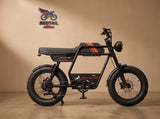
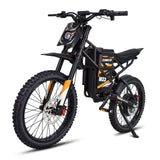
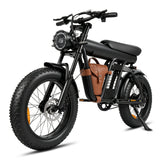
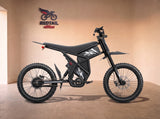
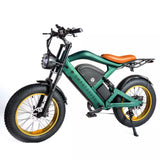
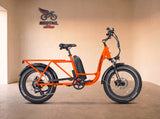
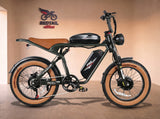
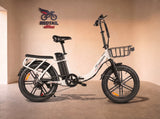
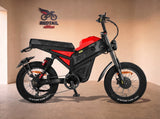
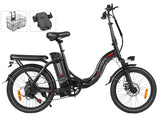
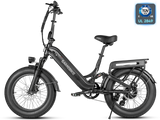
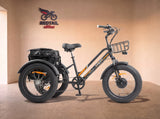
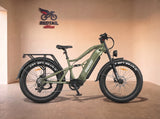

Quick Answer. The best electric bike Buffalo riders can buy for most rides is the VTUVIA CMB 8-Speed at $1,399, a 500 W Class 2 as it ships. New York's line is "an electric motor of less than seven hundred fifty watts" that stops assisting at 20 mph (VTL § 102-c). Four picks sit inside it; four ride as limited use motorcycles.
The CMB 8-Speed is $1,199 with code REDTAIL200 through November 30; for snow, the META26 on 26 x 3.0 in Innova tires; for a walk-up or the bus, the folding META20; for groceries and kids, the G30-CARGO 2.0.
If you hold a driver license and want more motor than New York's 750 W line allows an e-bike, the FAT-AWD 2.0, Soletri II, E-325 and TIGER RE follow, each a limited use motorcycle in New York. All 8 ship free within the contiguous United States.

7,188 Buffalo street blocks graded on USGS 1-meter lidar · all 35 of the City's neighborhoods · 8 bikes matched to eight ways of riding · speeds worked out for your weight in January air · New York's statutes, the DMV's moped rules, Buffalo's code and NFTA's bus and rail rules read in the original. Prices and stock read from our store on November 18, 2026.
Written and reviewed by Milad Ghobadibeygvand, BScN (Western University, 2014), Redtail eBikes. Last verified: November 18, 2026. Corrections: support@redtailebikes.com.
Buffalo's streets will not test a motor. Half of its graded blocks pitch 0.8% or less over their steepest 30 meters, one in ten reaches 2.2%, and the steepest street this guide confirmed from the air, Michigan Avenue in Ellicott, pitches 5.8% (USGS lidar).
The winter tests everything else. The airport averages 95.4 inches of snow a year, 123.7 mornings at 32°F or colder and 48.6 days that never climb above freezing (NOAA normals). And New York decides which bikes count as e-bikes at all, then keeps them off public land until the land's manager posts it open (VTL § 1242(4)).
A flat city, a long winter, a strict state. So this guide chooses on the law, the tires and where you may ride first, and on the motor last.
It matches eight ways of riding Buffalo to 8 bikes from our shelf and shows the arithmetic: each maker's weight, your weight, the city's measured grades and January air. Each speed names the rider weight it was worked out for.
Start here. Find the row that sounds like you. The fourth column says how New York classes that bike, and the last names the one fact that would send you to a different one.
| Your situation | Start with | Price | New York calls it | Where the answer changes |
|---|---|---|---|---|
| A commute, every month of the year | Buy the CMB | $1,399 | an e-bike (§ 102-c) | your street is posted over 30 mph: New York keeps e-bikes off it, so plan the route first (the law) |
| Riding through the snow months | Buy the META26 | $1,529 | an e-bike (§ 102-c) | you want both wheels driven: the FAT-AWD 2.0 is a limited use motorcycle in New York, so read its card first |
| Stairs, a small apartment or the bus | Buy the META20 | $1,529 | an e-bike (§ 102-c) | you carry it up more than a flight: weigh 63.4 lb against the CMB at 60 lb with rear rack and fenders, which does not fold |
| Groceries or a child, no car | Buy the G30-CARGO | $1,444 | an e-bike (§ 102-c) | you carry more than the long-tail's rating with you on board: the E-325 is rated for 550 lb, as a limited use motorcycle |
| Two-wheel drive for snow and power | Buy the FAT-AWD 2.0 | $1,444 | a limited use motorcycle | you want a New York e-bike you can ride without a registration: the META26 is one |
| Three wheels and a wide seat | Buy the Soletri II | $2,799 | a limited use motorcycle | you need it to count as a bicycle in New York: its 750 W rear-mounted motor is not under the state's 750 W line, so read the law first |
| Deliveries without a van | Buy the E-325 | $3,599 | a limited use motorcycle | your loads fit a long-tail: the G30-CARGO is a New York e-bike and needs no registration |
| Retro style first | Buy the TIGER RE | $1,399 | a limited use motorcycle | you are taller than 5 ft 9 in: Qiolor's published window stops there, so start with the CMB |
Which electric bike Buffalo riders should buy
The eight bikes come from 4 makers, and you can buy every one from us, on its card below. Each card prints the maker's own figures and the maker's own words for its speed setting. The speed table gives every pick's speed for a 250 lb rider on the city's grades in January air.
Those picks were checked against 1,344 riders on paper: six body weights, seven heights, two fitness levels and two riding histories, in each of the eight situations. 636 found a pick whose published height window and load rating both hold the rider; the rest are set out in Limitations.
New York e-bikes first. These four have motors under 750 W, a throttle that stops at 20 mph as they ship, and pedals: a Class 2 in New York's terms. You may ride one from age 16 on streets posted 30 mph or less (VTL § 1242), and it is not registered: in the DMV's words, "A bicycle with electric assist does not qualify for registration as a motorcycle, limited-use motorcycle, moped, or ATV" (DMV).
A year-round commute on Buffalo's streets
Buffalo's commute is short and flat, and the hard part is the weather. One graded block in ten pitches 2.2% or more over its steepest 30 meters, while the airport records 123.7 mornings a year at 32°F or colder (USGS lidar; NOAA normals).
The test for this situation: a 250 lb rider pedaling easily on a January afternoon holds 12 mph or more on the 2.2% pitch one block in ten reaches. The CMB holds 19.2 mph there.

VTUVIA CMB 8-Speed
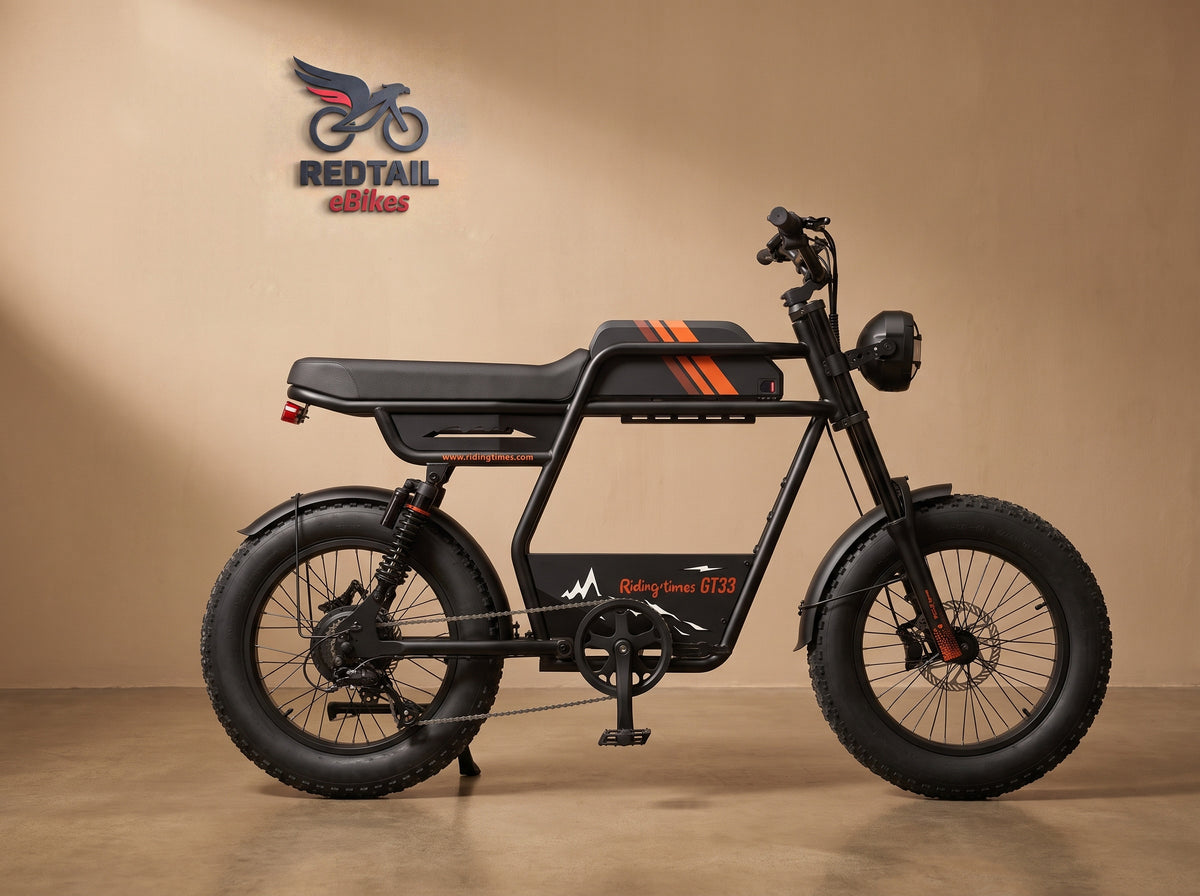
$1,399The CMB puts its 500 W mid-drive motor (VTUVIA prints its peak as 820 W in the spec table and 750 W on the page banner) at the cranks, so it works through a Shimano 8-speed, with 175 N·m of torque behind a cadence and a torque sensor (VTUVIA's page).
For a Buffalo winter, VTUVIA's page says: "The bike is built to the IP67-rated standard, making it suitable for riding through creeks, mud, and snow." It comes with aluminum fenders and a rear rack included and a 150 lux headlight and a rear light on the main battery (VTUVIA's page).
It stops on LOGAN hydraulic disc brakes, 160 mm rotors and rolls on 26 in puncture-resistant tires (2.4 in in the spec table, 2.6 in on the feature card). It weighs 60 lb with rear rack and fenders, and VTUVIA's spec table lists "Safety certifications UL2271(Battery) UL2849(E-bike System)" (VTUVIA's page).
The number that decides it: 175 N·m at the cranks through a Shimano 8-speed, for $1,399.
List price: VTUVIA lists it at $1,899 and sells it for $1,399 on its own store.
Code REDTAIL200: through 11:59 p.m. Pacific on November 30, 2026, it takes $200 off at checkout, so the CMB comes to $1,199, and the button on this card applies it for you.
Our full review: VTUVIA CMB 8-Speed review
In Buffalo: VTUVIA's page says "the default maximum speed is set to 20 MPH, which can be adjusted according to user preferences". New York's Class 2 must stop assisting at 20 mph, so a raised limit takes the bike out of the state's e-bike class. At 250 lb and an easy effort you hold 12.6 mph up Michigan Avenue, the steepest street this guide confirmed.
Best for: You, if you are 5 ft 1 in to 6 ft 1 in and ride to work all year on streets posted 30 mph or less. Not right for: A long-tail's load: the G30-CARGO is rated for 440 lb total.
Ships free within the contiguous United States, dispatched within 1–3 business days · price-matched to VTUVIA's own store · Shop Pay, Apple Pay, Google Pay or Klarna at checkout · we handle the warranty claim with VTUVIA
Takeaway
Commuting year-round: the CMB at $1,399, a mid-drive with an eight-speed and a frame rated to IP67 by its maker.
Snow, slush and potholes, on wider tires
The airport averages 95.4 inches of snow a year and 71.0 days with an inch or more on the ground (NOAA normals). Tire width is the bike part that meets that snow.
The test for this situation: tires 3.0 inches wide or wider in the maker's own figure. Of the four New York e-bikes here, the META26 clears it on full-size 26-inch wheels.

Eunorau META26
$1,529The META26 rolls on 26 x 3.0 in Innova tires, wide enough for the slush a plow leaves at the curb, with fenders included (Eunorau's page).
Its 500 W rear hub motor gives up to 55 N·m through a torque sensor, a thumb throttle and a Shimano 7-speed, and Eunorau fits hydraulic brake levers with a motor cutoff switch (Eunorau's page). The battery is a 48 V, 15 Ah battery (a second 15 Ah optional).
Eunorau's spec strip reads "UL CERTIFIED Yes".
The number that decides it: 26 x 3.0 in Innova tires on a 68.4 lb bike, for $1,529.
List price: Eunorau lists it at $1,699 and sells it for $1,529 on its own store.
Our full review: Eunorau META26 review
In Buffalo: Eunorau ships it at 20 mph and its spec strip reads "Speed limited Unlockable". Unlock it and the bike assists past New York's 20 mph Class 2 line, so it is no longer a New York e-bike. On Michigan Avenue, at 250 lb, you hold 12.3 mph.
Best for: You, if you are 5 ft 4 in to 6 ft 3 in and keep riding when the snow comes. Not right for: A rider under 5 ft 4 in: the META20 fits from 5 ft 1 in.
Ships free within the contiguous United States, dispatched within 1–3 business days · price-matched to Eunorau's own store · Shop Pay, Apple Pay, Google Pay or Klarna at checkout · we handle the warranty claim with Eunorau
Takeaway
Snow months on a New York e-bike: the META26 at $1,529, on 26 x 3.0 in Innova tires with fenders included.
A walk-up, Metro Rail or a car trunk
57.0% of Buffalo's households rent their home (American Community Survey, table B25003), and a rented flat rarely comes with a garage. A folding frame is how a bike fits a closet, a trunk or a bus.
The test for this situation: two wheels and a frame the maker says folds. NFTA-Metro adds its own reason to choose 20-inch wheels: "Folding bikes with wheels that are 20 inches or smaller can be taken on board Metro buses" (NFTA-Metro).

Eunorau META20
$1,529The META20 has a hinge-folding frame: in Eunorau's words, "A hinge-folding frame lets you collapse the bike" (Eunorau's page).
It runs a 500 W rear hub motor with up to 55 N·m, a torque sensor, a thumb throttle and a Shimano 7-speed, on 20 x 3.0 in Kenda tires, and Eunorau fits hydraulic brake levers with a motor cutoff switch. It weighs 63.4 lb, and Eunorau gives its folded size as about 105 x 78 x 56 cm folded (41 x 31 x 22 in) (Eunorau's page).
Eunorau's spec strip reads "UL CERTIFIED Yes".
The number that decides it: Folds, on 20-inch wheels, for $1,529.
List price: Eunorau lists it at $1,699 and sells it for $1,529 on its own store.
Our full review: Eunorau META20 review
In Buffalo: Fold it and NFTA's own rule lets it on a Metro bus. Metro Rail takes it folded or not, two bikes to a car. It ships at 20 mph with the same "Unlockable" line on Eunorau's strip, and unlocked it leaves New York's e-bike class.
Best for: You, if you are 5 ft 1 in to 6 ft 1 in and your bike lives in an apartment or rides the bus. Not right for: Carrying it up stairs every day at 63.4 lb: the CMB is lighter at 60 lb with rear rack and fenders and does not fold.
Ships free within the contiguous United States, dispatched within 1–3 business days · price-matched to Eunorau's own store · Shop Pay, Apple Pay, Google Pay or Klarna at checkout · we handle the warranty claim with Eunorau
Takeaway
Stairs, the bus or a trunk: the META20 at $1,529, on 20-inch wheels that NFTA lets on board.
Groceries and kids without a car
22.6% of Buffalo's households have no vehicle (American Community Survey, table B08201). For them, a bike has to carry the groceries home.
The test for this situation: a load rating of 300 lb or more in the maker's own figure, and a rear rack or a long-tail named by the maker. The G30-CARGO 2.0 clears it with the highest load rating of the four New York e-bikes here.

Eunorau G30-CARGO 2.0
$1,444The G30-CARGO 2.0 is a long-tail: a long-tail rear rack Eunorau rates for optional child seats. Eunorau rates it for 440 lb total, a figure that includes the rider, any passengers (with optional child seats), and cargo (Eunorau's page).
It pulls with a 500 W geared rear hub motor and up to 65 N·m through a Shimano 7-speed, on 20 x 3.0 in Kenda tires, and Eunorau fits hydraulic brake levers with a motor cutoff switch. It weighs 78 lb (Eunorau's page).
Eunorau's spec strip reads "UL CERTIFIED Yes".
The number that decides it: Rated for 440 lb total, rider and cargo together, for $1,444.
List price: Eunorau lists it at $1,699 and sells it for $1,444 on its own store.
Our full review: Eunorau G30-CARGO 2.0 review
In Buffalo: At 250 lb, before any cargo, you hold 12.0 mph up Michigan Avenue, and every pound on the rack slows the climb. It ships at 20 mph with Eunorau's "Unlockable" line, and an unlocked G30 is no longer a New York e-bike.
Best for: You, if you are 5 ft 1 in to 6 ft 2 in and carry a child seat or a week of groceries. Not right for: A walk-up: the META20 folds.
Ships free within the contiguous United States, dispatched within 1–3 business days · price-matched to Eunorau's own store · Shop Pay, Apple Pay, Google Pay or Klarna at checkout · we handle the warranty claim with Eunorau
Takeaway
Groceries or a child seat: the G30-CARGO 2.0 at $1,444, rated for 440 lb total.
Four with more motor, and New York's law on each card. These four have a 750 W motor or two motors. New York's e-bike definition stops below that, so the state classes each as a limited use motorcycle: "A limited use vehicle having only two or three wheels, with a seat or saddle for the operator" (VTL § 121-b).
Each ships with a top speed of 20 mph or less, which is the class the DMV calls C. You need a driver license and a registration to ride one on Buffalo's streets, and each card sets out the DMV's rule (DMV).
Power and all-wheel drive for every season
Snow on the ground takes traction before it takes power. A second driven wheel is the hardware answer, and it moves the bike into another class in New York.
The test for this situation: a front and a rear motor in the maker's own words, on tires 3.0 inches wide or wider. The FAT-AWD 2.0 clears it. With two 500 W hub motors, front and rear (1,000 W together), it is over New York's e-bike line, so the law on its card is the one that applies.

Eunorau FAT-AWD 2.0
$1,444The FAT-AWD 2.0 drives both wheels: two 500 W hub motors, front and rear (1,000 W together), up to 110 N·m (Eunorau's page). In Eunorau's words: "You can switch between front-wheel, rear-wheel, and dual-motor drive."
It rolls on 26 x 4.0 in Kenda Krusade Sport fat tires with an RST Guide suspension fork with 95 mm travel, and Eunorau names its ground as "suitable for pavement, gravel roads, sand, snow, and moderate off-road trails" (Eunorau's page). It weighs 81.5 lb step-over, 79.4 lb step-thru and Eunorau rates it for 375 lb total: "The payload includes the rider, cargo, and any added accessories."
Eunorau fits hydraulic brake levers with a motor cutoff switch; the sensor is a torque sensor on the page's spec table; the product record says cadence sensor. Eunorau's spec strip reads "UL CERTIFIED Yes" (Eunorau's page).
The number that decides it: Two driven wheels and up to 110 N·m, for $1,444.
List price: Eunorau lists it at $1,699 and sells it for $1,444 on its own store.
In New York: limited use motorcycle, Class C (121-b: 20 mph or less); 102-c fails on the motor (1,000 W). The DMV asks for a driver license and a registration, registers only a certified model and bars it from sidewalks (DMV; VTL § 121-b). Ask us which certification the maker holds before you order.
Our full review: Eunorau FAT-AWD 2.0 review
In Buffalo: Even at 250 lb you hold 18.1 mph up Michigan Avenue, the most of any bike here. At 20 mph as it ships it is a Class C limited use motorcycle; unlocked past 20 it becomes Class B, which in the DMV's table makes a helmet and insurance required.
Best for: You, if you are 5 ft 3 in to 6 ft 1 in, hold a driver license and want both wheels pulling in the snow. Not right for: Riding without a registration or on bike paths: the META26 is a New York e-bike.
Ships free within the contiguous United States, dispatched within 1–3 business days · price-matched to Eunorau's own store · Shop Pay, Apple Pay, Google Pay or Klarna at checkout · we handle the warranty claim with Eunorau
Takeaway
All-wheel drive on 4-inch tires: the FAT-AWD 2.0 at $1,444, ridden in New York as a limited use motorcycle.
Mostly the throttle, and no bicycle seat
Some riders want to sit, not perch, and to let the throttle do the work. A trike with a long seat answers both, and in New York its motor size decides its class.
The test for this situation: three wheels and a seat the maker describes as something other than a bicycle saddle. The Soletri II clears it, as a limited use motorcycle at its 750 W rear-mounted motor.
If you are back on a bike after years off, this guide matches you to three wheels in every situation, and the two trikes on this page are the Soletri II and the E-325; both are limited use motorcycles in New York at their 750 W motors, so read the law before you order.

Addmotor Soletri II M-366X
$2,799The Soletri II seats you on a 23.5 x 8.5 in banana seat, over three wheels and 20 x 4.0 in Kenda Gigas puncture-resistant fat tires, with a half-twist throttle with a power-cut switch (Addmotor's page).
Addmotor fits Tektro Aries mechanical disc brakes with 180 mm rotors, and a parking brake, a differential and aluminum fenders front and rear, and rates it for 450 lb (Addmotor's page). It weighs about 130 lb with the battery (Addmotor's answer on its page).
The battery is a 48 V, 20 Ah Samsung battery Addmotor calls UL-certified.
The number that decides it: Rated for 450 lb on three wheels, for $2,799.
List price: Addmotor's page strikes $3,099 beside the $2,799 it charges.
Code REDTAIL300: through 11:59 p.m. Pacific on November 30, 2026, it takes $300 off at checkout, so the Soletri II comes to $2,499, and the button on this card applies it for you.
In New York: limited use motorcycle, Class C (121-b: 20 mph or less); 102-c fails on the motor (750 W). The DMV asks for a driver license and a registration, registers only a certified model and bars it from sidewalks (DMV; VTL § 121-b). Ask us which certification the maker holds before you order.
Our full review: Addmotor Soletri II M-366X review
In Buffalo: At 250 lb you hold 13.9 mph up Michigan Avenue. At 32.7 in overall (Soletri II), 31.5 in (Herotri II) it is under New York's 36-inch width line, so its 750 W rear-mounted motor is what puts it in the limited use motorcycle class.
Best for: You, if you are 5 ft 2 in to 6 ft 2 in, hold a driver license and want a seat and three wheels under you. Not right for: Riding without a registration: the G30-CARGO carries more than a basket and is a New York e-bike.
Ships free within the contiguous United States, dispatched within 1–3 business days · price-matched to Addmotor's own store · Shop Pay, Apple Pay, Google Pay or Klarna at checkout · we handle the warranty claim with Addmotor
Takeaway
Three wheels and a banana seat: the Soletri II at $2,799, registered in New York as a limited use motorcycle.
A small business without a cargo van
A van costs a business a parking space, insurance and gas. A front-box trike carries a van's short-trip work at a fraction of its footprint.
The test for this situation: three wheels, a load rating of 500 lb or more and a cargo box in the maker's own words. The E-325 clears it.

Addmotor E-325
$3,599The E-325 carries a 36 x 25 x 23 in cargo box with a rain canopy ahead of the rider, and Addmotor rates it for 550 lb (Addmotor's page).
It runs a 750 W rear-drive motor with 7-level pedal assist with a torque sensor and a Shimano Tourney 7-speed, stops on hydraulic disc brakes on all three wheels and a parking brake, and tops out at up to 15 mph. It weighs 198 lb with the cargo box (Addmotor's page).
The battery is a 48 V, 20 Ah Samsung battery Addmotor calls UL-certified.
The number that decides it: 550 lb in a box with a rain canopy, for $3,599.
List price: Addmotor's page strikes $4,999 beside the $3,599 it charges.
Code REDTAIL400: through 11:59 p.m. Pacific on November 30, 2026, it takes $400 off at checkout, so the E-325 comes to $3,199, and the button on this card applies it for you.
In New York: limited use motorcycle, Class C (121-b: 20 mph or less); 102-c fails on the motor (750 W). The DMV asks for a driver license and a registration, registers only a certified model and bars it from sidewalks (DMV; VTL § 121-b). Ask us which certification the maker holds before you order.
Our full review: Addmotor E-325 review
In Buffalo: Loaded or not, it stops at up to 15 mph: at 250 lb you hold 12.2 mph up Michigan Avenue. At 33 in overall it fits under New York's 36-inch width line, and its 750 W rear-drive motor makes it a Class C limited use motorcycle.
Best for: You, if you are 5 ft 2 in to 6 ft 4 in, hold a driver license and run deliveries across town. Not right for: Personal errands: the G30-CARGO carries a child seat and needs no registration.
Ships free within the contiguous United States, dispatched within 1–3 business days · price-matched to Addmotor's own store · Shop Pay, Apple Pay, Google Pay or Klarna at checkout · we handle the warranty claim with Addmotor
Takeaway
A business on three wheels: the E-325 at $3,599, rated for 550 lb with a covered box.
For a rider who loves classic bikes and cars
Some riders choose a bike the way they choose a car, by how it looks parked at the curb. The moped look is its own reason to buy.
The test for this situation: the maker's own words call the style retro or moped. The TIGER RE clears it, and with its 750 W motor (1,100 W peak) it rides in New York as a limited use motorcycle.

Qiolor TIGER RE
$1,399Qiolor builds the TIGER RE for the look: "Retro moped style meets everyday power" (Qiolor's page).
Under the long seat sits a 48 V, 35 Ah removable battery; the 750 W motor (1,100 W peak) gives 85 N·m through 20 x 4.0 in fat tires, with a rear hydraulic shock. It weighs 98 lb and Qiolor rates it for 400 lb (Qiolor's page).
Qiolor's page shows "UL 2849 Certified".
The number that decides it: A 48 V, 35 Ah removable battery in a 98 lb retro frame, for $1,399.
List price: Qiolor lists it at $2,099 and sells it for $1,399 on its own store.
In New York: limited use motorcycle, Class C (121-b: 20 mph or less); 102-c fails on the motor (750 W). The DMV asks for a driver license and a registration, registers only a certified model and bars it from sidewalks (DMV; VTL § 121-b). Ask us which certification the maker holds before you order.
Our full review: Qiolor TIGER RE review
In Buffalo: Qiolor's page says "The default maximum speed is set to 20 MPH, which can be adjusted according to user preferences". As shipped it is a Class C limited use motorcycle in New York; raised past 20 it becomes Class B, which in the DMV's table makes a helmet and insurance required. At 250 lb you hold 14.7 mph up Michigan Avenue.
Best for: You, if you are 5 ft 1 in to 5 ft 9 in, hold a driver license and want a bike that looks like a moped. Not right for: A rider taller than 5 ft 9 in: Qiolor's window stops there, so look at the CMB.
Ships free within the contiguous United States, dispatched within 1–3 business days · price-matched to Qiolor's own store · Shop Pay, Apple Pay, Google Pay or Klarna at checkout · we handle the warranty claim with Qiolor
Takeaway
Retro style with range: the TIGER RE at $1,399, on a 48 V, 35 Ah removable battery.
Every pick side by side
Prices are our store's on November 18, 2026; every other cell is the maker's own figure, read on its store page or specification table. Where a maker prints two figures for one thing, the cell prints both and the arithmetic on this page uses the heavier weight and the narrower tire. The four New York e-bikes come first.
| Bike | Price | Motor | Weight | Load rating | Rider height | Tires |
|---|---|---|---|---|---|---|
| VTUVIA CMB | $1,399 | 500 W mid-drive, 175 N·m | 60 lb with rear rack and fenders | 300 lb | 5 ft 1 in to 6 ft 1 in | 26 in puncture-resistant tires (2.4 in in the spec table, 2.6 in on the feature card) |
| Eunorau G30-CARGO | $1,444 | 500 W geared rear hub, up to 65 N·m | 78 lb | 440 lb total | 5 ft 1 in to 6 ft 2 in | 20 x 3.0 in Kenda |
| Eunorau META20 | $1,529 | 500 W rear hub, up to 55 N·m | 63.4 lb | 286 lb | 5 ft 1 in to 6 ft 1 in | 20 x 3.0 in Kenda |
| Eunorau META26 | $1,529 | 500 W rear hub, up to 55 N·m | 68.4 lb | 286 lb | 5 ft 4 in to 6 ft 3 in | 26 x 3.0 in Innova |
| Qiolor TIGER RE | $1,399 | 750 W (1,100 W peak), 85 N·m | 98 lb | 400 lb | 5 ft 1 in to 5 ft 9 in | 20 x 4.0 in fat tires |
| Eunorau FAT-AWD 2.0 | $1,444 | two 500 W hubs, front and rear (1,000 W together), up to 110 N·m | 81.5 lb step-over, 79.4 lb step-thru | 375 lb total | 5 ft 3 in to 6 ft 1 in | 26 x 4.0 in Kenda Krusade Sport fat tires |
| Addmotor Soletri II | $2,799 | 750 W rear-mounted | about 130 lb with the battery (Addmotor's answer on its page) | 450 lb | 5 ft 2 in to 6 ft 2 in | 20 x 4.0 in Kenda Gigas puncture-resistant fat tires |
| Addmotor E-325 | $3,599 | 750 W rear-drive | 198 lb with the cargo box | 550 lb | 5 ft 2 in to 6 ft 4 in | 20 x 2.4 in front, 24 x 3.0 in rear |
Each load rating is the maker's own figure, as each maker states it, under its own label: VTUVIA's "Total capacity", Eunorau's "Payload Capacity", Addmotor's "Payload" and Qiolor's "Max Load". Eunorau's G30-CARGO 2.0 page says its figure includes the rider, any passengers (with optional child seats), and cargo, and its FAT-AWD 2.0 page says the same of rider, cargo and accessories.
Recalls. No federal recall names Addmotor, Eunorau, Qiolor or VTUVIA. We searched the recall records the CPSC publishes by title, description and product name on November 18, 2026, each search first shown to return results on a control word (CPSC recall data). A clean recall record is all this search shows.

The makers on this page, with our profile of each brand:
- Addmotor: our Addmotor profile
- Eunorau: our Eunorau profile
- Qiolor: our Qiolor profile
- VTUVIA: our VTUVIA profile
Same street, different rider
On most Buffalo streets the motor carries you close to the 20 mph assist limit. On the 2.2% pitch one block in ten reaches, a 250 lb rider pedaling easily on a January afternoon holds 18.8 to 19.2 mph on the four New York e-bikes (Martin et al., 1998).
The steepest street this guide confirmed from the air is short. Michigan Avenue in Ellicott pitches 5.8% at its steepest and climbs 5.4% end to end over 134 feet (USGS lidar). Up it, a 190 lb rider holds 13.1 to 13.7 mph on the New York e-bikes, and a 250 lb rider 12.0 to 12.6.
Your weight moves those numbers more than your fitness does. Up that block, a 160 lb rider holds 1.8 to 1.9 mph more than a 250 lb rider on the same New York e-bike at the same easy effort. For a rider from 160 to 250 lb, trained legs add 0.6 to 1.0 mph over untrained ones (Chorley et al., 2020).

January air barely moves the speed. The normal January high at the airport is 32.1°F, and air that cold is denser, 1.26 kg per cubic meter against 1.219 at the year's average temperature. Worked through for riders of 160 to 250 lb, no pick moves by more than 0.1 mph between the two on Michigan Avenue.
The model takes nothing off for cold legs or a cold battery, because no cited figure supports one here. In Buffalo the cold costs you range and grip, and the winter section deals with both.
This table gives every pick on the grades you will meet, pedaling at an easy effort in January air. The motor-only column leaves your legs out.
| Bike | 2.2% block, 250 lb, January | 4.5% block, 190 lb, January | 4.5% block, 250 lb, January | Michigan Avenue 5.8%, 190 lb, January | Michigan Avenue 5.8%, 250 lb, January | Michigan Avenue 5.8%, motor only, 190 lb |
|---|---|---|---|---|---|---|
| FAT-AWD 2.0 | 20.0 mph | 20.0 mph | 20.0 mph | 19.6 mph | 18.1 mph | 17.7 mph |
| TIGER RE | 20.0 mph | 18.1 mph | 17.0 mph | 16.0 mph | 14.7 mph | 13.8 mph |
| Soletri II | 20.0 mph | 17.1 mph | 16.1 mph | 15.0 mph | 13.9 mph | 12.8 mph |
| CMB | 19.2 mph | 15.7 mph | 14.6 mph | 13.7 mph | 12.6 mph | 11.0 mph |
| META20 | 19.1 mph | 15.5 mph | 14.5 mph | 13.6 mph | 12.5 mph | 10.9 mph |
| META26 | 19.0 mph | 15.4 mph | 14.3 mph | 13.4 mph | 12.3 mph | 10.7 mph |
| E-325 | 15.0 mph | 15.0 mph | 14.4 mph | 13.0 mph | 12.2 mph | 11.0 mph |
| G30-CARGO | 18.8 mph | 15.1 mph | 14.1 mph | 13.1 mph | 12.0 mph | 10.4 mph |
How these speeds were worked out. Each speed balances what a grade and the air take from the bike against what goes in: the maker's rated watts at 80% efficiency, plus half the rider's critical power at 95%. Critical power comes from Chorley et al., 2020, which measured 3.19 W/kg untrained and 4.17 W/kg trained. Four limits apply to it, every time:
- Critical power is a hard, sustained effort, far above a commuting pace.
- Taking half of it as "easy" is this guide's own choice.
- The study's "untrained" riders still played sport every week.
- The sample was twenty men.
The air comes from the airport station's elevation of 693 feet and the January temperature (NOAA monthly normals). Rolling resistance and frontal area are the model's fixed constants. Each machine stops at its maker's own top speed: 20 mph, except the E-325 at up to 15 mph. Gearing and torque do not enter the model, so the cards print them, and trikes are worked out on two-wheeler terms, which can only flatter a trike.
The year-round pick: a mid-drive with 175 N·m and eight speeds, 12.6 mph up Michigan Avenue with a 250 lb rider pedaling easily, at $1,399.
Buy the CMB for daily ridingBuffalo eBike laws
Electric bikes in Buffalo follow New York's statutes, because the city has no e-bike law of its own. The City's code, current through 03-31-2026, has 196 sections that mention bicycles and none that mention an e-bike or a bicycle with electric assist (Buffalo City Code). The one local rule that reaches an e-bike is the Riverwalk's, in the trail section.
For the line in the other 49 states, read our state-by-state e-bike law guide.
What counts as an e-bike in New York
New York calls an e-bike a bicycle with electric assist: "A bicycle which is no more than thirty-six inches wide and has an electric motor of less than seven hundred fifty watts, equipped with operable pedals", in one of three classes (VTL § 102-c). Every limb has to hold, and the four larger machines on this page each fail the motor limb.
| Limb | The statute's words | What it means for you |
|---|---|---|
| Width | "no more than thirty-six inches wide" | reaches trikes and wide cargo builds first |
| Motor | "an electric motor of less than seven hundred fifty watts" | a 750 W motor is outside; the four picks at 750 W or more are limited use motorcycles |
| Class 2 speed | "not capable of providing assistance when such bicycle reaches a speed of twenty miles per hour" | a throttle bike must stop assisting at 20 mph |
| Class 3 | "Solely within a city having a population of one million or more" | a 25 mph Class 3 is not an e-bike in Buffalo |
| Standard | "meeting the equipment and manufacturing requirements for bicycles adopted by the Consumer Product Safety Commission under 16 C.F.R. Part 1512.1 et seq." | the federal bicycle standard, a limb no product page shows |
A bike outside the definition does not become a bicycle by default. New York's motor-vehicle definition covers "Every vehicle operated or driven upon a public highway which is propelled by any power other than muscular power" and lists among its exceptions "bicycles with electric assist as defined in section one hundred two-c of this article" (VTL § 125). Unlock a New York e-bike past 20 mph and that exception no longer fits it.
Streets, bike lanes and sidewalks
On a New York e-bike you ride where a bicycle rides, with five more rules (VTL § 1242):
- Speed limits on the street. An e-bike "may only be operated on highways with a posted speed limit of thirty miles per hour or less", including designated bike lanes. Main roads posted higher are off the map unless a local rule says otherwise, and Buffalo has none.
- No sidewalks. "No bicycle with electric assist shall be operated on a sidewalk", unless a local law allows it, and Buffalo's code has none. You "shall yield the right of way to pedestrians" wherever you meet them.
- Age 16. "No person less than sixteen years of age shall operate a bicycle with electric assist."
- 20 mph. "No person shall operate a class one or class two bicycle with electric assist in excess of twenty miles per hour."
- The motor stops. Every e-bike must run so that "the electric motor is disengaged or ceases to function when the brakes are applied or the rider stops pedaling", or with a throttle "engaged through a switch or mechanism that, when released, will cause the electric motor to disengage or cease to function". The makers of the META26, META20, G30-CARGO, FAT-AWD 2.0 and Soletri II print a motor cutoff on the brake levers or the throttle in their own specifications. For the CMB, E-325 and TIGER RE, the delivery-day check tests all three of the statute's routes on the bike you receive.
A violation of the age, sidewalk, yield, speed or Class 3 rules is a civil offense: "A violation of the provisions of subdivision two, five, six, nine, or ten of this section shall result in a civil fine not to exceed fifty dollars" (VTL § 1242(12)).
The label rule is separate. A seller needs "a manufacturer's label which shall include the following information: the class, maximum motor-assisted speed, and motor wattage" on every e-bike it sells (VTL § 1242(11)), and you need it on the bike you ride on the street.
A helmet is the law for one class only. "No person shall ride upon, propel or otherwise operate a class three bicycle with electric assist unless such person is wearing a helmet" (VTL § 1238), and Class 3 is barred outside New York City, so on a Buffalo e-bike a helmet is your choice to make.
Trails, parks and the Riverwalk
New York closes public land to e-bikes until its manager opens it: "No person shall operate a bicycle with electric assist on any public lands or property, other than a highway exclusive of any greenway running adjacent to or connected with a highway", except on land "designated and posted for travel by bicycles with electric assist" (VTL § 1242(4)). In Buffalo, two managers have opened stretches.
The Canal Corporation opens its trails to e-bikes in its own words: "Class 1 & 2 E-bikes not capable of pedal-assist beyond 20 mph are allowed", at 15 mph, dawn to dusk (Canal Corporation). Inside the city that covers 3.6 miles of its stretches of the Shoreline Trail and the Riverwalk on the New York trails register.
State Parks opens Buffalo Harbor State Park's paved paths: "Class 1 and 2 electric bicycles may be operated on (i) boardwalks and (ii) shared use or multi-use trails and paths that are paved or improved", at 15 mph (State Parks policy). That is 1.3 miles inside the city.
The City's own paths carry no designation on the register, so they are closed by the statute (VTL § 1242(4)): 14.3 miles, with 8.0 more where the record names no manager and 0.2 on federal land whose rule it does not address.
| On the register | Trail pieces | Miles | Examples |
|---|---|---|---|
| Open to Class 1 and 2: the Canal Corporation's stretches | 10 | 3.6 | Riverwalk, Shoreline Trail and Shoreline Trail (Buffalo) |
| Open to Class 1 and 2: State Parks' paved paths | 6 | 1.3 | Buffalo Harbor State Park |
| Closed: no designation (VTL § 1242(4)(a)) | 29 | 14.3 | Buffalo Riverwalk Trail, Florida St Greenway, Hoyt Lake Path and Kensington Expressway Bridge Greenway |
| Manager not on the record | 21 | 8.0 | Buffalo Riverwalk, Elmwood-Forest Off Street Path, Jesse Kregal Pathway and Niagara River Bridge Path |
| Federal land, rule not addressed | 2 | 0.2 | Riverwalk and Shoreline Trail |
Delaware Park, the Outer Harbor and the rail trail. In Delaware Park, the Hoyt Lake Path and the Scajaquada Path, 1.7 miles together, are City paths with no designation on the register (the City's park map), so the statute keeps an e-bike off them.
On the waterfront, "The Shoreline Trail runs along the waterfront connecting Canalside to the Outer Harbor" (Erie Canal Harbor Development Corporation), and a 2.0-mile stretch of it inside the City's Outer Harbor Parkway (the City's park map) carries no designation either. Nor do the 0.6 miles of the North Buffalo Rails to Trails inside the city, a path the Town of Tonawanda manages.
The Riverwalk has a rule of its own. Buffalo's City Code says "No person shall operate or drive any vehicle which is propelled by any power other than muscular power on that property in the City known as the "Riverwalk."" (City Code § 91-1).
The Canal Corporation's stretches of the Riverwalk and the Shoreline Trail run along the same waterfront. Where a sign names the Riverwalk, follow the City's rule and keep the motor off or walk the bike: it is the stricter of the two, and no published record says which governs that path.
The four with more motor: limited use motorcycles
New York defines a limited use motorcycle as "A limited use vehicle having only two or three wheels, with a seat or saddle for the operator", and "A limited use motorcycle having a maximum performance speed of not more than twenty miles per hour shall be a class C limited use motorcycle" (VTL § 121-b).
The FAT-AWD 2.0, Soletri II, E-325 and TIGER RE all ship at 20 mph or less with a motor of 750 W or more, so each is Class C (VTL § 121-b).
The DMV sets the rules for one. "You must have a driver license and register your moped to drive it on streets and highways", and "You can never operate a moped on a sidewalk" (DMV). A Class C rides in the "right-hand lane or shoulder only (except when making a left turn)", with its headlight on; the DMV recommends a helmet, eye protection and insurance for Class C.
The registration rule is the one to read before you order: "Only a certified model of limited use motorcycle can get a registration in New York State (only the manufacturer can certify a moped)" (DMV).
Bought from outside the state, as every bike on this page is, the DMV adds: "If you purchase a moped from outside of New York State, you must register your moped before you can drive it on streets or highways" (DMV). Email us the model before you order and we will put the question to its maker.
The battery law
New York bars selling a lithium-ion battery for an e-bike or a limited use motorcycle unless it "has been certified by an accredited testing laboratory for compliance with a battery standard referenced in UL 2849, UL 2271 or EN 15194" (General Business Law § 495-a).
Every pick on this page carries a UL statement on its maker's own page, and each card quotes it. The law also says where to look: "Such certification or the logo, wordmark, or name of such accredited testing laboratory shall be displayed on packaging or documentation at the time of sale" (General Business Law § 495-a), so check the box and the papers the day the bike arrives.
Our battery guide explains what UL 2849 and UL 2271 each certify.
Bike lanes and where to ride
The street network is where a New York e-bike belongs. The Greater Buffalo-Niagara Regional Transportation Council's bike network puts 66.1 miles of on-road bikeways inside the city: 39.7 of dedicated bike lanes, 21.0 of shared-lane markings, 2.9 of lanes with contraflow, 2.3 of cycle track and 0.2 of signed routes (GBNRTC on-road layer). We measured every line on its geometry and counted only the miles inside the city.
| Type, in GBNRTC's layer | Miles inside Buffalo |
|---|---|
| Dedicated bike lanes | 39.7 |
| Shared-lane markings | 21.0 |
| Dedicated lanes with contraflow | 2.9 |
| Cycle track | 2.3 |
| Signed routes | 0.2 |
| All on-road types | 66.1 |
| Off-road greenway trails | 32.4 |
The same council maps 32.4 miles of off-road greenway trails in the city (GBNRTC off-road layer), and 10.0 miles of the Empire State Trail run through it as the Shoreline Trail (Empire State Trail segments). On an e-bike, an off-road path is open only where its manager has opened it, so check the trail rules before you take one.

Is Buffalo a bike-friendly city?
On the flat, yes, and the lanes are there. A painted lane is the commonest bikeway in the city, at 39.7 of the 66.1 on-road miles, while 21.0 are shared-lane markings, a painted symbol in a lane you share with cars (GBNRTC on-road layer). The miles are not spread evenly: every neighborhood gets its own row below with its lanes and its grades.
Try before you buy
Reddy Bikeshare puts 156 stations inside the city on GBNRTC's 2025 map (GBNRTC Reddy layer), and a short ride on a shared bike shows you which streets suit you before you buy your own.
Buffalo's bike shops are listed, with their brands and hours, in our Buffalo e-bike shop directory.
Buses, Metro Rail and the Peace Bridge
NFTA-Metro takes bikes on both its buses and its trains. "All Metro buses are equipped with a bike rack that can hold 2 bikes", and "Folding bikes with wheels that are 20 inches or smaller can be taken on board Metro buses" (NFTA-Metro bike guide). On the train, "NFTA-Metro allows up to 2 bikes on each Metro Rail car", and at the underground stations NFTA asks you to "Use the stairs or the elevator (not the escalator)".
NFTA's guide sets no separate rule for e-bikes and no weight or tire limit for the bus rack. A rack fits what it fits, so a heavy or fat-tired bike is a question for the rack itself on your first trip (NFTA-Metro bike guide).
The guide's one exclusion is plain: "Recumbent bicycles do not fit on Metro bus bike racks, and they cannot be carried on board." The rack is loaded by swinging its arm "over the top of the front wheel of your bike" (NFTA-Metro bike guide), a step written for a two-wheeler, so a trike stays off the bus.
That makes the META20 the pick for a bus commute: it folds on 20-inch wheels, the size NFTA lets on board.
Riding across the Peace Bridge
"Pedestrians and bicyclists may cross the Peace Bridge at any time toll free", and "you must use the south (closest to the lake) sidewalk" (Peace Bridge Authority). "Pedestrians and bicyclists are required to carry the same identification as if you were traveling by automobile." The Authority's crossing page names pedestrians and bicyclists and no rule for e-bikes or mopeds, so ask the Authority before you take either across.
A lake-effect winter
Plan your bike around the winter, because Buffalo's is long. NOAA's 1991–2020 normals at Buffalo Niagara International Airport, 3.1 miles outside the city line, count 95.4 inches of snow a year, 25.6 days with an inch or more and 71.0 days with an inch or more on the ground (NOAA normals). January alone averages 26.7 inches (NOAA monthly normals).
The cold settles in rather than spiking. The normal January high at the airport is 32.1°F (NOAA normals) and the low 19.0°F; the airport averages 123.7 mornings at 32°F or colder, 48.6 days that never get above freezing and 3.5 mornings at zero or below (NOAA annual normals).
The last five years have run milder than the thirty-year normal. Counted day by day from the airport's own record, 2021 to 2025 averaged 110.2 frosty mornings and 36.2 days below freezing all day (NOAA daily record).
| At Buffalo Niagara International Airport, counted day by day | 1991–2020, days a year | 2021–2025, days a year |
|---|---|---|
| Low of 32°F or colder | 124.0 | 110.2 |
| High of 32°F or colder (it never thaws) | 48.7 | 36.2 |
| Low of 0°F or colder | 3.5 | 0.4 |
| An inch of snow or more | 25.6 | 23.4 |
| Snow on the ground, an inch or more | 70.8 | 60.4 |
| Freezing rain (glaze) reported | 6.9 | 5.2 |
| A gust of 40 mph or more | 3.4 | 2.8 |
The table counts the airport's daily record itself, so its 1991–2020 column differs slightly from NOAA's published normals above (124.0 frosty mornings against 123.7).
What the winter asks of a bike. Three things decide whether you keep riding in January:
- Tires. Snow and the slush a plow leaves at the curb want width. The META26 rolls on 26 x 3.0 in Innova, and the FAT-AWD 2.0 on 26 x 4.0 in Kenda Krusade Sport fat tires with both wheels driven.
- Fenders and lights. Salt water comes off the front wheel, and the sun sets at 4:41 p.m. in December against 8:55 p.m. in June at the airport (NOAA solar equations), so in December a ride that ends after 4:41 p.m. ends in the dark.
- Where the battery sleeps. Do the charging indoors and keep the pack inside between rides; VTUVIA's winter rule is "Never charge below 32°F (0°C)" (VTUVIA). Each maker's range figure comes with its own conditions, and your own January rides will show what yours does in the cold. For winter storage, the salt and the chain, read our winter e-bike maintenance guide.


The snow pick: the META26 rolls on 26 x 3.0 in Innova tires with fenders included, a New York e-bike under the 750 W line, at $1,529.
Buy the META26 for the snowHow steep Buffalo's streets are
Most of Buffalo is flat. Of the 7,188 street blocks graded here, half pitch 0.8% or less over their steepest 30 meters, one in ten reaches 2.2% and one in a hundred 4.5% (USGS lidar). Only 8 reach 6%, and 5 reach 8%.

The steepest pitch on the whole map, 9.9%, sits in a lane through a parking lot on the aerial photographs (USGS NAIP imagery), not on a street a rider would choose. These are the steepest climbs the air photos confirm as streets, each with its length:
- Michigan Avenue in Ellicott: 5.8% at its steepest, 5.4% end to end over 134 feet
- West Ferry Street in Elmwood Bidwell: 5.4% at its steepest, 3.7% end to end over 625 feet
- Babcock Street in Seneca Babcock: 5.2% at its steepest, 4.7% end to end over 411 feet
- Niagara Street in Black Rock: 5.2% at its steepest, 3.9% end to end over 185 feet
- South Park Avenue in First Ward: 5.1% at its steepest, 5.0% end to end over 275 feet
- Hopkins Street in Hopkins-Tifft: 5.1% at its steepest, 4.9% end to end over 324 feet
- Amherst Street in Central Park: 5.0% at its steepest, 4.3% end to end over 223 feet
- Kensington Avenue in Fillmore-Leroy: 4.9% at its steepest, 4.6% end to end over 313 feet
- Tyler Street in University Heights: 4.6% at its steepest, 4.1% end to end over 323 feet
The other short, steep block, Auburn Avenue at 8.7%, is a dead-end stub down to the rail line below the Niagara River bluff on the same photographs (USGS NAIP imagery), so this guide does not count it as a climb.
Pitch and grade are different numbers. A block's pitch is its steepest stretch of 30 meters or more; its grade runs end to end. A short ramp onto a bridge can pitch hard on a block that is flat overall, so this guide ranks blocks by pitch and prints the grade beside it.
Every neighborhood in Buffalo
The City maps 35 planning neighborhoods, covering 99.3% of its land, and every one gets a row (City of Buffalo neighborhoods). Each row gives the graded blocks there, the pitch one block in ten reaches, the bike lanes and greenways measured inside it, its residents, and its share of households with no vehicle.
Read yours before you buy. In Pratt-Willert, 49.0% of households have no car, against 22.6% for the whole city (ACS table B08201), a gap larger than either figure's margin of error. The grade column peaks in Ellicott, Fruit Belt and University Heights, where one block in ten pitches 3.2% or more; 13 of the 35 neighborhoods with enough blocks to measure stay under 2%.
All 35 neighborhoods: graded blocks, the pitch one block in ten reaches, bikeways, residents and car-free households
| Neighborhood | Graded blocks | One block in ten pitches | Bike lanes and greenways | Residents | No vehicle |
|---|---|---|---|---|---|
| Allentown | 95 | 3.0% | 2.5 mi | 3,973 | 18.7% |
| Black Rock | 124 | 2.5% | 2.5 mi | 5,167 | 40.9% |
| Broadway Fillmore | 523 | 1.9% | 3.9 mi | 12,306 | 34.9% |
| Central | 362 | 2.6% | 13.9 mi | 5,656 | 28.2% |
| Central Park | 170 | 2.1% | 1.8 mi | 5,662 | 9.1% |
| Delavan Grider | 152 | 2.4% | 1.8 mi | 5,065 | 29.3% |
| Ellicott | 214 | 3.4% | 1.0 mi | 2,749 | 34.9% |
| Elmwood Bidwell | 318 | 2.1% | 7.2 mi | 17,627 | 9.7% |
| Elmwood Bryant | 157 | 2.0% | 4.1 mi | 10,930 | 22.5% |
| Fillmore-Leroy | 161 | 2.0% | 0.8 mi | 6,525 | 23.6% |
| First Ward | 129 | 2.6% | 2.0 mi | 1,239 | 29.2% |
| Fruit Belt | 209 | 3.3% | 2.5 mi | 2,588 | 47.3% |
| Genesee-Moselle | 256 | 2.3% | 0.4 mi | 9,879 | 28.6% |
| Grant-Amherst | 80 | 2.5% | 2.5 mi | 4,040 | 32.5% |
| Hamlin Park | 115 | 1.9% | 1.6 mi | 6,918 | 21.3% |
| Hopkins-Tifft | 217 | 1.4% | 10.9 mi | 7,544 | 14.2% |
| Kaisertown | 118 | 1.5% | 0.9 mi | 4,617 | 18.6% |
| Kenfield | 126 | 1.3% | 0.2 mi | 7,500 | 30.4% |
| Kensington-Bailey | 255 | 1.4% | 0.6 mi | 14,374 | 15.8% |
| Lovejoy | 211 | 1.5% | 1.2 mi | 11,194 | 17.1% |
| Lower West Side | 163 | 2.4% | 1.8 mi | 6,756 | 45.7% |
| Masten Park | 274 | 2.4% | 0.8 mi | 7,751 | 31.8% |
| MLK Park | 142 | 2.2% | 1.3 mi | 3,697 | 36.1% |
| North Park | 295 | 1.4% | 0.5 mi | 17,074 | 12.5% |
| Parkside | 229 | 2.7% | 7.0 mi | 7,555 | 7.3% |
| Pratt-Willert | 199 | 1.4% | 3.6 mi | 3,752 | 49.0% |
| Riverside | 205 | 1.3% | 2.0 mi | 11,928 | 25.3% |
| Schiller Park | 169 | 1.9% | 0.0 mi | 8,989 | 29.4% |
| Seneca Babcock | 181 | 2.6% | 0.2 mi | 2,289 | 33.2% |
| Seneca-Cazenovia | 170 | 1.2% | 3.9 mi | 7,637 | 14.3% |
| South Park | 354 | 1.2% | 3.1 mi | 16,663 | 7.8% |
| University Heights | 264 | 3.2% | 2.7 mi | 11,902 | 19.5% |
| Upper West Side | 211 | 2.5% | 2.7 mi | 7,126 | 38.2% |
| West Hertel | 122 | 2.0% | 0.0 mi | 5,062 | 18.4% |
| West Side | 216 | 2.2% | 4.7 mi | 11,062 | 26.4% |
Names from the City's Neighborhood Boundaries layer; bikeways from GBNRTC's on-road and off-road layers, measured on the geometry; residents and car-free households from the Census Bureau's American Community Survey 2020–2024, spread over each tract's land. A neighborhood with fewer than ten graded blocks prints no percentile.
Lock it and bring it inside
Bike theft in Buffalo is half what it was a decade ago, and the bikes taken are worth twice as much. The Buffalo Police Department reported 178 bicycle larcenies to the FBI in 2025, 2.7% of all larcenies, at an average value of $770. In 2015 it reported 369, at an average of $388 (FBI Crime Data Explorer).
Those are reports, not bicycles, and the federal record does not separate an e-bike from a bicycle. It gives no figure by neighborhood.
| Year | Bicycle larcenies Buffalo police reported to the FBI | Share of all larcenies | Average value stolen |
|---|---|---|---|
| 2015 | 369 | 5.0% | $388 |
| 2016 | 444 | 6.2% | $430 |
| 2017 | 288 (police reported 11 of 12 months) | 4.8% | $353 |
| 2018 | 271 | 4.0% | $403 |
| 2019 | 131 (police reported 7 of 12 months) | 3.5% | $378 |
| 2020 | 132 (police reported 11 of 12 months) | 2.6% | $419 |
| 2021 | 132 | 2.5% | $558 |
| 2022 | 153 | 2.5% | $638 |
| 2023 | 150 | 2.3% | $689 |
| 2024 | 226 | 3.2% | $648 |
| 2025 | 178 | 2.7% | $770 |
| 2026 | 58 (police reported 6 of 11 months) | 2.0% | $849 |

At $1,399 and up, a bike on this page is worth more than the average one stolen. Bring it inside at night, and on the street lock the frame, not a wheel, to something bolted to the ground, as NFTA's own guide advises. Where the battery comes off, take it with you.
Is there a New York e-bike rebate?
Not from the state. The bill that would create one, the Ride Clean Rebate (S.1047), passed the Senate on June 13, 2025; its last action, on January 7, 2026, reads "referred to energy and telecommunications", and nothing has moved since (the Assembly's record; the full story on our New York law page).
Buffalo has a local one with limits. Shared Mobility Inc., the Buffalo nonprofit that runs Reddy Bikeshare, says: "This pilot rebate program is now available for eligible residents of Western New York" (Shared Mobility Inc.).
It is a $650 point-of-sale rebate for City of Buffalo and Niagara Falls residents who meet an income test, such as "Your household income is below 60% of the area median income (AMI)". Applicants fill out an interest form, and "you may be selected at random for participation in the program" (Shared Mobility Inc., read November 18, 2026).
The voucher is spent in person: "You can redeem your voucher in store at any of these qualifying Bike Shops" (Shared Mobility Inc.), and the page names 4 of them. It does not apply to a bike bought online, from us or anyone else.
The saving that is real today is on the shelf: every one of the 8 picks shows a higher price from its maker, listed or struck, beside what you pay, and every one ships free within the contiguous United States.
Nine checks before you buy
Run these nine checks before you order and again the day the bike arrives. Between them they test the bike against your body, Buffalo's streets, the winter and New York's law:
- Your height against the maker's window. Each card prints the range the maker publishes. Outside it, choose the bike whose window holds you.
- Your weight plus your load against the rating. Add yourself, your bag and anything on the rack, and stay under the card's load figure.
- The motor wattage on the label. New York's line is "an electric motor of less than seven hundred fifty watts". In the statute's words, a New York e-bike carries "a manufacturer's label which shall include the following information: the class, maximum motor-assisted speed, and motor wattage", so read it before you ride on a street.
- Your route's speed limits. An e-bike rides only where the posted limit is 30 mph or less. Map your commute on those streets first.
- Where the bike sleeps. A walk-up or a shared hall wants the META20, which folds.
- The motor stops three ways. On delivery day, check that the motor cuts out when you squeeze each brake, when you stop pedaling, and when you let go of the throttle. New York's rule requires at least one of those, so check each on the bike you receive.
- The battery certification. Look for the testing laboratory's certification, logo, wordmark or name on the packaging or the documentation, where New York's battery law requires it at the time of sale.
- For the four with more motor: registration first. Ask before you order whether the maker holds New York's model certification, because the DMV registers only a certified model.
- Winter kit. Fenders, lights that run off the main battery, and a place indoors to charge.
How we verified every number
Each figure here was read or measured at a primary source and saved to a file with its date, from New York's statutes and Buffalo's City Code to the City's own map layers, the makers' own pages and federal datasets. The table says where each kind of figure comes from; the box after it covers what this guide measured itself.
This guide cites 50 sources, each retrieved and saved on the day it was read.
| What | Where it comes from | How it was checked |
|---|---|---|
| Every bike figure | The maker's own store, specification table or page | 130 facts, each read word for word in a saved copy read on or before November 18, 2026 |
| Prices and stock | Our store, read November 18, 2026 | Each card's price is ours for the colorway its Buy button adds, and equal to the maker's price for that variant on its own US store |
| The law | New York's Vehicle and Traffic Law (§ 102-c, § 1242, § 121-b), General Business Law § 495-a, the DMV's moped page and Buffalo's City Code § 91-1 | Every quote read in the saved text |
| Residents, renters and car-free households | The Census Bureau's American Community Survey 2020–2024 (B25003, B08201) | Spread over each tract's land, then summed by neighborhood |
| Weather | NOAA's 1991–2020 normals and daily records at Buffalo Niagara International Airport (annual normals) | Day counts computed from the saved daily record, two windows kept apart |
| Theft | The FBI's Crime Data Explorer, Buffalo Police Department | Year by year from the federal record |
| Bikeways | GBNRTC's on-road and off-road layers, the Empire State Trail's segments | Measured on the geometry, in miles, inside the city |
| Speeds | This guide's model: the Martin et al. (1998) power equation, Chorley et al. (2020) critical power, each maker's weight and rated watts, and NOAA's air at the airport | Read from the saved model output at every build and rounded half-up to one decimal |
| Buses, Metro Rail and the border | NFTA-Metro's bike guide and the Peace Bridge Authority's crossing page | Every rule quoted from the saved copy of the page |
The ground. 12,000 segments in the City's street file, whose classes come from the State's own data dictionary (NYS Streets data dictionary). Set aside before measuring: 284 outside the city line, 1,197 limited-access highway and ramp segments, 673 walkways, trails and other non-streets, and 782 private roads, parking lots, service roads and pieces too short to sample.
The lidar. 9,064 blocks measured on USGS 1-meter lidar flown April 25, 2019, to May 9, 2019, whose pixels cover 100.0% of the city's 40.4 square miles of land (USGS 3DEP).
The lidar agrees with USGS's own elevation service at 44 of 44 points and 40 of 40 more. Against the 6 ground-level survey marks with adjusted heights in the city (NGS survey marks), it sits within 0.7 m of 5; a grade is a rise over a run, so an offset shared by both ends of a block does not change it.
Bridges and new streets. 47 blocks sit on a bridge or ramp, by OpenStreetMap or the City's own level codes, and are left out, as are 241 blocks with no evidence their street existed before the flight (Census TIGER 2018). 7,188 blocks remain.
The eye. The 22 steepest blocks were checked on aerial photographs (USGS NAIP imagery): 11 are streets, 7 are a lot lane, a marina lot or a ramp and 4 could not be seen under buildings or a structure. Only blocks the photographs show as streets are named as climbs.
The speeds. Every speed comes from the model in the rider section, on each maker's weight and rated watts, and is read from the saved output at every build.
Why buy it here
Free shipping to Buffalo. Every e-bike ships free within the contiguous United States. Your order leaves within 1–3 business days of being confirmed, and it should arrive within 5–10 business days after that (shipping policy).
A box that arrives damaged is our claim to file. Note it with the carrier, send us photos within 48 hours of delivery, and we take it from there (refund policy).
One email covers a warranty claim. Write to us when a part fails, and we arrange the repair or replacement with the maker under the maker's warranty (refund policy); the maker's own terms decide what is covered (terms of service).
Pay the way you already pay. The checkout takes Shop Pay, Apple Pay, Google Pay, major cards and Klarna (contact).
Questions before you buy go to a person. Write to sales@redtailebikes.com about a bike, or to support@redtailebikes.com about an order, a delivery or a claim; replies typically come within one business day (contact). The company behind the store is named in our terms of service.
The 8 picks on our store: VTUVIA CMB 8-Speed · Eunorau META26 · Eunorau META20 · Eunorau G30-CARGO 2.0 · Eunorau FAT-AWD 2.0 · Addmotor Soletri II M-366X · Addmotor E-325 · Qiolor TIGER RE
Browse by need, and check a bike's wattage against New York's 750 W line: commuter and city e-bikes · folding e-bikes · cargo e-bikes · fat-tire e-bikes · electric trikes · the full e-bike range
More of New York: our New York e-bike law guide covers the statute and every local rule it counted, the New York bike trails atlas maps the state's trails by what each allows an e-bike, the Buffalo shop directory lists where to test ride, the New York City guide covers the five boroughs, and our ranking of US cities for e-bikes compares the other cities we have guides for.
Questions Buffalo riders ask
What is the best electric bike for Buffalo?
For most riders, the VTUVIA CMB 8-Speed at $1,399. It ships as a Class 2, so New York counts it as an e-bike and it needs no registration, and it comes with fenders and a rear rack for the salt and slush. If snow decides your rides, start with the META26; if stairs or the bus do, the folding META20; for groceries and a child, the G30-CARGO 2.0.
What is the best electric bike for snow?
The Eunorau META26 at $1,529, on 26 x 3.0 in Innova tires with fenders included. It ships as a Class 2, so it rides in Buffalo with no registration. For both wheels driven, the FAT-AWD 2.0 at $1,444 has two 500 W hub motors, front and rear (1,000 W together) (Eunorau's FAT-AWD 2.0 page), which makes it a limited use motorcycle in New York: a driver license and a registration (DMV).
Are e-bikes legal in Buffalo, NY?
Yes, an e-bike is street legal in Buffalo if it fits New York's definition: under 750 W, no more than 36 inches wide, pedals, and assist that stops at 20 mph (VTL § 102-c); the 25 mph Class 3 counts only in New York City. You ride on streets posted 30 mph or less, never on a sidewalk, from age 16 (VTL § 1242). Four picks here fit; the other four are limited use motorcycles.
Do you need a license for an electric bike in New York?
Not for an e-bike inside the definition: Section 1242's rules set an age of 16 and list no license (VTL § 1242). A limited use motorcycle is different: "You must have a driver license and register your moped to drive it on streets and highways" (DMV). That is the FAT-AWD 2.0, Soletri II, E-325 and TIGER RE.
Do e-bikes need to be registered in New York?
Not an e-bike inside the definition: "A bicycle with electric assist does not qualify for registration as a motorcycle, limited-use motorcycle, moped, or ATV" (DMV). A limited use motorcycle is registered, and the DMV adds: "Only a certified model of limited use motorcycle can get a registration in New York State (only the manufacturer can certify a moped)" (DMV). Ask us which certification the maker holds before you order one of the four.
Are Class 3 e-bikes legal in New York?
Only in New York City. The statute says "The operation of a class three bicycle with electric assist outside of a city having a population of one million or more is prohibited" (VTL § 1242). In Buffalo, a bike that assists past 20 mph is not an e-bike at all, so every New York e-bike on this page ships at 20 mph.
Do you need a helmet on an e-bike in New York?
Only on a Class 3. New York's helmet law says "No person shall ride upon, propel or otherwise operate a class three bicycle with electric assist unless such person is wearing a helmet" (VTL § 1238). Buffalo's streets allow Class 1 and 2 only, and the under-14 helmet rule cannot reach a rider who must be 16, so the helmet is your choice. The DMV recommends one on a Class C moped (DMV).
What is the e-bike age limit in New York?
Sixteen: "No person less than sixteen years of age shall operate a bicycle with electric assist" (VTL § 1242). A violation carries a civil fine of up to $50.
What is a limited use motorcycle in New York?
New York's term for a moped: "A limited use vehicle having only two or three wheels, with a seat or saddle for the operator" (VTL § 121-b). One with a top speed of 20 mph or less is Class C. The DMV requires a driver license and a registration, keeps it off sidewalks, and registers only a model its manufacturer has certified (DMV).
Can e-bikes be shipped to New York?
Yes, to Buffalo. Every pick here ships free within the contiguous United States. Addmotor's own spec table restricts delivery to New York City (Addmotor's page): "Delivery to New York City, including billing addresses, is currently prohibited due to Local Law 39." Buffalo is outside that restriction.
Can you bike across the Peace Bridge?
On a bicycle, yes: "Pedestrians and bicyclists may cross the Peace Bridge at any time toll free", on the south sidewalk, with the same identification you would carry by car (Peace Bridge Authority). The Authority's page names no rule for e-bikes, so ask it before you take one across.
Is Buffalo bike friendly?
On the flat, yes. Half its graded blocks pitch 0.8% or less at their steepest (USGS 3DEP lidar), and GBNRTC maps 66.1 miles of on-road bikeways inside the city, 39.7 of them dedicated lanes (GBNRTC). The winter is the hard part: 95.4 inches of snow a year at the airport (NOAA).
Is there an e-bike rebate in New York?
Not from the state: the Ride Clean Rebate bill's last action, on January 7, 2026, reads "referred to energy and telecommunications" (the Assembly's record). In Buffalo, Shared Mobility Inc.'s pilot offers a $650 point-of-sale rebate to income-qualified residents, chosen at random and spent at participating local shops (Shared Mobility Inc.).
Is there bike share in Buffalo?
Yes: Reddy Bikeshare, Buffalo's bike share, has 156 stations inside the city on GBNRTC's 2025 map (GBNRTC), and a ride on one shows you which streets suit you before you buy.
Can you ride an e-bike in the snow?
On the right tires, yes. Width is what meets the snow: the META26 rolls on 26 x 3.0 in Innova (Eunorau's META26 page), and the FAT-AWD 2.0 drives both wheels on 26 x 4.0 in Kenda Krusade Sport fat tires; Eunorau calls it "suitable for pavement, gravel roads, sand, snow, and moderate off-road trails" (Eunorau's FAT-AWD 2.0 page). Fenders, lights and an indoor charge matter as much as the motor.
Can I store my e-bike in a cold garage?
The bike, yes; bring the battery inside. VTUVIA says "Never charge below 32°F (0°C)" and to store the battery indoors at 50°F to 70°F (VTUVIA). Eunorau puts its batteries' optimal operating temperature at 10℃ to 55℃, or 50°F to 131°F (Eunorau). Addmotor: if the battery stays on the bike, "make sure your garage maintains a stable temperature throughout the season" (Addmotor).
The bottom line
Buffalo's streets are flat, so the questions that decide your bike are New York's class, the winter and where it sleeps. Choose on the law first, then on fit, then on the season.
- Most riders, all year: the CMB 8-Speed at $1,399, if you are 5 ft 1 in to 6 ft 1 in.
- Snow months: the META26 at $1,529, on 26 x 3.0 in Innova tires.
- A walk-up or the bus: the META20 at $1,529, which folds.
- Groceries and kids: the G30-CARGO 2.0 at $1,444, rated for 440 lb total.
- With a driver license, for more motor: the FAT-AWD 2.0 at $1,444 for both wheels driven, the Soletri II at $2,799 on three wheels, the E-325 at $3,599 for a business, or the TIGER RE at $1,399 for the retro look. Each is a limited use motorcycle in New York, so register it before it goes on the street.
Ride a New York e-bike on streets posted 30 mph or less, keep it in the class it shipped in, keep the motor off on the Riverwalk, light it for the winter and bring it inside at night.
The year-round pick for most Buffalo riders: a mid-drive with 175 N·m and eight speeds, at $1,399, shipped free within the contiguous United States.
Start with the CMB 8-SpeedLimitations
These are the limits of what this guide could measure or read, and, where one applies, how you can check the figure yourself before you order a bike.
- Speeds are computed, not ridden. Every speed on this page comes from the model in the rider section, on each maker's published weight and rated watts. Gearing, torque, tire pressure, wind and snow on the road are not in it.
- The ground is as of April 25, 2019. The lidar was flown April 25, 2019, to May 9, 2019. A street rebuilt since then is graded as it was, and 241 blocks with no evidence their street existed before the flight are left out.
- The survey marks. Against USGS's own elevation service the lidar agrees at every point checked. The city holds only 6 ground-level survey marks with adjusted heights; the lidar sits within 0.7 m of 5 and 1.1 m from the last, a plaque set in a concrete monument. A grade is a rise over a run, so an offset shared by both ends of a block does not change it.
- The weather station is outside the city. NOAA's Buffalo station sits at the airport, 3.1 miles past the city line, and its snow and temperature stand in for the city's.
- Width. New York's definition stops at 36 inches wide. VTUVIA and Eunorau give the four New York e-bikes' geometry from the side, and the META20's only width figure is its folded size, so this guide states the line rather than a riding width; measure the handlebar end to end if your frame is in doubt.
- The federal bicycle standard. New York's definition also asks for "meeting the equipment and manufacturing requirements for bicycles adopted by the Consumer Product Safety Commission under 16 C.F.R. Part 1512.1 et seq.". A maker's product page does not show that, so it is a question to put to the maker, and to us, before you order.
- UL statements are the makers' own. Each card quotes the UL line on its maker's page. This guide did not obtain the test certificates; the battery check on delivery day is the one to rely on.
- Two figures where a maker prints two. VTUVIA prints the CMB's peak power and tire width two ways, and Eunorau names the FAT-AWD 2.0's sensor two ways; each card prints both.
- As shipped. Several makers ship at 20 mph and say the limit can be raised. This guide counts each bike in the class it ships in, and each card says what a raised limit does to New York's class.
- Riders no pick fits. Of 1,344 riders checked on paper, 708 found no pick in their situation. 456 are riders back on a bike after years off, whom this guide matches to three wheels: where no trike passes a situation's test, or neither trike's published window holds them, they go unmatched, and both trikes on this page are limited use motorcycles in New York. The other 252 fall outside every pick's published height window or load rating in their situation.
- The Riverwalk. The Canal Corporation opens its stretches of the waterfront path to Class 1 and 2, and the City's code bars motor power on the Riverwalk. No published record says which governs where they meet, so this guide gives the stricter rule.
- The trail register is from October 10, 2026. The Canal Corporation's and State Parks' rules were read again on November 18, 2026; the register's map of who manages each piece is the New York trails atlas's, read October 10, 2026.
- Theft figures are reports. The FBI's record counts bicycle larcenies reported by the Buffalo Police Department, city-wide, with no e-bike split and no neighborhood figure.
- No e-bike rule at NFTA or the Peace Bridge. Neither NFTA's bike guide nor the Peace Bridge Authority's crossing page names one, read November 18, 2026. Ask either before you rely on it.
- Model certification for the four with more motor. Whether a maker holds New York's limited use motorcycle certification for a model is a question for the maker. Email us the model before you order, and we will put it to them.
- What would age this page. Re-check it when New York amends § 102-c or § 1242, when the Assembly acts on the Ride Clean Rebate (S.1047), when Shared Mobility Inc. closes its rebate pilot, when the City amends Chapter 91 of its code, when a maker changes a price, a specification or a UL statement, and when USGS flies new lidar over the city.
- Neighborhood figures are survey estimates split by land. The Census Bureau publishes its figures by tract, and this guide spreads each tract over its land to reach a neighborhood. The Bureau publishes no margin for such a piece, so this guide scales each tract's own margin by the same share: Pratt-Willert's 49.0% carries about ±10.7 points, the city's 22.6% ±1.3, and a neighborhood near the top of the table may hold its place only within those margins.
Sources
Every source this guide cites, with what it supports and the day it was read. Tier T1 is a law, a regulation or an agency's own record; T2 a public body's dataset or page; T3 a maker's own page.
Six of the records this guide leans on are each cited from their own publisher alone, with no second publisher's copy beside them: Vehicle and Traffic Law §§ 102-c and 1242 and General Business Law § 495-a as the State Senate prints them, Buffalo City Code § 91-1, the Canal Corporation's cycling rules and State Parks' e-bike policy.
| Source | Tier | What it supports here | Read |
|---|---|---|---|
| 1. VTL § 102-c | T1 | New York's e-bike definition: width, the 750 W line, pedals, the federal standard and the classes | November 16, 2026 |
| 2. VTL § 1242 | T1 | the rider's rules: the motor cutoff, age 16, local rules, public lands, sidewalks, 30 mph, 20 mph, Class 3, the label and the fines | November 16, 2026 |
| 3. VTL § 1238 | T1 | the Class 3 helmet rule | November 16, 2026 |
| 4. VTL § 121-b | T1 | limited use motorcycles and Class C | November 16, 2026 |
| 5. VTL § 125 | T1 | a motor vehicle, and the e-bike exception | November 16, 2026 |
| 6. GBL § 495-a | T1 | the battery certification law | November 16, 2026 |
| 7. NY DMV, limited use motorcycles | T1 | a moped's license, registration, certified-model rule, lanes and the out-of-state rule | November 16, 2026 |
| 8. NY DMV, e-bikes and scooters | T1 | an e-bike is not registered | November 16, 2026 |
| 9. Buffalo City Code § 91-1 | T1 | no motor power on the Riverwalk | November 16, 2026 |
| 10. NYS Canal Corporation, cycling | T1 | the canal trails' e-bike rule | November 18, 2026 |
| 11. NYS Parks e-bike policy | T1 | State Parks' paved paths and their speed | November 18, 2026 |
| 12. NFTA-Metro, bikes on Metro | T2 | bus racks, folding bikes on board, recumbents, Metro Rail and locking | November 18, 2026 |
| 13. Peace Bridge Authority, cyclists | T2 | crossing the Peace Bridge on a bicycle | November 18, 2026 |
| 14. Shared Mobility Inc., WNY rebate pilot | T2 | the Buffalo and Niagara Falls rebate, its income test, lottery and shops | November 18, 2026 |
| 15. NY Assembly, S.1047 | T1 | the state rebate bill's record | November 18, 2026 |
| 16. USGS 3DEP 1-meter lidar | T1 | the bare-earth elevation every block is graded on | November 16, 2026 |
| 17. USGS NAIP imagery | T1 | the eye check of the named streets | November 18, 2026 |
| 18. Census TIGER/Line 2018 roads | T1 | the street-age screen | November 18, 2026 |
| 19. NYS Streets data dictionary | T1 | the street file's classes and fields | November 17, 2026 |
| 20. OpenStreetMap | T3 | bridges and roads under each graded block | November 17, 2026 |
| 21. NGS survey marks | T1 | the survey marks the lidar was checked against | November 18, 2026 |
| 22. City of Buffalo neighborhoods | T1 | the 35 planning neighborhoods | November 16, 2026 |
| 23. GBNRTC on-road bikeways | T1 | the on-road bikeway miles by type | November 18, 2026 |
| 24. GBNRTC off-road greenways | T1 | the off-road greenway miles | November 18, 2026 |
| 25. GBNRTC Reddy stations | T1 | the bike-share stations in the city | November 18, 2026 |
| 26. Empire State Trail segments | T1 | the Empire State Trail's miles in the city | November 18, 2026 |
| 27. Census ACS 2020-2024, B08201 | T1 | households with no vehicle | November 17, 2026 |
| 28. Census ACS 2020-2024, B25003 | T1 | households that rent | November 17, 2026 |
| 29. NOAA annual normals, Buffalo airport | T1 | snow, frosty mornings and ice days in a normal year | November 16, 2026 |
| 30. NOAA monthly normals, Buffalo airport | T1 | January's high, low and snow; the air the speeds use | November 16, 2026 |
| 31. NOAA daily record, Buffalo airport | T1 | the season table's day counts | November 16, 2026 |
| 32. NOAA solar equations | T1 | sunset times, computed | November 8, 2026 |
| 33. FBI Crime Data Explorer, Buffalo Police Department | T1 | bicycle larcenies by year | November 17, 2026 |
| 34. CPSC recall records | T1 | no federal recall names the four makers | November 18, 2026 |
| 35. Martin et al., 1998 | T3 | the cycling power model | November 7, 2026 |
| 36. Chorley et al., 2020 | T3 | critical power, untrained and trained | November 7, 2026 |
| 37. Buffalo City Code | T1 | the code's currency and its chapters | November 16, 2026 |
| 38. City of Buffalo, park land layer | T1 | which register pieces sit in Delaware Park and the Outer Harbor Parkway | November 16, 2026 |
| 39. Erie Canal Harbor Development Corporation, trails | T2 | the Shoreline Trail joins Canalside and the Outer Harbor | November 18, 2026 |
| 40. VTUVIA, winter maintenance guide | T2 | never charge below 32°F; store the battery indoors at 50-70°F | November 18, 2026 |
| 41. EUNORAU, FAQ | T2 | the battery's optimal operating temperature | November 18, 2026 |
| 42. Addmotor, garage storage | T2 | a removable battery stored indoors; a stable garage temperature otherwise | November 18, 2026 |
| 43. VTUVIA, CMB | T2 | the card's specifications in the maker's words, and the maker's own price on the day the prices were read | November 18, 2026 |
| 44. Eunorau, META26 | T2 | the card's specifications in the maker's words, and the maker's own price on the day the prices were read | November 18, 2026 |
| 45. Eunorau, META20 | T2 | the card's specifications in the maker's words, and the maker's own price on the day the prices were read | November 18, 2026 |
| 46. Eunorau, G30-CARGO | T2 | the card's specifications in the maker's words, and the maker's own price on the day the prices were read | November 18, 2026 |
| 47. Eunorau, FAT-AWD 2.0 | T2 | the card's specifications in the maker's words, and the maker's own price on the day the prices were read | November 18, 2026 |
| 48. Addmotor, Soletri II | T2 | the card's specifications in the maker's words, and the maker's own price on the day the prices were read | November 18, 2026 |
| 49. Addmotor, E-325 | T2 | the card's specifications in the maker's words, and the maker's own price on the day the prices were read | November 18, 2026 |
| 50. Qiolor, TIGER RE | T2 | the card's specifications in the maker's words, and the maker's own price on the day the prices were read | November 18, 2026 |
References
- New York State Legislature. New York Vehicle and Traffic Law § 102-c, the definition and (a)-(c). Text as of 2020-04-17. Accessed November 16, 2026. https://www.nysenate.gov/legislation/laws/VAT/102-C
- New York State Legislature. New York Vehicle and Traffic Law § 1242, subdivisions (1)-(12). Current text. Accessed November 16, 2026. https://www.nysenate.gov/legislation/laws/VAT/1242
- New York State Legislature. New York Vehicle and Traffic Law § 1238, subdivision 5-c. Current text. Accessed November 16, 2026. https://www.nysenate.gov/legislation/laws/VAT/1238
- New York State Legislature. New York Vehicle and Traffic Law § 121-b, the definition. Current text. Accessed November 16, 2026. https://www.nysenate.gov/legislation/laws/VAT/121-B
- New York State Legislature. New York Vehicle and Traffic Law § 125, the definition and (e). Current text. Accessed November 16, 2026. https://www.nysenate.gov/legislation/laws/VAT/125
- New York State Legislature. New York General Business Law § 495-a, subdivision 1(a). Current text. Accessed November 16, 2026. https://www.nysenate.gov/legislation/laws/GBS/495-A
- New York State Department of Motor Vehicles. Register a limited use motorcycle (moped), Requirements; the requirements table. Accessed November 16, 2026. https://dmv.ny.gov/registration/register-a-limited-use-motorcycle-moped
- New York State Department of Motor Vehicles. Electric Scooters and Bicycles and other Unregistered Vehicles, Operating an Electric Scooter or Bicycle With Electric Assist. Accessed November 16, 2026. https://dmv.ny.gov/registration/electric-scooters-and-bicycles-and-other-unregistered-vehicles
- City of Buffalo. Buffalo City Code, Chapter 91, § 91-1, Article I, § 91-1. Code current through 2026-03-31. Accessed November 16, 2026. https://ecode360.com/11767262
- New York State Canal Corporation. Cycling and Paddling, Rules. Accessed November 18, 2026. https://www.canals.ny.gov/Recreation-and-Events/Cycling-and-Paddling
- New York State Office of Parks, Recreation and Historic Preservation. Operation of Class 1 and 2 Bicycles with Electric Assist, Boardwalks and Paved and Improved Trails and Paths. Accessed November 18, 2026. https://parks.ny.gov/documents/inside-our-agency/PublicDocuments/GuidancePolicies/OPRHPPolicyBicyclesElectricAssist.pdf
- Niagara Frontier Transportation Authority (NFTA-Metro). Bikes and Metro, Bus bike racks; Bringing your bike on the rail. Accessed November 18, 2026. https://metro.nfta.com/getting-around/guides/bikes-metro
- Buffalo and Fort Erie Public Bridge Authority. Cyclist/Pedestrian Crossing, Guidelines. Accessed November 18, 2026. https://www.peacebridge.com/cyclist-pedestrian-crossing
- Shared Mobility Inc. Western New York E-Bike Rebate Pilot, Who can apply; Where can you use your e-bike rebate. Accessed November 18, 2026. https://www.sharedmobility.org/e-bike-rebates/new-york/buffalo-niagara/
- New York State Assembly. S01047 Summary and Actions, Actions. 2025-2026 session. Accessed November 18, 2026. https://nyassembly.gov/leg/?default_fld=&leg_video=&bn=S01047&term=2025&Summary=Y&Actions=Y
- U.S. Geological Survey, 3D Elevation Program. NY_3County_2019_A19 1-meter DEM, 3 tiles over the city. 2019-05-09 (flown). Accessed November 16, 2026. https://prd-tnm.s3.amazonaws.com/index.html?prefix=StagedProducts/Elevation/1m/Projects/NY_3County_2019_A19/
- U.S. Geological Survey, The National Map. USGSNAIPImagery ImageServer, tiles named per crop. 2019 (imagery). Accessed November 18, 2026. https://imagery.nationalmap.gov/arcgis/rest/services/USGSNAIPImagery/ImageServer
- U.S. Census Bureau. TIGER/Line 2018, roads, Erie County, the county file. 2018-09-06 (file). Accessed November 18, 2026. https://www2.census.gov/geo/tiger/TIGER2018/ROADS/tl_2018_36029_roads.zip
- NYS Office of Information Technology Services, Geospatial Services. Data Dictionary, NYS Streets, Table 3; field definitions. July 26, 2023. Accessed November 17, 2026. https://gis.ny.gov/system/files/documents/2023/07/streets_data_dictionary.pdf
- OpenStreetMap contributors. OpenStreetMap data (ODbL), bridge and highway tags. Live data, read 2026-11-17. Accessed November 17, 2026. https://www.openstreetmap.org/copyright
- NOAA National Geodetic Survey. NGS Data Explorer, marks by bounds, the box's marks. Live data. Accessed November 18, 2026. https://geodesy.noaa.gov/api/nde/bounds?minlat=42.82602&maxlat=42.86602&minlon=-78.87688&maxlon=-78.83688
- City of Buffalo. Neighborhood Boundaries, layer 0. Live data. Accessed November 16, 2026. https://gis.buffalony.gov/server/rest/services/BaseFiles/Neighborhood_Boundaries/FeatureServer/0?f=pjson
- Greater Buffalo-Niagara Regional Transportation Council. Regional Bike Network, Existing On-Road Bike Facilities, layer 8. Live data. Accessed November 18, 2026. https://services6.arcgis.com/9XyqfVdLev2tuM3Q/arcgis/rest/services/RegionalBikeNetwork_fixed/FeatureServer/8
- Greater Buffalo-Niagara Regional Transportation Council. Regional Bike Network, Existing Off-Road Greenway Trails, layer 0. Live data. Accessed November 18, 2026. https://services6.arcgis.com/9XyqfVdLev2tuM3Q/arcgis/rest/services/RegionalBikeNetwork_fixed/FeatureServer/0
- Greater Buffalo-Niagara Regional Transportation Council. Regional Bike Network, Reddy Bikeshare Stations (2025), layer 7. 2025. Accessed November 18, 2026. https://services6.arcgis.com/9XyqfVdLev2tuM3Q/arcgis/rest/services/RegionalBikeNetwork_fixed/FeatureServer/7
- New York State Office of Parks, Recreation and Historic Preservation. Empire State Trail, ESTSegment, layer 4. Live data. Accessed November 18, 2026. https://services.arcgis.com/1xFZPtKn1wKC6POA/arcgis/rest/services/EST_Public/FeatureServer/4
- U.S. Census Bureau. American Community Survey 2020-2024 5-year, table B08201, Buffalo city and its tracts. 2026 (file). Accessed November 17, 2026. https://www2.census.gov/programs-surveys/acs/summary_file/2024/table-based-SF/data/5YRData/acsdt5y2024-b08201.dat
- U.S. Census Bureau. American Community Survey 2020-2024 5-year, table B25003, Buffalo city and its tracts. 2026 (file). Accessed November 17, 2026. https://www2.census.gov/programs-surveys/acs/summary_file/2024/table-based-SF/data/5YRData/acsdt5y2024-b25003.dat
- NOAA National Centers for Environmental Information. U.S. Climate Normals 1991-2020, annual and seasonal, USW00014733, ANN-SNOW-NORMAL, ANN-TMIN-AVGNDS-LSTH032, ANN-TMAX-AVGNDS-LSTH032. 2021. Accessed November 16, 2026. https://www.ncei.noaa.gov/access/services/data/v1?dataset=normals-annualseasonal-1991-2020&stations=USW00014733&format=json&includeAttributes=false
- NOAA National Centers for Environmental Information. U.S. Climate Normals 1991-2020, monthly, USW00014733, MLY-TMAX-NORMAL, MLY-TMIN-NORMAL, MLY-SNOW-NORMAL. 2021. Accessed November 16, 2026. https://www.ncei.noaa.gov/access/services/data/v1?dataset=normals-monthly-1991-2020&stations=USW00014733&format=json&includeAttributes=false
- NOAA National Centers for Environmental Information. Global Historical Climatology Network - Daily, station USW00014733, TMIN, TMAX, SNOW, SNWD, WT06, WSF5, daily. Live data. Accessed November 16, 2026. https://www.ncei.noaa.gov/data/global-historical-climatology-network-daily/access/USW00014733.csv
- NOAA Global Monitoring Laboratory. General Solar Position Calculations, the equations. Accessed November 8, 2026. https://gml.noaa.gov/grad/solcalc/solareqns.PDF
- Federal Bureau of Investigation, Uniform Crime Reporting Program. Crime Data Explorer, supplemental data, agency NY0140100, larceny type Bicycle, totals by year. Live data. Accessed November 17, 2026. https://cde.ucr.cjis.gov/LATEST/supplemental/agency/NY0140100/NL?type=totals&from=01-2025&to=12-2025
- U.S. Consumer Product Safety Commission. Recalls API (SaferProducts.gov), fields RecallTitle, RecallDescription, ProductName. Live data. Accessed November 18, 2026. https://www.saferproducts.gov/RestWebServices/Recall?format=json
- Journal of Applied Biomechanics (Human Kinetics). Validation of a Mathematical Model for Road Cycling Power. Journal of Applied Biomechanics 14(3):276-291, the model. 1998. Accessed November 7, 2026. https://doi.org/10.1123/jab.14.3.276
- European Journal of Applied Physiology (Springer). Physiological and anthropometric determinants of critical power, W' and the reconstitution of W' in trained and untrained male cyclists. European Journal of Applied Physiology 120:2349-2359, Table 1; Methods. August 9, 2020. Accessed November 7, 2026. https://doi.org/10.1007/s00421-020-04459-6
- City of Buffalo. Code of the City of Buffalo, the table of chapters. Code current through 2026-03-31. Accessed November 16, 2026. https://ecode360.com/BU1237
- City of Buffalo, Department of Public Works. Park land (DPW/Park_land FeatureServer, layer 2), features Delaware Park and Outer Harbor Parkway (Final_Name). Live data. Accessed November 16, 2026. https://gis.buffalony.gov/server/rest/services/DPW/Park_land/FeatureServer/2?f=pjson
- Erie Canal Harbor Development Corporation. Walking & Biking Trails (Buffalo Waterfront), Shoreline Trail. Accessed November 18, 2026. https://buffalowaterfront.com/walking-biking-trails
- VTUVIA. Winter Electric Bike Maintenance Guide (2026): Battery Care, Tire Pressure & Cold Weather Riding Tips, 3 Essential Winter Battery Rules; Winter Electric Bike FAQ. February 26, 2026. Accessed November 18, 2026. https://vtuviaebike.com/blogs/news/winter-electric-bike-maintenance-guide-2026-battery-care-tire-pressure-cold-weather-riding-tips
- EUNORAU. EUNORAU EBIKES FAQ, WEATHER & the ELEMENTS. Accessed November 18, 2026. https://eunorau-ebike.com/pages/faqs
- Addmotor. How to Prep Your Electric Bike for Long-Term Garage Storage, Charge and Store the Battery Properly. October 23, 2025. Accessed November 18, 2026. https://www.addmotor.com/blog/how-to-prep-your-electric-bike-for-long-term-garage-storage
- VTUVIA. CMB product page, specifications, description; price and stock. Accessed November 18, 2026. https://vtuviaebike.com/products/cmb-mid-drive-500-watt-electric-city-bike-vtuvia-ebike
- Eunorau. META26 product page, specifications, description; price and stock. Accessed November 18, 2026. https://eunorau-ebike.com/products/meta-26-1
- Eunorau. META20 product page, specifications, description; price and stock. Accessed November 18, 2026. https://eunorau-ebike.com/products/meta-20-1
- Eunorau. G30-CARGO product page, specifications, description; price and stock. Accessed November 18, 2026. https://eunorau-ebike.com/products/g30-cargo
- Eunorau. FAT-AWD 2.0 product page, specifications, description; price and stock. Accessed November 18, 2026. https://eunorau-ebike.com/products/fat-awd-2
- Addmotor. Soletri II product page, specifications, description; price and stock. Accessed November 18, 2026. https://www.addmotor.com/products/soletri
- Addmotor. E-325 product page, specifications, description; price and stock. Accessed November 18, 2026. https://www.addmotor.com/products/e-325
- Qiolor. TIGER RE product page, specifications, description; price and stock. Accessed November 18, 2026. https://qiolor.com/products/tiger-re
Image credit: Cover: a winter scene composed on Playcut (Nano Banana Pro, 2K) from Daderot's public-domain photograph of Buffalo City Hall (Wikimedia Commons, January 20, 2010); it shows no bicycle, rider or person, and its type was set in our studio. Pick photographs: every maker's own product photograph, in the colorway the pick's button puts in your cart, cropped and scaled and nothing else. Charts: drawn from the data this guide saved.

Share:
Freesky Cheetah Ultra Review 2026: 60V, 3,000 Wh
Samebike CY20 Review 2026: 468 Wh Folder for $539