

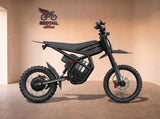
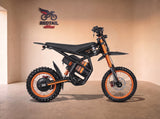
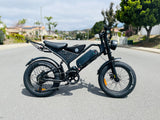
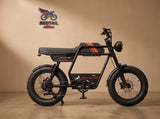


Freesky Cheetah Ultra review · moped-style e-bike with a seat for two · two 3,000 W peak motors, 260 N·m · Freesky Cheetah battery: 60 V 50 Ah, 3,000 Wh · 45 MPH Freesky-rated · 122 lb, 400 lb load · free shipping within the contiguous United States · verified November 18, 2026
Quick Answer — Freesky's Cheetah Ultra is a $1,999 moped-style e-bike with two 3,000 W peak motors, a 60 V battery of 3,000 Wh and a long seat for two, rated by Freesky at 45 MPH. At 15 mph on the throttle on level ground with a 180 lb rider, our model puts a full charge at about 157 miles.
Freesky quotes 110 to 200 miles on pedal assist. Two figures decide whether it suits you: the 35.0-inch seat height Freesky's Size & Fit table prints, set against your barefoot inseam (can I put my feet down?), and what your state calls a 45 MPH machine with pedals (where you can ride it).
Our store sells the Cheetah Ultra at $1,999, Freesky's own checkout price with its code B100, and shows $3,299 struck through. Through November 30 it is $200 less with code REDTAIL200: $1,799, below Freesky's own checkout. Every buy button here applies the code, with nothing to type, until 11:59 PM Pacific on November 30. Shipping is free within the contiguous United States, orders leave within 1–3 business days, and if a carrier damages the box, we file the claim.
Buy the Cheetah UltraWhat this review covers
Specification · What it is · Fit · Motors · Battery · Range · Riding two-up · Brakes and suspension · Lights, signals and sound · Weight and size · The Mercer fit test · UL · Recalls · Class and the law · Green and red flags · Verdict · Checklist · Buying it from us · FAQ · Limitations · Bottom line
How we verified this Freesky Cheetah Ultra review
The base is Freesky's own record of the bike, read on November 18, 2026, under Freesky's U.S. market: its product page, with its Technical Specification, Size & Fit table and drawing, feature sections and warranty block; its product record; and the user manual the page links. Our own store supplied the price, the color and the payment options the same day, and Freesky's cart supplied its checkout price.
Every figure here is specification-verified, traced to Freesky's page, record or manual, a statute, a federal record, our store, a study cited where it is used, or arithmetic shown on the page. Because Redtail sells the Cheetah Ultra, the red flags carry the same weight as the green.
Written by Milad Ghobadibeygvand, BScN (Western University, 2014). Corrections: support@redtailebikes.com.
Freesky's Cheetah Ultra specification
Every row below except the price is Freesky's own wording or figure from the Cheetah Ultra's U.S. product page, read November 18, 2026, and the last column names the part of the page that prints it.
| Item | Freesky's figure | Where it is printed |
|---|---|---|
| Name | Upgraded 60V Cheetah Ultra MT-380 ("Dual-Motor Electric Motorbike") | product title |
| Motors | 3000W + 3000W peak motor | Technical Specification |
| Peak power | 6,000 W combined | stat strip |
| Torque | 260 N·m (2 × 130 N·m in its comparison table) | stat strip; comparison table |
| Top speed | 45 MPH, on pedal assist or throttle | Technical Specification |
| Battery | 60V 50Ah, IPX7, removable | Technical Specification |
| Battery energy | 3,000 Wh ("50Ah removable battery (3000Wh)") | feature text |
| Range | 110–200 miles on pedal assist | Technical Specification |
| Charger | US Standard 5A Smart Charger | Technical Specification |
| Pedal assist | 0–5 levels, cadence sensor | Technical Specification |
| Throttle | Thumb throttle | Technical Specification |
| Gears | Shimano 7-speed rear derailleur, KMC chain | Technical Specification |
| Brakes | 2.3T × 180 mm four-piston hydraulic, front and rear | Technical Specification |
| Front fork | 120 mm oil-sprung | Technical Specification |
| Rear suspension | Dual coil rear shock | Technical Specification |
| Tires | 20 × 4 in fat tires (CST, in Freesky's feature text) | Technical Specification; CST in the feature text |
| Frame | Upgraded 6061 aluminum | Technical Specification |
| Seat | Long saddle for a rider and a passenger, foldable rear footrests | Technical Specification; footrests in the feature text |
| Display | Color LCD | Technical Specification |
| Lights and sound | 800-lumen LED headlight, handlebar turn signals, Bluetooth speakers | feature text |
| Weight | 122 lb | Technical Specification |
| Load capacity | 400 lb | Technical Specification |
| Rider height | 5'4" to 6'5" | Size & Fit |
| Inseam | 27 to 35 in | Size & Fit |
| Seat height | 35.0 in (Freesky lists the same figure as the maximum and the minimum) | Size & Fit |
| Standover | 28.7 in | Size & Fit |
| Wheelbase | 46.9 in | Size & Fit |
| Total length and height | 70.1 in long, 45.7 in tall | Size & Fit |
| Color | Red | color selector |
| In the box | The bike, the user manual, front and rear mudguards (page); the manual's own list adds two keys and the charger | What You'll Receive; the manual |
| Price | $1,999 at Redtail, Freesky's own checkout price with its code B100; $3,299 shown struck through; through November 30, with code REDTAIL200: $1,799 | our listing |
The battery energy is Freesky's own figure, and also our arithmetic: 60 volts times 50 amp-hours is 3,000 watt-hours.
A moped-style e-bike with a seat for two

Freesky describes the Cheetah Ultra as "a moped-style electric motorcycle engineered for unmatched power and endurance" on its product page, and the shape follows that line: a two-seater, with a long, flat seat for a rider and a passenger, a red tank-style cover, 20-inch fat tires and a high, upright handlebar.
It still has pedals, a seven-speed derailleur and five assist levels, so you can pedal it, but its two motors and its 3,000 Wh battery are the point of it.
The name carries the model's history. Freesky lists this machine as the "Upgraded 60V Cheetah Ultra MT-380", published on its U.S. store on October 21, 2026, and the 60-volt system is what the "Upgraded" refers to: a 60V 50Ah pack, two 3,000 W peak motors and a 45 MPH rating.
What you get for the money, in Freesky's own words: "full suspension, tandem seating, CST fat tires, and hydraulic disc brakes", "Dedicated foldable footrests for rear passengers", an "extended, cushioned saddle designed for both rider and passenger", "built-in HiFi Bluetooth speakers", a handlebar turn-signal system and an "800 Lumen LED headlight".
Does the Cheetah Ultra fit you? A 35.0-inch seat for riders 5'4" to 6'5"
Short answer: the seat is the whole fit question. Freesky fixes it at 35.0 inches and sizes the bike for riders 5'4" to 6'5" with a 27 to 35 inch inseam; in our model of 6,068 U.S. Army soldiers' measurements, a rider sitting on that seat puts both feet flat only from about 6 feet up, and every height reaches the bars without stretching.
Find your fit in three steps:
- Measure your barefoot inseam: stand against a wall, press a hardcover book up between your legs and measure from the floor to its top edge.
- Read your height's row in the stop table: it tells you how many riders of 100 your height can sit on the 35.0-inch seat with both feet flat. If you are under 6 feet, plan to stop the way a moped rider does, sliding forward off the seat or putting one foot down.
- Read the bench table for how bent your knees stay while pedaling: the seat cannot move, so the table tells you whether you will mostly pedal or mostly ride the motors.
Freesky's own window, repeated under each height table here: 5'4" to 6'5" rider height, 27 to 35 inch inseam, from the Size & Fit table on its product page, read November 18, 2026. The tables below do not replace that window; they show what the 35.0-inch seat means at each height inside it.
Every fit figure here is computed: the bodies come from the U.S. Army's ANSUR II anthropometric survey (4,082 men and 1,986 women), and the bike's points come from Freesky's own Size & Fit drawing, measured at the scale of its printed 46.9-inch wheelbase. The fit arithmetic shows every step.

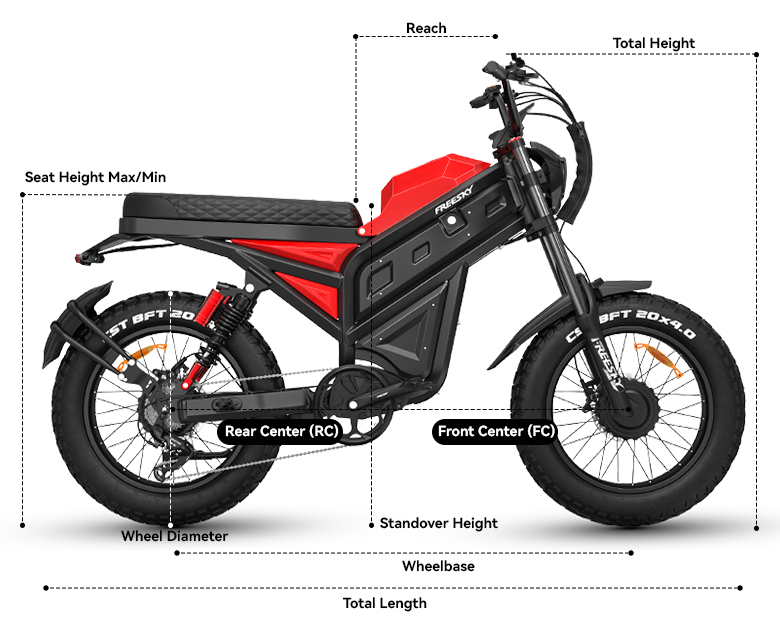
Freesky's drawing, the source of the crank axle, seat and grip positions in the fit tables; where its lines and its printed table disagree, the arithmetic prints both.
Will the seat suit my legs?
The seat sits closer to the cranks than LeMond's leg-extension setting for nearly every rider in Freesky's window, so your knees stay bent at the bottom of each pedal stroke; a rider at 5'0" sits on the mark, and the gap grows with height.
The reference here is Greg LeMond's rule: 88.3% of your inseam, measured from the crank axle to the top of the seat. Peveler and colleagues (2005) found that LeMond's method set saddles at 109.2% ± 0.9% of inseam measured from the pedal.
Freesky publishes no crank length for the Cheetah Ultra, so the table works from the crank axle, where LeMond's figure needs none. On Freesky's drawing, the middle of the seat sits 25.1 inches from the crank axle.
| Your height | Typical inseam | LeMond setting, median rider | The bench, median rider | Bench at or closer, of 100 |
|---|---|---|---|---|
| 5'0" | 27.1–29.7 in | 25.1 in | on the mark | 52 |
| 5'2" | 28.0–31.1 in | 26.1 in | 1.0 in closer | 88 |
| 5'4" | 29.1–32.2 in | 26.9 in | 1.9 in closer | 99 |
| 5'6" | 30.2–33.5 in | 28.0 in | 2.9 in closer | 100 |
| 5'8" | 31.1–34.3 in | 28.8 in | 3.7 in closer | 100 |
| 5'10" | 32.2–35.5 in | 29.8 in | 4.7 in closer | 100 |
| 6'0" | 33.2–36.7 in | 30.8 in | 5.8 in closer | 100 |
| 6'2" | 34.3–37.5 in | 31.8 in | 6.7 in closer | 100 |
| 6'4" | 36.3–39.1 in | 33.2 in | 8.2 in closer | 100 |
Freesky's window: 5'4" to 6'5", inseam 27–35 in. Solo rider, sitting at the middle of the seat; "typical inseam" is the middle 90% of the surveyed Army personnel at that height, the 5th to the 95th percentile.
What it means for you: a seat closer than LeMond's distance leaves more knee bend than the 30 to 40 degrees Ferrer-Roca and colleagues (2012) found optimal for pedaling, so long stretches of hard pedaling will feel cramped for taller riders. Riding on the motors with light pedaling, as the bike's 3,000 Wh and five assist levels invite, asks much less of the knees.
Can I put my feet down at a stop?
On the 35.0-inch seat, no surveyed rider of 100 at 5'4" or shorter puts both feet flat; 12 do at 5'10", 48 at 6'0", 86 at 6'2" and all at 6'4".
| Your height | Typical inseam | Clear the 35.0 in seat, of 100 |
|---|---|---|
| 5'0" | 28.4 in | 0 |
| 5'2" | 29.5 in | 0 |
| 5'4" | 30.5 in | 0 |
| 5'6" | 31.7 in | 1 |
| 5'8" | 32.6 in | 1 |
| 5'10" | 33.8 in | 12 |
| 6'0" | 34.9 in | 48 |
| 6'2" | 36.0 in | 86 |
| 6'4" | 37.6 in | 100 |
Freesky's window: 5'4" to 6'5". "Clear the seat" means a barefoot inseam at or above the 35.0-inch seat top, so both feet reach the ground flat while you sit; "typical inseam" here is the median at that height.
Freesky's table prints a standover height of 28.7 inches, the frame's low point you step over when you climb on.
Stopping while seated is a different measure: the stop table above shows that most riders under 6 feet cannot sit on this seat flat-footed, so plan to stop by sliding forward off the seat or by putting one foot down, as on a motorcycle. If you want both feet flat while seated, the Alaska Pro M-520 review covers a Freesky with a seat post you can lower.
Will I feel stretched or cramped at the bars?
Neither: sitting in the middle of the seat, the median rider leans 3 to 17 degrees forward to reach the grips, an upright position, and with a passenger behind you, sitting on the front half, 80 to 100 of every 100 riders inside Freesky's window reach the grips sitting straight up.
| Your height | Lean from upright, median rider | Across saddle and grip positions |
|---|---|---|
| 5'0" | 17° | 0–43° |
| 5'4" | 13° | 0–37° |
| 5'8" | 9° | 0–32° |
| 6'0" | 6° | 0–28° |
| 6'4" | 3° | 0–24° |
Two-up, sitting in the middle of the seat's front half with a passenger behind:
| Your height, two-up | Lean from upright, median rider | Riders who reach the grips sitting upright, of 100 | Elbow bend sitting upright, median rider |
|---|---|---|---|
| 5'0" | 1° | 34 | — |
| 5'4" | 0° | 80 | 32° |
| 5'8" | 0° | 98 | 44° |
| 6'0" | 0° | 100 | 52° |
| 6'4" | 0° | 100 | 61° |
Freesky's window: 5'4" to 6'5". Solo places the rider at the middle of the seat; "across saddle and grip positions" spans a quarter of the seat's length either way and both of Freesky's reach figures. A dash means the median rider at that height cannot reach the grips sitting fully upright.
How much weight goes through my hands?
Riding solo, the median rider at each height rests 7% to 15% of their weight on the grips, shared between both hands; two-up, sitting forward and nearly upright, about 5%.
| Your height | Share of your weight, back relaxed | Median rider's weight | On each hand |
|---|---|---|---|
| 5'0" | 15% (5–22%) | 126 lb | about 9 lb |
| 5'6" | 12% (5–20%) | 166 lb | about 9 lb |
| 6'0" | 9% (5–19%) | 204 lb | about 9 lb |
| 6'4" | 7% (5–18%) | 220 lb | about 7 lb |
| Your height, two-up | Share of your weight, back relaxed | Median rider's weight | On each hand |
|---|---|---|---|
| 5'0" | 5% (5–19%) | 126 lb | about 4 lb |
| 5'6" | 5% (5–17%) | 166 lb | about 4 lb |
| 6'0" | 5% (5–15%) | 204 lb | about 5 lb |
| 6'4" | 5% (5–13%) | 220 lb | about 6 lb |
Freesky's window: 5'4" to 6'5". Back relaxed; the range in brackets runs across saddle and grip positions. For scale, ten road racers on the hoods put 15% of body weight on the bars in Carahalios (2015).
How do I set it up when it arrives?
There is no seat height to set: the seat is fixed at 35.0 inches. Set the tires to Freesky's 16 to 20 PSI, and use the heel check to learn how you will ride.
- Tire pressure. Freesky's manual: "FREESKY recommends 16-20 PSI for the stock tires."
- The heel check. Sit on the middle of the seat, put your heel on the pedal at the bottom of the stroke and see whether the knee straightens. Peveler and colleagues (2005) use the straight leg as the mark of the right saddle height; a knee that stays bent means the seat sits low for your leg. On this seat that will be most riders above 5'2" (the bench table), which suits riding on the motors with light pedaling.
- Stopping. Practice sliding forward off the seat to stop before your first ride in traffic.
Freesky's manual says riders must be at least 18 years old.
The fit arithmetic, step by step
The worked example is a 5'10" rider with the median inseam at that height, 33.8 inches.
The inputs, and where each comes from:
| Input | Value | Source |
|---|---|---|
| Seat height | 35.0 in, fixed | Freesky's Size & Fit table |
| Crank axle above the ground | 12.7 in (12.4 to 13.0) | Freesky's drawing, at its wheelbase scale |
| Sit point, solo | 11.5 in behind the crank axle, give or take 6.0 | The middle of the seat Freesky draws |
| Grips | 12.0 to 18.5 in ahead of the crank axle, 30.2 to 35.1 in above it | Freesky's drawing; 18.5 in is Freesky's printed reach |
| Saddle rule | 88.3% of inseam, crank axle to seat top | LeMond's rule, as Peveler et al. (2005) measured it |
| Bodies | 4,082 men and 1,986 women | ANSUR II |
- The bike's points. On Freesky's drawing, scaled by its own Wheelbase line (459 pixels for the published 46.9 inches, 9.79 pixels per inch), the crank axle sits 12.7 inches above the ground and the seat runs from 23.5 inches behind the crank axle to directly above it. Freesky's printed seat height, 35.0 inches, puts the seat top 22.3 inches above the crank axle.
- The sit point. The middle of the seat, 11.5 inches behind the crank axle (bracketed a quarter of the seat's length either way); two-up, the middle of its front half, 5.5 inches behind.
- The seat's distance from the crank axle. The straight line between those two points is 25.1 inches solo; two-up, 23.0 inches.
- LeMond's distance for this rider. 0.883 × 33.8 = 29.8 inches. The seat sits 4.7 inches closer solo, 6.9 inches two-up.
- Feet at a stop. The 35.0-inch seat against the barefoot inseam: 33.8 inches is 1.2 inches short of flat feet.
The drawing checks against Freesky's own printed figures within 3.5% on five of eight dimensions:
| Dimension | Freesky lists | Measured on Freesky's drawing | Gap |
|---|---|---|---|
| total length (Freesky's line) | 70.1 in | 71.4 in | +1.9% |
| total height (Freesky's line) | 45.7 in | 48.8 in | +6.9% |
| seat height (Freesky's line) | 35.0 in | 34.2 in | −2.2% |
| standover (Freesky's line) | 28.7 in | 33.1 in | +15.4% |
| reach (Freesky's line) | 18.5 in | 14.7 in | −20.5% |
| rear center (Freesky's line) | 18.5 in | 18.4 in | −0.3% |
| front center (Freesky's line) | 28.3 in | 28.1 in | −0.8% |
| seat height, the seat's top at its middle | 35.0 in | 33.9 in | −3.1% |
Where Freesky's drawing and its table disagree, both figures are printed. The model uses Freesky's printed 35.0-inch seat height, and its grip position covers both reach figures. The method is in Limitations.
Over 6 feet and riding two-up? This is the Freesky built for two. Not sure about the 35.0-inch seat? Email sales@redtailebikes.com your height and barefoot inseam, and we will reply with the rows for your height before you order.
Add the Cheetah Ultra to cartTwo 3,000 W peak motors, 260 N·m and 45 MPH

Freesky fits two motors, and its photographs show one in the hub of each wheel; it prints their output as peak power: "3000W + 3000W Peak Motor" in the Technical Specification and "a combined 6000W peak power and 260 N·m torque" in the feature text, 130 N·m from each motor according to the page's comparison table. Freesky rates the bike at 45 MPH "via pedal assist or throttle".
Two things to know about those numbers. Freesky's figures are peak power, the most a motor delivers for a short burst, a different quantity from the rated (continuous) wattage some spec sheets print. And the motors respond to a cadence sensor: assist begins when the pedals turn, at the level you choose on the color display, from zero to five. The thumb throttle runs the motors with no pedaling at all.
For pedaling, Freesky fits a Shimano seven-speed rear derailleur and a KMC chain. On a bike this heavy, pedaling alone is slow: in our range model, a rider putting out 75 watts on flat pavement, both motors off, holds about 8 mph, and 150 watts holds about 13.
The Freesky Cheetah battery: 60 V 50 Ah, 3,000 Wh, and charging it
Freesky's battery figures: "60V 50Ah Battery, IPX7", and in its feature text, "Powered by a massive 50Ah removable battery (3000Wh)". The battery lifts out, so you can charge it indoors; Freesky's manual shows it charging both on the bike and off it, from the charger in the box, which Freesky's specification names the "US Standard 5A Smart Charger".
| Battery fact | Freesky's figure or ours |
|---|---|
| Voltage and capacity | 60V 50Ah (Freesky) |
| Energy | 3,000 Wh (Freesky; our arithmetic agrees: 60 × 50) |
| Water rating | IPX7 (Freesky) |
| Charger | US Standard 5A Smart Charger (Freesky) |
| Charging time | 8–10 hours (Freesky's comparison table); 50 Ah at the charger's 5 A is 10 hours by our arithmetic, before charging losses |
| Charge only between | 32 °F and 104 °F (0 °C to 40 °C), from Freesky's manual |
| Charge and store, dry, between | 50 °F and 77 °F (10 °C to 25 °C), from Freesky's manual |
Freesky's manual says to charge the battery only when the air around it is between 32 °F and 104 °F (0 °C to 40 °C), and to "Charge and store bike and battery in a dry location, between 50 °F – 77 °F (10 °C – 25 °C)".
Freesky's own charging guide adds: "If full range is not needed, charging to 80–90% can reduce thermal and chemical stress" (Freesky, Summer High-Temperature Charging Guide, June 12, 2026), which is why the range tables give an 80% column.
Range: how far a charge takes the Cheetah Ultra
At 15 mph on the throttle on level ground, with a 180 lb rider and both motors on, the Cheetah Ultra covers about 157 miles on a full 3,000 Wh charge in our model, and about 126 miles on an 80% charge. Freesky's own figure is 110 to 200 miles on pedal assist; the last table shows the speeds that produce each end.
Find your range in three steps: pick your usual speed in the speed table; adjust for your weight in the weight table; then take off what your hills cost in the hills table. Every figure below is computed from published physics, Freesky's own figures and a comparable motor's published data; none is a ride measurement. Every row assumes level pavement, no wind and 77 °F air unless it says otherwise.
Does riding faster cut the range?
Yes, sharply: on the throttle on level ground with a 180 lb rider, a full charge goes about 208 miles at 10 mph, 157 at 15 mph, 116 at 20 mph and 73 at 28 mph. Air drag climbs with the square of your speed, so every added mile per hour costs more battery than the one before.
| Speed, flat | Per mile | Full charge | At an 80% charge |
|---|---|---|---|
| 10 mph | 14.4 Wh | 208 mi | 166 mi |
| 12 mph | 16.0 Wh | 187 mi | 150 mi |
| 15 mph | 19.1 Wh | 157 mi | 126 mi |
| 18 mph | 22.9 Wh | 131 mi | 105 mi |
| 20 mph | 25.8 Wh | 116 mi | 93 mi |
| 25 mph | 34.7 Wh | 86 mi | 69 mi |
| 28 mph | 41.2 Wh | 73 mi | 58 mi |
180 lb rider, throttle only, both motors, level pavement, no wind, 77 °F. The model stops at 28 mph: the comparable motor it uses cannot be priced at Freesky's 45 MPH (see the formula).
Pedaling stretches it further. At the same speeds, with the motors helping:
| Speed, flat | Throttle only | Easy pedaling (75 W) | Steady pedaling (150 W) |
|---|---|---|---|
| 12 mph | 187 mi | 344 mi | legs alone |
| 15 mph | 157 mi | 228 mi | 395 mi |
| 18 mph | 131 mi | 167 mi | 228 mi |
| 20 mph | 116 mi | 141 mi | 177 mi |
| 25 mph | 86 mi | 97 mi | 109 mi |
| 28 mph | 73 mi | 79 mi | 87 mi |
180 lb rider, both motors, level pavement, no wind, 77 °F. "Legs alone": at 12 mph on the flat, 150 W of pedaling covers the whole load, so the motors add nothing.
Do one motor or two use less battery?
On level ground on the throttle it barely matters, within about 5% (the motor table); on a hill, two motors use less: at 10 mph on an 8% grade on the throttle, both motors use 95.6 Wh a mile against 124.4 Wh for one.
On a bike with a hub motor in each wheel, the gear you pick changes how fast your legs turn, never how fast the motors turn; the choice that changes the battery's work is one motor or two.
| Your ride | One motor | Both motors | Both vs one |
|---|---|---|---|
| 15 mph, flat, throttle | 18.7 Wh | 19.1 Wh | +2% |
| 20 mph, flat, throttle | 26.1 Wh | 25.8 Wh | −1% |
| 12 mph, flat, easy pedaling | 7.4 Wh | 8.7 Wh | +18% |
| 10 mph, 4% grade, throttle | 58.6 Wh | 49.8 Wh | −15% |
| 10 mph, 8% grade, throttle | 124.4 Wh | 95.6 Wh | −23% |
| 10 mph, 8% grade, easy pedaling | 101.9 Wh | 80.4 Wh | −21% |
Watt-hours per mile, 180 lb rider, 77 °F. Splitting a light load across two motors leaves each working less efficiently; splitting a heavy one keeps each in its efficient range.
Does going uphill drain it faster?
Much faster: holding 10 mph on the throttle with a 180 lb rider and both motors, a full charge covers about 97 miles on a 2% grade, 60 miles on 4%, 31 miles on 8% and 15 miles on 15%.
| Grade | Per mile, both motors | Full charge, both motors | Full charge, one motor |
|---|---|---|---|
| 2% | 31 Wh | 97 mi | 89 mi |
| 4% | 50 Wh | 60 mi | 51 mi |
| 6% | 71 Wh | 42 mi | 34 mi |
| 8% | 96 Wh | 31 mi | 24 mi |
| 10% | 122 Wh | 25 mi | 18 mi |
| 12% | 152 Wh | 20 mi | 14 mi |
| 15% | 201 Wh | 15 mi | 10 mi |
10 mph, throttle only, 180 lb rider, a steady climb at that grade the whole charge, 77 °F. Real routes mix climbs and descents; the model credits no charge back on a descent.
Climbing 1,000 feet at 10 mph costs the battery about 168 to 206 Wh above the same miles on the flat with both motors on, depending on the grade, and 212 to 289 Wh with one, in Martin et al.'s power model.
Does rider weight affect the range?
Yes, most on hills: on level ground at 15 mph on the throttle, a 130 lb rider gets about 169 miles and a 400 lb load about 121; on an 8% climb at 10 mph, 39 miles against 15.
| You plus your load | 15 mph flat, throttle | 20 mph flat, throttle | 8% climb, 10 mph |
|---|---|---|---|
| 130 lb | 169 mi | 122 mi | 39 mi |
| 180 lb | 157 mi | 116 mi | 31 mi |
| 300 lb | 135 mi | 104 mi | 20 mi |
| 400 lb | 121 mi | 95 mi | 15 mi |
Both motors, throttle only, 77 °F. 400 lb is Freesky's load capacity, which Freesky counts as the rider and cargo together, so a rider and a passenger share it (riding two-up).
Does cold weather drain it?
Yes: at 32 °F the pack holds about 89% of its 77 °F energy, so 20 mph on the throttle drops from about 116 miles to about 93. Freesky's manual sets 32 °F as the floor for charging the battery.
| Air | Pack energy vs 77 °F | 15 mph, easy pedaling | 20 mph, throttle |
|---|---|---|---|
| 95 °F | 99% | 242 mi | 120 mi |
| 77 °F | 100% | 228 mi | 116 mi |
| 68 °F | 98% | 214 mi | 111 mi |
| 50 °F | 93% | 190 mi | 100 mi |
| 41 °F | 91% | 180 mi | 96 mi |
| 32 °F | 89% (80–93) | 174 mi (156–183) | 93 mi (83–97) |
| 14 °F · below Freesky's floor | 82% (40–83) | 157 mi (76–157) | 84 mi (41–84) |
180 lb rider, both motors, level pavement. Freesky names no cell for this pack, so the energy column uses an LG 18650HG2 cell's measured discharge at each temperature, with the spread across other published cells in brackets. Warm air also helps a little, because it is thinner and tires roll more easily.
Do the tires cut the range?
Some: across ten measured 26 × 4.00 fat tires, the 15 mph throttle figure runs from about 146 to 183 miles, 7% fewer to 17% more than the median tire. No 20 × 4 fat tire is in the published rolling-resistance tables, so the model uses the median of ten 26 × 4.00 tires as a stand-in for the Cheetah Ultra's CST tires.
| Rolling resistance | 15 mph, throttle | 15 mph, easy pedaling | 20 mph, throttle |
|---|---|---|---|
| 0.0070 · lowest of ten | 183 mi | 281 mi | 129 mi |
| 0.0105 · median of ten (used here) | 157 mi | 228 mi | 116 mi |
| 0.0126 · highest of ten | 146 mi | 205 mi | 110 mi |
180 lb rider, both motors, level pavement, 77 °F. Tire figures from BicycleRollingResistance.com's fat-bike tests, measured at 12 psi; Freesky's manual asks for 16 to 20 psi.
Is it a 200-mile e-bike? Freesky's 110 to 200 miles
Both ends are reachable on level ground in our model, at different speeds: 200 miles takes about 10.8 mph on the throttle, or about 16.2 mph with easy pedaling; 110 miles comes at about 21 mph on the throttle.
| Freesky's figure | Watt-hours per mile it needs | Throttle only | Easy pedaling (75 W) | Steady pedaling (150 W) |
|---|---|---|---|---|
| 200 miles | 15.0 Wh | about 10.8 mph | about 16.2 mph | about 19.0 mph |
| 110 miles | 27.3 Wh | about 21.0 mph | about 23.2 mph | about 25.0 mph |
180 lb rider, both motors, level pavement, no wind, 77 °F, the full 3,000 Wh. On one motor the throttle-only speeds are 11.6 and 20.7 mph.
For planning, take Freesky's own advice and charge to 80%, with 20% kept in the pack: at 15 mph on the throttle that is about 126 miles, and at 20 mph about 93.
The biggest battery of any Freesky e-bike we sell: 3,000 Wh. Orders are dispatched within 1–3 business days of confirmation, and most arrive within 5–10 business days after that.
Buy it nowThe formula behind the range tables
The model, built on Martin et al.'s (1998) power equation, holds a steady speed on a constant grade and asks how much battery energy each mile takes, then divides the pack by it.
| Input | Value | Source |
|---|---|---|
| The bike | 122 lb, two motors, a 3,000 Wh pack | Freesky's page |
| Rolling resistance, Crr | 0.0105, the median of ten 26 × 4.00 fat tires | Bicycle Rolling Resistance fat-tire tests |
| Drag area, CdA | 0.64 m², cruiser bicycles ridden upright | Tengattini and Bigazzi (2018) |
| Air density at 77 °F | 1.184 kg/m³ | U.S. Standard Atmosphere (1976) |
| The motor | Bafang's RM G0H0 geared hub, 1,000 W rated, at least 80% efficient | Bafang OEM workbook (2021) |
| Battery efficiency | about 97% at these currents | Arango, Lopez and Ceren (2021) |
| Cells in the cold | LG 18650HG2, 89% of the 77 °F energy at 32 °F | McMaster HG2 data |
- Power at the wheel. P = v × [m g (Crr cos θ + sin θ) + ½ ρ CdA v²], the validated road-cycling model of Martin and colleagues (1998), with the speed held so the kinetic-energy term drops out. m is 122 lb of bike (Freesky) plus the rider; Crr is 0.0105 (the tire table); CdA is 0.640 m², the cruiser-bicycle riders measured by Tengattini and Bigazzi (2018); air density ρ comes from the U.S. Standard Atmosphere, 1976.
- The rider's share. Pedal power reaches the wheel through the chain at 97.698% (Martin and colleagues, 1998); the motors supply the rest.
- The motors. The motor constants come from a comparable motor's published figures: Bafang's RM G0H0.1000.DC geared hub, rated 1,000 W at 48 V with an efficiency of at least 80%, from Bafang's OEM workbook (2021). Each motor's battery draw is the motor's own losses plus its work, and in this model that draw does not depend on the supply voltage, so the figures hold at the Cheetah Ultra's 60 V as at 48 V. Each motor is held to the comparable's rated 1,000 W, which is why the tables stop at 28 mph.
- The battery. Battery losses follow the measured curve of Arango, Lopez and Ceren (2021), scaled to this pack's 50 Ah; the cold column uses LG 18650HG2 cell measurements.
- Miles. 3,000 Wh (Freesky's figure) times the cell's energy share at that temperature, divided by watt-hours per mile.
One ride worked through, every step shown: 15 mph, level, throttle, 180 lb rider, both motors, 77 °F. Rolling resistance takes 94.9 W and air 114.2 W, so the wheel needs 209.2 W. The two motors draw 277.5 W from the battery (each turning the wheel at 210 rpm with 4.8 N·m, 6.4 A), and battery losses bring it to 285.9 W.
285.9 W ÷ 15 mph = 19.06 Wh a mile; 3,000 Wh ÷ 19.06 = 157.4 miles, and 80% of the pack gives 125.9.
| Check | Published figure | This model |
|---|---|---|
| Road physics, Martin and colleagues' worked example | 45.7 W for tires and grade, 158.8 W for the air | 45.8 W and 158.8 W |
| The comparable motor at Bafang's rated point | at least 80% efficient | 80% |
No independent range measurement of the Cheetah Ultra exists to check the whole-bike figures against: the one video review we found covers torque and hill climbing and runs no full charge (Limitations).
Read your row, then plan on 80% of it. At 15 mph on the throttle on level ground, a 180 lb rider has about 126 miles from an 80% charge, and every 1,000 feet of climbing at 10 mph costs about 168 to 206 Wh with both motors on.
Riding two-up: the seat, the footrests and the 400 lb load
Freesky built the Cheetah Ultra as an e-bike with a passenger seat for adults. Its feature text describes "an extended, cushioned saddle designed for both rider and passenger", and "Dedicated foldable footrests for rear passengers—easy to unfold for solid support, neatly tucked away when not in use".
Freesky's load capacity is 400 lb, and Freesky counts that figure as the rider and cargo together: "Remember that total payload includes the rider and cargo", in its hunting-bike guide. So a 220 lb rider and a 160 lb passenger, 380 lb together, sit inside it; two 220 lb adults do not.

What a passenger changes, from the tables above:
| Riding two-up changes | The figure |
|---|---|
| Where you sit | The seat's front half, so you sit nearly upright: the median rider at every height from 5'2" up reaches the grips with no lean (the cockpit table) |
| Your knees | The seat sits 2.2 to 10.3 inches closer to the cranks than LeMond's distance, so you will pedal less and ride the motors more |
| Range at 15 mph, flat, throttle | About 135 miles with 300 lb aboard and 121 with the full 400 lb, against 157 solo at 180 lb (the weight table) |
| Range on an 8% climb at 10 mph | About 20 miles at 300 lb and 15 at 400 lb |
Whether a passenger may ride with you on a public road depends on how your state classes a 45 MPH machine (the law section).
Brakes, suspension and tires

| Part | Freesky's specification |
|---|---|
| Brakes | 2.3T × 180 mm four-piston hydraulic, front and rear: "4-piston hydraulic disc brakes on both the front and rear wheels" |
| Front fork | 120 mm oil-sprung |
| Rear suspension | Dual coil rear shock |
| Tires | 20 × 4 in fat tires, which Freesky's feature text calls "CST fat tires" |
| Tire pressure | 16–20 PSI, from Freesky's manual |

The brake specification Freesky prints, "2.3T*180MM 4-piston Hydraulic Brakes", gives the rotor diameter, 180 mm, at both wheels. With 122 lb of bike, a rider and possibly a passenger, the safety notice on Freesky's product page is worth following: "In case of emergency braking, apply the rear brake first, then the front brake."

The suspension is a fork and a rear shock with coil springs, which Freesky describes as "full suspension". Keep the tires inside the 16 to 20 PSI the manual gives.
Lights, turn signals and sound
The Cheetah Ultra carries the lights and signals of a small motorcycle: an 800-lumen LED headlight, turn signals worked from the handlebar, built-in Bluetooth speakers and an LCD display that shows speed, battery, mileage and the five assist levels, described below in Freesky's own words.


| Feature | Freesky's description |
|---|---|
| Headlight | "800 Lumen LED headlight" |
| Turn signals | "Integrated into the handlebars, this advanced turn signal system lets you easily signal your intentions with a simple press of a button" |
| Speakers | "built-in HiFi Bluetooth speakers" |
| Display | "The LCD smart display clearly shows 5 PAS levels, headlight status, speed, battery power, and mileage" |
| Throttle | Thumb throttle |
122 pounds, 70 inches long
Freesky's figures: 122 lb, 70.1 inches long, 45.7 inches tall and a 46.9-inch wheelbase. That weight is the cost of two motors and a 3,000 Wh battery, and it decides three things before you buy:
- Carrying it. A hitch rack must be rated for more than 122 lb with the bike, and two people should lift it.
- Storing it. At 70.1 inches long it needs about six feet of floor or wall, and the battery lifts out, so you can charge it indoors without moving the bike.
- Pushing it. Moving a 122 lb machine by hand on a slope is hard work; the motors make it easy to ride and nothing makes it light.
If you need a lighter Freesky to lift onto a rack, the Warrior Ultra M-530 review covers a lighter bike with the same 60 V and two 3,000 W peak motors, and the Alaska Pro M-520 review a 90 lb mountain bike.
Before it arrives, decide where 122 lb will park and how it will travel. It needs about six feet of floor, a hitch rack rated above its weight and two people to lift it; the battery comes out, so you can charge it indoors.
The Mercer fit test
Our seven recurring riders, the Mercers, run from age 12 to 63 and meet every machine we review at the same heights. Here each verdict rests on Freesky's published height window, seat height and load, its manual's age line, or the fit tables built from them, at the heights we give each member.
| Member | Age · Height | Verdict | The number behind it |
|---|---|---|---|
| Frank Kowalski | 63 · 5'10" | Inside the window | Freesky's window runs 5'4" to 6'5"; on the 35.0 in seat, 12 of 100 riders his height sit with both feet flat, so he stops by sliding forward |
| Ruth Kowalski | 61 · 5'5" | Inside, by an inch | The window starts at 5'4"; 1 or fewer of 100 riders her height sit flat-footed on the seat, so every stop is a slide forward |
| Jack Mercer | 48 · 6'1" | Inside | 48 of 100 riders at 6'0" and 86 at 6'2" sit with both feet flat; the seat sits about 6 in closer to the cranks than LeMond's distance |
| Dana Mercer | 45 · 5'7" | Inside | Fewer than 1 of 100 riders her height sits flat-footed; she leans about 10° to the grips riding solo |
| Maya Torres | 32 · 5'6" | Inside | 1 of 100 riders her height sits flat-footed; she leans about 11° to the grips riding solo |
| Cole Mercer | 16 · 5'11" | Not by Freesky's manual | Freesky's manual: "Riders must be at least 18 years old" |
| Ivy Mercer | 12 · — | Not as a rider | Freesky's manual: "Riders must be at least 18 years old"; whether a 12-year-old may ride as a passenger is for your state's rules |
Each member's age comes from their family page, and each height is the one we give that member on every review. The flat-foot figures come from the stop table.
The Cheetah Ultra suits Jack best and asks the most of Ruth. At 6'1" he sits in the middle of Freesky's window with nearly half of riders his height flat-footed on the seat; at 5'5" she is inside the window by an inch, and every stop means sliding forward off a 35.0-inch seat.
Is the Freesky Cheetah Ultra UL certified?
Freesky lists the Cheetah Ultra's battery as UL 2271 certified. Under the heading "UL2271 Certified Battery", Freesky writes: "FREESKY batteries are rigorously tested to meet the UL-2271 safety standard, ensuring unmatched protection against electrical and structural risks." UL 2271 is the standard for batteries in light electric vehicles; UL 2849 covers an e-bike's whole electrical system, and one does not stand in for the other.
Freesky publishes TÜV SÜD certificates for several other models in its range, battery and system. What we could confirm about the Cheetah Ultra's own certificate is in Limitations.
Has the Freesky Cheetah Ultra been recalled?
No recall or federal safety warning names Freesky. The U.S. Consumer Product Safety Commission's recall database, read whole on November 18, 2026, holds 10,089 records, the newest dated November 12, 2026, and none names Freesky; as a control, the same read finds 1 record for Ancheer and 79 for Specialized, so the search works. The Commission's list of product safety warnings, 393 entries, and its latest 40 recall notices, read the same day, name no Freesky product either.
Class and the law: a 45 MPH machine with pedals
At 45 MPH, the Cheetah Ultra is not a Class 1, 2 or 3 e-bike, so private land and off-road areas open to motor vehicles are the places it rides without a class question; on public roads your state decides whether it is an off-highway vehicle, a moped or a motor-driven cycle. Freesky rates it at 45 MPH on pedal assist or throttle and calls it a "Dual-Motor Electric Motorbike".
Federal law defines a low-speed electric bicycle this way:
the term "low-speed electric bicycle" means a two- or three-wheeled vehicle with fully operable pedals and an electric motor of less than 750 watts (1 h.p.), whose maximum speed on a paved level surface, when powered solely by such a motor while ridden by an operator who weighs 170 pounds, is less than 20 mph.
That is 15 U.S.C. § 2085(b), in the 2024 edition of the United States Code, read November 18, 2026. At 45 MPH, the Cheetah Ultra is above its 20 mph line on speed alone.
Where a state uses the three e-bike classes, the top class stops lower as well: a Class 3 e-bike, in California's definition, "ceases to provide assistance when the bicycle reaches the speed of 28 miles per hour" (Cal. Veh. Code § 312.5(a)(3), effective January 1, 2025).
What that means for you:
- Private land, farms, ranches and off-road areas open to motor vehicles are the places to ride it without an e-bike class question; check the rules of any park or trail before riding.
- On Bureau of Land Management land, an e-bike is a cycle with "an electric motor of not more than 750 watts" that meets one of the three classes (43 CFR § 8340.0-5(j)). A machine Freesky rates at 45 MPH meets none of them, so there it rides under the off-road vehicle rules, and breaking those rules can bring "a fine of not more than $1,000 or imprisonment for not longer than 12 months, or both" (43 CFR § 8340.0-7).
- On public roads, paths and trails, your state's rules for mopeds, motor-driven cycles or off-highway vehicles may apply, and those can reach registration, insurance, licensing, helmets, a passenger and where you may ride. Begin with our state-by-state e-bike law guide, then check with your state before any ride on public roads.
- Age. You must be at least 18 to buy from us, under our Terms of Service, and Freesky's manual says riders must be at least 18 years old.
Our Terms of Service apply to every order and say: "Riding an electric bicycle involves inherent risks, including the risk of serious injury or death." Wear a helmet and protective gear, and follow Freesky's manual for charging and care.
Ride it on private land and in off-road areas open to motor vehicles, and check your state before any public road. At 45 MPH it meets none of the three e-bike classes, and on Bureau of Land Management land it rides under the off-road vehicle rules.
Green flags / Red flags
The Cheetah Ultra's strengths are range, power and room for two; its limits are fit and weight, and each red flag below ends in what to do about it or which other Freesky to read instead.
Green flags
- 3,000 Wh, the biggest battery of any Freesky e-bike we sell.
- Two 3,000 W peak motors and 260 N·m, in Freesky's figures.
- A seat and foldable footrests for a passenger, with a 400 lb load rating.
- Four-piston hydraulic brakes at both wheels, a 120 mm fork and a coil rear shock.
- Turn signals, an 800-lumen headlight and Bluetooth speakers.
- Freesky's own checkout price, its code B100 already taken off, and Freesky's terms matched: 24 months on the motor, battery and controller.
Red flags
- A 35.0-inch seat: under 6 feet, few riders sit with both feet flat. Practice sliding forward to stop; for a seat post you can set, read the Alaska Pro M-520 review.
- 122 lb: plan on two people for a rack. For the same 60 V and two 3,000 W peak motors on a lighter bike, read the Warrior Ultra M-530 review.
- 45 MPH is above every e-bike class: ride it on private land and in off-road areas open to motor vehicles. Check your state in our law guide, and ask us at sales@redtailebikes.com before you order.
- Red is the only color: for five colors, Camouflage among them, read the Ranger Plus M-540 review.
- A fixed seat: taller riders pedal with bent knees, so plan to ride the motors and pedal lightly; the fit tables show your height.
Buy it if / Buy something else if
Buy the Freesky Cheetah Ultra if you ride two-up or carry heavy loads off-road and want the most range in the Freesky line. If you need a lighter bike, a seat post or more colors, one of the three Freesky models below suits you better.
A full 3,000 Wh charge costs about 54 cents at 18.16 cents per kWh, the August 2026 U.S. residential average in the Energy Information Administration's Table 5.6.A, leaving out what the charger itself loses. A year of 1,000 miles at 15 mph on the throttle pulls about 19.06 kWh from the pack, about $3.46 a year.
| Buy it if | Buy something else if |
|---|---|
| You ride two-up, or carry one passenger and gear, on private land or off-road | You need a bike you can lift: the Warrior Ultra M-530 pairs the same 60 V with two 3,000 W peak motors on a lighter mountain-bike frame, from $1,849 (its review) |
| You want the most range in the Freesky line: about 157 miles at 15 mph on the throttle, 180 lb rider, flat | You want a mountain-bike riding position and a seat post: the Alaska Pro M-520, 2,160 Wh across two batteries, from $1,849 (its review) |
| You are about 6 feet or taller, or happy to stop moped-style | You want a step-through frame in more colors: the Ranger Plus M-540, five colors, from $1,749 (its review) |
The four side by side, each bike's price from our store and the rest from Freesky's own page, read November 18, 2026:
| Bike | Price | Battery | Weight | Frame |
|---|---|---|---|---|
| Cheetah Ultra | $1,999 | 3,000 Wh, one pack | 122 lb | Moped-style, seat for two |
| Alaska Pro M-520 | from $1,849 | 2,160 Wh, two packs | 90 lb | Mountain bike |
| Warrior Ultra M-530 | from $1,849 | 1,800 Wh, one pack | 97 lb (90 in Freesky's comparison table) | Mountain bike |
| Ranger Plus M-540 | from $1,749 | 1,440 Wh, one pack | 95 lb | Step-through |
Through November 30, code REDTAIL200 takes $200 off each of the four at our checkout.
3,000 Wh, two motors and a seat for two, at Freesky's own checkout price with its code B100, and $200 less through November 30 with code REDTAIL200, which this button applies. Free shipping within the contiguous United States, and we handle any warranty claim with Freesky for you.
Buy it with code: $1,799Before you buy: the checklist
Six checks before you order settle the two questions that decide this bike: whether your inseam suits the fixed 35.0-inch seat, and where your state lets you ride a 45 MPH machine with pedals.
- Find your height in the stop table after measuring your barefoot inseam; below 6 feet, expect to slide forward at stops.
- Check your state for a 45 MPH machine with pedals: our law guide by state, and whether a passenger may ride.
- Add up rider, passenger and cargo: Freesky's 400 lb covers them together.
- Plan where it lives: 70.1 inches of floor, and a dry spot between 50 °F and 77 °F, where Freesky's manual says to charge and store the bike and battery.
- Plan the lift: 122 lb, two people for a rack.
- Pick your planning range: at an 80% charge, about 126 miles at 15 mph on the throttle on the flat with a 180 lb rider (the speed table).
Buying it from us
Why buy the Cheetah Ultra from Redtail
| What you get | Our terms, read November 18, 2026 |
|---|---|
| Price | $1,999, the price Freesky's own checkout charges with its code B100, with no code needed here; $3,299 shown struck through; through November 30, $200 less with code REDTAIL200: $1,799, applied by every buy button on this page |
| Shipping | Free on every electric bike within the contiguous United States (shipping policy) |
| Dispatch and delivery | Orders leave within 1–3 business days of confirmation; most arrive within 5–10 business days after dispatch |
| Damage in transit | Report it with photos within 48 hours of delivery, and we file the carrier claim and arrange a replacement or repair (refund policy) |
| Warranty | Freesky's current terms, matched for your order: 24 months on the motor, battery and controller and 12 months on other components, from your purchase date; the claim comes to us, and we open and manage it with Freesky |
| Paying | a credit card, Shop Pay, Google Pay, Apple Pay (in Safari) or Klarna at checkout, read November 19, 2026 |
| A person to ask | Email us before or after you buy; we typically respond within one business day (contact) |
| Who you buy from | Redtail Ebikes, the company named in our Terms of Service |
Deliveries to Alaska, Hawaii, U.S. territories, P.O. boxes and remote areas may incur additional charges or be excluded, so contact us before ordering to one of those.
Frequently asked questions
How fast does the Freesky Cheetah Ultra go?
Freesky rates the Cheetah Ultra at 45 MPH, on pedal assist or the thumb throttle, from two 3,000 W peak motors. That is above the 28 mph where Class 3 e-bike assist stops, so private land and off-road areas open to motor vehicles are the places to ride it; see the law section.
How far can the Freesky Cheetah Ultra go on one charge?
About 157 miles at 15 mph on the throttle on level ground with a 180 lb rider and both motors, in our model of its 3,000 Wh battery, and about 116 miles at 20 mph. Freesky quotes 110 to 200 miles on pedal assist; 200 takes about 10.8 mph on the throttle.
What battery does the Freesky Cheetah Ultra have?
A removable 60V 50Ah pack, 3,000 Wh, rated IPX7 by Freesky and charged on or off the bike by the 5A smart charger in the box. Freesky's comparison table gives 8–10 hours to charge it, and its manual limits charging to air between 32 °F and 104 °F.
How many watts does the Freesky Cheetah Ultra use?
Freesky rates its two motors at 3,000 W peak each, 6,000 W combined. Riding, it draws far less: about 278 W from the battery at 15 mph on the throttle on the flat with a 180 lb rider, in our model, or 19.06 Wh a mile once the pack's own losses are counted.
Is the Freesky Cheetah Ultra street legal?
Not as an e-bike. At Freesky's rated 45 MPH it is above the federal low-speed electric bicycle definition's 20 mph and the 28 mph where Class 3 assist stops. Off private land, your state decides whether it is an off-highway vehicle, a moped or a motor-driven cycle; read our law guide for your state before any public ride.
How much does the Freesky Cheetah Ultra cost?
On our store the Cheetah Ultra is $1,999, the price Freesky's own checkout charges with its code B100, with no code needed here, and $3,299 is shown struck through. Through November 30 it is $200 less with code REDTAIL200: $1,799, applied at checkout by the buttons in this review. Shipping is free within the contiguous United States.
What warranty comes with the Freesky Cheetah Ultra?
Bought from us, it carries Freesky's current terms, matched: 24 months on the motor, battery and controller and 12 months on other components, from your purchase date. Any claim comes to us, and we open and manage it with Freesky, so you deal with one seller.
Where can I find the Freesky Cheetah Ultra manual?
It ships in the box, and Freesky links the PDF from the Cheetah Ultra's product page: 19 pages covering assembly, charging, the brakes, maintenance and tire pressure, including "Riders must be at least 18 years old" and 16 to 20 PSI for the stock tires.
Can two people ride the Freesky Cheetah Ultra?
Freesky builds it for two: an extended, cushioned seat for a rider and a passenger and foldable rear footrests, with a 400 lb load capacity that counts the rider and cargo together. Whether a passenger may ride on public roads depends on how your state classes the machine.
What size rider does the Freesky Cheetah Ultra fit?
Freesky sizes it for riders 5'4" to 6'5" with a 27 to 35 inch inseam. The seat is fixed at 35.0 inches: in our model, 48 of 100 riders at 6'0" sit with both feet flat and almost none under 5'8", so riders that height stop by sliding forward (the fit tables).
Limitations of this review
Every figure on this page is read from a source or computed from one; these are the places where a computation rests on an assumption, a stand-in or a record we could not read, and what each one means for you.
- We sell this brand. Redtail sells the Cheetah Ultra and other Freesky e-bikes, so we gain when you buy one; the red flags above carry the same weight as the green.
- Computed from published data. Every range and fit figure is computed from published physics, Freesky's figures and published body measurements; none is a ride measurement. Freesky's product page carried no owner reviews when we read it on November 18, 2026, its first month on sale. The one video review we found ("FREESKY CHEETAH ULTRA MT-380 UPGRADED EBIKE REVIEW", Papa's Product Reviews, posted November 7, 2026) carries a shortened link to the bike and a discount code in its description, and its captions could not be retrieved on November 18, 2026. Its title names torque and hill climbing; a full-charge range test is not among them.
- A comparable motor. The motor constants are a 48 V Bafang geared hub's published figures, used for every Freesky range model we publish. In this model a ride's battery draw does not depend on the supply voltage, so the rows hold at 60 V, but each motor is held to the comparable's rated 1,000 W, so no row above 28 mph is printed and Freesky's 45 MPH is never priced. The comparable's efficiency surface is not checked against a measurement of a hub motor.
- Tires and cells. No 20 × 4 fat tire appears in the published rolling-resistance tables, so the median of ten 26 × 4.00 tires stands in for the Cheetah Ultra's CST tires. Freesky names no cell for the pack, so the cold column uses an LG 18650HG2 cell's measurements.
- The bodies. The fit tables use the U.S. Army's ANSUR II survey, 4,082 men and 1,986 women measured in service; a shopper's height, inseam and weight can sit outside that population's spread.
- The seat and the knees. Freesky publishes no crank length for the Cheetah Ultra: its Crank Set listing names other models in both sizes. The tables therefore use LeMond's crank-axle rule, which needs none, and the knee range Ferrer-Roca and colleagues found optimal was measured on well-trained cyclists pedaling without a motor.
- The sit point and the grips. The sit point is the middle of the seat, bracketed a quarter of its length either way, because no rider position is published; the grip position spans both of Freesky's reach figures, and the lean and hand figures assume a relaxed back.
- The drawing. Freesky's drawing measures away from its printed table on total height (+6.9%), standover (+15.4%) and reach (−20.5%); both figures are printed, and the model uses the printed seat height.
- Certification. Freesky's page states its batteries are tested to UL 2271. No certificate naming the Cheetah Ultra or a 60 V 50 Ah pack is on the product page, and Freesky's published certificate set names other models. TÜV SÜD's certificate search, the certifier on Freesky's other certificates, could not be read on November 18, 2026, so its directory was not checked.
- The manual and the photographs. The manual Freesky links from this page is titled for an earlier 20-inch Freesky model, and its file is dated July 30, 2026, before the Ultra went on sale; where the manual and the product page differ, this review uses the product page. The photographs here are Freesky's from the Cheetah Ultra's product page: its studio set, uploaded September 17, 2026, and its riding set, uploaded September 25, 2025, both before Freesky listed the Ultra on October 21, 2026.
- Two weights for one sibling. Freesky's Warrior Ultra page prints 97 lb in its specification and 90 lb in its comparison table; both are printed in the table above.
The bottom line
Buy the Freesky Cheetah Ultra if you want two-up range on private land: 3,000 Wh, two 3,000 W peak motors, a seat and footrests for a passenger, and about 157 miles at 15 mph on the throttle on the flat with a 180 lb rider, for about $3.46 a year in electricity over 1,000 such miles.
Measure your inseam first: on its 35.0-inch seat, most riders under 6 feet stop by sliding forward, and at 45 MPH it is not an e-bike under any class, so ride it where your state allows.
If you need a lighter machine or a seat post, the Warrior Ultra M-530 and Alaska Pro M-520 reviews are the next reads.
$1,999, or $200 less through November 30 with code REDTAIL200: $1,799, with free shipping to the contiguous United States. You must be 18 to order, under our Terms of Service.
Buy the Cheetah Ultra nowImage credit: the photographs and the Size & Fit drawing are Freesky's, from the Cheetah Ultra's product page; the cover is Freesky's studio photograph composed by Redtail on a drawn studio backdrop, with no image model.
Source register
Every source on this page is graded by tier: the maker's own record, the law and our own store first, then peer-reviewed studies and government data, then a third party's video, and nothing unsourced at all.
| Tier | What it is | Used here |
|---|---|---|
| T1 | The maker's own record; statutes; federal records; our own store and policies | Freesky's product page, product record, comparison table, manual, charging guide, hunting-bike guide and Crank Set listing; 15 U.S.C. § 2085(b); Cal. Veh. Code § 312.5; 43 CFR §§ 8340.0-5(j) and 8340.0-7; the CPSC recall database and warnings list; Redtail's listing and policies |
| T2 | Peer-reviewed studies, government datasets, manufacturer data for a comparable part | Martin et al. (1998); Tengattini and Bigazzi (2018); Peveler et al. (2005); Ferrer-Roca et al. (2012); Carahalios (2015); ANSUR II; U.S. Standard Atmosphere (1976); EIA Electric Power Monthly Table 5.6.A; Bafang OEM workbook (2021); Arango et al. (2021); McMaster LG 18650HG2 data; BicycleRollingResistance.com |
| T3 | A video review by a third party | Papa's Product Reviews (2026), listed without quotation |
| T5 | Unsourced web copy, AI summaries | Never used |
Expiry conditions
This review's figures hold until one of the following happens; when one does, we re-read every source it touches and update the figures on this page:
- Freesky changes the Cheetah Ultra's page, price, specification or Size & Fit table.
- Freesky's code B100 ends or changes, which moves our price.
- Our code REDTAIL200 ends at 11:59 PM Pacific on November 30, 2026; after that the buy buttons charge the listed price.
- A certificate naming this model or its pack is published.
- Owner reviews appear on Freesky's page.
- The EIA publishes a new month in Table 5.6.A.
- Your state's e-bike or moped law changes.
- 90 days pass from November 18, 2026.
References
Seven records here have one publisher each and are cited alone: Freesky's drawing, manual, hunting-bike guide, Crank Set listing and Warrior Ultra page, the CPSC's recall data, and Arango, Lopez and Ceren's battery measurements.
- Freesky, "Upgraded 60V Cheetah Ultra MT-380," U.S. product page, Technical Specification, Size & Fit, comparison table, feature sections, safety notice and warranty block. freeskycycle.com product page. Read November 18, 2026.
- Freesky, Size & Fit drawing on the Cheetah Ultra page. Drawing (PNG). Read November 18, 2026.
- Freesky, user manual linked from the Cheetah Ultra page, 19 pages. PDF. Retrieved November 16, 2026.
- Freesky, "Summer High-Temperature Charging Guide: How to Charge Your eBike Safely in Hot Weather," June 12, 2026. freeskycycle.com. Retrieved September 25, 2026.
- Freesky, "Best Hunting E-Bikes: Which FREESKY Electric Bike Is Right for Your Outdoor Adventure," September 8, 2026. freeskycycle.com. Retrieved September 25, 2026.
- Freesky, Crank Set parts listing. freeskycycle.com/products/crank-set. Read November 18, 2026.
- Freesky, "Upgraded 60V Warrior Ultra M-530," U.S. product page, Technical Specification and comparison table. freeskycycle.com/products/warrior-ultra-m-530. Read November 18, 2026.
- 15 U.S.C. § 2085(b), low-speed electric bicycles, United States Code, 2024 edition. govinfo.gov. Read November 18, 2026.
- California Vehicle Code § 312.5(a)(3), effective January 1, 2025. leginfo.legislature.ca.gov. Retrieved November 6, 2026, from the Legislative Counsel's bulk database.
- U.S. Consumer Product Safety Commission, recall database. saferproducts.gov. The whole recall list, the product safety warnings list and the recall feed, read November 18, 2026.
- U.S. Energy Information Administration, Electric Power Monthly, Table 5.6.A, Average Price of Electricity to Ultimate Customers by End-Use Sector, August 2026 (released October 23, 2026). eia.gov. Read November 18, 2026.
- Martin JC, Milliken DL, Cobb JE, McFadden KL, Coggan AR. Validation of a mathematical model for road cycling power. J Appl Biomech 1998;14:276–291. PDF.
- Tengattini S, Bigazzi AY. Physical characteristics and resistance parameters of typical urban cyclists. J Sports Sci 2018;36(20):2383–2391. PDF.
- BAFANG, Workbook OEM 2021. PDF.
- Arango I, Lopez C, Ceren A. Improving the autonomy of a mid-drive motor electric bicycle based on system efficiency maps and its performance. World Electr Veh J 2021;12:59. PDF.
- Kollmeyer P. LG 18650HG2 Li-ion battery data, McMaster University. doi.org/10.17632/b5mj79w5w9.2.
- BicycleRollingResistance.com, Fat bike tires test results. bicyclerollingresistance.com/fat-bike-reviews.
- NOAA, NASA, U.S. Air Force. U.S. Standard Atmosphere, 1976 (NOAA-S/T 76-1562). PDF.
- U.S. Army Natick Soldier Research, Development and Engineering Center. 2012 Anthropometric Survey of U.S. Army Personnel (ANSUR II), public data. army.mil.
- Peveler W, Bishop P, Smith J, Richardson M, Whitehorn E. Comparing methods for setting saddle height in trained cyclists. JEPonline 2005;8(1):51–55. document.
- Ferrer-Roca V, Roig A, Galilea P, García-López J. Influence of saddle height on lower limb kinematics in well-trained cyclists. J Strength Cond Res 2012;26(11):3025–3029. PubMed.
- Carahalios A. An analysis of the bicycle-rider interface. MS thesis, University of Colorado Boulder, 2015. scholar.colorado.edu.
- Redtail Ebikes, Freesky Upgraded 60V Cheetah Ultra MT-380 listing, Shipping Policy, Refund Policy, Terms of Service, How Buying Works and Contact. Read November 18, 2026.
- 43 CFR § 8340.0-5(j), definition of an electric bicycle on public lands, Bureau of Land Management, eCFR current. ecfr.gov. Read November 18, 2026.
- 43 CFR § 8340.0-7, penalties, Bureau of Land Management, eCFR current. ecfr.gov. Read November 18, 2026.


Share:
Addmotor E-325 Review: A 550 lb Family Cargo Trike
Best eBike for Buffalo (2026): 8 Picks for Snow, NY Law