


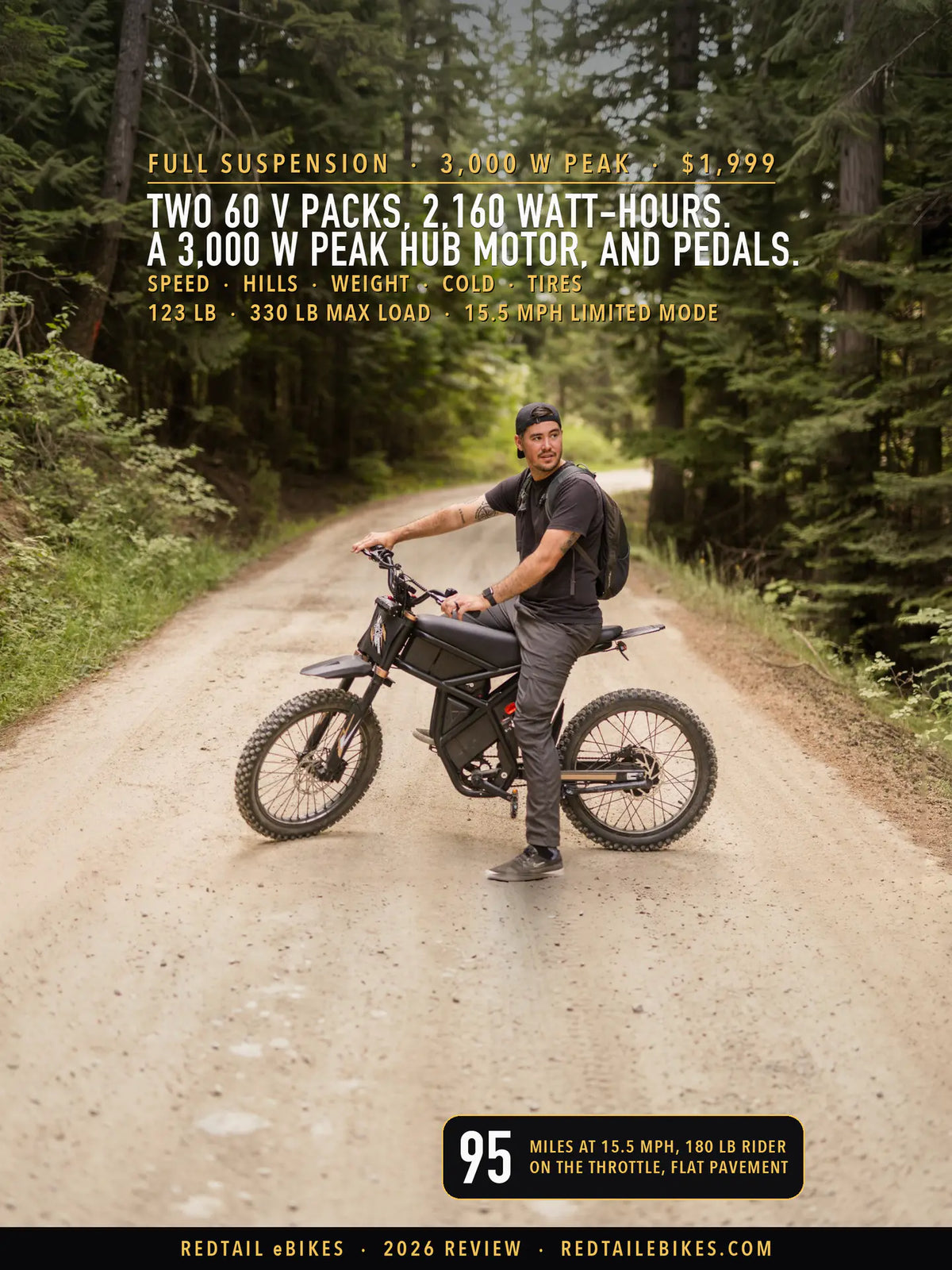

Riding Times GT73 Pro · electric dirt bike with pedals · a 3,000 W peak hub motor · 338 N·m · two 60 V packs, 2,160 Wh · 85 miles on the throttle, 155 on pedal assist, as Riding'times publishes them · 15.5 mph Limited Mode · 123 lb · 330 lb max load · rider height 5'5" to 6'3" · $1,999 · verified September 26, 2026
Quick Answer — The Riding'times GT73 Pro is a $1,999 electric dirt bike with pedals, full suspension, a 3,000 W peak hub motor with 338 N·m of torque and two removable 60 V packs, 2,160 Wh. For a 180 lb rider on flat pavement, a full charge computes to 95 miles at 15.5 mph on the throttle, the speed Limited Mode holds.
Hold 20 mph and the same charge lasts about 72 miles; pedal easily at 15.5 mph and it stretches to 141. Riding'times rates it at 85 miles on the throttle and 155 on pedal assist, and the range section works out your own ride from speed, climbing, load, air temperature and tires.
Unlimited Mode takes the throttle to 50 mph, and every motor figure Riding'times gives the GT73 Pro we sell sits above the 750 W in the federal e-bike definition; the class section sets out where you can ride it.
On September 26, 2026 the GT73 Pro was orderable on our store at $1,999, with $2,999 shown as the regular price. Delivery within the contiguous United States is free, and a warranty claim comes to our US support desk.
Buy the GT73 ProWhat this review covers
What $1,999 buys · What it is · Will it fit you · The motor and its modes · The batteries · How far it goes · Brakes and lights · Suspension, tires and water · Weight and load · The Mercer fit test · UL · Recalls · The class question · Where to ride it · Green and red flags · The verdict · Checklist · Buying it from us · FAQ · Limitations · The bottom line · References
How we verified this Riding'times GT73 Pro review
Every figure here was read on September 26, 2026 from Riding'times' GT73 Pro product page, its product record, the Riding'times FAQ, its warranty page, our listing or the statutes quoted in the class section. The range and fit figures are computed, and each section's formula names its inputs and their sources.
This review is specification-verified: every figure was checked against the manufacturer's published specification and recomputed, and the range model reproduces the published benchmarks it rests on. We sell the GT73 Pro, so weigh the red flags as carefully as the green ones.
Written by Milad Ghobadibeygvand, BScN (Western University, 2014). Corrections: support@redtailebikes.com.
What $1,999 buys
| Riding'times' published figure | |
|---|---|
| Type | "GT73 Pro Dual-Battery Off-Road All-Terrain Electric Dirt Bike with Pedals" |
| Motor | "Rear Gear Hub Motor 3000W", labeled "3000W Peak Motor" in the headline strip |
| Drive | "5.2:1 Integrated Geared Drive" |
| Torque | 338 N·m |
| Controller | "60V 40A Integrated Fardriver Controller" |
| Batteries | "Dual Battery - 60V 18Ah*2 Removable Lithium Battery UL 2849 Compliant" |
| Energy | 2,160 Wh ("2160Wh 60V 36Ah Dual Battery") |
| Range | "Throttle only: 85 miles", "Pedal Assist (PAS): 155 miles", "Range varies based on speed and load weight" |
| Top speed | 37–46 mph in the specification table; 50 mph in the title and the headline strip; 49 and 50 mph in the FAQ |
| Limited Mode | 25 km/h (15.5 mph) on every throttle and pedal-assist level |
| Unlimited Mode | throttle ECO 15.5, STD 28, TURBO 50 mph; pedal assist ECO 15.5, STD and TURBO 21.7 mph |
| Sensor | Cadence |
| Throttle | Full-twist |
| Chargers | Two, 67.2 V 3 A ("Dual Charger 67.2V 3A x2") |
| Charge time | 5–6 hours |
| Brakes | Hydraulic discs front and rear with EABS; 230 mm rotors on the product page, 180 mm discs in the product record |
| Suspension | "Adjustable Damping Aluminum Front Fork + 1200-LBS Rear Shock" |
| Tires | 25 × 3" off-road motorcycle tires, 70/100-19 |
| Rims | "Enhanced Load-bearing 7074 Aluminum Alloy" |
| Lights | Front and rear LED, turn signals, a 2-in-1 brake and turn-signal light, optional ambient light |
| Water resistance | IPX4 in the specification table; IPX5 in the FAQ, for all models |
| Weight | 123 lb |
| Max load | 330 lb |
| Size | 73.82 × 28.74 × 45.91 in (L × W × H); the geometry block gives 74.8 in long and 44.1 in high |
| Wheelbase | 50.0 in |
| Seat height | 30.3 in; rear seat height 35.4 in |
| Pedal ground clearance | 5.1 in |
| Rider height | 5'5" to 6'3" in the geometry block; 150–190 cm in the FAQ |
| Age | "Recommended Age: 12 years and above" (FAQ) |
| In the box | The bike, the front wheel, the front fender, a "Shock Absorber – 1800 lbs", pedals (L/R), two 60 V 18 Ah batteries, the user manual and eight wrenches |
| Shipping carton | 62.60 × 12.60 × 33.07 in |
Read September 26, 2026 from Riding'times' product page, its product record and the FAQ. Where two of Riding'times' own documents print different figures, both are in the row, and the brakes and suspension sections take them up.
The Riding Times GT73 Pro: an electric dirt bike with pedals and two packs
Riding'times' own label is "GT73 Pro Dual-Battery Off-Road All-Terrain Electric Dirt Bike with Pedals". Its FAQ on the same page describes "a high-performance full-size electric dirt bike with pedals" built "for recreational riding across pavement, gravel, packed dirt and suitable outdoor riding areas."

On a hilltop at dusk: the GT73 Pro on its kickstand, the rider in a full-face helmet, the long bench seat and the pack bay between the frame rails.
Behind the label sit full suspension, a long bench seat, 70/100-19 motorcycle tires, a 3,000 W peak hub motor in the rear wheel and two removable 60 V packs. Riding'times calls the Pro "the higher-performance model in the GT73 family", and its page sums up the aim in one line: "The GT73 Pro is designed for riders who want to move beyond basic neighborhood riding."

From the front three-quarter, drive side: the fork and front disc, the frame rails around the pack bay, and a pedal on its crank below the bay.
The pedals come in the box. The box list includes "Pedals - L/R", and the product page's FAQ answers a question buyers type into search: "Yes. The GT73 Pro includes functional pedals as part of its full-size electric dirt bike platform." They drive the rear wheel through a chain, and the class section explains why they count.

From behind: the hub motor inside the rear wheel, the chain running from the crank, the swingarm, and the rear shock under the bench.
GT73 or GT73 Pro?
Riding'times prints the two side by side on the Pro's page. The Pro trades seven pounds for more voltage, more torque and faster charging:
| GT73 | GT73 Pro | |
|---|---|---|
| Motor | "Rear Gear Hub Motor 2400W" | "Rear Gear Hub Motor 3000W" |
| Torque | 126 N·m | 338 N·m |
| Batteries | 48 V 18.2 Ah × 2 | 60 V 18 Ah × 2 |
| Charge time | 9–10 hours | 5–6 hours |
| Top speed, specification table | 28–37 mph | 37–46 mph |
| Weight | 116 lb | 123 lb |
| Range, as published | 85 mi throttle, 155 mi pedal assist | 85 mi throttle, 155 mi pedal assist |
| Price on our store | $1,499 | $1,999 |
From the comparison table on Riding'times' GT73 Pro page and our listings, read September 26, 2026. Both print the same range figures.
In the words of the page's FAQ: "The GT73 uses a 2400W peak motor with dual 48V batteries. The GT73 Pro increases peak power to 3000W and uses dual 60V batteries, making it the more performance-focused model." Our GT73 review runs the same range and fit models on the GT73.
Will the GT73 Pro fit you?
The GT73 Pro's seat is a fixed bench, 33.1 inches off the ground on Riding'times' own photograph, so fit comes down to two questions: how your feet meet the ground at a stop, and how bent your knee stays when you pedal. Seated, 35 of 100 riders at 5'8", 79 of 100 at 5'10" and 96 of 100 at 6'0" reach the ground flat-footed.
The model sets the 6,068 bodies the US Army measured for its 2012 survey against Riding'times' figures and its photograph, with the pedaling height at 109% of inseam.
To place yourself on this frame:
- Measure your inseam. In socks, back to a wall, pull a hardcover book up firmly between your legs and mark its top edge; the floor to that mark is your inseam.
- Find your row in the standover table and read how your feet meet the ground with the bench at 33.1 or 30.3 inches.
- Read the pedaling table if you plan to pedal; it shows how far below the formula's height the bench sits for your size.
Riding'times prints two rider windows for the GT73 Pro: 5'5" to 6'3" in the geometry block on its product page, and 150 to 190 cm (4'11" to 6'3") in its FAQ. The model's rows sit beside both.
| What Riding'times publishes | Its figure | On its photograph |
|---|---|---|
| Rider height | 5'5" to 6'3" (geometry block); 150–190 cm (FAQ) | not measurable |
| Seat height | 30.3 in | 33.1 in at the bench's lowest point |
| Rear seat height | 35.4 in | not measured |
| Pedal ground clearance | 5.1 in | 6.0 in to the pedal axle |

Riding'times' geometry drawing for the GT73 Pro, published beside its figures, with numbered lines for the overall height, the rear seat height, the seat height, the overall length, the wheelbase, the rear and front center, and the pedal ground clearance.
Will I pedal with a bent knee?
Yes, at every height in the table: the formula's pedaling height sits above the bench for all but 1 of 100 riders at 5'0" and for every rider from 5'2" to 6'2". The formula sets the saddle 109% of inseam above the pedal axle (Peveler et al., 2005), with a published range from 106% (Ferrer-Roca et al., 2012).
On the GT73 Pro the bench is fixed, so this table measures the knee bend you will pedal with. Turning the formula into a height off the floor runs through the 12.2-inch crank axle and the 6.2-inch cranks measured on Riding'times' photograph.
| Your height | Typical inseam | Formula saddle height, median rider | The 33.1 in seat, median rider | Riders it suits, of 100 |
|---|---|---|---|---|
| 5'0" | 27.1–29.7 in | 36.0 in | 3.0 in low | 1 |
| 5'2" | 28.0–31.1 in | 37.2 in | 4.1 in low | 0 |
| 5'4" | 29.1–32.2 in | 38.2 in | 5.1 in low | 0 |
| 5'6" | 30.2–33.5 in | 39.4 in | 6.3 in low | 0 |
| 5'8" | 31.1–34.3 in | 40.4 in | 7.4 in low | 0 |
| 5'10" | 32.2–35.5 in | 41.6 in | 8.6 in low | 0 |
| 6'0" | 33.2–36.7 in | 42.8 in | 9.8 in low | 0 |
| 6'2" | 34.3–37.5 in | 44.0 in | 10.9 in low | 0 |
The floor-to-saddle height the 109% formula asks for, the typical rider of each height against the bench's 33.1 inches on Riding'times' photograph, and the riders of 100 at that height whose 106 to 110.4% band contains the bench; Army survey bodies, both sexes.
The bench sits 3.0 to 10.9 inches below the formula's height from 5'0" to 6'2". A seat below the formula's height means more knee bend at the bottom of every pedal stroke; the throttle and pedal assist carry the pace, and the effort table prices what your pedaling saves.
Can I put a foot down at a stop?
It depends on your inseam and on which seat figure matches the bike: at the photograph's 33.1 inches, 35 of 100 riders at 5'8" put both feet flat while seated, against 79 of 100 at 5'10" and 96 of 100 at 6'0". On the GT73 Pro you sit astride the bench at a stop, so the seat height is the figure your legs meet.
Riding'times prints a 30.3-inch seat height and a 35.4-inch rear seat height; on its product photograph, scaled by the published 50.0-inch wheelbase, the bench's lowest point, where a rider sits, stands at 33.1 inches. Until the bike is in front of you, plan on the higher figure.
| Your height | Typical inseam | Clearance at 33.1 in | At 30.3 in |
|---|---|---|---|
| 5'0" | 28.4 in | −6.0 in | −3.2 in |
| 5'2" | 29.5 in | −5.0 in | −2.3 in |
| 5'4" | 30.5 in | −4.0 in | −1.2 in |
| 5'6" | 31.7 in | −2.9 in | −0.1 in |
| 5'8" | 32.6 in | −1.9 in | 0.8 in |
| 5'10" | 33.8 in | −0.8 in | 1.9 in |
| 6'0" | 34.9 in | 0.1 in | 2.9 in |
| 6'2" | 36.0 in | 1.3 in | 4.0 in |
Barefoot inseam minus each figure: 33.1 inches measured on Riding'times' photograph, 30.3 printed in its geometry block. Each cell is the clearance 95 of 100 riders at that height have or exceed, with a minus sign where the bench sits higher than that inseam.
Will I feel cramped, or stretched?
Neither: the grips sit 30.5 to 31.0 inches above the crank axle and 10.3 to 11.8 inches ahead of it, and every rider in the survey from 5'0" to 6'2" reaches them sitting upright. Sitting upright, the median rider's elbows stay bent 64 to 79 degrees, more for taller riders, because the grips come back toward the bench.
Twenty recreational cyclists in one study rated the most upright of three trunk positions the most comfortable (Priego Quesada et al., 2017); the GT73 Pro puts every rider in the table in that posture.
| Your height | Lean from upright, median rider | Riders who reach the grips sitting upright, of 100 | Elbow bend sitting upright, median rider |
|---|---|---|---|
| 5'0" | 0° | 100 | 64° |
| 5'2" | 0° | 100 | 67° |
| 5'4" | 0° | 100 | 69° |
| 5'6" | 0° | 100 | 73° |
| 5'8" | 0° | 100 | 75° |
| 5'10" | 0° | 100 | 76° |
| 6'0" | 0° | 100 | 78° |
| 6'2" | 0° | 100 | 79° |
Trunk lean from vertical for the middle rider of each height, the riders of 100 who reach the grips with no lean, and the median rider's elbow bend sitting upright, each from that body's measured torso and arm, with the grips measured on Riding'times' photograph.
How much weight goes through my wrists?
Little: 5 to 6 percent of your body weight at the median with the back fully relaxed. Ten road racers pedaling on the hoods in a lab put 15% of their weight through the bars (Carahalios, 2015); on the GT73 Pro's high, close grips the median rider's relaxed-back ceiling is under half of that at every height in the table.
Riding'times' own safety list in its FAQ includes "Protective gloves", and on rough ground your hands carry the bars through the bumps whatever your posture.
| Your height | Share of your weight, back relaxed | Median rider's weight | On each hand |
|---|---|---|---|
| 5'0" | 5% (5–7%) | 126 lb | about 3 lb |
| 5'2" | 6% (5–7%) | 139 lb | about 4 lb |
| 5'4" | 6% (5–7%) | 147 lb | about 4 lb |
| 5'6" | 6% (5–7%) | 166 lb | about 5 lb |
| 5'8" | 6% (5–7%) | 179 lb | about 5 lb |
| 5'10" | 6% (5–7%) | 192 lb | about 6 lb |
| 6'0" | 6% (5–7%) | 204 lb | about 6 lb |
| 6'2" | 6% (5–7%) | 216 lb | about 7 lb |
Ceiling on the hands with the back relaxed, from each body's segment weights (Clauser et al., 1969); the spread runs across bench and grip positions, at the survey's median weight for each height.
How do I set it up when it arrives?
The bench does not move, so your setup is the pedals, the suspension and the controls. The pedals go on during assembly: Riding'times' FAQ lists the front wheel, the handlebars and the pedals among the parts you fit, and asks that you "Make sure all bolts and fasteners are properly tightened during assembly."
On the pedals, the knee target in cycling research bends 25 to 35 degrees with the pedal at the bottom (Peveler et al., 2007); on this bench most riders' knees will bend more, as the table above shows.
For the ride itself, Riding'times specifies an "Adjustable Damping Aluminum Front Fork", and its box list adds a second rear shock rated 1,800 lb beside the fitted 1,200 lb one; email us your weight with gear and we will confirm with Riding'times which one to run.
If assembly is not for you, the same FAQ recommends "seeking assistance from a local bike shop or qualified technician."
How we computed fit
Pedaling height is 1.09 × inseam from the pedal axle; standover clearance is inseam minus the bench's height; lean is the smallest trunk angle at which a straight arm reaches the grip; hand load is the upper body's weight times its lean, divided by the reach to the grip.
Take a 5'8" rider with the survey's median 32.6-inch inseam: the formula needs 35.6 inches from the pedal, which is 29.4 inches from the crank axle (88.3% of inseam gives 28.8), a floor-to-saddle height of 40.4 inches, 7.4 inches above the bench.
| Input | Value | Source |
|---|---|---|
| Rider bodies | 6,068 (4,082 men, 1,986 women) | US Army ANSUR II, 2012 |
| Pedaling formula | 109% of inseam; range 106–110.4% | Peveler et al., 2005; Ferrer-Roca et al., 2012 |
| Bench height | 33.1 in, its lowest point; 30.3 in printed | measured on Riding'times' photograph; its geometry block |
| Crank length | 6.2 in | measured on Riding'times' photograph |
| Crank axle height | 12.2 in (11.9–12.5) | measured on Riding'times' photograph |
| Bench angle from the crank axle | 73.9° (70.9–76.9°) | measured on Riding'times' photograph |
| Grip center | 10.3–11.8 in ahead, 30.5–31.0 in above the crank axle | measured on Riding'times' photograph |
| Segment weights | head and trunk 58.0%, each arm 4.9% of body weight | Clauser et al., 1969 |
Before anything was read off the photograph, it was held against Riding'times' own figures.
| Dimension | Maker lists | Measured on its photograph | Gap |
|---|---|---|---|
| overall length | 74.8 in | 73.4 in | −1.9% |
| overall height | 44.1 in | 44.7 in | +1.3% |
| rear center length | 24.0 in | 24.3 in | +1.3% |
| front center length | 24.8 in | 25.7 in | +3.6% |
| seat height | 30.3 in | 33.1 in | +9.1% |
| pedal ground clearance | 5.1 in | 6.0 in | +17.8% |
Scaled from the published 50.0-inch wheelbase, axle center to axle center, on Riding'times' side-profile photograph of the GT73 Pro. The overall length, overall height and rear center agree within 3.5 percent; the seat height and pedal clearance measure differently on the photograph, so the model takes the bench from the photograph and prints both standover figures.
Near 5'5", or between two rows? Email your height and inseam to support@redtailebikes.com and we will run them through this model before you order. It is $1,999 on our store, and delivery is free.
Buy it for $1,999A 3,000 W peak hub motor, 338 N·m and two speed programs
Riding'times' specification table lists a "Rear Gear Hub Motor 3000W" with 338 N·m of torque, and the headline strip beside it labels the same figure "3000W Peak Motor".
The word "Peak" matters: a peak is the most a motor gives in a short burst, and the rating it holds is lower; the class section sets Riding'times' 2025 figure of 1,500 W beside it. The strip also names the gearing inside the hub: "5.2:1 Integrated Geared Drive".

The rear hub motor inside the spoked wheel, the disc and caliper beside it, the chain from the crank on its sprocket, and the rear shock's spring above the swingarm.
The motor sits in the rear wheel, and a "60V 40A Integrated Fardriver Controller" feeds it. Help arrives two ways: a full-twist throttle, and pedal assist through a cadence sensor, which answers the cranks turning.
Riding'times builds two speed programs into the GT73 Pro and prints them in its FAQ:
| Program | Throttle | Pedal assist |
|---|---|---|
| Limited Mode | 25 km/h (15.5 mph) on every level | 25 km/h (15.5 mph) on every level |
| Unlimited Mode | ECO 15.5 · STD 28 · TURBO 50 mph | ECO 15.5 · STD 21.7 · TURBO 21.7 mph |
Riding'times' FAQ, "What is the speed for each model?", read September 26, 2026; the kilometer figures are Riding'times', the mile figures its own conversions.
In Riding'times' words, "Limited Mode is a speed-restricted riding mode designed to comply with local eBike regulations in many regions", and when it is on "the maximum speed of the eBike is capped at 25 km/h (15.5 mph) regardless of the selected pedal-assist or throttle level."
The specification table puts the top speed at 37 to 46 mph, "Speed varies based on road condition and load weight"; the FAQ gives "up to 80 km/h (50 mph) in Unlimited Mode under test conditions" in one answer and 49 mph in two others.
The hub turns with the wheel. At a given road speed, what the battery pays depends on how hard you pedal, and the effort table puts a number on it.
Two 60 V 18 Ah packs, 2,160 Wh
60 V × 18 Ah × 2 is 2,160 watt-hours, the figure Riding'times prints as "2160Wh 60V 36Ah Dual Battery". Both packs are removable, and its specification table describes them as "UL 2849 Compliant".
Two chargers come with the bike, 67.2 V at 3 A each, and Riding'times gives 5 to 6 hours for a full charge. The arithmetic agrees if each charger fills one 18 Ah pack: 18 Ah at 3 A is 6 hours from empty.
The FAQ sets out the charging routine. Before you plug in, check that "The battery power switch is turned OFF", "The eBike is completely powered OFF" and "The charger and charging port are clean and dry"; the packs charge on the bike or off it, and the FAQ asks for "the original charger supplied with the eBike."
For storage the same page asks you to keep the packs between 40% and 60%, indoors and above 32 °F, and to recharge them "every 1–2 months". After a cold ride, let a pack reach room temperature before charging it.
How far the GT73 Pro goes on one charge
On flat pavement, a 180 lb rider gets about 95 miles from a full charge at 15.5 mph on the throttle, 72 at 20 mph, and 141 at 15.5 mph with easy pedaling. Climb an 8% grade at 10 mph on the throttle and the same charge lasts 13 miles.
Working out your own figure takes three steps:
- Pick your speed and your effort in the first two tables.
- Budget 278 to 414 Wh of the 2,160 for every 1,000 feet of climbing (10 mph on the throttle, 4 to 10% grades), or 229 to 357 if you pedal easily (the hills table).
- Adjust for your load and the air temperature, then plan on 75% of the result.
Each table computes one steady ride at a time from Riding'times' specifications, Bafang's published figures for a comparable geared hub motor, drum readings for knobby tires, the bike's own tire size, and a cycling-power model checked on a real road. The last subsection shows the formula and carries one ride through it.
Does riding faster cut range? Miles at each speed
On the flat, speed decides first: on the throttle, a full charge runs 129 miles at 10 mph and 43 at 28. From 15.5 mph to 20, a full charge drops from 95 miles to 72, because the power the air takes rises with the cube of your speed.
| Speed, flat | Per mile | Full charge | With 25% kept |
|---|---|---|---|
| 10 mph | 16.7 Wh | 129 mi | 97 mi |
| 12 mph | 18.5 Wh | 117 mi | 88 mi |
| 15.5 mph | 22.7 Wh | 95 mi | 71 mi |
| 18 mph | 26.6 Wh | 81 mi | 61 mi |
| 20 mph | 30.2 Wh | 72 mi | 54 mi |
| 22 mph | 34.3 Wh | 63 mi | 47 mi |
| 25 mph | 41.5 Wh | 52 mi | 39 mi |
| 28 mph | 50.0 Wh | 43 mi | 32 mi |
Throttle only, level pavement, a 180 lb rider at 77 °F. The right-hand column keeps 25% of the pack in reserve, the share a measured pedelec held back to prevent deep discharge in Schmitt, Decker and Doppelbauer's work. Every row past 15.5 mph is Unlimited Mode, which the class section takes up.
Easy pedaling stretches a charge a long way: 75 W from your legs at 15.5 mph takes a full charge from 95 miles to 141. Easy pedaling in these tables is 75 W and steady pedaling 150 W. With the motor idle, 75 W would carry this bike at about 7.6 mph on level ground and 150 W at about 11.9, so choose the column you could hold without help.
| Speed, flat | Throttle only | Easy pedaling (75 W) | Steady pedaling (150 W) |
|---|---|---|---|
| 15.5 mph | 95 mi | 141 mi | 249 mi |
| 18 mph | 81 mi | 108 mi | 153 mi |
| 20 mph | 72 mi | 89 mi | 116 mi |
| 22 mph | 63 mi | 75 mi | 92 mi |
| 25 mph | 52 mi | 59 mi | 68 mi |
| 28 mph | 43 mi | 48 mi | 53 mi |
Miles from a full charge on level pavement, a 180 lb rider; easy pedaling at 15.5 mph draws 15.3 Wh a mile where the throttle draws 22.7. In the 249-mile cell your legs push harder than the motor, so it leans most on the model's weakest part, its motor losses at light load (Limitations item 5).
The speed programs set where you ride in these tables. In Limited Mode everything happens at 15.5 mph or below; in Unlimited Mode the throttle's STD level holds 28 mph and its TURBO level runs past the table.
| Mode | Its speed cap | Full charge at the cap | With 25% kept |
|---|---|---|---|
| Limited mode, every level | 15.5 mph | 95 mi | 71 mi |
| Throttle ECO | 15.5 mph | 95 mi | 71 mi |
| Throttle STD | 28 mph | 43 mi | 32 mi |
| Pedal assist STD and TURBO | 21.7 mph | 64 mi | 48 mi |
Level pavement, a 180 lb rider, each mode held at its cap with the motor doing the work; on a cadence sensor the motor answers the cranks turning, so the pedal-assist row takes your legs as spinning without pushing. The model stops at 28 mph: its comparable motor, rated 1,000 W, holds about 28 mph on the flat with a 180 lb rider, so it does not price the 50 mph TURBO throttle.
Does pedaling save battery? Your effort decides
Pedal for the battery. The GT73 Pro drives its rear wheel through one chain and a hub motor that spins with the wheel, so at a set speed and grade the draw falls as your push rises:
| Your ride | Throttle only | Easy pedaling (75 W) | Steady pedaling (150 W) |
|---|---|---|---|
| 15.5 mph, flat | 22.7 Wh | 15.3 Wh | 8.7 Wh |
| 20 mph, flat | 30.2 Wh | 24.2 Wh | 18.7 Wh |
| 12 mph, 4% grade | 73.4 Wh | 56.7 Wh | 41.9 Wh |
| 12 mph, 8% grade | 159.6 Wh | 134.2 Wh | 111.2 Wh |
Watt-hours drawn from the packs per mile, a 180 lb rider at 77 °F; easy pedaling is 75 W from you and steady pedaling 150 W.
On an 8% grade at 12 mph, the throttle alone takes 159.6 Wh a mile; easy pedaling lowers it to 134.2 and steady pedaling to 111.2. Every watt at the pedals is one the motor does not supply, along with the heat the motor and the packs would have lost producing it.
Riding'times' own winter advice runs the same way: "Use lower assist levels when possible."
Does going uphill drain the battery faster?
Much faster: at 10 mph on the throttle up 4 to 10% grades, each 1,000 feet you climb costs 278 to 414 Wh beyond the same distance on the level, or 229 to 357 with easy pedaling. Raising you and the bike accounts for 28 to 41% of the throttle figure; the motor and the packs lose the rest, a share that grows as the road steepens.
A 180 lb rider on the 123 lb GT73 Pro weighs 303 lb together, and lifting 303 lb through 1,000 feet takes 114 Wh at the wheel.
Up an 8% grade at 10 mph on the throttle, the packs spend 405 Wh on each 1,000 feet, so the full 2,160 Wh would climb about 5,339 feet with nothing saved for the flat. The model gives no credit for descents; coasting downhill costs less than the same distance on the level, so a budget built from these rows leaves some in hand.
| Grade | Per mile, throttle | Full charge, throttle | Full charge, easy pedaling |
|---|---|---|---|
| 2% | 42 Wh | 52 mi | 85 mi |
| 4% | 75 Wh | 29 mi | 40 mi |
| 6% | 118 Wh | 18 mi | 24 mi |
| 8% | 170 Wh | 13 mi | 16 mi |
| 10% | 234 Wh | 9 mi | 11 mi |
10 mph, a 180 lb rider; the right-hand column adds 75 W of easy pedaling. The model caps the motor's draw at what the "60V 40A Integrated Fardriver Controller" can feed, 60 V × 40 A = 2,400 W.
Holding 10 mph on the throttle up 12% asks more than that, and 15% more than the comparable motor's torque, so both grades are left out; Riding'times rates the GT73 Pro's own motor at 3,000 W peak and 338 N·m.
Price a hilly ride as level miles plus climbing. Thirty level miles at 15.5 mph on the throttle use about 681 Wh, and 2,000 feet of 8% climbing adds about 730, near 1,411 Wh of the 2,160 in all. Wind, stops and starts come on top, because every mile in the model is ridden at an even pace.
Does rider weight affect range?
A heavier load costs a little on the flat and a lot on a hill. More weight adds to the work of the tires and the grade and nothing to the air's share, so the gap widens as the road tilts up.
| You plus your load | 15.5 mph flat, throttle | 20 mph flat, throttle | 8% climb, 10 mph |
|---|---|---|---|
| 100 lb | 111 mi | 80 mi | 20 mi |
| 130 lb | 105 mi | 77 mi | 17 mi |
| 180 lb | 95 mi | 72 mi | 13 mi |
| 220 lb | 89 mi | 68 mi | 10 mi |
| 260 lb | 83 mi | 64 mi | 9 mi |
| 330 lb | 74 mi | 59 mi | — |
Everyone and everything on the bike, with its own 123 lb added in every row because the motor carries that too; throttle only. A dash marks a climb the model cannot hold at 10 mph within the controller's 2,400 W. The 330 lb row is Riding'times' max load, which its FAQ counts as "Rider weight", "Passenger weight (if applicable)" and "Cargo and accessories".
Going from 180 lb to 260 lb takes 12 miles off the level 15.5 mph ride, from 95 to 83, and cuts the 8% climb from 13 miles to 9. With the full 330 lb aboard, the level 15.5 mph ride still reaches about 74 miles.
Up 8% at 10 mph the controller's 2,400 W carries 260 lb aboard but not the full 330, since on a grade most of the power at the wheel goes into lifting; the full load takes that grade more slowly, or with pedaling.
Does cold weather drain the battery?
Yes, and each colder row costs more. The 15.5 mph throttle ride that covers 95 miles at 77 °F comes to about 73 at 32 °F, 23% less, inside the 10% to 30% cold-weather loss Riding'times' FAQ gives.
| Air | Pack energy vs 77 °F | 15.5 mph flat, throttle |
|---|---|---|
| 95 °F | 99% | 101 mi |
| 77 °F | 100% | 95 mi |
| 68 °F | 98% | 90 mi |
| 50 °F | 93% | 80 mi |
| 41 °F | 91% | 76 mi |
| 32 °F | 89% (80–93) | 73 mi (66–77) |
| 14 °F | 82% (40–83) | 66 mi (32–66) |
Level pavement, a 180 lb rider. The central figures come from McMaster University's LG HG2 cell data, recomputed at a 0.5C discharge; the lab measured 77, 50, 32 and 14 °F, the other rows are interpolated, and the cells are taken to be at air temperature.
Brackets mark the spread between published cell data sets. The low end of each is the least capacity Samsung's data sheets print at that temperature for a cell drained at one to four times its capacity per hour (the 25R and 30Q sheets at 32 °F, the 35E at 14 °F); the high end is the most energy Casado and colleagues recorded in 2025 at a slower rate.
Three losses stack up at freezing. The cells return about 89% of the energy they give at 77 °F, and the air is about 9% denser, by the gas law in the U.S. Standard Atmosphere. The third is cold rubber: the model raises rolling resistance 0.5% for each °F below 77 °F, between Rothhämel's fit for a bicycle tire and Bicycle Rolling Resistance's road-tire average, and holds the 41 °F value below 41 °F.
Riding'times says riding in winter is fine and storing a pack in the freeze is not: "prolonged exposure to freezing temperatures may cause permanent battery damage". Bring the packs indoors between rides.
Do knobby tires cut range? Tires and riding position
On level ground your tires matter more to range than how you sit. The drum the model draws on measures bicycle tires and has no reading for a 70/100-19 motorcycle tire, so the model takes the heaviest-rolling knobby casings Bicycle Rolling Resistance has measured, a coefficient of 0.0126, and brackets it with Tengattini and Bigazzi's field average for 138 riders on knobby tires.
| Rolling resistance | 15.5 mph flat, throttle | 20 mph flat, throttle |
|---|---|---|
| 0.0092 · the knobby field average, 138 riders | 112 mi | 81 mi |
| 0.0126 · the heaviest knobby casings on the drum (used) | 95 mi | 72 mi |
| 0.0131 · the field average plus one standard deviation | 93 mi | 70 mi |
Full-charge miles on level pavement, a 180 lb rider. The heaviest casings are Kenda's Juggernaut Pro, 0.01262 on the site, and Schwalbe's Hans Dampf at extra-low pressure.
Sand, loose dirt and wet grass have no drum reading at all; send us a route and we will run it through the model.
How you sit counts for more as speed climbs. The model uses 0.640 m² of drag area, the figure Tengattini and Bigazzi recorded for 37 upright cruiser riders; their 0.603 m² for 90 mountain-bike riders would take the 20 mph ride from 72 miles to 75.
Riding'times' 85 and 155 miles, matched to real rides
Riding'times' two figures, 85 miles on the throttle and 155 on pedal assist, each match a steady ride on level pavement. Its page adds that "Range varies based on speed and load weight", and its FAQ lists rider weight, terrain, speed, temperature, tire pressure and battery condition.
- 85 miles leaves 25.4 Wh a mile: about 17.3 mph on the throttle, 20.6 mph with easy pedaling, or 22.8 with steady pedaling.
- 155 miles leaves 13.9 Wh a mile. No steady throttle-only speed in the model draws that little; it takes easy pedaling at about 14.8 mph or steady pedaling at about 18.0.
The throttle figure therefore fits a ride in the mid-teens, just above Limited Mode's 15.5 mph, and the pedal-assist figure fits riding where your legs do a real share of the work. The model's 15.5 mph throttle ride, 95 miles, sits above the 85, and easy pedaling at 15.5 mph, 141 miles, sits below the 155.
Plan from 75% of any figure here. Riding'times' FAQ warns that "Long-term storage with a fully depleted battery may reduce battery lifespan", and keeping a quarter in the packs matches what one measured pedelec held back. At 15.5 mph on the throttle, three quarters of a charge covers 71 of the full 95 miles.
Take your row's figure and plan on three quarters of it. Set aside 278 to 414 Wh of the 2,160 for each 1,000 feet of climbing at 10 mph on the throttle, less with pedaling. For a 180 lb rider on level pavement, that plan is 71 miles at 15.5 mph on the throttle, or 54 at 20.
Thirty level miles at 15.5 mph and 2,000 feet of 8% climbing use about 1,411 of the 2,160 Wh on the throttle, inside the 1,620 Wh that three quarters of a charge holds. Email us your distance, your climbing, your weight with gear and your usual speed, and we will price the ride before you order.
Buy now, delivered freeHow every figure here is worked out
A steady speed needs a steady flow of power at the rear wheel. Martin and colleagues' 1998 model, validated on an open road, gives that power in one line for a constant speed in still air:
Power at the wheel = v × [ m × g × (Crr × cos θ + sin θ) + ½ × ρ × CdA × v² ]
Here v is speed, m the combined mass of rider, cargo and bike, g gravity, θ the angle of the slope, Crr the tires' rolling resistance (0.0126 means a drag of 1.26% of the weight on the tires), ρ the density of the air and CdA the drag area, a measure of how much air the rider pushes aside.
The first bracketed term covers the tires and the grade and the second the air; once multiplied by v, the air term rises with the cube of the speed.
Between the wheel and the battery sit four steps:
- Your pedaling reaches the rear wheel through the chain at 97.7% efficiency, the figure Martin and colleagues used, and the motor supplies the balance.
- The rear hub motor does all of the motor's pushing, turning with the wheel.
- The motor follows a comparable motor's published figures: the model takes Bafang's 2021 OEM workbook entry for its RM G0H0 geared hub: an n0 of 510 rpm, an nT of 426 rpm, a rated 1,000 W and an efficiency of "≥ 80" percent. It keeps that shape at the GT73 Pro's 60 V and sets the no-load speed from Riding'times' own 46 mph, which leaves the comparable's losses unchanged.
- The packs lose a little energy internally, at the battery efficiency Arango, Lopez and Ceren measured.
From there, watt-hours per mile = battery watts ÷ mph, and miles = 2,160 Wh × the share of the pack's energy left at that temperature ÷ watt-hours per mile.
| Input | Value used | Where it comes from |
|---|---|---|
| Bike | 123 lb | Riding'times' specification |
| Rider and cargo | 180 lb; the weight table also runs 100, 130, 220, 260 and 330 | 330 lb is Riding'times' max load |
| Batteries | 60 V × 18 Ah × 2 = 2,160 Wh | Riding'times' specification |
| Motor | one, the RM G0H0's 1,000 W shape at 60 V, no-load speed from the published 46 mph, 80% at the rated point, torque capped at 90 N·m | Bafang OEM workbook 2021; Riding'times' specification |
| Wheel | 24.53 inches across, Michelin's published diameter for a 70/100-19 tire; the size code gives the same within 0.4 mm | Michelin, StarCross 5 Medium sizes |
| Rolling resistance | 0.0126, the heaviest knobby casings on the drum | Bicycle Rolling Resistance |
| Drag area | 0.640 m², 37 upright cruiser riders | Tengattini and Bigazzi, 2018 |
| Chain | 97.7%, your pedaling only | Martin et al., 1998 |
| Battery losses | 3.0% at 15.5 mph, more at climbing currents | Arango, Lopez and Ceren, 2021 |
| Air | 77 °F at sea-level pressure, 1.184 kg/m³ | U.S. Standard Atmosphere, 1976 |
| Cold | the share of a cell's energy left at each temperature | McMaster University's LG HG2 cell data |
A worked ride: 15.5 mph on level pavement on the throttle, 180 lb aboard. The tires take 118.0 W and the air 126.0 W, so the rear wheel needs 244.0 W.
At 15.5 mph the 24.53-inch wheel turns 212 rpm. In the motor model (0.909 N·m of torque per amp, a 0.474 Ω winding and a 0.88 A no-load current, each worked out from Bafang's published figures), the motor makes 11.0 N·m on 12.9 A at 71.5% efficiency, below its 80% because the load is light, and draws 341.3 W.
Adding the packs' own losses, the batteries supply 351.9 W: 22.70 Wh a mile at 15.5 mph, and 2,160 ÷ 22.70 comes to about 95.1 miles, or 71.4 from three quarters of a charge.
Two published benchmarks, recomputed. Both halves of the model land on the figures their sources print:
| Check | Published figure | This model |
|---|---|---|
| Road physics, Martin and colleagues' worked example | 45.7 W for tires and grade, 158.8 W for the air | 45.7 W and 158.8 W |
| The comparable motor at Bafang's rated point | at least 80% efficient | 80% |
The worked example in Martin and colleagues' Appendix I (8.36 m/s ground speed, a 90 kg system, a 0.3% grade) and the RM G0H0's rated point in Bafang's workbook, each recomputed by the model's self-test.
Brakes and lights
Riding'times specifies hydraulic disc brakes front and rear with EABS, on a 123 lb machine rated to carry 330 lb. Its documents print two rotor sizes: the comparison table on the product page gives "230mm rotors", and the table in its product record "180mm discs". Email us before you order and we will confirm the size with Riding'times in writing.

Up front, the caliper on the fork leg clamping the disc, inside the knobby 70/100-19 tire.
Riding'times' product page puts the reason for the brakes in one line: "With a 3000W peak drivetrain, braking performance matters." Riding'times' FAQ asks you to "Regularly inspect your brakes, tires, and lights before riding."
The lights are motorcycle-style: front and rear LEDs, turn signals, a "2-in-1 Brake and Turn Signal Light" and an optional ambient light.

In a parking garage with the headlight on; the rider wears a helmet and sits on the bench with a foot on the pedal.
Suspension, tires and water
Riding'times specifies an "Adjustable Damping Aluminum Front Fork + 1200-LBS Rear Shock", and writes that full suspension helps "manage bumps, gravel, packed dirt and changing surfaces". The box list adds a "Shock Absorber – 1800 lbs"; the page does not say which riders it is meant for, so ask us and we will get Riding'times' answer in writing before you fit it.

From above and behind: the full length of the bench, both pedals on their cranks, and the hub motor in the rear wheel.
The tires are 25 × 3-inch off-road motorcycle tires, size 70/100-19, on "Enhanced Load-bearing 7074 Aluminum Alloy" rims.
Water: ride in the rain, never pressure-wash it. The specification table rates the GT73 Pro IPX4 and the FAQ says all models carry "an IPX5-rated exterior", good for "Light rain", "Water splashes" and "Wet roads".
The same FAQ asks you to "avoid deep water, flooding, or prolonged exposure to heavy rain", and to wash the bike with "A damp cloth", "A soft brush" and "Mild soap and water", keeping water away from the controller, wiring, display, motor electrics, battery terminals and charging ports.
123 pounds and a 330-pound max load
Riding'times lists 123 lb for the GT73 Pro and a 330 lb max load. The FAQ spells out what that load holds: "Rider weight", "Passenger weight (if applicable)" and "Cargo and accessories", and adds that "The total combined weight should not exceed the recommended limit."
The 330 lb is everything on the bike; the 123 lb bike sits outside it. A 220 lb rider with 30 lb of gear totals 250 lb, which leaves 80 lb to spare.
The bike measures 73.82 by 28.74 by 45.91 inches, and it ships in a 62.60 × 12.60 × 33.07-inch carton. Plan the lift and the storage for that before it arrives: a garage bay or a ground-floor room suits it better than a stairwell, and a car carrier has to be rated for 123 lb with a margin.
Work out where the GT73 Pro lives and how it travels before you order. At 123 lb and nearly 74 inches long, it wants a garage or a ground-floor room, and any carrier or trailer rated above its weight with room to spare.

The left side: the bench, the frame around the packs, the crank with its pedal, and the front disc behind the fork.
The Mercer fit test
Every review we publish puts the bike in front of the same seven people, the Mercers, so every machine answers the same fit questions (meet the Mercers).
Each verdict below rests on a figure Riding'times publishes (its two height windows, the seat height, the weight, the max load, the age recommendation) or on the model's row at that height in the fit tables. The bench sits below the 109% pedaling height for every member of the family, so each row reads the standover model: how many riders of that height sit flat-footed on the 33.1-inch bench.
| Member | Age · Height | Verdict | The number behind it |
|---|---|---|---|
| Frank Kowalski | 63 · 5'10" | Fits; plan the lift | 5'10" is inside both windows, and seated on the 33.1-inch bench 79 of 100 riders his height reach the ground flat-footed; the bike weighs 123 lb to wheel into the garage |
| Ruth Kowalski | 61 · 5'5" | At the floor of the product page's window | 5'5" is the bottom of 5'5" to 6'3" and inside the FAQ's 150–190 cm; on the 33.1-inch bench, 2 of 100 riders her height put both feet flat, so read the standover row before ordering |
| Jack Mercer | 48 · 6'1" | Fits | 6'1" is inside both windows, and 99 of 100 riders his height sit flat-footed on the 33.1-inch bench |
| Dana Mercer | 45 · 5'7" | Inside the window; tiptoes at a stop | 5'7" is inside both windows; 18 of 100 riders her height sit flat-footed at 33.1 inches, and the 330 lb max load covers her and her gear |
| Maya Torres | 32 · 5'6" | Inside the window; the commute is her question | 5'6" is inside both windows, and 10 of 100 riders her height sit flat-footed at 33.1 inches; for a car-free commute, the class section decides where it may go |
| Cole Mercer | 16 · 5'11" | No | Riding'times recommends the GT73 Pro from 12 and up; at 3,000 W peak it sits above the 750 W line of the federal definition and California's classes, so the rules that govern it are your state's for that kind of vehicle, and on this page the answer at 16 is no |
| Ivy Mercer | 12 · — | No | Riding'times' recommended age, 12 and up, describes the machine; a 3,000 W machine above the classes' 750 W line is off the table at her age on this page |
Jack and Ruth show where the GT73 Pro divides a family. At 6'1" Jack sits flat-footed on 99 of 100 bodies his height, while at 5'5", the floor of the product page's window, Ruth's inseam falls short of the bench on 98 of 100 bodies her height. Both are inside Riding'times' windows; the bench decides how their stops feel.
Is it UL certified?
Riding'times states it is. Its FAQ answers "Are Riding'times eBikes UL Certified?" with "Yes", adding that they are "certified to applicable UL safety standards, including UL 2272 and UL 2849, depending on the product." The GT73 Pro's specification table describes both packs as "UL 2849 Compliant".
The same FAQ draws the line on what that means: "UL certification relates to product safety standards. UL certification does not determine whether a vehicle is legal to operate in a specific location."
If a landlord, a building manager or an insurer asks for the certificate itself, email us and we will request it from Riding'times in writing.
Has it been recalled?
No. On September 26, 2026 we searched the Consumer Product Safety Commission's recall database, querying the title, product-name and manufacturer fields for Riding'times, Riding times, Ridingtimes, ridert, Shenzhen Riding Robot and Riding Robot, and reading every record of a 623-record corpus built from bicycle, e-bike, battery and scooter terms. No record names the brand, its company or the GT73.
The search had to find recalls known to exist before its empty answer counted, and it did: Ancheer 1, Specialized 54 and Trek 24 in the live fields, and Ancheer 1 and Specialized 49 in the corpus.
The class question: 15.5 mph in Limited Mode, 50 mph in Unlimited Mode
Settle this before you order, because Riding'times builds the GT73 Pro with two speed programs and prints motor figures well above the e-bike lines. Its FAQ is plain that the rider carries it: "Riders are responsible for understanding and complying with local laws and regulations."
Federally, 15 U.S.C. § 2085(b) describes a low-speed electric bicycle as "a two- or three-wheeled vehicle with fully operable pedals and an electric motor of less than 750 watts (1 h.p.), whose maximum speed on a paved level surface, when powered solely by such a motor while ridden by an operator who weighs 170 pounds, is less than 20 mph."
| The statute's test | The GT73 Pro, as Riding'times publishes it |
|---|---|
| Fully operable pedals | "Pedals - L/R" in the box list; "Yes. The GT73 Pro includes functional pedals" |
| A motor of less than 750 watts | 3,000 W peak on the product page; "a 1500W motor that peaks at 3000W" in Riding'times' June 19, 2025 comparison post; a 60 V 40 A controller |
| Under 20 mph on motor power alone | 15.5 mph in Limited Mode; 28 and 50 mph on the throttle in Unlimited Mode |
Sources: § 2085(b); Riding'times' product page, FAQ and June 19, 2025 comparison post, read September 26, 2026.
On the wattage line, every motor figure Riding'times has published for the GT73 Pro we sell is above 750 W, in either program. Limited Mode holds the speed under 20 mph; the watt limb stays where the motor puts it. Your state then decides what kind of vehicle the GT73 Pro is on its roads and paths, and what that takes.
California's definition shows how a state writes the same line. California Vehicle Code § 312.5(a), read on September 26, 2026, covers a bicycle "equipped with fully operable pedals and an electric motor that does not exceed 750 watts of power"; its class 3 "ceases to provide assistance when the bicycle reaches the speed of 28 miles per hour."
| Setting | The speed line | Where the GT73 Pro sits |
|---|---|---|
| Limited Mode, 15.5 mph | Under California's 20 mph class 2 line and the federal 20 mph | Under the speed lines; the motor figures stay above 750 W |
| Unlimited Mode, throttle STD 28 and TURBO 50 mph | Class 3 assist stops at 28 mph; a class 2 throttle at 20 | Past the speed lines as well |
Sources: § 312.5(a), § 2085(b) and Riding'times' FAQ, read September 26, 2026.
Riding'times' FAQ points the same way on paperwork: "Licensing, registration, insurance, and permitted operating areas may vary by jurisdiction." Our 50-state e-bike law atlas prints each state's definition, and our California e-bike law page sets out that state's rules in full.
Plan on the GT73 Pro as an off-road machine: private land and designated off-road routes, under your state's rules for that kind of vehicle. Before any road or path, read your state's definition, and tell us where you will ride; we will answer before you order.
Where you can ride it
Off pavement, whoever manages the land decides whether the GT73 Pro may go there, and the federal agencies write their e-bike rules around the same 750 W line.
On Bureau of Land Management land, 43 CFR 8340.0-5 defines an e-bike around "an electric motor of not more than 750 watts (1 h.p.)" and counts any other "motorized vehicle capable of, or designed for, travel on or immediately over land" as an off-road vehicle.
Section 8341.1 permits off-road vehicles on "those areas and trails designated as open to off-road vehicle use" and bars riding one "in violation of State laws and regulations relating to use, standards, registration, operation, and inspection of off-road vehicles."
On National Forest land, the Forest Service's directives of March 31, 2022 "provide for managing all classes of e-bikes as motor vehicles", in the words of its notice at 87 FR 41278, and where a Ranger District has issued a motor vehicle use map, 36 CFR 261.13 prohibits operating a motor vehicle "other than in accordance with those designations".
| Where you plan to ride | Who decides | What to read |
|---|---|---|
| Private land, your own or with permission | the owner | the owner's say-so |
| A state or county off-highway vehicle area | that agency | its rules on registration and electric machines |
| A National Forest road or trail | the Ranger District | its motor vehicle use map (36 CFR 261.13) |
| BLM land | the field office | its route designations (43 CFR 8341.1) |
Four kinds of ground, four documents; a spec sheet settles none of them.
On BLM land a violation "may be a fine of not more than $1,000 or imprisonment for not longer than 12 months, or both", under 43 CFR 8340.0-7. Our public-land e-bike guide takes the agencies one by one.
Riding'times' warranty page adds one line every dirt rider should read: its coverage excludes "Improper use, accidents, stunts, racing, or abuse."
Tell us where you plan to ride before you order. Email support@redtailebikes.com with the land or the trail and we will say plainly what rule applies there. It ships free to the lower 48 states.
Buy the GT73 Pro todayGreen flags / Red flags
Green flags
- Two removable 60 V packs, 2,160 Wh, good for a computed 95 miles at 15.5 mph on the throttle for a 180 lb rider, or 141 with easy pedaling.
- 338 N·m from a 3,000 W peak hub motor, with a 5.2:1 geared drive and a 60 V 40 A controller.
- Two speed programs: Limited Mode at 15.5 mph and Unlimited Mode for private land and designated off-road routes.
- Pedals in the box, driving the rear wheel through a chain.
- Full suspension: an adjustable-damping fork and a rear shock, with a second, 1,800 lb shock in the box.
- Hydraulic discs front and rear with EABS, and motorcycle-style lights with turn signals.
- Two chargers that fill the packs in 5 to 6 hours.
- A 330 lb max load and an upright riding position for every height from 5'0" to 6'2" in the fit tables.
- No recall names the brand in the CPSC database, searched September 26, 2026.
Red flags
These are about fit: who the GT73 Pro is wrong for, and where to go instead.
- Wrong if you want an e-bike for bike paths and bike lanes. Every motor figure for the GT73 Pro we sell is above 750 W; our e-bike buying guide sorts the three classes and matches a pick to each kind of rider, and we will point you to one.
- Wrong if you need both feet flat at every stop and stand under 5'10". At the 33.1-inch bench, 35 of 100 riders at 5'8" sit flat-footed; find your row in the standover table before you order, or read our GT54 Pro review: the same published 3,000 W peak and 338 N·m on Riding'times' compact frame, with footpegs in place of pedals.
- Wrong if you want to pedal long distances on legs alone. The bench sits below the pedaling formula's height at every size in the fit tables; our e-bike motor guide explains which drives suit pedal-first riding.
- Wrong for a rider under 18 on our page. Riding'times recommends 12 and up; our 50-state law atlas lists each state's rules, and we can point a teenager to a bike that fits them.
- Wrong if it has to go up stairs. At 123 lb and nearly 74 inches long it wants a garage or a ground-floor room; email us and we will suggest a lighter bike from our reviews.
- Wrong if you want the assist to follow how hard you push. A cadence sensor answers the cranks turning, not the force on them; our motor guide explains both kinds of sensor.
- Wrong if you want less machine for less money. The GT73 prints the same geometry, pedals and published range at $1,499, with 126 N·m and a 37 mph top speed (our GT73 review); our GT54 review covers the $949 compact machine on footpegs; the GT33 and Z8 Pro are the 750 W Riding'times bikes we sell.
Buy it if / Buy something else if
Buy it if you want a full-size electric dirt bike with pedals and two packs, for private land and designated off-road routes, with a Limited Mode that holds 15.5 mph and a computed 95 miles at that speed on the throttle.
It also asks that you stand about 5'10" or taller if you want both feet flat at a stop, or that you are happy on one foot; that you have a garage or a ground-floor room for a 123 lb machine; and that you read your state's rules before the first ride.
For $1,999 you get a 3,000 W peak hub motor with 338 N·m of torque, two removable 60 V packs with two chargers, full suspension, hydraulic discs with EABS, motorcycle-style lights and turn signals, and pedals. Shop Pay's sample plan on our listing is $180.43 a month for 12 months at 15% APR, $2,165.16 in total, subject to an eligibility check by Affirm's lending partners.
Buy something else if you need an e-bike for paths and bike lanes, where our e-bike buying guide matches a class to the ride; if you want the GT73 platform for less, where our GT73 review covers the $1,499 GT73.
If you want the same published motor figures in a smaller machine for $700 less, the GT54 Pro review covers the $1,299 GT54 Pro, with one pack and footpegs in place of two packs and pedals; for one of the 750 W Riding'times bikes we sell, the GT33 review and the Z8 Pro review take over.
Our electric dirt bike guide and our 3000W e-bike guide set the GT73 Pro beside the other machines of its kind that we sell. Every Riding'times model is on our Riding'times brand page, and every review we have published on our e-bike reviews hub.
Before you buy: the checklist
Ten checks before you spend $1,999; the first three tell you whether the GT73 Pro is yours to ride at all.
- Check the rules where you will ride: the land manager's for trails and off-road areas, your state's definition for anything else.
- Read Riding'times' age recommendation, 12 and up, beside your state's rules for a machine of this power.
- Plan where it lives: a garage or ground-floor room for a 123 lb, 73.82-inch machine.
- Measure your inseam and find your row in the standover table; at the 33.1-inch bench, both feet flat is the norm from about 5'10".
- Total the rider and everything they carry and keep it at 330 lb or less; the 123 lb bike does not count toward it.
- Find your ride in the range tables, plan on 75% of it, and budget your climbing.
- Choose a charging spot that is dry and indoors, with the packs' switch off and the bike powered off before you plug in.
- Keep the packs indoors in winter and between 40% and 60% for storage.
- Read the brakes and suspension notes if the rotor size or the second shock decides your order.
- Read the class section before you ride in Unlimited Mode anywhere.
Buying it from us
Why buy the GT73 Pro from Redtail
Our listing priced the GT73 Pro at $1,999 on September 26, 2026, with $2,999 shown as the regular price. Both figures are price-matched to Riding'times' own store, which listed the GT73 Pro at the same $1,999 and $2,999 on September 28, 2026. Our part begins the day the order ships.
| What you get | The detail |
|---|---|
| Price | $1,999, orderable on September 26, 2026 |
| Shipping | Free within the contiguous United States, dispatched in 1–3 business days, with most e-bikes arriving 5–10 business days after that. Alaska, Hawaii, US territories, P.O. boxes and remote areas: ask us first |
| Paying over time | Shop Pay installments: $180.43 a month for 12 months at 15% APR, $2,165.16 in total, subject to an eligibility check and provided by Affirm's lending partners. Read September 26, 2026* |
| Warranty | The manufacturer's two-year warranty, on the manufacturer's terms, with the claim routed through our US support desk; our terms: "We will help facilitate warranty claims with the manufacturer" |
| What the warranty covers | Manufacturing defects in "the battery, motor, and electrical components"; batteries on "a 2-year prorated warranty"; outside the warranty, a 40% discount on replacement parts (Riding'times' warranty page) |
| If it arrives damaged | Note the damage with the driver, email us photos within 48 hours, and we file the carrier claim and arrange the repair or replacement |
| A fit answer first | Send your height and inseam and we will run them through the fit model before you pay |
| Parts later | Riding'times replacement parts are in our Riding'times parts collection, and we will confirm a part fits your GT73 Pro before you order it |
*Rates range from 0-36% APR. Payment options through Shop Pay Installments are subject to an eligibility check and are provided by these lending partners: affirm.com/lenders. Options depend on your purchase amount, and a down payment may be required. More options may be available upon approval. State notices to consumers: affirm.com/licenses.
Changing your mind works differently: an unopened bike still sealed in its factory packaging, requested within 72 hours of delivery, carries a 15% restocking fee plus return shipping, and canceling an order carries a 3% transaction fee. That is why we would rather answer your fit, range and riding-ground questions before the order goes in.
We read the price, the stock and the shipping terms above from our own store on September 26, 2026. If the GT73 Pro fits your riding, it is one click away, and any warranty claim comes to us, so we deal with Riding'times for you.
Buy yours with free shippingFrequently asked questions
What is the range on the GT73 Pro?
Riding'times publishes 85 miles on the throttle and 155 on pedal assist. Computed for a 180 lb rider on flat pavement, a full charge covers about 95 miles at 15.5 mph on the throttle, 72 at 20 and 141 at 15.5 with easy pedaling; the range tables add climbing, load, cold and tires.
What is the GT73 Pro's top speed?
Riding'times publishes 37–46 mph in the specification table, "Speed varies based on road condition and load weight", 50 mph in the title and headline strip, and 49 or 50 mph in its FAQ, "under test conditions". In Limited Mode every level stops at 15.5 mph (the motor section).
Is the GT73 Pro street legal?
Not as an e-bike under the federal definition: every motor figure Riding'times publishes for the GT73 Pro on our store is above the 750 W line in 15 U.S.C. § 2085(b), in either speed program. Your state decides what vehicle it is on its roads and what that takes; the class section sets out the lines.
Is the GT73 Pro legal in California?
California's e-bike definition in Vehicle Code § 312.5(a) covers a motor "that does not exceed 750 watts of power", and the GT73 Pro's published motor figures are above that. Plan on private land and designated off-road routes, and read our California e-bike law page before any road.
Does the GT73 Pro come with pedals?
Yes. The box list on Riding'times' product page includes "Pedals - L/R", and its FAQ says: "Yes. The GT73 Pro includes functional pedals as part of its full-size electric dirt bike platform." You fit them during assembly.
Does the GT73 Pro have pedal assist?
Yes, through a cadence sensor. In Limited Mode pedal assist stops at 15.5 mph; in Unlimited Mode its ECO level holds 15.5 mph and its STD and TURBO levels 21.7 mph, per Riding'times' FAQ.
Does the GT73 Pro have a speed limiter?
It has Limited Mode, which Riding'times describes as "a speed-restricted riding mode designed to comply with local eBike regulations in many regions": every throttle and pedal-assist level stops at 25 km/h (15.5 mph). Unlimited Mode lifts the throttle to 28 mph in STD and 50 in TURBO.
How many watts is the GT73 Pro, and what motor does it use?
A rear geared hub motor that Riding'times lists as "Rear Gear Hub Motor 3000W" and labels "3000W Peak Motor", with a "5.2:1 Integrated Geared Drive" and a 60 V 40 A controller. Riding'times' June 19, 2025 comparison post gave "a 1500W motor that peaks at 3000W".
How much torque does the GT73 Pro have?
338 N·m, as Riding'times publishes it in the GT73 vs GT73 Pro table on its product page, against 126 N·m for the GT73.
What is the weight limit on the GT73 Pro?
330 lb max load. Riding'times' FAQ counts the rider, a passenger where the bike takes one, and cargo and accessories inside it; the 123 lb bike sits outside it.
How much does the GT73 Pro weigh?
123 lb, as Riding'times lists it, 7 lb more than the GT73's 116. It measures 73.82 × 28.74 × 45.91 inches.
What is the seat height of the GT73 Pro?
Riding'times prints a seat height of 30.3 inches and a rear seat height of 35.4. On its product photograph, scaled by the 50.0-inch wheelbase, the bench's lowest point, where a rider sits, measures 33.1 inches; the standover table gives your clearance at both.
What is the recommended height for the GT73 Pro?
Riding'times prints 5'5" to 6'3" on the product page and 150 to 190 cm in its FAQ. For the US Army's survey bodies, a 5'8" rider with the median 32.6-inch inseam is about half an inch short of both feet flat on the 33.1-inch bench, and 35 of 100 riders that height put both feet flat (the fit section).
Is the GT73 Pro waterproof?
Water-resistant: its specification table rates it IPX4 and Riding'times' FAQ gives all models "an IPX5-rated exterior". Ride in light rain; never pressure-wash it, and keep water off the controller, the display, the battery terminals and the charging ports.
Does the GT73 Pro have turn signals?
Yes: front and rear LED lights, turn signals, a "2-in-1 Brake and Turn Signal Light" and an optional ambient light, per Riding'times' specification.
How long does the GT73 Pro take to charge?
5 to 6 hours on the two 67.2 V 3 A chargers included with it, one per pack; 18 Ah at 3 A is 6 hours from empty. Switch the pack off and power the bike off before plugging in, as Riding'times' FAQ asks.
What is the difference between the GT73 and the GT73 Pro?
The Pro runs 60 V packs to the GT73's 48 V, 3,000 W peak to 2,400 W, 338 N·m to 126 N·m, and charges in 5–6 hours to 9–10, at 123 lb to 116 and 37–46 mph to 28–37. Riding'times prints the same 85 and 155-mile range for both; on our store the GT73 is $1,499 and the Pro $1,999 (the comparison).
Is the GT73 Pro worth it?
At $1,999 on our store on September 26, 2026, with $2,999 shown as the regular price and free delivery in the contiguous United States, it puts two 60 V packs, 2,160 watt-hours, 338 N·m, full suspension and pedals on one frame. It suits riders who have private land or designated off-road routes and room for a 123 lb machine (the verdict).
Does the GT73 Pro have a warranty?
Yes. Bought from us, it carries the manufacturer's two-year warranty on the manufacturer's terms, and the claim comes to our US support desk; batteries are on "a 2-year prorated warranty" per Riding'times' warranty page (buying it from us).
Can I finance the GT73 Pro?
Yes: Shop Pay on our listing showed a sample plan on September 26, 2026 of $180.43 a month for 12 months at 15% APR, $2,165.16 in total, subject to an eligibility check by Affirm's lending partners. You see the plan you are offered before you pay.
Limitations of this review
Twenty-one things this review cannot settle, listed so you can weigh them.
- We sell this bike. Read the red flags with the same attention as the green.
- This is a specification-verified review. Its figures come from Riding'times' published documents, statutes, our own store record, the published research the range and fit sections cite, or arithmetic on this page.
- Each range figure is for a steady ride: one speed on one grade with no wind and no stops. Stops, starts and headwinds cost more, and a tailwind less.
- Bafang's figures stand in for Riding'times' motor. Riding'times names no motor maker; the model uses Bafang's published figures for a 1,000 W geared hub, kept at the GT73 Pro's 60 V with its no-load speed set from the published 46 mph. At 82% efficiency in place of Bafang's 80% floor the 15.5 mph throttle figure moves from 95 miles to 99; on Bafang's 750 W version it is 90; at the 1,500 W rating in Riding'times' June 19, 2025 post it is 99, and the 8% climb 16 miles in place of 13.
- No ride of this model to an empty battery checks the model. None we found states the rider's weight, speed and a ride to empty together. The physics reproduces Martin and colleagues' worked example and the motor reproduces Bafang's 80% at the rated point; no measured hub-motor map was available to check the motor model at light loads.
- The model caps the motor's draw at the controller's printed 60 V × 40 A, 2,400 W, which leaves out a 12% throttle climb at 10 mph and the full 330 lb load up 8%. Riding'times prints a 3,000 W peak for the motor; if the controller allows more current in short bursts, those climbs could be held for a while.
- The 25% kept in the planning column is a measured pedelec's, from researchers at KIT, since Riding'times publishes no reserve or usable-capacity figure.
- The tire coefficient is the heaviest knobby casing on a bicycle drum, a stand-in for the 70/100-19 motorcycle tire, and the tire table brackets it with a field average for knobby tires.
- The cold figures rest on one cell's laboratory data. Riding'times names no cell, so the central line uses McMaster University's measured LG HG2 cell, bracketed by other published cell data, with the cells assumed to be at air temperature.
- The wheel is the size code's, 24.53 inches for 70/100-19. On Riding'times' photograph, scaled by its wheelbase, the tires measure 23.1 inches across; with the motor set from the published top speed, the range figures come out the same on either.
- Riding'times' documents print two rotor sizes, 230 mm on the product page and 180 mm in the product record; no range figure depends on it.
- Its documents print two water ratings: IPX4 in the specification table and IPX5 in the FAQ for all models.
- The box list names a second rear shock, rated 1,800 lb, beside the specification's 1,200 lb shock, and the page read here does not say which riders it is for.
- Riding'times' earlier posts carry earlier figures. Its June 19, 2025 comparison post gave 350 N·m, 65 miles on the throttle and 110 on pedal assist, and "dual 4A chargers"; its April 2, 2025 post gave 87 to 174 miles and a 45 mph Sport mode. This review follows the product page read on September 26, 2026.
- The seat height is the bench's lowest point on Riding'times' photograph, 33.1 inches, where the geometry block prints 30.3; the standover table prints both, and the fit model uses the photograph.
- The fit figures use the US Army's ANSUR II bodies: 6,068 soldiers aged 17 to 58, measured in 2010 to 2012, who are not the US public, so your own inseam decides your row.
- The cockpit is the one on Riding'times' photograph. The crank axle, the bench and the grips are measured on it, and where your sit bones rest on the bench is bracketed along its length.
- The hand figure is a ceiling with a relaxed back. On a real ride your back and arms carry part of it, and we found no study that measures the hand load on a machine set up like this one.
- The 109% formula describes efficient pedaling on a bicycle. In 19 trained cyclists it put 55 to 65% inside the 25-to-35-degree knee range and the heel check put 70%; on a fixed bench it measures knee bend, and the throttle and assist carry the rest.
- The UL statement is Riding'times', from its FAQ and specification table; the pages read here link no certificate; ask us and we will request it from Riding'times in writing.
- Stock and price were read on September 26, 2026, and both can change. Trail and road access is set locally and can change too.
The bottom line
For $1,999, the GT73 Pro puts a 3,000 W peak hub motor with 338 N·m of torque and two removable 60 V packs, 2,160 Wh, on a full-suspension electric dirt bike with pedals, hydraulic discs with EABS, motorcycle-style lights and two chargers.
On level pavement a 180 lb rider gets about 95 miles at 15.5 mph on the throttle and 141 with easy pedaling, and each 1,000 feet of climbing takes 278 to 414 Wh at 10 mph on the throttle.
It suits riders with private land or designated off-road routes and room for a 123 lb machine; from about 5'10" most riders sit flat-footed on the bench. With Shop Pay on our listing that is $180.43 a month for 12 months at 15% APR, $2,165.16 in total, subject to an eligibility check.
Before you pay, settle the class: every motor figure for the GT73 Pro we sell is above the 750 W e-bike line, and Unlimited Mode runs to 50 mph. Tell us where you will ride before you order, and we will answer with the rule that applies there.
One version, $1,999, delivered free in the contiguous United States. Pay over 12 months with Shop Pay at $180.43 a month and 15% APR, subject to an eligibility check, and bring any warranty claim to our US desk.
Buy the GT73 Pro — $1,999Source register
Each document this review relies on, and what it supports.
T1 is the record itself, read from the party that issued it: a statute, a federal regulation or notice, the maker's own product page, record, FAQ and warranty page, our own store record.
T2 is a party's own publication about its product or its measurements: the maker's posts, the motor maker's workbook, the tire maker's published sizes, the research groups' and laboratories' published measurements.
| Source | Tier | What it supports |
|---|---|---|
| Riding'times, GT73 Pro product page and product record | T1 (manufacturer, primary) | Every specification row, the GT73 vs GT73 Pro table, the geometry block and drawing, the box list, the range figures, the page's FAQ, the brake, suspension and lighting descriptions |
| Riding'times FAQ | T1 (manufacturer, primary) | The speed programs, Limited Mode, the rider windows and ages, max load, cold weather, water, charging, storage, assembly, UL, the rider's responsibility |
| Riding'times warranty page | T1 (manufacturer, primary) | What the warranty covers, the battery's prorated term, the exclusions, the parts discount |
| Riding'times, June 19, 2025 comparison post · April 2, 2025 post | T2 (manufacturer, own posts) | The 1,500 W rating and the earlier figures in Limitations |
| 15 U.S.C. § 2085 · Cal. Veh. Code § 312.5 | T1 (GPO, legislature) | The definitions and class lines, quoted |
| 43 CFR 8340.0-5 · § 8341.1 · § 8340.0-7 · 36 CFR 261.13 · 87 FR 41278 | T1 (federal regulation and notice) | BLM and Forest Service rules and the BLM penalty |
| CPSC recall database | T1 (federal agency) | The recall search and its controls |
| Redtail eBikes shipping policy, refund policy, terms of service and our listing | T1 (first party) | Price, stock, Shop Pay terms, shipping scope, damage window, warranty routing, change-of-mind terms |
| Bafang workbook 2021 | T2 (motor maker, primary) | The comparable hub motor's speeds, rating, efficiency floor and torque |
| Michelin, StarCross 5 Medium | T2 (tire maker, own published sizes) | The 70/100-19 diameter behind the 24.53-inch wheel |
| Martin et al., 1998 | T2 (own validation) | The cycling-power model, its worked example and chain efficiency |
| Bicycle Rolling Resistance (Kenda Juggernaut Pro, temperature test) · Rothhämel, 2023 | T2 (own published measurements) | Knobby-tire rolling resistance and its change with temperature |
| Tengattini and Bigazzi, 2018 | T2 (own field measurements) | Drag areas and the knobby-tire field average |
| Arango, Lopez and Ceren, 2021 · Schmitt, Decker and Doppelbauer, 2019 | T2 (own measurements) | Battery efficiency; usable pack energy on a measured pedelec |
| McMaster HG2 data; Samsung 25R sheet; Casado et al., 2025 · U.S. Standard Atmosphere, 1976 | T2 / T1 | Cell energy by temperature and its brackets; air density |
| US Army ANSUR II, 2012 | T1 (federal agency data) | The 6,068 bodies behind every fit figure |
| Peveler et al., 2005 · Peveler et al., 2007 · Ferrer-Roca et al., 2012 | T2 (peer-reviewed measurements) | The saddle formula, its published range and the knee target |
| Priego Quesada et al., 2017 · Carahalios, 2015 · Clauser et al., 1969 | T2 (own published measurements) | Comfort by trunk position, the measured load on the bars, and the segment weights |
Expiry conditions
Re-read this page if Riding'times changes the GT73 Pro's price, specification, range figures, speed programs, geometry block or rider windows on its product page or FAQ; if Riding'times answers our written questions on the rotor size, the second shock or the tire pressure; or if the stock, the price or the Shop Pay terms change on our store.
Re-read it as well if a recall is published naming Riding'times or its company. Verified September 26, 2026.
References
The full bibliographic record for each document cited above, with the date it was retrieved.
- Riding'times, GT73 Pro Dual-Battery Off-Road All-Terrain Electric Dirt Bike with Pedals — product page (headline strip, box list, GT73 vs GT73 Pro table, geometry block and drawing, page FAQ, as rendered in USD). Retrieved September 26, 2026. https://www.ridingtimes.com/products/gt73-pro-electric-motorbike
- Riding'times, GT73 Pro — product record,
body_htmlspecification table, price and compare-at price. Retrieved September 26, 2026. https://www.ridingtimes.com/products/gt73-pro-electric-motorbike.json - Riding'times, FAQ (About Our Ebikes Q1 and Q7–Q10; Usage and Maintenance Q1–Q9; Law and Safety Q1–Q6). Retrieved September 26, 2026. https://www.ridingtimes.com/pages/faq
- Riding'times, Warranty (What Is Covered, What Is Not Covered, Battery Coverage, the 40% parts discount). Retrieved September 26, 2026. https://www.ridingtimes.com/pages/warranty
- Riding'times, GT73 Pro Electric Bike vs GT73 – Which One Is Right for You? (June 19, 2025). Retrieved September 26, 2026. https://www.ridingtimes.com/blogs/blog/gt73-pro-electric-bike-vs-gt73-which-one-is-right-for-you
- Riding'times, GT73 Pro eBike: Enhanced Performance and Features (April 2, 2025). Retrieved September 26, 2026. https://www.ridingtimes.com/blogs/blog/gt73-pro-ebike-enhanced-performance
- US Government Publishing Office, 15 U.S.C. § 2085 — Low-speed electric bicycles, subsection (b). Retrieved September 26, 2026. https://www.govinfo.gov/content/pkg/USCODE-2024-title15/html/USCODE-2024-title15-chap47-sec2085.htm
- California Legislative Information, California Vehicle Code § 312.5, subdivisions (a), (a)(2) and (a)(3). Retrieved September 26, 2026. https://leginfo.legislature.ca.gov/faces/codes_displaySection.xhtml?lawCode=VEH§ionNum=312.5.
- Bureau of Land Management, 43 CFR § 8340.0-5, paragraphs (a) and (j). Retrieved September 26, 2026. https://www.ecfr.gov/current/title-43/subtitle-B/chapter-II/subchapter-H/part-8340/subpart-8340/section-8340.0-5
- Bureau of Land Management, 43 CFR § 8341.1, paragraphs (a), (c) and (d). Retrieved September 26, 2026. https://www.ecfr.gov/current/title-43/subtitle-B/chapter-II/subchapter-H/part-8340/subpart-8341/section-8341.1
- Bureau of Land Management, 43 CFR § 8340.0-7 — Penalties. Retrieved September 26, 2026. https://www.ecfr.gov/current/title-43/subtitle-B/chapter-II/subchapter-H/part-8340/subpart-8340/section-8340.0-7
- Forest Service, US Department of Agriculture, 36 CFR § 261.13 — Motor vehicle use. Retrieved September 26, 2026. https://www.ecfr.gov/current/title-36/chapter-II/subchapter-B/part-261/subpart-A/section-261.13
- US Forest Service, Directive Publication Notice, 87 FR 41278 (July 12, 2022), recording the final e-bike directives issued March 31, 2022. Retrieved September 26, 2026. https://www.federalregister.gov/documents/2022/07/12/2022-14777/directive-publication-notice
- US Consumer Product Safety Commission, Recall database, title, product-name and manufacturer queries for Riding'times, Riding times, Ridingtimes, ridert, Shenzhen Riding Robot and Riding Robot, a full read of a 623-record corpus, and controls Ancheer / Specialized / Trek. Retrieved September 26, 2026. https://www.saferproducts.gov/
- Redtail eBikes, Shipping policy. Retrieved September 26, 2026. https://redtailebikes.com/policies/shipping-policy
- Redtail eBikes, Refund policy (48-hour damage window, change-of-mind and cancellation terms). Retrieved September 26, 2026. https://redtailebikes.com/policies/refund-policy
- Redtail eBikes, Terms of service (warranty facilitation). Retrieved September 26, 2026. https://redtailebikes.com/policies/terms-of-service
- Redtail eBikes, GT73 Pro storefront record and Shop Pay terms (price, compare-at price, availability, sample plans). Retrieved September 26, 2026. https://redtailebikes.com/products/gt73-pro-electric-motorbike
- Affirm, Affirm's lending partners (the lenders behind Shop Pay Installments, as our listing names them). Retrieved September 26, 2026. https://www.affirm.com/lenders
- BAFANG, Workbook OEM 2021, MOTORS table, RM G0H0 column: n0, nT, rated power, efficiency, maximum torque. Retrieved September 23, 2026. https://www.bafang-e.com/Uploaded/Labels/BAFANG%20Workbook%20OEM%202021.pdf
- Michelin, MICHELIN STARCROSS 5 MEDIUM — Motorcycle Tire, size table, 70/100-19 overall diameter 623 mm. Retrieved September 26, 2026. https://www.michelinman.com/motorcycle/tires/michelin-starcross-5-medium
- Martin, J. C., Milliken, D. L., Cobb, J. E., McFadden, K. L. and Coggan, A. R., Validation of a Mathematical Model for Road Cycling Power, Journal of Applied Biomechanics 14(3):276–291 (1998), Eq. 14 and Appendix I; doi 10.1123/jab.14.3.276. Retrieved September 23, 2026. https://collections.lib.utah.edu/dl_files/b4/8e/b48ef26086091662c561e673d7bd990d77868437.pdf
- Bierman, J., Fat Bike Tires Test Results, BicycleRollingResistance.com. Retrieved September 25, 2026. https://www.bicyclerollingresistance.com/fat-bike-reviews
- Bierman, J., Kenda Juggernaut Pro 2016, BicycleRollingResistance.com, rolling-resistance results. Retrieved September 25, 2026. https://www.bicyclerollingresistance.com/fat-bike-reviews/kenda-juggernaut-pro-2016
- Bierman, J., CRR at Different Temperatures: Examining Temperature Dependence of Rolling Resistance, BicycleRollingResistance.com. Retrieved September 23, 2026. https://www.bicyclerollingresistance.com/specials/crr-temperature-test
- Rothhämel, M., On rolling resistance of bicycle tyres with ambient temperature in focus, International Journal of Vehicle Systems Modelling and Testing 17:67–80 (2023); doi 10.1504/IJVSMT.2023.132317. Retrieved September 23, 2026. https://www.inderscience.com/filter.php?aid=132317
- Tengattini, S. and Bigazzi, A. Y., Physical characteristics and resistance parameters of typical urban cyclists, Journal of Sports Sciences 36(20):2383–2391 (2018), Table 4; doi 10.1080/02640414.2018.1458587. Retrieved September 23, 2026. https://civil-reactlab.sites.olt.ubc.ca/files/2022/11/Tengattini_2018_Physical-characteristics-and-resistance-parameters-of-typical-urban-cyclists.pdf
- Arango, I., Lopez, C. and Ceren, A., Improving the Autonomy of a Mid-Drive Motor Electric Bicycle Based on System Efficiency Maps and Its Performance, World Electric Vehicle Journal 12(2):59 (2021), Eq. (40); doi 10.3390/wevj12020059. Retrieved September 23, 2026. https://mdpi-res.com/d_attachment/wevj/wevj-12-00059/article_deploy/wevj-12-00059.pdf
- Schmitt, M., Decker, S. and Doppelbauer, M., Measuring and Characterization of a Pedal Electric Cycle (Pedelec) on a Full System Test-Bench with Full Range Emulation of a Cyclist, EPE'19 ECCE Europe (IEEE, 2019); doi 10.23919/EPE.2019.8915567. Retrieved September 23, 2026. https://publikationen.bibliothek.kit.edu/1000100371/50695920
- Kollmeyer, P. et al., LG 18650HG2 Li-ion Battery Data, Mendeley Data v2, McMaster University; doi 10.17632/b5mj79w5w9.2 (0.5C discharge files, recomputed). Retrieved September 23, 2026. https://doi.org/10.17632/b5mj79w5w9.2
- Samsung SDI, Specification of Product INR18650-25R, § 7.6 Temperature dependence of discharge capacity. Retrieved September 23, 2026. https://e2e.ti.com/cfs-file/__key/communityserver-discussions-components-files/196/4628.130109_5F00_INR18650_2D00_25R-Cell-SPEC-_2800_3_2900_-_2800_1_2900_.pdf
- Casado, S. et al., Evaluation of commercial Li-Ion 18650 battery cells for deep space applications, Journal of Power Sources 638:236552 (2025), Table 3; doi 10.1016/j.jpowsour.2025.236552. Retrieved September 23, 2026. https://doi.org/10.1016/j.jpowsour.2025.236552
- NOAA, NASA and US Air Force, U.S. Standard Atmosphere, 1976 (NOAA-S/T 76-1562). Retrieved September 23, 2026. https://ntrs.nasa.gov/api/citations/19770009539/downloads/19770009539.pdf
- Redtail eBikes, GT73 Pro range model, the computation set out in the range section of this review, every input and its source in its inputs table; run September 26, 2026. https://redtailebikes.com/blogs/journal/ridingtimes-gt73-pro-review#range
- Redtail eBikes, GT73 Pro fit model, the computation set out in the fit section of this review, every input and its source in its inputs table, the photograph's controls beside it; run September 26, 2026. https://redtailebikes.com/blogs/journal/ridingtimes-gt73-pro-review#fit
- U.S. Army Natick Soldier Research, Development and Engineering Center, 2012 Anthropometric Survey of U.S. Army Personnel (ANSUR II), public data release (4,082 men, 1,986 women). Retrieved September 25, 2026. https://www.army.mil/article/188601/for_good_measure_natick_releases_raw_data_from_army_wide_anthropometric_survey
- Peveler, W., Bishop, P., Smith, J., Richardson, M. and Whitehorn, E., Comparing Methods for Setting Saddle Height in Trained Cyclists, Journal of Exercise Physiology Online 8(1):51–55 (2005), Methods and Results. Retrieved September 25, 2026. https://www.asep.org/asep/asep/JEPonlineFEBRUARY2005_PevelerSaddle.doc
- Ferrer-Roca, V., Roig, A., Galilea, P. and García-López, J., Influence of saddle height on lower limb kinematics in well-trained cyclists: static vs. dynamic evaluation in bike fitting, Journal of Strength and Conditioning Research 26(11):3025–3029 (2012); doi 10.1519/JSC.0b013e318245c09d. Retrieved September 25, 2026. https://pubmed.ncbi.nlm.nih.gov/22190163/
- Peveler, W. W., Pounders, J. D. and Bishop, P. A., Effects of saddle height on anaerobic power production in cycling, Journal of Strength and Conditioning Research 21(4):1023–1027 (2007); doi 10.1519/R-20316.1. Retrieved September 25, 2026. https://pubmed.ncbi.nlm.nih.gov/18076230/
- Priego Quesada, J. I., Pérez-Soriano, P., Lucas-Cuevas, A. G., Salvador Palmer, R. and Cibrián Ortiz de Anda, R. M., Effect of bike-fit in the perception of comfort, fatigue and pain, Journal of Sports Sciences 35(14):1459–1465 (2017); doi 10.1080/02640414.2016.1215496. Retrieved September 25, 2026. https://pubmed.ncbi.nlm.nih.gov/27490817/
- Carahalios, A., An Analysis of the Bicycle-Rider Interface Forces in Stationary Road Cycling, MS thesis, Department of Integrative Physiology, University of Colorado (2015). Retrieved September 25, 2026. https://scholar.colorado.edu/downloads/70795789x
- Clauser, C. E., McConville, J. T. and Young, J. W., Weight, Volume, and Center of Mass of Segments of the Human Body, AMRL-TR-69-70, Aerospace Medical Research Laboratory, Wright-Patterson Air Force Base (1969). Retrieved September 25, 2026. https://ntrs.nasa.gov/api/citations/19700027497/downloads/19700027497.pdf
- Samsung SDI, Specification of Product INR18650-30Q, § 7.6 Temperature dependence of discharge capacity. Retrieved September 23, 2026. https://e2e.ti.com/cfs-file/__key/communityserver-discussions-components-files/196/INR18650_2D00_30Q_5F00_datasheet.PDF
- Samsung SDI, Specification of Product INR18650-35E, § 7.5 Temperature Dependence of Discharge Capacity. Retrieved September 23, 2026. https://enerpower.de/wp/wp-content/uploads/2016/03/Technical_Information_INR18650-35E.pdf
Image credit: every image of the GT73 Pro on this page is Riding'times' own. The cover at the top of this page and the card inside it are Riding'times' photograph of the GT73 Pro on a forest dirt road with its rider; the machine and rider are the photograph's own pixels.
The forest and road beyond that photograph's edges are a scene we made around it with Playcut (playcut.ai) to fit the cover, and the type is set in real fonts. The other photographs, the studio views, the close-ups and the geometry drawing are Riding'times' product images.


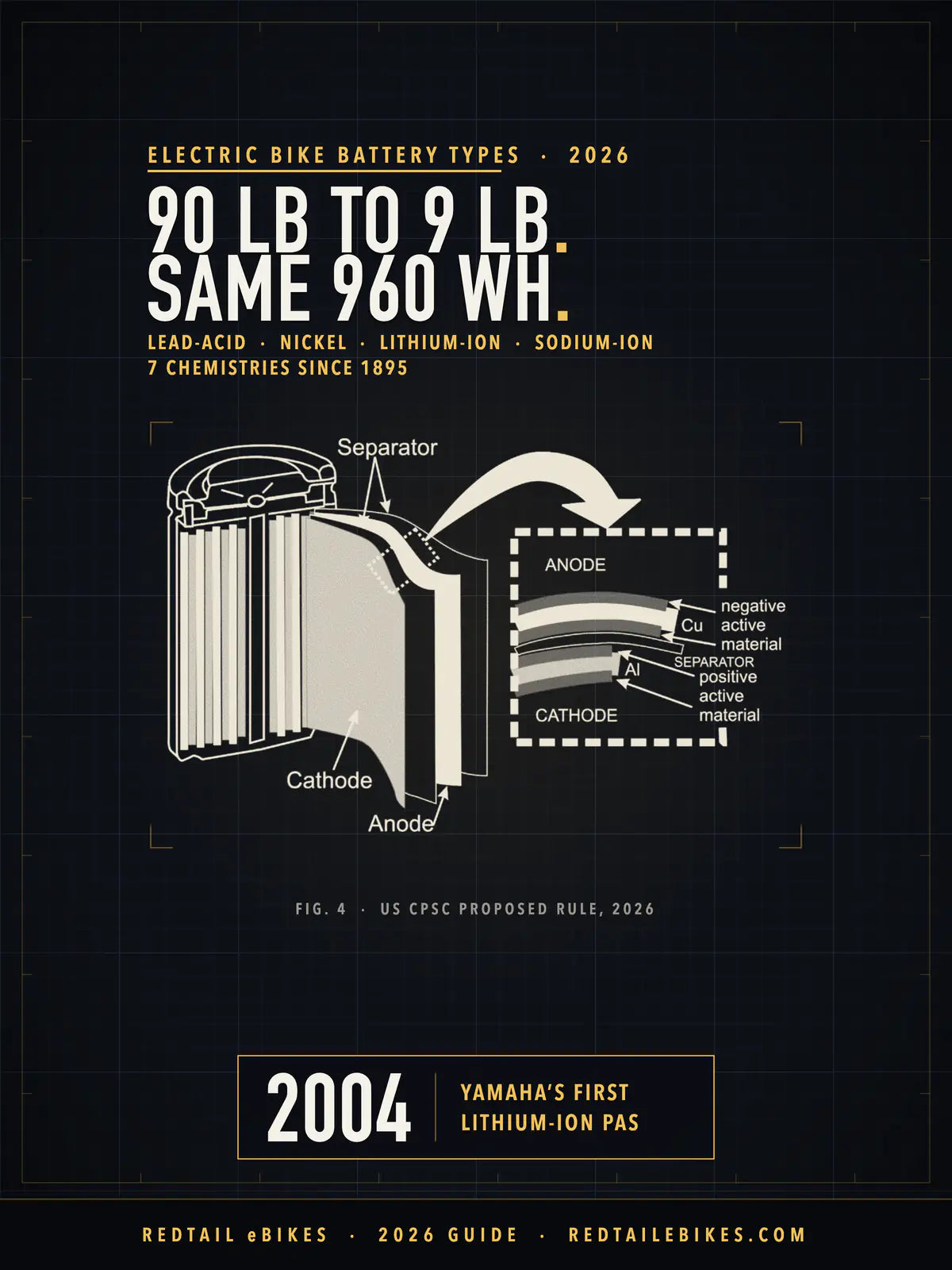
Share:
Eunorau META20 Review 2026: Folding, 63.4 lb, $1,699
Riding'times GT73 Review 2026: $1,499, 1,747 Wh