
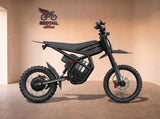
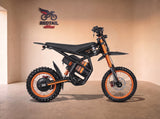
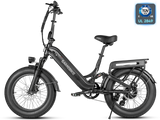


Kids' electric balance bike · footboards, no pedals · 350 W geared rear hub · removable 36 V 10 Ah pack (360 Wh) · thumb throttle · two speed modes, 4, 7 and 9 mph by default and 7, 13 and 15 mph after a switch · 16 x 3.0 tires · one hydraulic disc brake, at the rear · 32 lb, rated for 165 lb · riders 3'3" to 4'9" · $799, Himiway's own US price · verified October 31, 2026
Quick Answer — Himiway's C1 is a $799 electric balance bike for children 3'3" to 4'9": footboards, no pedals, a 350 W hub. It starts in a 9 mph mode and switches to 15; on the throttle at 9 mph on level pavement, a 54 lb child computes to 43 miles. Every measured child from 3'11" stands flat-footed on its 19.7-inch seat.
At 3'4", none of the measured children reach the ground flat-footed from that seat, so measure your child's inseam against 19.7 inches before you order (fit). Himiway prints two age windows for the C1, 4 to 9 on its product page and 4 to 12 in its owner's manual, and the height window is the one to plan by (fit).
Our C1 listing is $799 in Cyan, Bluish Gray or Coral, with $999 struck through, and on October 31, 2026, Himiway's own US store listed the same two figures, with all three colors available. This button checks out Cyan; Bluish Gray and Coral are also $799. Shipping is free within the contiguous United States.
Buy the Cyan C1, $799What this review covers
Specification · What it is · Fit · Speed modes · Brakes and throttle · Battery · Range · Weight and payload · The Mercer fit test · UL · Recalls · Federal law · The CPSC · State definitions · Green and red flags · Verdict · Checklist · Buying it from us · FAQ · Limitations · Bottom line · References
How we verified this Himiway C1 review
On October 31, 2026, we read every Himiway figure on this page at its source: the C1 page and its tables, the updated manual and the one before it, the 20-80 charging post, and the safety and warranty pages; then we recomputed it.
Our price, colors and terms were read off our own store that day. Two models, their inputs printed with sources, produce the fit and range figures, the laws are read in their own text, and the questions answered here were drawn from 792 search terms, ranking pages' headings and AI engines' answers.
We sell the C1, and the ledger is as plain about the children it does not suit as about the ones it does. Part of our e-bike reviews; Himiway's other bikes are in our Himiway profile.
Written by Milad Ghobadibeygvand, BScN (Western University, 2014). Corrections: support@redtailebikes.com.
The C1 as Himiway prints it
Himiway sells the C1 in Cyan, Bluish Gray and Coral at $799 and prints the figures that decide whether it fits your child, how fast it goes and how far it runs on its product page; wherever the owner's manual gives another number, you get both below. Set each one against your child's height before you order.

The Cyan C1 in Himiway's own studio image from the C1 listing, used whole.
| What it measures | Himiway's figure | Where Himiway prints it |
|---|---|---|
| Motor | 350 W brushless geared hub, rear | Product page specification rows; manual page 4 |
| Battery | 36 V 10 Ah, 360 Wh, removable; Samsung or LG cells on the page, LG 21700 cells in the manual | Product page; manual page 4 |
| Charger | US standard 2.0 A smart charger | Product page; manual page 4 |
| Range | 40 to 50 miles, which Himiway says rider weight, incline and assist level affect | Product page; manual page 4 |
| Speed modes | Low-speed mode 4, 7 and 9 mph (the default); high-speed mode 7, 13 and 15 mph | Product page; the manual's table differs (speed modes) |
| Throttle | Thumb throttle | Product page |
| Brakes | Nutt hydraulic disc, rear only, 160 mm rotor; an electronic auxiliary brake | Product page |
| Tires | Innova HV-5189, 16 x 3.0 | Product page |
| Fork and frame | Steel 16-inch fork, no suspension; 6061 aluminum frame | Product page |
| Seat height | 19.7 in, the one seat height printed | Product page geometry, "minimum seat height"; manual page 3, "Saddle Height" |
| Footboards | Aluminum on the page, plastic in the manual | Product page "Pedal" row; manual page 5 |
| Footboard height | 7.8 in | Manual page 3, "Foot Height" |
| Wheelbase and length | 28.9 in and 45.6 in | Product page geometry; manual page 3 |
| Handlebar | 29.1 in high, 21.8 in wide | Product page geometry; manual page 3 |
| Weight | 32 lb with the battery | Product page; manual page 4 |
| Payload | 165 lb, rider plus cargo | Product page; manual safety instruction 4 |
| Rider height | 3'3" to 4'9" | Product page; manual page 4 |
| Age | 4 to 9 on the page; 4 to 12 in the manual | Product page title and age figure; manual safety instruction 3 |
| Water | IPX4; "can be safely ridden in light rain" | Manual, care section |
| Price | $799 in each color, $999 struck through | Product page, read October 31, 2026 |
Where Himiway's own documents disagree, this page prints both and tells you which one to plan on. The product page titles the C1 "for 4-9 Year Old" and prints "4~9 Years of Age", while the updated manual permits "ONLY children aged 4-12 years or standed between 3'3 (100 cm) and 4'9 (150 cm)". Both print the same height window, and the height is what the fit tables answer.
The page calls the footboards' row "Aluminum pedal", and the manual's assembly step says "Align the plastic pedal with holes in the bike frame". The page lists an LCD display and the manual an LED screen. None of these changes how the C1 fits or rides, and each is a question we put to Himiway in writing for any buyer who asks.
What the C1 is: a balance bike with a motor and footboards
The C1 is the bike your child learns balance on, with a motor to carry them once they can. In Himiway's words on the C1 page: "This children's electric balance bike has no pedals and is designed for balance and coordination training at safe speeds under adult supervision."

Two C1s in a driveway, Himiway's own photograph from the C1 listing, used whole.
Where a pedal bike has a crank and a chain, the C1 has two short footboards bolted to the frame, a thumb throttle beside the display and a hub motor in the rear wheel. Your child pushes along with their feet, rests them on the boards once the bike is moving, and the throttle does the rest. There is nothing to pedal and no gear to shift.
If you are shopping for your child's first electric ride, the case for the C1 is a short list of published numbers. It weighs 32 pounds with its battery. It rolls on 16 x 3.0 tires under a long bench seat. It offers two speed modes that start at 4 mph, and it stops with a hydraulic disc brake at the rear (brakes).
Your child's feet have to reach the ground from the C1's seat, 19.7 inches up and the only height Himiway prints, so the fit section measures it against legs like your child's before anything else.
Three numbers decide the C1 for your child: a 19.7-inch seat, a 3'3" to 4'9" rider window and a 9 mph default that switches to 15. The fit table turns the first two into a yes or a wait at your child's height.
Will the C1 fit your child?
Himiway sizes the C1 for riders 3'3" to 4'9" tall and prints one seat height, 19.7 inches; among 3,853 US children measured for a 1977 federal survey, none 3'3" or 3'4" tall stand flat-footed on that seat, 45 of 100 at 3'8" do, and every child from 3'11" does.
Your child steers, pushes and stops a balance bike with their feet, so its fit comes down to one reach: from the seat to the ground. The table below gives that reach height by height, computed on children's measured bodies, beside Himiway's own window.
Those children come from Snyder et al., 1977, which measured US children's bodies for the Consumer Product Safety Commission; UMTRI publishes its raw records. In that survey 1,969 children stand 3'3" to 4'9", and the middle 90 of every 100 of them were 3.9 to 11.9 years old.
Your child's fit in three steps:
- Measure the inseam: back your child against a wall in socks, slide a hardcover book up between their legs until it is snug, and mark where its spine meets the wall; floor to mark is the number you need.
- Find their row by height in the table and compare the inseam with the range printed there: longer than the middle of it means more reach than the median child has, shorter means less.
- Check on the bike itself: with the C1 on flat ground and your child in the shoes they will ride in, see whether both soles rest flat (the setup steps).
How high is the seat, and who reaches the ground from it?
The seat sits 19.7 inches off the ground, and Himiway prints no higher or lower setting, so every child rides it at that height. The table reads it against each height in the survey, from three inches below Himiway's 3'3" floor to its 4'9" ceiling.

The bench seat, Himiway's own close-up from the C1 page, used whole.
| Your height | Typical inseam | Inseam minus the 19.7 in seat, median rider | Riders flat-footed astride it, of 100 |
|---|---|---|---|
| 3'0" | 14.1–15.8 in | −4.8 in | 0 |
| 3'1" | 14.7–16.5 in | −4.3 in | 0 |
| 3'2" | 15.5–17.0 in | −3.5 in | 0 |
| 3'3" | 15.8–17.9 in | −2.9 in | 0 |
| 3'4" | 16.4–18.2 in | −2.4 in | 0 |
| 3'5" | 16.9–19.3 in | −1.9 in | 3 |
| 3'6" | 17.8–19.5 in | −1.2 in | 2 |
| 3'7" | 18.1–20.4 in | −0.6 in | 19 |
| 3'8" | 18.8–20.5 in | −0.1 in | 45 |
| 3'9" | 19.4–21.2 in | 0.4 in | 85 |
| 3'10" | 19.9–21.8 in | 1.0 in | 99 |
| 3'11" | 20.6–22.5 in | 1.7 in | 100 |
| 4'0" | 20.9–23.1 in | 2.3 in | 100 |
| 4'1" | 21.4–23.4 in | 2.8 in | 100 |
| 4'2" | 22.3–24.3 in | 3.5 in | 100 |
| 4'3" | 22.8–25.1 in | 4.1 in | 100 |
| 4'4" | 23.5–25.9 in | 4.9 in | 100 |
| 4'5" | 23.9–26.1 in | 5.4 in | 100 |
| 4'6" | 24.8–26.8 in | 6.1 in | 100 |
| 4'7" | 25.3–27.4 in | 6.6 in | 100 |
| 4'8" | 25.8–28.4 in | 7.3 in | 100 |
| 4'9" | 26.5–28.8 in | 7.6 in | 100 |
Computed on the Snyder et al., 1977 children, each height to the nearest inch, against the 19.7-inch seat Himiway prints as "minimum seat height" on the C1 page and as "Saddle Height" in the manual. A negative reach is how far the median child's barefoot inseam falls short of the seat.
Himiway's window opens at 3'3", where the median child's inseam falls 2.9 inches short of the seat. Our table and Himiway's window answer different questions: the window sets who may ride, and the table shows who reaches the ground flat-footed. A child at 3'5" to 3'8" who does not yet reach it rides on tiptoe or with feet off the ground at a stop.
Send your child's height and inseam and we run them through this model and reply with their row. If the C1 is a season early, we say so and name the bike that fits now.
Email your child's inseamWhich ages does the window cover?
Children are measured in inches, and the survey shows how far each birthday carries them through the C1's window. Himiway prints 4 to 9 on its product page and 4 to 12 in its manual; the table sets both against the same children.
| Age | Median height | Inside the 3'3" to 4'9" window, of 100 | Flat-footed on the 19.7 in seat, of 100 |
|---|---|---|---|
| 3 | 38.7 in | 56 | 1 (1–2) |
| 4 | 41.5 in | 94 | 10 (8–17) |
| 5 | 43.9 in | 100 | 46 (36–55) |
| 6 | 46.4 in | 100 | 88 (79–91) |
| 7 | 48.8 in | 100 | 98 (97–99) |
| 8 | 51.1 in | 100 | 100 |
| 9 | 53.4 in | 95 | 100 |
| 10 | 55.5 in | 80 | 100 |
| 11 | 57.2 in | 54 | 100 |
| 12 | 59.9 in | 21 | 100 |
Each age is a whole year in Snyder et al., 1977; "inside the window" is the share of that age standing 3'3" to 4'9" to the nearest inch, and the flat-footed bracket runs between the two adult calibrations described under the formula.
At 4, nearly every child is inside the window and 10 of 100 reach the ground flat-footed; by 6 it is 88, and from 8 it is all of them. At the other end, 54 of 100 eleven-year-olds and 21 of 100 twelve-year-olds are still 4'9" or shorter, so at those ages your child's height, not their birthday, decides.
Will both feet reach the ground?
A balance bike is ridden with the feet, so seat-to-ground is the fit figure this page computes; Himiway prints a standover height of 19.7 inches, the same as its seat height. If your child's barefoot inseam is shorter than 19.7 inches, they cannot set both feet flat.
Your child's shoe soles add a little to the barefoot reach in the table. Himiway prints a steel fork and no suspension, so the seat does not sink under your child and the printed height is the height they meet.
A year of growth can change the answer: in the survey, median height went from 41.5 inches at age 4 to 43.9 inches at age 5, and the share of children flat-footed on the 19.7-inch seat rose from 10 to 46 of 100 (the age table).
How far is the reach to the bars?
The lean to the bars needs a child's arm and trunk lengths, and the survey file this page reads carries height, leg length and weight, so the lean is not computed here. The figures that bound it are printed: the grips sit 29.1 inches up, 9.4 inches above the seat, on a bar 21.8 inches wide.
Have your child sit on the bench with both hands on the grips. If their arms lock straight to get there, the C1 is still too big; if their knees bump the handlebar, they have grown past it.

The handlebar, Himiway's own close-up from the C1 page, used whole.
How much weight goes on small hands?
The share of body weight carried by the hands depends on the same missing arm and trunk lengths, so it is not computed here. As a distant reference only: in Carahalios, 2015, adult road racers gripping the brake hoods put roughly 15% of their body weight onto the stem, leaning far deeper than a child sitting up on the C1's bench.
A body's mass sits mostly in the head and trunk (Clauser et al., 1969), and an upright seat puts that mass over the bench. In Slane et al., 2011, 36 experienced cyclists wearing padded gloves had 10 to 28% less pressure over the ulnar nerve in the palm.
Setting it up before the first ride
On flat ground, put your child on the C1 in their riding shoes and check that both soles touch down; next, let them push it forward a few steps and pull the brake lever. Between 3'5" and 3'8", a child who reaches the ground only on tiptoe is better off waiting a season; write to us first if you are unsure.
The manual says "the height of the handlebar can be adjusted by adding or removing the headset spacers if needed" and recommends a professional for that adjustment. The seat height itself is printed once, so you have no seat setting to change.
Start in the low-speed mode, which Himiway's page names the default (speed modes). The footboards sit 7.8 inches off the ground by the manual's drawing, 11.9 inches below the seat, so check that your child's feet rest on them without lifting off the bench.
How the fit figures are computed
Each row reads the children of one height in Snyder et al., 1977, 3,853 of whom carry both a standing height and an erect sitting height. That survey did not measure crotch height, the inseam the table needs, so each child's inseam is estimated from those two measurements.
The estimate is standing height minus erect sitting height plus an offset that carries the leg length to the crotch. Two adult surveys measured all three on the same people: ANSUR 1988, 3,982 adults, gives an offset of −5.5 mm, and ANSUR II, the 6,068 soldiers whose raw data the Army released, +8.8 mm.
The table uses their midpoint and prints the two ends as the flat-footed bracket. As a check on 1,231 children who were also measured to the gluteal furrow, a second route to the inseam ran 7.2 mm longer on average. The seat reach is the barefoot inseam minus 19.7 inches, and "flat-footed" means a reach of zero or more.
| Input | Value | Source |
|---|---|---|
| Seat height | 19.7 in, the one height printed | Himiway's C1 page and manual |
| Rider window | 3'3" to 4'9" | Himiway's C1 page |
| Children | 3,853 with standing and erect sitting height | Snyder et al., 1977 |
| Inseam offset, ANSUR 1988 | −5.5 mm, from 3,982 adults | UMTRI's anthropometry downloads |
| Inseam offset, ANSUR II | +8.8 mm, from 6,068 soldiers | The Army's ANSUR II release |
| Flat-footed | barefoot inseam of 19.7 in or more | The seat height above |
Worked example: a child 45 inches tall has a median estimated inseam of 20.1 inches, so the reach from the 19.7-inch seat is +0.4 inches, both feet down with a little to spare.
Two speed modes: 9 mph to start, 15 after a switch
The C1 starts in its low-speed mode, whose three settings top out at 4, 7 and 9 mph, and seven presses of the power button while it is stopped switch it to the high-speed mode's 7, 13 and 15 mph. Those are Himiway's product page figures, in its words: "Low-speed mode: 4 / 7 / 9 mph (default). Press the power button 7× (while stopped) to switch to high-speed mode (7 / 13 / 15 mph)."
| Setting | Low-speed mode (the default) | High-speed mode | An adult alongside, by the Compendium |
|---|---|---|---|
| 1 | 4 mph | 7 mph | 4 mph is between a "brisk" walk (3.5 to 3.9 mph) and a "very, very brisk" one (4.5 to 4.9 mph) |
| 2 | 7 mph (8 mph in the manual's table) | 13 mph | 7 mph is a run at 8.5 minutes a mile; 13 mph a run at 4.6 |
| 3 | 9 mph | 15 mph | 9 mph is a run at 6.5 minutes a mile; 15 mph is past the list's fastest row, 14 mph |
Settings and caps from Himiway's C1 page; the manual's middle low-mode figure from the updated manual; paces from the Compendium of Physical Activities' walking and running tables.
A short press of the function button lets your child step through the three settings within whichever mode is on, by the manual's display page: "Short-press the Function Button to switch 1, 2, and 3 level Assist." The mode itself changes only from a stop.

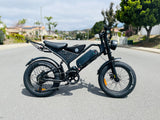
A C1 on a residential street, Himiway's own photograph from the C1 page, used whole.
How the switch works, in Himiway's words
The updated manual gives the steps: "When powered on and stationary: Continuously short-press the 'Power Button' 7 times. If the screen flashes the number 15, the system enters High Speed Mode. Short-press 7 times again. If the screen flashes the number 9, the system enters Low Speed Mode."
The same page says which C1s have the switch: "If the maximum speed of your bike is 9 mph when first powered on, your system supports switching between low and high speed modes. If the maximum speed of your bike is 15 mph when first powered on, your system does not support switching between low and high speed modes."
The earlier manual, which Himiway's help center still links beside the updated one, prints a single set: "Mode 1: Up to 7 mph/ Mode 2: Up to 13 mph/ Mode 3: 15 mph". A C1 that powers on at 15 mph does not switch, by the updated manual, and the earlier manual's three settings top out at 7, 13 and 15 mph.
One table in the updated manual prints the two labels the other way round: its specification page lists "Low Speed Mode: G1: 7 mph;G2: 13 mph;G3: 15 mph" and "High Speed Mode: G1: 4 mph;G2: 8 mph;G3: 9 mph". Its own switching steps and Himiway's product page both put 15 in the high-speed mode and 9 in the low, so plan on the product page's figures.
The speed limiter connector
Himiway's manual describes a connector that holds the C1 in its low-speed mode whatever the display is set to. In its words: "In the gap above the battery, you will find a connector as shown in the figure below. When this connector is mated (has priority over display settings), the speed will be restricted to the low - speed mode; when it is disconnected, there will be no such speed restriction."
That is the manual's whole description of it. It does not say how the C1 ships, so ask us before you order and we confirm with Himiway in writing how your C1 arrives set and what the connector does on it.
Plan on 9 mph while your child is a beginner and 15 mph as the most the C1 can be set to. The switch to 15 is seven presses of the power button from a stop, and the manual says its limiter connector "has priority over display settings".
A thumb throttle and one hydraulic disc brake
The C1 runs on a thumb throttle and stops with a hydraulic disc brake on the rear wheel, the only friction brake it has. Himiway's specification rows print "Nutt Y-2C D-2S hydraulic brake (Rear Only)" on a "160*2mm" rotor and, among its feature figures, an "Electronic" "Auxiliary brake".

The rear disc and hub, Himiway's own close-up from the C1 page, used whole.
A single brake means one lever for your child to learn, and the manual's display page shows a "Brake Status Indicator" that lights when your child pulls it.
Himiway writes on its page that "A thumb throttle prevents accidental acceleration". The throttle sits under the grip beside the display, and the manual lists a "Throttle fault" and a "Brake lever fault" among its display codes, so you see either problem on the screen.

The thumb throttle and display, Himiway's close-up from the C1 page, used whole.
A removable 360 Wh pack and a 2 A charger
The pack is 36 V and 10 Ah, 360 watt-hours, under the seat, and you can lift it out to charge or plug it in on the bike, from a 2.0 A charger. Himiway's page names "Samsung/LG Battery" cells and the manual "36V 10Ah 21700 LG lithium battery".
At the charger's 2.0 A, 10 amp-hours take 5.0 hours of charging at full current, and the manual adds that "A new battery may take longer to be fully charged when depleted". The charger "will automatically stop charging once the battery pack is fully charged".
Filling the 360 Wh pack costs about 6.5 cents before the charger's own losses, priced at 18.16 cents per kWh: that is the August 2026 residential average for the US in the Energy Information Administration's monthly table. If your child weighs 54 lb and rides 1,000 flat miles in a year on the throttle at 9 mph, the C1 uses about $1.53 a year in electricity.
Charge where you can see it, at room temperature. In the manual's words: "Do not allow the battery to be charged in environments under 14° Fahrenheit (-10° Celsius) and over 104° Fahrenheit (40° Celsius)", and "Keep the battery away from children while charging." Himiway's safety page adds, for the C1: "always supervise charging and store the battery out of reach of young children when not in use."
Two Himiway documents give different storage advice: the manual says to "store the battery with a full charge and charge it once a month", and the safety page to "Store the battery at 50–80% charge if not riding for more than two weeks". Ask us which applies to your pack and we put Himiway's answer in writing.
Range: 43 miles at 9 mph for a 54 lb child, computed
On a full 360 Wh pack, a 54 lb child holding a steady 9 mph over level pavement at 77 °F computes to 43 miles, and 34 if you recharge with Himiway's 20% still in the pack; at the top 15 mph setting the same ride computes to 26. Himiway prints "40-50 miles" and adds: "The range can be affected by several factors like rider weight, incline, and pedal-assist levels, etc." (the maker's figure, mapped).
The 54 lb rider is the median weight of the 1,969 children 3'3" to 4'9" tall in Snyder et al., 1977. The tables below come from one physics model fed Himiway's published numbers and published studies, and the formula prints each input with its source.
Your child's range in three steps:
- Find the setting they ride at in the speed table: 9 mph is the default mode's top, 15 mph the most the C1 can be set to.
- Adjust for your hills, your child's weight and the weather with the tables after it.
- Plan your child's rides on the "20% kept" column. Himiway's 20-80 post advises against letting the charge drop below 20% in everyday use.
How far does the C1 go at your child's speed?
Each row is a steady speed on level pavement, the 54 lb child on the throttle, 77 °F and still air. The middle column is the energy each mile costs, which is why the miles fall as the speed rises.
| Speed, flat | Per mile | Full charge | With 20% kept |
|---|---|---|---|
| 4 mph | 6.2 Wh | 58 mi | 46 mi |
| 7 mph | 7.3 Wh | 49 mi | 39 mi |
| 8 mph | 7.8 Wh | 46 mi | 37 mi |
| 9 mph | 8.4 Wh | 43 mi | 34 mi |
| 13 mph | 11.7 Wh | 31 mi | 25 mi |
| 15 mph | 13.9 Wh | 26 mi | 21 mi |
Computed for the C1 from Himiway's 360 Wh pack, 32 lb weight and 16 x 3.0 tires; "20% kept" plans on 80% of the pack, by Himiway's 20-80 post.
Tell us the loop your child rides, its hills and their weight, and we run them through this model. You get the miles back, with the setting that stretches them.
Email us where they rideWhich speed setting saves the most battery?
The C1 has no gears to shift, so the choice that saves battery is the speed setting: the slower the pace, the less each mile costs. The table shows where the energy goes, from the pack through the hub motor to the rear wheel.
| Speed, flat | Motor efficiency | Power at the rear wheel | Per mile |
|---|---|---|---|
| 4 mph | 45% | 11 W | 6.2 Wh |
| 7 mph | 54% | 27 W | 7.3 Wh |
| 8 mph | 57% | 35 W | 7.8 Wh |
| 9 mph | 60% | 44 W | 8.4 Wh |
| 13 mph | 70% | 102 W | 11.7 Wh |
| 15 mph | 74% | 147 W | 13.9 Wh |
The same 54 lb child, level pavement, 77 °F. Motor efficiency is the model's comparable hub at each speed (the formula).
The motor turns less of the pack's energy into wheel power at a walking pace than at 13 mph, yet the 4 mph row still costs the least per mile, because the wheel needs far less power to begin with. For the most miles on a charge the slowest setting goes farthest, and the low-speed mode's 7 and 9 mph settings still go well past the high mode's 13 and 15.
How much does a hill cost the pack?
Climbing costs energy on top of the flat, so the same pack covers fewer miles uphill. Each row is the 54 lb child holding 10 mph up a steady paved grade, the whole way.
| Grade | Per mile, throttle | Full charge, throttle |
|---|---|---|
| 2% | 13 Wh | 27 mi |
| 4% | 17 Wh | 21 mi |
| 6% | 22 Wh | 17 mi |
| 8% | 26 Wh | 14 mi |
| 10% | 31 Wh | 12 mi |
| 12% | 36 Wh | 10 mi |
| 15% | 45 Wh | 8 mi |
Computed at 10 mph, the 54 lb child on the throttle, 77 °F; each row is that grade held for every mile, a ceiling on what a hilly loop costs.
Over the flat cost of the same distance, 1,000 feet of climbing takes another 39 Wh on a 4% grade and 42 Wh on a 10% grade, about 11 to 12% of the 360 Wh pack. At that rate a 100-foot hill adds about 4 Wh, about 1% of the pack.
How fast the C1 climbs with your child aboard depends on the motor's torque. The table below is the model's upper estimate, using the published torque of a comparable 350 W hub (limitations), and it sits above the one measured climb we found.
| Grade | 34 lb aboard | 54 lb aboard | 87 lb aboard |
|---|---|---|---|
| 4% | 14.7 mph | 14.6 mph | 14.4 mph |
| 6% | 14.5 mph | 14.4 mph | 14.1 mph |
| 8% | 14.4 mph | 14.2 mph | 12.7 mph |
| 10% | 14.2 mph | 13.7 mph | 11.3 mph |
| 12% | 14.1 mph | 12.5 mph | 10.1 mph |
The fastest steady speed the model holds on each grade at the 15 mph setting, throttle only, for the 5th-percentile, median and 95th-percentile child of Himiway's window.
Electric Bike Report's reviewer, an adult, "rode this up a .29-mi.-long 2 percent grade" and climbed it "in 1:30 for an average of 11.7 mph" in April 2024. The model gives a rider of any weight from 100 to 250 lb a fastest steady speed of 14.0 to 14.6 mph on that grade.
The measurement includes getting up to speed and names no rider weight, so treat the climbing rows as an upper estimate (limitations).
How far does it go with a heavier child?
The more your child weighs, the more energy every mile costs, and most of all uphill. Three rows are children from Himiway's window, at the weights that mark its 5th percentile, its median and its 95th percentile; the fourth is Himiway's 165 lb limit for rider and cargo together.
| Your child plus any load | 9 mph flat, throttle | 13 mph flat, throttle | 8% climb, 10 mph |
|---|---|---|---|
| 34 lb | 46 mi | 32 mi | 17 mi |
| 54 lb | 43 mi | 31 mi | 14 mi |
| 87 lb | 38 mi | 28 mi | 10 mi |
| 165 lb | 31 mi | 24 mi | past the model's motor |
Computed for each total weight aboard, 77 °F, throttle only; the climb column is 10 mph up an 8% grade.
At 165 lb, the most Himiway allows aboard, the model's comparable motor cannot hold 10 mph up 8%, and the cell says so instead of printing a speed. None of the 1,967 children weighed in Himiway's window was over 165 lb.
Does cold weather cut the range?
In the cold the C1's pack gives back less of its energy, by the measured cell data in the table, so a winter ride runs shorter. Each row is the 54 lb child at 9 mph on level pavement at that air temperature.
| Air | Pack energy vs 77 °F | 9 mph flat, throttle |
|---|---|---|
| 95 °F | 99% | 44 mi |
| 77 °F | 100% | 43 mi |
| 68 °F | 98% | 41 mi |
| 50 °F | 93% | 37 mi |
| 41 °F | 91% | 36 mi |
| 32 °F | 89% (80–93) | 35 mi (31–37) |
| 14 °F | 82% (40–83) | 32 mi (15–32) |
Cell energy from the LG HG2 cell's measured discharge at each temperature (McMaster data); below freezing the spread across published cell data is printed in brackets.
The manual's charging floor is 14 °F (battery), and the coldest row is that temperature. Keep the pack indoors and bring it out just before the ride.
Do the fat tires cost range?
The table brackets the rolling resistance of the C1's Innova 16 x 3.0 tires between published measurements of knobby casings.
| Rolling resistance | 9 mph flat, throttle | 13 mph flat, throttle |
|---|---|---|
| 0.0092 · the knobby field average, 138 riders | 46 mi | 33 mi |
| 0.0126 · the heaviest knobby casings on the drum (used) | 43 mi | 31 mi |
| 0.0131 · the field average plus one standard deviation | 42 mi | 30 mi |
The central case, in the middle row, uses the knobby casings that rolled heaviest on Bicycle Rolling Resistance's drum; the other two rows take the average knobby figure from 138 everyday riders in Tengattini and Bigazzi, 2018 and that average plus one standard deviation.
Inflate the tires to the limits printed on their sidewalls, as the manual's pre-ride checks ask.
What ride gives Himiway's 40 to 50 miles?
Himiway's "40-50 miles" fits a child of about 54 lb riding steadily between about 7 and 10 mph on level pavement, on a full pack. The table maps each end of Himiway's figure to the steady speed the model needs to spend the pack over that distance.
| Himiway's figure | Watt-hours a mile it allows | The steady flat speed that spends it, 54 lb child |
|---|---|---|
| 40 miles on 360 Wh | 9.0 Wh | 9.9 mph |
| 50 miles on 360 Wh | 7.2 Wh | 6.9 mph |
Each end of Himiway's range divided into the 360 Wh pack, then matched to the model's steady flat speed for the 54 lb child at 77 °F.
So Himiway's figure matches a steady ride at 7 to 10 mph with no stops; hills and extra weight each shorten your child's range, by the amounts the tables above give.
How the range figures are computed
One equation produces every row: the road-cycling power model Martin and colleagues published in 1998 after checking it on measured riders, traced here from the wheel back to the cells:
Wheel power = v × [ m × g × (Crr × cos θ + sin θ) + ½ × ρ × CdA × v² ]
Here v is the speed, m the mass of child, bike and anything carried, g gravity, θ the grade's angle, Crr the tires' rolling-resistance coefficient, ρ the air's density and CdA the drag area. The wheel's power is then traced back through the hub motor and the pack's own losses to the cells.
| Input | Value | Source |
|---|---|---|
| Rider | 54 lb, the median child 3'3" to 4'9" | Snyder et al., 1977 |
| Bike | 32 lb with the battery | Himiway |
| Pack | 36 V, 10 Ah, 360 Wh | Himiway |
| Wheel | 18.0 in, the 16 x 3.0 size's nominal diameter: a 305 mm bead seat plus twice 3.0 in | Sheldon Brown's tire-sizing table; Himiway prints the size, not the diameter |
| Rolling resistance | 0.0126, the heaviest knobby casings on the drum | Bicycle Rolling Resistance |
| Drag area | 0.640 m², upright adult riders | Tengattini and Bigazzi, 2018 |
| Motor | A 350 W geared rear hub's published curve, fitted to Himiway's 15 mph | Bafang's OEM workbook, RM G020.350.D |
| Pack losses | Measured on a 48 V pack, applied at the same rate of discharge | Arango et al., 2021 |
| Air | Density at 77 °F and sea-level pressure | U.S. Standard Atmosphere, 1976 |
| Planning reserve | 20% kept in the pack | Himiway's 20-80 post |
Worked example, 9 mph on level pavement: the 86 lb of child and bike rolling at 4.0 meters a second need 19.4 W against the tires and 24.7 W against the air, 44.1 W at the wheel.
At 60% motor efficiency the pack must supply 73.6 W; with the cells' own internal losses added, that is 76.0 W at the chemistry, or 8.4 Wh a mile, so 360 Wh carries the child 43 miles.
32 pounds, and a 165 lb limit
The C1 weighs 32 pounds with its battery and carries up to 165 pounds of rider and cargo, by Himiway's page and its manual. The manual's instruction reads: "The total weight (riders plus cargo) on the bike should NEVER exceed 165 pounds (80 kilograms)."
Its two figures are not quite the same weight: 165 pounds is 74.8 kilograms, and 80 kilograms is 176 pounds. Plan on 165, the figure both documents print in pounds. The heaviest child in Himiway's window is far under either: the 95th-percentile weight among those children is 87 pounds.

The footboards, Himiway's own close-up from the C1 page, used whole.
At 32 pounds and 45.6 inches long, the C1 is a lift you can manage into a car trunk or a hatch; measure your cargo space against 45.6 inches before the first trip to the park. The battery comes out for charging indoors, which takes its weight off the bike while you carry it.
The Mercer fit test
The verdicts rest on published numbers, Himiway's 3'3" to 4'9" rider window, its two age figures, its 165 lb limit and its 19.7-inch seat, read against the survey children in the fit section, and on the speed modes when the question is how fast.
The Mercers are the fictional family, seven characters across three generations, that our reviews keep constant so that you can compare one bike with another; find the row nearest your own child.
| Member | Verdict on the C1 | The number behind it |
|---|---|---|
| Ivy Mercer, 12 | Most likely past it, on height. The next size up is the EKIDS24. | The median 12-year-old in the survey is 59.9 inches, above the 57-inch ceiling; 21 of 100 twelve-year-olds are still inside the window. |
| Cole Mercer, 16, 5'11" | Not his machine. At 16 his questions are about a full-size bike and his state's rules for one. | 71 inches, fourteen above Himiway's 57-inch ceiling; the manual permits "ONLY children aged 4-12 years or standed between 3'3 (100 cm) and 4'9 (150 cm)". |
| Maya Torres, 32, 5'6" | Buying for a five-year-old, and her question is the inseam. Measure before you order. | At 5, 46 of 100 measured children stand flat-footed on the 19.7-inch seat (36 to 55 on the calibration bracket). |
| Dana Mercer, 45, 5'7" | Buying for a seven-year-old, inside both of Himiway's age figures and its height window. | At 7, every measured child is inside the window and 98 of 100 stand flat-footed on the seat. |
| Jack Mercer, 48, 6'1" | Buying for a ten-year-old who wants the 15 mph mode. He decides when it comes on. | At 10, 80 of 100 are still inside the window. 15 mph is past the fastest running pace the Compendium lists, 14 mph, so an adult following needs a bike. |
| Ruth Kowalski, 61, 5'5" | The grandparent's verdict: a yes, in the low-speed mode, with 32 lb to lift into the car. | 4 mph, the lowest setting, sits between a "brisk" walk and a "very, very brisk" one in the Compendium's walking table. |
| Frank Kowalski, 63, 5'10" | A yes on a path where he can see the whole loop. Keeping up on foot at the default mode's top means a hard run. | 9 mph, the default mode's top, is a run at 6.5 minutes a mile in the Compendium's running table. |
The sharpest contrast on this table runs between Dana's row and Ivy's. The seven-year-old Dana is buying for sits inside both of Himiway's age figures and its height window, and 98 of 100 children that age reach the ground flat-footed.
Ivy, at the top of the manual's age range, has in most cases outgrown the 4'9" ceiling, because a child's height, not the birthday on the box, sets the limit on this bike.
Pick the color at the button: Bluish Gray here, or Cyan or Coral, each $799.
Buy for riders 39–57 in, $799Is the Himiway C1 UL certified?
Need a certificate for a school, a building or a rebate program? Tell us before you buy, and we send Himiway the request in writing and forward its reply to you. Himiway's safety page says "The C1 Kids features a UL-certified electrical system".
The same page answers its own question, "Are all Himiway eBikes UL certified?", with: "Himiway designs its eBikes to meet UL 2849 safety standards across the lineup, including the D5 2.0, C1 Kids, A7, D7, and C3. Always check the physical certification label on your specific model and contact Himiway support for certification documentation if required for a rebate program."
UL Solutions certifies e-bikes to UL 2849 "by examining the electrical drive train, battery, and charger system combinations in e-bikes", so a certificate names the model and the standard together. Ask for it by the name Himiway C1.
At the federal level, the Consumer Product Safety Commission proposed a mandatory standard for lithium-ion batteries in micromobility products on June 24, 2026 (91 FR 38162). It remains a proposal; written comments closed August 24, 2026 (the CPSC section).
Has the Himiway C1 been recalled?
No: neither Himiway nor the C1 appears on the Consumer Product Safety Commission's recall list, which we read in full on October 31, 2026. We read the whole list, 10,070 records with the newest dated October 29, 2026, for the brand's name and the model's.
The one C1 in it belongs to another maker: SRAM's hydraulic brake recall lists a Norco "Threshold C1", a bicycle unrelated to Himiway. The Commission's product safety warning list, 382 warnings, names neither, and neither does its recall feed for October 2026.
A recall is announced after the fact, so the check is worth repeating before you order and once a year after: search the name Himiway at cpsc.gov/Recalls.
Federal law: why a machine with no pedals is not a bicycle there
Under federal law a low-speed electric bicycle must have pedals, and the C1 has none, so the federal bicycle rules do not reach it; built for children 12 and under, it comes under the federal children's-product rules instead. Himiway's own page says the C1 "has no pedals" and "is not a standard road e-bike and does not fall under conventional classifications" (the C1 page).
The definition sits at 15 U.S.C. § 2085(b): "For the purpose of this section, the term 'low-speed electric bicycle' means a two- or three-wheeled vehicle with fully operable pedals and an electric motor of less than 750 watts (1 h.p.), whose maximum speed on a paved level surface, when powered solely by such a motor while ridden by an operator who weighs 170 pounds, is less than 20 mph."
The Consumer Product Safety Commission's bicycle regulation turns on the same word. 16 CFR § 1512.2(a) gives two limbs, "(1) A two-wheeled vehicle having a rear drive wheel that is solely human-powered" and "(2) A two- or three-wheeled vehicle with fully operable pedals and an electric motor of less than 750 watts". A motor takes the C1 out of the first, and the missing pedals out of the second.
The banned-article listing at 16 CFR § 1500.18(a)(12) covers "Any bicycle as defined in § 1512.2(a)" if it falls short of Part 1512, so it hangs on the same definition.
A further term in § 1512.2 looks closer than it is: a "sidewalk bicycle" is "a bicycle with a seat height of no more than 635 mm (25.0 in)", and the C1's 19.7-inch seat is lower, but that definition opens with "a bicycle" too.
Two federal definitions, one missing part. Both the low-speed electric bicycle in the statute and the bicycle in the CPSC's regulation require pedals. The C1 has none, by Himiway's own page; that points to a different chapter of federal law, and it is not a rule against the bike.
The chapter that does apply is the one for children's products. 15 U.S.C. § 2052(a)(2) reads: "The term 'children's product' means a consumer product designed or intended primarily for children 12 years of age or younger."
The statute weighs four factors, the first two being the maker's own statement of intended use and how the product is represented in its packaging and advertising. Himiway's manual permits "ONLY children aged 4-12 years", and its product page titles the C1 "for 4-9 Year Old".
A children's product carries its own federal duties: a lead limit under 15 U.S.C. § 1278a, certification under 15 U.S.C. § 2063(a)(2) on the strength of testing at an accredited third-party laboratory, and the certificate rules of 16 CFR Part 1110. A final rule published on January 8, 2025, revised Part 1110 and, for imported products, added electronic filing of certificates with Customs; it took effect on July 8, 2026 (90 FR 1800).
What the CPSC says about electric balance bikes
The Consumer Product Safety Commission has named electric balance bikes in its e-bike rulemaking, and that rulemaking has not gone past its first notice. The Commission voted 4–0 on March 5, 2024, to publish an advance notice of proposed rulemaking on e-bikes, which appeared on March 15, 2024, at 89 FR 18861, Docket No. CPSC-2024-0008.
The notice describes the category in these words: "Some e-bikes are marketed and intended for use by children. These include electric balance bikes, which are a type of e-bike mostly marketed for younger children. Although an electric balance bike does not have pedals, the electric motor assists the rider with propulsion, which is accomplished by the rider pushing their feet against the ground instead of pedaling."
It continues: "These e-bikes are designed to help children learn balance and coordination. The scope of this rulemaking is limited to e-bikes and does not include gas powered bicycles and non-powered bicycles, or battery powered ride-on toys subject to the mandatory Toy standard." The notice concerns "mechanical hazards of e-bikes"; battery hazards were left to a separate proceeding.
No proposed rule has followed it in that proceeding: on October 31, 2026, the Federal Register's index of the Commission's documents lists the 2024 notice as the latest document of the e-bike rulemaking, under each of "electric bicycles", "e-bike", "balance bike" and "micromobility".
The separate battery proceeding has reached a proposal. On June 24, 2026, the Commission proposed that "electrical systems using lithium-ion batteries in micromobility products comply with applicable voluntary standards, with modifications", and, "Because some micromobility products are children's products requiring third party testing", to add the rule to the list that requires such testing (91 FR 38162).
The same proposal leaves out "children's battery-powered ride-on toys (defined in 16 CFR part 1250)". Written comments closed on August 24, 2026, and the Commission heard oral comments on October 21, 2026 (91 FR 63208). It is a proposal, and it names no product by brand.
Whose state definition requires pedals: 51 read
Pedals are written into the electric bicycle definition in 47 of the 51 US jurisdictions; Montana's and Rhode Island's definitions omit them, while the Alaska and Kentucky codes contain no electric bicycle definition. Each definition is read here in its own words, from the statute texts collected on September 24, 2026.
Where a state sorts e-bikes into Class 1, Class 2 and Class 3, its age floors, helmet rules and path access hang on those classes. In the 47, the definition those rules build on requires pedals, so that chapter of the vehicle code describes a different vehicle from the C1. The rules that reach it come from wherever your state places children's ride-on machines, and from local rules for sidewalks, parks and paths.
| What the definition says | Jurisdictions | Example, in the statute's words |
|---|---|---|
| Requires pedals | 47 | California: "a bicycle equipped with fully operable pedals" (Veh. Code § 312.5) |
| Requires pedals, through the definition of a bicycle | (Oregon, counted in the 47) | "(6) Is equipped with pedals" (ORS 801.150) |
| Defines an electric bicycle with no pedal requirement | 2 | Montana and Rhode Island (below) |
| Defines no electric bicycle | 2 | Alaska and Kentucky (below) |
Each jurisdiction's own defined term read in its statute text as banked on September 24, 2026; the four outliers quoted below.
The words differ more than the rule does. Missouri writes "a bicycle equipped with fully operable pedals" (RSMo § 301.010(15)), Oklahoma "Fully operative pedals for human propulsion" (47 O.S. § 1-104), and Pennsylvania a vehicle "equipped with operable pedals" (75 Pa.C.S. § 102).
Ohio reaches the same place through its classes. ORC § 4511.01 defines an electric bicycle as one of three classes, and each class opens "a bicycle that is equipped with fully operable pedals".
Two jurisdictions change their definitions on dates a reader of this page may pass. North Carolina's S.L. 2026-46, section 19 rewrites G.S. 20-4.01(7a) on December 1, 2026, and the new text keeps "fully operable pedals for human propulsion".
California's SB 1167, chaptered on September 30, 2026, rewrites Veh. Code § 312.5 from January 1, 2027. The new text still requires "fully operable pedals", then sets out a list of things that "are not electric bicycles under this code"; item (5) on it is "A vehicle without operable pedals."
Read your state's definition first, then the sidewalk and park rules of the place your child will ride. For the local rule, write to us with your zip code and we will find it with you.
Open your state's law pageThe four jurisdictions that answer differently
Montana defines the machine without a pedal limb. MCA § 61-8-102 reads: "'Electrically assisted bicycle' means a vehicle on which a person may ride that has two tandem wheels and an electric motor capable of propelling the vehicle and a rider who weighs 170 pounds no faster than 20 miles an hour on a paved, level surface".
Whether a seated child's balance bike is the machine the statute has in mind is a question for Montana, and its genus definition of a bicycle at subsection (2) is a vehicle "propelled solely by human power".
Rhode Island also omits pedals. R.I. Gen. Laws § 31-1-3(g) gives the "Electric motorized bicycle", "also called an 'electric bicycle'", as "a two-wheel (2) vehicle that may be propelled by human power or electric motor power, or by both, with an electric motor rated not more than two (2) (S.A.E.) horsepower". Each of the three classes in § 31-19.7-1 is defined as a "Bicycle equipped with" a motor.
Alaska defines no electric bicycle. None of the 34 numbered paragraphs in its definitions section, AS 28.90.990, defines an electric bicycle; the closest term there, the motor-driven cycle, turns on engine displacement.
Kentucky defines none either. The definitions section for its traffic chapter, KRS 189.010, names no electric bicycle. In both states, the answer for a child's electric balance bike comes from local rules and from wherever the state's other vehicle definitions place it.
On National Forest land, a federal rule reaches it
A federal rule applies to the C1 whatever your state calls it: the Forest Service's rule for motor vehicles. On national forest land, the motor vehicle definition in 36 CFR § 212.1 reaches "Any vehicle which is self-propelled, other than" one operated on rails or a wheelchair or mobility device for a person with impaired mobility, and the C1's hub motor propels it.
A forest's motor vehicle use map shows the roads, trails and areas it has designated, and 36 CFR § 261.13 limits motor vehicle use to what is "in accordance with those designations".
The penalty under 36 CFR § 261.1b is "imprisonment of not more than six months or a fine in accordance with the applicable provisions of 18 U.S.C. 3571 or both". Before you take your child riding in a national forest, check that map for the trail you have in mind.
Green flags / Red flags
The green flags are what the C1 does well, each item sourced to a published document or a computed figure; the red flags are who it is the wrong fit for, and what to do instead.
Green flags
- A gentle start. The low-speed mode is the default, and its first setting is 4 mph (Himiway).
- A hold on the low mode. The manual's limiter connector "has priority over display settings" (manual).
- A hydraulic disc brake on a 160 mm rotor, with an electronic auxiliary brake (Himiway).
- 43 miles at 9 mph for a 54 lb child on level pavement, computed (range).
- 32 pounds, with a pack that comes out to charge indoors (manual).
- The same price here as at Himiway, $799 with $999 struck through, shipped free within the contiguous United States.
Red flags, and what to do
- The seat does not move. At 3'8", 45 of 100 measured children stand flat-footed on its 19.7 inches (fit). For a shorter child, read our EKIDS16 review: its seat starts at 18.5 inches.
- There are no pedals. A child who should be learning to pedal is better served by the EKIDS20, which has them.
- One friction brake, at the rear. Practice stopping on a flat, quiet path before the first ride on a slope (brakes).
- 15 mph is seven button presses away. Decide which mode your child rides, and ask us how the limiter connector is set on yours (speed modes).
- A birthday will not size it. Plan by your child's height, with the age table showing how far each age carries a child through the window.
- Most state e-bike chapters do not describe it. Check your town's rules for sidewalks, parks and paths (state definitions).
Buy it if / Buy something else if
Buy the C1 if your child stands 3'11" or taller, up to 4'9", can glide with feet up, and rides driveways, paths and parks with an adult nearby. At those heights every measured child reaches the ground from its seat, and the 9 mph default leaves room to grow into the 15 mph mode.
Buy something else if your child stands under about 3'9" (the lower seat of the EKIDS16, $719 here, fits them sooner), if you want them learning to pedal (the EKIDS20, $809 here, has a crank and chain), or if they are taller than 4'9" (the EKIDS24, $899 here, is the next size up).
If the next bike will have pedals, our kids and teens e-bike guide covers the age rule for a Class 1 or 2 e-bike in each of the 51 US jurisdictions, and our kids' e-bikes collection puts the C1 beside the EKIDS bikes.

The Coral C1 in Himiway's own studio image from the C1 listing, used whole.
All three colors are $799 here and at Himiway, and the charger and the manual come in the box. This button is Coral; Cyan and Bluish Gray cost the same.
Check out: Coral C1, $799Before you buy: the checklist
Run these six checks before you order, starting with your child's inseam.
- Measure your child's inseam and find their row in the fit table; 19.7 inches is the seat.
- Choose the mode your child starts in, and ask us how the limiter connector is set (speed modes).
- Gear up as the manual requires: "helmets, knee pads, elbow pads, and proper footwear", by its safety instruction 2 (manual).
- Plan the adult's role: the first of the manual's safety instructions is "ALWAYS ensure that children ride under adult supervision."
- Read your town's rules for sidewalks, parks and paths where your child will ride (state definitions).
- Charge it where you can see it, between 14 °F and 104 °F, as the manual says (battery).
Buying it from us
Here or on Himiway's own US store, the C1 was $799 on October 31, 2026; the terms below are our policies and checkout as they read that day, in the policies' own words where the wording decides, and our fit offer closes the list.

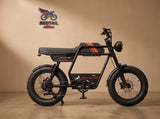
The Bluish Gray C1 in Himiway's own studio image from the C1 listing, used whole.
| What you get | Our terms on October 31, 2026 |
|---|---|
| Who sells it | Redtail Ebikes, the business name of the Florida corporation named in our terms of service; Himiway makes the C1 |
| Questions before you buy | support@redtailebikes.com; our contact page says "We typically respond to email within one business day" |
| Price | $799 in Cyan, Bluish Gray or Coral, with $999 struck through, the prices on Himiway's own US store that day |
| Shipping | "free shipping on every electric bike within the contiguous United States", by our shipping policy; Alaska, Hawaii, U.S. territories, P.O. boxes and remote areas may cost extra or be excluded |
| Dispatch and transit | "prepared and dispatched within 1–3 business days of confirmation"; "most e-bikes arrive within 5–10 business days after dispatch" |
| Damage in transit | Photos within 48 hours of delivery, and "we file the carrier claim and arrange a replacement or repair", by our refund policy |
| Defective on arrival | "covered under manufacturer warranty — we coordinate repair or replacement remotely", per our refund policy |
| Warranty | Himiway's terms, on Himiway's warranty page; our terms say "We will help facilitate warranty claims with the manufacturer" |
| Payment | A credit card, Apple Pay or Google Pay at checkout |
| Your child's fit | Email their height and inseam, and we reply with their row in the fit table before you order |
From our policy pages and checkout as they read on October 31, 2026; quotation marks hold the policies' own words, and the payment methods are those our checkout listed that day.
Settle the warranty question before you pay. Registration follows the rules on Himiway's warranty page. Tell us which color you are considering, and we will set out in writing, before you buy, how a warranty repair is handled for a C1 bought from us.
Changed your mind? Our refund policy refunds a C1 sent back still sealed in its factory packaging if the return is requested within 72 hours of delivery; it deducts a 15% restocking fee, and return shipping is yours to pay. Canceling an order costs a 3% transaction fee.
Place your order today: the C1 is packed and on its way within 1–3 business days, with free shipping to the contiguous United States. Prefer Bluish Gray or Coral? Same $799.
Order the C1 in Cyan, $799Frequently asked questions
Is the Himiway C1 a good kids' electric bike?
For a child 3'11" to 4'9" tall who rides paths and parks with an adult nearby, yes: every measured child at those heights reaches the ground from its 19.7-inch seat, it starts in a 9 mph mode, and a 54 lb child computes to 43 miles at 9 mph. For a shorter child, or one learning to pedal, our verdict names the better fit.
What age is the Himiway C1 for?
Himiway prints two figures: 4 to 9 years on its product page and "aged 4-12 years" in its manual, beside one height window, 3'3" to 4'9". In the 1977 survey of US children, 10 of 100 four-year-olds stand flat-footed on its seat, and 21 of 100 twelve-year-olds are still 4'9" or shorter, so plan by your child's height (ages).
How tall does a child need to be to ride the Himiway C1?
Himiway's window is 3'3" to 4'9". On its 19.7-inch seat, 19 of 100 measured children 3'7" tall stand flat-footed, 85 of 100 at 3'9", and every child from 3'11" (fit table). Measure the inseam: 19.7 inches or more is both feet flat in bare feet.
What is the seat height of the Himiway C1?
19.7 inches, the only seat height Himiway prints: "minimum seat height 19.7" on its product page and "Saddle Height 19.7 Inch" in the manual's drawing. Its standover height is the same 19.7 inches, and the footboards sit 7.8 inches up (fit).
How fast does the Himiway C1 go?
Up to 15 mph. The C1 starts your child in its low-speed mode, 4, 7 and 9 mph, and seven presses of the power button from a stop switch it to the high-speed mode's 7, 13 and 15 mph, by Himiway's product page. A C1 that powers on at 15 mph does not switch, per the updated manual (speed modes).
How do you change the speed mode on the Himiway C1?
With the C1 on and stationary, press the power button seven times in a row. The manual says: "If the screen flashes the number 15, the system enters High Speed Mode." Seven more presses bring a flashing 9 and the low-speed mode. A short press of the function button steps through the three settings within a mode (how the switch works).
Can the Himiway C1 be held in its low-speed mode?
Himiway's manual describes a connector "In the gap above the battery": "When this connector is mated (has priority over display settings), the speed will be restricted to the low - speed mode." It does not say how the C1 ships, so ask us before you order and we confirm with Himiway in writing (the limiter).
Does the Himiway C1 have pedals?
No. Himiway's page says: "This children's electric balance bike has no pedals". In their place are two footboards bolted to the frame, and a thumb throttle runs the rear hub motor. Your child pushes off with their feet and rests them on the boards once moving (what it is).
Does the Himiway C1 come with training wheels?
Himiway's page lists what comes in the box as "E-bike", "Charger" and "Manual", with no training wheels. A balance bike teaches balance through your child's own feet on the ground, which is why fit at the seat matters most (fit).
What is the weight limit on the Himiway C1?
165 pounds of rider plus cargo, by Himiway's page and its manual: "The total weight (riders plus cargo) on the bike should NEVER exceed 165 pounds (80 kilograms)." The bike itself weighs 32 pounds with its battery (weight).
How far does the Himiway C1 go on a charge?
Himiway prints "40-50 miles". With a 54 lb child aboard, flat pavement and 77 °F air, the model puts a full 360 Wh pack at 43 miles at a steady 9 mph and 26 at 15 mph, or 34 and 21 keeping Himiway's 20% in reserve (range).
How long does the Himiway C1 take to charge?
Its 2.0 A charger needs 5.0 hours at full current to put back 10 amp-hours, and the manual adds that "A new battery may take longer to be fully charged when depleted". The charger stops on its own when the pack is full, and the pack charges on or off the bike (battery).
What brakes does the Himiway C1 have?
A single hydraulic disc brake, on the rear wheel: Himiway prints "Nutt Y-2C D-2S hydraulic brake (Rear Only)" on a 160 mm rotor, and an electronic auxiliary brake. The display shows a brake status light when your child pulls the lever (brakes).
What size tires does the Himiway C1 use?
Innova HV-5189, 16 x 3.0, on 16-inch spoked wheels, by Himiway's specification rows. Before your child rides, the manual's pre-ride checklist says to "Inflate tires to within recommended limits displayed on sidewalls" (tires and range).
Can the Himiway C1 be ridden in the rain?
Himiway's manual rates it IPX4 and says "The Himiway Bike can be safely ridden in light rain", while its first instructions say to "AVOID riding the bike in slippery conditions or poor weather, such as heavy rain, ice, or snow". If your child rides in light rain, dry the bike afterward, as the manual asks (specification).
Is the Himiway C1 safe for kids?
Himiway designs it with a 4 mph first setting, a hydraulic rear brake and a speed limiter connector, and its manual requires adult supervision, a helmet, knee and elbow pads and proper footwear. Check fit first: if your child reaches the ground from its 19.7-inch seat, they can put both feet down at a stop (checklist).
Is it legal for a child to ride an electric balance bike?
The federal and most state e-bike definitions require pedals, so the C1 sits outside the e-bike chapter in 47 of 51 jurisdictions, and Himiway itself says it "does not fall under conventional classifications". Where your child may ride it comes from your state's other vehicle rules and your town's rules for sidewalks, parks and paths (state definitions).
Where can kids ride a Himiway C1?
Himiway's page says "Please check local regulations before public use", and its manual calls for adult supervision on every ride. Your driveway, quiet paths and parks that allow small electric rides suit its 4 to 9 mph low-speed mode; your town's rules decide sidewalks and paths (checklist).
What comes in the box with the Himiway C1?
Himiway lists "E-bike", "Charger" and "Manual". Assembly is the handlebar and the footboards, with the hex wrenches the manual names; the manual recommends removing the battery first to check it for shipping damage. The updated manual is on Himiway's help center (specification).
What is a good alternative to the Himiway C1?
For a shorter child, the EKIDS16, also $799, whose seat starts at 18.5 inches; for a child learning to pedal, the EKIDS20; for a child past 4'9", the EKIDS24. Our verdict sets out which child fits which.
Limitations of this review
The figures above rest on published data and on the assumptions this list names, with the places where the data run out.
- The fit tables estimate each child's inseam from standing and sitting height in a 1977 survey, calibrated on two adult surveys, ANSUR 1988 and ANSUR II; the bracket in the age table spans the two calibrations, and children today may differ from children measured in 1975 to 1977.
- Reach to the grips and load on the hands are left uncomputed, since the survey records read here hold no arm or trunk lengths; for both, use the seated check in the setup steps.
- The seat reach is computed in bare feet against the seat height Himiway prints; riding shoes add a little, and the sit-down check settles it for your child.
- The fit rows bin children by height, rounded to the nearest inch, and stop at Himiway's 4'9" ceiling; a row's typical inseam range spans its 5th to 95th percentile.
- No ridden measurement of the C1's range was found. For air drag the model borrows the figure Tengattini and Bigazzi, 2018 measured on upright adults; a child's smaller frontal area would lengthen every range, and most at the higher speeds.
- Himiway prints no motor torque and no controller current figure (the earlier manual names a "Controller current limit value" setting and gives no number), so the model uses a comparable 350 W hub's published curve, fitted to the 15 mph top setting. One measured climb, Electric Bike Report's 11.7 mph average up a 2% grade by an adult of unstated weight, ran 2.3 to 2.9 mph slower than the model's steady speeds on that grade.
- We found no lab rolling-resistance figure for a 16 x 3.0 tire, so the model brackets the C1's tires with published measurements of knobby casings (tires).
- The cold rows use the LG HG2 cell's measured discharge as a representative LG cell; Himiway names LG cells without a model number.
- Himiway's documents disagree in places, and this page prints both: the age figures, the manual's speed-mode labels and its middle low-mode setting, the footboard material, the display type and the storage advice.
- The questions this page answers were measured, from search suggestions on four surfaces, ranking pages' headings and an AI-search panel run through a search tool, since ChatGPT, Perplexity and Google's AI Mode could not be reached that day.
The bottom line
The Himiway C1 is an electric balance bike that fits a child 3'11" to 4'9" tall: it starts gently at 4 to 9 mph, stops with a hydraulic disc brake, runs a long way on a 360 Wh pack and weighs 32 pounds. Measure your child against its 19.7-inch seat first, and choose the speed mode before the first ride.
At that size it costs you $799 here, matching Himiway's own price, and delivery within the contiguous United States is free. Before you order, tell us your child's height and inseam; we will write back with the row that fits.
Cyan here, or Bluish Gray and Coral, all $799. Free shipping within the contiguous United States.
Get the Cyan C1 for $799Source register
Each document behind this review, with the tier of its publisher (T1 government records and public research datasets, T2 the maker's own documents, our own policies and the studies, T3 reference works and a standards body, T4 a publication's own account, quoted as theirs), what it supports here and the day we read it.
| Source | Tier | What it supports | Date read |
|---|---|---|---|
| Himiway, C1 listing | T2 | Himiway's C1 listing: the price, colors and stock, the 'no pedals' and local-regulations statements, the two speed modes, and the geometry and specification rows (seat, standover, wheelbase, handlebar, motor, battery, brake, tires, weight, payload, rider window and ages) | October 31, 2026 |
| eBike Warranty Policy — himiwaybike.com | T2 | Himiway's warranty page: Himiway's own terms for warranty registration and coverage; the page links it and does not analyze it | October 31, 2026 |
| Safety Certified — himiwaybike.com | T2 | Himiway's safety page: 'The C1 Kids features a UL-certified electrical system'; 'Himiway designs its eBikes to meet UL 2849 safety standards across the lineup, including the D5 2.0, C1 Kids, A7, D7, and C3'; for the C1, 'always supervise charging and store the battery out of reach of young children when not in use'; 'Store the battery at 50–80% charge if not riding for more than two weeks' | October 31, 2026 |
| Should You Charge Your E-Bike After Every Ride? The 20-80 Rule | T2 | Himiway's 20-80 post: avoid letting the charge drop below 20% in daily use, the planning reserve the range tables keep | October 31, 2026 |
| Anthropometry of Infants, Children, and Youths to Age 18 for Product Safety Design | T1 | Snyder et al. (1977), the survey of US children's dimensions for the CPSC: the 3,853 children with standing and sitting height behind the fit and age tables, 1,969 of them 3'3" to 4'9" tall, and the median 54 lb child of the range model | October 1, 2026 |
| Anthropometric data downloads: UMTRI/CPSC Child Anthropometry Study; ANSUR 88 | T1 | UMTRI's anthropometry downloads: the raw records of the 1977 child survey and of ANSUR 1988, whose 3,982 adults give the -5.5 mm inseam offset | October 1, 2026 |
| 2012 Anthropometric Survey of U.S. Army Personnel (ANSUR II), public data release 2017 | T1 | The Army's release of the ANSUR II raw data: the 6,068 soldiers whose +8.8 mm inseam offset is the other end of the fit bracket | September 26, 2026 |
| Carahalios A. An Analysis of the Bicycle-Rider Interface Forces in Stationary Road Cycling (MS thesis, Department of Integrative Physiology, University of Colorado) | T2 | Carahalios (2015): about 15% of body weight through the stem for road racers on the hoods, a scale reference for hand load | September 25, 2026 |
| Clauser, McConville & Young, Weight, volume, and center of mass of segments of the human body, AMRL-TR-69-70 | T2 | Clauser, McConville and Young (1969): how a body's mass divides among head, trunk and limbs | September 25, 2026 |
| Slane J, Timmerman M, Ploeg HL, Thelen DG. The influence of glove and hand position on pressure over the ulnar nerve during cycling. Clin Biomech 26(6):642-8; doi 10.1016/j.clinbiomech.2011.03.003 | T2 | Slane et al. (2011): padded gloves eased pressure over the palm's ulnar nerve by 10 to 28% in 36 experienced cyclists | September 25, 2026 |
| 2024 Adult Compendium of Physical Activities — Walking | T3 | The Compendium of Physical Activities, walking: 'Walking, 3.5 to 3.9 mph, level, brisk' and 'Walking, 4.5 to 4.9 mph, level, firm surface, very, very brisk', beside the C1's 4 mph setting | October 31, 2026 |
| 2024 Adult Compendium of Physical Activities — Running | T3 | The Compendium of Physical Activities, running: 'Running, 7 mph (8.5 min/mile)', 'Running, 9 mph (6.5 min/mile)', 'Running, 13 mph (4.6 min/mile)' and its fastest row, 'Running, 14 mph (4.3 min/mile)' | October 31, 2026 |
| Validation of a Mathematical Model for Road Cycling Power (Martin JC, Milliken DL, Cobb JE, McFadden KL, Coggan AR), J Appl Biomech 14(3):276-291 | T2 | Martin et al. (1998): the road-cycling power equation behind every range figure, validated against measured riders | October 4, 2026 |
| Kenda Juggernaut Pro 2016 | T2 | Bicycle Rolling Resistance: the heaviest-rolling knobby casings on its drum, rolling resistance 0.0126, the range model's central tire | September 25, 2026 |
| Physical characteristics and resistance parameters of typical urban cyclists (Tengattini S, Bigazzi AY) | T2 | Tengattini and Bigazzi (2018): drag area 0.640 m² for upright adult riders, and the knobby-tire field average of 138 everyday riders and its standard deviation that bracket the tire table | October 4, 2026 |
| OEM Workbook 2021 | T2 | Bafang OEM workbook 2021, RM G020.350.D (H400B): the comparable 350 W geared rear hub's curve, 45 N·m maximum torque and 80% efficiency floor, fitted to the C1's 15 mph | October 3, 2026 |
| Arango I, Lopez C, Ceren A. Improving the Autonomy of a Mid-Drive Motor Electric Bicycle Based on System Efficiency Maps and Its Performance | T2 | Arango, Lopez and Ceren (2021): the battery-efficiency curve applied at the same rate of discharge | October 4, 2026 |
| U.S. Standard Atmosphere, 1976 (NOAA-S/T 76-1562; NASA TM-X-74335) | T1 | U.S. Standard Atmosphere, 1976: air density at each temperature of the cold table | October 4, 2026 |
| LG 18650HG2 Li-ion Battery Data | T2 | LG HG2 cell discharge data by temperature (McMaster): the cold table's pack-energy column, as a representative LG cell | September 28, 2026 |
| Tire Sizing Systems | T3 | Sheldon Brown's tire-sizing table: the 16-inch size's 305 mm bead seat behind the wheel's 18.0 in nominal diameter | September 28, 2026 |
| Electric Power Monthly, Table 5.6.A. Average Price of Electricity to Ultimate Customers by End-Use Sector | T1 | US EIA Electric Power Monthly Table 5.6.A: the August 2026 US residential average, 18.16 cents per kWh, behind about 6.5 cents a full charge and about $1.53 a year for 1,000 miles at 9 mph | October 31, 2026 |
| E-Bikes Certification: Evaluating and Testing to UL 2849 | T3 | UL Solutions: UL 2849 certification 'by examining the electrical drive train, battery, and charger system combinations in e-bikes' | October 30, 2026 |
| Recall database (saferproducts.gov REST API), query by field | T1 | CPSC recall service on October 31, 2026: all 10,070 records read, the newest dated October 29, 2026, none naming Himiway or the C1; the one 'C1' is a Norco Threshold C1 in an SRAM brake recall | October 31, 2026 |
| Product safety warning listing (CSV) — U.S. Consumer Product Safety Commission | T1 | CPSC product safety warnings on October 31, 2026: all 382 rows read, none naming Himiway or the C1 | October 31, 2026 |
| Recalls RSS feed — U.S. Consumer Product Safety Commission | T1 | CPSC recalls feed on October 31, 2026: 40 items, October 1 to October 29, 2026, none naming Himiway or the C1 | October 31, 2026 |
| Recalls & Product Safety Warnings | T1 | CPSC recalls search: where a reader repeats the check by the name Himiway | October 31, 2026 |
| United States Code, 2023 edition, Title 15 | T1 | 15 U.S.C. § 2085(b): a low-speed electric bicycle is 'a two- or three-wheeled vehicle with fully operable pedals and an electric motor of less than 750 watts' | October 31, 2026 |
| 16 CFR Part 1512 — Requirements for Bicycles | T1 | 16 CFR § 1512.2(a) and (b): the bicycle's two limbs, solely human-powered or with fully operable pedals and a motor under 750 W; the sidewalk bicycle's 25.0 in seat | October 31, 2026 |
| 16 C.F.R. § 1500.18 — Banned toys and other banned articles intended for use by children | T1 | 16 CFR § 1500.18(a)(12): the ban written for 'Any bicycle as defined in § 1512.2(a)' that does not meet Part 1512 | October 31, 2026 |
| 15 U.S.C. § 2052 — Definitions | T1 | 15 U.S.C. § 2052(a)(2): a children's product is 'designed or intended primarily for children 12 years of age or younger' | October 31, 2026 |
| 15 U.S.C. § 1278a — Children's products containing lead; lead paint rule | T1 | 15 U.S.C. § 1278a: the lead limit for children's products | September 12, 2026 |
| 15 U.S.C. § 2063 — Product certification and labeling | T1 | 15 U.S.C. § 2063(a)(2): third-party testing and a certificate for a children's product | October 31, 2026 |
| 16 C.F.R. Part 1110 — Certificates of Compliance | T1 | 16 CFR Part 1110: the certificate rules, revised by the final rule of January 8, 2025 | September 12, 2026 |
| Safety Standard for Lithium-Ion Batteries in Micromobility Products; proposed rule, docket CPSC-2025-0012 | T1 | 91 FR 38162 (June 24, 2026): the CPSC's proposed standard for lithium-ion batteries in micromobility products, 'Because some micromobility products are children's products requiring third party testing'; it leaves out 'children's battery-powered ride-on toys (defined in 16 CFR part 1250)'; comments closed August 24, 2026 | October 31, 2026 |
| Vehicle Code § 312.5 | T1 | Cal. Veh. Code § 312.5: 'a bicycle equipped with fully operable pedals and an electric motor that does not exceed 750 watts' | October 30, 2026 |
| SB 1167 (2026) | T1 | California SB 1167 (Chapter 846, Statutes of 2026), in force January 1, 2027: § 312.5(a) keeps 'fully operable pedals', and § 312.5(c) lists vehicles that 'are not electric bicycles under this code', item (5) 'A vehicle without operable pedals.' | October 31, 2026 |
| ORS chapter 801 (ORS 801.258) | T1 | ORS 801.258(4) 'a bicycle that is equipped with an electric motor', and ORS 801.150 'Bicycle' means a vehicle that '(6) Is equipped with pedals' | October 29, 2026 |
| RSMo § 301.010(15) | T1 | RSMo § 301.010(15): 'a bicycle equipped with fully operable pedals' | October 30, 2026 |
| 47 O.S. § 1-104, Bicycle - Electric-assisted bicycle | T1 | 47 O.S. § 1-104(B): 'Fully operative pedals for human propulsion' | October 26, 2026 |
| 75 Pa.C.S. § 102 — Definitions | T1 | 75 Pa.C.S. § 102: a pedalcycle with electric assist is a vehicle 'equipped with operable pedals' | October 19, 2026 |
| R.C. 4511.01(SSS)-(VVV) | T1 | ORC § 4511.01: the electric bicycle as three classes, each 'a bicycle that is equipped with fully operable pedals' | October 30, 2026 |
| Session Law 2026-46 | T1 | North Carolina S.L. 2026-46, section 19, in force December 1, 2026: the rewritten G.S. 20-4.01(7a) keeps 'fully operable pedals for human propulsion' | October 30, 2026 |
| Montana Code Annotated 61-8-102, Uniform Operation of Vehicles — definitions | T1 | MCA § 61-8-102: an electrically assisted bicycle with no pedal limb, and the genus bicycle 'propelled solely by human power' | October 25, 2026 |
| R.I. Gen. Laws § 31-1-3 | T1 | R.I. Gen. Laws § 31-1-3(g): an electric motorized bicycle 'that may be propelled by human power or electric motor power, or by both', with no pedal limb | October 29, 2026 |
| General Laws of Rhode Island, Title 31 | T1 | R.I. Gen. Laws § 31-19.7-1: the three classes, each a 'Bicycle equipped with' a motor | October 31, 2026 |
| Alaska Statutes § 28.90.990 | T1 | AS 28.90.990: 34 numbered definitions and no electric bicycle; the motor-driven cycle defined by displacement | October 25, 2026 |
| Kentucky Revised Statutes § 189.010 | T1 | KRS 189.010: the traffic chapter's definitions, with no electric bicycle | October 25, 2026 |
| Terms of service | T2 | Our terms of service: the Florida corporation doing business as Redtail Ebikes that sells the C1; 'We will help facilitate warranty claims with the manufacturer' | October 31, 2026 |
| Contact | T2 | Our contact page: 'We typically respond to email within one business day' | October 31, 2026 |
| Shipping policy | T2 | Our shipping policy: 'free shipping on every electric bike within the contiguous United States'; Alaska, Hawaii, U.S. territories, P.O. boxes and remote areas 'may incur additional charges or be excluded'; 'prepared and dispatched within 1–3 business days of confirmation'; 'most e-bikes arrive within 5–10 business days after dispatch' | October 31, 2026 |
| Refund policy | T2 | Our refund policy: damage reported within 48 hours with photos, 'we file the carrier claim and arrange a replacement or repair'; a defective bike is 'covered under manufacturer warranty — we coordinate repair or replacement remotely'; change-of-mind returns within 72 hours, factory-sealed, a 15% restocking fee plus return shipping; a 3% fee on canceled orders | October 31, 2026 |
| 36 CFR § 212.1 — Definitions | T1 | 36 CFR § 212.1: on National Forest System land a motor vehicle is 'Any vehicle which is self-propelled, other than' a rail vehicle or a mobility device | October 31, 2026 |
| 36 CFR § 261.13 — Motor vehicle use | T1 | 36 CFR § 261.13: once a forest's designations are on its motor vehicle use map, operating a motor vehicle 'other than in accordance with those designations' is prohibited | October 31, 2026 |
| 36 CFR § 261.1b — Penalty | T1 | 36 CFR § 261.1b: 'imprisonment of not more than six months or a fine in accordance with the applicable provisions of 18 U.S.C. 3571 or both' | October 31, 2026 |
| Himiway, C1 manual (updated) | T2 | Himiway's updated C1 owner's manual ('Updated Version with Speed Switch Function'): 'ONLY children aged 4-12 years or standed between 3'3 (100 cm) and 4'9 (150 cm)'; 'should NEVER exceed 165 pounds (80 kilograms)'; the drawing (Saddle Height 19.7, Foot Height 7.8, Saddle Length 13.9 in); the switching steps ('If the screen flashes the number 15, the system enters High Speed Mode'); the Speed Limiter Wire ('has priority over display settings'); the specification table's 'Low Speed Mode: G1: 7 mph;G2: 13 mph;G3: 15 mph.' and 'High Speed Mode: G1: 4 mph;G2: 8 mph;G3: 9 mph.'; charging between 14 °F and 104 °F; IPX4 | October 31, 2026 |
| Himiway, C1 manual (earlier) | T2 | Himiway's earlier C1 manual: 'Mode 1: Up to 7 mph/ Mode 2: Up to 13 mph/ Mode 3: 15 mph' | October 31, 2026 |
| Electric Bike Report, Himiway C1 review | T4 | Electric Bike Report, 'Himiway C1 Kids E-Bike Review' (April 23, 2024): its adult reviewer 'rode this up a .29-mi.-long 2 percent grade' and the C1 'climbed the hill in 1:30 for an average of 11.7 mph'; the rider's weight not stated | October 31, 2026 |
| Electric Bicycles; Advance Notice of Proposed Rulemaking; Request for Comments and Information | T1 | 89 FR 18861 (March 15, 2024), the CPSC's e-bike advance notice of proposed rulemaking, Docket No. CPSC-2024-0008, voted 4–0 on March 5, 2024: 'These include electric balance bikes, which are a type of e-bike mostly marketed for younger children. Although an electric balance bike does not have pedals, the electric motor assists the rider with propulsion'; its scope leaves out 'battery powered ride-on toys subject to the mandatory Toy standard' | October 31, 2026 |
| Certificates of Compliance | T1 | 90 FR 1800 (January 8, 2025), the CPSC's final rule 'Certificates of Compliance': revises 16 CFR Part 1110 and implements electronic filing of certificates with Customs for imported products; effective July 8, 2026 | October 31, 2026 |
| Safety Standard for Lithium-Ion Batteries Used in Micromobility Products and Electrical Systems of Micromobility Products Containing Such Batteries | T1 | 91 FR 63208 (October 5, 2026): the CPSC's notice of an oral-comment session on its lithium-ion battery proposal, held October 21, 2026 | October 31, 2026 |
Expiry conditions
This review is current as of October 31, 2026. It expires, and every figure above is re-read, when Himiway changes the C1's price, speed modes, seat height, battery or rider window on its product page or manual; when the CPSC acts on its e-bike notice or its battery proposal; and on January 1, 2027, when California's SB 1167 takes effect.
References
The same documents, numbered for citation: the publisher, the title, the passage this review relies on, the day it was read and the full web address.
- Himiway (himiwaybike.com), C1 Kids eBike. Himiway's C1 listing: the price, colors and stock, the 'no pedals' and local-regulations statements, the two speed modes, and the geometry and specification rows (seat, standover, wheelbase, handlebar, motor, battery, brake, tires, weight, payload, rider window and ages). Retrieved October 31, 2026. https://himiwaybike.com/products/kids-electric-bike
- Himiway, eBike Warranty Policy — himiwaybike.com. Himiway's warranty page: Himiway's own terms for warranty registration and coverage; the page links it and does not analyze it. Retrieved October 31, 2026. https://himiwaybike.com/pages/warranty
- Himiway, Safety Certified — himiwaybike.com. Himiway's safety page: 'The C1 Kids features a UL-certified electrical system'; 'Himiway designs its eBikes to meet UL 2849 safety standards across the lineup, including the D5 2.0, C1 Kids, A7, D7, and C3'; for the C1, 'always supervise charging and store the battery out of reach of young children when not in use'; 'Store the battery at 50–80% charge if not riding for more than two weeks'. Retrieved October 31, 2026. https://himiwaybike.com/pages/safety-certified
- Himiway, Should You Charge Your E-Bike After Every Ride? The 20-80 Rule. Himiway's 20-80 post: avoid letting the charge drop below 20% in daily use, the planning reserve the range tables keep. Retrieved October 31, 2026. https://himiwaybike.com/blogs/news/should-you-charge-your-e-bike-after-every-ride
- Highway Safety Research Institute, University of Michigan, for the U.S. Consumer Product Safety Commission, Anthropometry of Infants, Children, and Youths to Age 18 for Product Safety Design. Snyder et al. (1977), the survey of US children's dimensions for the CPSC: the 3,853 children with standing and sitting height behind the fit and age tables, 1,969 of them 3'3" to 4'9" tall, and the median 54 lb child of the range model. Retrieved October 1, 2026. https://mreed.umtri.umich.edu/mreed/downloads/anthro/child/Snyder_1977_Child.pdf
- University of Michigan Transportation Research Institute (data host); U.S. Army (survey), Anthropometric data downloads: UMTRI/CPSC Child Anthropometry Study; ANSUR 88. UMTRI's anthropometry downloads: the raw records of the 1977 child survey and of ANSUR 1988, whose 3,982 adults give the -5.5 mm inseam offset. Retrieved October 1, 2026. https://mreed.umtri.umich.edu/mreed/downloads.html
- U.S. Army Natick Soldier Research, Development and Engineering Center, 2012 Anthropometric Survey of U.S. Army Personnel (ANSUR II), public data release 2017. The Army's release of the ANSUR II raw data: the 6,068 soldiers whose +8.8 mm inseam offset is the other end of the fit bracket. Retrieved September 26, 2026. https://www.army.mil/article/188601/for_good_measure_natick_releases_raw_data_from_army_wide_anthropometric_survey
- University of Colorado Boulder (MS thesis), Carahalios A. An Analysis of the Bicycle-Rider Interface Forces in Stationary Road Cycling (MS thesis, Department of Integrative Physiology, University of Colorado). Carahalios (2015): about 15% of body weight through the stem for road racers on the hoods, a scale reference for hand load. Retrieved September 25, 2026. https://scholar.colorado.edu/downloads/70795789x
- Aerospace Medical Research Laboratory, Wright-Patterson AFB, Clauser, McConville & Young, Weight, volume, and center of mass of segments of the human body, AMRL-TR-69-70. Clauser, McConville and Young (1969): how a body's mass divides among head, trunk and limbs. Retrieved September 25, 2026. https://ntrs.nasa.gov/api/citations/19700027497/downloads/19700027497.pdf
- Clinical Biomechanics (Elsevier), Slane J, Timmerman M, Ploeg HL, Thelen DG. The influence of glove and hand position on pressure over the ulnar nerve during cycling. Clin Biomech 26(6):642-8; doi 10.1016/j.clinbiomech.2011.03.003. Slane et al. (2011): padded gloves eased pressure over the palm's ulnar nerve by 10 to 28% in 36 experienced cyclists. Retrieved September 25, 2026. https://pubmed.ncbi.nlm.nih.gov/21458120/
- Compendium of Physical Activities, 2024 Adult Compendium of Physical Activities — Walking. The Compendium of Physical Activities, walking: 'Walking, 3.5 to 3.9 mph, level, brisk' and 'Walking, 4.5 to 4.9 mph, level, firm surface, very, very brisk', beside the C1's 4 mph setting. Retrieved October 31, 2026. https://pacompendium.com/walking/
- Compendium of Physical Activities, 2024 Adult Compendium of Physical Activities — Running. The Compendium of Physical Activities, running: 'Running, 7 mph (8.5 min/mile)', 'Running, 9 mph (6.5 min/mile)', 'Running, 13 mph (4.6 min/mile)' and its fastest row, 'Running, 14 mph (4.3 min/mile)'. Retrieved October 31, 2026. https://pacompendium.com/running/
- Journal of Applied Biomechanics (Human Kinetics), Validation of a Mathematical Model for Road Cycling Power (Martin JC, Milliken DL, Cobb JE, McFadden KL, Coggan AR), J Appl Biomech 14(3):276-291. Martin et al. (1998): the road-cycling power equation behind every range figure, validated against measured riders. Retrieved October 4, 2026. https://collections.lib.utah.edu/dl_files/b4/8e/b48ef26086091662c561e673d7bd990d77868437.pdf
- Bicycle Rolling Resistance (Jarno Bierman), Kenda Juggernaut Pro 2016. Bicycle Rolling Resistance: the heaviest-rolling knobby casings on its drum, rolling resistance 0.0126, the range model's central tire. Retrieved September 25, 2026. https://www.bicyclerollingresistance.com/fat-bike-reviews/kenda-juggernaut-pro-2016
- Journal of Sports Sciences (Taylor & Francis), Physical characteristics and resistance parameters of typical urban cyclists (Tengattini S, Bigazzi AY). Tengattini and Bigazzi (2018): drag area 0.640 m² for upright adult riders, and the knobby-tire field average of 138 everyday riders and its standard deviation that bracket the tire table. Retrieved October 4, 2026. https://civil-reactlab.sites.olt.ubc.ca/files/2022/11/Tengattini_2018_Physical-characteristics-and-resistance-parameters-of-typical-urban-cyclists.pdf
- Bafang, OEM Workbook 2021. Bafang OEM workbook 2021, RM G020.350.D (H400B): the comparable 350 W geared rear hub's curve, 45 N·m maximum torque and 80% efficiency floor, fitted to the C1's 15 mph. Retrieved October 3, 2026. https://www.bafang-e.com/Uploaded/Labels/BAFANG%20Workbook%20OEM%202021.pdf
- World Electric Vehicle Journal (MDPI), Arango I, Lopez C, Ceren A. Improving the Autonomy of a Mid-Drive Motor Electric Bicycle Based on System Efficiency Maps and Its Performance. Arango, Lopez and Ceren (2021): the battery-efficiency curve applied at the same rate of discharge. Retrieved October 4, 2026. https://mdpi-res.com/d_attachment/wevj/wevj-12-00059/article_deploy/wevj-12-00059.pdf
- NOAA, NASA, US Air Force, U.S. Standard Atmosphere, 1976 (NOAA-S/T 76-1562; NASA TM-X-74335). U.S. Standard Atmosphere, 1976: air density at each temperature of the cold table. Retrieved October 4, 2026. https://ntrs.nasa.gov/api/citations/19770009539/downloads/19770009539.pdf
- McMaster University (Mendeley Data), LG 18650HG2 Li-ion Battery Data. LG HG2 cell discharge data by temperature (McMaster): the cold table's pack-energy column, as a representative LG cell. Retrieved September 28, 2026. https://data.mendeley.com/datasets/b5mj79w5w9/2
- Sheldon Brown and John Allen (Harris Cyclery), Tire Sizing Systems. Sheldon Brown's tire-sizing table: the 16-inch size's 305 mm bead seat behind the wheel's 18.0 in nominal diameter. Retrieved September 28, 2026. https://www.sheldonbrown.com/tire-sizing.html
- U.S. Energy Information Administration, Electric Power Monthly, Table 5.6.A. Average Price of Electricity to Ultimate Customers by End-Use Sector. US EIA Electric Power Monthly Table 5.6.A: the August 2026 US residential average, 18.16 cents per kWh, behind about 6.5 cents a full charge and about $1.53 a year for 1,000 miles at 9 mph. Retrieved October 31, 2026. https://www.eia.gov/electricity/monthly/epm_table_grapher.php?t=epmt_5_06_a
- UL Solutions, E-Bikes Certification: Evaluating and Testing to UL 2849. UL Solutions: UL 2849 certification 'by examining the electrical drive train, battery, and charger system combinations in e-bikes'. Retrieved October 30, 2026. https://www.ul.com/services/e-bikes-certificationevaluating-and-testing-ul-2849
- U.S. Consumer Product Safety Commission, Recall database (saferproducts.gov REST API), query by field. CPSC recall service on October 31, 2026: all 10,070 records read, the newest dated October 29, 2026, none naming Himiway or the C1; the one 'C1' is a Norco Threshold C1 in an SRAM brake recall. Retrieved October 31, 2026. https://www.saferproducts.gov/RestWebServices/Recall
- U.S. Consumer Product Safety Commission, Product safety warning listing (CSV) — U.S. Consumer Product Safety Commission. CPSC product safety warnings on October 31, 2026: all 382 rows read, none naming Himiway or the C1. Retrieved October 31, 2026. https://www.cpsc.gov/s3fs-public/recall-data/product_safety_warning_listing.csv
- U.S. Consumer Product Safety Commission, Recalls RSS feed — U.S. Consumer Product Safety Commission. CPSC recalls feed on October 31, 2026: 40 items, October 1 to October 29, 2026, none naming Himiway or the C1. Retrieved October 31, 2026. https://www.cpsc.gov/Newsroom/CPSC-RSS-Feed/Recalls-RSS
- U.S. Consumer Product Safety Commission, Recalls & Product Safety Warnings. CPSC recalls search: where a reader repeats the check by the name Himiway. Retrieved October 31, 2026. https://www.cpsc.gov/Recalls
- United States Government Publishing Office, United States Code, 2023 edition, Title 15. 15 U.S.C. § 2085(b): a low-speed electric bicycle is 'a two- or three-wheeled vehicle with fully operable pedals and an electric motor of less than 750 watts'. Retrieved October 31, 2026. https://www.govinfo.gov/content/pkg/USCODE-2023-title15/html/USCODE-2023-title15-chap47-sec2085.htm
- Office of the Federal Register, 16 CFR Part 1512 — Requirements for Bicycles. 16 CFR § 1512.2(a) and (b): the bicycle's two limbs, solely human-powered or with fully operable pedals and a motor under 750 W; the sidewalk bicycle's 25.0 in seat. Retrieved October 31, 2026. https://www.ecfr.gov/current/title-16/chapter-II/subchapter-C/part-1512
- US Consumer Product Safety Commission, 16 C.F.R. § 1500.18 — Banned toys and other banned articles intended for use by children. 16 CFR § 1500.18(a)(12): the ban written for 'Any bicycle as defined in § 1512.2(a)' that does not meet Part 1512. Retrieved October 31, 2026. https://www.ecfr.gov/current/title-16/chapter-II/subchapter-C/part-1500/section-1500.18
- US Government Publishing Office, 15 U.S.C. § 2052 — Definitions. 15 U.S.C. § 2052(a)(2): a children's product is 'designed or intended primarily for children 12 years of age or younger'. Retrieved October 31, 2026. https://www.govinfo.gov/content/pkg/USCODE-2023-title15/html/USCODE-2023-title15-chap47-sec2052.htm
- US Government Publishing Office, 15 U.S.C. § 1278a — Children's products containing lead; lead paint rule. 15 U.S.C. § 1278a: the lead limit for children's products. Retrieved September 12, 2026. https://www.govinfo.gov/link/uscode/15/1278a
- US Government Publishing Office, 15 U.S.C. § 2063 — Product certification and labeling. 15 U.S.C. § 2063(a)(2): third-party testing and a certificate for a children's product. Retrieved October 31, 2026. https://www.govinfo.gov/content/pkg/USCODE-2023-title15/html/USCODE-2023-title15-chap47-sec2063.htm
- US Consumer Product Safety Commission, 16 C.F.R. Part 1110 — Certificates of Compliance. 16 CFR Part 1110: the certificate rules, revised by the final rule of January 8, 2025. Retrieved September 12, 2026. https://www.ecfr.gov/current/title-16/chapter-II/subchapter-B/part-1110
- Consumer Product Safety Commission (Federal Register, 91 FR 38162), Safety Standard for Lithium-Ion Batteries in Micromobility Products; proposed rule, docket CPSC-2025-0012. 91 FR 38162 (June 24, 2026): the CPSC's proposed standard for lithium-ion batteries in micromobility products, 'Because some micromobility products are children's products requiring third party testing'; it leaves out 'children's battery-powered ride-on toys (defined in 16 CFR part 1250)'; comments closed August 24, 2026. Retrieved October 31, 2026. https://www.govinfo.gov/content/pkg/FR-2026-06-24/pdf/2026-12749.pdf
- California Legislative Information, Vehicle Code § 312.5. Cal. Veh. Code § 312.5: 'a bicycle equipped with fully operable pedals and an electric motor that does not exceed 750 watts'. Retrieved October 30, 2026. https://leginfo.legislature.ca.gov/faces/codes_displaySection.xhtml?lawCode=VEH§ionNum=312.5
- California State Legislature, SB 1167 (2026). California SB 1167 (Chapter 846, Statutes of 2026), in force January 1, 2027: § 312.5(a) keeps 'fully operable pedals', and § 312.5(c) lists vehicles that 'are not electric bicycles under this code', item (5) 'A vehicle without operable pedals.' Retrieved October 31, 2026. https://leginfo.legislature.ca.gov/faces/billNavClient.xhtml?bill_id=202520260SB1167
- Oregon Legislature, ORS chapter 801 (ORS 801.258). ORS 801.258(4) 'a bicycle that is equipped with an electric motor', and ORS 801.150 'Bicycle' means a vehicle that '(6) Is equipped with pedals'. Retrieved October 29, 2026. https://www.oregonlegislature.gov/bills_laws/ors/ors801.html
- Missouri (official code or session law), RSMo § 301.010(15). RSMo § 301.010(15): 'a bicycle equipped with fully operable pedals'. Retrieved October 30, 2026. https://revisor.mo.gov/main/OneSection.aspx?section=301.010
- Oklahoma Legislature (OSCN), 47 O.S. § 1-104, Bicycle - Electric-assisted bicycle. 47 O.S. § 1-104(B): 'Fully operative pedals for human propulsion'. Retrieved October 26, 2026. https://www.oscn.net/applications/oscn/DeliverDocument.asp?CiteID=81890
- Pennsylvania General Assembly, 75 Pa.C.S. § 102 — Definitions. 75 Pa.C.S. § 102: a pedalcycle with electric assist is a vehicle 'equipped with operable pedals'. Retrieved October 19, 2026. https://www.palegis.us/statutes/consolidated/view-statute?txtType=HTM&ttl=75&div=0&chapter=1§ion=102
- Ohio (official code or session law), R.C. 4511.01(SSS)-(VVV). ORC § 4511.01: the electric bicycle as three classes, each 'a bicycle that is equipped with fully operable pedals'. Retrieved October 30, 2026. https://codes.ohio.gov/ohio-revised-code/section-4511.01
- North Carolina General Assembly, Session Law 2026-46. North Carolina S.L. 2026-46, section 19, in force December 1, 2026: the rewritten G.S. 20-4.01(7a) keeps 'fully operable pedals for human propulsion'. Retrieved October 30, 2026. https://www.ncleg.gov/EnactedLegislation/SessionLaws/HTML/2025-2026/SL2026-46.html
- Montana Legislature, Montana Code Annotated 61-8-102, Uniform Operation of Vehicles — definitions. MCA § 61-8-102: an electrically assisted bicycle with no pedal limb, and the genus bicycle 'propelled solely by human power'. Retrieved October 25, 2026. https://archive.legmt.gov/bills/mca/title_0610/chapter_0080/part_0010/section_0020/0610-0080-0010-0020.html
- Rhode Island General Assembly, R.I. Gen. Laws § 31-1-3. R.I. Gen. Laws § 31-1-3(g): an electric motorized bicycle 'that may be propelled by human power or electric motor power, or by both', with no pedal limb. Retrieved October 29, 2026. https://webserver.rilegislature.gov/Statutes/TITLE31/31-1/31-1-3.htm
- Rhode Island General Assembly, General Laws of Rhode Island, Title 31. R.I. Gen. Laws § 31-19.7-1: the three classes, each a 'Bicycle equipped with' a motor. Retrieved October 31, 2026. https://webserver.rilegislature.gov/Statutes/TITLE31/31-19.7/31-19.7-1.htm
- Alaska State Legislature, Alaska Statutes § 28.90.990. AS 28.90.990: 34 numbered definitions and no electric bicycle; the motor-driven cycle defined by displacement. Retrieved October 25, 2026. https://www.akleg.gov/basis/statutes.asp?media=print&secStart=28.90.990&secEnd=28.90.990
- Kentucky General Assembly, Kentucky Revised Statutes § 189.010. KRS 189.010: the traffic chapter's definitions, with no electric bicycle. Retrieved October 25, 2026. https://apps.legislature.ky.gov/law/statutes/statute.aspx?id=57661
- Redtail eBikes, Terms of service. Our terms of service: the Florida corporation doing business as Redtail Ebikes that sells the C1; 'We will help facilitate warranty claims with the manufacturer'. Retrieved October 31, 2026. https://redtailebikes.com/policies/terms-of-service
- Redtail eBikes (redtailebikes.com), Contact. Our contact page: 'We typically respond to email within one business day'. Retrieved October 31, 2026. https://redtailebikes.com/pages/contact
- Redtail eBikes, Shipping policy. Our shipping policy: 'free shipping on every electric bike within the contiguous United States'; Alaska, Hawaii, U.S. territories, P.O. boxes and remote areas 'may incur additional charges or be excluded'; 'prepared and dispatched within 1–3 business days of confirmation'; 'most e-bikes arrive within 5–10 business days after dispatch'. Retrieved October 31, 2026. https://redtailebikes.com/policies/shipping-policy
- Redtail eBikes, Refund policy. Our refund policy: damage reported within 48 hours with photos, 'we file the carrier claim and arrange a replacement or repair'; a defective bike is 'covered under manufacturer warranty — we coordinate repair or replacement remotely'; change-of-mind returns within 72 hours, factory-sealed, a 15% restocking fee plus return shipping; a 3% fee on canceled orders. Retrieved October 31, 2026. https://redtailebikes.com/policies/refund-policy
- Forest Service, USDA (eCFR), 36 CFR § 212.1 — Definitions. 36 CFR § 212.1: on National Forest System land a motor vehicle is 'Any vehicle which is self-propelled, other than' a rail vehicle or a mobility device. Retrieved October 31, 2026. https://www.ecfr.gov/current/title-36/chapter-II/part-212/subpart-A/section-212.1
- Forest Service, USDA (eCFR), 36 CFR § 261.13 — Motor vehicle use. 36 CFR § 261.13: once a forest's designations are on its motor vehicle use map, operating a motor vehicle 'other than in accordance with those designations' is prohibited. Retrieved October 31, 2026. https://www.ecfr.gov/current/title-36/chapter-II/subchapter-B/part-261/subpart-A/section-261.13
- Forest Service, USDA (eCFR), 36 CFR § 261.1b — Penalty. 36 CFR § 261.1b: 'imprisonment of not more than six months or a fine in accordance with the applicable provisions of 18 U.S.C. 3571 or both'. Retrieved October 31, 2026. https://www.ecfr.gov/current/title-36/chapter-II/subchapter-B/part-261/subpart-A/section-261.1b
- Himiway (himiwaybike.com), C1 Guide & Manual. Himiway's updated C1 owner's manual ('Updated Version with Speed Switch Function'): 'ONLY children aged 4-12 years or standed between 3'3 (100 cm) and 4'9 (150 cm)'; 'should NEVER exceed 165 pounds (80 kilograms)'; the drawing (Saddle Height 19.7, Foot Height 7.8, Saddle Length 13.9 in); the switching steps ('If the screen flashes the number 15, the system enters High Speed Mode'); the Speed Limiter Wire ('has priority over display settings'); the specification table's 'Low Speed Mode: G1: 7 mph;G2: 13 mph;G3: 15 mph.' and 'High Speed Mode: G1: 4 mph;G2: 8 mph;G3: 9 mph.'; charging between 14 °F and 104 °F; IPX4. Retrieved October 31, 2026. https://cdn.shopify.com/s/files/1/0255/9528/1483/files/C1_Guide_Manual.pdf?v=1770003470
- Himiway (himiwaybike.com), C1 Guide & Manual (earlier edition). Himiway's earlier C1 manual: 'Mode 1: Up to 7 mph/ Mode 2: Up to 13 mph/ Mode 3: 15 mph'. Retrieved October 31, 2026. https://cdn.shopify.com/s/files/1/0255/9528/1483/files/C1.pdf?v=1709186498
- Electric Bike Report (electricbikereport.com), Himiway C1 Kids E-Bike Review. Electric Bike Report, 'Himiway C1 Kids E-Bike Review' (April 23, 2024): its adult reviewer 'rode this up a .29-mi.-long 2 percent grade' and the C1 'climbed the hill in 1:30 for an average of 11.7 mph'; the rider's weight not stated. Retrieved October 31, 2026. https://electricbikereport.com/himiway-c1-kids-e-bike-review/
- U.S. Consumer Product Safety Commission (Federal Register), Electric Bicycles; Advance Notice of Proposed Rulemaking; Request for Comments and Information. 89 FR 18861 (March 15, 2024), the CPSC's e-bike advance notice of proposed rulemaking, Docket No. CPSC-2024-0008, voted 4–0 on March 5, 2024: 'These include electric balance bikes, which are a type of e-bike mostly marketed for younger children. Although an electric balance bike does not have pedals, the electric motor assists the rider with propulsion'; its scope leaves out 'battery powered ride-on toys subject to the mandatory Toy standard'. Retrieved October 31, 2026. https://www.govinfo.gov/content/pkg/FR-2024-03-15/pdf/2024-05472.pdf
- U.S. Consumer Product Safety Commission (Federal Register), Certificates of Compliance. 90 FR 1800 (January 8, 2025), the CPSC's final rule 'Certificates of Compliance': revises 16 CFR Part 1110 and implements electronic filing of certificates with Customs for imported products; effective July 8, 2026. Retrieved October 31, 2026. https://www.govinfo.gov/content/pkg/FR-2025-01-08/pdf/2024-30826.pdf
- U.S. Consumer Product Safety Commission (Federal Register), Safety Standard for Lithium-Ion Batteries Used in Micromobility Products and Electrical Systems of Micromobility Products Containing Such Batteries. 91 FR 63208 (October 5, 2026): the CPSC's notice of an oral-comment session on its lithium-ion battery proposal, held October 21, 2026. Retrieved October 31, 2026. https://www.govinfo.gov/content/pkg/FR-2026-10-05/pdf/2026-20296.pdf


Share:
E-Bike News, October 2026: At Least 29 US Deaths
Idaho Bike Trails Map 2026: Where eBikes Can Ride