
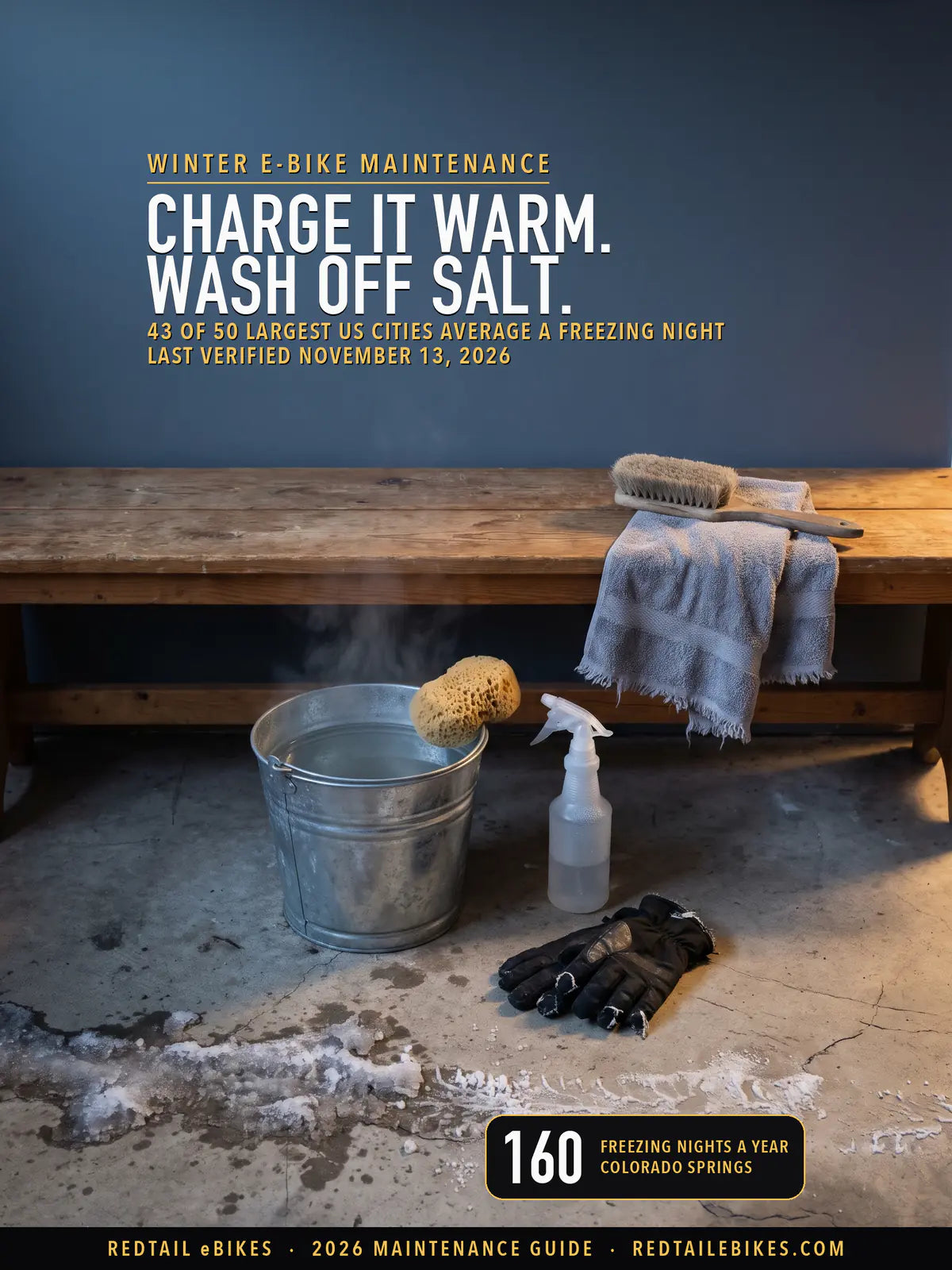

Of the ten jobs, two guard against damage that does not come back: charge the battery at 32 °F or warmer, and rinse road salt off after a salted ride. The cover is a still life of a winter wash-down generated on Playcut; no bicycle appears in it.
Quick Answer
Winter e-bike maintenance is mostly battery care and salt control. Charge only at 32 °F or warmer, ideally at room temperature, and store the battery indoors at the charge your bike's manual names, checking it monthly. Rinse road salt off gently, dry the bike, re-lube the chain and set tire pressure for the outdoor temperature.
The cold costs range while the pack is cold. One measured lithium-ion cell gave 89% of its room-temperature energy near 32 °F on a gentle draw and 84% on a hard one (McMaster University data), and VTUVIA and Velotric call that loss temporary. Charging a frozen pack is the step that can do lasting harm (Eahora).
Need a charger, tube or brake pads before the snow? Our parts shelf carries parts from the makers we sell, and our accessories include covers, pumps and lights.
Shop e-bike partsIn this guide
- How we verified this guide
- Why winter e-bike maintenance matters more
- Your city's winter, measured
- How does cold weather affect an e-bike battery?
- How much range do e-bikes lose in cold weather?
- Charging an e-bike battery in the cold
- How do you store an e-bike battery for winter?
- How do you store an e-bike for winter?
- Road salt: what it does and how to wash it off
- Cleaning and lubricating the chain for winter riding
- Which tire pressures are best for winter e-biking?
- Brakes and cables in winter
- Water, condensation and the electronics
- Ebike battery not charging after winter: what to check
- Where winter riders get caught out
- The winter e-bike maintenance checklist
- Winter parts, covers and the bike itself
- Why buy it here
- Frequently asked questions
- The bottom line
How we verified this guide
Written and verified by Milad Ghobadibeygvand, BScN (Western University, 2014), Redtail eBikes. Last verified: November 13, 2026. Corrections: support@redtailebikes.com.
The rules here come from documents read on November 12 and 13, 2026: the winter and storage guidance of six e-bike makers we carry, two fire departments, the CPSC, the Federal Highway Administration, the U.S. Geological Survey, the federal brake-fluid standard, NASA's and the National Weather Service's physics formulas, and three peer-reviewed or registered datasets and papers; the source register lists every one.
The four tables of numbers are ours, computed from public data: winter nights for the 50 largest US cities from NOAA's 1991–2020 normals, one battery cell's energy at six temperatures from McMaster University's raw test files, and tire pressure and condensation from federal formulas. The questions are the ones people ask, harvested from search suggestions, forum thread titles, our Search Console data, competitor headings and an AI-engine panel; the full method and counts are below.
Why winter e-bike maintenance matters more
Your first freezing night changes three things at once: the battery holds less while it is cold, road salt starts landing on the frame and chain, and warm-room charging becomes a decision rather than a habit. Getting it wrong costs a battery's lasting capacity, because charging a frozen pack can plate lithium on its anode, or a drivetrain, because chlorides corrode metal. The decision is which ten small jobs keep the bike whole until spring.
Winter reaches most riders. The Federal Highway Administration says "over 70 percent of the nation's roads are located in snowy regions," defined as places averaging more than five inches of snow a year, and that "nearly 70 percent of the U.S. population lives in these snowy regions."
Those roads get salted. Highway deicing took "about 41% of total salt consumed" in the United States, according to the U.S. Geological Survey's 2025 salt summary, and state and local agencies spend "more than 2.3 billion dollars on snow and ice control operations annually" (FHWA).
Velotric's six winter checks run from the battery and its charging temperature to the tires, brakes, chain, steering and lights: a pedal bike's winter jobs, plus the battery and the electronics. Four stresses do the damage: cold on the lithium-ion cells (measured below), salt on metal (the salt section), warm-and-cold swings that put water on cold parts (condensation), and cold on tire air and brake fluid (tires, brakes). The sections below take them in turn.
The battery is the priority. Cold lowers its output for the moment; charging it while it is frozen is what can shorten its life. Salt is the second job.
Your city's winter, measured
In 43 of the 50 largest US cities, the nearest major weather station averages at least one night a year at or below 32 °F in NOAA's 1991–2020 normals, and the median city sees 44 such nights. Nine average 100 or more freezing nights a year, led by Colorado Springs at 160 and Denver at 156.
Seven average fewer than one: Tampa (0.8), Mesa (0.6), San Diego (0.2), Long Beach (0.1), and Los Angeles, San Francisco and Miami at 0.0.
Those 43 cities hold 84% of the 51.1 million people who live in the 50 largest, by the Census Bureau's 2024 estimates. The counts come from NOAA's 1991–2020 U.S. Climate Normals, the 30-year averages NOAA's National Centers for Environmental Information computes for weather stations with enough record (station files), matched to each city by the method below the table.
A freezing night matters for one reason: 32 °F is the charging floor that Eahora and the Seattle Fire Department set and Himiway's manual recommends, so a battery kept in an unheated garage on such a night comes indoors before you plug it in. On a day that stays below freezing, check the garage's temperature before you charge there.

Each bar is one city's average count of nights at or below 32 °F in NOAA's 1991–2020 normals at its nearest first-order weather station; the table below adds the colder thresholds and names each station.
| City (2024 rank) | Nights at or below 32 °F | At or below 20 °F | At or below 0 °F | Days that stay below freezing | Average winter low | NOAA station |
|---|---|---|---|---|---|---|
| Colorado Springs, Colorado (40) | 160 | 68 | 4.1 | 21 | 19 °F | Colorado Springs MUNI AP (CO) |
| Denver, Colorado (19) | 156 | 62 | 5.0 | 21 | 18 °F | Denver-Stapleton (CO) |
| Minneapolis, Minnesota (46) | 147 | 82 | 22 | 72 | 12 °F | Minneapolis/St Paul AP (MN) |
| Omaha, Nebraska (41) | 131 | 58 | 9.7 | 44 | 18 °F | Omaha #1 (NE) |
| Milwaukee, Wisconsin (31) | 123 | 52 | 6.6 | 50 | 20 °F | Milwaukee Mitchell AP (WI) |
| Detroit, Michigan (26) | 113 | 41 | 1.7 | 41 | 22 °F | Detroit City AP (MI) |
| Chicago, Illinois (3) | 106 | 41 | 4.3 | 39 | 22 °F | Chicago Midway AP (IL) |
| Indianapolis, Indiana (16) | 106 | 37 | 3.3 | 29 | 24 °F | Indianapolis (IN) |
| Columbus, Ohio (15) | 103 | 34 | 2.3 | 28 | 25 °F | Columbus Port Columbus INTL AP (OH) |
| Kansas City, Missouri (38) | 93 | 31 | 1.4 | 22 | 25 °F | Kansas City Downtown AP (MO) |
| Albuquerque, New Mexico (32) | 93 | 13 | 0.0 | 2.1 | 28 °F | Albuquerque INTL AP (NM) |
| Boston, Massachusetts (25) | 92 | 29 | 0.6 | 23 | 26 °F | Boston Logan INTL AP (MA) |
| Philadelphia, Pennsylvania (6) | 88 | 20 | 0.0 | 13 | 29 °F | Philadelphia Ne AP (PA) |
| Louisville, Kentucky (27) | 80 | 20 | 0.4 | 15 | 29 °F | Louisville Bowman FLD (KY) |
| Oklahoma City, Oklahoma (20) | 72 | 15 | 0.1 | 7.2 | 29 °F | Oklahoma City Will Rogers AP (OK) |
| Tulsa, Oklahoma (48) | 72 | 16 | 0.2 | 7.6 | 30 °F | Tulsa INTL AP (OK) |
| New York, New York (1) | 67 | 17 | 0.1 | 16 | 30 °F | New York CNTRL PK TWR (NY) |
| Nashville, Tennessee (21) | 66 | 14 | 0.1 | 6.2 | 32 °F | Nashville INTL AP (TN) |
| Raleigh, North Carolina (39) | 65 | 7.6 | 0.0 | 2.4 | 34 °F | Raleigh Durham INTL AP (NC) |
| Washington, DC (22) | 60 | 9.9 | 0.0 | 7.4 | 32 °F | Washington Reagan AP (VA) |
| Charlotte, North Carolina (14) | 58 | 7.2 | 0.0 | 1.1 | 34 °F | Charlotte Douglas AP (NC) |
| Atlanta, Georgia (36) | 52 | 4.3 | 0.0 | 1.0 | 35 °F | Atlanta Fulton CO AP (GA) |
| Baltimore, Maryland (30) | 52 | 8.8 | 0.0 | 9.1 | 32 °F | Md Sci Ctr Baltimore (MD) |
| Virginia Beach, Virginia (43) | 50 | 4.6 | 0.0 | 2.3 | 33 °F | Oceana Nas (VA) |
| Memphis, Tennessee (29) | 44 | 5.9 | 0.0 | 3.7 | 35 °F | Memphis INTL AP (TN) |
| El Paso, Texas (23) | 42 | 2.0 | 0.0 | 0.2 | 36 °F | El Paso INTL AP (TX) |
| Arlington, Texas (50) | 36 | 2.6 | 0.0 | 1.3 | 39 °F | Arlington MUNI AP (TX) |
| Portland, Oregon (28) | 32 | 1.3 | 0.0 | 1.6 | 36 °F | Portland INTL AP (OR) |
| Fort Worth, Texas (11) | 30 | 3.1 | 0.0 | 1.6 | 39 °F | Ft Worth Meacham FLD Naaf (TX) |
| Seattle, Washington (18) | 25 | 0.8 | 0.0 | 0.8 | 37 °F | Seattle Sand Pt WSFO (WA) |
| Dallas, Texas (9) | 23 | 1.6 | 0.0 | 1.3 | 40 °F | Dallas Love FLD (TX) |
| San Antonio, Texas (7) | 14 | 0.4 | 0.0 | 0.2 | 43 °F | San Antonio INTL AP (TX) |
| Austin, Texas (13) | 12 | 0.3 | 0.0 | 0.5 | 44 °F | Austin-Camp Mabry (TX) |
| Tucson, Arizona (33) | 12 | 0.2 | 0.0 | 0.0 | 42 °F | Tucson INTL AP (AZ) |
| Fresno, California (34) | 11 | 0.0 | 0.0 | 0.0 | 41 °F | Fresno Yosemite INTL AP (CA) |
| Las Vegas, Nevada (24) | 11 | 0.0 | 0.0 | 0.0 | 40 °F | Las Vegas Air Terminal (NV) |
| Bakersfield, California (47) | 9.9 | 0.0 | 0.0 | 0.0 | 41 °F | Bakersfield AP (CA) |
| Houston, Texas (4) | 4.2 | 0.0 | 0.0 | 0.0 | 48 °F | Houston Hobby AP (TX) |
| Sacramento, California (35) | 4.0 | 0.0 | 0.0 | 0.0 | 42 °F | Sacramento 5 Ese (CA) |
| Jacksonville, Florida (10) | 3.7 | 0.0 | 0.0 | 0.0 | 49 °F | Jacksonville Nas (FL) |
| San Jose, California (12) | 3.2 | 0.0 | 0.0 | 0.0 | 43 °F | San Jose (CA) |
| Oakland, California (45) | 2.6 | 0.0 | 0.0 | 0.0 | 43 °F | Oakland Metro INTL AP (CA) |
| Phoenix, Arizona (5) | 2.6 | 0.0 | 0.0 | 0.0 | 44 °F | Phoenix Deer Valley MUNI AP (AZ) |
| Tampa, Florida (49) | 0.8 | 0.0 | 0.0 | 0.0 | 55 °F | Tampa INTL AP (FL) |
| Mesa, Arizona (37) | 0.6 | 0.0 | 0.0 | 0.0 | 47 °F | Phoenix Sky Harbor INTL AP (AZ) |
| San Diego, California (8) | 0.2 | 0.0 | 0.0 | 0.0 | 46 °F | San Diego Montgomery FLD (CA) |
| Long Beach, California (44) | 0.1 | 0.0 | 0.0 | 0.0 | 47 °F | Long Beach Daugherty FLD (CA) |
| Los Angeles, California (2) | 0.0 | 0.0 | 0.0 | 0.0 | 49 °F | Santa Monica MUNI AP (CA) |
| Miami, Florida (42) | 0.0 | 0.0 | 0.0 | 0.0 | 63 °F | Miami Beach (FL) |
| San Francisco, California (17) | 0.0 | 0.0 | 0.0 | 0.0 | 47 °F | San Francisco DWTN (CA) |
How this table was built: the 50 most populous incorporated places in the Census Bureau's Vintage 2024 estimates; each place's internal point from the Census 2024 Gazetteer; the nearest first-order NOAA station with all six figures, within 60 km, from NOAA's normals station inventory.
NOAA's readme for the normals files defines each count as the days "less than or equal to" its threshold. The figures describe outdoor air at an airport or city station, not the inside of a garage. Download the 50-city table as CSV or as JSON, and the cell-energy data as CSV or as JSON.
If your city sits near the top of the table, plan on the indoor-charging routine for the whole cold season. In the middle, a cold snap is the risk; in the seven cities at the bottom, the station averages less than one freezing night a year. Our city guides match bikes to every neighborhood of Chicago, Denver, Columbus and Indianapolis, four of the nine coldest cities in the table.
How does cold weather affect an e-bike battery?
An e-bike battery in winter delivers less energy, and the loss grows with how hard you ride. VTUVIA lists what happens as temperatures drop: voltage falls faster under load and internal resistance rises. In McMaster University's measurements of one 18650 cell at 15 to 17 °F, it gave 83% of its room-temperature energy on a gentle two-hour discharge and 68% on a hard half-hour one.
The data are one new LG HG2 cell tested in a thermal chamber at McMaster University by Dr. Phillip Kollmeyer, published on Mendeley Data (Naguib, 2020). We integrated the twelve discharges in the table from the raw cycler files ourselves, so its shares are our arithmetic on their measurements, each a share of the same cell's energy at about 75 °F.

Energy at each starting temperature as a share of the same cell's energy at about 75 °F, on a gentle (0.5C) and a hard (2C) discharge; one lab cell, not a whole pack, as the limitations explain.
| Cell temperature at the start (gentle / hard run) | Energy left, gentle draw (0.5C, about a 2-hour discharge) | Energy left, hard draw (2C, about a 30-minute discharge) |
|---|---|---|
| 101 °F / 101 °F | 98% | 99% |
| 75 °F / 76 °F | 100% | 100% |
| 49 °F / 49 °F | 93% | 91% |
| 31 °F / 33 °F | 89% | 84% |
| 15 °F / 17 °F | 83% | 68% |
| -2 °F / 0 °F | 67% | 45% |
"C" is a discharge rate: 0.5C would empty the cell in about two hours and 2C in about 30 minutes, and the room-temperature files ran 1.8 hours and 27 minutes.
As our own example of what that means on a bike, a 48 V battery delivering 500 W draws about 10.4 A (500 ÷ 48), which on a 15 Ah pack is about 0.7C, between the two columns. Climbing on full throttle draws more current, toward the right-hand column.
The loss is temporary. VTUVIA writes that "this performance loss is temporary and reversible when temperatures rise," and Velotric that cold "can temporarily reduce available output and riding range, which does not by itself establish permanent damage."
Makers publish the e-bike temperature range their packs are built for. Himiway's B3 manual gives a "safe operating and storage temperature" of 32 °F to 113 °F, and Eunorau writes that "the optimal operating temperature for a EUNORAU battery is 10℃ to 55℃," or 50 °F to 131 °F, adding that efficiency "can be severely limited outside of these temperatures." Check the figure in your own bike's manual; the window belongs to the pack.
Ride in a lower assist level when it is very cold. The McMaster data show why: near 0 °F the cell gave 67% of its energy on the gentle draw and 45% on the hard one, so the same battery carries you noticeably farther at a lower current.
Ride cold, charge warm, in VTUVIA's words. A cold pack is weaker for the moment; keep the assist modest in deep cold and let the battery warm indoors before it goes on the charger.
How much range do e-bikes lose in cold weather?
E-bike range in cold weather is shorter, and the loss grows as the temperature falls. Three effects stack: the cell gives less energy (11% less at 31 °F on a gentle draw), the air is denser, and tire pressure drops. Two makers we carry print 15% to 40% less range between 32 °F and 20 °F, and VTUVIA 50% or more below 0 °F.
The battery share comes from the table above. The air is our arithmetic from NASA's equation of state: at the same pressure, air at 32 °F is 9.2% denser than at 77 °F, at 20 °F 11.9% and at 0 °F 16.8%.
Aerodynamic drag rises in proportion to air density in NASA's drag equation, so the drag on you at a given speed rises by the same share. Tire pressure falls too, as the tire section computes, and fueleconomy.gov notes that the drop increases rolling resistance.
The makers' own estimates are wide. VTUVIA prints a 15–30% reduction at 32 °F, up to 40% at 20 °F and 50% or more below 0 °F, and Eunorau tells riders to "Plan for 20-40% less real-world range below 32°F." Use them as planning ranges from the people who build the packs.
A federal comparison points the same way. Fueleconomy.gov, run by the Department of Energy and the EPA, reports that an electric car's range is "about 12% lower" at 20 °F than at 75 °F when the cabin heater is off.
Fueleconomy.gov's wider 20 °F figure is a range drop of up to 41%, and "about two-thirds of the extra energy consumed" goes to heating the cabin. An e-bike has no cabin to heat, so its losses track the battery, the air and the tires.
To plan, take your usual summer range, multiply it by the share in the table nearest your temperature, then keep a reserve for the ride home; VTUVIA puts it as "Don’t run to 0% in freezing temperatures." If your winter commute needs every summer mile, a second battery or a dual-battery bike solves it.
Shopping for a bike that rides through winter? Our winter guide matches 14 picks to snow, ice and cold commutes.
See our 14 winter e-bike picksCharging an e-bike battery in the cold
Charge the battery only at 32 °F or warmer: bring it indoors and let it reach room temperature first. Eahora writes that charging below 32 °F "can cause permanent damage," and VTUVIA puts it as "Never charge below 32°F (0°C)."
Himiway's B3 manual gives two figures. It recommends charging between 32 °F and 104 °F, and its charger section sets the outer limit lower: "Do not allow the battery to be charged in environments under 14° Fahrenheit (-10° Celsius) and over 104° Fahrenheit (40° Celsius)." Every source we read that gives a charging range recommends 32 °F or warmer, and your own manual has the last word.
The reason is chemistry. Charging pushes lithium into the graphite anode, and a cold cell cannot take it in fast enough; the review by Das and Shrotriya (2024) defines lithium plating as "the accumulation of metallic lithium on the graphite anode surface during rapid charging or at low temperatures." It "significantly shortens the battery’s life," they write, and at its worst grows lithium dendrites that "may pass through the separator and lead to an internal short circuit."
The makers we carry put it in plain words. Eahora writes that "charging lithium-ion batteries below 32°F (0°C) can cause permanent damage" and suggests bringing the battery indoors before charging, "around 41°F (5°C) is ideal." VTUVIA writes "Never charge below 32°F (0°C)" and "Always bring the battery indoors and allow it to reach room temperature before charging."
The fire departments agree. The Seattle Fire Department says "Don’t charge them if it’s too cold (below 32°F or 0°C) or too hot (above 105°F or 40°C)," and Boise's brochure gives the same 32 °F and 105 °F limits.

Each bar is a charging range as its source states it in the documents cited above; an open end means the source gives a floor and no upper figure.
The CPSC adds two rules for any season: be present while charging, and use only the battery charger supplied or recommended by the maker. Our own terms of service put the first rule in writing for every bike we sell, "do not leave a charging battery unattended," and add that a damaged, swollen or wet battery is never charged.
Where you charge matters too. Boise's brochure names "garages, carports and apartment bike storage areas" as good charging spots, away from living spaces, and asks owners to keep e-bikes and batteries "away from exits." In winter that advice meets the 32 °F floor: charge in the garage or bike room while it is above freezing, and otherwise warm the pack indoors and charge it where you can watch it.
A federal rule for the batteries themselves is in progress. On June 24, 2026, the CPSC published a proposed safety standard for lithium-ion batteries used in micromobility products (91 FR 38162, docket CPSC-2025-0012), which "proposes that electrical systems using lithium-ion batteries in micromobility products comply with applicable voluntary standards, with modifications."
On October 5, 2026, the CPSC opened the record to oral comments. As of November 13, 2026, those are the docket's only two Federal Register documents, so the standard is still a proposal.
Give it time to warm through. Bring the pack in when you get home, let it sit until the case no longer feels cold, and charge it later that evening while you are awake and nearby, as the CPSC asks: "Never charge them while sleeping or when you are not at home."
Charge at room temperature, never below 32 °F, and only while you are home and awake. A cold garage is a place to park the bike, not to charge it.
How do you store an e-bike battery for winter?
To store an e-bike battery for winter, keep it indoors at a cool room temperature, part-charged at the level your bike's manual names, and check it every month. The six makers in the table below name different figures, from about 40% to full, so your own manual decides; none of them says to store it empty.
What six of the makers we carry tell their owners, in their own words:
| Maker | Storage charge it asks for | How often to check | Temperature it gives |
|---|---|---|---|
| Velotric | "roughly 40-70%" | "every month or two" | 50–68 °F ideal; keep it between 32 °F and 86 °F |
| Addmotor | "about 60 percent" | top up "if the charge drops below 30 percent" | indoors, cool and dry, away from heaters and freezing temperatures |
| Eunorau | "70%-80%" when stored more than 2 weeks | "Avoid running the battery completely flat" | "a cool, dry place" |
| Eahora | "about 75%" | "once a month," back to 75% | indoors, "around room temperature" |
| Himiway (B3 manual) | about 50 to 60% "of its capacity" for "extended periods"; "a full charge" in its battery maintenance section | "charge it once a month" | storage 32 °F to 113 °F |
| VTUVIA (2026 guide, tips) | "50–70% for long-term storage" | "every few weeks" | indoors, "a dry, insulated space" |
That spread is the e-bike battery winter storage question in one table, and the science explains it. Researchers who calendar-aged commercial cells for up to 13 years write that the rate of calendar degradation "depends on factors such as temperature and state of charge (SOC), with trends varying across cell types and chemistries" (Lam et al., 2025, Joule). No single figure fits every pack, so the maker's figure for yours is the one to use.
Where they agree matters more. Velotric writes that "leaving a lithium battery at 100% for months puts it under constant stress and speeds up aging," Addmotor to avoid "storing it fully charged or completely drained," and five of the six ask for a check or a top-up during the winter, because, as Velotric puts it, a pack "slowly loses charge over time."
Keep the charger unplugged between top-ups. Velotric explains that "continuous charging keeps the pack at a high state of charge," and the CPSC tells owners to "unplug the device when done." A dry indoor shelf, away from heaters and direct sun, is the place.
If your manual gives no storage charge, our reading of the makers above is a default of roughly half to three-quarters, never empty, checked monthly. For the chemistry behind each pack type, our e-bike battery types guide walks through seven chemistries, from the ones e-bikes have used to the ones still being readied.
Follow your own manual's storage charge, store it indoors, and look at it once a month. The one thing all six makers agree on is never to let it sit empty.
How do you store an e-bike for winter?
For e-bike winter storage, keep the bike clean, dry and indoors if you can, in a garage if you cannot, with the battery taken inside and the tires inflated. An unheated garage keeps snow and salt spray off the bike; it is the battery that should not stay there through freezing nights.
If you are working out how to store an e-bike in a garage, the battery is the part that comes indoors. Velotric warns that garages, sheds and balconies "can freeze overnight, warm up in the afternoon sun, and turn damp in between," and Addmotor that if a battery stays on the bike, the garage should hold "a stable temperature throughout the season."
Clean the bike before it sits. Addmotor notes that dirt "can trap moisture, which leads to long-term damage—especially in garages that are humid or unheated," and that "moisture around bolts, joints, and electrical connectors can lead to rust or short circuits." Wash salt off as the salt section describes, dry the bike, and lube the chain before storage.
Mind the tires. Addmotor warns that tires left flat for months "can lead to cracking or permanent flat spots," and Velotric suggests nudging a parked bike "forward every few weeks so the tires rest on a different part of the tread."
A stand or storage rack that lifts the wheels does the same job, if it is built for the bike. Himiway's manual warns against storing a bike "on a rack that is not designed for the size and weight of the bike," and says to remove the battery first "to reduce the weight and make lifting or loading easier."
Outside storage is the last choice. If the bike has to stay outdoors, take the battery inside, cover the bike, and keep it off bare ground; VTUVIA advises "a weatherproof cover to shield your e-bike from snow and rain" when outdoor storage is unavoidable. Dry the bike before you cover it: Eahora is blunt, "Never store your bike wet."
Road salt: what it does and how to wash it off
Rinse road salt off the same day with gentle water, never a pressure washer, then dry the bike and re-lube the chain. Rock salt is sodium chloride, the brines agencies add are chlorides too, and a report for Connecticut's transportation department notes that "all chlorides are corrosive to metals."
That report, Winter Highway Maintenance Operations: Connecticut by the Connecticut Academy of Science and Engineering (2015), names magnesium chloride and calcium chloride among the de-icers in use and lists, as a disadvantage of magnesium chloride, that it "Causes corrosion of metals including steel reinforcement in pavements and bridge structures." In our reading, the same chemistry acts on a chain, bolts and spokes, so slush off a salted road is the winter mixture to wash away first.
Wash gently. VTUVIA's routine is to wipe the frame, "Rinse gently (avoid pressure washers)", dry it completely and "Apply winter-rated chain lubricant", and its tips page adds: "Use a damp cloth and avoid spraying water directly on electronic components." Take the battery off first if it is removable, and keep water away from the display and the charging port.
Dry it where it will not refreeze. Eahora puts it in five words, "Never store your bike wet," and adds: "A quick, post-ride wipe can do wonders for rust prevention." Drying indoors also lets the chain and brakes shed water before the next frozen morning.
Wash the salt off after every salty ride. A gentle rinse, a dry towel and a drop of lube are the routine.
Cleaning and lubricating the chain for winter riding
After every wet or salty ride, wipe the chain clean, let it dry, and apply a winter-grade lubricant, then wipe off the excess. Freezing weather can "accelerate chain wear due to road salt," VTUVIA warns, and moisture left on a chain invites rust; the aim is a clean, lightly oiled chain with the excess wiped off, as Velotric's method below does.
VTUVIA advises a "winter-grade bike lubricant" on the chain, derailleur and other moving parts "to prevent rust and ensure smooth operation." Velotric gives the method: wipe the chain, "apply a suitable chain lubricant to the rollers, rotate the cranks to distribute it and wipe off excess," then shift through the gears on a short test.
Keep lube off the brakes. Velotric writes "Keep chain lubricant and protective sprays away from pads and rotors," and tells owners to replace pads "contaminated with oil." Lube with the bike upright and a rag behind the rotor.
For the full chain routine, wear limits and the right lubricant through the rest of the year, our electric bike maintenance guide covers it, along with the cost of a shop service if you would rather hand the job over.
Which tire pressures are best for winter e-biking?
Check tire pressure outdoors at riding temperature, or set it a little higher indoors, because air loses pressure as it cools. By our arithmetic from NASA's gas law, a fat tire set to 10 psi in a 68 °F room reads 7.8 psi at 20 °F, a 22% drop, while a 60 psi hybrid tire loses 11%.
The physics is the ideal-gas law, p = ρRT on NASA's page: with the air and the tire's volume fixed, absolute pressure falls in step with absolute temperature. A gauge reads pressure above the atmosphere's, taken as 2,116 pounds per square foot, NASA's figure for sea level (NASA Glenn), so low-pressure tires lose a larger share.
| Set indoors at 68 °F | Reads at 32 °F | Reads at 20 °F | Reads at 0 °F | Loss per 10 °F |
|---|---|---|---|---|
| 10 psi (fat tire, soft-snow setting) | 8.3 psi | 7.8 psi | 6.8 psi | 0.47 psi |
| 20 psi (fat tire, street setting) | 17.6 psi | 16.8 psi | 15.5 psi | 0.66 psi |
| 30 psi (2.4 in. commuter or all-terrain tire) | 27.0 psi | 25.9 psi | 24.2 psi | 0.85 psi |
| 45 psi (1.75-2.2 in. city tire) | 40.9 psi | 39.6 psi | 37.3 psi | 1.13 psi |
| 60 psi (narrow hybrid tire) | 54.9 psi | 53.2 psi | 50.4 psi | 1.42 psi |
By the same arithmetic, VTUVIA's rule of thumb, "approximately 1 PSI for every 10°F temperature drop," fits a tire set at about 38 psi; on a fat tire at 10 to 20 psi the drop per 10 °F is half to two-thirds of a psi, but it is a bigger share of the pressure you run.
VTUVIA suggests 30–35 psi for 1.75–2.2 in. tires and 18–25 psi for 4–5 in. fat tires in winter, depending on snow depth; stay inside the range printed on your tire's sidewall.
Lower pressure buys grip on snow, but not automatically. Velotric writes "Lowering pressure by 10–20% can improve grip on snow and loose ground, but do not do it automatically," and Eahora that a slight decrease "can increase the contact surface, reducing the chance of slipping."
On ice, studs do what pressure cannot. Eunorau writes "Studs are different. They bite ice, not powder," and Velotric that "compatible studded tires improve grip on ice" and "Fat tires alone do not guarantee ice traction." Our winter guide covers riding on studs.
Our fat-tire picks list bikes built for tires 4 inches and wider.
Brakes and cables in winter
Check brake pads more often in winter, keep oil and lube off the rotors, and squeeze each lever with the bike stopped to confirm a firm feel before a frozen ride. Velotric writes that "wet roads, grit and salt wear brake pads faster in winter, and stopping distances are already longer in the cold"; replace pads that are worn, chipped or contaminated.
Velotric lists the checks: "Replace pads that are chipped, missing material or contaminated with oil," and test lever feel: "With the ebike stationary, squeeze each lever separately. It should feel firm and give full braking."
Brake fluid thickens as it cools, and the federal standard for DOT fluid caps how thick it may get. 49 CFR 571.116 applies to "all fluid for use in hydraulic brake systems of motor vehicles," and its S5.1.3 allows DOT 3 no more than 1,500 mm²/s at −40 °F, DOT 4 1,800 and DOT 5 900.
A bicycle is not a motor vehicle, so treat those figures as a reference point; on hydraulic disc brakes, use only the fluid or mineral oil your brake maker names.
If a lever feels soft after a cold night, do not ride until the brake has been checked. Brake pads from seven of the brands we sell are on our parts shelf, and our store finder lists e-bike shops near you for service.
Water, condensation and the electronics
Even a bike rated for rain does not want water in its connectors, and winter adds a source of it: condensation. A cold bike carried into a warm room collects water on every surface colder than the room air's dewpoint, so let it warm and dry before you charge it or open the battery bay.
By our arithmetic from the National Weather Service's vapor-pressure and dewpoint formulas, air at 68 °F and 40% humidity has a dewpoint of 42.8 °F, so a frame or battery at 20 °F gathers water until it warms past about 43 °F. In a damp unheated garage at 35 °F and 85% humidity, the dewpoint is 31.0 °F.
| Where the bike comes in | Air temperature | Relative humidity | Dewpoint: metal colder than this collects water |
|---|---|---|---|
| Heated room | 68 °F | 30% | 35.5 °F |
| Heated room | 68 °F | 40% | 42.8 °F |
| Heated room | 68 °F | 50% | 48.7 °F |
| Heated room | 72 °F | 45% | 49.5 °F |
| Unheated garage | 40 °F | 70% | 31.0 °F |
| Unheated garage | 35 °F | 85% | 31.0 °F |
Makers draw the line in their own words. Eunorau writes that its "motor and electronic components are sealed," Himiway's manual that its bike "can be safely ridden in light rain" while exposure to water "can damage the electric elements," and Addmotor that moisture around "electrical connectors can lead to rust or short circuits." Wipe the bike down after a slushy ride and let the charging port dry before you plug in.
Is an e-bike waterproof? The makers' own answer is water resistant. Eunorau writes that its bikes "are water resistant which means they are able to resist the penetration of water to some degree but not entirely," Himiway's manual rates the B3 "IPX4" and says "please do not park your bike outdoors in cold or inclement weather for extended periods," and Velotric lists "IPX6-rated bikes and IPX7-rated batteries."
An IP rating tells you how well an enclosure keeps out dust and water. The ratings come from IEC 60529, the international standard that classifies the "Degrees of protection provided by enclosures (IP Code)" for electrical equipment. Read your bike's rating in its manual, and wash it the way the maker says rather than the way the rating might allow.
Ebike battery not charging after winter: what to check
If the battery will not charge in spring, check temperature, then charge level, then the connections. A pack below 32 °F should not be charged until it warms; a pack that sat empty can "slip into deep discharge," in which, Velotric warns, it "may no longer accept a charge at all"; and moisture at the connectors can cause rust or short circuits. Work through those three before calling for support.
Warm it first. The makers and fire departments above recommend charging at 32 °F or warmer (Seattle Fire Department), and a pack straight from a freezing garage is below it. VTUVIA puts the order plainly: "allow it to reach room temperature before charging."
Then think back to the charge. A stored pack loses charge slowly, which is why the makers above ask for top-ups: Addmotor asks for a top-up below 30%, and Eunorau to "avoid running the battery completely flat." A pack that sat empty for months is one for the maker's support; do not try another charger, since the CPSC asks owners to use "the charger provided with or recommended by the manufacturer."
Last, the connections: dry the charging port and the battery contacts and look for corrosion, which Addmotor ties to moisture at the connectors. If nothing works, stop and contact the maker or us. Boise's fire department warns that "DAMAGED OR DEFECTIVE BATTERIES CAN OVERHEAT, CATCH FIRE, OR EXPLODE," so a pack that is swollen, leaking or hot goes nowhere near a charger.
Leave battery repair to a professional. Boise's brochure says to "only have device repairs performed by a qualified professional," and its "signs of a problem" list puts "not keeping charge" beside odor, excessive heat, leaking, smoking, odd noises and a change in color or shape. Our e-bike store guide explains who will work on your bike and lists stores by state and city; before you take a battery to a repair shop, ask whether it services batteries.
If a battery shows those signs, Boise's brochure says to stop using it and, if it is not smoking and "appears safe to move," to separate it "from anything that can catch fire" and take it to a battery recycling location. If it is burning, "leave the area, close the door, and call 9-1-1."
Where winter riders get caught out
Six habits that seem sensible in winter work against the battery, the bike or your reading of it: charging in a cold garage, storing a pack full or empty, the pressure washer, charging the moment you walk in, reading a cold tire as a leak, and blaming the battery for a short ride.
- Charging in the garage. The bike lives there, so the charger does too; on a freezing night that puts a sub-32 °F pack on the charger, which Eahora says "can cause permanent damage."
- Storing the battery full by habit, or empty by neglect. All six makers in the storage table give a partial charge for storage, and Himiway's manual also gives a full one with a monthly charge. None asks for empty, and your own manual is the one that counts.
- The pressure washer. VTUVIA's winter routine says "Rinse gently (avoid pressure washers)", and its tips to "avoid spraying water directly on electronic components."
- Charging the moment you walk in. A pack carried in at 20 °F sits below a 68 °F room's dewpoint of about 43 °F, by our arithmetic from the National Weather Service's formula, and VTUVIA asks for room temperature before charging.
- Reading a cold tire as a slow leak. A fat tire set at 10 psi indoors reads 7.8 psi at 20 °F with no leak at all, by our arithmetic from NASA's gas law; reset it for the temperature you ride in.
- Blaming the battery for a short winter ride. Cold cells, denser air and softer tires all cost range at once, and VTUVIA calls the battery's share "temporary and reversible when temperatures rise."
The winter e-bike maintenance checklist
To maintain an e-bike through winter, work down these ten jobs in the order you meet them; each is sourced in its section above.
| # | Job | When | Why |
|---|---|---|---|
| 1 | Charge only at 32 °F or above, ideally at room temperature | every charge | plating risk below freezing (Das and Shrotriya; Seattle Fire) |
| 2 | Bring the battery in after a cold ride and let it warm and dry before charging | every cold ride | condensation and the cold cell (VTUVIA) |
| 3 | Use a lower assist level in deep cold and plan range from the cold table | every cold ride | a hard draw loses more energy (McMaster data) |
| 4 | Rinse salt off gently, no pressure washer, and dry the bike | after every salty ride | chlorides corrode metal (Connecticut report; VTUVIA) |
| 5 | Wipe and re-lube the chain with a winter-grade lubricant | after wet or salty rides | rust and wear (VTUVIA) |
| 6 | Set tire pressure for the outdoor temperature | weekly | cold air reads low (NASA; VTUVIA) |
| 7 | Check pads and lever feel; keep lube off rotors | before the first frozen ride, and whenever a lever feels soft | brakes in winter (Velotric) |
| 8 | Store the battery indoors at your manual's storage charge | if you park the bike for winter | the makers' figures (Velotric) |
| 9 | Check the stored battery's charge and top up per the manual | monthly | packs drain while they sit (Velotric; Eahora) |
| 10 | Store the bike clean, dry and off flat tires; recommission in spring | for storage | storage and spring (Addmotor) |
Print it or keep it on your phone; the sections linked in the last column hold each source.
Winter parts, covers and the bike itself
The parts that matter in winter are the ones you will reach for when something wears: a spare charger for the office, brake pads, tubes, and a cover for a bike that has to live outdoors. Buy the maker's own part for your model so the connector and fit are right.
Our e-bike parts shelf carries chargers, batteries, brake pads, tires and tubes for brands we sell, with brand pages such as Eahora parts, VTUVIA parts, Riding'times parts and Tesway parts. Our accessories include bike covers, pumps, fenders and lights.
VTUVIA suggests an insulated battery cover, which "can help protect the battery from cold temperatures during rides"; a cover adds no heat of its own, so fit it to a pack that starts the ride warm.
If you ride through the whole winter, a removable battery you can carry inside makes the battery jobs above easier. Our winter guide matches 14 picks to snow, ice and cold, and our fat-tire collection lists the fat-tire bikes we stock.
Riding through winter rather than storing the bike? Fat-tire e-bikes run the low pressures in the tire table, and our winter guide groups its 14 picks by the conditions you ride in, from a plowed-road commute to deep snow.
See fat-tire e-bikesWhy buy it here
If the bike itself is your winter project, it ships free within the contiguous United States and leaves us within 1 to 3 business days of confirmation (shipping policy). Should a winter delivery arrive damaged, our refund policy asks two things of you within 48 hours, a note with the carrier and photos by email, and leaves the carrier claim and the replacement or repair to us.
A battery or charger question this winter can start with us: our terms of service say "We will help facilitate warranty claims with the manufacturer," and our contact page says which address to write to, support with an order number or sales before you buy; at checkout, Apple Pay, Google Pay, Shop Pay and Klarna all work.
Ready to look? Our full e-bike collection, with our winter picks as the shortlist for snow and cold.
Browse every e-bike we sellFrequently asked questions
Can I store my e-bike in a cold garage?
Yes, if the battery comes indoors. Velotric warns that garages "can freeze overnight" and gives 50 to 68 °F as the ideal for a stored pack, so the bike can stay in the garage while the battery lives inside. Charge only once the pack is at room temperature.
Can I store my e-bike outside during winter?
Only if you must. Take the battery inside, rinse off salt, dry the frame, cover the bike and keep it off bare ground. VTUVIA advises "a weatherproof cover to shield your e-bike from snow and rain" when outdoor storage is unavoidable.
Should I store an e-bike battery fully charged?
Follow your manual. Five makers we carry ask for part-charged storage: Velotric about 40 to 70%, Addmotor about 60%, Eahora about 75%, Eunorau 70 to 80% and VTUVIA 50 to 70%. Himiway's B3 manual gives two figures: about 50 to 60% for extended periods, and a full charge, charged once a month, in its battery section. None asks for storage at empty.
How often should I check a stored e-bike battery?
Monthly. Eahora says once a month, Himiway's manual says charge it once a month, VTUVIA says every few weeks and Velotric every month or two. Top it back up to your manual's storage level; Addmotor sets its top-up point at 30%.
Should I charge my e-bike battery during winter storage?
Only to bring it back to its storage level, and only indoors at room temperature. A stored pack loses charge slowly, so makers we carry schedule a monthly or every-few-weeks check, and Velotric warns against leaving the charger plugged in all winter.
Can I charge my battery immediately after a winter ride?
Wait until it has warmed. VTUVIA says to "allow it to reach room temperature before charging," and Eahora that charging below 32 °F "can cause permanent damage." A pack carried in from the cold also collects condensation, so let it warm and dry first.
Does cold weather permanently damage an e-bike battery?
Riding in the cold does not, by the makers' own words: VTUVIA calls the loss "temporary and reversible when temperatures rise." The risk is charging it cold, which can plate lithium metal on the anode, and storing it empty.
How much range do e-bikes lose in cold weather?
It depends on the temperature and how hard you ride. One measured cell gave 89% of its room-temperature energy near 32 °F on a gentle draw and 68% near 17 °F on a hard one; VTUVIA and Eunorau print 15 to 40% less range between 32 °F and 20 °F.
Why is my e-bike battery not charging after winter?
Check three things: temperature, charge level and connections. A pack below 32 °F should not be charged until it warms (Seattle Fire); one stored empty for months is a case for the maker's support; and moisture at the connectors can cause rust or short circuits.
How do you winterize an e-bike?
To winterize an electric bike, clean and dry it, re-lube the chain, inflate the tires, and store the battery indoors at your manual's storage charge, checking it monthly (Addmotor). Store the bike dry and covered if it is outdoors, and check the brakes and tires before the first spring ride.
Should I cover my e-bike battery?
For riding, it can help: VTUVIA writes that insulated covers "can help protect the battery from cold temperatures during rides." A cover slows heat loss, so it works best on a pack that starts warm. For storage, the battery belongs indoors.
Are studded tires necessary for winter e-bike riding?
On ice, yes. Eunorau writes that studs "bite ice, not powder," and Velotric that "Fat tires alone do not guarantee ice traction." On snow, a lower pressure within the sidewall range can improve grip, though Velotric warns not to lower it automatically.
What PSI should tires run in winter?
Start from the sidewall range and check pressure outdoors. A tire set indoors reads lower outside: 10 psi at 68 °F reads 7.8 psi at 20 °F, by our arithmetic from NASA's gas law. VTUVIA suggests 30 to 35 psi for city tires and 18 to 25 psi for fat tires.
What should I do after finishing riding in winter?
Bring the battery inside, rinse off salt gently and dry the bike, wipe and re-lube the chain if it got wet, and let the pack warm before charging. Eahora adds that "A quick, post-ride wipe can do wonders for rust prevention."
Can you ride an e-bike in the winter?
Yes, with the right tires and a battery kept warm between rides. Range is shorter in the cold and ice calls for studded tires (Velotric); our winter guide matches 14 bikes to snow, ice and cold commutes.
What is the biggest mistake riders make when winterizing an e-bike?
Charging a cold battery, usually in the garage where the bike lives. The makers and fire departments we read that give a charging range recommend 32 °F or warmer (Seattle Fire); bring the battery inside and let it warm first.
Do I need to perform maintenance before storing an e-bike?
Yes: clean it, dry it, lube the chain, inflate the tires, and bring the battery inside at its storage charge. Addmotor notes that dirt "can trap moisture," and that tires left flat for months can crack or develop flat spots.
Where should I store my e-bike battery in winter?
Indoors, somewhere dry and at a cool room temperature, away from heaters and direct sun. That is also how to store an e-bike battery for winter if you ride only now and then. Velotric gives 50 to 68 °F as ideal; Himiway's manual sets storage between 32 °F and 113 °F.
The bottom line
Winter e-bike maintenance is ten small jobs, and two of them guard against damage that does not come back: charge it warm, since Eahora writes that charging below 32 °F "can cause permanent damage," and wash off salt, since Connecticut's report notes that "all chlorides are corrosive to metals." The rest is the storage charge, a monthly check, the chain, the tires and the brakes.
If you keep riding, the cold will shorten your range while the pack is cold, more on a hard draw than a gentle one (McMaster data), and VTUVIA calls that loss temporary. If you park the bike, store the battery indoors at your manual's charge and look at it monthly; in spring, warm it before the first charge.
If you are deciding whether to ride through winter on a new bike, our 14 winter picks are the place to start, and our parts shelf carries spares from the makers we sell. Questions about your battery go to support@redtailebikes.com.
Decided to ride through the cold? Our winter guide has the bikes, and the maintenance guide has the routine for the rest of the year.
Compare the winter picksHow we verified this guide, in detail
The questions. 9,361 questions and search phrasings harvested from 6 kinds of source (AI engines, search autocomplete, competitor headings, forums, our Google Search Console data, the editor's request); 890 are answered on this page. The rest belong to other guides, such as which bike to buy for snow, or to other senses of the words, such as a bike store. Counted once each, 9,122 phrasings are distinct and 860 of them are answered.
The AI panel. Fifteen questions ran on Google's Gemini and on Claude Code's web search on November 12, 2026, and redtailebikes.com was cited in none of the 30 answers; ChatGPT, Perplexity, Google AI Mode, Copilot Search and Brave showed verification pages and are not counted.
The sources. 56 documents were requested and 39 were read in full; the 17 that could not be read are named in the limitations below. The sources below were retrieved on November 12 and 13, 2026 (UTC), each on the date the register gives. Statements from makers are quoted as theirs, and each one we carry is named as such.
The numbers we computed. The city table matches the Census Bureau's 50 most populous incorporated places to the nearest first-order NOAA station with complete 1991–2020 normals. The cold-energy table integrates McMaster University's raw discharge files for one LG HG2 cell at six temperatures and two rates.
The tire, air-density and dewpoint figures apply NASA's equation of state and the National Weather Service's vapor-pressure formulas. Each is our arithmetic, labelled where it appears.
The source register
The register grades this guide's sources by tier (T1 primary official, T2 a maker or the store speaking about itself, T3 a scholarly or standards body) and lists the claim a source supports and the date we read it.
| Source | Tier | What it supports | Accessed |
|---|---|---|---|
| LG 18650HG2 Li-ion Battery Data, Naguib, Mina (Mendeley Data); tests by Phillip Kollmeyer, McMaster University | T3 | one cell's energy at six temperatures and two discharge rates (our integration) | November 12, 2026 |
| Winter Electric Bike Maintenance Guide (2026): Battery Care, Tire Pressure & Cold Weather Riding Tips, VTUVIA | T2 | never charge below 32 °F; storage at 50-70%, indoors; cold loss temporary; range figures; winter tire pressures; no pressure washer | November 12, 2026 |
| How to Store Your Electric Bike and Battery This Winter, Velotric | T2 | storage at roughly 40-70%; an empty pack can slip into deep discharge; packs slowly lose charge; 50-68 °F ideal, 32-86 °F limits; check every month or two; IPX6 bikes and IPX7 batteries; cold loss temporary | November 12, 2026 |
| 6 Ebike Winter Maintenance Tips, Eahora | T2 | storage at about 75%, checked monthly; never charge below 32 °F; warm to about 41 °F; studded tires; never store wet | November 12, 2026 |
| Electrochemical Mechanism Underlying Lithium Plating in Batteries: Non-Invasive Detection and Mitigation, Das, Sourav and Shrotriya, Pranav | T3 | what lithium plating is and why it shortens battery life | November 12, 2026 |
| Winter Highway Maintenance Operations: Connecticut, Connecticut Academy of Science and Engineering, for the Connecticut Department of Transportation | T3 | all chlorides are corrosive to metals; magnesium chloride corrosion | November 12, 2026 |
| Snow and Ice, Federal Highway Administration, Road Weather Management Program | T1 | over 70% of roads and nearly 70% of people in snowy regions; $2.3 billion a year on snow and ice control | November 12, 2026 |
| Mineral Commodity Summaries 2025: Salt, U.S. Geological Survey | T1 | highway deicing about 41% of salt consumed | November 12, 2026 |
| How to Prepare Your Electric Bike for Winter: 6 Checks, Velotric | T2 | brake pad and lever checks; chain lubrication method; pressure 10-20% lower on snow; studded tires on ice | November 12, 2026 |
| 1991-2020 U.S. Climate Normals, annual/seasonal station files, NOAA National Centers for Environmental Information | T1 | the 50-city cold-night counts (our compilation) | November 12, 2026 |
| City and Town Population Totals: 2020-2024 (sub-est2024), U.S. Census Bureau | T1 | the 50 most populous incorporated places | November 12, 2026 |
| U.S. Climate Normals, NOAA National Centers for Environmental Information | T1 | what the 1991-2020 normals are; generated every 10 years | November 12, 2026 |
| Fire safety tips for e-bikes and e-scooters, Seattle Fire Department | T1 | do not charge below 32 °F or above 105 °F | November 12, 2026 |
| B3 Guide & Manual, Himiway | T2 | recommended charging 32-104 °F, outer charging limit 14 °F; operating and storage 32-113 °F; about 50-60% for extended periods, or a full charge charged monthly; racks built for the bike, battery removed; IPX4; water exposure | November 12, 2026 |
| 2024 Gazetteer Files: Places, U.S. Census Bureau | T1 | each city's internal point | November 12, 2026 |
| Normals station inventory (inventory_30yr.txt), NOAA National Centers for Environmental Information | T1 | station coordinates for the city match | November 12, 2026 |
| Readme for the by-variable and by-station normals files (1991-2020), NOAA National Centers for Environmental Information | T1 | each count is the days less than or equal to the threshold; what the completeness flags mean | November 13, 2026 |
| EUNORAU EBIKES FAQ, EUNORAU | T2 | storage at 70-80% beyond two weeks; battery optimal 10-55 °C; components sealed; water resistant, not entirely | November 12, 2026 |
| Equation of State, NASA Glenn Research Center | T1 | the ideal-gas law behind the tire and air-density arithmetic | November 12, 2026 |
| Drag Equation (Beginner's Guide to Aeronautics), NASA Glenn Research Center | T1 | drag in proportion to air density | November 12, 2026 |
| Fuel Economy in Cold Weather, U.S. Department of Energy and U.S. Environmental Protection Agency (fueleconomy.gov) | T1 | EV range about 12% lower at 20 °F with no heater; up to 41% lower overall, two-thirds of the extra energy heating the cabin; colder tires raise rolling resistance | November 12, 2026 |
| Fat Tire Ebikes in Snow: What They Can and Cannot Handle, EUNORAU | T2 | plan for 20-40% less range below 32 °F; studs bite ice | November 12, 2026 |
| E-bike and e-scooter safety tips (brochure), Boise Fire Department (City of Boise) | T1 | do not charge below 32 °F or above 105 °F; garages, carports and apartment bike rooms as charging spots; away from exits; repairs by a qualified professional; signs of a problem, not keeping charge among them; damaged batteries can overheat; recycling and fire response | November 12, 2026 |
| Micromobility: E-Bikes, E-Scooters and Hoverboards, U.S. Consumer Product Safety Commission | T1 | be present while charging; the maker's charger; unplug when done | November 12, 2026 |
| Terms of Service, Redtail eBikes | T2 | battery-safety rule; we help facilitate warranty claims with the manufacturer | November 12, 2026 |
| Safety Standard for Lithium-Ion Batteries Used in Micromobility Products and Electrical Systems of Micromobility Products Containing Such Batteries, U.S. Consumer Product Safety Commission (Federal Register) | T1 | the proposed standard and its status | November 12, 2026 |
| Safety Standard for Lithium-Ion Batteries Used in Micromobility Products and Electrical Systems of Micromobility Products Containing Such Batteries, U.S. Consumer Product Safety Commission (Federal Register) | T1 | the oral-comment notice | November 12, 2026 |
| Federal Register documents in docket CPSC-2025-0012 (API search), Office of the Federal Register | T1 | the docket holds two Federal Register documents, both proposed-rule documents | November 13, 2026 |
| How to Prep Your Electric Bike for Long-Term Garage Storage, Addmotor | T2 | storage at about 60%, top up below 30%; moisture at connectors; flat tires crack | November 12, 2026 |
| Winter Maintenance Tips for Your Electric Bike, VTUVIA | T2 | charge every few weeks; insulated battery covers; damp cloth, no spray on electronics; winter-grade lubricant; weatherproof cover | November 12, 2026 |
| A decade of insights: Delving into calendar aging trends and implications, Lam, Vivek N.; Cui, Xiaofan; Stroebl, Florian; Uppaluri, Maitri; Onori, Simona; Chueh, William C. | T3 | calendar aging depends on temperature and state of charge, varying by cell type | November 12, 2026 |
| Earth Atmosphere Model - Imperial Units, NASA Glenn Research Center | T1 | sea-level pressure used in the tire arithmetic | November 12, 2026 |
| 49 CFR 571.116, Standard No. 116; Motor vehicle brake fluids, National Highway Traffic Safety Administration (Code of Federal Regulations, eCFR) | T1 | DOT 3, 4 and 5 viscosity limits at -40 °F; applies to motor vehicles | November 12, 2026 |
| Wet-bulb Temperature and Dewpoint Temperature from Air Temperature and Relative Humidity, National Weather Service, El Paso forecast office | T1 | the dewpoint formula behind the condensation table | November 12, 2026 |
| Vapor Pressure, National Weather Service, El Paso forecast office | T1 | the vapor-pressure formula behind the dewpoint table | November 12, 2026 |
| IEC 60529:1989+AMD1:1999+AMD2:2013 CSV, Degrees of protection provided by enclosures (IP Code), International Electrotechnical Commission | T3 | what an IP rating classifies | November 12, 2026 |
| Shipping policy, Redtail eBikes | T2 | free shipping within the contiguous United States; dispatch and transit windows; 48-hour damage report | November 12, 2026 |
| Refund policy, Redtail eBikes | T2 | we file the carrier claim and arrange a replacement or repair | November 12, 2026 |
| Contact, Redtail eBikes | T2 | how to reach us | November 12, 2026 |
Limitations
- Our interest. Redtail eBikes sells bikes and parts from Eahora, EUNORAU, Himiway, VTUVIA, Velotric and Addmotor, whose winter guidance is quoted here as theirs; we sell and do not make batteries.
- One cell. The cold-energy table is one new LG HG2 18650 cell, measured in a lab and tested in sequence, so its colder runs also carry the cell's ageing between tests. E-bike packs use other cells and their own battery electronics; treat the shares as the shape of the effect.
- Outdoor air at a station. NOAA's normals describe 1991–2020 outdoor air at the nearest complete first-order station, which is not always a city's official climate site: Denver's is the former Stapleton station, Los Angeles's is Santa Monica's airport, and San Francisco's Census point sits offshore because the city takes in the Farallon Islands. A garage's own temperature can differ from the station's air.
- Physics, not a tire test. The tire and dewpoint figures are ideal-gas and National Weather Service arithmetic; a real tire stretches and a gauge has its own error.
- The makers' range figures are their published planning estimates; this page reports them as written.
- Documents we could not read on November 12, 2026. Bosch eBike Systems' battery guide, eBike guide, winter article and weather help page and Shimano's battery manual answered with a verification page, Schwalbe's winter page refused the request, and the Internet Archive rate-limited our reads of its copies, so none of their figures appear here. Two journal copies (Keil et al., 2016, and Tomaszewska et al., 2019), a PubMed Central copy and the Federal Register's full text of the proposed rule were also unreadable; the proposed rule is quoted from its Federal Register record. Two U.S. Department of Transportation reports in the National Transportation Library's ROSA P repository refused the request, Schwalbe's tire-information page answered 404, not found, and an older NASA Glenn drag page returned too little text to read; NASA's current drag-equation page is the one cited.
- The question harvest. Bing's suggestion service returned nothing for all 18 test phrasings we sent it, and no Reddit thread was read: its own search feed refused our requests, and the two search indexes we tried could not list its threads. The forum questions are 54 thread titles from Bike Forums, Electric Bike Review's forum and Endless Sphere, as a search index listed them for 24 searches; the threads themselves were not opened. The rest come from Google, YouTube, DuckDuckGo and Amazon suggestions, competitor headings, our Search Console data and two AI engines.
- The brake-fluid standard is a motor-vehicle rule, quoted as a reference point; it does not govern bicycle brakes.
When to re-check this page. If the CPSC finalizes the proposed lithium-ion battery standard in docket CPSC-2025-0012 (proposed June 24, 2026); when NOAA publishes its next official normals, which NCEI generates every 10 years; and by May 12, 2027, six months after this verification, when the makers' guidance pages are read again.
Image credit: the cover is a still life generated with Nano Banana Pro on Playcut (playcut.ai), with the type set over it in real fonts; the three charts are drawn from the data and quotations this guide cites.
References
The full bibliographic record for the sources above: author or publisher, title, the section used, the date issued, the date we read it, and an archived copy, or our deposit where no public capture carries the version we read.
- Naguib, Mina (Mendeley Data); tests by Phillip Kollmeyer, McMaster University, LG 18650HG2 Li-ion Battery Data, Version 2; raw cycler files 549, 555, 575, 585, 593 and 607 (Dis_0p5C, Dis_2C). Issued: 2020. Accessed: November 12, 2026. https://doi.org/10.17632/b5mj79w5w9.2 Archive: no public capture was found; a deposit copy is held by Redtail eBikes.
- VTUVIA, Winter Electric Bike Maintenance Guide (2026): Battery Care, Tire Pressure & Cold Weather Riding Tips, How Much Range Can You Lose?; 3 Essential Winter Battery Rules; Tire Pressure & Winter Traction; Drivetrain Protection; Winter Storage Guide. Issued: February 26, 2026. Accessed: November 12, 2026. https://vtuviaebike.com/blogs/news/winter-electric-bike-maintenance-guide-2026-battery-care-tire-pressure-cold-weather-riding-tips Archive: no public capture was found; a deposit copy is held by Redtail eBikes.
- Velotric, How to Store Your Electric Bike and Battery This Winter, 1. Remove the Battery and Store It Indoors; 2. Maintain the Recommended Storage Charge (Why Full and Empty Are Both Bad Ideas; Check In Every 1-2 Months); 3. Clean and Lubricate; FAQs. Issued: undated. Accessed: November 12, 2026. https://www.velotricbike.com/blogs/story-landing/how-to-store-your-electric-bike-battery-this-winter Archive: the newest public capture, September 17, 2025, is an earlier version that does not carry the text cited here; a deposit copy of the version we read is held by Redtail eBikes.
- Eahora, 6 Ebike Winter Maintenance Tips, Battery Care; Charging Tips; Tire Pressure; Cleaning and Storage. Issued: December 5, 2024. Accessed: November 12, 2026. https://www.eahoraebike.com/blogs/news/6-ebike-winter-maintenance-tips Archived: Internet Archive capture.
- Das, Sourav and Shrotriya, Pranav, Electrochemical Mechanism Underlying Lithium Plating in Batteries: Non-Invasive Detection and Mitigation, Energies 17(23):5930, Abstract. Issued: November 26, 2024. Accessed: November 12, 2026. https://doi.org/10.3390/en17235930 Archive: no public capture was found; a deposit copy is held by Redtail eBikes.
- Connecticut Academy of Science and Engineering, for the Connecticut Department of Transportation, Winter Highway Maintenance Operations: Connecticut, chemical deicer descriptions; pre-wetting recommendation. Issued: July 2015. Accessed: November 12, 2026. https://portal.ct.gov/-/media/deep/site_clean_up/road-salt/2015-case-study.pdf Archived: Internet Archive capture.
- Federal Highway Administration, Road Weather Management Program, Snow and Ice, Snow and Ice (opening paragraphs). Issued: undated. Accessed: November 12, 2026. https://ops.fhwa.dot.gov/weather/weather_events/snow_ice.htm Archived: Internet Archive capture.
- U.S. Geological Survey, Mineral Commodity Summaries 2025: Salt, Domestic Production and Use. Issued: January 2025. Accessed: November 12, 2026. https://pubs.usgs.gov/periodicals/mcs2025/mcs2025-salt.pdf Archived: Internet Archive capture.
- Velotric, How to Prepare Your Electric Bike for Winter: 6 Checks, 2. Inspect both tires; 3. brakes; 4. Clean the chain. Issued: undated. Accessed: November 12, 2026. https://www.velotricbike.com/blogs/story-landing/how-to-prepare-your-electric-bike-for-winter Archive: the newest public capture, July 17, 2026, is an earlier version that does not carry the text cited here; a deposit copy of the version we read is held by Redtail eBikes.
- NOAA National Centers for Environmental Information, 1991-2020 U.S. Climate Normals, annual/seasonal station files, ANN-TMIN-AVGNDS-LSTH032, -LSTH020, -LSTH000; ANN-TMAX-AVGNDS-LSTH032; DJF-TMIN-NORMAL. Issued: 2021. Accessed: November 12, 2026. https://www.ncei.noaa.gov/data/normals-annualseasonal/1991-2020/access/ Archived: Internet Archive capture.
- U.S. Census Bureau, City and Town Population Totals: 2020-2024 (sub-est2024), SUMLEV 162, POPESTIMATE2024. Issued: 2025. Accessed: November 12, 2026. https://www2.census.gov/programs-surveys/popest/datasets/2020-2024/cities/totals/sub-est2024.csv Archived: Internet Archive capture.
- NOAA National Centers for Environmental Information, U.S. Climate Normals, product overview. Issued: February 25, 2021. Accessed: November 12, 2026. https://www.ncei.noaa.gov/products/land-based-station/us-climate-normals Archived: Internet Archive capture.
- Seattle Fire Department, Fire safety tips for e-bikes and e-scooters, charging tips. Issued: April 4, 2024. Accessed: November 12, 2026. https://fireline.seattle.gov/2024/04/04/fire-safety-tips-for-e-bikes-and-e-scooters/ Archived: Internet Archive capture.
- Himiway, B3 Guide & Manual, Charging, Usage, and Storage Guidelines; Battery Maintenance; charger care information; Moving and Storage Instructions; Water Exposure. Issued: undated. Accessed: November 12, 2026. https://cdn.shopify.com/s/files/1/0255/9528/1483/files/B3.pdf?v=1721617239 Archive: no public capture was found; a deposit copy is held by Redtail eBikes.
- U.S. Census Bureau, 2024 Gazetteer Files: Places, INTPTLAT, INTPTLONG. Issued: 2024. Accessed: November 12, 2026. https://www2.census.gov/geo/docs/maps-data/data/gazetteer/2024_Gazetteer/2024_Gaz_place_national.zip Archived: Internet Archive capture.
- NOAA National Centers for Environmental Information, Normals station inventory (inventory_30yr.txt), first-order (USW) stations. Issued: 2021. Accessed: November 12, 2026. https://www.ncei.noaa.gov/data/normals-annualseasonal/1991-2020/doc/inventory_30yr.txt Archived: Internet Archive capture.
- NOAA National Centers for Environmental Information, Readme for the by-variable and by-station normals files (1991-2020), Variable name definitions (GRTHnnn and LSTHnnn); Completeness flags. Issued: April 24, 2021. Accessed: November 13, 2026. https://www.ncei.noaa.gov/data/normals-annualseasonal/1991-2020/doc/Readme_By-Variable_By-Station_Normals_Files.txt Archived: Internet Archive capture.
- EUNORAU, EUNORAU EBIKES FAQ, BATTERY questions; Can the bike get wet?; Are the bikes waterproof? Issued: undated. Accessed: November 12, 2026. https://eunorau-ebike.com/pages/faqs Archived: Internet Archive capture.
- NASA Glenn Research Center, Equation of State, p = r * R * T. Issued: undated. Accessed: November 12, 2026. https://www.grc.nasa.gov/www/k-12/airplane/eqstat.html Archived: Internet Archive capture.
- NASA Glenn Research Center, Drag Equation (Beginner's Guide to Aeronautics), D = Cd * rho * V^2 * A / 2. Issued: undated. Accessed: November 12, 2026. https://www1.grc.nasa.gov/beginners-guide-to-aeronautics/drag-equation/ Archived: Internet Archive capture.
- U.S. Department of Energy and U.S. Environmental Protection Agency (fueleconomy.gov), Fuel Economy in Cold Weather, electric vehicles in cold weather. Issued: undated. Accessed: November 12, 2026. https://www.fueleconomy.gov/feg/coldweather.shtml Archived: Internet Archive capture.
- EUNORAU, Fat Tire Ebikes in Snow: What They Can and Cannot Handle, Fat Tire Ebike Snow Battery Range In Cold; studded tires. Issued: June 11, 2026. Accessed: November 12, 2026. https://eunorau-ebike.com/blogs/news/fat-tire-ebikes-in-snow-what-they-can-and-cannot-handle Archive: no public capture was found; a deposit copy is held by Redtail eBikes.
- Boise Fire Department (City of Boise), E-bike and e-scooter safety tips (brochure), Safety tips; Signs of a problem; charging location; fire response. Issued: 2023. Accessed: November 12, 2026. https://www.cityofboise.org/media/19805/fire-ebikescooter-brochure-trifold.pdf Archived: Internet Archive capture.
- U.S. Consumer Product Safety Commission, Micromobility: E-Bikes, E-Scooters and Hoverboards, charging safety. Issued: undated. Accessed: November 12, 2026. https://www.cpsc.gov/Safety-Education/Safety-Education-Centers/Micromobility-Information-Center Archived: Internet Archive capture.
- Redtail eBikes, Terms of Service, Battery safety; Warranty. Issued: August 26, 2026. Accessed: November 12, 2026. https://redtailebikes.com/policies/terms-of-service Archived: Internet Archive capture.
- U.S. Consumer Product Safety Commission (Federal Register), Safety Standard for Lithium-Ion Batteries Used in Micromobility Products and Electrical Systems of Micromobility Products Containing Such Batteries, 91 FR 38162, docket CPSC-2025-0012, notice of proposed rulemaking. Issued: June 24, 2026. Accessed: November 12, 2026. https://www.federalregister.gov/documents/2026/06/24/2026-12749/safety-standard-for-lithium-ion-batteries-used-in-micromobility-products-and-electrical-systems-of Archived: Internet Archive capture.
- U.S. Consumer Product Safety Commission (Federal Register), Safety Standard for Lithium-Ion Batteries Used in Micromobility Products and Electrical Systems of Micromobility Products Containing Such Batteries, 91 FR 63208, announcement of opportunity for oral presentation of comments. Issued: October 5, 2026. Accessed: November 12, 2026. https://www.federalregister.gov/documents/2026/10/05/2026-20296/safety-standard-for-lithium-ion-batteries-used-in-micromobility-products-and-electrical-systems-of Archived: Internet Archive capture.
- Office of the Federal Register, Federal Register documents in docket CPSC-2025-0012 (API search), conditions[docket_id]=CPSC-2025-0012: count 2 (2026-12749, June 24, 2026; 2026-20296, October 5, 2026); control docket CPSC-2017-0044: count 7. Issued: current as read. Accessed: November 13, 2026. https://www.federalregister.gov/api/v1/documents.json?conditions%5Bdocket_id%5D=CPSC-2025-0012 Archive: no public capture was found; a deposit copy is held by Redtail eBikes.
- Addmotor, How to Prep Your Electric Bike for Long-Term Garage Storage, Clean Your Electric Bike; Charge and Store the Battery Properly; Maintain Tire Pressure. Issued: undated. Accessed: November 12, 2026. https://www.addmotor.com/blog/how-to-prep-your-electric-bike-for-long-term-garage-storage Archived: Internet Archive capture.
- VTUVIA, Winter Maintenance Tips for Your Electric Bike, 1. Battery Care; 2. Cleaning and Lubrication; 5. Storage. Issued: December 19, 2024. Accessed: November 12, 2026. https://vtuviaebike.com/blogs/news/winter-maintenance-tips-for-your-electric-bike Archived: Internet Archive capture.
- Lam, Vivek N.; Cui, Xiaofan; Stroebl, Florian; Uppaluri, Maitri; Onori, Simona; Chueh, William C., A decade of insights: Delving into calendar aging trends and implications, Joule 9(1):101796, Introduction. Issued: January 2025. Accessed: November 12, 2026. https://doi.org/10.1016/j.joule.2024.11.013 Archive: no public capture was found; a deposit copy is held by Redtail eBikes.
- NASA Glenn Research Center, Earth Atmosphere Model - Imperial Units, troposphere pressure formula (2116 lb/sq ft at sea level). Issued: undated. Accessed: November 12, 2026. https://www.grc.nasa.gov/www/k-12/airplane/atmos.html Archived: Internet Archive capture.
- National Highway Traffic Safety Administration (Code of Federal Regulations, eCFR), 49 CFR 571.116, Standard No. 116; Motor vehicle brake fluids, S3 Application; S5.1.3 Kinematic viscosities. Issued: current as read. Accessed: November 12, 2026. https://www.ecfr.gov/current/title-49/subtitle-B/chapter-V/part-571/subpart-B/section-571.116 Archived: Internet Archive capture.
- National Weather Service, El Paso forecast office, Wet-bulb Temperature and Dewpoint Temperature from Air Temperature and Relative Humidity, dewpoint formula. Issued: undated. Accessed: November 12, 2026. https://www.weather.gov/media/epz/wxcalc/wetBulbTdFromRh.pdf Archived: Internet Archive capture.
- National Weather Service, El Paso forecast office, Vapor Pressure, saturated and actual vapor pressure formula. Issued: undated. Accessed: November 12, 2026. https://www.weather.gov/media/epz/wxcalc/vaporPressure.pdf Archived: Internet Archive capture.
- International Electrotechnical Commission, IEC 60529:1989+AMD1:1999+AMD2:2013 CSV, Degrees of protection provided by enclosures (IP Code), publication abstract. Issued: 2013. Accessed: November 12, 2026. https://webstore.iec.ch/en/publication/2452 Archived: Internet Archive capture.
- Redtail eBikes, Shipping policy, Processing & delivery; damage claims. Issued: current as read. Accessed: November 12, 2026. https://redtailebikes.com/policies/shipping-policy Archived: Internet Archive capture.
- Redtail eBikes, Refund policy, Damaged in transit. Issued: current as read. Accessed: November 12, 2026. https://redtailebikes.com/policies/refund-policy Archived: Internet Archive capture.
- Redtail eBikes, Contact, contact details. Issued: current as read. Accessed: November 12, 2026. https://redtailebikes.com/pages/contact Archived: Internet Archive capture.

Share:
Fort Worth Bike Trails Map 2026: Where eBikes Can Ride
Best Electric Bikes for Mud: 12 Picks by Terrain